



Goddess cornrow updos sit at the meeting point of structure and softness. The cornrow base does the architectural work — clean parts, defined lines, controlled tension — while loose curls or soft waves spill from the updo to break up that precision with movement. The combination is what gives the style its name. There’s an undeniably regal quality when sharp braided geometry meets cascading texture pinned high on the crown.
Goddess updos work for almost every face shape and almost every occasion. Bridal, formal, casual, festival — the versatility is built into the format. The cornrow base can stay protective and minimal while the updo portion changes day to day, which means a single install can carry you through weeks of different looks.
The style has roots in West African braiding traditions where cornrows were paired with adornments — beads, gold, fabric, shells — to mark celebrations. The contemporary goddess updo borrows that same sensibility. The cornrow does the work; the updo carries the celebration.
What “Goddess” Actually Means in Braiding
The term gets thrown around loosely. In strict braiding terminology, “goddess” refers to a style that combines tight braided foundations with looser curly or wavy elements. Goddess locs add curls to the loc tips. Goddess braids leave wavy hair around the face. Goddess cornrow updos do both — sharp cornrows on the scalp, soft loose hair in the gathered updo.
The defining element is contrast. Pure cornrow updos read as architectural and severe. Pure curl updos read as bohemian and undone. Goddess updos sit between the two — controlled enough to feel intentional, soft enough to feel feminine.
Done well, the style works for everything from a court appearance to a music video. Done poorly, it looks like an unfinished cornrow install with random hair stuck on top. The difference comes down to the integration between the braided base and the loose hair.
Choosing Your Hair for the Updo Portion
The loose curly or wavy hair you’ll use for the updo portion makes or breaks the style. Three main options. Pre-curled bulk hair like Outre X-Pression Pre-Stretched Braiding Hair in curly finishing texture. Water wave bundles, similar to what you’d use for a sew-in. Drawstring ponytail pieces with the curl pattern you want.
I lean toward water wave bundles for goddess updos because the curl pattern stays defined longer. Pre-curled braiding hair tends to lose its curl by week 2. Drawstring pieces are the easiest install — just pin and go — but they look added-on if your braider doesn’t blend the base properly.
Match texture to your natural curl pattern when possible. A 3B curl pattern on top of 4C cornrows can read as obviously synthetic. A 4B curl pattern blends much more seamlessly.
Prep That Makes the Updo Hold All Day
Wash and deep condition 2 days before install — never the day of. Day-of washing leaves your hair too slick for the cornrow tension to hold properly.
Stretch your hair through African threading or chunky twists overnight. Stretched hair takes the cornrow pattern cleaner and reduces the visible bumps that fresh shrinkage can create.
Apply a light layer of edge gel along the hairline before the braider starts. Just a thin layer — enough to make the cornrows lay flat without making the hair too stiff to braid. Got2B Glued or Eco Styler Krystal both work.
Tools the Braider Needs for Goddess Updos
Standard cornrow tools — rat-tail comb, edge brush, duckbill clips, kanekalon for the cornrow base if extensions are added.
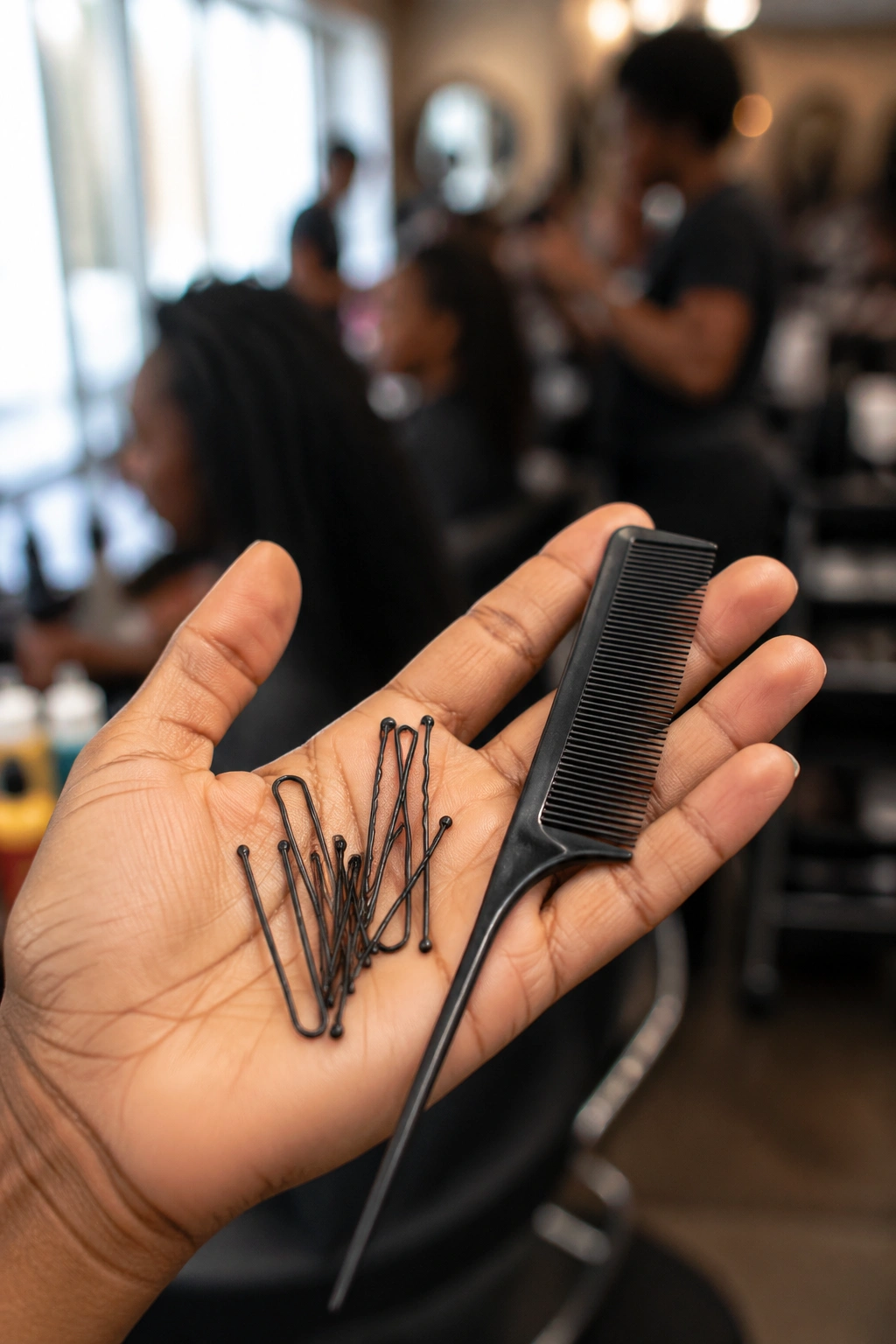
The updo portion needs additional tools. U-pins or French pins for securing the loose hair without flattening the curls. A fine-tooth comb for tucking. Hair spray with hold but not stiffness — Aussie Instant Freeze or Ouidad Climate Control Heat & Humidity Gel both work for textured hair updos.
A handheld mirror is essential. The back of an updo needs as much attention as the front, and you can’t see it without two mirrors angled together.
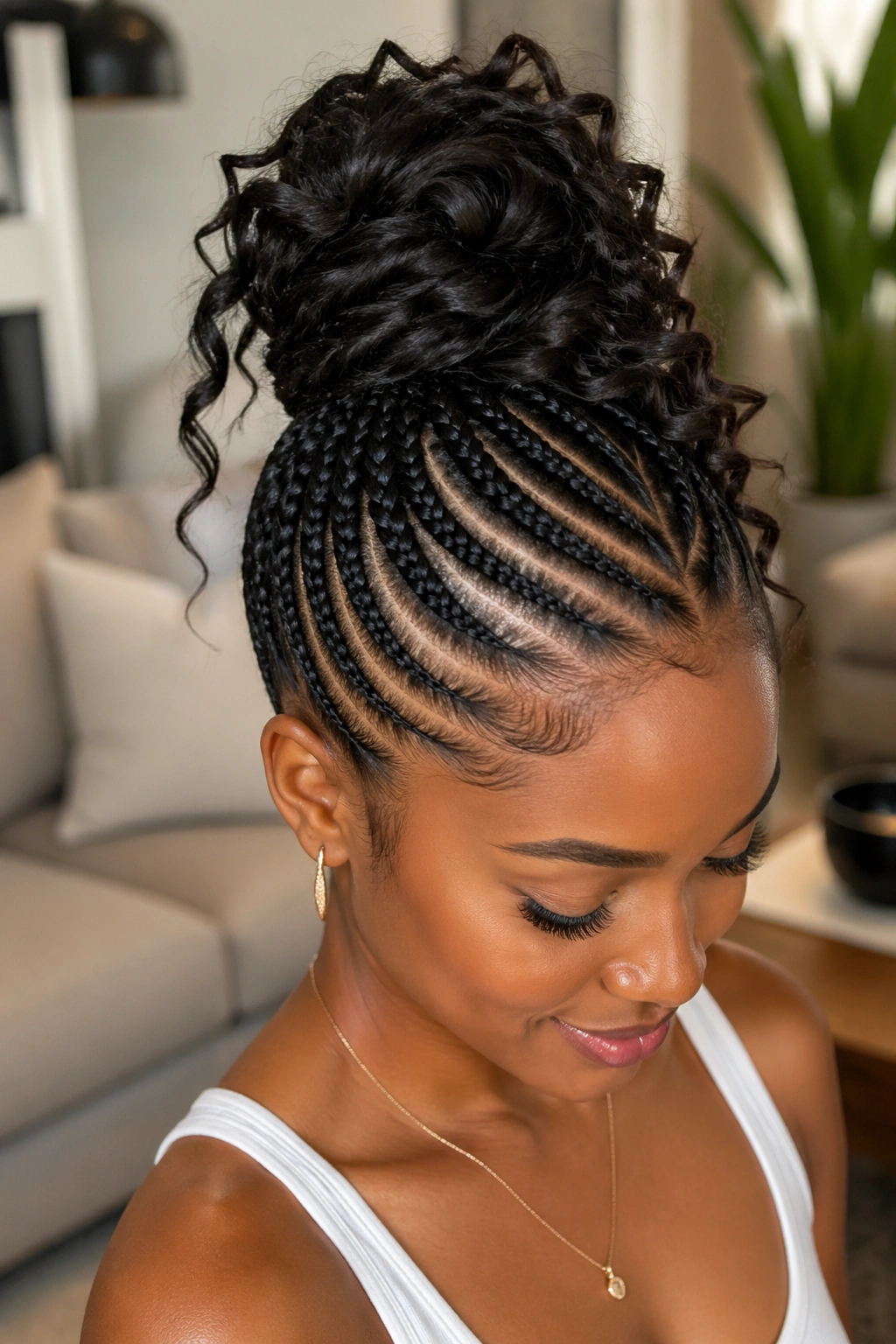
1. Crown Bun with Diagonal Cornrow Base
Cornrows angle diagonally from the hairline up toward a single high bun positioned at the crown. The bun is built from loose curly hair that cascades slightly over its own gathering point.
The diagonal cornrow lines create natural visual flow up to the focal point. From the front, the eye travels naturally up the diagonal lines to the bun. From the side, the silhouette reads tall and elegant.
- Best for: oval, heart, and long face shapes
- Cornrow count: 6 to 8 diagonal braids
- Bun size: tennis ball to softball, depending on your hair density
Tip: Pin the bun slightly off-center toward the back rather than directly on top of the head. Dead-center bun placement reads flat in photographs; slightly back placement gives you dimension from every angle.
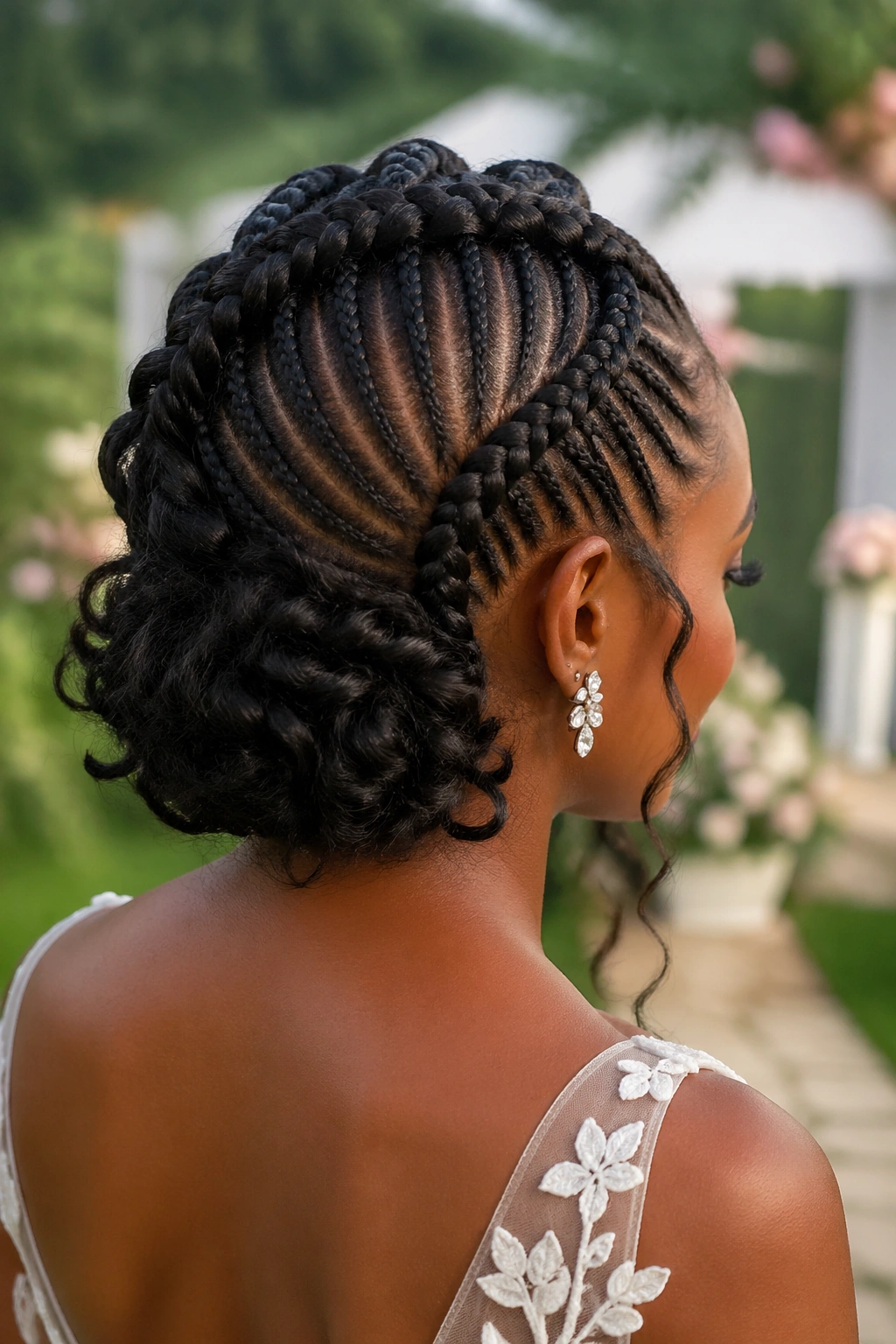
2. Halo Cornrows with Gathered Curl Wreath
A circular cornrow pattern wraps around the head like a halo, about 2 inches above the hairline. All braid ends gather into a soft pile of loose curls at the back, sitting like a wreath against the nape.
This is the goddess updo I recommend for outdoor weddings. The halo silhouette photographs beautifully against any background, and the loose curls move naturally with breeze without falling out of place.
The halo cornrow base is technically demanding. The braider has to maintain consistent spacing all the way around the head, which most stylists find harder than straight-back patterns. Budget 5 to 7 hours for full install.
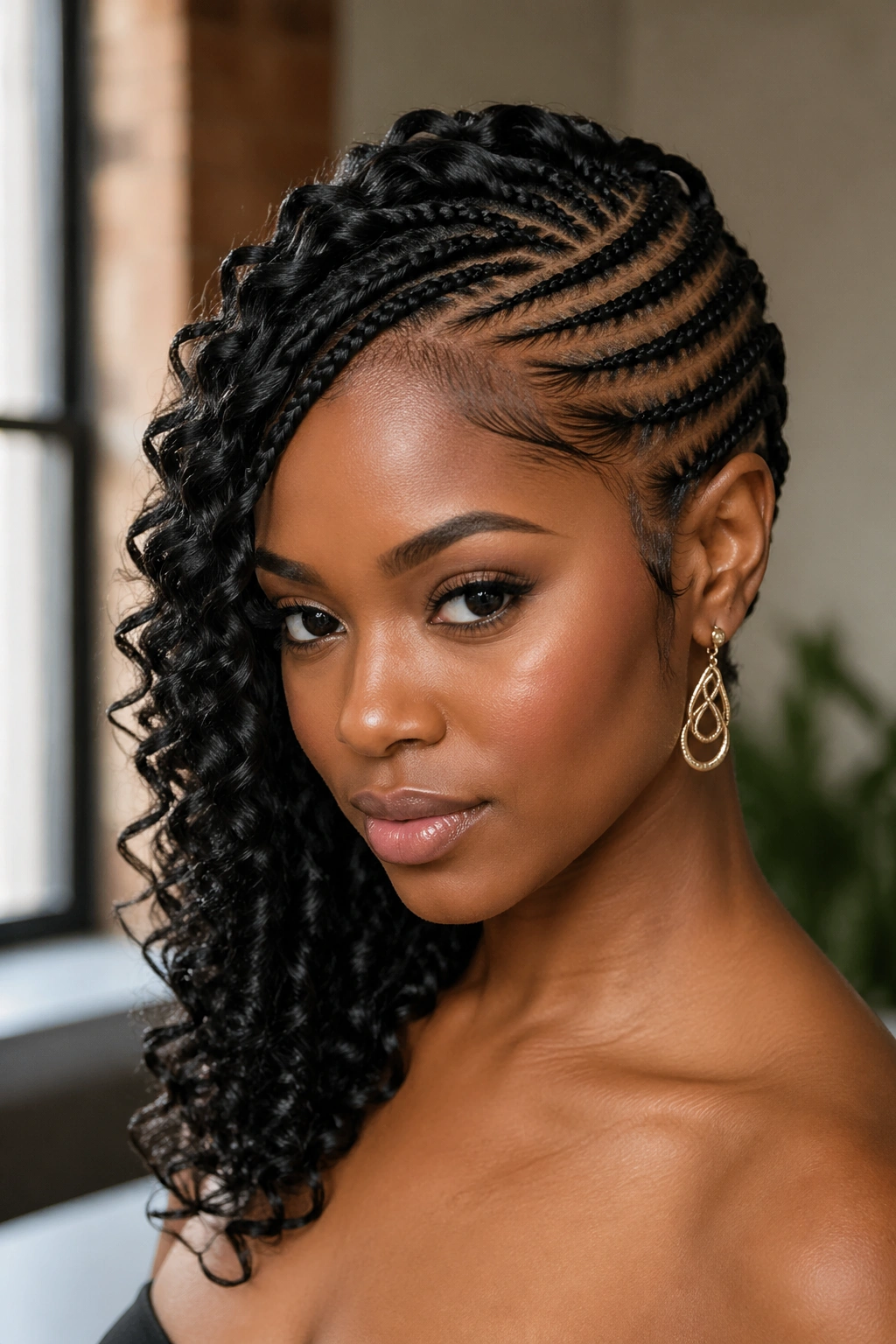
3. Side-Swept Goddess Updo
Cornrows angle sharply from one side of the hairline down toward the opposite shoulder, where they gather into a cascading curl piece that flows over one shoulder.
The asymmetry is the whole point. This is the updo for women with strong cheekbones who want to lean into their bone structure. The cornrow lines create a visual sweep that emphasizes facial angles.
Pair with a single statement earring on the exposed ear side. The bare neckline on one side carries the styling weight.
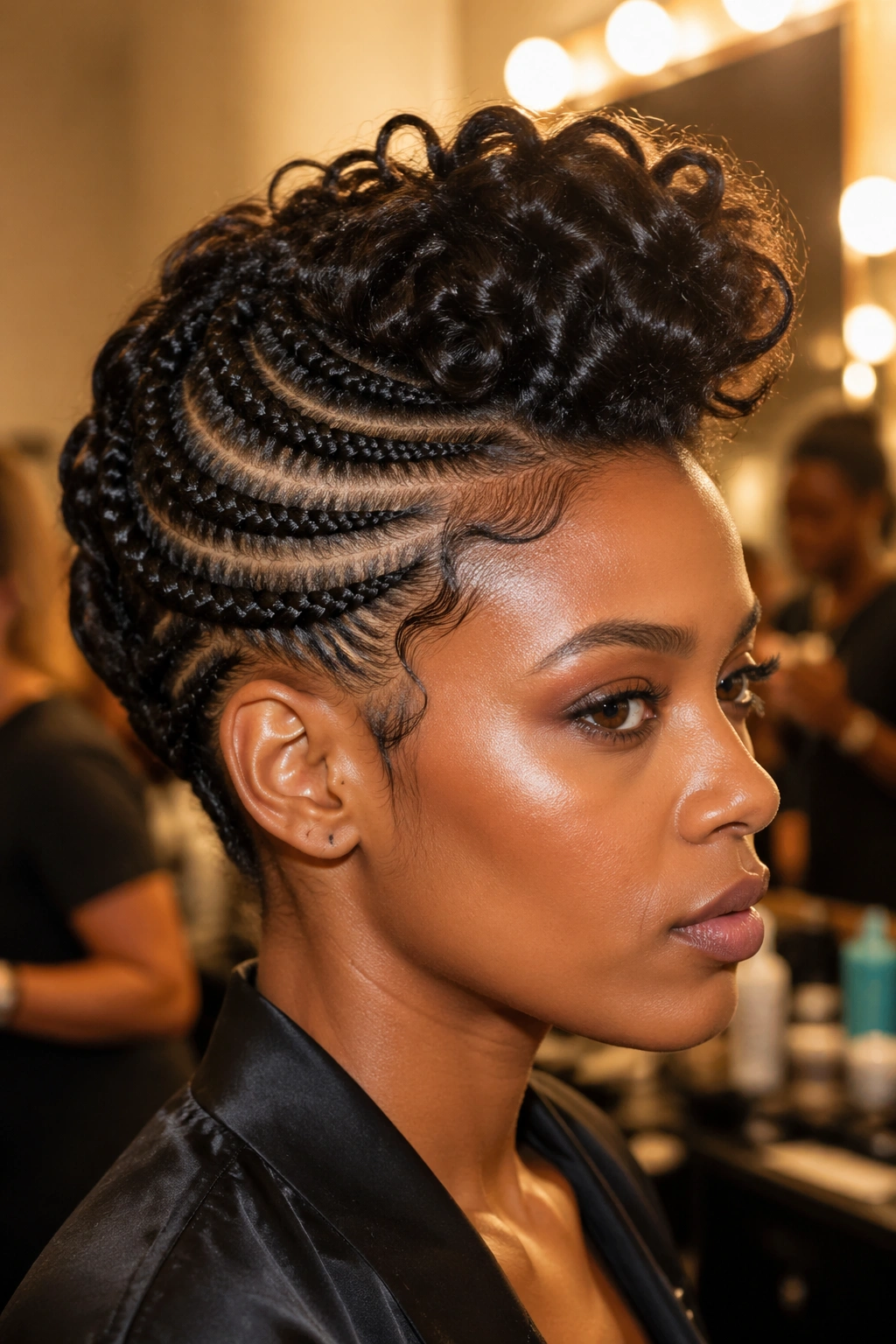
4. Braided Crown with Curly Pompadour
Cornrows form a flat crown on the sides and back of the head. The front section is teased and styled into a pompadour — voluminous loose curls swept back from the forehead.
How to Style It
The pompadour can be built from your own natural hair if you have enough length up front. If not, a small drawstring puff piece pinned at the front gives you the height. Tease the loose hair gently with a wide-tooth comb to add fullness, then smooth the front surface into the pompadour shape.
Spray with a flexible hold spray — the pompadour should hold its shape but still move when you turn your head. Stiff pompadours look helmet-like.
Best for: Formal events, performances, anywhere you want height and drama.
5. Low Curly Bun with Stitch Cornrow Base
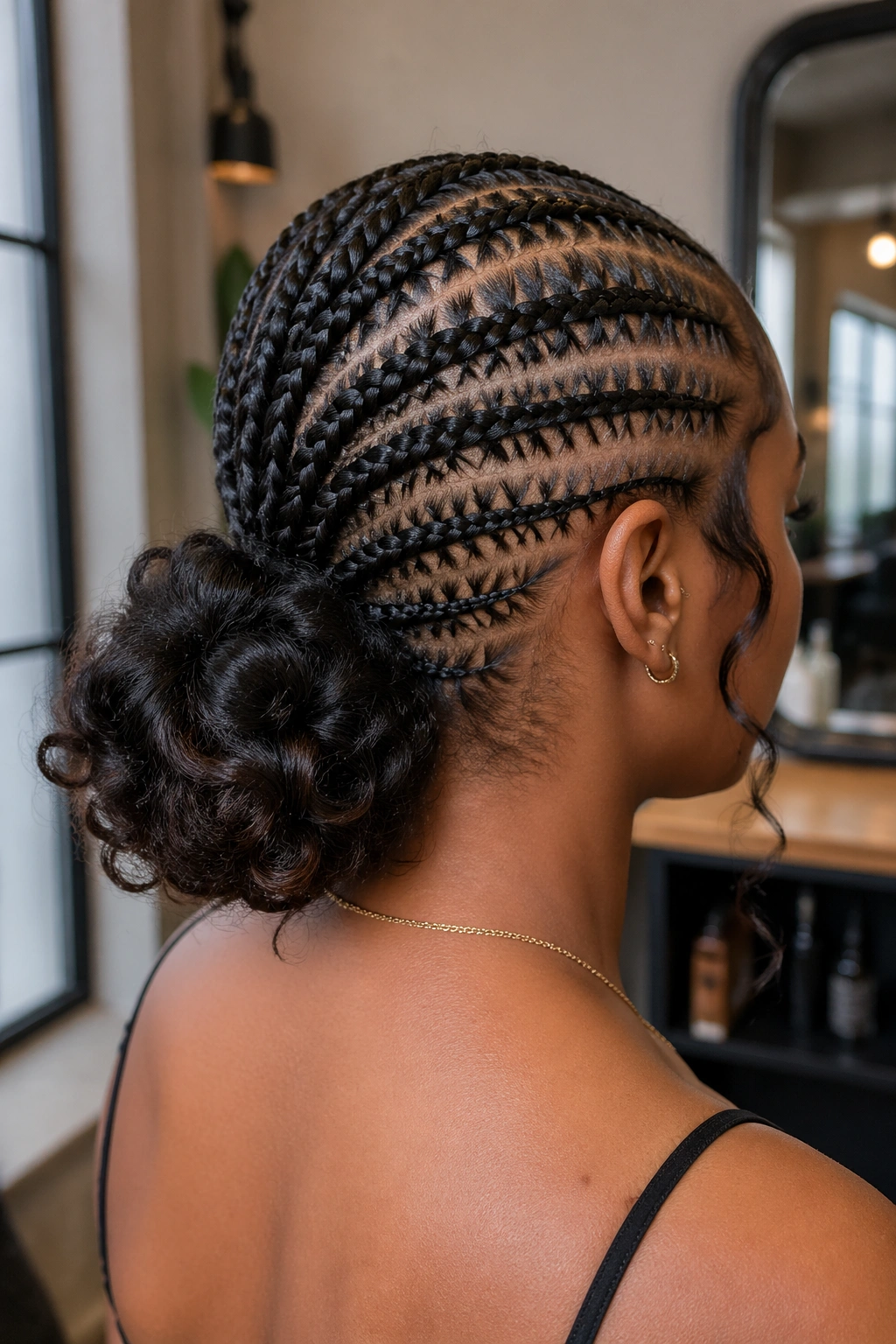
The cornrow base features visible stitch detailing — small horizontal stitches along each braid that catch the light. The braids angle down to a soft low bun positioned at the nape, built from loose curly hair.
The stitching adds texture to what would otherwise be plain cornrows. From behind, the stitch lines create rhythm across the back of the head, and the low bun anchors the eye.
Stitch braiding adds about 2 hours to install time. Worth it for the photographic quality, especially if you’re getting professional photos taken.
6. Faux Hawk Goddess Updo
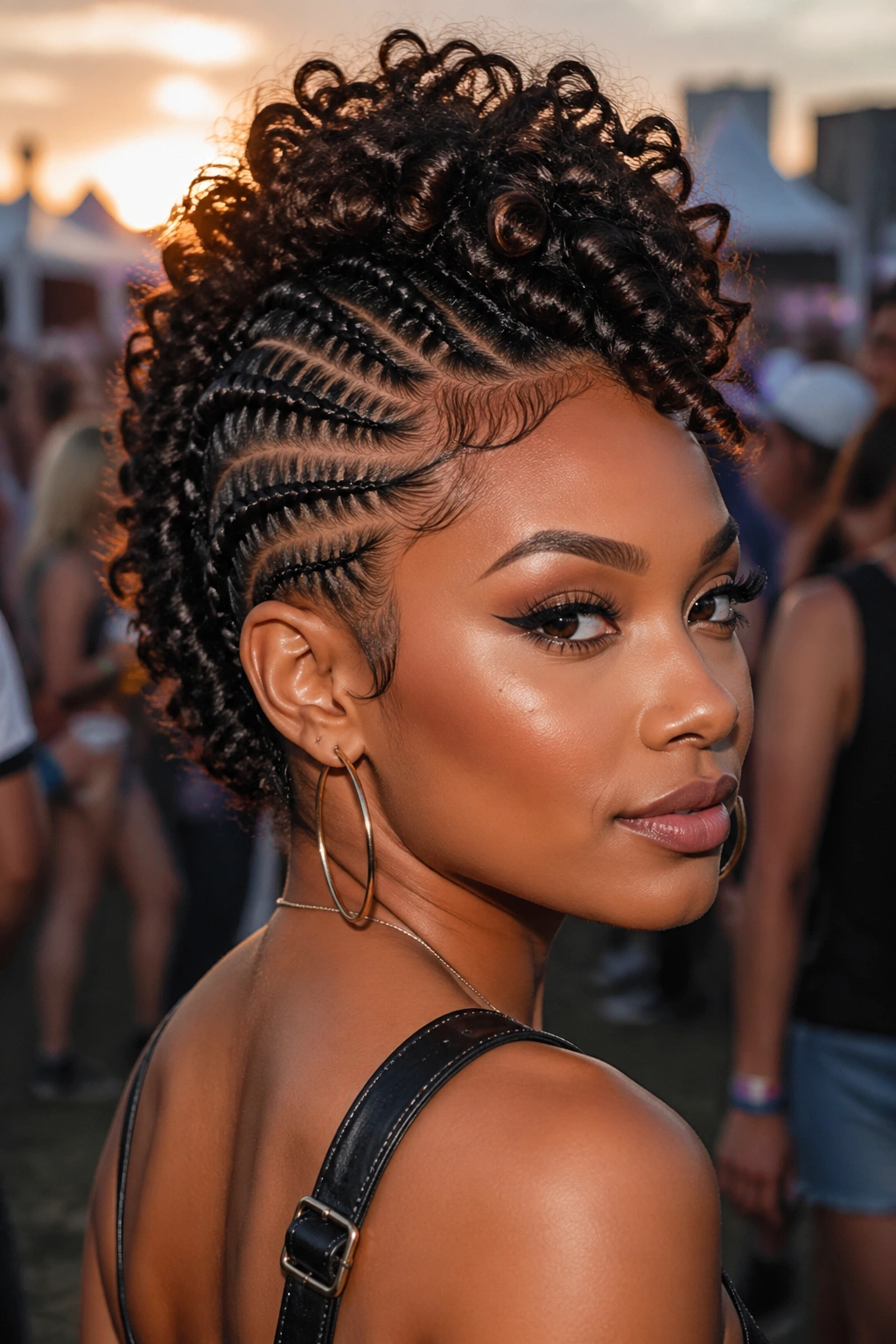
Cornrows are tight on the sides and back. The center strip from forehead to crown stays unbraided or loosely braided, then gets pulled up into a curl-heavy faux hawk that runs front to back along the top of the head.
This is the goddess updo with attitude. It works for music festivals, fashion events, anywhere you want structure with edge.
The faux hawk can be built from your natural hair if it’s long enough, or from added curly extensions pinned along the center strip. Either way, the height comes from teasing and pinning rather than literal vertical hair.
7. Top Knot with Wraparound Braid
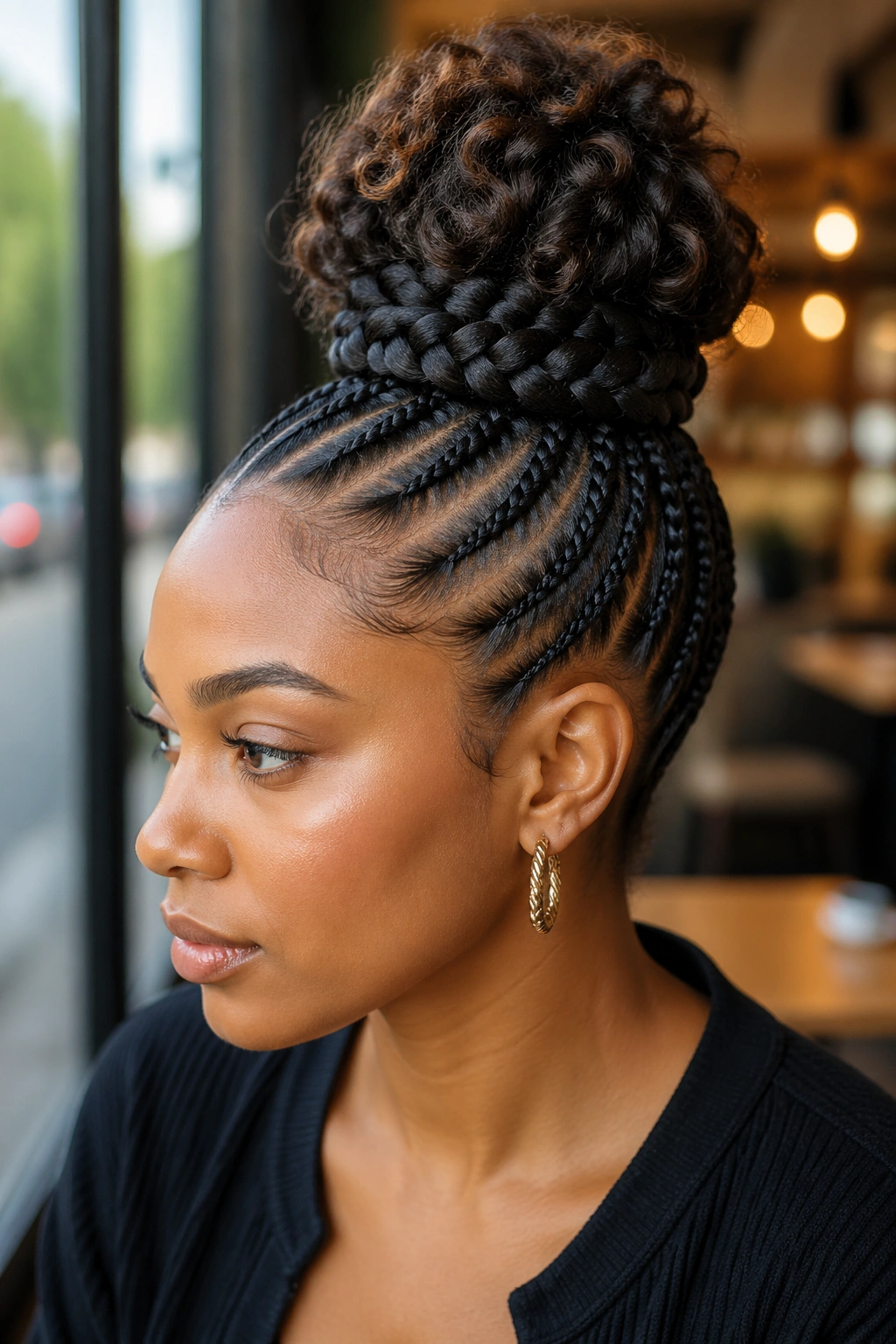
A high top knot built from loose curly hair sits at the crown. One thicker cornrow wraps horizontally around the base of the knot, creating a braided “ring” that secures the gather point.
The wraparound braid serves both decoration and function. It hides the elastic or pin securing the knot, and it adds a visible braid element to what would otherwise be a simple curly bun.
For added drama, embellish the wraparound braid with thin gold wire or a single strand of small beads.
8. Goddess Updo with Cornrow Bangs
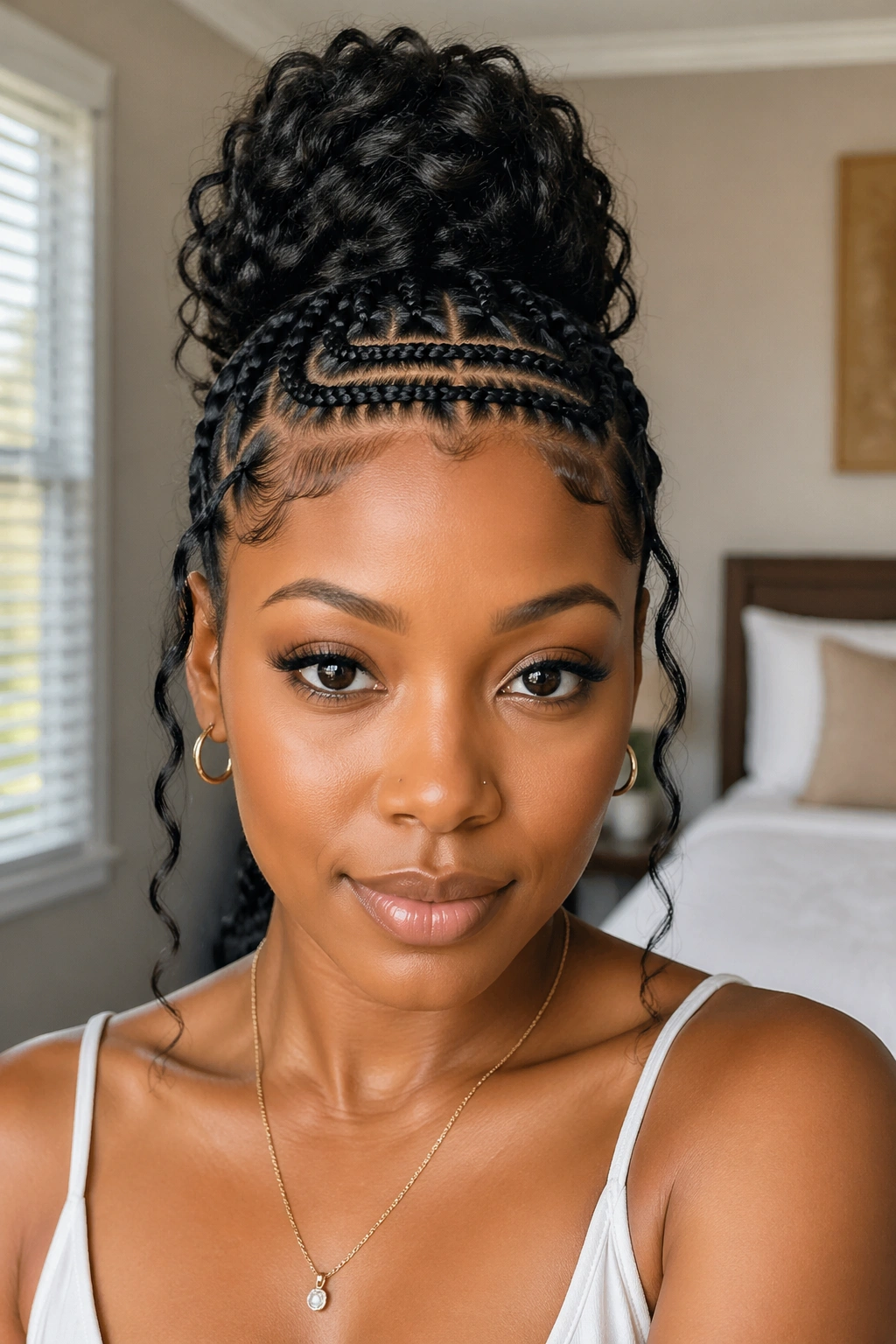
Most goddess updos pull all hair away from the face. This version doesn’t. Two to three cornrows form a flat bang section across the forehead, while the rest of the cornrows angle back toward an updo at the crown.
What Makes It Different
The cornrow bangs frame the face the way a fringe does — softening foreheads, balancing strong jawlines, drawing attention to eyes. Combined with a goddess updo, the front bangs and the loose updo create a top-and-bottom contrast that reads modern.
Who this is for: Women with high foreheads or square face shapes who want their cornrow style to soften their features.
9. Twisted Goddess Updo
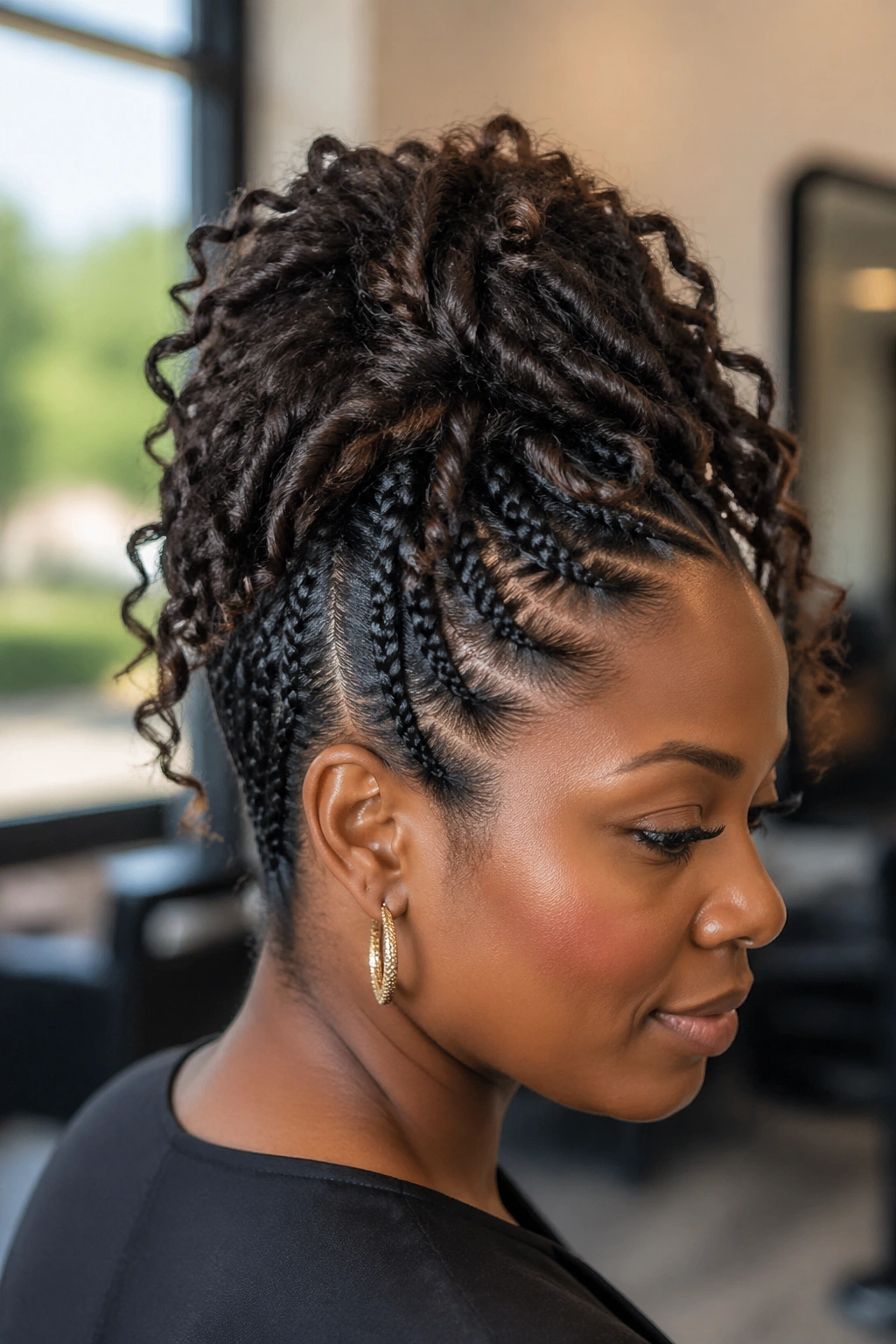
Instead of cornrow base, the foundation is built from flat twists (two-strand twists laid flat against the scalp). The updo on top is built from loose curly hair with visible chunky twists running through it.
Flat twists are softer than cornrows visually. Pairing them with a curl-heavy updo creates an entirely twist-based aesthetic that reads more bohemian than the cornrow versions above.
This is the goddess updo for women who find cornrows too tight or too sharp. Twists distribute tension differently and can be more comfortable for sensitive scalps.
10. Beaded Goddess Updo
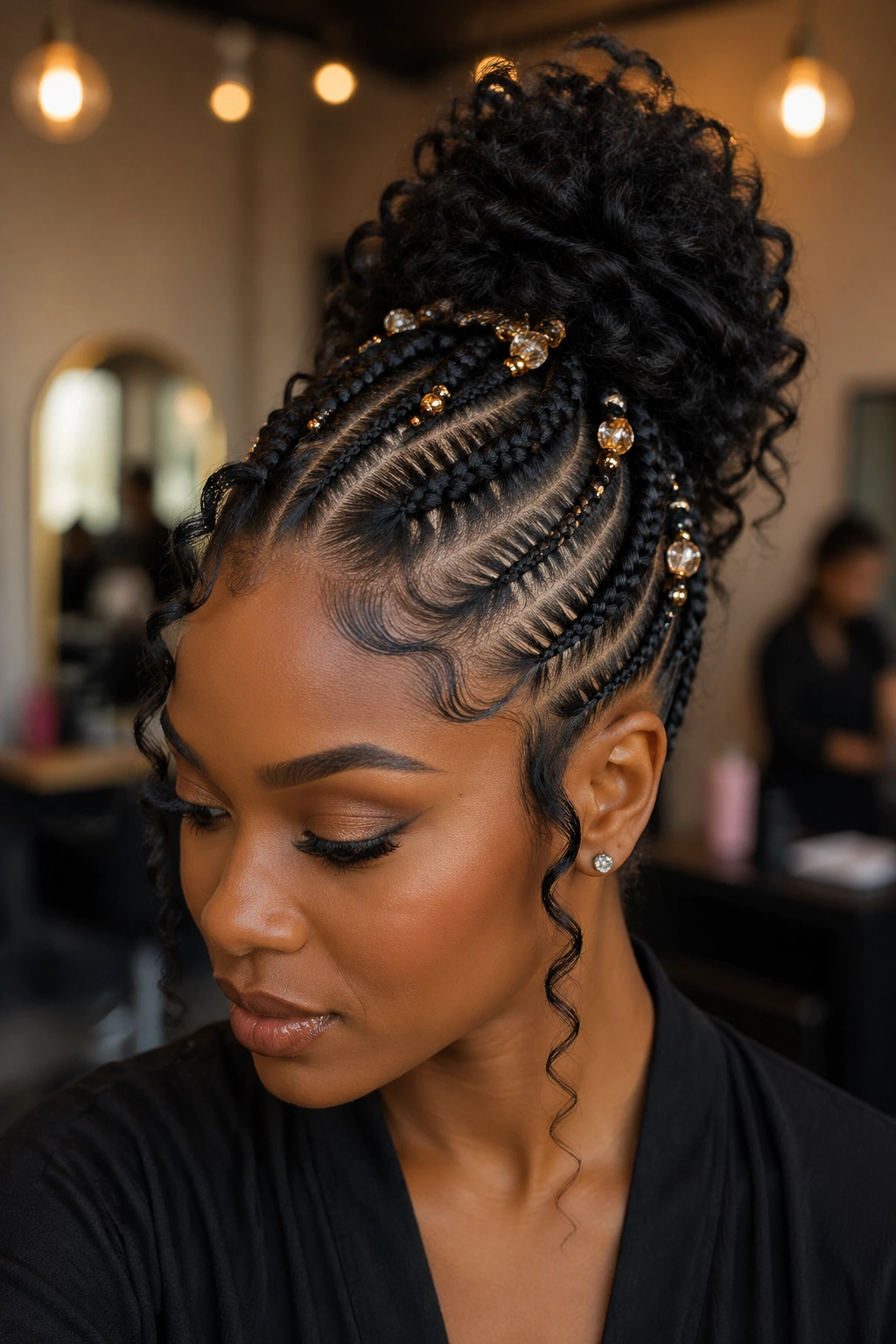
The cornrow base — whichever pattern you chose — gets adorned with beads at strategic points. Wooden beads, gold-tone beads, glass beads. The updo on top stays unbeaded, letting the loose curls move freely.
Bead placement matters more than bead quantity. Cluster 5 to 6 beads at the points where cornrows enter the updo gather. Add 2 to 3 small accent beads scattered along the cornrow lengths. Skip beading the updo itself.
The beaded sections catch light against the loose curls. It’s a layered visual story.
11. Cornrow Cage Updo
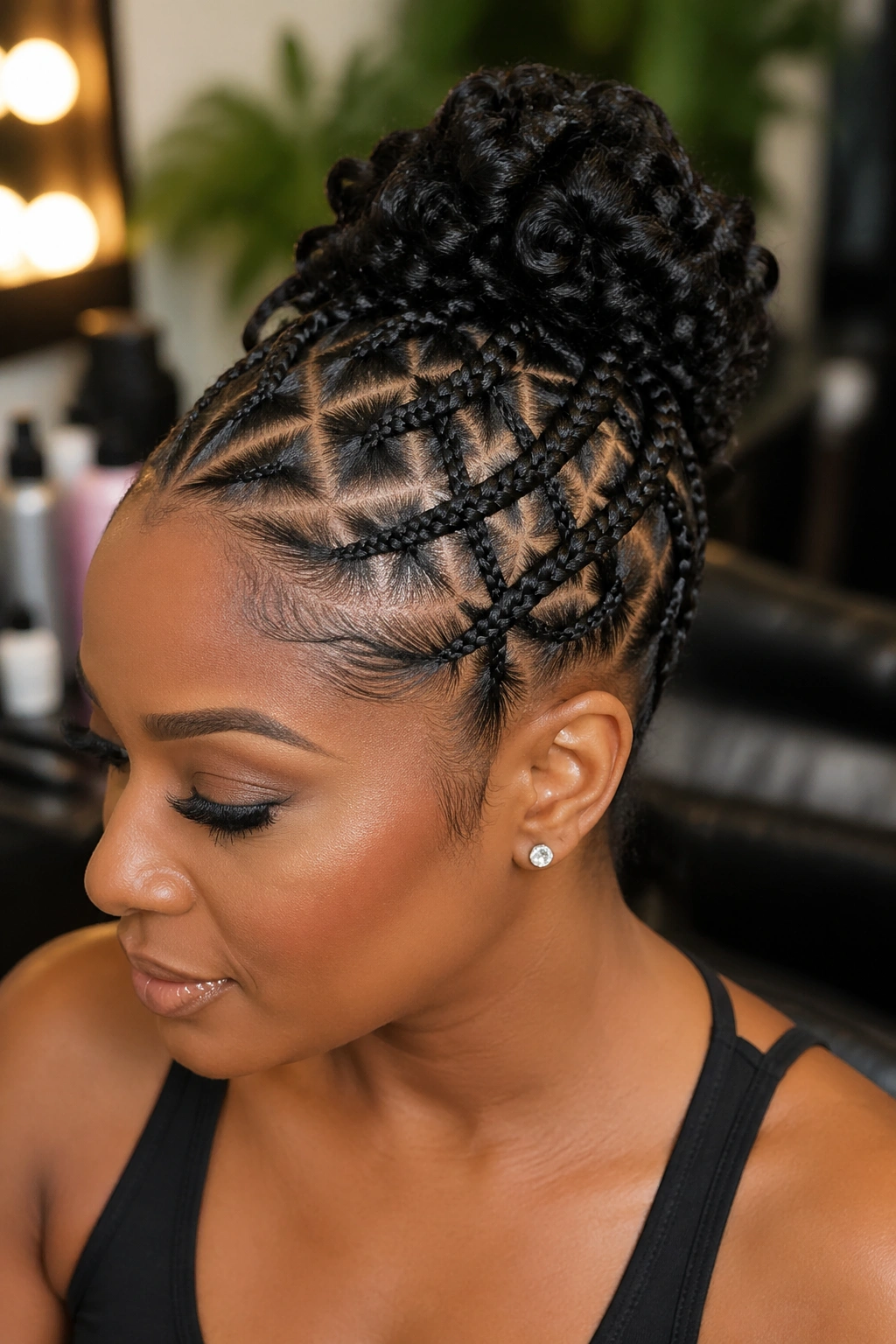
The cornrow base forms a “cage” pattern — interlocking diagonal lines that create a diamond or basket-weave appearance across the scalp. All cornrows feed into a central gathered updo at the crown.
The cage pattern is the most architecturally complex goddess updo on this list. It requires a braider who specializes in pattern work. Not every cornrow expert can do cage parting cleanly.
When done well, it’s the kind of style that stops people on the street. The geometric scalp pattern combined with cascading curls is unforgettable.
12. Updo with Heart-Shaped Cornrow Detail
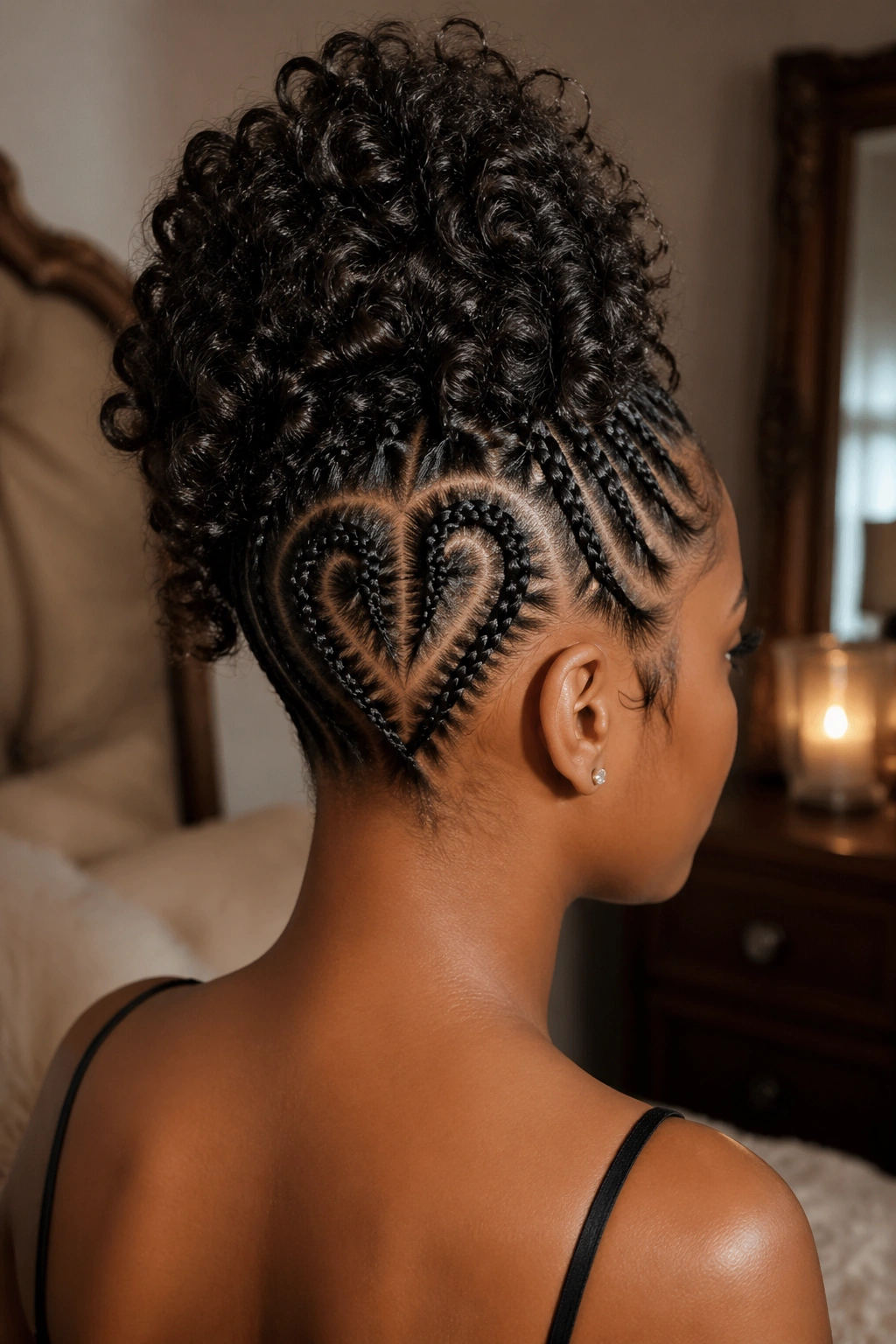
A clean heart-shaped cornrow pattern sits at the back of the head, with the rest of the cornrows feeding up into a curly updo at the crown. The heart serves as a back-of-head decorative element visible when you turn or in profile.
This is romantic without being childish. The heart shape works particularly well for engagement photos, anniversaries, or any celebration with romantic undertones.
The heart placement matters. Center the heart on the back of the head, slightly below the crown but above the nape. Too low and the heart points down; too high and it gets lost under the updo.
13. Goddess Updo with Side Cornrow Accent
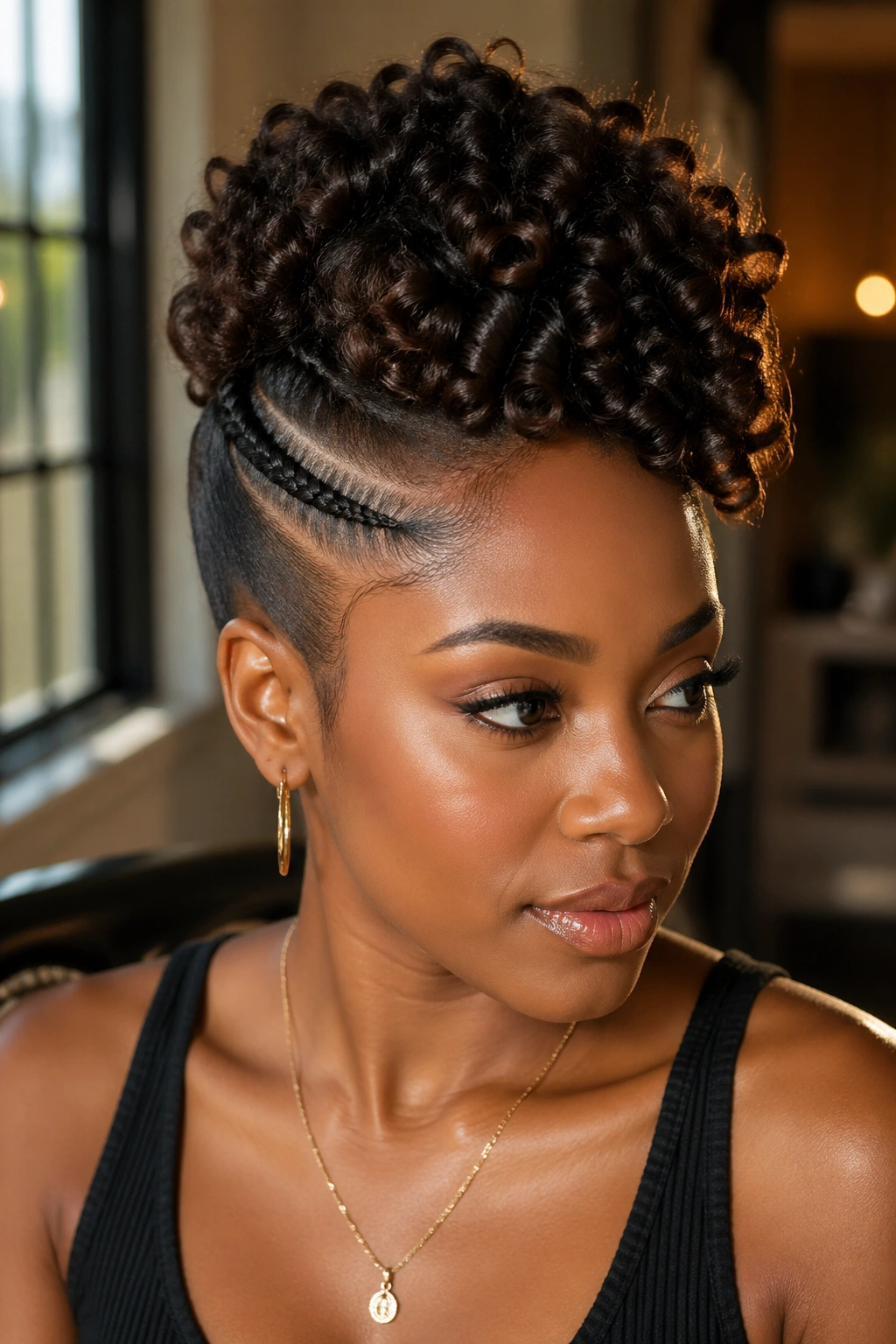
The updo is the focus — a high, full curly gather at the crown. One side of the head features a single cornrow accent running from the temple back to where the cornrow joins the updo. The opposite side stays smooth or has minimal cornrow detail.
The asymmetry creates interest without overwhelming the updo. It’s a way to incorporate cornrow detail without committing to a fully cornrowed scalp.
This is the goddess updo for women who want minimal cornrow visibility but want some braided element to anchor the look.
14. Crown Braid with Loose Curl Cascade
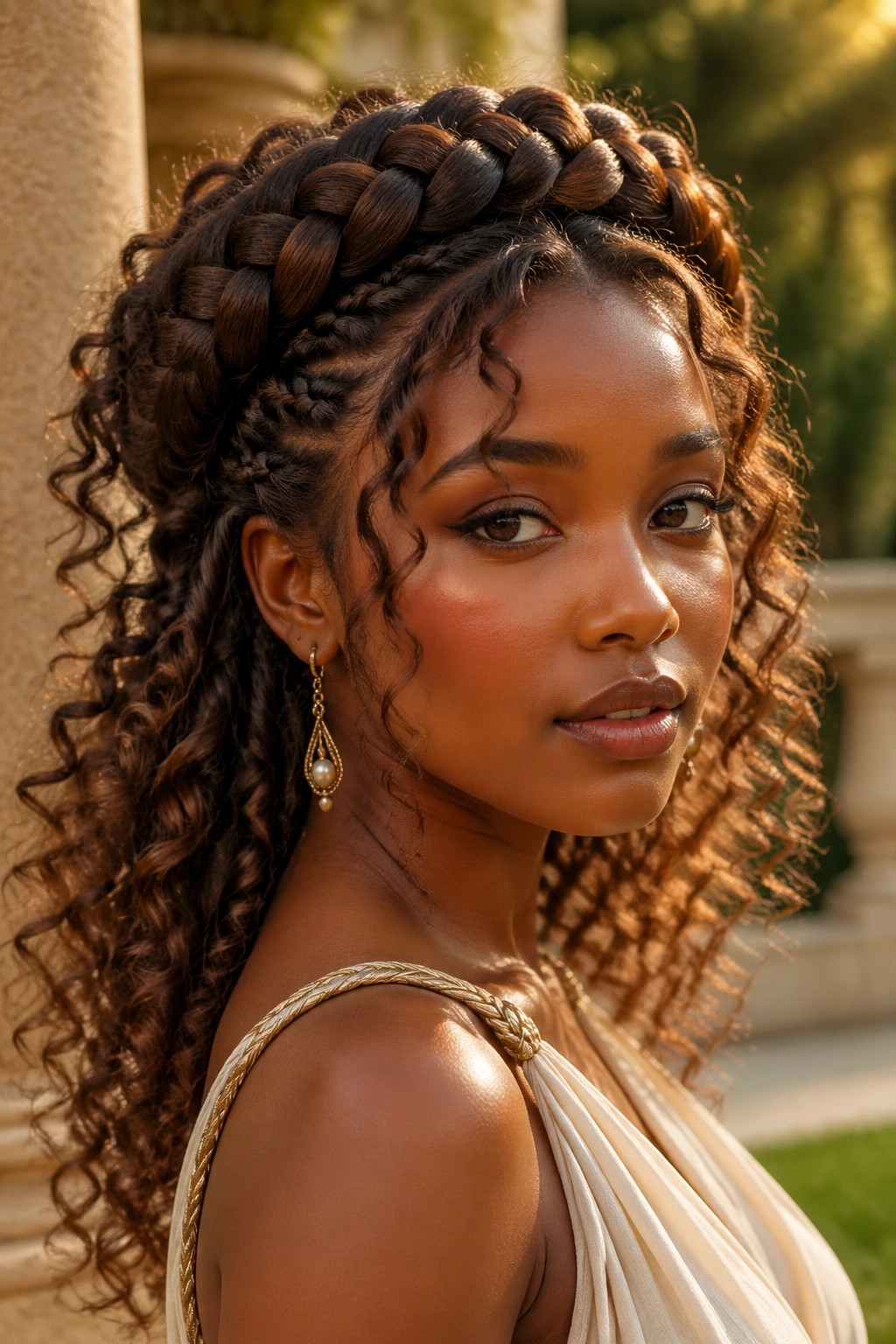
A thick cornrow runs in a circular pattern around the crown, forming a literal “crown” of braid. Loose curly hair cascades down from inside the crown ring, falling around the face and down the back.
How to Use It
Think of this as the inverse of the halo updo. There, the halo is decorative and the curls gather into a structured wreath. Here, the crown is decorative and the curls flow free.
It’s the most “literal goddess” of the styles on this list. Greco-Roman aesthetic meets African braiding tradition. Pair with gold accessories — earrings, necklaces, an arm cuff — and the look is complete.
15. Pinned Goddess Updo
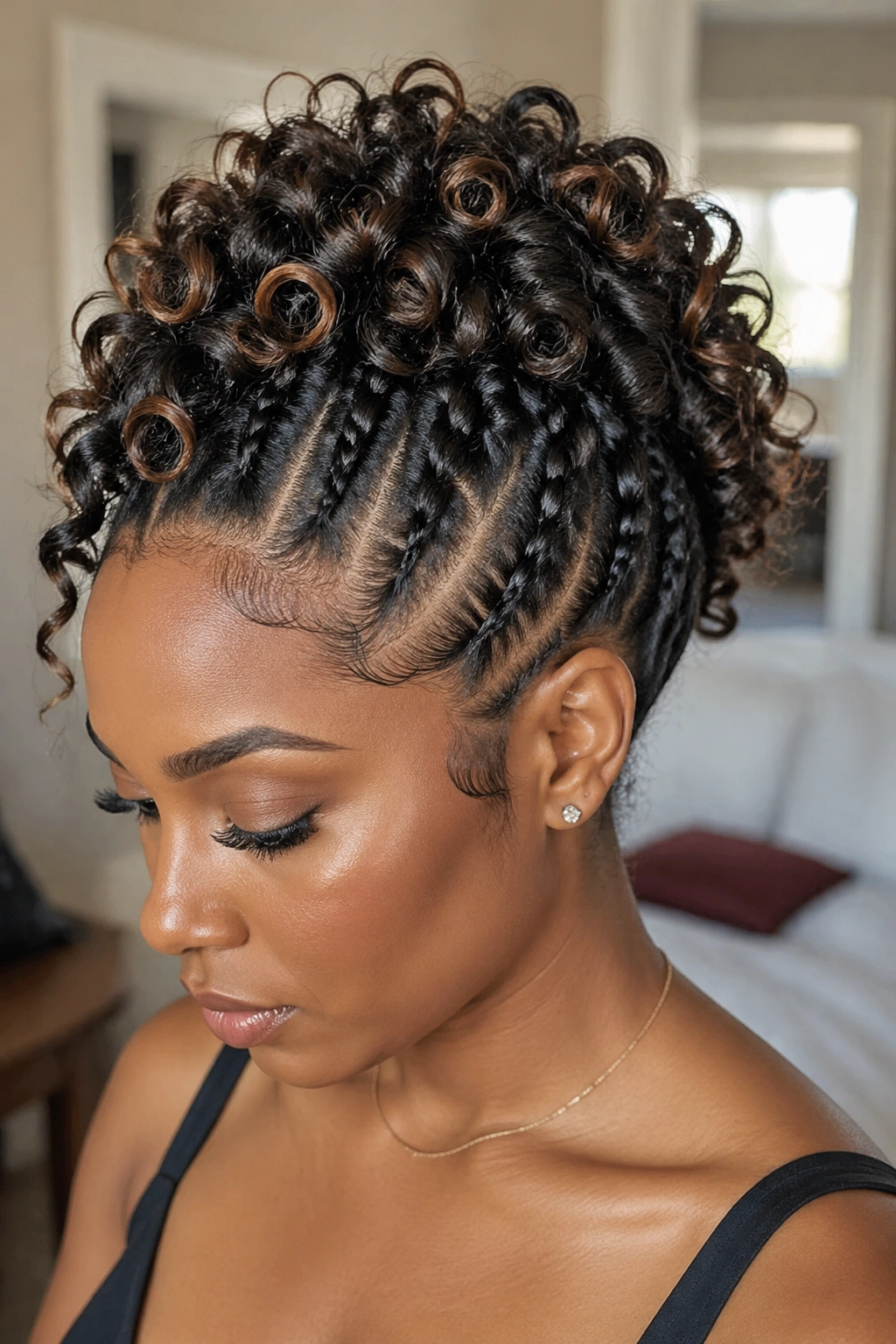
The updo is built entirely from pinned loose curls — no traditional bun, no twist, no wrap. Each curl section is individually pinned in place to create a structured cloud of curls at the crown.
This is technically the most labor-intensive updo on the list because every curl requires individual placement. Budget extra time for the updo portion alone.
The result is an updo with maximum visual texture. Each pinned curl reads independently, creating depth and dimension that smooth bun shapes can’t match.
16. Mohawk Cornrow with Curl Crest
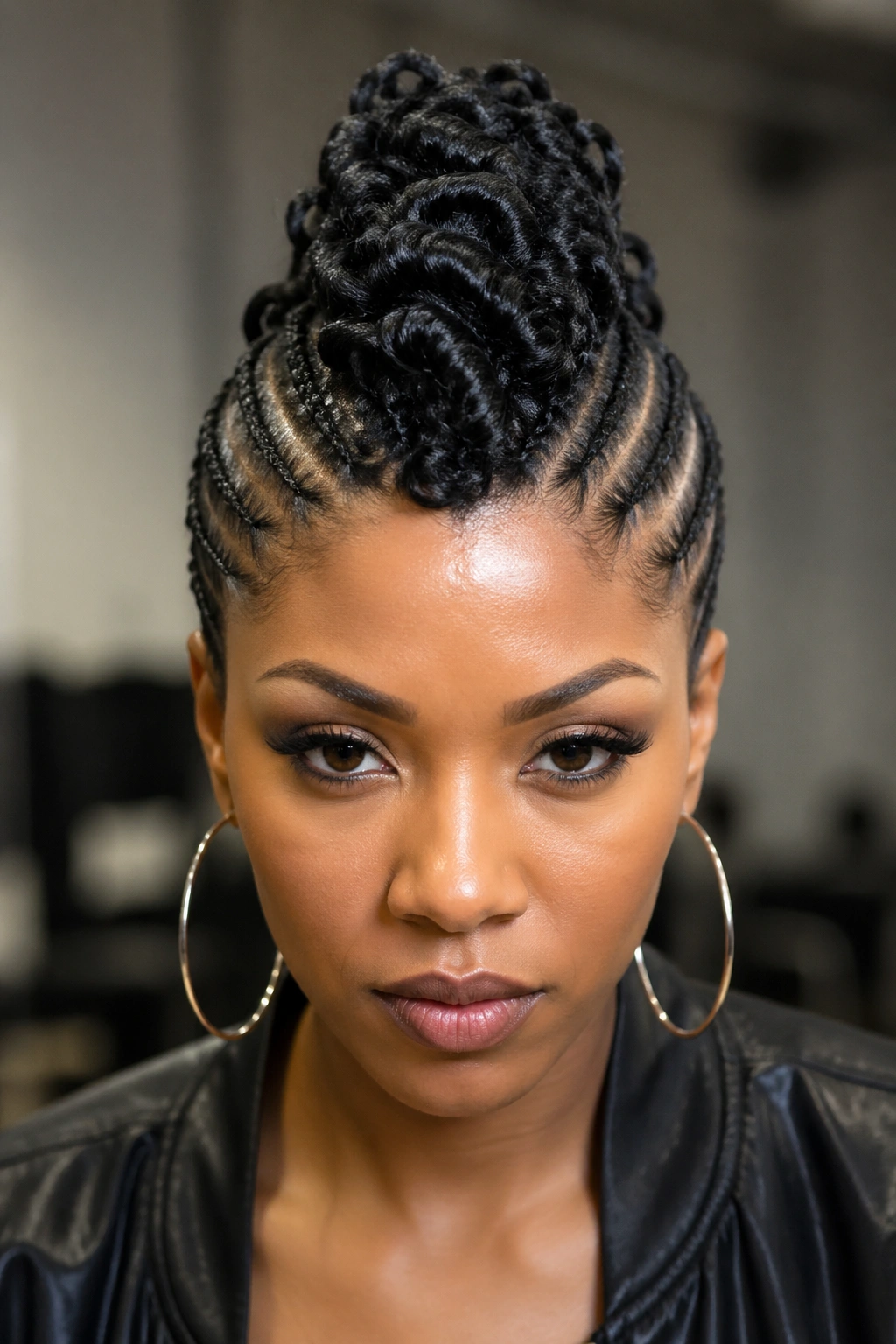
The cornrow base is a true mohawk pattern — sides braided tight against the scalp, center strip raised. The center strip features loose curly hair pinned along its length, creating a curly “crest” running from forehead to nape.
This goddess updo reads warrior. It’s bold, defiant, and unmistakable. Works for women who want their hair to make a statement before they say a word.
The crest needs daily maintenance. Curls flatten under sleep pressure, so morning re-fluffing is mandatory.
17. Updo with Gold Chain Accents
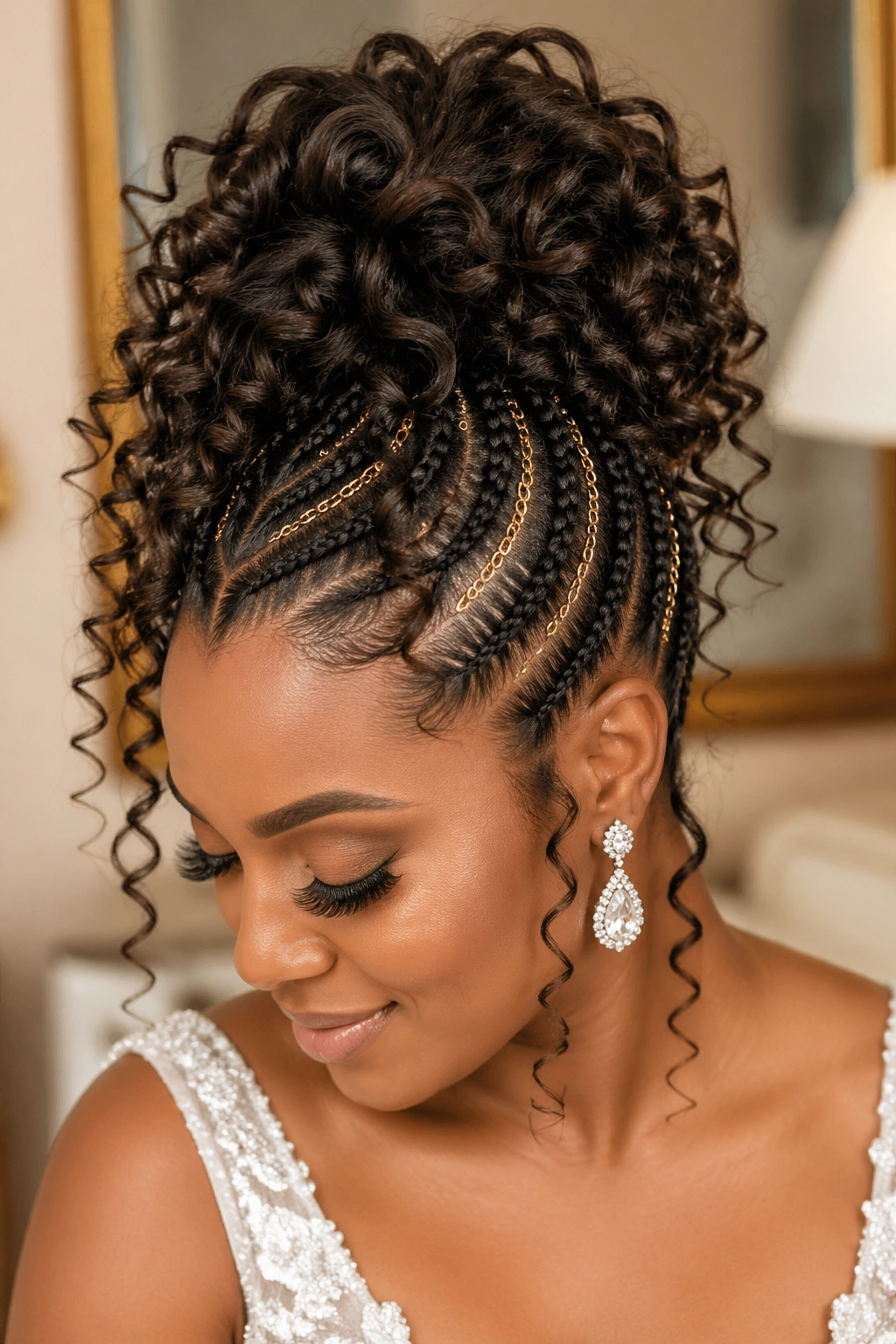
The cornrow base — whichever pattern you chose — incorporates fine gold chains woven into the braids. The chains follow the cornrow lines, peeking out at intervals. The curly updo on top stays free of metal.
Gold chains add light-catch without weight. Use chains designed for hair use — costume jewelry chains can rust or stain the hair.
The chain detail elevates almost any goddess updo into bridal or red-carpet territory. It’s the style I recommend for women whose dress has gold detail and who want their hair to echo that.
18. Half-Updo Goddess
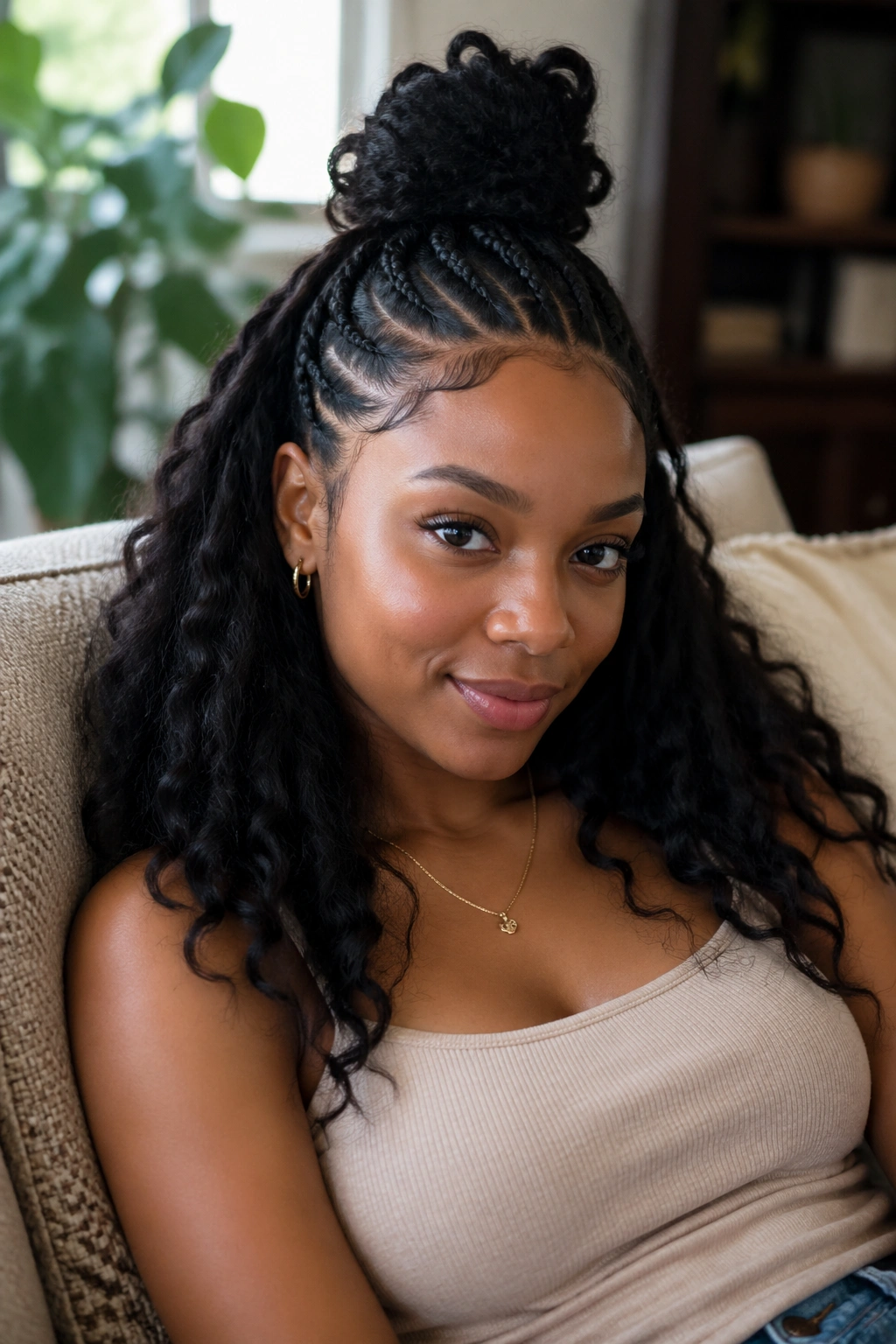
Half the loose hair is gathered into a top-of-head bun or twist. The other half flows freely down the back. The cornrow base anchors both halves.
This is the most casual goddess updo on the list. It works for everyday wear, casual events, anything where you want the goddess aesthetic without full updo formality.
Easier to install and easier to wear than full updos. The flowing back portion needs a satin scarf at night to prevent friction tangles.
19. Cornrow Updo with Floral Accents
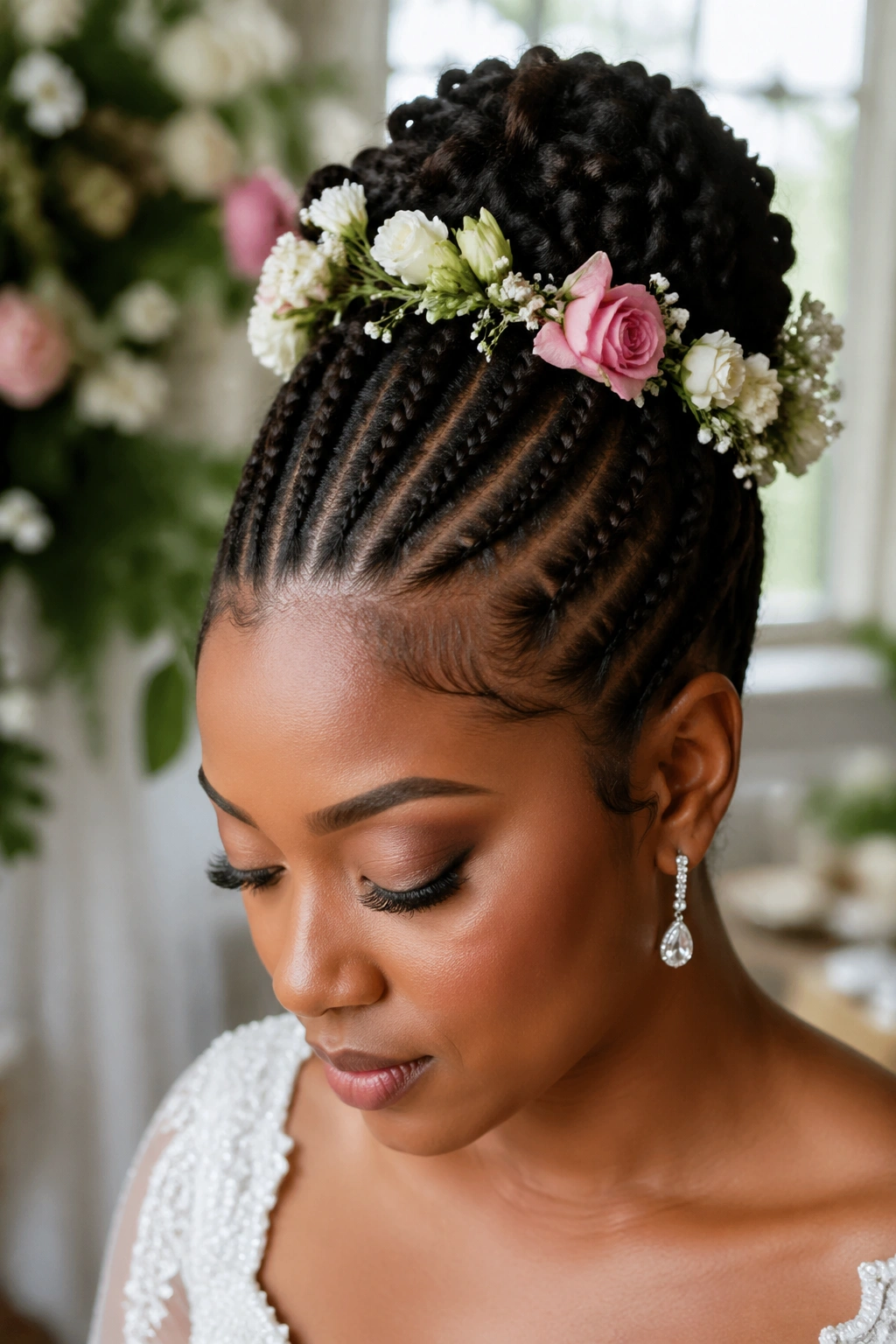
Real or silk flowers tucked into the gathered updo at the crown. Small flowers — baby’s breath, miniature roses, small orchids — work better than big statement blooms because the cornrow base already has visual structure.
This is the bridal or formal event goddess updo. The flowers carry color and softness; the cornrows carry structure; the curls carry movement.
For long-wear events, silk flowers stay fresh-looking longer. Real flowers wilt within hours under hot lights.
20. Sleek Cornrow Base with Voluminous Curl Bun
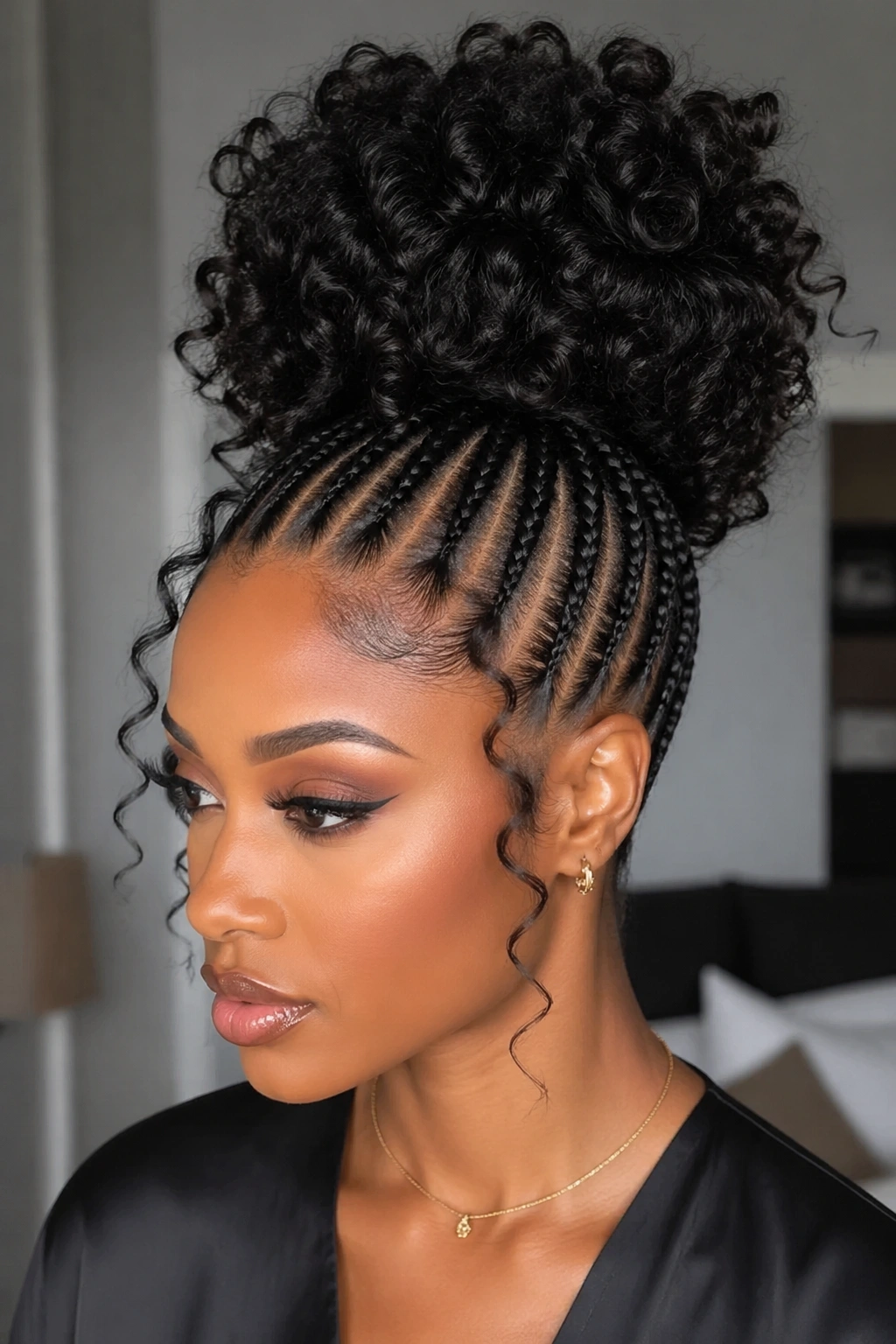
The cornrow base lies extremely flat against the scalp — almost glued-down with edge gel. The contrast comes from the bun on top, which is built oversized and voluminous from loose curly hair.
The contrast between flat scalp and big bun is the visual story. It’s an exaggerated proportion that reads architectural and editorial.
The flat base requires aggressive smoothing. Use a brush, gel, and sometimes a satin scarf wrap during install to set the cornrow base completely flat. The bun on top compensates for the smoothness with maximum volume.
21. Cornrow Updo with Wrapped Front Section
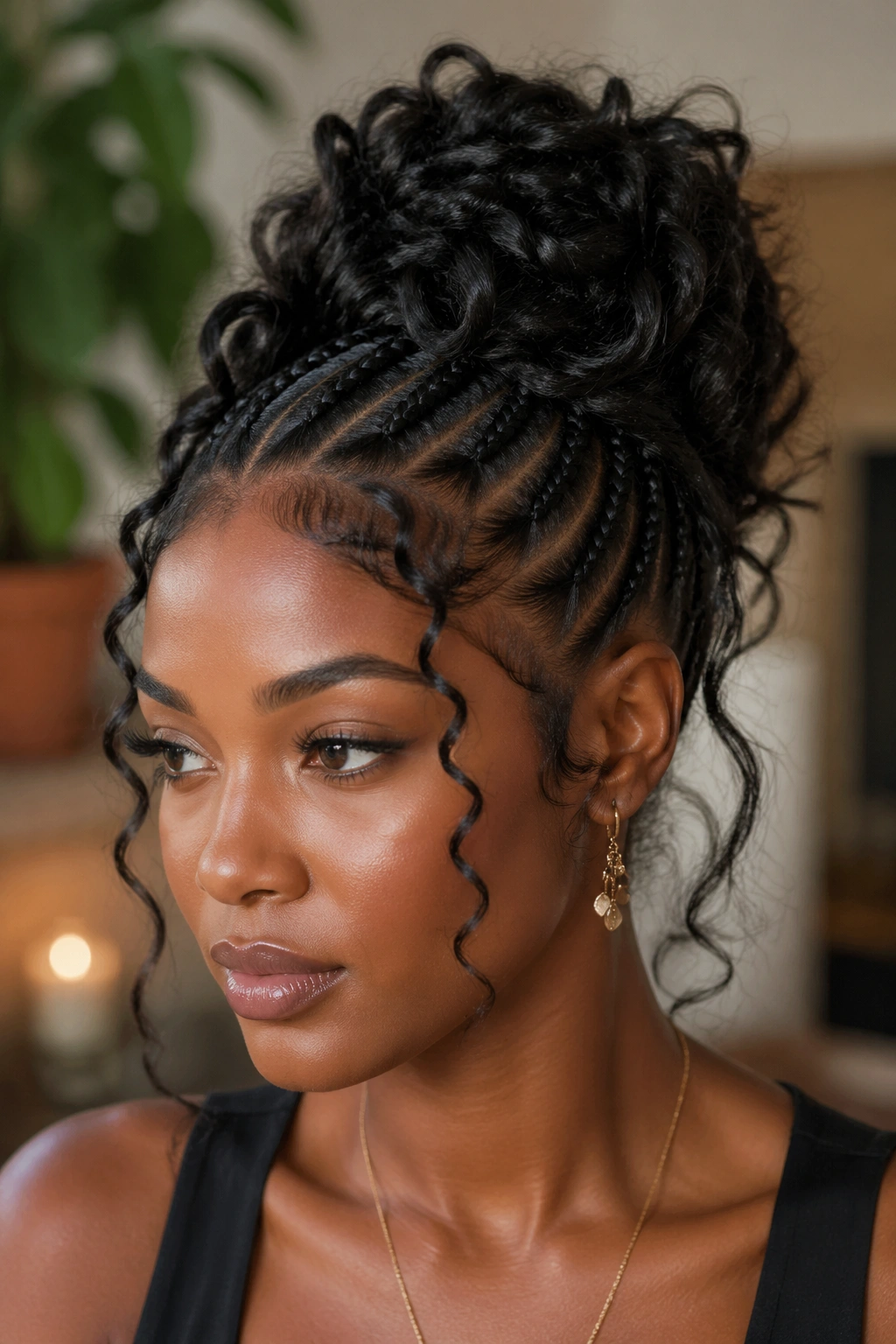
The cornrows angle back toward an updo at the crown. The front section — about 4 inches deep at the forehead — gets wrapped in a single horizontal cornrow that runs ear-to-ear before joining the back braids.
Why It Works
The front wrap creates a clean horizontal line across the forehead. It frames the face like a hairband. Pair with statement earrings and the styling reads complete.
The wrap section is the hardest part to install cleanly. The braider has to maintain even tension across the entire forehead width while keeping the wrap braid flat. Quality varies by stylist.
22. Double-Bun Goddess Updo
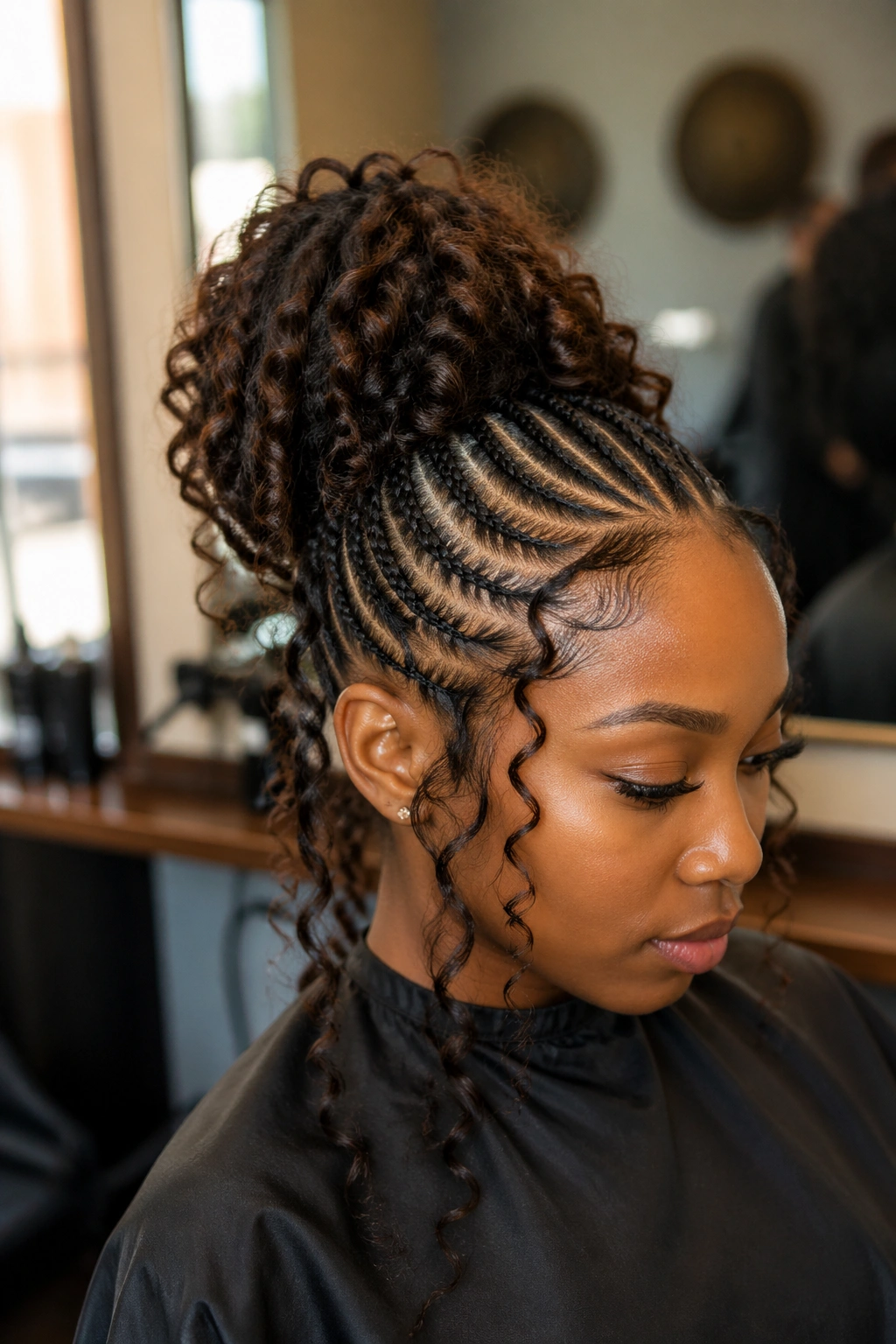
Two separate buns at the crown rather than one. Each bun is built from loose curly hair, positioned symmetrically on either side of a center part. The cornrow base flows up into both bun bases.
Double buns read younger, more playful than single-bun updos. They suit casual events, social gatherings, festivals, performances.
Bun symmetry is critical. Uneven double buns look like a mistake. Use a measuring tape during install if you don’t trust your eye for symmetry.
Maintaining the Updo Through Multi-Day Wear
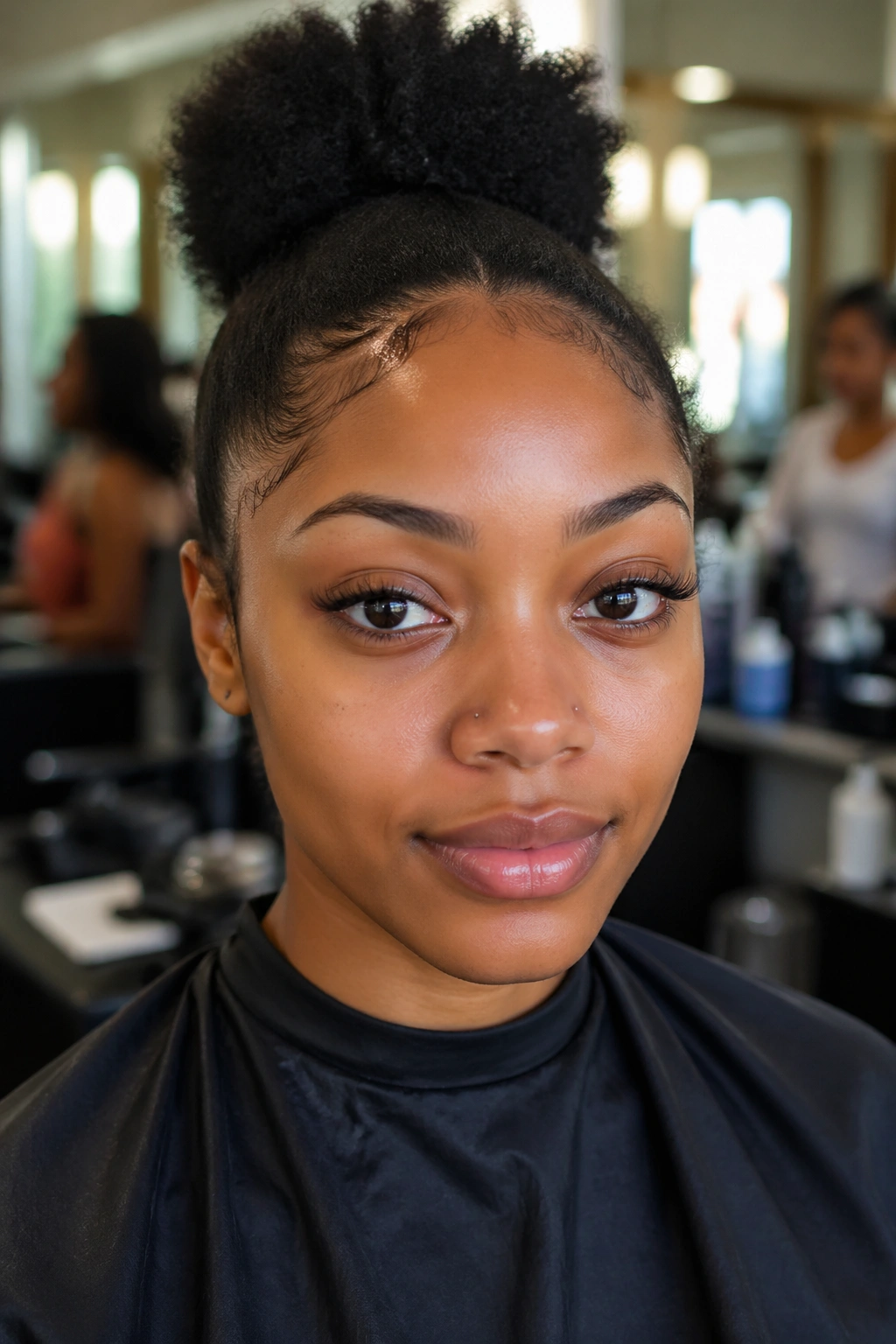
The updo portion is the most fragile element. Loose curls flatten, lose definition, and frizz under sleep pressure.
Re-pin the updo every morning. Some sections will have shifted overnight. Adjust placement, re-tease where volume has fallen, smooth any frizz with a light pomade on your fingertips.
Refresh the curls with a leave-in spray every 2 to 3 days. Cantu Curl Activator Cream diluted with water in a spray bottle works well for synthetic curl maintenance.
Avoid touching the updo throughout the day. Hands carry oils that flatten curls and make the gathered hair look greasy by evening.
Sleeping with a Goddess Updo
This is where many goddess updos die early. The combination of cornrow base and elaborate updo doesn’t fit standard satin bonnets well — the bonnet flattens the curls.
Use an oversized satin bonnet designed for braids and twists — the ones with extra crown space. Or wrap the updo in a satin scarf separately while leaving the cornrow base under a regular bonnet.
For multi-day formal events, take the updo down at night and rebuild it each morning. The cornrow base stays intact; only the loose curls need re-styling. This adds 20 minutes to your morning but extends the life of the cornrow base by weeks.
Washing Goddess Updos
You can’t wash a fully assembled goddess updo. The pinning structure won’t survive water exposure.
Take down the updo first. Wash the cornrow base with diluted shampoo squeezed through the braids. Air dry or sit under a hooded dryer until completely dry. Then rebuild the updo with fresh or washed curly hair.
If your updo uses extensions or drawstring pieces, wash them separately in cool water with a gentle shampoo. Air dry on a folded towel to maintain curl shape.
Taking the Whole Style Down
Start by removing all pins from the updo portion. Set the curly hair aside for reuse if it’s still in good shape — quality drawstring pieces and water wave bundles can be washed and re-pinned for a future style.
Saturate the cornrow base with conditioner mixed with warm water. Unbraid carefully from tip to root, working slowly to preserve as much natural hair length as possible.
Deep condition immediately after takedown. The cornrow base has been under tension for weeks, and your scalp and hair need recovery time before the next style.
Picking the Right Goddess Updo for You
Face shape matters more than for almost any other cornrow style. Round faces benefit from height — top knots, pompadours, vertical updos. Long faces benefit from horizontal balance — halos, low buns, side-swept styles. Heart and square faces have flexibility.
Consider event type. Bridal goddess updos lean formal — halo, crown, floral accent versions. Festival goddess updos lean playful — double buns, faux hawks, side-swept asymmetry. Everyday goddess updos lean simple — half-updos, sleek base with voluminous bun.
Your hair density determines what’s possible. Fine or thin natural hair limits the volume of the updo portion — you’ll need extensions for any high-volume style. Dense thick hair gives you flexibility but adds weight that requires more secure pinning.
Budget your time. Goddess updos take 5 to 8 hours for full install with most braiders. Schedule accordingly and don’t book the install on a day when you have evening commitments.
Common Mistakes That Ruin Goddess Updos
Mismatched curl texture between the updo hair and the cornrow base. The eye catches this immediately. Pick curl extensions that visually blend with your natural texture or commit fully to a contrasting curl pattern as a design choice.
Over-pinning the updo. Too many pins create a stiff, helmet-like updo that doesn’t move. Use the minimum number of pins that hold the structure.
Under-pinning the updo. Curls escape their position by hour 3 of wear. Pin securely, but with finesse.
Cornrow base too tight. The updo needs to sit on a base, but the base shouldn’t be so tight that it’s painful or causes hairline damage. Balance.
Loose hair that doesn’t match the cornrow color exactly. Off-tone updos look like wigs sitting on top of cornrows. Match the loose hair color to your natural hair color or to the cornrow extensions you used.
Skipping the deep condition before install. Goddess updos last 4 to 6 weeks. Your hair needs to be in good shape before that long stretch.
Goddess cornrow updos are special-occasion hair that can also handle daily wear. The style makes you feel composed, finished, deliberate. The cornrow base does protective work for your natural hair while the updo carries the visual statement.
Find the version that fits your event or your everyday. Find a braider who specializes in updos specifically — not all cornrow stylists work the loose-hair component well. And give yourself the time investment the style requires.
The investment shows.
