



Red feed in cornrows are a commitment. Where natural-toned braids let you blend into any setting, red braids announce themselves the moment you walk into a room. The color catches sunlight differently than darker shades, holds attention in photos with no extra effort, and somehow flatters skin tones across the entire spectrum from deep to fair. There’s a reason red has been the rebellious color of choice in Black hair traditions for decades.
Feed-in technique gives the red color extra dimension. Because the braid starts with your natural hair and gradually adds extension hair, the root often shows your real color while the rest of the braid blooms into red. That natural-to-color transition reads as deliberate styling rather than a wig moment.
Red kanekalon comes in many shades — fire engine red, deep wine, copper, burgundy, auburn, ginger, and rusted orange-red. Each shade hits differently against skin and lighting. Picking the right red is half the battle.
What follows is a working catalogue of 22 red feed in cornrow styles, from subtle warm-tone integrations to bold full-color statements. Each one approaches the red color from a different angle, with practical install notes and care advice along the way.
Why Red Hair Color Works So Well
Red is one of the few colors that genuinely complements every Black skin tone. Where blonde can wash out cool undertones and platinum can clash with warm undertones, red has a built-in warmth that bridges both ends of the spectrum.
The shade matters more than the choice itself. Deep skin tones tend to glow with rich burgundy and wine reds — the depth of the color pairs with the depth of the skin tone. Lighter skin tones often look stunning in copper, ginger, or auburn — the warmth of the color matches the warmth of the complexion.
Red also photographs well. Whether you’re documenting your style for personal memory or content creation, red hair shows up clearly in any lighting condition. Dark hair can disappear in low light. Red holds its visibility.
How Red Kanekalon Differs From Standard Black
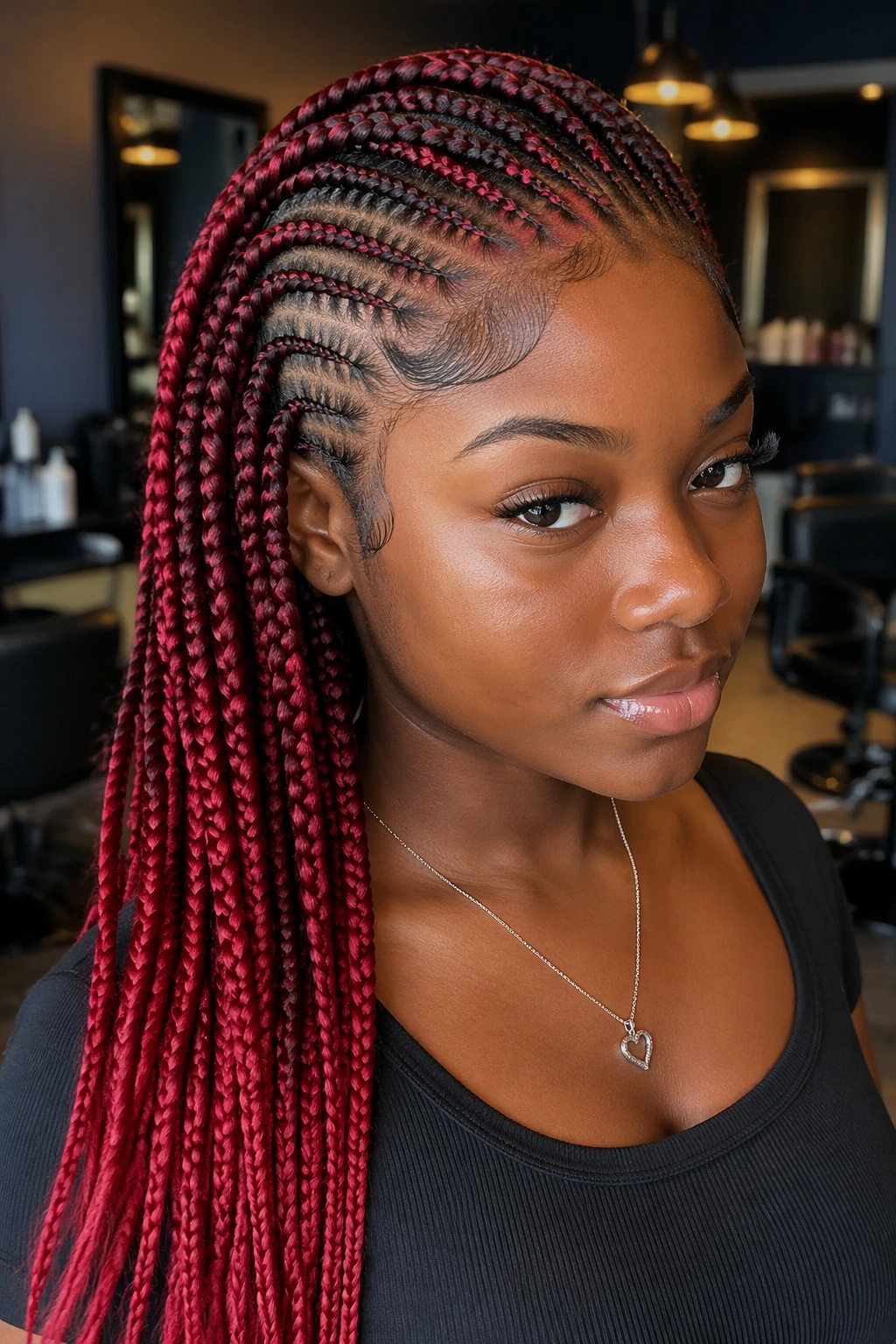
Red kanekalon goes through additional dye processing compared to standard black or brown shades. This means the strands sometimes feel slightly stiffer, especially in cheaper packs. Quality brands have largely solved this issue, but budget kanekalon in red can be noticeably less soft than its black counterpart.
Color bleeding is a real concern. Red dye is one of the most likely shades to transfer onto light clothing, pillowcases, and towels — especially during the first few washes after install. Rinse the braiding hair before installation if possible. Some braiders soak red kanekalon in vinegar water for 30 minutes before braiding to set the color and reduce bleed.
The brand of kanekalon affects color quality. Cheaper packs often look orange-red rather than true red. Mid-range and premium brands deliver more vibrant, controlled color. For red feed-ins, this is one place where spending a few extra dollars per pack makes a visible difference.
Choosing The Right Red For Your Skin Tone
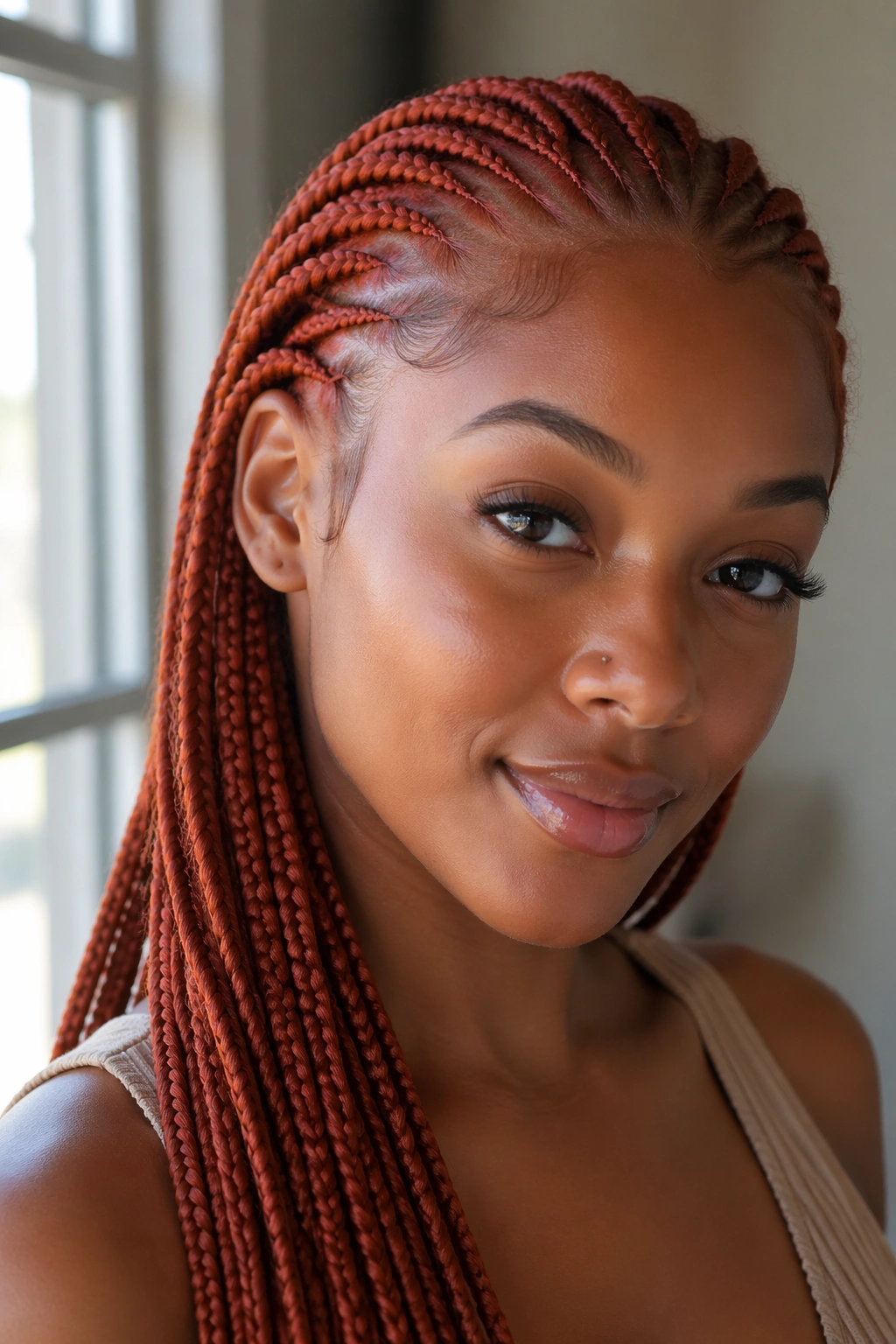
Quick guide based on undertones:
- Cool undertones (pinkish or blueish skin): Burgundy, wine, deep cherry red
- Warm undertones (yellowish or peachy skin): Copper, auburn, ginger, fire engine red
- Neutral undertones: Most reds work — try a mid-range red-orange
Test by holding a strand of the red kanekalon next to your jawline in natural light. If the color makes your skin look brighter and your eyes pop, it’s a match. If it makes your skin look dull or tired, try a different shade.
Tools And Prep For Red Installs
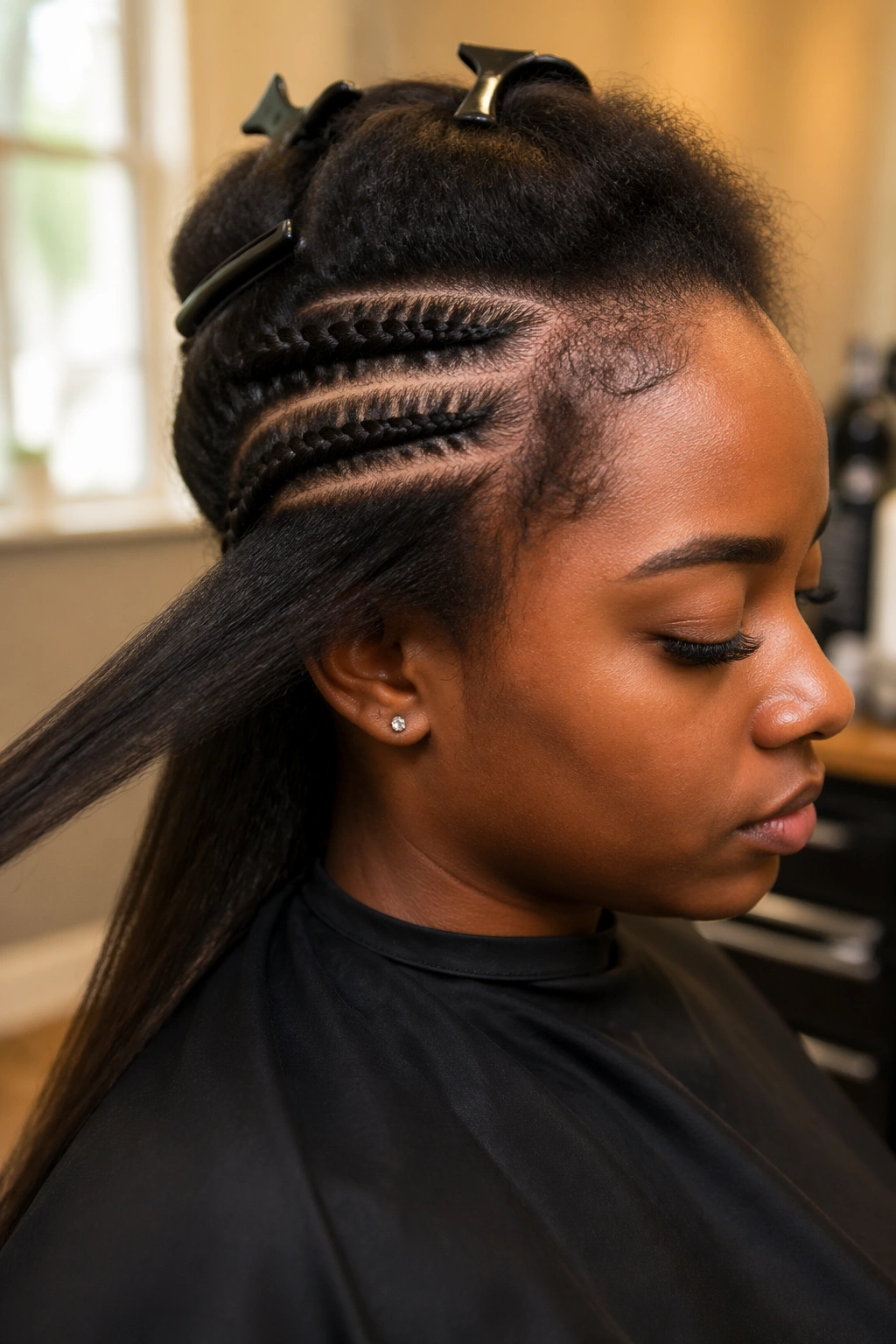
The same tools as any feed-in install — rat-tail comb, edge gel, duckbill clips, spray bottle. The kanekalon is the only variable that’s color-specific.
For prep, do a clarifying wash and deep condition the day or two before install. Stretch the hair so it lays flat. Skip oils on install day for grip.
One extra step for red: if you have light-colored upholstery, towels, or sheets at home, take precautions for the first week. Cover headrests on couches with old fabric. Use dark towels for hair drying. Sleep on a satin scarf to protect pillowcases.
1. Burgundy Feed-In Cornrows In Six Braids
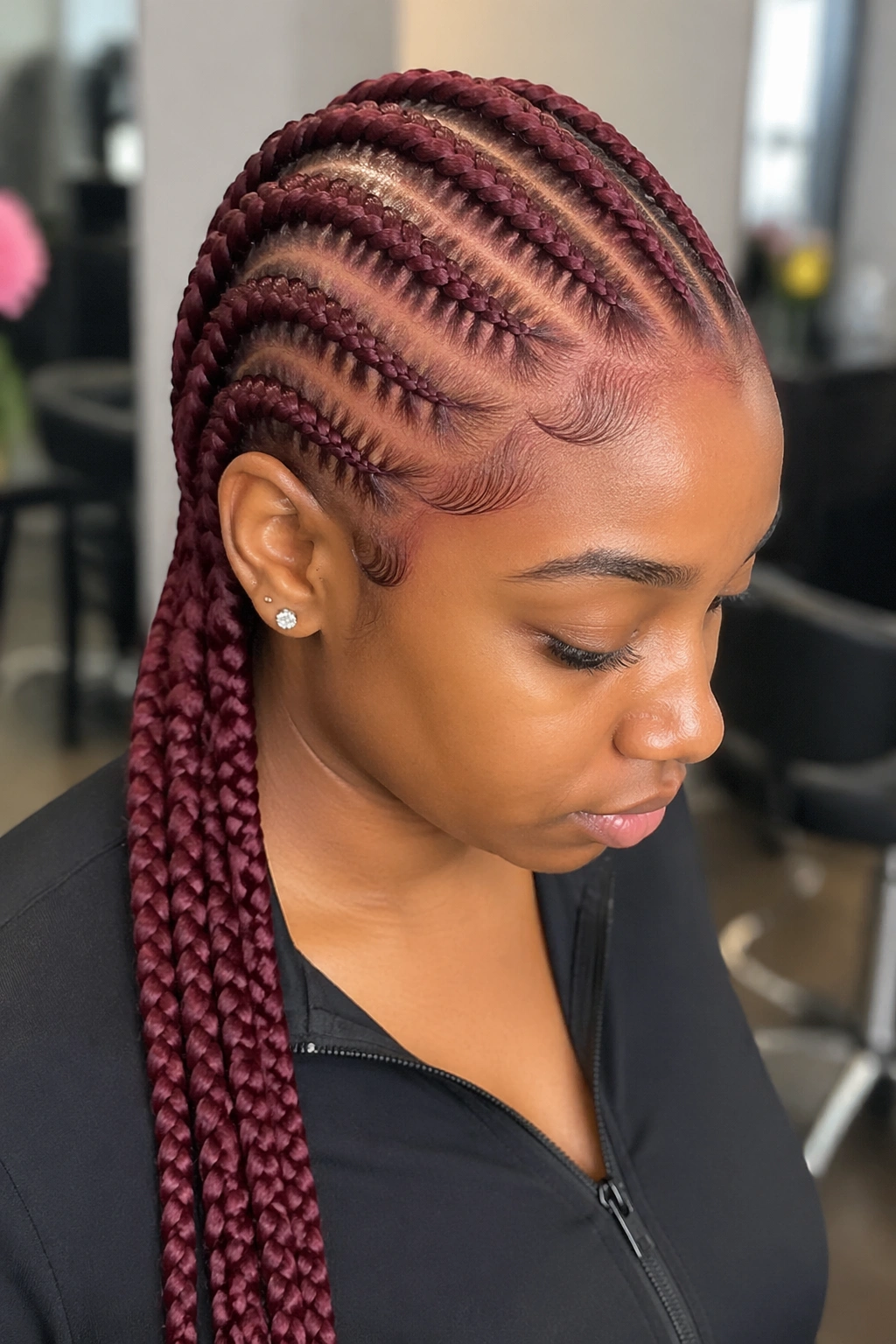
The classic. Six straight back cornrows in deep burgundy red, fed gradually with extension hair to create that smooth taper from natural-toned root to colored length.
Why It Works
Burgundy is the entry-level red for people who want color without bright neon energy. It reads as elevated and sophisticated rather than playful, which makes it suitable for professional environments where bolder reds might feel out of place.
- 2-3 packs of burgundy kanekalon depending on length
- Six braids work for medium to thick natural hair
- Pair with gold jewelry to make the wine tones pop
Pro tip: Look for kanekalon labeled “1B/burgundy” — this is a pre-mixed pack with darker root color blending into burgundy length, which simplifies the color transition.
2. Bright Cherry Red Feed-Ins With Eight Braids
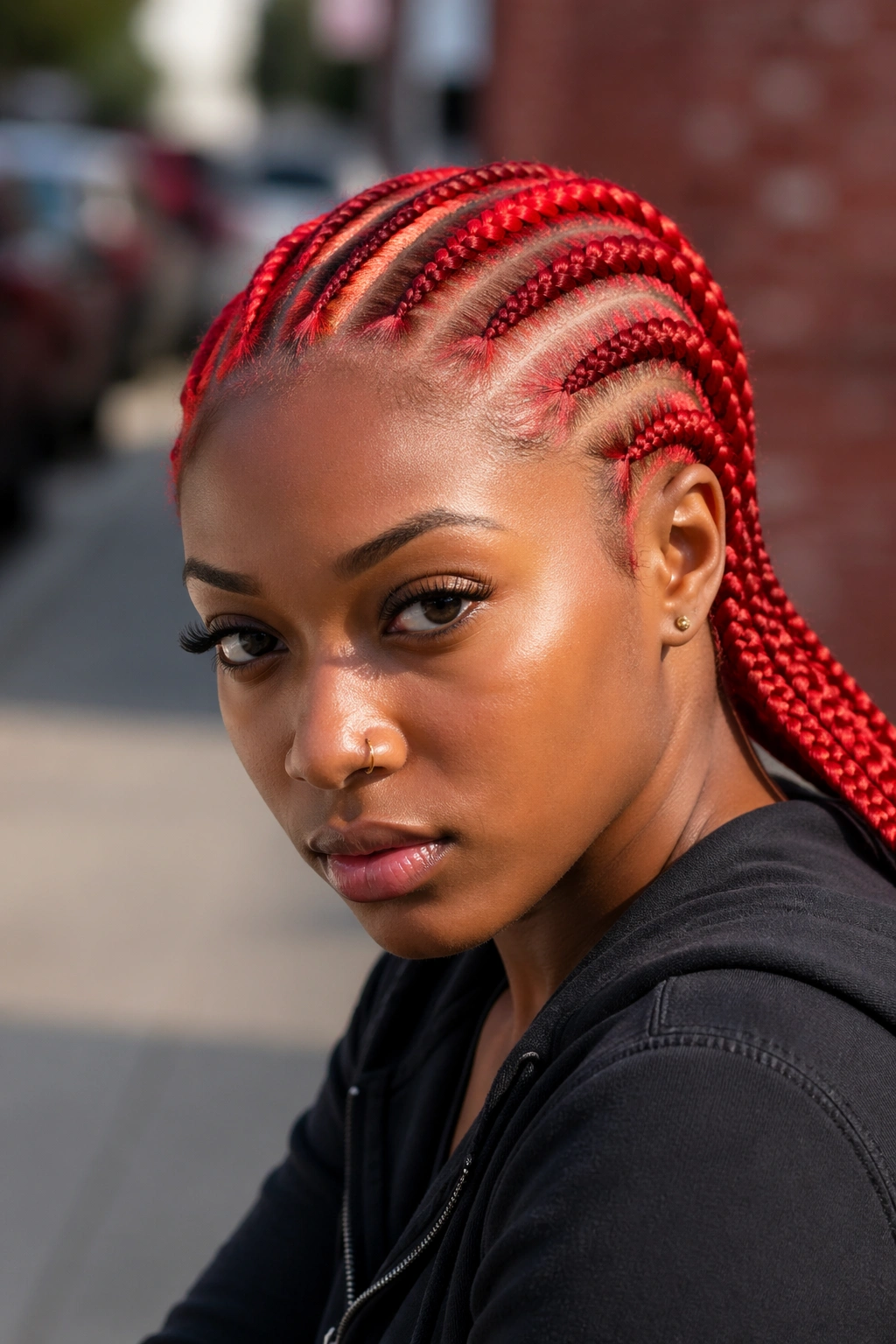
Eight feed-in cornrows in true cherry red, the kind of shade that demands a second look on the street. This is bold, unambiguous color.
Cherry red sits at the brightest end of the red spectrum without crossing into pink or orange territory. It’s vivid, saturated, and carries strong personality.
The eight-braid count creates more density than a six-braid install, which means more red is visible at any angle. The braids fill the visual space more thoroughly, making the color statement louder.
For events, performances, or anywhere you want to be unmistakable in a crowd, cherry red feed-ins do the job. They photograph as a clear red — not orange-red, not magenta — across all lighting conditions.
The downside of cherry: it’s a high-maintenance color visually. Any frizz or fuzz shows up against the bright base. Stay diligent with edge control and overnight bonneting to keep the look crisp.
3. Copper Feed-In Cornrows With A Side Part
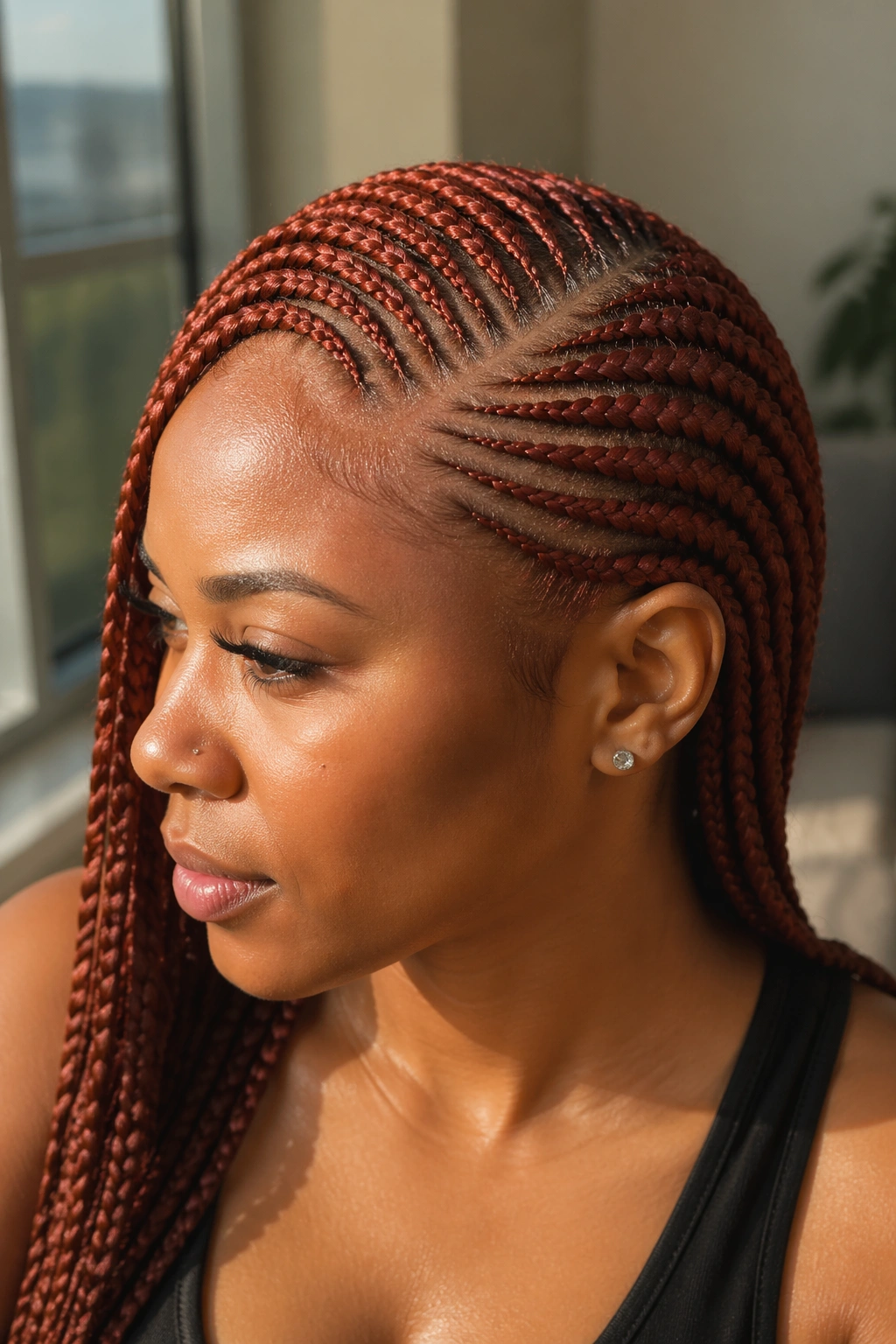
A copper-red shade that lands between auburn and ginger. The braids run from a deep side part across the head, sweeping into a diagonal flow that reads as artistic and intentional.
Copper has more warmth and less depth than burgundy. It’s the shade that looks like it was kissed by the sun rather than dyed in a bottle. Especially flattering on warm-toned skin and people with naturally copper undertones in their natural hair.
The side part adds asymmetry to the color, so the eye sees more red on one side of the head and more scalp on the other. This imbalance reads as a styling choice, not an accident.
Copper kanekalon often blends well with warmer-toned natural hair colors at the root, creating an even more seamless feed-in transition.
4. Two-Toned Red Feed-Ins With Burgundy And Wine
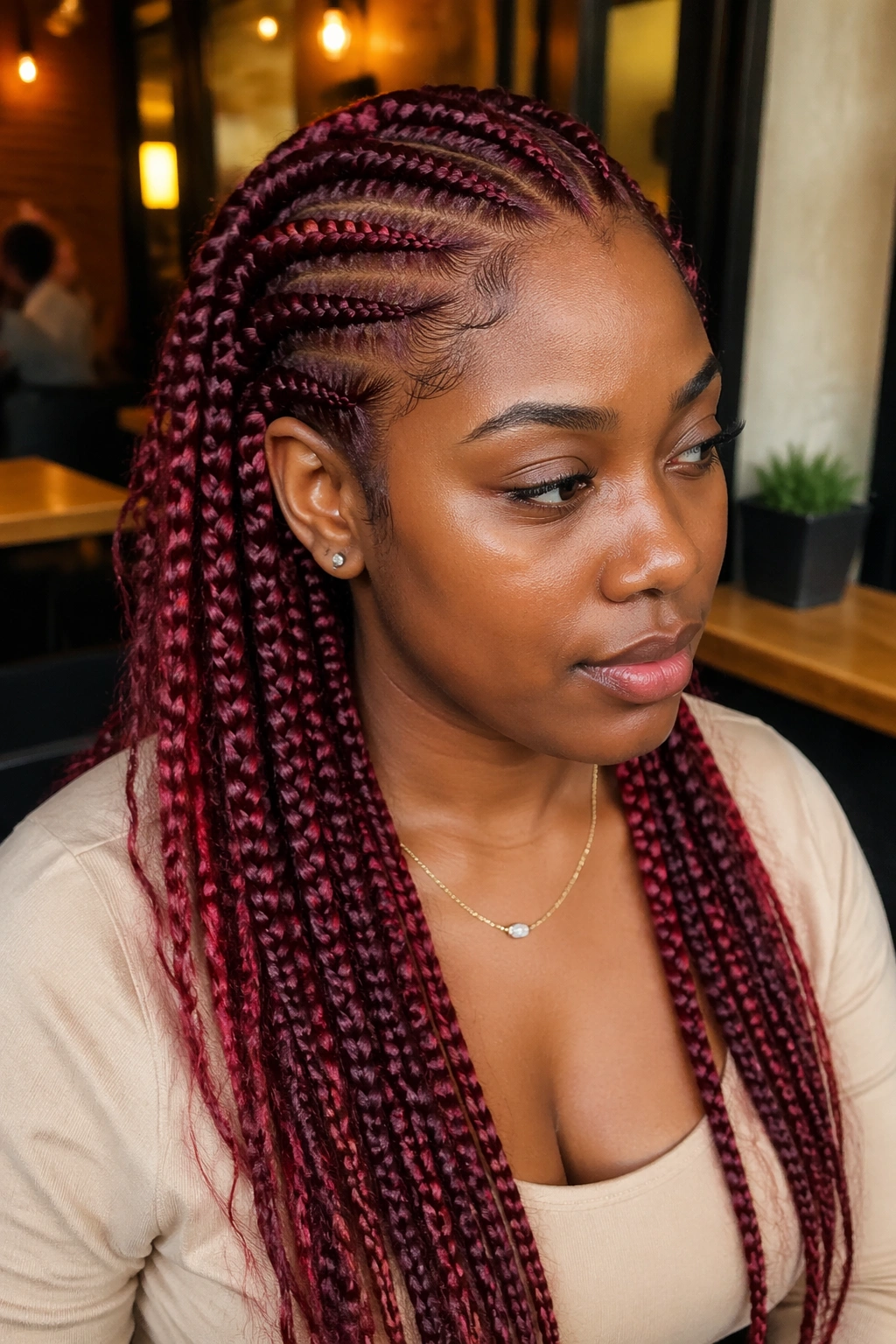
Two shades of red mixed within the same braids — burgundy as the base and wine as the highlights, or vice versa. The mixing creates dimensional color that looks more natural than single-shade red.
How To Style It
The two-tone effect is achieved during installation. The braider takes one strand of burgundy and one strand of wine kanekalon, twists them together loosely, then feeds them into the braid as one piece. The colors interweave naturally throughout the braid length.
Done well, the result looks like richly highlighted hair — like color that grew in dimensionally rather than being applied as one flat tone.
This style works well for people who want the impact of red color but find single-shade reds too bold. The dimensional mixing softens the visual intensity while keeping the color presence.
5. Fire Engine Red Cornrows With Beaded Ends
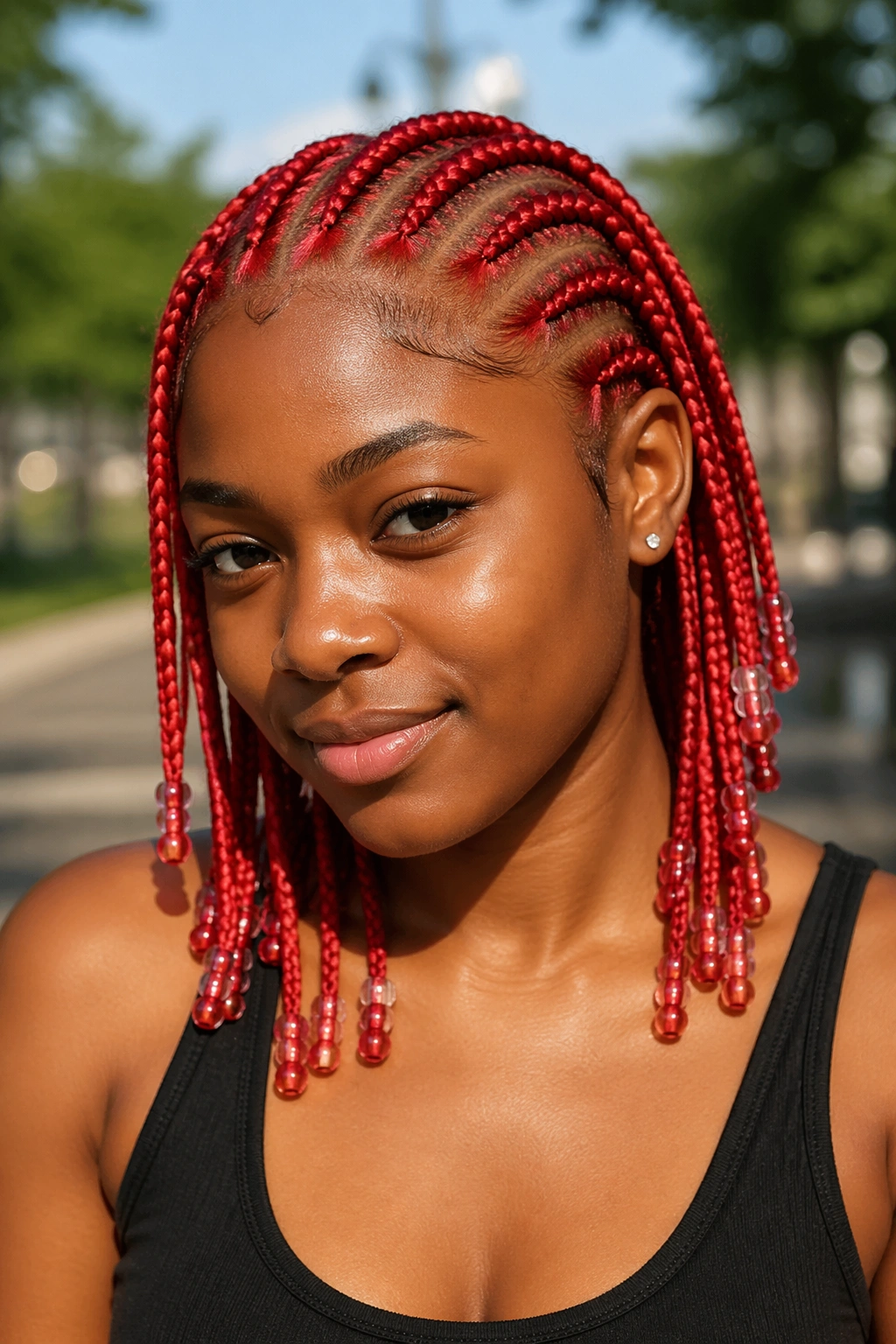
The brightest end of the red spectrum. Fire engine red is the shade of stop signs, fire trucks, and 1990s lipstick. There’s no subtlety to it — it announces itself with full volume.
Combined with beaded ends in either matching red or contrasting black/gold, the style reads as deliberately maximalist. Six or eight feed-in braids in fire red, each ending with two or three beads that clink against each other when you move.
Fire engine red shows fading more than darker reds. The bright pigment loses intensity faster with sun exposure and washing. Plan to keep this style for two to three weeks max if you want the color to stay vivid throughout.
For deep skin tones, fire red creates dramatic contrast that photographs as editorial. For lighter skin tones, the same color can read as softer because of how the contrast plays out.
6. Auburn Red Feed-Ins Subtle Style
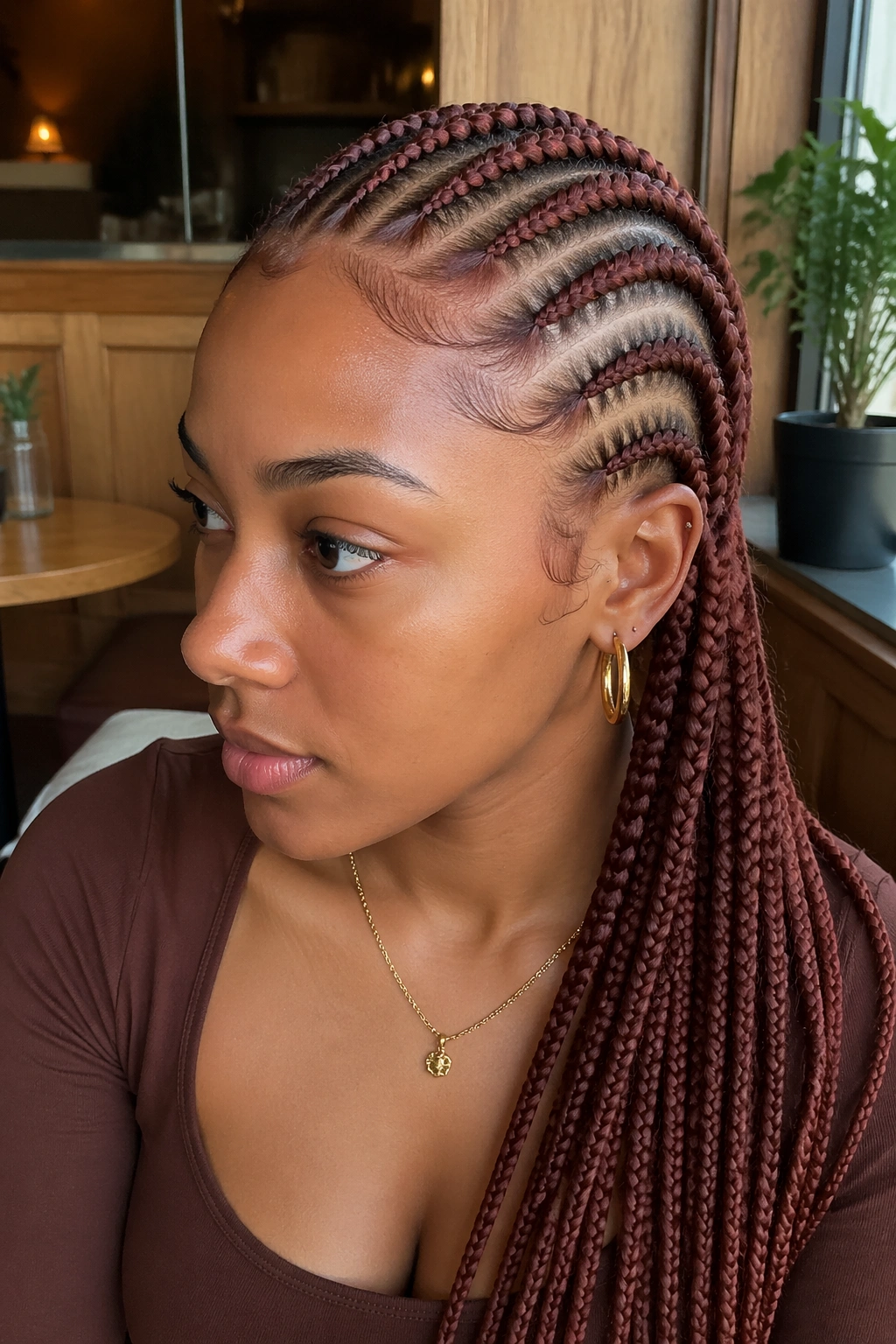
Auburn is red-with-brown — a muted, natural-looking red that mimics what some people are born with. It’s the most “real” looking of the red kanekalon shades.
Who This Is For
People who want a color change but don’t want everyone to immediately know they have extensions. Auburn reads as your natural color with a slight twist, which makes it the most beginner-friendly entry into red feed-ins.
The subtle nature of auburn means the feed-in transition is barely visible. Where bright reds make the natural-to-color shift obvious, auburn blends so smoothly that the braid looks all one color from root to tip.
Pair auburn with neutral makeup and earth-toned clothing for an autumnal aesthetic that feels cohesive across the whole look.
7. Wine Red Cornrows With Curved Front Parts
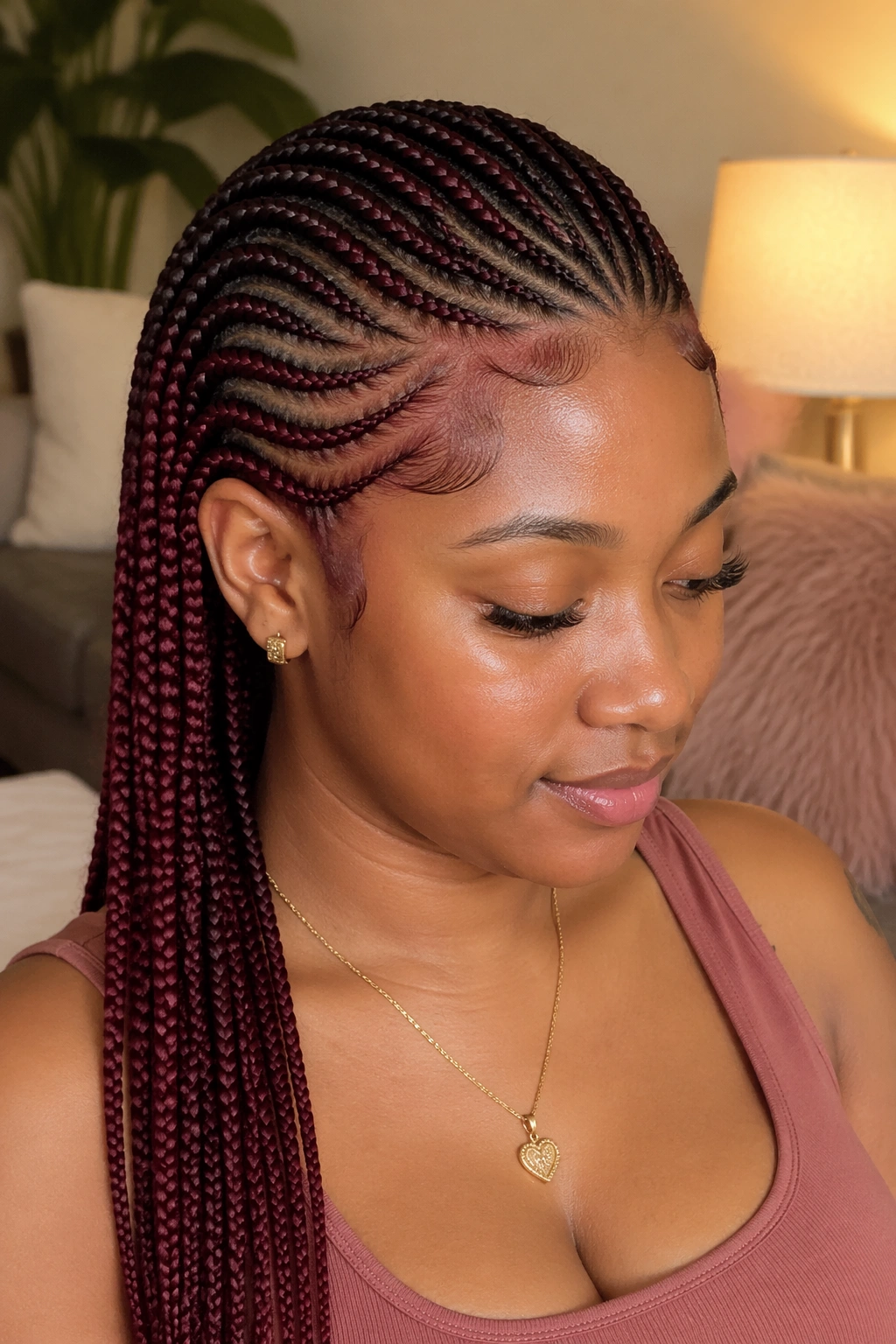
Wine is a deep, plummy red — almost purple-leaning. The curved front parts add elegance to the dark, rich color, creating a style that reads as romantic and feminine.
The curves at the front frame the face with arcing lines rather than rigid straight parts. Combined with the wine color, the effect is soft and flowing despite the structured braided foundation.
Wine kanekalon doesn’t bleed as aggressively as brighter reds because the deeper pigments are more stable. This makes wine a practical choice if you’re worried about color transfer to clothes or pillows.
Style wine red with cool-toned makeup — berry lips, mauve eyeshadow, silver jewelry — for a cohesive look that emphasizes the color’s purple undertones.
8. Red Ombre Feed-Ins From Black To Bright Red
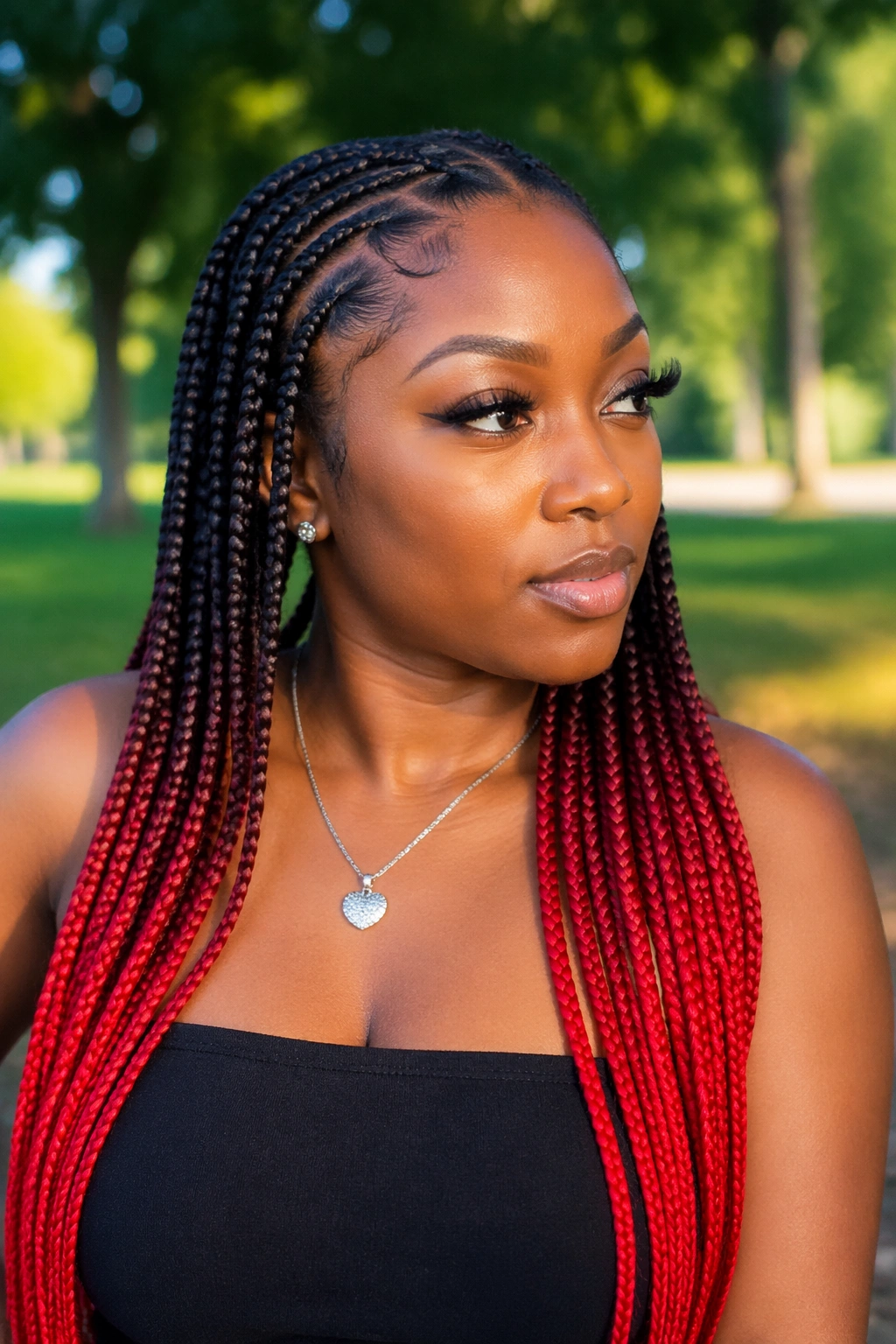
The braid starts with natural black at the root, transitions through deep burgundy in the middle, and finishes with bright red at the ends. The gradient happens over the full length of the braid.
Ombre kanekalon comes pre-colored, which saves time and money. Look for packs labeled “T1B/red” or “1B/burgundy/red” for the gradient effect.
The gradient is most visible on longer braids — at least 18-24 inches of finished length. Shorter braids don’t have enough vertical space for the color transition to register clearly.
This style gives the impression of progressively more dramatic color as you move down the braid. The eye starts with the familiar dark root and follows the color shift into bold red at the ends.
9. Ginger Red Cornrows With Stitched Detail
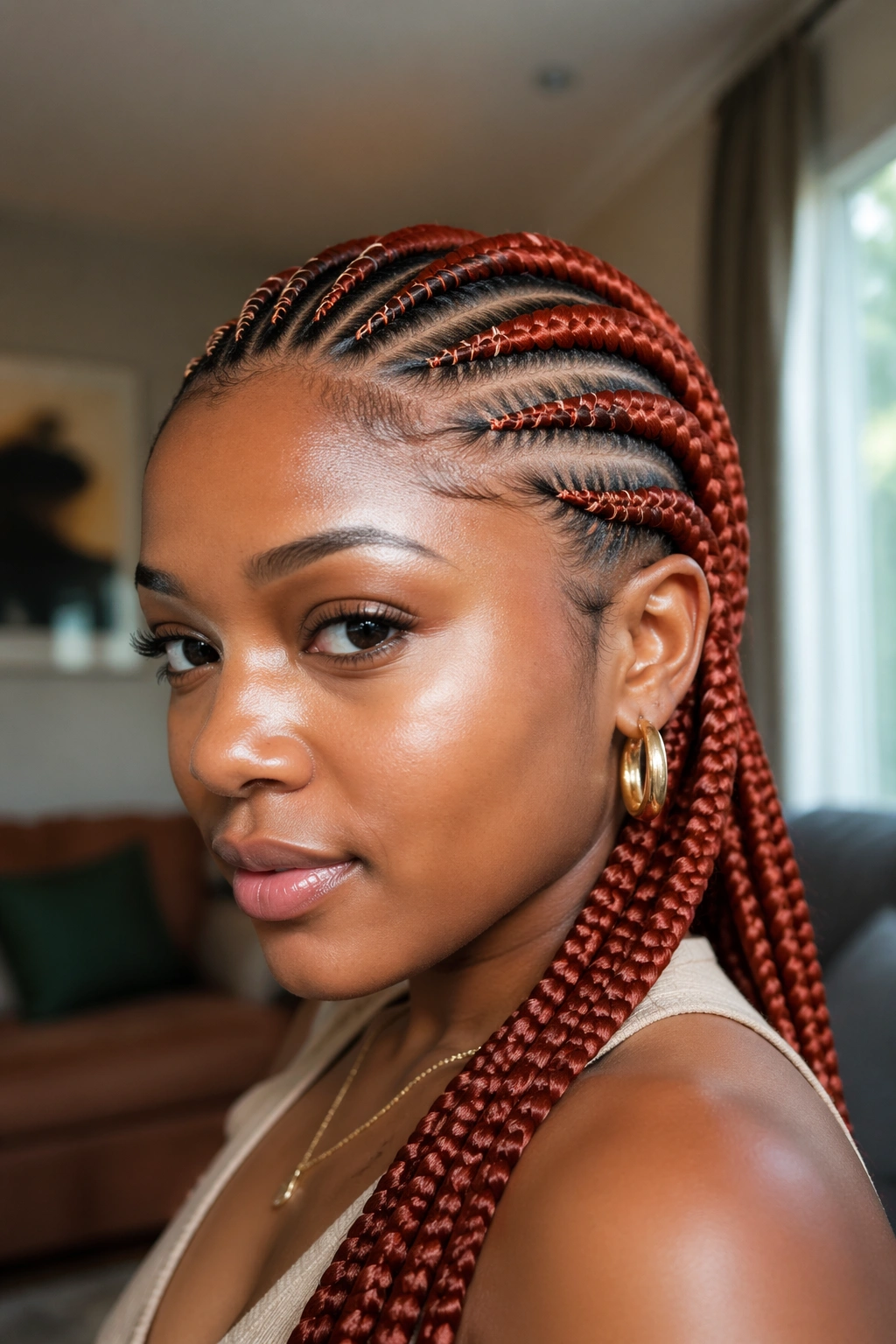
Ginger sits in the orange-red zone — warmer than copper, brighter than auburn. The stitched braid pattern adds horizontal lines that catch light against the warm color.
What Makes It Different
Stitch braids in ginger create a textured, detailed look that pulses with warmth. The horizontal stitches break up the color visually, creating bands of light and shadow along each braid.
Ginger looks especially good on warm-skinned women with hazel or golden eyes. The color pulls out warmth in the complexion and brightens the overall appearance.
Stitching adds 1-2 hours to the install time. The combination of detailed stitch work plus colored kanekalon is one of the more time-intensive feed-in installs, so plan for a long appointment.
10. Cherry Red Feed-Ins Into A High Ponytail
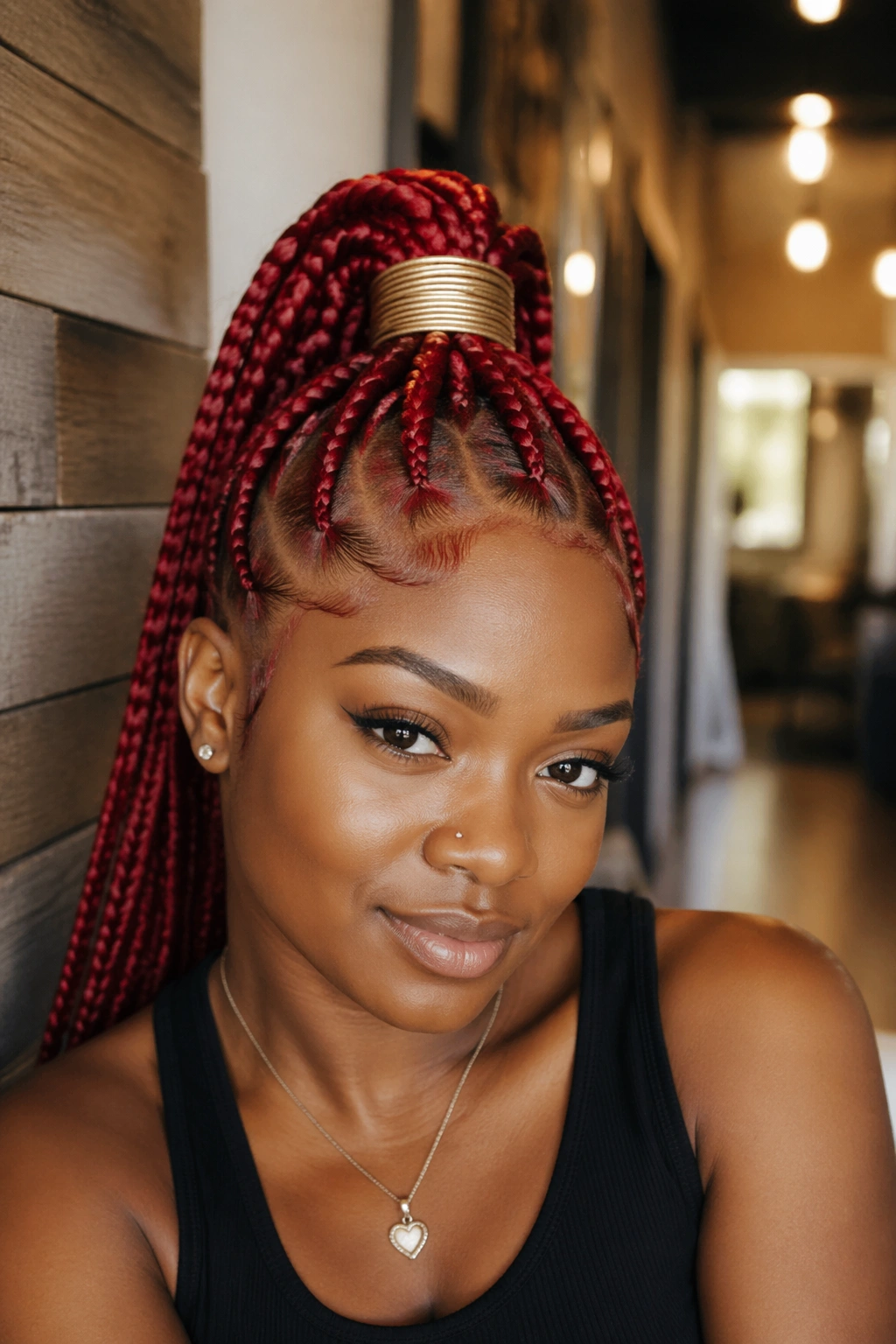
Six feed-in cornrows in cherry red, all gathered into a high ponytail at the crown. The bright color paired with the lifted pony creates a youthful, energetic look.
The high pony exposes more of the red color because the braids are pulled upward and the long pony length cascades down. From any angle, there’s red visible in motion.
Wrapping the pony base with a contrasting color (black, gold thread, or a fabric scrunchie) adds another design element to break up the all-red field.
11. Burgundy Cornrows With Gold Cuffs
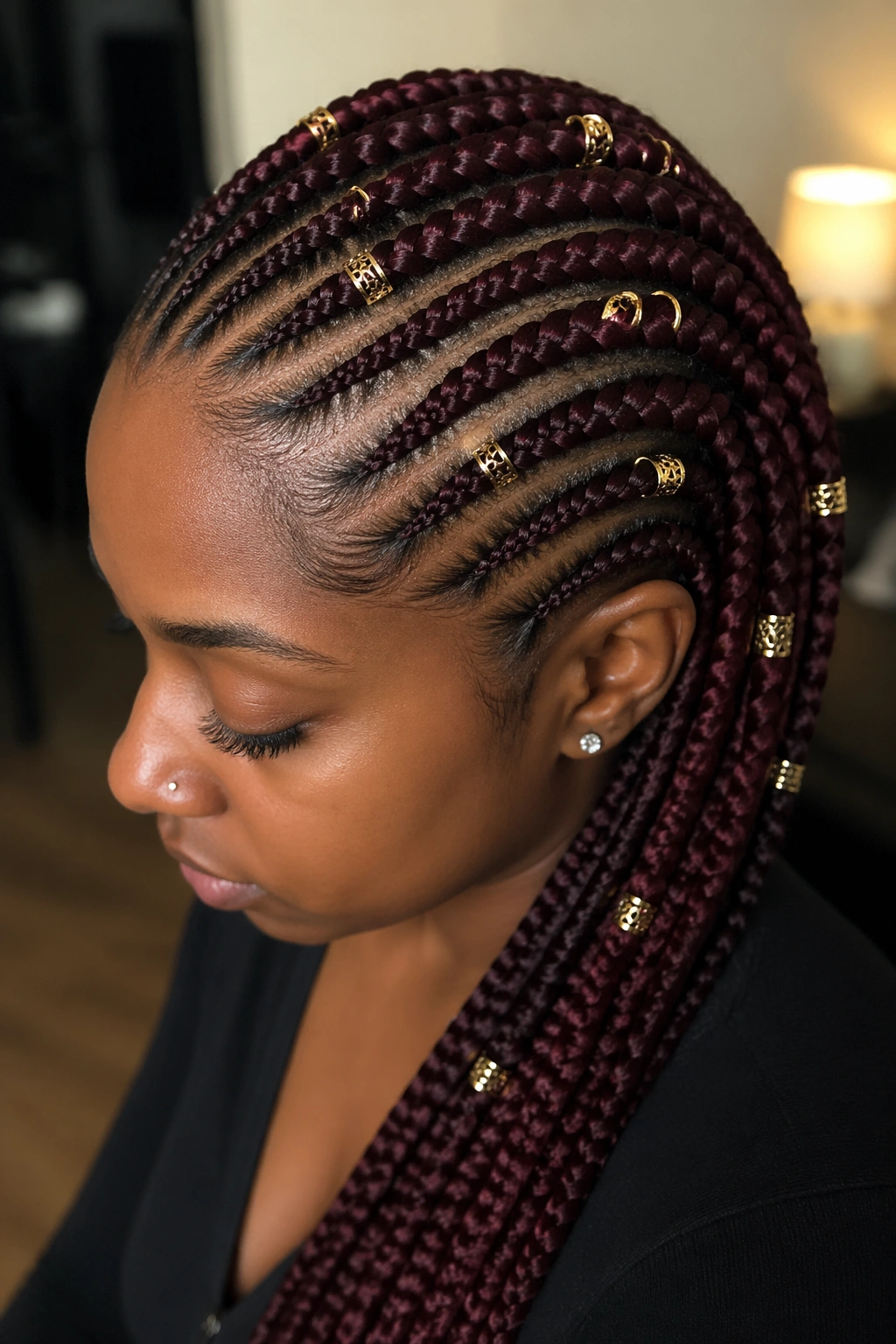
Deep burgundy braids with gold metal cuffs scattered across specific braids. The combination is regal — the rich red of the wine paired with the warm shine of the gold creates an opulent palette.
Place cuffs at varying heights for asymmetric visual rhythm. All cuffs at the same height looks militant and over-organized; staggered cuff heights look styled and intentional.
Gold paired with burgundy is a classic combination that goes back to traditional African and Middle Eastern jewelry traditions. The color story has historical depth, which adds to the look’s gravitas.
12. Rust Red Cornrows With An Asymmetric Cut
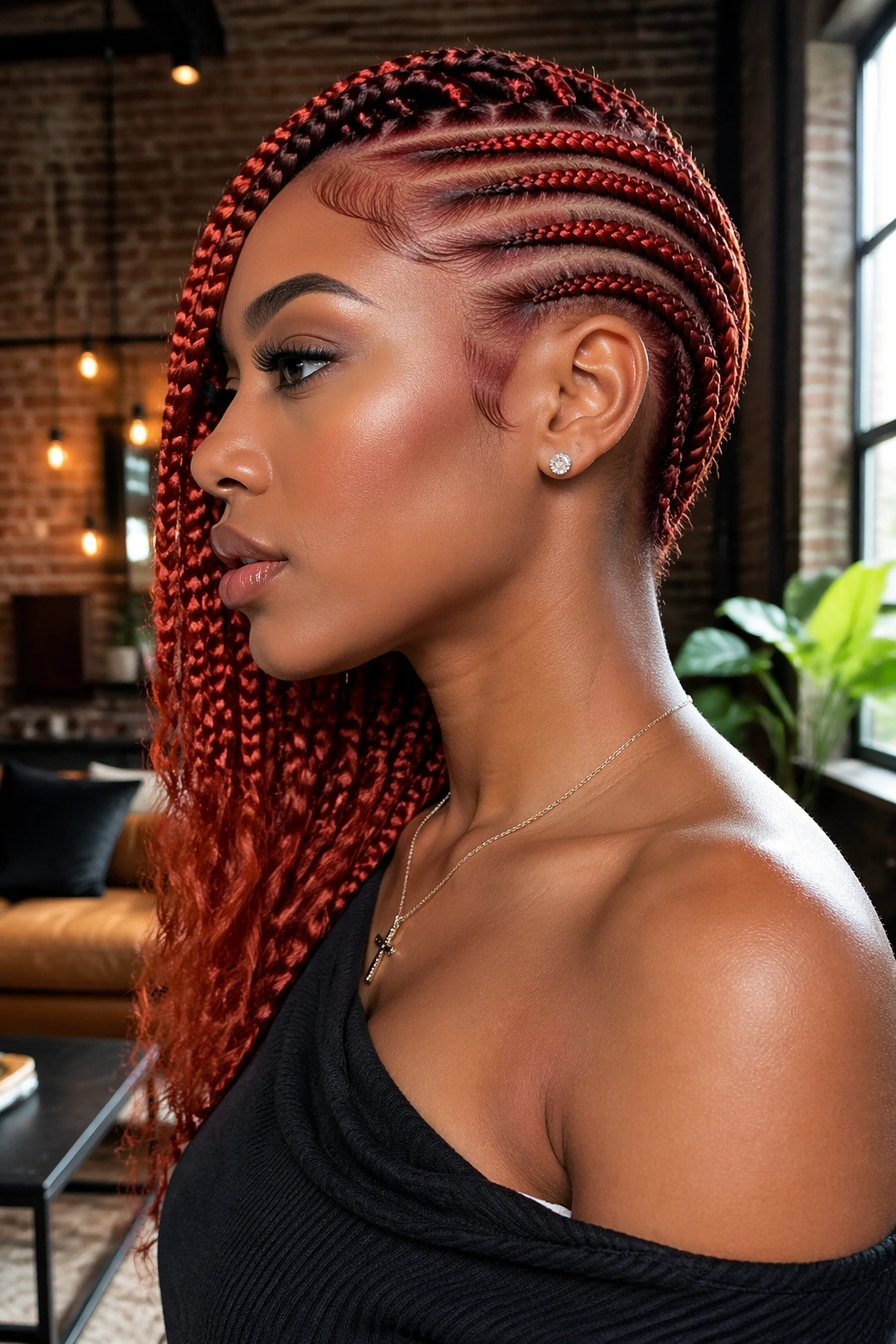
Rust red — a deep, oxidized orange-red — paired with an asymmetric cut where one side is shorter than the other. The braids on the short side end at the jawline; the long side flows past the shoulders.
The Catch
Asymmetric cuts require precise planning because the imbalance has to look intentional. Random length differences look like a mistake; deliberate asymmetric cuts look like editorial styling.
The rust color is muted enough that the asymmetric cut becomes the primary visual focus. If you used a brighter red, the color and the cut would compete for attention.
Maintain the asymmetry by trimming both sides as the braids age. Even a half-inch of growth on the short side disrupts the visual balance.
13. Wine Red Feed-Ins With A Low Sleek Pony
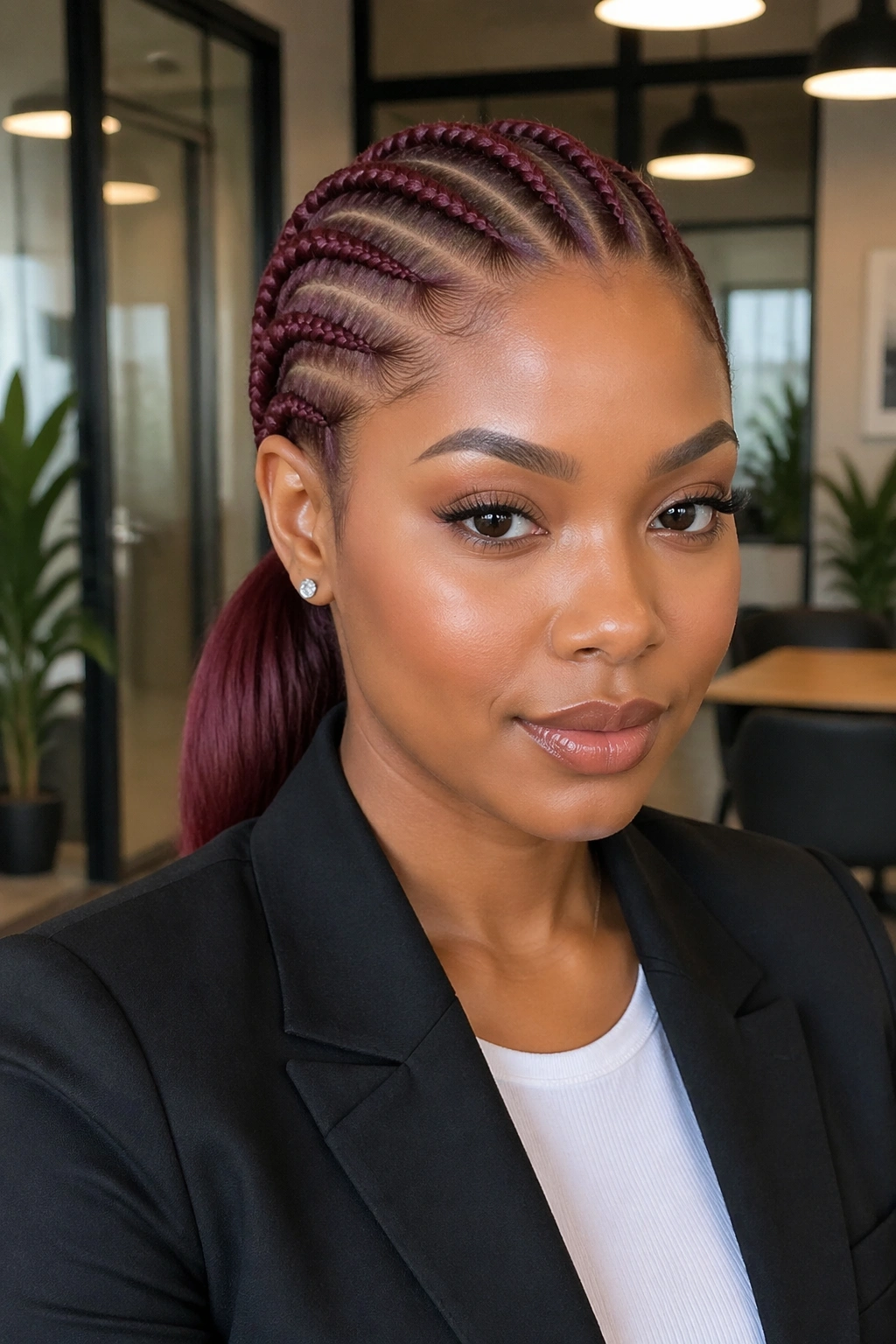
Six wine feed-in cornrows pulled into a low, polished ponytail at the nape. The pony is wrapped with a strand of matching wine kanekalon for a clean finish.
This is the professional-friendly version of red feed-ins. Wine is dark enough to read as conservative in office settings, and the low sleek pony reinforces the polished aesthetic.
For maximum sleekness, apply edge control along the entire braid length, not just the hairline. Smooth with a boar-bristle brush before securing the pony.
14. Cherry Red Cornrows With Beaded Crown Detail
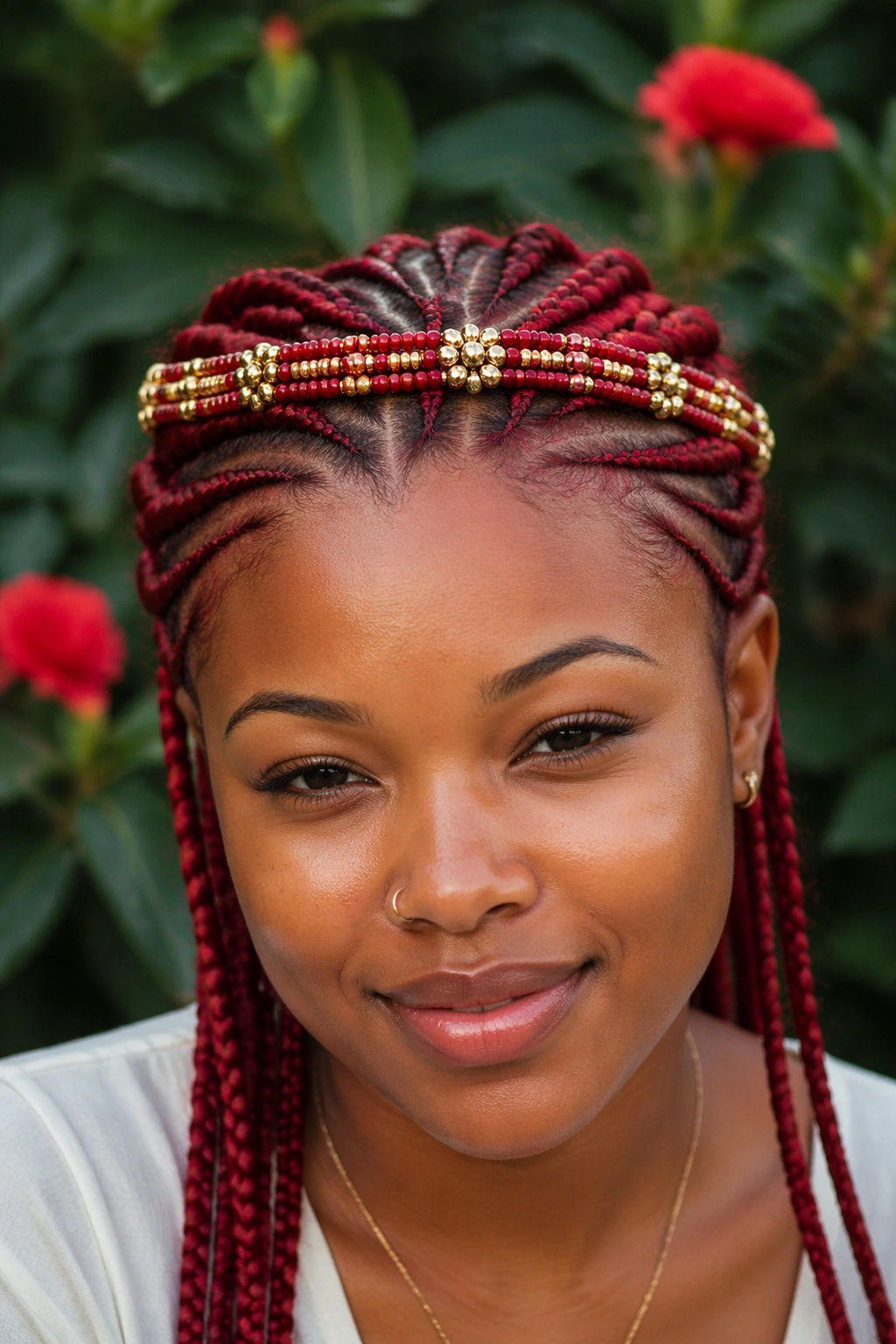
Beads woven into the braids around the crown of the head, forming a horizontal beaded band that circles the upper portion of the head. The cherry red base color shows through between the beads.
The beaded crown takes additional install time — each bead is threaded individually onto specific braids. The result looks ceremonial and intricate, like a built-in headpiece.
Choose bead colors that contrast with the cherry red. Black beads, white beads, or gold beads all create visible contrast. Red beads disappear into the red braids and waste the design effort.
15. Copper Red Cornrows With A Diagonal Sweep
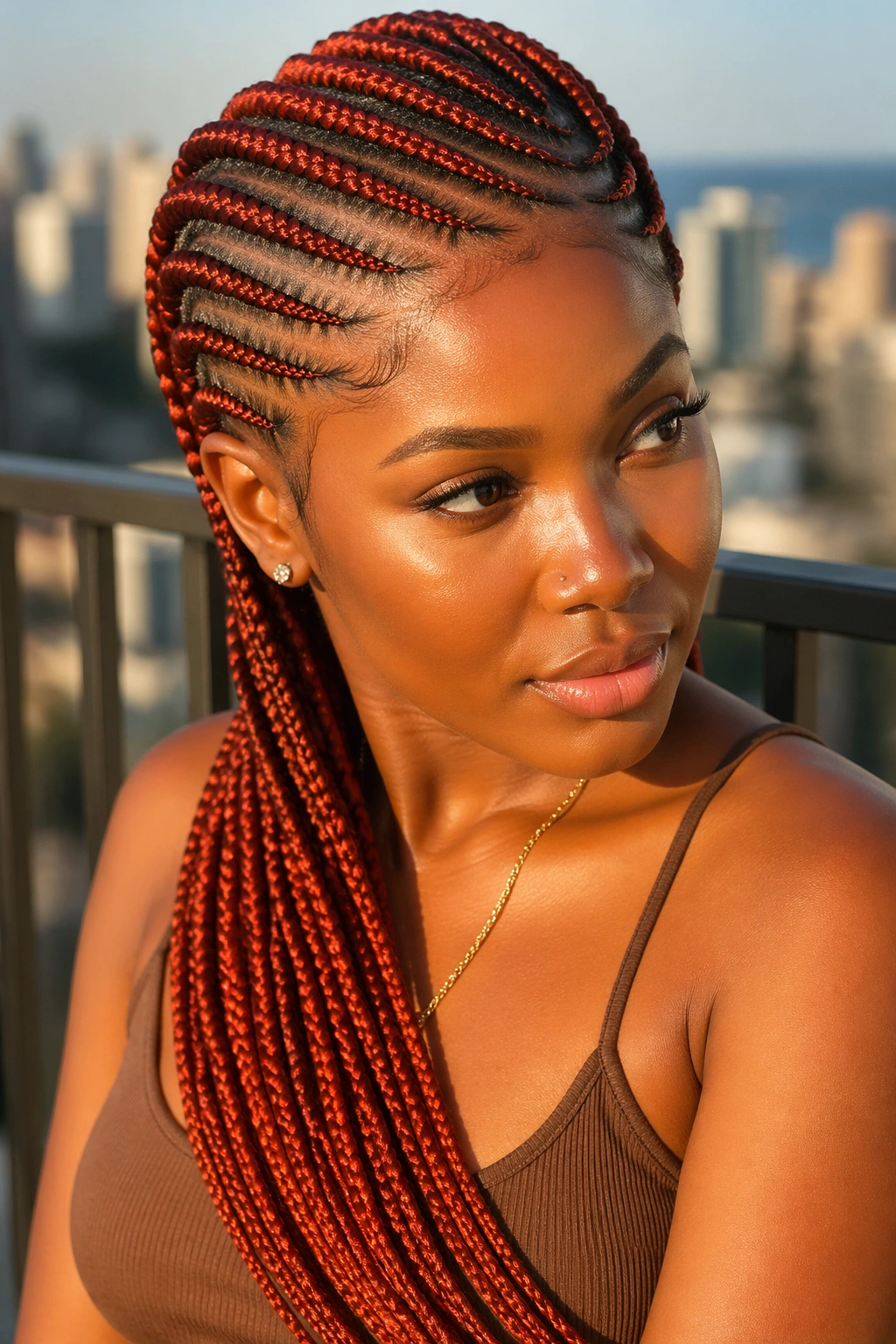
All braids angled diagonally across the head, ending at the opposite shoulder rather than running straight back. The copper color combined with the dynamic sweep creates dramatic movement.
Styling Tips
Diagonal sweeps need consistent angles. All the braids should curve in the same direction at roughly the same angle, or the sweep loses its visual coherence.
The braids on the “downhill” side land on the shoulder. The braids on the “uphill” side end higher on the back. This intentional length difference is part of the sweep’s design.
Copper red looks especially good in this configuration because the warm tones catch sunlight at the angle the braids fall, creating an almost glowing effect when you move.
16. Two-Color Red Feed-Ins Mixing Burgundy And Copper
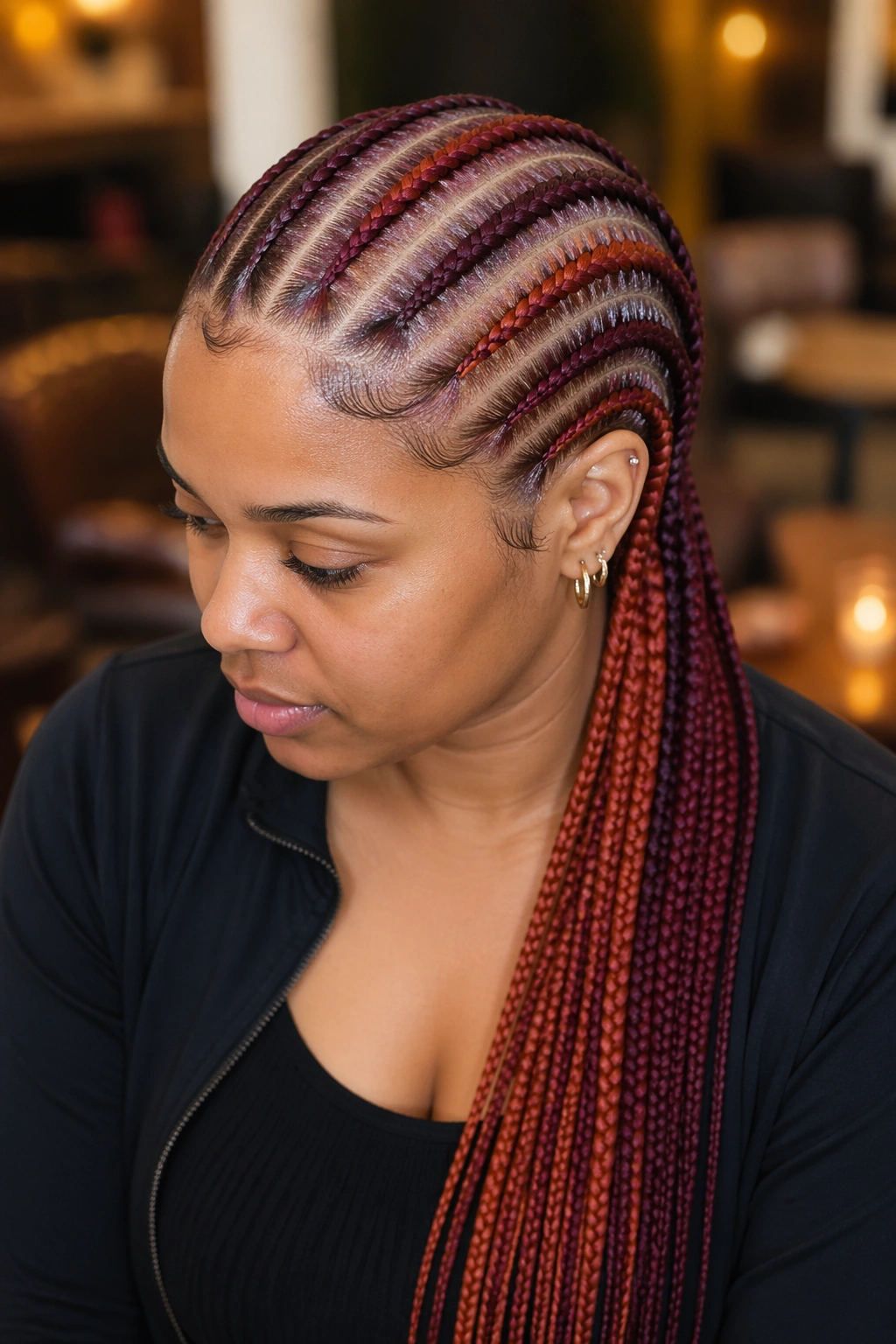
Half the braids are burgundy, half are copper, alternating across the head. The two reds sit close enough on the color spectrum that they read as related rather than clashing, but distinct enough to create visible variation.
This style requires careful planning. The braider needs to track which braid is which color so the alternation stays consistent. A typical pattern is burgundy-copper-burgundy-copper across six or eight braids.
The visual effect is dimensional red color across the head, like a forest of autumn leaves rather than a single uniform shade.
17. Auburn Cornrows With A Natural Hair Pop At The Front
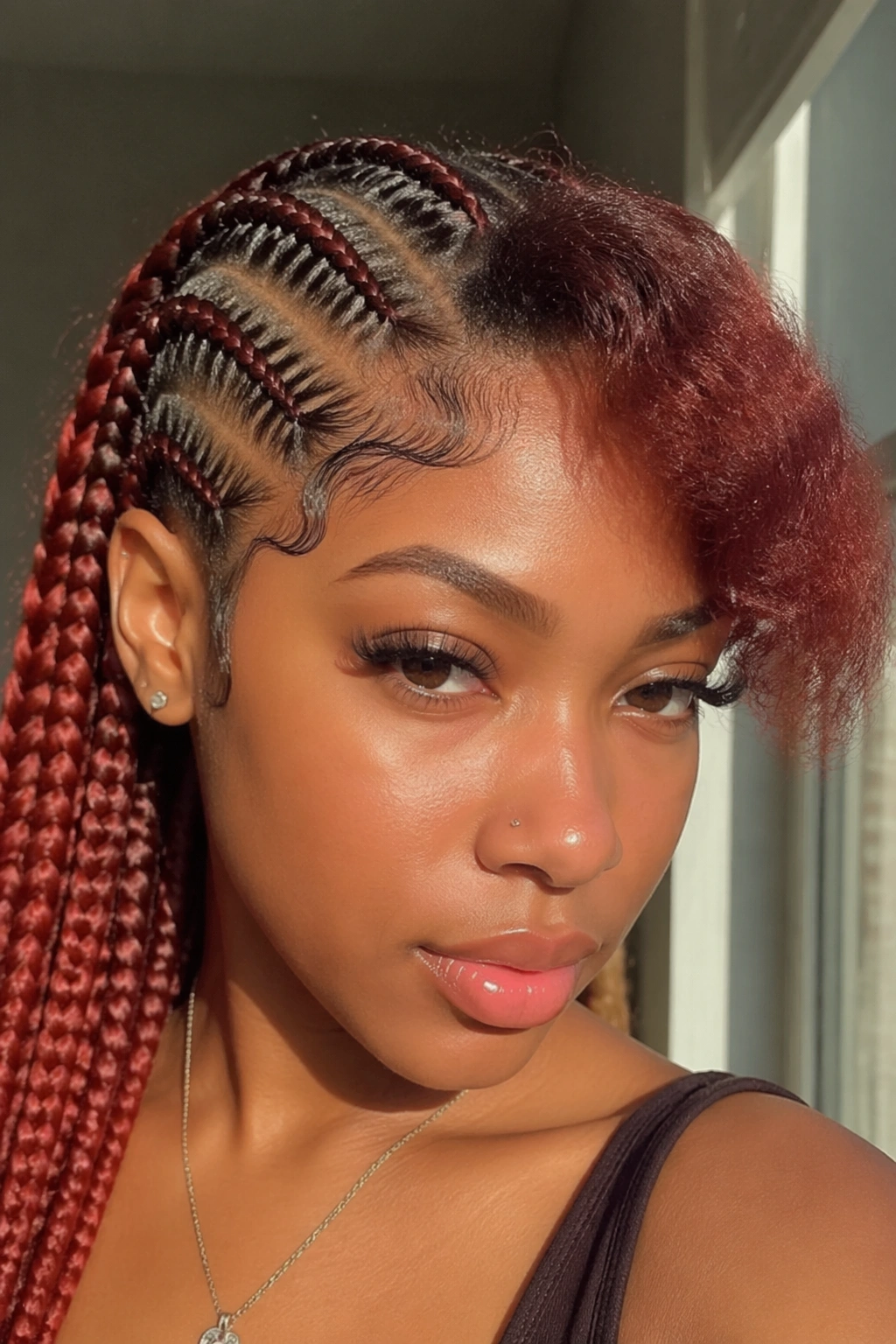
The braids are auburn red, but a small section of natural hair is left out at the front and styled as a swept bang. The contrast between the red braids and the natural hair adds visual dimension.
The natural section can be flat-ironed straight, curled with rods, or styled into a small puff above the braids. Each finish creates a different effect.
This style softens the impact of the colored braids by maintaining a connection to your natural color at the most prominent part of the face — the hairline.
18. Bright Red Feed-Ins With A High Bun
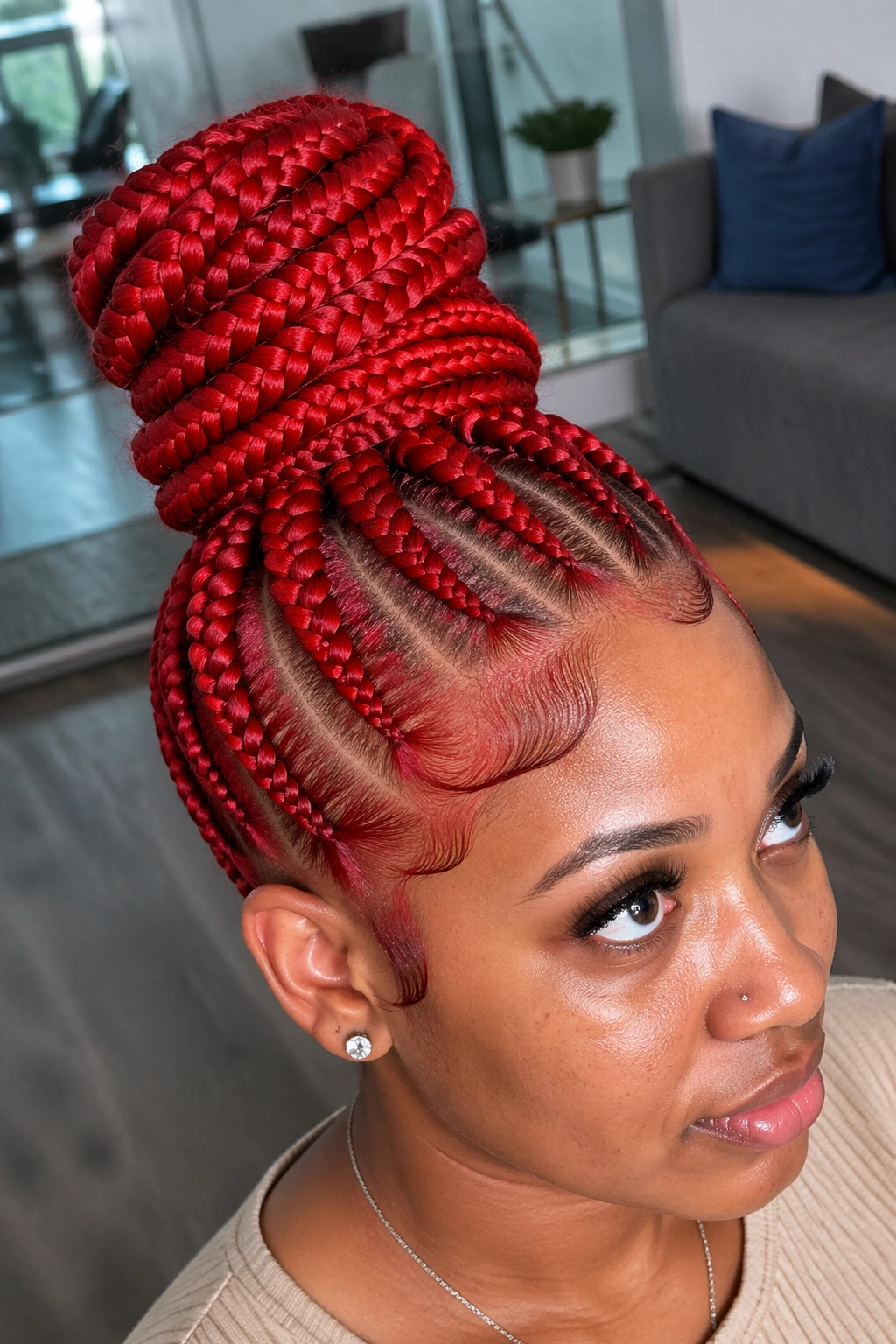
Eight feed-in cornrows in fire engine red, all gathered into a high bun at the crown. The bun is made from the braid lengths themselves, twisted and pinned into a coiled shape.
Who This Is For
People who want maximum color impact in a single style. The bright red plus the elevated bun creates a tall, dramatic silhouette that commands attention.
This is event-styling, not everyday wear. The intensity of bright red plus a structured high bun reads as deliberately styled for a specific occasion.
For longer wear, a less concentrated bun (more relaxed, less tightly coiled) is more practical day-to-day.
19. Wine And Black Striped Feed-Ins
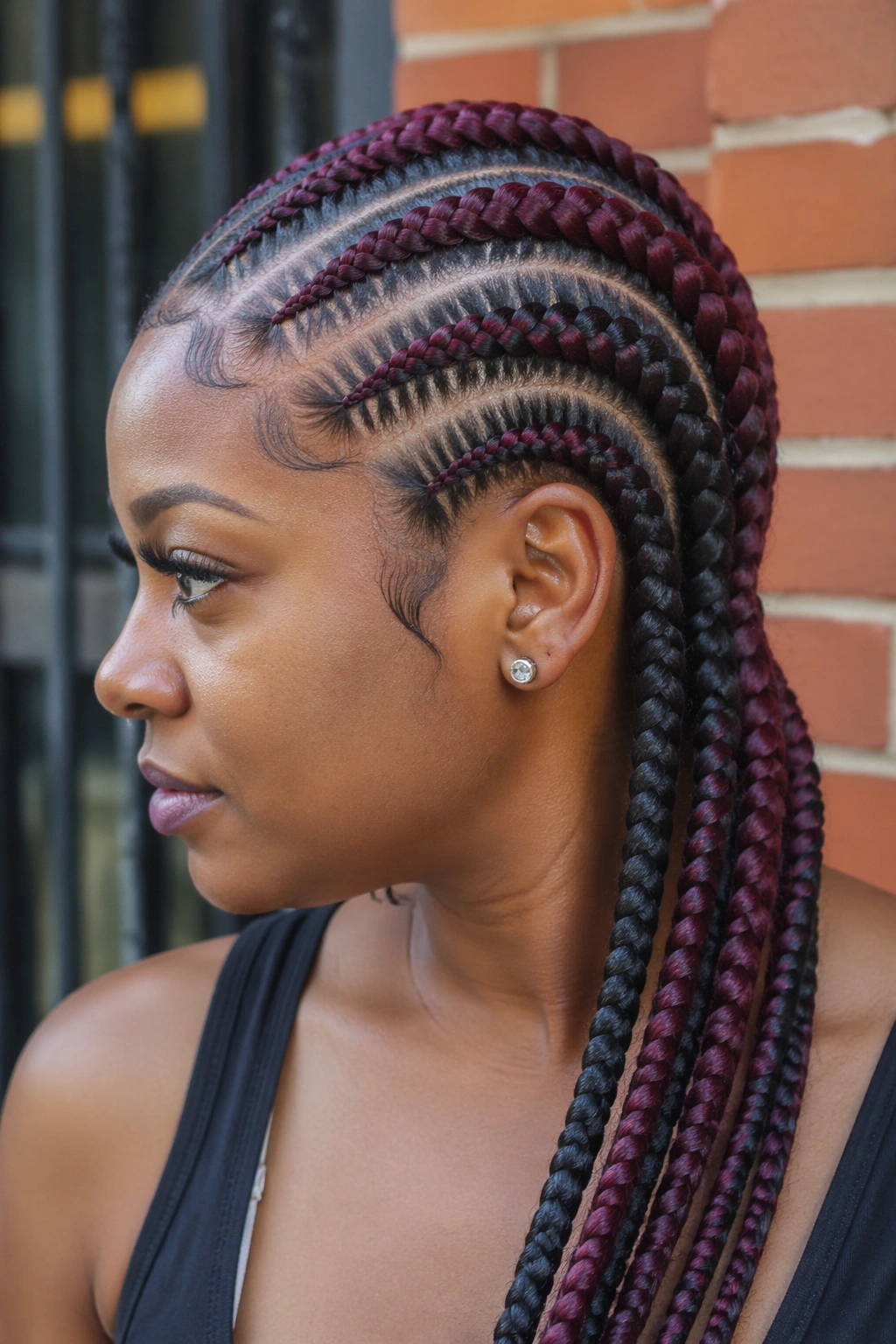
Alternating wine and black braids create a striped effect across the head. The contrast between the dark red and pure black is visible but not extreme — both are dark colors that share a similar value range.
The stripe pattern reads as deliberate and structured. It’s one of the few styles where the alternating color pattern enhances the geometric clarity of cornrows rather than competing with it.
Stripes work best with even braid counts (six or eight) so the alternation comes out symmetrical. Odd counts (five or seven) leave one extra braid that disrupts the rhythm.
20. Auburn Cornrows With Shell Or Cowrie Accents
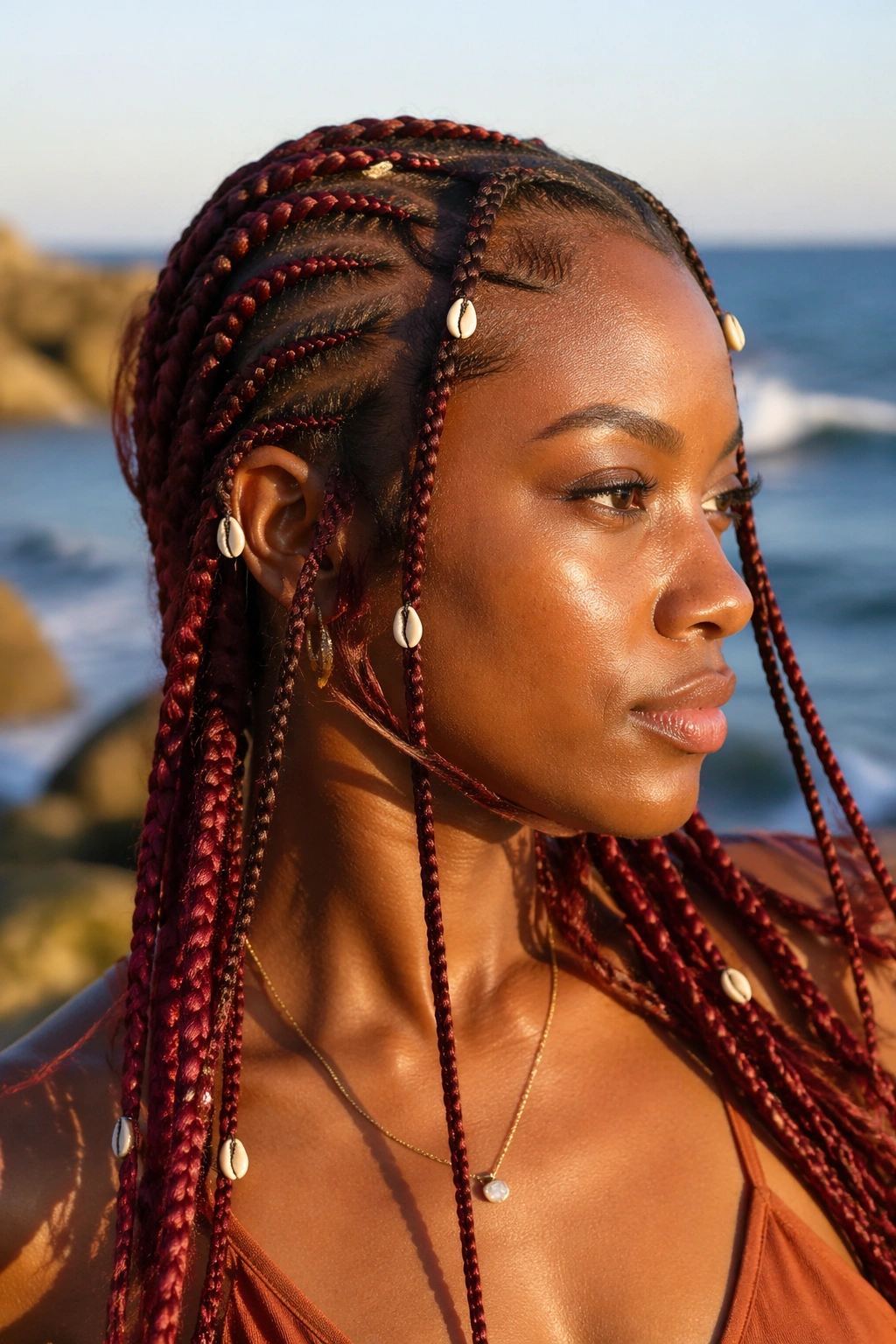
Auburn-red braids accented with cowrie shells or other natural shell ornaments woven into specific braids. The combination of warm red and creamy white shells creates an earthy, traditional aesthetic.
Cowrie shells have specific cultural significance in many West African traditions. Pairing them with red braids creates a styling choice that connects to ancestral hair practices.
The shells should be selected with the right size — large enough to be visible but not so large they pull on the braid base. Pre-drilled cowries with elastic threading attachments are easiest to install.
21. Burgundy Feed-Ins With A Side Bun
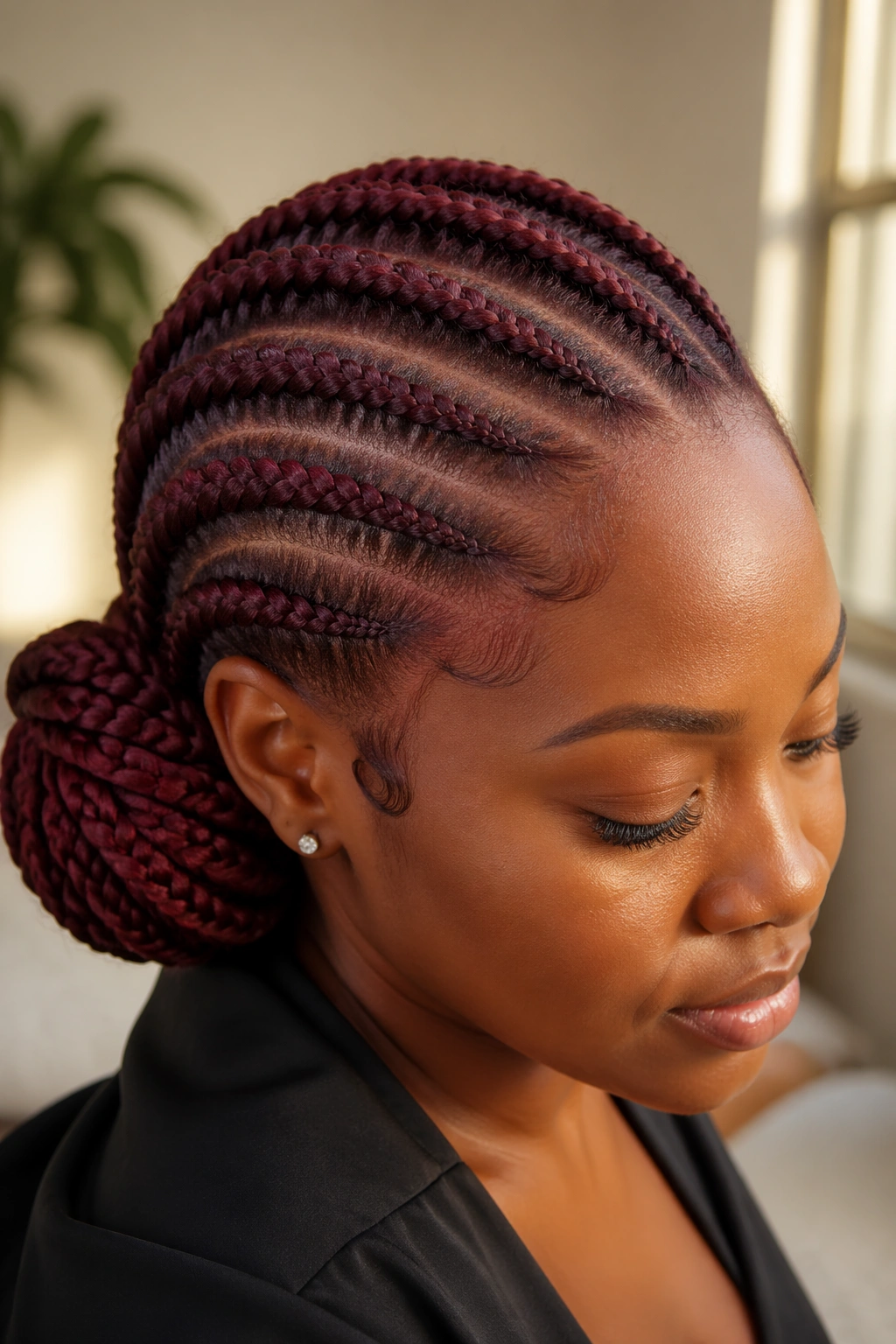
Six burgundy feed-in cornrows that all sweep to one side and gather into a low side bun. The bun sits behind one ear, creating an asymmetric, romantic silhouette.
Maintenance Notes
Side buns put weight on one side of the head, which can feel uneven over time. Switch sleeping positions throughout the night to prevent strain on one side.
- Use bobby pins to anchor the bun shape
- Smooth with edge gel for a polished finish or leave slightly fuzzy for a relaxed feel
- Add a flower or hair clip for evening events
Pro tip: For weddings, side buns photograph well from both the front and side angles, which is why they’re popular bridesmaids’ choices.
22. Multi-Tonal Red Feed-Ins With Gradient Effect
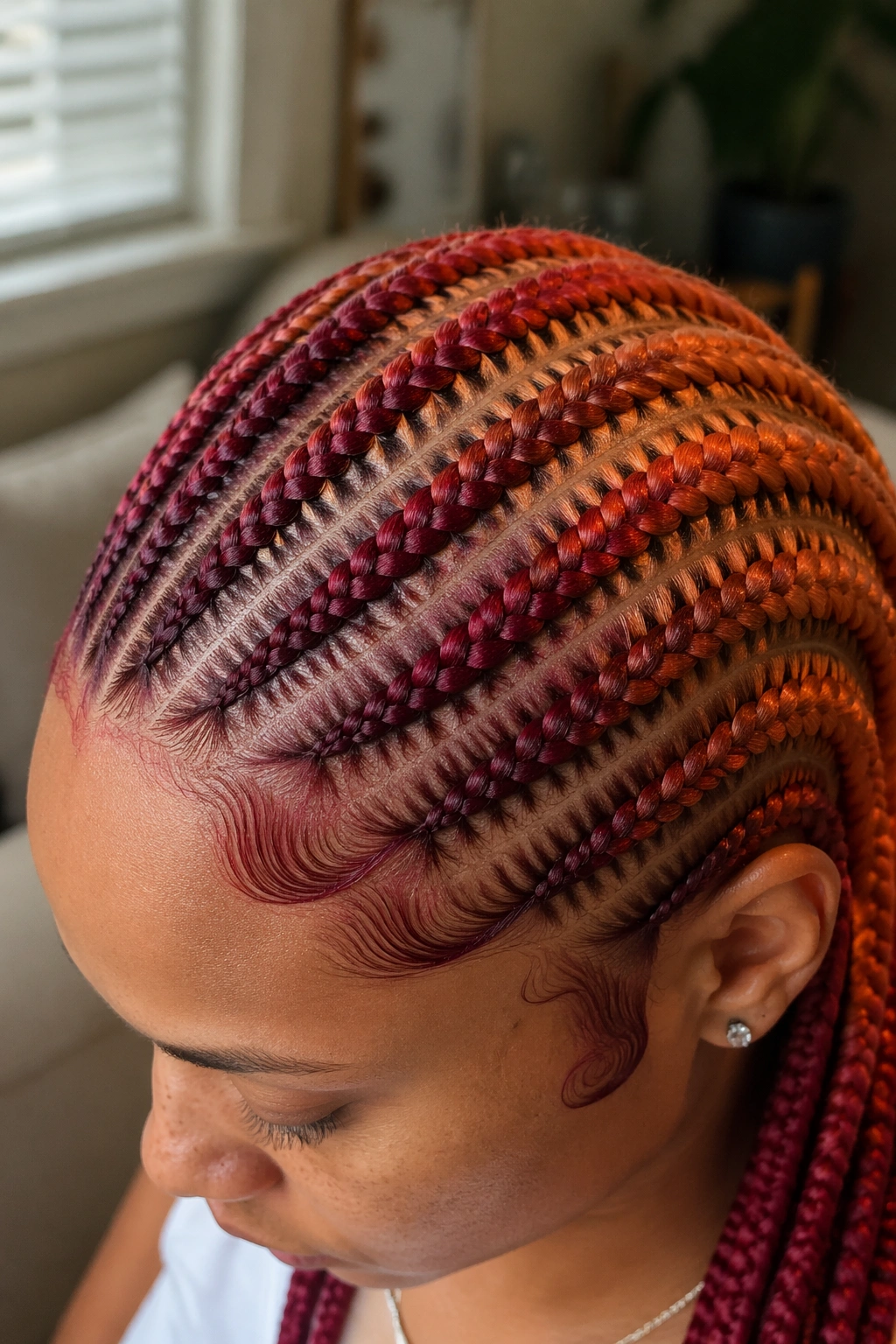
Multiple shades of red used across the head — burgundy at the front, copper in the middle, ginger at the back. The gradient creates a head of red that shifts color depending on the angle.
This is the most visually complex red feed-in style. The braider needs to track which shade goes in which section, and the install requires more pre-planning than single-color styles.
The result is a head of hair that looks dimensional from every angle. Move your head and the color seems to shift between shades. Photographs capture different reds depending on the lighting and angle.
Caring For Red Cornrows To Prevent Fading
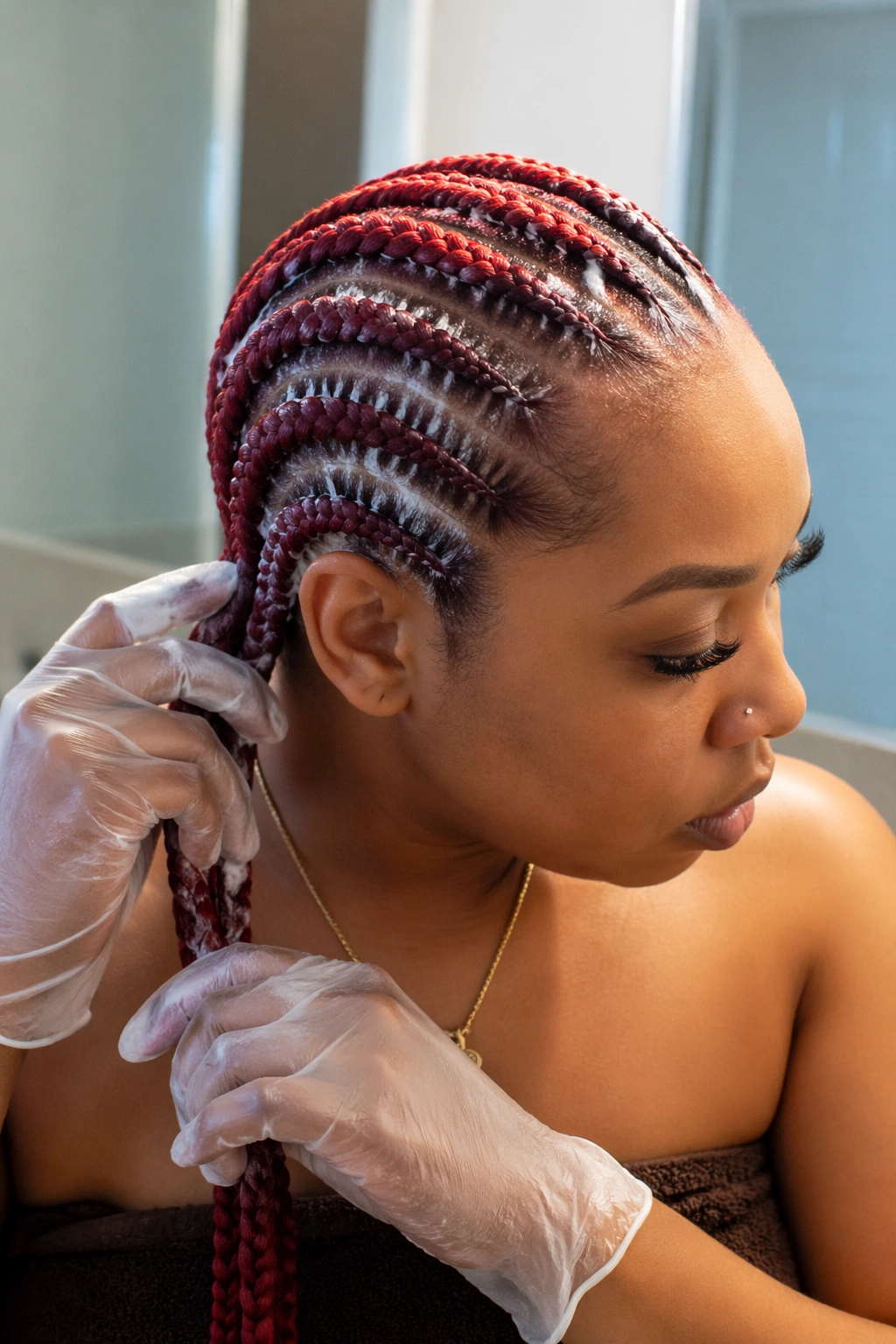
Red dye fades faster than most other colors. The first wash strips noticeable pigment; each subsequent wash strips a little more. To slow fading, wash less frequently — every 14 days rather than every 7 — and use cool water rather than hot.
Avoid clarifying shampoos after the first wash. They strip color along with buildup. Use a sulfate-free shampoo with conditioning agents instead.
Keep the braids out of direct sunlight when possible. UV exposure breaks down red pigments faster than other colors. A wide-brimmed hat or hood when you’re outside for extended periods extends the color’s life.
Sleeping And Bonneting With Red Braids
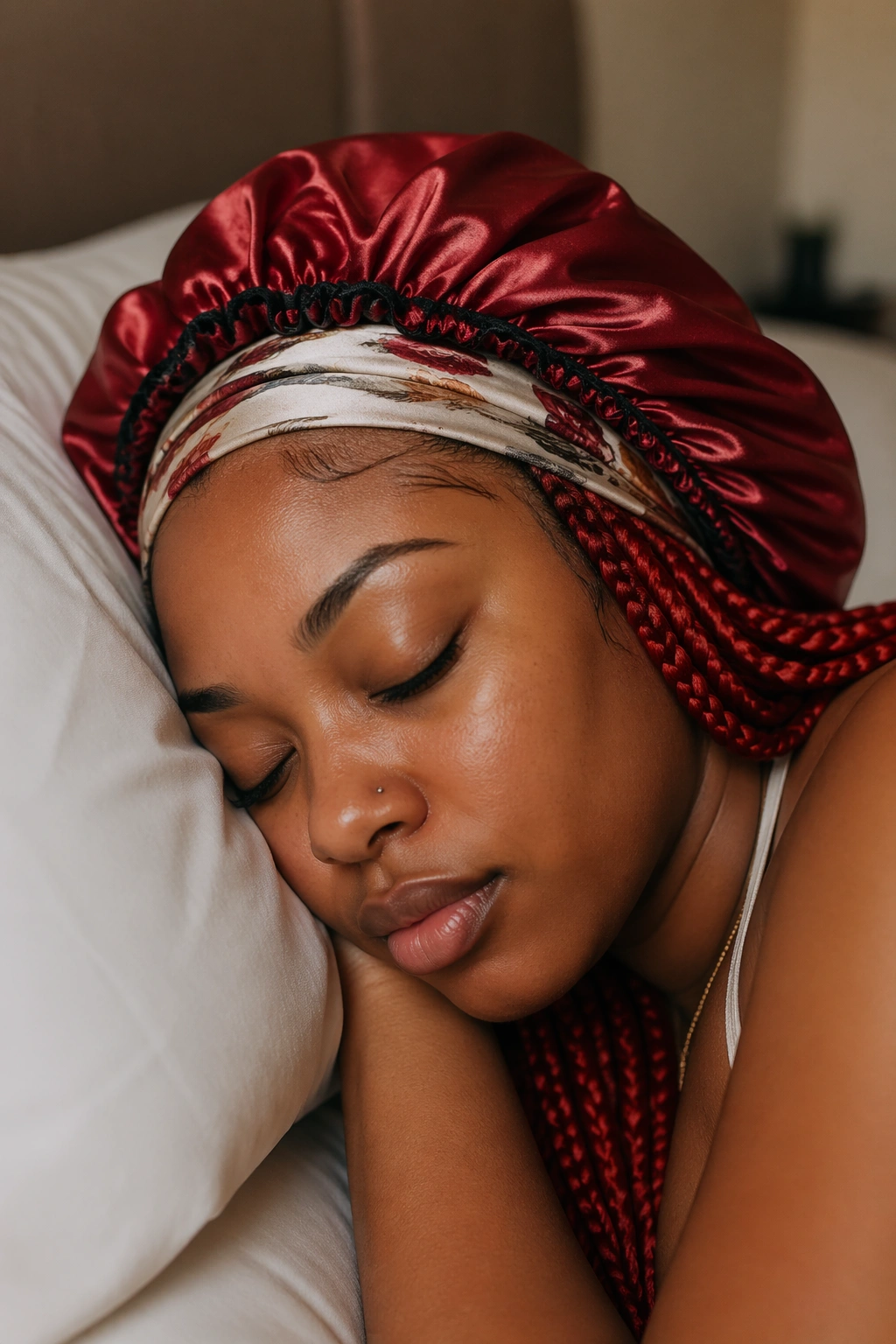
A satin or silk bonnet is non-negotiable. Cotton pillowcases pull color and moisture from the braids, accelerating fading and creating frizz.
For the first week of install, layer protection: silk scarf wrapped tightly first, then satin bonnet over it. The double layer prevents color bleed onto bedding while the kanekalon settles.
Wash the bonnet weekly. Color residue builds up inside the bonnet and can transfer back to the braids if not cleaned.
Refreshing The Color Mid-Wear
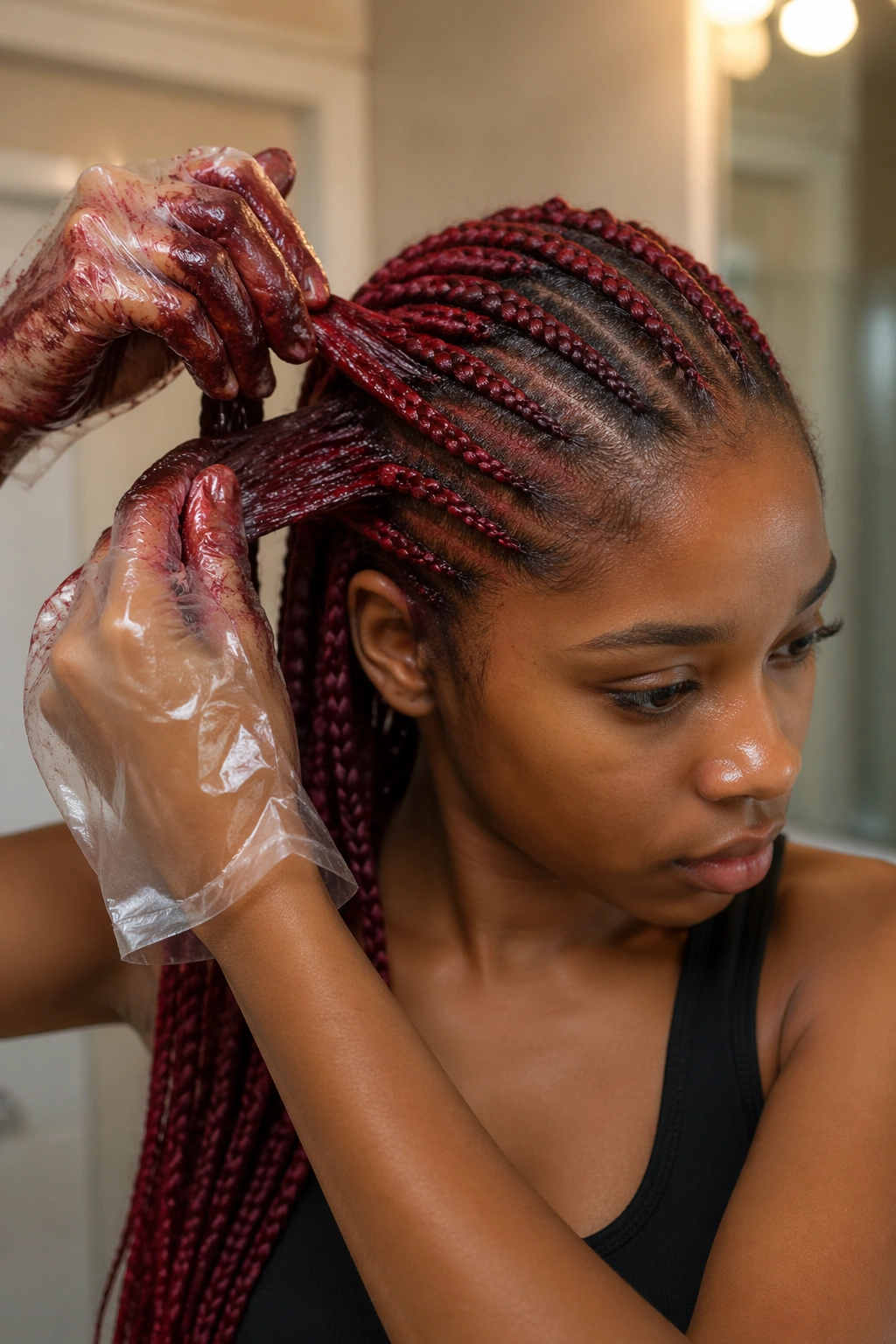
If the color fades noticeably during the wear period, you have options.
A semi-permanent color rinse can refresh red kanekalon. Apply with gloves, work through the colored portions of the braid, let sit per product instructions, and rinse.
Color-depositing conditioners (like the ones from ceremonia or arctic fox) work between washes to add a small amount of pigment back. Use them in place of regular conditioner during washes for ongoing color refreshment.
Don’t apply color refresh to your scalp or natural hair sections — only to the kanekalon portions where the color has faded.
Taking Down Red Cornrows Without Stains
Color bleed during takedown is real. Wear an old shirt and use dark towels.
Cut off the kanekalon tails first to remove most of the colored extension before unraveling. This significantly reduces the volume of dyed material you’re working with.
Spray each braid with a mix of water and conditioner before unraveling. The dampness helps the kanekalon release without rubbing against your natural hair.
After takedown, do a clarifying wash to remove any color residue from your scalp and natural hair. A second wash with regular shampoo and a deep conditioner restores moisture.
Some red dye may temporarily tint your natural hair, especially if your hair is light-colored to begin with. The tint typically washes out within 2-3 washes. If it persists, a clarifying wash with baking soda paste can lift the residual pigment.
