



The half-up half-down cornrow has a particular magic. You get the tidy structure of cornrows at the crown, paired with texture or movement below. Nothing pulled too tight, nothing fully contained. It’s the compromise style that somehow looks more put-together than either extreme.
Half up half down cornrow styles solve a problem most women know well: when you want the braids to show, but you also want some softness around your face, some movement at your shoulders, some hair actually doing something. Full cornrows can feel severe. Full loose hair can feel like you didn’t try. Half up half down splits the difference perfectly.
These looks work on natural hair, relaxed hair, transitioning hair, and hair with extensions. They work for weddings and grocery runs. They photograph well and feel good on the head.
Not every half-up version is created equal, though. The spacing matters. The finish matters. Where the cornrows stop and the loose hair begins — that line either flatters your face or throws the whole look off.
The Half-Up Half-Down Idea, Explained
At its core, the style divides the head horizontally. Everything above a certain line gets braided into cornrows that either run back or up into a style. Everything below that line stays loose.
The dividing line is usually around ear level, but it can sit higher or lower depending on the look. A higher line creates a crown effect — more hair up, less hair down. A lower line leans the other way — mostly loose hair with a small braided section at the top.
Both versions have their place. Neither is more correct than the other.
Halfway between the two is where the classic half-up half-down lives.
Why This Style Works So Well on Natural Hair
Natural coils and curls often get ignored when they’re the whole look. They blend together. The shape of the head disappears into one soft silhouette.
Half-up half-down cornrows break that up. The crown gets definition and line. The bottom half keeps its volume and texture. Suddenly there’s contrast — smooth versus coiled, tight versus soft, sculpted versus free.
For 4C hair especially, the cornrows give the top a polished frame that can make the bottom curls feel more intentional. Without the frame, a wash-and-go can sometimes feel shapeless on certain days. Add cornrows above it and the same curls read styled.
The structure helps the hair behave too. Cornrows along the crown keep the front from frizzing when you sweat or when humidity shows up.
Prepping Hair for a Half-Up Cornrow Style
The bottom half needs its own prep. That’s what most tutorials skip.
Before any braiding starts, the loose portion of the hair should already be styled. You can’t add curls or twist-outs after the cornrows are in — the angles don’t work. Do the wash, the conditioner, the curl cream, the twist-out or braid-out the night before, and set the bottom half overnight.
Then, in the morning, the braider can work on the crown without disturbing the set curls below.
Tools that matter here:
- A wide-tooth comb for the bottom section
- Small clips or claw clips to pin the set curls out of the way
- A light pomade or hair butter for smoothing the cornrow sections
- A spray bottle with water mixed with a tiny bit of leave-in
Don’t use heavy oils before braiding. They slip. The cornrows will move out of place within hours.
Choosing Where the Cornrows Stop
This is the decision most people don’t think about, and it’s the one that changes the whole style.
If you stop the cornrows at the temples, you get a crown cornrow look — tidy around the hairline, loose everywhere else. Reads softer, more casual.
If you stop them at the crown, you get a true half-up — roughly even split. Reads balanced.
If you stop them at the nape, you’ve moved past half-up into full cornrows with a loose finish, which is a separate style.
Most people look best with the cornrows ending just above the ears. That line flatters most face shapes and keeps the proportions balanced.
1. Two Front Cornrows with Loose Coils Behind
The simplest version. Two feed-in cornrows at the front — one on each side of a center part — running back to the crown. Everything behind the crown stays in natural coils or a defined twist-out.
What Makes It Simple but Striking
- No extensions required
- No complicated parting
- Takes 20 to 30 minutes
Styling tip: Let the two front cornrows overlap slightly at the crown before the loose section begins. The overlap hides the transition point, which is where most half-up styles start looking unfinished.
This works especially well for shorter natural hair. You don’t need length for the loose portion — even a short twist-out looks right behind the cornrows.
2. Three Cornrows into a Half Puff
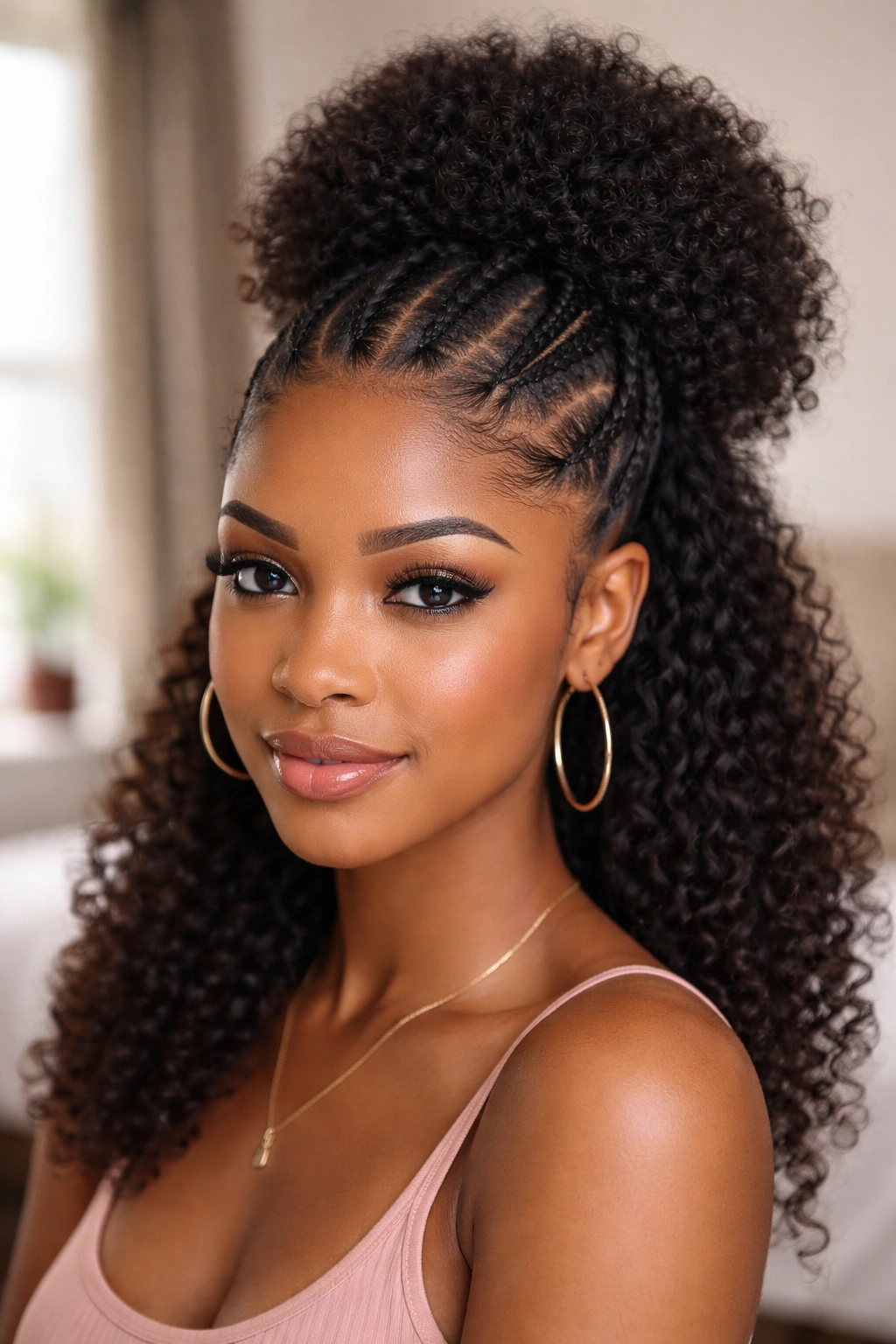
Three cornrows running from the forehead back to the crown, where they gather into a small puff made from the rest of your natural hair.
The puff is the feature. It should sit at the exact spot where the cornrows end — not higher, not lower.
Thicker 4C hair creates the fullest puff. Looser curl patterns can still work but may need a puff cuff or elastic headband to build up the volume.
3. Side-Parted Cornrows with a Wavy Wig Clip-In Below
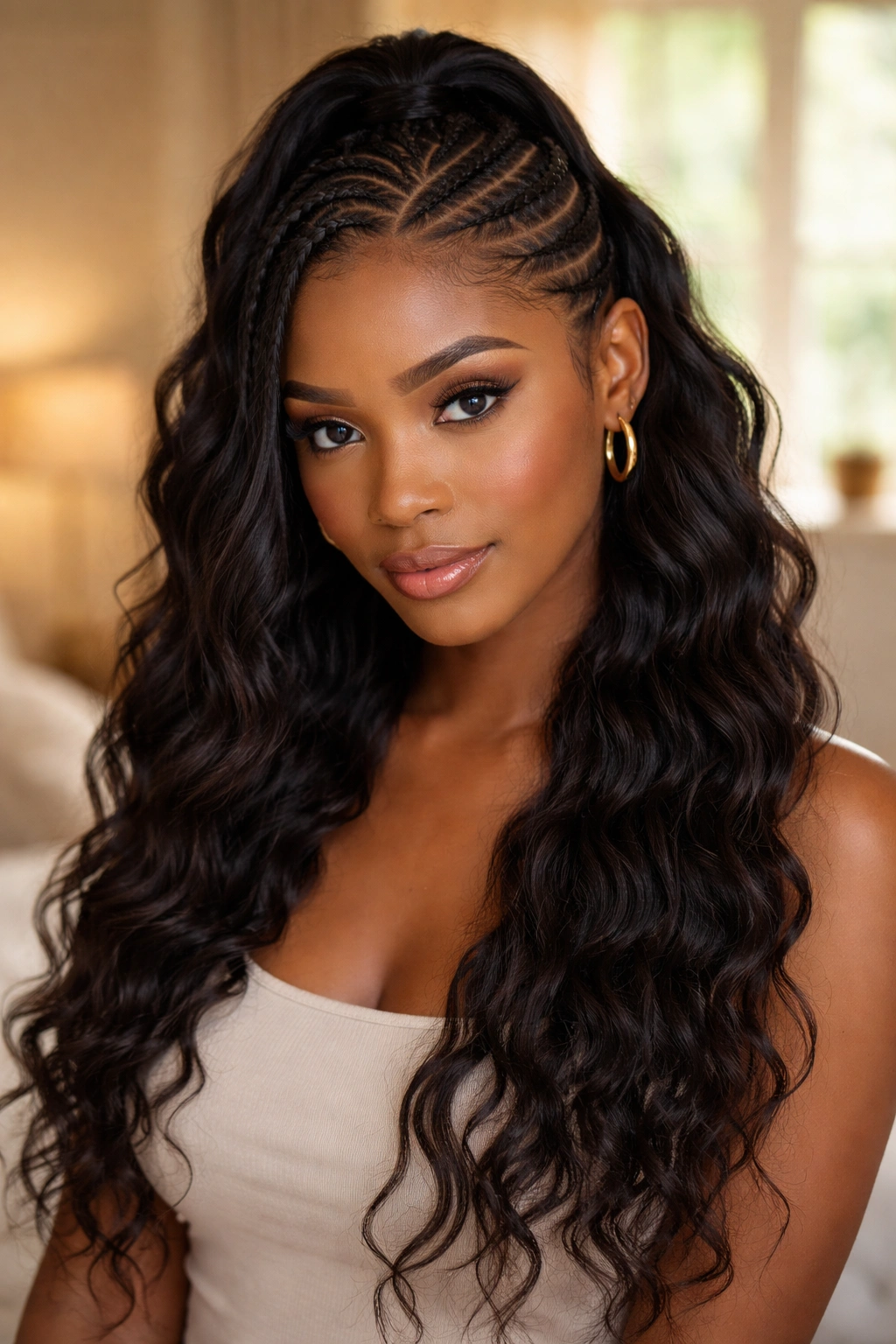
Bold claim: clip-in extensions transformed what half-up half-down cornrows could look like.
The cornrows on top stay small and tidy, running from a deep side part toward the back. Beneath the transition point, a wavy or curly clip-in adds length and body that your natural hair might not have on its own.
The trick is blending. Clip-ins should match your natural texture — if you have 4C coils, don’t pair them with silky waves. Look for wavy kinky textures, or deep wave hair that mimics a natural stretch.
Clips go in under the cornrow line, hidden by the last row of braids.
4. Jumbo Cornrows with a Long Braid Below
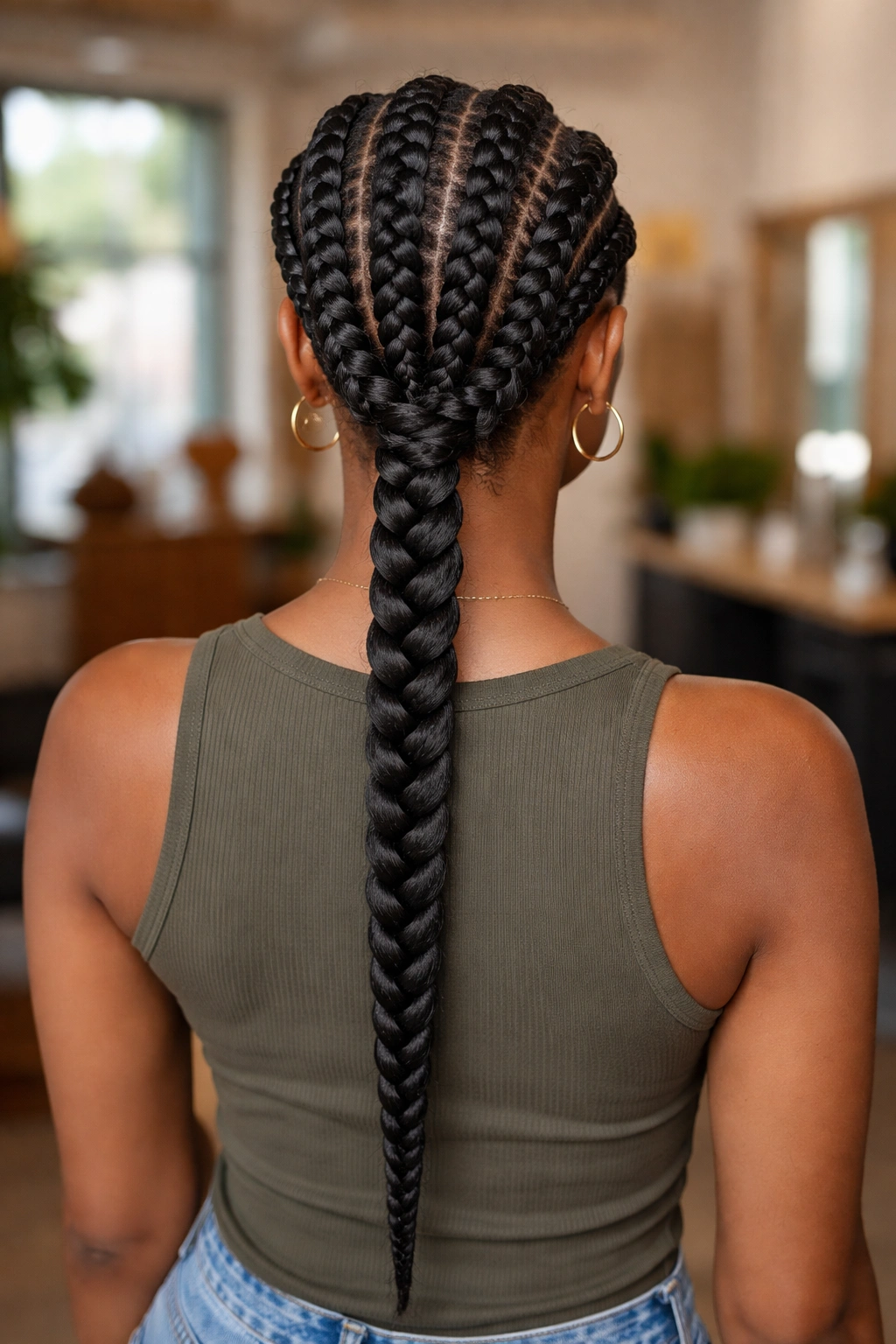
Jumbo feed-in cornrows across the crown, ending just past the ears, with the bottom half left in one long single braid that hangs down the back.
What to Watch For: The single braid below needs to align with the center of the cornrow layout. Slightly off-center and the whole style looks like it was an afterthought.
Tie the single braid with a gold thread wrap for a decorative finish. Or leave it plain with a wooden bead at the end.
This is a style you can wear three or four times with different finishes for the bottom braid and it’ll feel different each time.
5. Heart-Shaped Cornrow at the Crown with Loose Curls
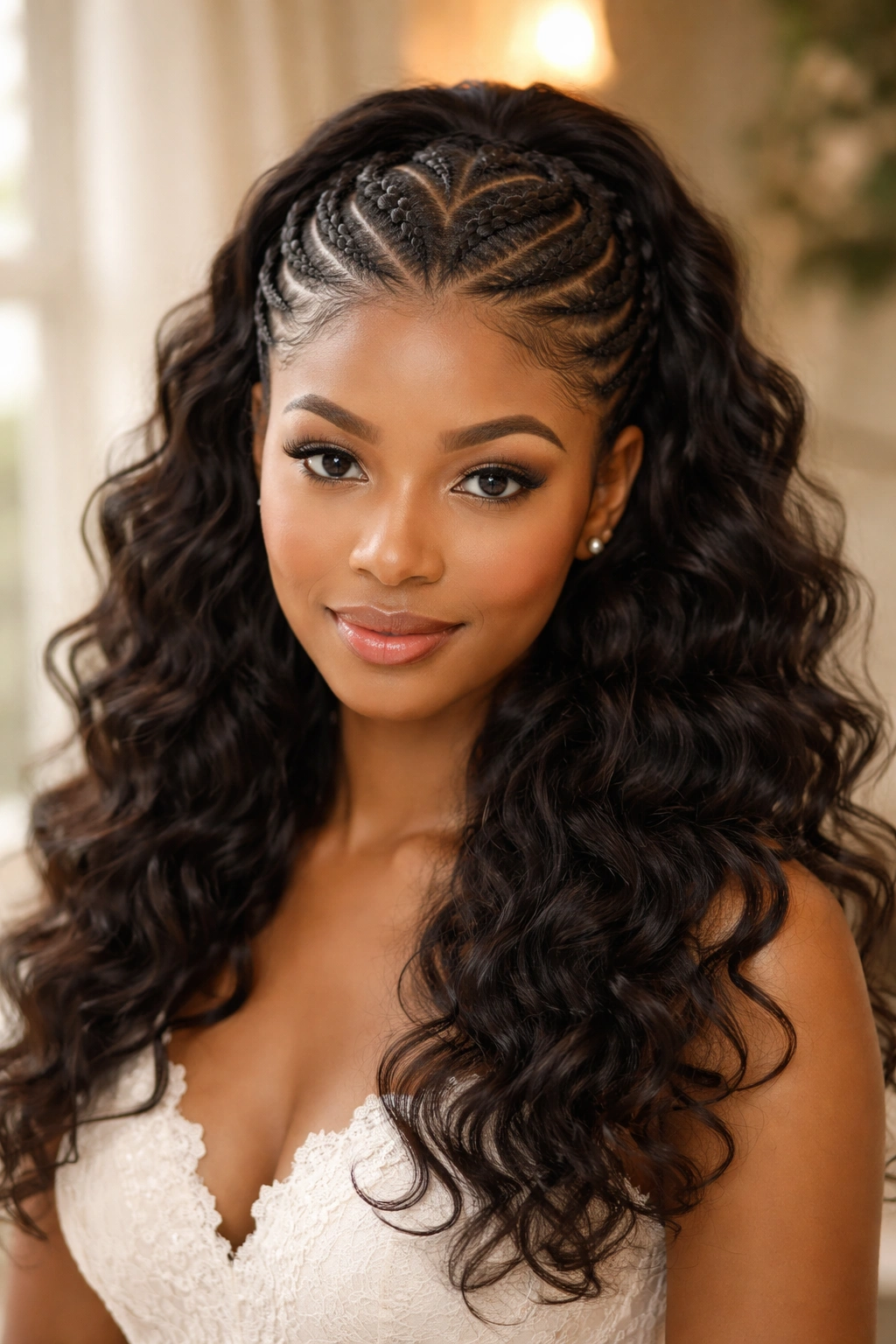
A single heart-shaped cornrow design at the crown, with the loose curl portion fanning out behind.
The heart sits between where the cornrows start at the hairline and where they end at the crown. Usually about the size of your palm.
This style has a softness that other cornrow designs don’t quite match. The heart reads gentle rather than sharp, and the loose curls continue that feeling into the bottom half.
Great for weddings, bridal showers, anniversary shoots — anywhere the feeling matters as much as the look.
6. Stitch Cornrows to a Half Bun
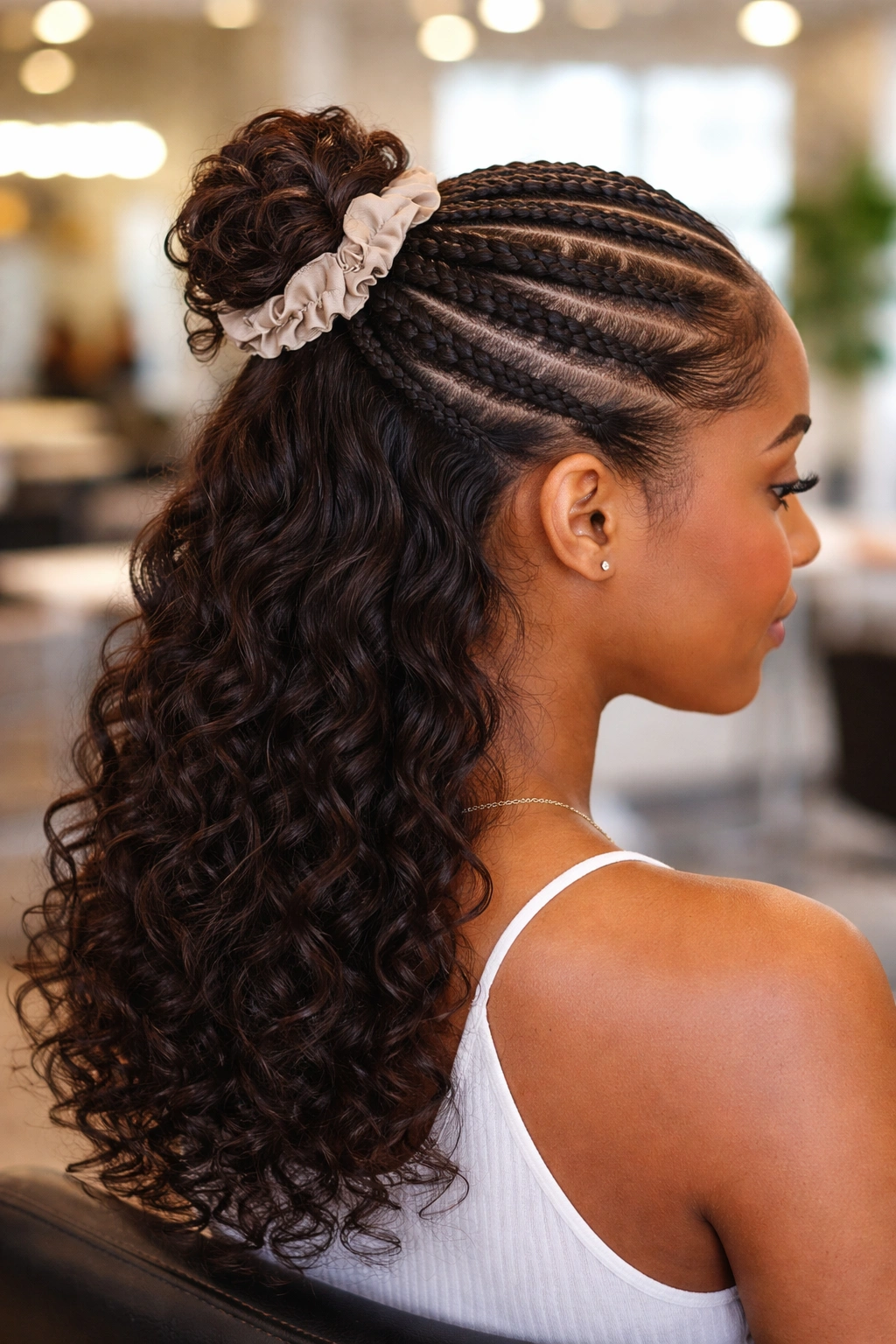
Question opener: what happens when you take the precision of stitch cornrows and pair it with the softness of a half bun?
You get one of the most photographed half-up styles out there. The stitches read like tattoo linework across the crown — crisp, defined, deliberate. The half bun sits at the back of the crown, catching half of the cornrow ends plus the loose hair behind.
The rest stays down.
How to Use It
- Tie the half bun with a fabric scrunchie, not a rubber band (less breakage)
- Let a few loose coils escape at the nape — the imperfect frame softens the stitch precision
- Refresh the stitch sections with edge gel on day three if they start softening
7. Fulani-Inspired Half Up with a Center Braid
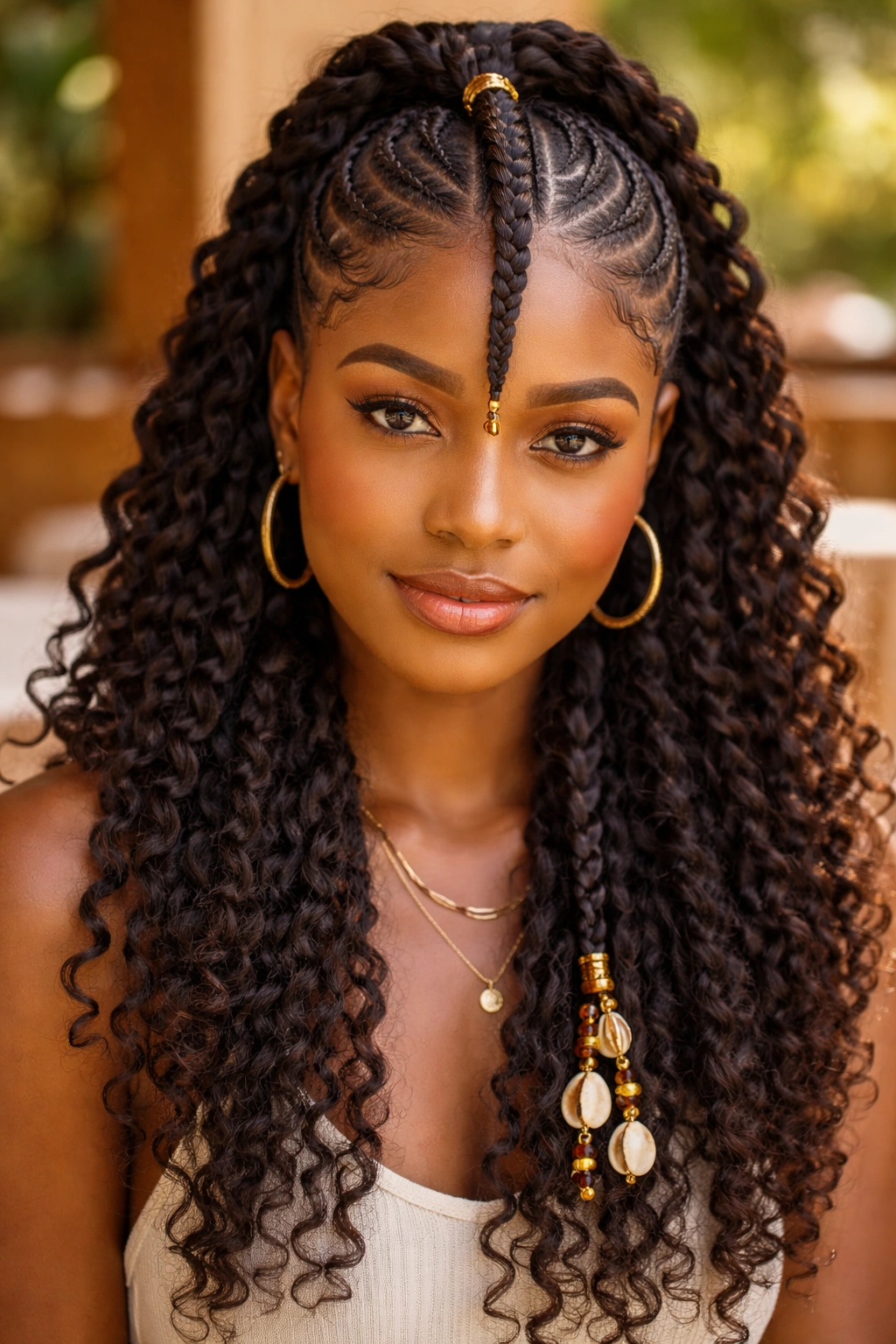
Fulani cornrows traditionally have a thick central braid running straight down the middle of the head. This half-up version keeps the center braid, adds side cornrows that curve outward, and leaves the bottom half loose.
The center braid usually has beads or cowrie shells at the end. Side cornrows can have smaller beads or stay plain.
The loose bottom section should be styled as a soft twist-out rather than a tight curl — the texture needs to feel continuous with the braided top.
8. Zigzag Parted Cornrows with a Twist-Out Below
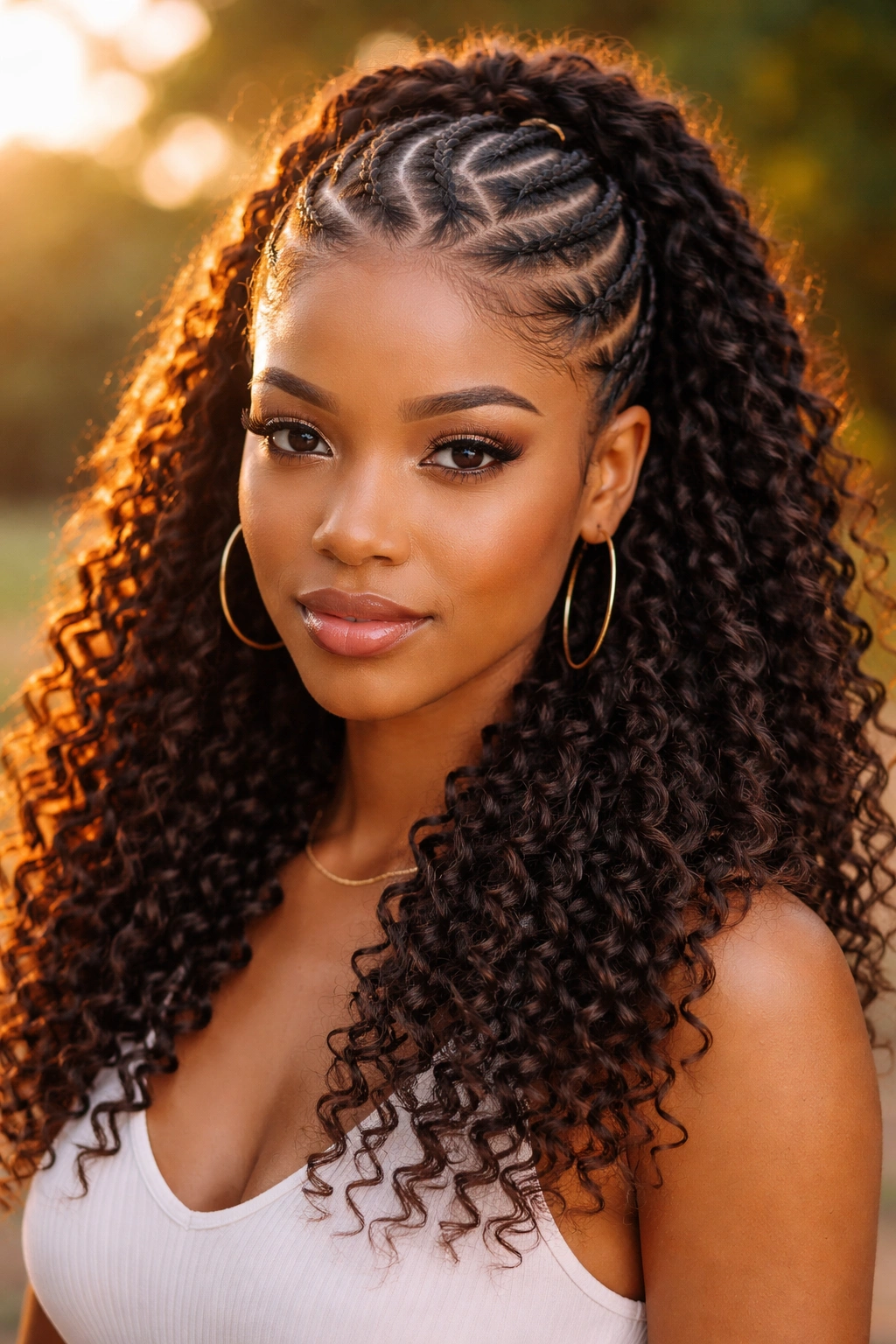
Zigzag parts across the top of the head, ending at the crown, with a defined twist-out underneath.
Unlike straight parts, zigzag parts add movement to the crown section. That movement echoes the waves in the twist-out below, creating a style where both halves feel connected.
Zigzag parts take longer to install than straight ones. Budget another 30 minutes on top of your normal cornrow time.
9. Cornrow Crown with Free-Flowing Length Below
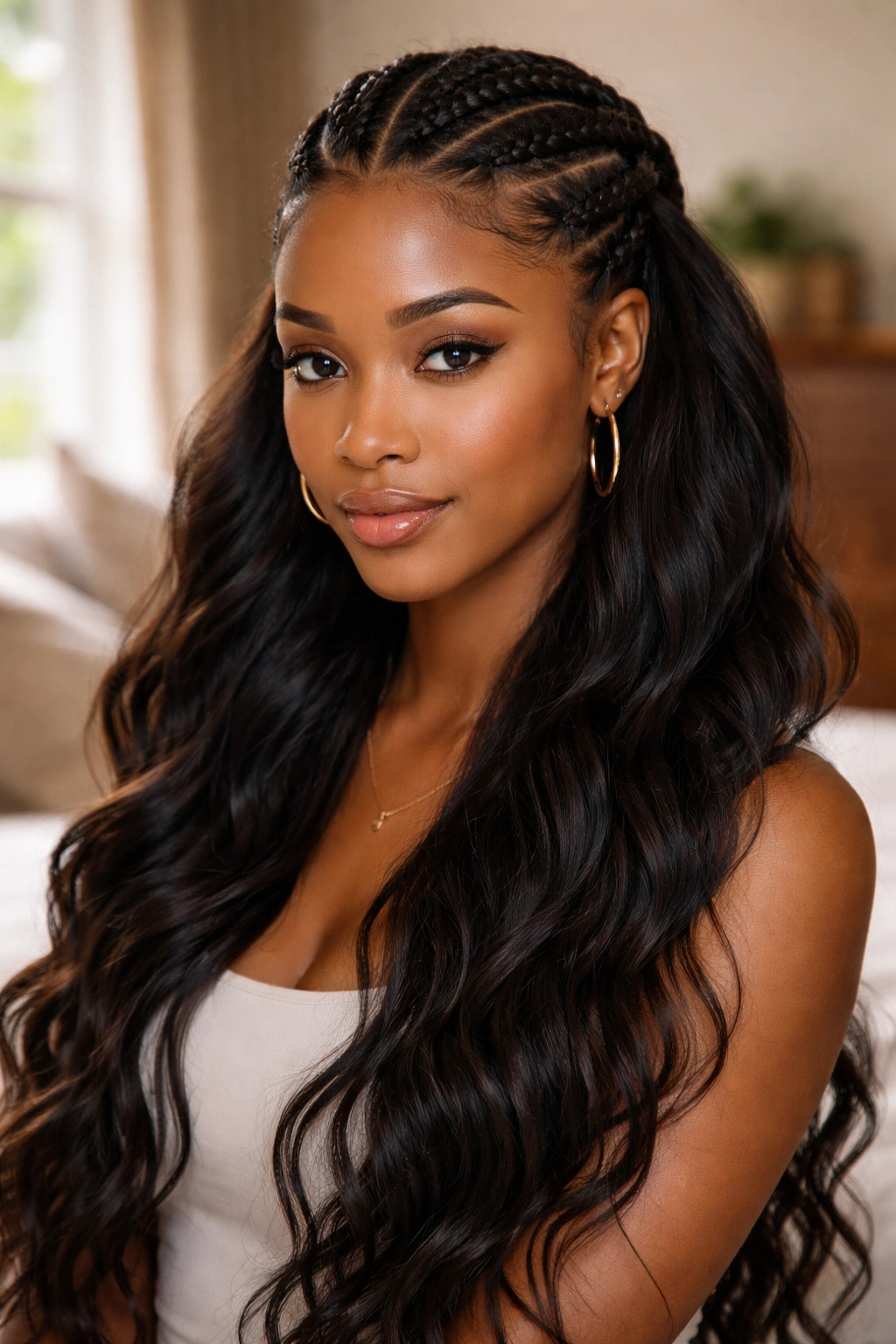
A single thick cornrow running from one temple across the hairline to the other temple, forming a crown or headband shape. Below the cornrow, the rest of the hair flows free.
Who This Is For: People with long natural hair or long extensions who want to show off the length without anything pulled tight.
The crown cornrow is a feed-in braid, so it builds up in thickness as it moves across the head. Starts thin at one temple, hits full size at the center, tapers down at the other side.
10. Cornrows with Beaded Ends Peeking Out
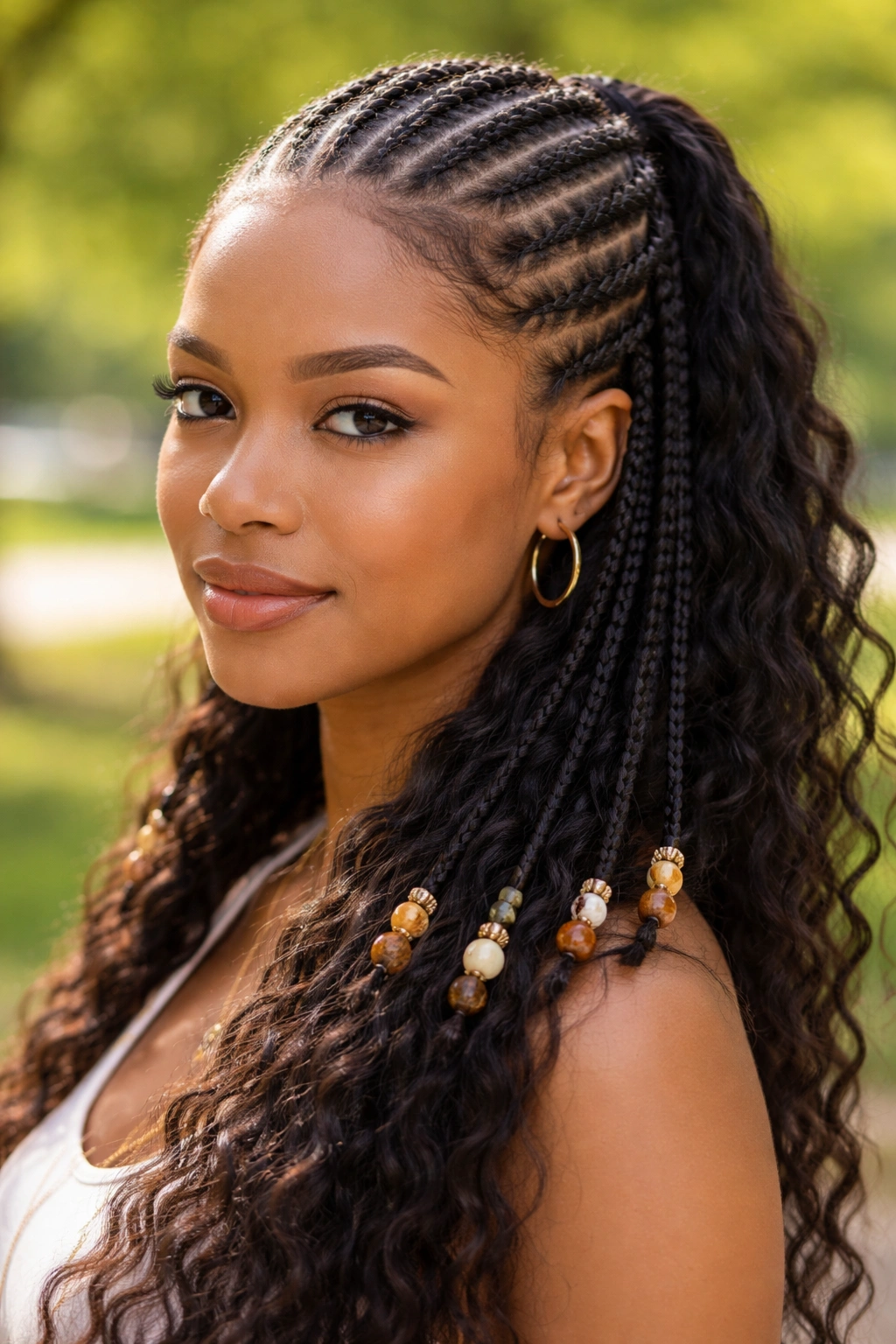
Cornrows only cover the top third of the head. At the transition line, each cornrow ends in two or three small beads that sit against the loose hair below.
The beads create an intentional stopping point. They mark where the structure ends and the texture begins.
Gold beads read dressy. Wood beads read earthy. Mixed cowrie and wood reads tribal and storytelling.
Maintenance Notes
- Check the bead threads weekly. Plastic-coated rubber loosens faster than you’d think.
- Remove the beads before washing and re-attach after. Trying to wash over the beads creates tangles.
11. Two Braids Down the Sides, Cornrows Up Top
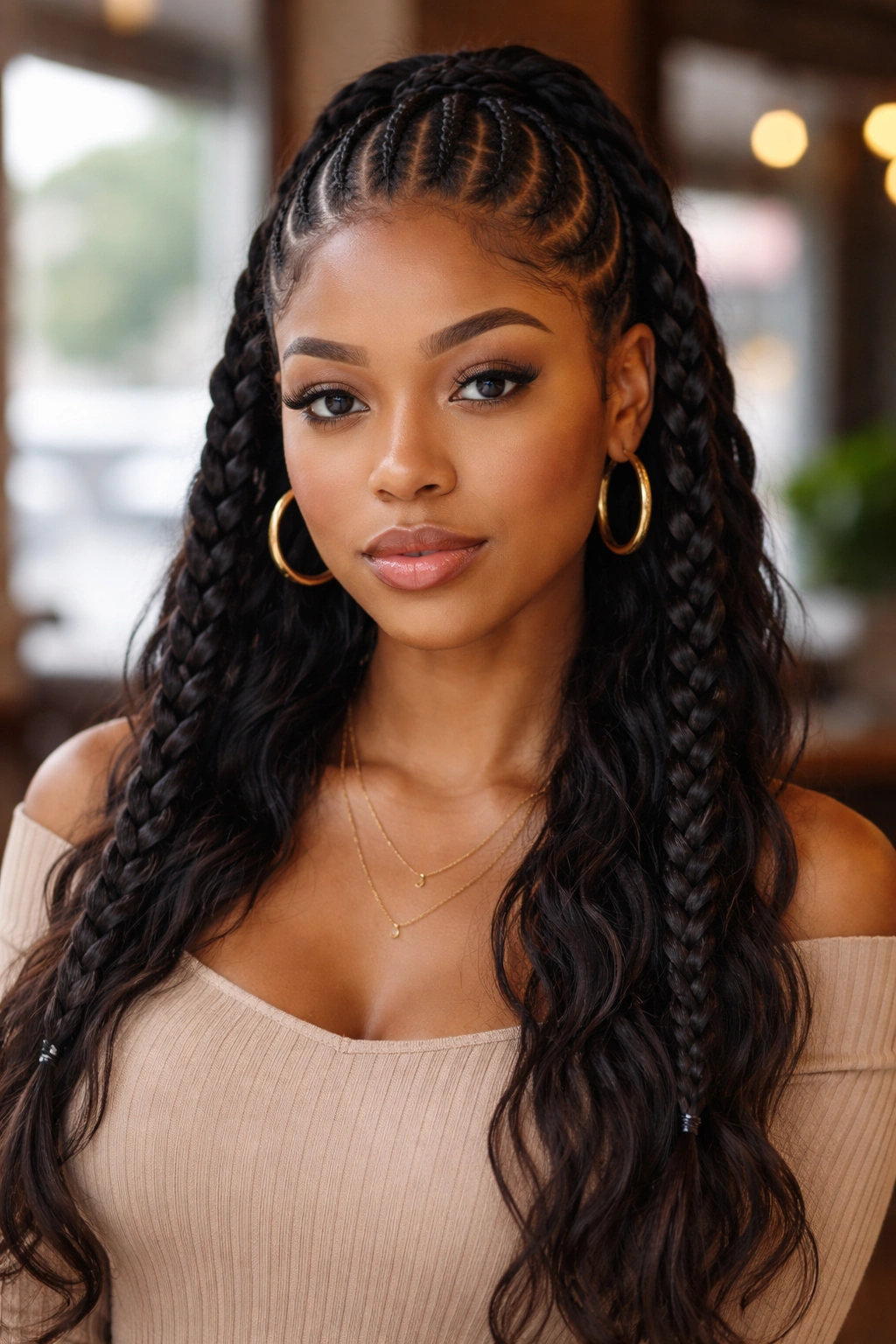
Two thick braids frame the face — one on each side, starting at the temple and running down past the shoulders. The rest of the top stays in small cornrows running back.
This is a frame-and-fill style. The side braids frame the face. The cornrows fill the top.
The frame braids can be box braids, feed-in braids, or just thick plaits from your natural hair. The inside cornrows stay smaller.
For a softer version, let the two side braids have loose curly ends rather than finishing them with elastics.
12. Cornrows Ending in a Half Ponytail
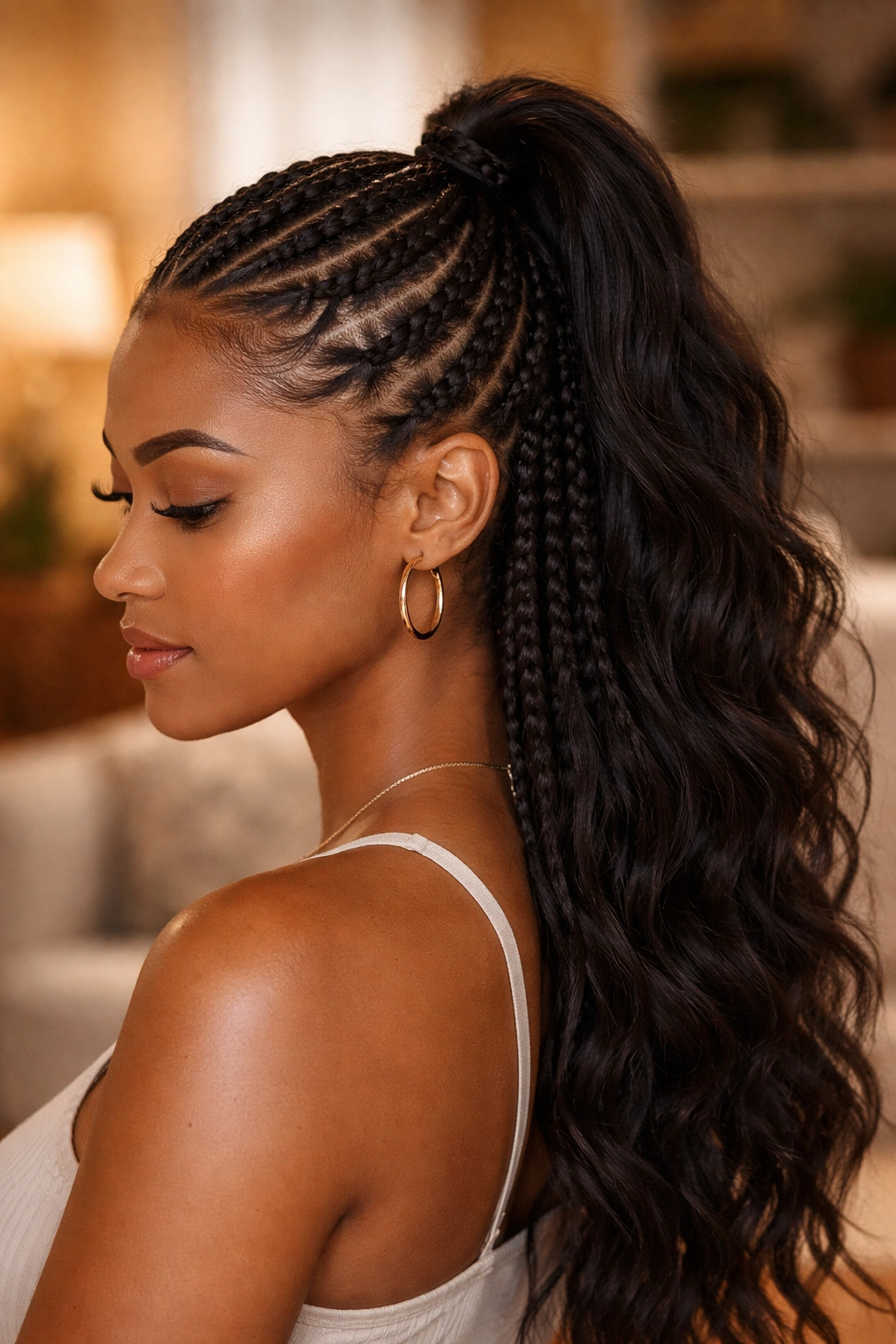
A gathered half ponytail at the back of the crown, catching the cornrow ends plus some of the loose hair. The rest of the loose hair falls behind.
The half ponytail can be wrapped with a braid from the ponytail itself, covered with a silk scarf, or cuffed with a metal hair ring.
This is a style that transitions from day to night easily. Leave the ponytail plain for work. Add a cuff for evening.
13. Side-Swept Cornrows with a Cascading Curl
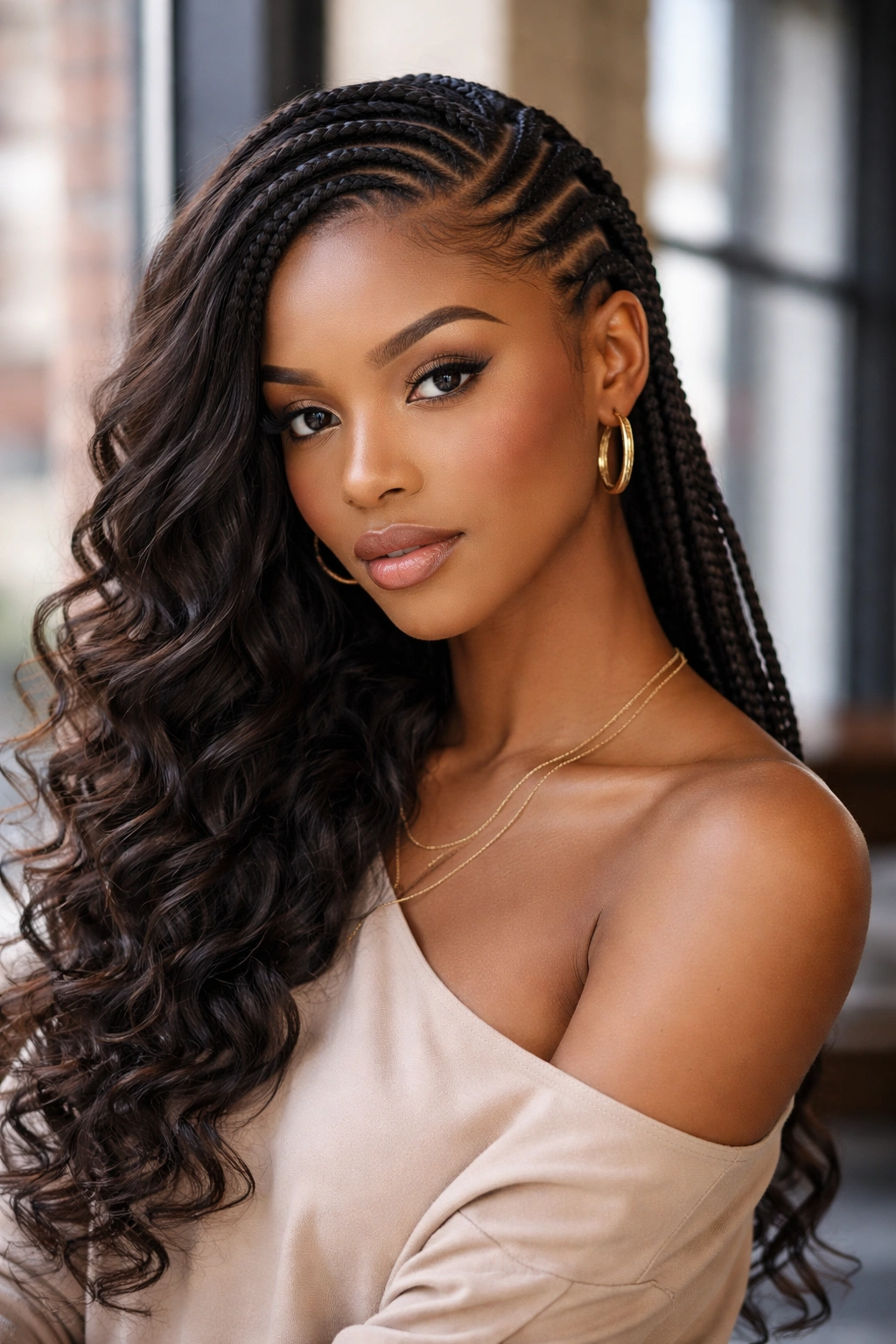
A single deep side part. Cornrows on the larger side sweep diagonally back toward the opposite ear. The smaller side gets one or two thin cornrows running back, then loose curls cascade down the smaller shoulder.
The asymmetry is the point. Nothing about this style is symmetrical, and that’s what makes it feel editorial.
Works best for people with defined jawlines — the asymmetric part draws attention to the face’s structure.
14. Cornrow Mohawk with Loose Sides
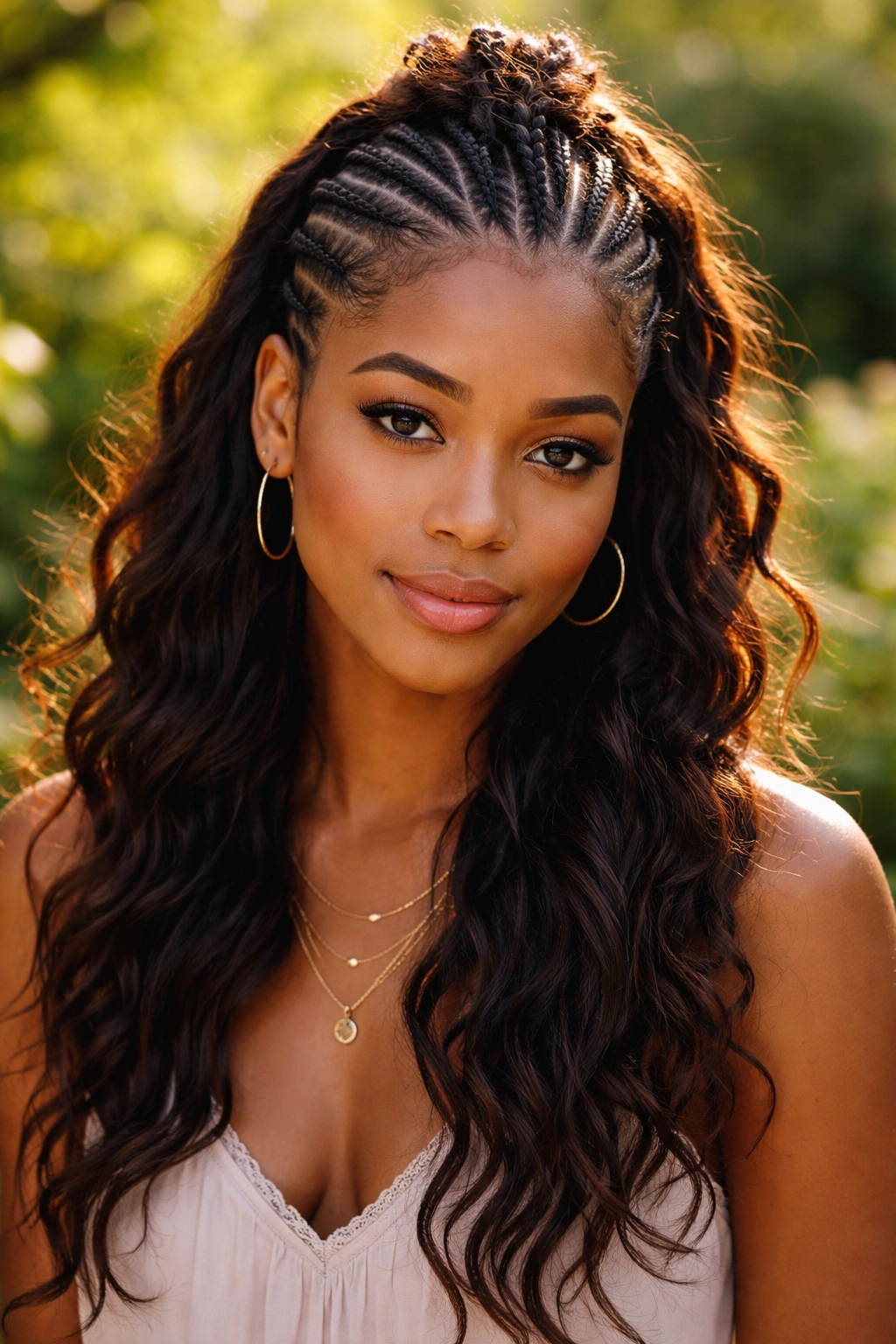
Unlike a full cornrow mohawk, this version puts cornrows only along the center strip of the head. The sides stay completely loose — not braided, not pulled back.
The effect is softer than a traditional mohawk but still has the central line. Reads bohemian, almost hippie, rather than hard punk.
The loose sides need some definition. A curl cream or twist-out set the night before keeps the sides from just hanging limp.
15. Half Up Cornrows with a Space Bun Finish
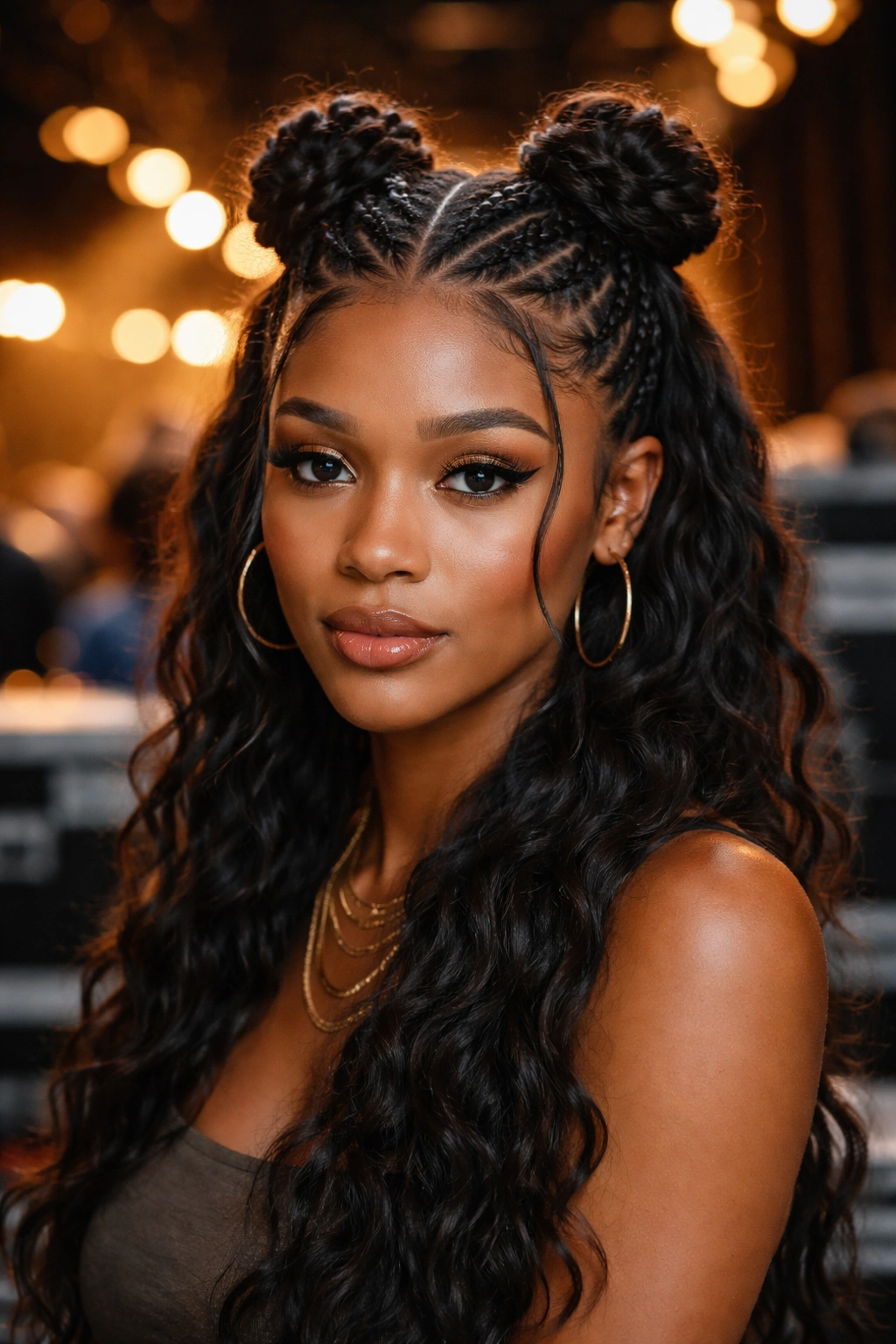
Two small buns at the crown — space bun style — formed from the cornrow ends plus some of the loose hair above them. The rest of the hair stays down.
Playful. Youthful. Reads more like a style you’d wear to a concert or a weekend afternoon.
Space buns aren’t for every occasion. But when the mood fits, they’re cute as anything.
Styling tip: Leave two small pieces of hair out at the temples to soften the look. Bare space buns with nothing around the face can look costume-y. Face-framing pieces anchor it.
16. Large Center Cornrow with Loose Hair Around
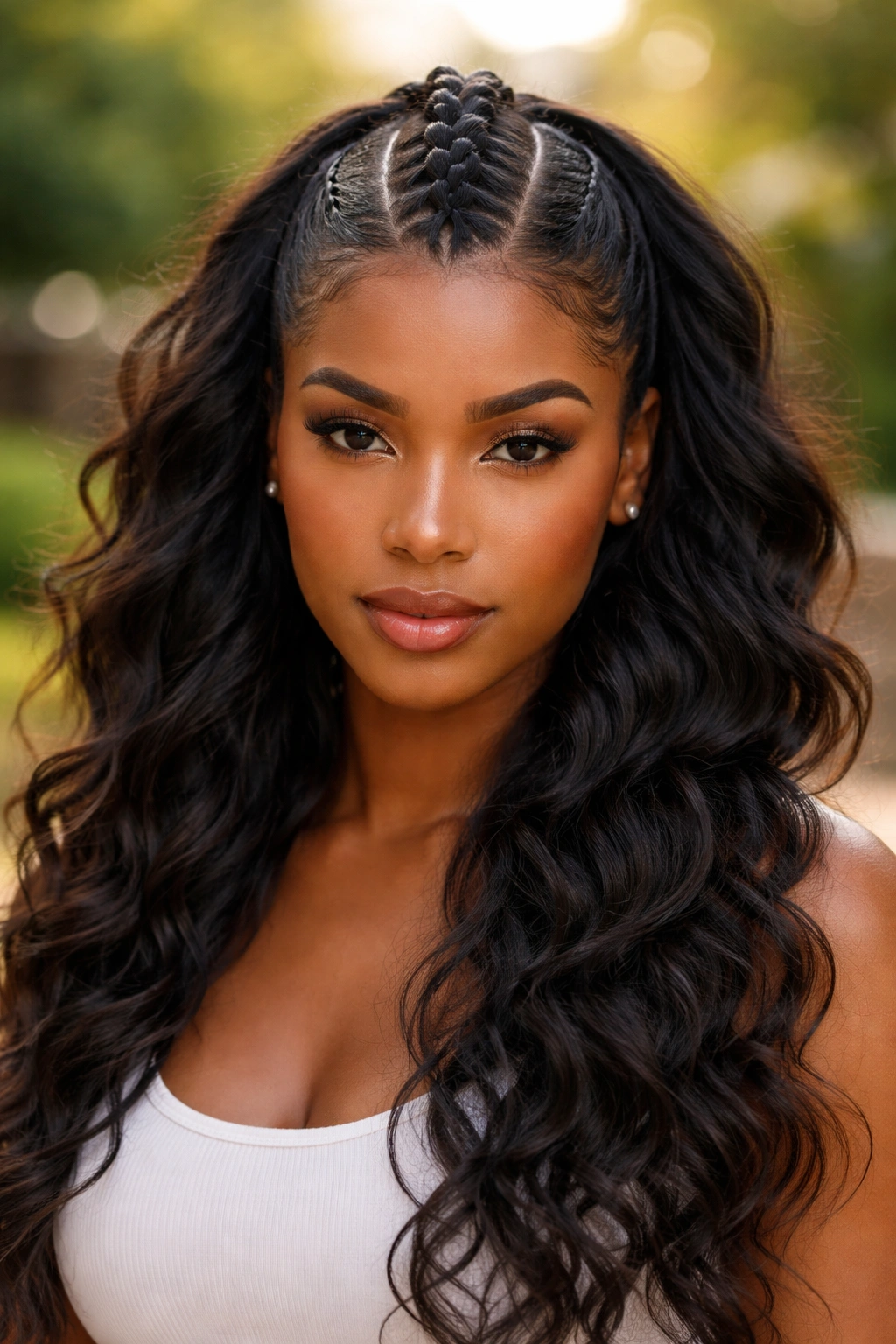
Just one cornrow. Big, thick, feed-in, running down the exact center of the head from the forehead to the crown. Everything else loose.
The single cornrow is the whole style. It doesn’t need company.
This works because the contrast is extreme. One braid. Acres of loose curls. The eye goes straight to the cornrow and then travels out into the texture.
17. Cornrows with a Curly Clip-In Bang
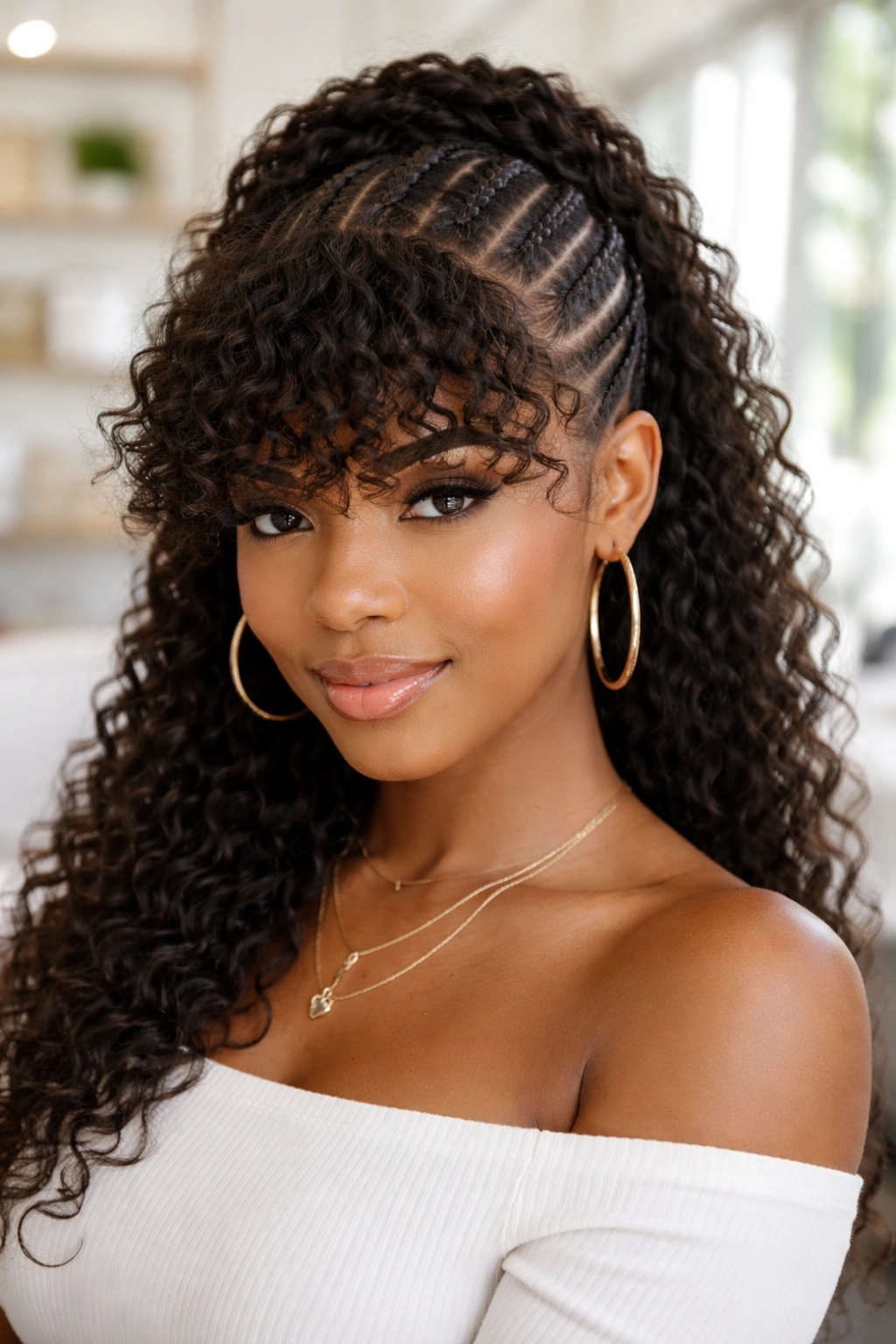
Cornrows across the top of the head, running back, with a clip-in curly bang over the forehead.
The clip-in bang attaches at the very front, just behind the cornrow starting point. It covers the forehead with a curly fringe while the cornrows continue behind it.
Pairs with shorter natural hair beautifully. The cornrows hide the transition between natural and clip-in, and the bang creates a fringe you wouldn’t be able to get from natural hair alone.
18. Triple Cornrows into a Low Half Braid
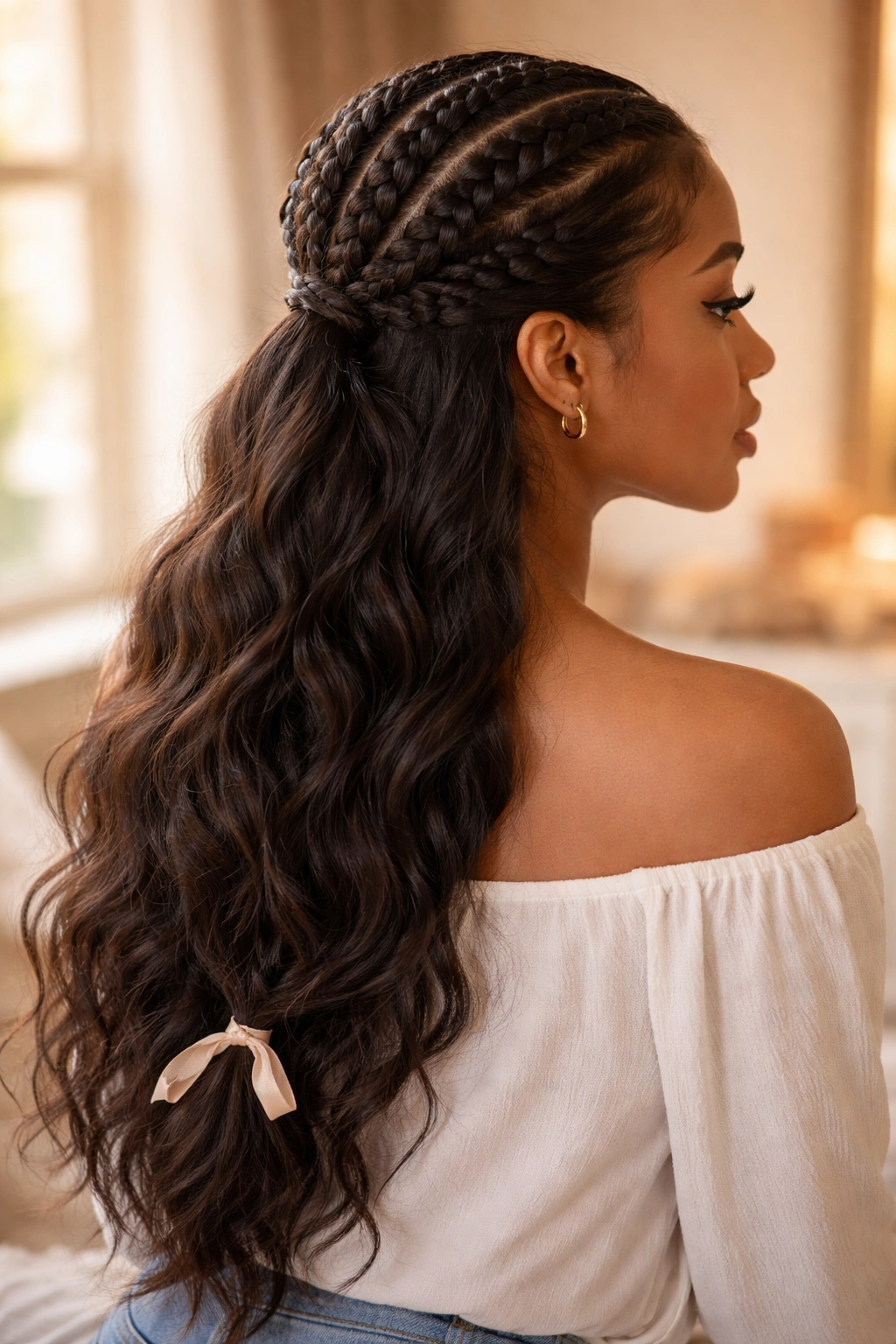
Three cornrows from the hairline to the crown, gathered together with loose hair into a low half braid that falls down the back.
Where This Shines: Medium to long hair. The half braid needs length to look substantial. On shorter hair, the braid ends up too stubby to register.
Tie the half braid with a small silk ribbon. Or let it end in a natural taper without a tie at all, held together by the weight of the hair itself.
19. Cornrows with Finger Waves Up Front
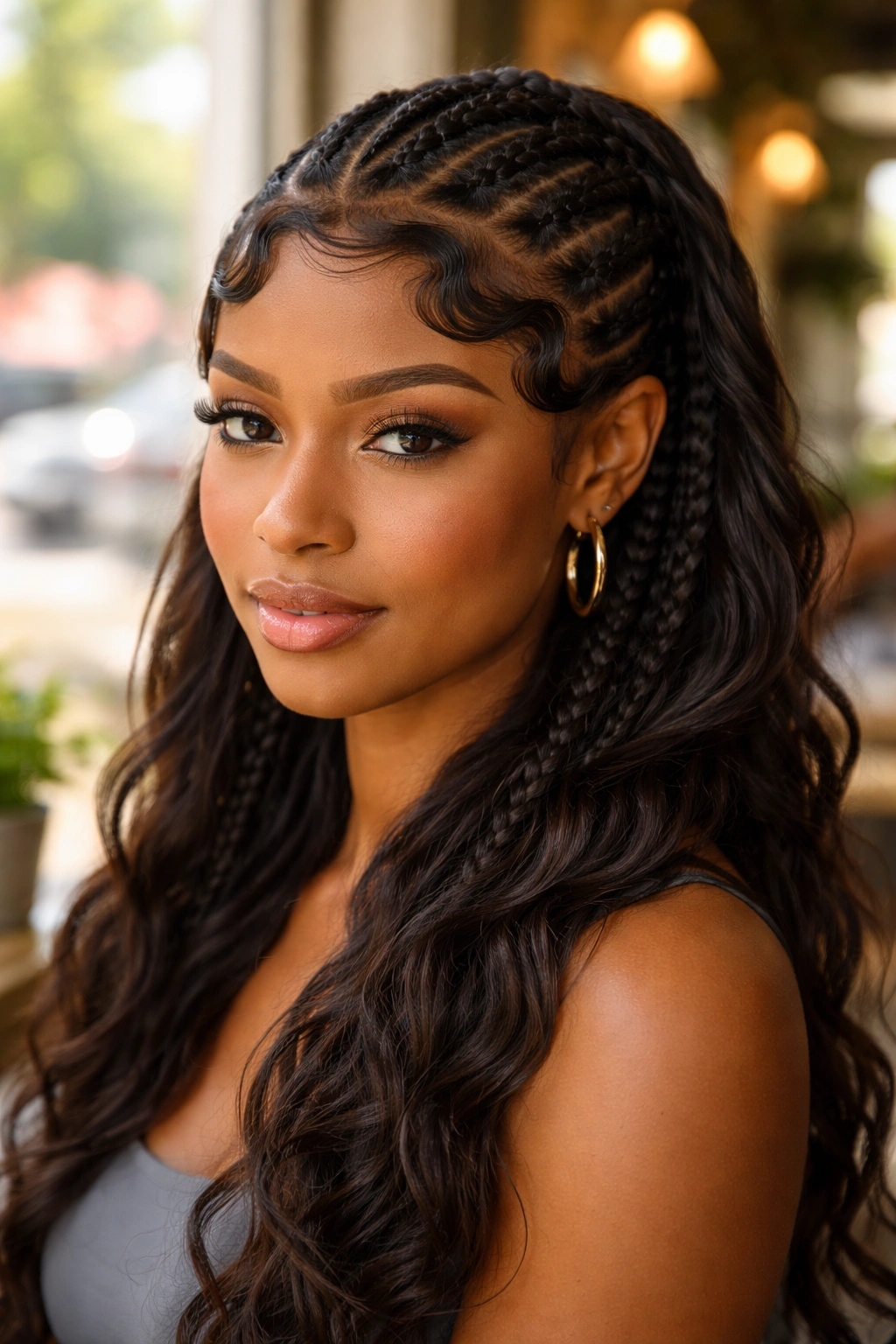
Pure prose territory. Finger waves belong to a specific tradition — the S-shaped waves pressed close to the scalp, often paired with short hair or as a vintage statement. Combined with cornrows running back from the crown, they create a look that references multiple eras at once.
The finger waves stay only at the very front, covering the forehead and temples with their S-curves. From about ear level back, the cornrows take over.
A gel with serious hold — something like eco-styler black castor or a similar thick formula — is what sets the waves. Finger wave clips hold the shape while the gel dries.
This is more a special-occasion style than a weekly option. Finger waves require reshaping almost daily.
20. Cornrows with a Side Bun and Open Back
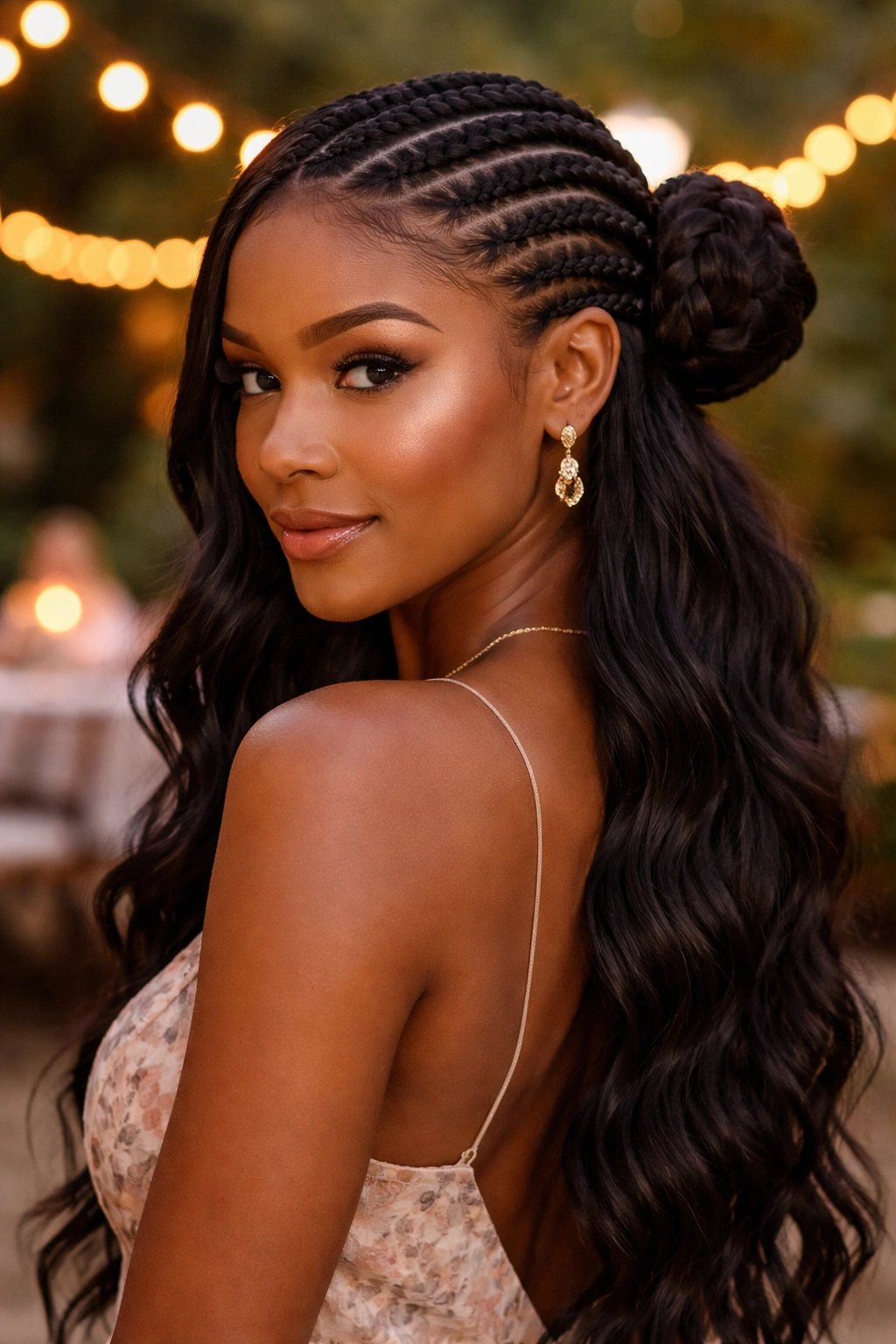
Cornrows run diagonally across the crown to one side, gathering into a side bun just above the ear. The back half of the hair stays loose.
Side buns can look haphazard if they’re too close to the jawline, or too stiff if they sit too high. Just above the ear is the sweet spot.
The bun catches the cornrow ends plus some of the front-section hair. The back hair flows around it without getting tangled up.
For an evening look, pin a small fresh flower at the base of the bun. For daytime, leave it plain.
21. Straight-Back Cornrows with a Curly Ponytail Below
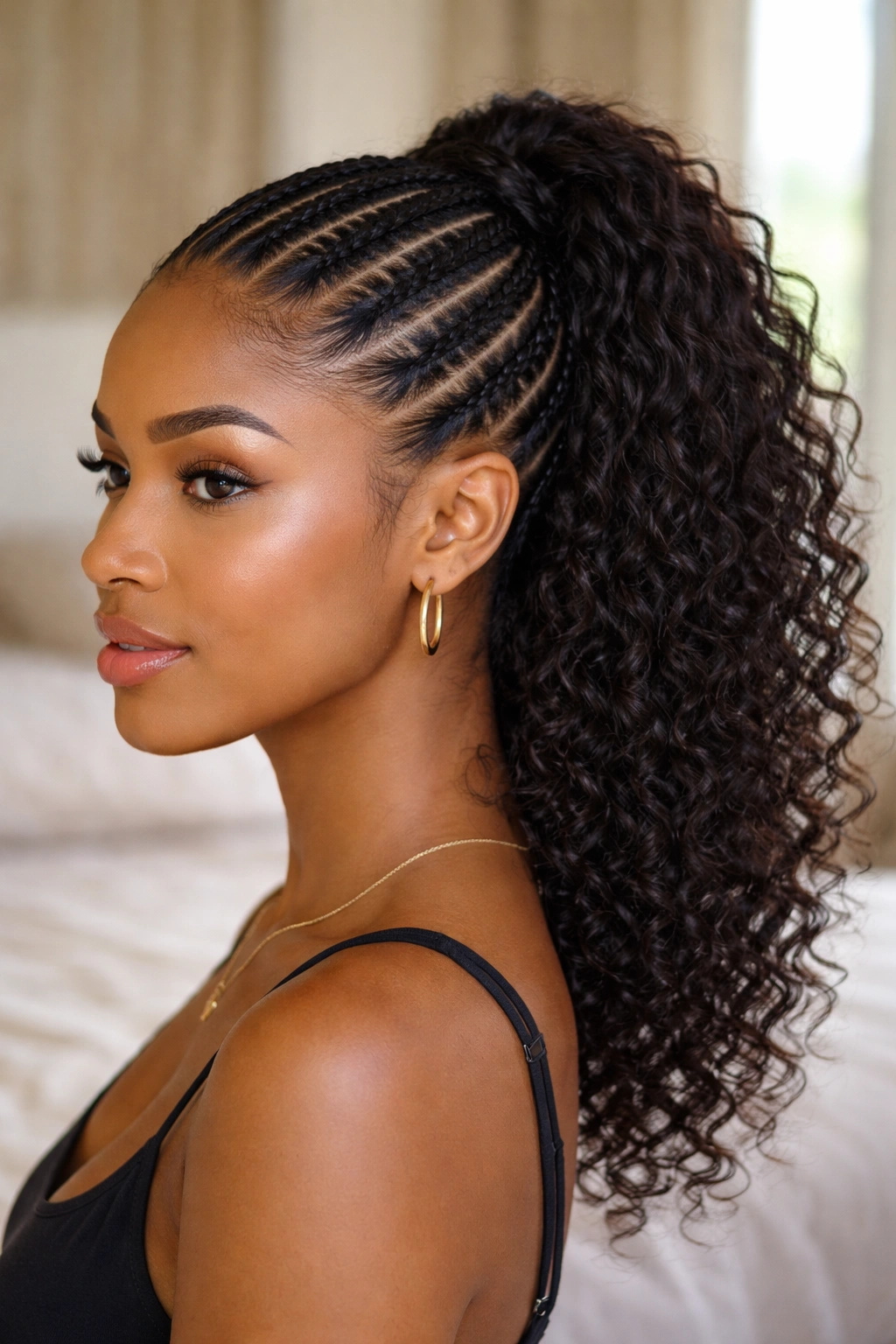
Cornrows go straight back to the crown, then gather into a curly ponytail made from extensions or from the remaining natural hair teased out.
The ponytail sits high — at the top of the back of the head, not at the nape. High ponytail placement lengthens the neck and adds lift that a low version can’t match.
The curls in the ponytail should be defined but not overly tight. Loose spiral curls work better than ringlets here.
22. Cornrow Half Up with Bantu Knot Accents
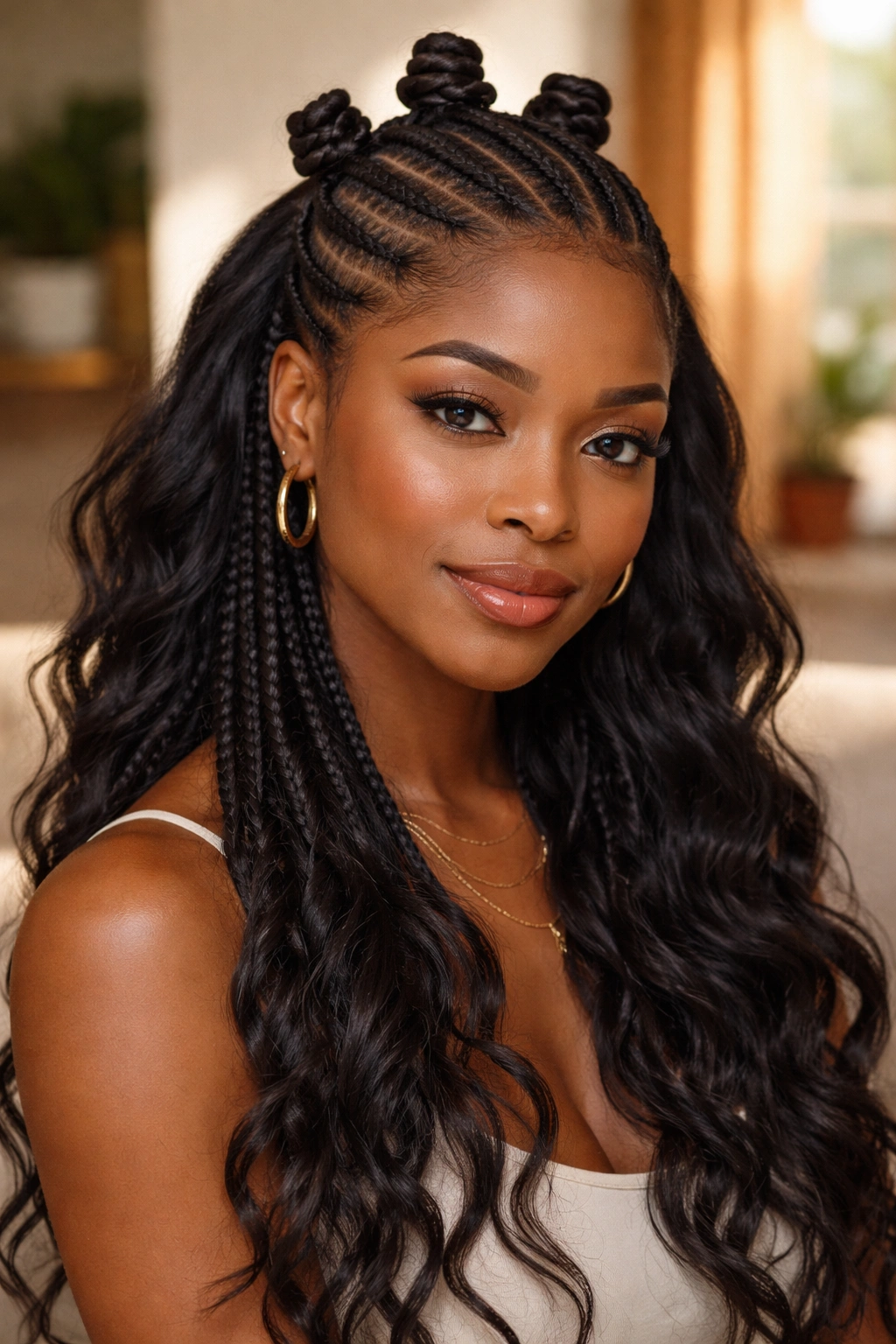
Bantu knots dotted along the crown where the cornrows end, with the rest of the hair flowing loose behind.
Maybe three knots, maybe five — odd numbers photograph better than even ones. The knots can be formed from some of the loose hair at the transition point, or from the cornrow ends themselves wrapped tightly.
Bantu knots have their own history in Southern African cultures. Using them as accents on a cornrow half-up pays respect to that lineage while creating a visually punchy look.
Takedown is easy: unwind each knot, shake out the cornrows, and you’ve got a bonus knot-out curl pattern underneath.
Keeping the Two Halves Looking Their Best
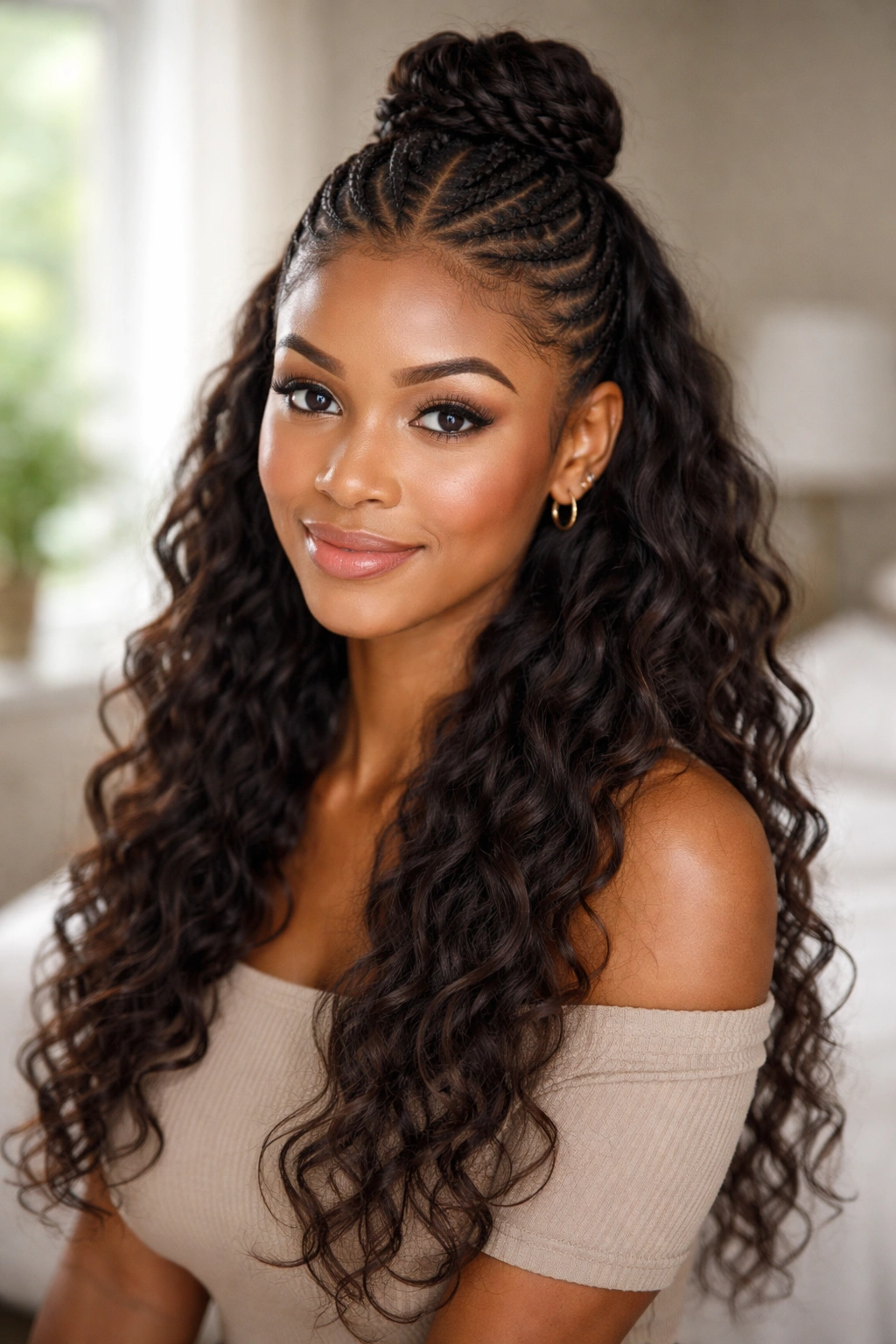
The challenge with half-up half-down styles is that the top and bottom age differently. Cornrows can hold for three or four weeks. Twist-outs and curl sets usually need a refresh every four to five days.
That means the bottom needs more attention.
A weekly re-set of the loose section keeps the whole style looking intentional. Rewet the bottom, apply a curl cream or mousse, re-twist (or re-braid) overnight in the original pattern. The cornrows stay untouched.
For the cornrow portion, edge gel touch-ups on day seven and day fourteen are usually enough.
Sleeping in Half-Up Half-Down Cornrows
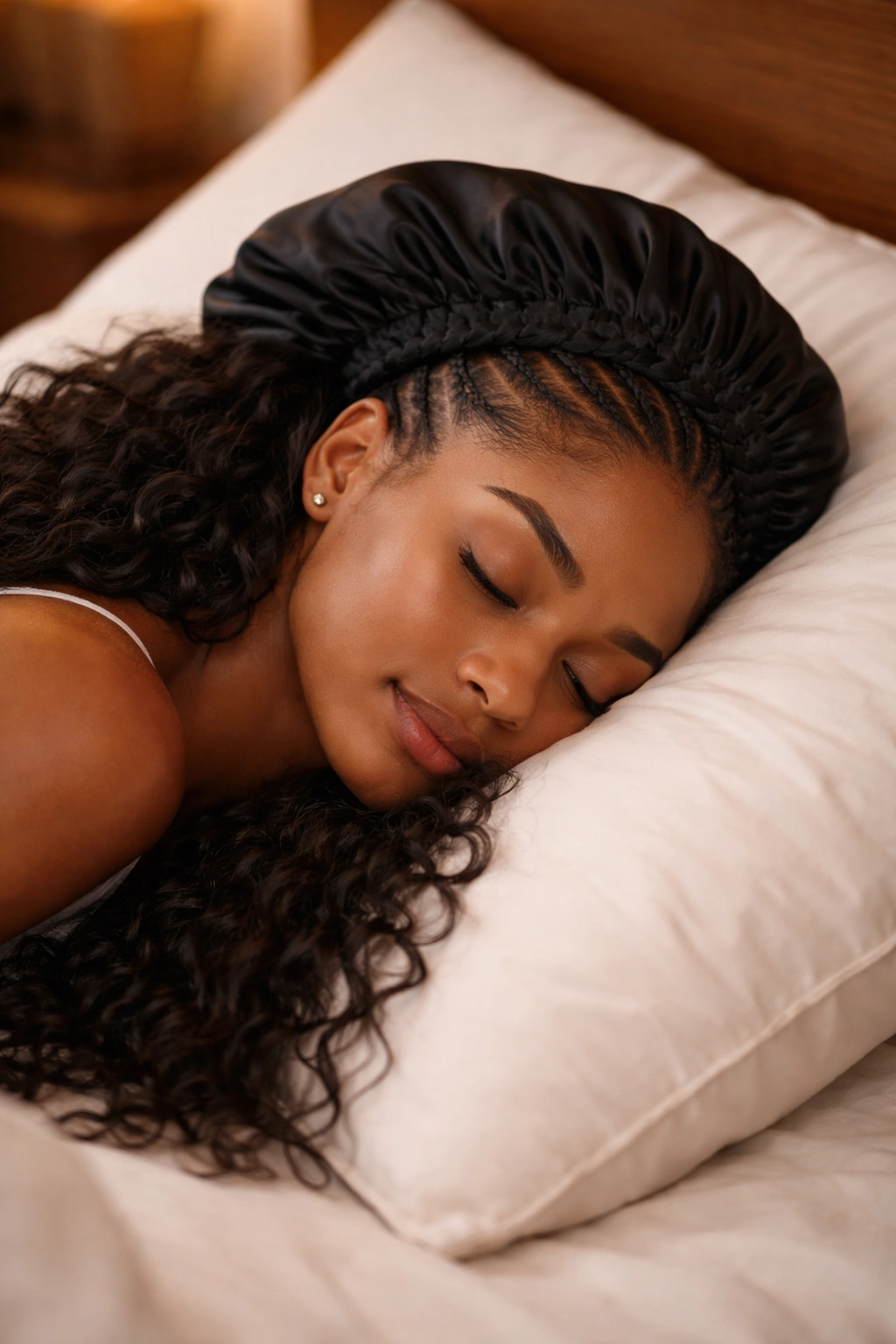
The cornrows need a bonnet. The loose hair needs its own protection.
A large silk bonnet that covers the entire head works, but the loose curls underneath can flatten against the back of your head during the night.
Better approach: pineapple the loose hair (gather it into a loose high ponytail at the very top of the head, held with a silk scrunchie) before putting the bonnet on. The pineapple keeps the curl pattern from getting crushed while the bonnet keeps the cornrows smooth.
A silk or satin pillowcase adds a second layer of protection if you tend to shift your bonnet during the night.
Washing a Half-Up Style Mid-Wear
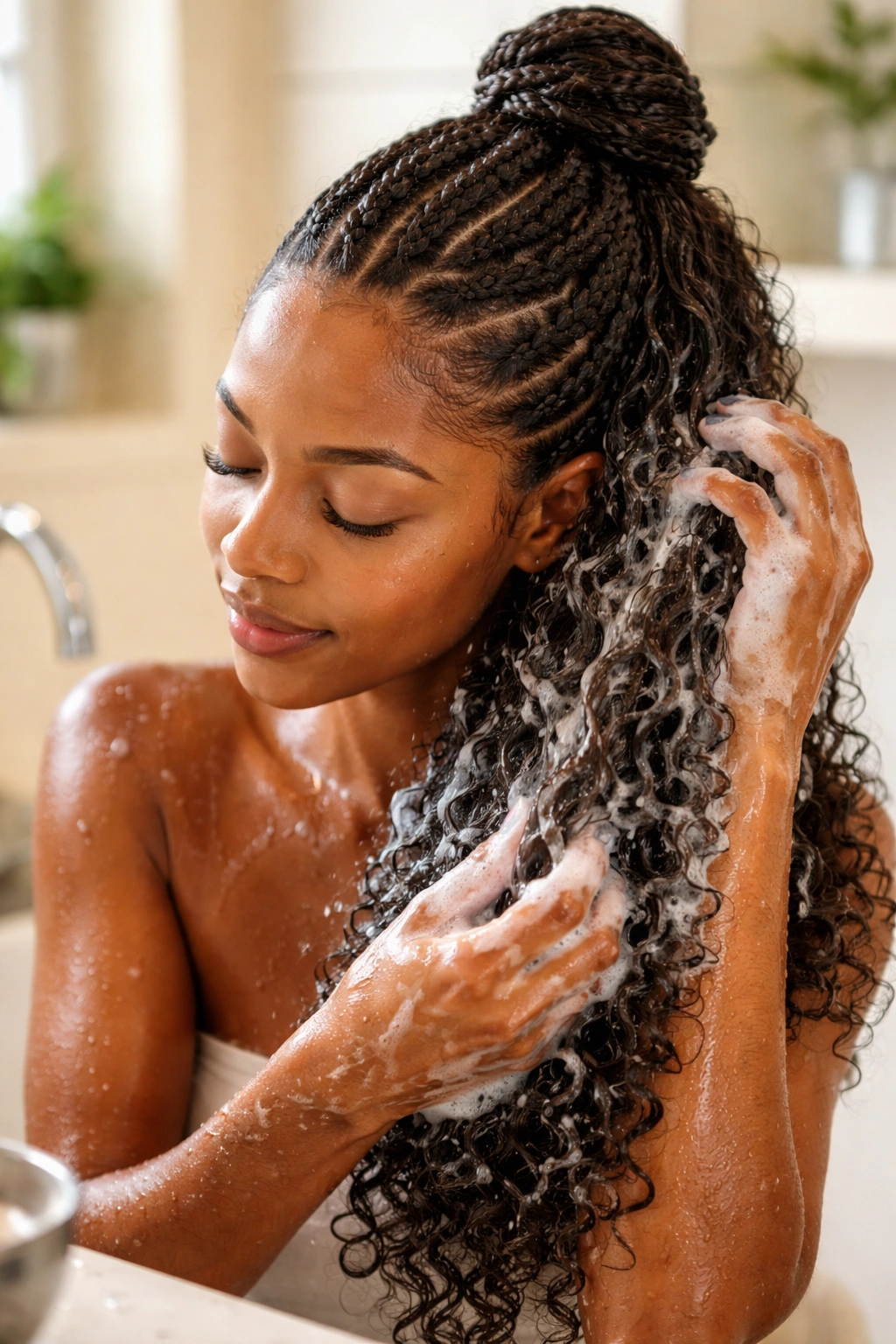
Full washes are hard on these styles because the loose section gets soaking wet but the cornrow section doesn’t want to be disturbed.
Co-wash the loose section only. Use a cleansing conditioner, apply it only below the cornrow transition line, and rinse gently.
For the cornrow section, use a diluted shampoo in a squeeze bottle aimed at the parts. Gentle massage with fingertips only.
Blot both sections with a microfiber towel. Let air dry for at least thirty minutes before applying any leave-in to the loose section.
Restyle the bottom with fresh curl cream or a new twist-out the same day. The whole process takes about an hour for a full refresh.
Common Mistakes with Half-Up Cornrow Styles
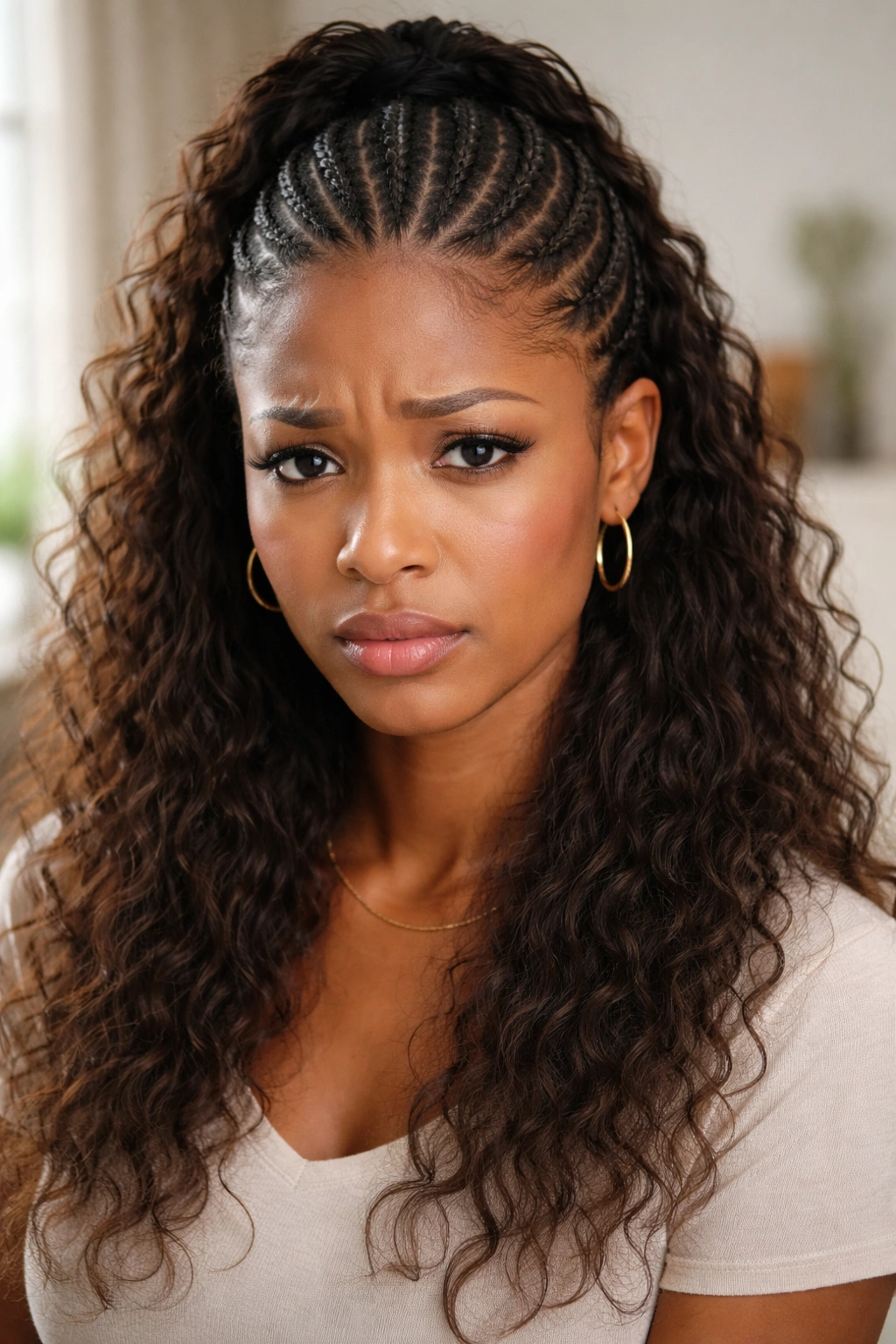
The first mistake is styling the cornrows without thinking about how they’ll meet the loose hair. Cornrows that end abruptly, with no transition care, create a visible line between braided and loose that draws the eye in the wrong direction. A good braider softens that line — either by letting a few wisps escape from the last cornrow or by using a small section of curly hair to cover the transition.
The second mistake is leaving the loose section unstyled. A rough wash-and-go behind tight cornrows looks unfinished. Spend time on the bottom half. Twist-outs, braid-outs, or defined wash-and-gos all work better than undefined frizz.
The third mistake is over-tension at the front. When the crown is braided tight, the hairline takes the pressure. Ask your braider to ease up at the very front rows. Tight at the back is fine. Tight at the forehead thins edges within weeks.
And finally — leaving the style up too long without refreshing. A style that looks great at day three and tired by day ten gives half-up cornrows a bad reputation they don’t deserve. Keep the bottom refreshed and the top tidy, and the look holds for a month or more.
That’s the rhythm. Small touches over time. Not a single install and hope.
How Long Half-Up Cornrows Actually Last
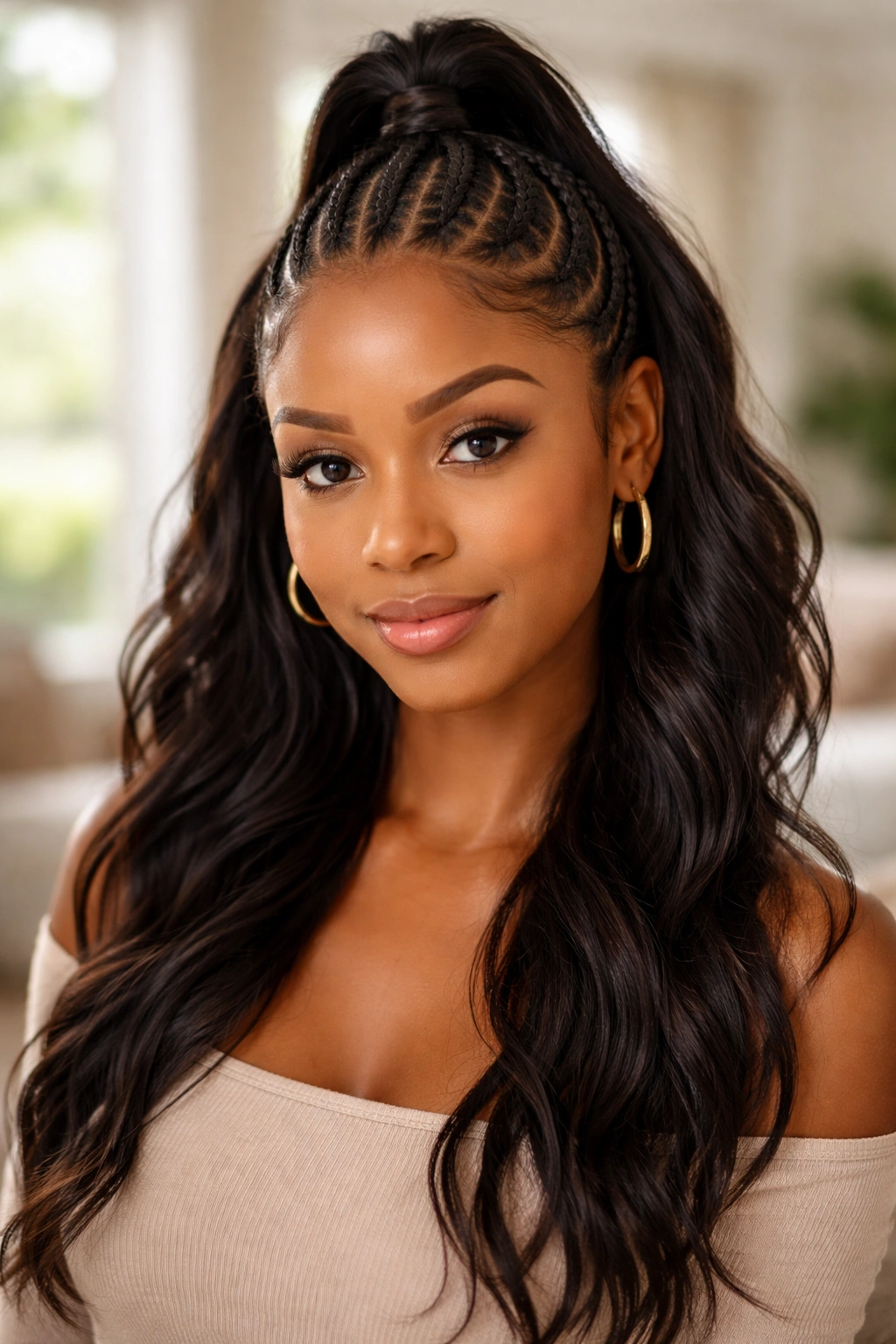
A full-head of cornrows might go four to six weeks. Half-up versions rarely make it past three.
The reason is simple — the loose section takes daily wear. It gets washed, manipulated, restyled, pulled back at night. All that handling puts stress on the transition point where the cornrows meet the loose hair. Eventually, the cornrows at that boundary start to fuzz, lift, or loosen.
Three weeks is a reasonable target. Some styles stretch to four if you’re gentle.
Past that, plan on a takedown.
Matching the Style to Your Face Shape
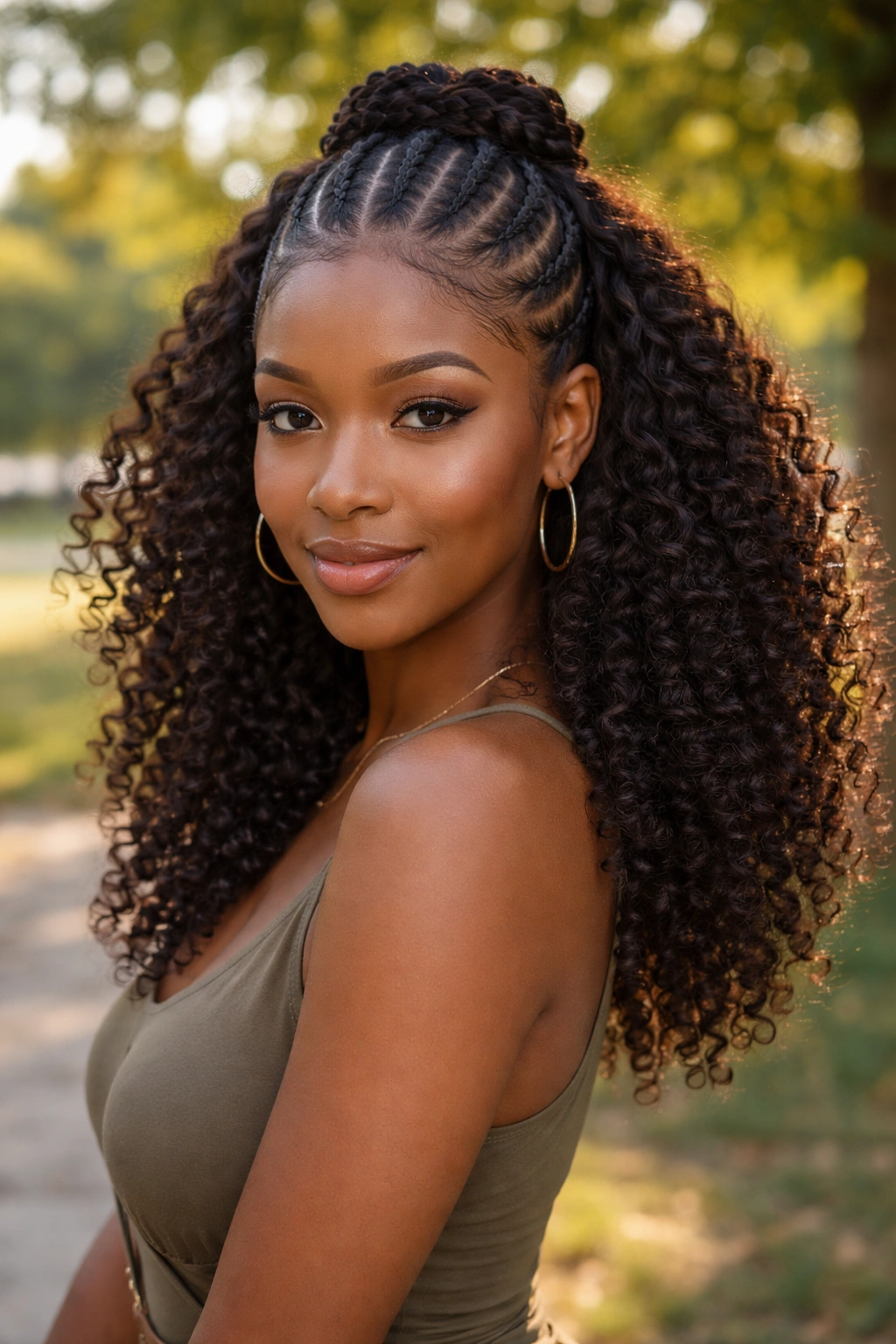
Round faces benefit from cornrows that add vertical lines. Straight-back cornrows with a high bun work. Zigzag parts also elongate a round face.
Square faces soften with curves. Heart-shaped parts, lemonade-inspired diagonal braids, and loose curls below all round out the jaw angles.
Long faces look balanced with horizontal elements. A crown cornrow headband works well here. So does a side-swept cornrow that cuts across the face width.
Oval faces can wear almost anything — the shape is forgiving.
Heart-shaped faces benefit from bottom-heavy styles. Fuller curls or longer loose sections balance out a narrower chin.
What Works for Shorter Natural Hair
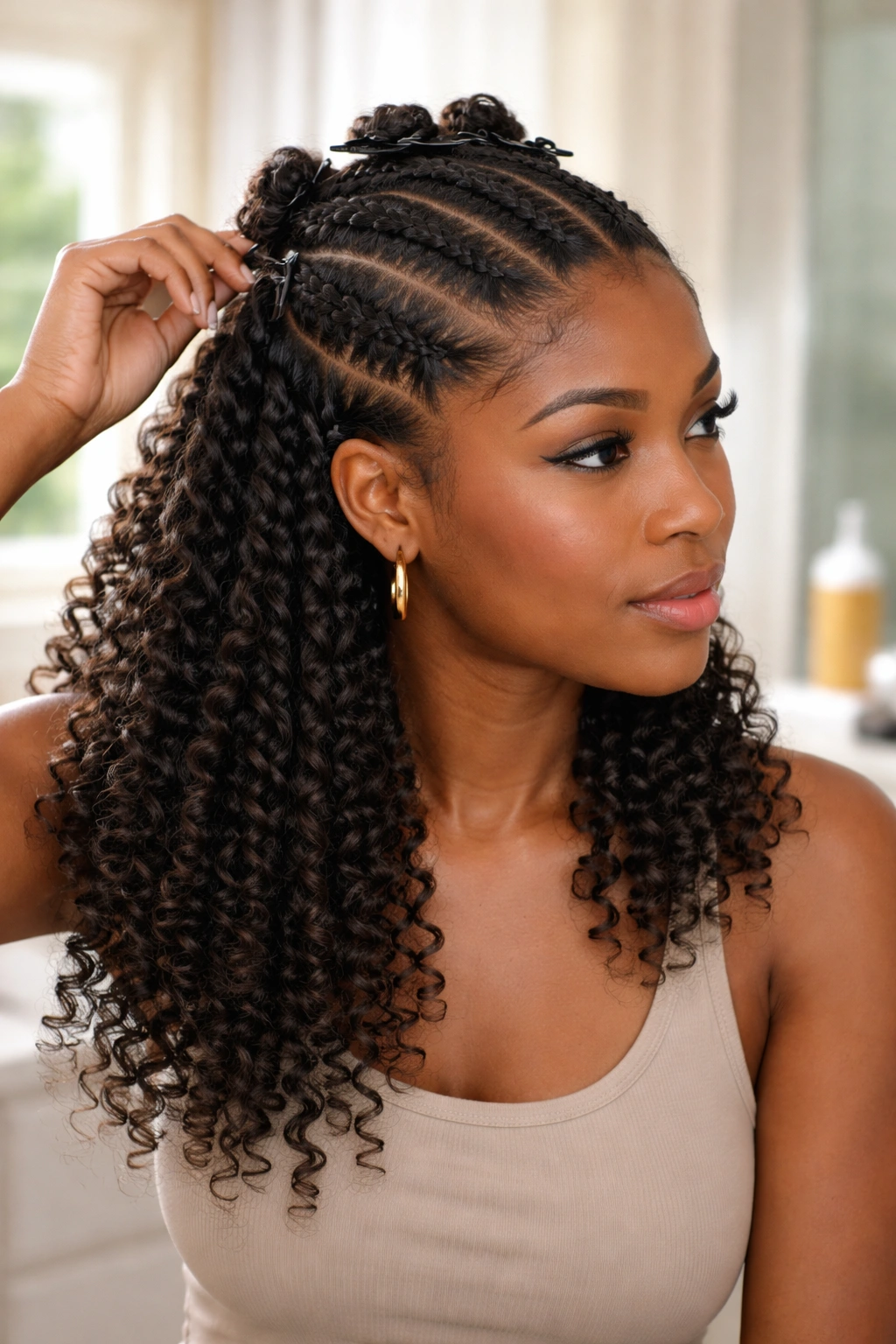
Shorter natural hair — say, four to six inches stretched — can still do half-up cornrow styles, but the proportions shift.
The cornrow section needs to be smaller since there’s less hair to work with. Two to three cornrows rather than a full head of rows. The loose section ends up being a short twist-out or defined curl rather than flowing length.
This is where clip-ins change the game for shorter hair. A curly clip-in at the transition point adds length to the bottom half without compromising the natural cornrows on top. Blended correctly, nobody can tell where your hair ends and the clip-in begins.
The trick with clip-ins on short hair is making sure your natural hair is dry and set before attaching the clip. Wet attachment causes the clip to slide as the hair dries.
Mixing Textures in One Style
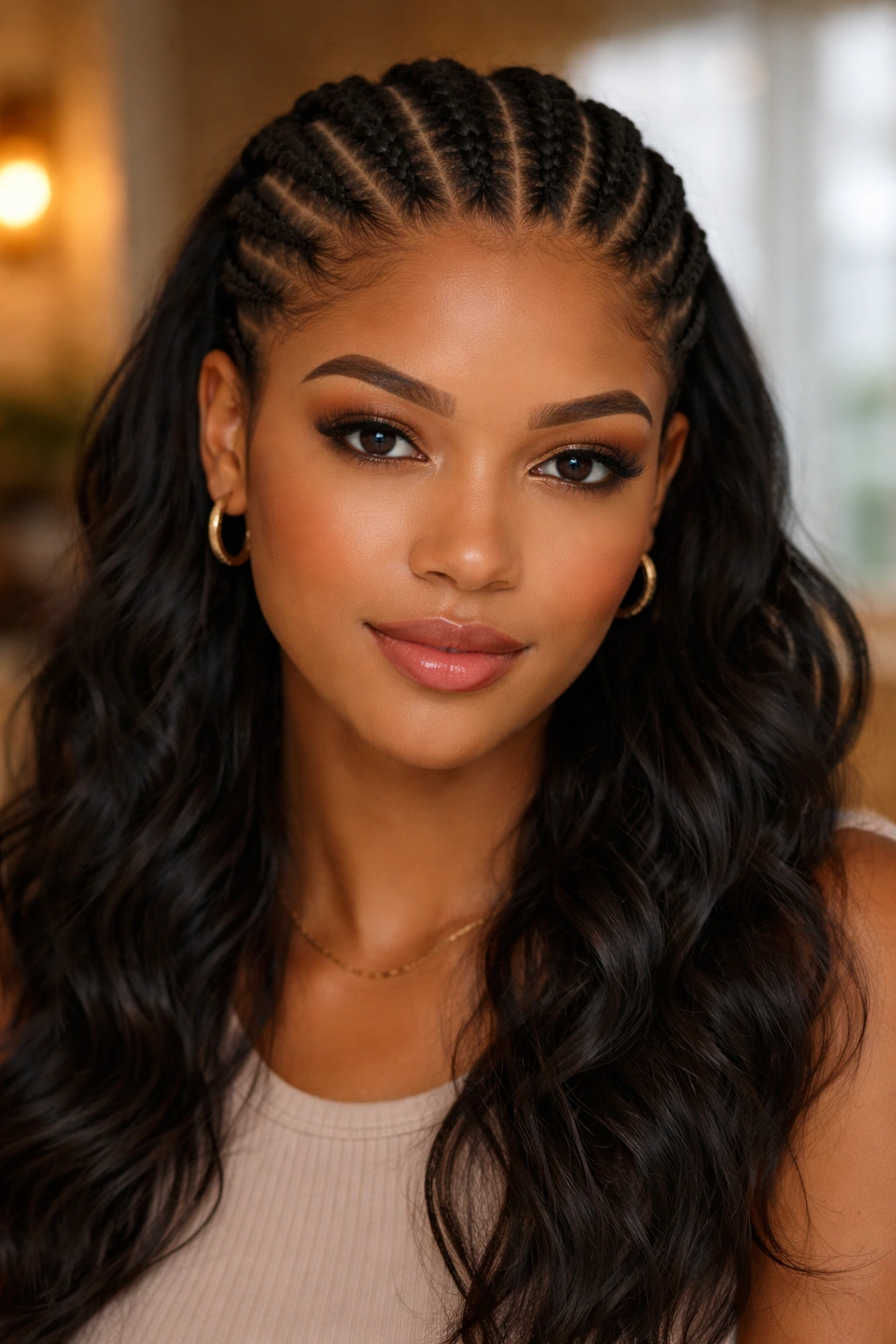
One quiet point that doesn’t get discussed enough: half-up half-down cornrows let you wear two different textures at the same time.
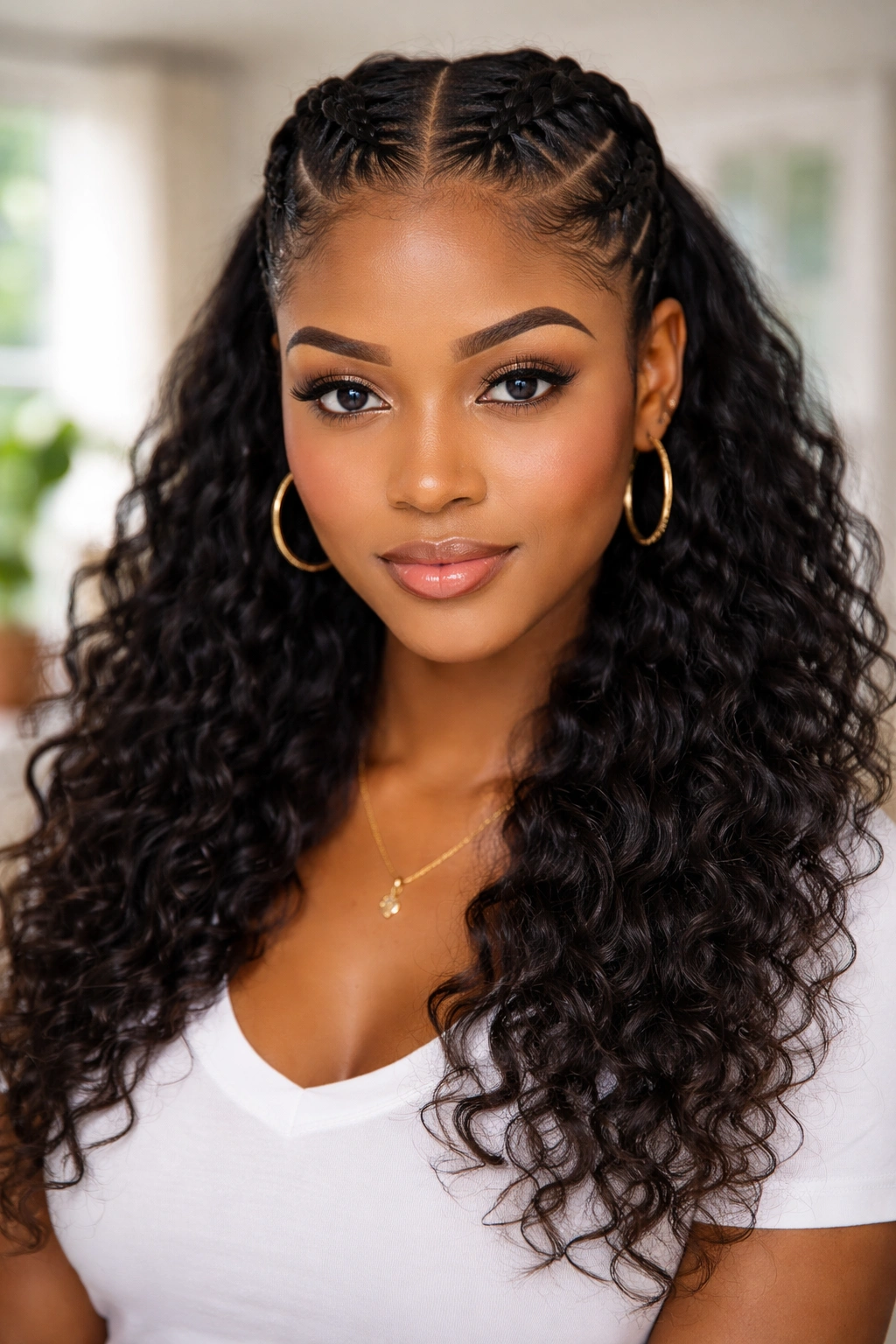
The top half is smooth and defined. The bottom half can be whatever texture fits your mood — finger coils, a twist-out, defined curls, loose waves, a blown-out afro. Each creates a completely different feeling.
A twist-out below reads classic natural. A finger coil set reads intentional. A blow-out reads bold and full. Loose spiral curls read soft and romantic. A kinky puff below reads afrocentric.
The same cornrow layout can look like five different styles depending on which bottom texture you pair with it. That flexibility is part of why these styles don’t go out of favor.
When to Avoid Half-Up Cornrows
Not every hair situation works for this style.
If your hairline is already thinning, half-up cornrows can add pressure at the front that you don’t want. The tension of the cornrows pulling back is focused right where the damage would be worst.
If you have locs, this isn’t a style option — cornrows don’t work on locked hair.
If you’ve just had chemical treatments (color, relaxer, keratin), wait two weeks before installing. The scalp needs time to recover from the chemical stress before taking on braid tension.
And if you’re in a period of heavy shedding — postpartum, post-illness, after a stressful season — give your hair a few weeks of low-manipulation care before committing to a braided style. Shed hairs get caught in cornrows and can’t release naturally, which creates matting over time.
