

Bohemian cornrow styles blend structured braiding with soft, loose, curly accents. The base is still cornrow — braided flat against the scalp — but instead of ending in a neat sealed tip, the style transitions into loose curls, beach waves, or crimped texture that falls freely around the shoulders and back. The contrast between the disciplined cornrow foundation and the wild curly release is the whole point. Twenty-five bohemian cornrow styles follow, each with a genuinely different approach to the cornrow-plus-curly-hair formula.
Bohemian cornrows sit somewhere between a protective style and a fashion statement. They’re less about tucking hair away for weeks and more about a specific look — the kind that photographs beautifully, moves with you, and feels grown-up but not stiff. If you love the polished root structure of cornrows but aren’t ready to commit to a fully braided finish, boho cornrows are the bridge.
What Makes a Cornrow Style Bohemian
The curly hair. That’s the defining feature. A cornrow ends where the curly extension begins, and the curly section can be loose waves, tight spirals, a beach-wave curl pattern, or anything in between. The cornrow stops braiding before the end of the extension, and the remaining hair is allowed to coil, spiral, or wave naturally.
Most bohemian cornrows use human hair curly extensions or high-quality synthetic curl-defined hair. Cheap synthetic curl patterns tangle within days and look matted by week two. Spend on the hair — it’s the visible 70 percent of the style.
The hairline on a boho cornrow set often also includes face-framing loose pieces — small sections of the curly extension left free near the temples to soften the look. It’s a detail that shifts the whole style from constructed to romantic.
Picking the Right Curly Hair for Your Style
Curl patterns come labeled numerically: 3A (loose waves), 3B (springy corkscrews), 3C (tight corkscrews), 4A (defined coils), 4B (Z-shaped coils), 4C (tightest coil pattern). Match the curly extension to either your own natural texture for a blended look, or pick a contrasting pattern for visual drama.
Water wave, deep wave, body wave, and kinky curly are the most common commercial extension patterns. Water wave gives you beachy S-curves; deep wave is tighter and more defined; body wave is softer with looser S-waves; kinky curly mimics natural 4A to 4B textures.
Key decision point: human hair can be re-dampened and re-styled; synthetic hair holds its pattern but can’t be heat-restyled. Choose based on how much styling you want to do during the life of the install.
Prep Work Before Installing
Wash day with a clarifying shampoo, a deep condition for 30 minutes, and a leave-in spray. Stretch the hair with blow-dry on cool or overnight twists. The stretched base blends with the extension better than a shrunken, kinked hairline does.
Detangle the curly extension before installation. Even human hair curly bundles can arrive with small knots from shipping and packaging. Gently finger-comb with a leave-in spray and lay them out in order.
Apply a lightweight edge gel to the hairline so the front of each cornrow smooths flat. Skip heavy product on the scalp — heavy product makes the cornrow lift at the root within days.
Tools That Matter for Boho Cornrows
- A rat-tail comb with a metal tip
- Curly hair extensions (human or high-quality synthetic)
- Hair clips for sectioning
- Edge gel with medium hold
- A small spray bottle with water and leave-in mixed
- A curl-refreshing spray for daily maintenance
- A wide-tooth comb or your fingers for curl separation
- A silk or satin bonnet sized for long, full curls
Brush choice matters here. No fine-tooth combs on the curly sections — they destroy the curl definition. Wide-tooth only, or fingers only, for the curly parts.
Technique Basics for Cornrow-to-Curly Transitions
The cornrow stops before the extension does. You braid the scalp-flat portion for your desired length — maybe eight inches, maybe twelve — and then release the remaining curly hair to hang free.
To seal the transition, wrap a thin piece of the curly extension around the base of the release point and secure with a tiny invisible hair tie. The wrap hides the braid termination and blends the cornrow into the curly section cleanly.
If the transition looks blocky, the extension is too dense at the release point. Trim a few strands to taper the density, or pull a few pieces aside before releasing so the transition feels gradual rather than abrupt.
A Quick History Note on Boho Braiding
Bohemian cornrow styles draw from a mix of cultural traditions — African cornrow techniques, 1970s hippie-era loose hair, and the broader braided-plus-flowing style that has existed across many cultures for hundreds of years. The specific modern blend — disciplined cornrow root plus untamed curly release — came into its own as curl extensions became higher quality and more accessible.
The category sits at a specific intersection. It’s cornrow work done by someone who values structure but doesn’t want a fully constructed silhouette. It reads artistic rather than utilitarian.
1. Two Cornrows Into Waist-Length Deep Waves
Two thick cornrows running from a clean center part to just past the ears, then releasing into deep-wave curly extensions that reach the waist. Minimalist at the top, dramatic at the bottom.
Why It Works
- Only two parts to make — fastest boho cornrow style to install
- Waist-length release creates serious movement and visual impact
- Deep wave pattern reads polished but not stiff
- Easy to tuck behind ears for a different look
Best tip: start the release point right above the ear so the waves fall in front of and behind the shoulder for balance.
2. Four Feed-In Cornrows Into Beach Waves
Four cornrows with a subtle kanekalon feed-in, running from the hairline to about mid-back, where the braids transition into beach-wave curls. The feed-in adds thickness to the cornrow portion; the beach waves at the bottom add softness.
Unlike tighter curl patterns, beach waves read casual and relaxed. The cornrow foundation keeps the look from feeling too beachy or undone. It’s a balance between styled and unstudied.
Beach wave hair tangles less than tighter curls, which means this style is easier to maintain over two to three weeks of wear. Who this is best for: anyone installing their first boho cornrow set or anyone wanting a lower-maintenance option.
3. Cornrow Crown With Loose Curly Back
The front and crown of the head are cornrowed — three or four neat rows running front to crown — and the rest of the hair behind the crown is left in loose curly extension. The cornrow crown functions like a headband; the back flows free.
Bold fact: this style cuts installation time by about 30-40 percent compared to a full cornrow install because you’re only braiding the top portion.
The back hair is attached by sewing a weft of curly extension to a thin cornrow track that runs horizontally across the back of the head. The track itself is hidden under the crown braids and under the loose curls above it. If done well, no seams show.
Curly back sections should match the density of the cornrow front. Too sparse and the curls look stringy; too dense and the back reads bulky.
4. Boho Cornrows With a Side Deep Part
A dramatic deep side part runs from the outer corner of the eye straight back to the crown. Five cornrows sit on the heavier side of the part; two thin cornrows sit on the lighter side. Everything releases into curly extension by the mid-length.
A deep side part reads sultry on boho styles. It adds dimension and gives the style a built-in focal point at the part itself. The curls fall more to one side, which softens facial features and creates asymmetric balance.
Who this suits: anyone with a round or square face shape looking to add visual length, or anyone who prefers asymmetric styles over symmetric ones.
5. Cornrows With Face-Framing Loose Tendrils
Standard boho cornrows (five straight-back rows transitioning into curly length) with small, deliberate face-framing tendrils left loose at the temples. The tendrils are 6-8 inches of curly hair pulled out before the cornrow starts, draping softly along the cheekbones.
The tendrils are the design detail. Without them, this is a plain boho cornrow set. With them, it reads polished and intentional.
How to Style It
- Pull 3-4 small curly sections forward at each temple before starting the front cornrows
- Let the tendrils fall at an angle that frames the face, not straight down
- Mist the tendrils lightly with a curl-refreshing spray each morning
- If a tendril goes flat, wrap it loosely around a finger while damp to re-coil
6. Three Big Cornrows Into Kinky Curly
Three chunky cornrows — thicker than standard — running from a clean center part and transitioning into kinky curly extension texture at the mid-length. The kinky curly pattern matches 4A-4B natural texture, so the transition reads organic.
Unlike smoother curl patterns, kinky curly has a coiled, dense texture that reads bold. It takes up more visual space and gives the style density without adding length.
Kinky curly hair tangles more easily than looser patterns. Accept this going in. Plan for slightly more frequent detangling — maybe every other day with a curl spray and fingers — than you’d do for water-wave hair.
7. Cornrowed Bantu Knots With Curly Release
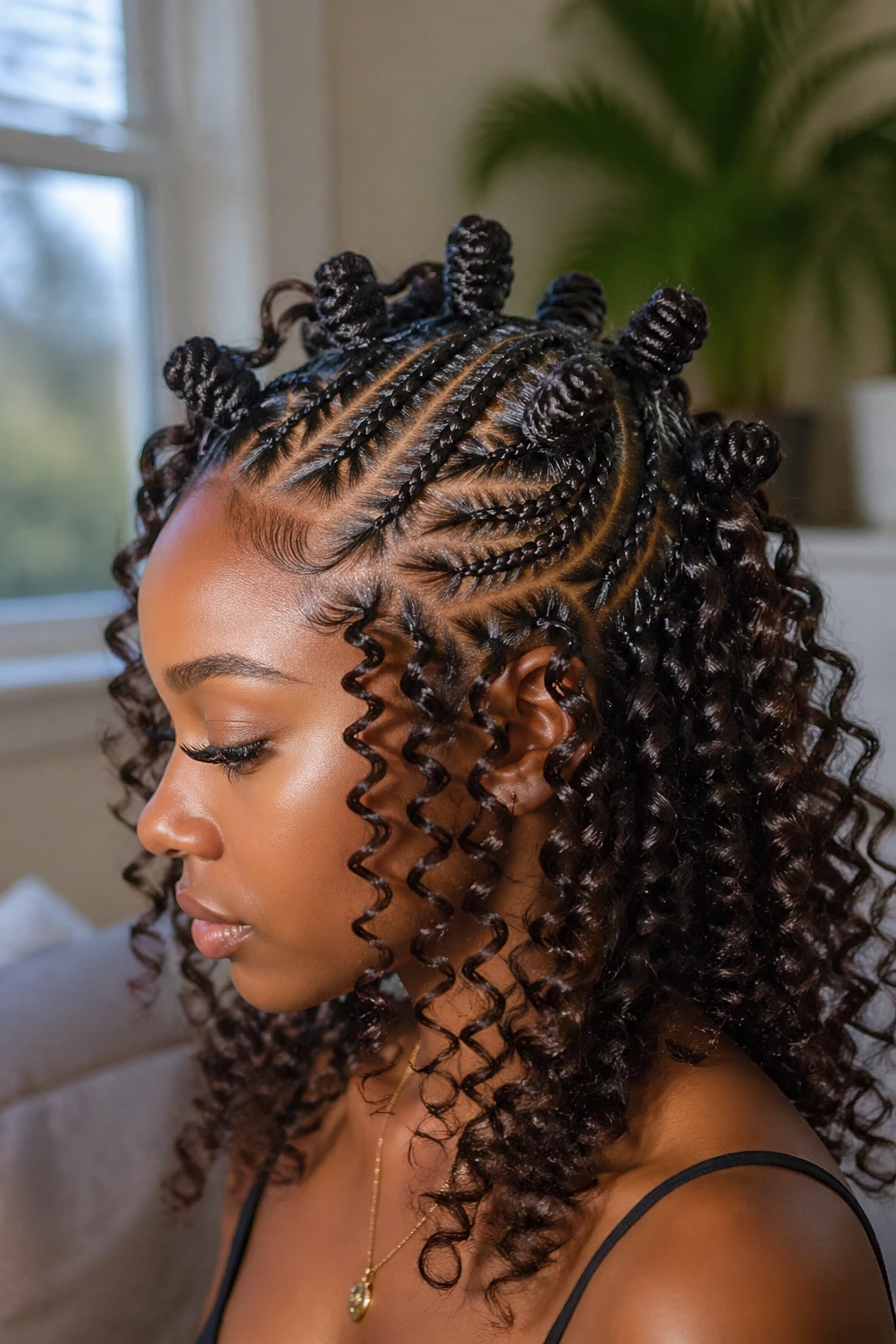
Cornrows leading into Bantu knots at the crown, with the curly extension wrapped around each Bantu knot. The knots sit like little sculpted mounds at the top of the head with curly hair spiraling out.
Picture this: the scalp-flat cornrows feed upward to a series of small Bantu knots, and from each knot, curly hair cascades down the back and sides.
This is an elaborate style. It takes 4-6 hours to install and demands a skilled braider or patient self-styling. The payoff is unmistakable presence.
8. Half-Up Half-Down Boho Cornrows
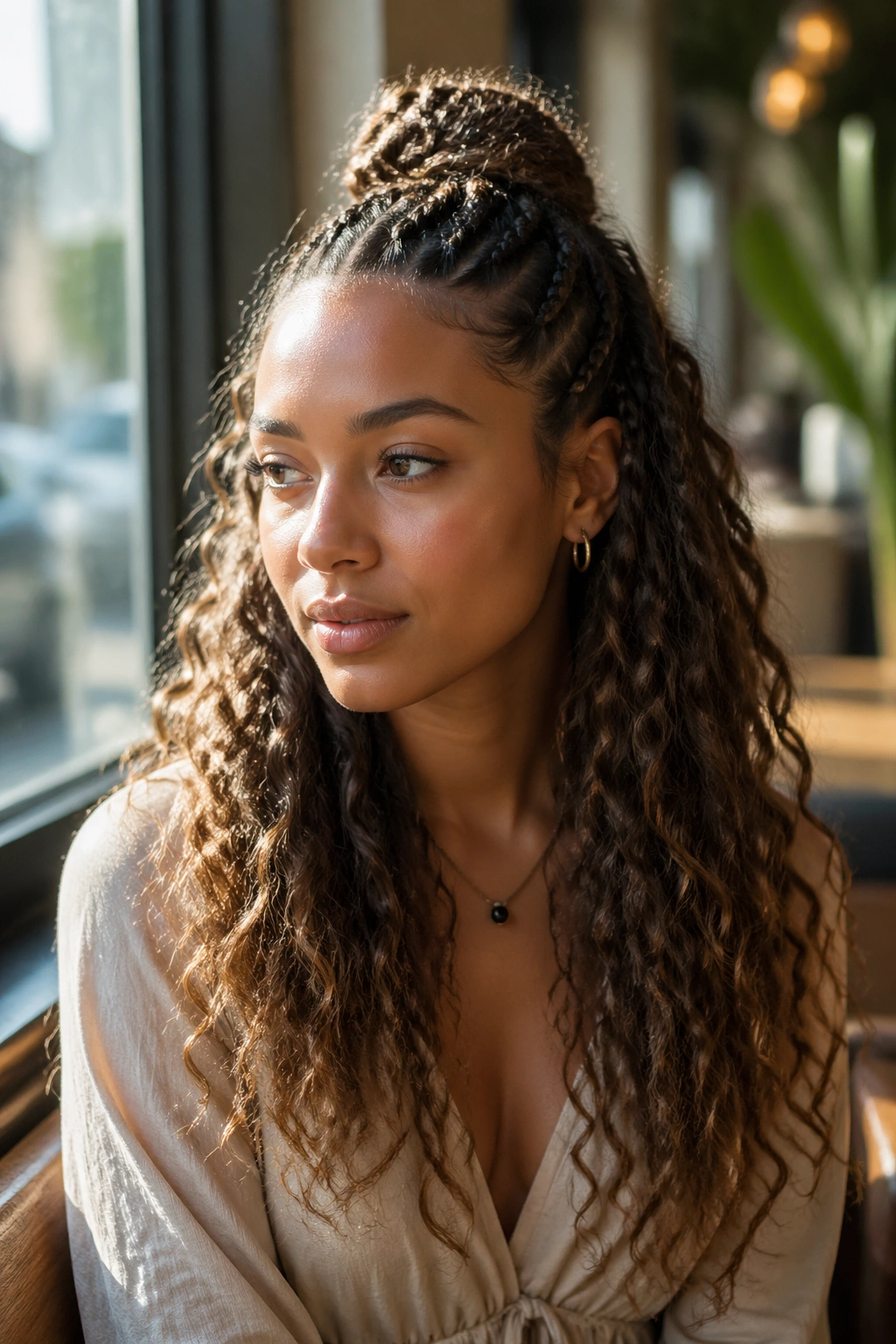
The top half of the hair is in small cornrows — three to five rows — gathered into a loose bun or ponytail at the crown. The bottom half is free-flowing curly extension. It’s the half-up look applied to boho braiding.
Half-up styles flatter most face shapes because they pull hair off the face while leaving length and movement below. This version adds the structural interest of the cornrow crown without fully committing to a braided look.
The cornrow section stops at the crown and the hair below is a separate section of loose curly extension. Attaching the two cleanly is the main challenge — use a horizontal cornrow track at the crown as the base for sewing in the loose curly weft.
Best for: date nights, weddings, and anyone wanting one style that reads elegant from the front and dramatic from the side.
9. Cornrows Ending in Loose Water Waves
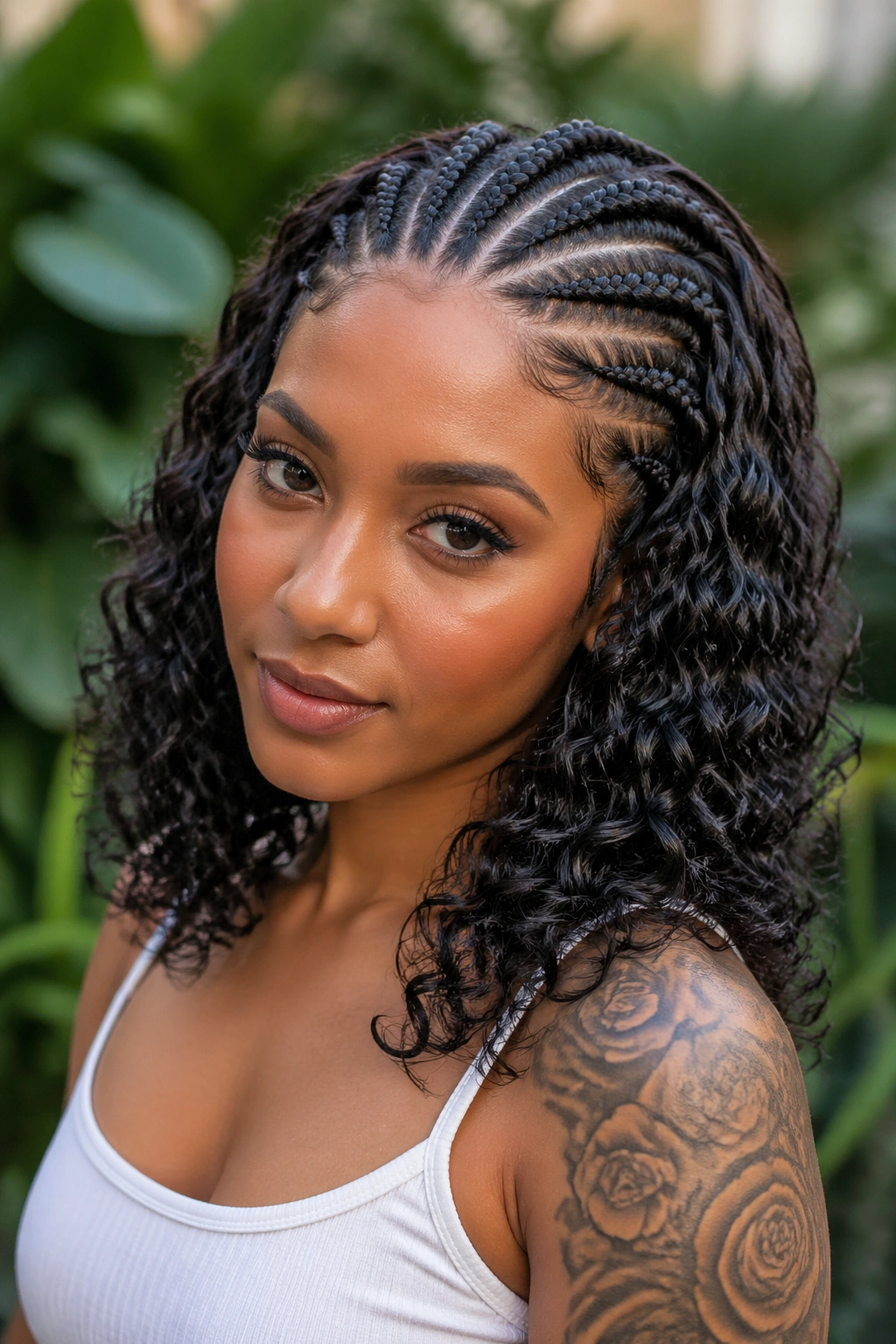
Cornrows that transition into water-wave curly extension at about shoulder length. Water wave is a specific curl pattern with defined S-shaped waves — neither tight corkscrews nor loose beach waves. The pattern sits between the two.
Water wave is one of the most photogenic curly textures. It catches light on each curve and moves fluidly with head motion. Photos taken in natural light especially showcase the curl definition.
Water wave human hair extensions can be re-dampened and re-styled, which means the curl pattern can be freshened up throughout the life of the install. Just mist, scrunch, and let air-dry.
- Mist with a 70/30 water-to-leave-in mix every second day
- Scrunch upward from the ends to revive curl shape
- Let dry fully before sleeping to prevent mildew smell
- Sleep in a pineapple or in a silk bonnet to preserve curls overnight
10. Cornrowed Side-Swept Bangs With Curly Body
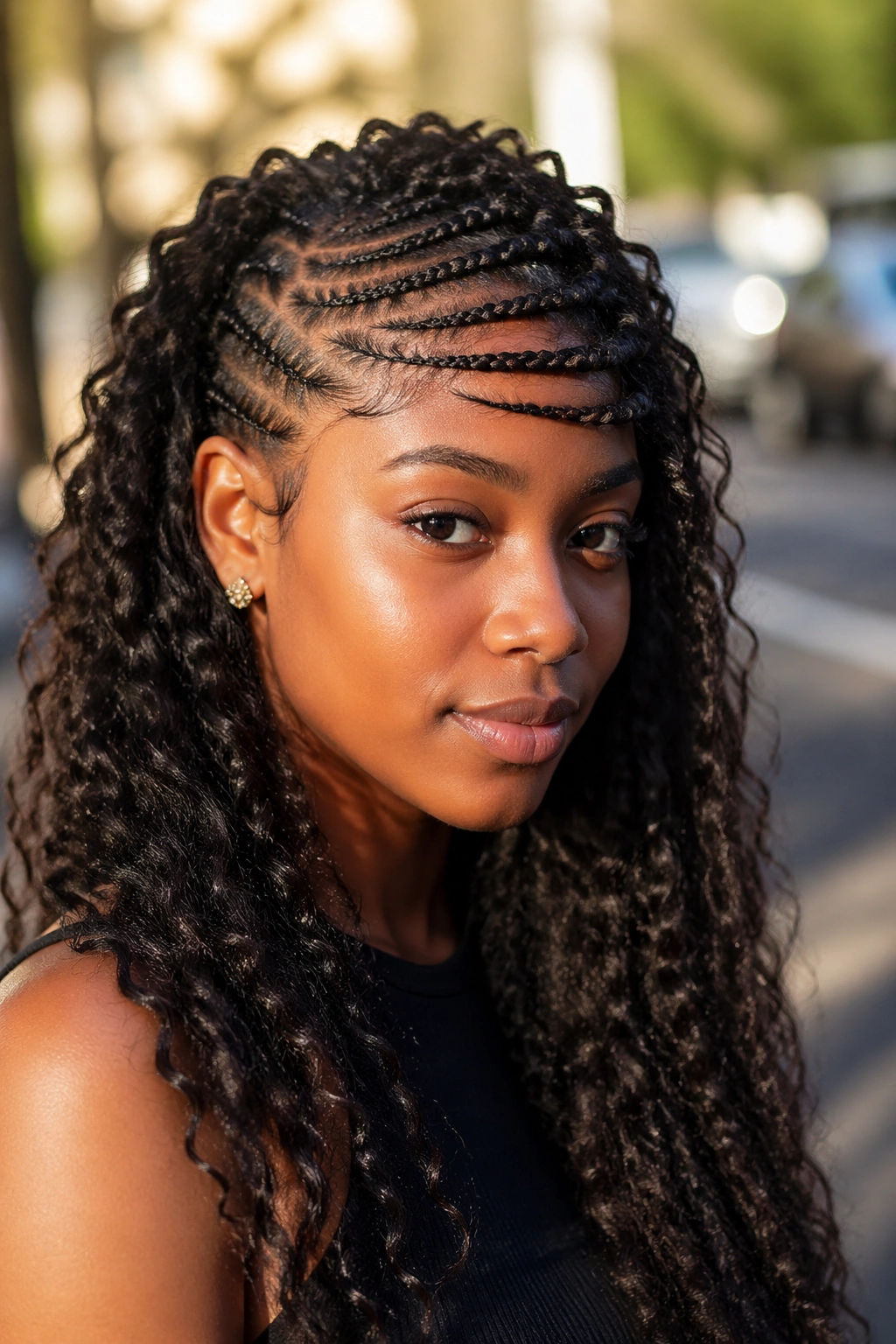
Cornrows that form a specific side-swept bang effect at the hairline — the front rows are angled diagonally across the forehead rather than straight back — and the rest of the head is curly extension. The diagonal cornrow over the forehead reads like a bang.
This is a specific styling concept borrowed from haircut language. The diagonal front rows function as bangs, giving you the bang aesthetic without cutting actual hair.
The cornrow-bang section stops right at the temple. From the temple back, either more cornrows or loose curly extension continues. Both options work; they read differently.
11. Boho Cornrows With a Single Accent Braid
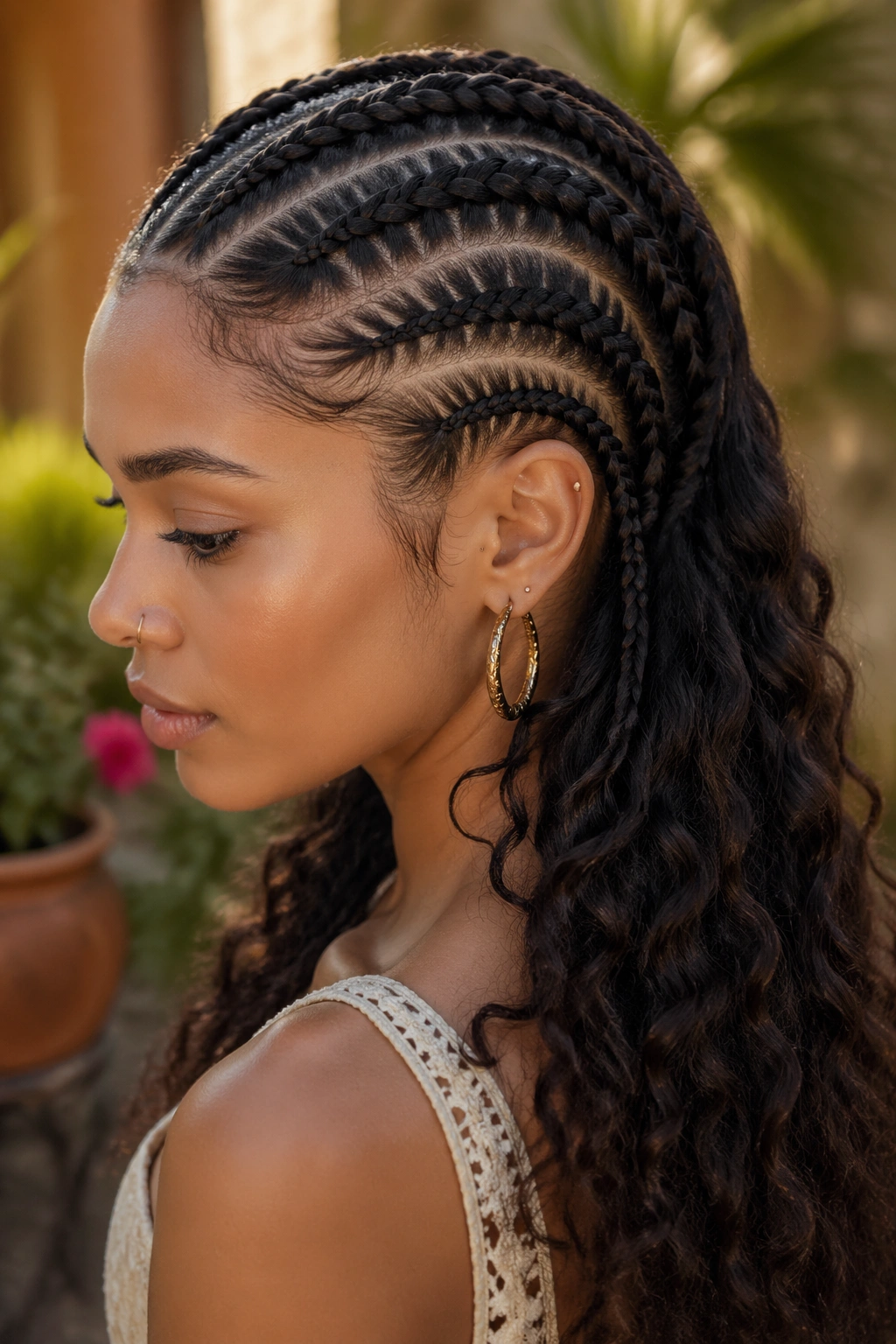
Mostly cornrow-to-curly style, with one decorative accent braid running from the temple to the nape. The accent braid is usually a fishtail, rope braid, or a thin three-strand that sits against the curly section as a design line.
A single accent braid against loose curls reads elegant. It’s the equivalent of adding one statement necklace to an otherwise simple outfit — a single detail elevates the whole look.
The accent braid needs to be thin. A thick braid competes with the cornrow foundation and the curly body for attention. Think of it as a finishing touch, not a second foundation element.
12. High Ponytail Cornrows With Curly Release
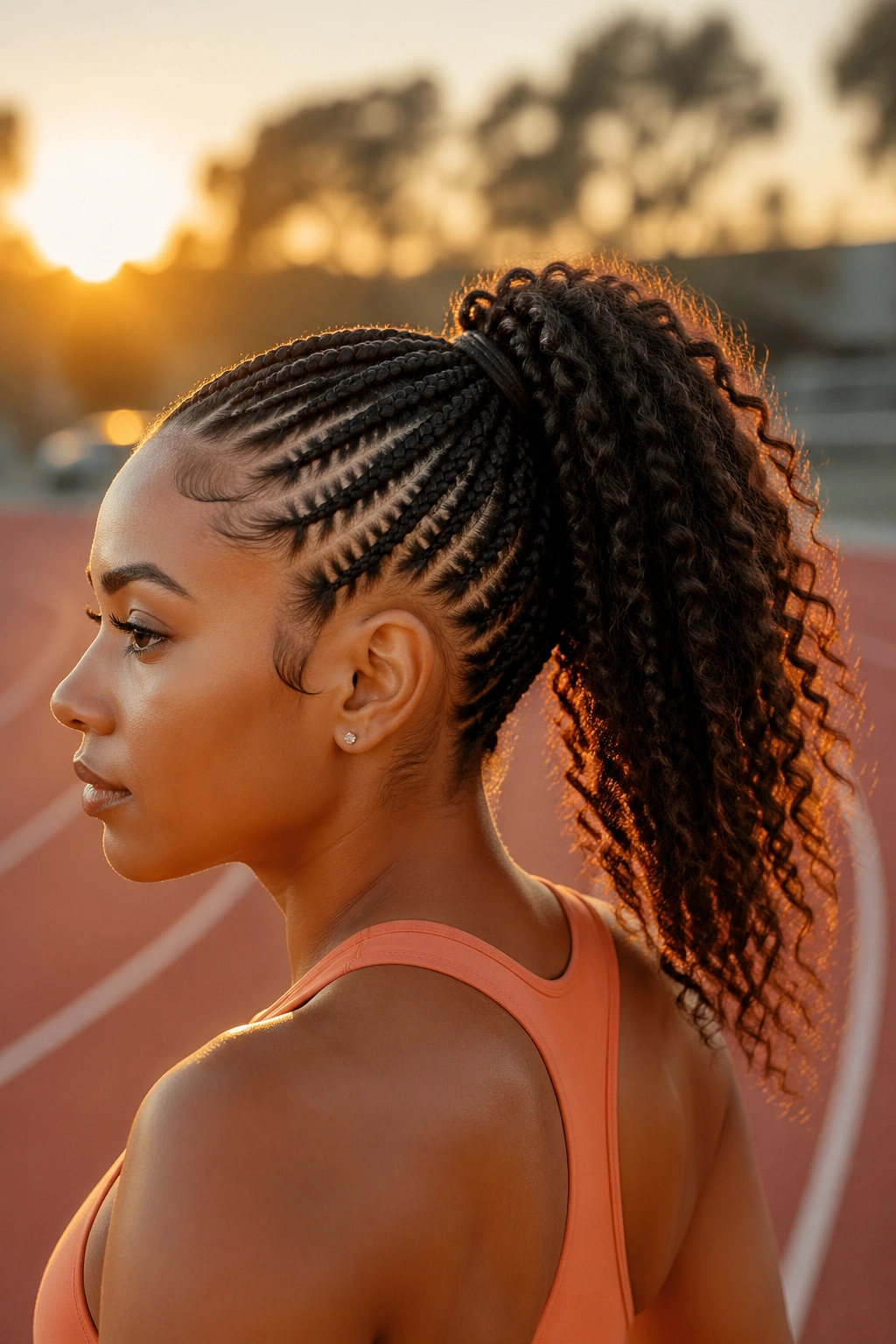
All the cornrows feed up to a high ponytail at the crown, and the ponytail itself is curly extension — not straight, not wavy, curly. The cornrow foundation stops at the crown; the ponytail is all curl.
This is a great pick for athletic activities. The cornrows keep the front smooth through a workout, and the curly ponytail doesn’t tangle the way long loose curly sides would.
Mechanism-wise, the curly ponytail sits on top of the cornrow gather point. Wrap the base with a color-matched piece of curly hair to hide the gather tie. The wrap blends the cornrow base into the curly tail smoothly.
The Catch
A high gather pulls harder at the hairline than a low style. If you know your edges are sensitive, go with a mid or low ponytail instead. The style reads almost as dramatic and costs your edges less.
13. Zigzag Cornrow Parts With Flowing Curls
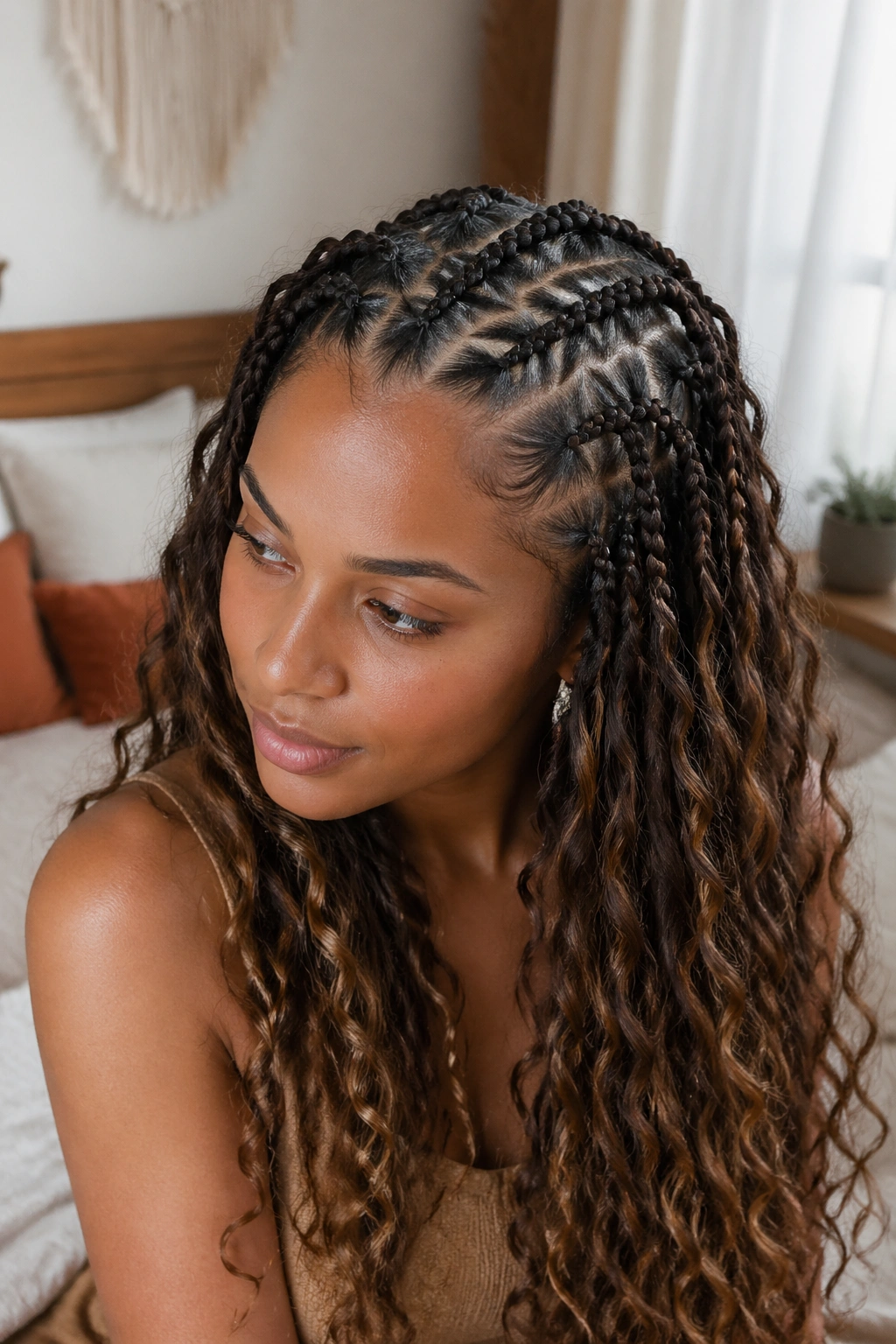
The cornrow section uses zigzag parts between rows — four or five rows divided by wavy part lines. The curly section below the cornrows is standard loose curl.
The zigzag parts add visual interest to the cornrow portion without changing the braiding technique or the curly finish. It’s the easiest way to add design energy to a boho cornrow set.
Zigzag parts need to be drawn with the rat-tail comb tip and checked in the mirror before braiding starts. Once the cornrow begins, the part can’t be adjusted — you’re committed.
Who this suits: anyone wanting a boho cornrow set that reads creative from the front view but remains loose and flowing from the back.
14. Goddess Boho Cornrows With Pre-Stretched Ends
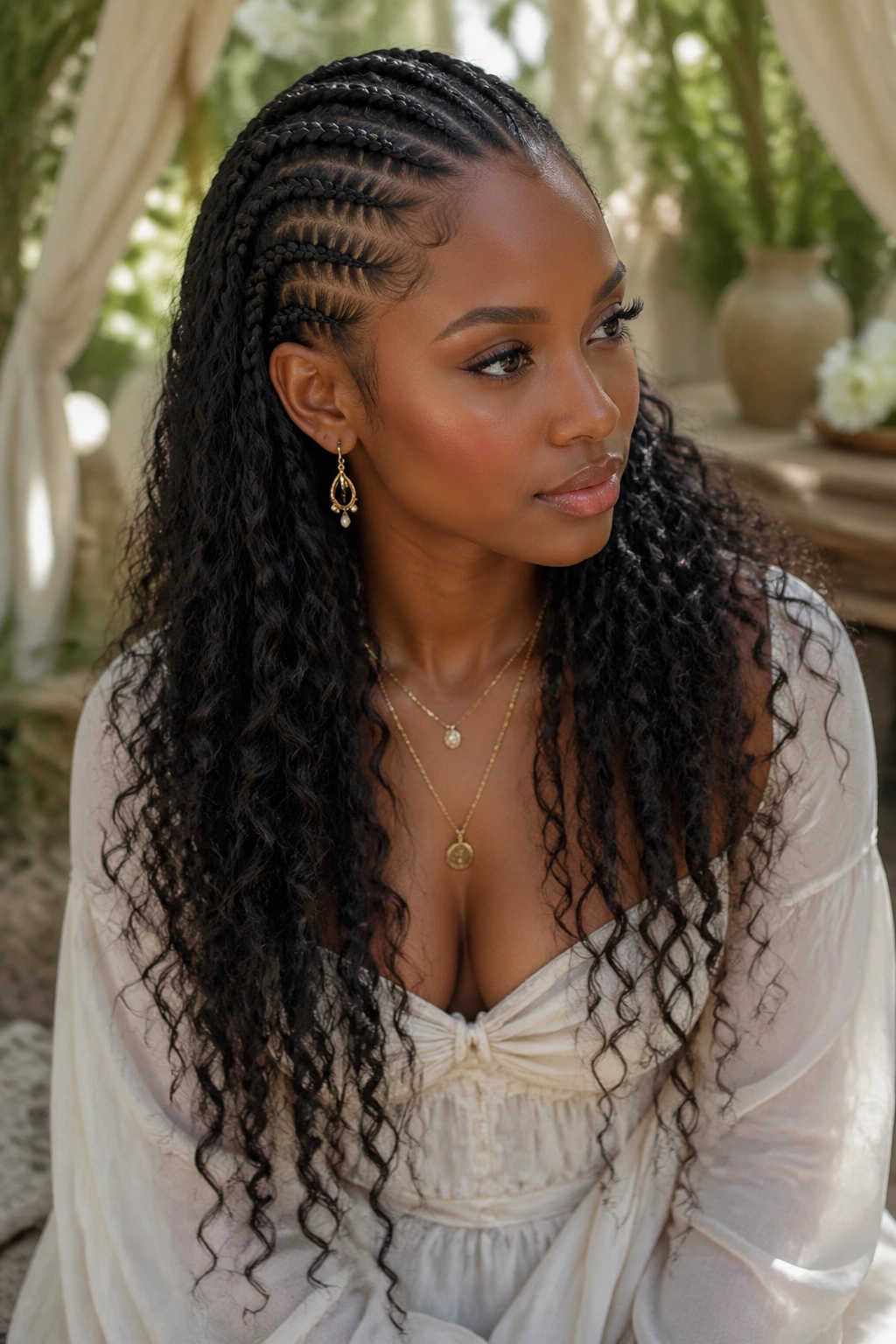
A goddess-inspired variant where the cornrow portion is thinner and more sculpted, and the curly release is longer and flowier than standard boho cornrows. The whole look reads more ethereal — like stepping out of a Renaissance painting.
Goddess boho cornrows usually have six to eight thin cornrows rather than four chunky ones. The added parts create more visual detail on the scalp portion while keeping the overall silhouette light.
Pre-stretched curly extensions work best for goddess boho because they have already-tapered ends that blend into the curly section more fluidly.
15. Boho Cornrows With a Crown Band of Curls
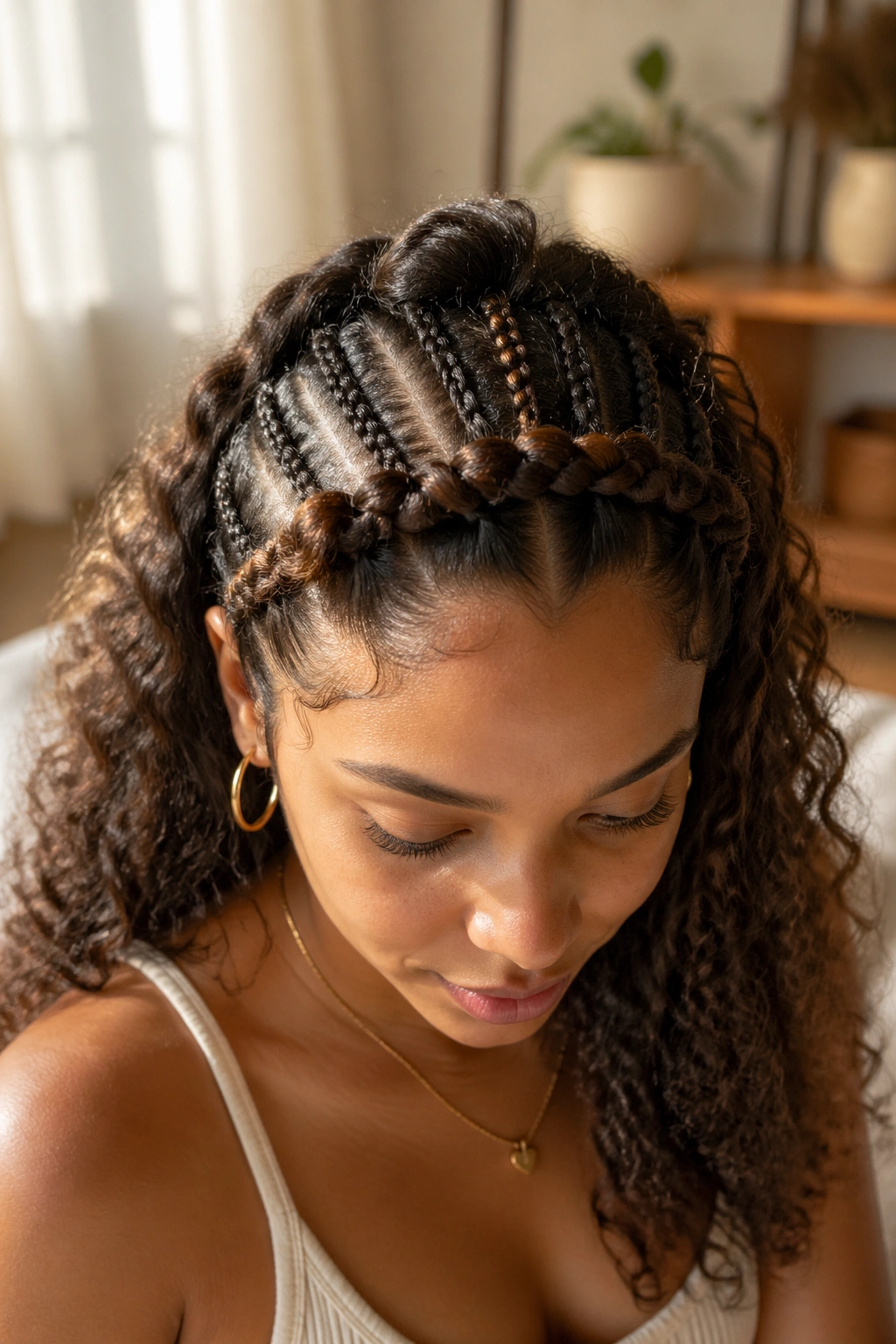
A decorative band of curls wraps across the crown horizontally — like a braided headband, but made of curly extension instead of a braid. The band sits between the cornrow crown and the loose curly back.
The crown band is held in place by a horizontal cornrow track underneath. A weft of curly hair is sewn to the track, creating a visible band of curly hair stacked on top of the cornrow foundation.
Visually, the band adds a third zone to the style. You get cornrow front, curly band, loose curly back. Three distinct textures layered in sequence.
16. Braided Updo With Curly Trailing Pieces
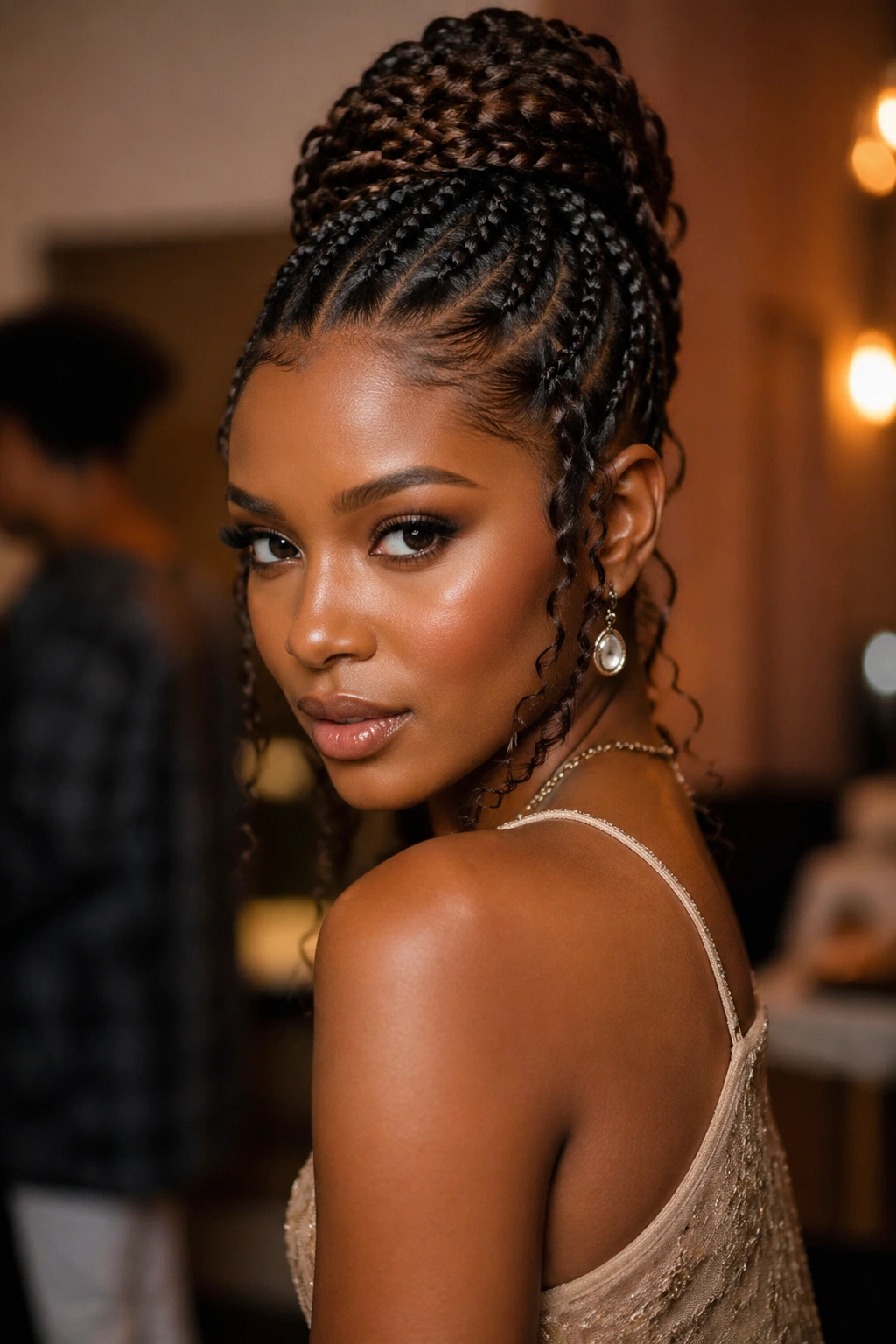
Cornrows woven into an updo at the crown, with two or three sections of curly extension pulled loose to trail down from the updo. The updo is structured; the trailing pieces are organic.
The trailing pieces emerge from the updo at deliberate points — behind the ear, at the nape, or to one side. They shouldn’t look accidental. Plan the trail placement before securing the updo.
This is the boho cornrow style to wear to an event. It reads formal from ten feet but boho up close. Few styles bridge those two zones so cleanly.
17. Cornrows With Curly Accent at the Part
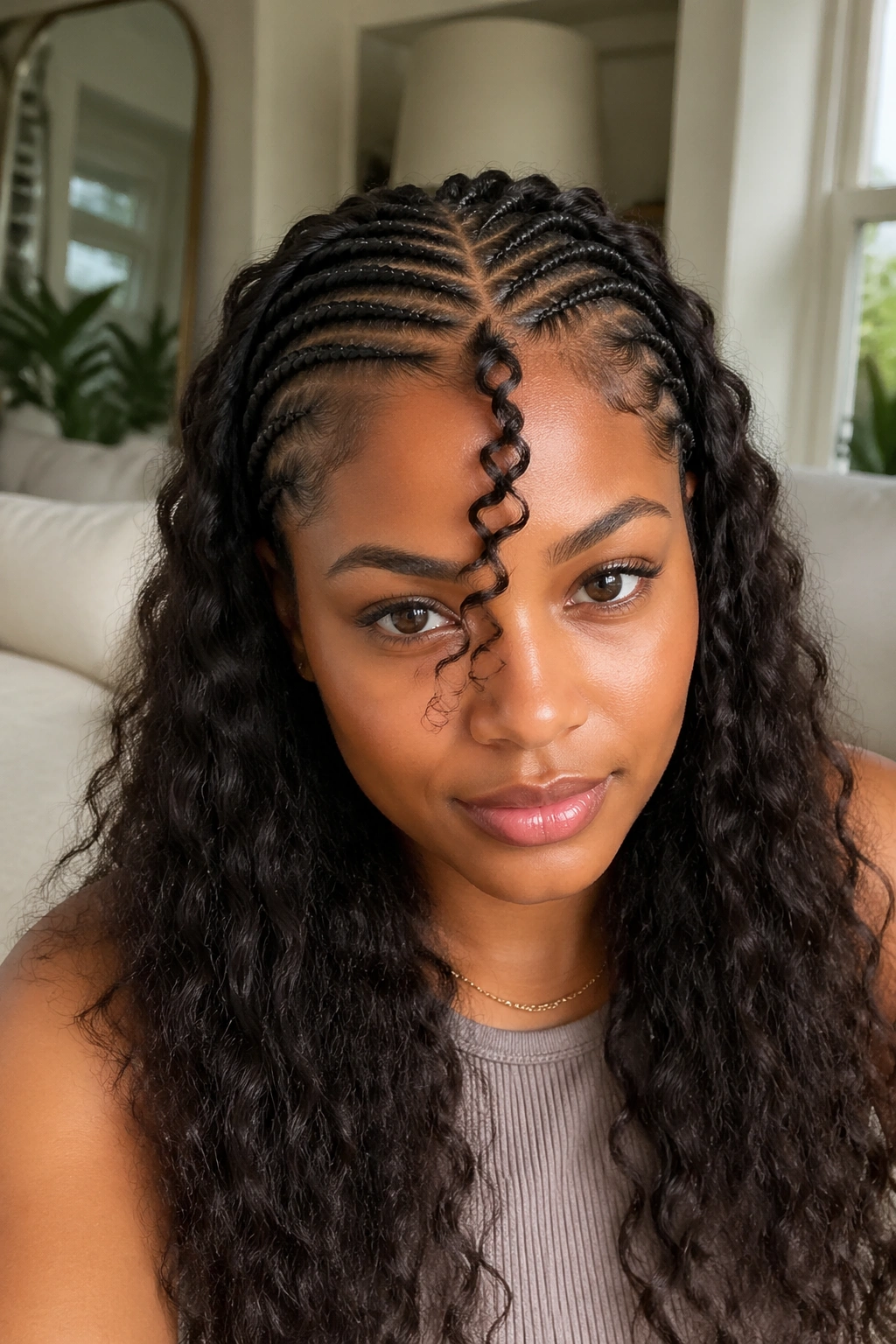
A standard cornrow-to-curly set, but with a single loose curly section pulled out along the part line and draping over the front rows. The center part reads less severe because of the soft curly accent crossing it.
Picture a clean center part broken up by a loose tendril that falls over the forehead. The part is still there, but it’s softened.
The accent piece should be about an inch wide and long enough to drape over 2-3 cornrow rows. Shorter pieces look like flyaways; longer pieces start to compete with the main curly body.
Styling tip: pin the accent piece at its origin point with a small invisible pin so it drapes consistently instead of shifting throughout the day.
18. Low Messy Bun Boho Cornrows
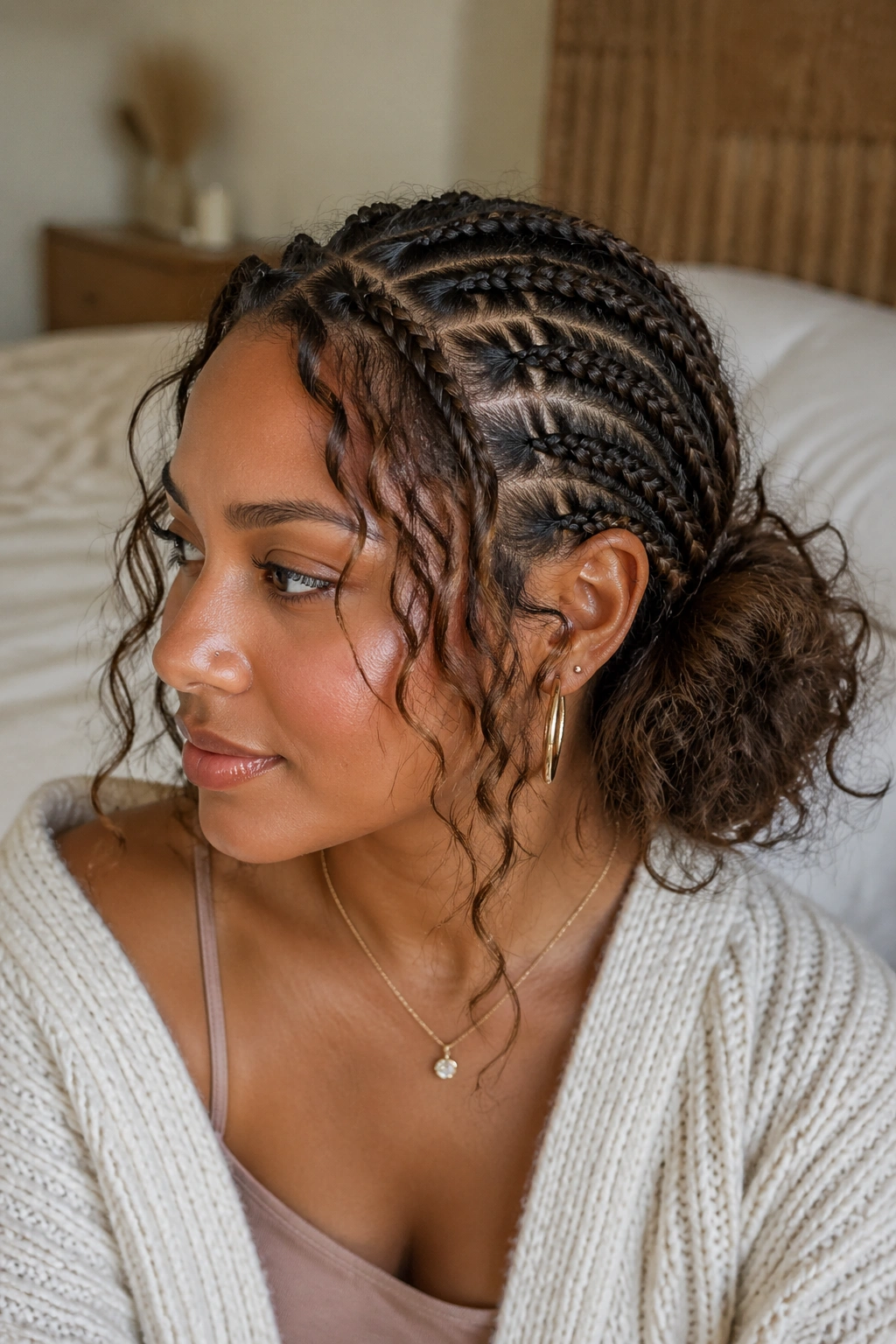
Cornrows into a low, deliberately messy bun at the nape — the bun is made from the curly extension gathered and loosely pinned rather than neatly wrapped. Curly strands escape from the bun, framing the face and neck.
The mess is the design. A tight, sleek bun reads formal; a deliberately loose bun reads bohemian. Pulling a few curly strands out of the bun immediately after pinning sets the intentional messiness.
- Gather all curly ends at the nape
- Twist once, then pin into a loose mound at the base
- Pull 5-6 curly pieces out of the bun deliberately
- Mist with water and scrunch the escaped pieces for definition
19. Cornrow Bangs With Long Curly Length
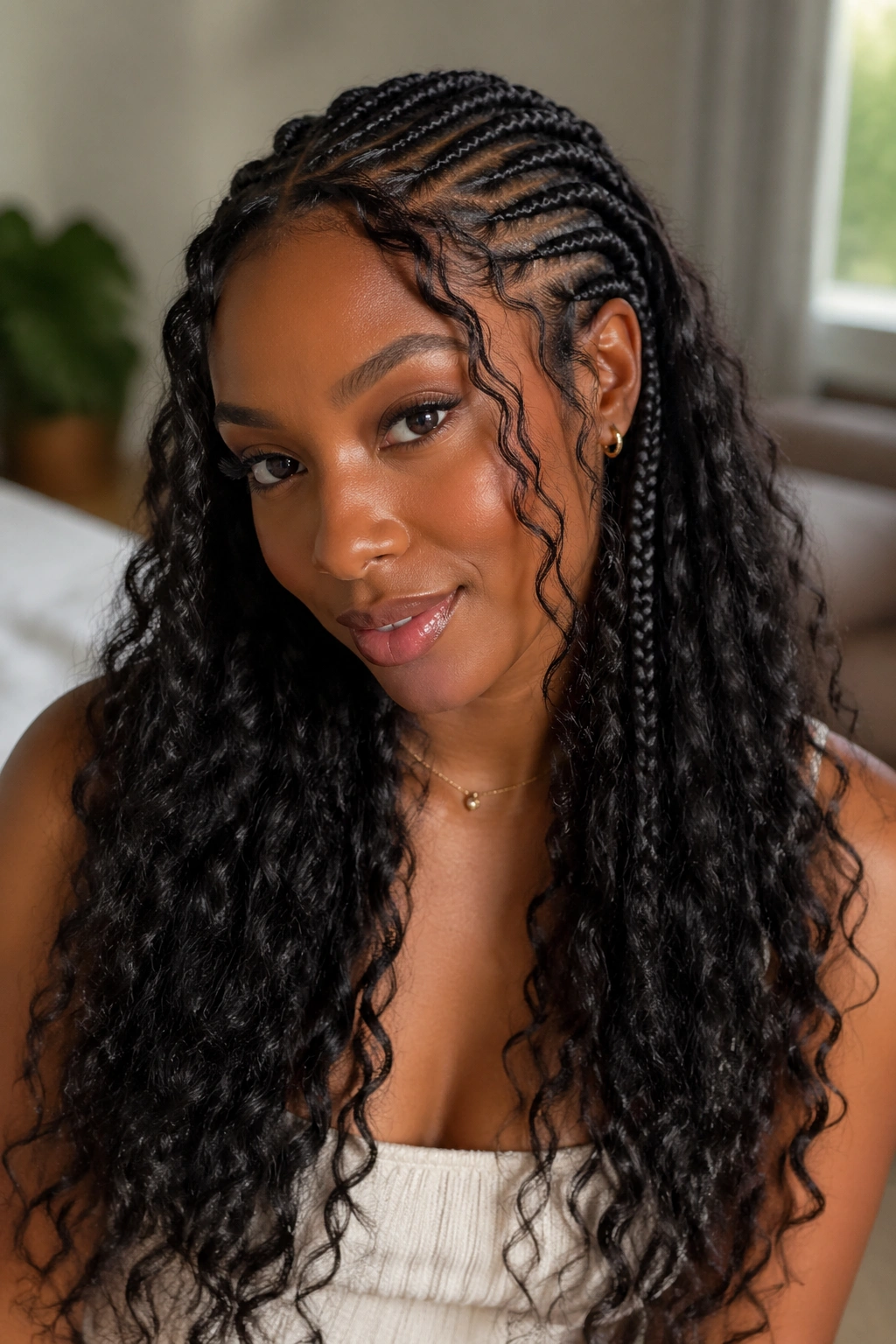
The cornrow section is limited to the hairline and front — like cornrow bangs — and the rest of the hair is curly extension in long length. Only the front 3 inches of the head is cornrowed; everything else hangs loose.
This is the most minimalist boho cornrow approach. The cornrow is almost an accent rather than a foundation. It gives you a styled face-frame without covering much of the head.
The cornrow bang section holds the front hair back and away from the face. It’s functional and decorative at the same time.
20. Half-Cornrowed One-Side Boho
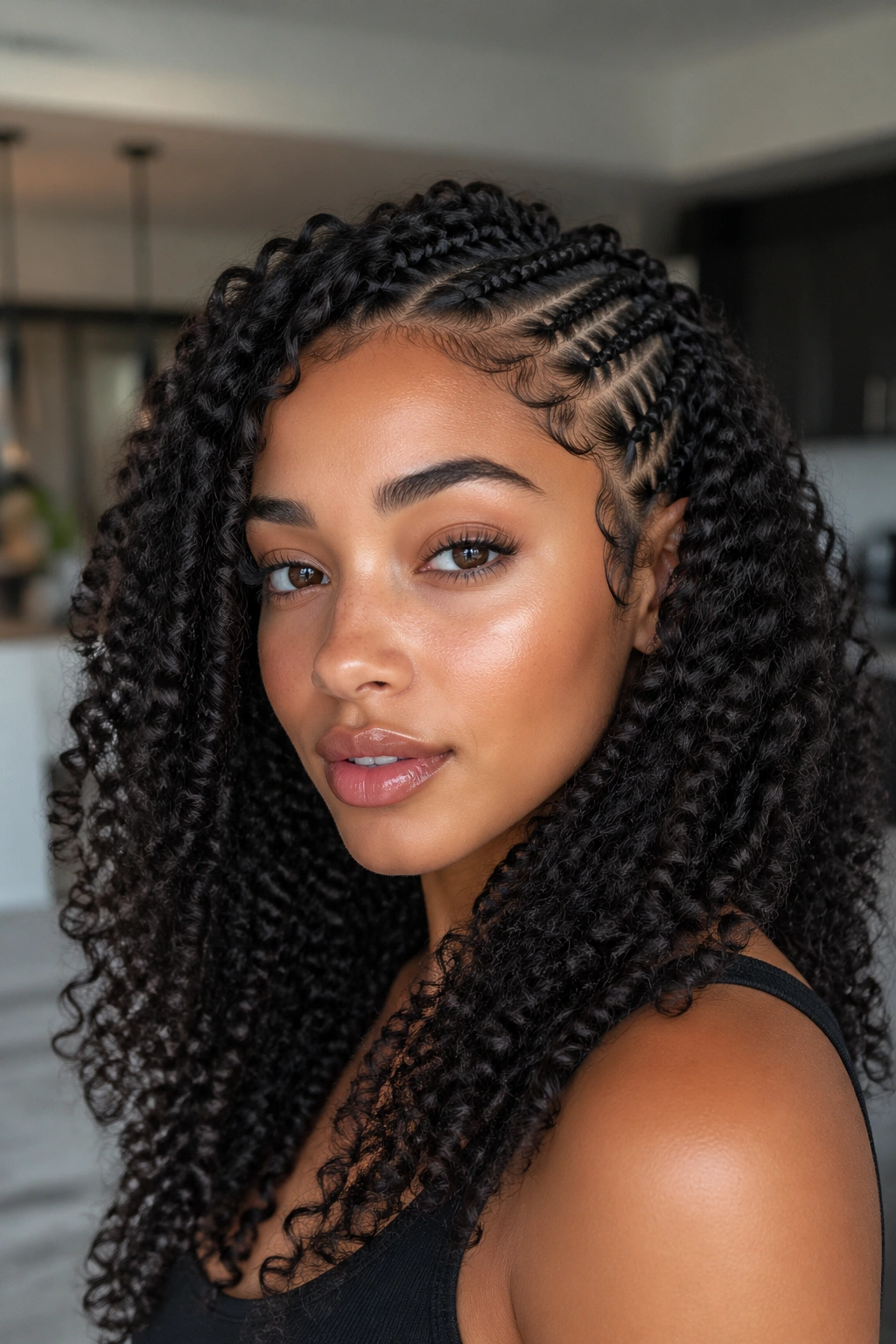
The right side of the head is cornrowed — four or five rows running flat — and the left side is loose curly extension. The style is half-shaved-looking from one angle but actually just half-cornrowed.
This borrows the visual from undercut and half-shaved hairstyles without requiring any cutting. The cornrow side reads structured; the free side reads untamed.
Who this is best for: anyone bored of symmetric styles, or anyone who wears their hair pushed to one side anyway. The cornrowed side becomes functional — it keeps that side of the hair flat and off the face permanently.
21. Cornrows Into a Messy High Ponytail
All cornrows gather high at the crown, and the curly ponytail is deliberately messy — ends uneven, some curls pulled out, no attempt at neatness. The opposite of a polished high ponytail.
The mess sells the boho feel. A neat high ponytail reads athletic; a messy one reads artistic. The styling takes five minutes after the install is done and transforms the whole look.
Pull out short curly pieces around the hairline after finishing the gather. Let them fall where they will. Spray with a curl-refresh mist to soften and define them.
22. Cornrow Track With Curly Hair Over Top
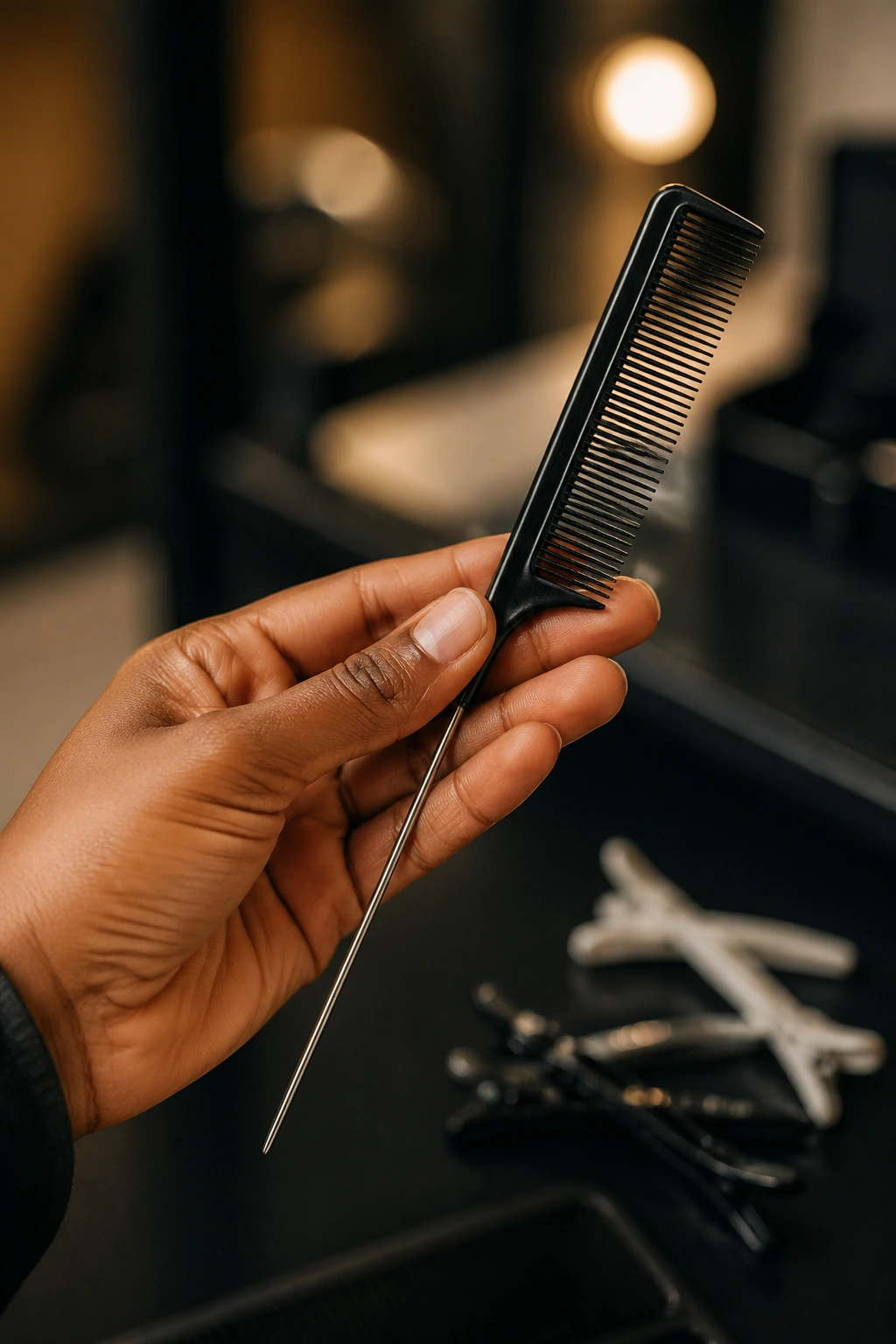
A single horizontal cornrow track runs from ear to ear across the crown, holding the head hair. A full weft of curly extension is sewn to the track, completely covering it. The result is a full head of curly hair with a hidden structural foundation.
This is technically boho but reads almost entirely like a curly wig or sew-in. The cornrow is pure structure — invisible once the curly weft is installed.
Installation takes longer because the weft sewing adds a step. But the install lasts 4-6 weeks, longer than most boho cornrow sets, which makes it worth the extra effort for some wearers.
Who This Is For
Anyone wanting the look of a curly sew-in without visible cornrow detail. Anyone with edges that can’t handle a lot of exposed braiding tension.
23. Boho Cornrows With Color Ombré Curls
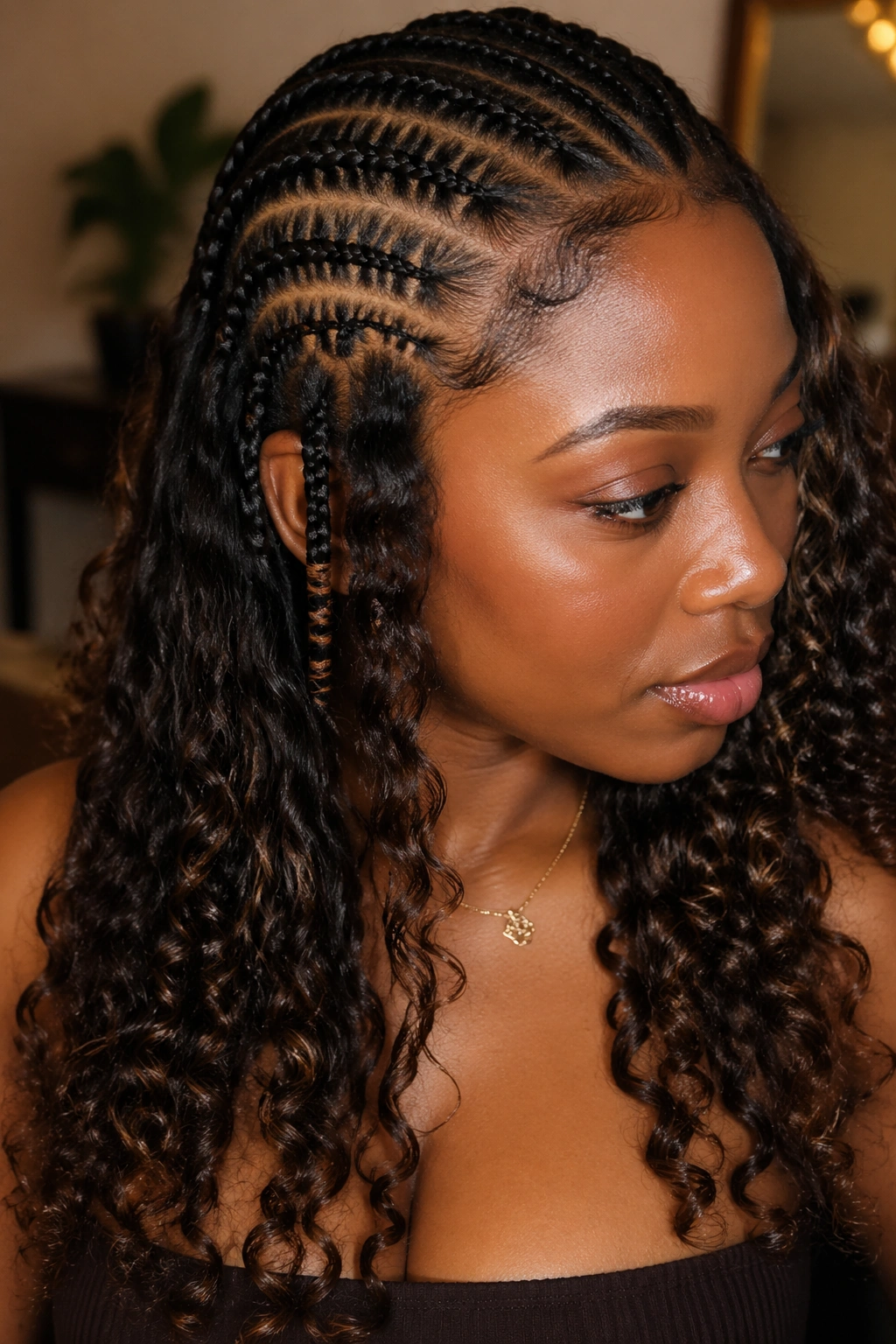
Cornrows in natural color, curly ends transitioning into a color ombré — honey blonde, caramel, burgundy, or copper highlights on the curly section. The gradient appears only in the curly portion, leaving the cornrows in natural shade.
Color ombré curls photograph beautifully in natural light. The color transition draws the eye downward and adds dimensional interest that single-color styles can’t match.
Human hair works better than synthetic for colored ombré because the color reads more natural and the fiber doesn’t develop a plastic sheen. If you’re going with synthetic, pick a brand specifically designed for color-blended extensions.
24. Tribal-Style Boho Cornrows With Beads and Curls
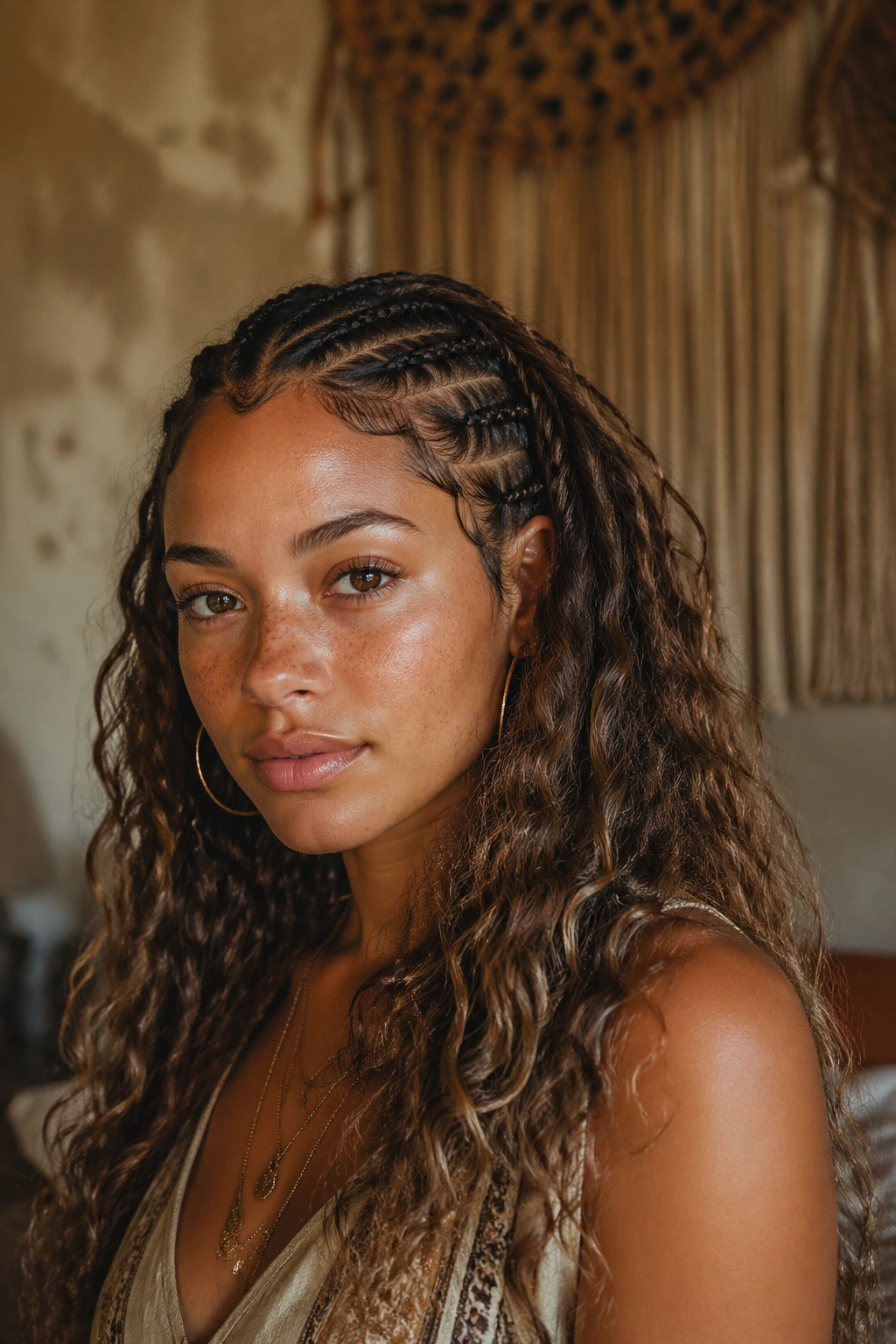
The cornrow portion is tribal-style — mixed row thicknesses, accessory beads, designed parts — and the finish is loose curly extension. Tribal cornrow structure meets boho curly finish.
This is the most detailed and time-intensive boho cornrow style on the list. It combines tribal parting and accessorizing with the curly release, which takes 6-8 hours to install at a skilled braider’s pace.
The beads sit on the cornrow portion, not the curly section. Bead placement is at the end of the cornrow right before the curly release begins. Three to five beads per accented braid, not every braid.
25. Short Cornrows With Chin-Length Curls
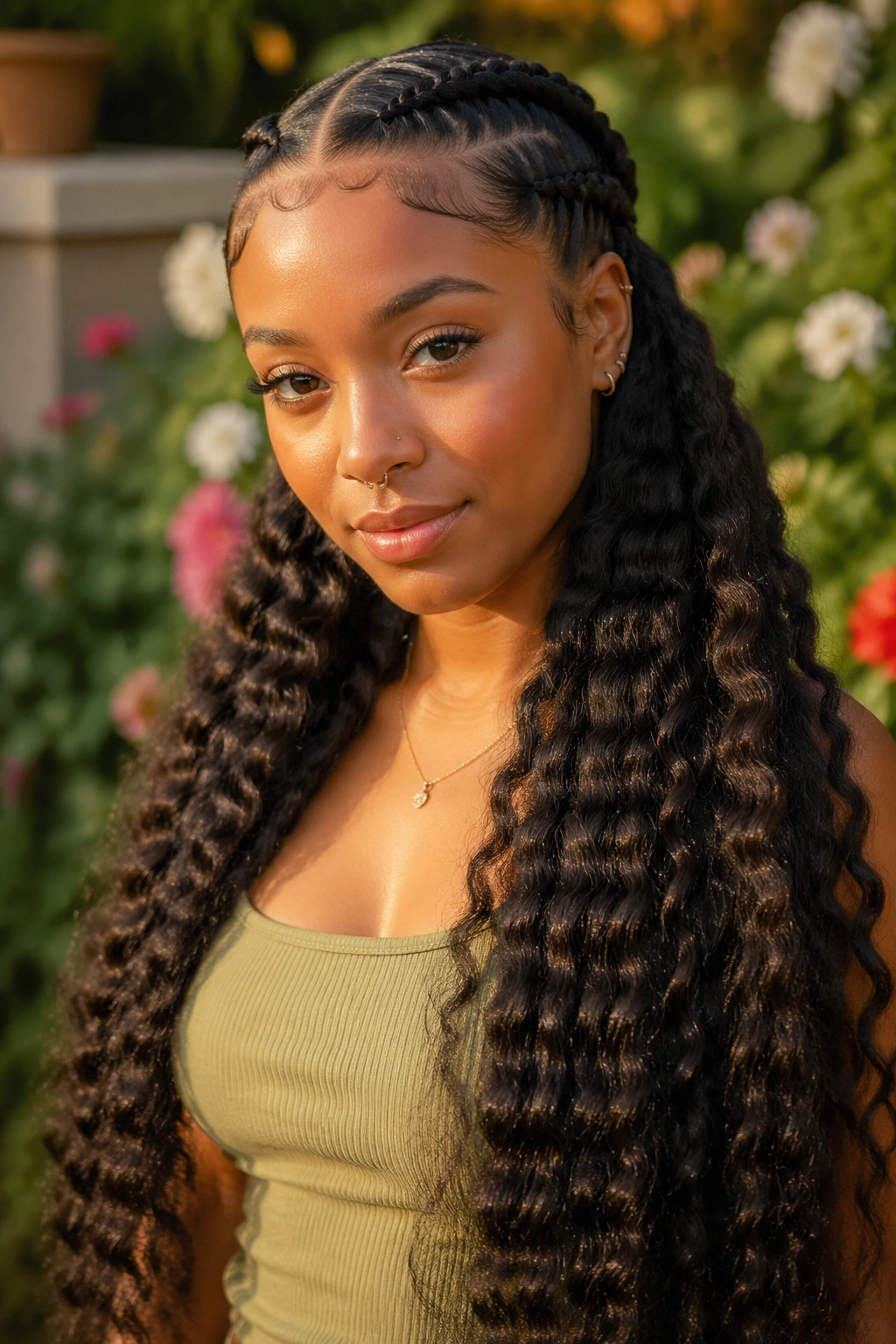
Cornrows stop at about chin length, with the curly release falling just to or slightly past the jawline. This is the boho cornrow answer to a bob haircut.
Short boho cornrows are a different vibe from waist-length ones. The style reads chic and deliberate rather than dramatic. It suits anyone who doesn’t want hair past their shoulders but still wants the cornrow-plus-curly aesthetic.
The short length is lower maintenance than long boho cornrows. Less hair to detangle, less tension from weight on the scalp, and faster to wash and dry. For a first-time boho wearer, this is a solid starting point.
Daily Maintenance for Curly Extensions
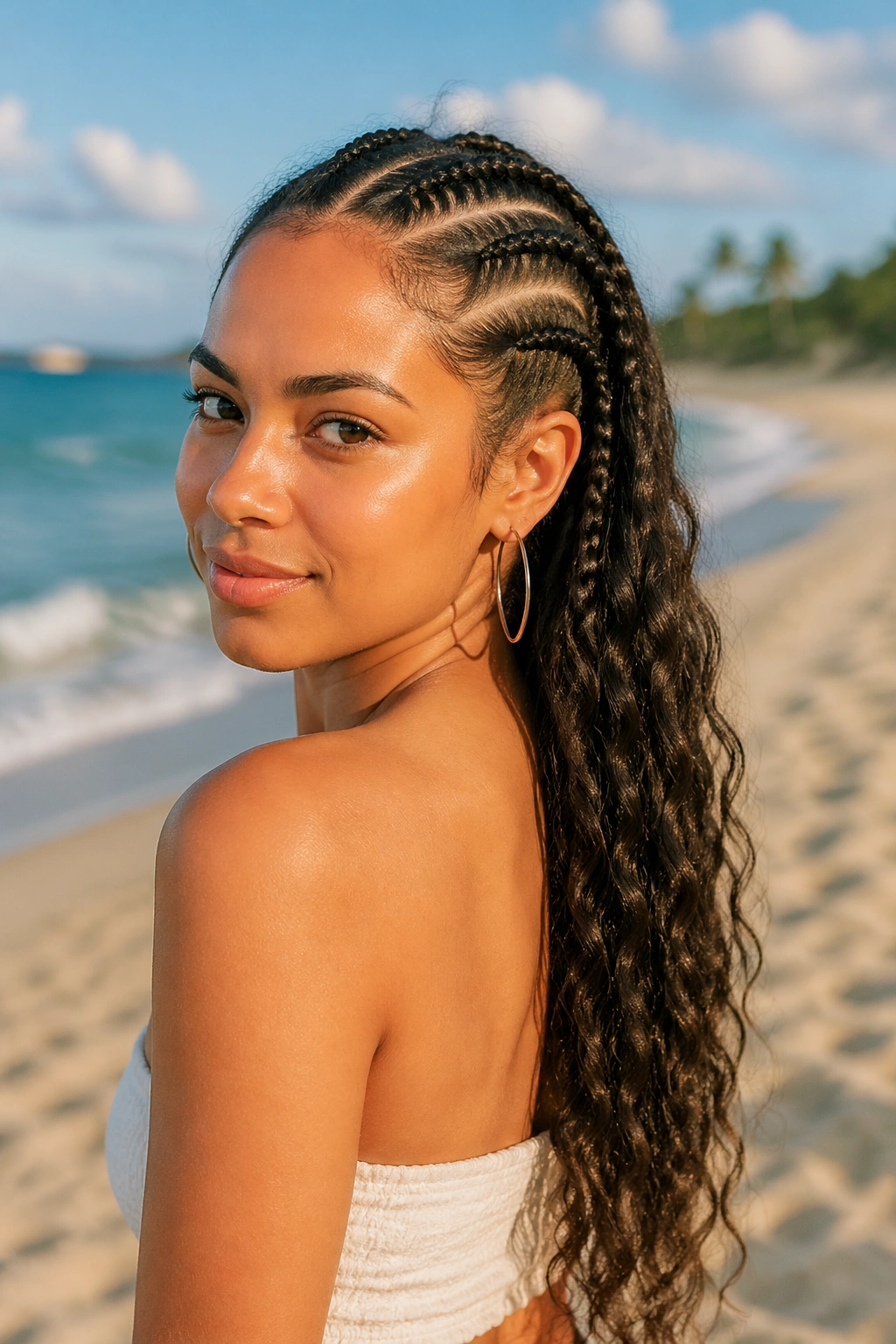
The curly portion of a boho cornrow style needs specific care. Curls dry out. Curls tangle. Curls lose their pattern without re-hydration. Daily maintenance is what keeps a boho install looking fresh past week one.
Mist the curls with a water-and-leave-in mix twice a day — once in the morning and once before bed. The leave-in prevents the water from drying the hair out further. Plain water alone can make curls stiff and brittle.
Scrunch the curls upward from ends to roots to redefine the pattern. Don’t brush. Brushes destroy curl definition and turn defined waves into frizzy fluff.
Protecting Curls Overnight
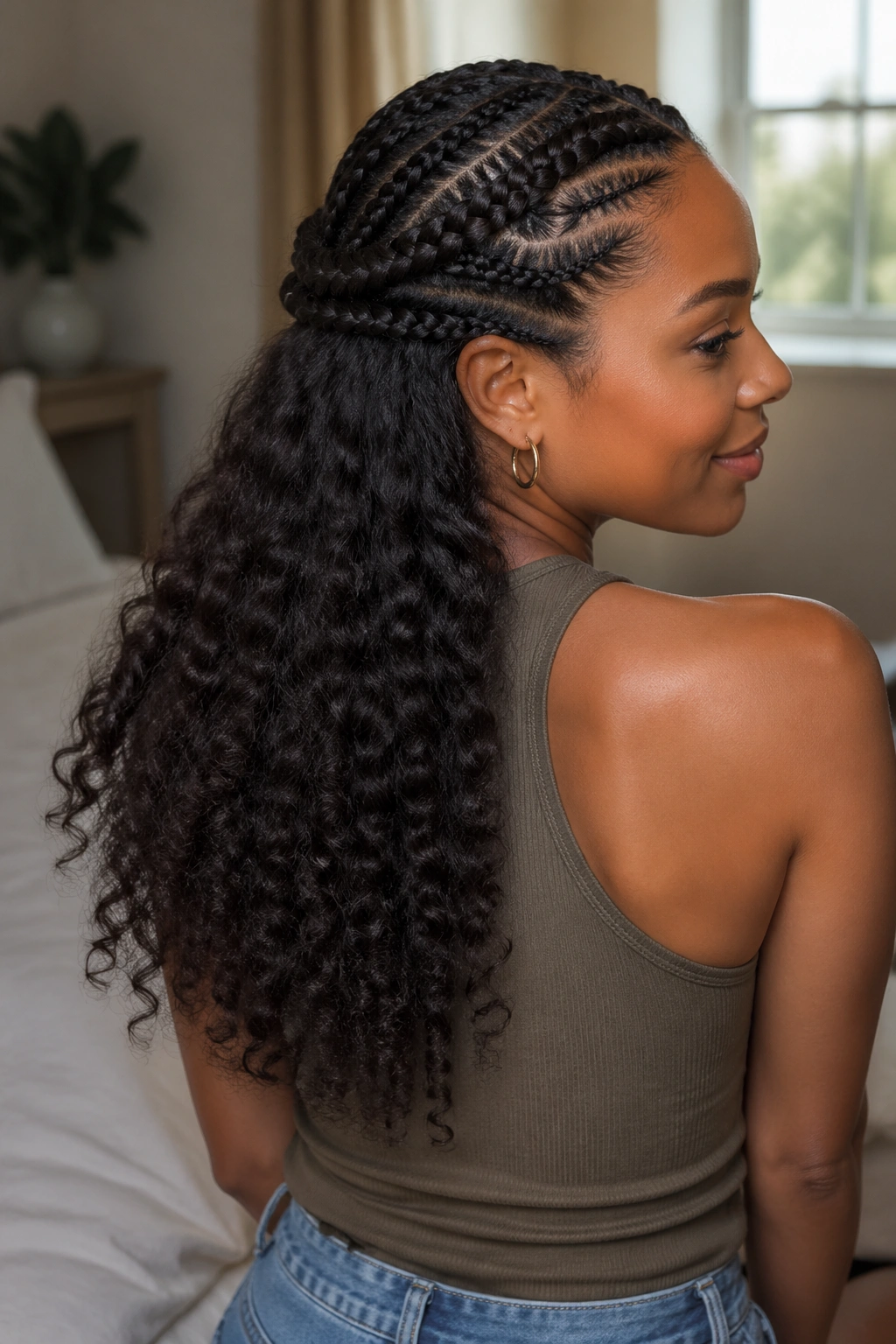
A silk or satin bonnet sized for long, curly hair is non-negotiable. A standard bonnet won’t contain a full head of curly extension, and the pressure of an undersized bonnet flattens the curls.
Alternatively, pineapple the curls — gather them loosely at the top of the head with a silk scrunchie so the ends face upward and can’t get crushed under a pillow.
Silk pillowcases help but don’t replace bonnets. The friction between hair and pillow is what roughens curls; a bonnet prevents that friction entirely.
Scalp Care for Boho Cornrow Bases
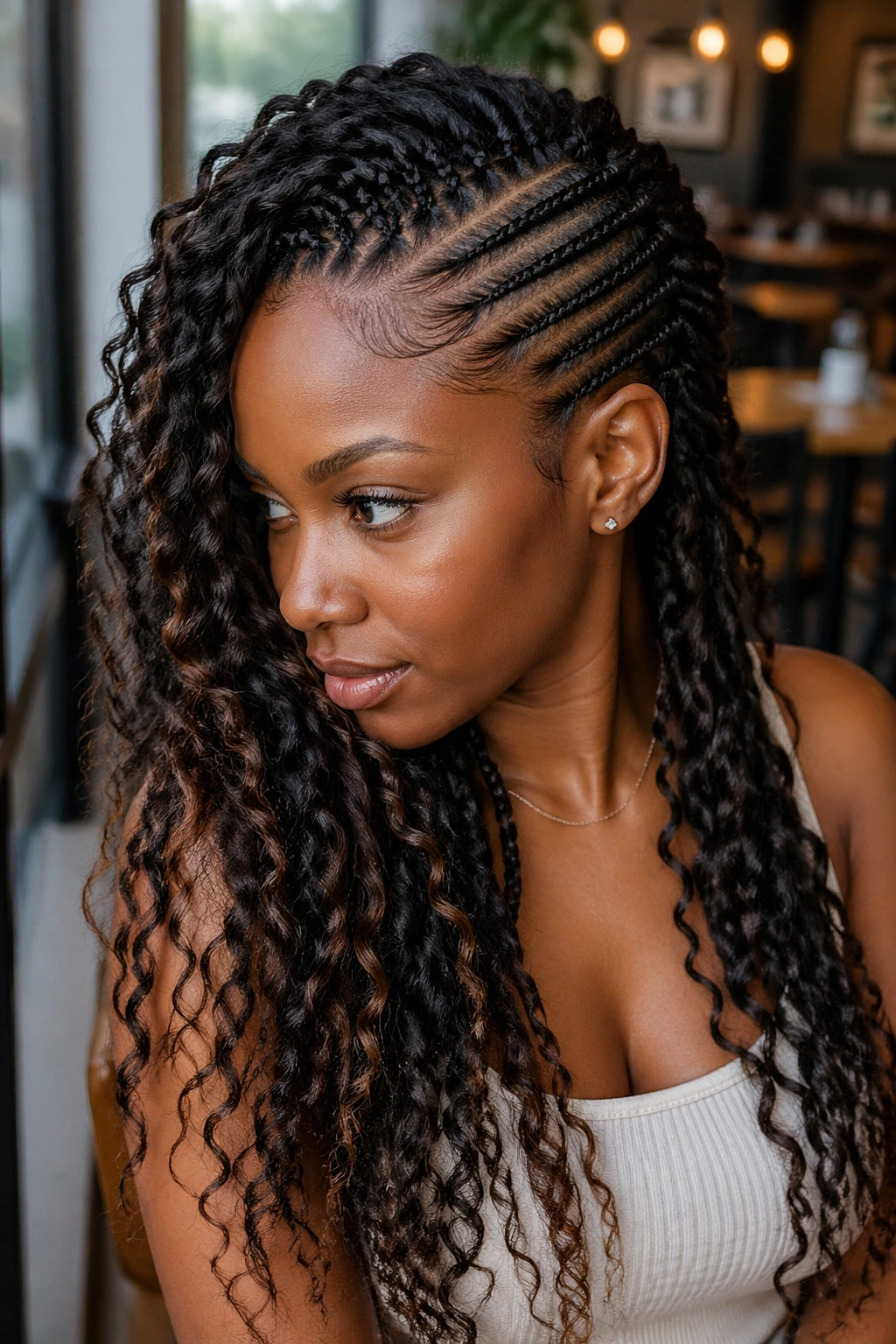
The cornrow foundation needs scalp care just like any other cornrow style. The curly portion doesn’t need scalp care — there’s no scalp under it.
Use a nozzle-tip bottle with a lightweight scalp oil to apply directly to the cornrow part lines. Every other day is usually enough. Avoid applying to the curly section itself — oil on the curly extension makes it look greasy and weighs down the curl pattern.
Massage the oil in with fingertip pads. Never scratch. Scratching breaks the cornrow at the root and causes lift-off.
Washing a Boho Cornrow Install
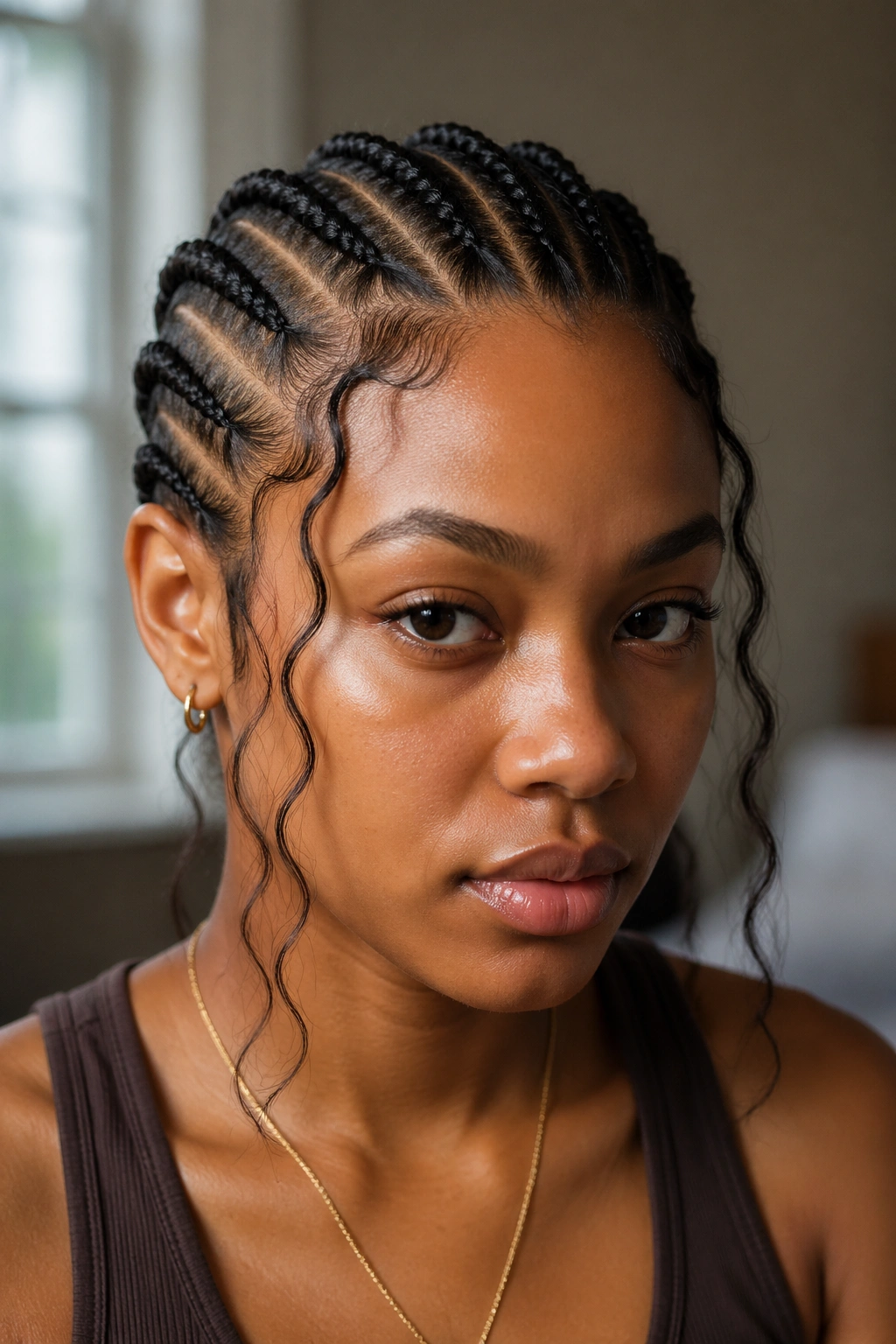
Washing requires patience. The cornrow section washes like a standard cornrow set — squeeze bottle with diluted shampoo, scalp focus, cool rinse. The curly section washes separately — work conditioner through with fingers, rinse, and air dry.
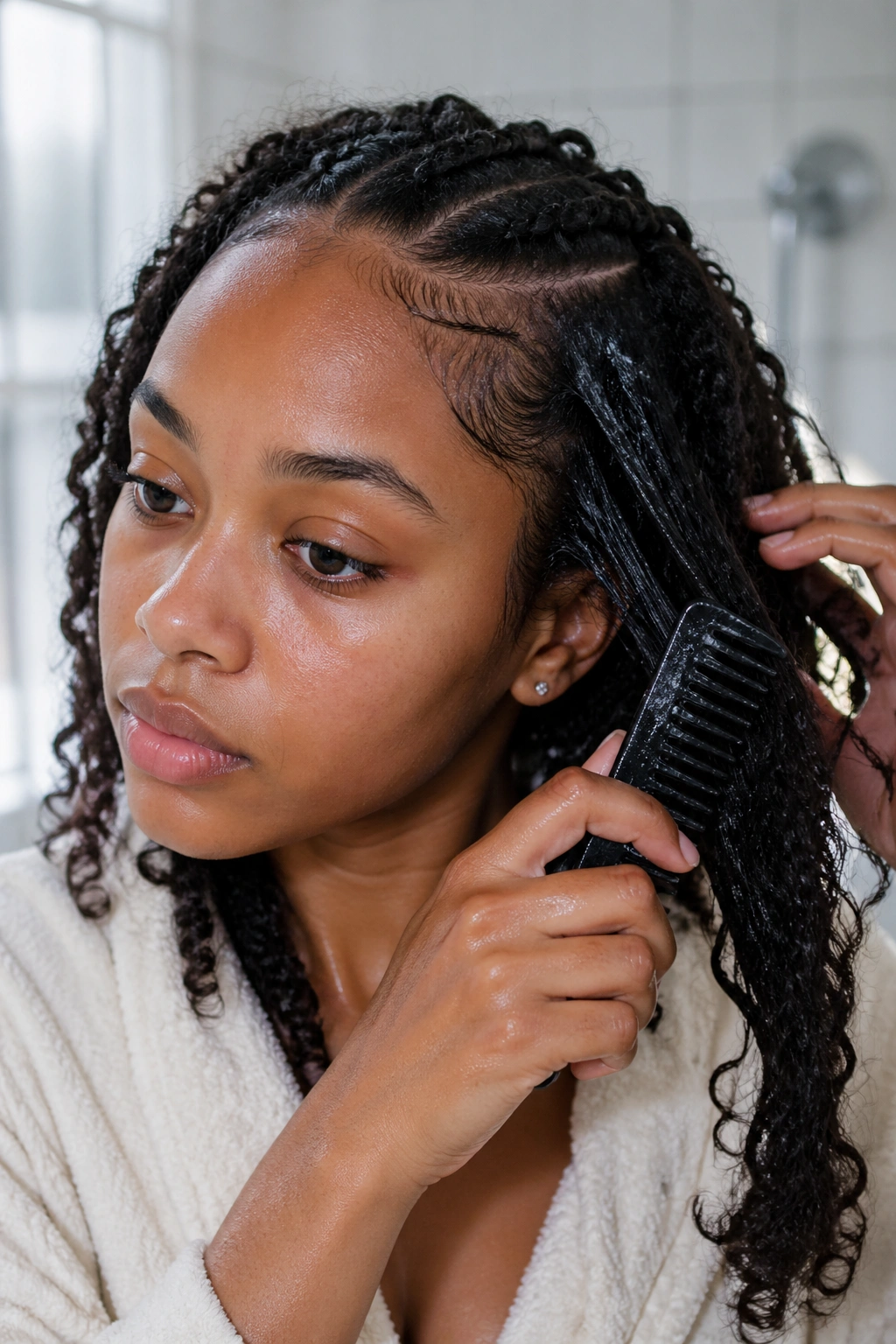
Don’t wet-brush the curly section during or after washing. Wet hair is fragile. Wet curly hair tangles fast. Use your fingers and a curl cream to detangle while damp, not while dripping.
Air-dry fully before bed. Damp curly hair against damp cornrow foundation is a recipe for mildew within 24 hours. Plan wash day so you have the evening to air-dry.
When to Take Down Boho Cornrows
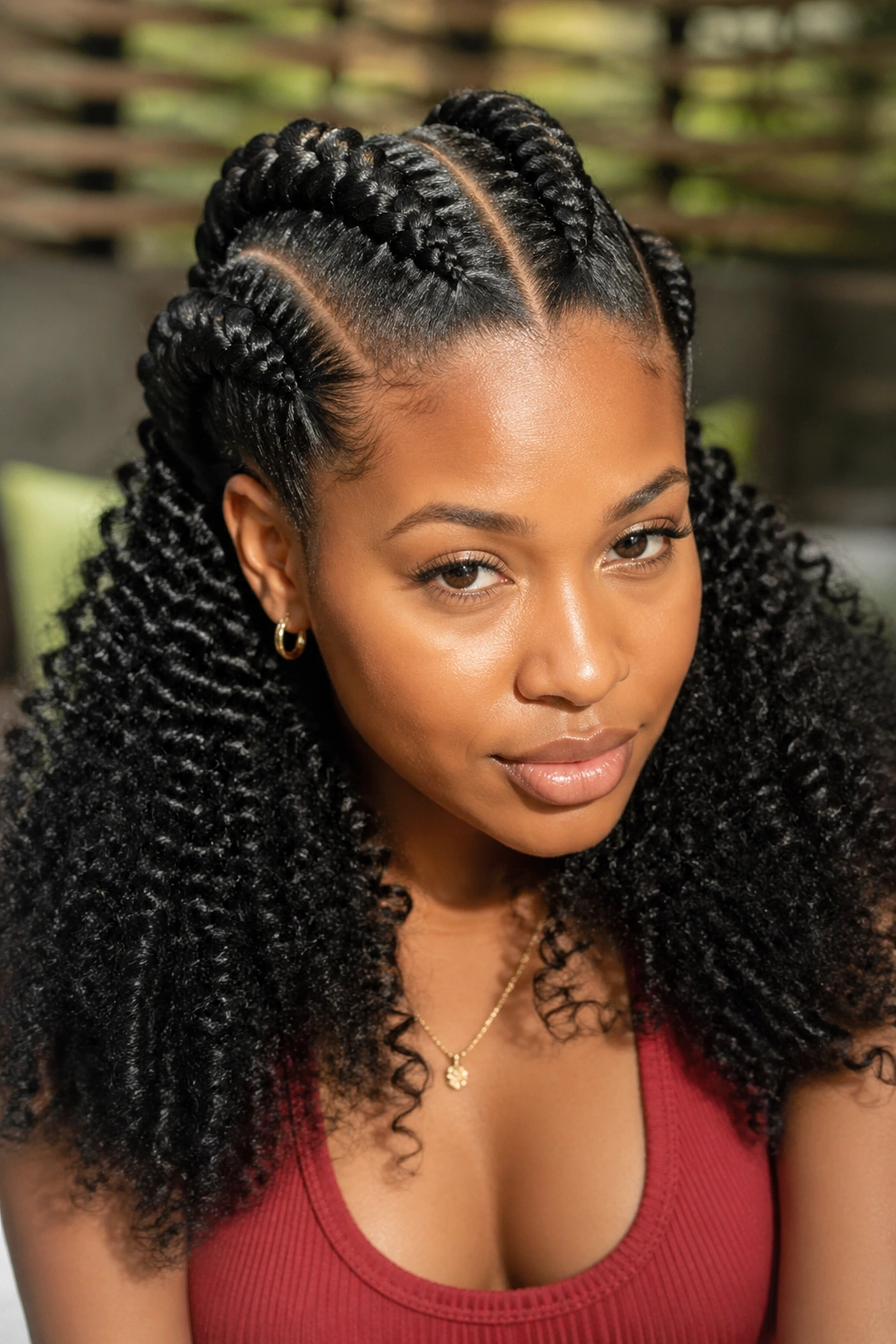
Boho cornrow sets generally last 3-4 weeks — shorter than straight cornrow or Ghana braid installs because the curly extension matts and tangles as it wears. By week 4, the curls usually look tired even with daily maintenance.
Signs it’s time:
- Curl pattern has flattened beyond what a mist can revive
- Tangles have turned into visible matts at the nape
- Scalp feels tight or shows flake buildup that washing won’t fix
- Cornrow roots are lifting visibly
- The curly extension has developed a dull sheen that conditioner can’t restore
Takedown starts with the curly sections. Detangle thoroughly with fingers and a conditioner spray before unbraiding. Once the curly portion is free, unbraid the cornrow portion from the tip up. Total takedown time runs 2-4 hours for most styles.
Boho cornrows reward attention to the curly portion above all else. Cornrow technique matters, but the curly hair is the visible portion and the part that ages fastest. Care for it well and any of the 25 styles above deliver their full promise.