



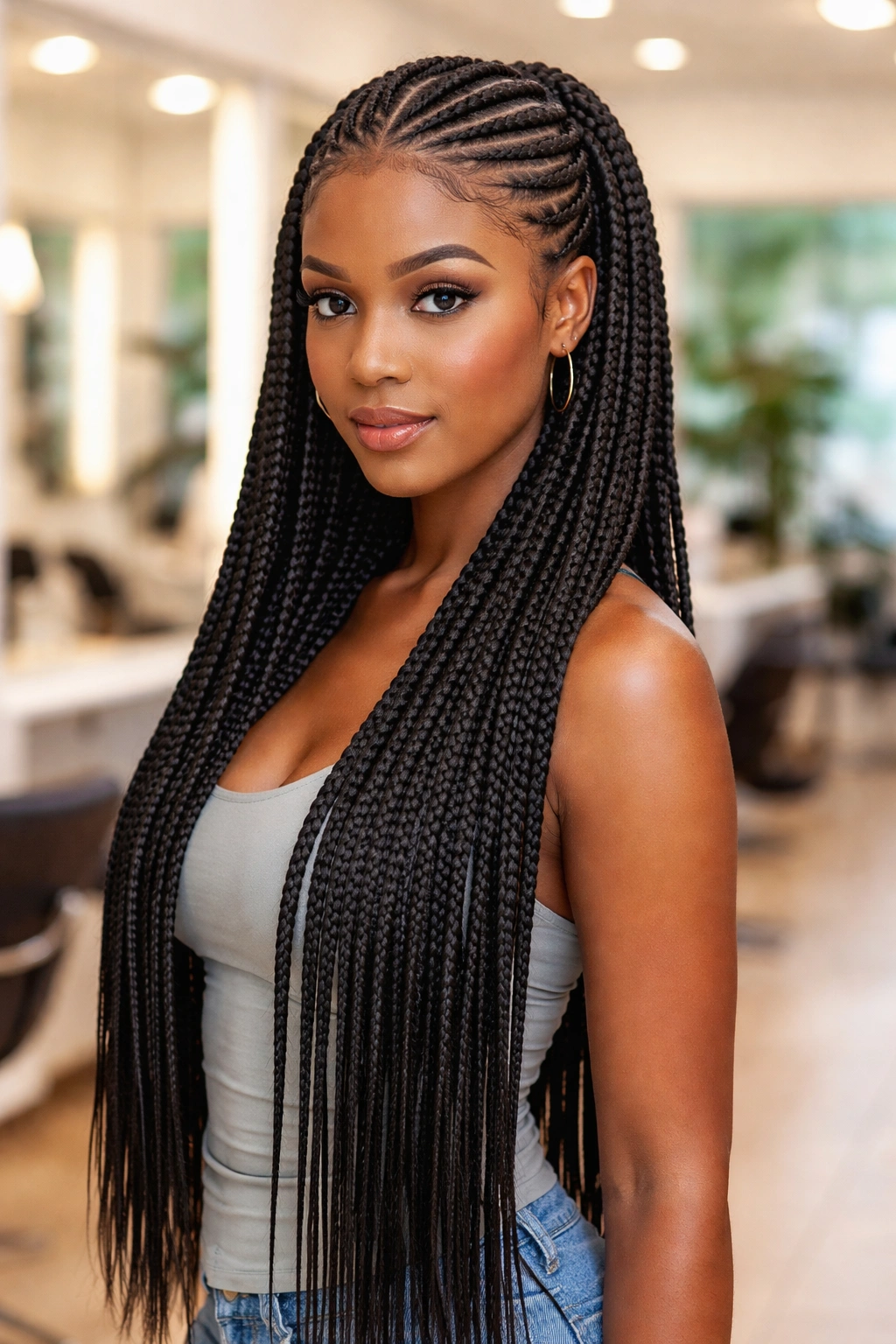
Half cornrows with box braids give you the best of both worlds without making you choose. The cornrowed top reads sleek and structured. The box braid bottom swings, drapes, and lets your fingers actually run through your hair.
This combo style — sometimes called a half-up cornrow, sometimes a Lemonade-meets-box, sometimes just “the half-up half-down” — has been around for decades. It’s gone through every iteration imaginable. What’s stayed the same is the basic logic: braid the top close to the scalp, leave the bottom swinging.
The 22 styles below split that logic in different ways. Some keep the cornrows minimal and let the box braids dominate. Others go heavy on the cornrow design and treat the box braids as supporting cast. Pick based on which side of the style you want doing the talking.
Why Half Cornrow + Box Braid Combos Work
The structural appeal is real. Cornrows lock the top of the head into a clean, defined silhouette. Box braids release that tension into individual swinging braids. The transition between the two creates a natural visual divide — usually somewhere between the crown and the back of the head.
The combo also solves problems that pure cornrows or pure box braids each create on their own.
Pure cornrows can feel restrictive. Nothing moves. There’s no “running fingers through your hair” option.
Pure box braids can feel heavy at the front. The braids start right at the hairline, adding bulk where you might want a sleek finish.
Half-and-half splits the difference. Sleek where you want structure. Free where you want movement.
The Anatomy of the Style
The cornrow portion typically covers the top third or top half of the head — running from the hairline back to a chosen transition point at the crown, mid-scalp, or just above the nape.
The box braid portion picks up where the cornrow ends and runs to whatever length the extensions allow.
The transition zone is the make-or-break point. A skilled braider creates a smooth handoff where each cornrow flows directly into a box braid without a visible bump or break. A less skilled braider creates a ridge — and that ridge will haunt you in every photo for the next 6 weeks.
Where you place the transition matters too. High transition (at the crown) gives you more cornrow surface area on top — good for showing off design work. Low transition (at the nape) gives you more swinging hair — good for length lovers.
Hair Length and Extensions
You don’t need long natural hair for this style. Most installs use kanekalon braiding hair that adds whatever length you want.
Common length choices:
- Shoulder length: easiest to manage, lightest weight
- Mid-back: most popular, good drape
- Waist length: dramatic but heavy
- Hip or floor length: statement-making, requires careful neck care
Pre-stretched kanekalon is the standard. It tangles less, looks more natural, and reduces install time.
For the cornrow portion, feed-in technique looks cleanest. The braider adds extension hair gradually so your hairline reads natural rather than thick and obvious.
Tools and Prep
Standard cornrow tools — rat-tail comb with metal tip, duckbill clips, edge gel, water spray bottle.
Plus extras specific to this style:
- Hot water and a shallow pot for sealing the box braid ends
- Small rubber bands for securing braid ends before sealing
- A handheld mirror so you can review the back transition
Prep your hair the same as for any cornrow installation: clean, deep conditioned, stretched. The more cooperative your hair is at install, the better the cornrow base will look.
Tip: If you have very tight 4C hair, blow it out lightly before going to your appointment. Stretched hair speeds up the install by 30-45 minutes.
How Long This Style Takes to Install
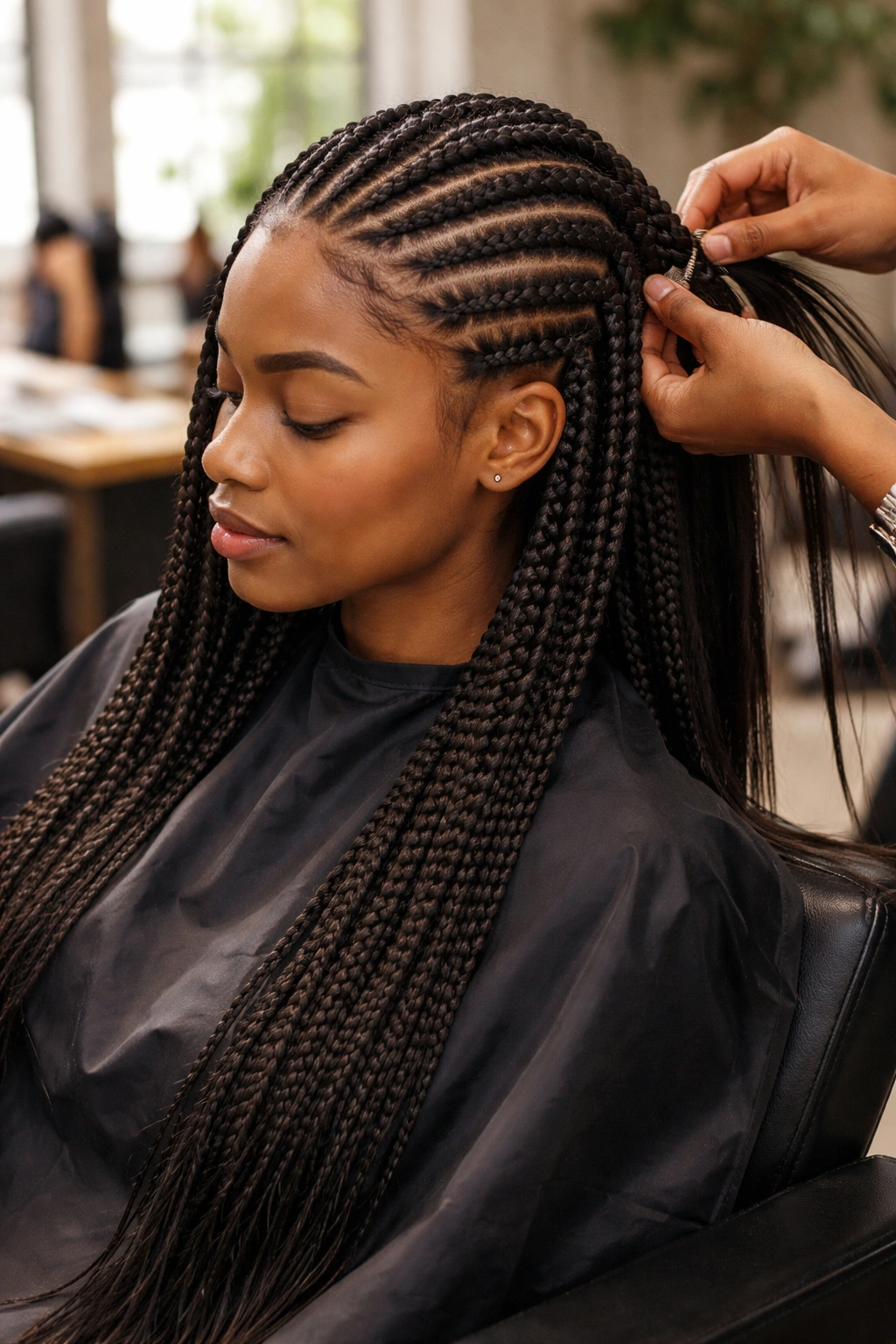
Plan for 4-6 hours for a basic half-cornrow-half-box-braid style. Add 1-2 hours for design work in the cornrow portion or for extra-long box braids.
A skilled braider can finish faster, but rushing the transition zone always shows.
Bring water, snacks, and entertainment. Charge your phone.
1. Classic Straight Back Cornrows With Mid-Length Box Braids
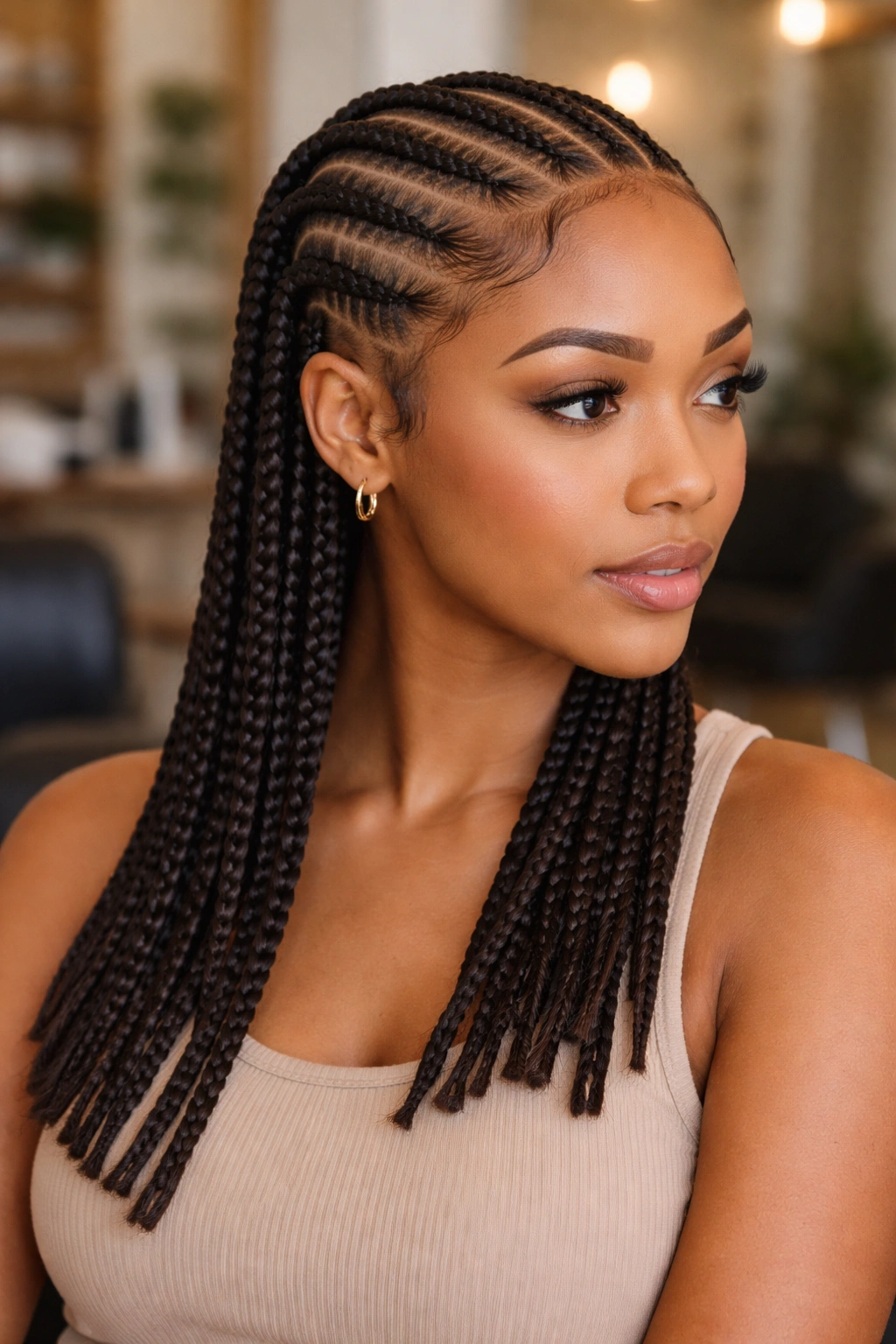
Five to seven straight cornrows running from hairline to crown, then transitioning into shoulder-blade-length box braids. The simplest version of this style — and often the best.
Why It Works
- Universally flattering, suits every face shape
- Quick install at about 4 hours
- Lasts 6-8 weeks with proper care
- Pairs with any outfit, any occasion
Tip: Ask for the cornrow ends to wrap slightly under the box braid bases — this hides the transition completely.
2. Side-Swept Cornrows Into Long Box Braids
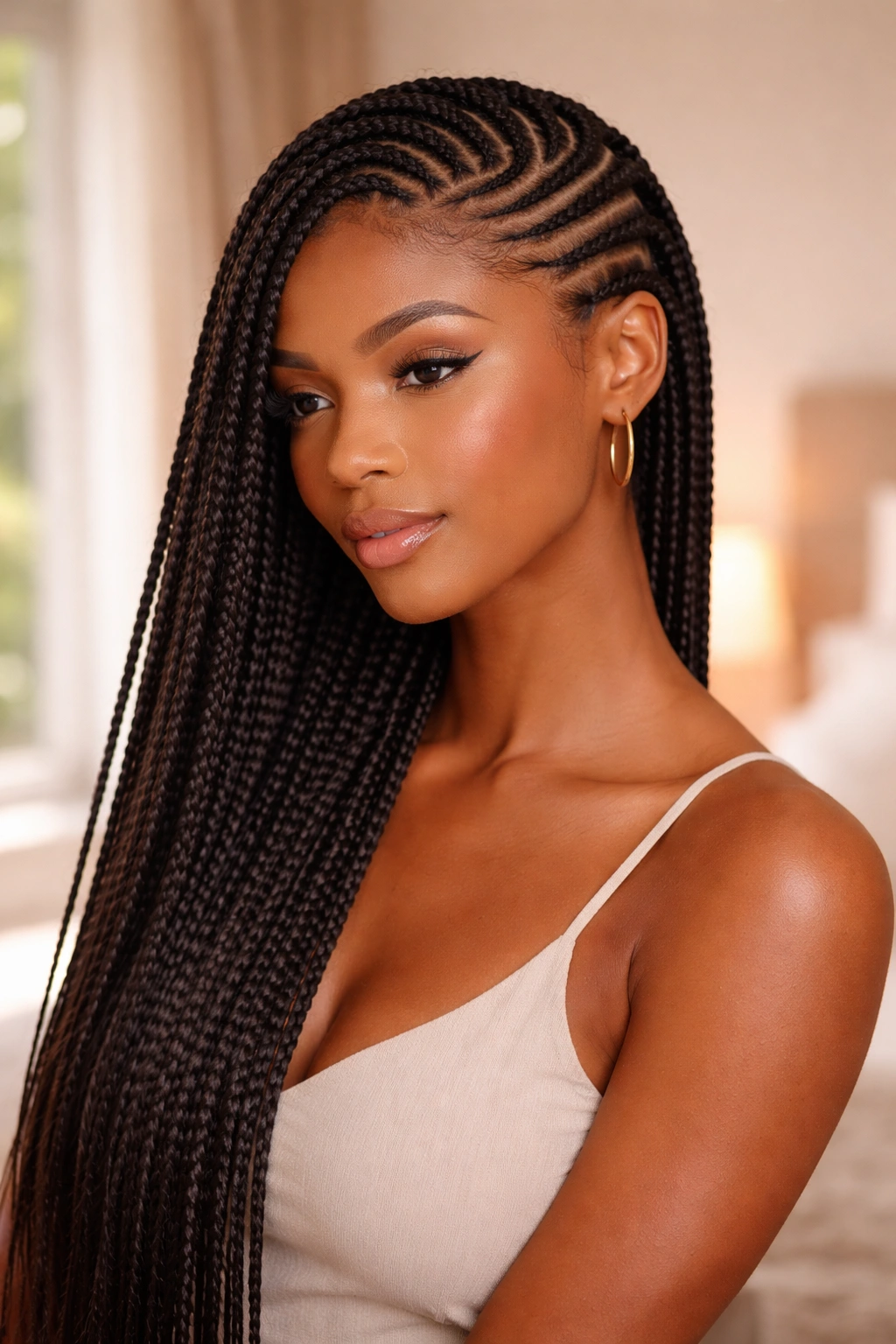
Cornrows sweep diagonally across the top of the head from one side, then transition to long box braids that hang on the opposite side. The diagonal sweep adds visual movement before the braids even drop.
This is one of the most photographed half-up styles because the diagonal lines lead the eye dramatically. From any angle, the style reads dynamic.
The sweep direction should follow your dominant side — if you naturally part on the right, sweep right-to-left across the head. Working with your natural part eliminates fight at the transition.
3. Zig-Zag Cornrows With Knotless Box Braids
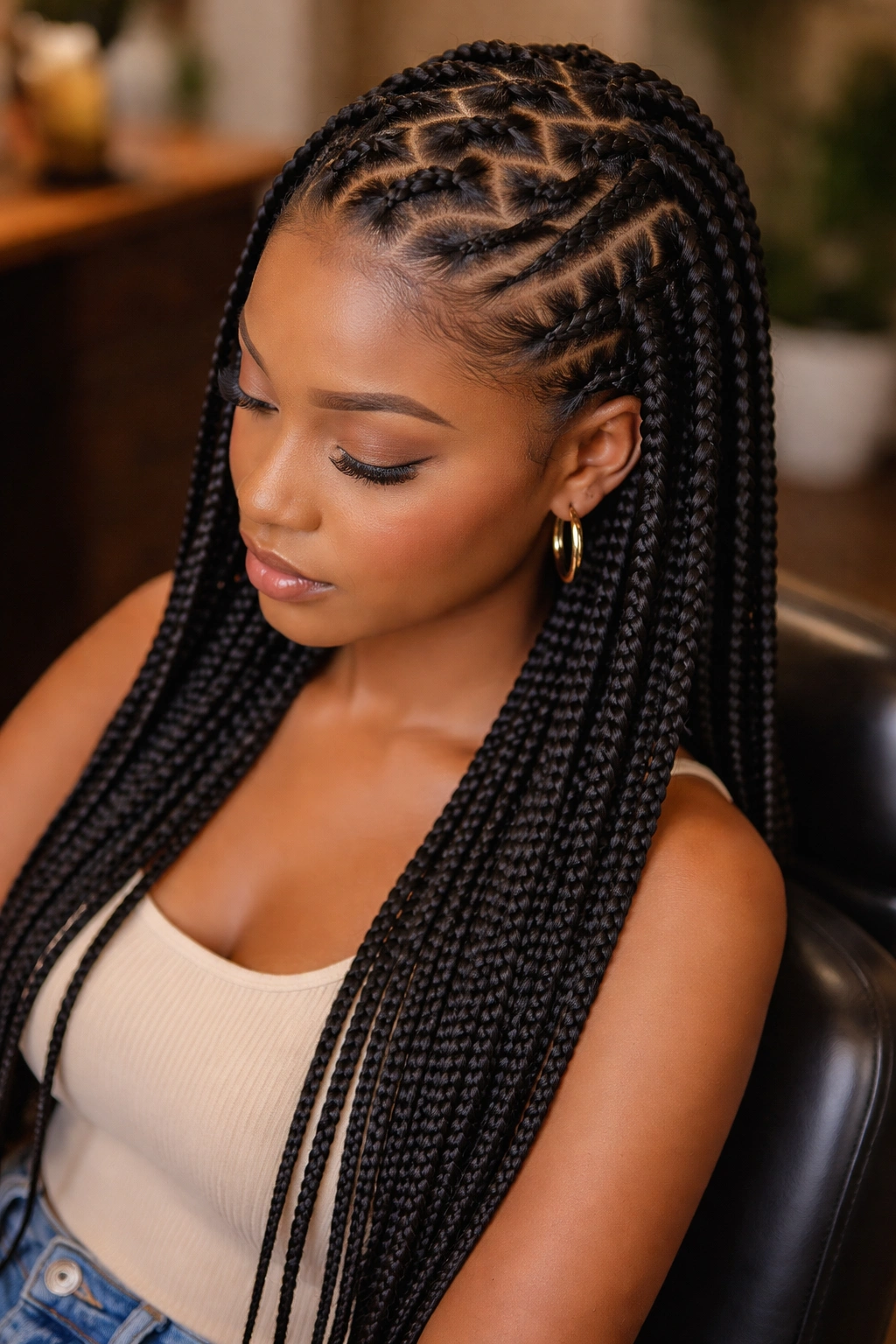
Cornrows on top use zig-zag parts for visual interest, then transition to knotless box braids — the kind that start with your natural hair and gradually feed in extensions, leaving a softer, weightless start at the scalp.
Knotless braids are gentler than traditional knotted box braids. They don’t have a hard bump at the base, and they reduce tension on the hairline.
This combo is a strong choice if you have sensitive edges or have dealt with thinning. The zig-zag cornrows add interest without the bulk of design braids, and the knotless transition keeps tension low.
4. Cornrow Halo With Box Braid Cascade
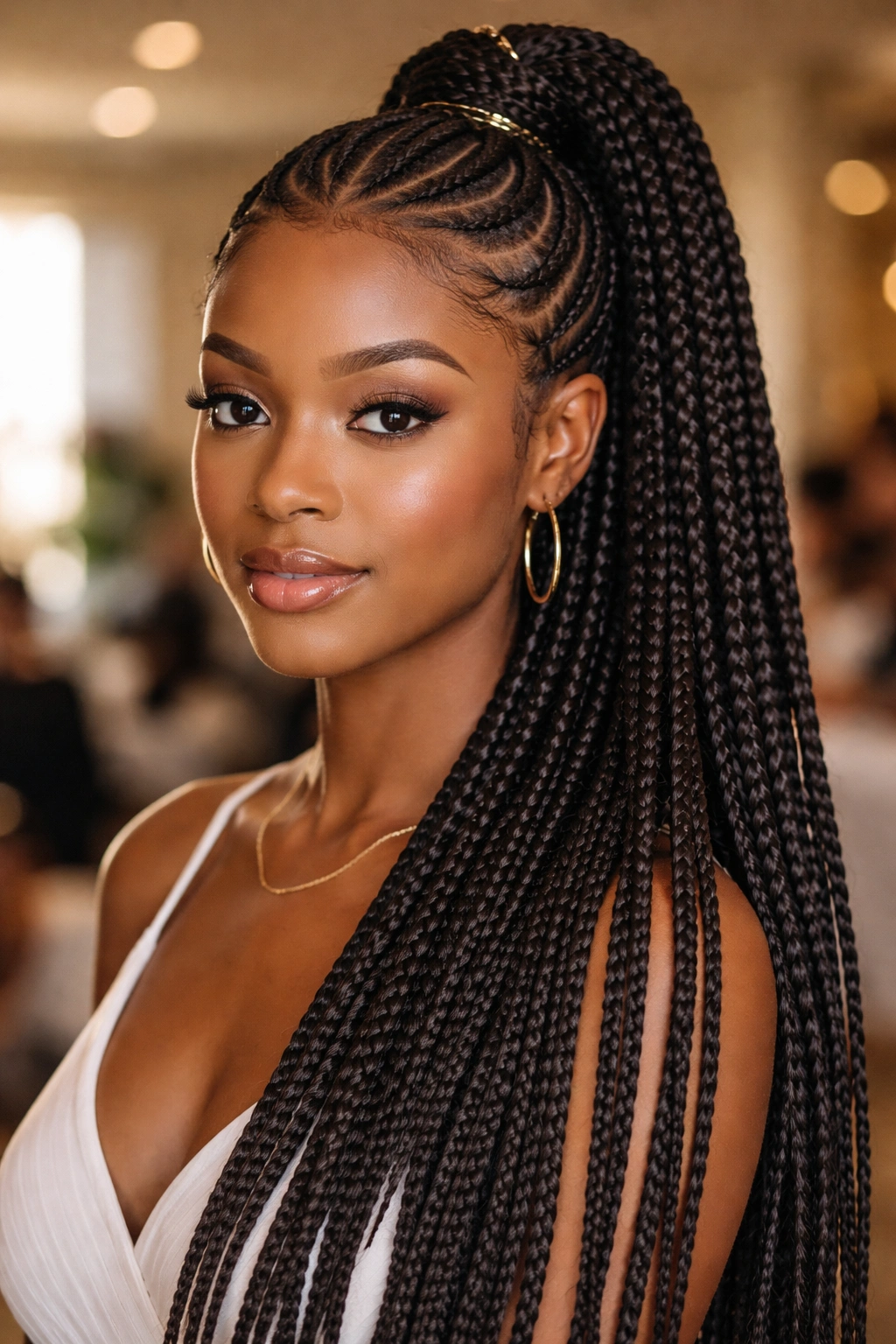
Cornrows form a halo around the perimeter of the head — wrapping above the ears and around the back — with all the braids feeding into a cascading ponytail of box braids at the crown.
The halo is the structural element. It frames the face from every angle.
The cascading ponytail is the showpiece. It can be tied with a ribbon, decorated with cuffs, or left to drape freely.
This works for formal events, weddings, and photo shoots. The combination is genuinely architectural.
5. Half-Up Lemonade Cornrows With Box Braid Bottom
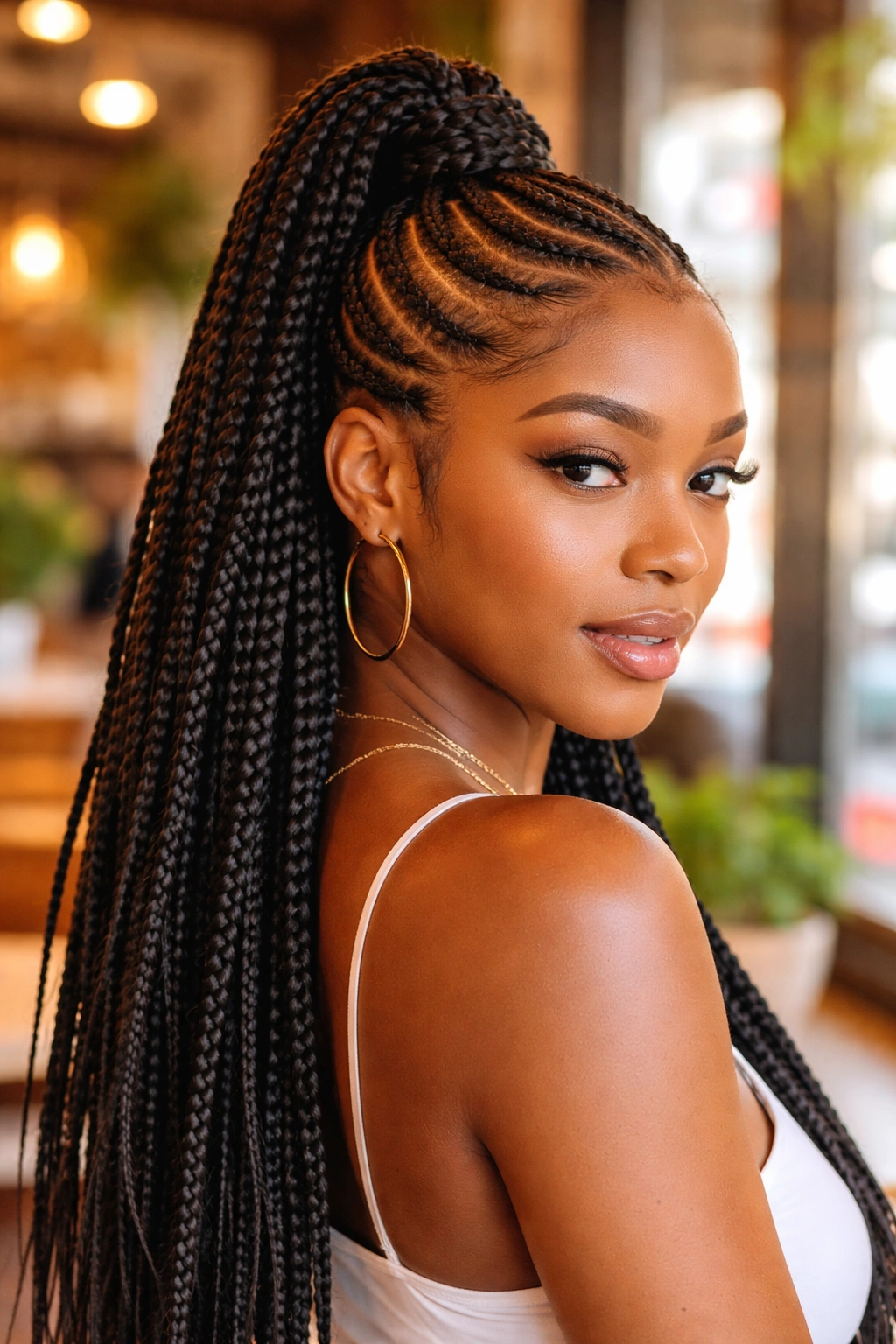
Lemonade-style diagonal cornrows on top — five to seven braids running from one side across the scalp — transition into box braids hanging down. The diagonal direction is the key element borrowed from the original Lemonade braids.
Pair this with hoop earrings and a strong red lip and the style does most of the talking.
The box braid bottom can be any length. Short box braids (chin to shoulder) read playful. Long box braids (waist or below) read dramatic.
6. Half Cornrow With Beaded Box Braid Tips
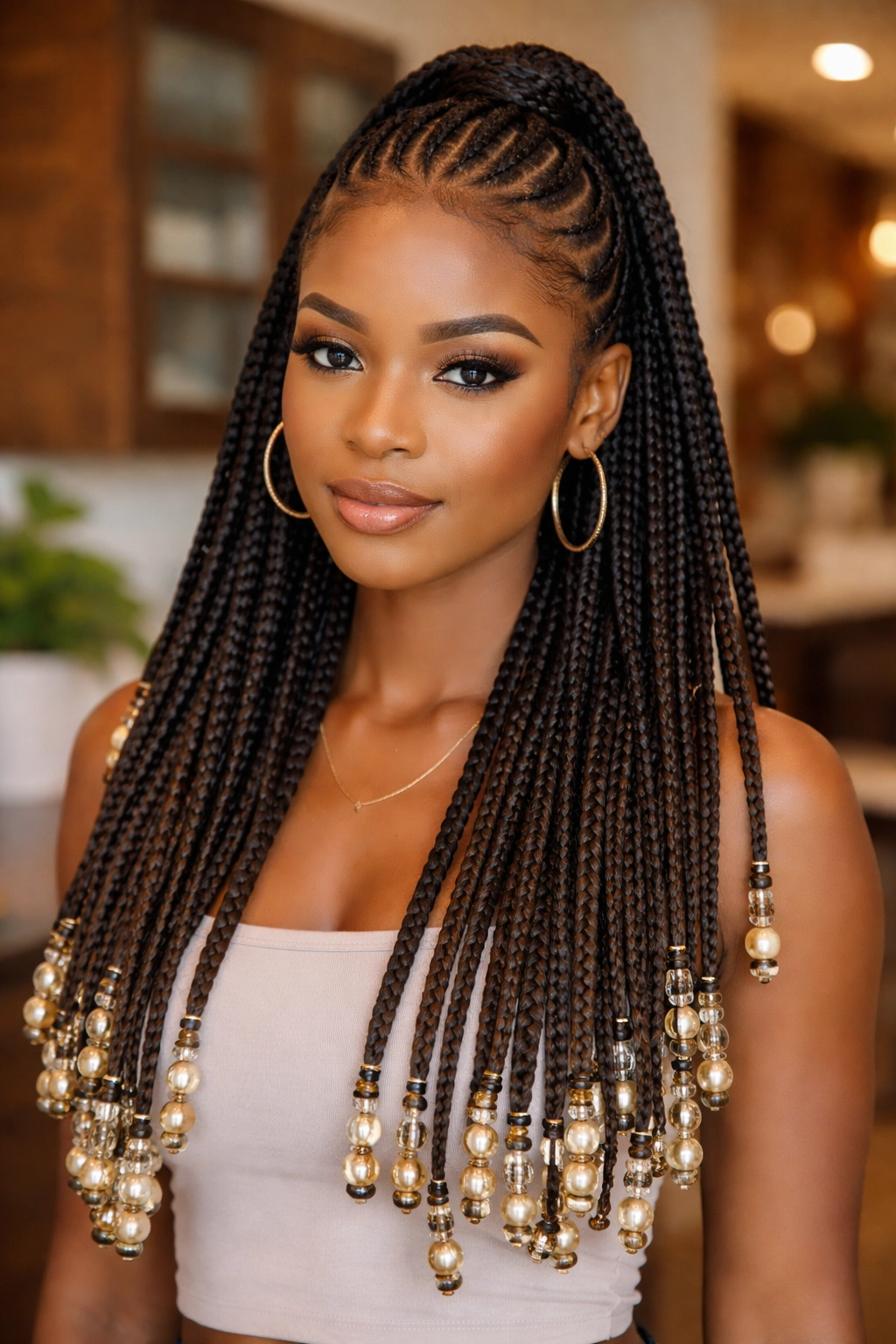
Standard half cornrow on top. Box braids on bottom, but each box braid ends with three to five beads. The beads anchor the otherwise-loose ends and add weight that keeps the box braids hanging straight.
Wooden beads are the natural-tone choice. Acrylic in mixed colors reads playful. Glass or metal reads dressed-up.
How to Style It
- Pick bead size based on box braid thickness (medium braids = 8-10mm beads)
- Use 3-5 beads per braid, max
- Secure with a metal cuff just below the last bead
- Avoid beads on box braids longer than waist length — too much weight
Tip: Color-match the beads to your top outfit color rather than your hair color for a coordinated look.
7. Cornrow Bun With Box Braid Ponytail
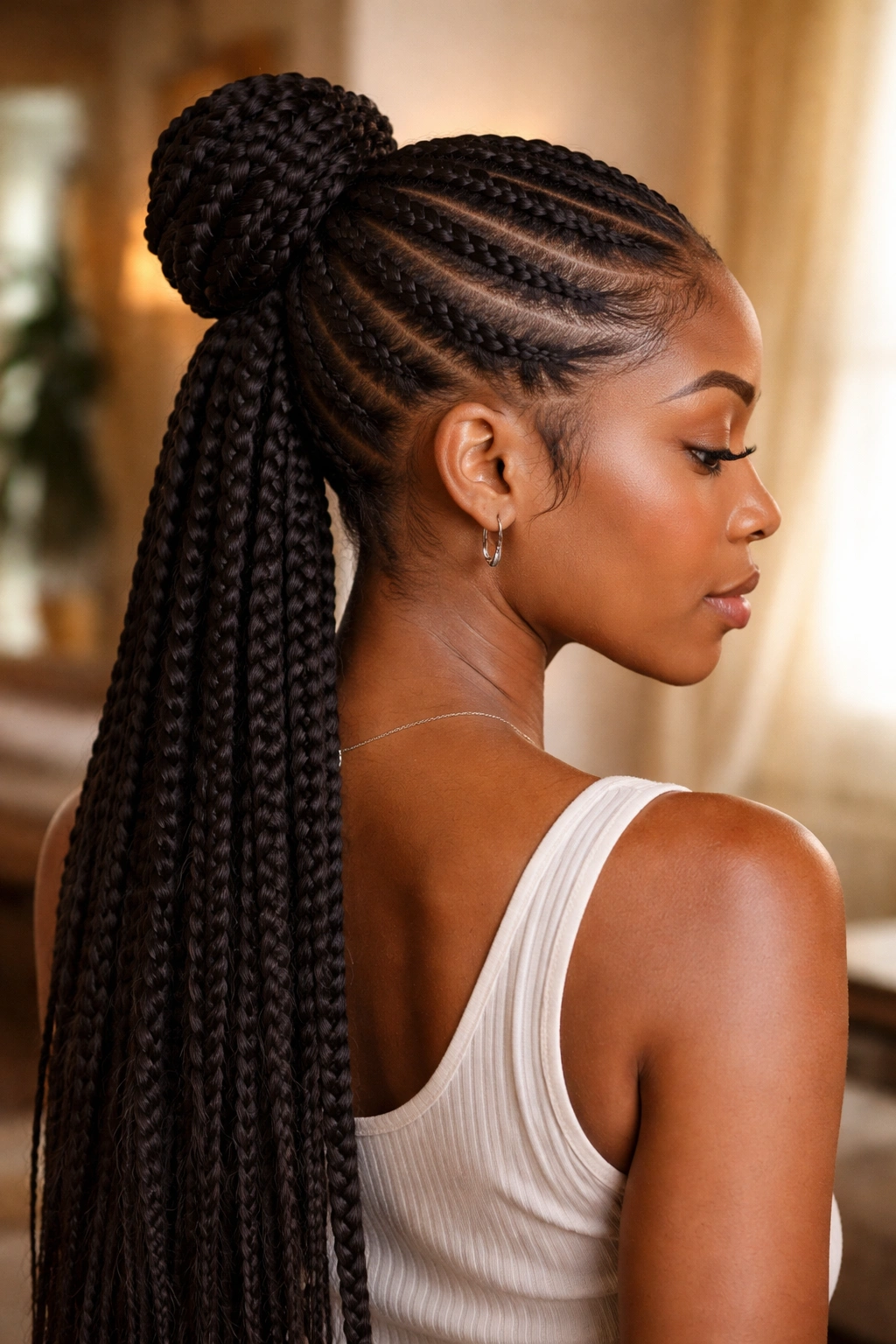
Cornrows feed into a sleek bun at the crown. From the bun, a thick ponytail of box braids drapes down the back. The bun is the focal point; the ponytail is the cascade.
The bun can be small and tight or large and chunky. Match it to your face — smaller features look balanced with smaller buns, stronger features can carry larger buns.
This style reads polished and elegant. It works for offices, weddings, and any event where pulled-together is the goal.
8. Tribal Cornrows Into Bohemian Box Braids
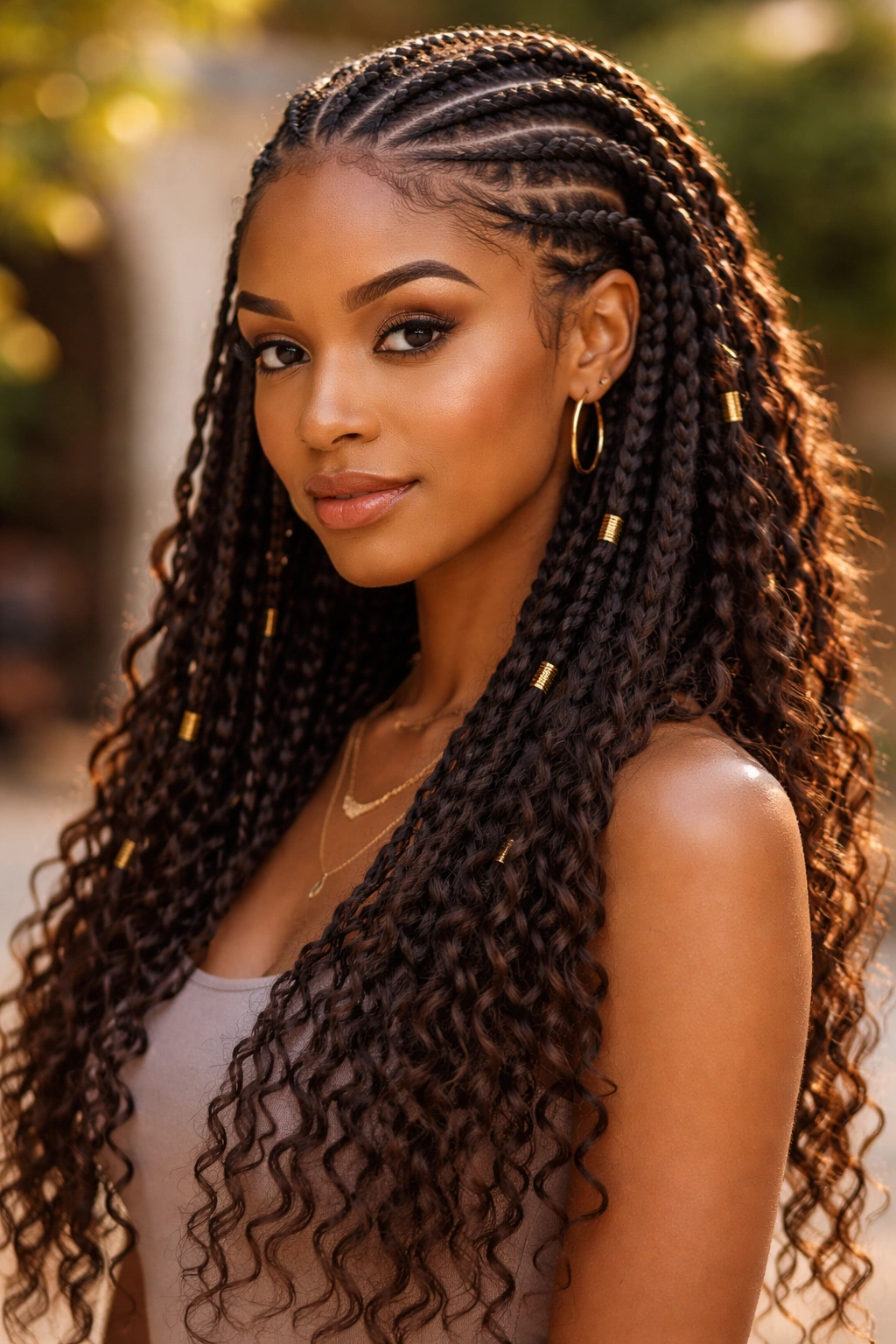
Tribal cornrows mix thick and thin braids in stacked arrangements on top, then release into bohemian box braids — the kind with intentional curly pieces left out and wispy tendrils hanging loose.
This combination reads textural and free-spirited. It’s the antidote to overly polished braid styles.
The bohemian box braids look effortless but actually take longer to install than standard box braids because the braider has to leave specific pieces curly while braiding the rest.
9. Half Cornrow With Curly Tip Box Braids
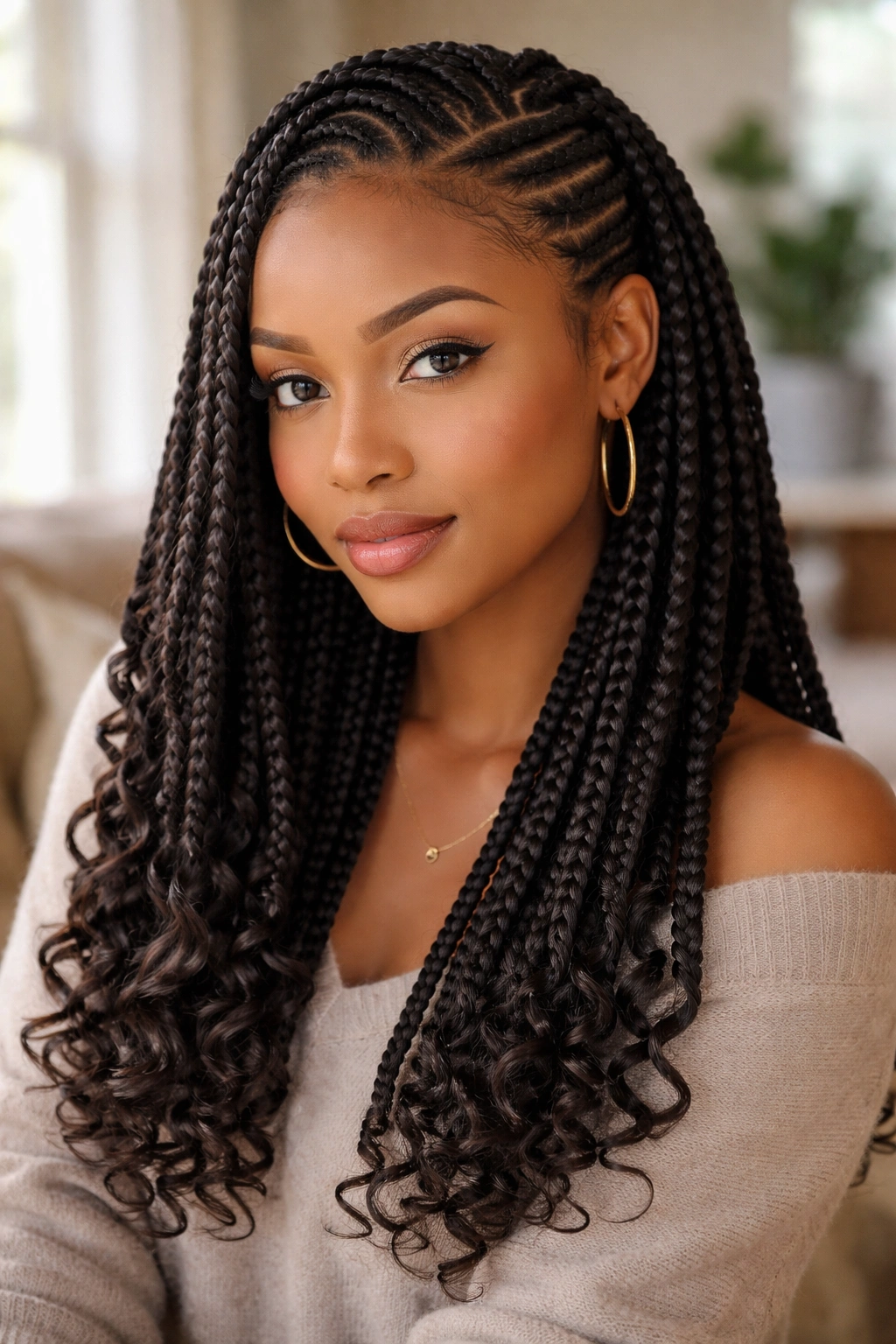
Cornrows on top, box braids below, and the bottom 4-6 inches of each box braid are curled — usually with hot water and flexi-rods or pipe cleaners.
The curl tips add softness to what would otherwise be a very linear style. They also visually shorten the braids, making waist-length installations feel less heavy.
Curl tips need refreshing every 2-3 weeks with another hot water dip and flexi-rod set.
Tip: Ask your braider to leave the bottom 6 inches of each box braid uncurled when wet, then dip and curl after the entire install is done. This batch approach saves time.
10. Cornrow Crown With Loose Box Braid Mass
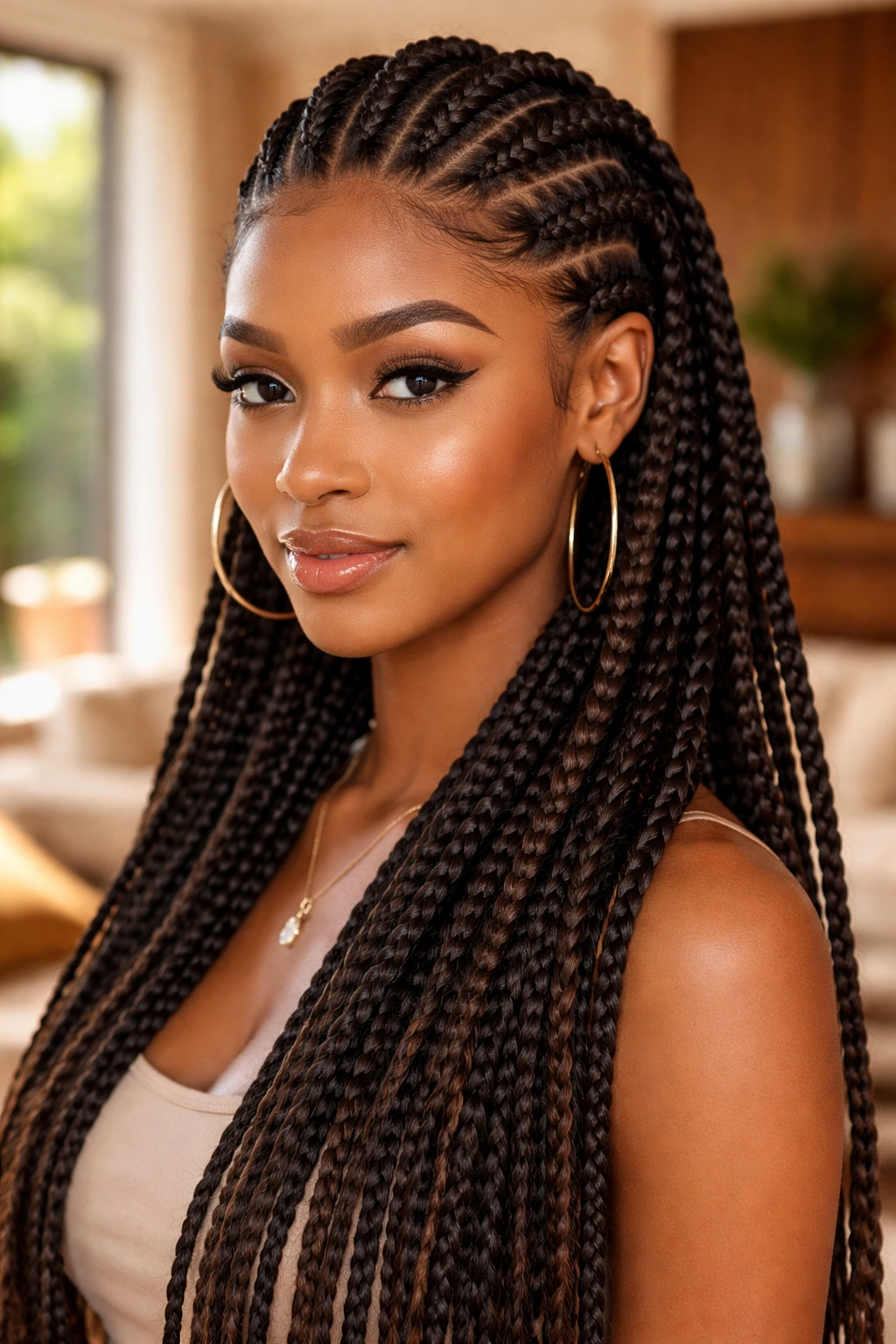
Two to three thick cornrows form a crown across the front of the head, then a full mass of box braids — maybe 80-120 individual braids — hangs from the crown line back.
The crown is structural. The mass is volume.
This is for women who want maximum length and movement with just enough structure at the front to keep the style polished.
The box braid mass needs daily refreshing — fingers through the braids, a touch of edge gel along the front line, and a satin scarf at night.
11. Half Cornrow With Color-Block Box Braids
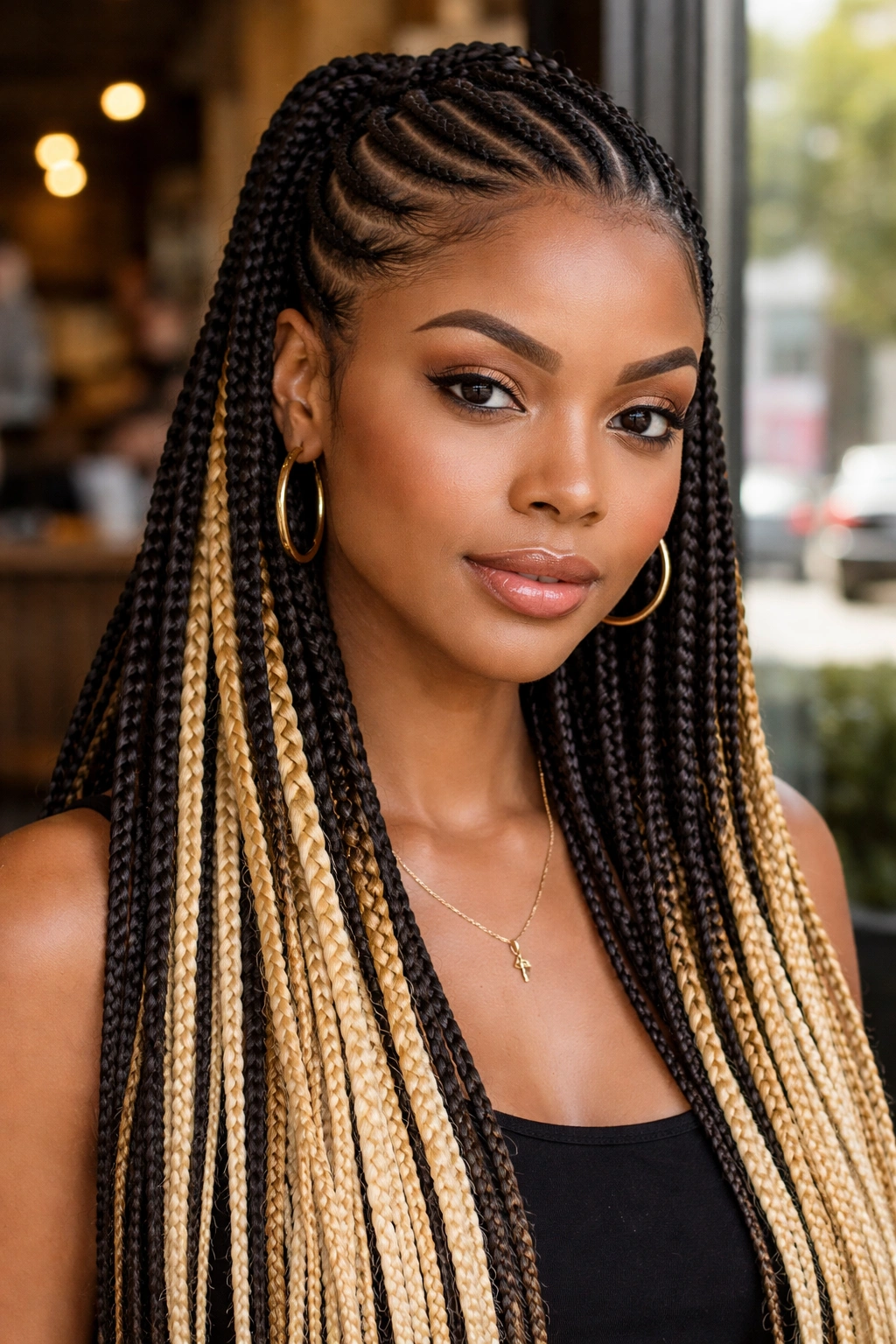
Cornrows on top in natural color, then box braids in a contrasting color — burgundy, copper, blue, even silver. The color appears below the transition zone.
Color blocking with this technique gives you the option of color statements without the commitment of dyeing your natural hair.
Pick colors based on skin undertone. Burgundy and copper warm cool undertones (because contrast is flattering). Silver and blue cool warm undertones for the same reason.
12. Cornrow Side-Part With Box Braid Sweep
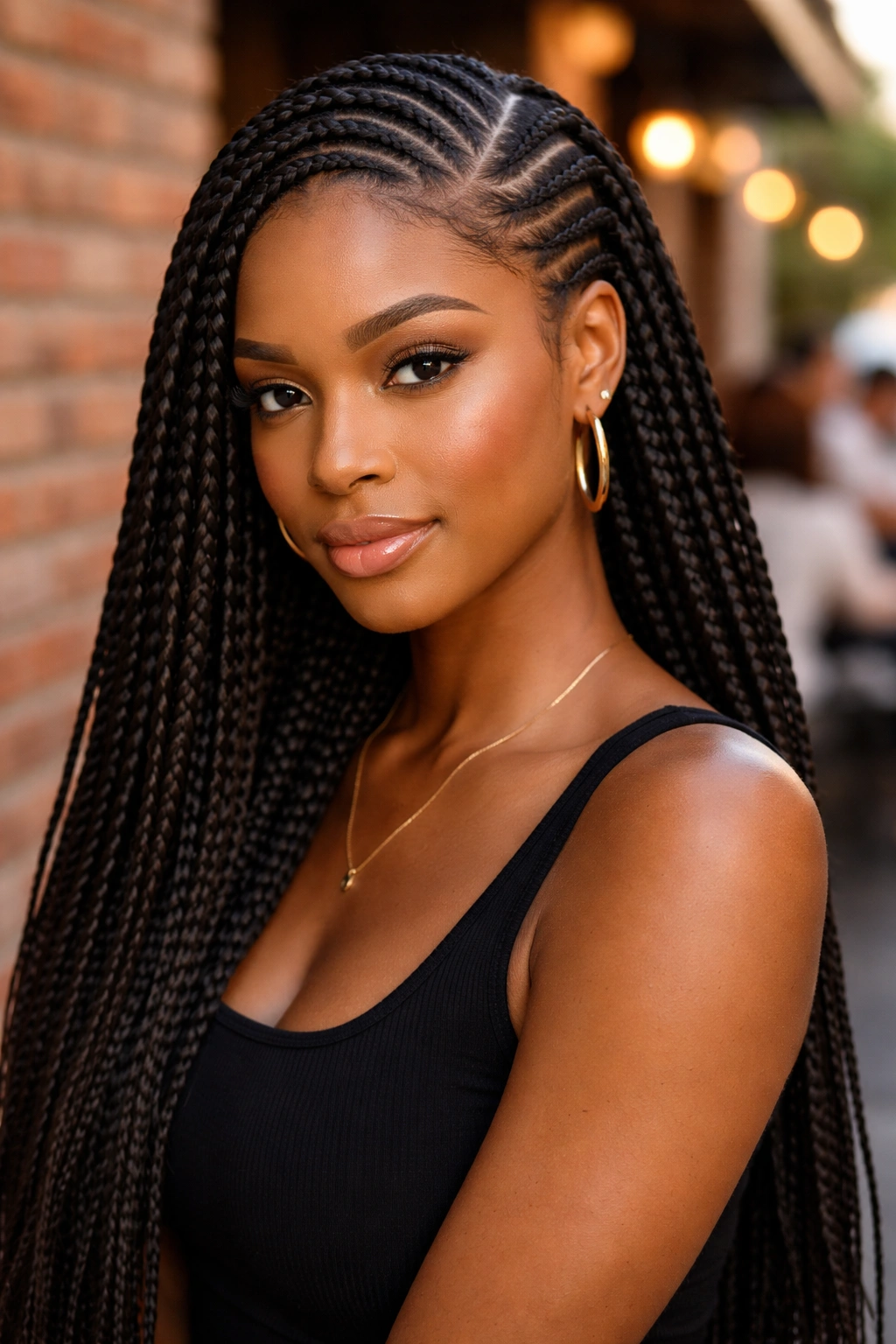
A deep side part with cornrows on the smaller side of the part — maybe 4-5 cornrows — and a heavy sweep of box braids on the larger side.
The asymmetry is the design. One side reads structured, the other side reads loose.
Best on women with strong jawlines because the asymmetry plays against the jaw line for visual balance.
Maintenance Notes
- Asymmetric styles loosen unevenly — the heavier side fuzzes faster
- Re-tighten the box braid sweep every 3-4 weeks if needed
- Sleep with the heavier side facing up to reduce friction
Tip: Wear earrings only on the cornrow side. The box braid sweep covers that ear; visible jewelry on the cornrow side balances the look.
13. Cornrow Mohawk With Box Braid Sides
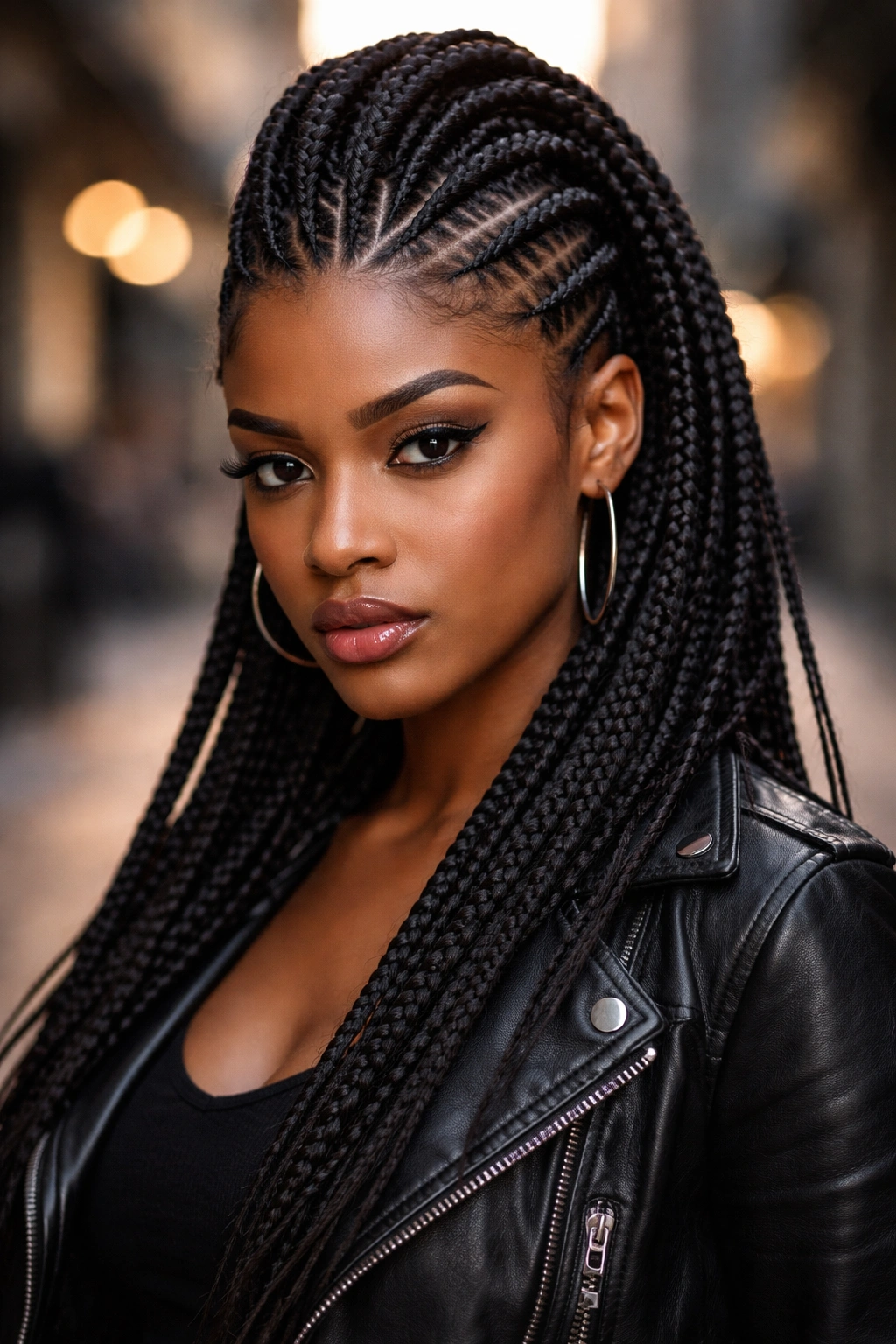
A mohawk of cornrows runs down the center of the head — usually 3-5 cornrows wide — with box braids on both sides hanging loose.
This is the loudest style on the list. It’s not subtle, and it’s not meant to be.
The mohawk needs to be raised — meaning the cornrows are braided slightly upward at the start to lift the center section. Without lift, the mohawk reads as a part rather than a ridge.
Best for women who want statement hair and have the wardrobe to back it up. Pair with leather jackets, edgy boots, and confidence.
14. Half Cornrow Into Pixie-Length Box Braids
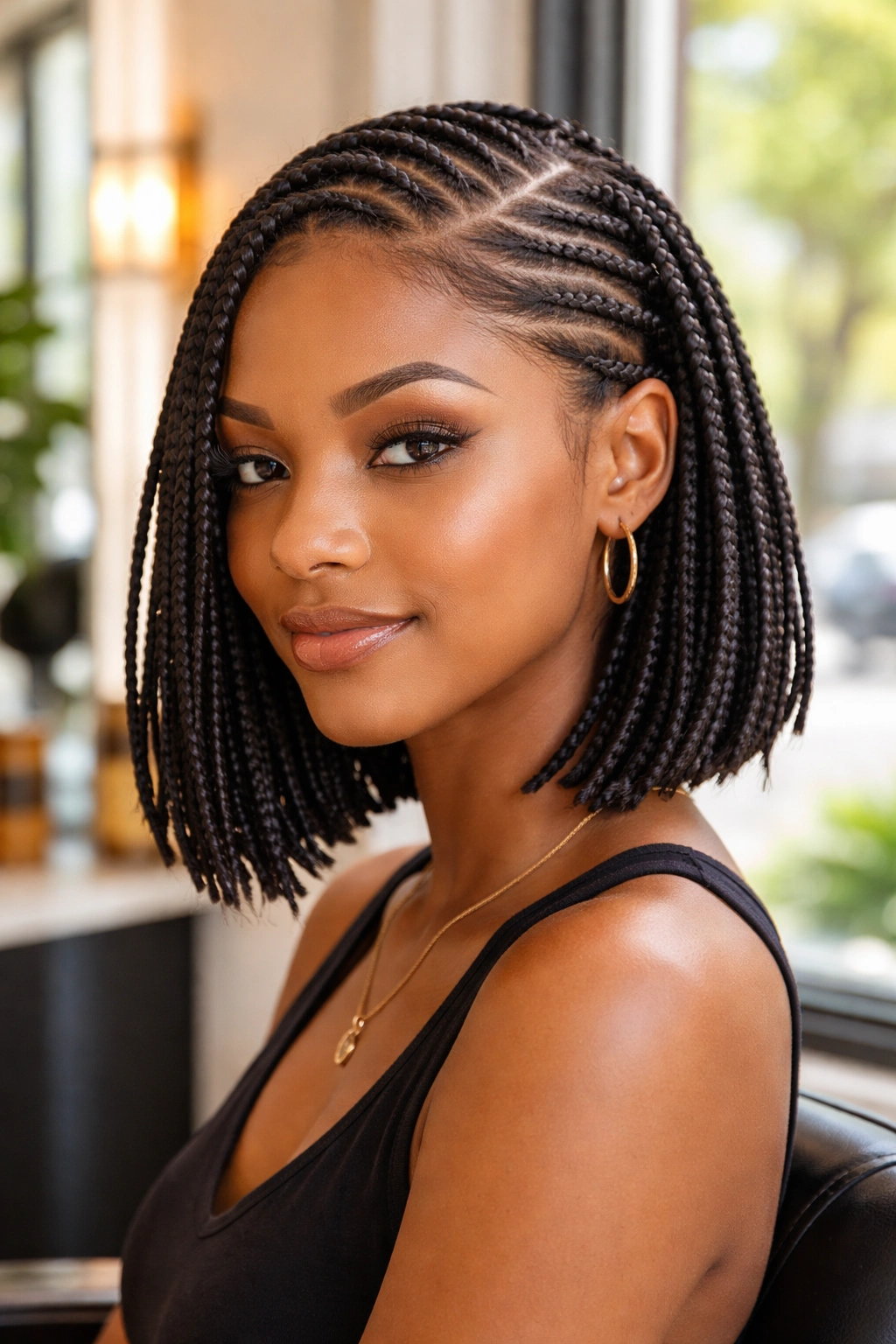
Cornrows on top transition into very short box braids — chin-length or shorter. The whole style feels light, sharp, and modern.
Short box braids read graphic. They’re harder to wear if you’ve been used to long hair, but they’re remarkably easy to maintain.
The short length means lower weight on the scalp, reduced tension on edges, and easier sleep. Trade-off: less drama, less swing.
15. Cornrow Halo With Pinned Box Braid Updo
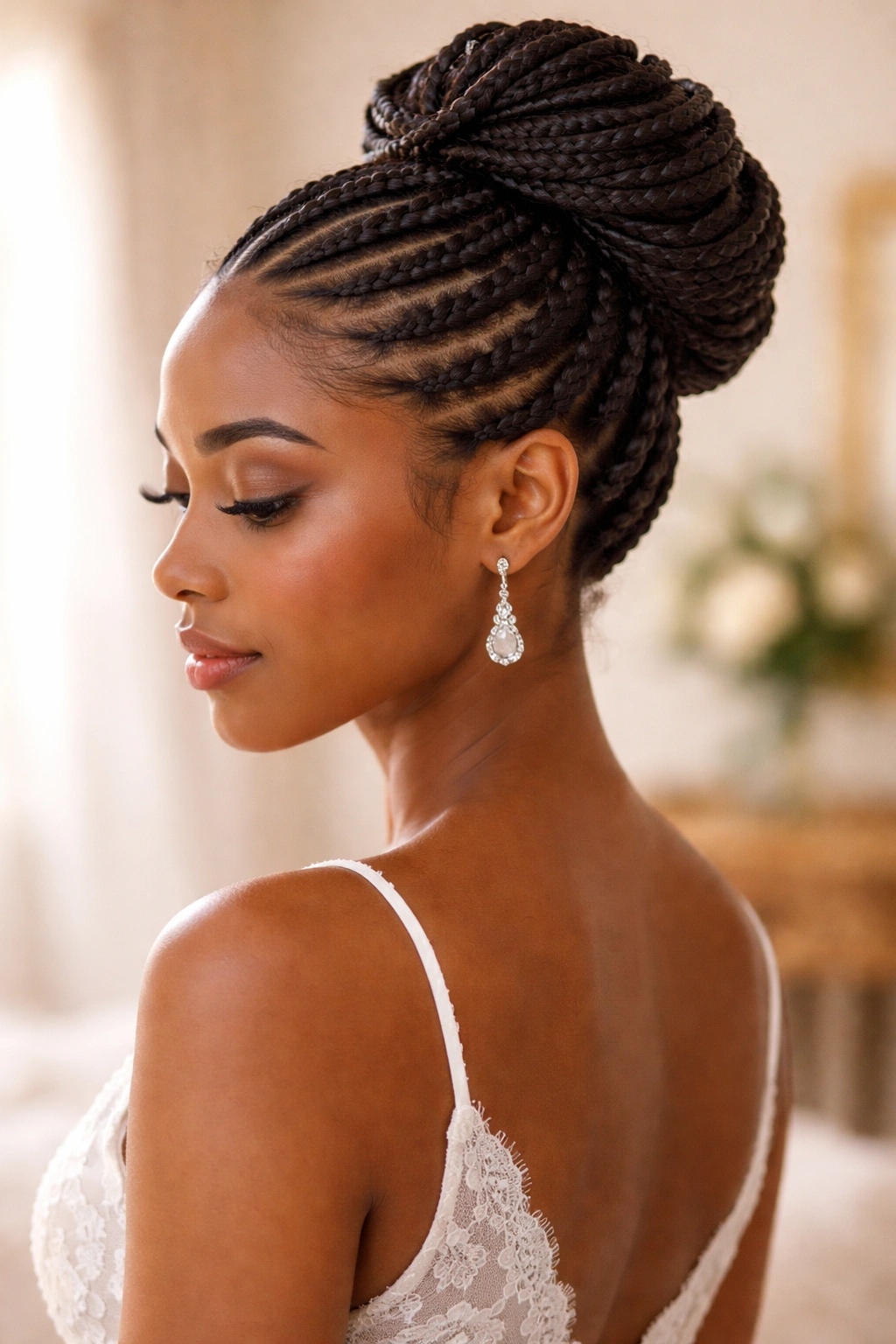
Cornrows form a halo, then box braids gather on top of the head and are pinned into a sculpted updo. The whole style sits up, off the neck.
This is bridal hair territory. It’s also great for hot weather — nothing touches the neck or shoulders.
The pinned updo can be loose and textured (more romantic) or tight and sleek (more formal). Discuss with your braider before starting.
16. Half Cornrow With Scattered Beaded Box Braids
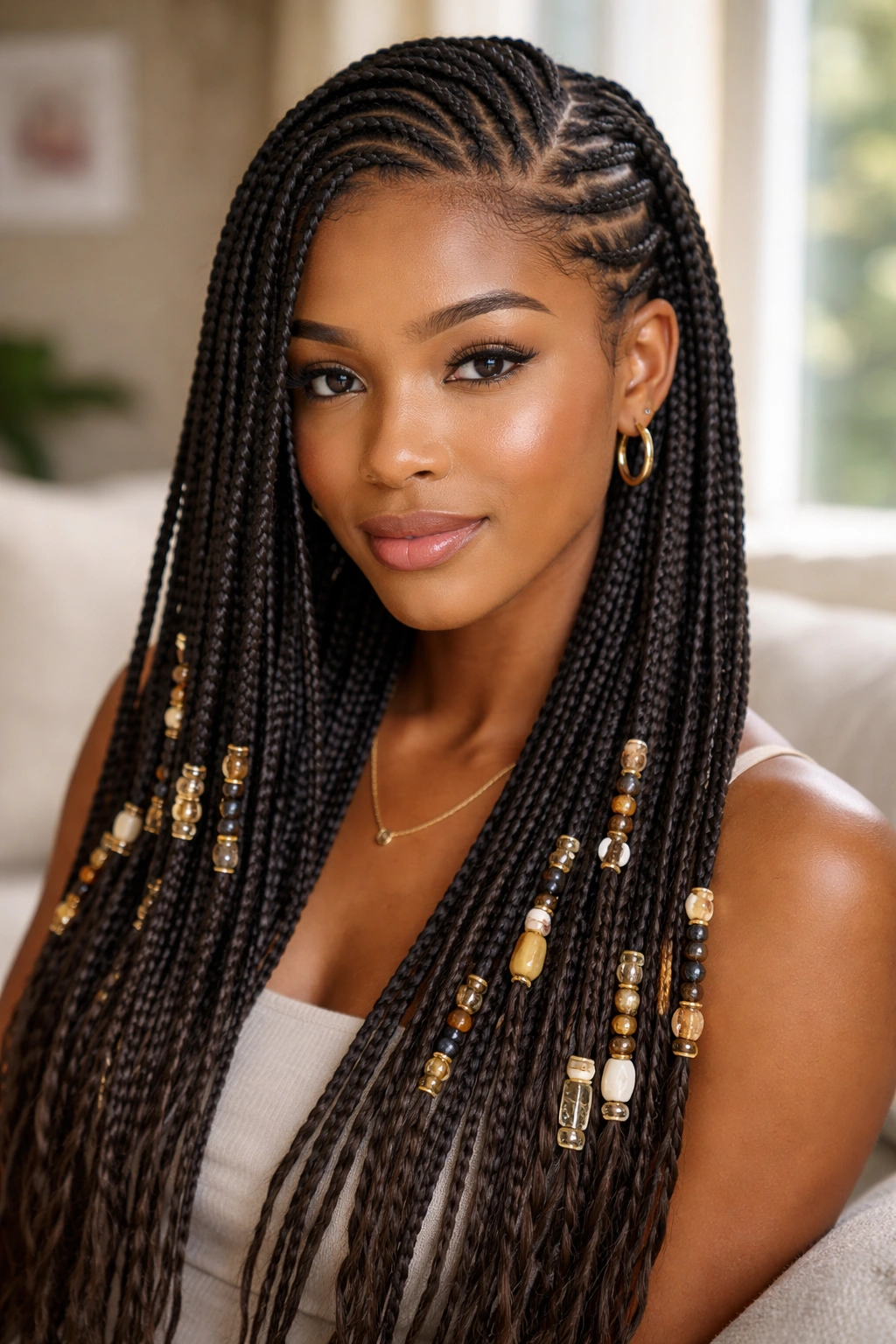
Cornrows on top are clean and unadorned. Box braids on bottom have scattered beads — but only on about a third of them. The rest hang plain.
Selective beading reads more sophisticated than full beading. Your eye lands on the beaded braids, and the empty braids give visual rest.
Distribute beaded braids asymmetrically. Two on the left, three on the right back, one at the front. Symmetric placement looks formulaic.
17. Cornrow Cluster With Box Braid Spray
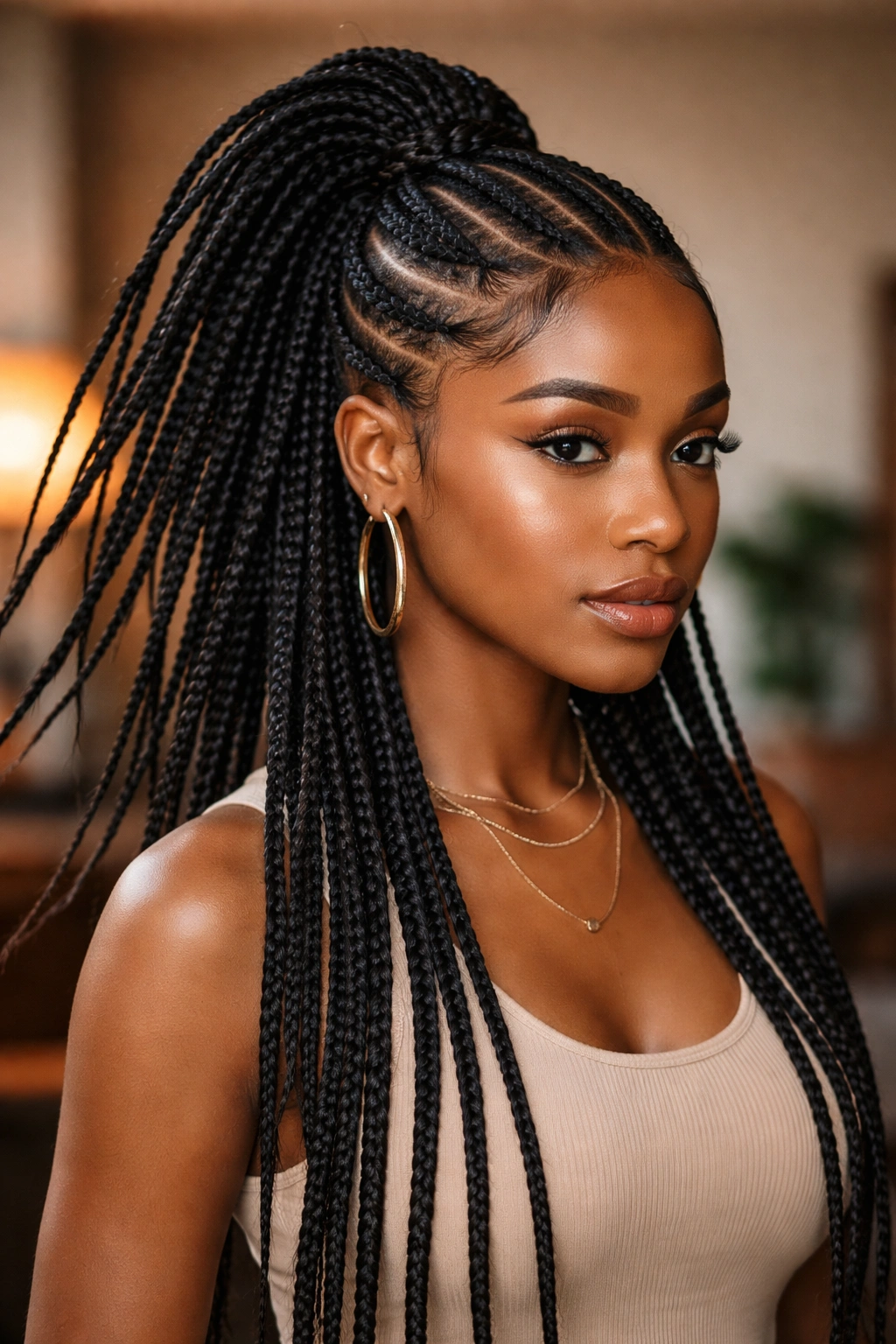
Three to five large cornrows cluster at the front of the head, then spray outward into box braids that hang in all directions. The cluster is dense; the spray is fan-like.
This is one of the more sculptural half-up styles. It treats hair like a design element rather than a frame for the face.
The cornrow cluster needs to be small enough to read as cluster — not as full coverage. Aim for 4-5 inches of cornrow coverage at most.
18. Half Cornrow With Wrapped Ponytail Base
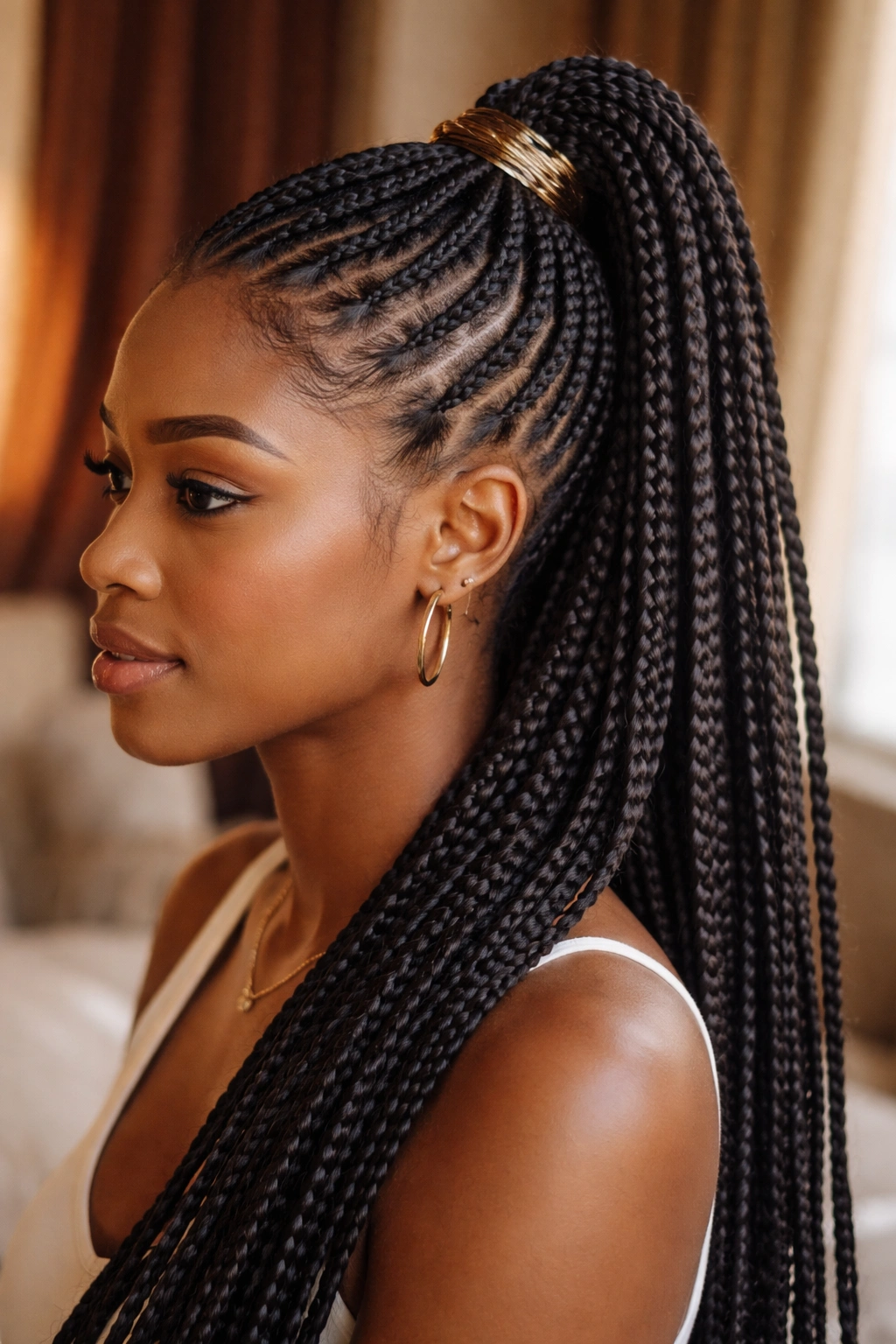
Cornrows on top, box braids on bottom, and the transition zone is wrapped with a contrasting cord, ribbon, or thin braid that encircles the gather.
The wrap hides the transition and adds an ornamental detail at a focal point.
Wraps can be silk ribbon, leather cord, gold thread, or even a thicker braid in a different color. Choose based on the overall vibe of the style.
Who This Is For
Women who want a small ornamental detail without committing to beads, charms, or design braiding.
Tip: A black satin ribbon wraps any color combination cleanly. Start with that if you’re not sure what color to choose.
19. Cornrow Front With Box Braid Twist Updo
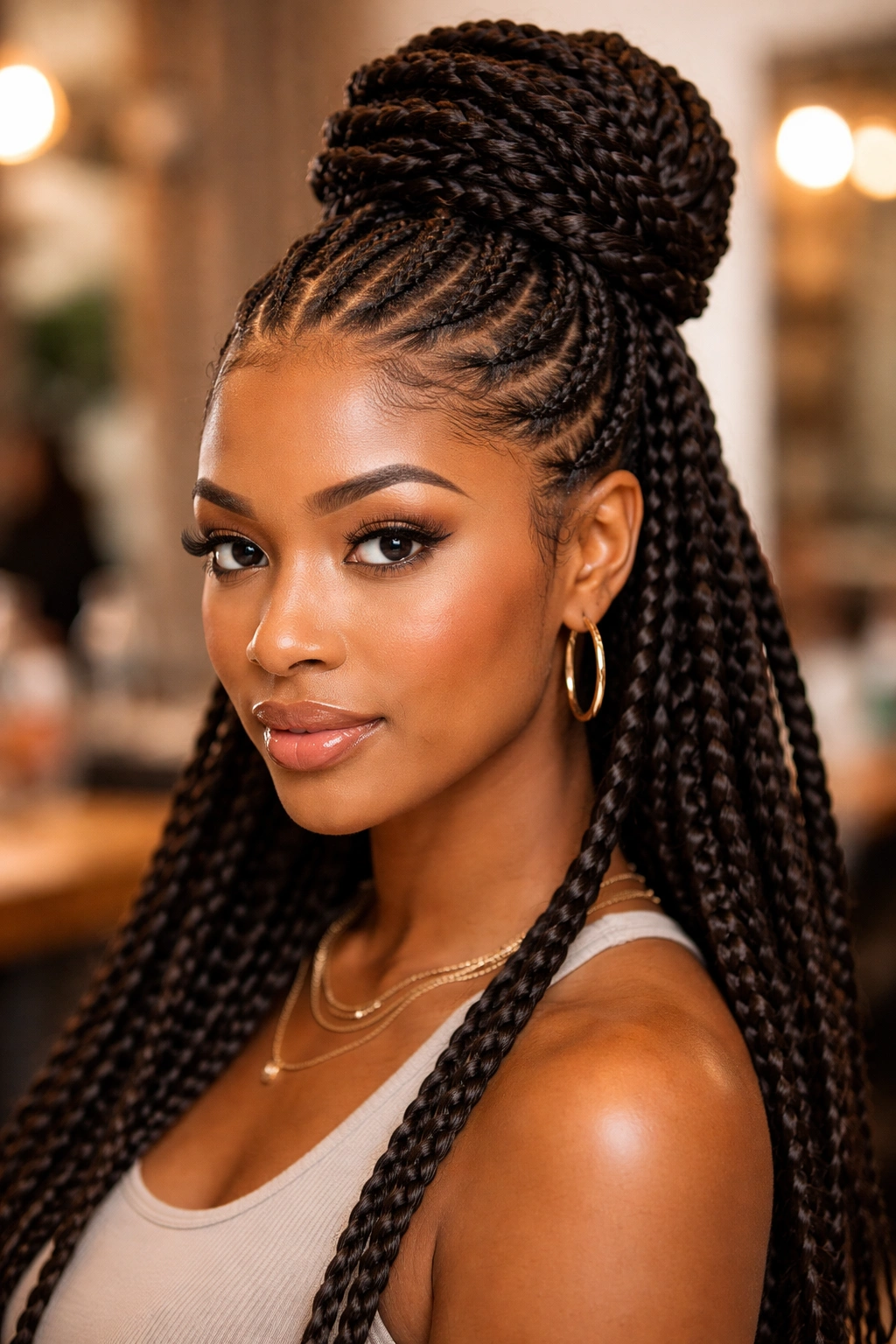
Cornrows cover only the front 2-3 inches of the head — basically a thick band of braided hair from forehead to crown. The rest of the head is in box braids twisted up into a high updo.
The cornrow front frames the face. The twisted updo lifts the back.
This works well for formal events because the silhouette is balanced — defined at the front, voluminous at the back.
20. Half Cornrow With Ombré Box Braids
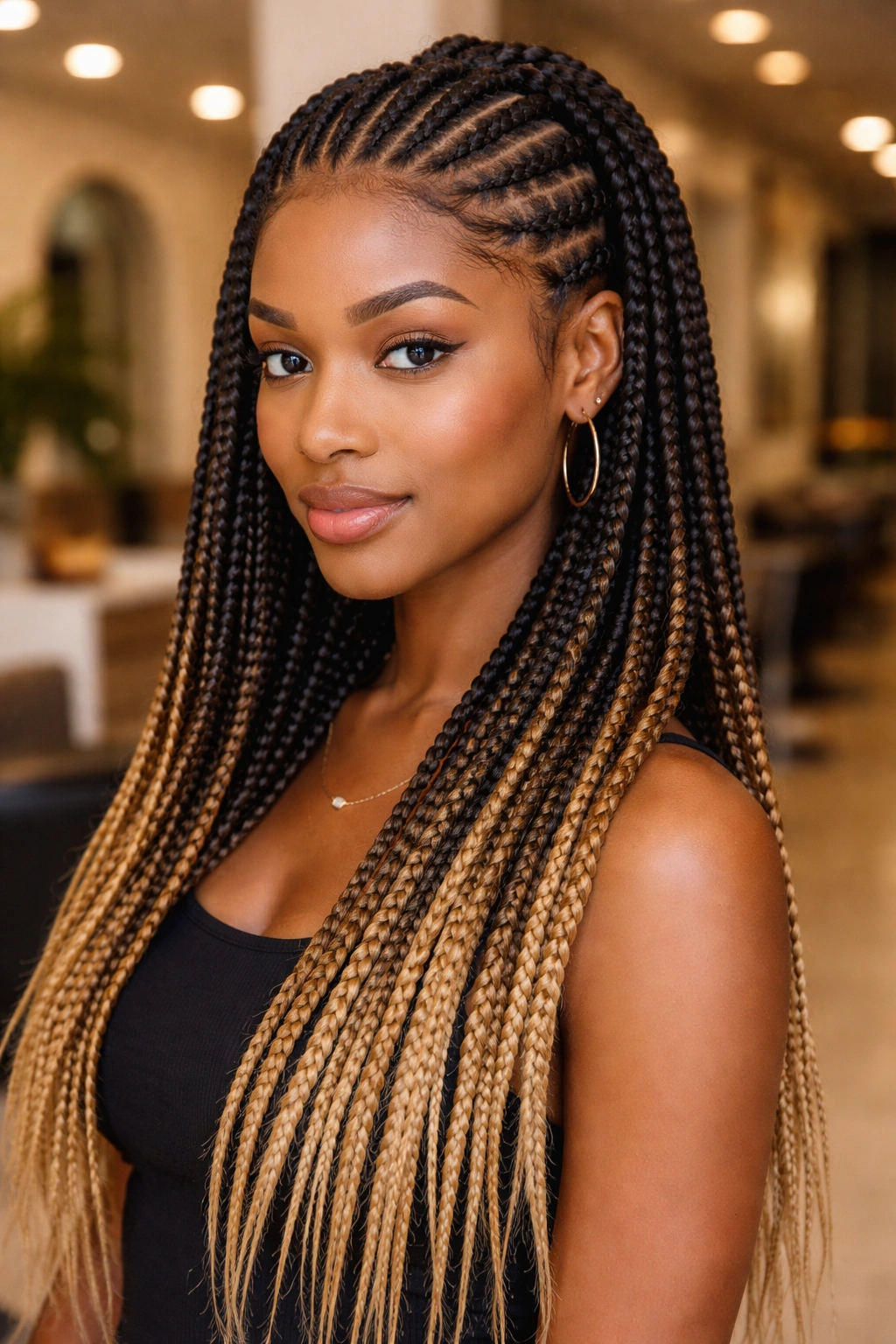
Cornrows on top in solid natural color. Box braids in ombré — natural at the base, gradually transitioning to a lighter color toward the ends.
Ombré box braid extensions come pre-colored. The braider doesn’t have to do any color work; they just choose the right pre-dyed kanekalon.
Most flattering ombré combos: natural-to-honey for warm tones, natural-to-ash for cool tones, natural-to-burgundy for dramatic warm.
The ombré effect gets more pronounced as the braids get longer. Short box braids barely show the gradient.
21. Cornrow Half-Up With Box Braids Down
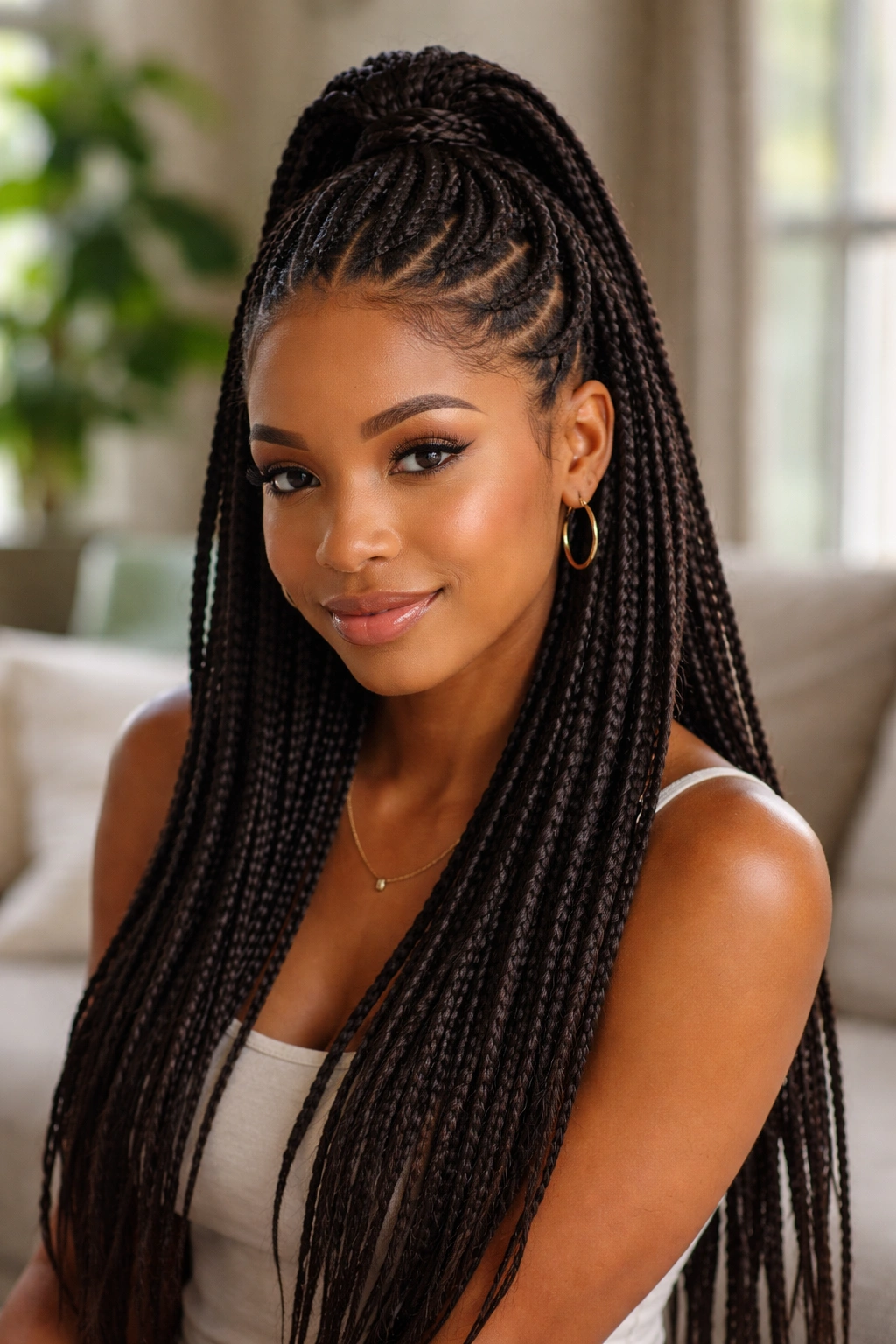
Sometimes called a “half-up half-down,” this is the most casual version of the style. Just the top section of hair gets cornrowed, gathered, and either tied or pinned at the crown. The rest of the box braids hang loose.
This is everyday wear. It’s the style you do for work, the gym, brunch, or anywhere you want low-effort polish.
Quick to install — about 3-4 hours total — because the cornrow section is small.
22. Cornrow Crown With Pony-Tied Box Braids
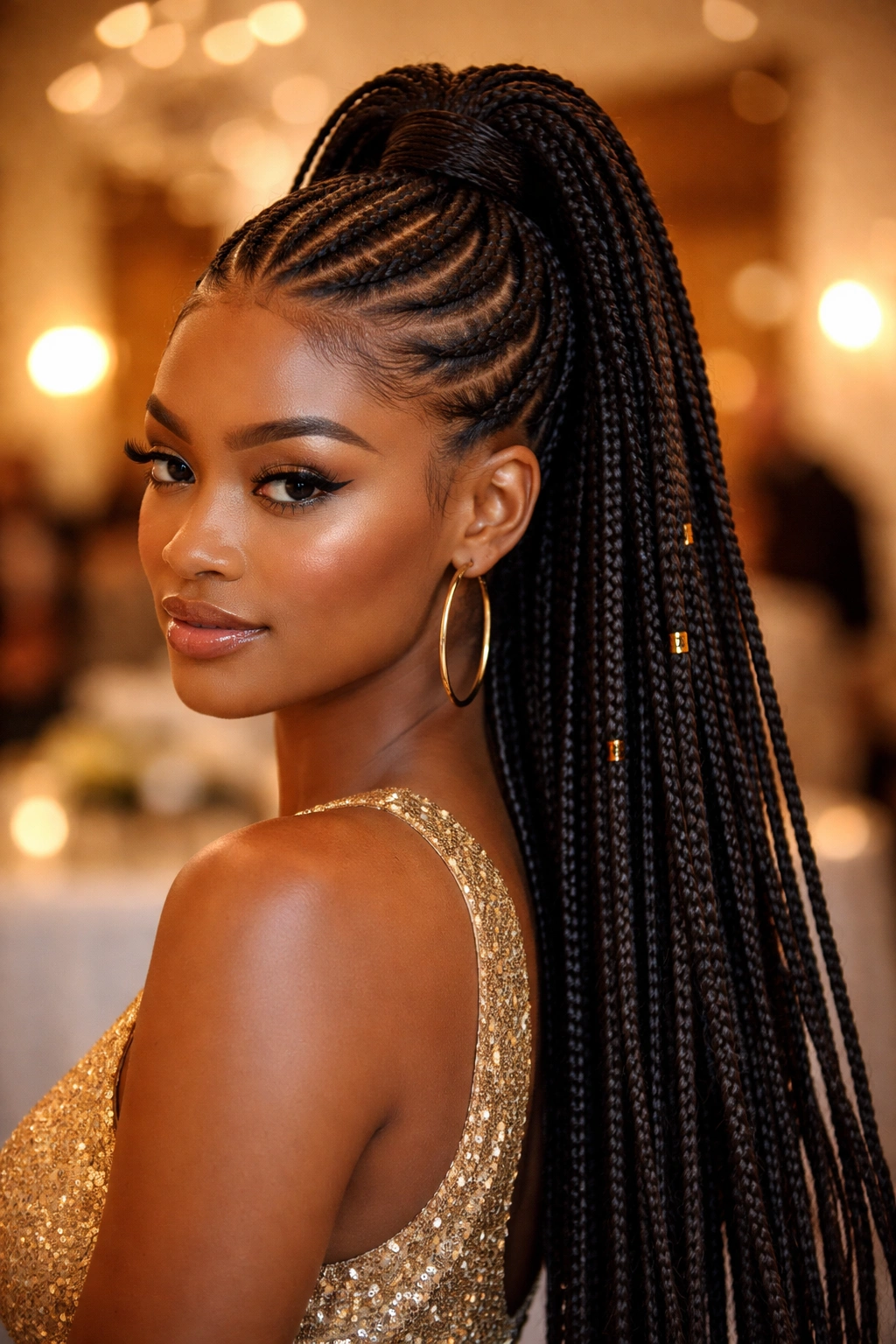
A crown of cornrows wraps the head, then all the box braids gather into a high ponytail at the very top of the crown — like a fountain.
The high pony adds vertical lift and lengthens the face.
This is a celebratory style — birthdays, parties, milestones. Not a daily wear because the high pony pressures the scalp.
Tip: Wear this for short stretches, then switch to a low ponytail or loose drape when you need a tension break.
Sleeping in Half Cornrow Styles
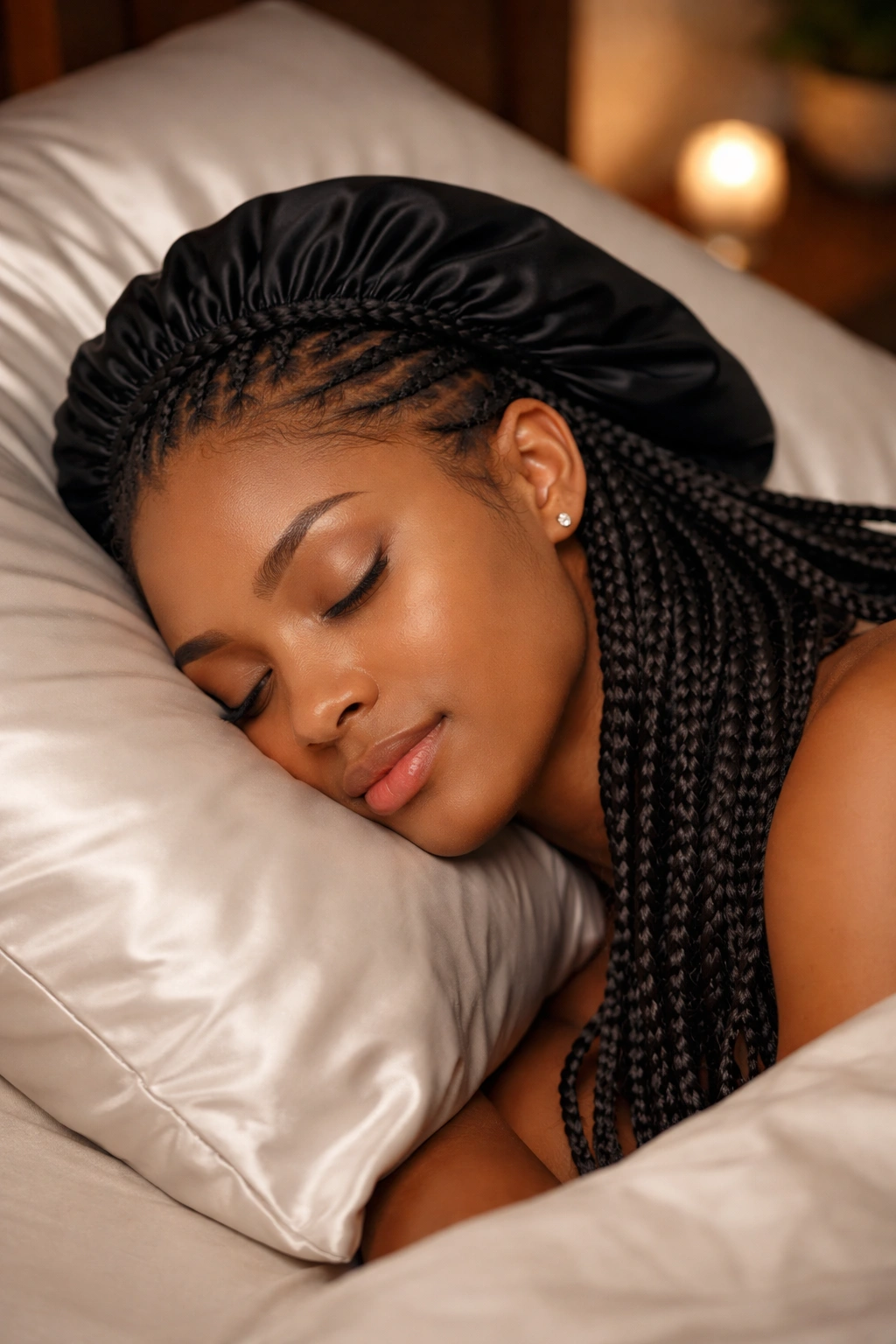
The cornrow portion stays put easily. The box braids are the part that needs management.
Pineapple the box braids before bed. Gather them loosely at the top of your head and secure with a silk scrunchie. This keeps them from flattening against the pillow and frizzing.
Wear a satin bonnet or sleep on a satin pillowcase. Cotton pillowcases are devastating for braided hair — they create friction at every contact point.
Don’t sleep on damp box braids. Damp synthetic hair compresses overnight and develops a permanent bend that takes weeks to release.
Pad the cornrow section if needed. If your scalp feels tight at the cornrows after a long day, sleep with a small folded silk scarf between your scalp and the pillow for cushioning.
Washing Half Cornrow Styles
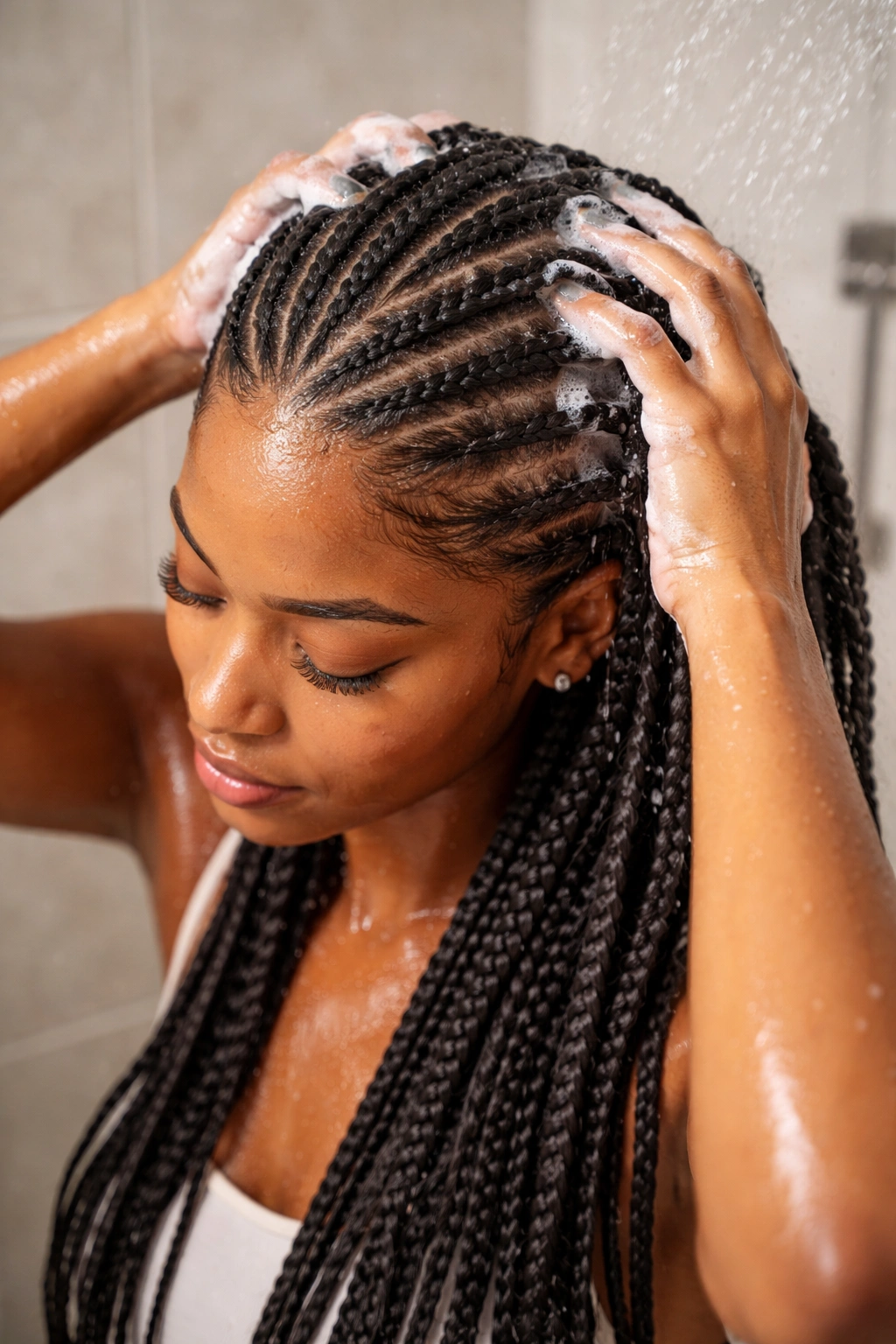
Wash every 10-14 days. More often, and you stress the cornrows. Less often, and product buildup makes the scalp itch.
Cornrow section: Apply diluted shampoo directly to the scalp at the parts. Massage with fingertips. Rinse thoroughly.
Box braid section: Avoid heavy product on the box braids. Apply diluted shampoo only at the base where it meets the cornrows; let the rinse water carry it down through the braids.
Drying: Pat the cornrow section with a microfiber towel. Air dry the box braids — never wring them.
Allow at least 2-3 hours of air drying before applying any oils or products. Damp synthetic hair takes oil differently and can end up greasy.
Edge Care for Half Cornrow Styles
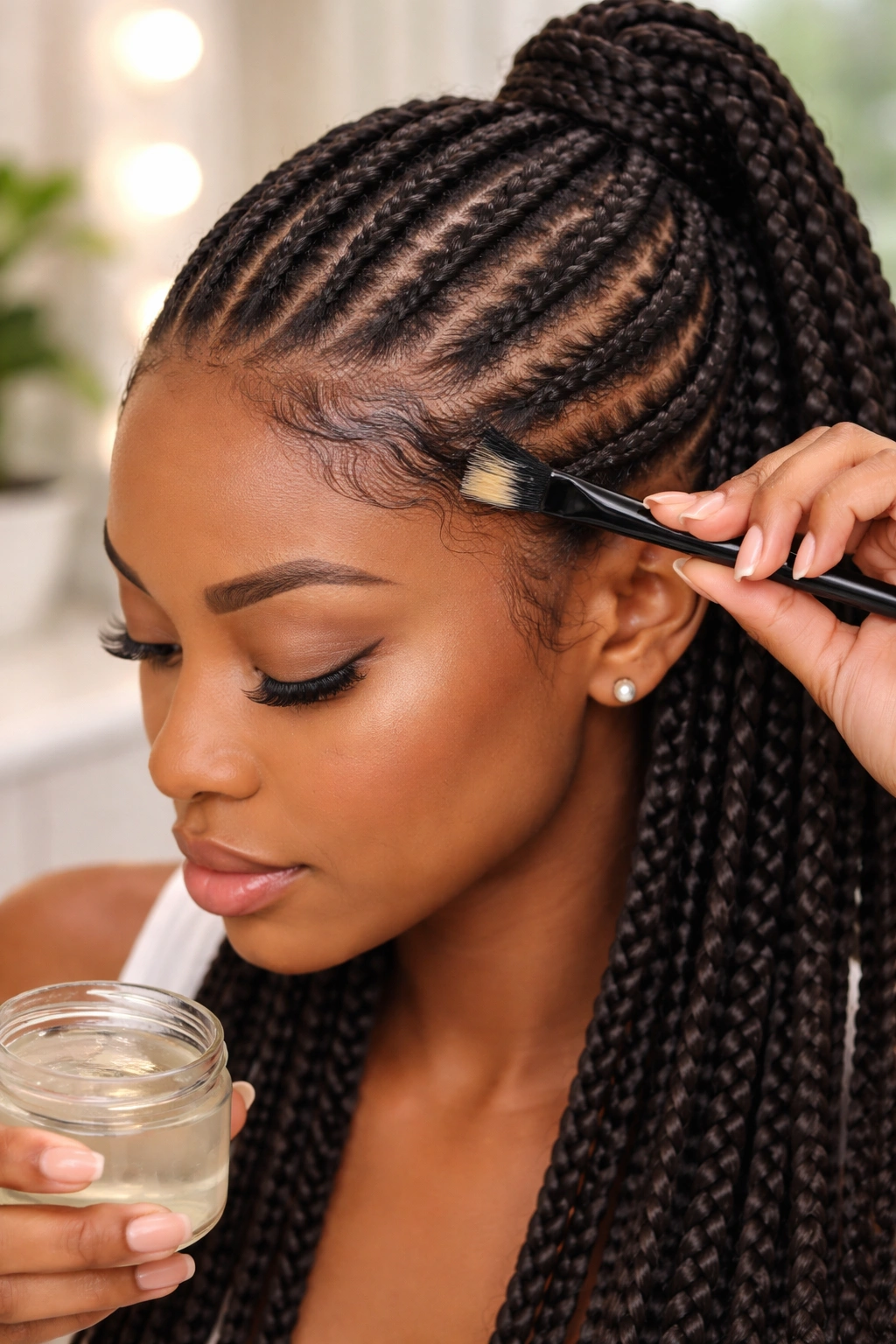
Edges are the make-or-break for any cornrow-based style. Half cornrow styles need extra attention because the cornrow section starts directly at the hairline.
Edge brush + light gel twice a week. Smooth the baby hairs in the direction of your cornrow flow.
Don’t over-edge. Heavy edge styling every day eventually weighs the baby hairs down and causes them to shed. Twice a week is plenty.
Refresh edges before social events. A 5-minute touchup with a damp edge brush and a swipe of gel makes the whole style look fresh.
Maintaining the Box Braid Section
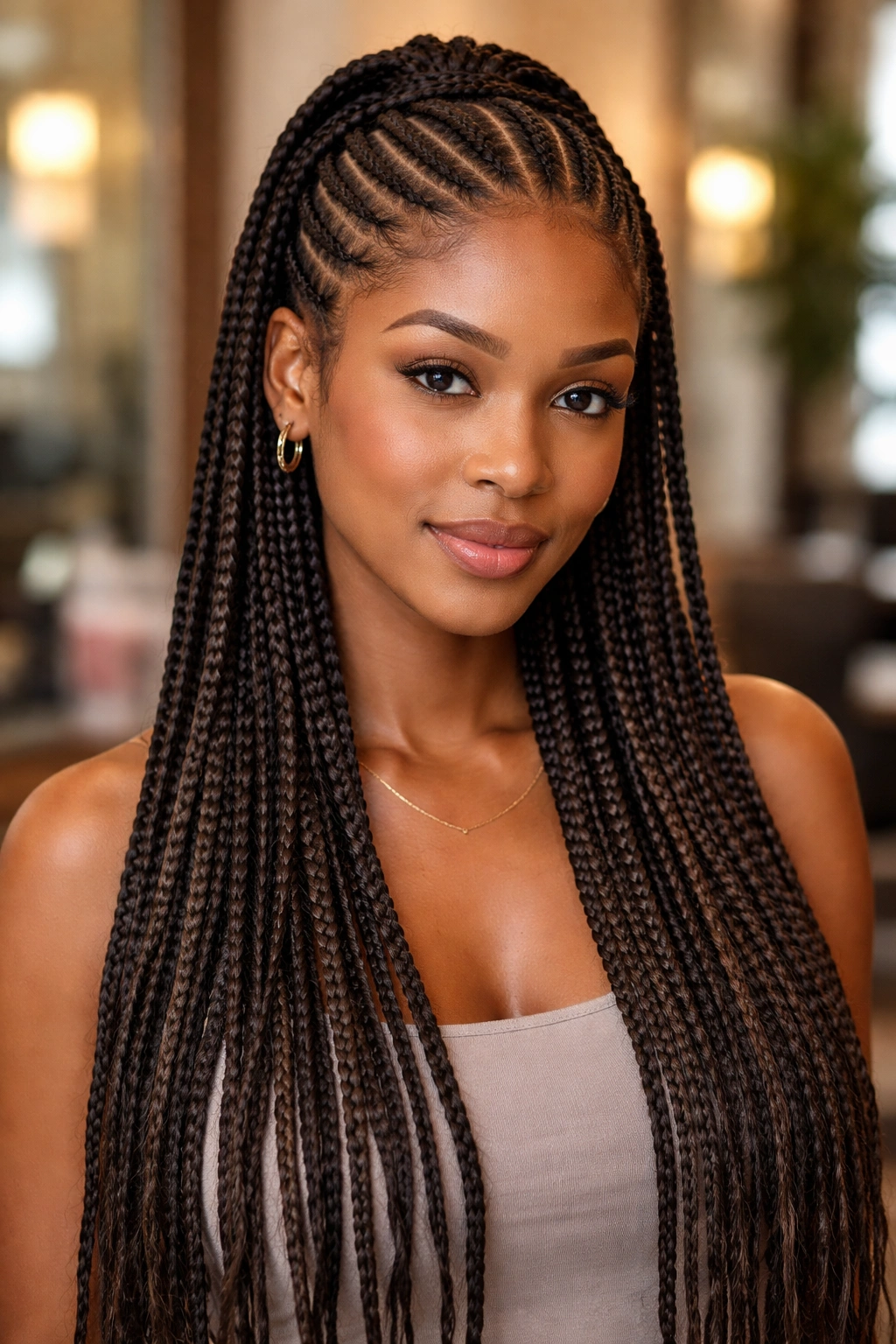
Box braids need their own care routine separate from the cornrows.
Mist with a leave-in conditioner spray every 3-4 days. This keeps the synthetic hair from getting brittle.
Avoid heavy butters and oils. They weigh the braids down and attract dust. Light oils like jojoba or argan are fine in small amounts.
Don’t separate braids that have stuck together. Forcing them apart creates fly-aways. Let them naturally separate over time as you finger-comb.
Trim fly-aways with small scissors. Don’t try to braid them back in.
When to Take the Style Down
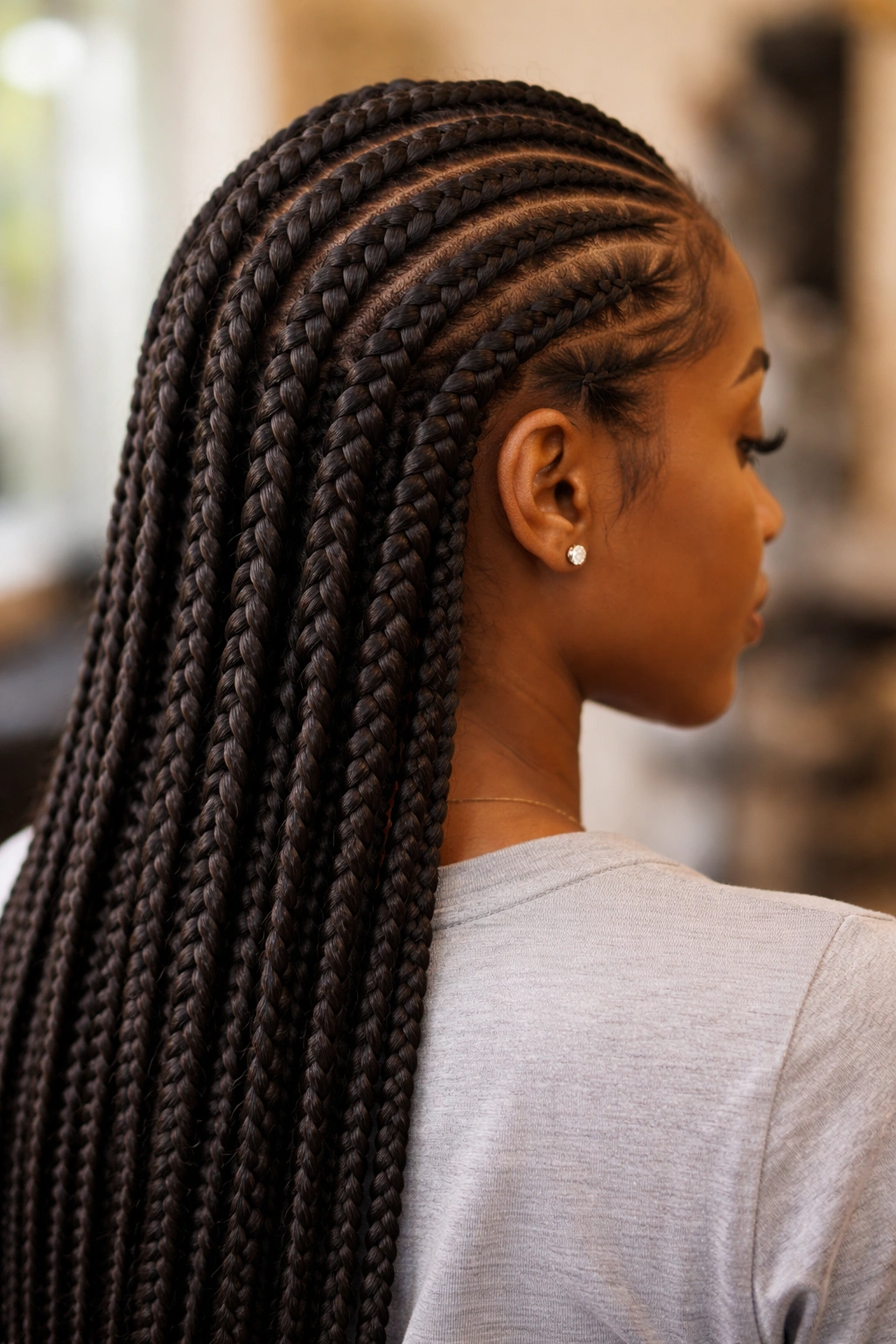
Half cornrow styles last 6-8 weeks comfortably. Past 8 weeks, the cornrow section starts showing significant new growth at the parts, and the transition zone can begin to weaken.
Signs it’s time:
- More than an inch of new growth visible at the cornrow parts
- Cornrow lifting at the front hairline
- Box braid weight pulling the cornrow section down
- Itchiness that scalp oil doesn’t resolve
Don’t push past 8 weeks. The combined weight of cornrows and box braids stresses your natural hair more than either style alone.
Taking Down Without Damage
The takedown order matters: box braids first, then cornrows.
Box braid takedown: Snip any rubber bands or cuffs at the ends. Unravel each braid from the tip up. Use detangling spray to soften synthetic hair. Take your time — a full box braid takedown is 1-2 hours.
Cornrow takedown: Once the box braids are fully unraveled, the cornrow section can be unraveled the same way. Use the pointed end of a rat-tail comb to lift each cornrow from the tip.
Detangle thoroughly before washing. Natural hair that’s been braided for 6+ weeks has accumulated 6 weeks of normally-shed strands tangled in the braid base. Finger-detangle each section.
Wash with a clarifying shampoo to strip product buildup. Deep condition for at least 30 minutes.
Give your scalp 5-7 days of rest before the next protective style.
Common Mistakes With Half Cornrow Styles
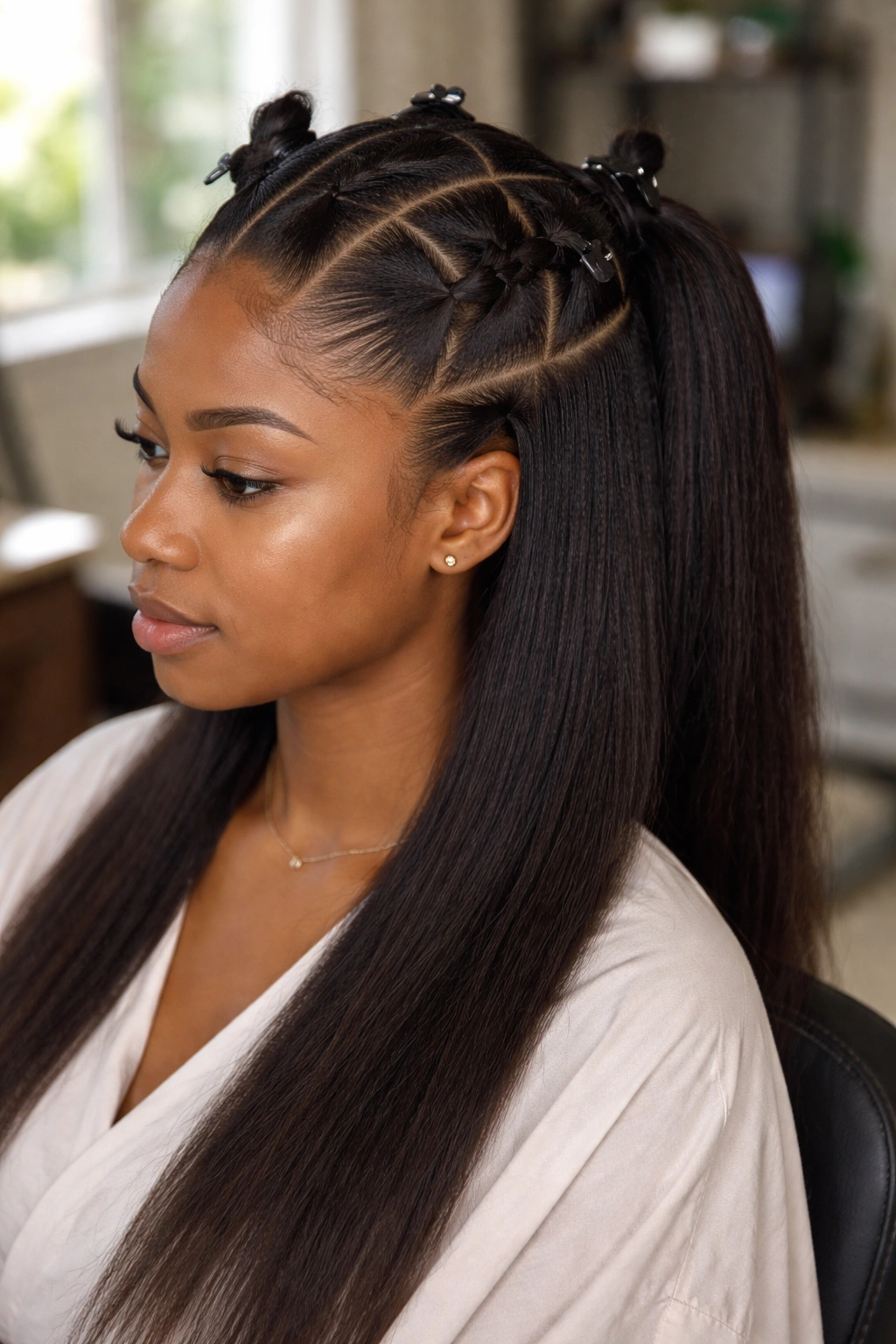
Mismatched braid sizes between the cornrow and box braid sections. If your cornrows are pencil-thin, your box braids should be thin too. If your cornrows are thick, the box braids should match.
Wrong transition placement for face shape. High transitions (at the crown) elongate the face — good for round, bad for long. Low transitions (at the nape) shorten the face — good for long, bad for round.
Heavy box braid extensions on a thin cornrow base. The weight pulls the cornrows out of place. Match the extension density to your cornrow density.
Ignoring the back transition. You can’t see the back transition without a handheld mirror. Always check it before leaving the salon. A bumpy back transition looks bad in every photo for the next two months.
Skipping satin sleep care. The single biggest factor in how long your style lasts isn’t the install quality — it’s how you sleep. Satin or nothing.
And the last thing — half cornrow styles are an investment of 4-6 hours and several hundred dollars. Treat them like that. A skilled braider, the right extension hair, and proper aftercare turn this combo into one of the most flexible and flattering protective styles available. A rushed install with cheap hair and no aftercare turns into frizz and frustration within a month.
