


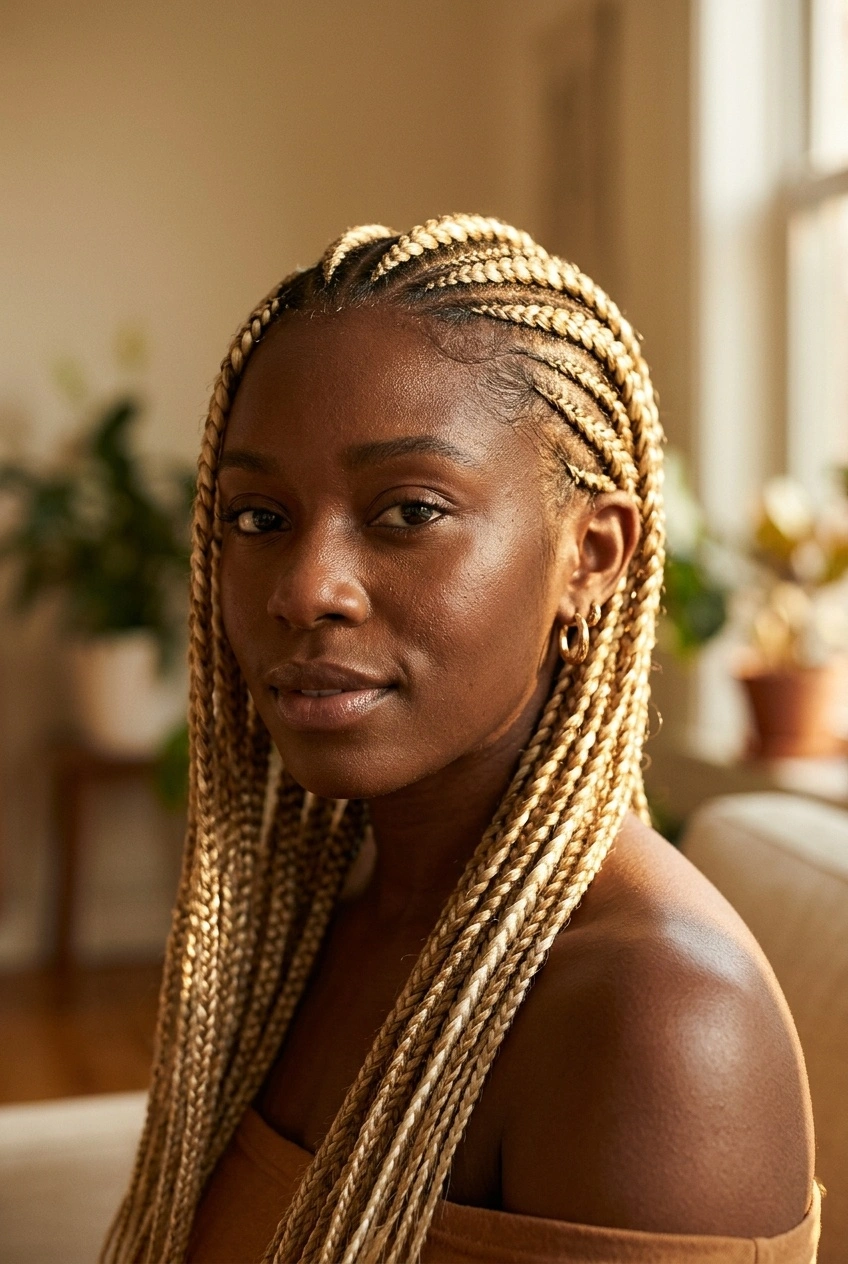
Feed in cornrows in blonde are a commitment. The color reads loud, the technique requires skill, and the upkeep demands attention you wouldn’t give a darker shade. I won’t pretend otherwise. But the payoff — bright, luminous braids that catch every light source and frame your face with warmth — is hard to replicate with any other style.
Blonde feed-ins have been part of the cornrow conversation for decades. What’s changed is the range of blonde shades available in kanekalon form. Ash blonde, honey blonde, platinum, bleach blonde, dirty blonde, strawberry blonde, champagne — each reads differently and flatters different undertones. Picking the right blonde for your skin matters more than picking the right cornrow pattern.
The feed-in technique itself solves an old problem with colored cornrows. Traditional cornrow installation used to require attaching color at the root, which created an abrupt color transition. Feed-in installation introduces the kanekalon gradually, which makes the color appear to emerge from the scalp naturally. On blonde, this is critical — nothing looks worse than blonde kanekalon with a visible attachment point at the hairline.
Why Blonde Is Worth the Extra Effort
Blonde cornrows photograph differently than any other color. They reflect light rather than absorb it. Where black cornrows read as texture, blonde cornrows read as dimension. You see every braid line clearly. You see the shape of the style at a glance.
Blonde also flatters dark skin beautifully when done right. The warm tones in honey blonde, the golden notes in champagne, the rich glow of caramel — these highlight undertones in deep skin that darker hair colors don’t reveal.
There’s also the confidence factor. Blonde braids aren’t subtle. Wearing them signals that you chose to stand out. For anyone who’s been playing it safe with hair color, a blonde feed-in install is a worthwhile departure.
Picking Your Blonde Shade

Honey blonde (around color code 27 or 27/30 mix) is warm and suits most skin tones. It’s the most forgiving blonde for first-time blondes.
Ash blonde (closer to 613A or a cool platinum) has grey or silver undertones. It suits cool undertones in the skin — those with pink or blue tones in their base.
Bleach blonde or platinum (typically 613) is the brightest and most dramatic blonde. Flatters deeper skin tones especially. Requires more maintenance since it shows any dirt or oil quickly.
Strawberry blonde (color 350/613 mix) has pink or red undertones. Suits warm skin with golden undertones.
Dirty blonde (color 8 or 10) is darker, more muted. Good for people who want blonde dimension without full brightness.
Test kanekalon swatches against your cheek in natural light before committing. The color that makes your skin look most radiant is the right one.
Prep for Blonde Kanekalon
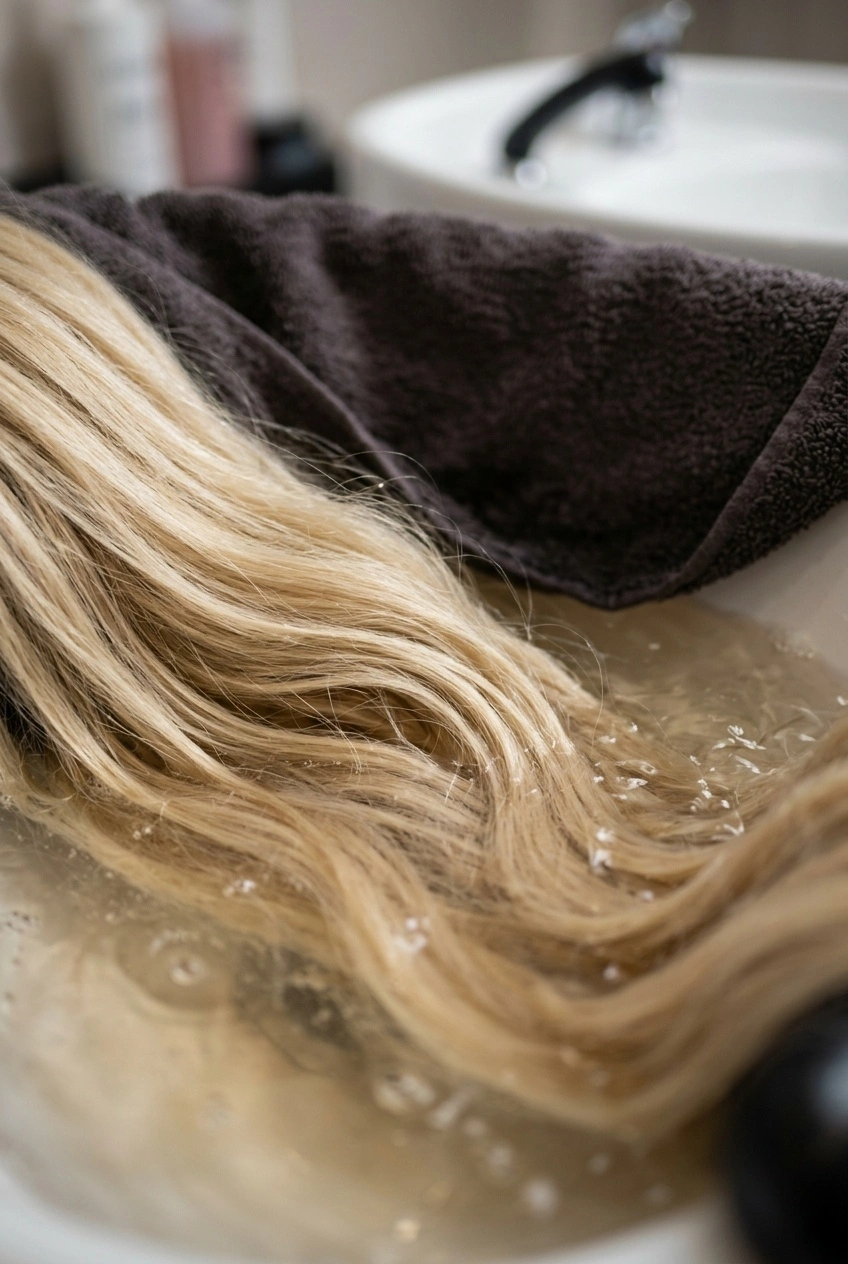
Blonde kanekalon sheds color and fiber slightly during the first install. Pre-wash the kanekalon in warm water with a tablespoon of apple cider vinegar for 10 minutes to set the color and minimize shedding.
Rinse thoroughly, squeeze gently, and hang to dry for 2-3 hours before installation. Damp kanekalon is easier to work with than bone-dry, but soaked kanekalon weighs too much and distorts the braid tension.
Your natural hair gets standard preparation — clarify, deep condition, tension dry, edge prep. Nothing about the color changes the base work.
Keep a dark towel around your shoulders during install. Blonde kanekalon can shed tiny fibers that show up on dark clothing.
Tools That Matter for Blonde Installs
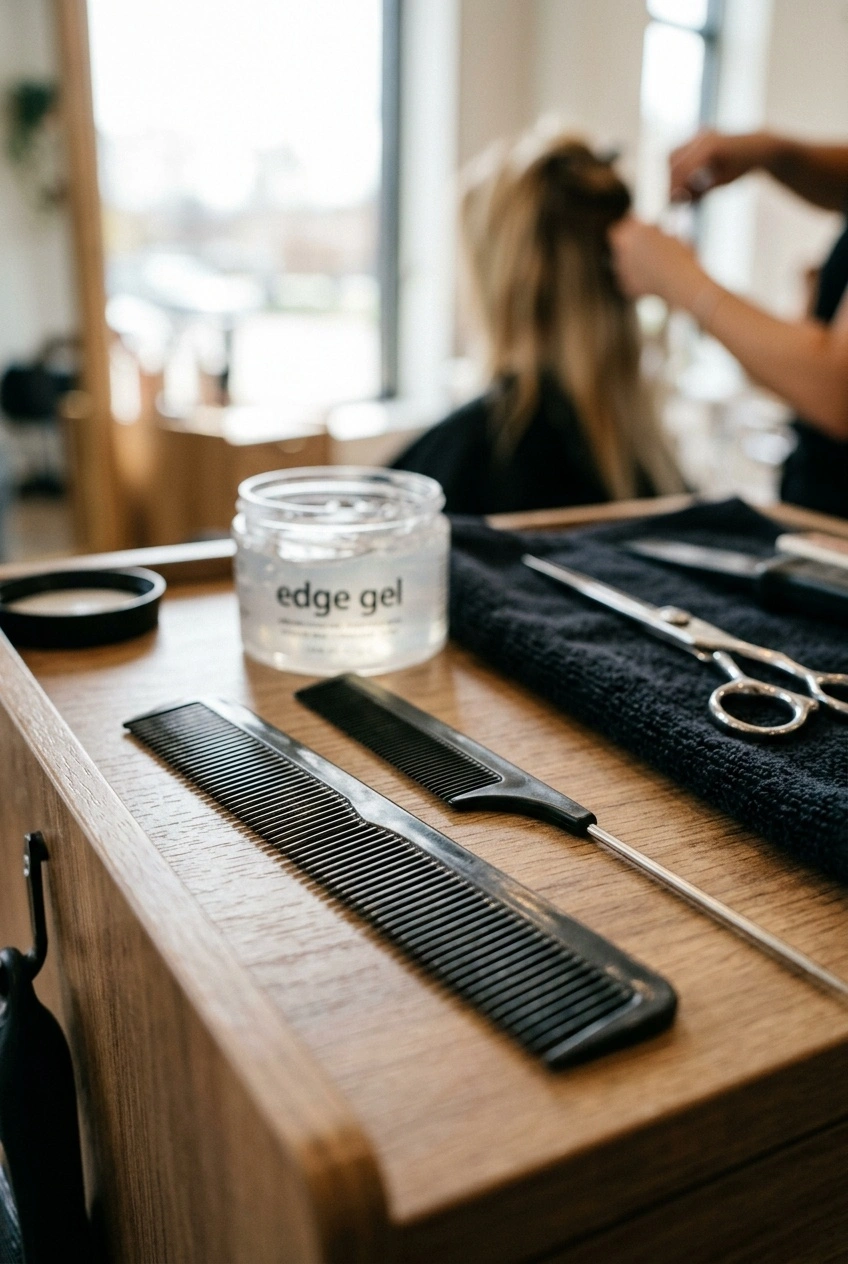
Good lighting. Blonde kanekalon shows every imperfection. Install in bright daylight or under strong LED work lights so you catch tension issues and uneven parting immediately.
Fine-tooth rat-tail comb for clean parts. Blonde cornrows rely on visible clean partings more than darker colors do; any wobble in the part shows.
Edge gel in a finish that suits blonde. Light-hold clear or blonde-tinted gels work better than the darker-colored gels that might show against light-colored hair.
Hair shears for trimming the kanekalon tips after install. Blunt, clean trims read more polished than ragged ends.
1. Straight Back Honey Blonde Feed-Ins
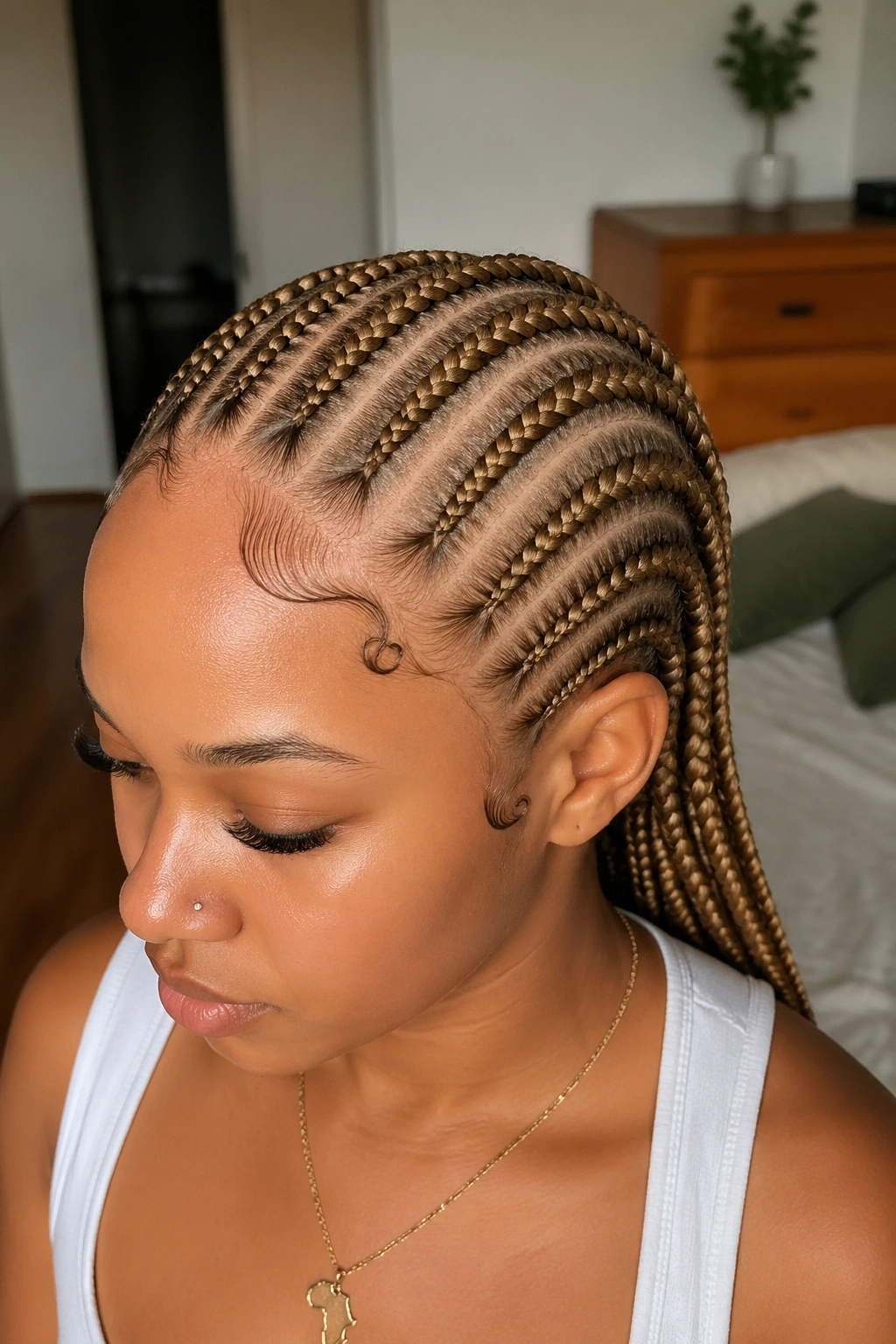
Six to eight honey blonde cornrows running straight from the hairline to the nape. The most accessible entry point for blonde cornrow wearers.
Why It Works
Honey blonde is the forgiving shade that works on nearly every skin tone. The straight-back layout is the simplest cornrow pattern. Together, they make a balanced, approachable blonde look.
- Cornrow count: 6-8, medium width (1 inch at base)
- Kanekalon color: 27 (honey blonde) or 27/30 mix for dimension
- Length: mid-back to waist-length for full impact
- Ends: tapered naturally with no blunt cut
Tip: If your natural hair is dark, the first inch of cornrow from the scalp shows your natural color. Ask your braider to start the feed-in kanekalon as close to the scalp as possible without causing tension — this minimizes the visible dark section at the root.
2. Side Part With Ash Blonde Feed-Ins
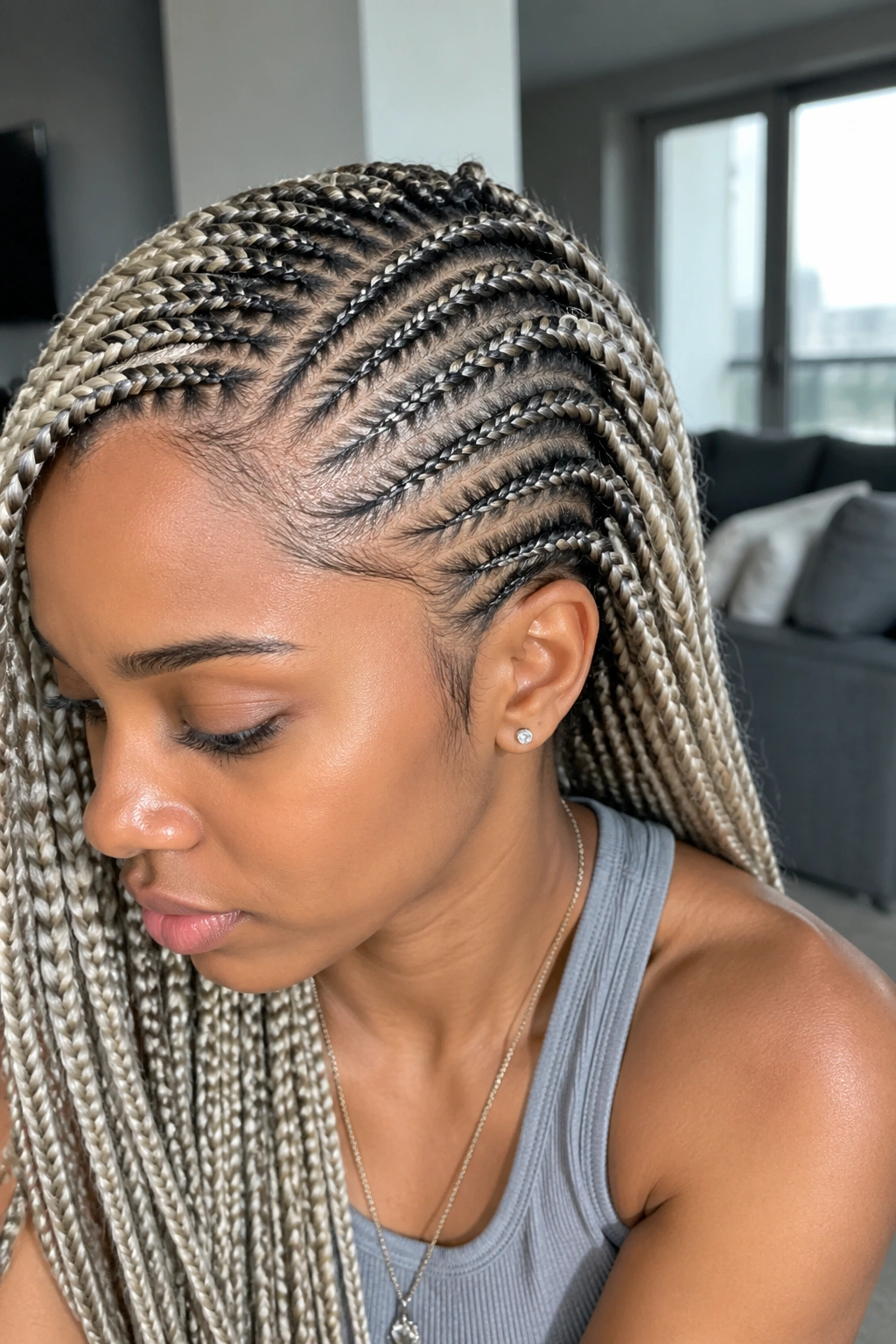
A deep side part with ash blonde feed-in cornrows angling from the part toward the opposite ear. The cool tones of ash blonde pair with the asymmetric side layout for an editorial look.
Ash blonde against dark skin can read striking because of the contrast. The cool silver-grey undertones create dramatic visual interest.
The side part should be clean and committed. Wishy-washy parts that wander between center and side look indecisive. Pick your part side and make it bold — 2-3 inches off center.
Wear this style for events or moments when you want a statement. For daily wear, warmer blondes tend to feel less intense.
3. Platinum Feed-Ins in a Mohawk Pattern
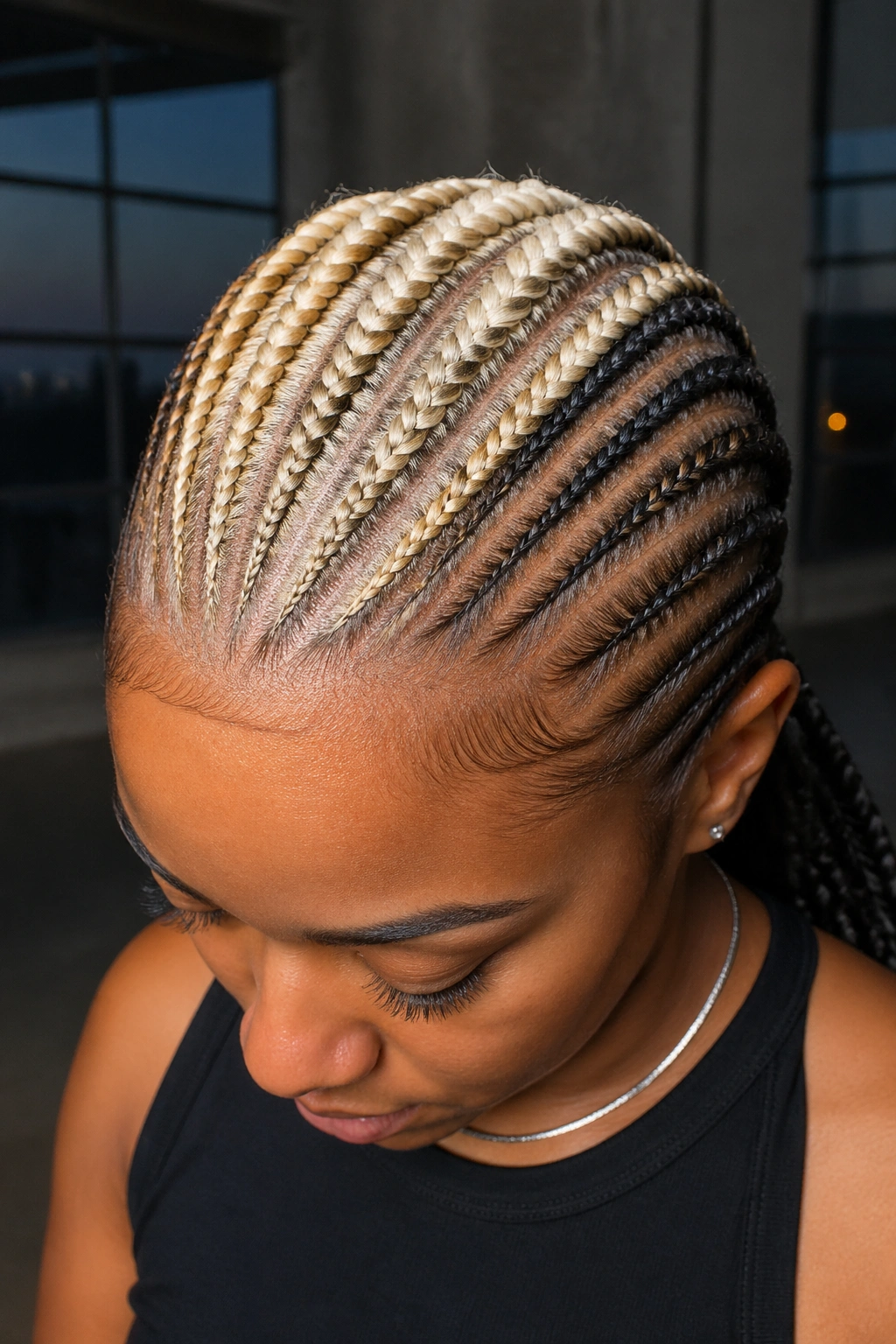
Mohawk-pattern platinum feed-ins. Center strip cornrowed in bright platinum blonde, sides flat-braided in natural color or shaved close.
The contrast between platinum center and dark sides creates maximum drama. This is a statement style that suits bold personalities and photographs beautifully.
Platinum requires heavy maintenance. Shows dirt, oil, and product buildup faster than any other color. Budget time for washing every week rather than the typical 2-3 weeks for darker cornrow installs.
The mohawk strip should be 3-4 inches wide. Cornrow count within the strip: 6-8 small to medium.
4. Blonde Feed-Ins With Dark Roots
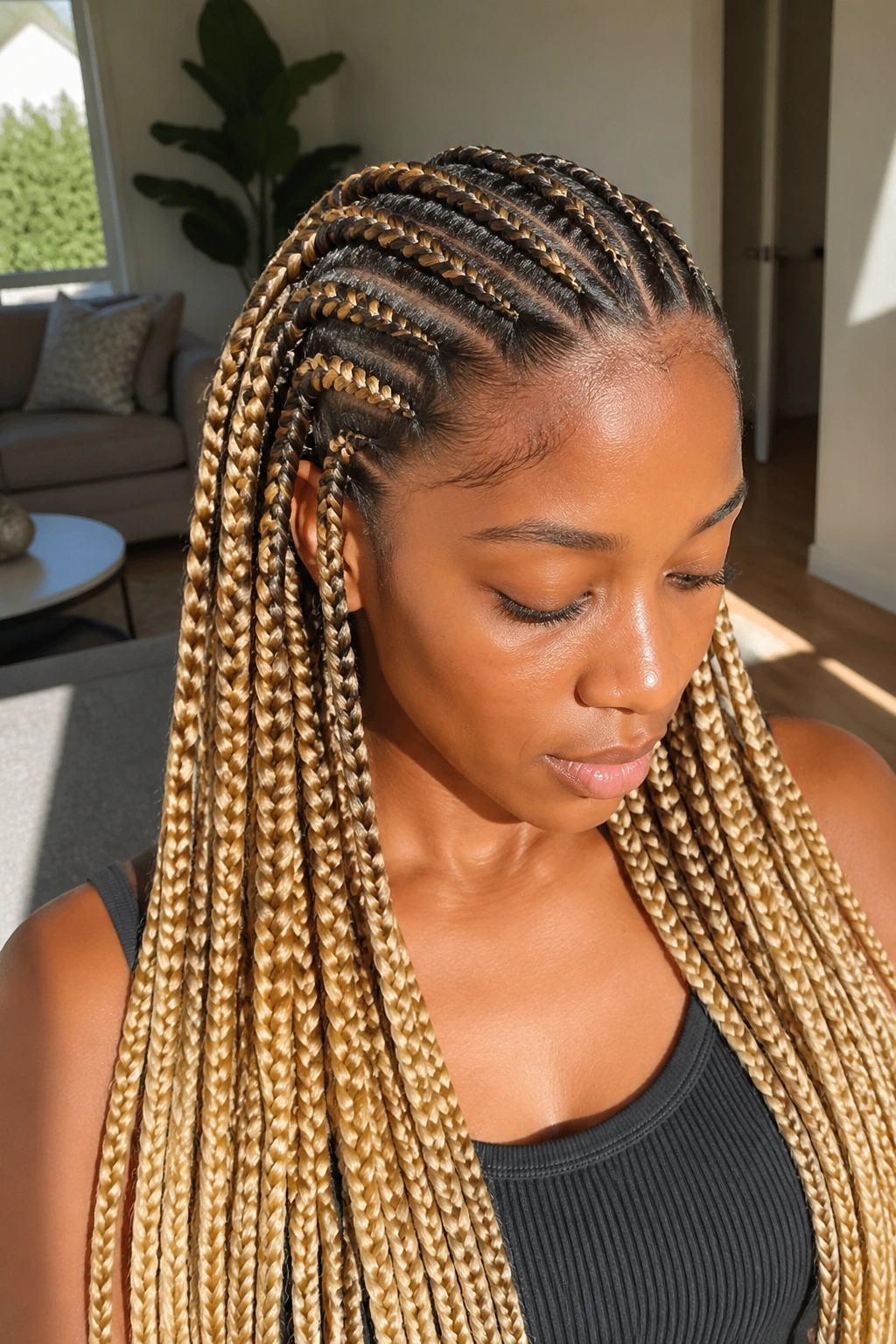
Intentional dark roots paired with blonde length. The first 2-3 inches at the scalp stays dark (your natural color or dark kanekalon), then transitions to blonde for the rest of the cornrow length.
This look is grown-out glamour by design. It references the rooted blonde look that’s been a signature for years without requiring a full commitment to bright color at the scalp.
The transition from dark to blonde should happen at the same distance from the scalp across all cornrows. Inconsistent transition heights look accidental.
The advantage of rooted blonde is that new growth doesn’t show as dramatically. Your actual roots coming in match the intentional dark roots in the style.
5. Champagne Feed-Ins With Soft Curl Ends
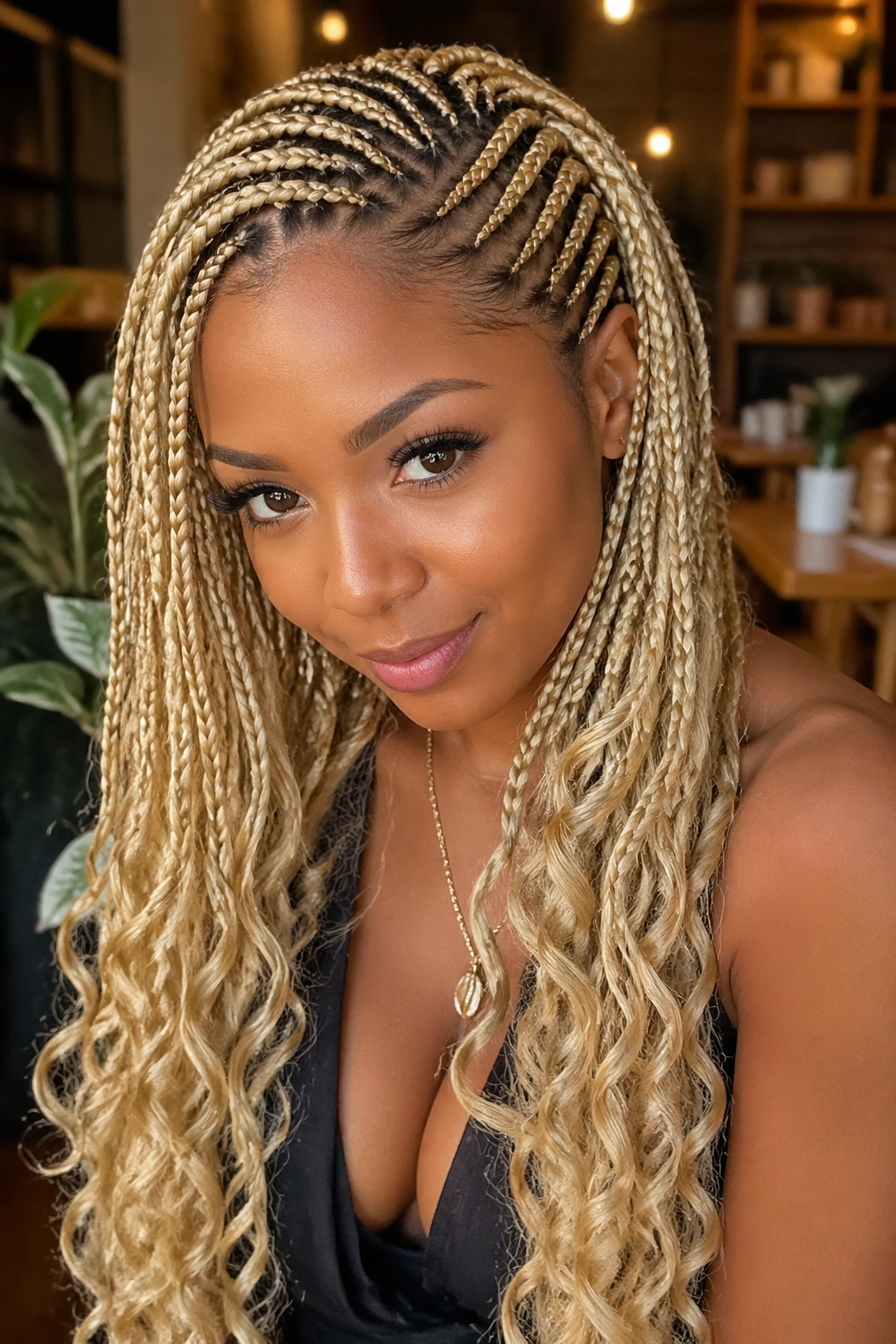
Champagne-toned kanekalon feed-ins that finish in soft, wavy ends. The champagne sits between honey and platinum — warm but light, with slight golden shimmer.
The soft curl ends add femininity. Plain blunt-cut kanekalon tips can look harsh; wavy ends soften the overall look.
Create the wavy ends by dipping the kanekalon tips in hot water (not boiling — around 180°F) for 10-15 seconds after install. The heat curls the fiber gently. Let it cool before handling.
Champagne flatters medium to deep skin tones. On very fair skin it can wash out; on deep skin it glows.
6. Bleach Blonde Jumbo Feed-Ins
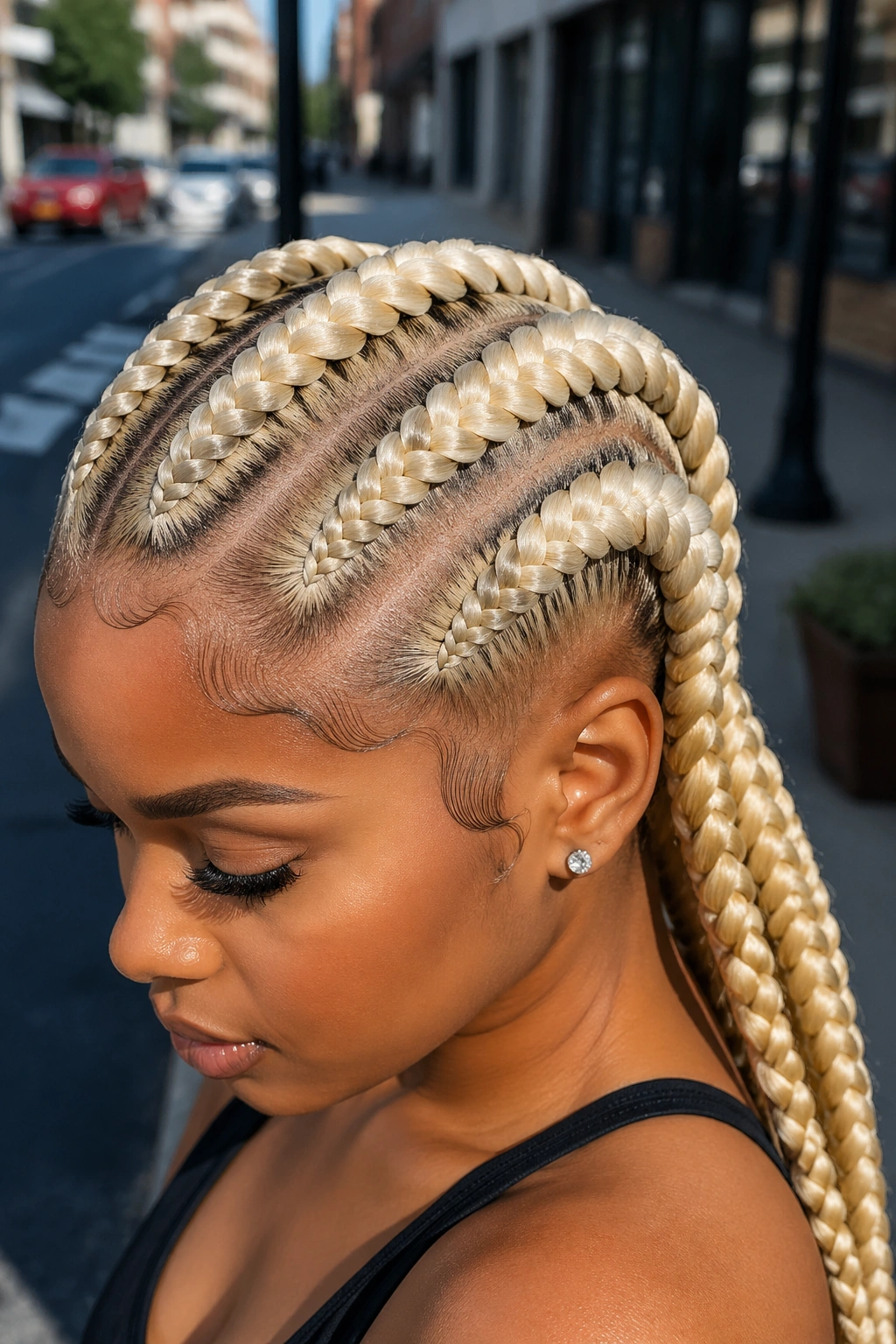
Fewer, thicker cornrows in bleach blonde. Four to six jumbo feed-ins across the whole head, each 1.5-2 inches wide at the base.
Jumbo blonde cornrows read as a statement. The fewer braids mean the color dominates; the thick braids mean every inch of the style is highly visible.
The trade-off is shorter wear time. Jumbo cornrows loosen faster than smaller ones because of the weight pulling on each foundation. Expect 2-3 weeks before reinstall.
For maximum impact, pair with simple edges and no additional accessories. The color and scale do the work.
7. Blonde Feed-Ins With Dark Underlayer
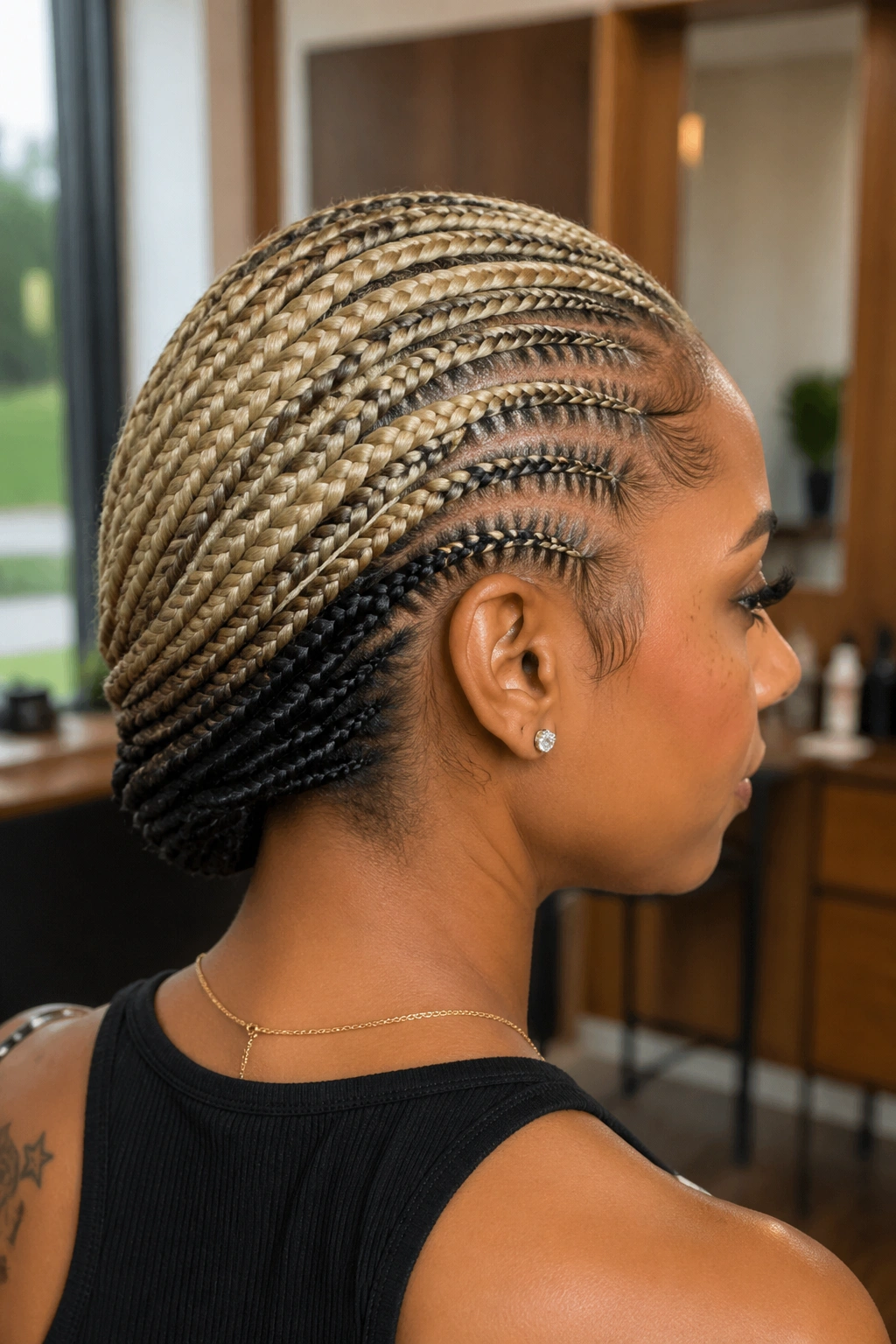
Two-tone cornrow install where the top layer is blonde and the underlayer (the cornrows at the nape and bottom sections) stays dark. The effect shows when you move your head — blonde on top, dark below.
This layered color approach reads dimensional. It flatters people who want blonde drama but not full commitment.
Execution requires careful planning of which cornrows get which color. Map out the cornrow layout before starting, marking each section for blonde or dark. Changing mid-install makes the color break look random.
The contrast shows most when hair is pulled back or styled up. In down styles, the blonde dominates and the dark appears as shadow.
8. Strawberry Blonde Feed-Ins With Beads
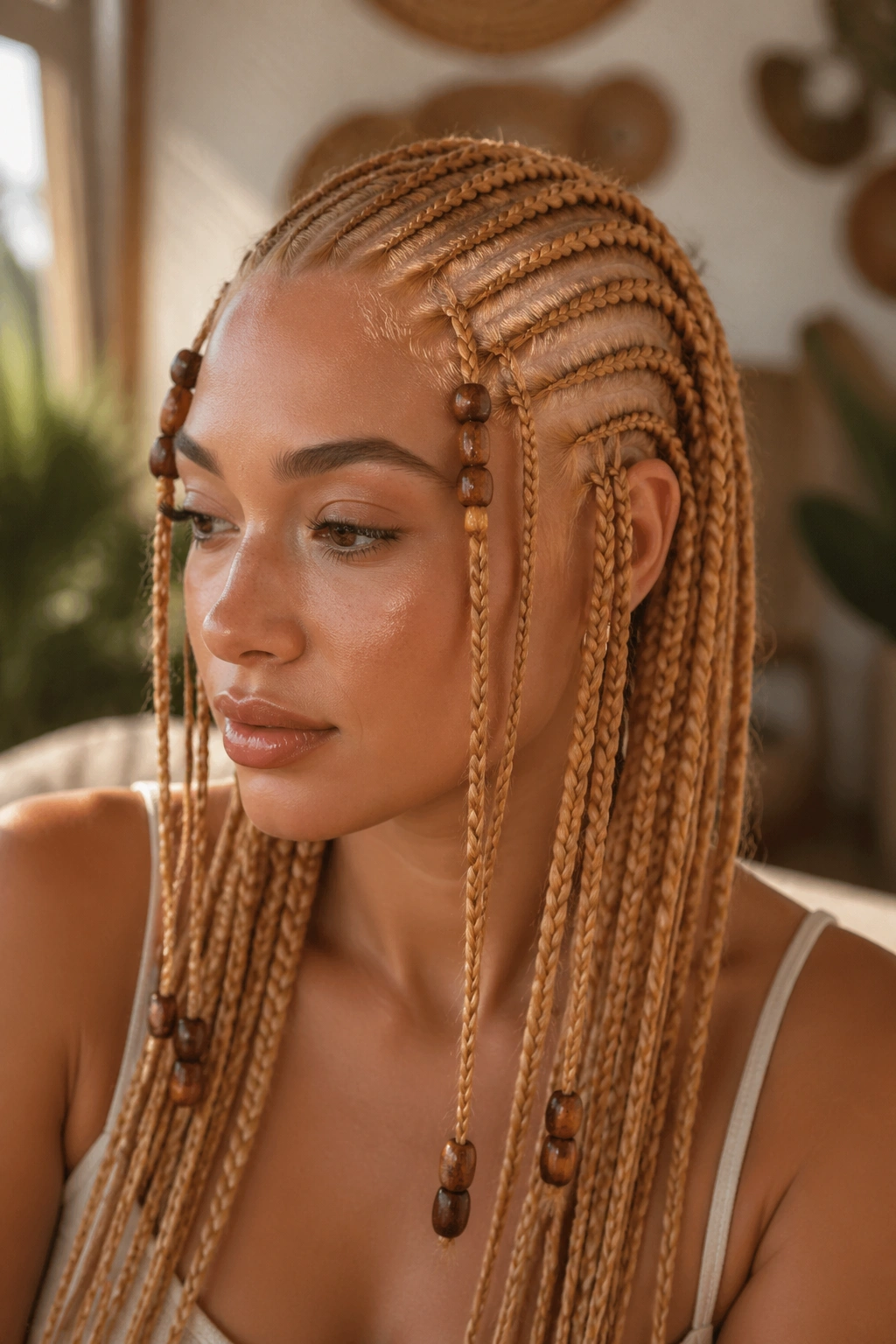
Warm strawberry blonde — a shade between blonde and copper with pink-red undertones — paired with bead accents. Five to seven beads placed strategically along selected cornrows.
Strawberry blonde flatters warm skin tones especially. It’s a softer alternative to bright copper or vibrant red.
Beads should be wooden in walnut or cherry tones, or glass in amber colors. Cool-toned beads (silver, blue glass) clash with strawberry’s warmth.
This style reads bohemian without being costumey. Good for creative industries, events, or travel.
9. Thin Blonde Feed-Ins With Complex Pattern
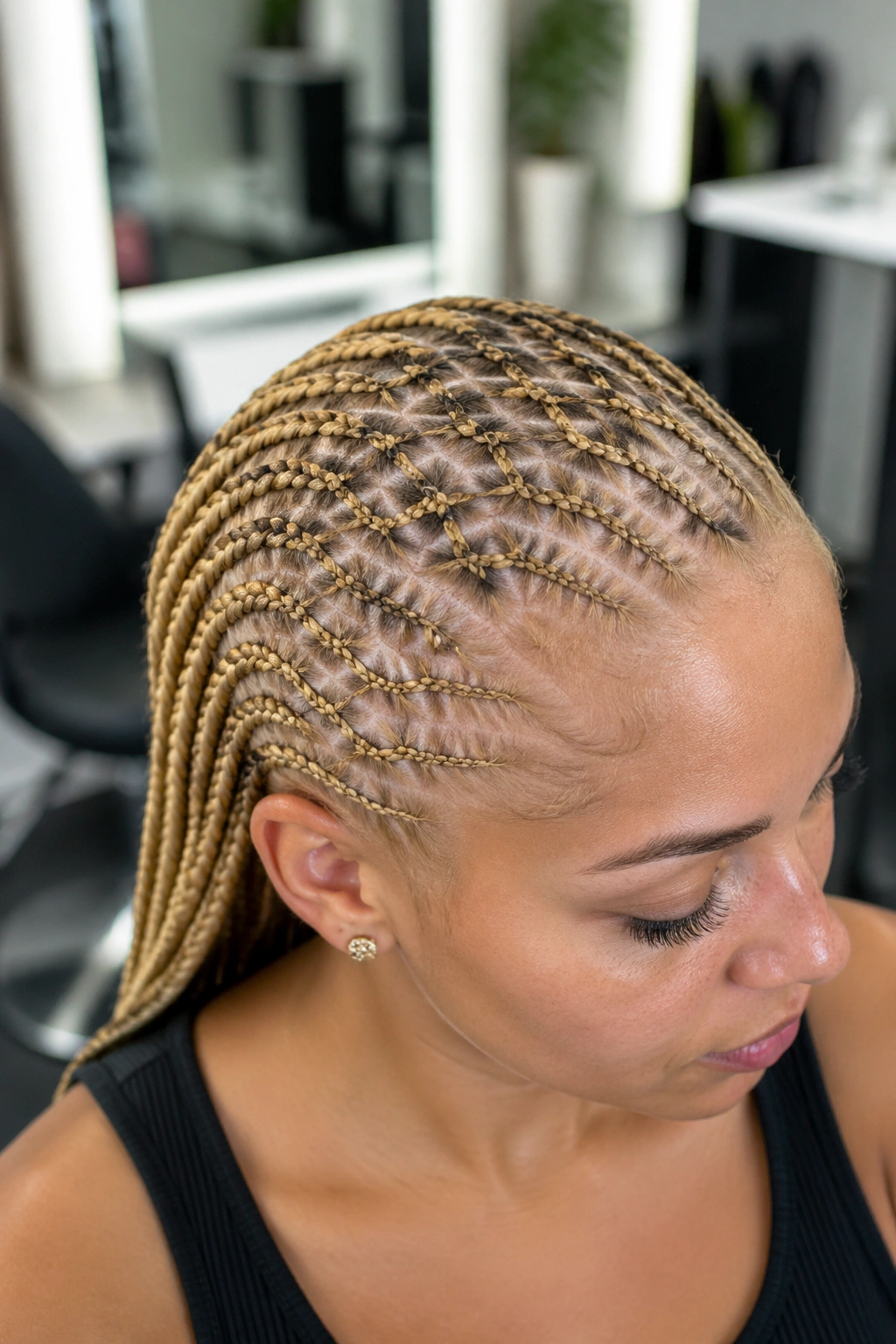
Small cornrows — 1/4 inch at the base — in blonde with an intricate parting pattern. Diamond shapes, zigzags, curves, or layered geometric designs.
Small blonde feed-ins take 6-8 hours to install with an experienced braider. The combination of small scale and color precision requires time.
The payoff is a densely patterned style where the blonde color emphasizes every partition line. The scalp becomes a canvas.
Wear time runs 4-5 weeks with maintenance. Small cornrows hold their pattern longer than larger ones.
10. Blonde Feed-Ins With Curved Parts
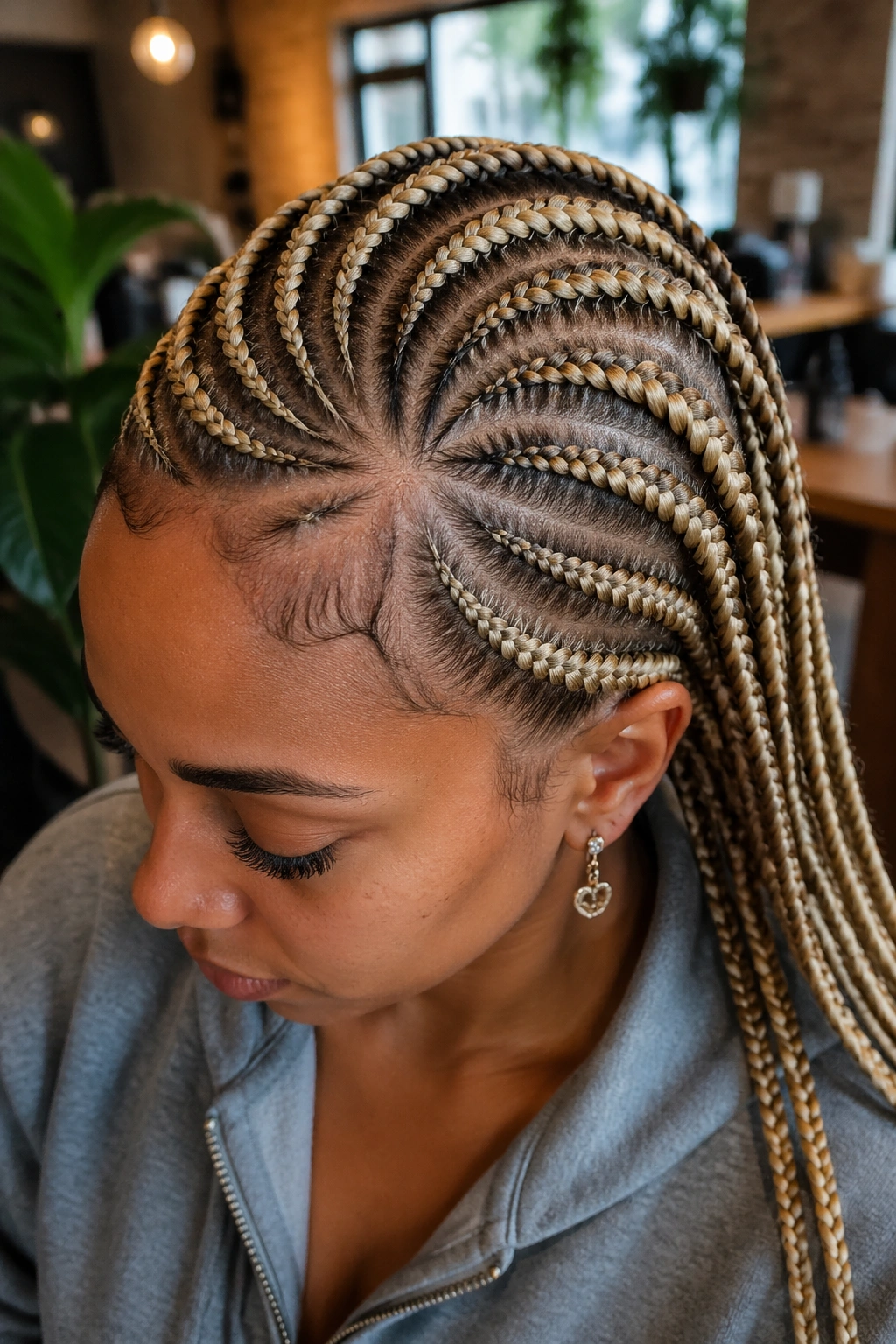
Parts curved in arcs, waves, or S-shapes rather than straight lines. The curves create movement and flow visually.
Blonde highlights every curve. Where straight blonde cornrows read structured, curved blonde cornrows read fluid.
Common curve patterns: concentric arcs radiating from a central point at the crown, S-waves running front to back, or curved parts mimicking natural hair direction.
The curves should be smooth and intentional. Sharp angle changes read as mistakes. A confident curve from one side of the head to the other is the goal.
11. Two-Toned Blonde Feed-Ins
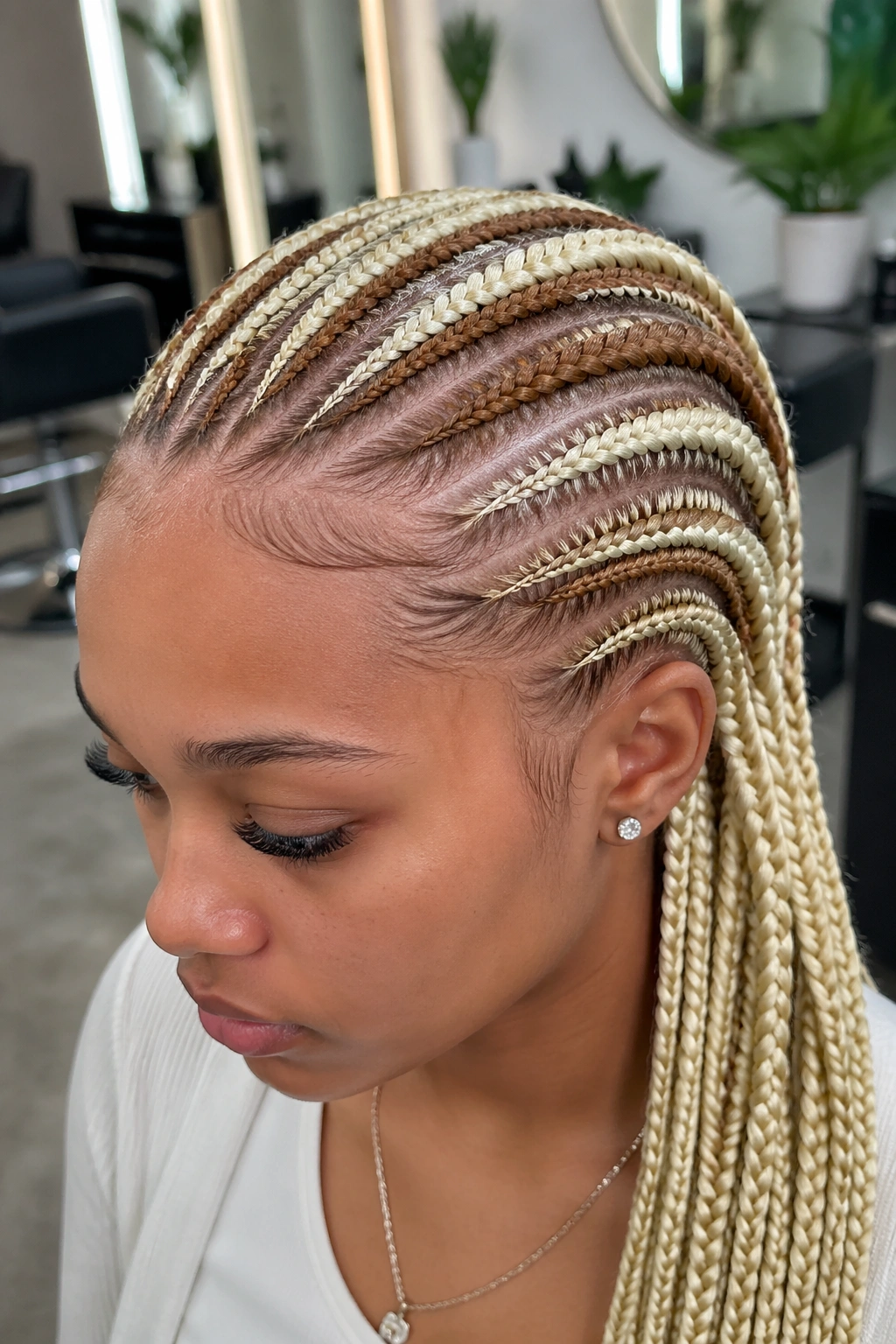
Two different blonde shades woven throughout the cornrows. Honey blonde and platinum. Champagne and ash. Strawberry and honey. The combinations are flexible.
The two tones should be distinct enough to read as intentional but close enough to complement each other. Extreme contrasts (champagne and bleach white) can look stark. Subtle contrasts (honey 27 and 30) can look accidentally monochrome.
Alternate which cornrows carry which color. Every other cornrow gets one shade; the others get the second shade. This creates a striped visual effect.
For a softer look, introduce the second shade through feeding in rather than using full single-color packs. Mix small amounts of the contrasting blonde into cornrows of the primary color.
12. Blonde Feed-Ins With Twisted Ends
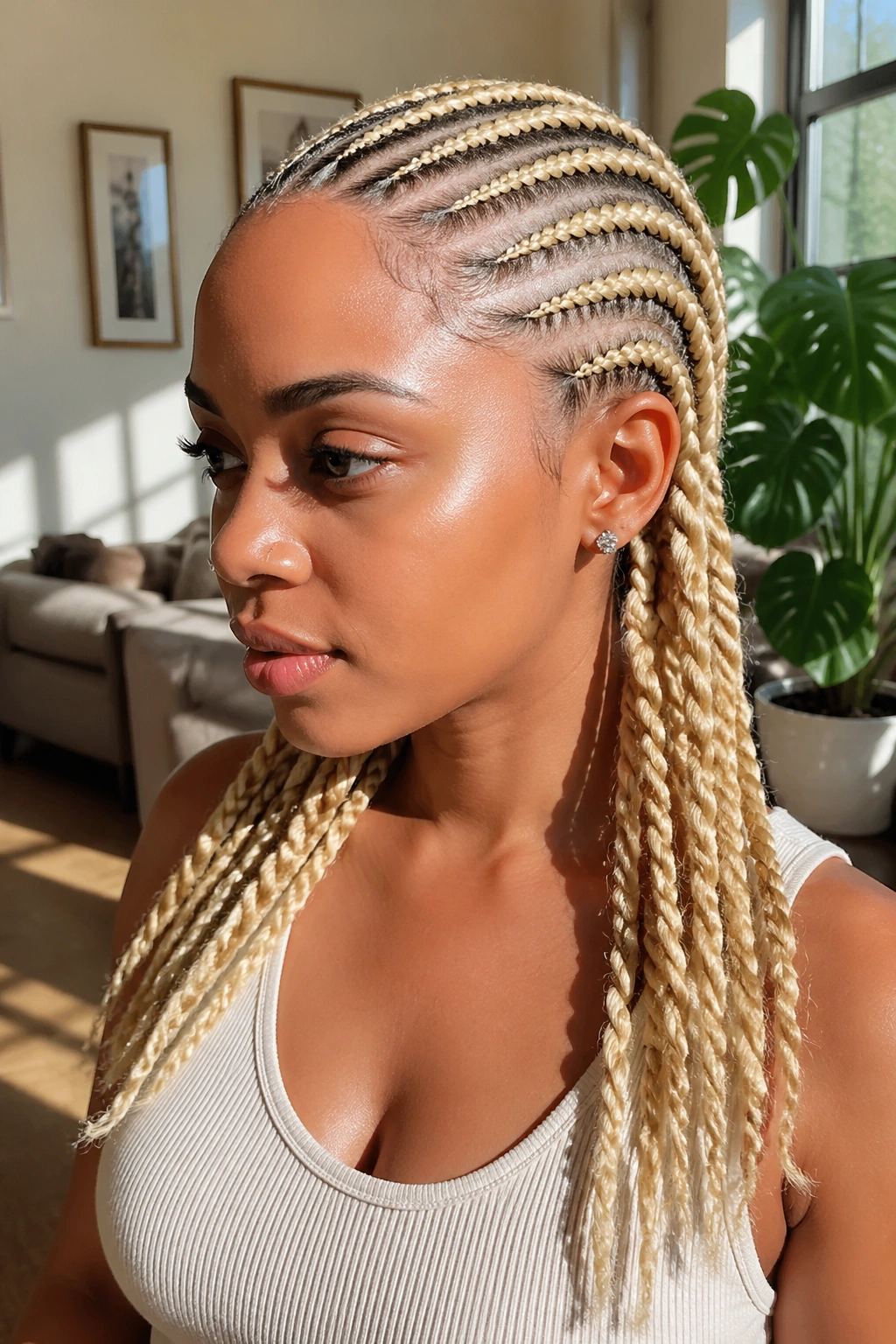
Standard blonde feed-in cornrows that finish in two-strand twists rather than continuing as braids or ending in a blunt cut. The twists extend another 4-6 inches past where the cornrow ends.
Twisted ends give the style a softer, more textured finish. The twists can be left loose for a casual look or set with a curl cream for definition.
Not every braider adds twisted ends by default. Ask specifically if you want this finish. Some braiders call it “twisted tips” or “twist-out ends.”
The twists tend to loosen over wear. Re-twist every 7-10 days to keep the finish looking intentional rather than frizzy.
13. Caramel Blonde Side Swept
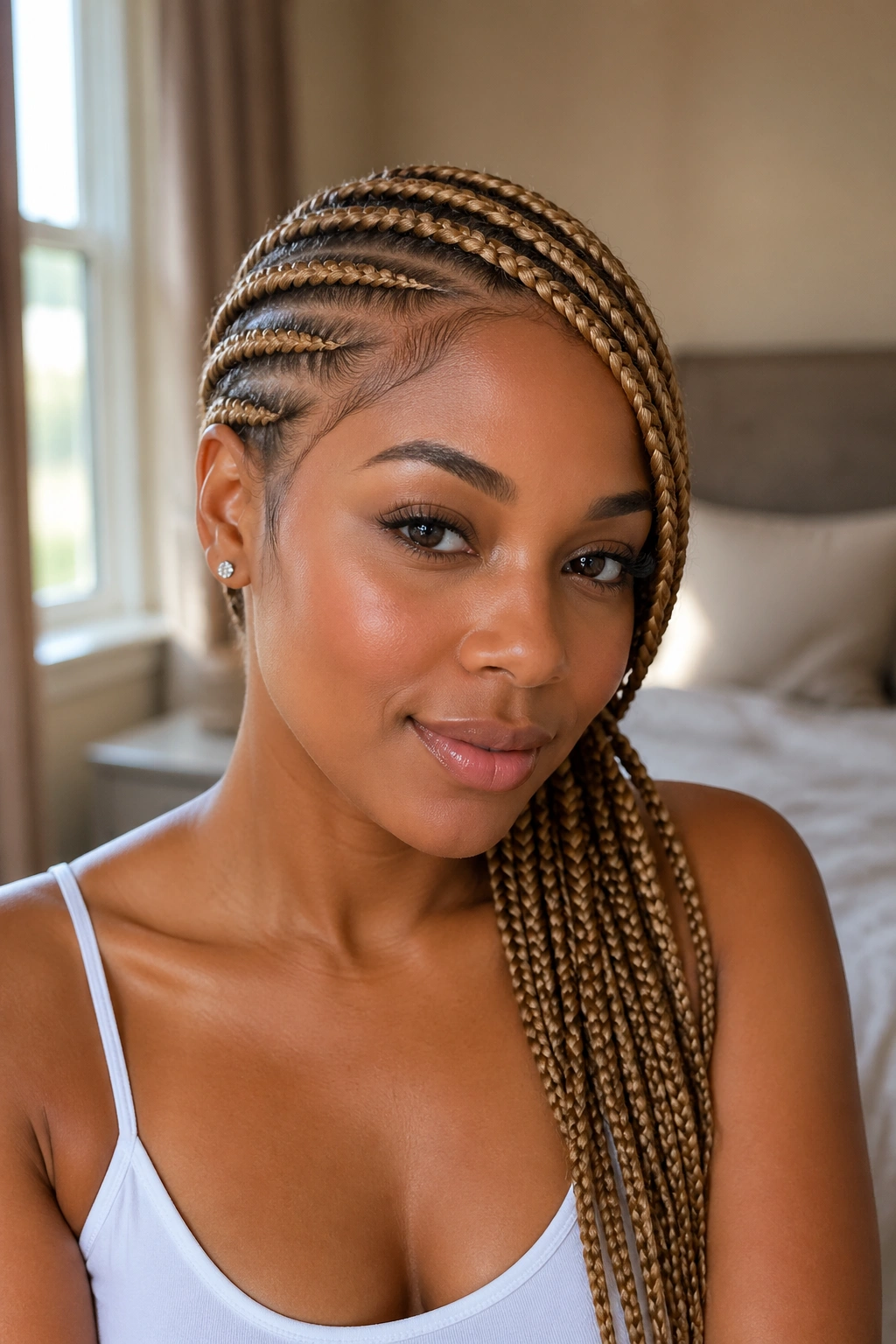
Caramel blonde (a darker blonde with warm brown undertones) in a side-swept layout. All cornrows angle across the head toward one side, with the ends gathered over the opposite shoulder.
Caramel is one of the most flattering blondes for deep skin. The warm brown notes bridge blonde and dark brown, creating a shade that works for transition periods or for people uncomfortable with extreme blonde.
The side sweep emphasizes the caramel dimension — the color appears to shift from lighter at the hairline to warmer in the mass of cornrows.
Wear time matches other feed-in styles: 3-4 weeks with care.
14. Dirty Blonde Feed-Ins With Natural Roots
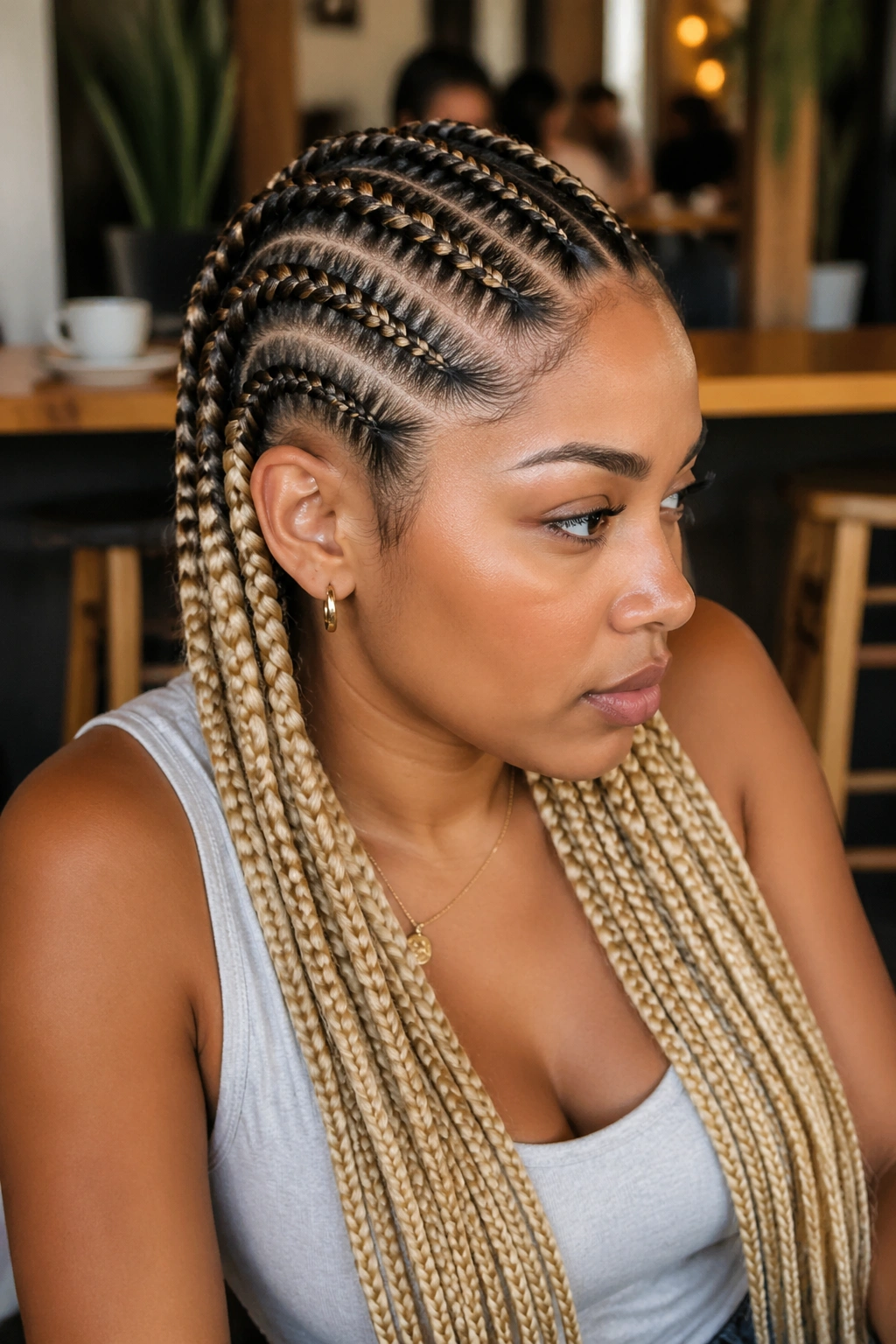
Dirty blonde kanekalon paired with visible dark natural hair at the roots. Similar to the rooted blonde approach but with a more muted blonde shade.
Dirty blonde reads subtle. It’s the blonde for people who don’t want to commit to bright color but want dimension and lift.
The natural root section becomes part of the style rather than a flaw. When the new growth comes in, it extends the rooted effect naturally.
Good for work environments where bright blonde might be inappropriate. Dirty blonde reads more professional than bleach or platinum.
15. Blonde Feed-Ins With Ombre Tips
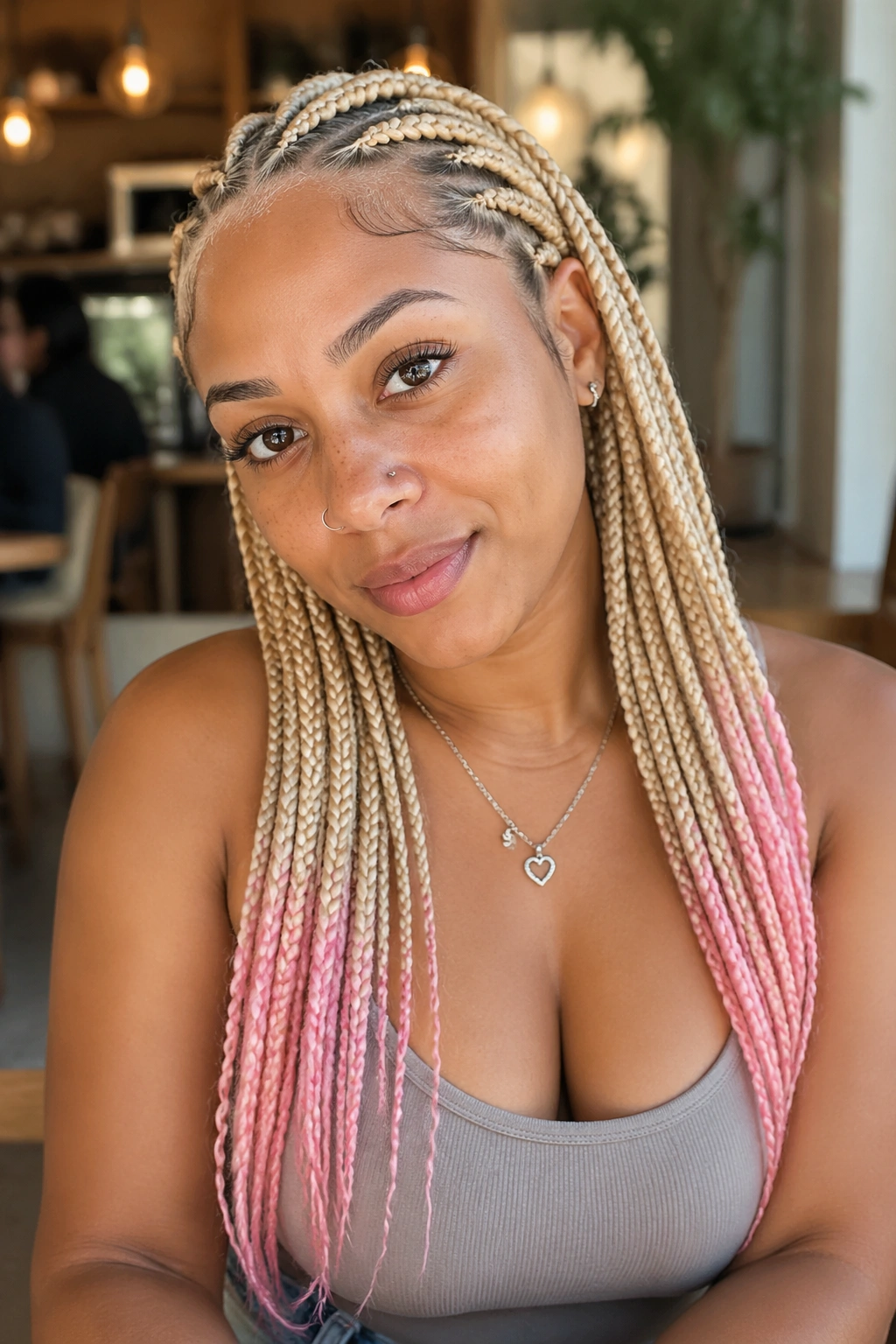
Ombre to a second color at the tips only. Blonde along most of the cornrow, transitioning to a contrasting color — pink, purple, red, or teal — in the bottom 4-6 inches.
The color pop at the tips creates surprise. From the scalp to mid-length, the style reads as pure blonde. Then the unexpected color appears.
Common pairings: blonde to dusty pink, blonde to lavender, blonde to coral, blonde to turquoise. Each gives a different mood.
Buy pre-ombred kanekalon for cleaner color transitions. DIY ombre on kanekalon is possible but rarely clean enough to look professional.
16. Blonde Feed-Ins With Heart Detail
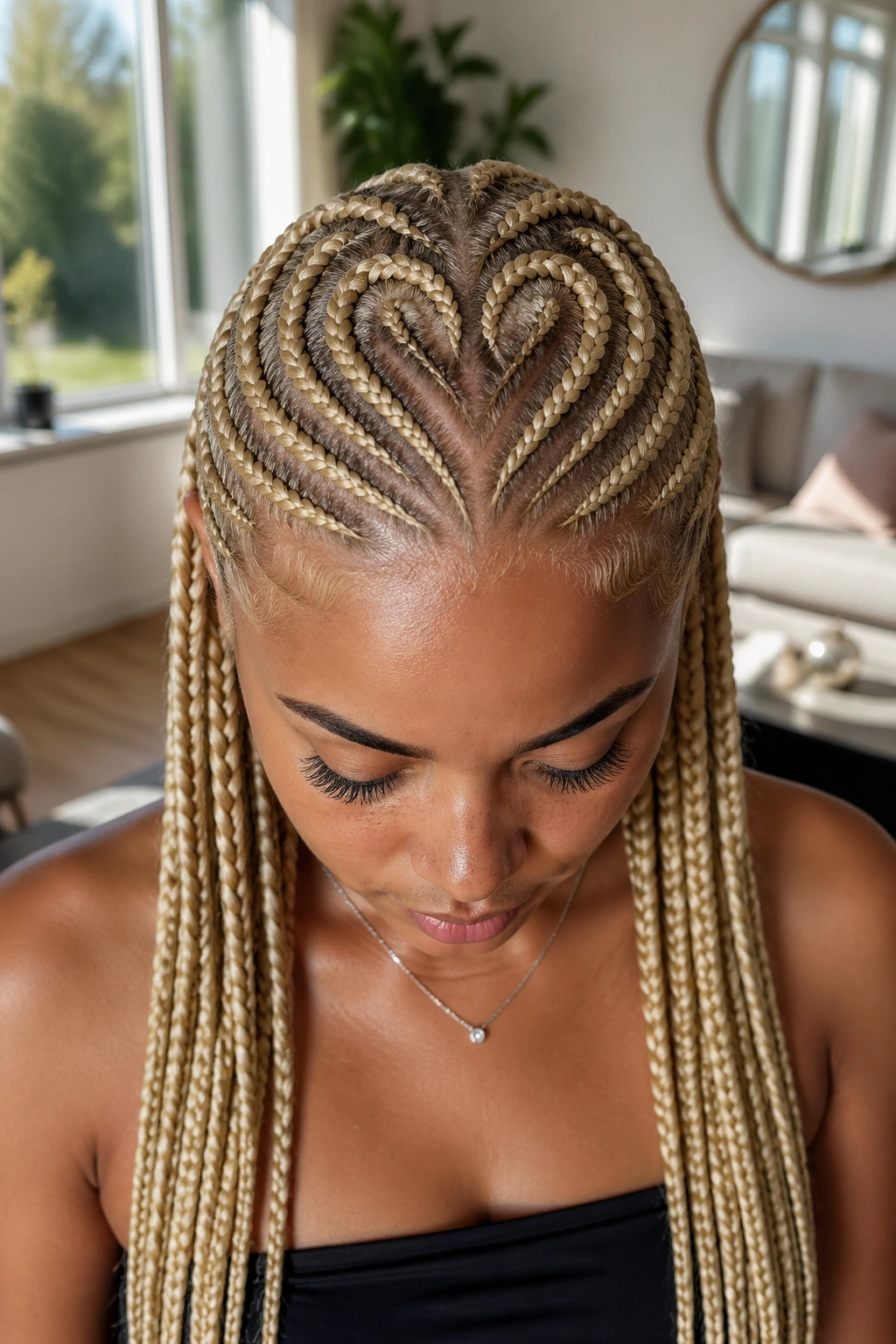
A heart shape outlined on the crown through cornrow placement. The blonde color makes the heart highly visible from any angle.
The heart details the crown with symmetric cornrows forming the heart’s outline. Below the heart, additional cornrows feed the structure back to the nape in straight or curved patterns.
What Makes It Different
Most heart-pattern cornrows are subtle — you notice the heart only on close inspection. Blonde amplifies the detail so the heart is the immediate focal point.
This style photographs striking for event coverage, professional shoots, and social media. Less appropriate for purely casual settings where the strong design might feel forced.
17. Blonde Feed-Ins With Braided Bun
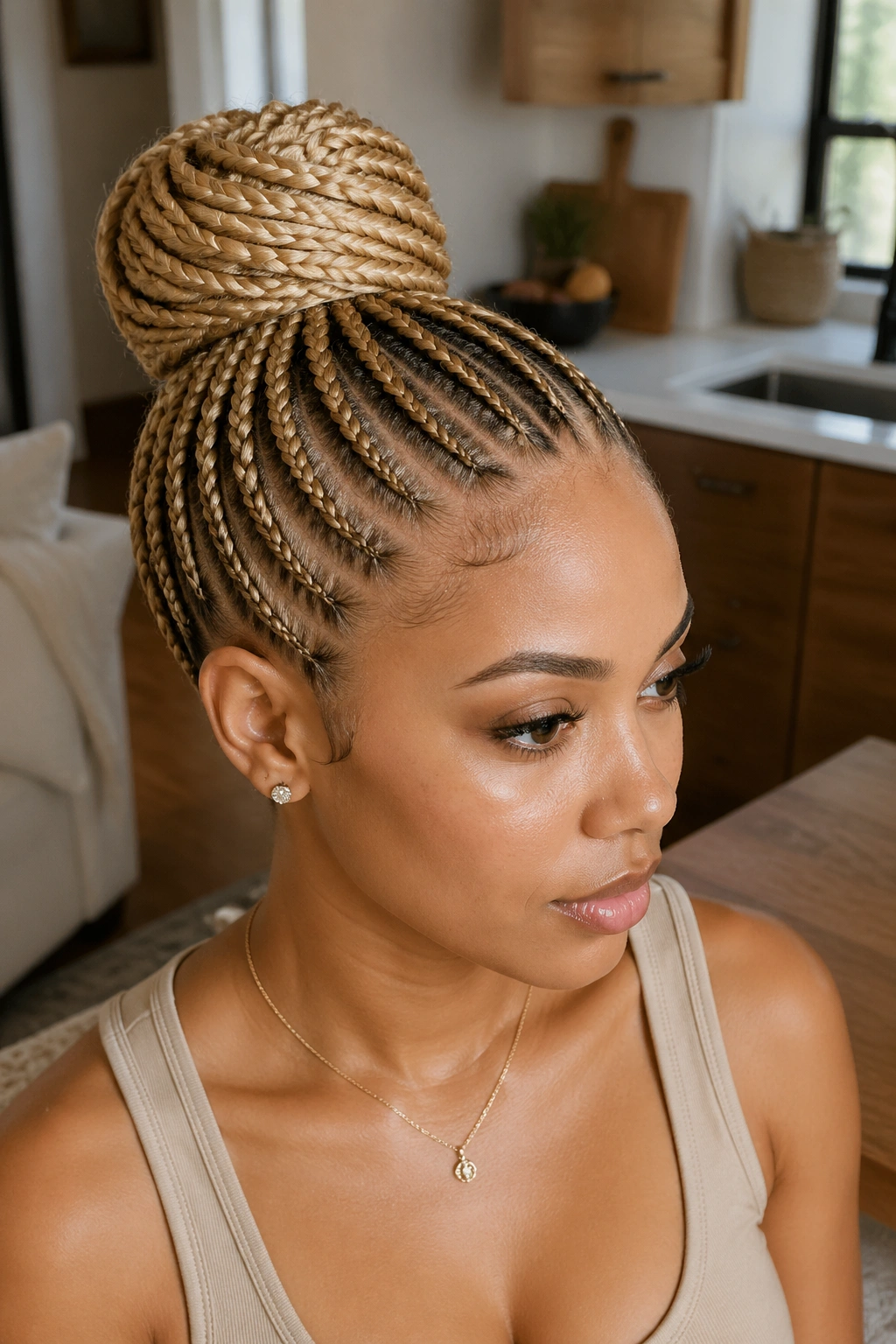
Cornrows feeding into a braided bun at the crown or nape. The bun itself is formed by coiling the kanekalon ends into a flat, wrapped shape.
Braided buns on blonde feed-ins read elegant. The color and the bun structure combine for a look that reads formal-adjacent even during daily wear.
Bun placement: high crown buns read youthful and sporty; mid-head buns read balanced; low nape buns read refined and classic.
The bun should be wrapped rather than loosely pinned. Wrapped buns stay neat longer and don’t show as many pin points.
18. Blonde Feed-Ins With Beaded Accents
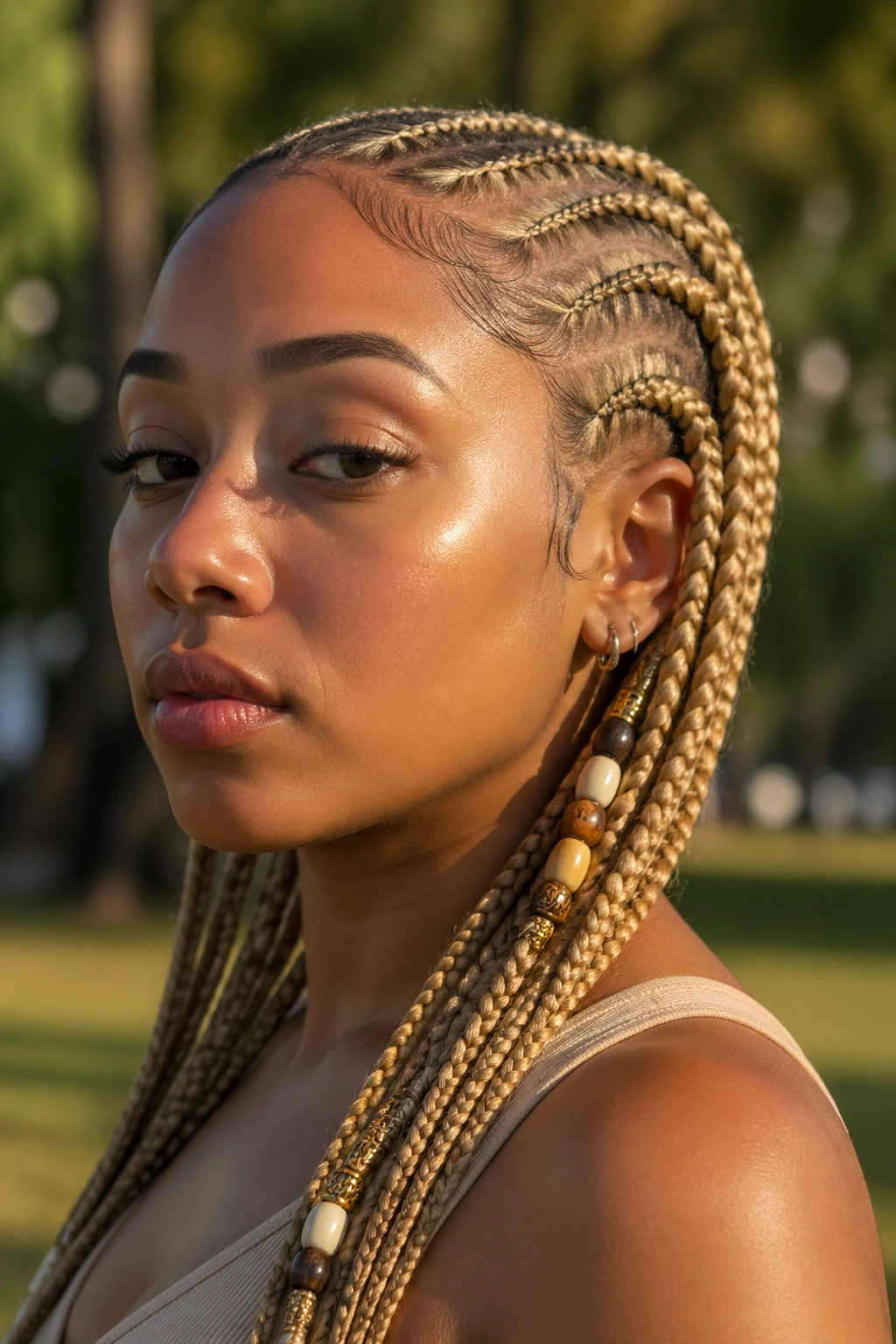
Beads threaded onto blonde cornrows as decorative accents. Wooden, glass, metal, or shell beads depending on the desired look.
Blonde with warm wooden beads creates a bohemian earthiness. Blonde with gold or brass beads creates a glamorous, luxe look. Blonde with cool-toned glass beads (amber, clear) creates a refined feel.
Limit beads to 6-10 across the whole style. More than that crowds the blonde color and creates visual chaos.
Bead placement should feel deliberate. Clustered near one area, spaced along selected cornrows, or concentrated at the ends — each approach creates different effects.
19. Blonde Feed-Ins With Waist Length
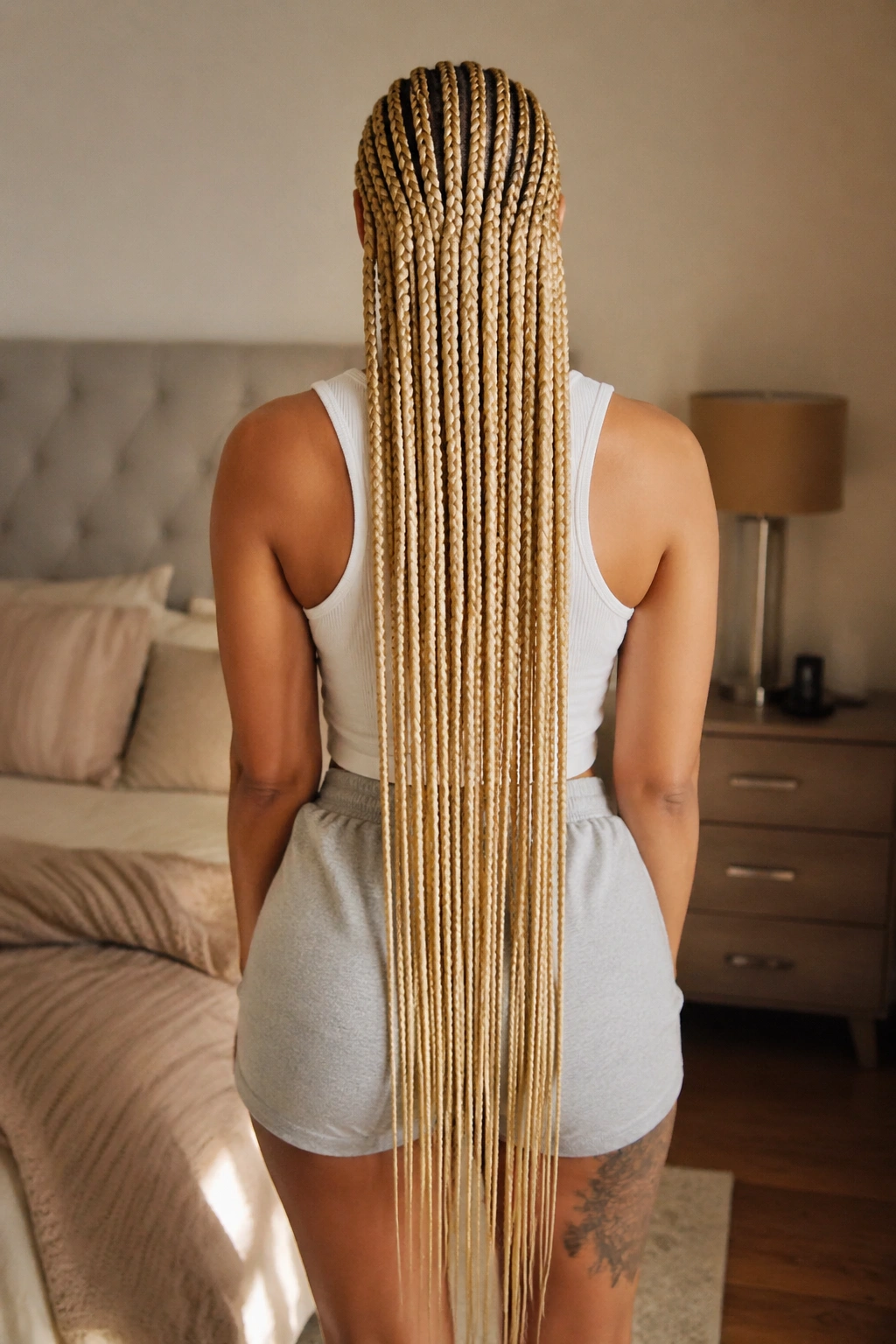
Extra-long blonde cornrows extending past the waist. Drama length for anyone who wants maximum visual impact.
Long blonde feed-ins weigh more than shorter styles. The weight pulls on the cornrow foundations at the scalp, so tighter installation is required.
Sleep management becomes critical. A satin bonnet large enough to contain all the braid length is non-negotiable. Cotton pillowcases destroy the blonde shine and create frizz.
For daily wear, a low gathered tuck or loose braid keeps the length manageable. Straight loose wear is for events and photos, not for commuting or working.
20. Blonde Feed-Ins With Zigzag Parts
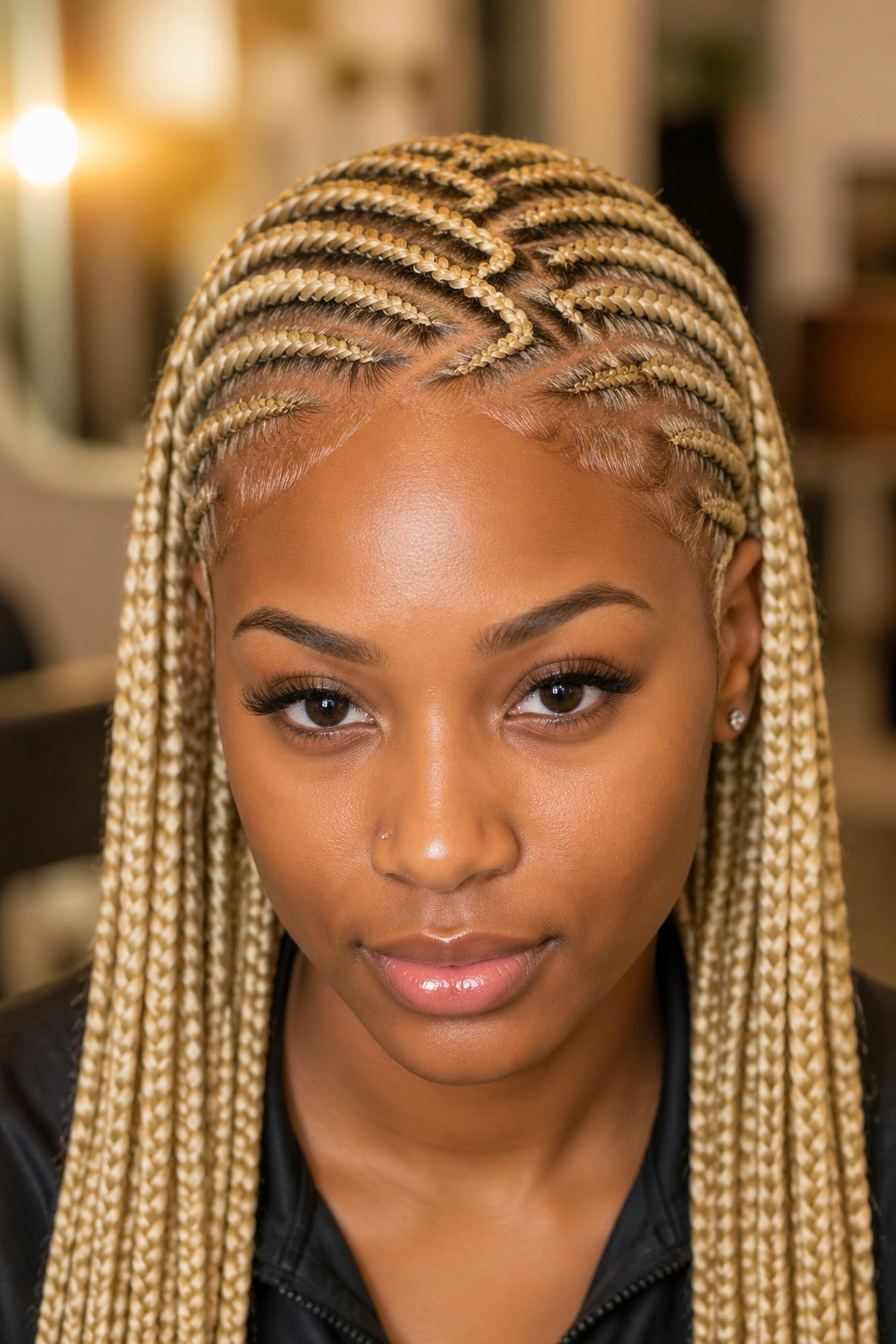
Zigzag parts across the head with blonde cornrows filling the zigzag sections. The parts themselves draw the eye as much as the cornrow structure.
Zigzag parts create a pattern that moves as you turn your head. On blonde, the wavy parting lines show clearly against the scalp.
Execute by parting in continuous zigzag segments 1-1.5 inches wide. Commit to the line — hesitation shows.
The cornrows filling each zigzag section run parallel to the edges of the zigzag. So the cornrow direction shifts every inch or so, creating dynamic visual movement.
21. Blonde Feed-Ins With Curly Bulk Added
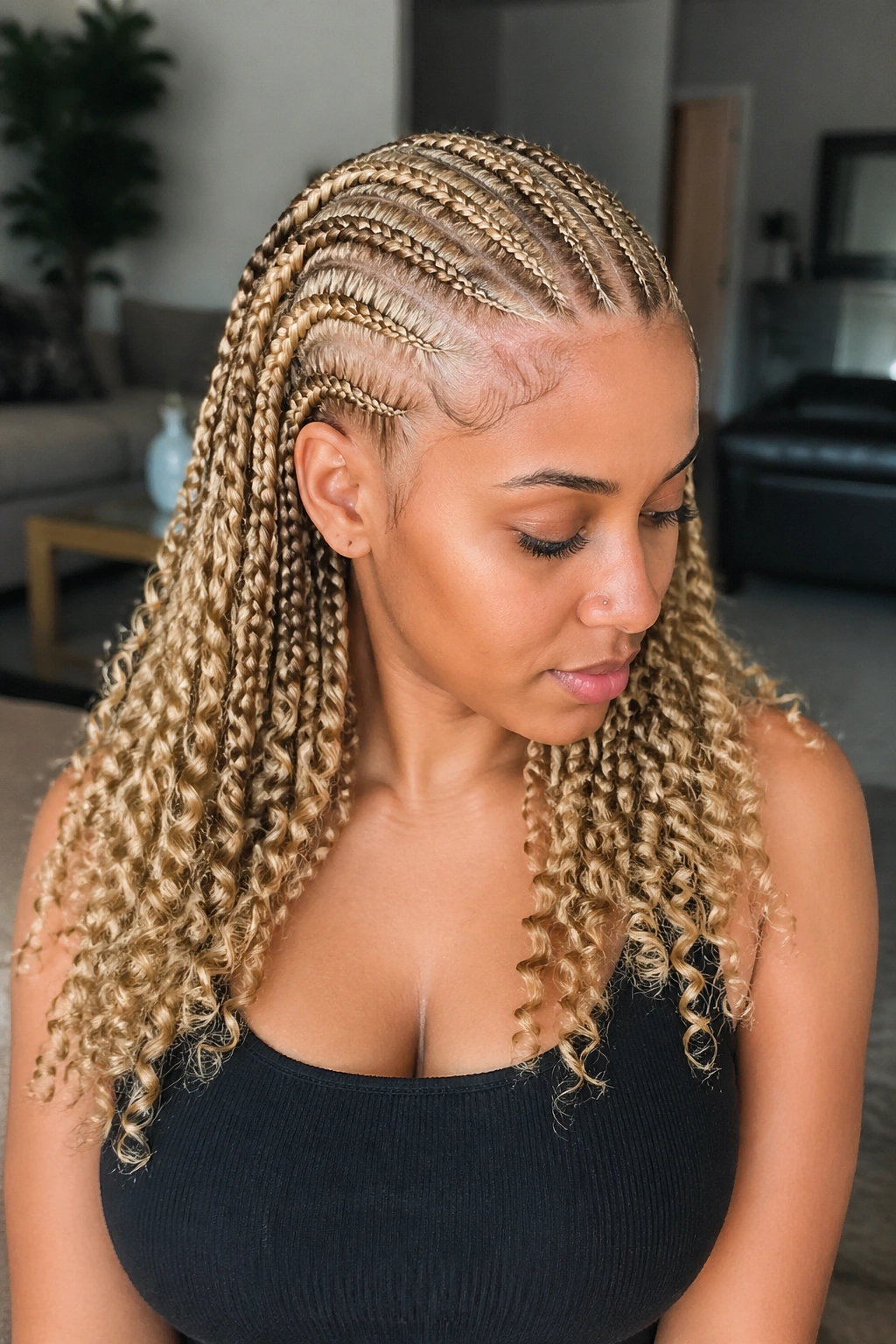
Blonde feed-in cornrows with curly blonde bulk hair woven into the ends. The cornrows transition into loose curl texture below the cornrowed section.
Curly bulk hair in matching blonde creates seamless continuation from braid to curl. The style reads as a single flow rather than two separate techniques.
Match the curl texture to what blends with your natural hair when wet. Loose wave or body wave curl patterns work for most texture types.
Length: keep the total style at shoulder to mid-back. Longer curly bulk tangles quickly and requires intensive maintenance.
22. Blonde Feed-Ins With Color Streaks
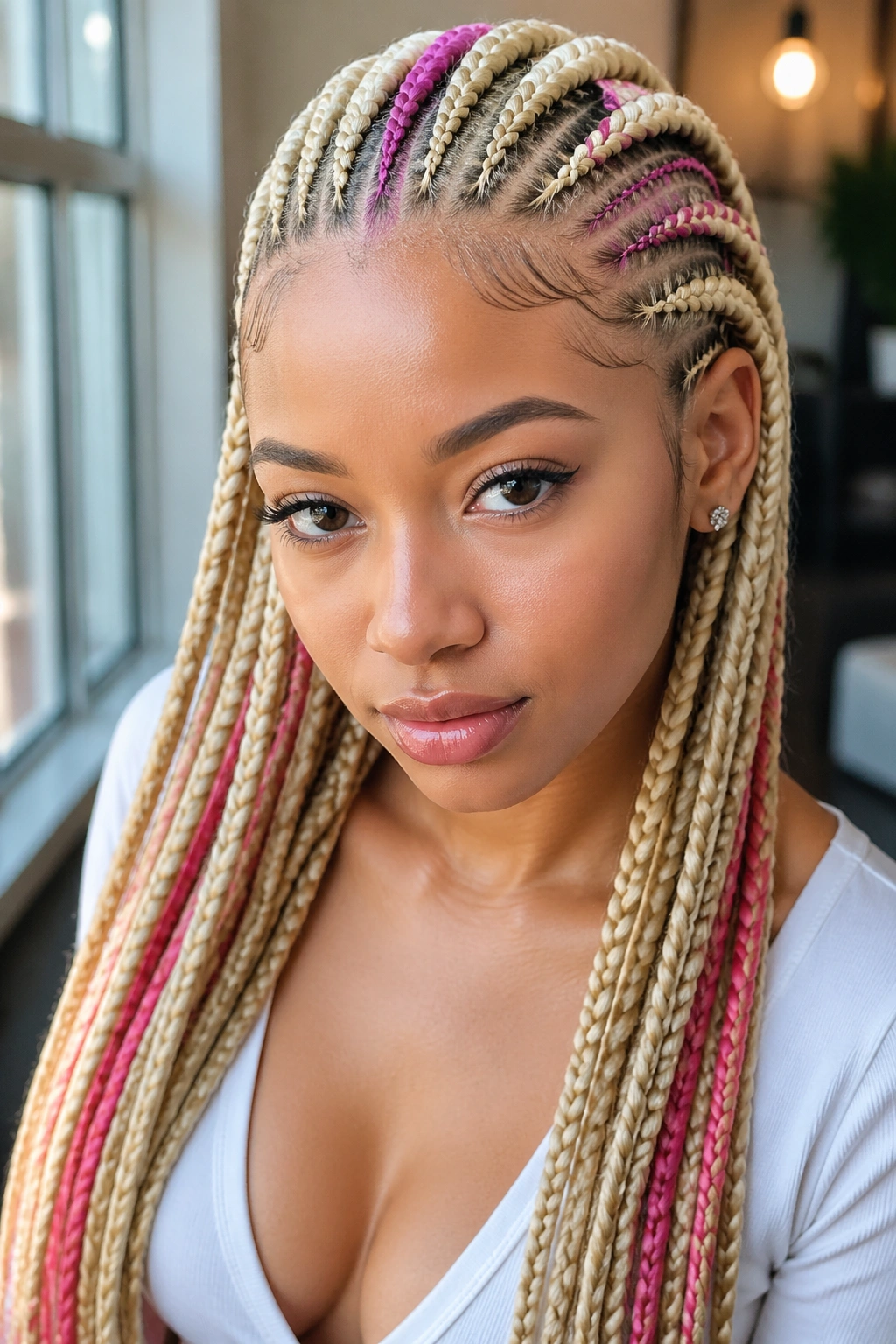
Mostly blonde cornrows with 1-2 cornrows in a contrasting bold color. Pink, purple, teal, or burgundy streaks running through the blonde.
The streaks can be placed at the temple, along the center, or at the nape. Each position creates a different effect.
This approach lets you experiment with color without committing to it across the full style. If you’ve been curious about blue or red but haven’t been ready to commit, a single streak in a blonde install tests the waters.
Streak colors should complement the blonde. Pink with honey blonde reads soft. Purple with platinum reads edgy. Teal with ash blonde reads editorial. Pick the blonde base first, then the streak.
Caring for Blonde During Wear
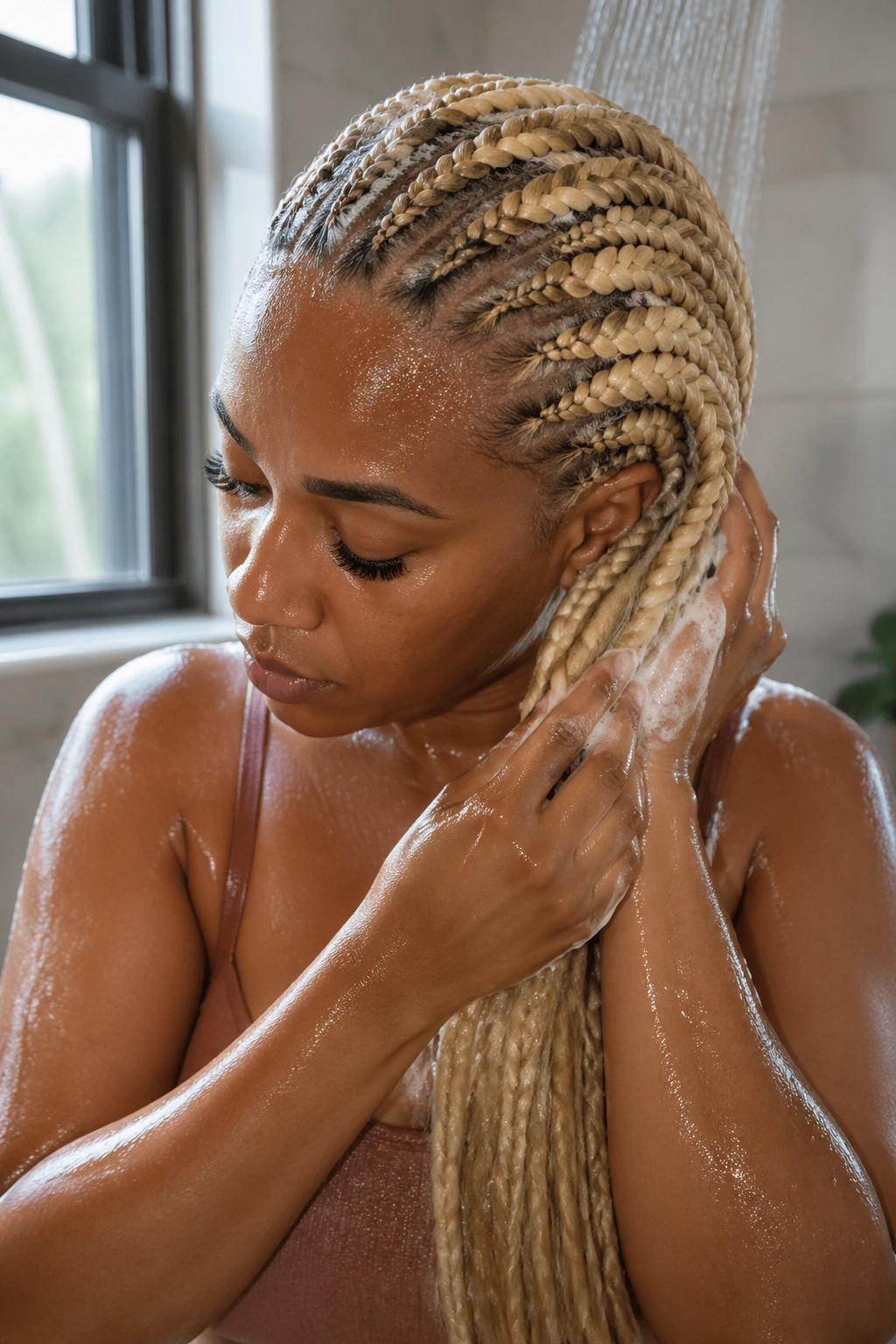
Blonde kanekalon needs gentle washing. Harsh shampoos strip color and leave the fiber dull. Use sulfate-free shampoo diluted with water.
Purple shampoo — the kind used to maintain brightness in natural blonde hair — works on kanekalon too. Use it once every 2-3 washes to counter brassiness that develops over wear time.
Avoid product buildup. Heavy styling products, thick oils, and silicone-based serums cling to blonde fiber and leave it looking yellow or grimy. Use light formulas.
Sun protection helps. UV rays fade blonde kanekalon over time. A wide-brim hat during extended outdoor periods protects the color.
Avoiding Orange and Brassy Tones
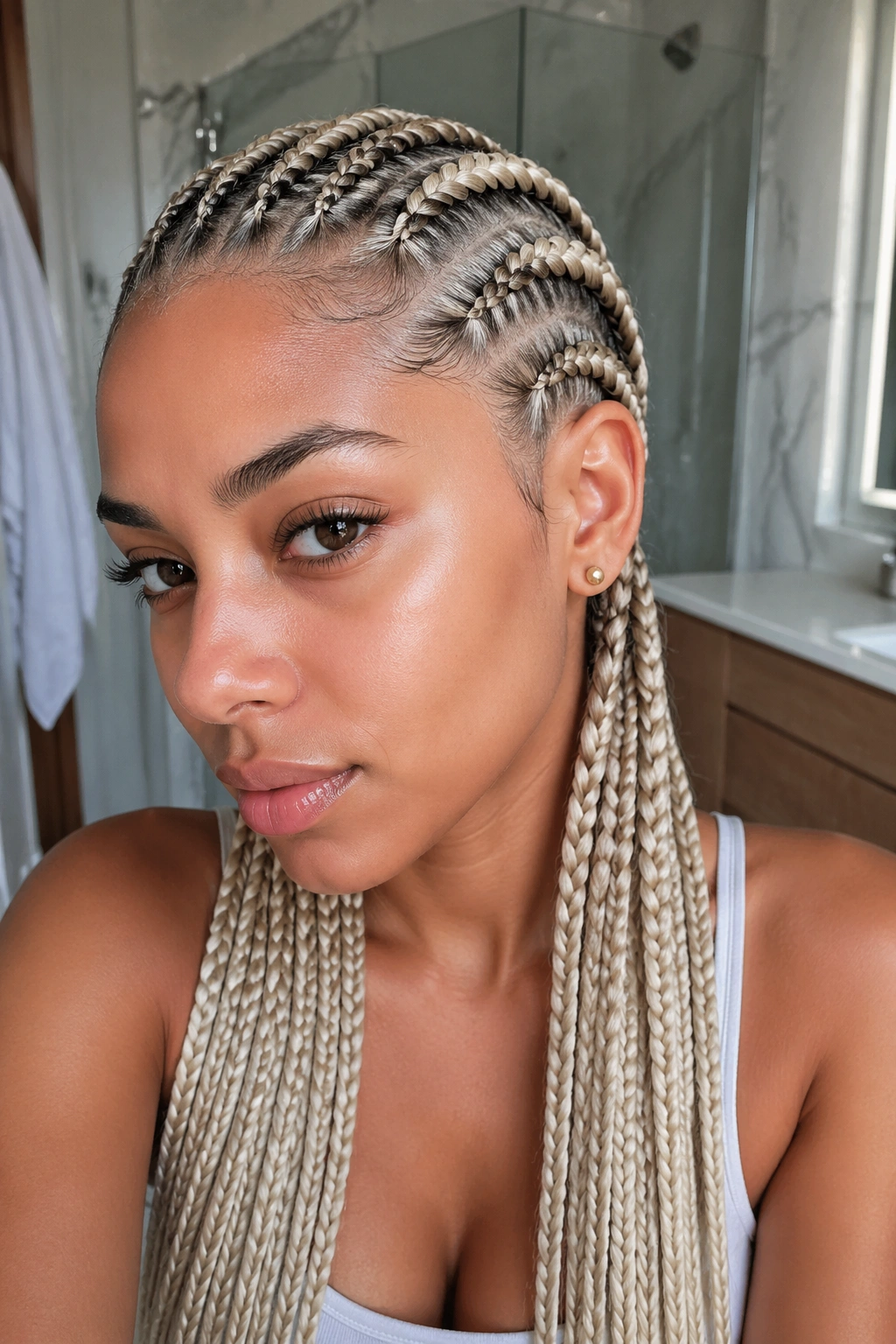
Blonde kanekalon can pull orange or brassy over weeks of wear. Causes: chlorine, hard water, UV, and mineral buildup.
Preventive care: rinse with distilled water rather than tap if you have hard water. Wet cornrows before swimming so they absorb less pool water. Apply purple shampoo weekly.
Once brassiness sets in, it’s harder to remove. A deep conditioning treatment with a blue or purple toner can mask brass but can’t fully reverse it.
The most effective cure is prevention. The second most effective is replacing the install once brassiness becomes visible.
Nighttime Protection Priorities
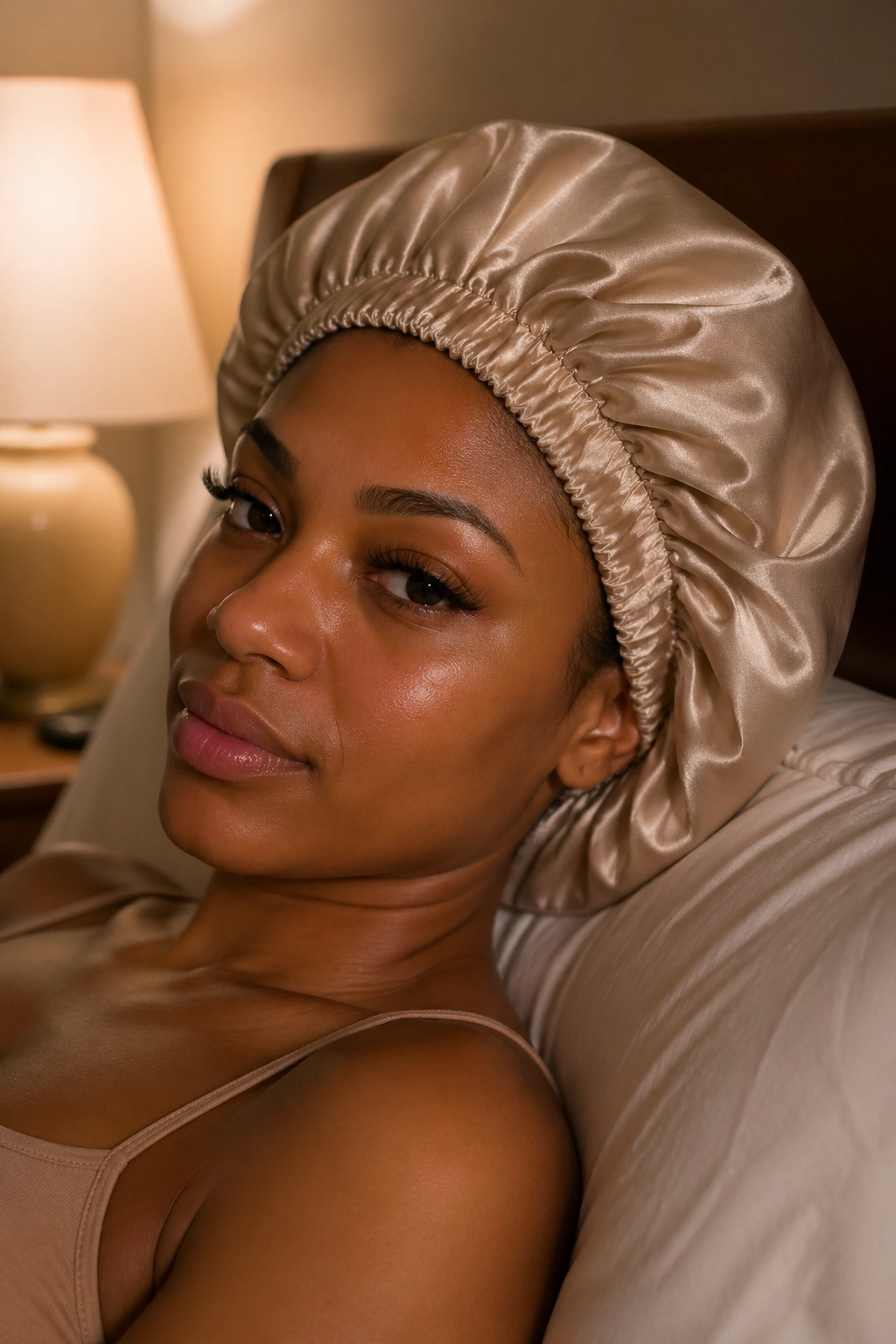
Satin bonnet every night. Not silk, which can snag kanekalon; not cotton, which ruins shine. Satin specifically.
Pillowcase backup. If the bonnet slips off in the night, a satin pillowcase saves the style. Use both.
Don’t sleep with wet hair. Blonde cornrows take hours to dry, and wet overnight creates frizz, buildup, and fiber damage.
Refresh in the morning with a light mist of water and leave-in spray. Smooth any fuzzy areas with a small brush along the cornrow direction.
When Blonde Is the Wrong Choice
Blonde feed-ins aren’t for everyone. Skip them if you can’t commit to the maintenance — blonde requires more care than any other color.
Skip if your environment requires conservative appearance and bright blonde would feel out of place. Darker shades of blonde (dirty blonde, dark ash) might still work for conservative settings.
Skip if your scalp is sensitive to bleached or dyed kanekalon. Some people react to the chemical processes used to lighten kanekalon to blonde. Test a small patch before committing to a full install.
For everyone else — the 22 styles above offer enough range to find a blonde feed-in install that fits your face, your lifestyle, and your willingness to maintain. Pick carefully, prep thoroughly, and commit to the color. Blonde done right is unforgettable.
Refreshing Blonde Between Installs
If you love blonde and plan to stay in it, plan your installs to overlap in color family. Moving from honey blonde to platinum in a single install jump can be harsh on your natural hair if you’re also coloring your roots to match.
Stay within one or two shades of blonde across consecutive installs. This gives your natural hair time to adjust and reduces the visual shock of abrupt color changes.
Between installs, use color-depositing conditioners or temporary toners on your natural hair if you want to maintain the blonde look without another full install. This bridges the gap for 2-4 weeks until you’re ready for a new install.
Blonde is a journey. The 22 styles above are starting points, but your personal relationship with blonde deepens over time. What looks striking at first becomes your signature. The investment pays off in confidence, compliments, and the visual impact of a color that simply doesn’t go unnoticed.