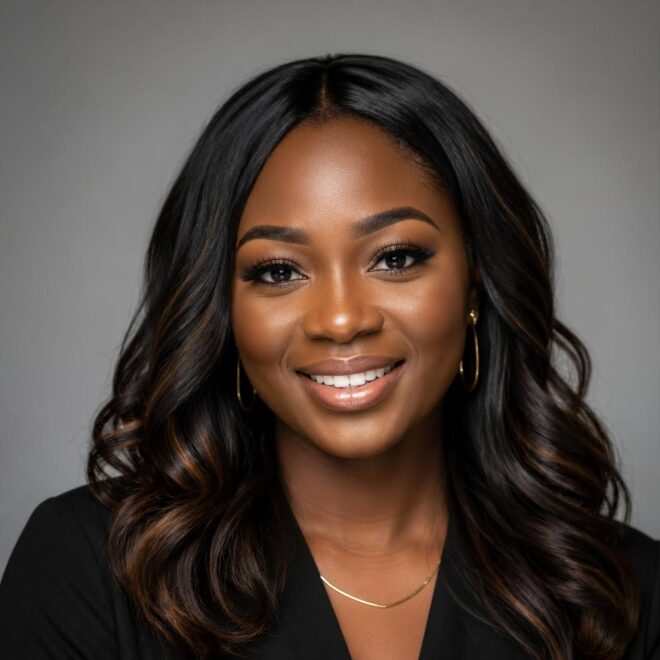


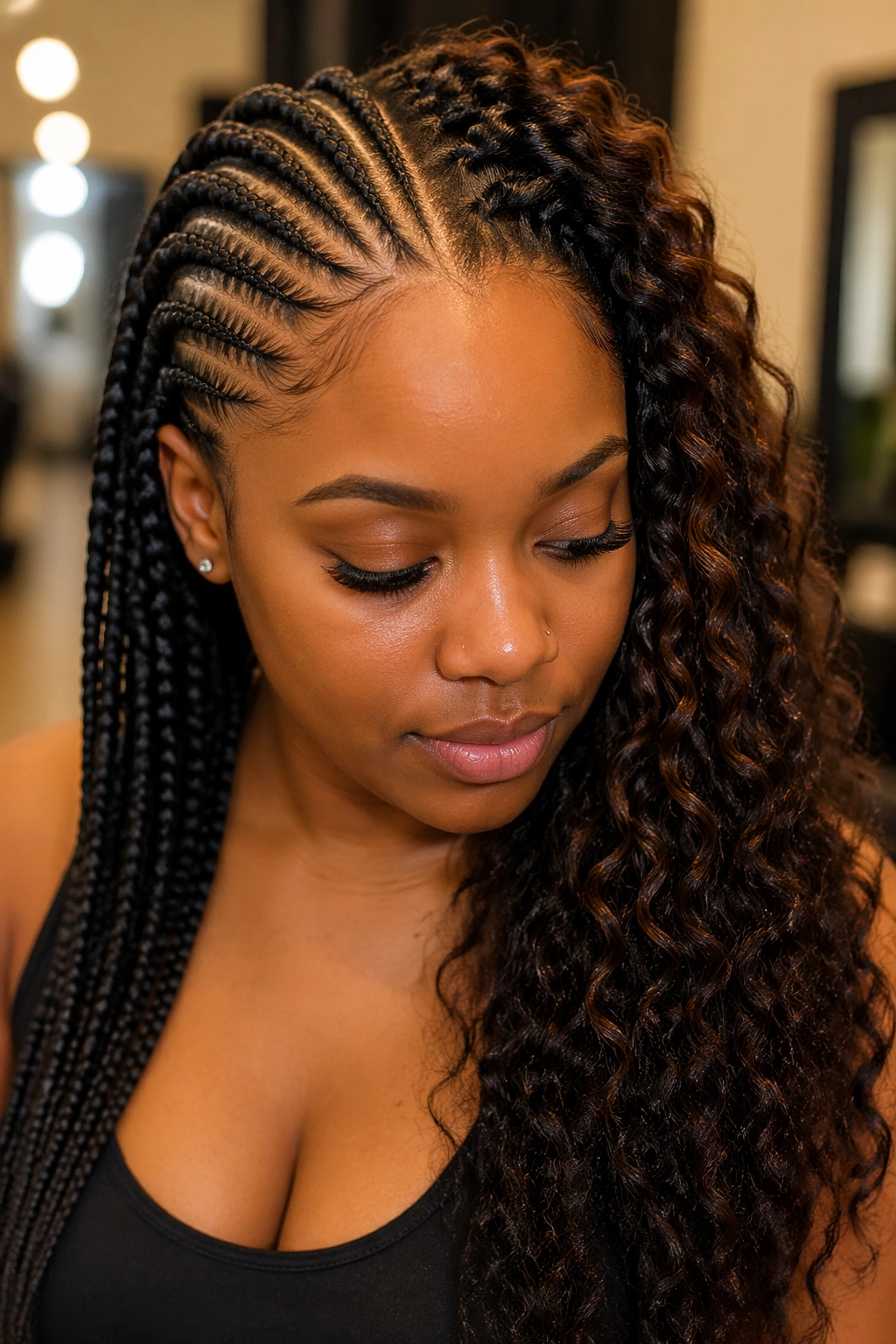
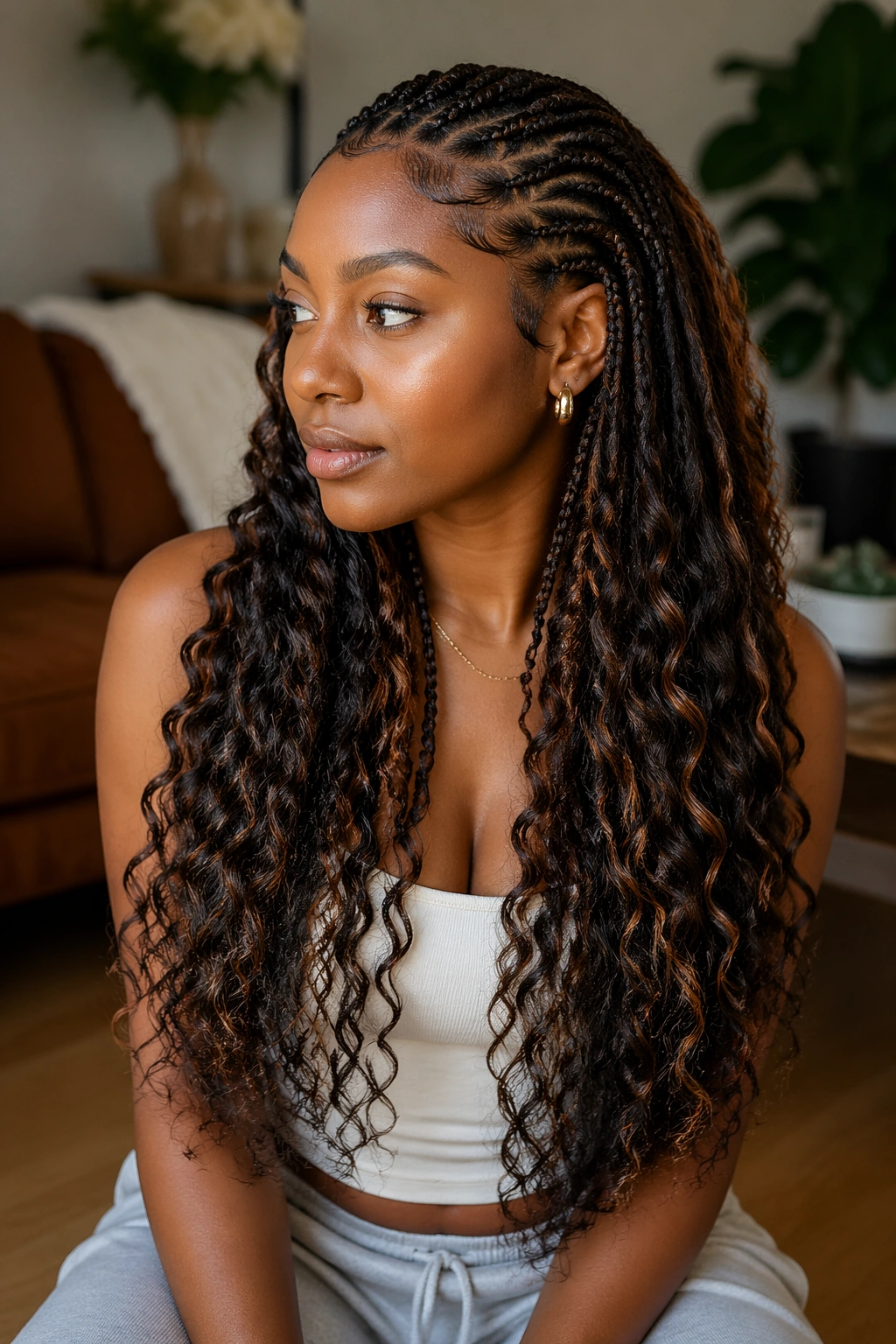
Bohemian cornrows are what happens when structure meets softness. The cornrow base keeps everything tidy and protective, but loose curly hair is woven through to give the whole install that flowing, slightly undone look that reads as effortless even though it took four hours to build. Bohemian cornrows for Black women have quietly become the default ask at braiding shops for anyone who wants length and detail without the sharp, sculpted feel of classic cornrows.
The first time I sat for a bohemian install, I misunderstood the technique completely. I thought the curls were attached at the ends like a ponytail piece. Wrong. The curly hair is fed throughout the braid length and pulled out in loose sections, so the curls appear to grow out of the braid itself. That distinction changes how the whole style moves.
This list covers 25 genuine variations — not 25 photos of the same thing with different lighting. Length changes. Part pattern changes. Curl density changes. Color changes. Each one suits a different mood, face shape, or occasion.
Where the Bohemian Style Comes From
Traditional cornrows are tight, sculpted, and sleek. Bohemian cornrows keep the cornrow base but pull loose curly human hair through the braid to create a textured, free-flowing finish. The aesthetic is inspired by bohemian fashion — loose, natural, intentional looseness — applied to a structured braid pattern.
Over the years, the style has been shaped by braiders across the diaspora who wanted to offer clients something softer than traditional box braids or classic cornrows. The combination gives protection (from the cornrow base) and styling versatility (from the loose curls).
The curly sections are almost always wet-and-wavy or loose-wave human hair, not kanekalon. Human hair moves more naturally and holds curl patterns better. Some braiders use a blend of kanekalon for structure and human hair for softness, but pure human hair gives the most bohemian look.
What You Pay For Bohemian vs Standard Cornrows
Cost is higher than plain cornrows. You’re paying for two sets of material (kanekalon base plus human hair curls) and significantly more install time. A bohemian cornrow install typically runs 30-50% more than the same pattern in plain kanekalon.
Install time ranges from 4 to 8 hours depending on curl density and braid count. The bohemian technique requires the braider to stop periodically, pull curly sections out, and braid around them — a slower process than straight kanekalon braiding.
Material cost: 3-5 bundles of wet-and-wavy hair (16-20 inches each) plus 2-3 packs of kanekalon for the cornrow base.
The cost comparison matters less when you consider lifespan. A well-maintained bohemian install lasts 4-6 weeks. That’s cost per wear dropping quickly.
What to Expect at the Install
Bring snacks and water. Four to eight hours is a long sit. Wear loose clothing without a tight collar because you’ll be leaning forward for extended periods.
Wash your hair 2-3 days before. Not same-day — slippery clean hair doesn’t grip the braid well.
Bring reference photos. Bohemian cornrows vary wildly based on curl density, cornrow size, and finish technique. A braider cannot read your mind. Show them at least three examples so they understand exactly what density and style you want.
Ask about the human hair brand being used. Cheaper wet-and-wavy hair sheds heavily and matts faster. Mid-range brands (around $15-20 per bundle) last longer and look more natural.
Prepping the Hair
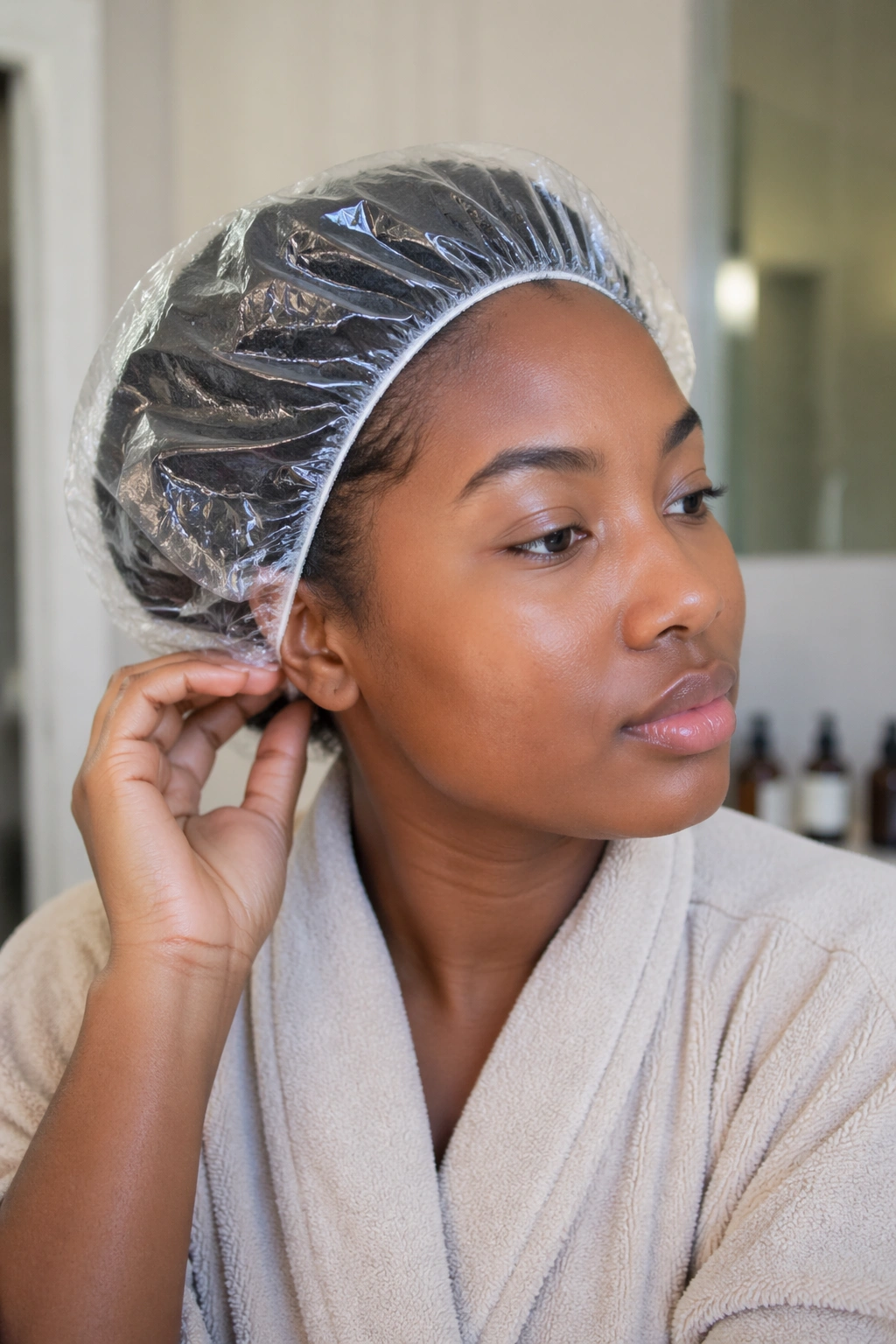
Deep condition 2-3 days before. Under a plastic cap with body heat for 30 minutes. Rinse with cool water to seal the cuticle.
Trim any split ends. Splitting at the scalp level doesn’t matter for this style, but splits along the length can cause the cornrow to fray out of the braid.
Stretch the hair. A silk press is ideal but aggressive. A tension blow-dry on low heat with a heat protectant gives you the stretch you need without heavy damage. Or an overnight twist-out for a heat-free stretch.
Moisturize lightly. Heavy cream products under a 4-6 week install cause buildup and smell. A light leave-in spritz applied day-of is all you need.
How the Curls Get Added
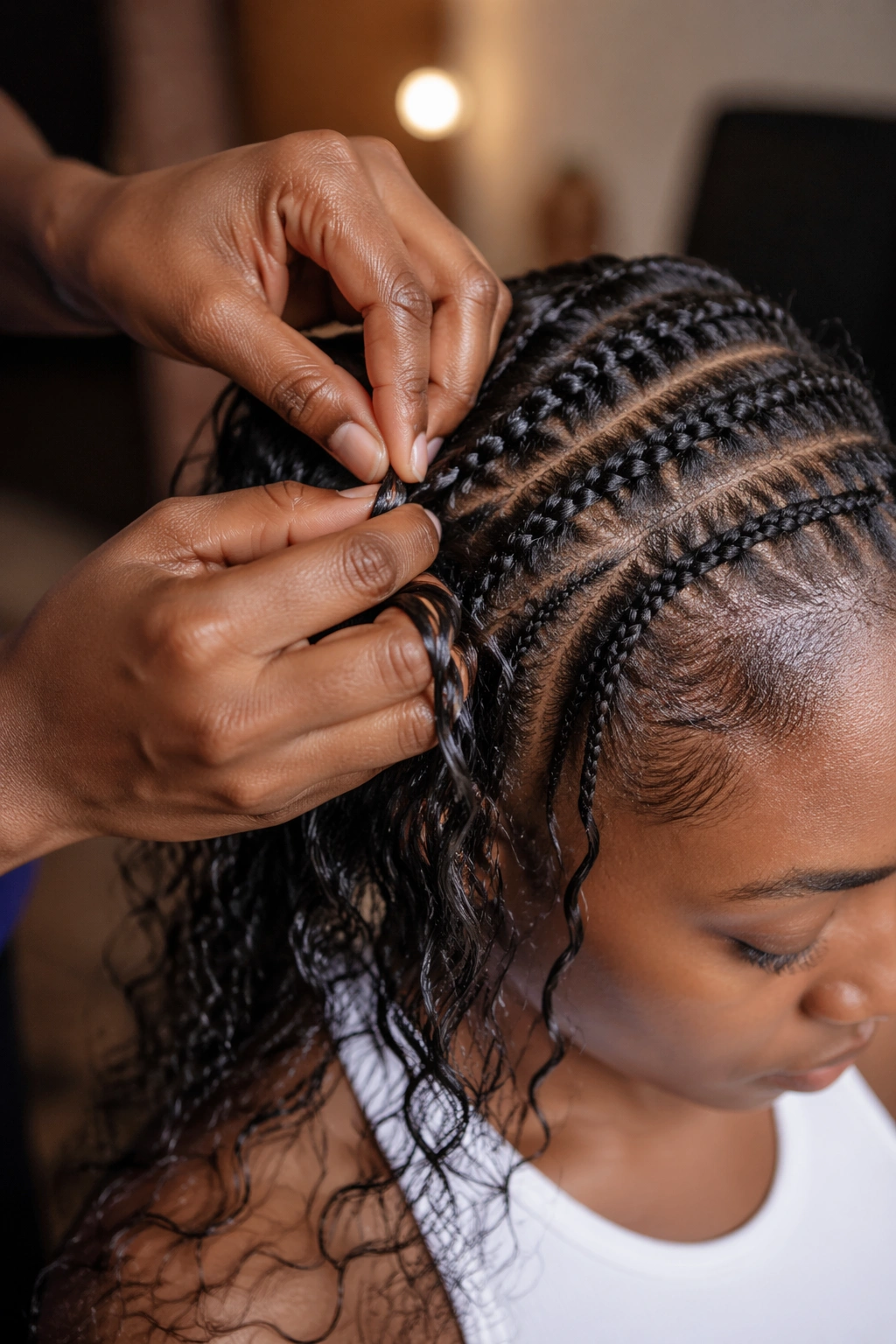
Technique matters. Braiders use one of two approaches:
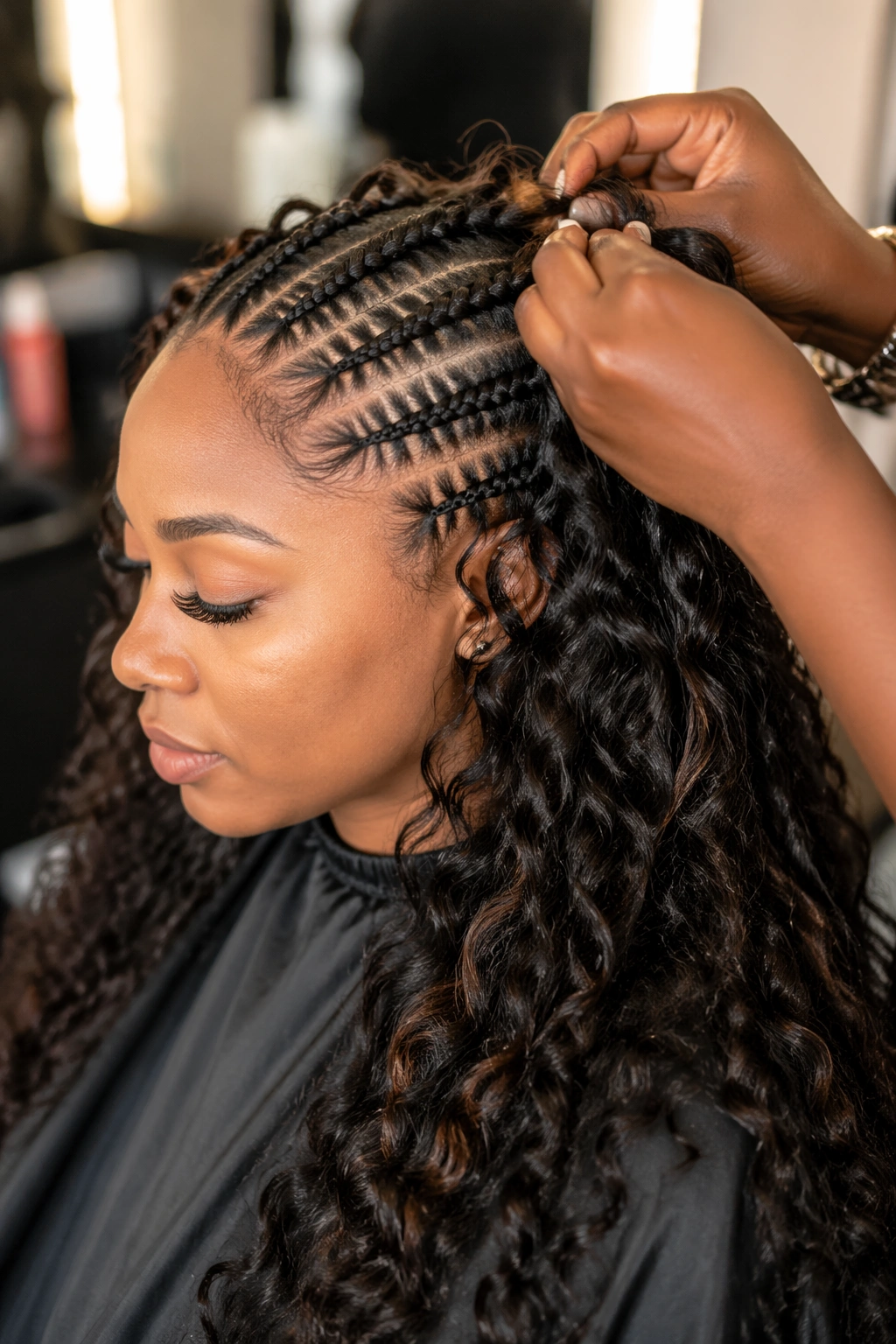
Woven-in method: Curly hair is added into each braid during the braiding process. As the braider works down the length of the cornrow, they feed small sections of wet-and-wavy hair into the braid pattern. After the braid is complete, they pull sections of the curly hair out of the braid to create the flowing effect.
Loose-pulled method: The cornrow is braided normally with kanekalon only, then curly hair is crocheted or threaded through the base braid after the fact. This method is faster but creates a slightly bulkier base.
The woven-in method produces a more natural, seamless result. The loose-pulled method is cheaper and quicker. Ask your braider which method they use before booking.
1. Waist-Length Bohemian Box Cornrows
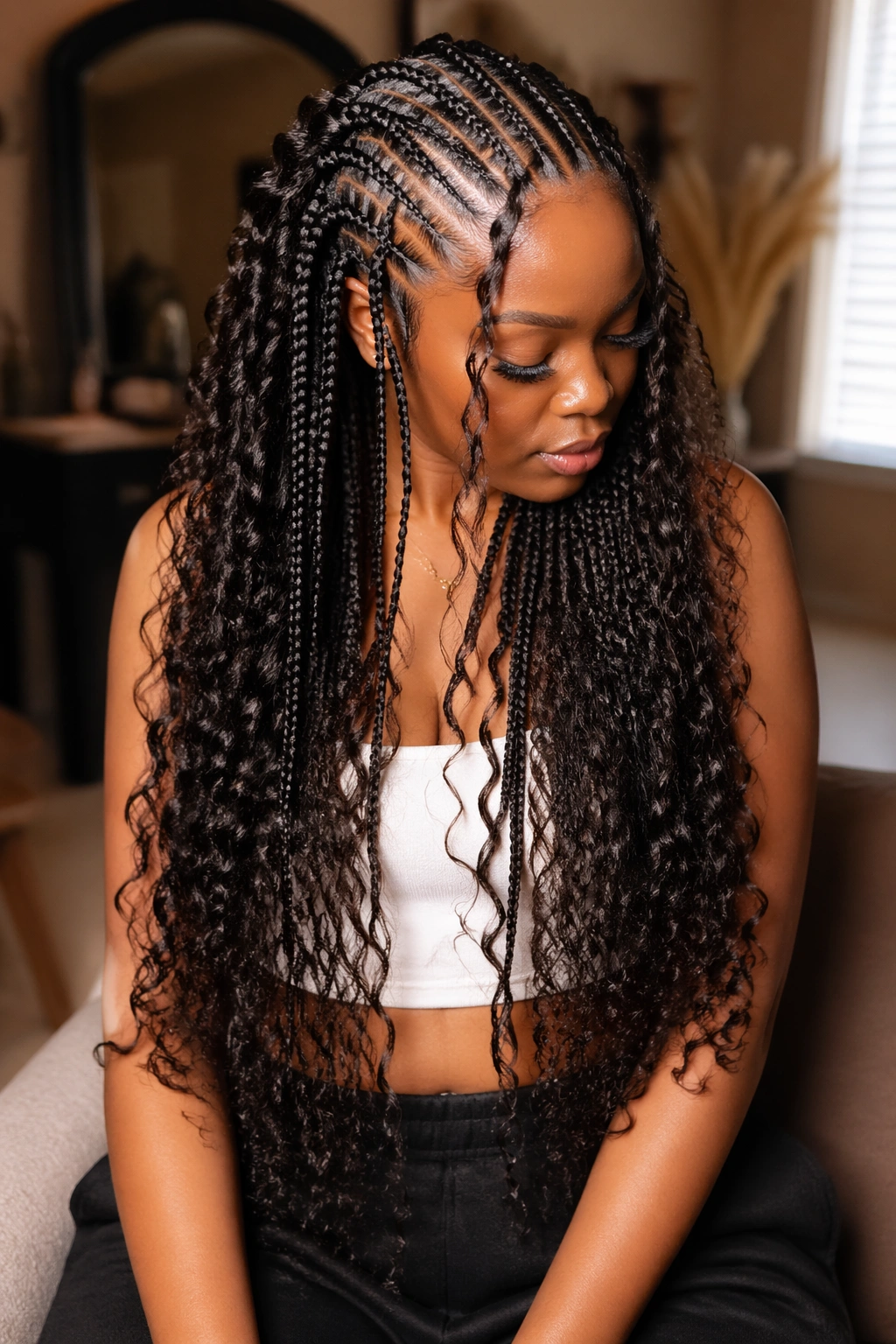
The default bohemian style. Six to eight medium cornrows running from the hairline to the crown, then transitioning into long loose curly sections that hang to the waist.
Why It Works
Length draws the eye downward and elongates the silhouette. Waist-length works on most heights — shorter women get more dramatic movement, taller women get balance with their proportions.
- Cornrow count: 6-8
- Cornrow length: about 6 inches (to the crown)
- Curl length from transition: 24-30 inches
- Install time: 5-6 hours
The curl density at the transition point is what sells this style. Too sparse and it looks like cornrows with a bad wig attached. Too dense and it looks like a full wig with cornrow accents. Medium density — where you can see the cornrow transition clearly but the curls are generous — is the goal.
2. Shoulder-Length Bohemian Cornrows With Middle Part
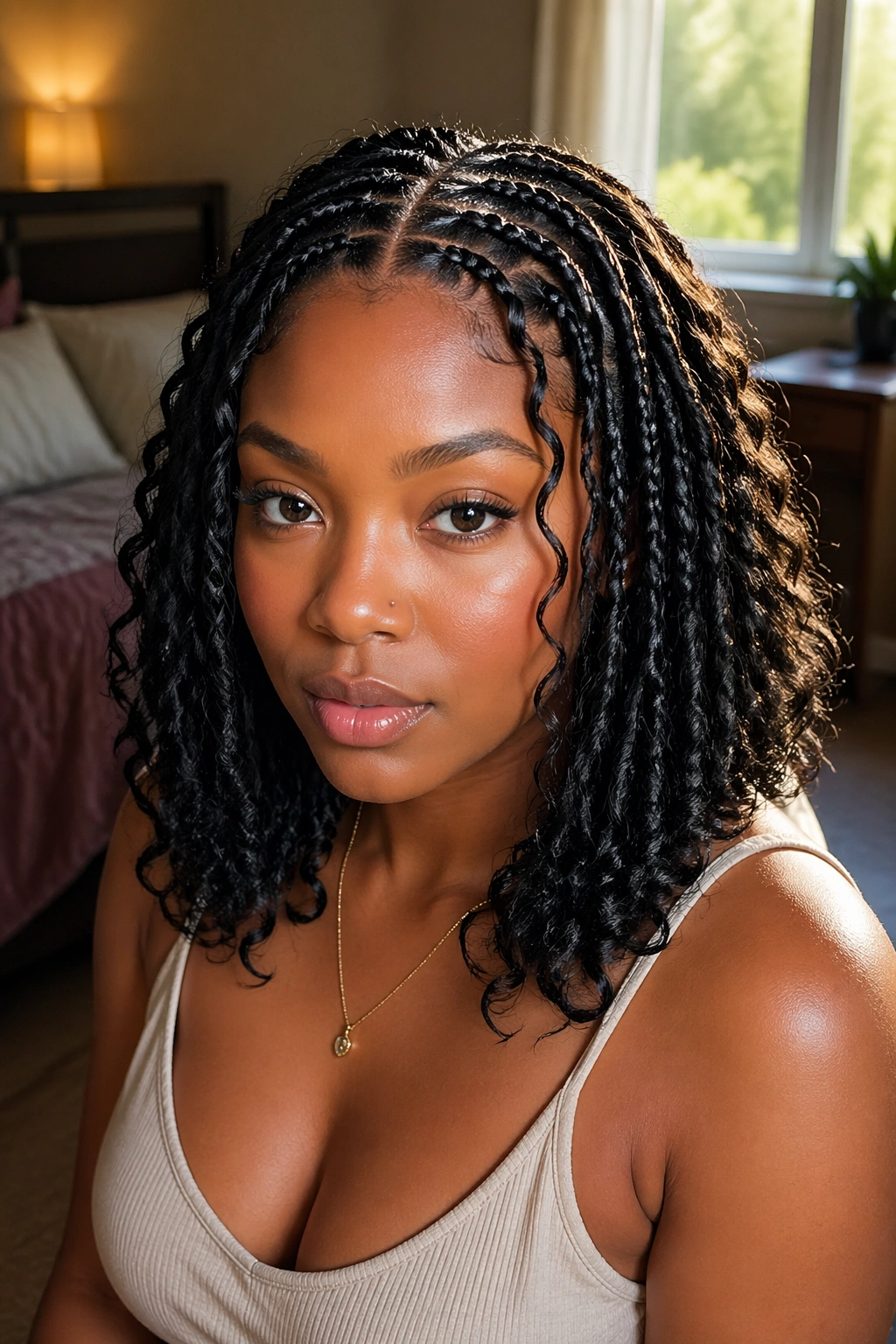
Unlike the long waist-length version, this one stops at the shoulders. The middle part runs clean from forehead to crown, with 3-4 cornrows on each side flowing into shoulder-length curls.
Middle parts favor oval, heart, and diamond face shapes. Round faces can still wear a middle part with this style if the curl density is heavy at the cheeks — that softens the face’s visible roundness.
The shoulder length is practical. You can still tuck the hair into a jacket collar. You can sleep on it without it tangling into a knot. You can wash it in a sink if needed.
Best for anyone wanting the bohemian aesthetic without the maintenance of waist-length hair.
3. Bohemian Cornrows With Face-Framing Curls
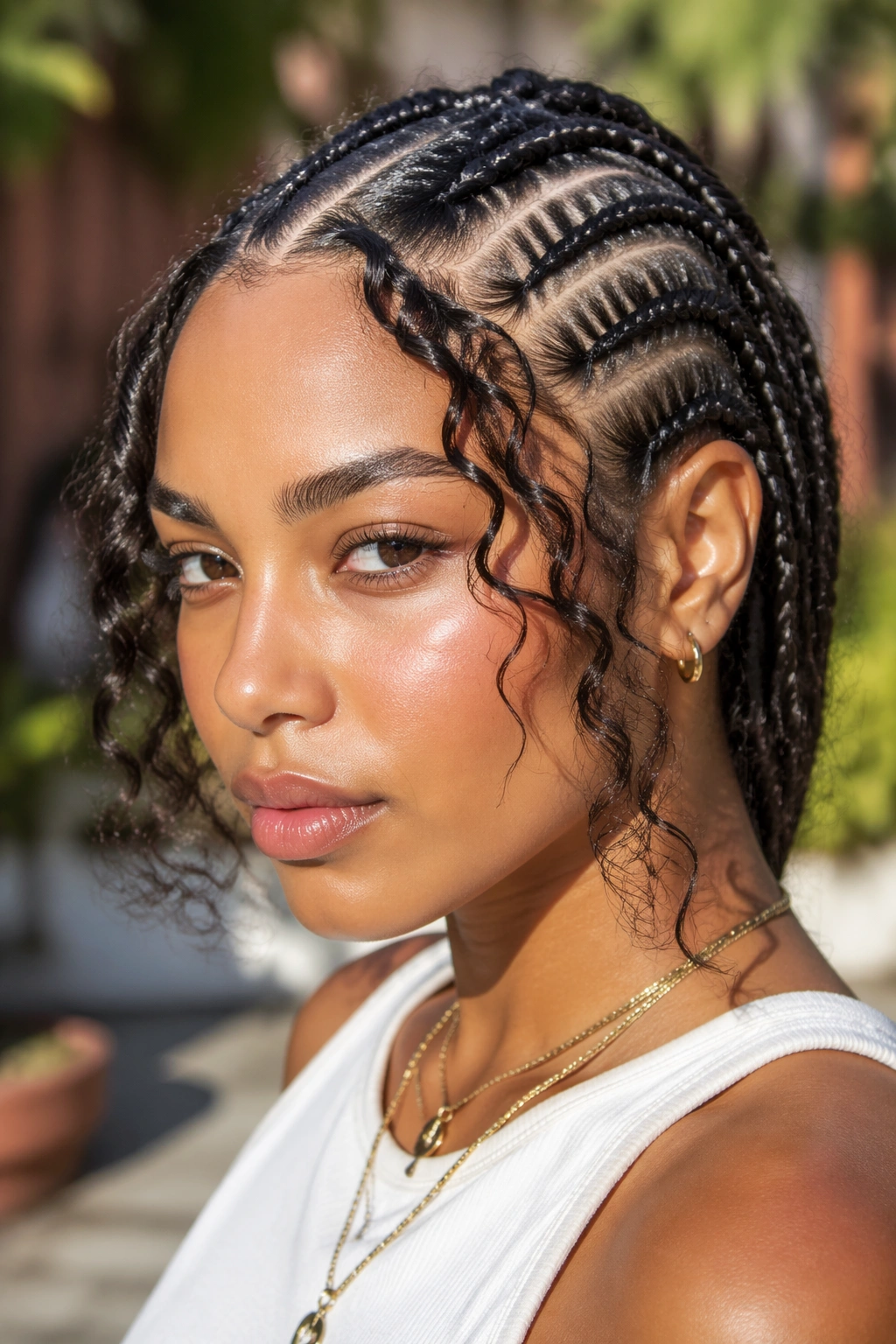
Three or four cornrows on each side that curve along the face, with loose curly sections pulled out specifically around the face. The rest of the head has cleaner cornrows with less visible curl.
The face-framing curls are the feature. They fall at the cheekbones and jawline, softening the face and giving that “I rolled out of bed like this” look that takes actual hours to create.
How to Style It
- Cornrow direction angles toward the face, not away
- Pull curls out at specific points near the temples and ears
- Leave the back cornrows cleaner for visual balance
- Use a light oil on face-framing curls to control frizz
This style photographs exceptionally well because the face-framing curls catch light around the face and create natural dimension in portraits.
4. Half-Up Bohemian Cornrow Ponytail
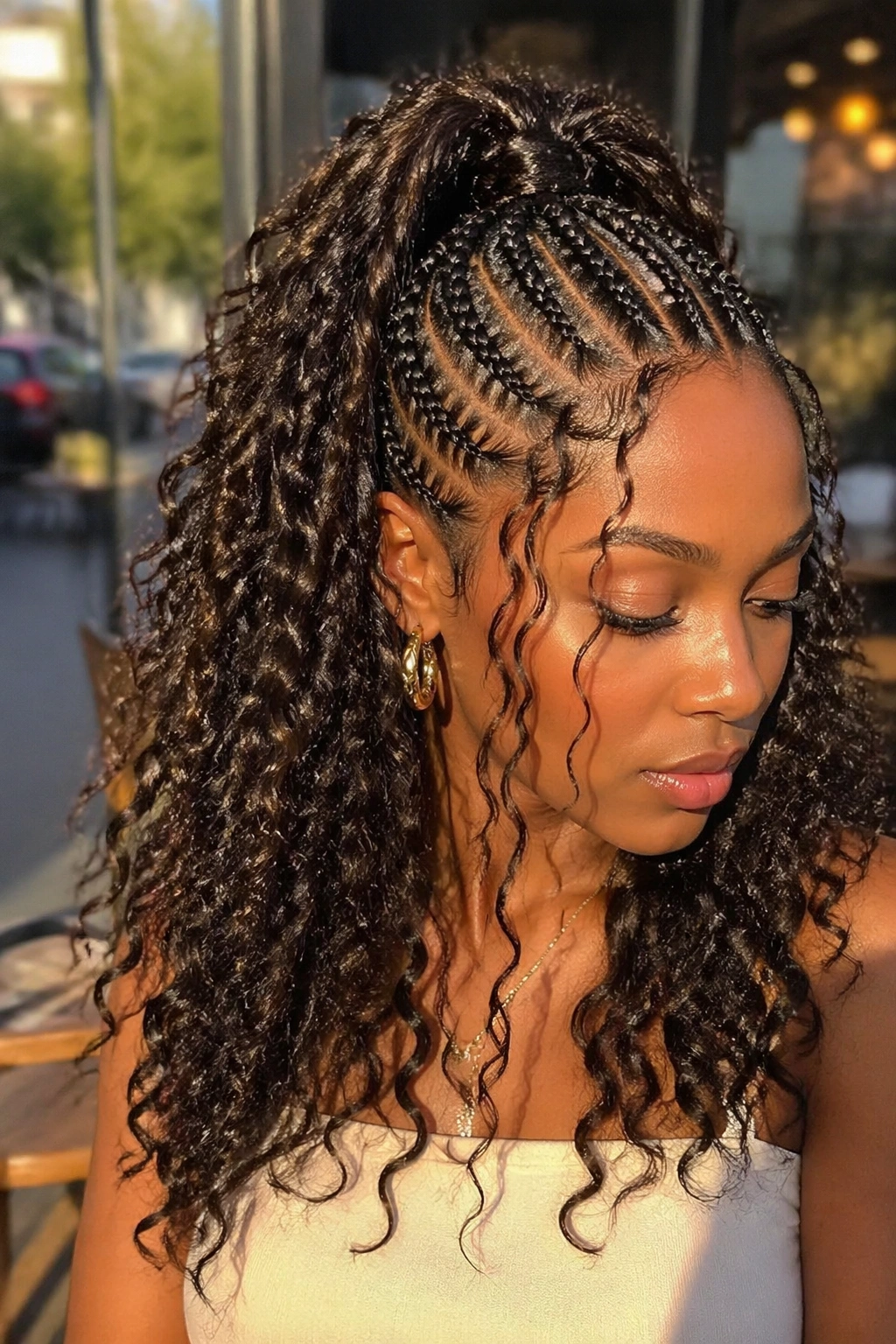
The cornrow section is limited to the top half of the head. From the crown down, the hair flows as loose curls. The top cornrows gather at the crown into a high ponytail held with a scrunchie or thin kanekalon wrap.
This is a 2-in-1 style. You wear it flowing by day, and ponytail-up by evening. Or the reverse. The styling change takes 30 seconds.
The ponytail itself has enough hair to look full because the curly sections add significant volume. A half-up bohemian ponytail looks dense where a half-up style without curls would look thin.
5. Butt-Length Bohemian Cornrows
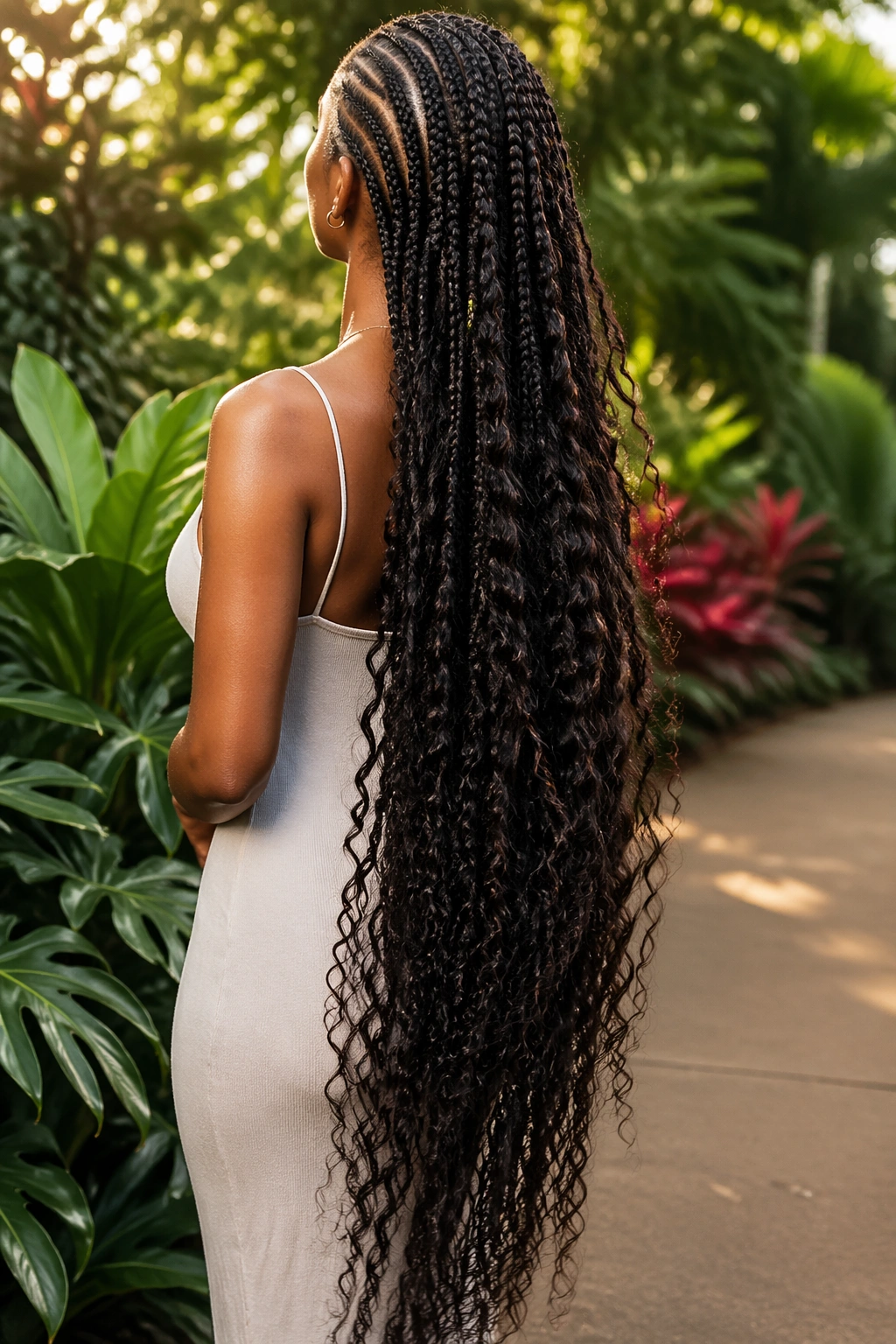
Extreme length. Curls flow past the waist and hit at mid-thigh or lower. The cornrow section stays the same length as standard styles; what differs is the curly hair that’s added.
Practicality drops at this length. You can’t sit back against a chair without pinning down your own hair. Showers become a production. Wind pushes the hair into your face constantly.
Best for: photoshoots, special events, and anyone whose lifestyle accommodates dealing with waist-plus hair daily.
Not for: anyone who works a job involving helmets, hats, or close-quarters machinery. Not for beach vacations where the hair will tangle in salt air.
6. Bohemian Cornrows With Copper Highlights
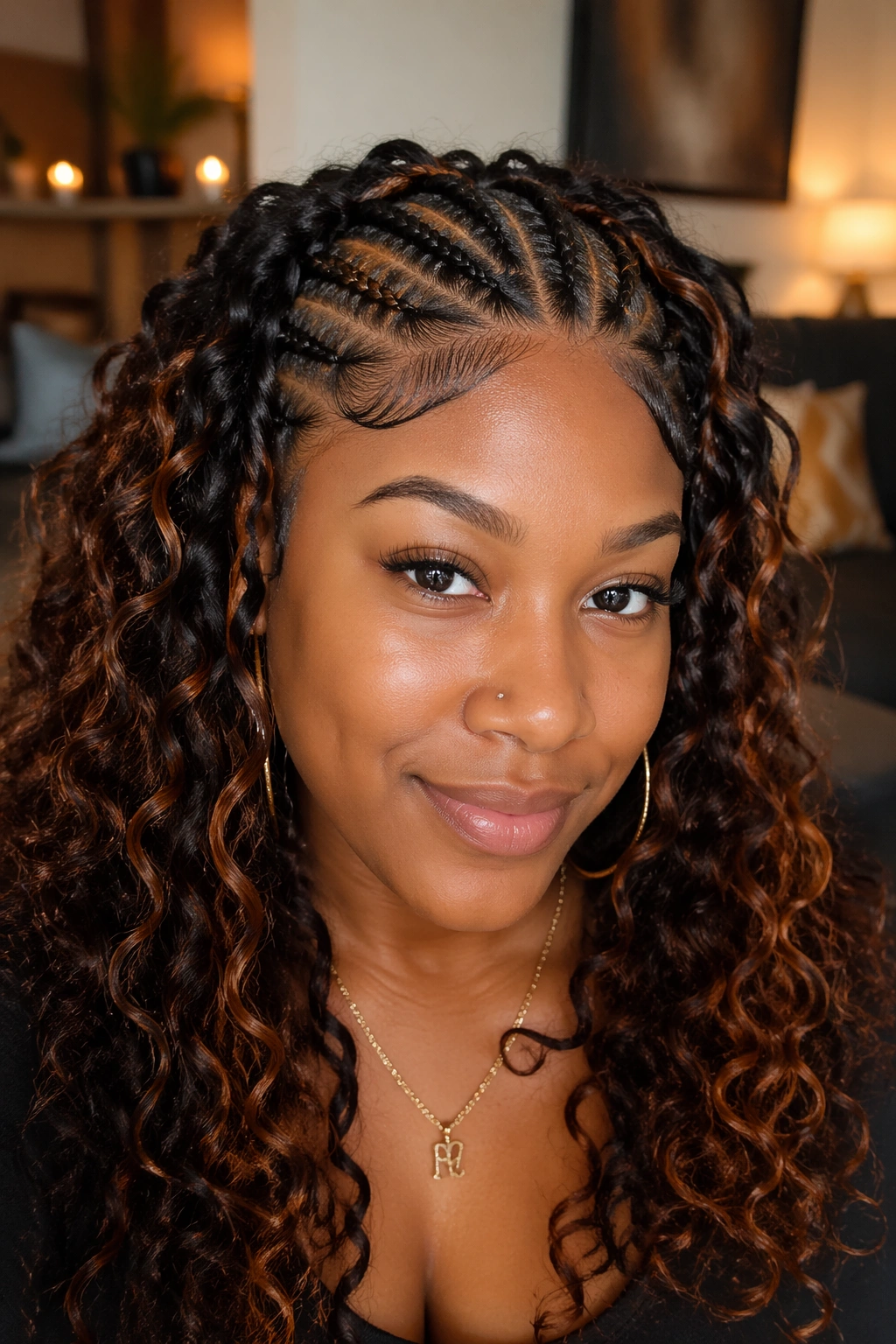
Base color is dark brown or black kanekalon in the cornrow section. The loose curly hair is blended — some strands in base color, some in copper. The copper catches light and creates visible dimension throughout the loose curl length.
Copper reads especially well on warm skin tones. Olive, honey, caramel, or deep warm undertones all work with copper highlights.
The Catch
Copper fades. Even the best wet-and-wavy hair in copper will soften by week 3-4. You can refresh with a temporary color spray or color rinse, but the original brightness is never fully replicated.
- Start with slightly brighter copper than you want long-term
- Highlight ratio: 20-30% copper, 70-80% base color
- Blend during install; don’t clump copper into large sections
- Pre-stretched human hair holds color better than non-stretched
7. Bohemian Cornrows With Burgundy Accents
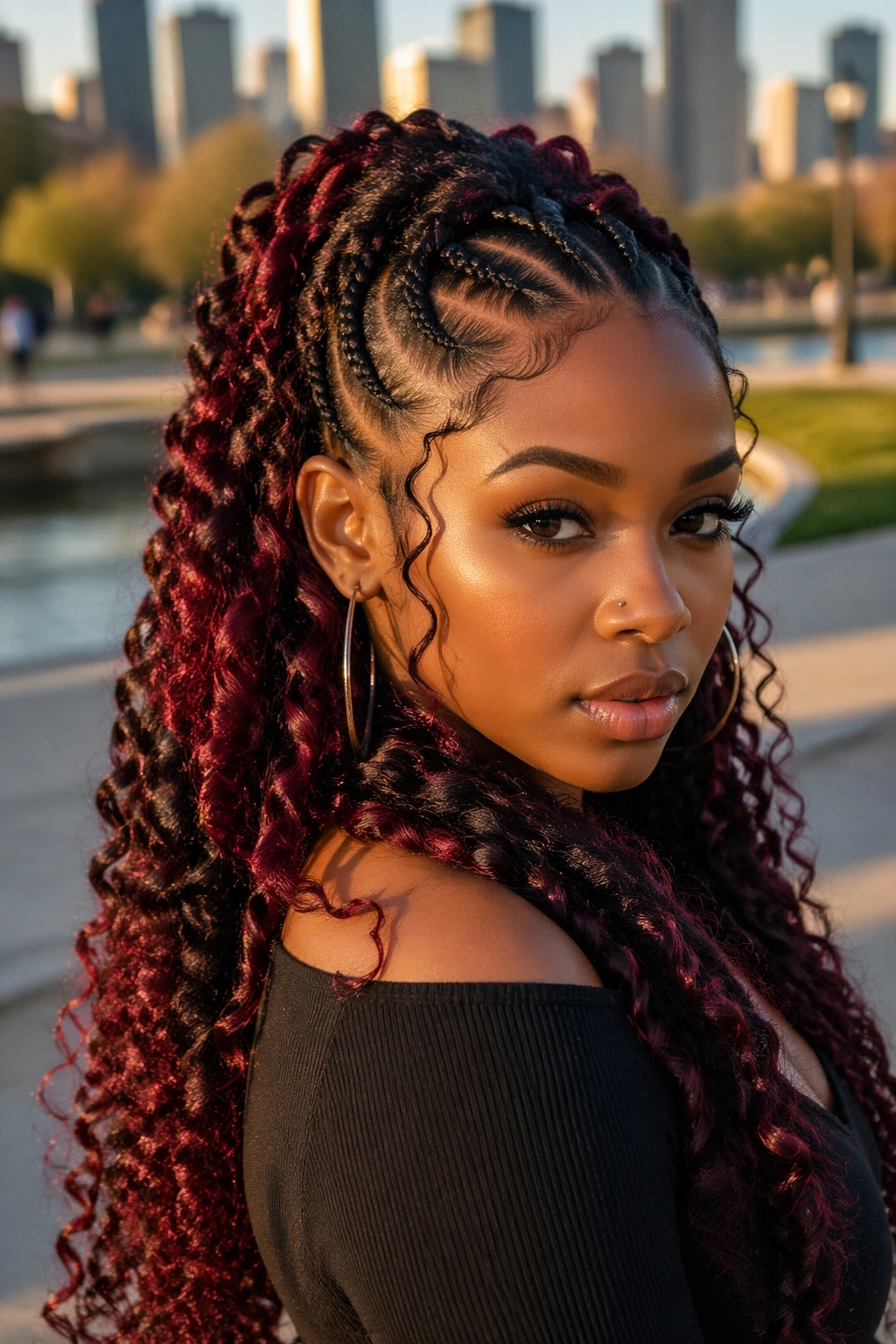
Burgundy is red with a purple underlay. On bohemian cornrows, burgundy accents appear throughout the loose curly sections without taking over.
The effect is subtle from a distance (looks like dark hair) and vivid up close (rich wine tones where the light hits).
Burgundy works across most skin tones but flatters warm undertones especially. Pair with gold jewelry rather than silver to complement the warm color.
8. Bohemian Cornrow Updo
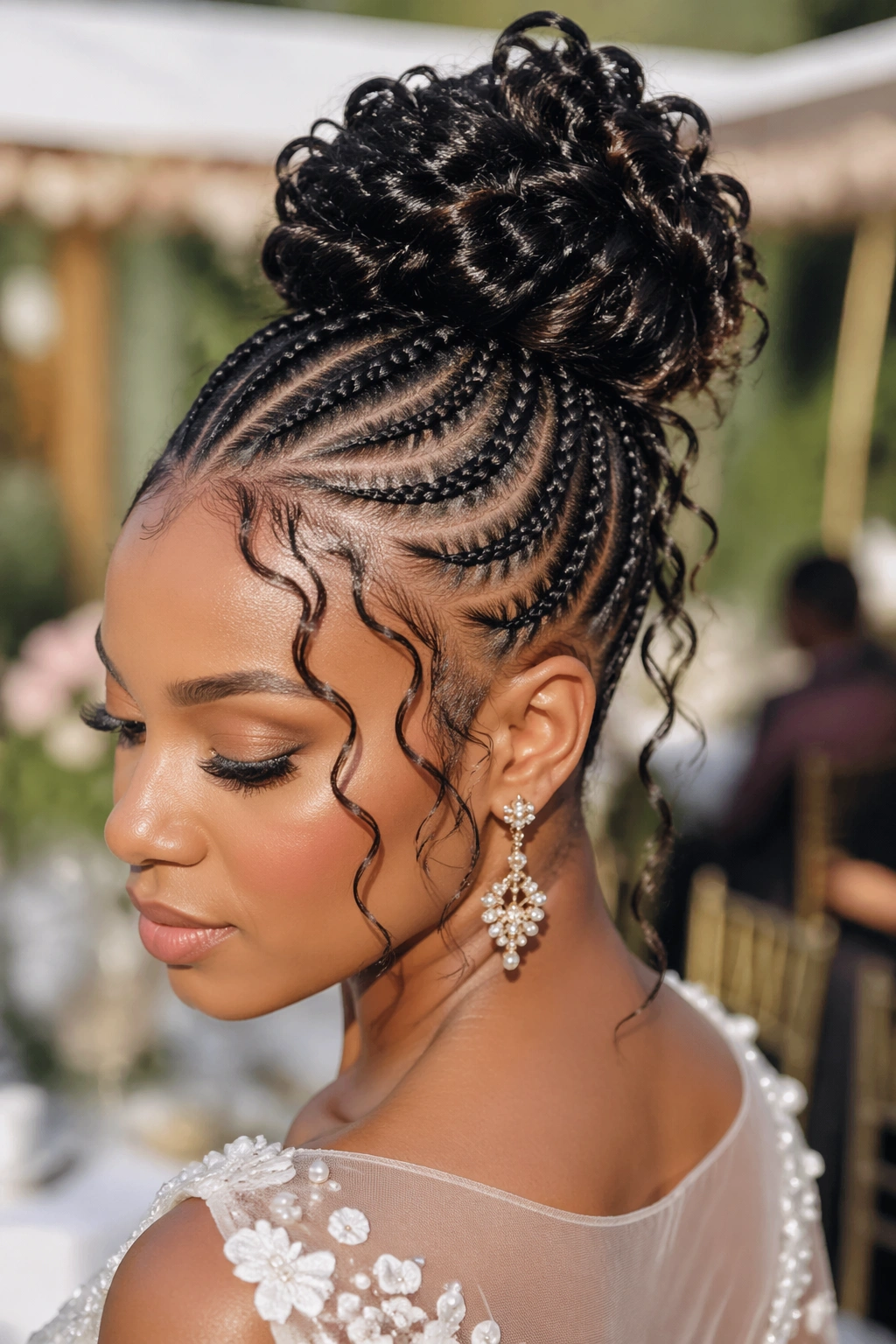
All the hair pulled into a high or low bun, with curls escaping from the bun in controlled wisps. The cornrow section runs flat across the top, gathers at the crown or nape, and the loose curly hair forms the bun itself.
This is an event style. Weddings, formal photoshoots, graduations, galas. The prep time is longer than a standard bohemian install because the bun needs to be sculpted with pins and setting spray.
Updo release: can you wear it down later? Yes, but the pin marks from the bun will take 30 minutes to smooth out.
9. Bohemian Cornrows With Side-Swept Curls
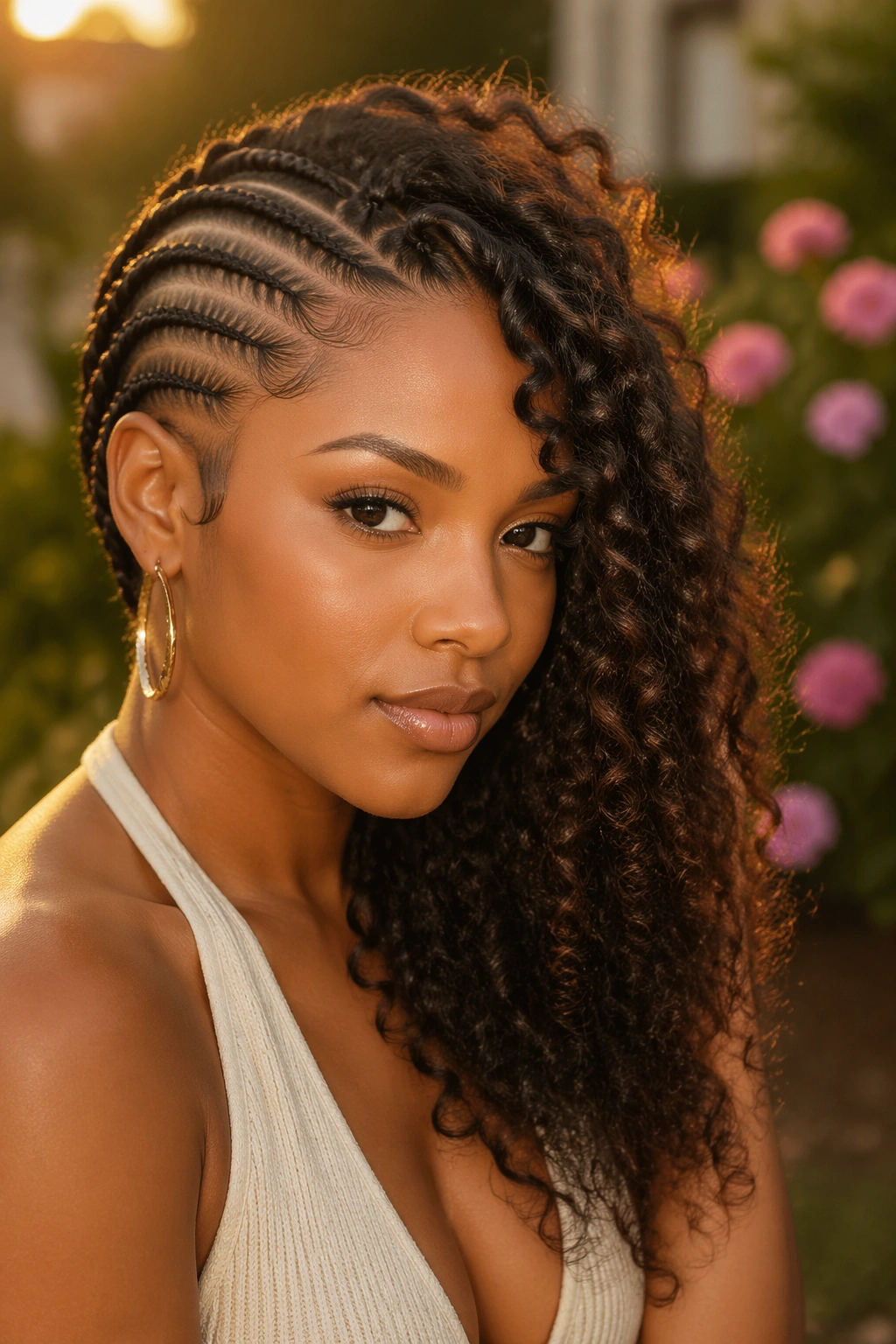
Scenario: you want the bohemian look but most of the curls sit on one side of the face. Three cornrows on the deep side, more cornrows on the shallow side, with curls swept dramatically across the face from the deep side to cascade over the shallow side’s shoulder.
The mechanism is visual weight redistribution. All the hair movement happens on one side, creating a focal point and implied motion.
- Part 3 inches off-center for the deep side
- Deep-side cornrows: 3-4 small ones
- Shallow-side cornrows: 4-5 thicker ones
- Curls pulled more aggressively on the deep side
- Loose curl cascade over the shallow shoulder
Best for photography and events where you’re often photographed from one primary angle.
10. Bohemian Cornrows With Pink Tips
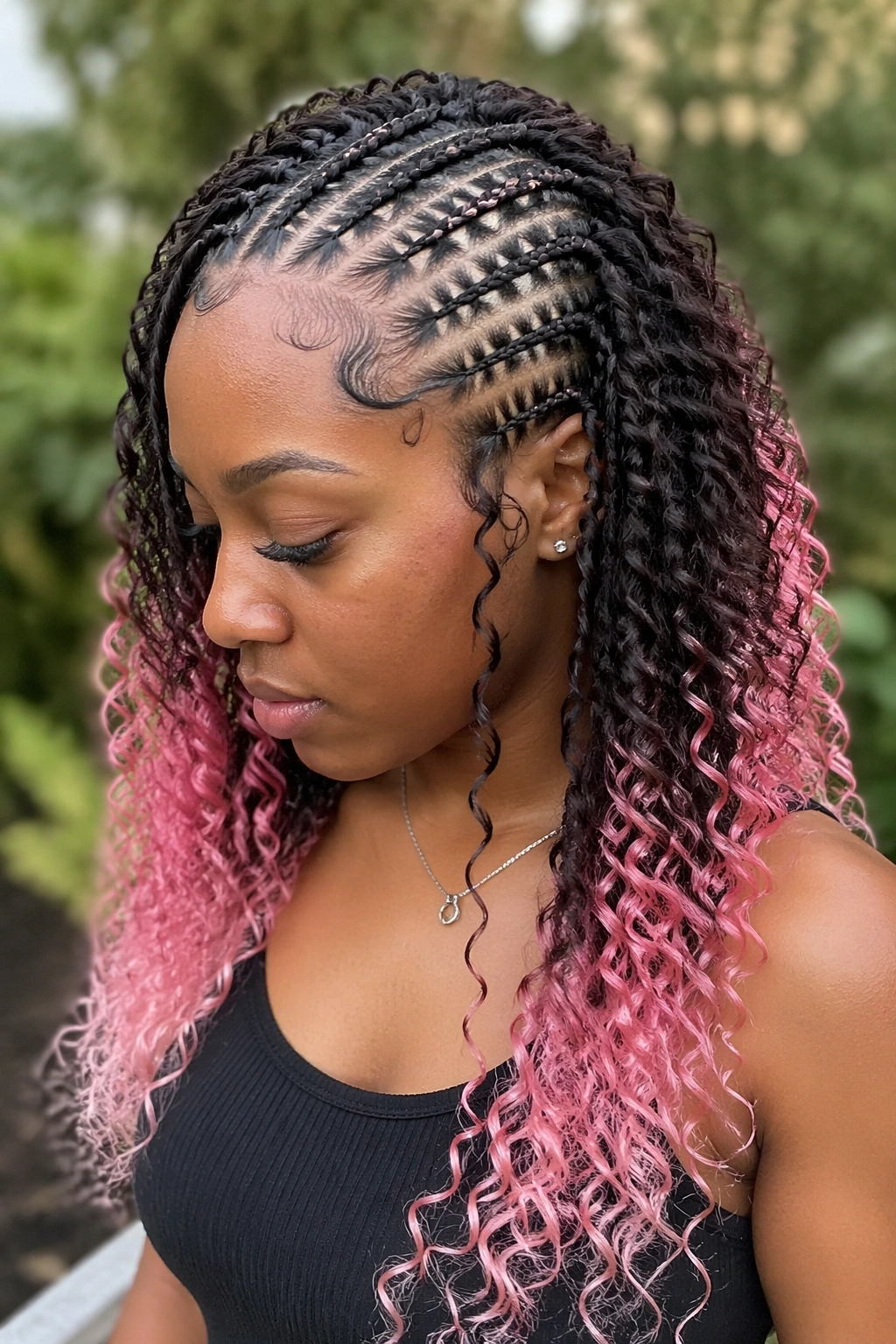
Cornrows in natural color. Curls transition from natural at the root to pink at the tips. Baby pink, hot pink, or dusty rose depending on preference.
Pre-ombré wet-and-wavy hair comes in pink-tipped options from brands like Sensationnel and Outre. The pink fade is subtle at the midpoint and concentrated at the ends.
Pink on darker kanekalon bases creates strong contrast. On lighter bases (honey blonde or caramel), the pink reads as softer and more blended.
11. Bohemian Cornrows With Curtain Bangs
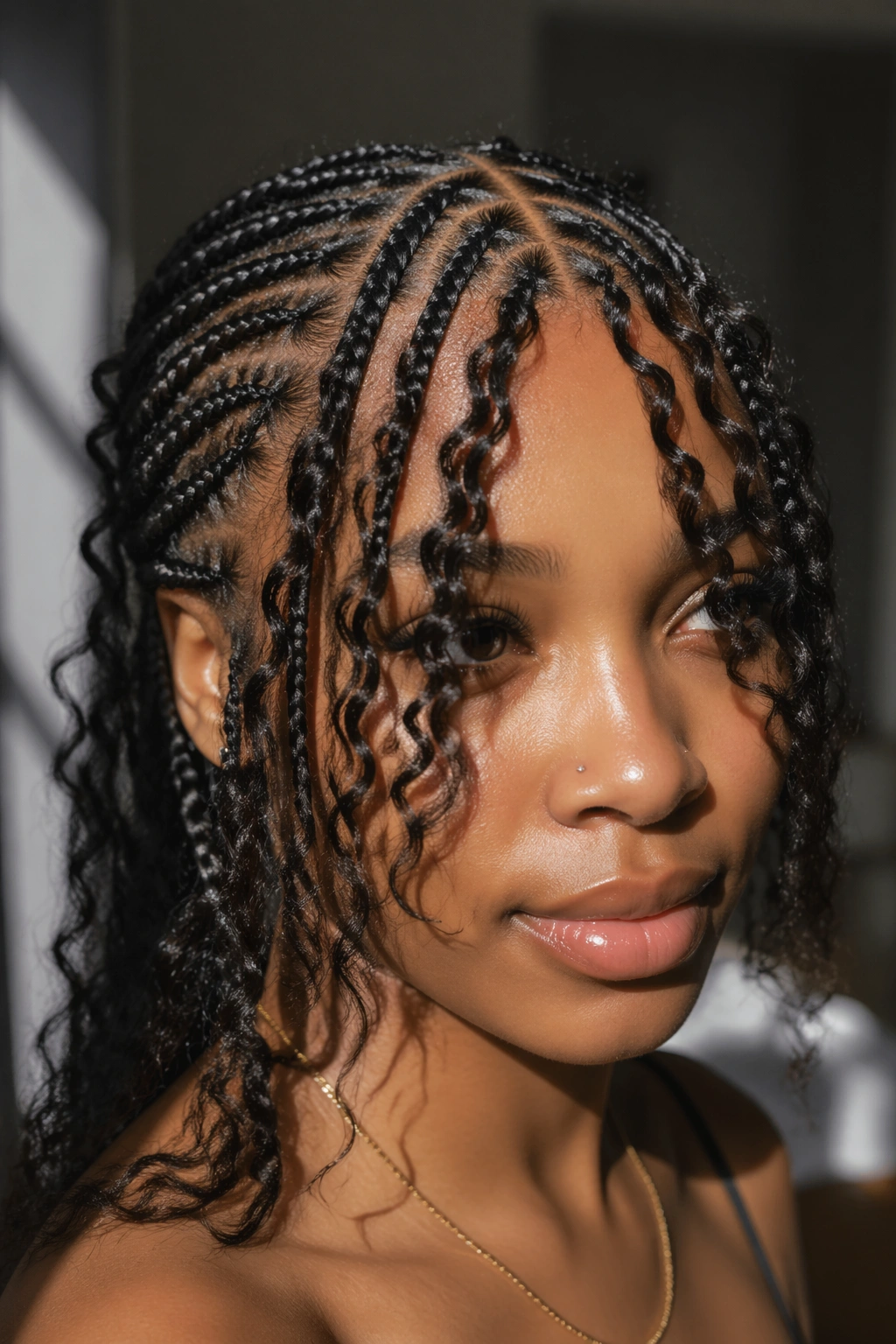
A curtain of loose curly bangs across the forehead, parted in the middle, falling just below the eyebrows on each side. The bangs are pulled from the front cornrow section and styled separately from the rest of the curls.
Curtain bangs suit most face shapes but work especially well on oval, oblong, and heart-shaped faces. They add softness to longer faces and visual width to narrower faces.
Who This Is For
Anyone wanting a bohemian cornrow look with a clearly defined face frame. The curtain bangs draw the eye to the eyes, which is flattering and conversation-starting.
- Bang length: to the eyebrows or just below
- Bang parting: center only; side parts look awkward with curtain bangs
- Bang styling: light oil and finger-shaping, no heat tools needed
- Refresh: bangs frizz fastest on this style; re-moisten with water daily
12. Bohemian Cornrows With Gold Thread Wraps
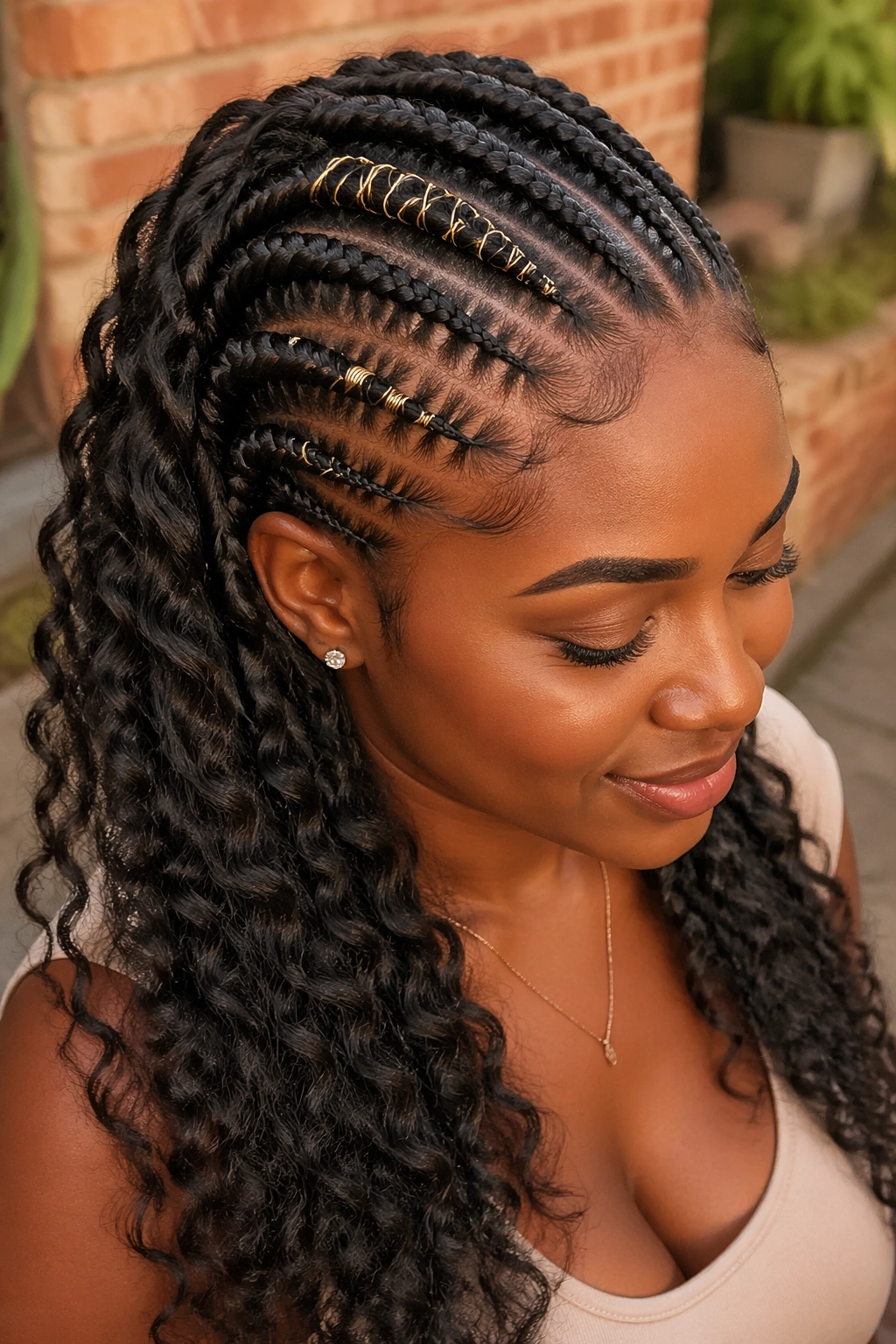
Selected cornrow sections (usually 2-3 of them) wrapped with gold thread near the root. The thread wraps 1-2 inches and adds a glint at the hairline area.
The thread is cotton or polyester embroidery floss, wound tightly around the cornrow and tied with a double knot on the underside where it doesn’t show.
Gold thread pairs with gold accessories. Don’t mix gold thread with silver earrings or necklaces — the metallic clash reads as uncoordinated.
Most practical refresh: cut the thread off after 2 weeks and either rewrap or wear plain.
13. Bohemian Cornrows With Beaded Cornrow Ends
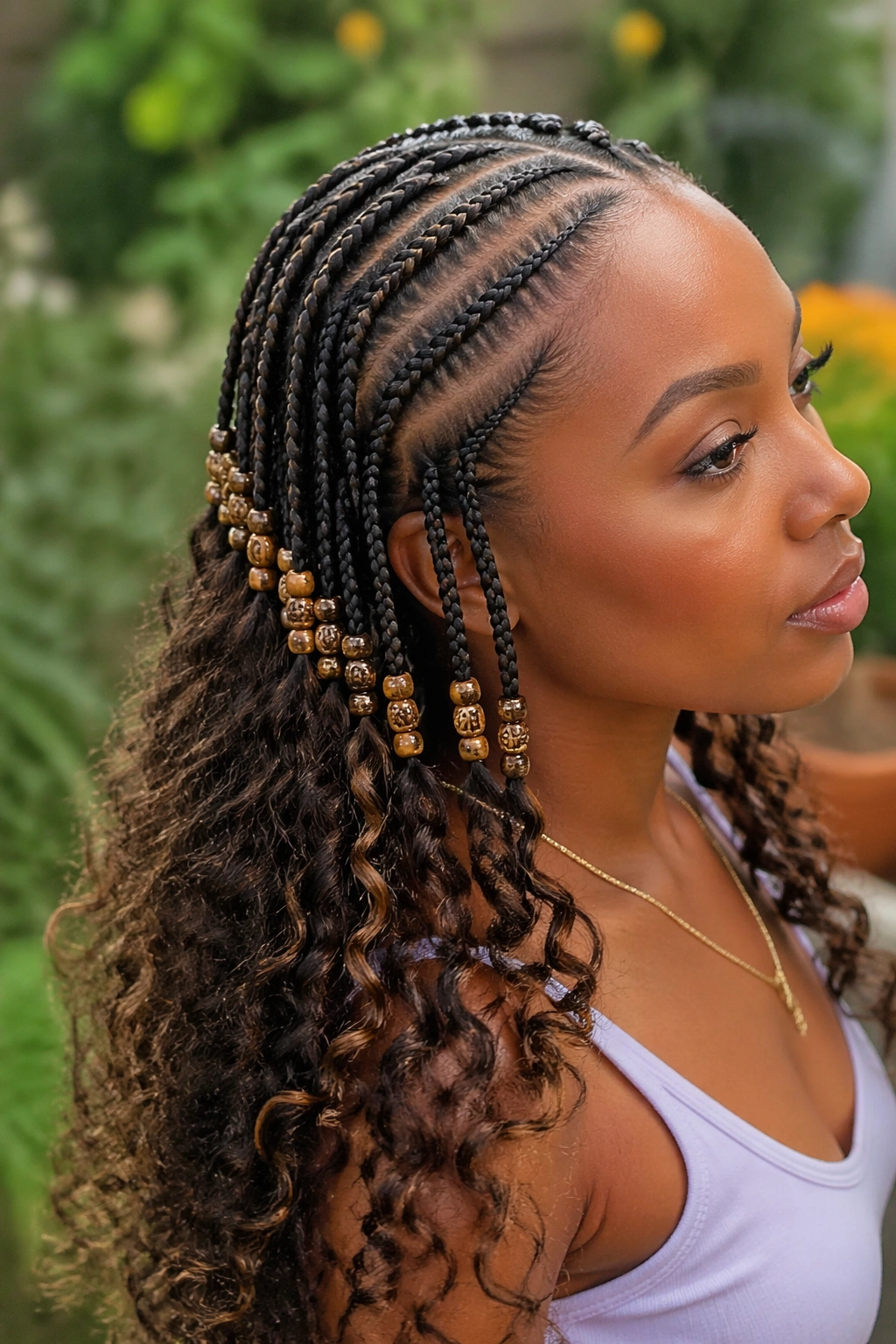
Where the cornrow stops (at the crown) and the curls begin, a cluster of wooden or metal beads sits at the junction. The beads hang at the crown level and are visible when the hair is styled in most positions.
What Makes It Different
Most bohemian styles have nothing at the cornrow-to-curl junction. Adding beads there creates a visible accent at the transition, making the cornrows themselves a focal point rather than just the curls.
- Bead count per cornrow: 2-4 beads at the junction
- Bead material: wooden beads for subtlety, metal cuffs for shine
- Bead sizing: 10mm-12mm inner diameter
- Pair with a simple curl style so the beads don’t compete
14. Stitched Bohemian Cornrows
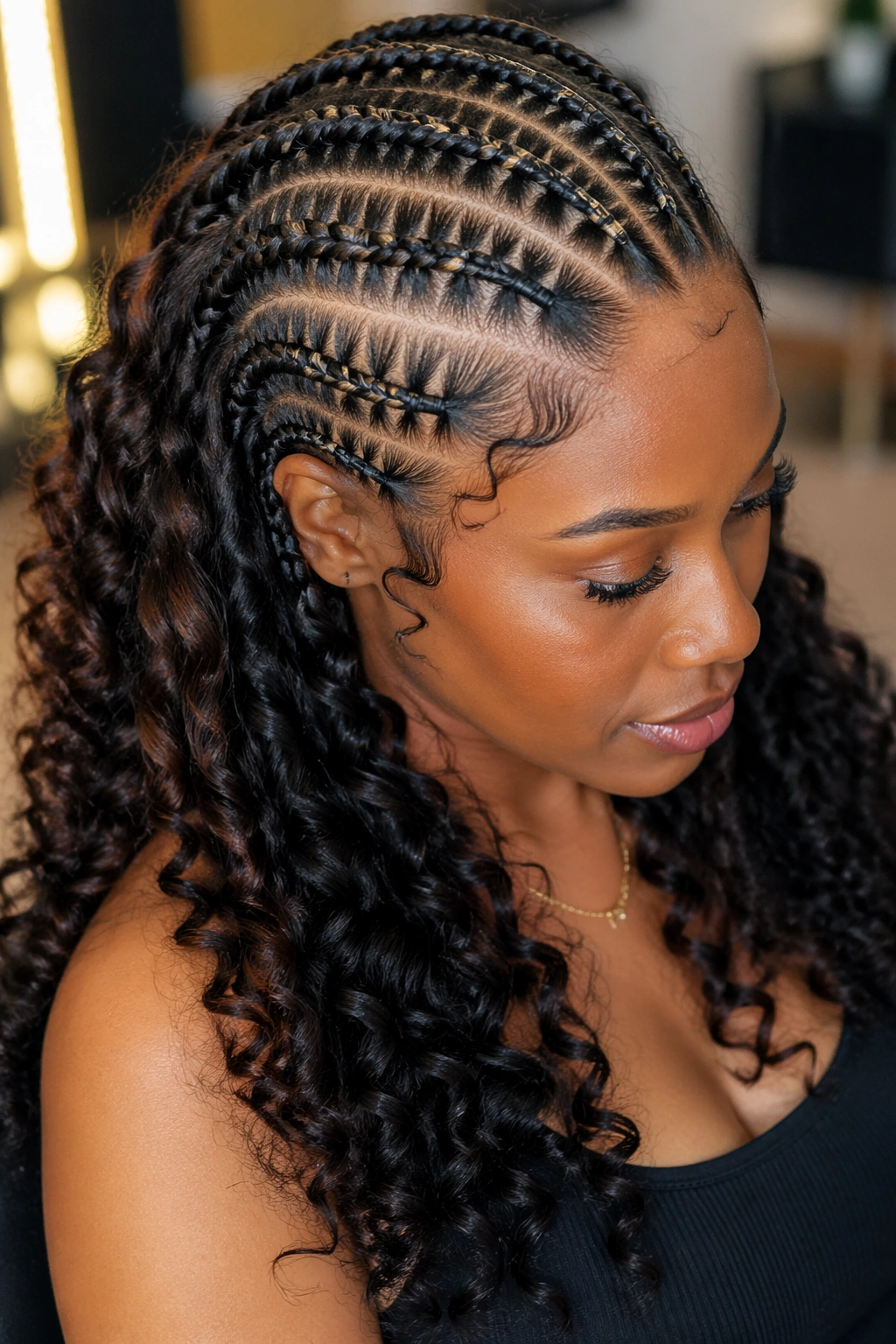
Cornrow sections with horizontal stitch details (small perpendicular mini-braids crossing the main cornrow) before transitioning into loose curls. The stitches add visible texture to the cornrow length, which contrasts with the soft flowing curls below.
Stitch count: 4-6 per cornrow is a balanced look. More than 8 looks cluttered.
Stitches should match across all cornrows. If one has 5 stitches and another has 7, the asymmetry reads as a mistake rather than a design.
15. Asymmetrical Bohemian Cornrows
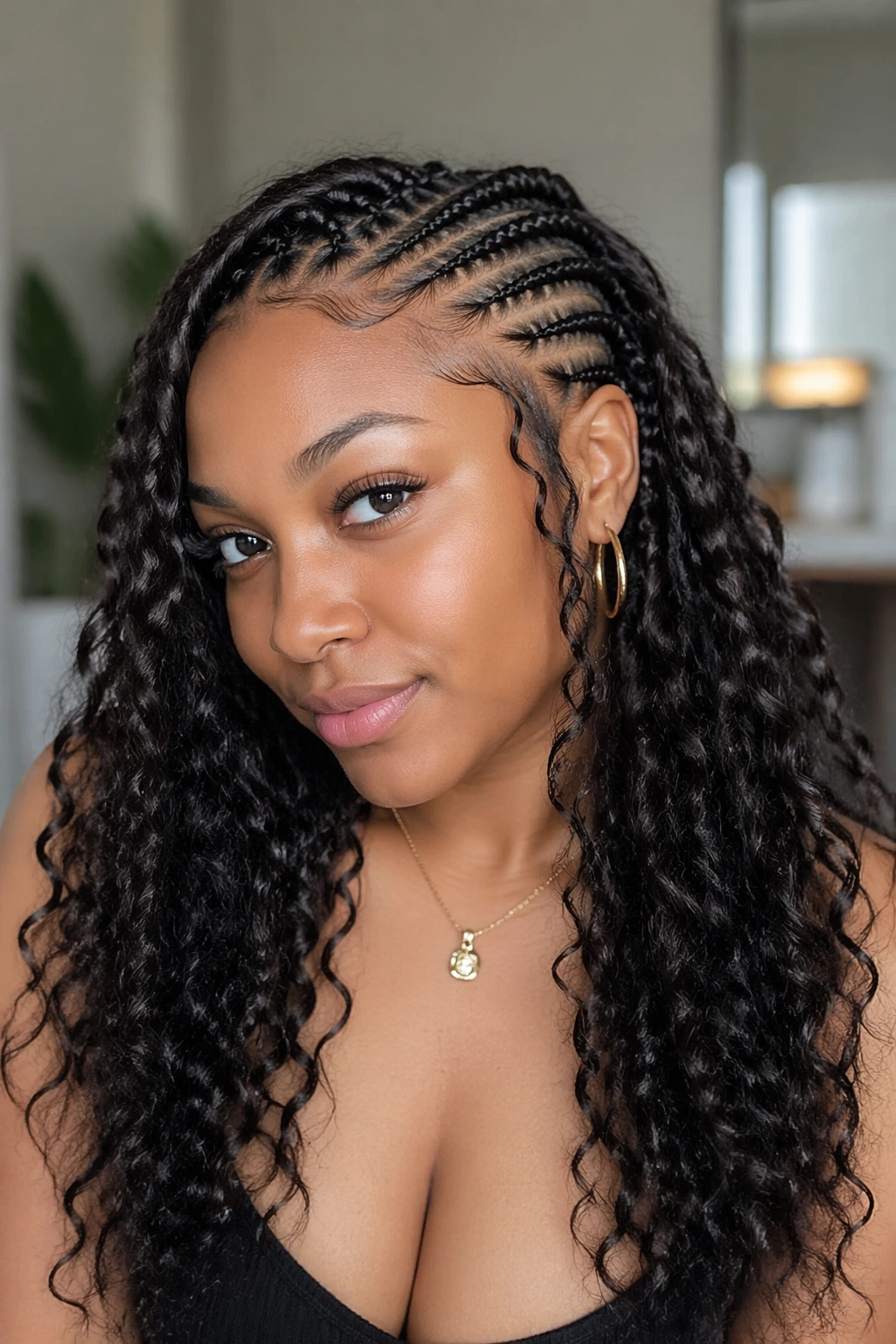
Unlike the classic symmetrical style, asymmetrical bohemian cornrows have different cornrow counts on each side of the head. Maybe 4 cornrows on the left and 6 on the right, with loose curls flowing from each side at matching lengths.
The asymmetry is the style. It reads as intentional design rather than a mistake when the braiders are obviously different counts on each side.
Best for oval and heart-shaped faces. Round faces should avoid asymmetrical cornrow counts because the weight distribution tends to emphasize facial roundness on the heavier side.
16. Bohemian Cornrows With Jumbo Front Braids
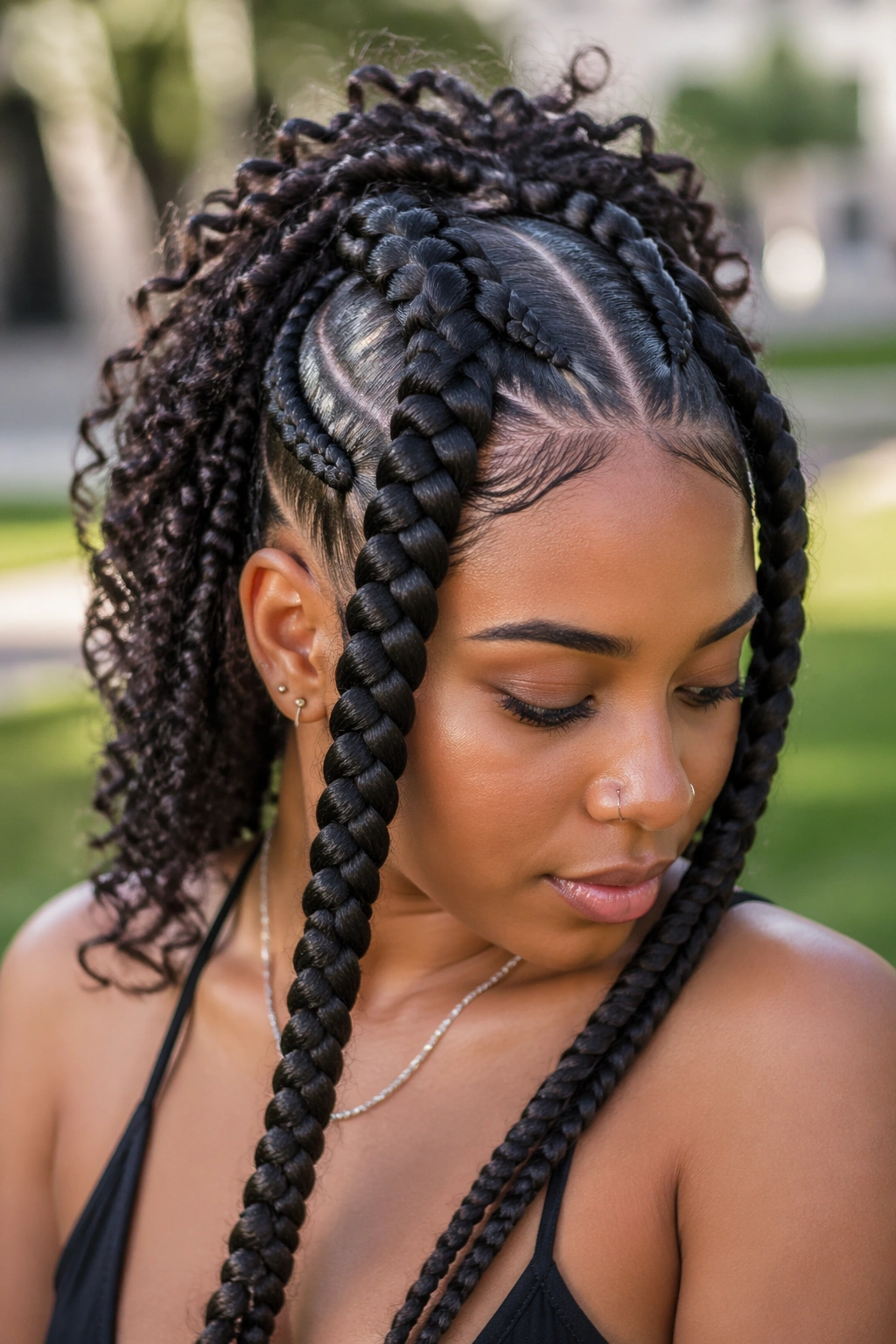
Larger front cornrows (about 2 inches wide) with smaller back cornrows. The jumbo fronts create a visible frame around the face before transitioning into curls at the crown.
This style balances drama (the jumbo fronts) with softness (the flowing curls) in a way straight-size installs can’t quite achieve.
Install tip: the jumbo front cornrows should still be feed-in at the hairline, not freehand with pre-added extension. A freehand jumbo front creates an obvious bump at the forehead.
17. Bohemian Cornrows Into Curly High Ponytail
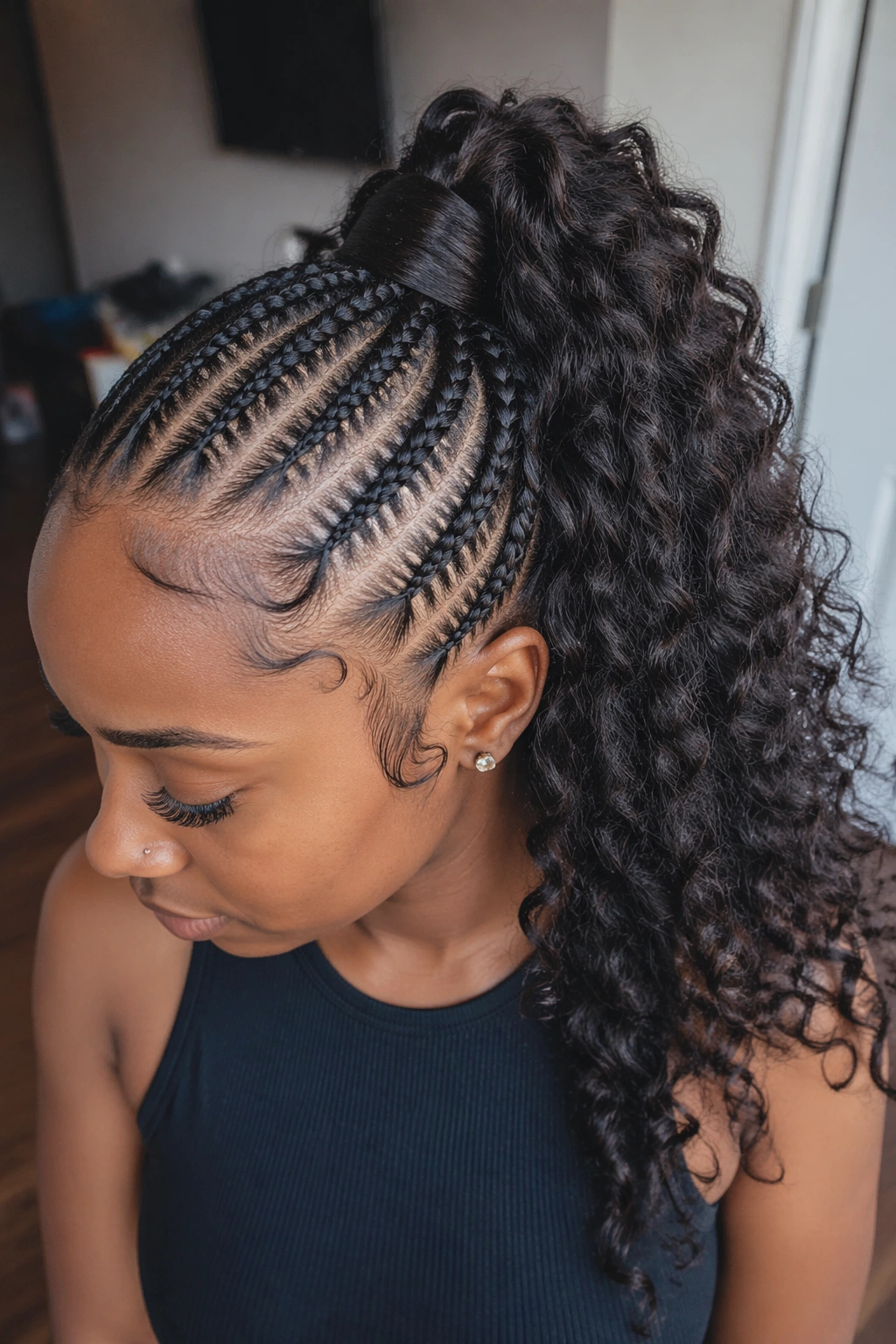
The cornrow section is standard (6-8 cornrows from forehead back) but all the curls are gathered at the crown into a high ponytail. The ponytail itself is loose curls held with kanekalon-wrapped elastic.
Not to be confused with the half-up version (entry 4). This one has ALL the loose hair in the ponytail, not just half.
High ponytails pull tension on the crown. If your scalp is sensitive or you’ve had hairline issues, choose a lower ponytail position or skip this style.
18. Bohemian Cornrows With Ombre Purple
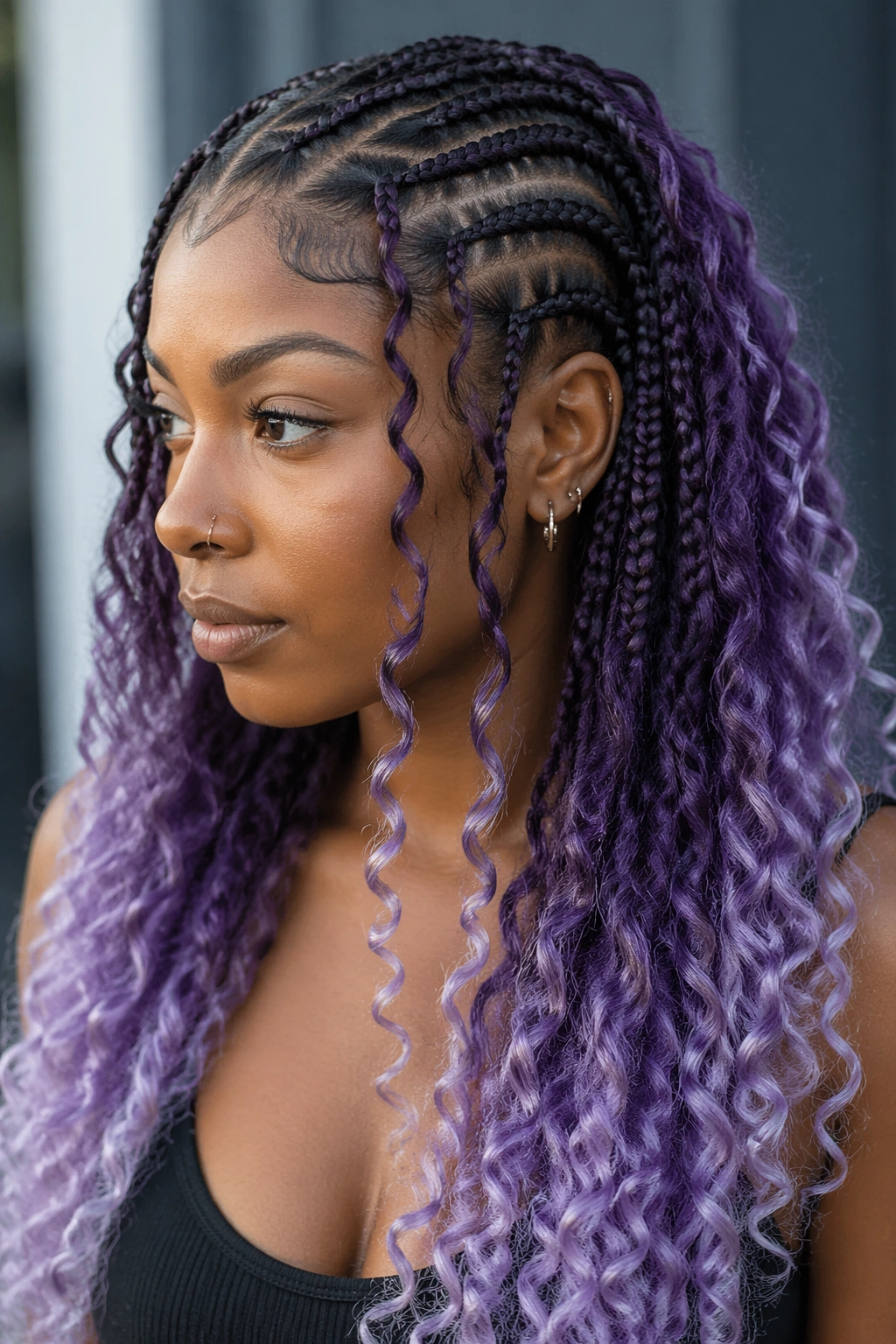
Deep violet transitioning into lavender by the ends. The cornrow section is either solid dark purple or natural tone; the curly section does the ombré gradient.
Purple is bold but wearable. Deep plum reads as sophisticated; brighter violet reads as fashion-forward; lavender at the ends keeps it soft.
Pairs with cool-toned skin, silver jewelry, and monochromatic outfits. Purple clashes with warm oranges and reds in clothing, so adjust your wardrobe choices during the install.
19. Bohemian Cornrows With Hair Cuffs
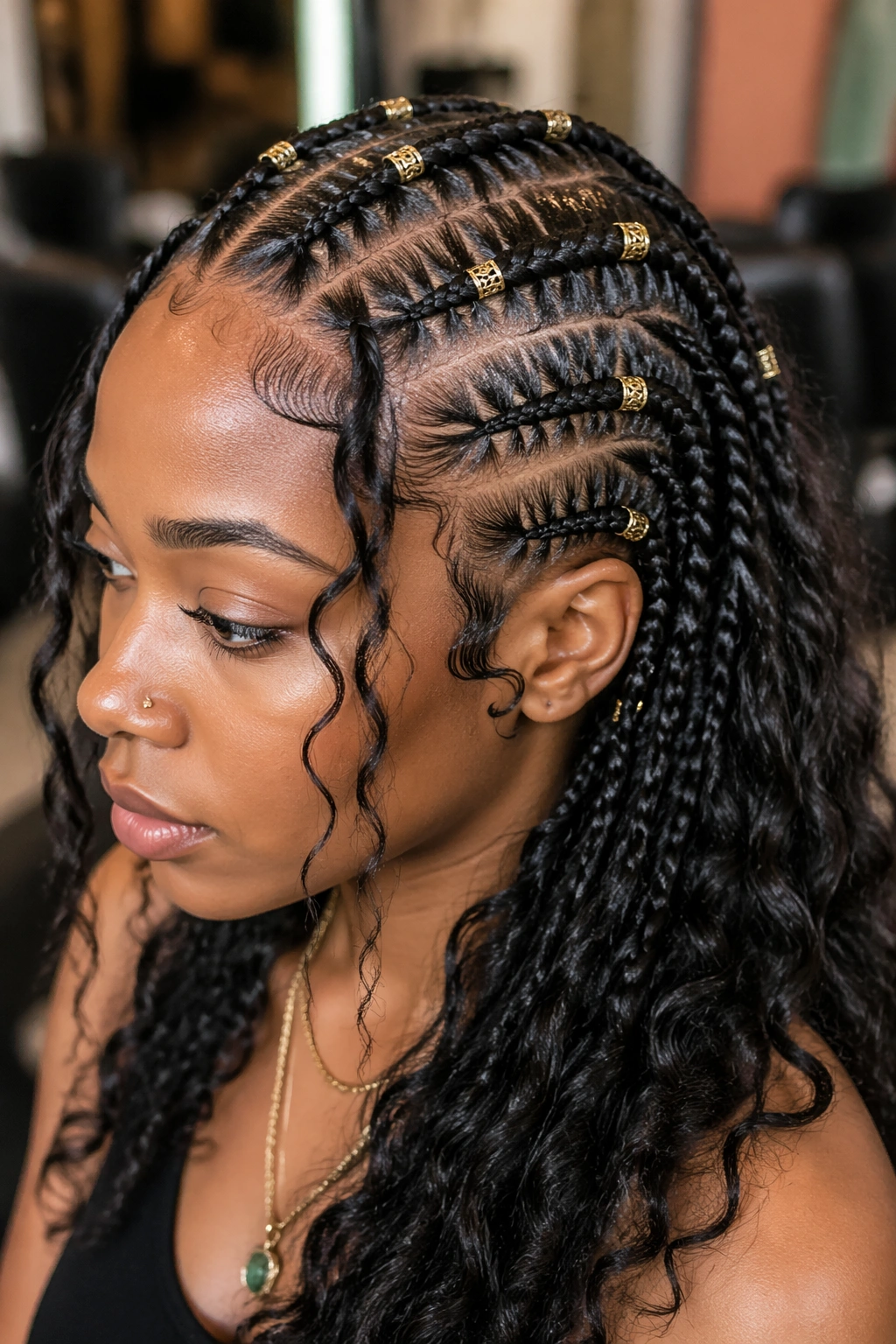
Gold or silver hair cuffs placed along the cornrow section before the curls begin. Cuffs sit at specific points on each cornrow — typically near the root and at the crown junction.
Styling Tips
- Use 2-3 cuffs per cornrow, placed at even intervals
- All cuffs same metal tone; don’t mix gold and silver
- Pair with simple dangle earrings that match the cuff tone
- Rotate cuffs weekly to prevent scalp pressure in one spot
Hair cuffs are interchangeable. You can swap them mid-install without redoing the braid. Pull them off, slide new ones on, done.
20. Bohemian Cornrows With Curly Baby Hairs
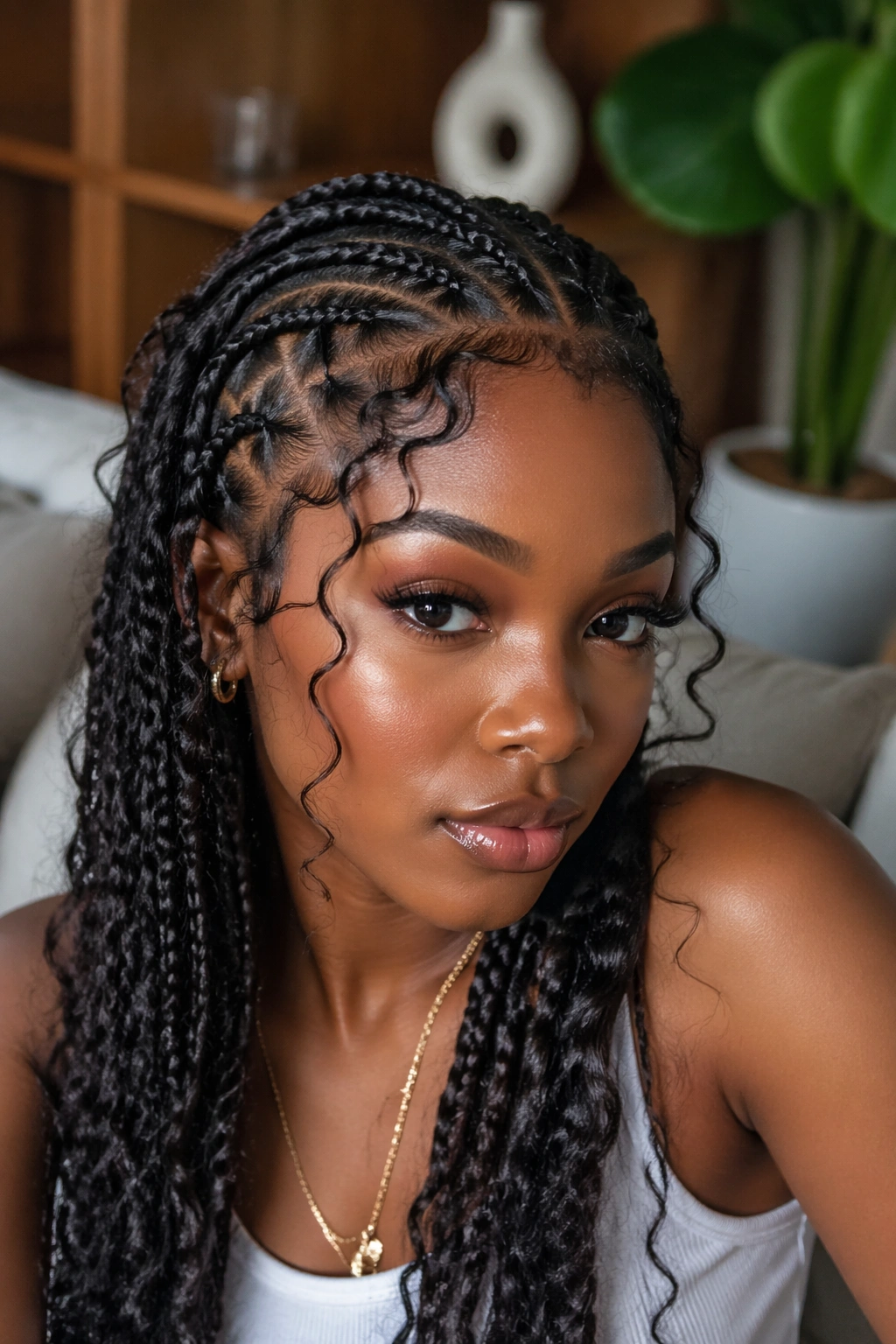
The front edges have deliberately curly baby hairs rather than the sleek edge-laid hairline that most cornrow styles use. The baby hairs are naturally coiled or curled with a small round brush and heat, adding to the bohemian texture.
This is a softer front than sharp laid edges. It suits the bohemian aesthetic because everything about the style emphasizes texture and looseness rather than precision.
Technique: use a small round brush with a blow dryer on low heat. Brush the baby hairs forward while drying, then finger-curl to create soft coils. Finish with a mist of light hairspray.
21. Bohemian Cornrows With Knotless Front
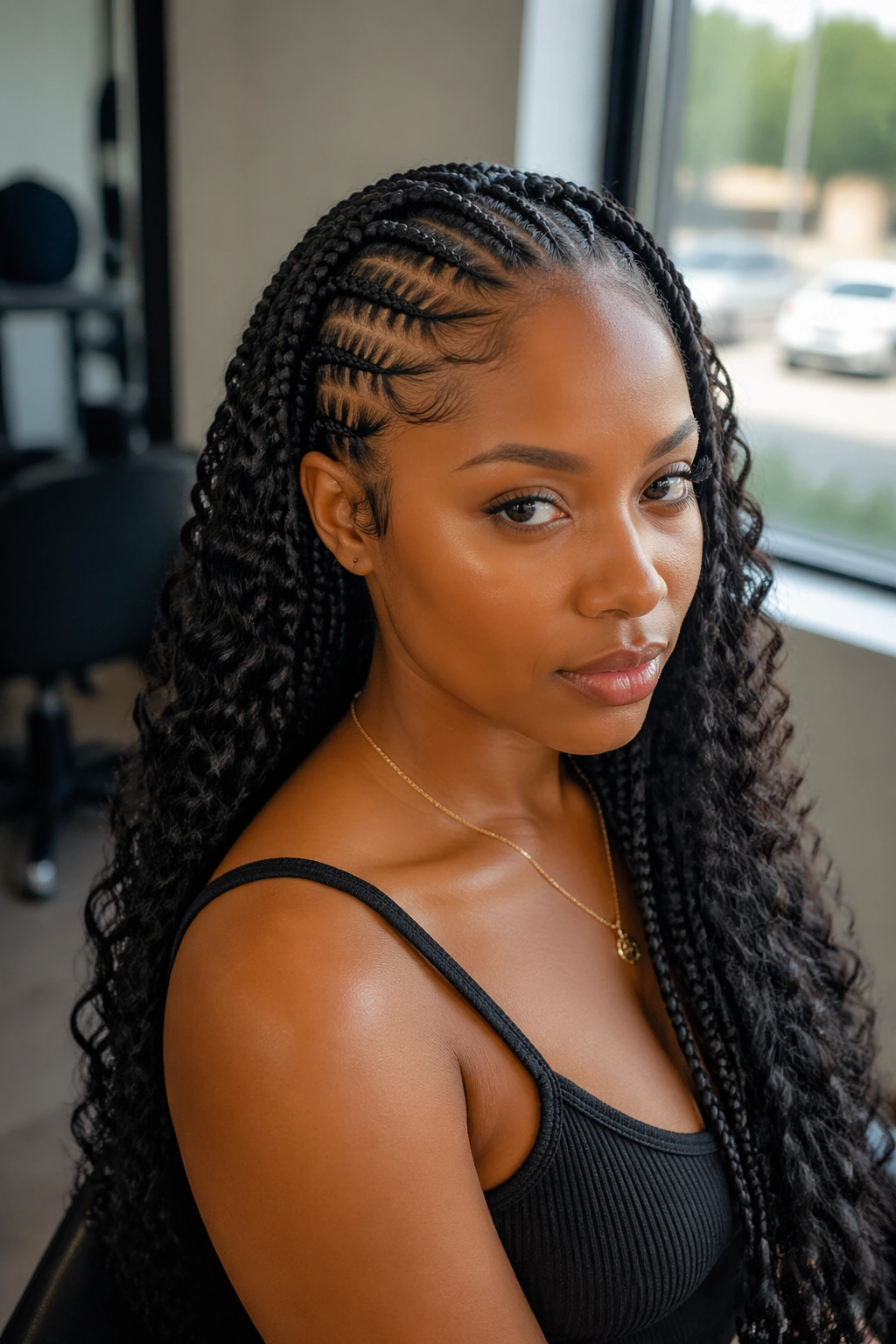
The front hairline section is knotless — no visible bump at the braid start — transitioning into standard cornrows behind the hairline. Knotless fronts give the cleanest look at the face while standard cornrows continue elsewhere.
Knotless takes longer to install (feed-in technique starting with zero extension and gradually adding). Worth the time if the front of the style matters most to you.
Most bohemian installs can skip knotless if the loose curls are heavy enough to hide the root bumps. If your curl density is moderate, knotless is worth the investment.
22. Bohemian Cornrows With Rainbow Accents
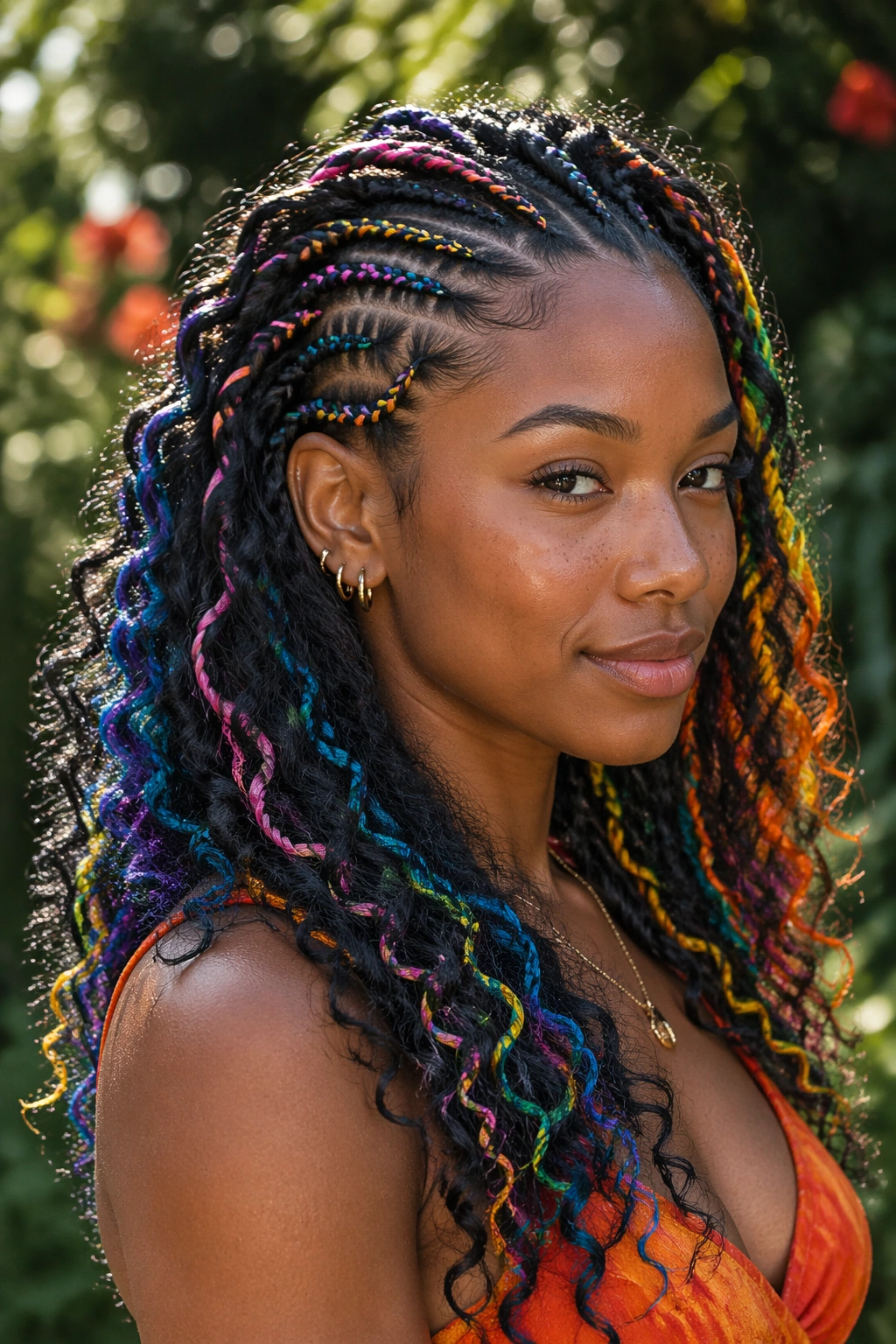
Multi-color kanekalon woven into the loose curly sections. Small strands of red, orange, yellow, green, blue, and purple distributed across the curls.
This is a bold style. Rainbow reads as celebratory, festival-ready, expressive. Not for conservative work environments.
The rainbow accents don’t need to be evenly distributed. A cluster of red on one side, a few strands of blue throughout, a pop of yellow near the face. Distribution creates personality.
23. Bohemian Cornrows With Twisted Sections
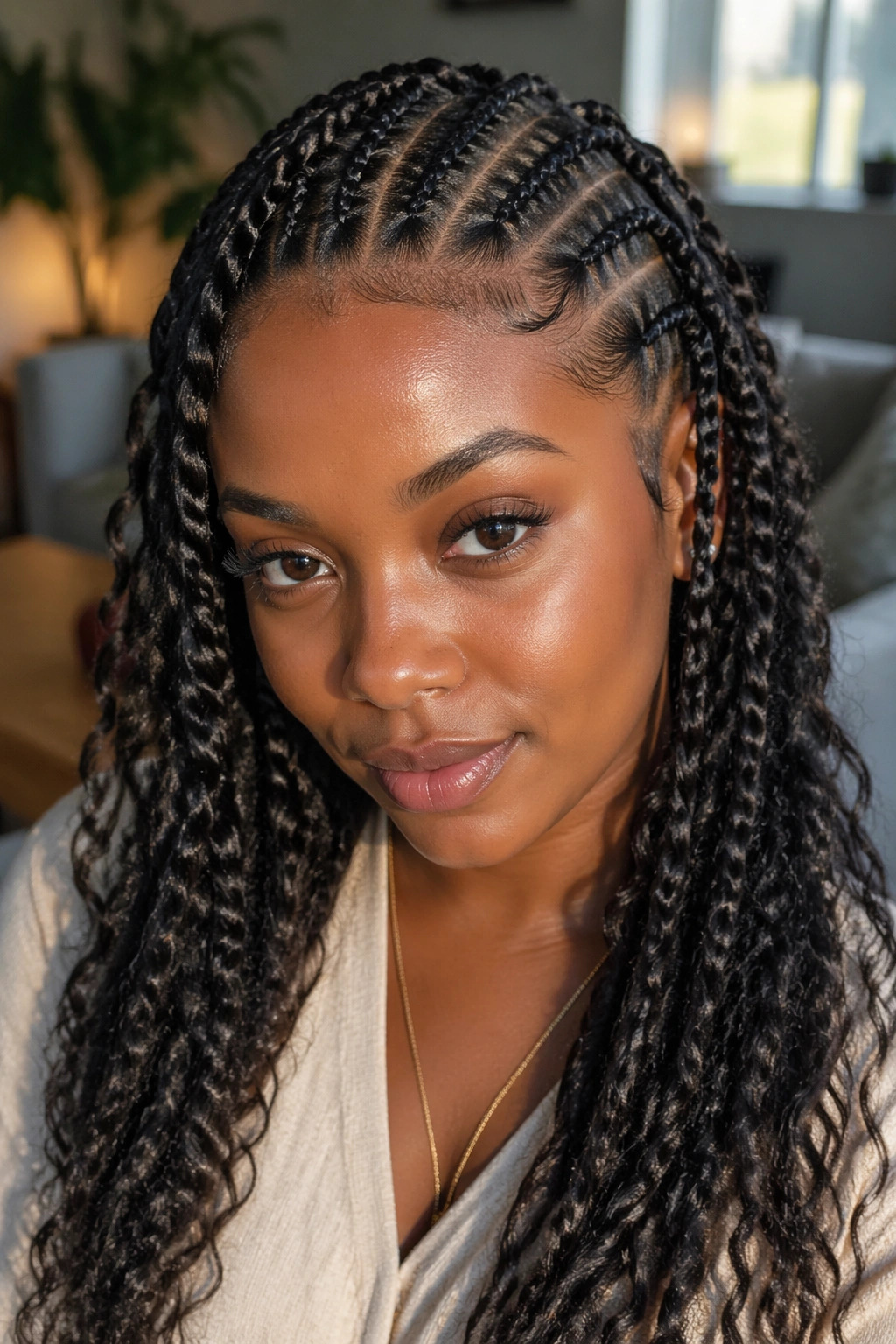
Some cornrow sections replaced with two-strand twists that transition into loose curls. Maybe 2 twists among 6 cornrows, creating visual variety in the base pattern.
The twists add texture contrast. Cornrows are tight and smooth; twists are ropey and dimensional. Combining them gives more visual interest than all-cornrows or all-twists.
Not every braider does mixed technique installs cleanly. Ask for examples before booking.
24. Bohemian Cornrows With Short Blunt Cut
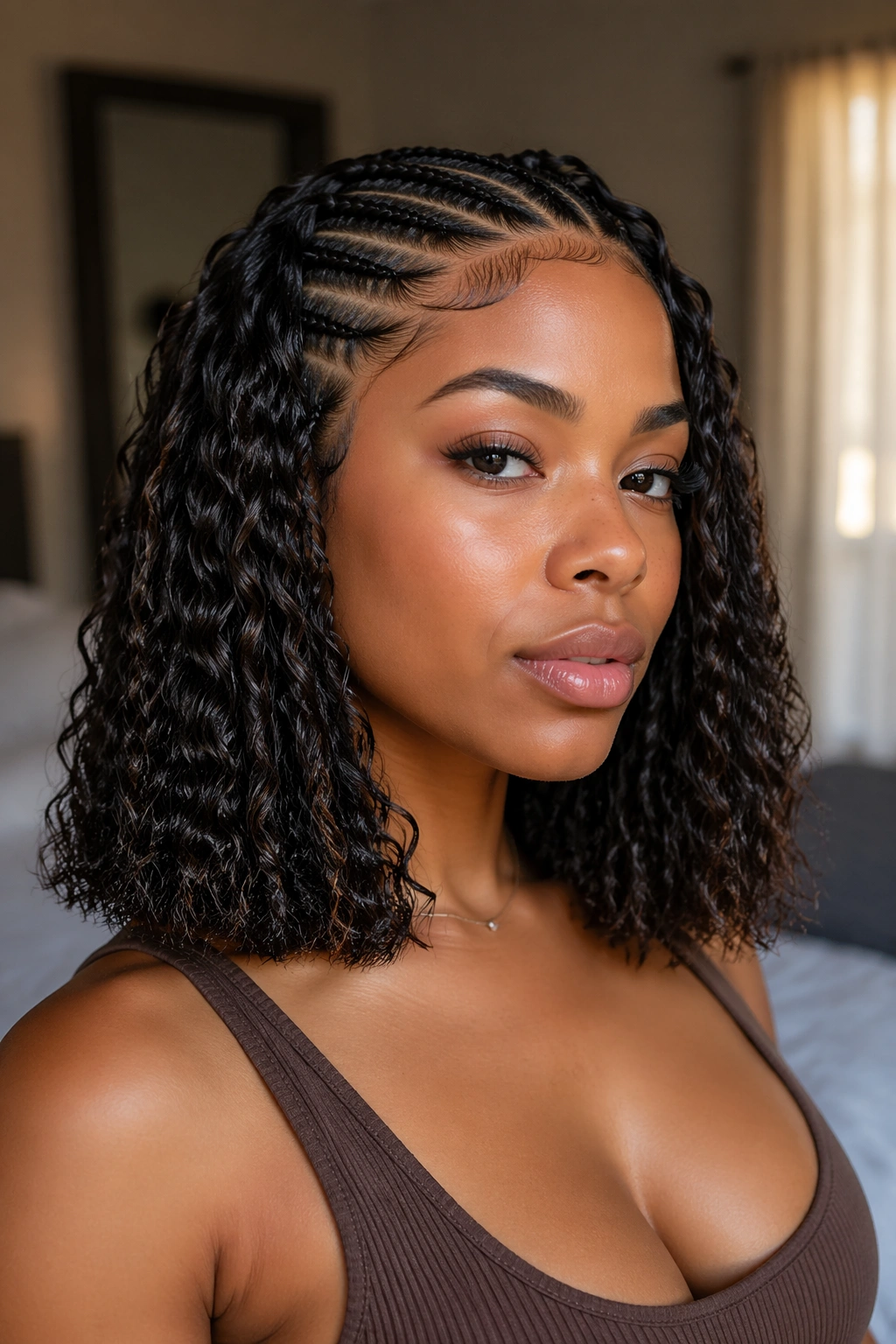
The loose curls are cut to a blunt length at the shoulders or chin — no graduated layering, no face-framing layers, just a straight cut across the bottom.
Blunt cuts on bohemian cornrows create interesting contrast. The curly texture is soft and flowing, but the bottom edge is sharp and defined. The contrast reads as intentional and distinctly styled.
Blunt cuts require a stylist’s scissors. Don’t trim at home — curly hair snaps back when cut wet, so the blunt line needs to be cut on slightly damp hair by someone who knows curl shrinkage patterns.
25. Bohemian Cornrows With Middle Bun Accent
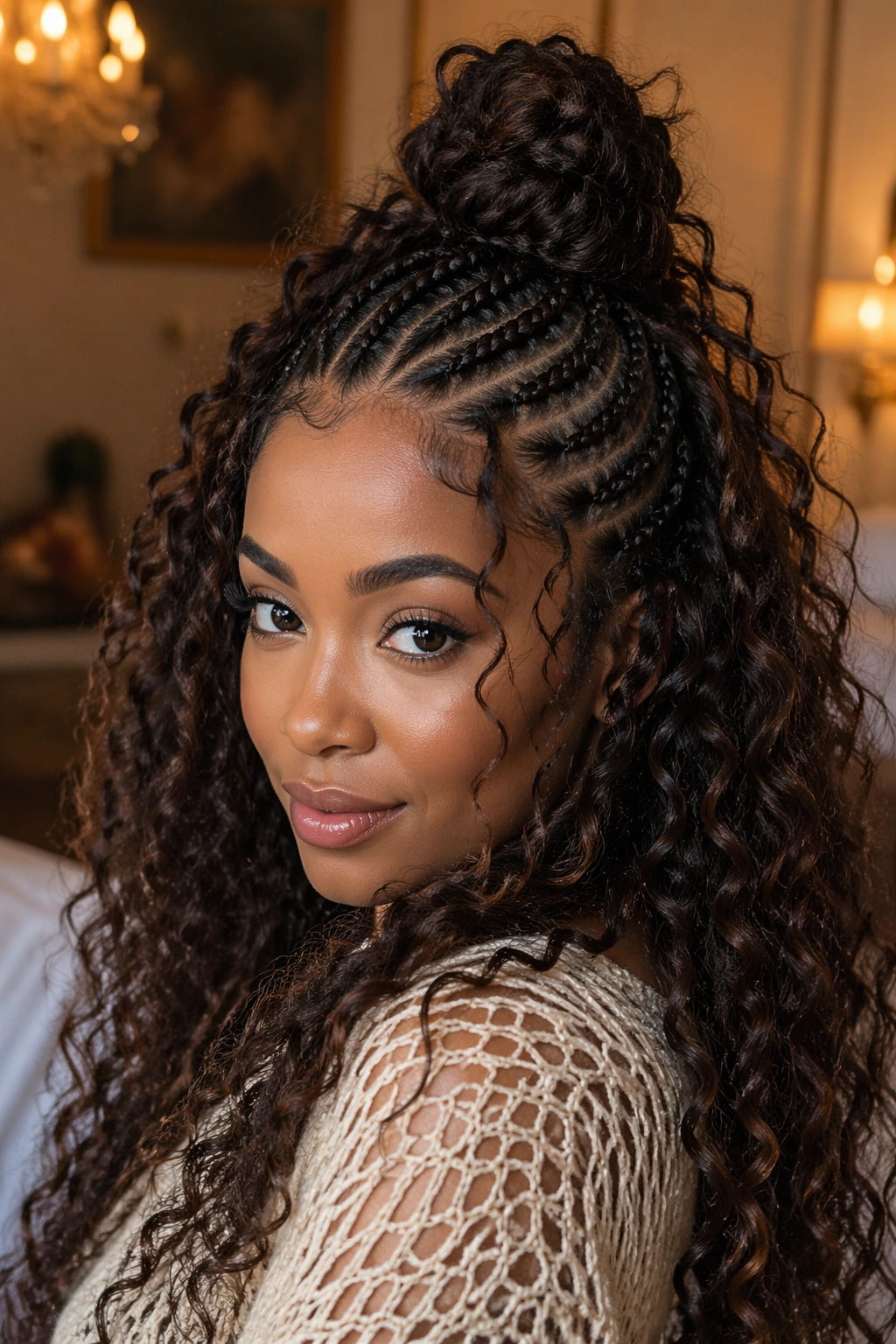
Most of the hair flows as loose curls, but a small bun is pinned at the crown using some of the cornrow-transition hair. The bun is decorative, not functional — it’s a detail accent while most of the hair hangs loose.
Who This Is For
Anyone wanting a formal accent in an otherwise casual bohemian style. The small bun adds event-appropriate structure without committing to a full updo.
- Bun size: about the size of a golf ball
- Bun placement: top of the crown, visible from the front and back
- Bun secured with: small U-pins and a light setting spray
- Release: pull bun out for daytime wear, recreate for evening events
Sleep Care for Bohemian Cornrows
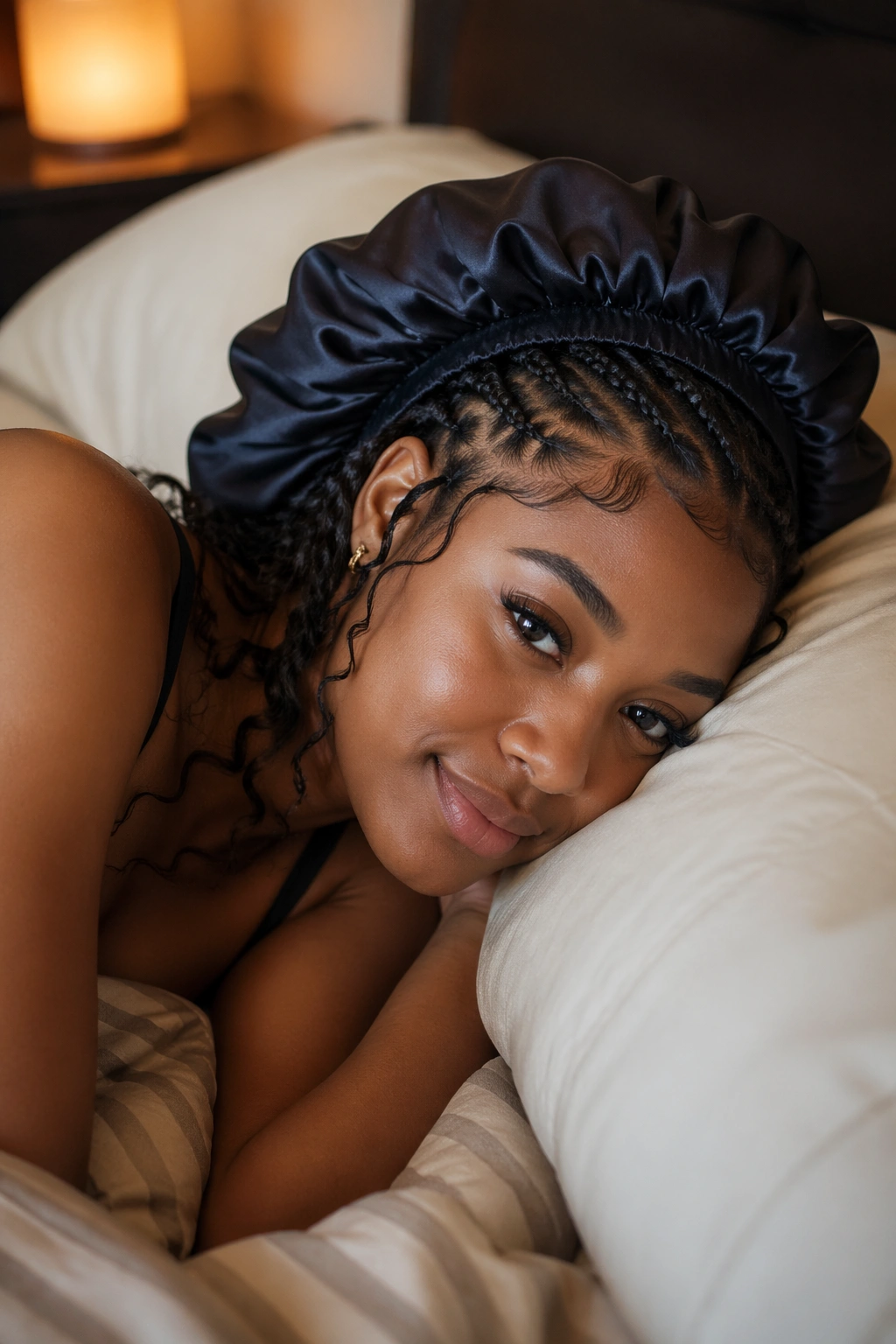
Bonnets designed specifically for long hair (oversized or “jumbo” bonnets) accommodate bohemian cornrows without flattening the curls. Standard bonnets compress the curls and leave them flat in the morning.
Silk pillowcases as backup for nights you forget the bonnet. Cotton is the enemy of loose curls on protective styles.
Pineapple technique: gather all the loose curls on top of your head in a loose ponytail before sleeping. This keeps the curls from matting against the pillow even if you shift during sleep.
Refresh in the morning with a curl refresher spray — water, leave-in, and a drop of oil in a spray bottle. Mist lightly, scrunch with fingers, let air dry.
Weekly Maintenance Schedule
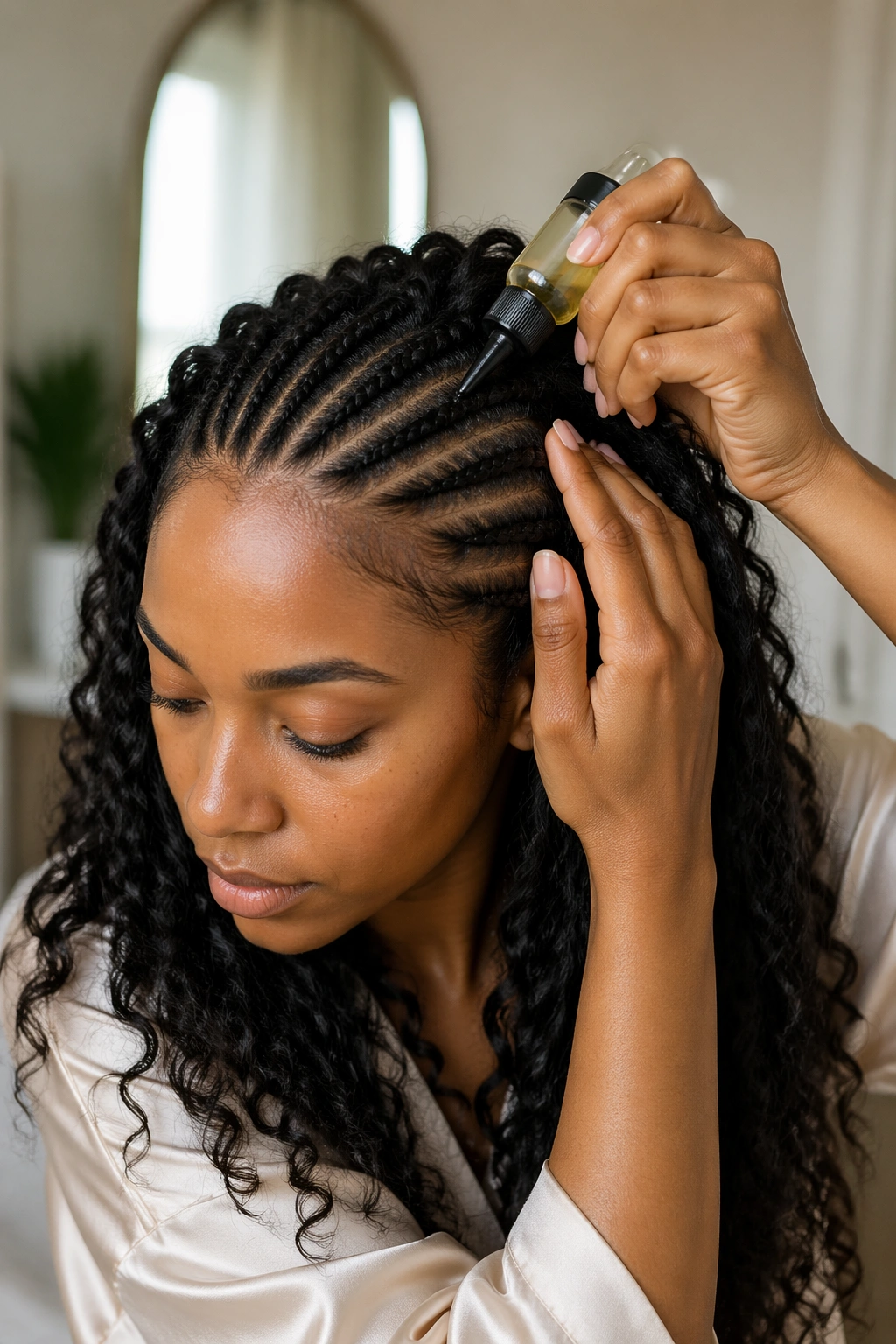
Day 1 (install day): bonnet sleep, no washing, minimal product.
Day 3: first scalp oil application. Apply lightly between cornrows with a pointed applicator bottle.
Day 7: curl refresh with water and leave-in spray. Finger-detangle any minor tangles in the loose curl section.
Day 14: scalp rinse with diluted ACV (1 tablespoon per cup of water). Apply to scalp only.
Day 21: second deep moisturize. Use a light oil on the curls; focus on ends where dryness shows first.
Week 4+: assess. Is the install still looking good? Are cornrows frizzy? Is the curl pattern still defined? Decide whether to take down or extend.
Picking the Right Length and Density
Length matters more than density for visual impact. A sparse install with 26 inches of hair reads more dramatic than a dense install with 14 inches.
Density matters more than length for fullness. A dense install with 16 inches of hair looks thick and bouncy. A sparse install with 28 inches looks stringy and wispy.
Pick based on your goal:
- Drama: long length, medium density
- Volume: medium length, high density
- Everyday wear: medium length, medium density
- Red carpet: long length, high density (expensive; plan for 6+ bundles)
Your face shape also plays in. Oval faces work with any length. Round faces benefit from longer lengths. Long faces work with medium lengths and bangs.
Common Mistakes With Bohemian Installs
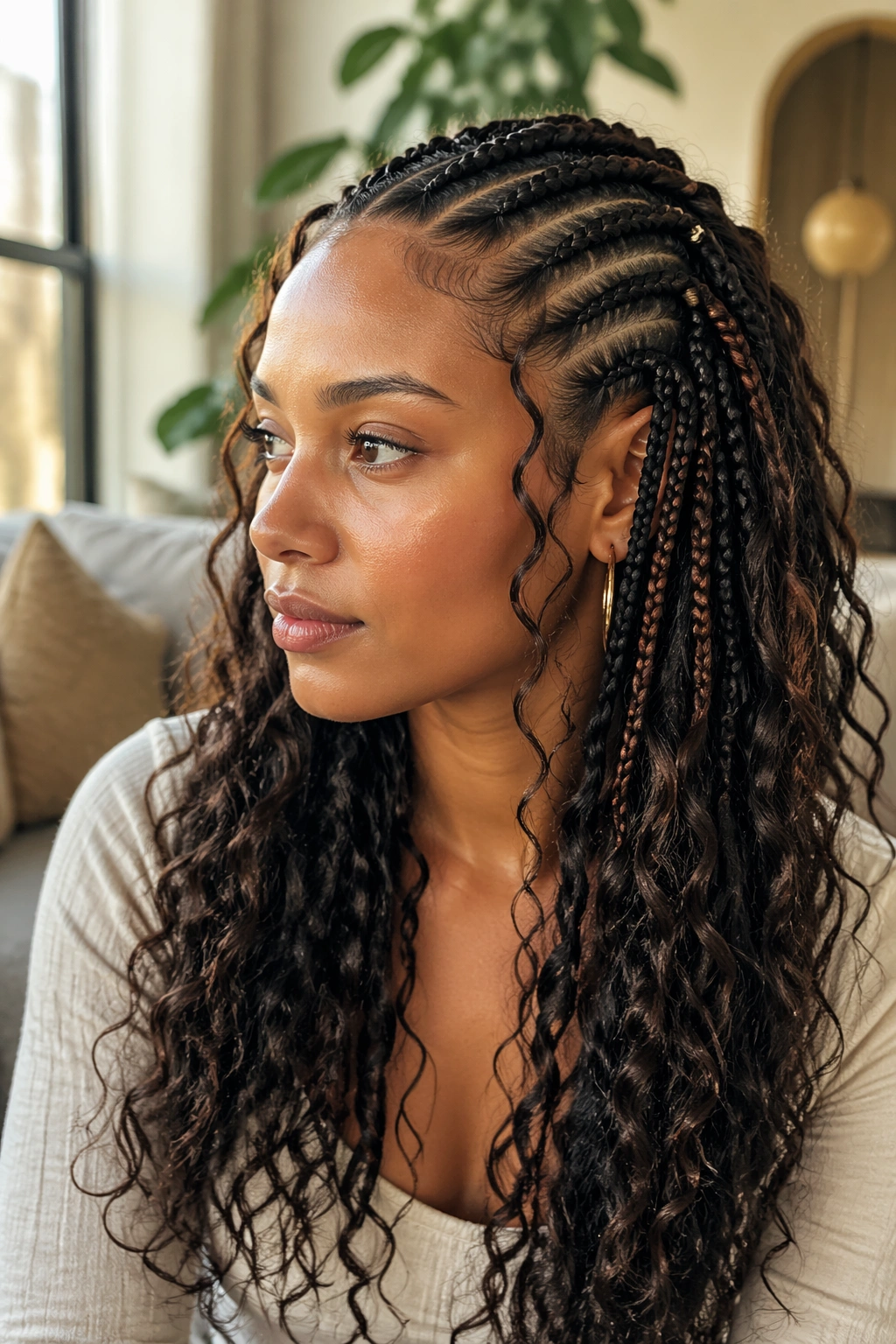
Too much curl on day one. Braiders sometimes over-release curls to make the install look full immediately. The problem: you have no adjustment room left. By week 2, the curls look frizzy and excessive.
Wrong curl pattern. Wet-and-wavy is a specific curl pattern (loose S-wave). If you want tighter curls, ask for “curly” or “deep wave” hair instead. Wet-and-wavy flat-ironed straight is a common mistake because braiders assume you want wavy hair.
Cheap hair brands. Saving $30 on hair quality results in visible shedding, matting, and premature frizz. Mid-range is the floor for bohemian installs.
Ignoring base color. If your cornrow kanekalon doesn’t match your curly hair color, the transition point shows obviously. Match the base color to the curl color within 1-2 shades.
Skipping the refresh spray. Loose curls get drier than straight hair because the curl pattern exposes more surface area to air. Daily refresh spray is mandatory for curl longevity.
Bohemian cornrows feel like a full-time relationship once they’re on your head. They demand care. They reward it with 4-6 weeks of a style that photographs well, feels light enough to wear comfortably, and makes you look like you spent time on yourself — even when you haven’t touched it in three days.