



Small cornrows on long hair occupy a particular sweet spot in the protective styling world. Big enough to install in a reasonable timeframe, small enough to give you the dense, jewel-like detail that makes cornrow patterns photograph well. When you’ve got real length to work with — past the shoulders, mid-back, longer — small cornrows let you carry that length through the whole style instead of bunching it into thicker rows that lose definition by week two.
I’ve worn small cornrows on long hair through every season, every climate, every messy life moment. Gym workouts, long flights, beach trips. The style holds. What changes is the maintenance routine, the choice of pattern, and the level of finish you want at the ends.
This piece walks through 22 small cornrow looks designed specifically for hair that has length to show. Some keep the natural length visible at the ends. Some incorporate kanekalon for added drama. Some braid the length into intricate patterns at the back. Each one solves a different challenge that long-haired wearers face when picking a small cornrow style.
Why Small Cornrows Suit Long Hair
The math is simple. The longer your hair, the more weight each braid carries. Larger cornrows on long hair often feel heavy at the scalp because each row holds significant mass. Small cornrows distribute the same total weight across more rows, which means lighter individual tension and less strain on the hairline.
There’s also a visual reason. Long hair in chunky cornrows can look top-heavy because the bulk of the style sits in the rows themselves. Small cornrows balance the proportion — the braid pattern reads delicate, and the length flowing past it reads dramatic.
The third reason is style longevity. Small cornrows lose their definition more slowly than larger rows. The thinner braid base resists the gradual loosening that wider braids experience around days 7-10. A small cornrow install on long hair can hold a clean look for three weeks if cared for properly.
Tools That Earn Their Place
Long hair plus small cornrows means a longer install and more material handling. The right tools matter.
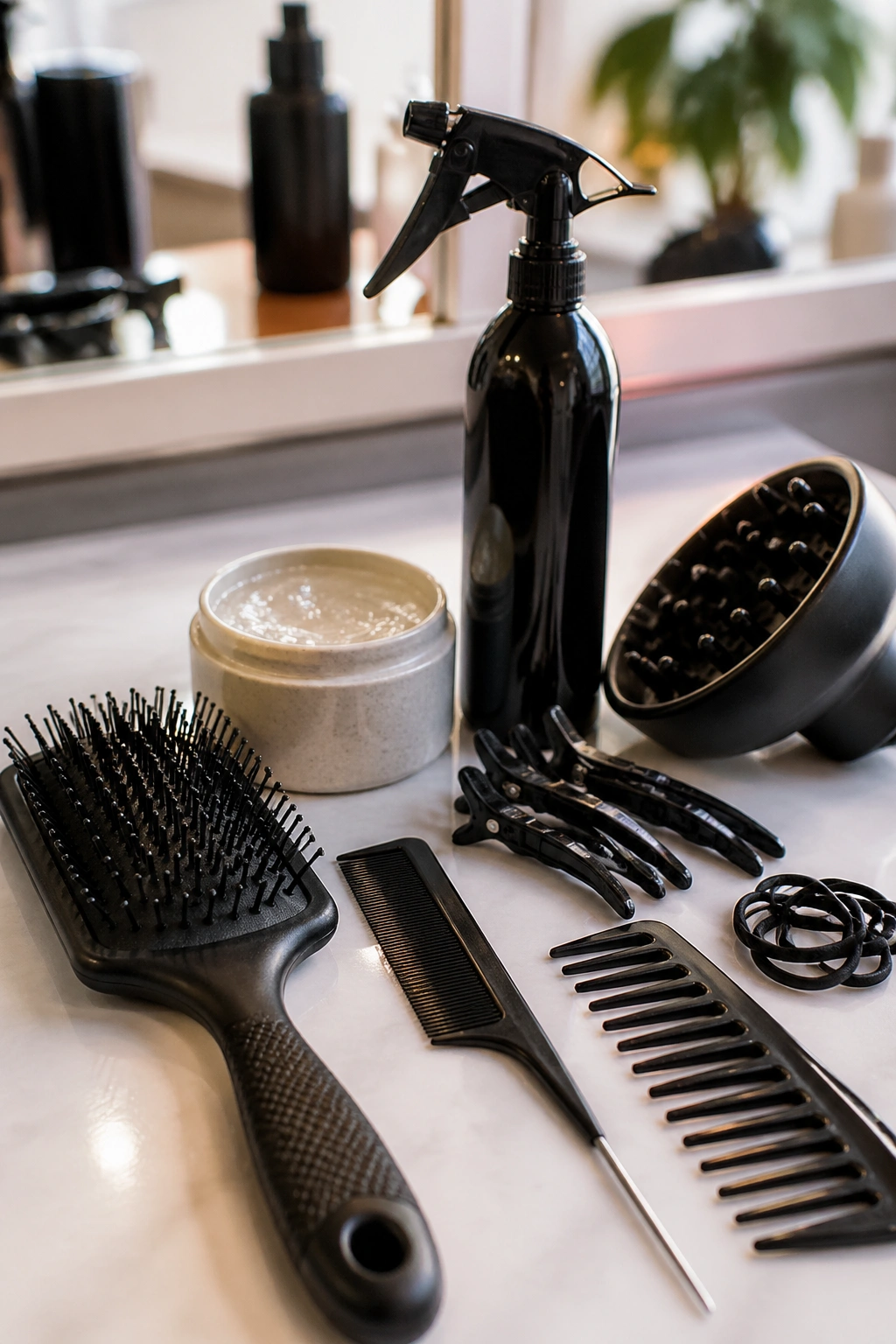
- A fine-tooth rat-tail comb with a needle-sharp metal tip
- A second wide-tooth detangling comb for working through length before parting
- Sectioning clips — at least 10 — to keep loose hair under control during the install
- A spray bottle filled with a water-leave-in mix for slip
- Edge gel with strong hold and minimal flake
- Small black or clear rubber bands for securing braid bases
- A hooded dryer or bonnet dryer if you plan to set the ends
- A satin or silk pillowcase, plus a bonnet for nightly care
- Optional: pre-stretched kanekalon if adding feed-ins
The tool I’d specifically recommend for long hair sessions is a Denman or similar paddle brush for prepping the loose length before braiding. Tangles in the loose hair slow the install down significantly.
Prep That Sets You Up for a Three-Week Install
Long hair holds tangles in places short hair never has to deal with. Before you sit down for small cornrows, you have to detangle obsessively. Knots at the ends, mats near the nape, any matting from previous styles — all of it has to go.
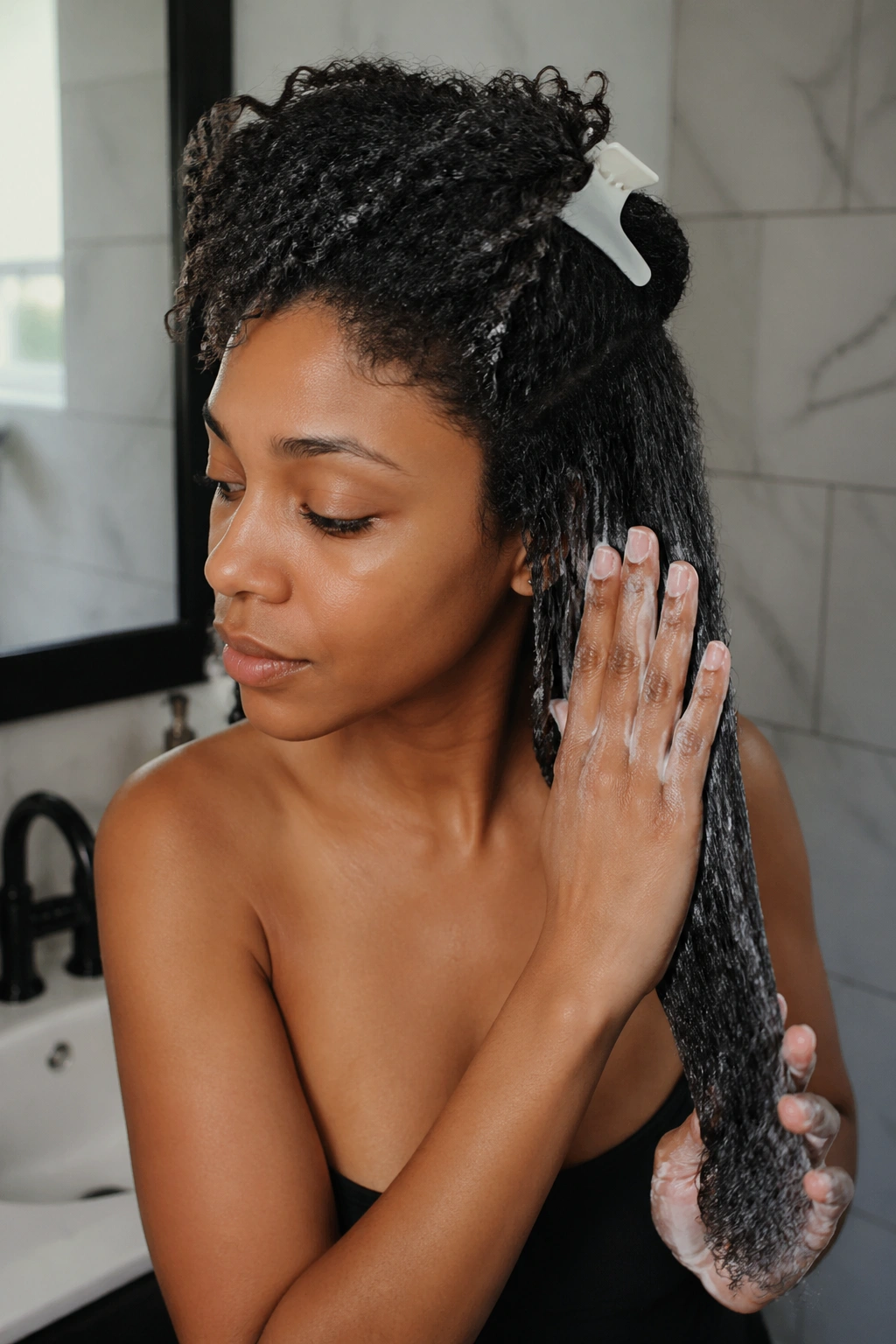
Wash with a gentle clarifying shampoo if you’ve been using heavy products recently. Follow with a deep conditioner, leave it in for at least 20 minutes under heat or a shower cap, and rinse with cool water to seal the cuticle. Detangle with a wide-tooth comb in the shower while the conditioner is still in.
After rinsing, apply a leave-in conditioner from mid-shaft to ends. Skip the scalp — leave-in at the roots before braiding causes slippage.
Air-dry to about 80% damp before starting the install. Fully wet hair stretches during braiding and snaps back looser; fully dry coily hair fights the comb during parting. The 80% mark is the goldilocks zone.
Stretch your length before braiding. Whether you achieve this with a blow-dryer on cool, banding, or large twist-outs, stretched hair braids more cleanly and produces less frizz than coiled hair forced into a small braid.
Parting Strategy for Dense Small-Cornrow Patterns
Parting fifty or more small sections takes patience and a system. Random parting leads to uneven density across the head — some areas with packed rows, others with sparse coverage.
Plan your pattern before you make the first part. Decide whether the rows will run straight back, side-to-side, in a curved sweep, or in a custom geometric pattern. Then mark the master parting lines first — the boundary partings — before subdividing into individual rows.
Maintain consistent row width. If the back of the head has 1/2-inch wide rows, the front should match. Variable row widths in a small cornrow style read as inconsistent rather than artistic.
Keep your fingers off the scalp during parting. Use only the comb tip. Skin contact smudges the gel line and blurs the parting.
Why Small Doesn’t Mean Tiny
There’s a distinction between small cornrows (around 1/2 inch base width) and micro cornrows (around 1/4 inch). Both are smaller than standard, but they behave differently on long hair.
Small cornrows hold long-hair weight without distorting. Micro cornrows on long hair can struggle — the tiny braid base sometimes can’t support the length and the rows lift from the scalp earlier.
For most long-hair wearers, small cornrows hit the sweet spot. They give the dense detail without the structural fragility of micro work. Save micros for shorter hair or styles where you only need the pattern over part of the head.
1. Straight-Back Small Cornrows With Loose Natural Ends
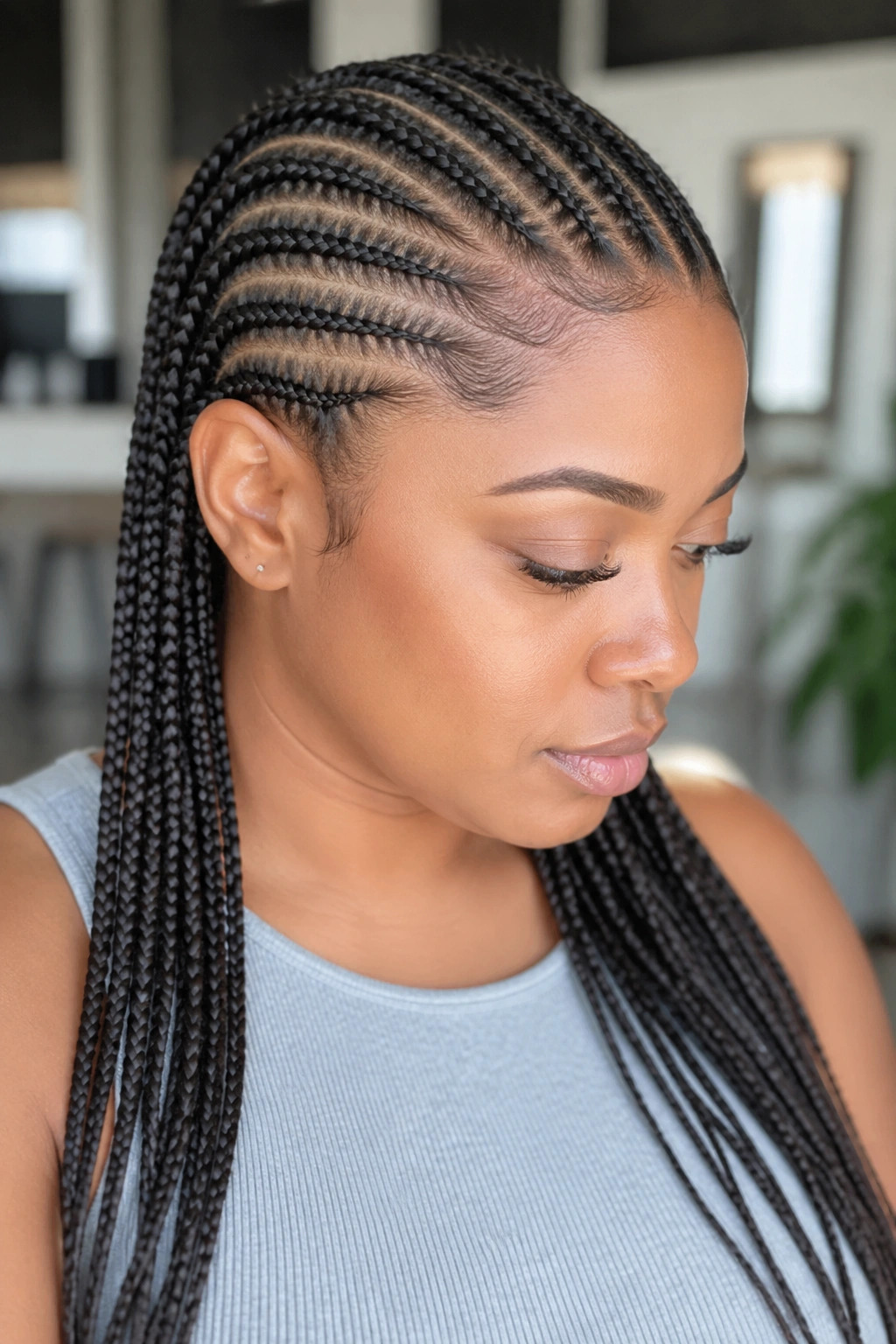
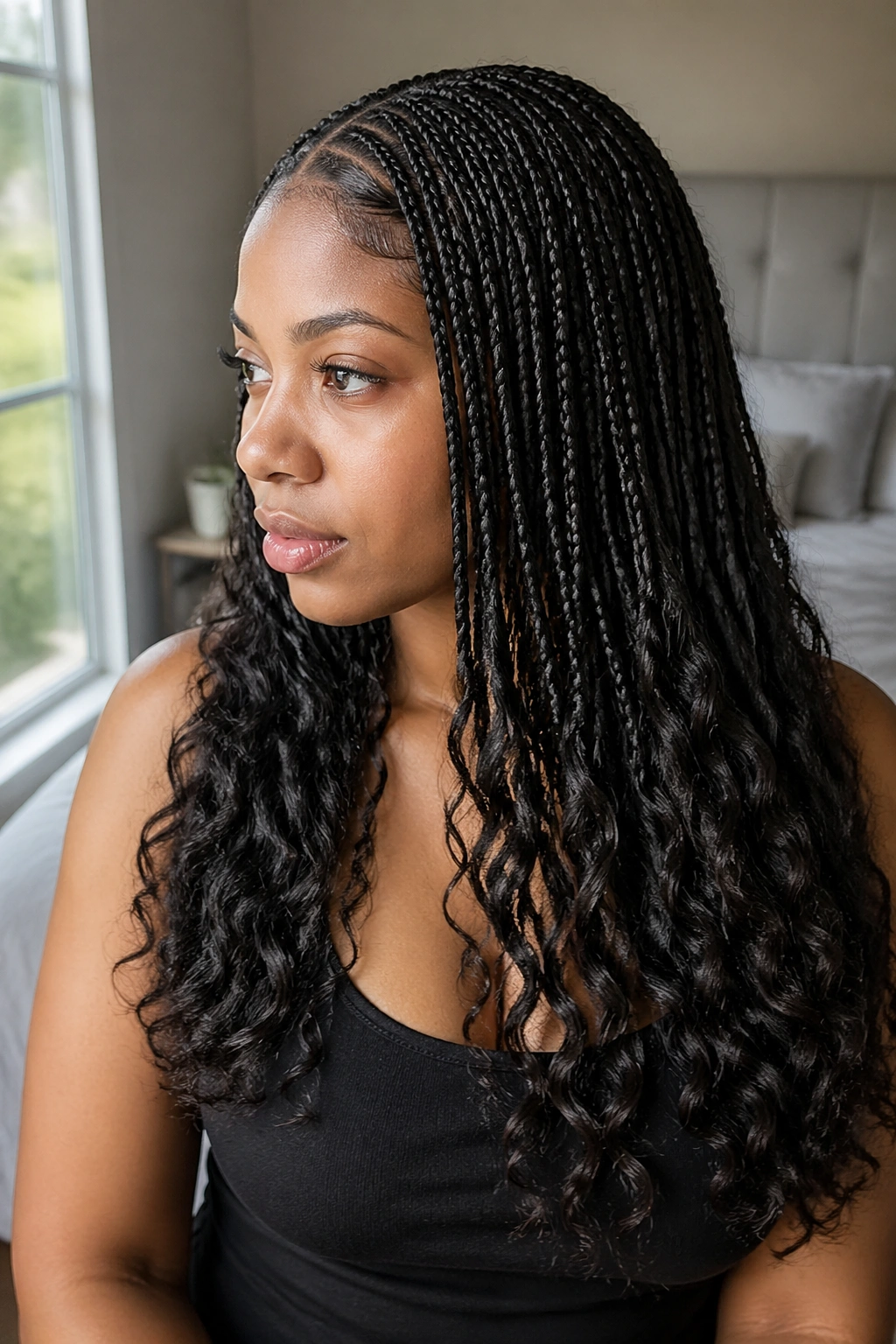
The classic. Twenty to twenty-eight small cornrows running straight from the hairline to the nape, with the long natural hair flowing freely from the braid ends. No extensions, no kanekalon, no decorative finish — just clean rows and visible length.
Why It Works
This is the foundational small cornrow style for long hair. It showcases your length without competing with it. The braid pattern provides structure across the scalp; the loose ends provide movement.
- Plan for 3-4 hours of install time on average density
- Use roughly 22-26 rows depending on head size
- Secure each braid base with a small rubber band before letting the loose end hang
The trick with this style is the transition point. Where the cornrow ends and the loose hair begins should be smooth, not lumpy. A clean transition reads professional. A bumpy transition reads amateur.
This style works for almost any setting — gym, office, dinner, sleep — and refresh is straightforward. It’s the style I keep coming back to when I need protection without statement.
2. Center-Part Small Cornrows With Twisted Ends
A deep center part divides the head, and small cornrows curve away from the center on each side, forming a symmetric sweep. The braid ends get two-strand twisted to add visual interest at the bottom.
Where a straight-back style emphasizes simplicity, the center-part sweep emphasizes structure. The symmetry forces the eye to read the pattern as deliberate.
The twisted ends work because they extend the long-hair drama past the cornrow portion. Each braid ends in a longer twist, which on long hair can mean an additional 6-10 inches of styled length below the braid.
Twist each end with a small amount of mousse or curl cream for hold. Untreated twists unravel within a day or two.
Best for: anyone whose head shape is symmetric and who wants a style that photographs well from straight-on angles.
3. Side-Sweep Small Cornrows With Curled Ends
Unlike a center part, the side-sweep runs all small cornrows from a deep side part across the head. The longer side carries more rows; the shorter side has fewer. The braid ends get curled with flexi-rods or a curling iron at low heat.
What’s different about this style is the asymmetric flow. The eye follows the rows from the side part, across the head, to the gathered side where the curls fall.
- Set the side part deep — at least 2 inches off-center for visible asymmetry
- Use 18-22 rows depending on head size
- Curl ends overnight with flexi-rods for the most natural finish
The curls at the ends soften what would otherwise be a sharp geometric look. Long curled ends drape past the shoulders and add a romantic quality that pure cornrows lack.
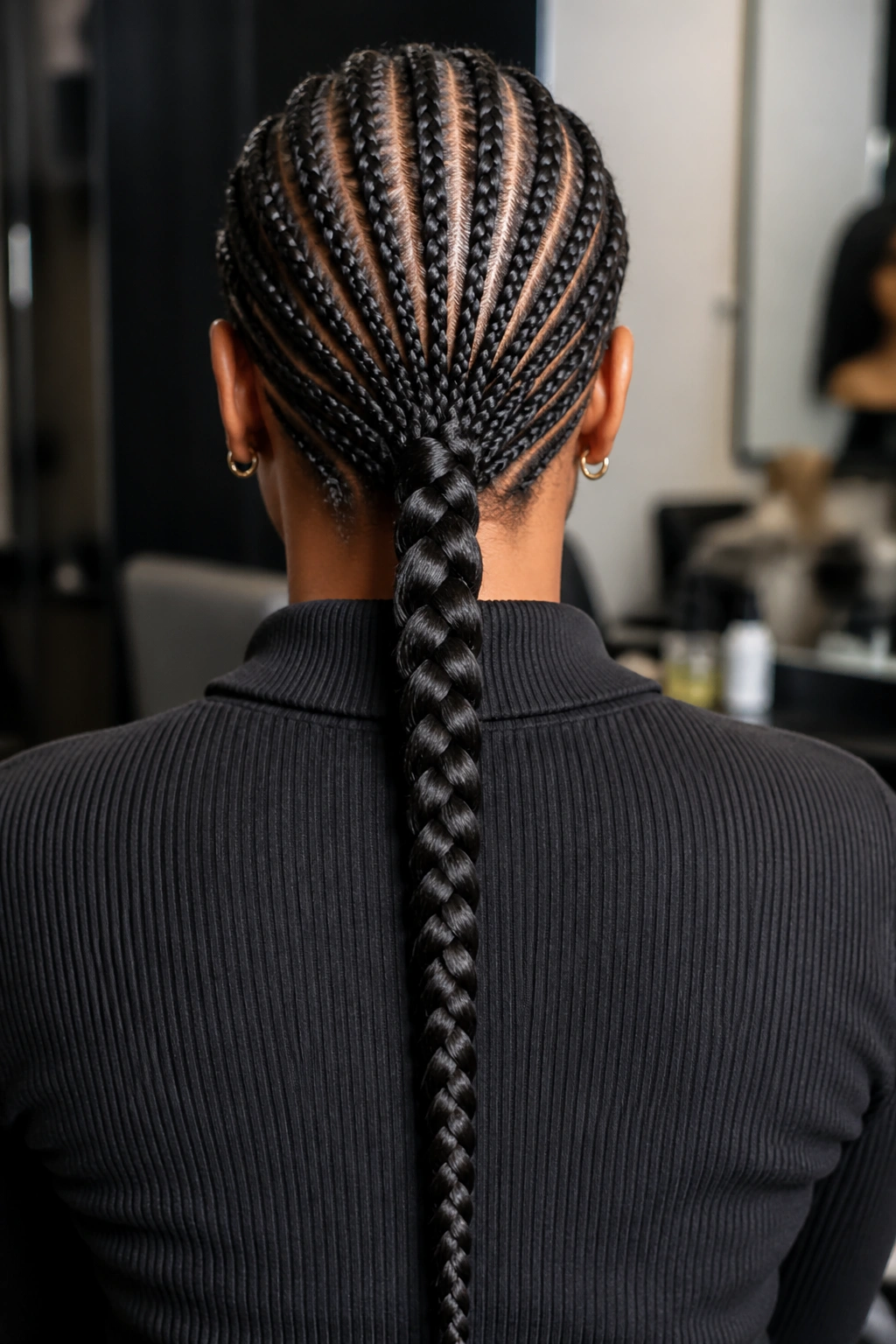
4. Small Cornrows Into a Single Long Braid
Every small cornrow leads back to a central gather point at the nape, where all the braid ends combine into one long single braid hanging down the back. The single braid can extend far past the natural hair length if you’ve added kanekalon to the cornrow ends.
This style is mechanically clever. The cornrows do the structural work across the scalp; the single trailing braid does the visual work down the back. From the front, you see crisp rows. From behind, you see one dramatic braid.
The combined braid can be a three-strand standard braid, a fishtail, or a four-strand for added detail. Three-strand reads classic; fishtail reads ornate; four-strand reads bold.
Recommendation: secure the gather point with a small fabric tie rather than a rubber band. Fabric ties don’t damage the braid bases and read more polished if visible.
5. Small Cornrows With a Halo Crown
A halo crown is a continuous circle of small cornrows running around the head, just above the ears, creating a literal crown of braids. The hair inside the halo (top of the head) and below it (nape) is left loose or styled separately.
Picture a wreath of small braids encircling the head. The interior loose hair can be pinned up, twisted into a bun, or left as a textured top puff. The nape hair can hang loose for length emphasis.
The technical challenge is keeping the halo perfectly horizontal. Any tilt or asymmetry shows immediately because the halo is the focal element. A skilled braider with a steady hand makes this style sing.
Best for special occasions rather than everyday wear. The halo reads ceremonial, so it suits weddings, photo shoots, formal events.
The downside: the hair above and below the halo needs its own daily styling. This isn’t a low-maintenance look despite its braided structure.
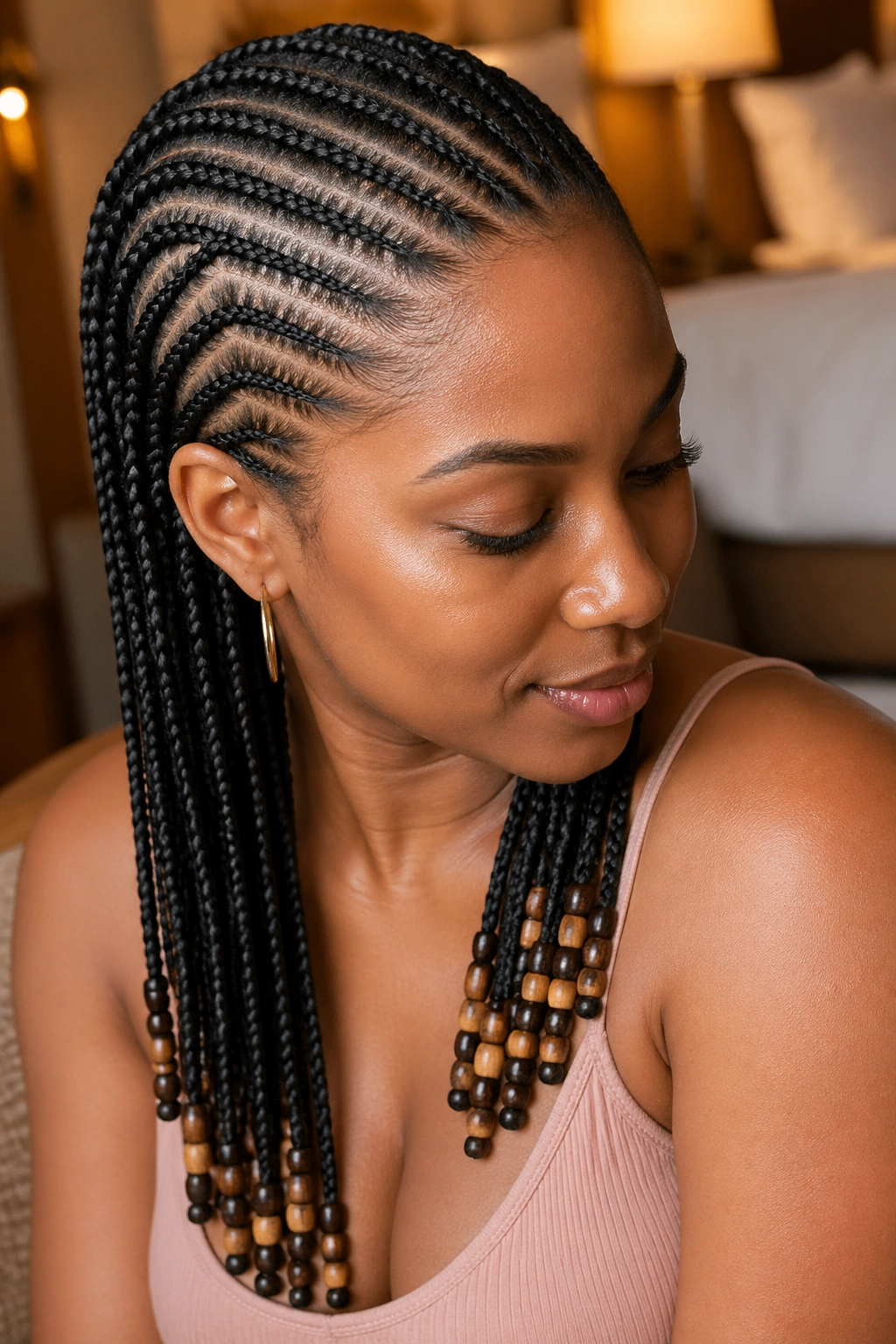
6. Diagonal Small Cornrows With Beaded Ends
Small cornrows running at a strong diagonal — say 60 degrees from the hairline toward the nape — create a sweeping motion across the scalp. Beads at the ends add weight and sound to the long braided length.
Diagonal small cornrows are harder to part than straight-back ones because the angles have to remain consistent across the head. Even a small drift in angle from row to row makes the pattern look uneven.
How to Use It
Use no more than 4 beads per braid. Long braids with too many beads start to drag uncomfortably and can create traction at the scalp.
- Choose lightweight beads — wood or resin — for long braids
- Distribute bead colors unevenly for a more natural finish
- Secure each bead with a rubber band looped through the bead hole
The diagonal direction looks especially flattering on round and square face shapes because it visually elongates the head.
7. Small Cornrows With a Knotless Front Section
Combining techniques: the front section of the head (forehead to mid-crown) gets small cornrows with knotless feed-ins, while the back gets standard small cornrows. Knotless means the braid starts without the small “knot” of doubled hair at the base, instead beginning with your natural hair only and feeding in extension hair over the first few stitches.
Why combine? Knotless reduces tension at the hairline, where damage is most concerning. Standard small cornrows at the back are faster to install and less expensive in terms of time.
This hybrid approach is what experienced braiders often recommend for long-haired clients with sensitive edges. You get edge-protection where you need it without adding hours to the install.
Best for: anyone with thinning edges or a history of traction damage along the hairline.
Recommendation: be specific with your braider about the knotless front. Say “knotless feed-in technique on the front rows, standard small cornrow on the back.” Vague instructions can lead to mixed results.
8. Small Cornrows With Wave-Set Ends
Long natural hair at the braid ends gets wave-set on flexi-rods or perm rods overnight, creating defined waves that fall past the cornrow ends. The contrast between sharp braids and soft waves is the appeal.
The wave-set adds maybe 8 hours of overnight processing time but takes only minutes of active work. Apply setting lotion to the loose ends, divide into small sections, wrap each section around a flexi-rod, sleep with a bonnet.
In the morning, unravel gently and apply a sheen spray. The waves should be defined but not overly stiff.
This style suits anyone who likes their long hair to look “done” rather than just hanging. Waves give the loose ends a sense of intention.
9. Small Cornrows With a Crown Bun
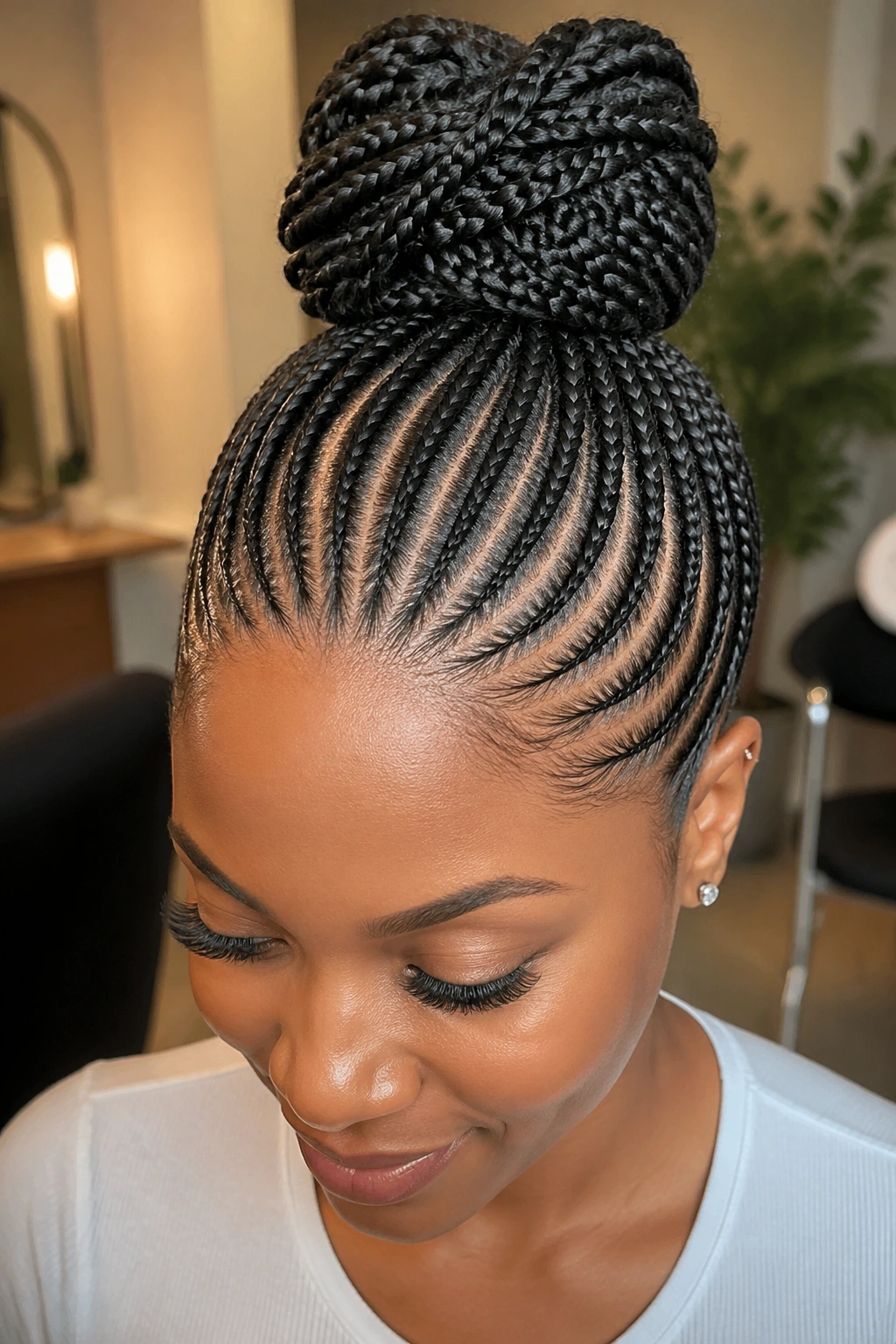
All small cornrow ends gather at a single point on top of the head, forming a high crown bun. The bun can be kept tight and structured or fluffed for a more voluminous look.
Mechanically, this style requires every cornrow to angle toward the gather point. Straight-back rows won’t work — each row has to curve subtly toward the crown.
The crown bun configuration pulls the eye upward and creates an elongating effect. It’s flattering on shorter face shapes (square, round) because it adds vertical height.
Avoid sleeping in the high bun. Press the bun between your head and the pillow nightly and you’ll deform the shape within days. Take it down before bed and re-pin in the morning.
10. Small Cornrows With Decorative Cuffs
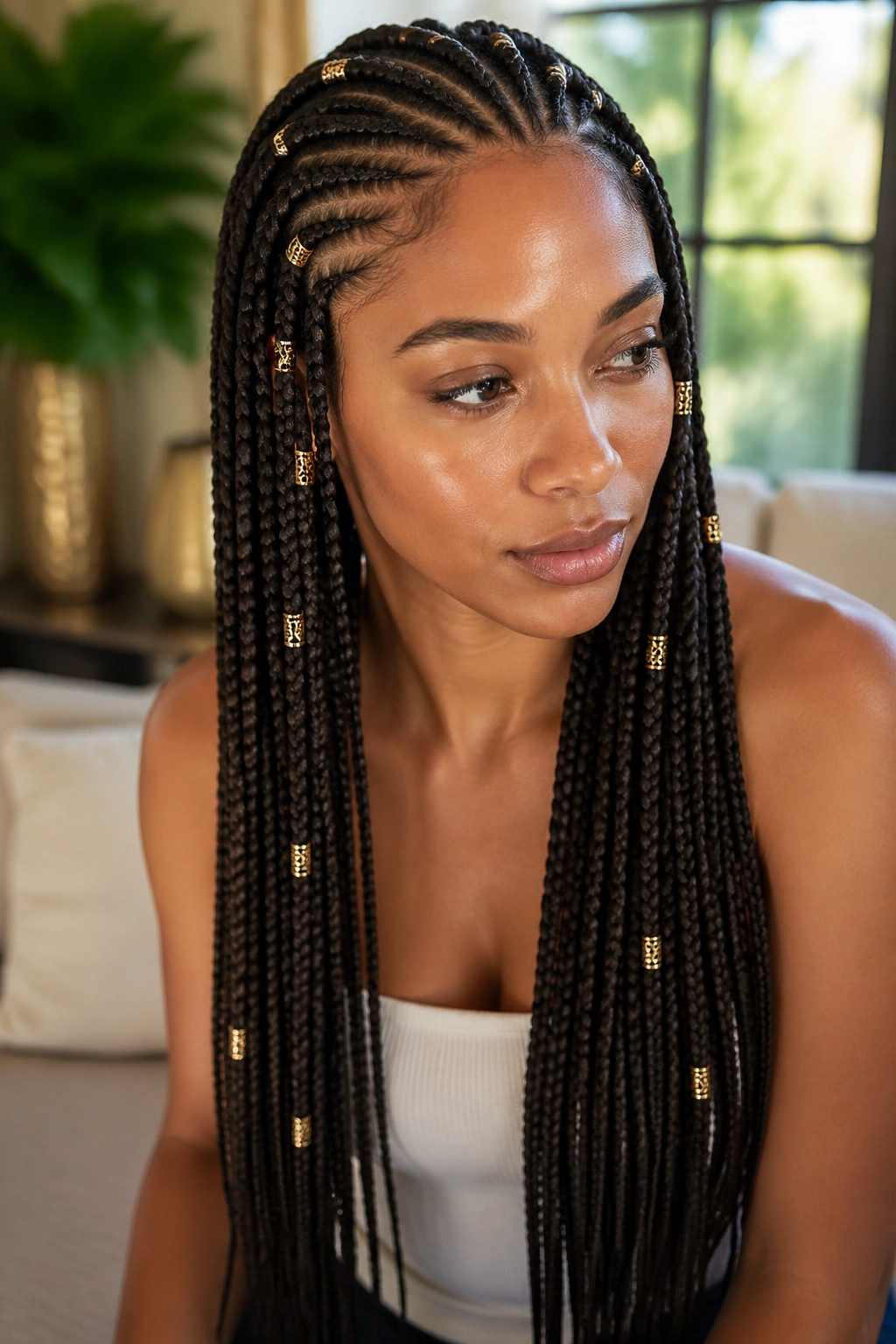
Metal cuffs slipped onto select braids add jewelry-like accents. Unlike beads, cuffs are typically larger and placed less frequently — maybe one or two cuffs per braid, at intervals.
Gold, silver, brass, or copper cuffs each give a different mood. Gold reads luxurious; silver reads cool; brass reads earthy; copper reads warm.
- Use cuffs with smooth inner edges to prevent hair snagging
- Place cuffs at varying heights down the braid for visual rhythm
- Don’t overdo it — six to ten cuffs total across the head is plenty
Cuffs work especially well on long small cornrows because the long braided length gives the cuffs visual real estate to occupy. On short braids, a cuff can dominate the whole braid; on long braids, it accents without overwhelming.
11. Small Cornrows in a Lemonade Side Pattern
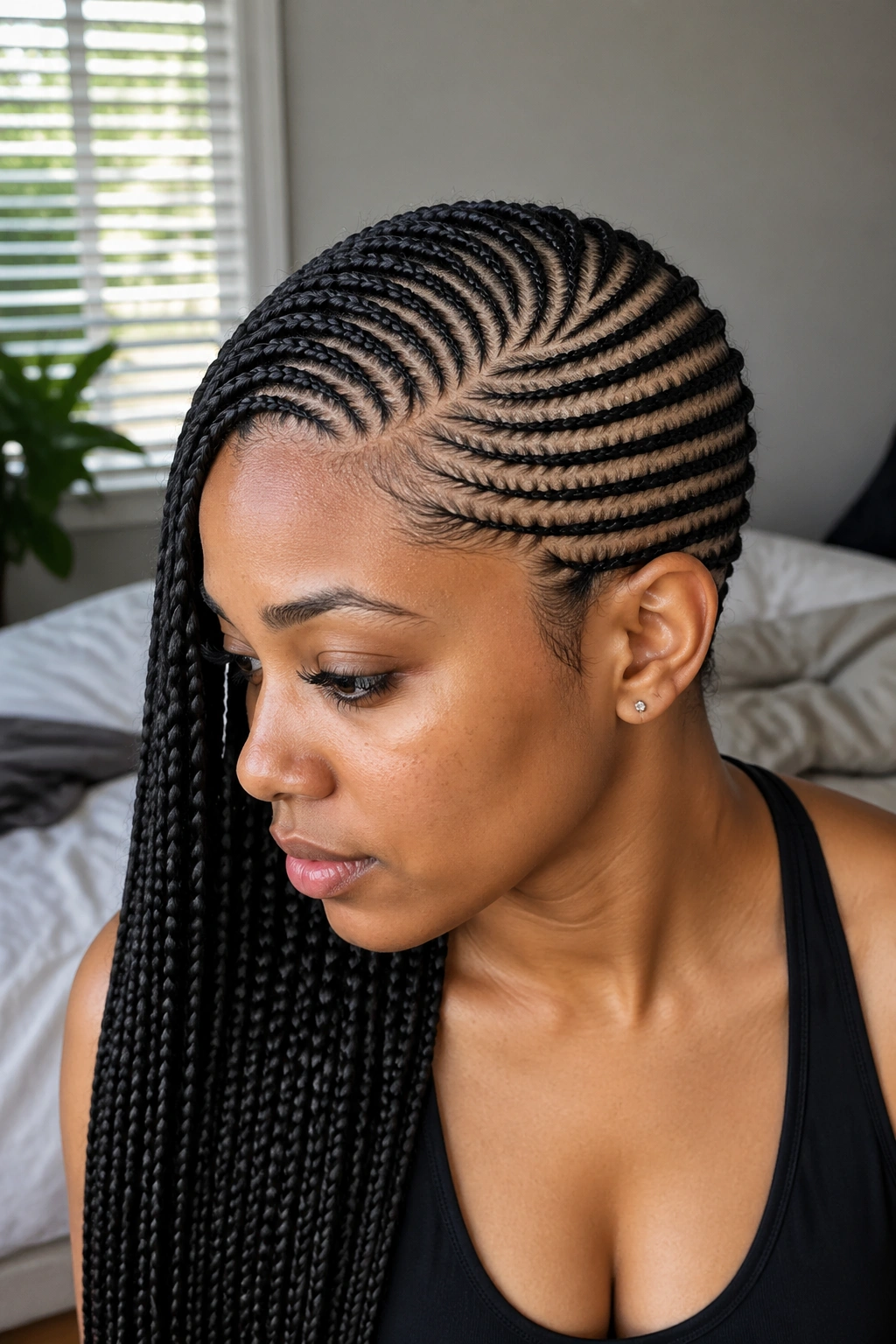
The lemonade pattern (named for the iconic music video that popularized it) sweeps all cornrows across the head from one side, creating a dramatic side-swept silhouette. On long hair with small cornrows, the effect is heightened by the density of rows and the visible length.
What makes lemonade different from a basic side-sweep is the curve. Lemonade rows don’t run straight; they curve gracefully from the side part across the head, ending at the opposite ear or behind it.
The curving rows require a braider who can maintain consistent curve geometry across all the rows. Each row has to mirror the curve of the row above it, scaled for its position on the head.
Best for: someone who wants the iconic look and doesn’t mind the brand association. The lemonade pattern carries cultural weight beyond its visual appeal.
12. Small Cornrows Into a Low Side Ponytail
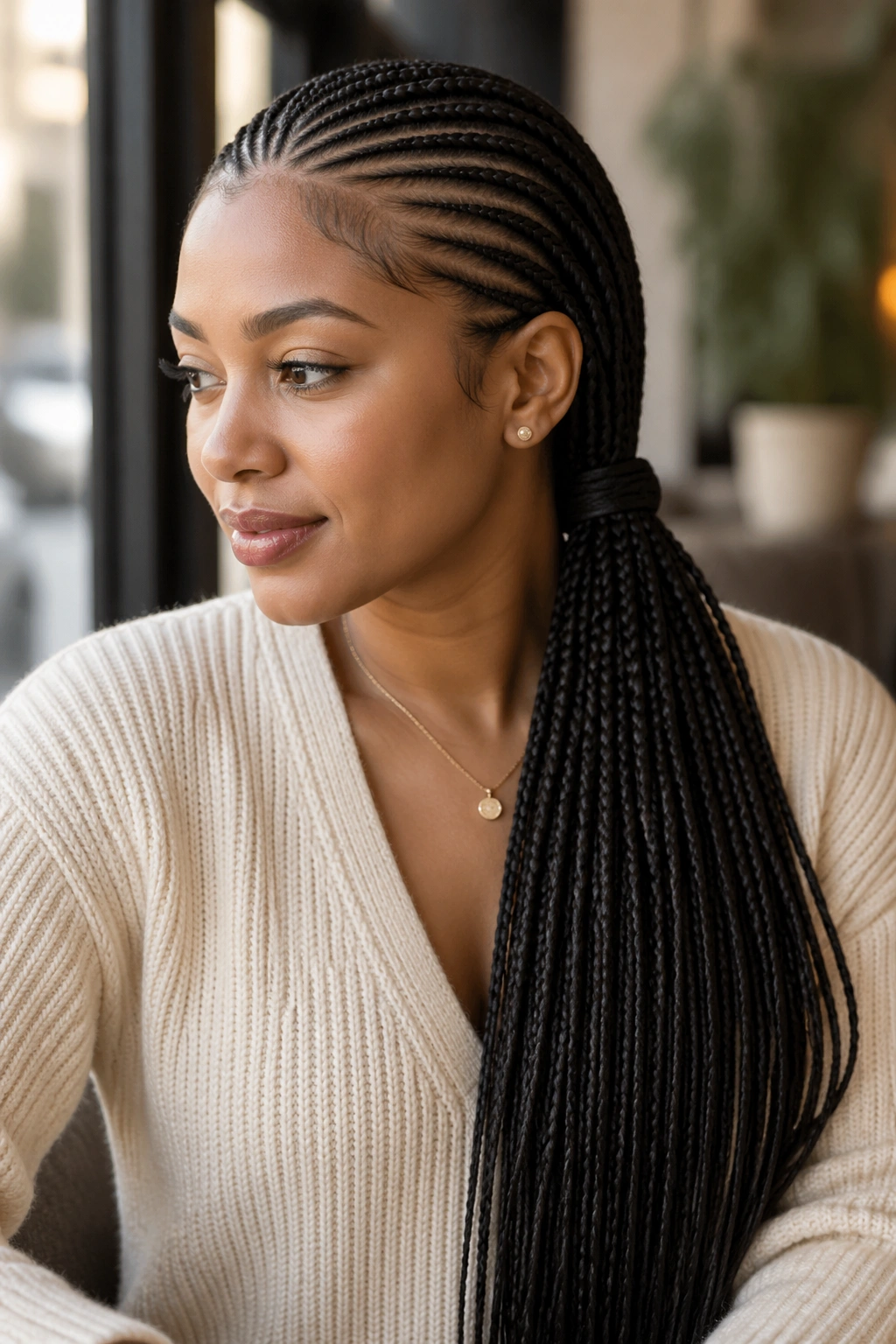
Small cornrows angle from across the head toward a low gather point behind one ear, where the ends combine into a side ponytail draped over the shoulder. The ponytail can be left as braid bundles, wrapped with kanekalon, or wave-set for added drama.
Unlike a center-back ponytail, the low side gather creates an asymmetric finish that reads more relaxed. It’s less formal than a structured updo but more polished than loose-ended cornrows.
The braided ponytail draped over one shoulder photographs particularly well from three-quarter angles.
Who this is for: anyone who likes asymmetry, prefers their hair to drape rather than hang straight back, or wants a softer alternative to high ponytails.
Recommendation: make sure the ponytail length doesn’t catch on your shoulder bag straps or coat collars. Test the drape before committing to a style for an active day.
13. Small Cornrows With Bantu Knot Ends
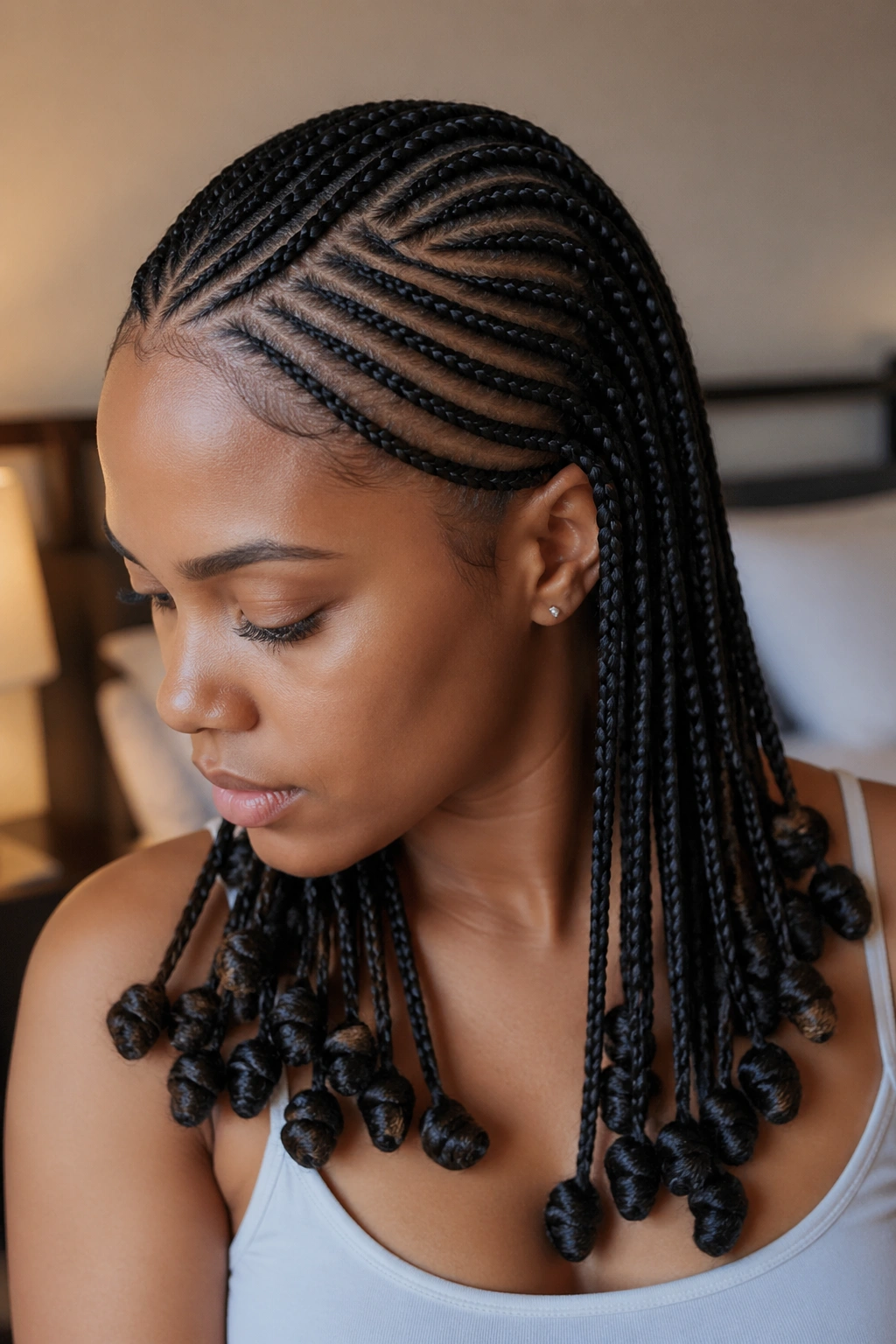
Instead of leaving the braid ends straight or curled, twist each braid end into a small bantu knot at the bottom. The bantu knots create textured “balls” at the ends of every long braid, giving the style sculptural detail.
This is a heritage technique fused with a contemporary cornrow pattern. Bantu knots have ancient African roots; pairing them with the structured cornrow style creates a culturally rich finish.
What to Watch For
- Bantu knots at braid ends require longer hair to wrap around — at least 6 inches of loose length per braid
- Use a small bobby pin to hold each knot until it sets
- Take the knots down before sleep to prevent flattening
The look is bold. It’s not subtle; it’s not casual. But for cultural events, photo shoots, or any setting where you want the hair to make a statement, it earns its space.
14. Small Cornrows With a Single Accent Color Braid
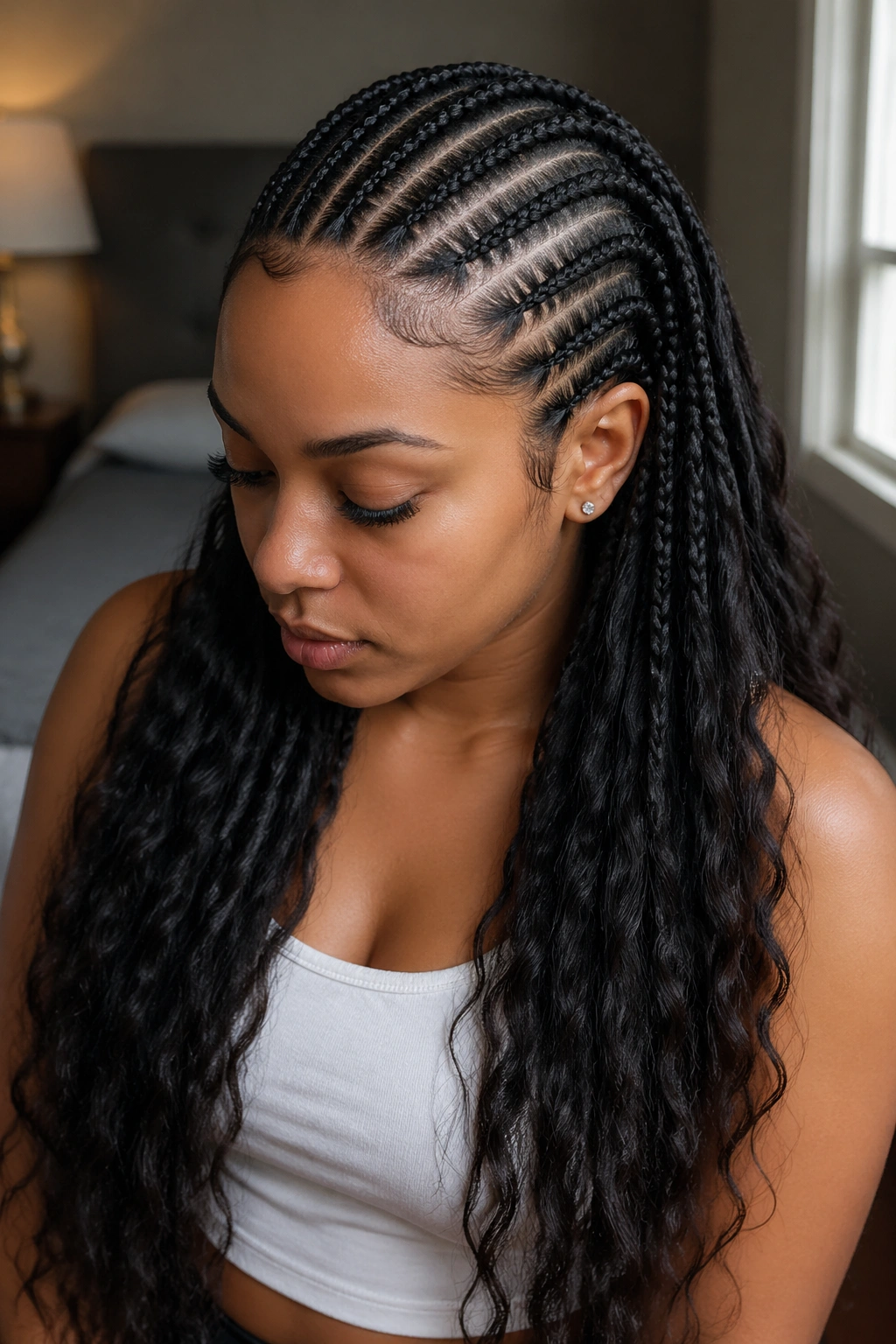
In a head of dark small cornrows, one or two braids get installed in a contrasting color — bright red, electric blue, vivid yellow, hot pink. The accent braids stand out dramatically against the rest.
The placement matters. Frame-of-face placement (one braid right at the temple) draws attention forward. Mid-head placement reads more graphic. Back placement reads as a hidden detail revealed when you turn your head.
Use kanekalon in the accent shade and braid it into one or two specific rows during the install. Skip trying to dye your natural hair just for the accent — too much commitment for a temporary look.
Who this is for: someone who appreciates restraint with a single statement element. Maximalist accent palettes (every braid a different color) read costume-y; one or two accents read intentional.
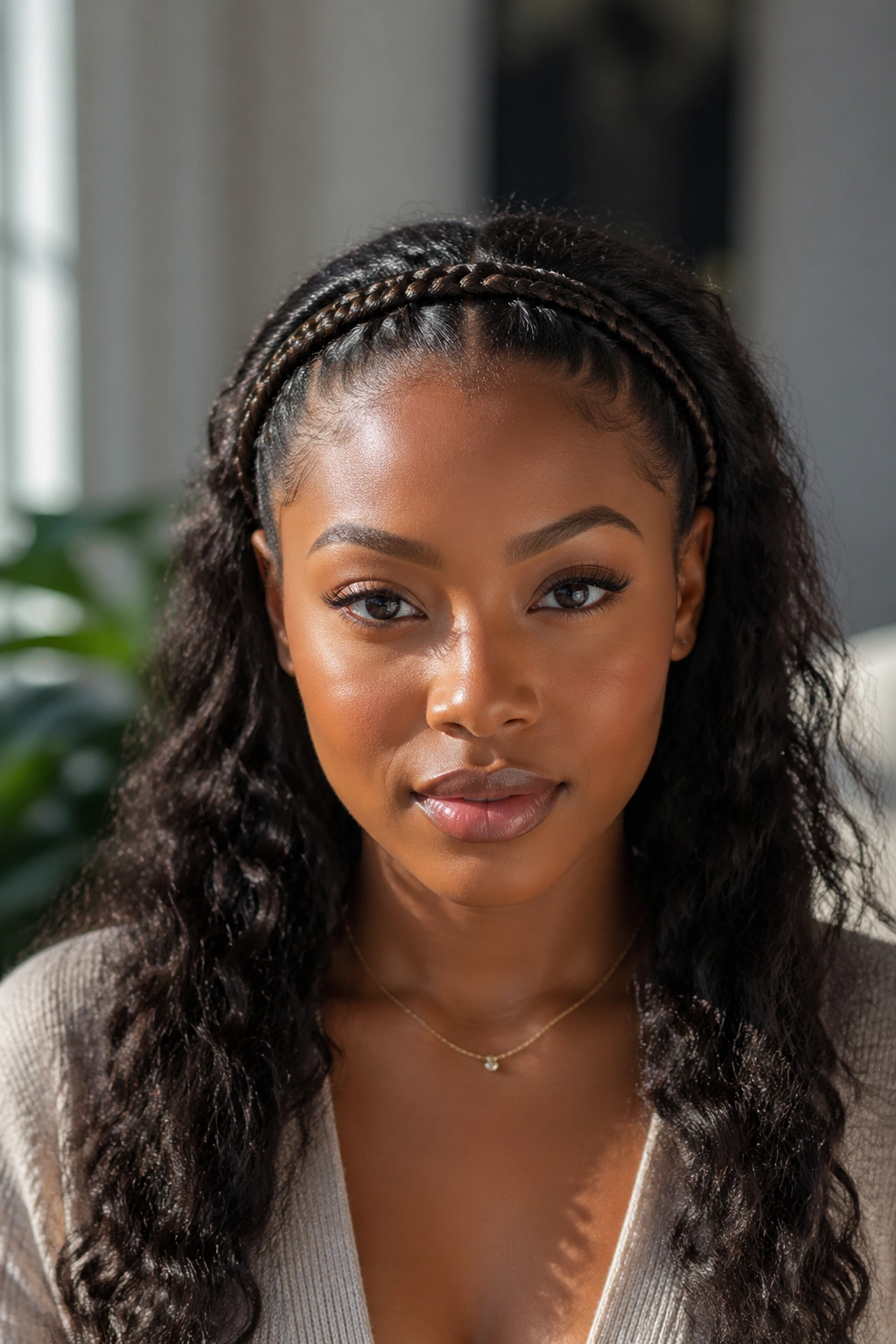
15. Small Cornrows With a Braided Headband Wrap
The first two cornrows at the front get wrapped with a thick piece of kanekalon or yarn, creating what looks like a braided headband sitting across the front of the head. The remaining cornrows continue normally down the back.
This is essentially building a hair accessory into the install. The wrap reads as a separate element layered over the cornrow base, even though it’s structurally integrated.
The wrap material can match the cornrow color or contrast. Matching reads subtle and sophisticated; contrasting reads playful and bold.
Best for: anyone who wants a cornrow style with built-in detail at the hairline. The wrap adds visual interest without requiring additional accessories.
Recommendation: choose a wrap thickness that complements your face. Heavier wraps suit longer face shapes; thinner wraps suit shorter face shapes.
16. Small Cornrows With a Triangular Parting Pattern
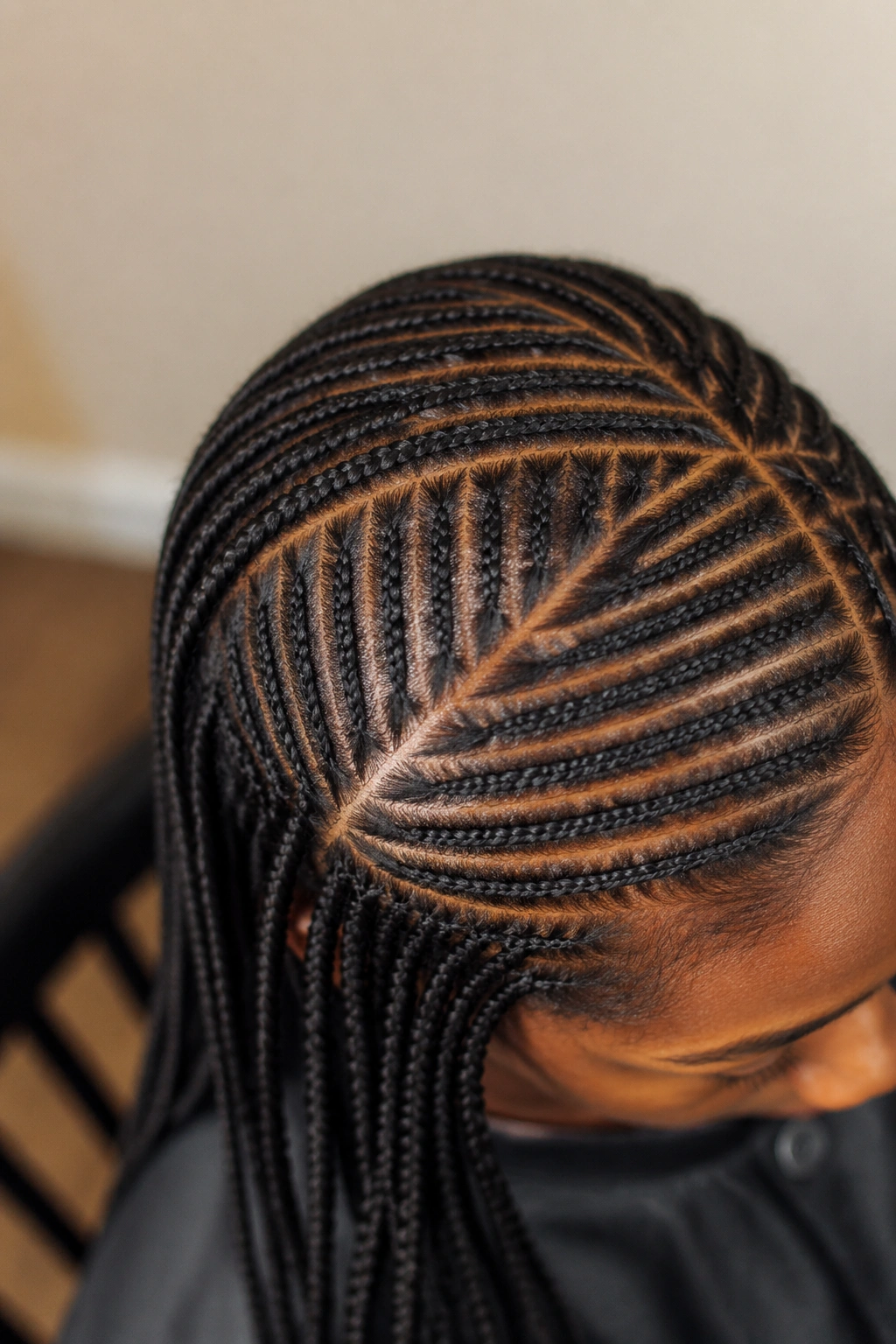
The partings between rows form triangular shapes rather than rectangular ones. Each cornrow base is a triangle, and the braids cascade out from the triangle’s apex. The pattern reads architectural and geometric.
Triangular partings have appeared in African braiding traditions for generations and have made consistent appearances in protective style portfolios. The reason they work: triangles distribute weight more evenly than rectangles, reducing strain at any single point on the scalp.
The challenge is execution. Triangular partings require precise measurement to maintain consistent triangle sizes across the head. Rough triangles look like mistakes; clean triangles look like art.
Plan with your braider in advance. Bring reference photos and confirm the braider has done triangular parting before. Not all braiders specialize in this technique.
The finished look is striking. Long braid ends drape from the geometric triangle bases, creating a layered visual depth.
17. Small Cornrows With Threaded Ends
Threading wraps the bottom 2-3 inches of each braid in colored embroidery thread. The thread can be a single color or multiple colors per braid, creating gradient or banded effects at the braid ends.
Unlike beads or cuffs, threading is permanent for the duration of the wear. It doesn’t slide, doesn’t fall off, and doesn’t need to be re-secured during the install lifetime.
Color choice for the thread carries weight. Earthy tones (rust, mustard, olive, teal) read traditional and grounded. Bright tones (neon pink, electric blue) read modern and playful. Metallics read luxe.
Threading takes time during the install — maybe 30-45 additional minutes for a full head — but the visual payoff is significant.
18. Small Cornrows With a Twisted Halo Updo
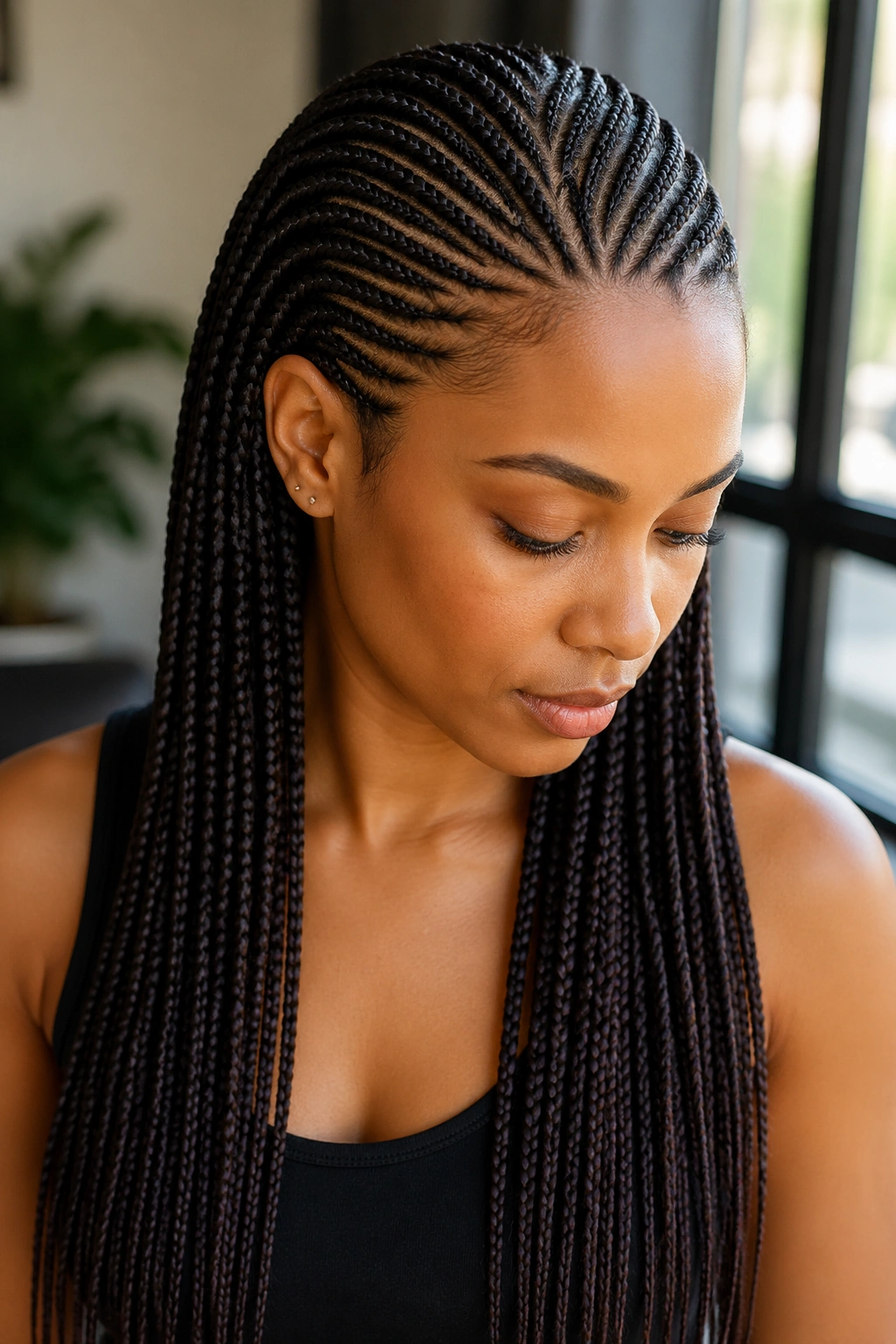
The cornrows are styled into a high updo by twisting all the braid ends together and pinning them in a circular pattern around the crown. The result is a halo of twisted long braids sitting like a turban on top of the head.
This styling is for events. It transforms small cornrows into a formal updo without requiring redoing the underlying install. You can wear the cornrows in a more casual configuration during the week and pin them up for special occasions.
The pinning takes practice. Use long bobby pins inserted at angles that hold against the head’s curve. Cheap small bobby pins won’t hold the weight of a halo updo and will slip throughout the night.
Who this is for: anyone who wears small cornrows as a multi-week protective style and wants the option to dress them up for events without taking them down.
19. Small Cornrows With Color-Block Sections
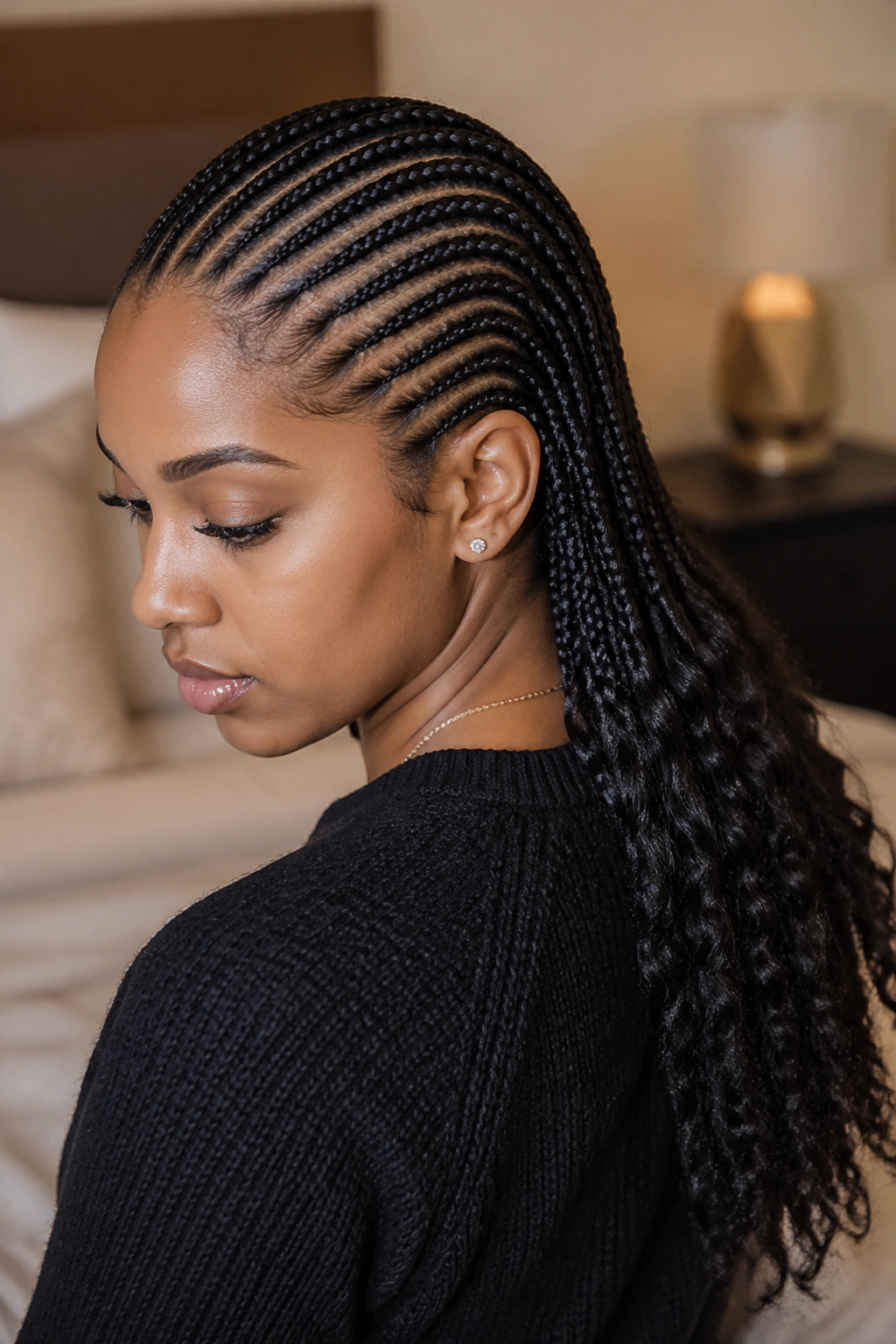
The head is divided into clear zones, with each zone braided in a different solid color. Front section in honey blonde, middle section in burgundy, back section in natural black, for example. The contrast between zones is the design feature.
This requires advance planning and color selection. The boundary between zones should fall along a natural parting line — like the crown line or a side part — so the color transitions read intentional.
The kanekalon for each zone is selected and prepared separately. You’re essentially doing three small installs in one session, each with its own color.
Best for: someone who loves bold color but doesn’t want a single-color full head. Color-blocking lets you incorporate multiple shades without overwhelming the look.
Recommendation: limit yourself to two or three color zones max. More than three starts to look chaotic.
20. Small Cornrows With a Pulled-Back Half-Up
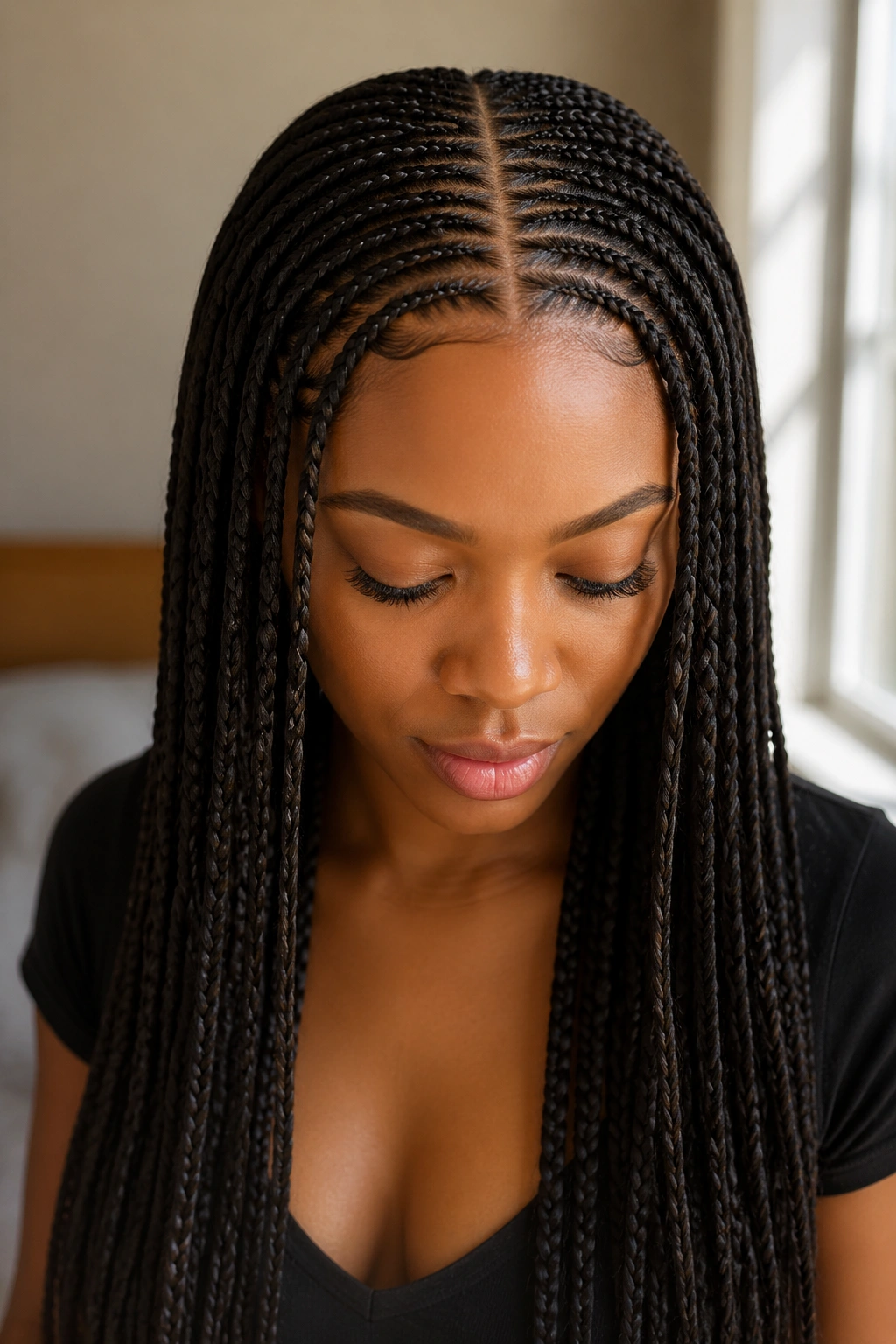
A portion of the small cornrows — the front and top — gather into a half-up gather at the crown, while the rest hang loose down the back. The gather can be secured with a fabric tie, a clip, or a pinned bun.
Unlike a full updo, the half-up keeps the long braided length visible while also showing some structural detail at the crown. It’s the most casual of the styled finishes on this list.
The half-up suits everyday wear because it’s quick to put up in the morning and just as quick to take down at night. No re-pinning, no complicated maintenance.
For long hair, the half-up balances the heavy weight of the loose braided portion with the lift of the gathered section. Without the half-up, all the visual weight sits at the bottom; with it, the proportion balances.
21. Small Cornrows With a Back Detail Pattern
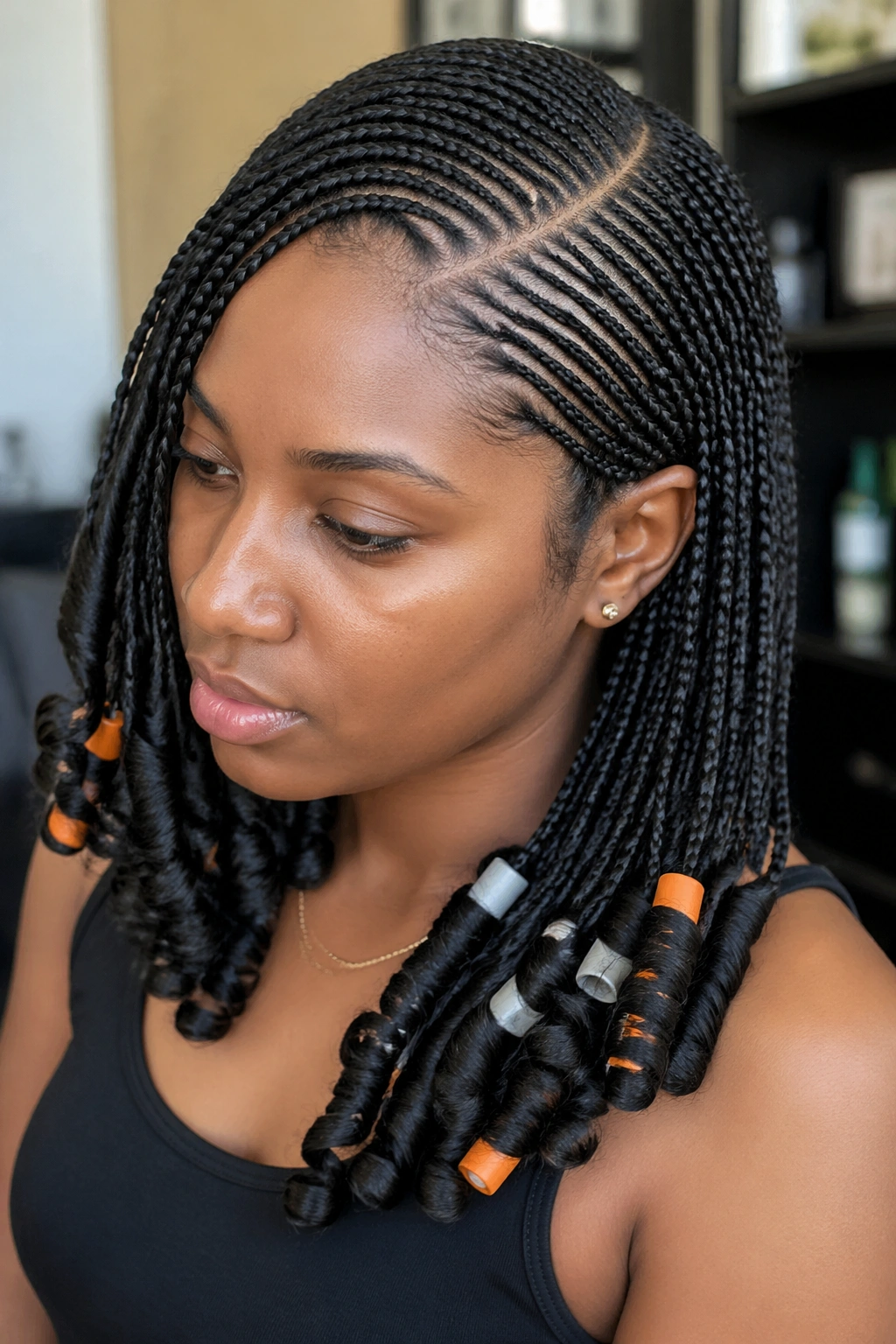
The front and sides have standard straight small cornrows, but the back features a special pattern — a starburst, a series of nested triangles, a heart, a swirl. The back is where artistic detail lives.
Most people see the front of your head daily, but the back is where you can express creativity that doesn’t dominate every interaction. A starburst at the nape becomes a private detail revealed when you pin your hair up or someone catches your back view.
Custom back patterns require collaboration with your braider. Some braiders specialize in custom designs; others stick to standard layouts. Find someone whose portfolio shows back-detail work before booking.
The pattern should suit the back of the head’s natural shape. Starbursts work well on round skull shapes; long swirls suit oval shapes; geometric patterns suit angular shapes.
22. Small Cornrows With Curtain Bangs
The front-most cornrows are kept short — only 4-5 inches long — and styled to fall around the face like curtain bangs. The rest of the install runs to full length down the back. The contrast between short framing pieces and long body length creates a layered cut effect within a braided style.
This is a relatively new approach to small cornrow styling. Traditional braiding doesn’t include “bang” sections; the technique borrows from haircut philosophy.
How to Style It
The curtain bang braids should be parted around the face naturally, not braided straight back. Each one should curve to fall along the cheekbone or jawline.
- Plan 4-6 short braids for the curtain effect
- Style them to part down the middle and sweep outward
- Use a light gel or pomade to keep them in place
Best for: anyone who loves the curtain bang look in regular hair and wants to translate it into a protective style. It’s particularly flattering on longer face shapes because the bangs break up the vertical line.
Caring for Long Cornrowed Hair
Long small cornrows have a lot of surface area to maintain. Daily care matters more than for shorter installs.
Refresh the braids every two days with a light spritz of water-and-leave-in mix. Focus on the scalp and the braid bases first; mist lightly down the length.
Use a small soft brush — boar bristle or a gentle nylon — to smooth flyaways at the parting lines. Heavy brushing breaks the braid pattern.
For the loose long ends (if you have any), apply a small amount of light oil — argan, jojoba, or a finishing serum — every few days. Avoid the scalp; oil at the roots makes braids slip.
Every week, do a full scalp oil treatment. Apply a scalp-specific oil (rosemary, peppermint, jojoba) directly to the scalp using a applicator bottle with a nozzle. Massage gently, then leave overnight.
Sleep and the Long-Hair Challenge
Long cornrow ends drape, fall, and tangle if you don’t manage them at night.
A bonnet is essential. Use a large bonnet with enough room for all the loose ends to coil inside it. A small bonnet that squishes the braids causes friction and frizz.
For dramatic-length installs, gather the loose ends into a single low bun before putting the bonnet on. Contained ends friction less against the bonnet interior.
Silk pillowcases supplement the bonnet. If your bonnet slips off mid-sleep (it happens), the silk pillowcase reduces the damage.
Knowing When to Take Down
Long small cornrows can hold a clean look for 3-4 weeks. Past four weeks, matting at the scalp base becomes a concern, and shed hair tangled into the braids requires aggressive detangling to remove.
Signs it’s takedown time:
- New growth pushing the cornrows visibly away from the scalp
- Fuzz overwhelming the geometric pattern beyond what refresh can fix
- Itchy scalp that doesn’t resolve with regular oil treatments
- Audible crackling when running fingers along braid bases (tangled shed hair)
When taking down, work slowly. Saturate each braid with water and conditioner, unravel from the end toward the scalp, and detangle each section thoroughly before moving to the next.
Common Small-Cornrow Mistakes
Tension at the hairline ranks first. Long-haired clients sometimes get over-tightened front rows because the braider assumes the length will pull on the braids more. The opposite is true — long hair distributes weight better than short hair, so excessive tension at the front isn’t necessary.
Skipping prep ranks second. Long hair has more places to hide tangles, more old product, more shed hair. Cutting prep short means the install starts behind.
Picking a row count that’s too dense is the third common error. More rows isn’t always better. Forty small cornrows on a small head can look crowded; thirty might look balanced. Talk to your braider about what suits your head size.
And finally: not protecting the loose ends at night. Long braid ends rubbing against pillows or sliding under your body during sleep break down quickly. Treat the ends like the investment they are.
Picking the Right Small Cornrow Style for Your Length
Hair length itself shapes your options. Mid-back length supports almost any style on this list. Hip-length adds drama and weight to consider. Past-hip length requires extra night care and limits some active styles (high updos can be heavy; loose ends catch on furniture).
Face shape guides pattern selection. Round and square faces benefit from styles that add vertical line (mohawks, halo crowns, vertical row patterns). Long and oval faces look balanced under horizontal patterns or side sweeps.
Lifestyle counts. If you swim or exercise daily, choose styles that handle moisture well — avoid wave-set ends or pin-curl ends that lose definition with sweat. Pick clean cornrow patterns with simple ends.
Hair density matters. Fine, lower-density hair benefits from smaller row counts that don’t fight against thin hair to grip. Dense, thick hair can handle higher row counts and more elaborate patterns.
Trust your braider’s input. The best style choice often comes from someone who can see your head shape, hair texture, and edge condition firsthand. Bring reference photos but stay flexible if your braider suggests an adjustment.
The right small cornrow style on long hair becomes a signature. Once you find the pattern that suits you, you can wear variations of it for years and always look pulled together.
