

Stitch cornrows in blonde hit differently. The pattern that makes stitch braids stand out — those tight horizontal feed-in “stitches” that stack along each row like ladder rungs — shows up more sharply against blonde tones than against dark hair. You can see every single stitch. Every feed-in addition. Every parting edge. Dark on dark tends to blur the detail together; blonde separates each element into its own graphic moment, which is why stitch cornrows in blonde have quietly become one of the most photographed braid styles on the internet.
I’ve installed and worn stitch cornrows in maybe a dozen blonde variations over the years, from near-white platinum to honey to warm ginger-blonde. They’re not the same style in different colors. They’re genuinely different experiences. Platinum reads cold and editorial. Honey reads soft and easy. Ash blonde brings an almost greige, smoky quality. The color carries half the mood.
What follows is 22 specific stitch cornrow styles in blonde — different tones, different patterns, different lengths, different finishes. Some lean conservative, some lean bold. Each one solves a different styling problem or serves a different aesthetic goal.
What Makes Stitch Cornrows Different From Regular Cornrows
Stitch cornrows are a specific evolution of feed-in braiding. Where standard feed-in cornrows blend extension hair smoothly along the braid, stitch cornrows use deliberate, highly visible horizontal “stitches” — small tight sections of added hair that create a ladder-like pattern along each row. The effect is graphic and unmistakable.
The term “stitch” comes from how the added hair creates what looks like cross-hatching at regular intervals, similar to embroidery stitches on fabric. Each row has maybe 6-12 visible stitches running from scalp to braid end.
This is a technique style. Not every braider knows how to do clean stitches, and not every natural braid shop advertises them. When you book, ask specifically about stitch cornrows and request to see examples of their work. The quality varies wildly between braiders, and in blonde the quality difference is visible from across a room.
Why Blonde Amplifies the Stitch Pattern
Color contrast is what makes stitch detail readable. In black or dark brown, the stitches blend into the braid; you know they’re there but your eye fills in the detail. In blonde, every stitch stands alone. You can see the parting, the feed-in edge, the tension, the flyaways.
That visibility cuts both ways. Excellent stitch work becomes stunning. Sloppy stitch work becomes glaring. Before committing to blonde stitch cornrows, make sure the braider can deliver clean stitches at close range.
Another piece worth knowing: blonde kanekalon comes in a wider range of shades than most non-blonde colors. Platinum 60, honey 27, golden-blonde 613, beige 24, warm-gold 22, ash-blonde 101. The numbering system is standard across major brands, so if you find a shade you love in one brand, you can usually match it elsewhere.
Prepping Your Hair Before a Blonde Stitch Install
Blonde kanekalon has a slightly different texture than standard black kanekalon — it’s often drier because of the processing required to achieve lighter shades. That dryness means it slips less during braiding, which is actually good for stitch work. But it also means the extension hair can look frizzy within days if you don’t prep it right.
Before the install, soak the kanekalon in apple cider vinegar diluted with water. Roughly two tablespoons of vinegar in a sink full of cool water. Let the hair sit for 20 minutes, rinse, and hang to dry. This step strips the manufacturing chemical coating that causes itching and softens the texture.
Never skip the vinegar soak for blonde extensions. The processing residue is more significant in lighter shades and more reactive on sensitive scalps.
For your natural hair, clarify the day before with a sulfate shampoo, follow with a deep conditioner, and detangle thoroughly. Clean hair grips better, and blonde stitch patterns demand clean grip.
Parting Geometry for Stitch Cornrows
The parting is where stitch cornrows earn or lose their appeal. Because stitches create such a visible horizontal pattern, the vertical lines (the partings between rows) have to be exactingly straight. Any wobble shows immediately in blonde.
Use a fine-tooth rat-tail comb with a metal tip. Draw partings on gel-smoothed scalp so the lines hold. Measure row widths if you’re doing a symmetric pattern — say, six rows across the crown — to ensure even spacing.
For asymmetric patterns, still plan widths before starting. Freehanding without a plan produces uneven row distribution that undermines the stitch work.
Tools and Products Worth Buying
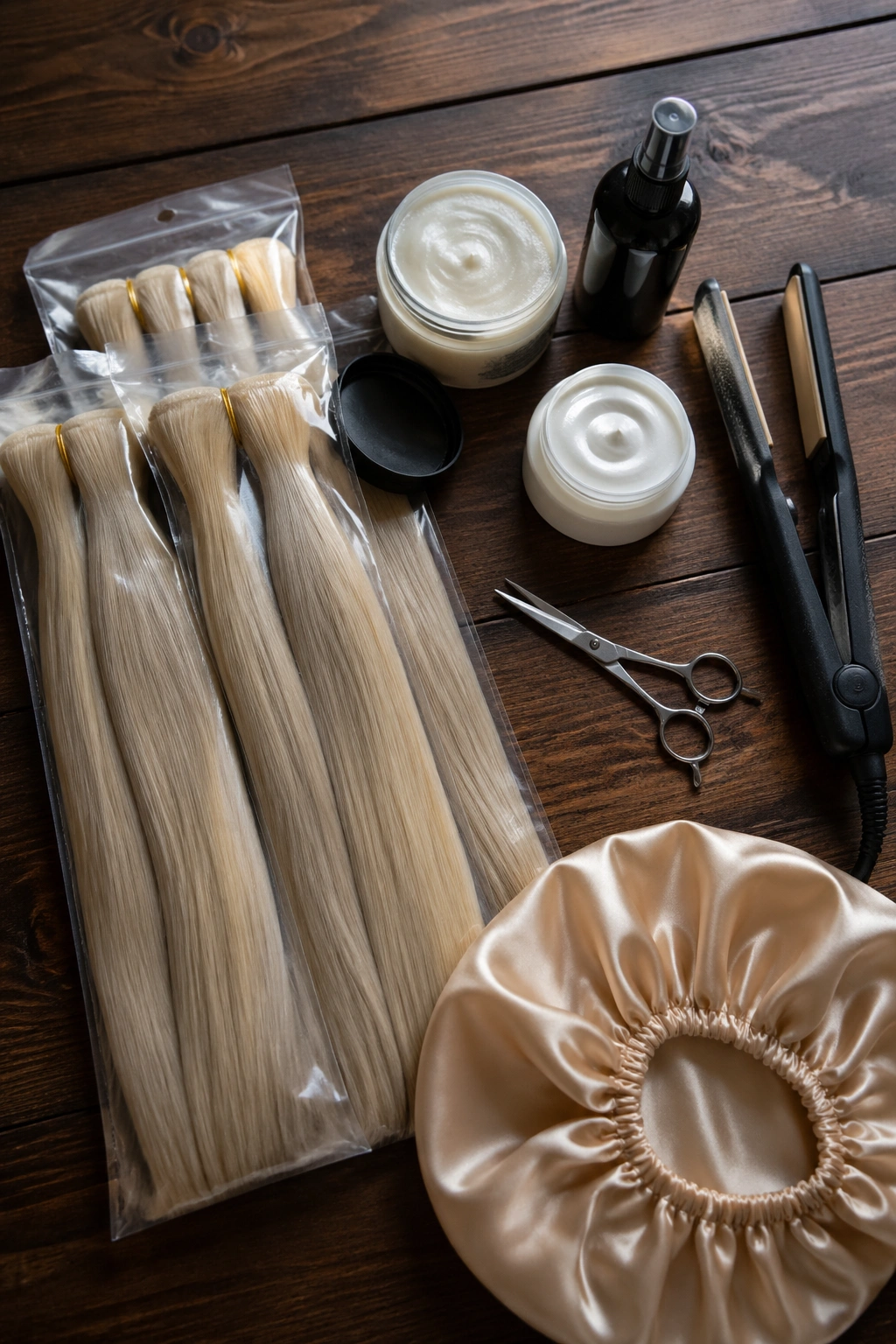
- Pre-stretched kanekalon in your chosen blonde shade (usually 1-2 packs for a full head)
- Edge control with firm hold and no flake
- Braid sheen spray (light formula, not heavy)
- A small pair of braid-specific scissors for trimming ends
- Flat-iron or hot water for sealing braid tips
- A silk or satin bonnet for nightly protection
- Mousse (optional, for setting a flip or wave at the ends)
I’d skip heavy oils before install. Oil on blonde braid hair can cause yellowing over time, especially in natural kanekalon that’s been lightened. Stick to dry or spray products for refresh.
1. Classic Straight-Back Stitch Cornrows in Platinum 60
Six to eight stitch cornrows run straight from the hairline to the nape, each stitched with roughly 8-10 visible horizontal bars. The color is platinum — shade 60 in standard kanekalon numbering — which reads almost white under direct light.
Why It Works
Platinum amplifies the stitch detail more than any other blonde shade. Against warm brown skin tones especially, the contrast is striking. Against cool or fair skin, the platinum reads more subtle but still sharp.
- Use about 1.5 packs of kanekalon for a full head at medium density
- Plan for 4-6 hours of install time
- Expect to sleep carefully the first night to let the stitch pattern set
The key thing: platinum shows every mistake, so this is a style that demands a practiced braider. The first time you sit for platinum stitch cornrows should be with someone whose work you’ve seen in person or on social media photos that weren’t heavily filtered.
2. Honey Blonde Stitch Cornrows With Curled Ends
Where platinum reads editorial, honey blonde reads warm and approachable. This style uses shade 27 kanekalon — a medium-warm blonde with golden undertones — and finishes the braid ends with a soft curl rather than leaving them straight.
The curl at the end softens what would otherwise be a very geometric look. Stitches are sharp and rigid; curled ends are fluid. That contrast makes the whole style read more wearable for daytime or casual settings.
To curl the ends, dip the last three inches of each braid into hot water (not boiling — maybe 170°F) for about 15 seconds, then wrap immediately around a flexi-rod or small foam roller. Let it air-dry overnight. The next morning, unravel and spritz with sheen spray.
Practical note: honey blonde is the shade most forgiving of second-day styling. Fuzz reads as warm rather than as damage.
3. Two-Tone Stitch Cornrows With Platinum Root and Dark Blonde Length
Two-tone kanekalon is pre-colored so one end matches a darker shade (often a medium brown or dark blonde) and the other end fades into a lighter blonde. Installing the dark end at the scalp and the light end at the braid tip creates a grown-out balayage effect.
Unlike single-tone blonde, this pattern reads more natural at the roots and more dramatic at the ends. It also conceals the “extension hair starts here” line that straight blonde can emphasize.
Who this is for: anyone nervous about the visual transition from their natural dark roots into bright blonde braids. The two-tone extension hair softens that shift.
Recommendation: buy two-tone kanekalon from a reputable brand rather than trying to DIY the color fade. Professional two-tone has a smoother gradient than homemade versions.
4. Ash Blonde Stitch Cornrows With Zigzag Parting
Ash blonde reads cool, slightly gray, and almost silvery. Pair it with a zigzag parting pattern — cornrows that follow a chevron or lightning-shaped path rather than straight rows — and you get a style that’s neither classical nor messy. It’s something newer.
The zigzag parting has to be crisp for the style to work. Sloppy zigzags in ash blonde look like mistakes because the color punishes imprecision. A skilled braider can zigzag cleanly; a less experienced one should stick to straight rows.
Tip: bring a reference photo of the zigzag pattern you want, not just a verbal description. Zigzag styles vary widely (shallow vs. sharp, regular vs. irregular, one-directional vs. mirrored), and photos prevent misunderstandings.
Ash blonde also pairs beautifully with cool-toned makeup — smoky eyes, berry lips — if you’re thinking about the complete look.
5. Stitch Cornrow Mohawk in Golden Blonde
A mohawk stitch cornrow uses five to seven stitch cornrows running down the center of the head, with the sides either shaved, braided small, or slicked flat. The version in golden blonde (shade 22, a warm-yellow gold) gives the mohawk a fire-like quality.
The center strip carries the visual weight. When the sides are shaved, the braided strip becomes a crown. When the sides are slicked flat, the contrast between smooth black scalp texture and bright blonde braids is the whole statement.
Golden blonde specifically suits warmer skin tones — olive, warm brown, golden brown. On cooler skin, the yellow can read jarring against the skin’s undertone. If you’re cooler-toned and want a similar effect, swap for honey blonde or strawberry blonde instead.
Who should consider this: anyone who treats their hair as a fashion statement. This isn’t a conservative look. It’s a “look at me” look.
6. Small-Gauge Stitch Cornrows in Icy Blonde
Small-gauge stitch cornrows use narrower row widths — maybe 3/4 inch instead of the standard 1.5-2 inches — producing a denser, more detailed pattern across the head. In icy blonde (a very cool-toned near-white), the density of rows amplifies the stitch visibility.
Expect a longer install. Small-gauge with stitches can easily run 6-8 hours for a full head, and the stitch count per row goes up with the row count.
The payoff is a more sophisticated, layered finish. Where chunky stitch cornrows read casual or playful, small-gauge reads dressed up. Event hair.
- Use 2 full packs of kanekalon for a small-gauge full head install
- Request 14-16 stitches per row for maximum pattern density
- Plan a full rest day after the install — your scalp will feel tight
Nighttime care matters more with dense styles. Sleep in a bonnet the first week without exception.
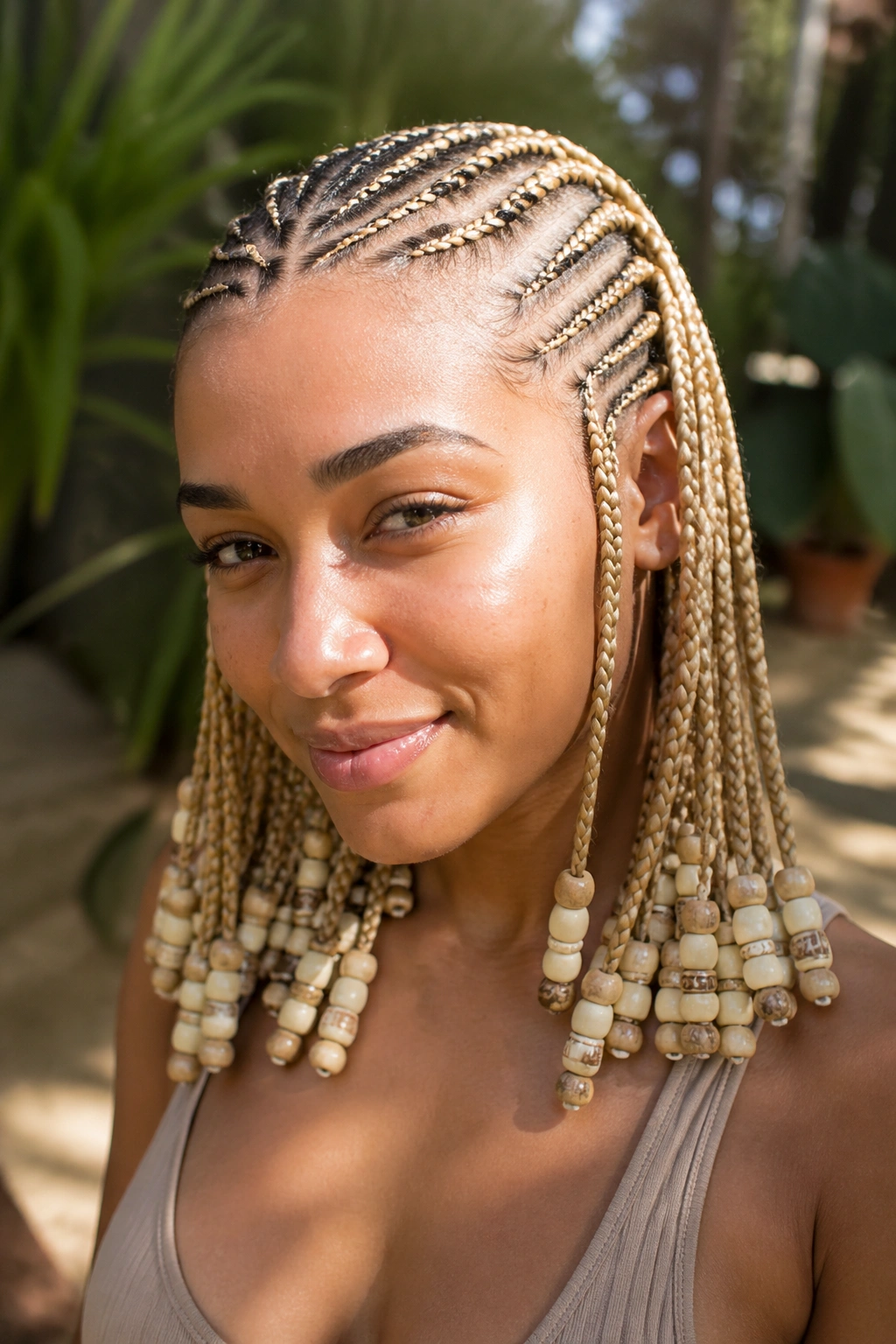
7. Stitch Cornrows With Beaded Ends in Beige Blonde
Beige blonde sits between warm and cool — softer than golden, warmer than ash. It’s one of the most flattering blonde tones across skin tones because it reads neutral. Add wooden or bone-colored beads at the braid ends and you get a style with organic, earthy finish.
How to Style It
Thread 3-4 beads on each braid end, securing with small clear or tan rubber bands. The bead color should complement the blonde — go neutral (wood, bone, ivory) rather than competing (bright primary colors).
- String beads loose enough to slide but tight enough not to fall
- Use beads no heavier than 5 grams each — heavier drags braid ends down
- Distribute beads so some rows have more, some have fewer, for visual rhythm
Watch for: beads catching on clothing necklines, particularly turtlenecks and scarves. This is more of a warm-weather style if you’re planning to wear the beads full-time.
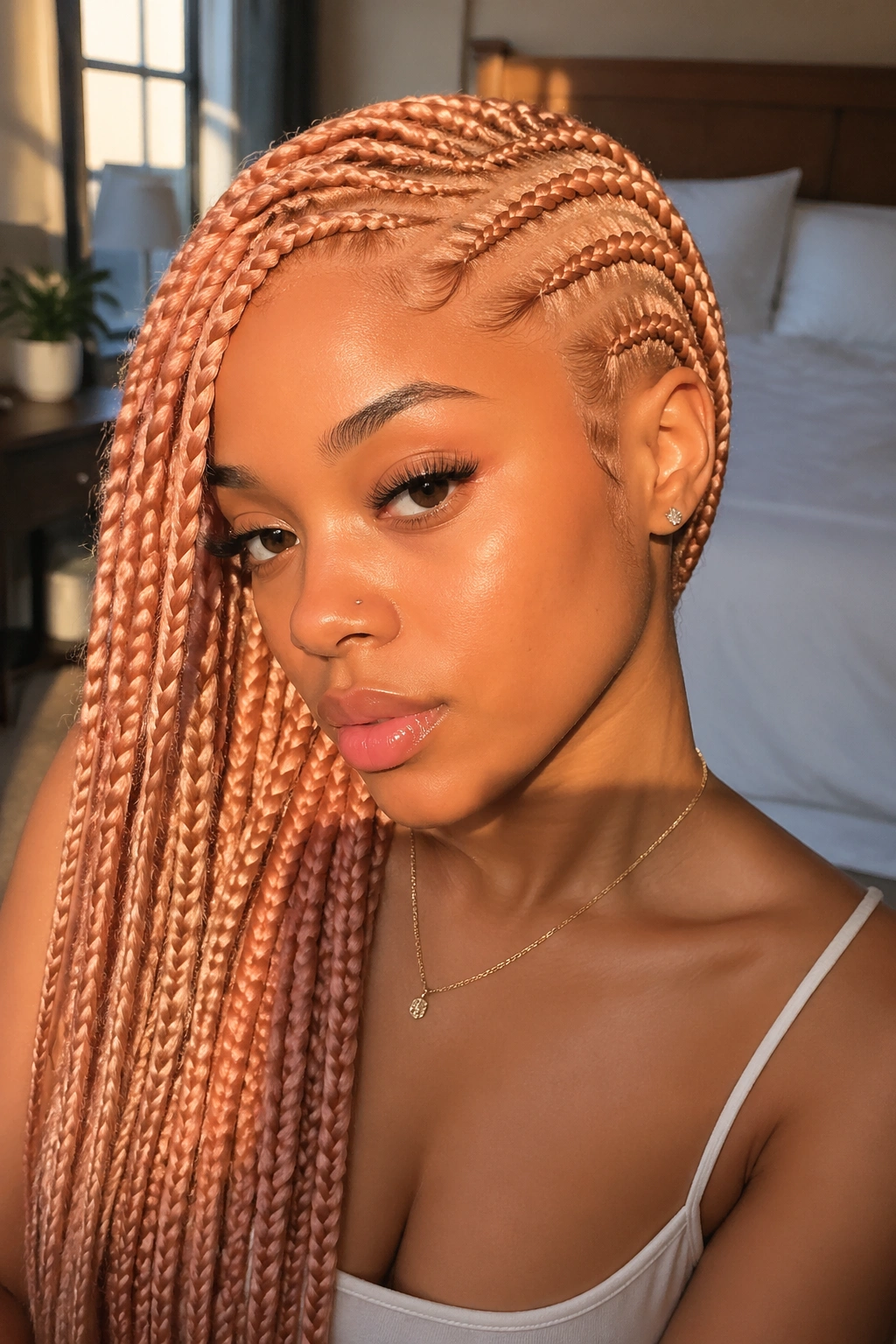
8. Side-Swept Stitch Cornrows in Strawberry Blonde
Strawberry blonde blends pink and gold undertones — warmer than honey, more pigmented than platinum. Sweeping all the stitch cornrows to one side rather than braiding them straight back creates an asymmetric look that emphasizes the color.
The side-sweep angle can be subtle (a 10-15 degree tilt) or dramatic (a full 45-degree angle). Steeper angles read bolder but can be harder to maintain because the weight distribution pulls one side more than the other.
What makes strawberry blonde special is how it photographs. In warm golden-hour light, the pink undertone catches and glows. In harsher midday light, it reads more warm-gold. The variability is a feature, not a bug.
Best for: someone comfortable with a look that shifts based on lighting. The strawberry blonde doesn’t stay the same shade from morning to evening, and neither does the overall vibe of the style.
9. Stitch Cornrows Into a High Ponytail in Champagne Blonde
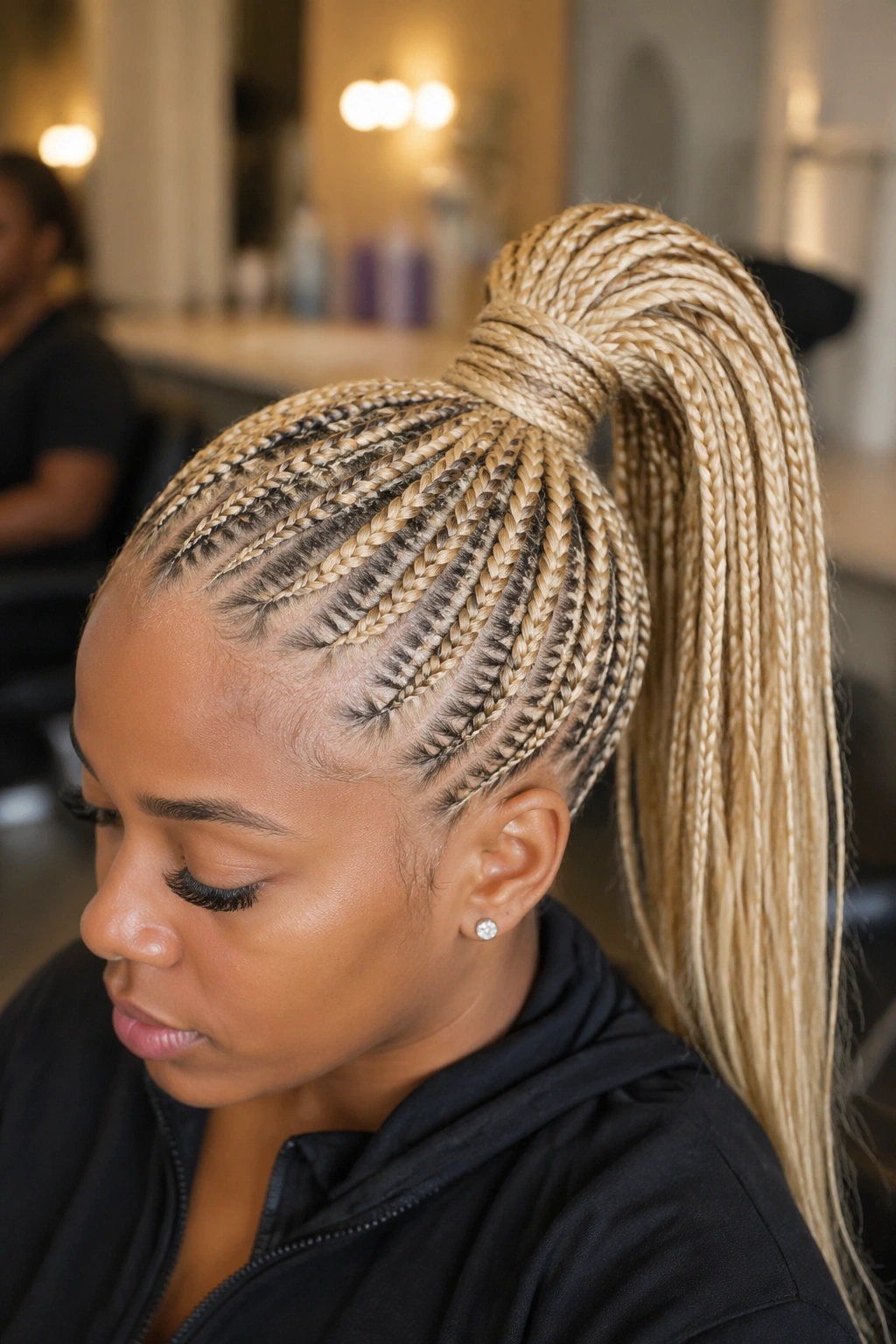
Champagne blonde is pale gold with a subtle warm undertone — lighter than honey, warmer than platinum. When all the stitch cornrow ends gather into a high ponytail at the crown, the braid pattern radiates out from the gather point like a starburst.
The ponytail itself can be left as loose braid bundles or wrapped with additional champagne-toned kanekalon to create a smooth finish. The wrapping is the more polished option and reads dressier.
Mechanically, gathering all the stitch cornrow ends into a single ponytail requires planning during the install. The braider has to angle every row toward the crown gather point, which means no straight-back rows. Every cornrow curves slightly to meet at the top.
The payoff: this style looks incredible from every angle. From the front, you see the radiating stitch pattern. From the side, you see the sweep. From the back, you see the full ponytail.
Perfect for: photo shoots, event hair, or anyone who wants a hair-forward look.
10. Stitch Cornrows With a Cuff Accent in Wheat Blonde
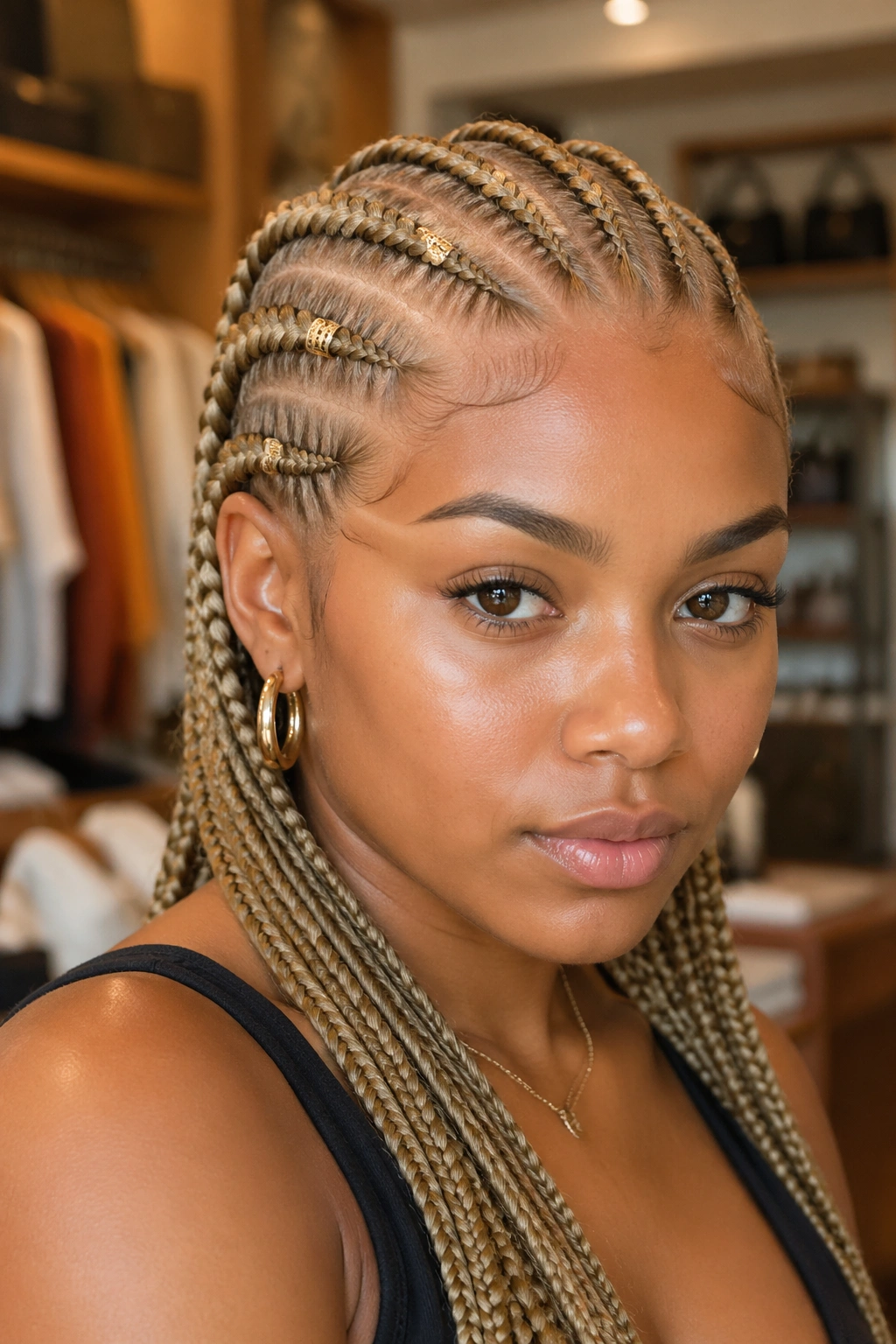
Wheat blonde is a dusty, muted gold — less saturated than honey, warmer than ash. Adding decorative metal cuffs to a few select cornrows (not all of them) creates restrained statement jewelry in the hair.
Unlike beading, which tends to be repetitive, cuff accents are singular. One cuff per chosen braid. Maybe three or four cuffs total across the head, strategically placed.
Gold or rose-gold cuffs complement wheat blonde. Silver cuffs can work too but create more contrast. Match the cuff metal to other jewelry you tend to wear — if you’re a gold-person, gold cuffs; if you’re a silver-person, silver.
Who this is for: someone who appreciates intentional, small-scale accessorizing. Not every braid is dressed up; a select few are.
Recommendation: avoid cuffs with sharp inner edges that can catch hair strands when they slide. Smooth-edged cuffs are worth the small price difference.
11. Chunky Stitch Cornrows in Warm Bronze Blonde
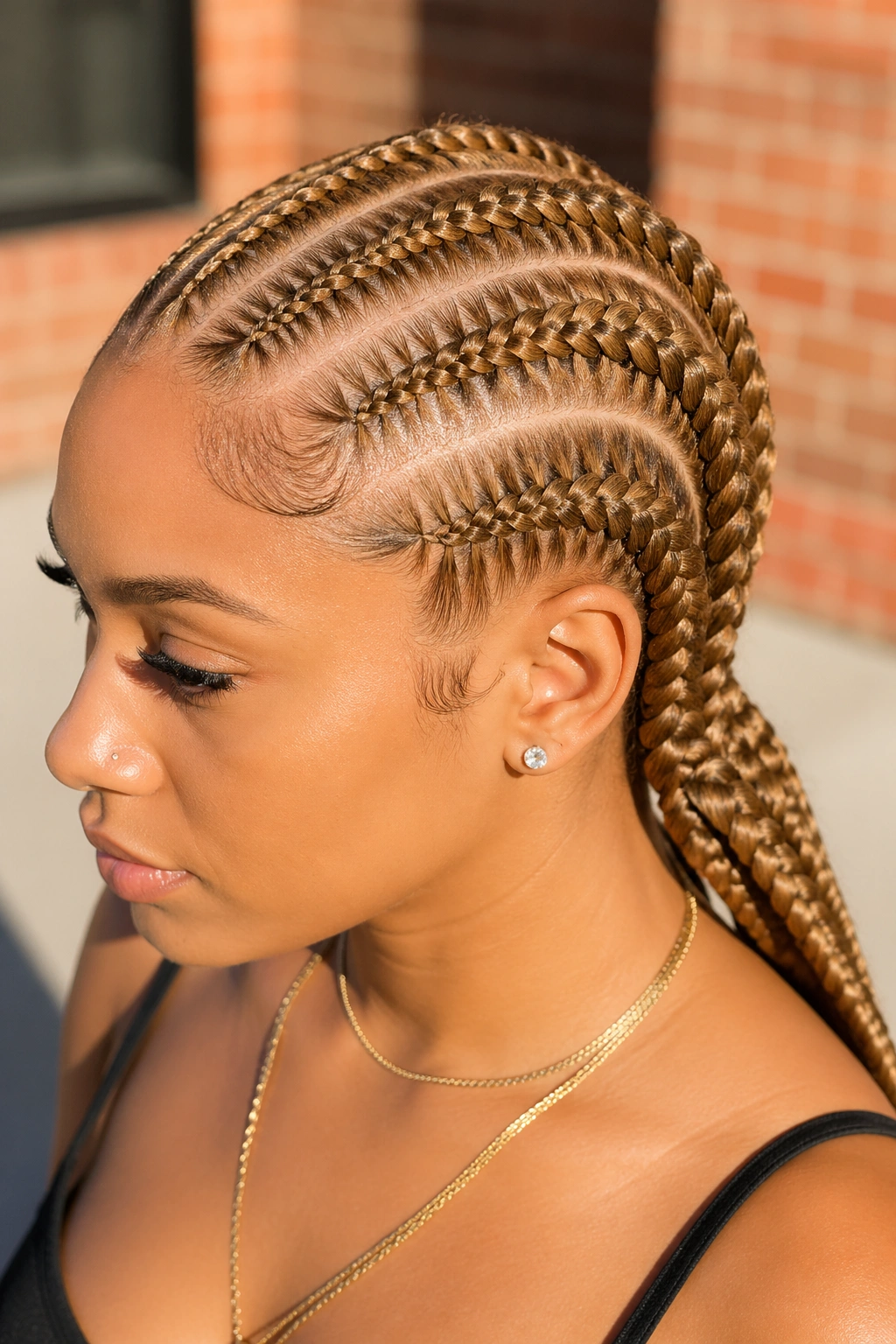
Warm bronze blonde is a deeper, richer blonde with amber undertones — it reads almost like dark honey or very light caramel. Chunky stitch cornrows mean wider row widths (2-2.5 inches per row) with proportionally larger stitches.
Chunky styles read more casual and playful. Stitches are bigger and more widely spaced, and the overall pattern is simpler than small-gauge versions.
What’s different about bronze blonde is it complements nearly every skin tone while still reading as a clear departure from natural hair color. It’s the shade I recommend for anyone trying a blonde braid style for the first time.
The install is faster. Chunky stitch cornrows take maybe 3-4 hours for a full head versus 6-8 for small-gauge. Your scalp gets less coverage but also less tension.
Best for: first-time blonde-braid wearers, lower-maintenance lifestyles, or anyone who wants a look that reads intentional without demanding a salon day.
12. Stitch Cornrows With Scattered Baby Stitches in Silver Blonde
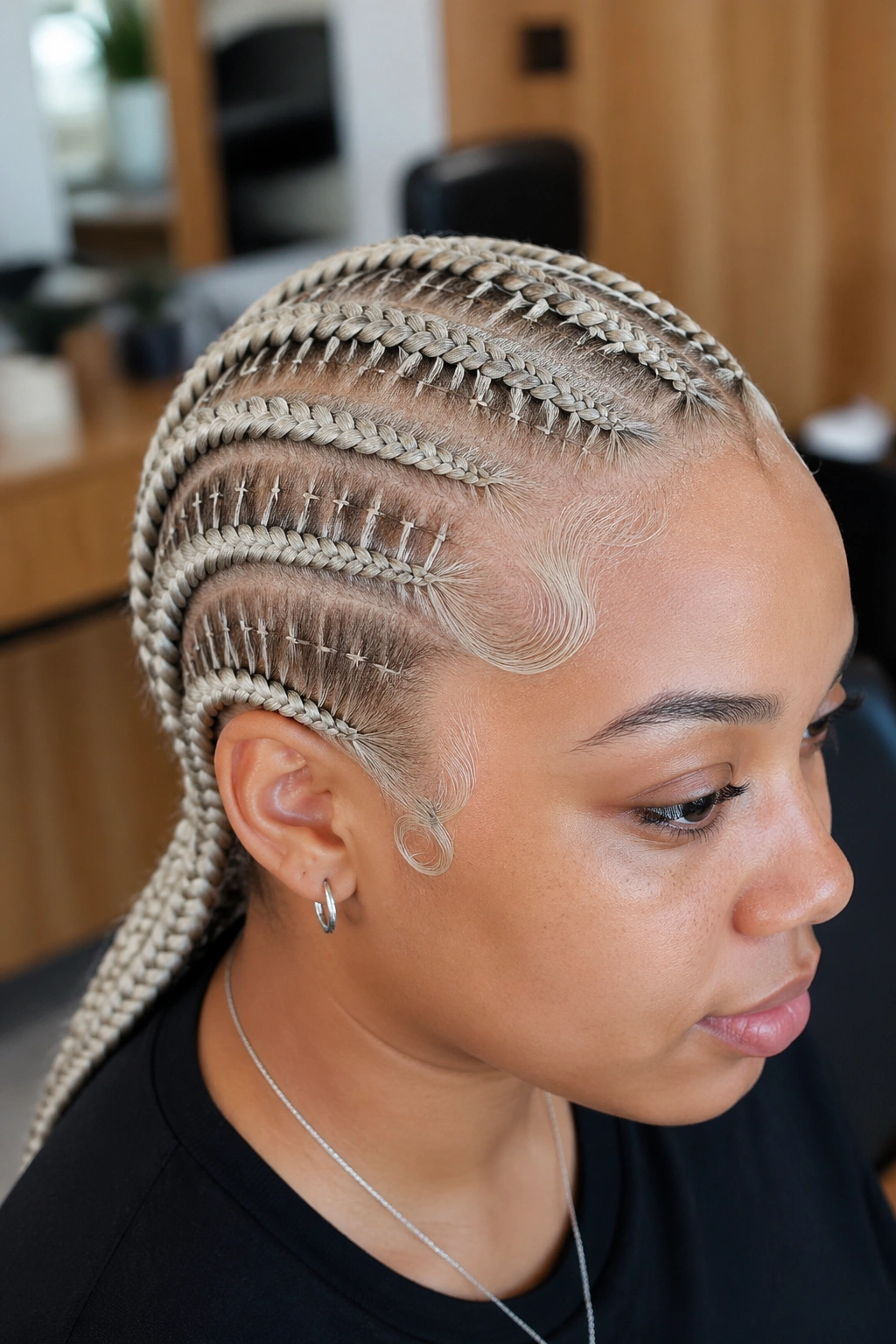
This is where technique gets interesting. Between the main stitches on each row, the braider adds tiny “baby stitches” — smaller, less obvious additions that fill the space between the main pattern. In silver blonde (a very cool, gray-leaning blonde), these baby stitches create a textured, almost woven appearance.
What to Watch For
Baby stitches require serious skill. A braider has to deliver the main pattern cleanly AND add the secondary stitches without losing rhythm. If they rush, the baby stitches look inconsistent.
- Ask for portfolio examples specifically showing baby-stitch work
- Expect a longer install time — baby stitches add 1-2 hours to the total
- Plan this style for an occasion, not for a casual install
Silver blonde with baby stitches photographs cinematically. The layered detail catches light in multiple places and creates depth that flat blonde styles can’t match.
13. Stitch Cornrows With a Low Bun in Dark Blonde
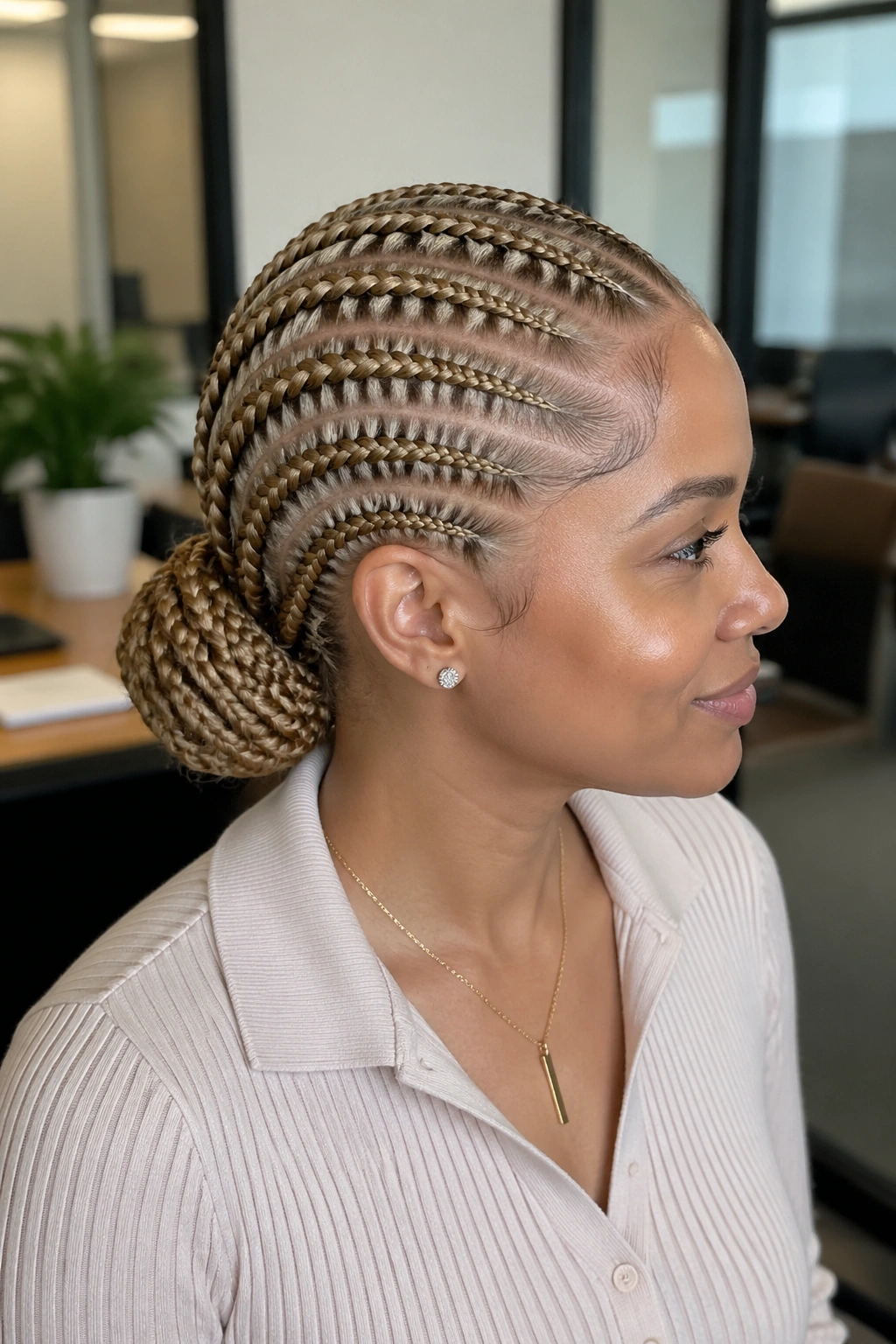
Dark blonde sits at the edge of blonde territory — slightly warmer and deeper than a honey but clearly lighter than a brown. It reads natural and understated.
All stitch cornrow ends get collected into a low bun at the nape. The bun can be a loose knot, a tight coil, or wrapped with additional kanekalon for a larger, more dramatic silhouette.
Low buns in dark blonde suit professional settings. The color doesn’t scream, the bun is tidy, and the stitch pattern up top is crisp. You can wear this to a boardroom without feeling like you’re performing a statement.
The wear time extends with the low bun configuration. Because the ends aren’t loose, there’s less friction and less fraying. Two weeks of clean wear is achievable with decent maintenance.
Avoid: buns that sit too high on the head with dark blonde stitch cornrows. The style starts reading top-heavy and the balance falls off.
14. Stitch Cornrows With Face-Framing Front Pieces in Bleached Blonde
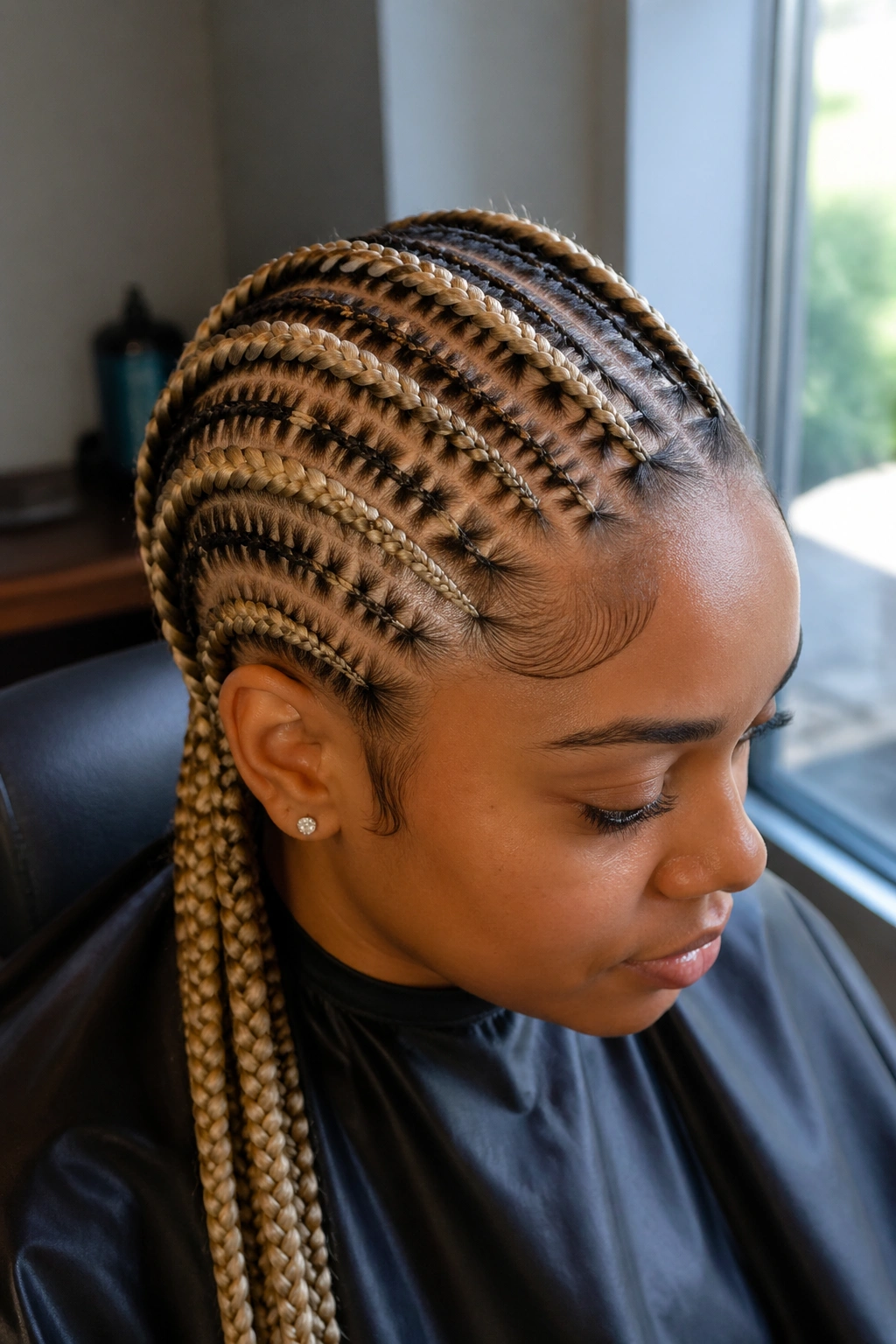
Bleached blonde reads as the lightest possible shade — nearly white, minimal warm or cool cast. This style cornrows most of the head in bleached blonde but leaves the front two pieces (one on each side) as loose face-framing hair. The loose pieces can be your natural hair pressed straight, or additional straight kanekalon extensions left unbraided.
What makes this different is the face-framing contrast. The sides of the face are softened by loose strands, while the rest of the head is highly structured with braids. That contrast flatters almost every face shape because it breaks up the geometric rigidity of the cornrow pattern.
Who this is for: anyone who wants the drama of blonde stitch cornrows without the full commitment to a fully braided look. The loose face-frames make the style feel more transitional.
Recommendation: if you’re using your natural hair for the loose pieces, press them straight before the install begins. Adding loose curls later doesn’t match the sleek face-frame aesthetic.
15. Angular Stitch Cornrows in Neon Yellow Blonde
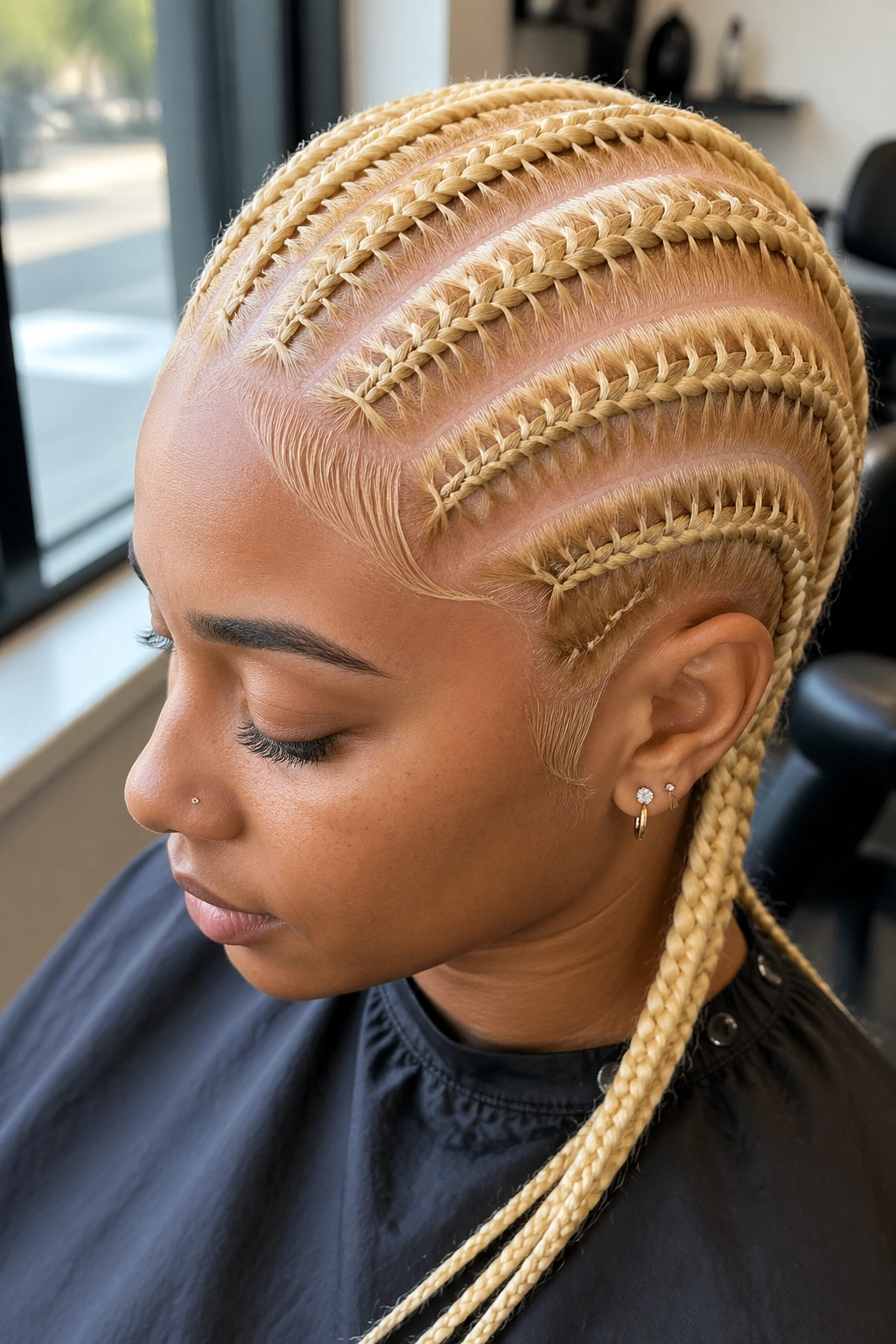
This is the maximalist option. Neon yellow blonde — a saturated, almost highlighter-bright shade — paired with angular stitch cornrow partings (sharp geometric shapes rather than curves or straight rows) produces a look that reads pure fashion.
This isn’t everyday hair. It’s concert hair, festival hair, photoshoot hair, costume hair. You wear it for a reason, not by default.
The angular partings create diamond, triangle, or chevron shapes across the scalp, with stitch cornrows filling each shape. Planning the parting grid takes time — often more time than the braiding itself — because each angle has to be measured.
Expect stares. In a good way, usually. Neon yellow blonde on a well-executed angular stitch pattern is the kind of hair that stops conversations.
Worth noting: the kanekalon itself in neon shades tends to fade faster than natural-blonde shades. A fresh install glows; three weeks later it’s noticeably softer in tone. If you want to preserve the bright color, plan a shorter wear cycle.
16. Stitch Cornrows With a Wrapped Headband Effect in Beige
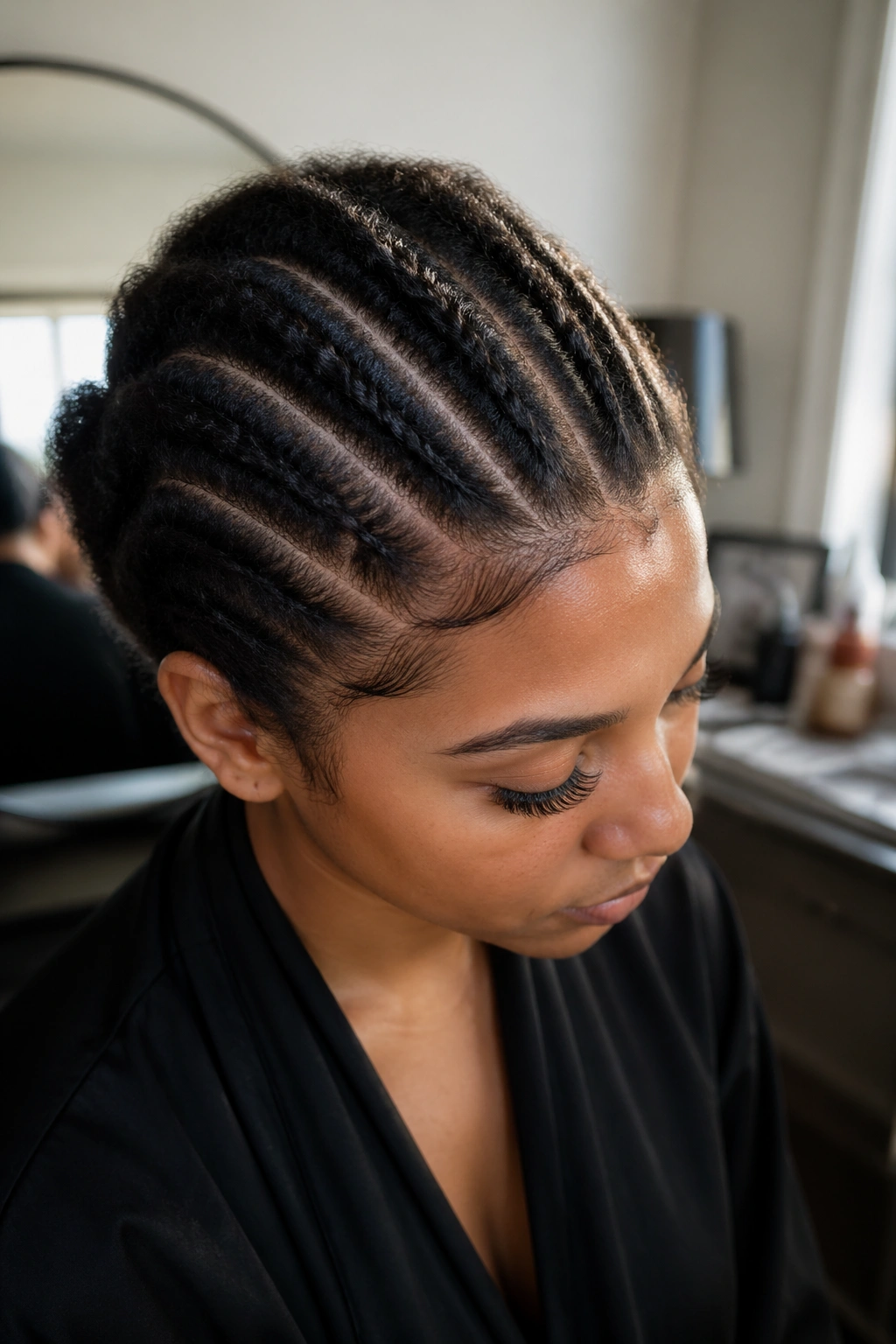
A wrapped headband effect means the front two or three cornrows get wrapped with a single thick piece of beige-blonde kanekalon, creating what looks like a braided headband integrated into the style. The rest of the cornrows continue normally down the back.
The wrapped section reads almost like a hair accessory rather than part of the braid pattern. It adds visual weight at the hairline and draws attention forward.
Beige blonde is particularly forgiving for this style because the shade itself is soft. The wrapping doesn’t scream for attention; it reads as deliberate but subtle.
Who This Is For
- Someone looking for a cornrow style with a built-in accessory
- Anyone who wants variety within a single install
- People who find standard cornrow patterns too uniform
The wrapping adds maybe 20 minutes to the install time. Worth every second for the added visual interest.
17. Dramatic Length Stitch Cornrows in Honey Gold
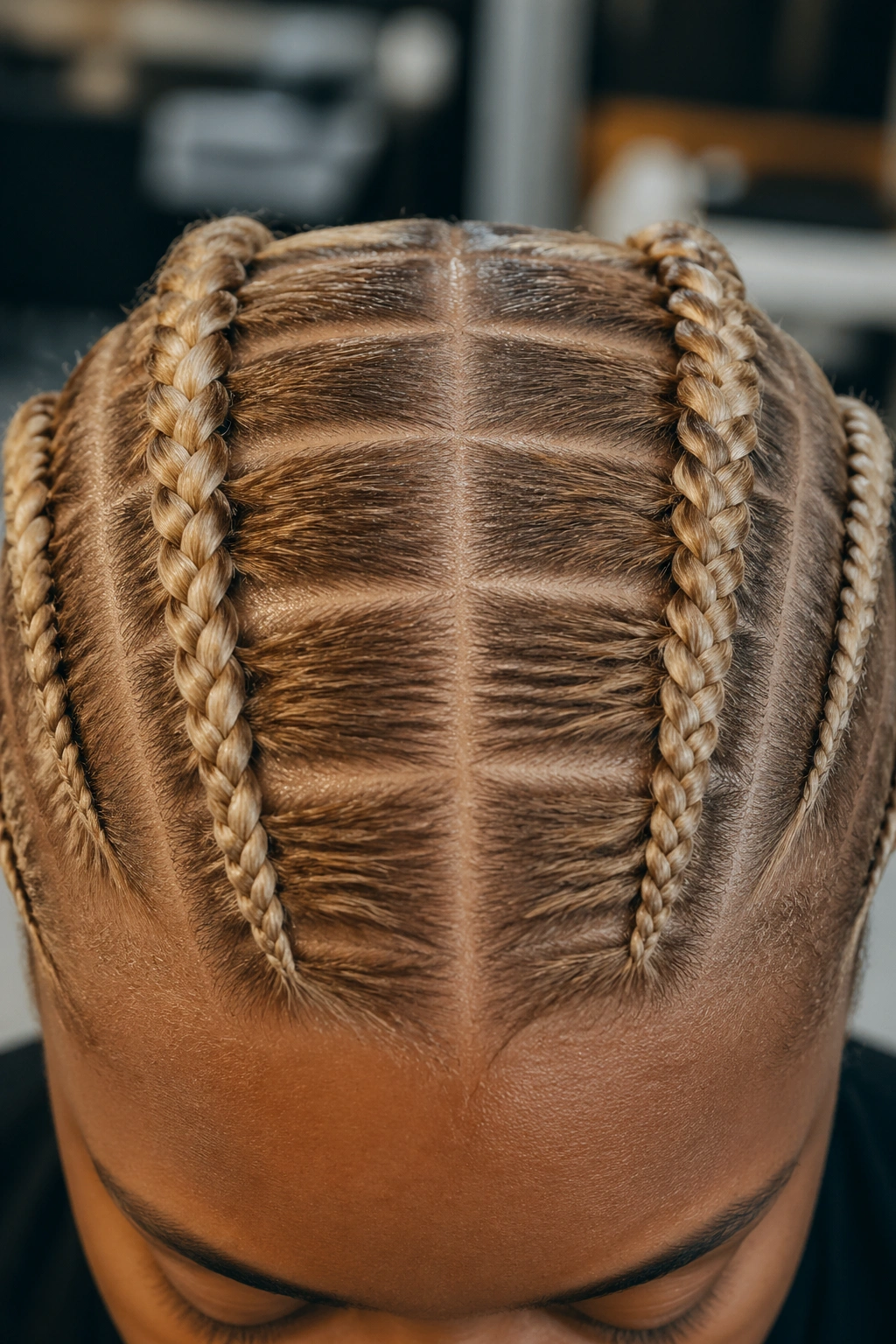
Where most stitch cornrow styles run to mid-back length, dramatic length takes it further — waist-length, hip-length, even longer. In honey gold (a richer, more saturated honey), the length becomes part of the statement.
The kanekalon volume required increases significantly. Expect 2-3 full packs per install rather than the standard 1.5. The weight also increases, which means more strain on the scalp. Plan rest periods during the install and avoid making the first few days too active.
Dramatic length has a specific aesthetic. It reads old-Hollywood-meets-Afrocentric, particularly with honey gold’s warm richness. For events where you want the hair to make the entrance alongside you, this style delivers.
Trade-offs worth knowing: dramatic length tangles more easily, catches in doorways and car seats, and requires more careful sleep protection. Bonnets aren’t optional.
Daily maintenance rises — probably 15 minutes each morning of light detangling, refreshing, and securing. For two weeks, that adds up.
18. Stitch Cornrows With Twisted Ends in Buttery Blonde
Buttery blonde has a creamy, slightly yellow-warm undertone that reads luxurious without being loud. Twisting the braid ends (rather than leaving them straight or curling them) creates a rope-like finish that contrasts with the flat stitch pattern up top.
The twists can be two-strand or three-strand. Three-strand twists hold longer and read more structured. Two-strand twists are faster and more fluid.
Unlike curled ends, which soften the overall look, twisted ends maintain the graphic feel of the stitch pattern. The eye sees sharp stitches at the scalp, then sharp twists at the ends — consistency of geometry throughout.
Best for: anyone who loves the stitch aesthetic and wants the entire braid to share that architectural quality.
Recommendation: apply a small amount of mousse or setting lotion while twisting the ends to help them hold. Untreated twists loosen within a day or two.
19. Asymmetrical Stitch Cornrows With Shaved Temple in Icy Platinum
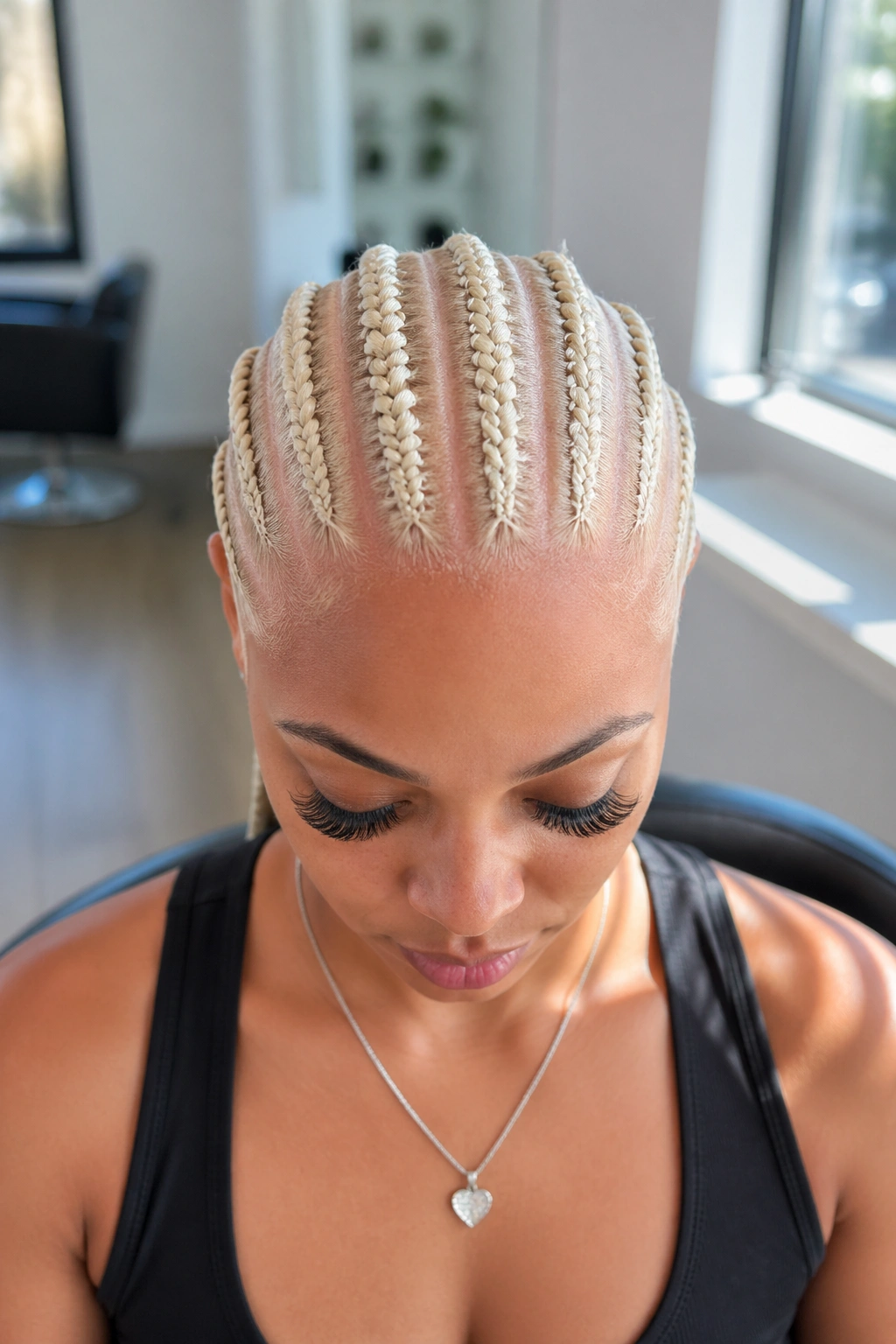
Asymmetry means the cornrows are distributed unevenly — maybe seven rows on one side, three on the other. Pair that with a shaved temple on the side with fewer rows, and the contrast between braided and bare scalp becomes the style’s defining feature.
In icy platinum (a very cool, almost-white blonde), this combination reads avant-garde. The braid mass on the heavier side balances against the shaved clean space on the lighter side.
The mechanics of asymmetric installation require clear planning. The braider needs to understand which side carries more visual weight and braid accordingly. A last-minute decision to change sides mid-install doesn’t work.
Who’s this for: someone with clipper work already in place, or someone ready to commit to the shaved temple look. Without the shaved element, asymmetric stitch cornrows just look uneven. The shave is what makes the asymmetry read intentional.
20. Stitch Cornrows With Colored Thread Wrapping in Dirty Blonde
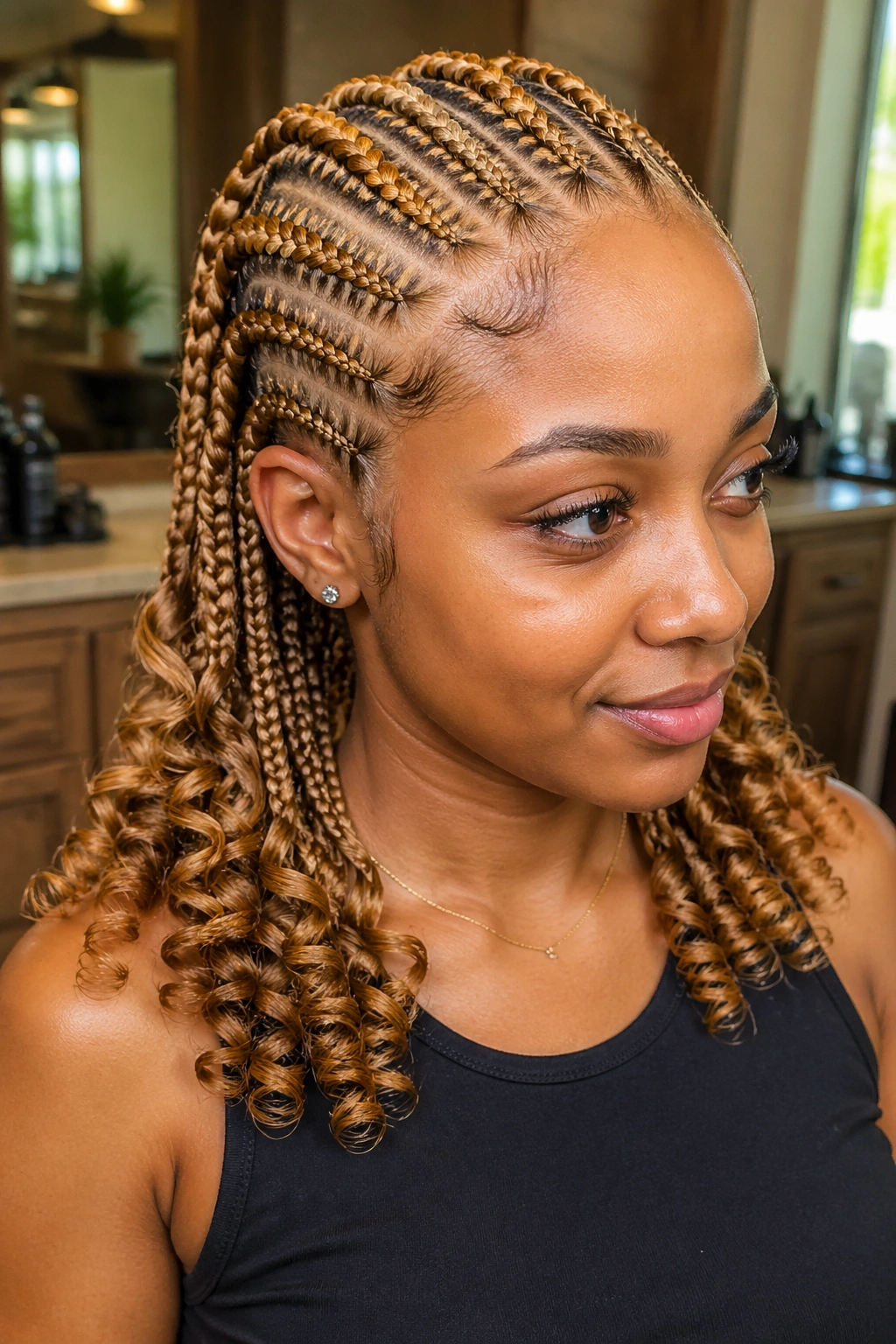
Dirty blonde is a dark-toned blonde with slight gray undertones — think the color of wet sand or light wood. Wrapping sections of individual braids with colored cotton thread (black, navy, burgundy, hunter green) adds a pop of accent color that contrasts with the neutral blonde base.
Thread wrapping is an artisanal accent that’s been part of African braiding traditions for generations. Adding it to a modern stitch cornrow style creates a bridge between heritage technique and contemporary pattern.
- Use cotton embroidery thread rather than polyester
- Wrap length varies per braid — 1 inch on some, 3 inches on others for rhythm
- Tie off each wrap with a tiny invisible knot tucked behind the braid
The finished look has texture beyond what the braid itself provides. Thread adds tactile and visual dimension.
Who this is for: anyone who appreciates layered detail. This is a style for people who enjoy being asked about their hair.
21. Stitch Cornrows With Wave-Set Ends in Sandy Blonde
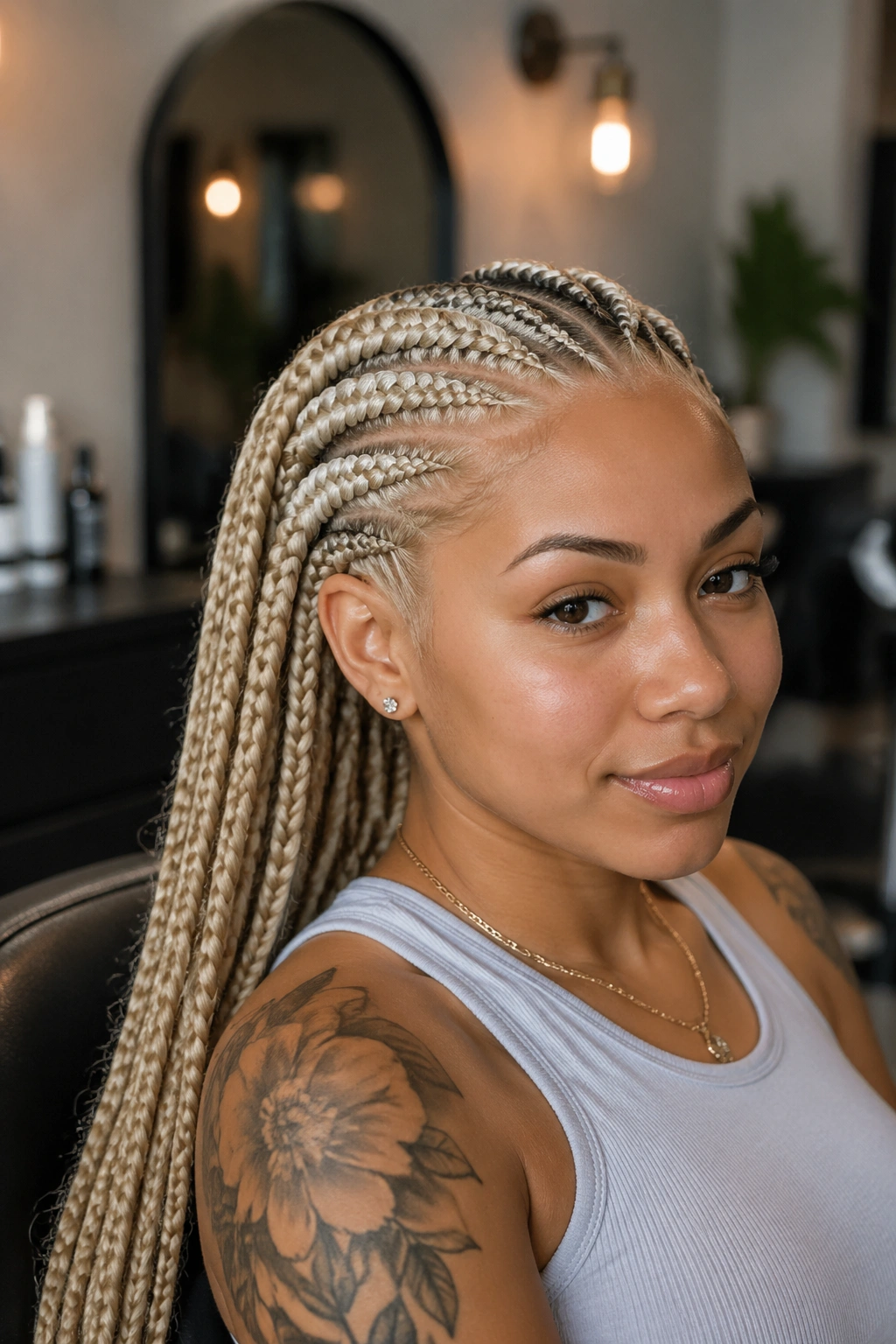
Sandy blonde is a warm, slightly muted blonde with beige undertones — the color of desert sand in late afternoon. Wave-setting the braid ends (using flexi-rods or Bantu knots applied only to the ends) creates a beachy wave texture that falls from the braid tips.
The contrast is sharp stitch pattern meets soft flowing waves. Stitches are rigid; waves are fluid. Sandy blonde unifies both elements visually because the shade itself is soft.
The Catch
Wave-setting braid ends takes overnight drying. Install the cornrows during the day, wet-set the ends before bed, sleep carefully, and unravel the waves the next morning. It’s a two-day process for a one-day style.
For the setting: divide the last 4-5 inches of each braid into two-strand twists, wrap around a flexi-rod, secure the rod in place, and sleep with a bonnet over the whole head. Unravel gently and apply a light sheen spray.
The payoff is a look that blends protective-style energy with mermaid-wave aesthetics.
22. Minimalist Stitch Cornrows in Natural-Match Blonde
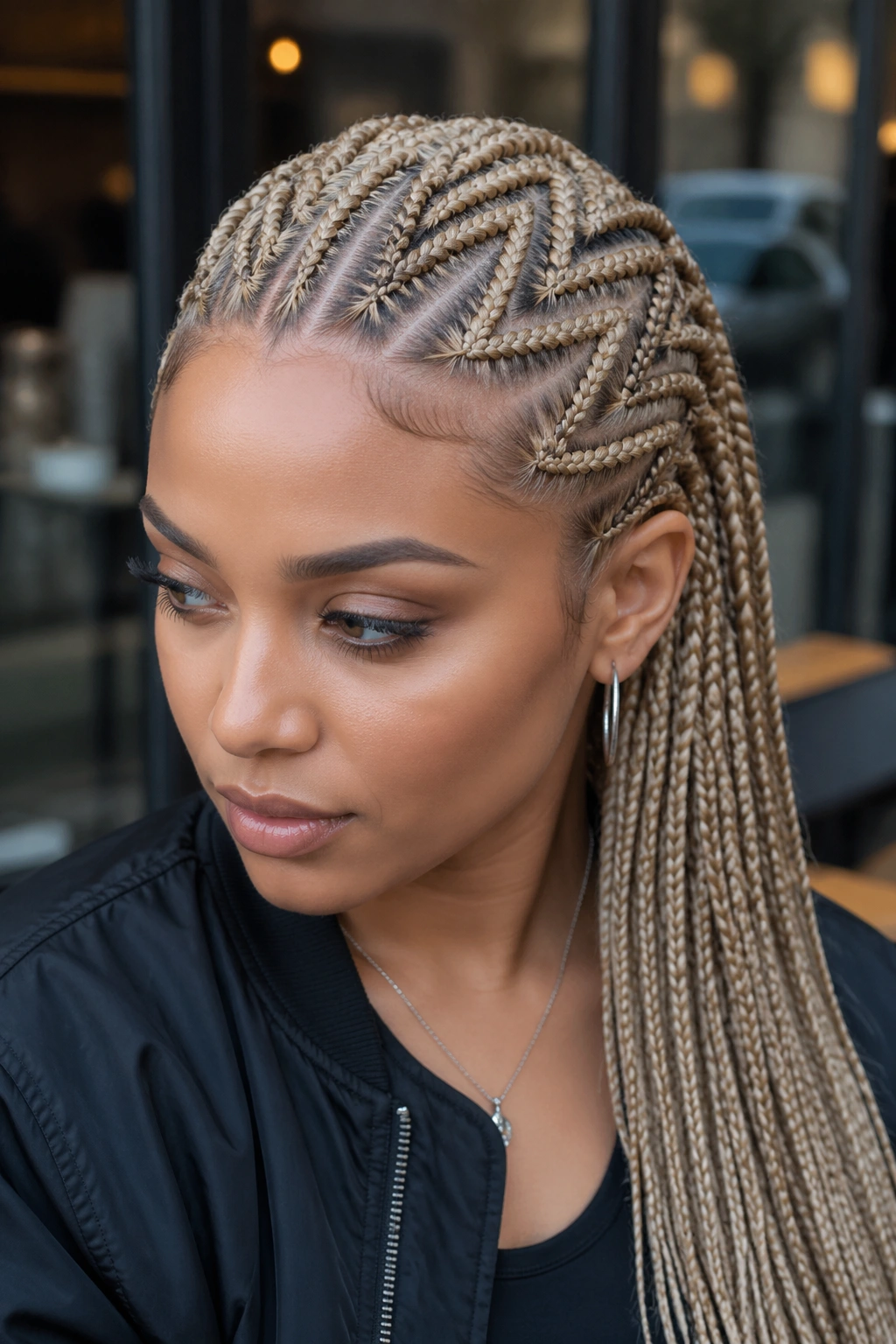
This last one is the subtle option. Four to six stitch cornrows only — not a full head — installed in a blonde shade that’s close to your natural hair color at its lightest point. The style reads as an enhanced version of your own hair, not a dramatic shift.
Natural-match blonde varies by person. If your natural hair has warm undertones, match toward honey or beige blonde. If cool, match toward ash or smoky blonde. The goal is harmony with your skin and existing hair, not contrast.
Minimalist stitch cornrows work for professional settings where a full blonde installation would feel performative. It’s a weekend addition that doesn’t announce itself. Coworkers notice something’s different but struggle to name it.
Wear time is shorter because fewer braids distribute the protective function less effectively. Plan for 7-10 days of clean wear rather than 2-3 weeks.
Who this is for: someone testing blonde before committing, anyone in a conservative work environment who still wants expression, or people who prefer understatement as a personal aesthetic.
Caring for Blonde Kanekalon
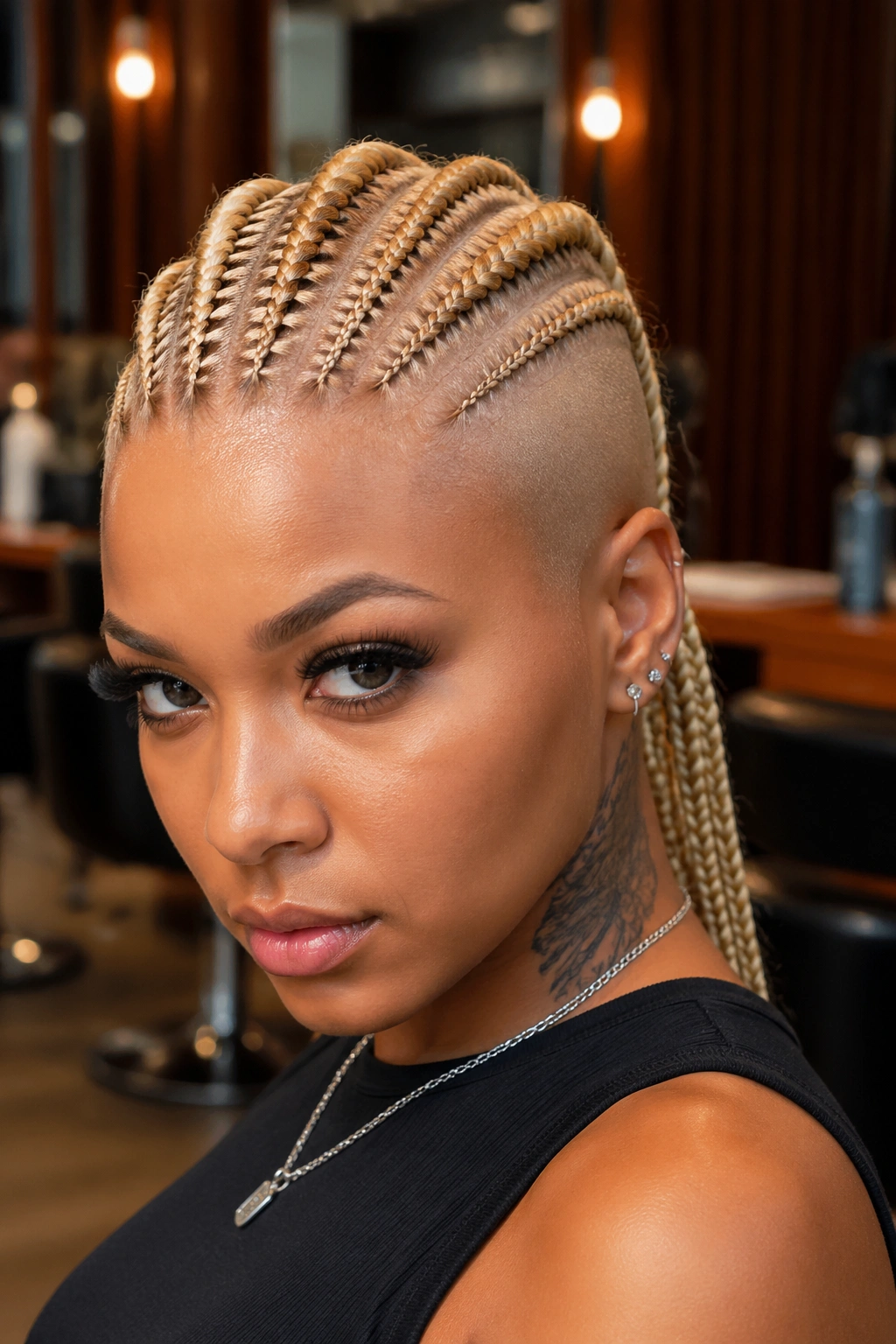
Blonde extensions need different care than black or dark brown. The lighter shades yellow with exposure to hard water, chlorine, and certain oils. Protecting your install means avoiding a few specific things.
Hard water leaves mineral deposits that tint blonde hair yellow or orange over time. If you live in a hard-water area, rinse your braids with distilled or filtered water once a week. Some people use clarifying shampoo monthly to strip buildup.
Chlorine from pools will lighten some blonde shades further (making them appear greenish) or damage the kanekalon texture. A swim cap is your friend. If you do swim with the braids, rinse immediately with clean water and apply a leave-in conditioner.
Heavy oils — particularly coconut, castor, and olive — can darken blonde over weeks of application. Switch to light refresh sprays, water-based leave-ins, or diluted mousses for maintenance.
A sheen spray designed for braid hair keeps the kanekalon looking fresh without adding oil weight. Spritz every few days, focusing on the length rather than the scalp.
Sleep Protection Specifically for Blonde Braids
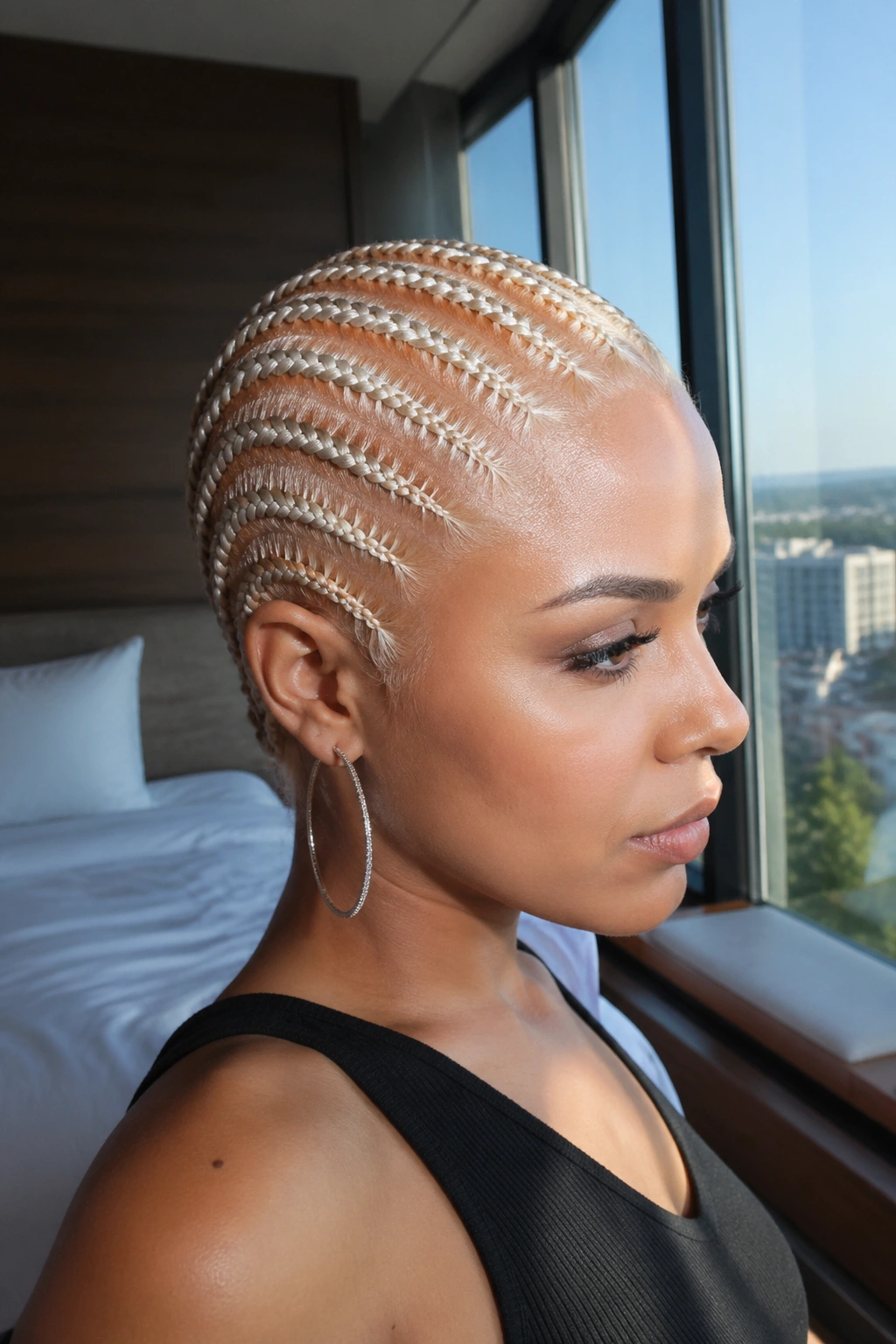
Friction with cotton pillowcases is the fastest way to ruin blonde stitch cornrows. Cotton grabs the hair, causes micro-breakage in the extension fibers, and creates frizz that you can’t refresh away.
A silk or satin bonnet that covers all the braids is the baseline. Silk pillowcases help but don’t eliminate friction entirely if you move during sleep.
For dramatic-length installs, consider tying the braids into a loose low bun or gathering them in a silk scrunchie before putting the bonnet on. Contained braids friction less against the bonnet interior than loose braids.
Takedown Without Damage
When it’s time to remove the braids, rush is the enemy. Blonde kanekalon can shed fibers onto your natural hair during rushed takedowns, leaving fuzzy blonde residue that’s hard to wash out.
Unravel each braid slowly, starting from the end and working upward. Use a conditioning spray on each section as you go to reduce tangles. Have a wide-tooth comb and a detangling brush ready.
For the final detangling, shampoo with a clarifying formula first, then follow with a deep conditioner. Your natural hair will have absorbed product residue from the braid wear, and the clarifying step gets it out. Skipping this step can leave hair dull and coated for weeks.
Picking the Right Blonde Shade
Skin undertone guides shade selection more than hair texture does. Look at the veins on your wrist in natural light.
- Blue or purple veins = cool undertone → ash, platinum, icy, silver blondes
- Green veins = warm undertone → honey, golden, strawberry, bronze blondes
- Can’t tell either way = neutral undertone → beige, wheat, sandy blondes
Contrast preference also matters. If you want maximum visibility for the stitch pattern, pick a blonde that contrasts highly with your natural hair color (which is probably dark). If you want the style to read subtle, pick a blonde close to your natural shade.
Skin tolerance for bold color counts too. Some people feel at home in neon yellow; others feel themselves in wheat. Pick a shade you’ll actually enjoy seeing in the mirror every morning for two to three weeks straight.
Ask your braider which shade they’ve worked with most recently — they’ll have opinions on which shades photograph well, which shed less, and which hold up best over a typical install window.
Test with a small patch if you can. Some braiders will install one or two practice braids in your chosen shade before committing to a full install, especially if you’re nervous. Worth the extra ten minutes.