



Fulani cornrows trace their roots to the Fulani people of West and Central Africa, where the style has carried meaning for centuries. The signature pattern — a single cornrow running down the center of the head, surrounded by side-swept rows, often with a braid or two falling over the temples — wasn’t invented for fashion. It signaled status, age, marital position, and tribal belonging. Adding beads compounds the cultural weight; beads themselves were currency, family heirlooms, and protective talismans long before they were styling accents.
I’ve worn Fulani cornrows with beads for everything from cultural events to casual weekends, and the style holds something most other braid patterns don’t: a built-in connection to lineage. When you wear Fulani cornrows respectfully, you’re participating in a tradition that predates almost every modern hairstyle in popular rotation.
This piece walks through 22 specific Fulani cornrow looks with bead variations. Each one preserves the core elements — center braid, side rows, temple drop — while exploring different bead choices, color palettes, and finishing details.
What Defines a Fulani Cornrow Style
The Fulani cornrow has a recognizable structure. A central braid runs from the front hairline straight back down the middle of the head. Side cornrows curve away from this center braid, falling toward the ears and back of the head. Often, one or two short braids drop down at the temples or along the hairline, framing the face.
Beads are part of the traditional finish. They appear at the ends of the temple braids, threaded along the central braid, or distributed across various rows depending on the specific tribal variant.
What separates Fulani cornrows from other patterns is the central spine. That single dominant row down the middle is non-negotiable; without it, you have a pretty cornrow style but not a Fulani style.
Variations exist across regions. Some Fulani communities favor the pattern with the center braid only running halfway. Others extend it to the nape. Some use thick beads exclusively; others mix small and large beads. The style is a tradition, not a fixed rulebook.
The Cultural Weight of Beads
Beads have carried meaning in African braiding for thousands of years. They’ve represented social status, age, marriage, fertility, wealth, and spiritual protection. Different bead colors, materials, and patterns spoke different messages.
When wearing Fulani cornrows with beads, awareness matters. The style isn’t a costume; it’s a cultural practice with depth. Educating yourself before installing — even a basic understanding of the pattern’s origins — shows respect.
That said, the style has been adopted broadly across the African diaspora and has become part of contemporary Black hair culture. Wearing it as a Black woman is participating in heritage, not appropriating it. Wearing it from outside that heritage requires more thought and conversation.
Tools and Materials Worth Gathering
A Fulani cornrow install with beads requires more materials than a standard cornrow set.
- A fine-tooth rat-tail comb with a metal tip
- Edge gel with firm hold
- Pre-stretched kanekalon if adding feed-ins
- Wooden, glass, metal, or cowrie shell beads in your chosen mix
- Small clear or color-matched rubber bands for securing beads
- A bead threader or large-eye needle (for some bead types)
- Hair clips for sectioning
- A spray bottle with water-leave-in mix
- Satin or silk bonnet for nighttime protection
Bead selection deserves dedicated time. Visit a beauty supply store in person if possible — feel the bead weight, check the inner edge for smoothness, and visualize the colors against your skin tone. Online buying works but can result in surprises.
How to Choose Beads That Won’t Damage Hair
Not all beads are created equal. Cheap plastic beads with rough inner edges shred hair fibers as they slide. Heavy metal beads pull on the braid base and create traction at the scalp.
Look for beads with smooth interior holes. Run your fingernail around the inside edge — any roughness will catch hair. Reject those.
Weight matters. For temple braids and shorter braids, lighter beads (wood, resin, glass) work best. Heavier beads (metal, stone) are fine on longer braids that can support the weight without scalp strain.
Hole size has to match your braid thickness. Beads with holes too small won’t slide on; beads with holes too large fall off without firm rubber band securing.
Prep That Holds Through Two Weeks of Wear
Fulani cornrows hold for 2-3 weeks if installed and maintained properly. Prep determines whether you hit the longer end of that range.
Clarify your hair the day before with a sulfate shampoo to remove product buildup. Follow with a deep conditioner — at least 20 minutes under heat. Rinse with cool water to seal the cuticle.
Detangle thoroughly with a wide-tooth comb. Any knots that survive prep will tangle into the braid base and cause matting later.
Air-dry to about 80% damp. Apply a leave-in conditioner from mid-shaft to ends, skipping the scalp. Stretch the hair if your texture is tight (banding, blow-out on cool, or large twist-outs all work).
Edges deserve dedicated prep. Apply a small amount of edge gel to the hairline and slick down with a soft brush before braiding starts. Defined edges from the beginning hold for the duration of the install.
1. Classic Fulani With Wooden Beads at the Temples
The foundational style. Center braid runs from the hairline to the nape. Side cornrows curve away on each side. Two short temple braids fall along the cheekbones, finished with three to five wooden beads each.
Why It Works
This is the version closest to traditional Fulani styling. Wooden beads carry the most authentic look because wood was the original material — long before glass or metal — used for hair beads in the region.
- Use natural wood beads in earth tones (brown, beige, dark walnut)
- String 3-5 beads per temple braid
- Secure each bead bundle with a small rubber band
The temple braids should be shorter than the rest — usually 4-6 inches shorter than the side cornrows. They’re meant to frame the face, not blend with the side rows.
This version suits any face shape and any setting. It’s the Fulani look I’d recommend for a first installation if you’re new to the style.
2. Fulani With Cowrie Shell Accents
Cowrie shells carry their own cultural significance. In many African traditions, cowrie shells represented wealth, fertility, and spiritual connection. Adding them to a Fulani cornrow style anchors it in symbolism beyond just visual appeal.
Cowrie shells are typically larger and heavier than standard beads. Use them sparingly — three to four shells across the entire install, not on every braid. Placement matters: one or two on the temple braids, perhaps one on the central braid, one threaded into a side cornrow.
The shells need to be drilled with through-holes to slide onto braids. Most cowrie beads sold for hair come pre-drilled. Check before buying.
Best for: cultural events, weddings, gatherings where the symbolism is appreciated. The cowrie accent reads ceremonial.
3. Fulani With Mixed Metal Beads
Combining gold, silver, copper, and brass beads creates a layered metallic look. Each metal catches light differently — gold reads warm, silver reads cool, copper reads earthy, brass reads vintage.
The mix should be considered, not random. Two metals usually work better than four. Gold and copper together read warm and cohesive. Silver and gold together read more eclectic.
- Place metal beads at the ends of side cornrows, not the central braid
- Use no more than 2-3 metal beads per braid to control weight
- Distribute metal types evenly across the head
The catch with metal is weight. Metal beads weigh significantly more than wood or glass. On long braids, the weight can pull noticeably on the scalp by week two.
4. Fulani With Long Center Braid Only
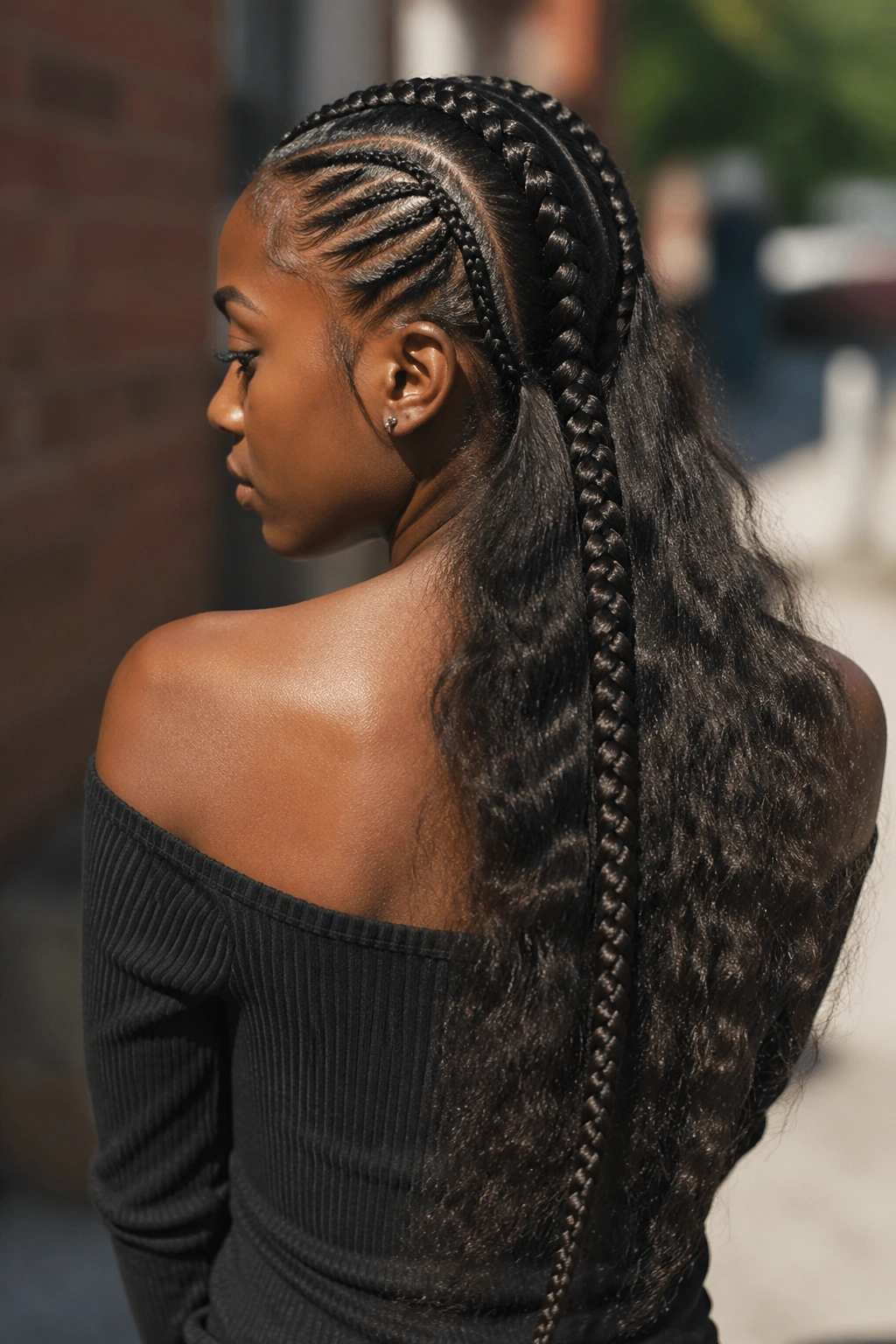
A minimalist take: the central braid runs the full length of the head and continues into a long single braid hanging down the back. The side cornrows are kept short — only running from the hairline to the crown — and then the hair flows loose.
The contrast is the long structured center against the short side cornrows. The temple braids drop as usual but appear less prominent because the central braid dominates.
Best for anyone who loves the central spine of Fulani styling but wants less braided coverage overall.
This style holds up well in active settings because there’s less braided surface area to maintain. Refresh the central braid and the side rows; the loose hair gets its own care routine.
5. Fulani With Beaded Center Braid
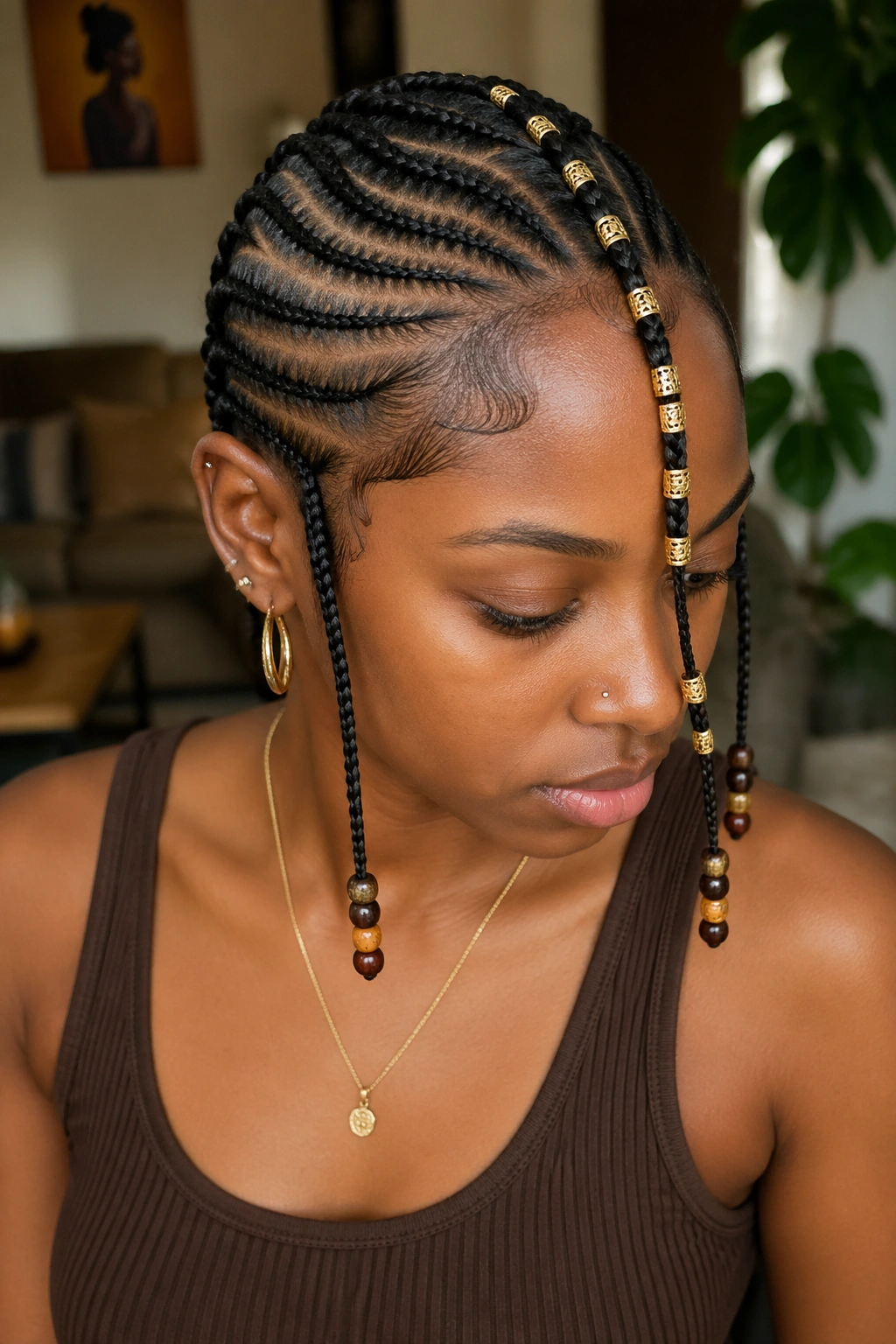
Instead of placing all the beads at the temple braids and side cornrows, this version threads beads along the entire length of the central braid. The center spine becomes the bead-heavy element.
The beads on the central braid can be uniform (all the same color) or graduated (transitioning from dark at the scalp to light at the end, or vice versa).
Threading beads along a braid requires either bead-stringing during braiding (the braider adds beads as they work) or post-install threading (sliding beads up from the end).
- Use a bead threader for post-install bead application
- Space beads about 1 inch apart along the braid length
- Secure both ends of the bead section with rubber bands
Who this is for: someone who loves bead-heavy looks and wants to focus the visual interest on the central spine.
6. Fulani With Color-Block Beads
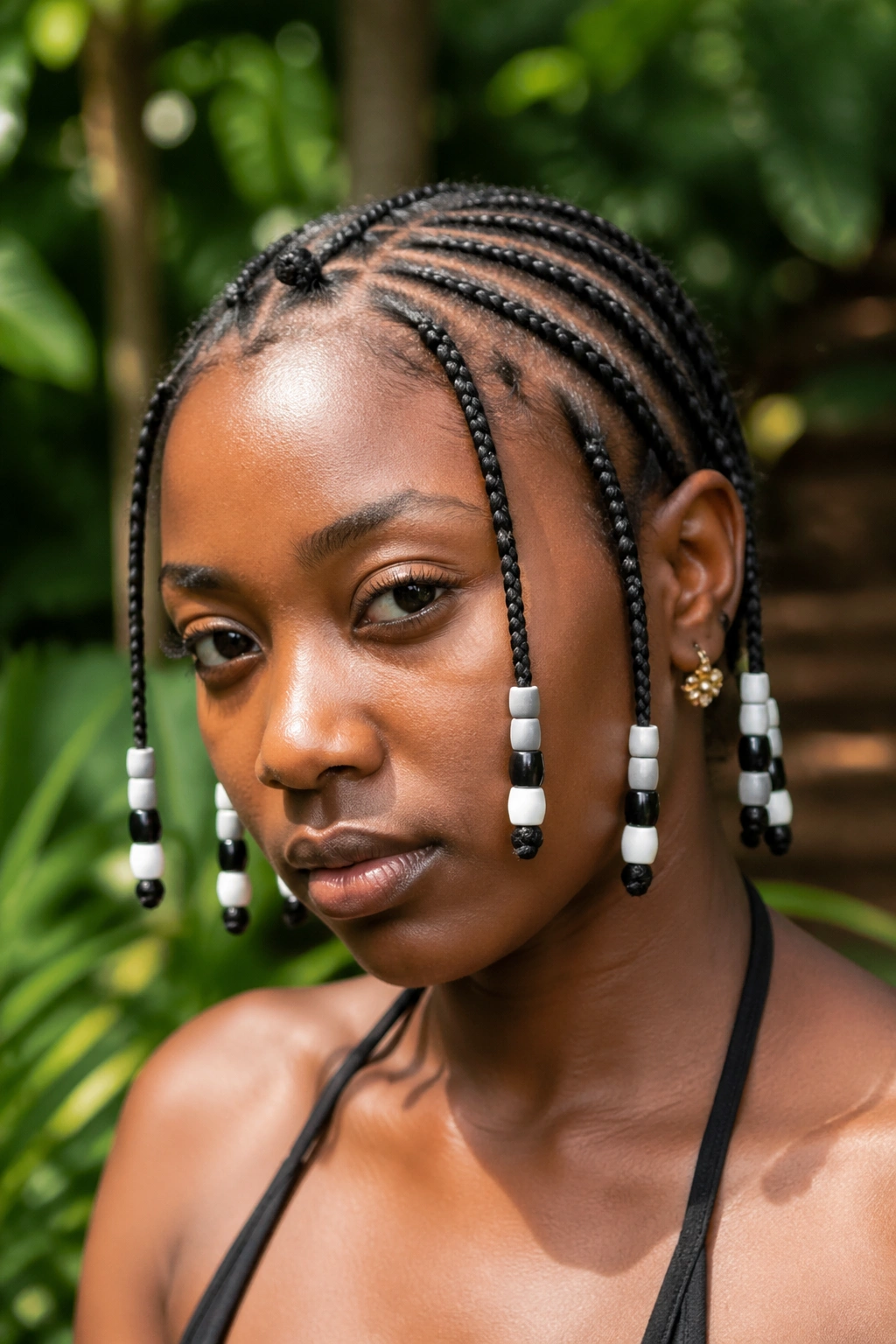
Beads in distinct color groups along each braid. The first two beads might be black, the next two white, the last two black again. The pattern creates a banded effect.
Color choice carries meaning. Earth tones (brown, rust, mustard) read traditional. Bright primary colors (red, blue, yellow) read playful. Monochrome (all white, all black) reads modern.
Plan the bead pattern before threading. Random color application looks chaotic; planned color blocking looks intentional.
This version reads younger and more playful than traditional bead choices. It’s a good fit for everyday wear when you want the style but not the formality of full ceremonial bead application.
7. Fulani With Feed-In Extensions
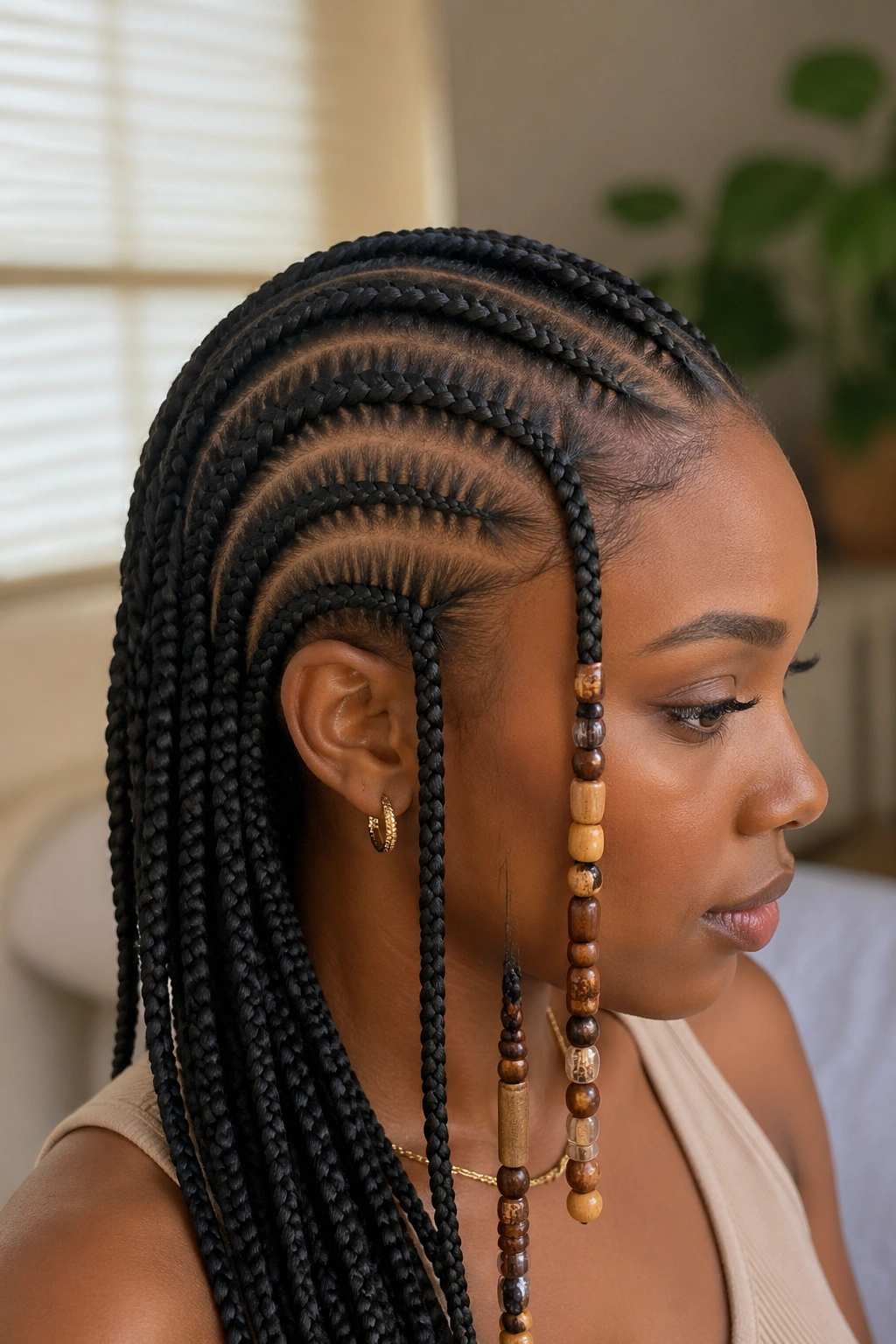
Adding kanekalon for length and density. The cornrows start with your natural hair only at the front, then incorporate feed-in extensions a few stitches in. The result is fuller, longer braids than your natural hair alone could produce.
Feed-ins reduce visible tension at the hairline because the first few stitches are pure natural hair. They also extend the visible length, which gives more space for bead placement.
For Fulani styling specifically, the feed-ins should be added subtly — the goal isn’t to obscure the natural texture but to enhance the length. Use kanekalon in a shade matching your natural hair color.
Best for: anyone with shorter natural hair who wants the dramatic long-braid Fulani aesthetic.
Recommendation: for traditional looks, use natural-shade kanekalon. For modern interpretations, color-matched feed-ins still keep the style readable as Fulani.
8. Fulani With Pony Beads in Bright Colors
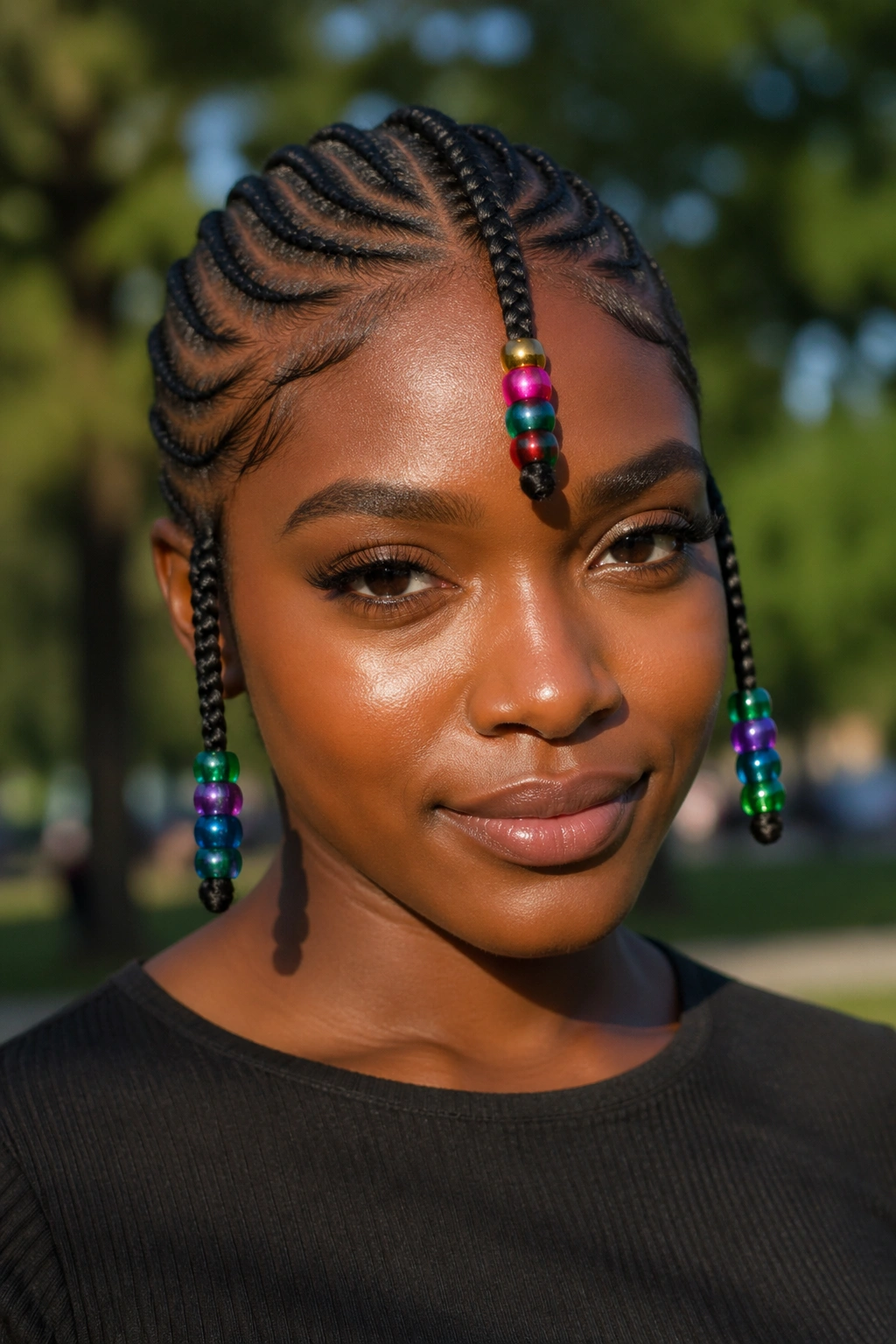
Pony beads (those large, plastic, rounded beads commonly found in craft stores) come in a vast range of bright colors. Using them in Fulani cornrows creates a youthful, playful version of the traditional style.
Pony beads are a common children’s hair accessory, but they work for adult installations too when paired with intentional color choices.
The bright colors should complement your wardrobe palette. If you wear a lot of jewel tones, pony beads in jewel colors (sapphire, emerald, ruby) work. If you wear neutrals, beads in coordinating colors (cream, dusty pink, sage) might suit better.
How to Use Them
Pony beads’ larger size means fewer beads per braid. Two to three beads per temple braid is plenty; more starts to look overdone.
- Choose pony beads with rounded edges to prevent hair snagging
- Avoid neon-only palettes (too costume-y for adult wear)
- Mix matte and glossy finishes for visual interest
This version reads casual and approachable. It’s a good fit for warm-weather settings, festivals, or any environment where you want to lean into color.
9. Fulani With Beaded Drop Braids Over the Forehead
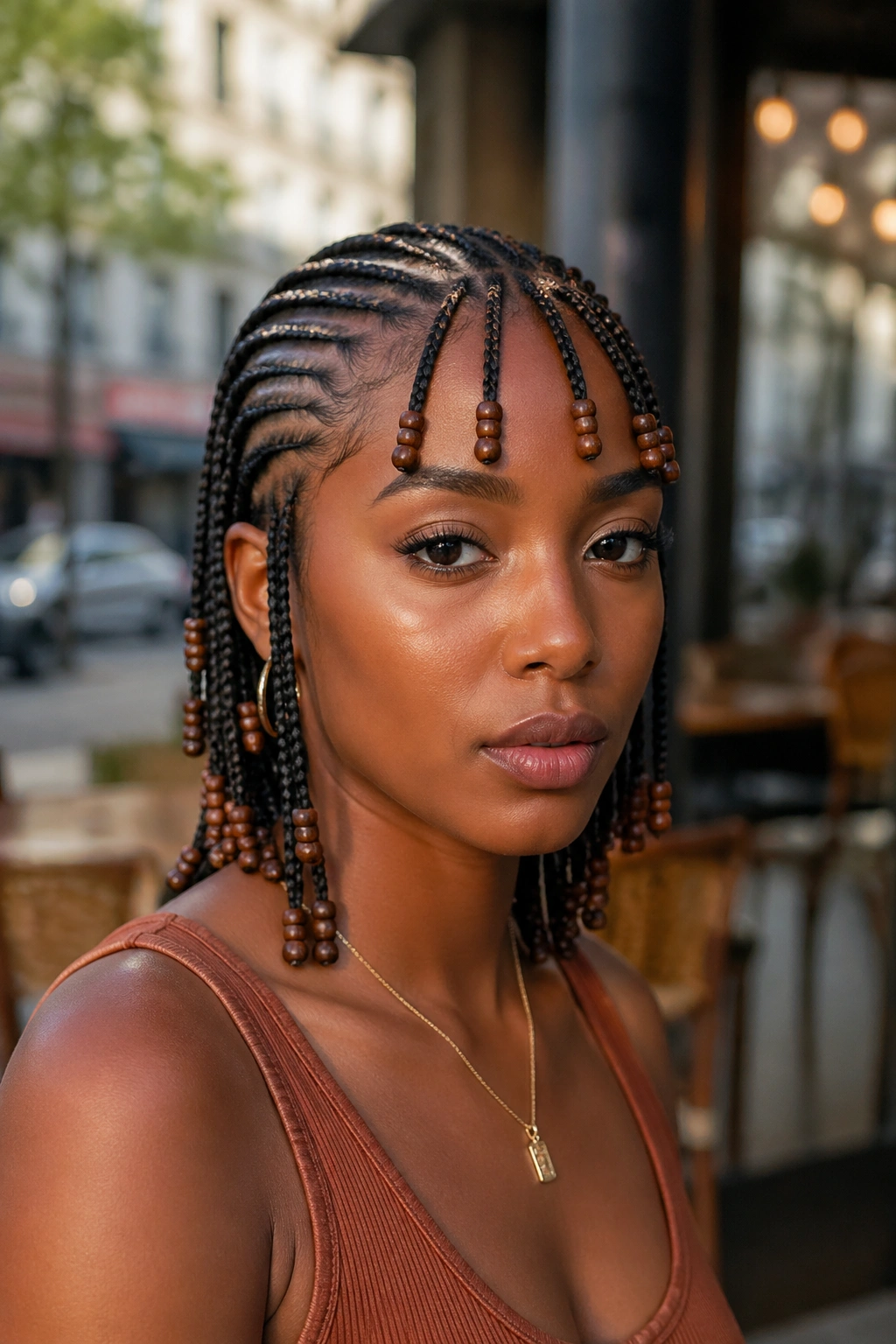
Standard Fulani temple braids fall along the cheekbones. This variation includes additional short braids that drop directly over the forehead, framing the face from above. Each drop braid carries 2-3 beads at its end.
The forehead drops add visual weight at the front of the face. They flatter taller foreheads particularly well by visually shortening the apparent forehead height.
The drop braids should be shorter than the temple braids — maybe 2-3 inches at most — to avoid covering the eyes.
This style requires shorter natural hair at the front to braid into. If your front section is too long, the drops will hang too low. Trim slightly or skip this variation.
10. Fulani With Glass Beads in Earth Tones
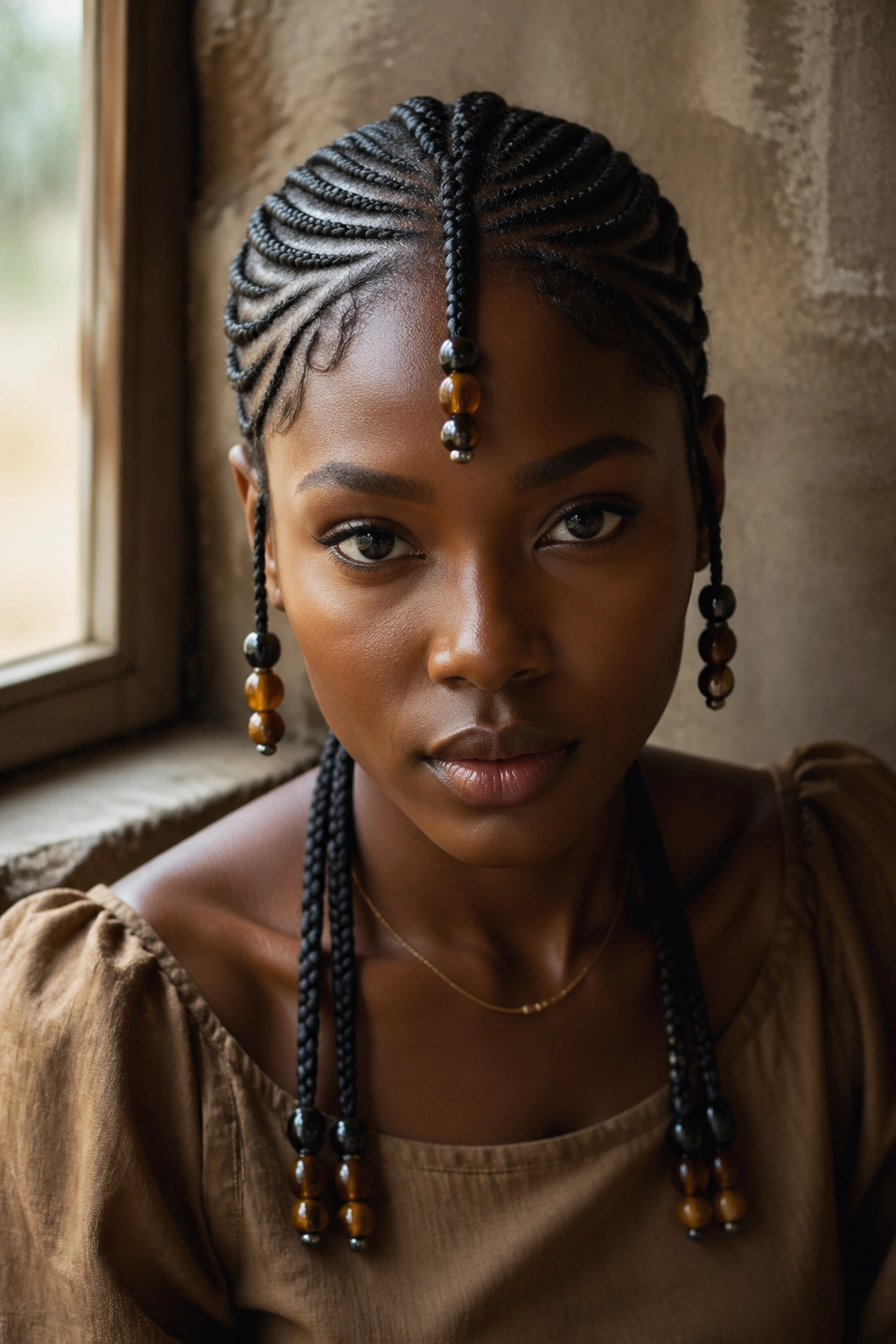
Glass beads have a smoother surface than wood and a cleaner shape. In earth tones — amber, smoky topaz, hematite, deep brown — they read elegant and refined.
Glass beads catch light differently than wood. Where wood absorbs light and reads matte, glass reflects light and reads polished. The same Fulani pattern with glass beads versus wood beads gives off two different moods.
Glass beads are heavier than wood. Use fewer per braid — 2-3 instead of 4-5.
Best for: dressed-up occasions, photo shoots, settings where the bead detail will be noticed and appreciated.
11. Fulani With Tribal Symbol Beads
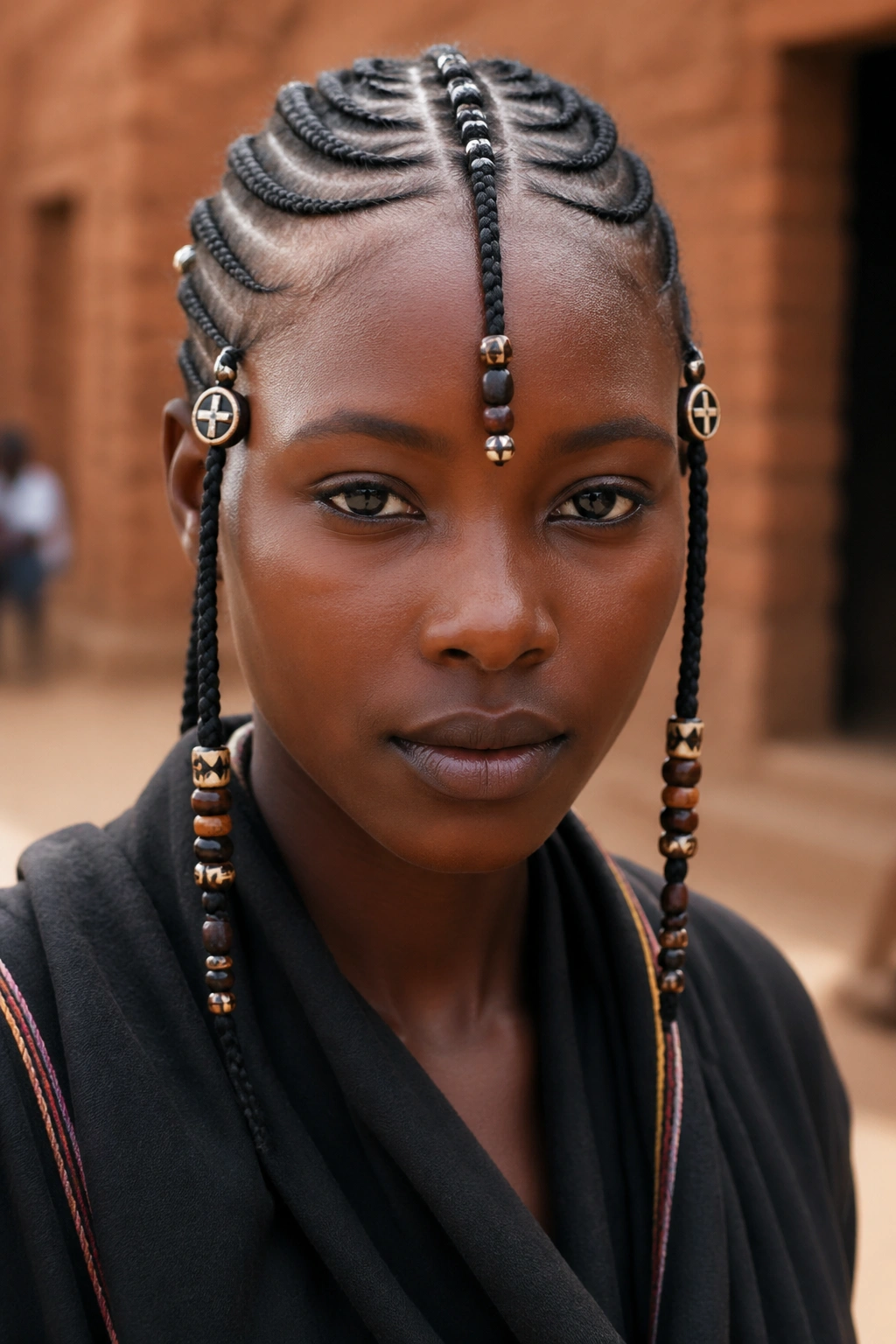
Some bead manufacturers produce beads stamped with tribal symbols, geometric patterns, or African-inspired motifs. Using these specifically in a Fulani cornrow install adds another layer of cultural reference.
Source these beads carefully. Beads marketed as “tribal” without specific cultural context can feel generic or appropriative. Look for beads from artisans who specify the symbolism they’re using.
A few symbol beads at the temple braids and central braid suffice. The rest of the install can use plain beads to balance the visual.
Recommendation: research the symbols before wearing. Knowing what you’re wearing on your head matters when others ask about it.
12. Fulani With Asymmetric Bead Distribution
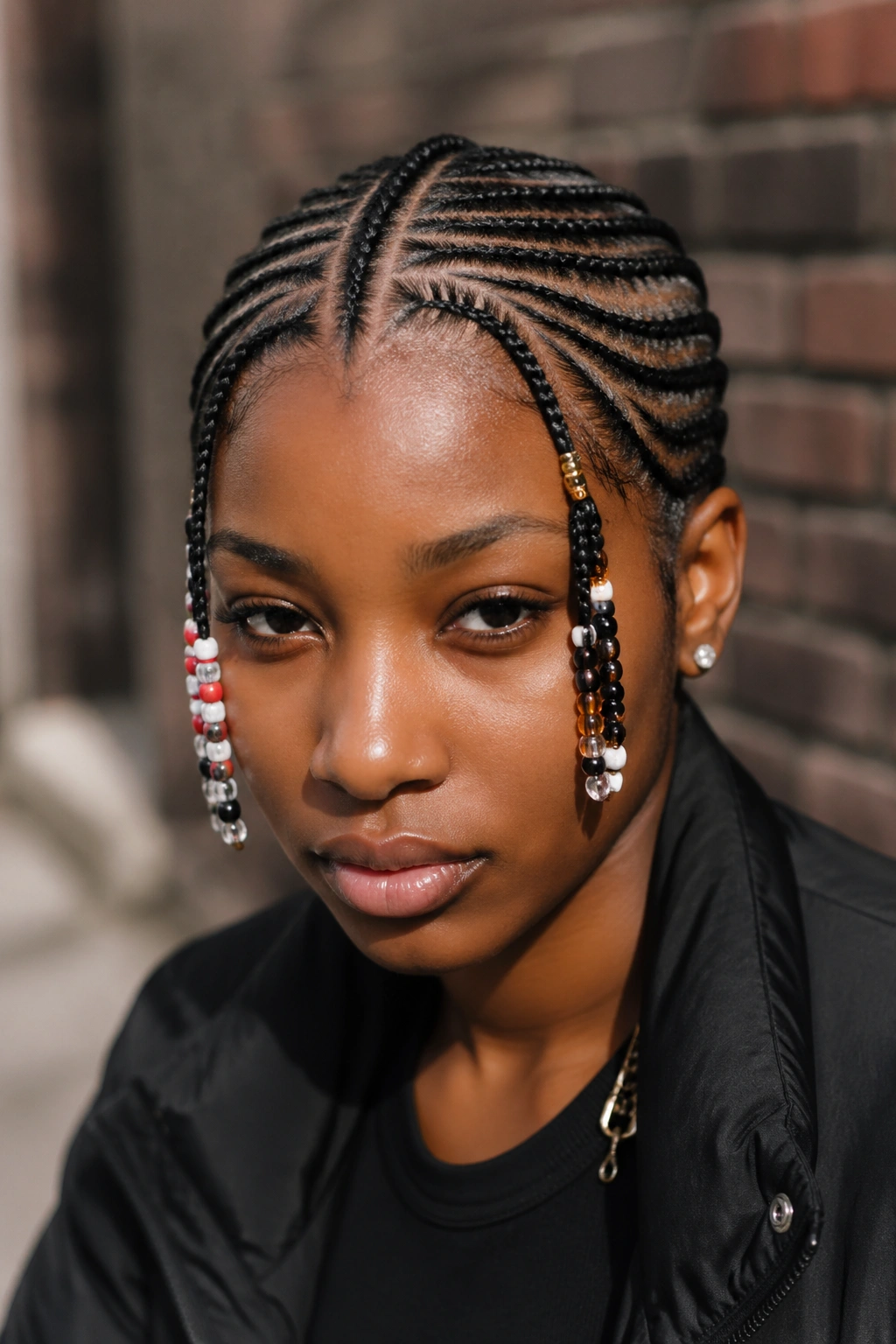
Standard Fulani has beads symmetrically placed — same number on left and right temple braids, balanced across the side cornrows. This variation breaks that symmetry.
Maybe the right temple braid has 6 beads while the left has only 2. Maybe one side cornrow features beads while the other is plain. The asymmetry creates an editorial, fashion-forward feel.
This isn’t traditional. It’s a modern interpretation that uses Fulani structure as a base for contemporary styling. Wear it knowing that purists may not consider it authentic Fulani styling.
Best for: someone comfortable with contemporary takes on traditional looks. The asymmetry reads as artistic choice rather than mistake when the rest of the install is clean.
13. Fulani With a Crown of Beads at the Apex
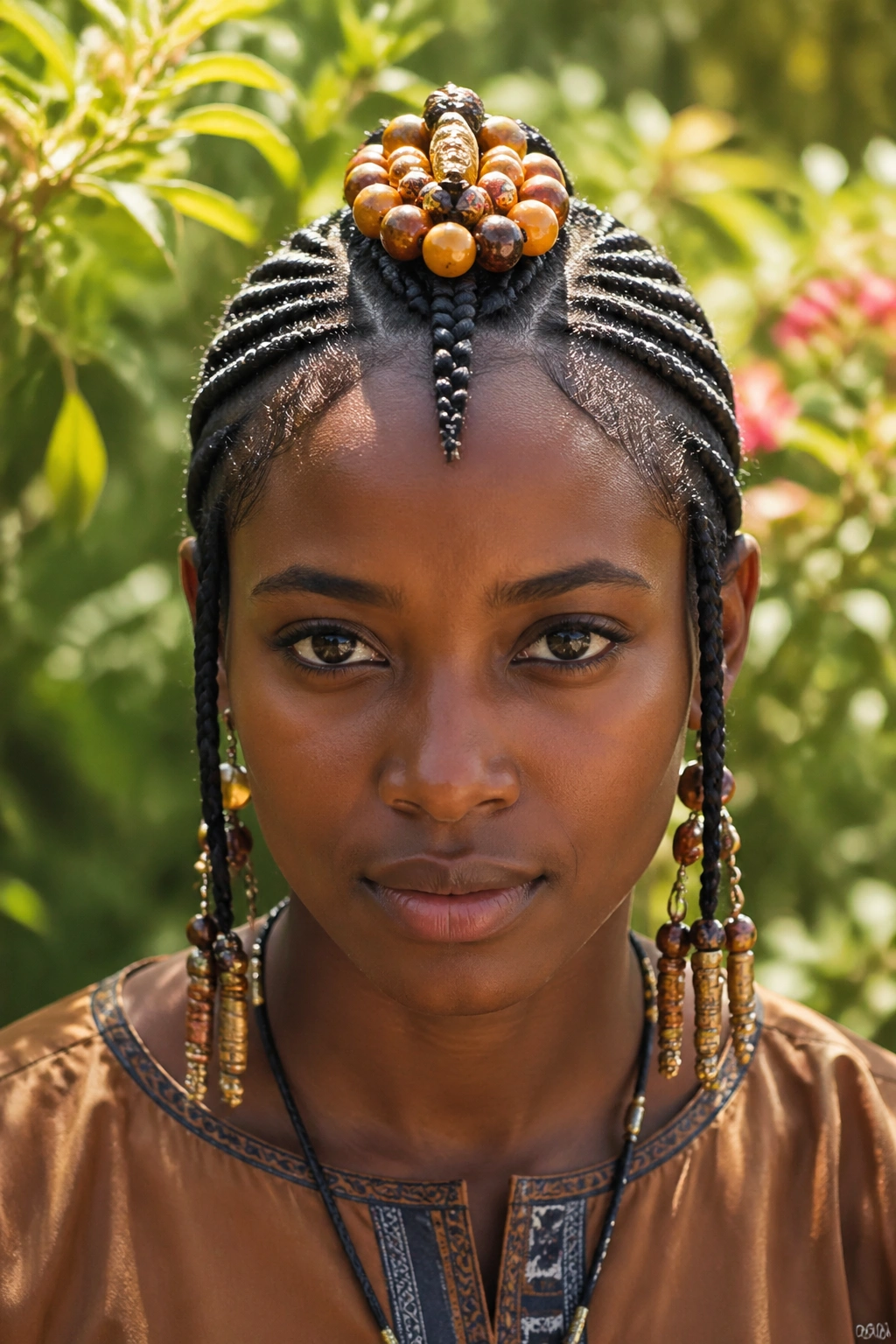
The central braid passes through a cluster of larger ornamental beads at the crown of the head — essentially creating a “crown” of beads at the highest point. The side cornrows feed into this crown cluster from each side.
The crown beads should be your statement beads. Larger than the rest, more elaborate, possibly the focal cowrie or a single ornate carved bead.
The crown placement draws the eye upward to the top of the head, which has an elongating effect on the face. Flattering for round and shorter face shapes.
Avoid sleeping on the crown beads. Their position on top of the head means they press against the pillow if you sleep on your back. Sleep on your side or use a contoured pillow with the bead cluster off-pillow.
14. Fulani With Beaded Edge Loops
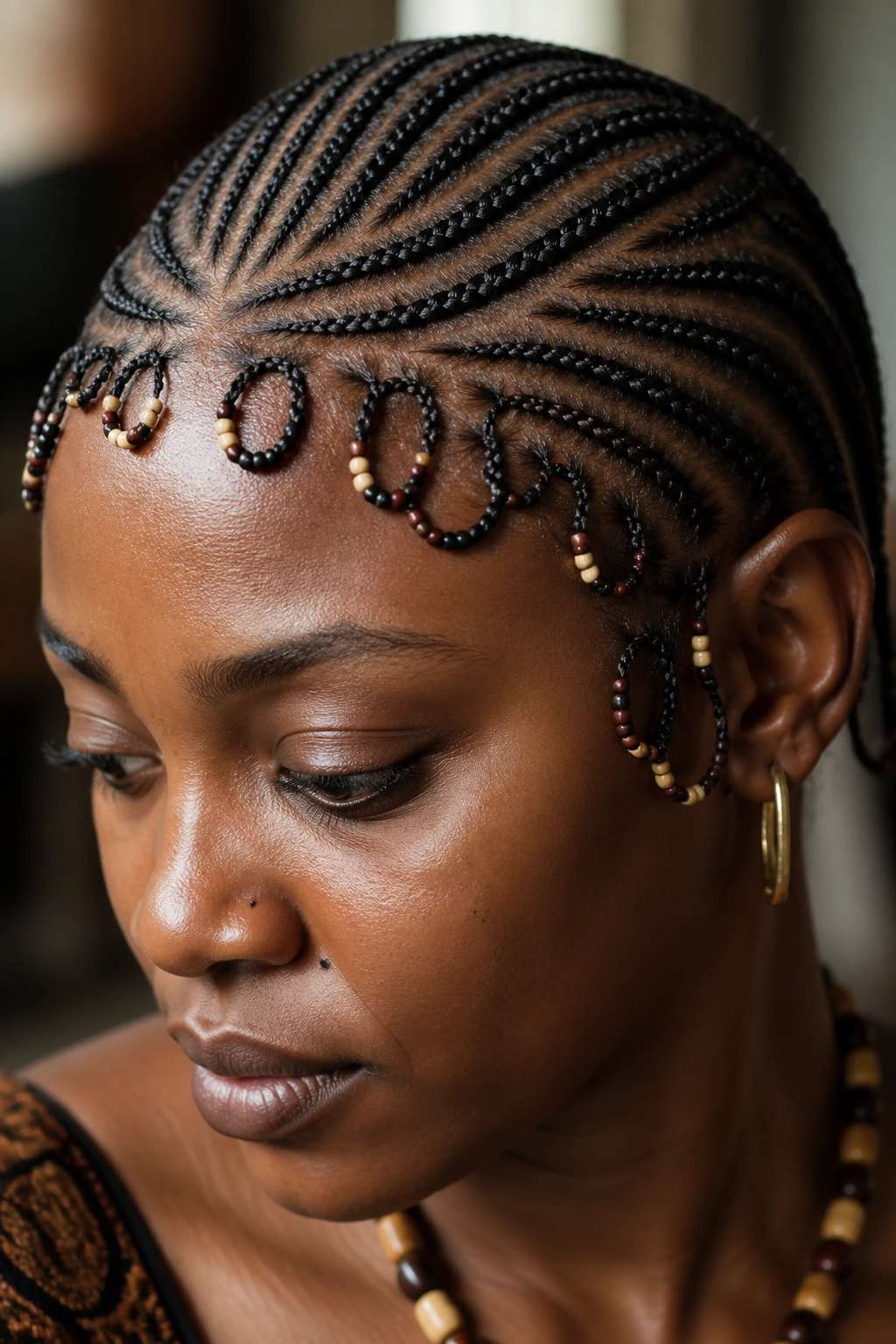
Small loop braids near the hairline get beads threaded through them, creating delicate beaded loops along the front of the head. These are different from the temple braids — smaller, more decorative, positioned right at the edge of the hairline.
The edge loops work as edge-jewelry. They sit just past where regular edges meet the rest of the hair, adding a beaded border to the front.
Use small beads — maybe 4mm or smaller — for the edge loops. Larger beads pull on the delicate hairline and can cause damage over time.
This style reads ornate and detailed. It’s the version I’d choose for ceremonial or formal events where the close-up detail at the hairline will be appreciated.
15. Fulani With Long Side Braids and Bead-Heavy Ends
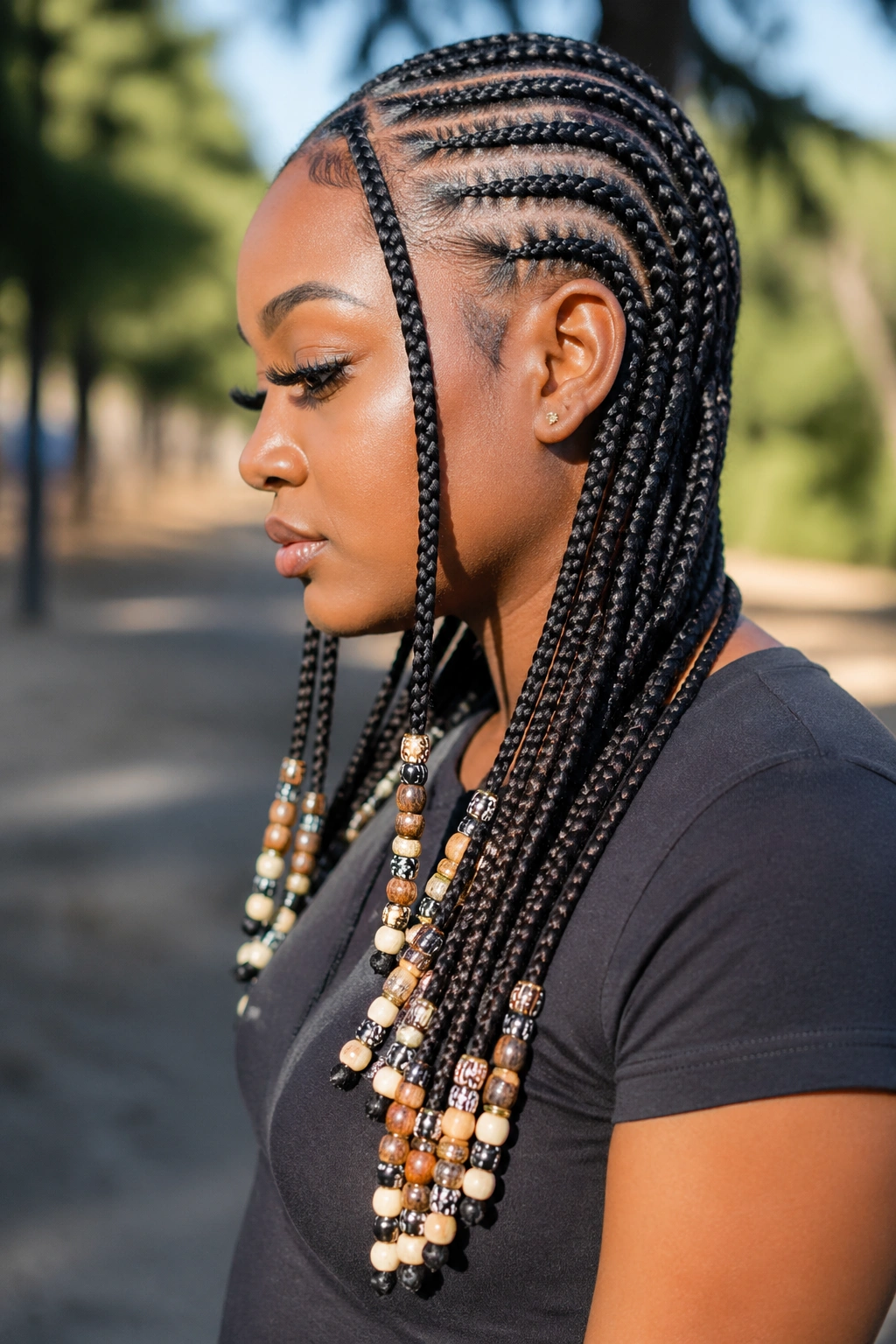
The side cornrows are extended to longer lengths than typical Fulani styling — past the shoulders, possibly to the bust. The ends of these long side braids carry heavy bead clusters: 8-10 beads per braid.
The visual effect is dramatic. Long beaded ends swing and click as you move, creating sound and motion alongside the visual pattern.
This requires either long natural hair or significant feed-in extensions. The braids have to be long enough to support 8-10 beads without dragging at the scalp.
Best for: special occasions, music videos, photo shoots, settings where the dramatic motion of the bead-heavy ends will be appreciated.
The trade-off: weight. Long bead-heavy braids put more strain on the scalp than shorter or less-beaded versions. Don’t wear this style for more than 2 weeks before letting your scalp rest.
16. Fulani With Mismatched Bead Sizes
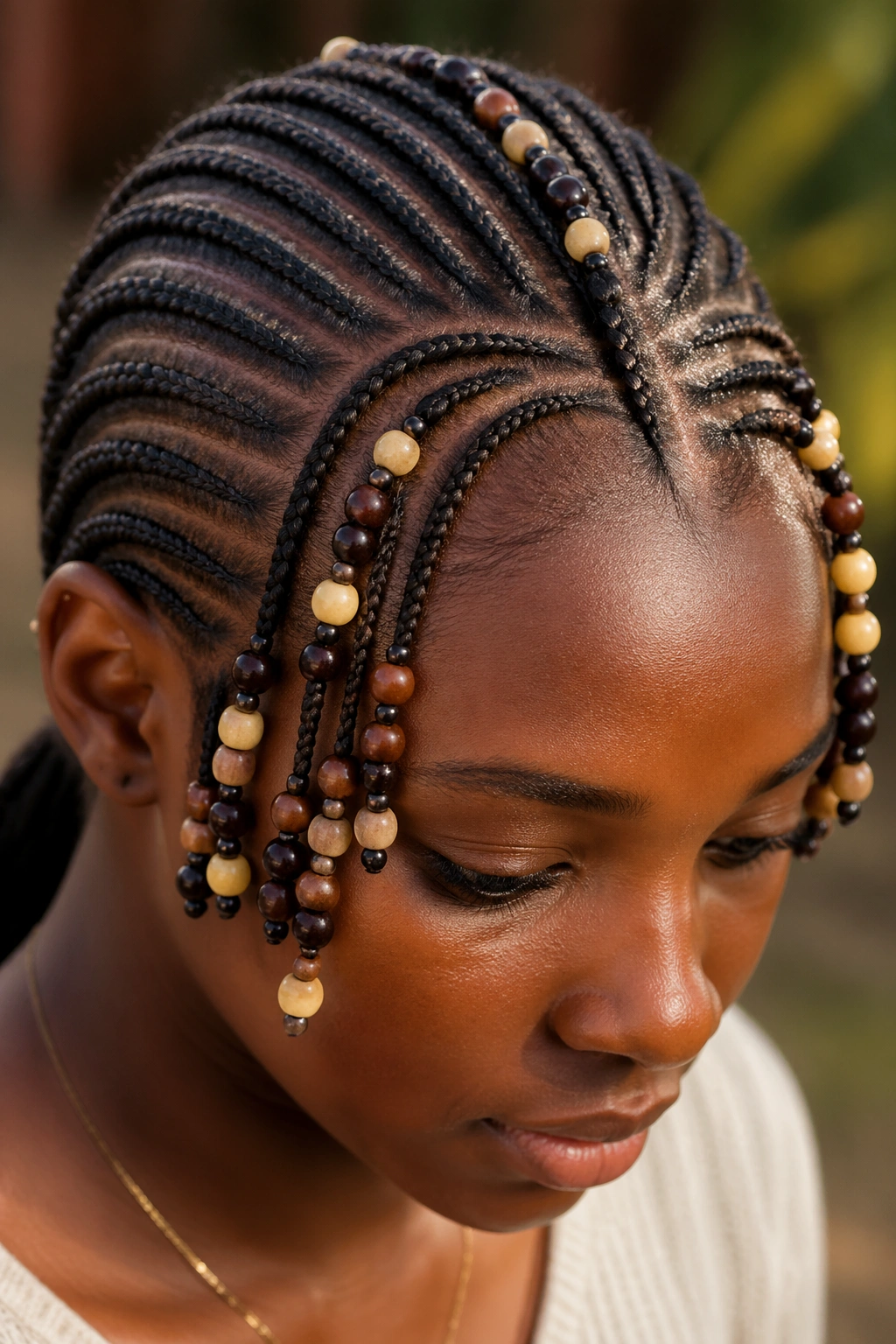
Mixing small (4mm), medium (6mm), and large (8mm) beads on the same braid creates visual rhythm. The eye moves up and down each braid, registering the size variation.
Plan the size pattern before threading. Random sizing looks haphazard; intentional sizing (small at top, growing to large at bottom, or alternating) looks designed.
- Use consistent color across the size variations for cohesion
- Keep the overall bead count per braid the same as a single-size install
- Test the visual at one braid before committing the whole head
Who this is for: someone who appreciates layered detail and visual rhythm. The mixed sizes give the style depth that single-size beads can’t match.
17. Fulani With Thread-Wrapped Bead Sections
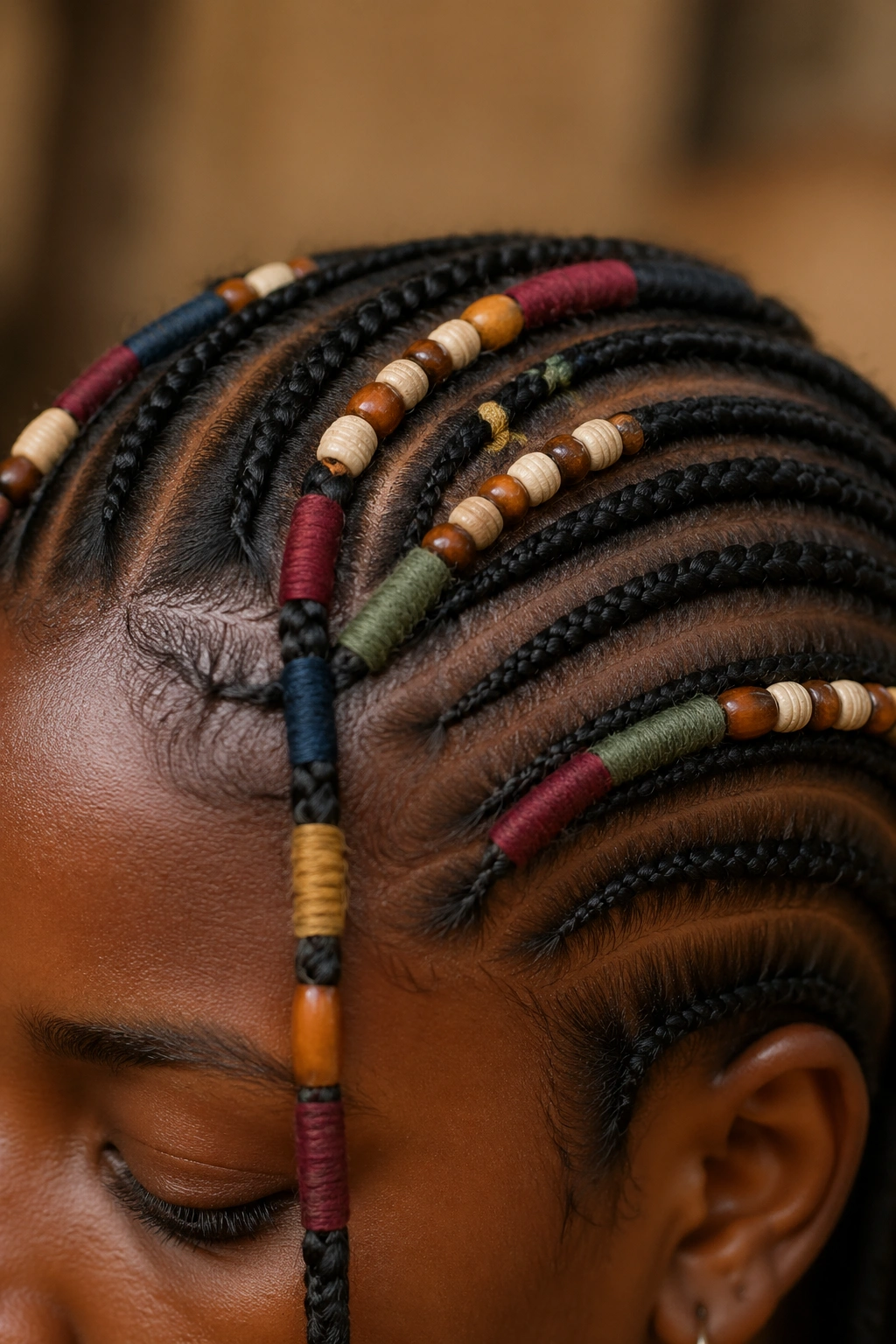
Wrapping certain sections of the braids in colored thread before threading beads creates banded color effects. The thread sections become solid color bands; the beaded sections become point accents.
Thread color and bead color can match (monochromatic look) or contrast (graphic look). Both work depending on the desired aesthetic.
Use cotton embroidery thread, not polyester. Cotton holds its color better and feels softer against the scalp.
This combination is artisanal. It takes time to execute but produces a finished look that reads handcrafted.
18. Fulani With Small Hoop Accents Instead of Beads
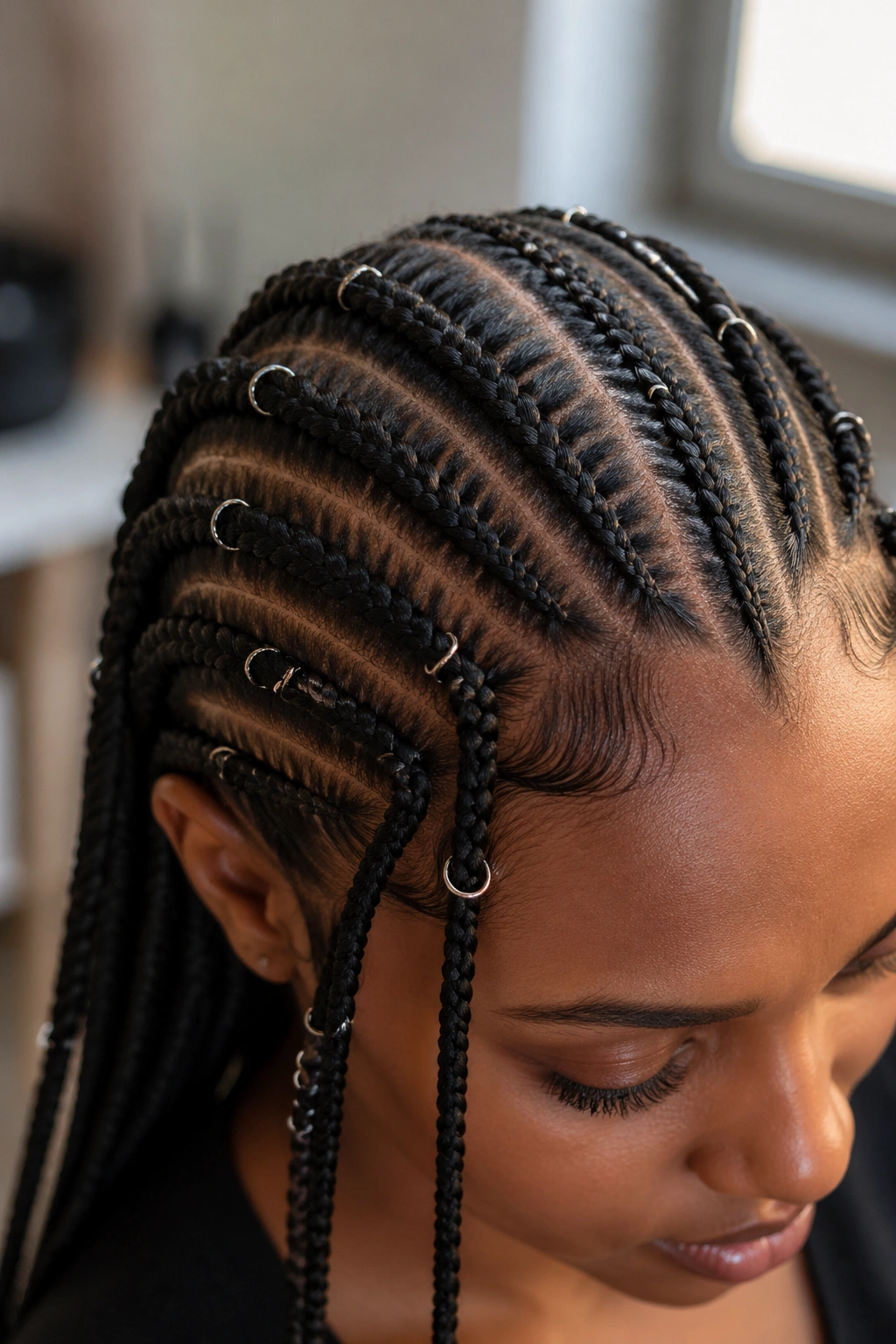
Small metal hoops (the kind sold as ear cuffs or hair rings) clip onto the braids at strategic points instead of threaded beads. The hoops slide onto the braids and grip without rubber bands.
This is a contemporary spin on the bead tradition. Hoops read more modern, more architectural. They also remove and replace easily without disturbing the braid structure.
Choose hoops in matte finishes for daytime wear or polished finishes for evening. Mixed metals work as long as the overall mix feels intentional.
Best for: someone who wants a beaded aesthetic without the actual beads. The hoops give a similar effect with a different mood.
19. Fulani With a Single Statement Bead
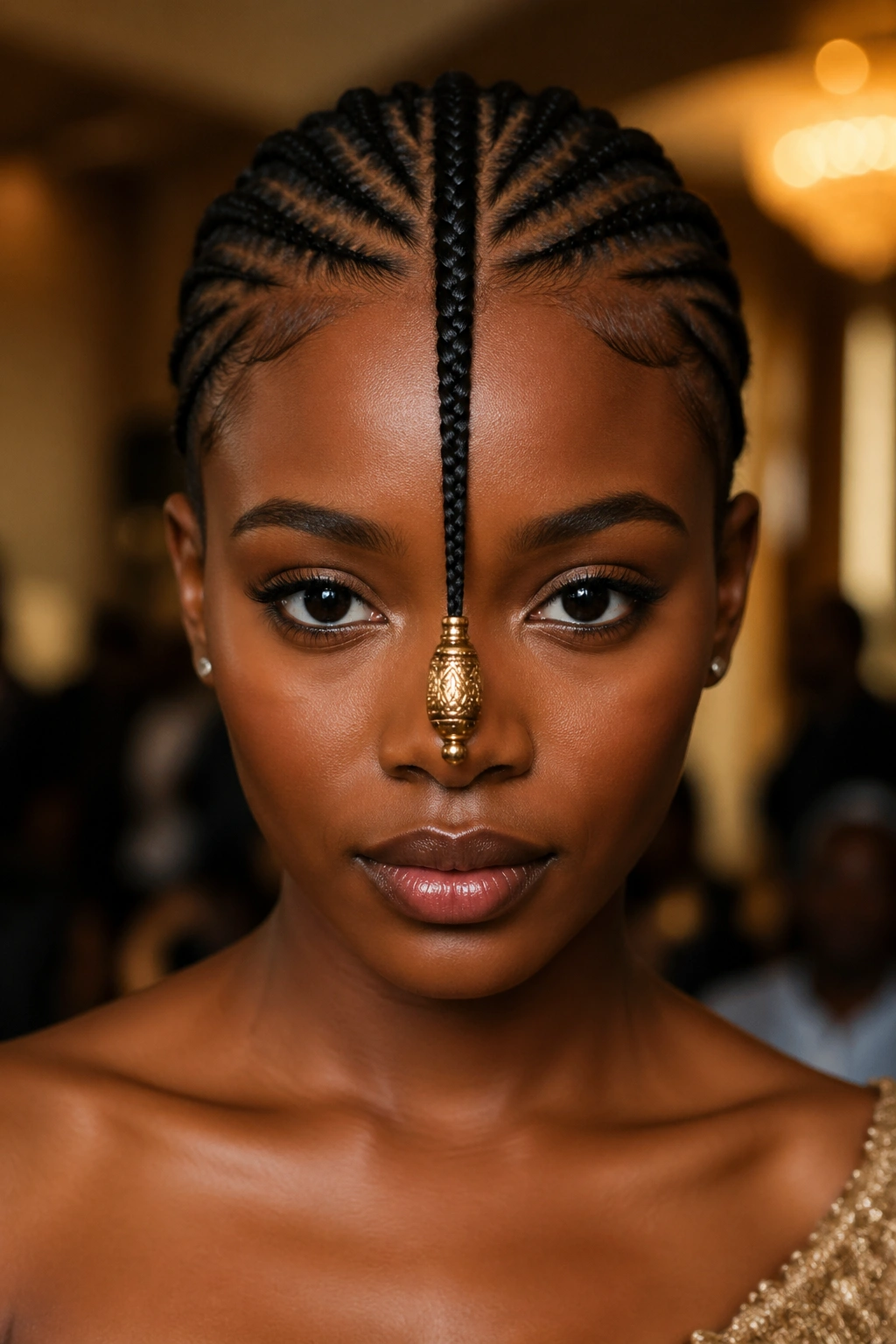
Restraint as a style choice. The entire install has a single decorative element: one large, ornate bead at the end of the central braid. Everything else is plain.
The statement bead becomes the focal point. It can be a hand-painted ceramic bead, an antique African trade bead, a carved bone bead, or any unique piece you’ve collected.
This version asks the bead to do all the work. Choose carefully. The bead should be something you genuinely love.
The minimalism reads sophisticated and intentional. It suits formal settings where excessive ornamentation might feel out of place.
20. Fulani With Beaded Hairline Border
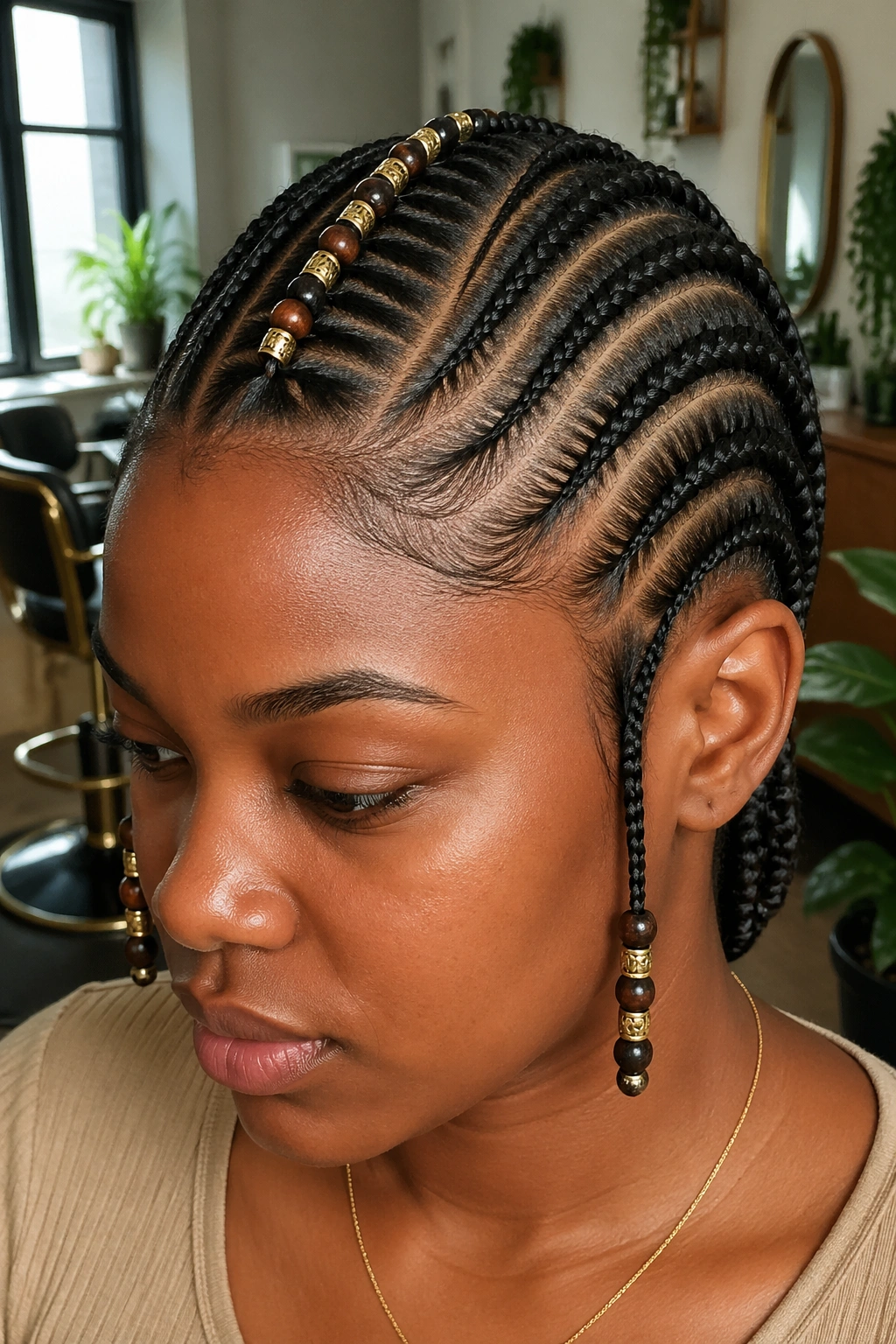
Beyond the standard temple braids, this version adds tiny braids running along the entire hairline — maybe 8-10 small braids forming a continuous border around the front and sides. Each carries a single small bead.
The border effect frames the face like a beaded headband. The standard Fulani structure (center braid, side cornrows, temple drops) sits inside this border.
The hairline braids should be very small to read as a border rather than as additional braided sections. Tiny braids with single beads create the delicate border effect.
Be careful with hairline tension. Adding too many braids at the hairline increases edge stress. If your edges are fragile, skip this variation.
Who this is for: someone with healthy edges who wants maximum detail at the hairline. The border effect is striking but demanding on the edges.
21. Fulani With Tonal Beads Matching the Hair
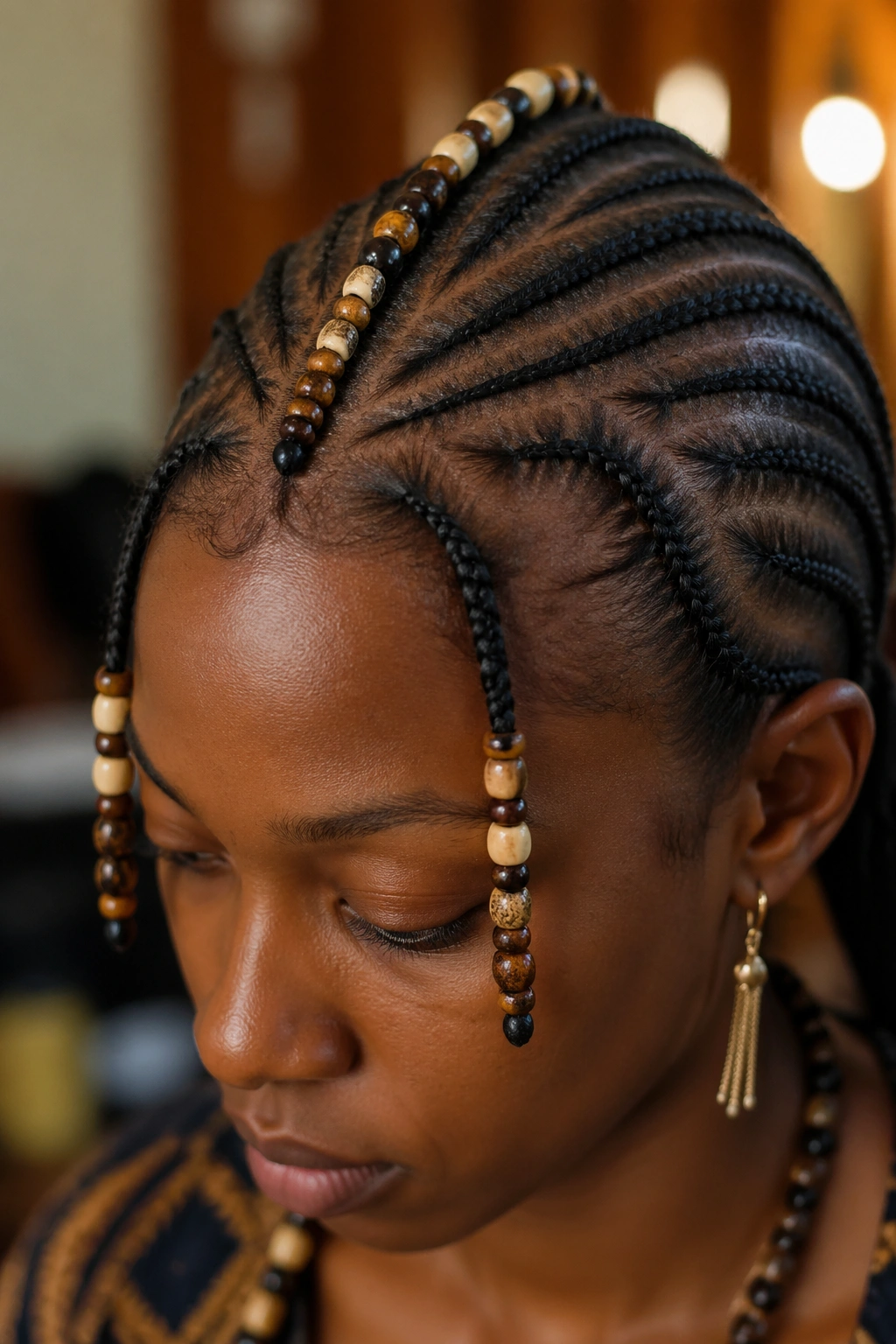
Beads in shades close to the hair color — dark brown beads with dark hair, honey beads with blonde feed-ins — create a subtle, tonal look. The beads add texture without color contrast.
The effect is understated. From a distance, the beads might not register as separate elements; up close, they add detail and texture.
This is the most office-friendly version of the Fulani-with-beads style. It reads professional because the bead detail doesn’t shout.
Best for: workplaces with conservative dress codes, professional settings, anyone who wants the style’s structural appeal without the color drama.
22. Fulani With Gradient Bead Colors
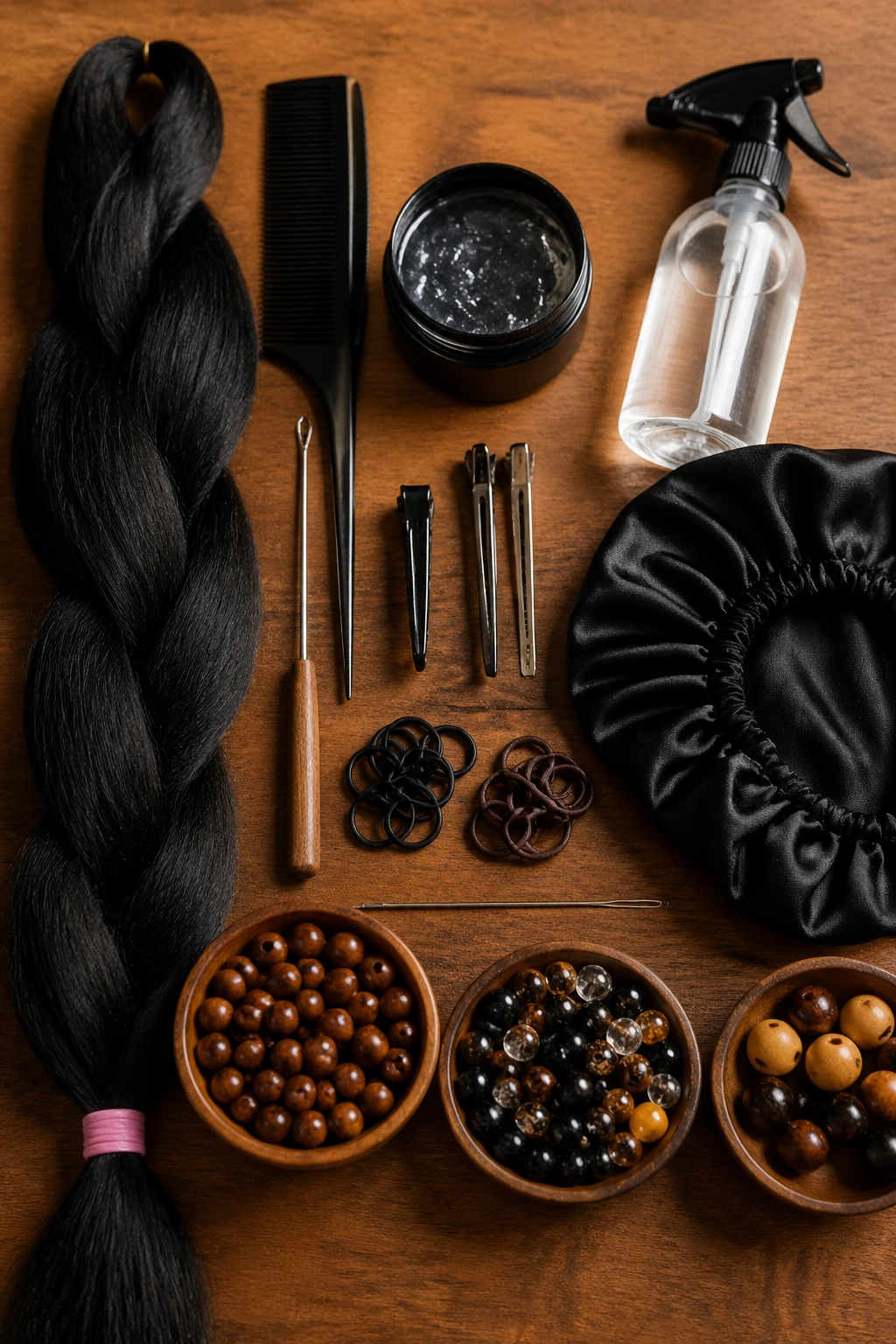
A color gradient runs across the install. Beads at the front are one color (say, deep amber), and they gradually shift through intermediate shades to a different color at the back (say, cream). The transition is gradual across the rows.
The gradient requires careful bead selection — multiple shades that bridge the start and end colors smoothly. Three to four intermediate shades usually work.
What Makes It Different
Most beaded styles use either single colors or random multi-color mixes. The gradient takes a third path, telling a color story across the head.
- Plan the color order before installation
- Group beads by row before threading begins
- Place the brightest or boldest color at the visible focal points (temples, central braid)
The finished gradient reads sophisticated and considered. It suits anyone who appreciates color storytelling in their styling choices.
Caring for Beaded Cornrows
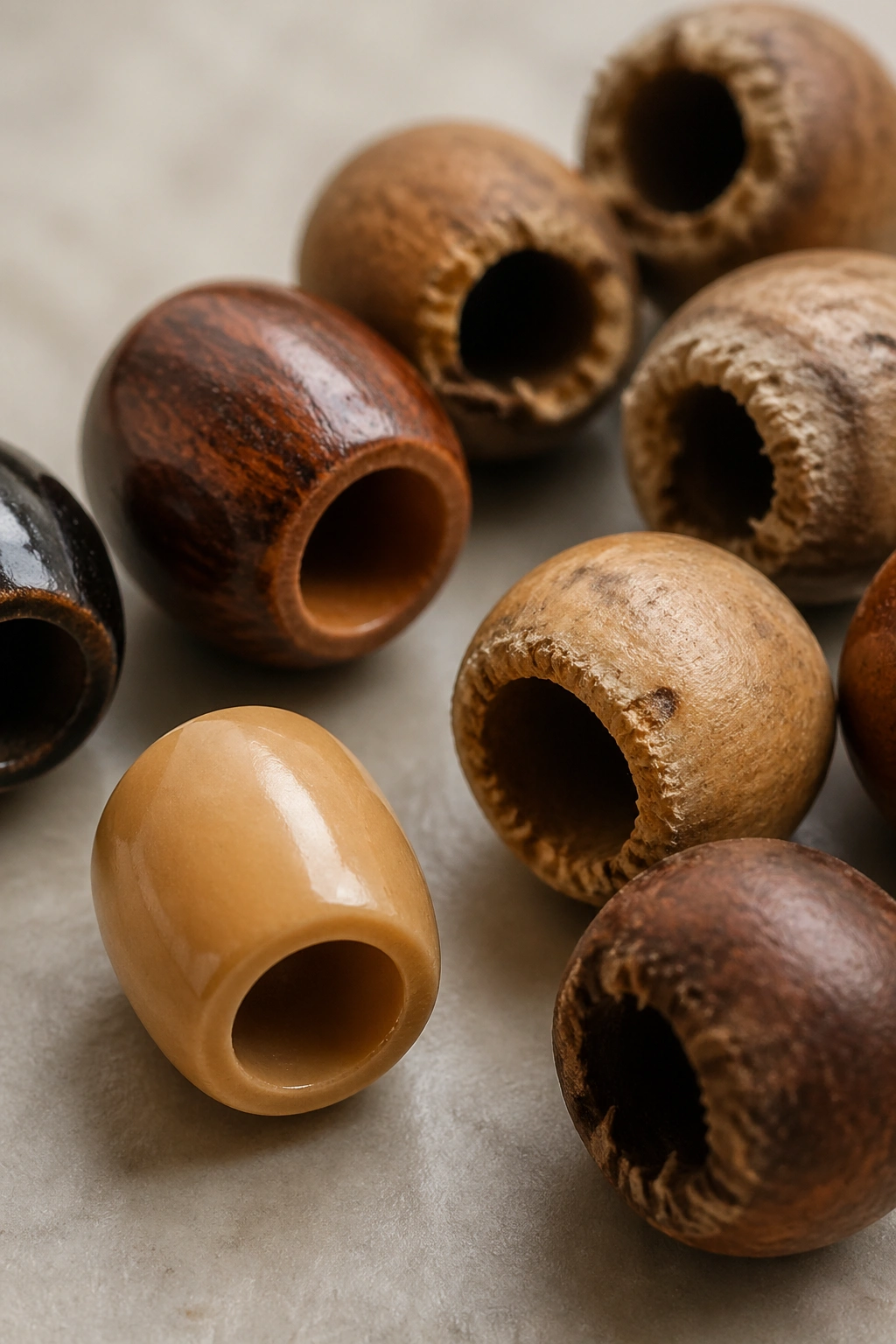
Beaded cornrows need bead-aware care. Beads can knock together at night, get caught on clothing, snag on bag straps. Routine care minimizes these issues.
Sleep with all the beaded braids gathered into a low loose ponytail or contained in a large bonnet. Loose beaded braids spread across a pillow create more friction and noise.
Refresh the braid bases every few days with a light spritz of water-and-leave-in. Avoid spraying directly onto the beads themselves — moisture can dull metal finishes and stain wood beads.
For the scalp, use an applicator bottle to apply scalp oil directly to the partings without touching the beads. Routine scalp oiling supports edge health and reduces itch.
Re-check bead security weekly. Rubber bands holding beads in place sometimes loosen with movement. A quick check and re-securing prevents lost beads.
Sleep Protection With Beads
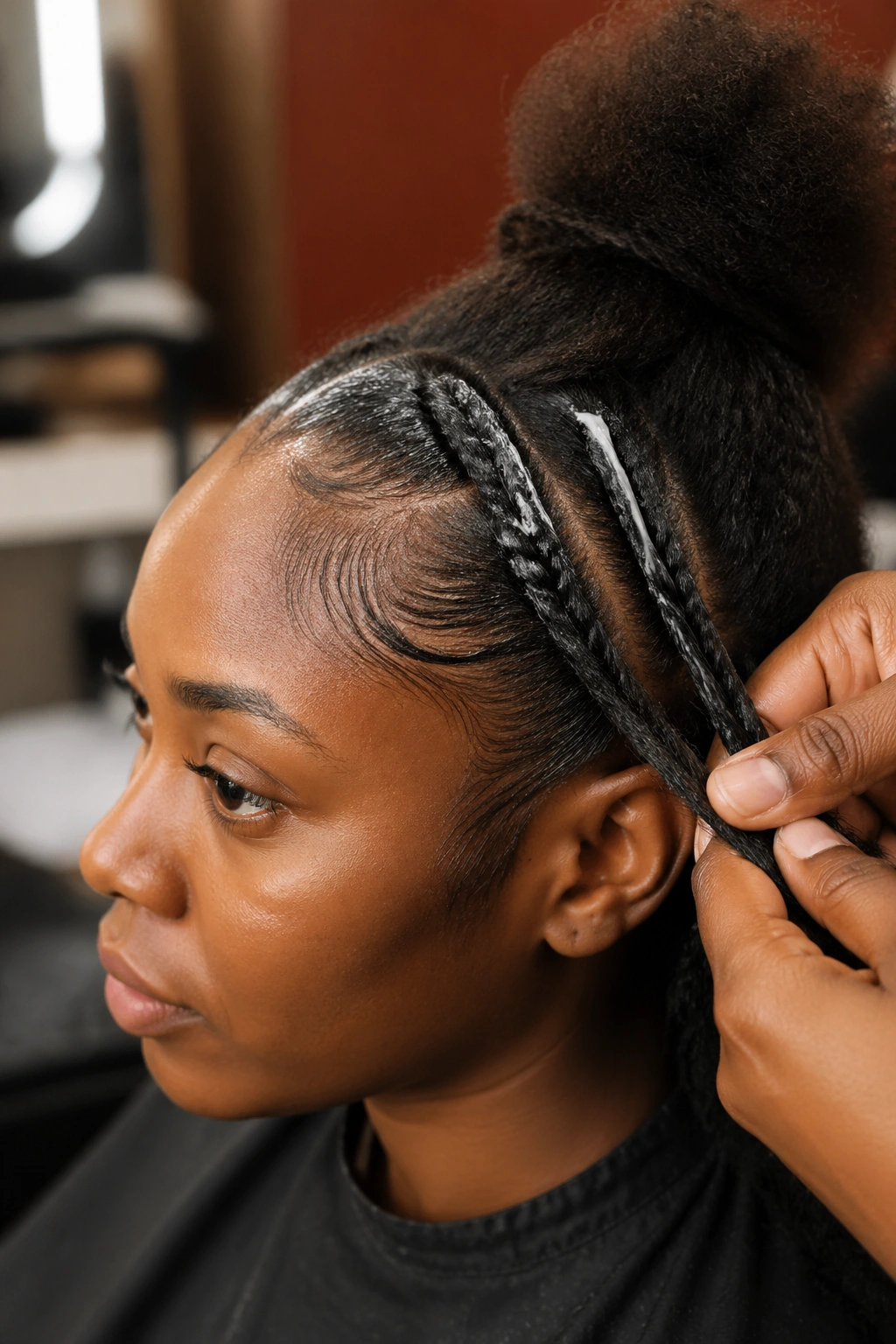
Beads need their own sleep protection layer. Beyond the standard satin bonnet, consider these adjustments.
A larger bonnet that contains all the beaded braids without compression. Tight bonnets crush the bead arrangement.
Side sleeping with a bead-heavy installation can hurt. The beads press into your cheek or temple. A pillow with a slightly recessed center (or a buckwheat hull pillow) helps relieve the pressure.
If you toss and turn during sleep, gather all the beaded braids into a single low ponytail before putting the bonnet on. Containment minimizes friction and bead clatter.
Refreshing Beaded Fulani Cornrows
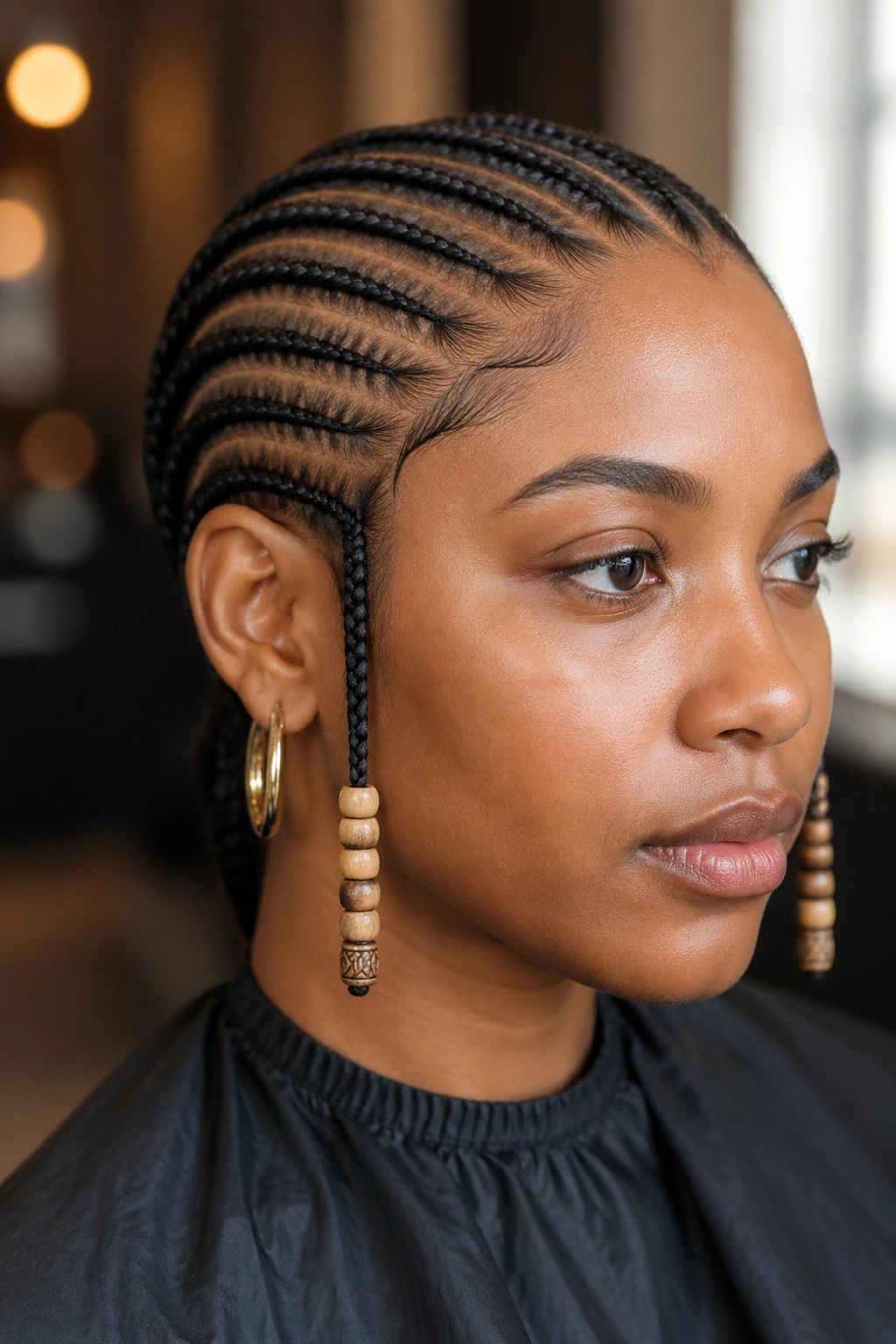
Past day 7, beaded cornrows start showing wear. Specific refresh techniques bring them back.
Re-slick the edges with edge gel and a soft brush. The hairline is the first visible area to fuzz; restoring sleek edges restores the whole style.
Spray the partings with a light setting mist. Water-based setting sprays designed for protective styles work well — they don’t add weight but do reset shape.
Replace any rubber bands holding bead clusters that have loosened. Clean rubber bands keep beads secure for the second half of the install.
Touch up the central braid if the parting line has shifted. The center braid is the visual spine of the style; its cleanliness matters.
When to Take Down
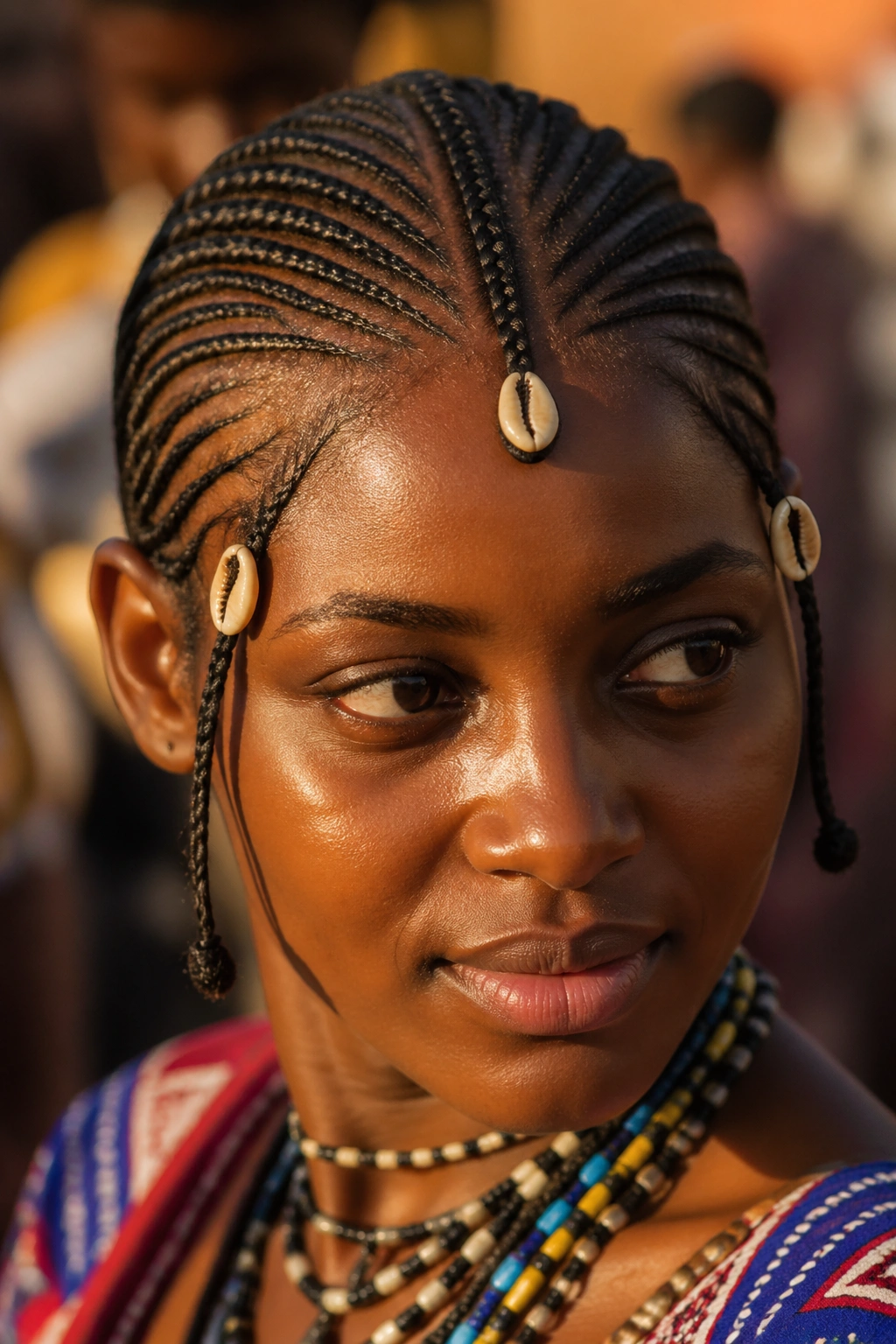
Fulani cornrows with beads typically hold for 2-3 weeks. Past three weeks, the bead weight starts to loosen the braid bases and the install begins to look unraveled.
Signs it’s time:
- Beads sliding too far up or down the braids
- Visible scalp showing through the partings as braids loosen
- Itchy scalp that persists after oil treatments
- Frayed braid bases with significant new growth pushing the cornrows away from the scalp
When taking down, remove all beads first by sliding them off the ends. Then unravel each braid slowly from the bottom up, detangling as you go.
Picking the Right Fulani Style for You
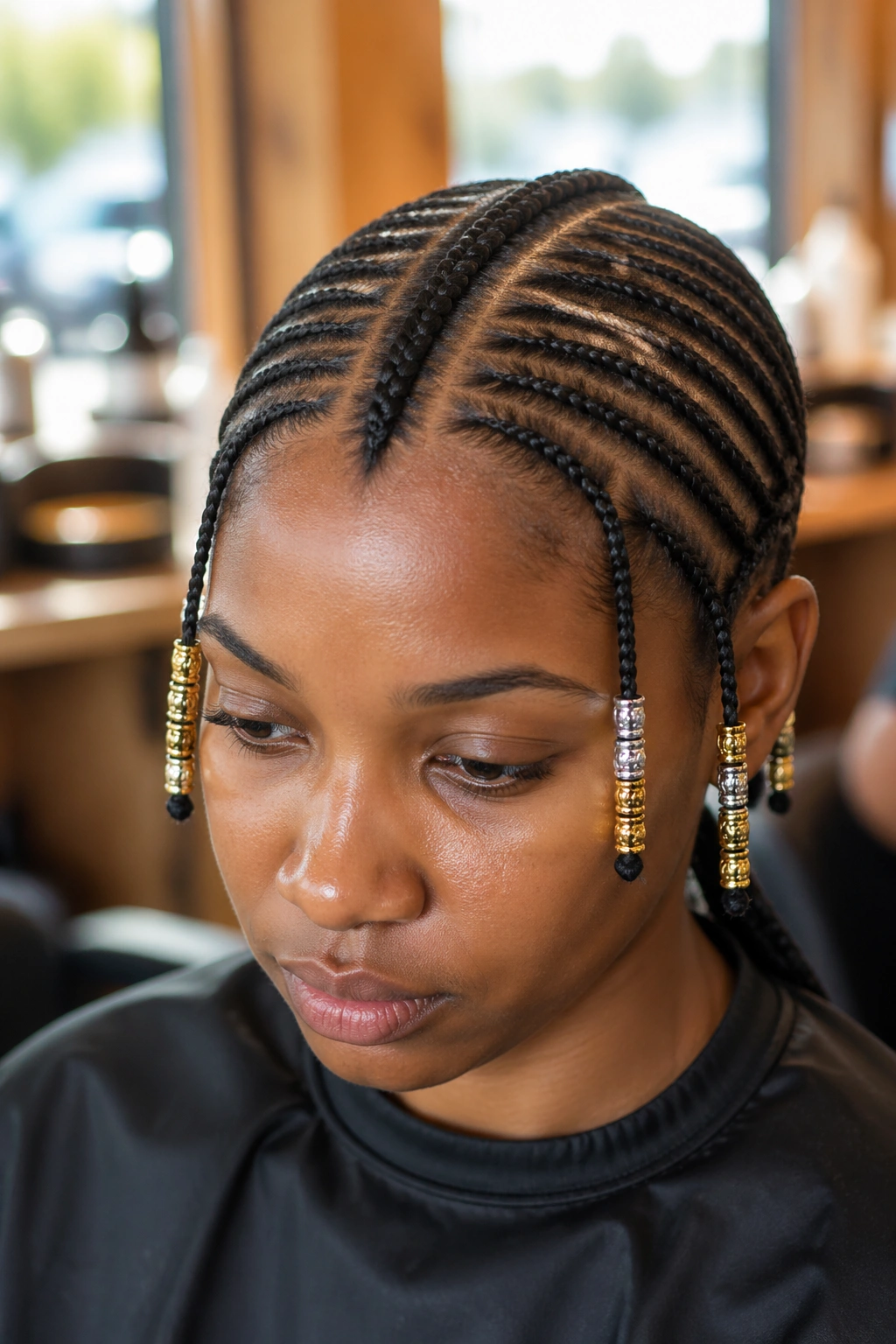
Cultural awareness comes first. Wear Fulani cornrows knowing what they represent. Appreciation, not appropriation.
Bead choice should feel like you. Heavy ceremonial beads aren’t for everyone; minimalist single-bead options exist for those who want the style without the visual loudness.
Face shape and size considerations apply. The central braid elongates the face visually; this flatters round and short face shapes. Side rows curving back add width; this can flatter narrow faces.
Lifestyle factors in. Heavy beads aren’t for daily gym wear. Long beaded ends catch on coat collars and bag straps. Choose accordingly based on your daily activities.
Find a braider familiar with Fulani styling. The pattern has specific rules that not all braiders know. A braider who’s done it before will execute cleaner than someone learning the style for the first time.
The right Fulani cornrow style with beads is more than hair. It’s a connection to lineage, a wearable tradition, and a personal expression all in one install.
