



Straight back cornrows with beads carry a kind of effortless authority. The braids run clean from hairline to nape — no curves, no zigzags, no fancy parts to distract. Then beads enter the picture and turn a quiet style into something with sound, weight, and personality. The simplicity is the canvas. The beads are the brushstroke.
What makes this combination so durable across decades and cultures is its honesty. Straight back cornrows are the most foundational braid pattern there is. Beads are among the oldest hair adornments in the world. Together they don’t try to reinvent anything — they refine.
These 22 takes on straight back cornrows with beads cover everything from minimalist single-bead finishes to fully beaded designs with cuffs along the length of every braid. Each style is genuinely different. Each suits a different mood, occasion, hair density, or wear length.
Why Straight Back Cornrows Are the Best Base for Beads
Straight back cornrows hang in parallel lines. That parallel hang is what makes beads sit right. When the braids run uniform from front to back, the beads at the ends catch light evenly, swing in unison, and click together with that distinctive rhythm.
A curved or angled cornrow pattern doesn’t give beads the same showcase. Beads on swirl cornrows or zigzag cornrows clump where the braids converge and gap where they spread. Beads on straight backs hang in a clean fringe across the back of the head.
The structure also handles the weight of beads well. Straight back braids transfer bead weight straight down through the braid, into the scalp anchor at the front. Curved braids transfer weight at angles, which can cause the braid to twist or lift over time.
Bead Materials That Work and Ones That Don’t
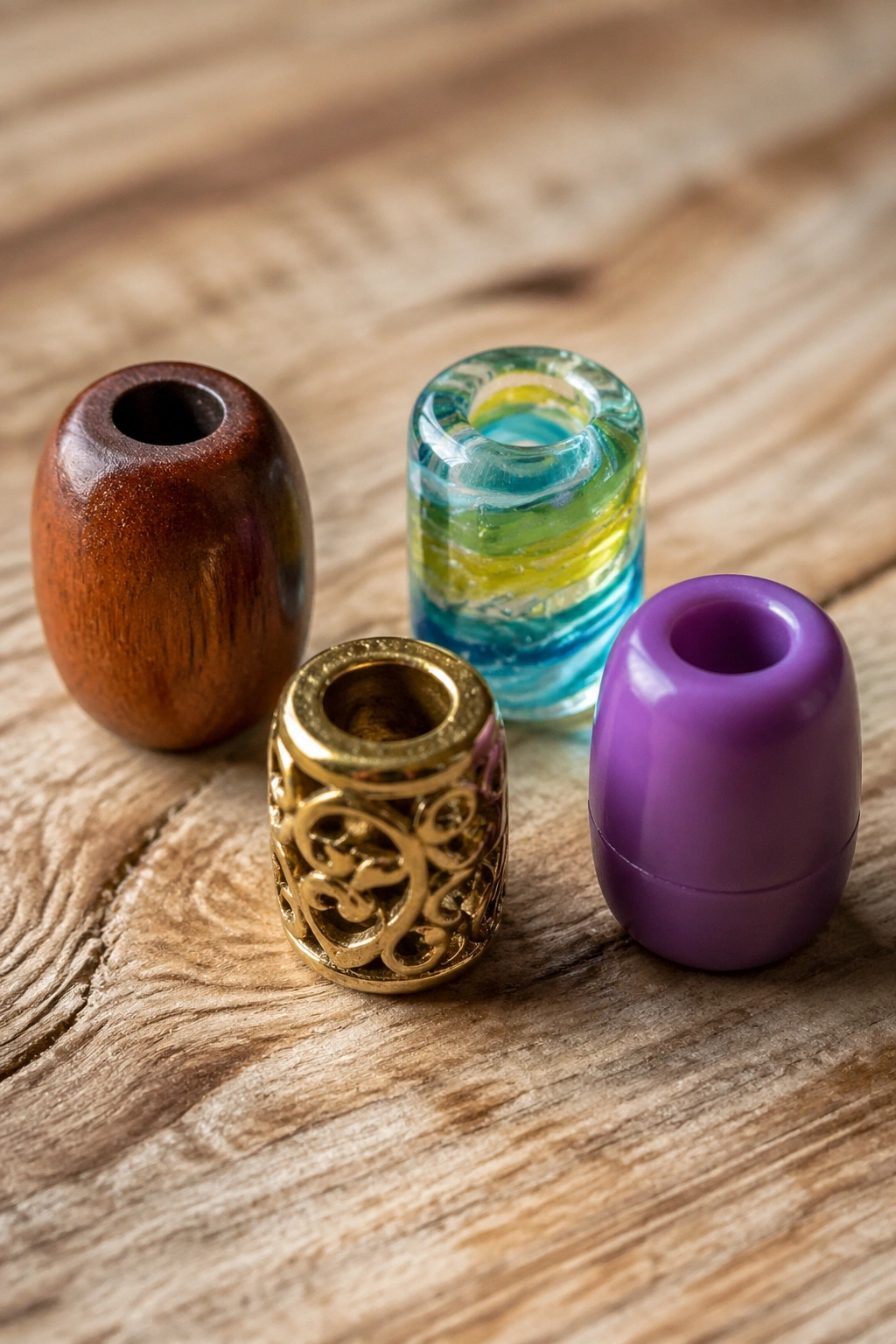
Wooden beads are the gold standard. Lightweight, naturally beautiful, gentle on hair, available in every color and shape. They don’t transfer color, they don’t oxidize, and they age well — wooden beads from a year-old install still look fresh.
Glass beads add real visual sparkle but they’re heavy. Use sparingly — one or two glass beads per braid maximum. A whole braid of glass beads will pull the braid down enough to cause tension headaches.
Metal beads (brass, silver, gold-tone) catch light dramatically. Solid metal is fine. Hollow plated metal is risky — the plating wears off and leaves dark marks on the hair. Look for solid construction whenever possible.
Plastic beads are functional and cheap. They work for kids and for casual everyday wear. They look plastic up close, so they’re not the right choice for formal events or photos.
Tip: Avoid beads with sharp interior edges. Run your finger through the bead hole before threading. A rough interior edge will saw through the braid over time, causing breakage at the bead point.
Securing Beads Without Damaging Hair
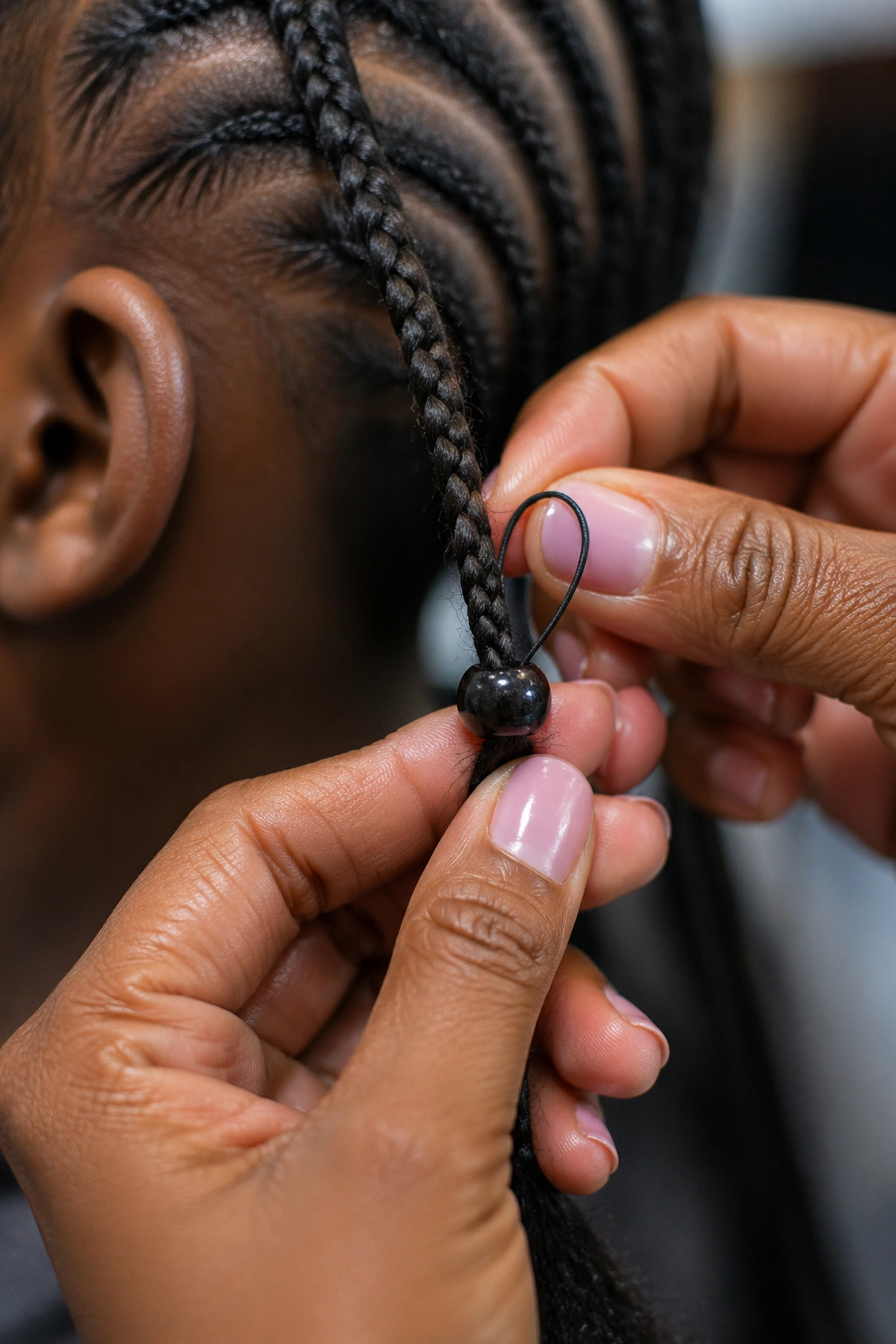
Two main methods. The first uses fine elastic bands wrapped around the braid above and below the bead — the elastic stops the bead from sliding off either end. The second uses a folded loop of the braid itself pushed up through the bead hole, locking the bead in place by the doubled-over braid.
Loop method is more secure. Bead method is faster.
For kids, always loop method. The bead can’t escape, can’t be swallowed, can’t fall off and get lost. For adults, either method works depending on speed needs.
Don’t use rubber bands. Standard rubber bands snap into the hair when stretched and break strands at the contact point. Hair-safe elastics or silicone bands are the right choice.
Hair Prep for Bead-Friendly Cornrows
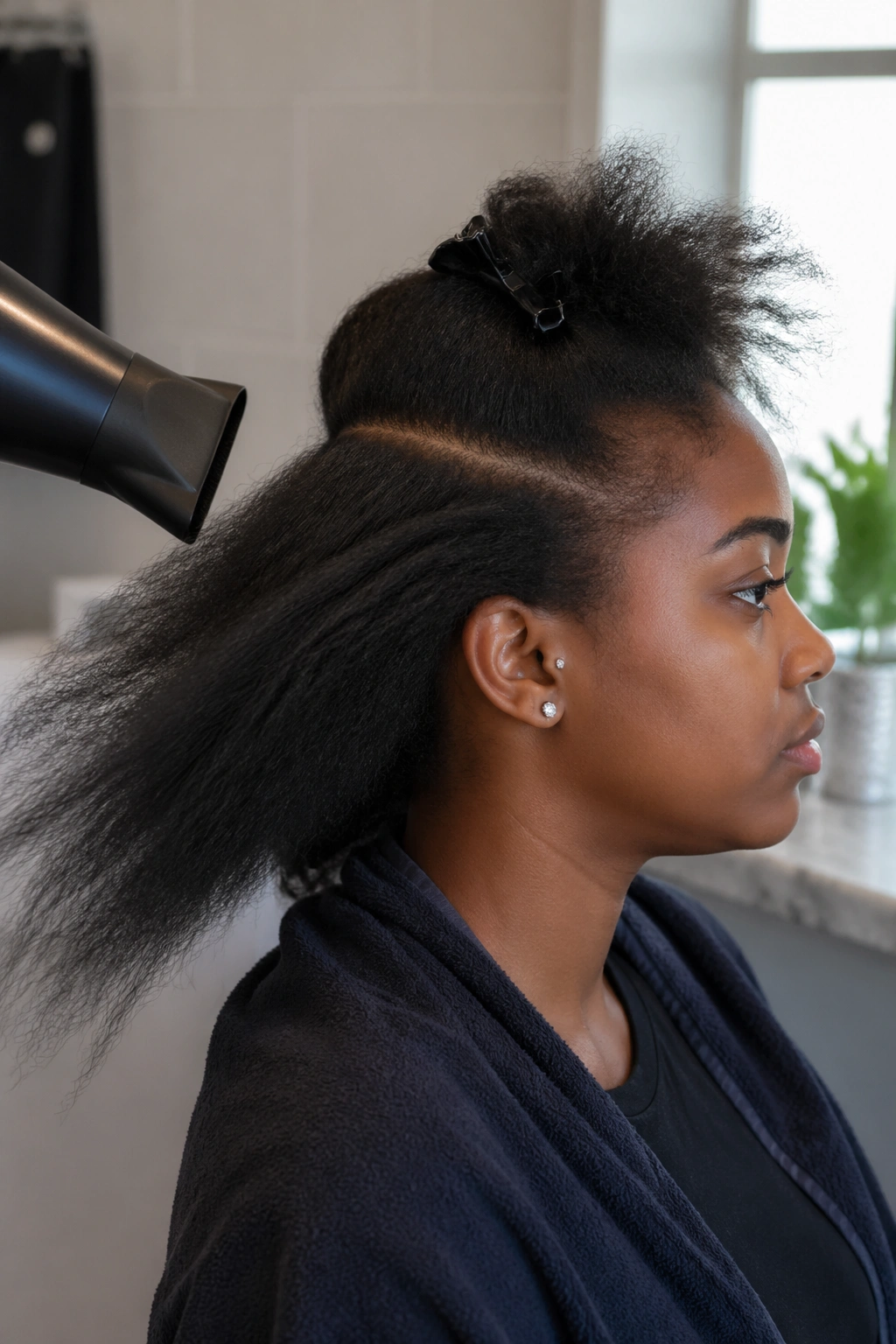
Clean, stretched hair holds beads better than freshly washed hair. Wash 24-48 hours before installation. Use a clarifying shampoo to remove any product buildup that could make the braids slippery.
Stretch the hair with a blow-out on cool air. Stretched hair sits straighter under the bead weight, which keeps the beads from pulling at odd angles.
Moisturize before braiding but don’t overdo it. A leave-in spray and a light cream is enough. Heavy butters make the braids slippery, which then makes the beads slide where they shouldn’t.
Don’t oil the braid until after the beads are placed. Oil on the braid makes thread loops slip rather than grip — the beads will slide off within hours.
How Many Braids and How Many Beads
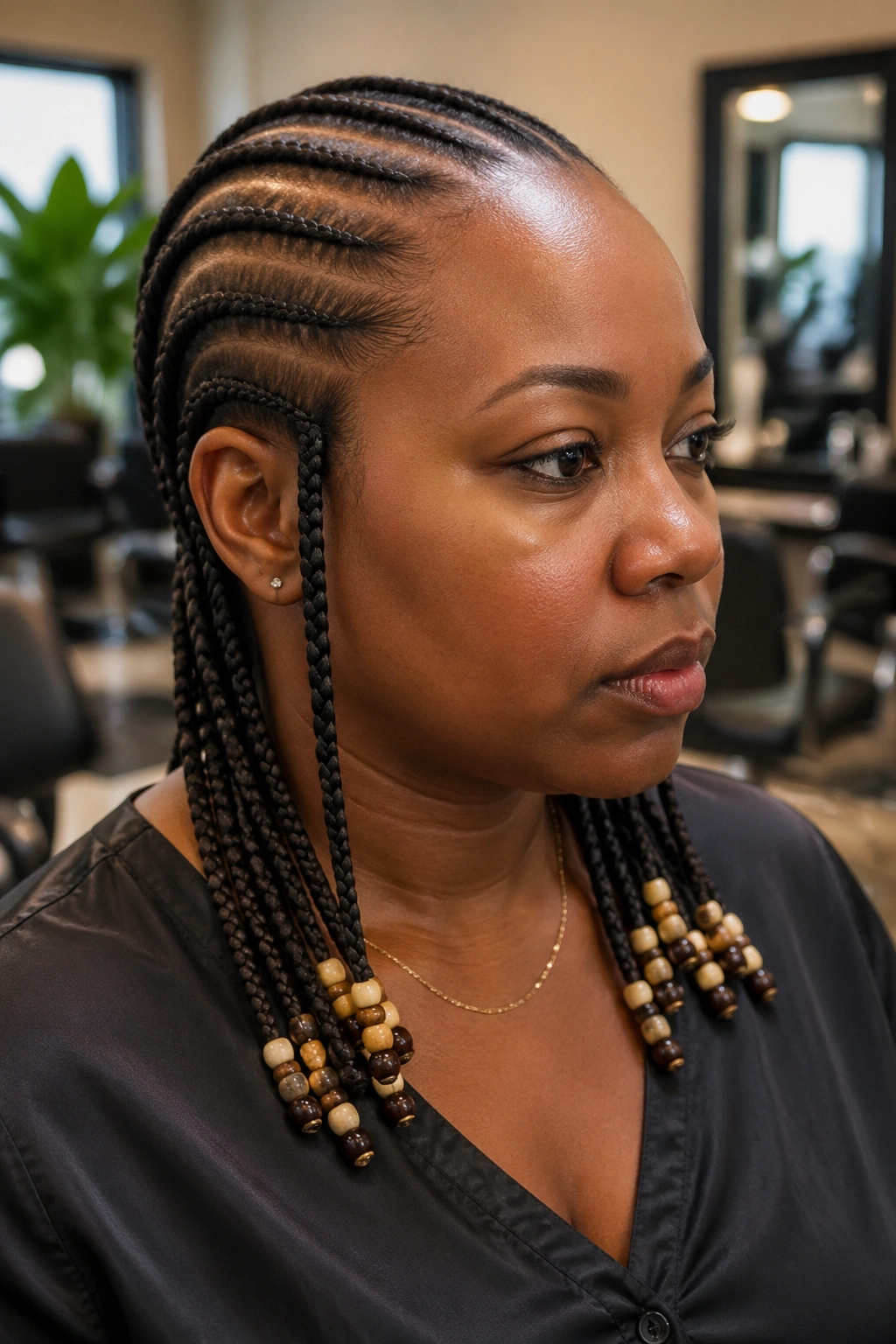
Five to seven braids is the standard for adult straight back cornrows. Three to five braids works for kids. More than seven braids on most heads makes the beads cramp at the back of the head and clack against each other unpleasantly during head movement.
Bead count per braid ranges from one to fifteen depending on the style. Single-bead finishes are minimalist. Three-to-five beads per braid is the most common middle ground. Heavily beaded styles can run 10-15 beads per braid down the lower length.
Test the weight. Hold all the beads you plan to add in your hand and feel the total weight. If it feels heavy in your palm, it’ll feel heavier on your scalp by hour six.
1. Single Bead Per Braid
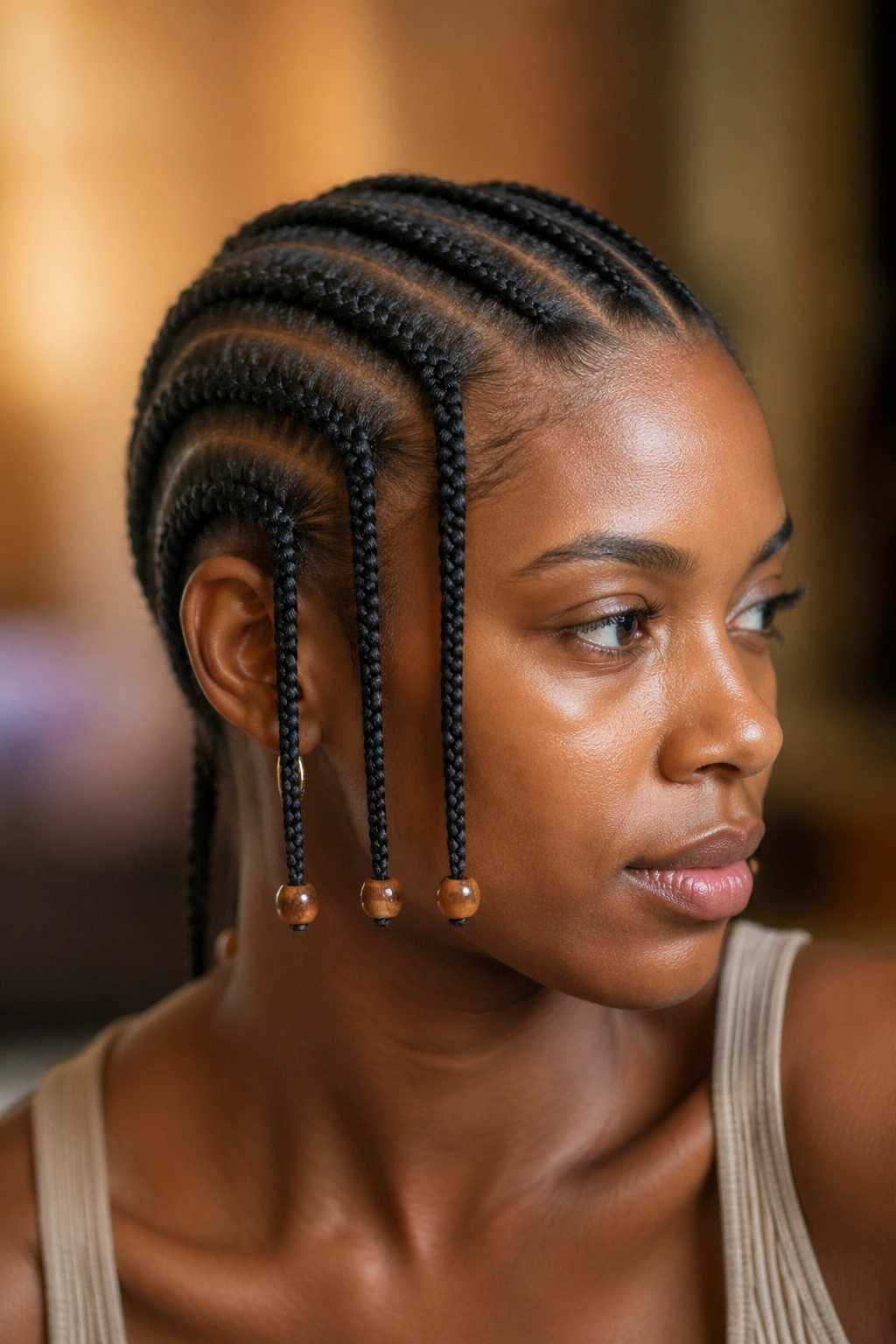
A wooden bead at the end of each braid. Five braids, five beads. Done.
This is the cleanest minimalist version. The beads add finish without distracting from the braid pattern itself.
Why It Works
- Lightweight install — almost no extra weight from beads
- Quick to add at end of braiding session
- Beads don’t clack noisily during normal movement
- Sleeps easy with standard satin bonnet
Choose beads larger than they look comfortable holding. A bead that seems too big in your hand looks just right at the end of a braid. Small beads get visually lost.
Tip: Match the bead color to skin undertone. Warm brown beads on warm skin tones, cool gray-brown beads on cool skin tones. The bead becomes an extension of the wearer rather than an obvious accessory.
2. Three Beads Stacked Per Braid
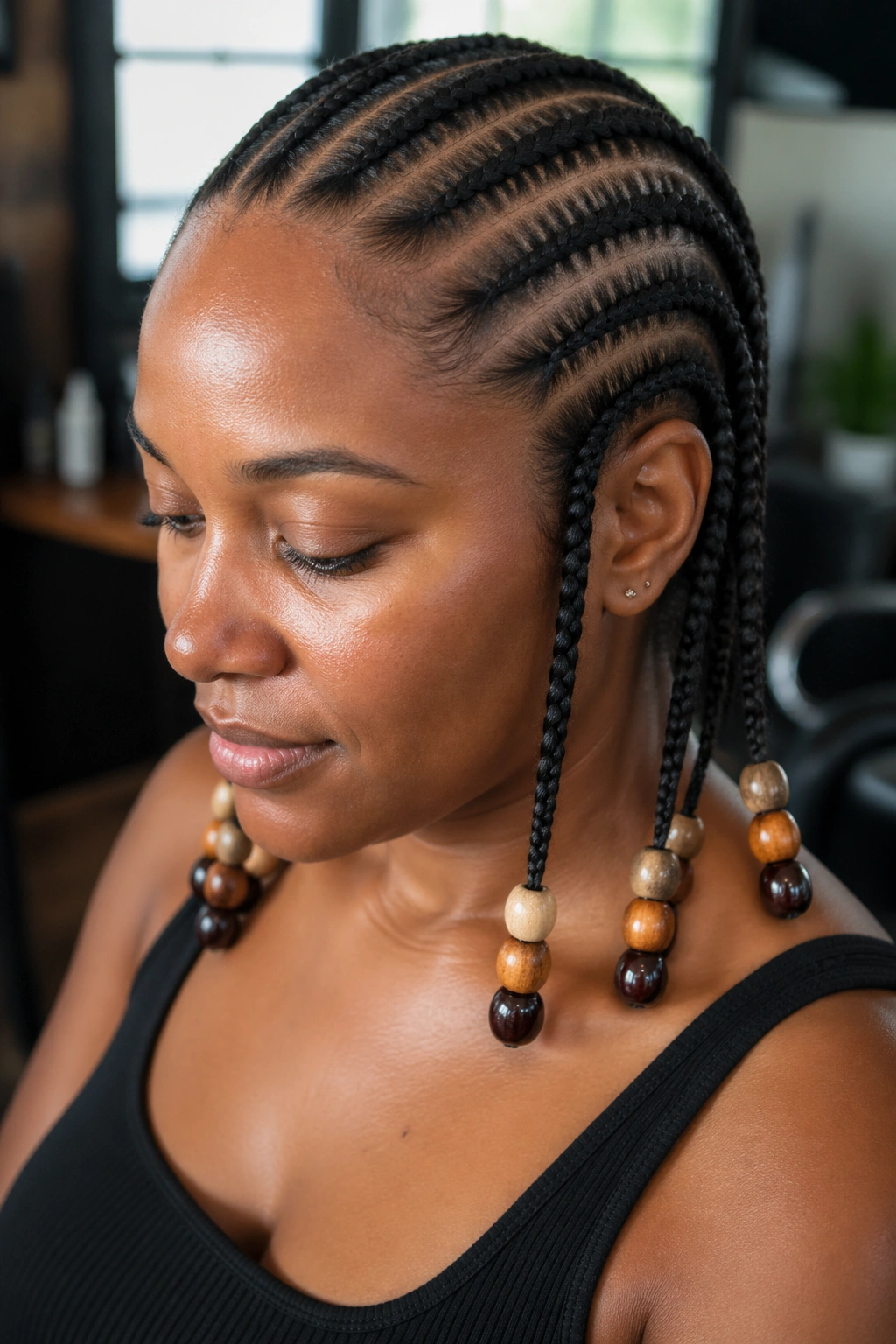
Bold claim — three beads is the most balanced bead count for a moderate impact straight back style.
Three beads stacked vertically at the end of each braid create a visible cluster without overwhelming the braid. The eye reads “three” as a deliberate group rather than an accident, which lifts the whole style into intentional territory.
Vary the bead colors slightly within each cluster. Three identical beads can look monotonous. Three beads in graduated tones — light wood, medium wood, dark wood — give the cluster depth.
The bottom bead in each cluster catches the most attention, so make that one the most distinct. A larger bead, a brighter color, or a different material at the bottom of the stack draws the eye to where the braid ends.
This style suits everyday wear especially well. Enough visual interest to feel intentional. Not so much weight that the beads become annoying by mid-day.
3. Beaded Halfway Up the Braid
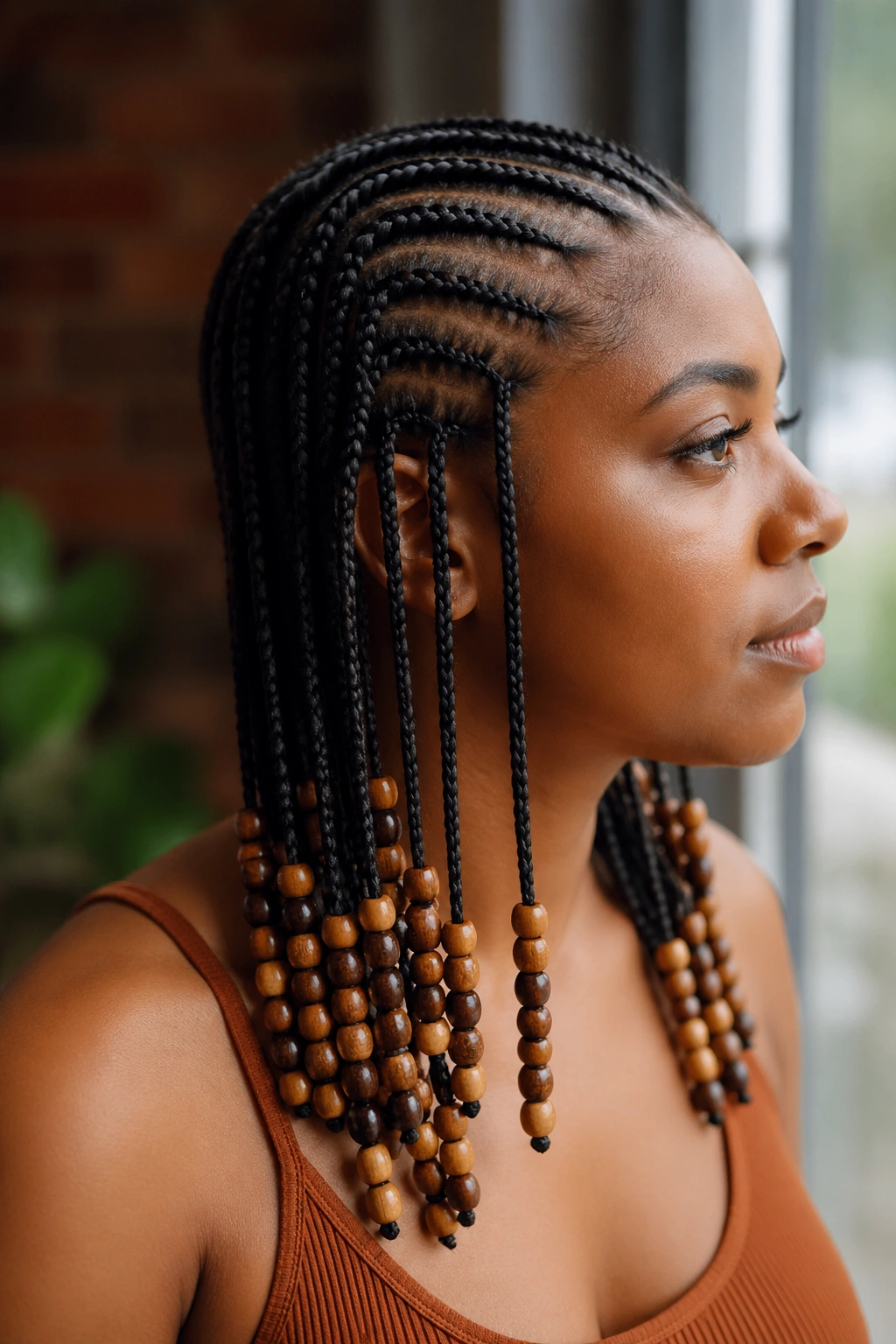
Beads start halfway down each braid and continue to the ends. Seven to ten beads per braid in the lower half, with the upper half kept clean.
The split-aesthetic — clean braid above, beaded fringe below — creates a hair waterfall effect. From a distance, the upper braids read as architectural lines. The lower beaded halves read as cascading texture.
This style is heavier than end-only bead styles, but the weight is distributed across the lower half of each braid rather than concentrated at the tip. That distribution makes the weight more comfortable to wear.
Bead spacing matters. Space the beads 1-1.5 inches apart along the lower braid. Closer spacing makes the beads cluster together. Wider spacing makes them feel scattered.
4. Beaded Top, Plain Bottom
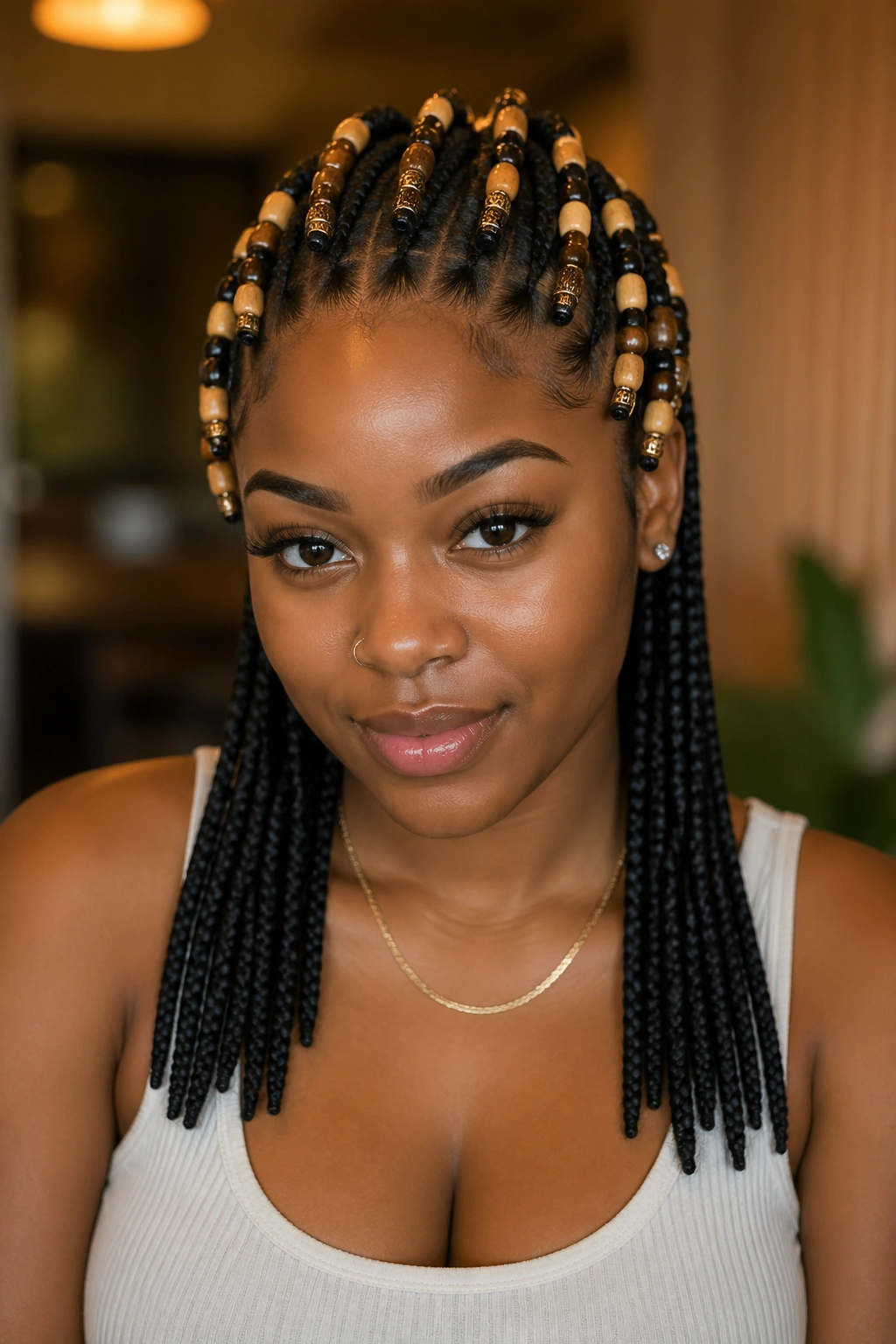
The opposite of style 3. Beads cluster at the top of each braid near the scalp. The lower length of each braid stays plain.
The visual result is a beaded crown — beads concentrated where the head is most visible from face-on angles. From the side, the lower braids hang as plain lines.
This style works particularly well for those whose hair is shorter and ends near the shoulders. The beaded crown gives visual interest at the top while the shorter braid ends hang naturally without feeling under-styled.
Place beads carefully near the scalp. Beads that touch the scalp during sleep can leave indentations on the skin. Keep the highest bead at least an inch off the scalp.
5. Double Beads at Ends With Cowrie Shells
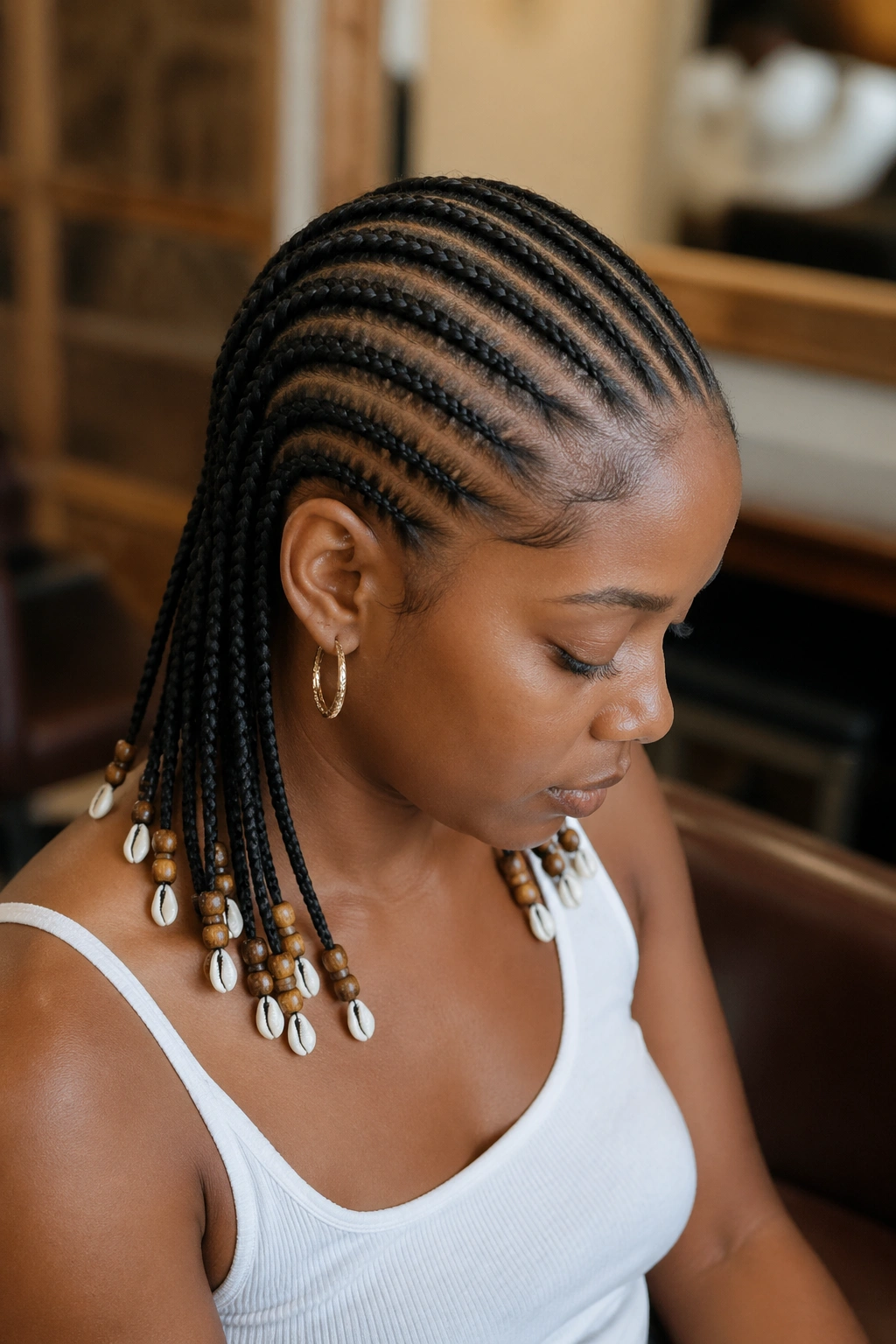
Two wooden beads at the end of each braid, finished with a single cowrie shell hanging beneath as the final element.
Cowrie shells carry deep cultural significance in many African and Caribbean traditions. They’re not just decorative — they have history, symbolism, and meaning. Wearing them in cornrows is a connection to that lineage.
Who This Is For
Anyone who wants to honor cultural heritage through hair adornment. Cowrie shells in straight back cornrows are a visual statement that goes beyond aesthetics into identity expression.
The shells need to be securely attached. Wire loops through the natural shell openings work better than glue or thread, which deteriorate over time. Quality shell sources sell pre-drilled cowries with reinforced edges.
6. Beaded Tips With Edge Designs
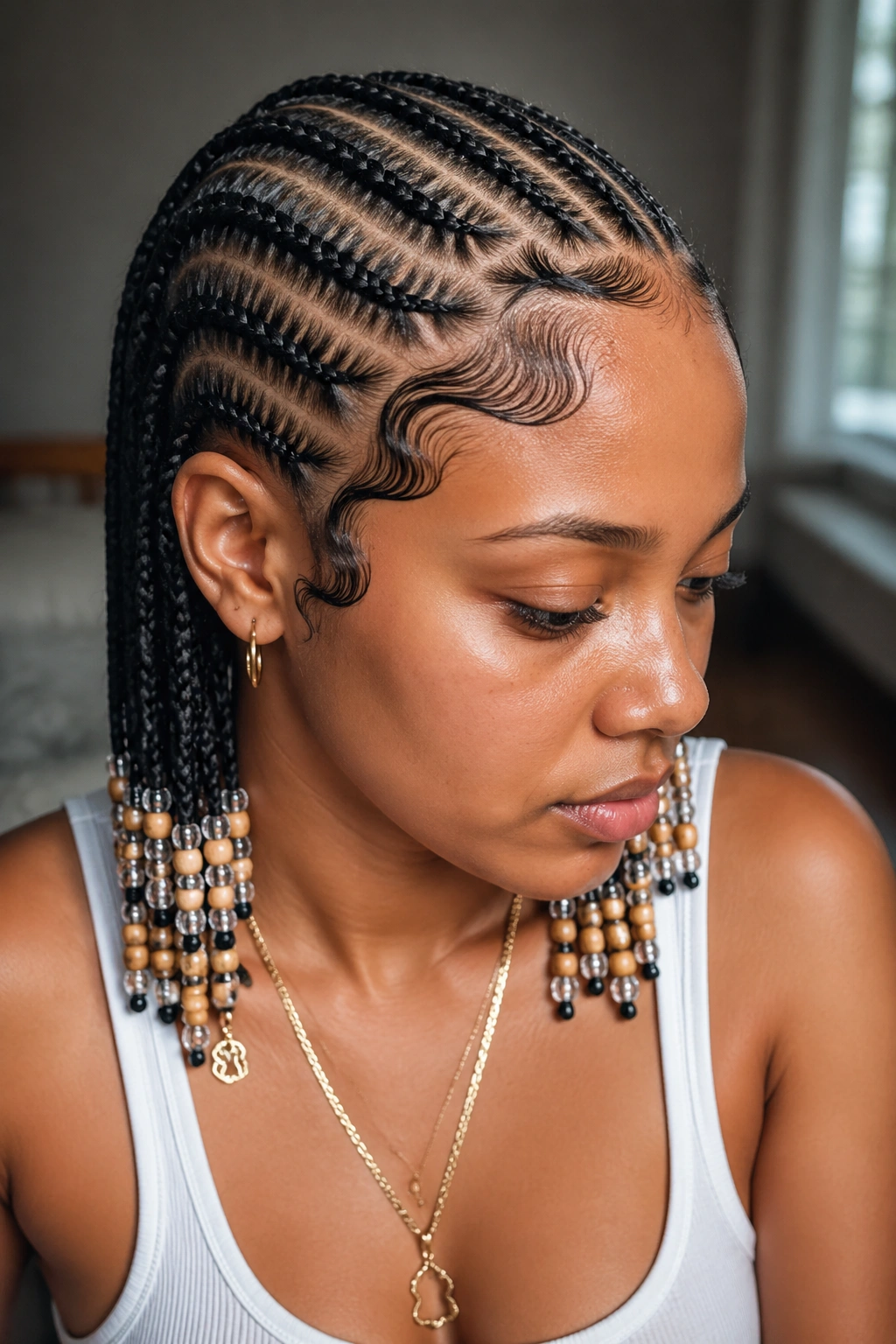
The braids themselves are simple straight backs with a single bead at each end. The visual interest concentrates at the front hairline, where elaborate baby hair patterns are laid with edge gel.
The combination is striking — elaborate front, simple sides and back. The edge work draws attention to the face. The beads at the back add finish from rear angles.
Edge gel patterns can include sharp angled swoops, soft S-curves, or geometric shapes laid flat against the forehead and temples. A toothbrush is the right tool for laying edge gel; a fingertip is too imprecise.
This style is photogenic. The contrast between the structured edge work and the organic bead movement creates visual interest in still photos that doesn’t show as well on more uniformly elaborate styles.
7. Color-Coordinated Beads to Outfit
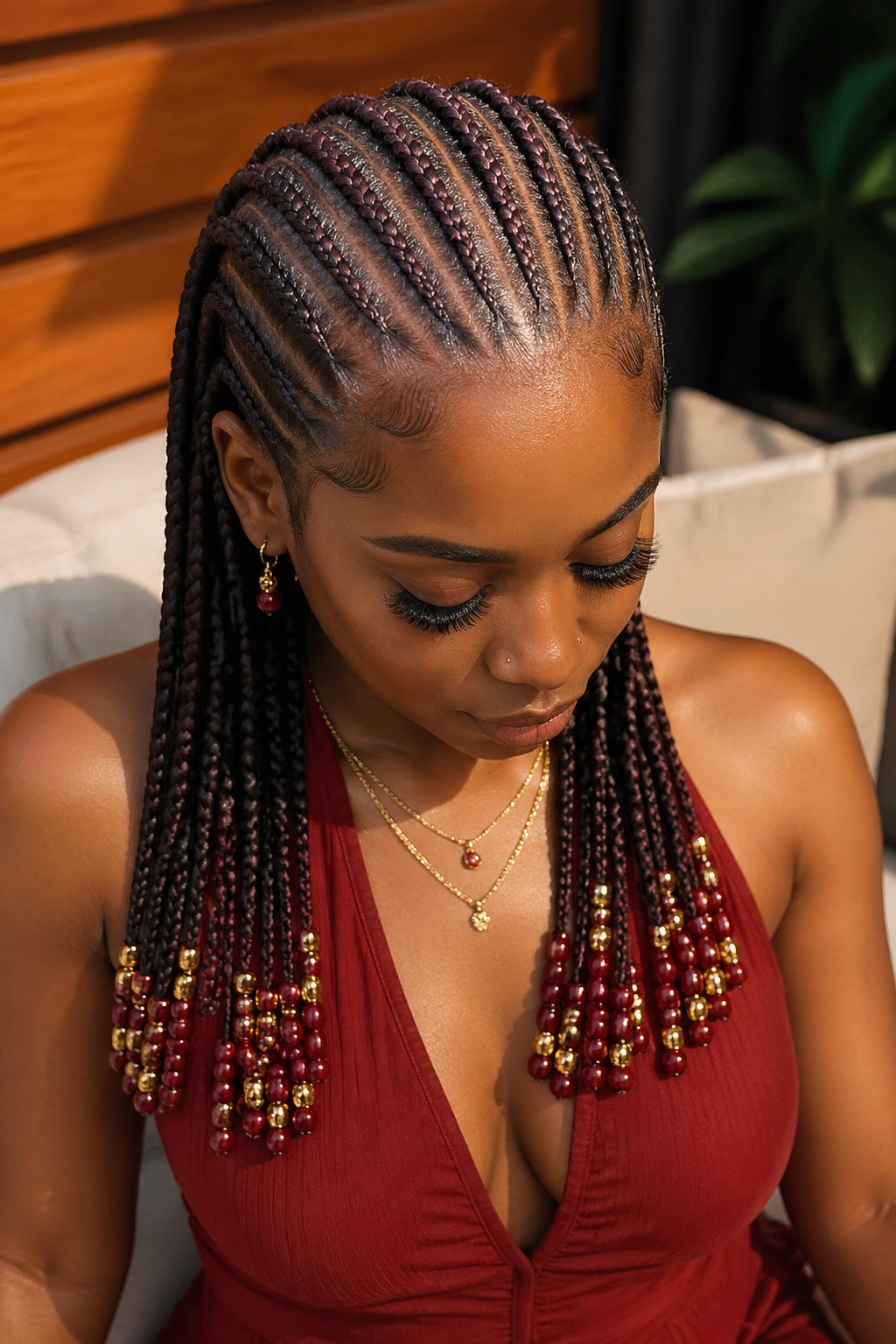
Bead choice that intentionally matches a planned outfit. Beaded finishes designed to complement rather than overpower clothing.
A cocktail dress in deep red gets dark red and gold beads. A casual outfit in neutrals gets cream and brown beads. A formal black gown gets jet black and silver beads.
This approach turns beads into accessories rather than statement pieces. They become part of the overall styling rather than competing with the outfit for attention.
Plan ahead. If the cornrows are getting installed for a specific event, decide on the outfit first, then choose beads to match. Trying to coordinate after the install is locked in becomes frustrating.
8. Beaded Crown With Rest Plain
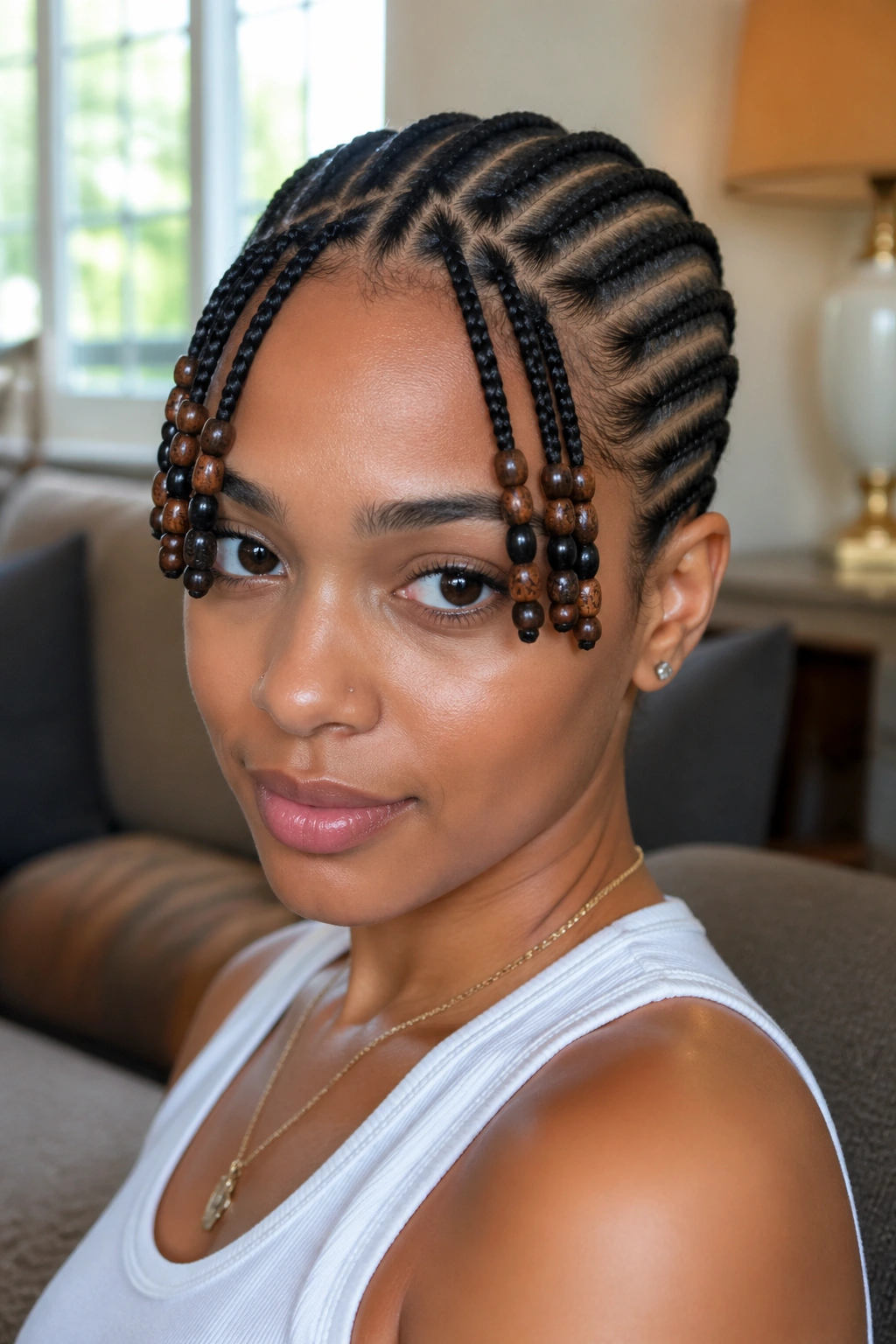
Only the top three braids feature beads. The lower four braids stay plain.
Why split this way: beads add weight to the front of the braids that anchors them forward. The plain back braids hang naturally without competing visual weight.
The beads on the front three braids form a small bead curtain that hangs over the forehead and temples. It’s a defined feature rather than overall ornamentation.
The bead count on each of the front three braids can be elaborate — five to ten beads each — without overloading the overall style. Concentration of beads on three braids reads as intentional. Spread across all seven, the same bead count would look chaotic.
9. All Wooden Beads, All Natural
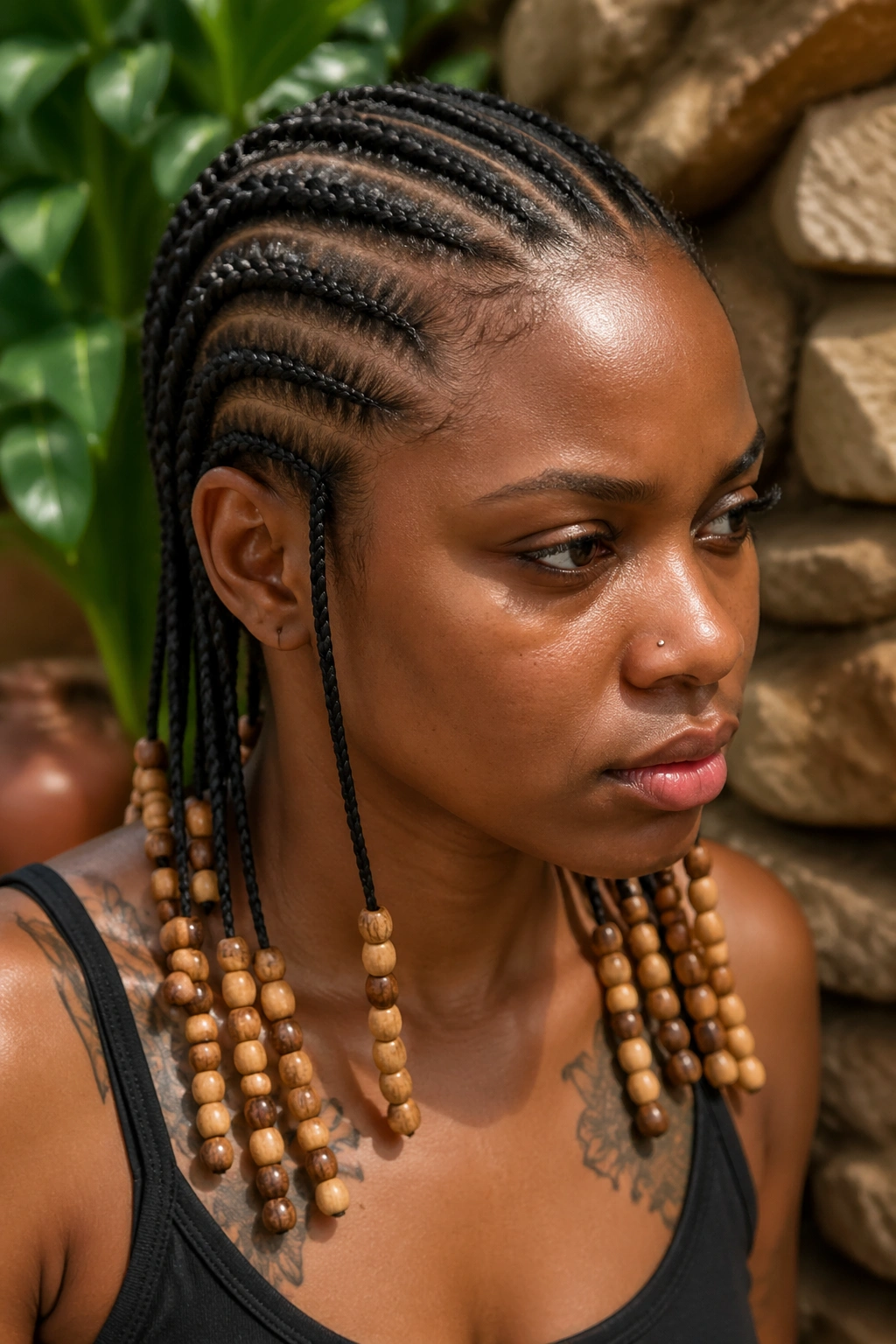
Every bead is wood. Every braid is natural color, no extensions. The whole style is fully natural in materials and color.
This is the most timeless version of straight back cornrows with beads. No synthetic materials, no extensions, no chemical processes. Just natural hair, wood, and skill.
What Makes It Different
The aesthetic reads as grounded, organic, and traditional. It doesn’t try to be modern or trendy — it sits in the long tradition of wooden bead adornment that goes back centuries.
For those drawn to natural living, sustainable choices, or traditional aesthetics, this version checks every box. The beads can be sourced from sustainable wood, the natural hair requires no chemical processing, and the whole style biodegrades cleanly when removed.
10. Long Beaded Braids With Extensions
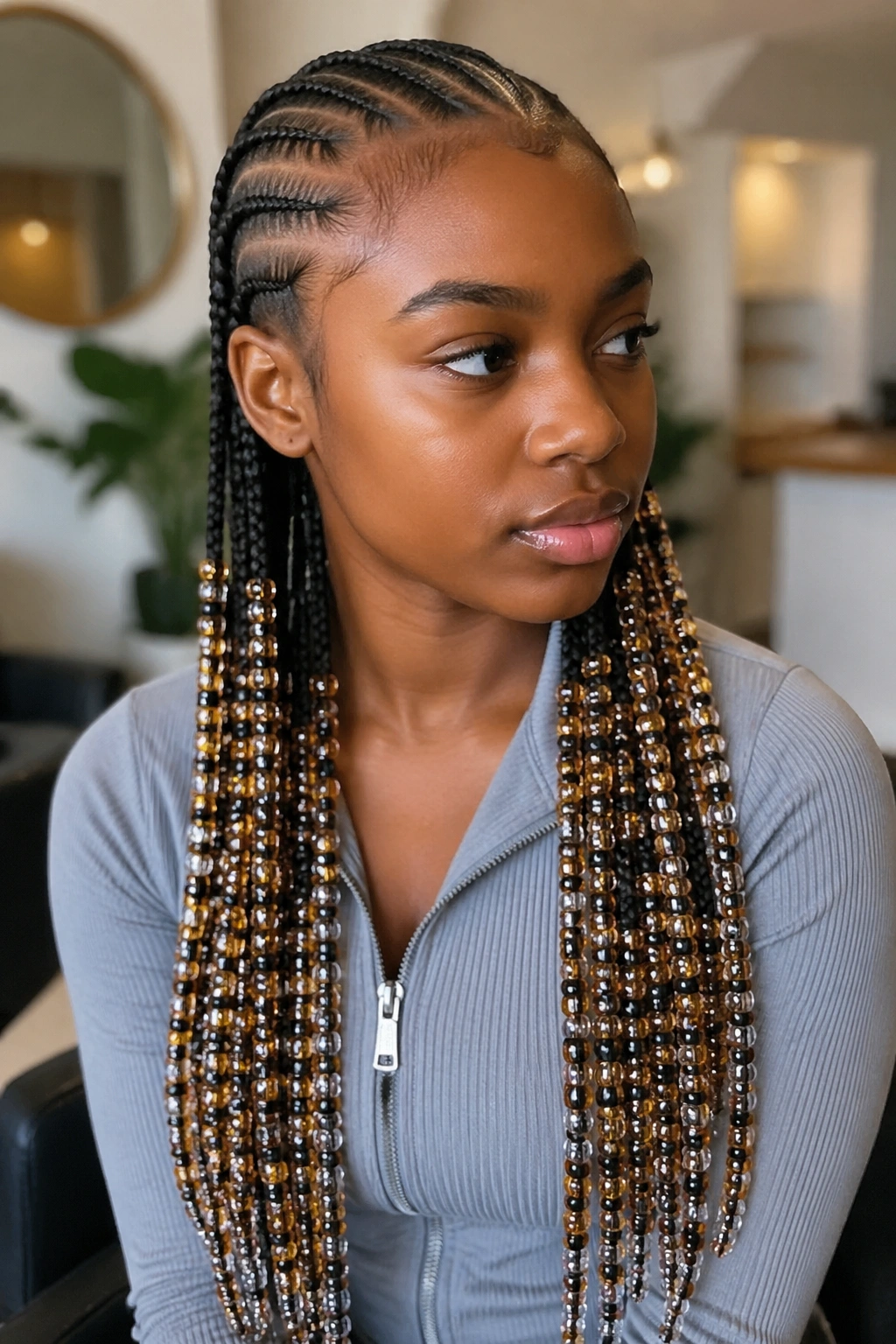
Feed-in extensions extend the braid length well past the natural hair. Beads run the full length of each extended braid — 10 to 20 beads per braid spaced evenly.
This is the maximalist version. Long beaded braids that swing past the shoulders, often past the chest, with beads clicking and catching light at every movement.
The extensions need to be high-quality kanekalon. Cheap synthetic hair frizzes within days, and frizzy braids look terrible behind beads. Spend on the hair; it shows.
Total install time is six to eight hours including the bead work. Plan a full day. Hydrate, eat, take bathroom breaks. Don’t try to rush this style.
The wear is heavy. Expect the scalp to feel weighted for the first 48 hours. Sleep with extra neck support to prevent strain from the bead weight.
11. Beaded Braids With Color Pop
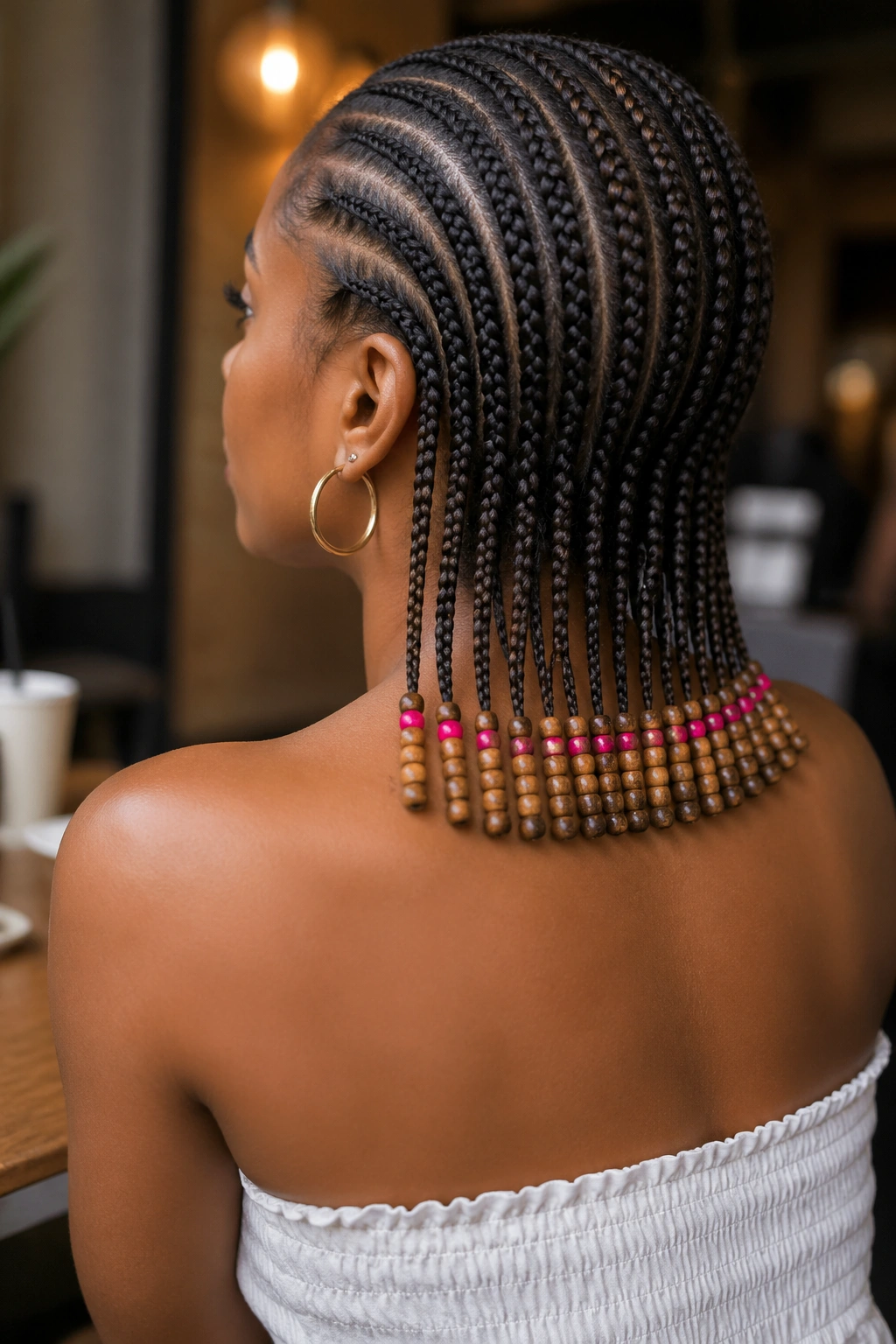
Most beads are neutral wood tones. One bead per braid is a bright color — coral, turquoise, cobalt, magenta.
The bright bead acts as an accent. Placed at the same position on each braid (usually three beads down from the end), the colored beads create a horizontal line of color across the back of the head.
Pick the color carefully. The accent color should complement skin tone and either harmonize or contrast intentionally with regular wardrobe colors. A color that clashes with everything in the closet becomes useless quickly.
The accent color works best in sets of one per braid. Multiple colored beads per braid become competing accents and lose the focal-point quality.
12. Beads Plus Cuffs Combination
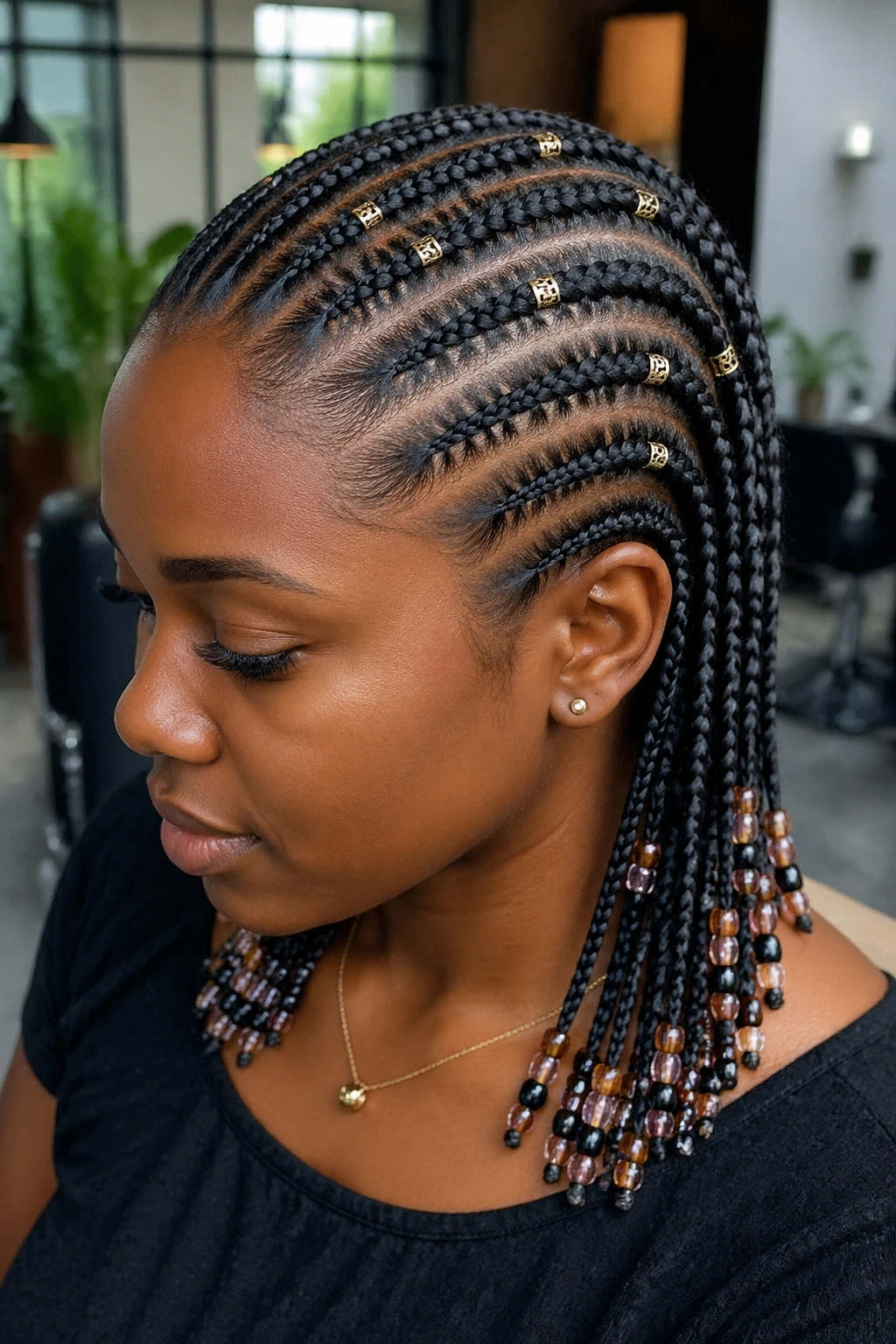
Beads at the ends of each braid; metal cuffs slid onto the upper portion of each braid.
The combination layers two types of adornment. Beads handle the bottom. Cuffs handle the top. Together they give the braid visual interest from end to end without bead-only overload.
Styling Tips
Cuffs should match the metal tone of any beaded jewelry being worn. Silver cuffs with silver earrings. Gold cuffs with gold accents. Mixed metals look unfocused.
Cuff placement matters. Don’t slide cuffs too close to the scalp — they create pressure points during sleep. Mid-braid placement, about 4-6 inches down from the scalp, is comfortable and visually balanced.
The overall weight of the style increases with cuffs added. Combine cuffs with lightweight wooden beads, not with heavy glass or metal beads, to avoid total weight becoming uncomfortable.
13. Double-Strand Beaded Ends
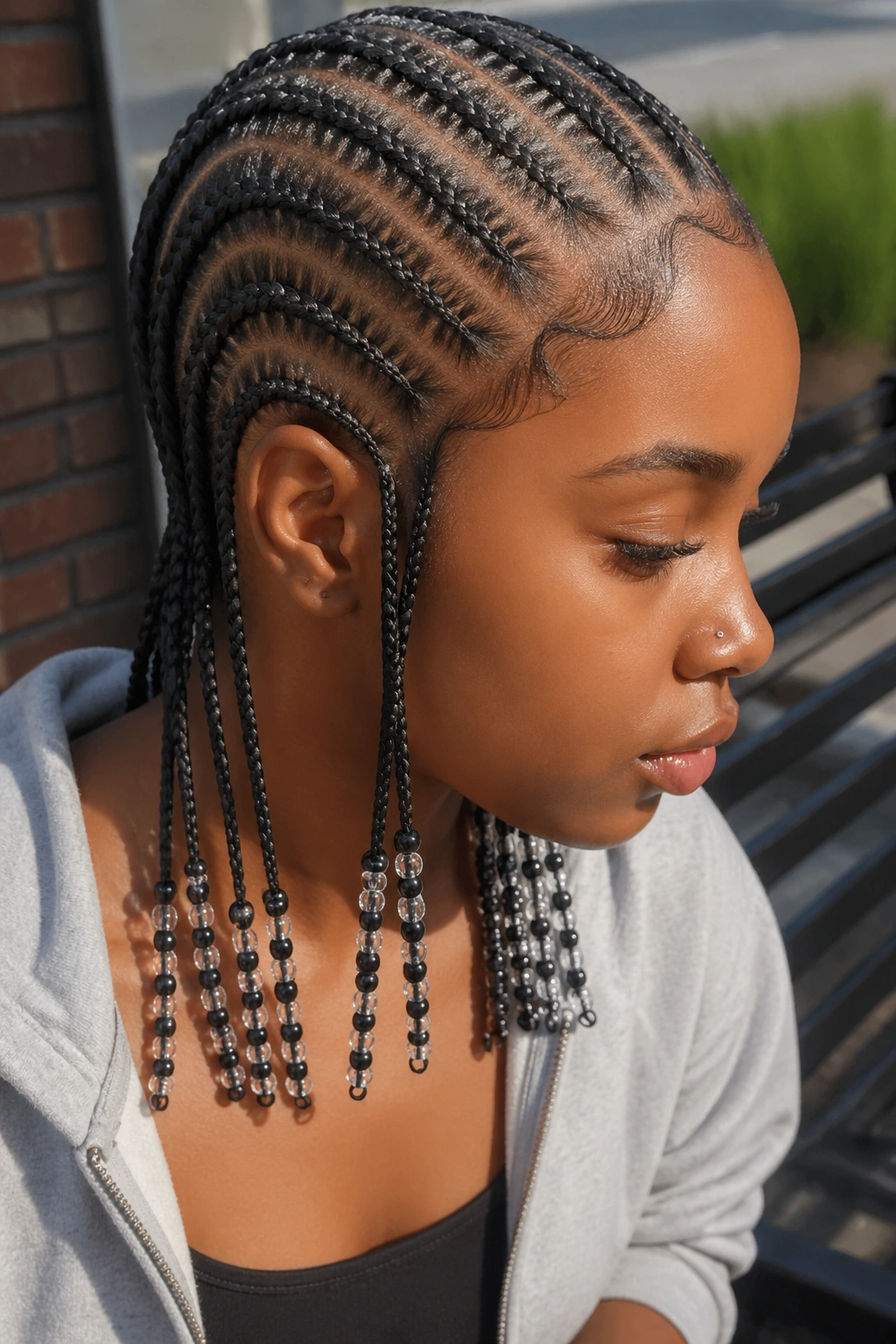
Each braid splits into two strands at the bottom three inches. Each strand gets its own bead trail. The result is a forked beaded fringe at each braid end.
This is an unusual variation that adds bead density without multiplying the braid count. Five braids become ten beaded strand-ends, doubling the visible bead count without doubling install time.
The split point needs reinforcement to prevent the braid from unraveling at the fork. A small clear elastic at the split point holds the braid integrity while allowing the bottom three inches to separate.
Beads on the split strands should be smaller than beads on a single-strand finish — the strands are thinner and can’t support large beads without bending awkwardly.
14. Beaded Side Sweep Variation
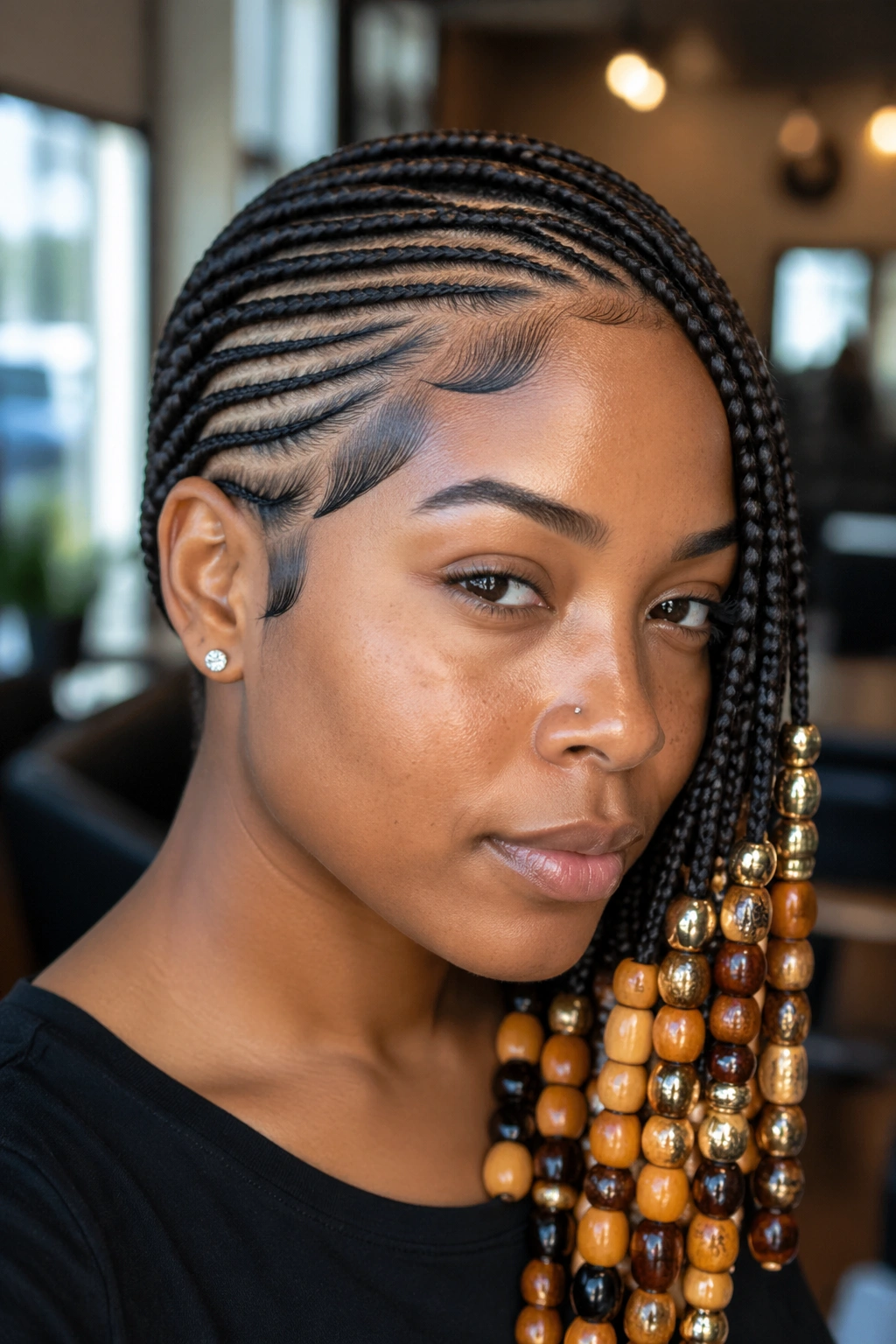
Most braids run straight back. The two front braids sweep slightly to one side and feature heavier beading than the rest.
The asymmetric beading on the swept-side braids draws the eye to one side of the face. It’s a flattering effect for those who want to highlight one cheekbone or jawline.
The swept braids should remain flat against the scalp despite the angle. A swept braid that lifts off the scalp loses the sleekness that defines the side-sweep effect. Use edge gel along the path to keep the braid flat.
This style suits asymmetric outfits well — clothing with one shoulder cut, off-center necklines, or single-sided embellishments. The hair asymmetry mirrors the outfit asymmetry.
15. Beaded Cornrows Into a Ponytail
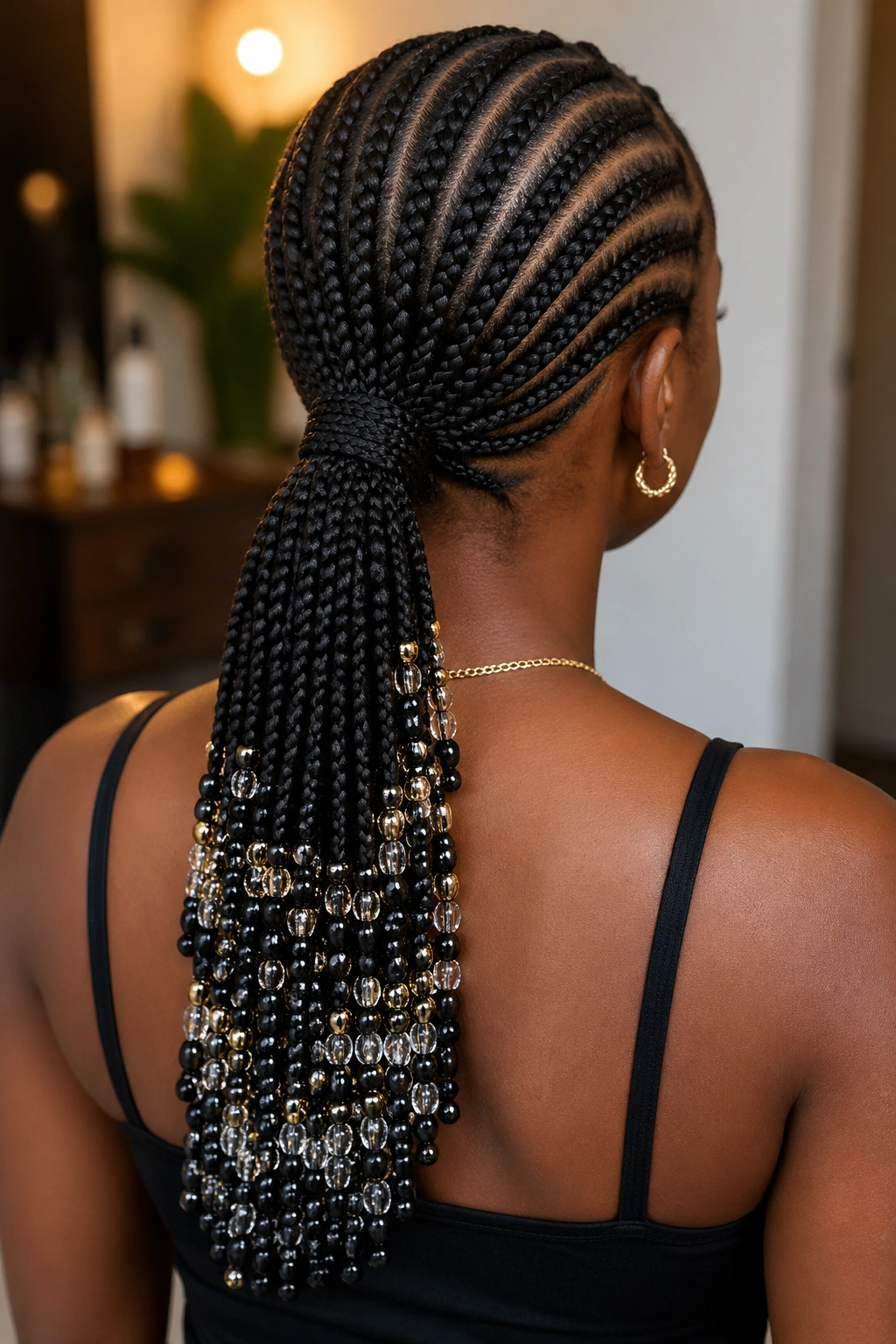
The braids run straight back to a single point at the back of the head, where they’re gathered into a ponytail. Beads start where the ponytail begins and run down the gathered braid length.
This combines the cornrow-and-bead aesthetic with a more polished gathered finish. The ponytail looks dressed-up. The beads keep the look distinctive.
Wrap the ponytail base with a strand of braid hair to hide the elastic. A visible elastic at the ponytail base looks unfinished against the otherwise polished style.
The ponytail can hang loose down the back, swing over one shoulder, or be styled into a high crown — depending on the desired silhouette.
16. Beaded Braids With Asymmetric Lengths
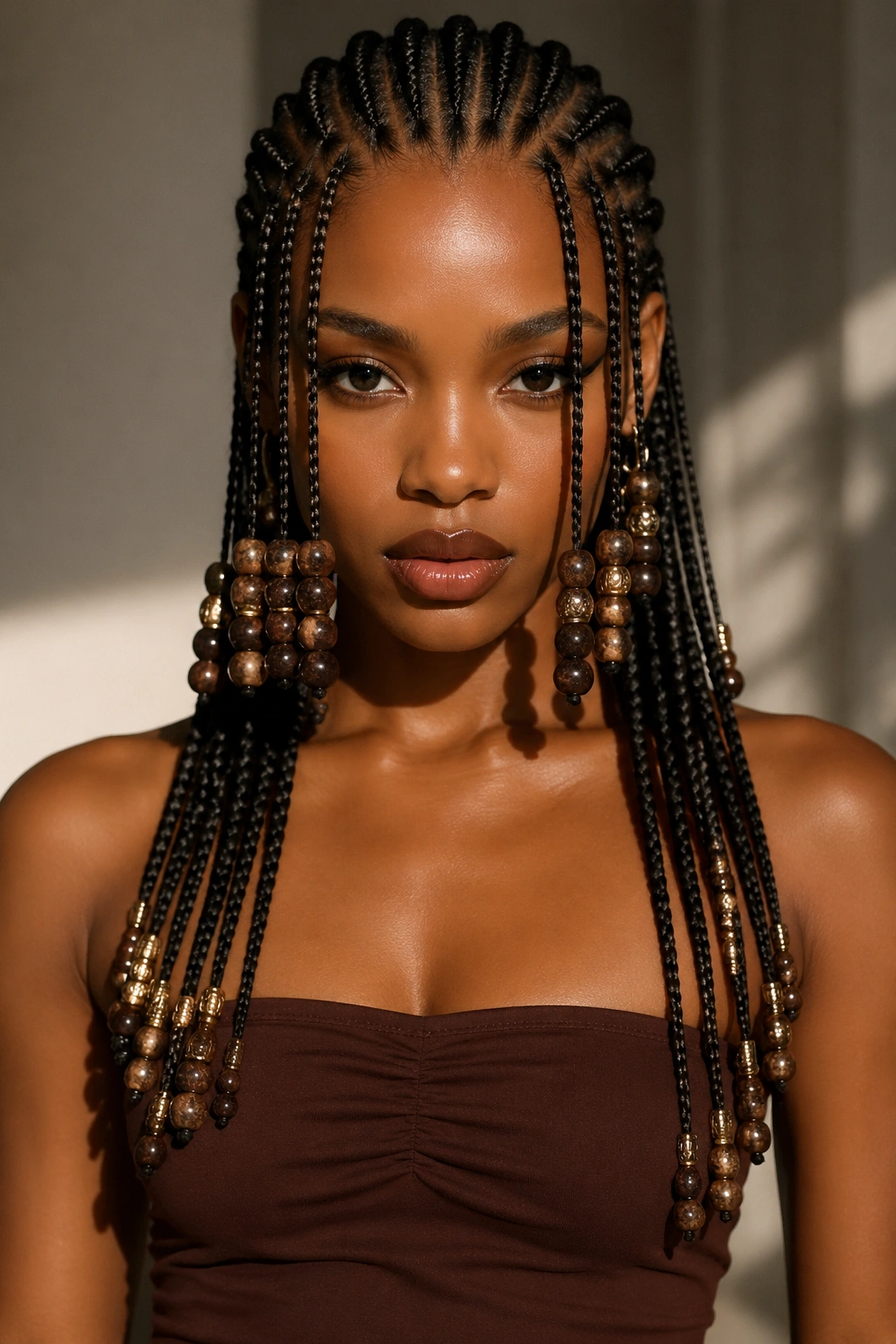
The braids are intentionally varied in length. Some end at the shoulders. Some extend past the chest. Beads scale to match — heavier beads on shorter braids, lighter beads on longer braids.
The varied lengths create a layered look that’s more visually dynamic than uniform-length braids. The beads echo the layering by varying weight and color across the braid spectrum.
This is a fashion-forward variation. It reads as styled and intentional rather than spontaneous. Best worn for events, photo shoots, or environments where bold styling fits the context.
The shorter braids should be the front-most ones. Longer braids hang from the back. This layering positions the variation flatteringly around the face.
17. Single Braid Down Each Side With Beads
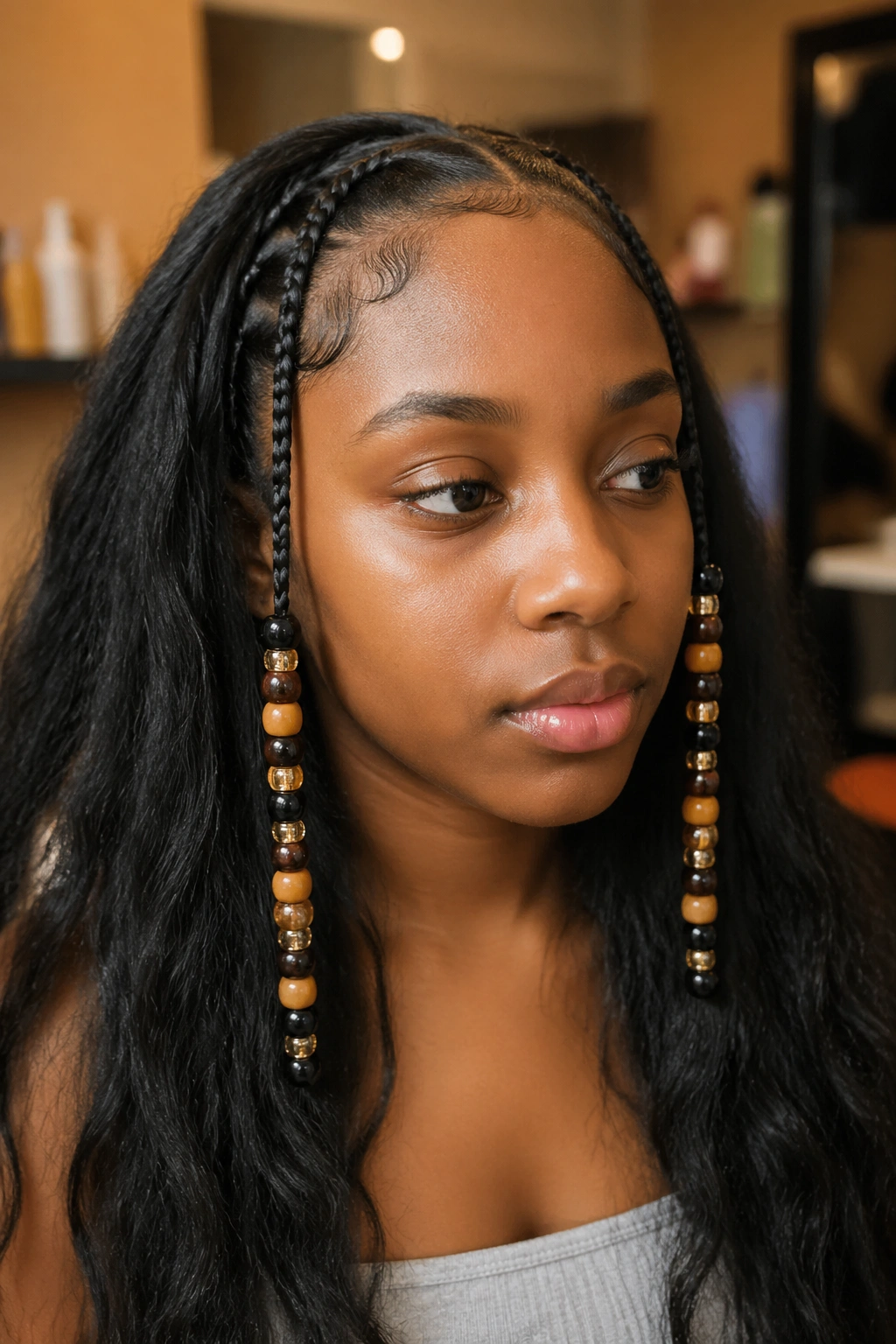
Only two braids — one on each side of the head, running from temple to past the ear. The rest of the hair is left out as a defined natural style.
The two side braids are heavily beaded — eight to fifteen beads per braid — making them prominent against the loose hair around them.
This is a minimalist take on bead adornment. Most of the hair stays free; the bead concentration on just two braids becomes the entire styling statement.
The two braids can be installed in 30 minutes including bead placement. The loose hair gets a wash-and-go or a twist-out depending on length and texture. The total style takes far less time than full straight back cornrows.
18. Beaded Cornrows With Headband
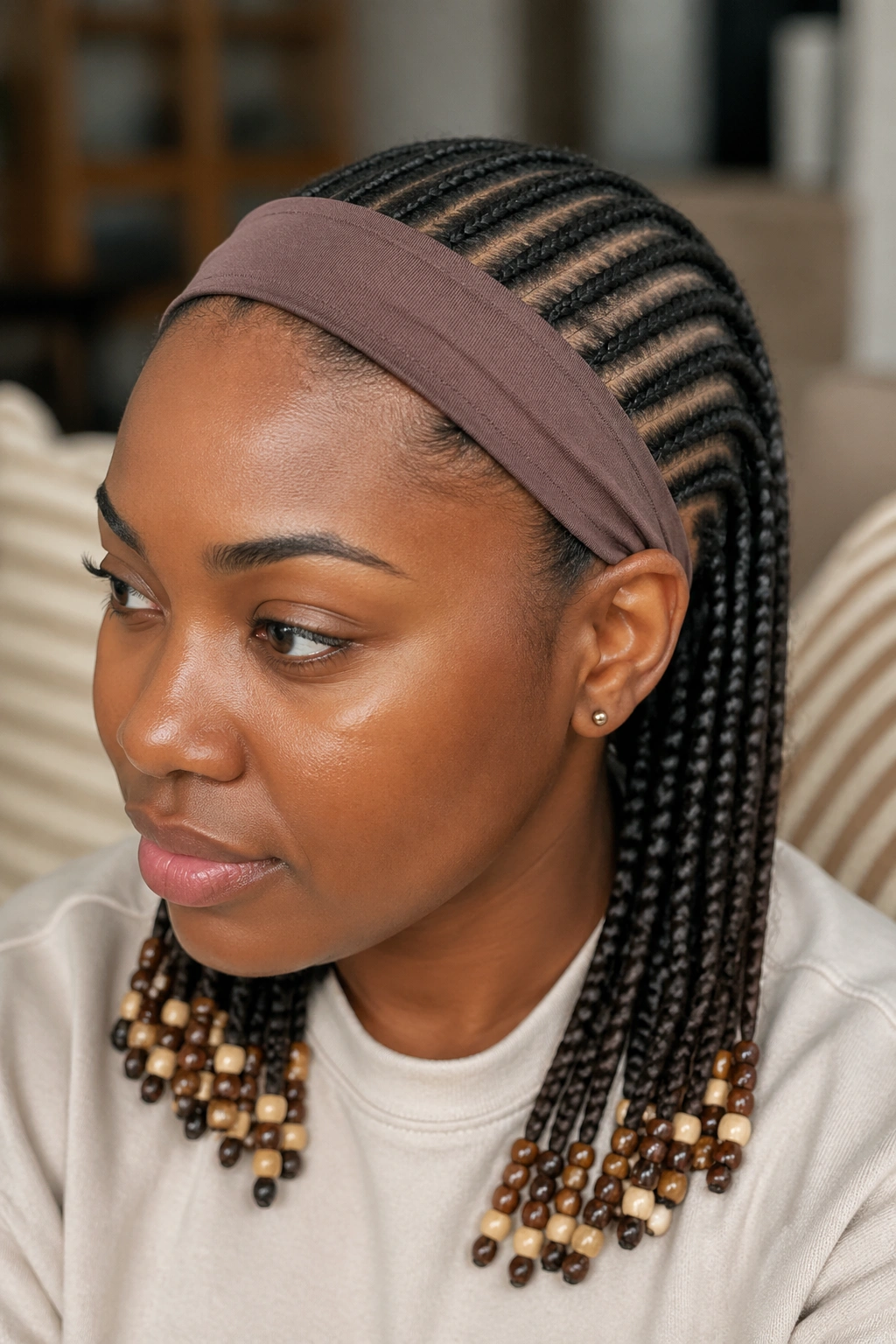
Standard straight back cornrows with beads at the ends, plus a fabric headband worn across the front hairline.
The headband adds a layer of adornment that doesn’t compete with the beads. Headband at the top, beads at the bottom — the visual elements bookend the style.
Headband fabric should match or complement bead color. Wooden beads with a leather or suede headband. Glass beads with a velvet or silk headband. The fabric texture should harmonize with the bead material.
Headbands should be elastic-backed, not rigid. Rigid headbands press into the cornrows and create dents along the front of the install. Elastic backs sit comfortably without distorting the braids.
19. Beaded Cornrows With Curly Bangs
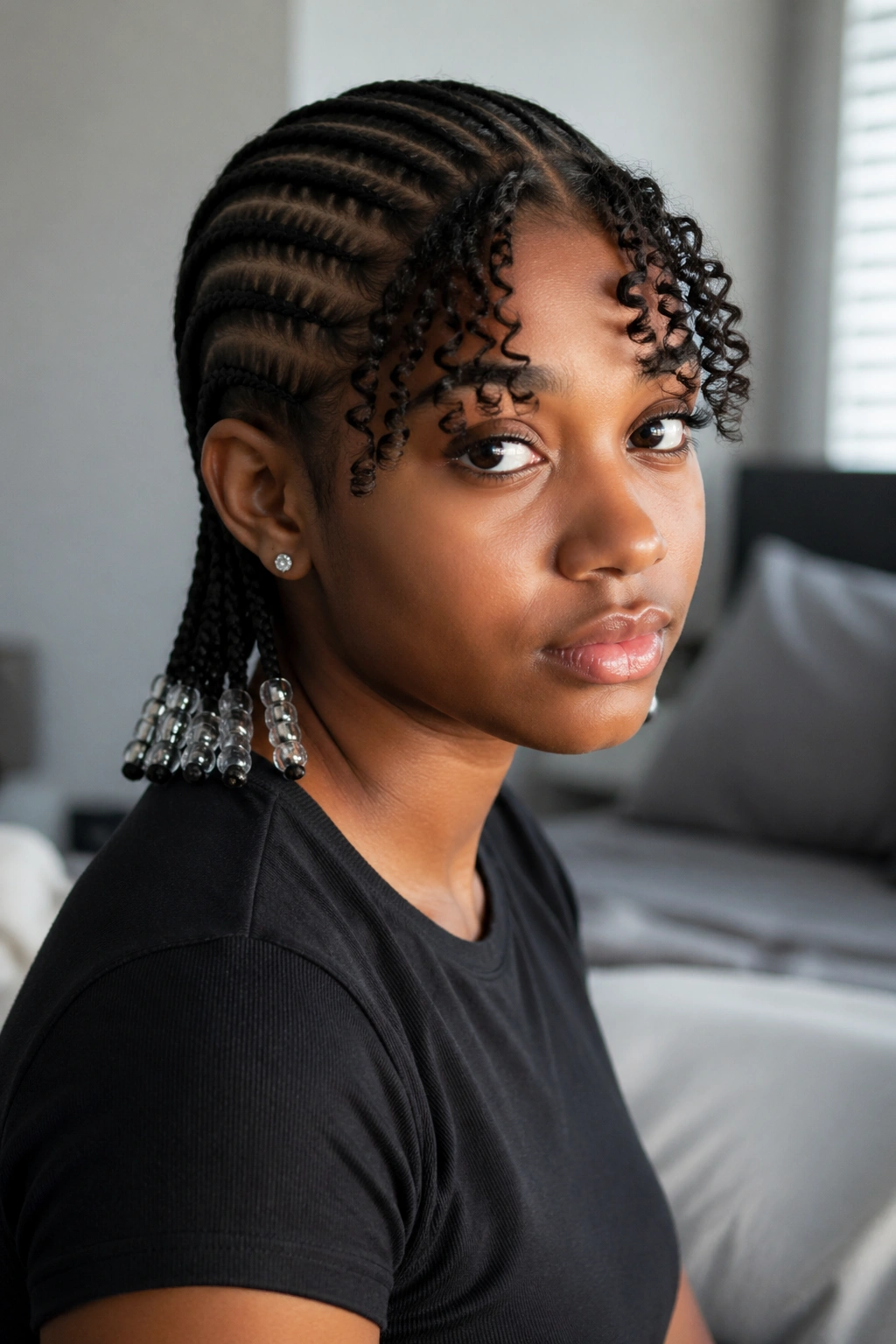
Straight back cornrows behind the front section of the head; the front section is left out as natural curl bangs framing the forehead. Beads only on the cornrow ends in the back.
The bangs soften the front of the face. The beaded back delivers the styled aesthetic from rear angles. From the front, the style reads as soft and natural. From the back, it reads as braided and beaded.
Bangs need their own daily refresh — a spritz of water and a finger-detangle each morning. The cornrows behind don’t need daily attention.
This is the right style for those who feel exposed by a fully pulled-back hairline. The bangs preserve facial framing without sacrificing the cornrow aesthetic.
20. Beaded Cornrows With Beaded Edges
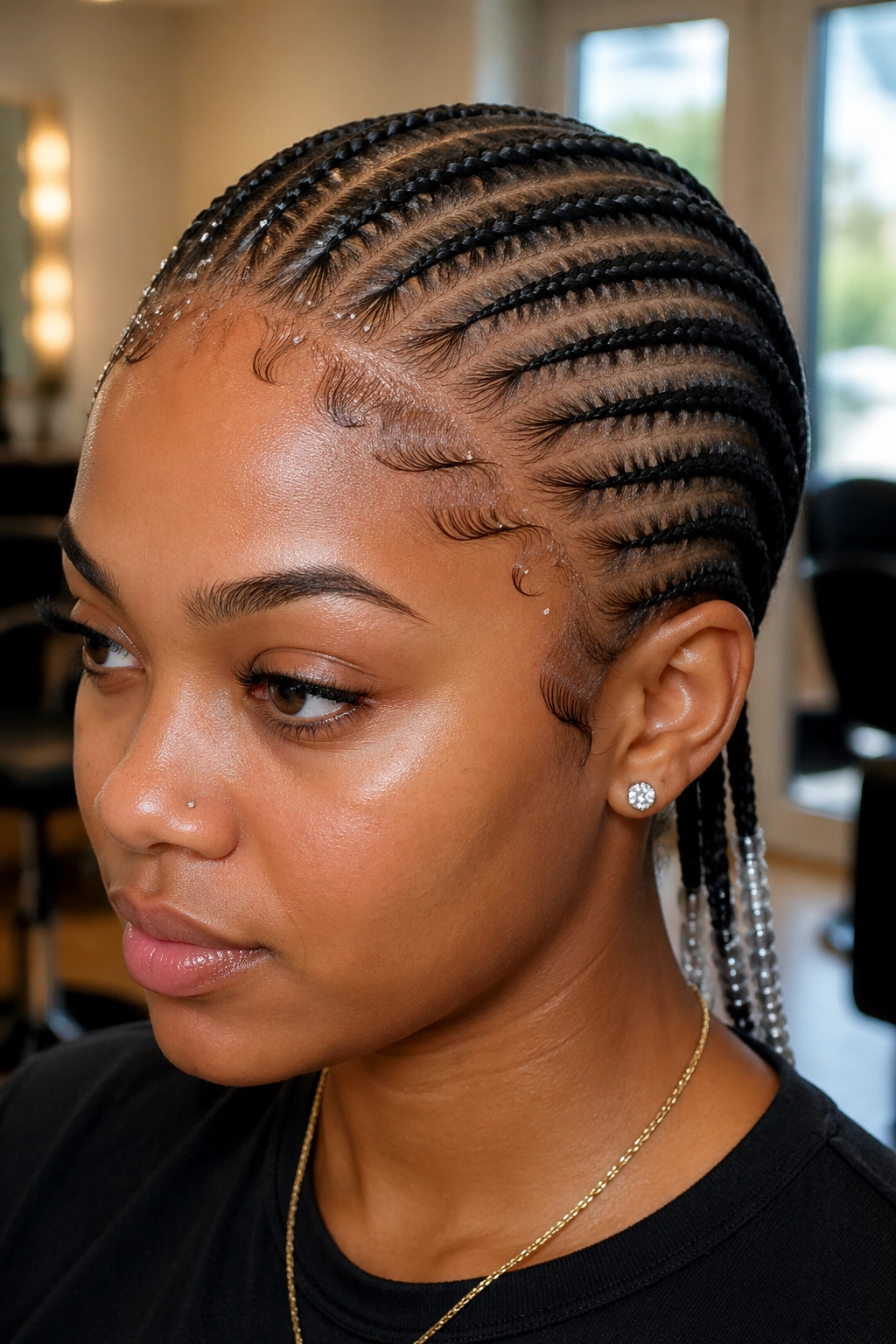
Both the braid ends and the front edges feature bead work. Tiny beads laid into the edge gel along the hairline create a beaded edge accent that matches the larger bead trail at the back.
This is high-detail work. The beaded edges need to be installed after the cornrows are done, with small beads pressed into wet edge gel and held until the gel sets.
The edge bead size has to be small — 3-5mm maximum. Larger beads at the hairline look heavy and pull the gel out of position before it sets.
This style is for special occasions — weddings, festivals, performances. It’s not a daily-wear style because the edge beads need careful sleep care to prevent dislodging.
21. Beaded Cornrows With Mixed Bead Types
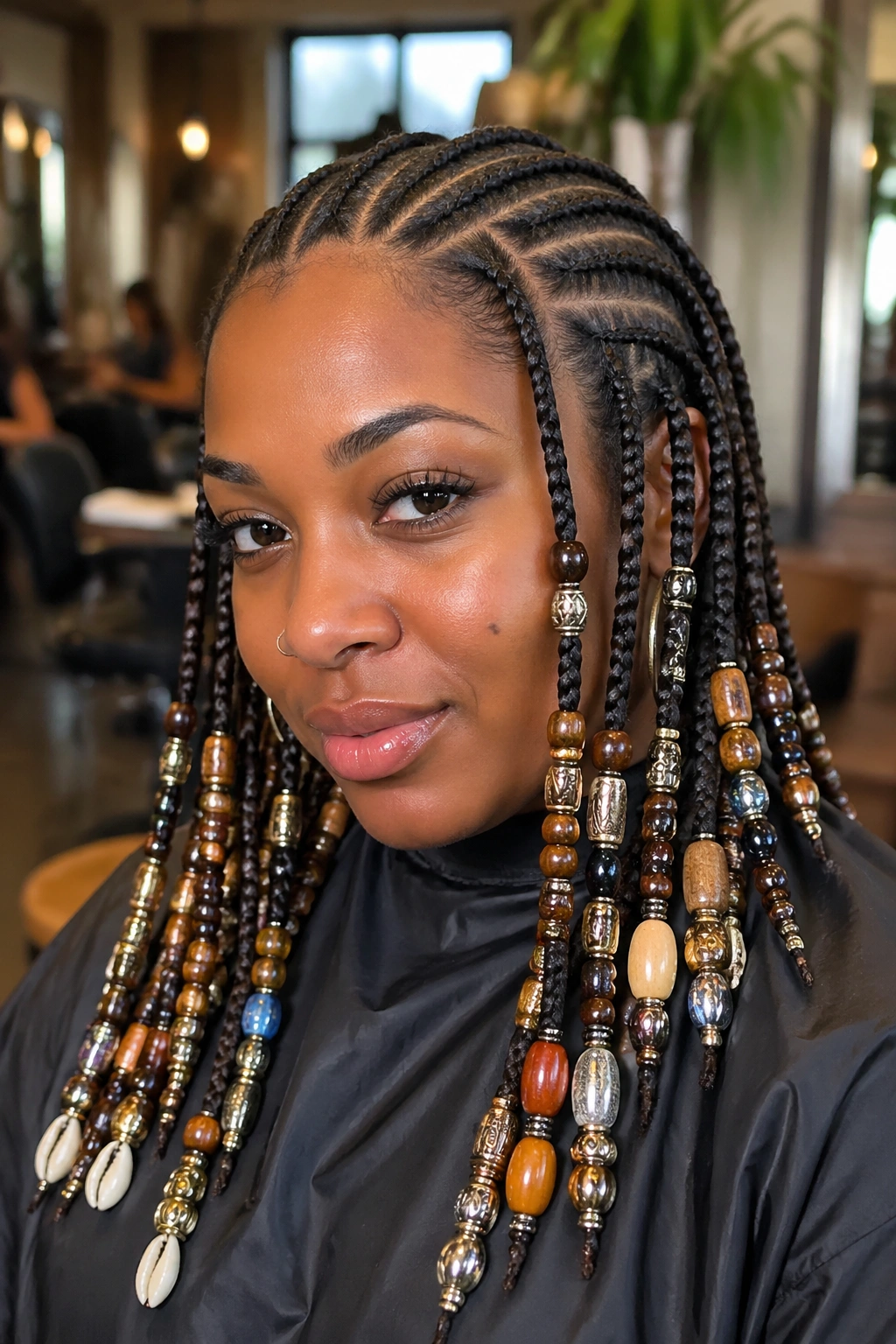
Each braid features a mix of bead types — wood, glass, metal, shell — combined in patterns down each braid length.
The mixed-material approach gives each braid its own personality. One braid might be heavy on wood with glass accents. Another might be metal-dominant with single shell ends. The variation makes the whole style read as collected rather than uniform.
The Catch
Mixed beads add complexity. The total install becomes a beading session in addition to a braiding session. Plan an additional 90 minutes beyond standard cornrow time.
The mix should follow some logic. Pure random looks chaotic. Patterns that repeat across braids — even if each braid has unique details — give the eye something to track.
This is collector-style beading. People who source beads from travels, gifts, or vintage finds can feature their collection through mixed-bead cornrows.
22. Minimalist Beaded Tips With No Other Adornment
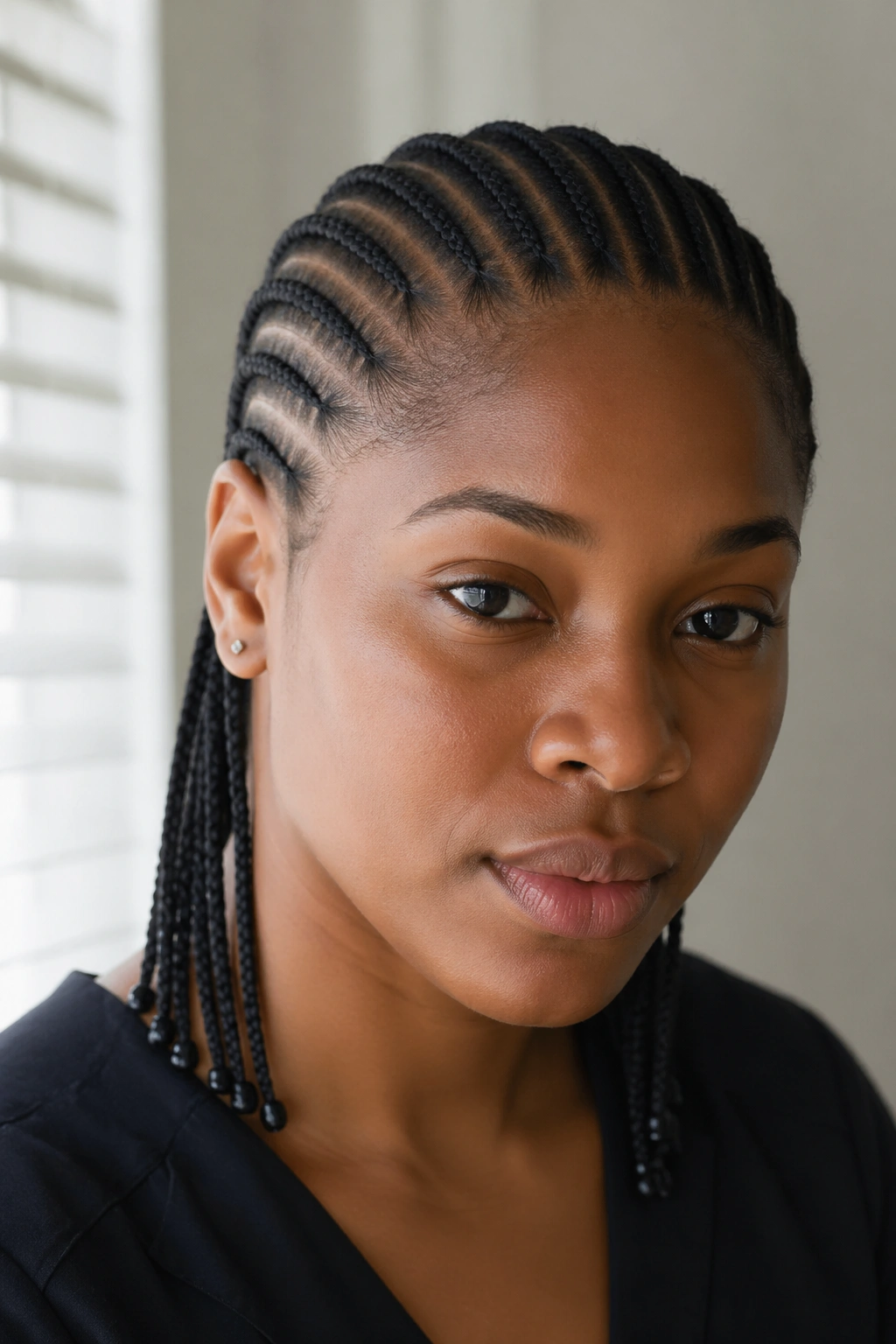
Just the cornrows and a single small bead at each end. No edges laid, no jewelry, no additional accessories. The bead is the only adornment and it’s small.
The minimalism is the statement. Strip everything down to braid and bead, and what remains is pure technique on display.
This is a confident choice. It requires the cornrows themselves to be flawless because there’s no adornment to distract from imperfections. Every braid has to be even, every part has to be sharp, every section has to be smooth.
For those who appreciate minimalist aesthetics — clean lines, restraint, quiet beauty — this version is the gold standard. It’s the cornrow equivalent of a perfectly tailored white shirt. Simple, polished, undeniably elegant.
Sleeping in Beaded Cornrows Without Damage
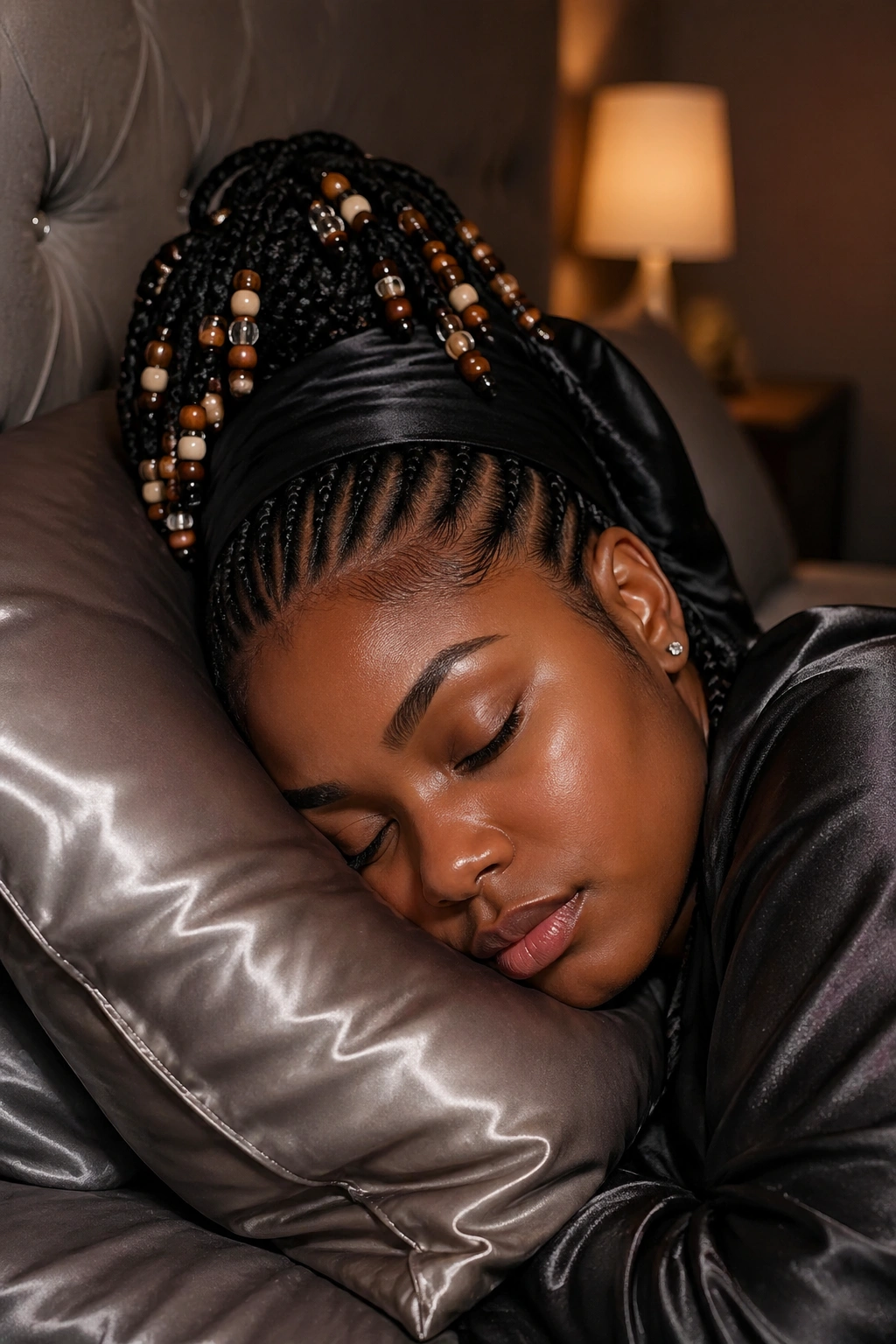
Beads create unique sleep challenges. They press into the scalp, clack against each other, and can dent the side of the face if you sleep on them.
A satin bonnet that fully contains the beaded ends is the first line of defense. Look for bonnets with deep elastic and ample interior space. A bonnet that’s too tight compresses the beads against the scalp.
For heavy bead styles, gather the braids into a loose pineapple at the top of the head before applying the bonnet. The pineapple lifts the beads off the back of the neck and prevents the beads from pressing against the spine during sleep.
Side-sleepers should wrap a satin scarf around the head over the bonnet. The double layer of satin reduces the pressure of beads against the cheek and jaw.
Daily Care for Bead-Friendly Cornrows
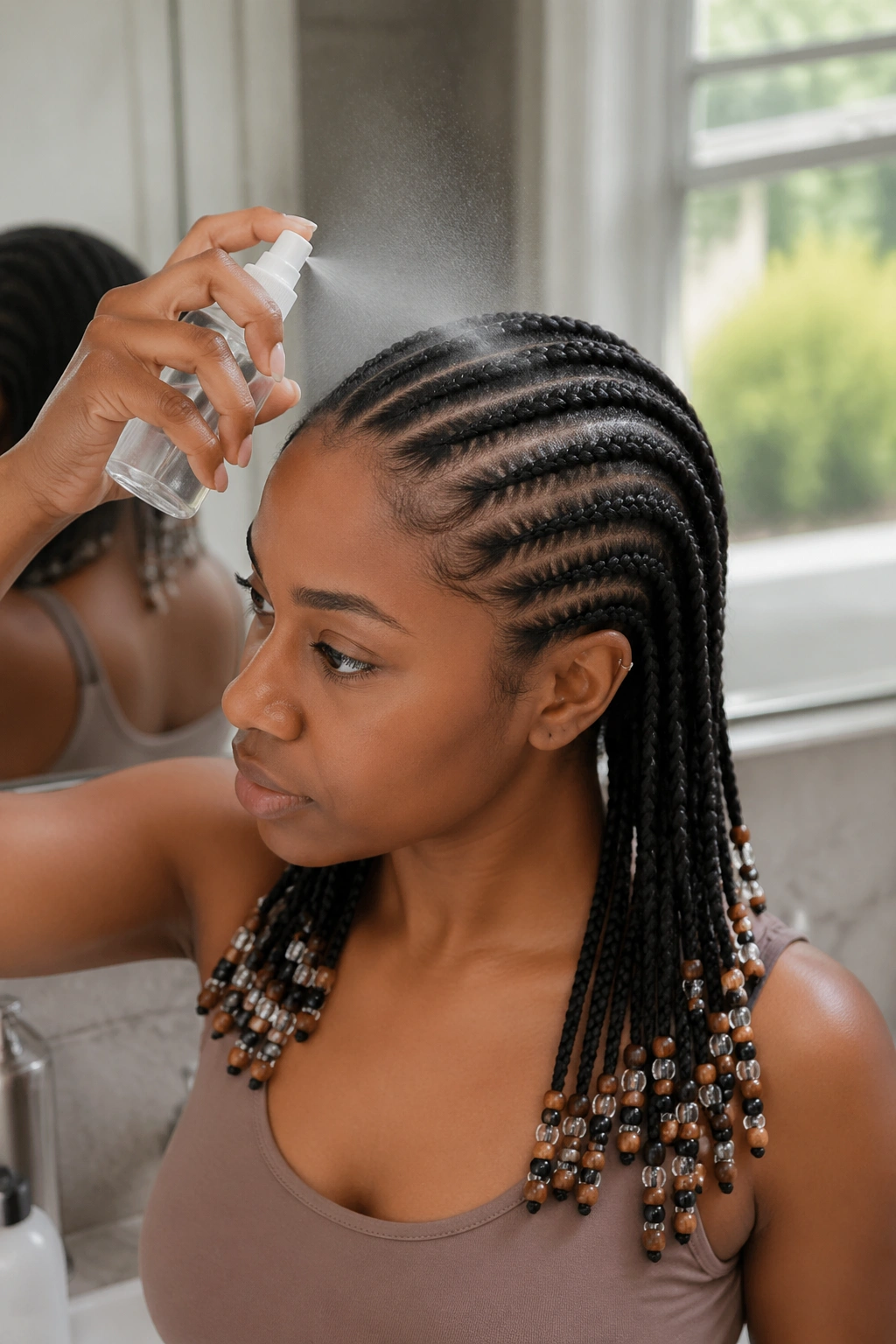
Spritz the parts daily with a water-based mix. Avoid spraying directly on beads — water can warp wooden beads or dull glass over time.
Oil the scalp two to three times per week. A nozzled bottle drops oil directly into the parts without coating the beads.
Inspect bead security weekly. Loose beads that wobble more than they should are about to fall off. Reinforce or replace before they’re lost.
Don’t sleep with beads if they’re particularly heavy. Some heavily beaded styles benefit from removing the beads at night and re-attaching in the morning. The work is worth it for serious heavy styles where the bead weight causes tension.
Wash Day With Beads In
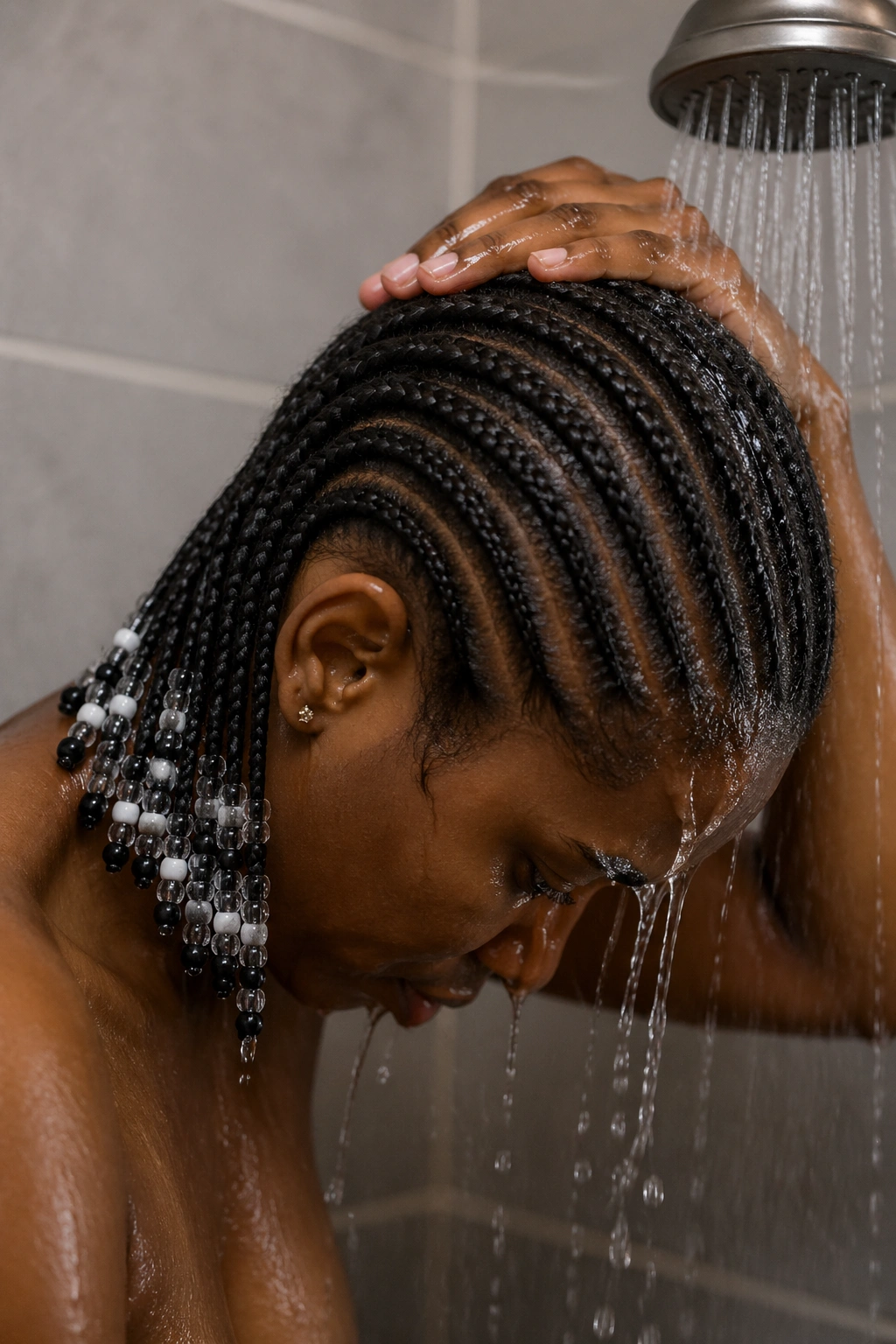
Beads complicate washing. Water gets trapped behind beads and dries slowly, which can lead to mildew smells if not addressed.
Wash carefully along the parts using diluted shampoo. Avoid soaking the bead area. Rinse thoroughly under low-pressure water, lifting beads to allow water to flush behind them.
Towel-dry by patting with a microfiber towel. Don’t rub — rubbing tangles the braids around the beads. Pat until most surface water is absorbed.
Air-dry with the head slightly tilted forward to let water drain out through the bead openings. A fan on low setting helps speed drying without using heat that could damage beads.
Removing Beads at Takedown
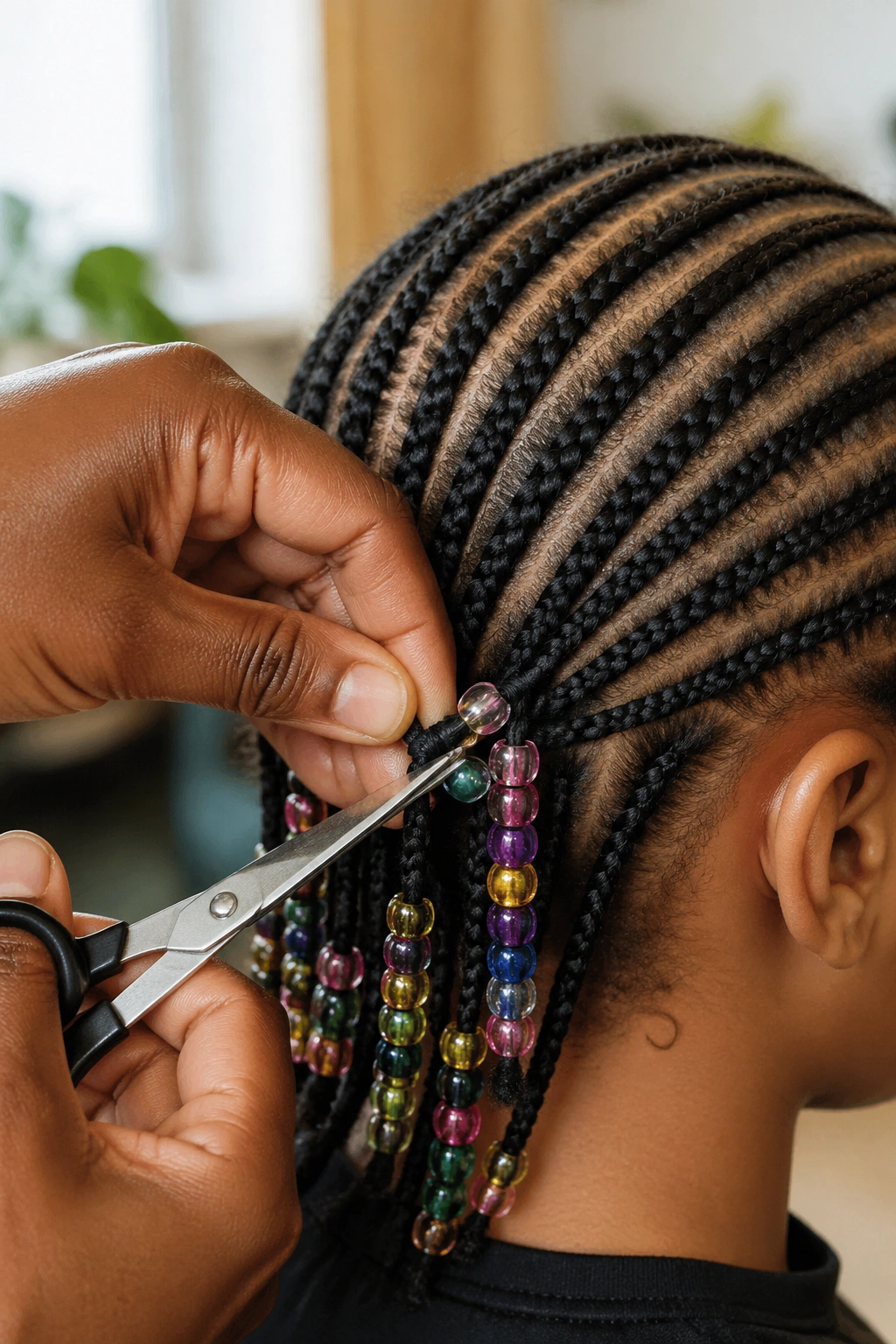
Use small scissors to cut the elastic securing each bead. Don’t try to pull beads off — that breaks hair at the bead point.
If beads were attached using the loop method, gently work the loop free by pushing the braid back through the bead hole. This takes patience but preserves both the bead and the hair.
Save reusable beads in a small container, sorted by color or material. Quality beads get used across multiple installs over years. Don’t discard a bead unless it’s actually damaged.
Picking the Right Beaded Style
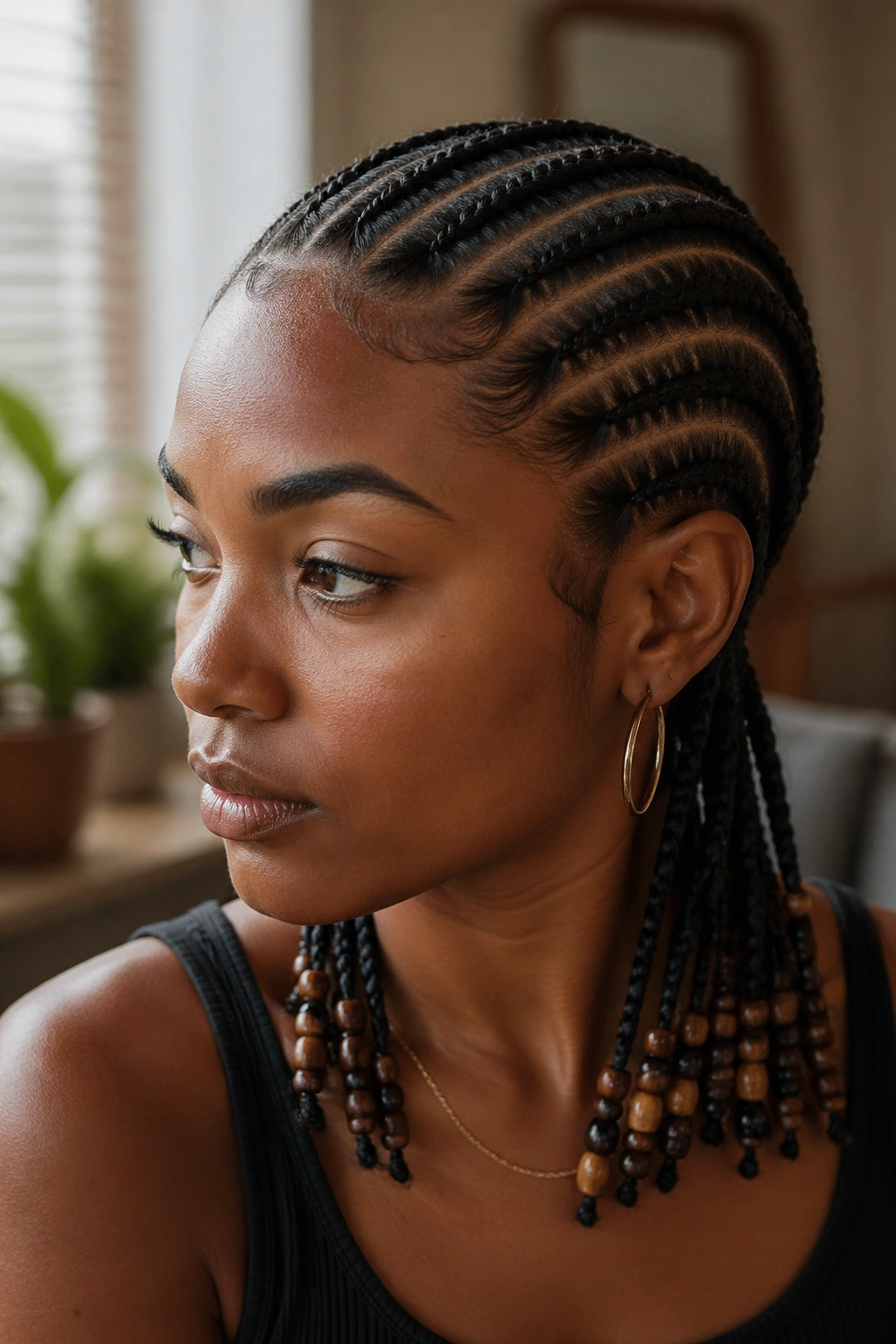
For a first attempt, choose the single-bead-per-braid style. Minimal weight, easy install, low daily maintenance.
For everyday wear, the three-beads-stacked style or the beaded crown variation work without overwhelming. Both deliver visible beadwork without daily sleep difficulties.
For events, the heavily beaded long extension style or the mixed-bead variation maximize visual impact for occasions where the style itself is part of the statement.
For cultural connection, the cowrie shell style or the all-natural wooden bead style honor the long traditions of bead-adorned braids in African and African diaspora hair history.
The bead style should match the wearer’s natural movement style. Someone who shakes their head expressively will find heavy beads disruptive. Someone who moves quietly and gracefully can carry heavier bead weight comfortably. Watch how you move before committing to a heavy bead install.
Beaded straight back cornrows have been worn for thousands of years for good reason. They’re functional, durable, beautiful, and capable of expressing personality, status, occasion, and identity all at once. The combinations are endless. The fundamentals stay the same: clean braids, considered beads, careful installation, and respectful daily care.
