



Standing in a field or an open-air arena with music hitting your chest and your afro catching the wind — there is no better environment for afro festival outfits to do exactly what they’re supposed to do. Festivals are theatrical spaces. They reward boldness. They reward texture, color, and silhouette choices that might feel extreme in a work meeting or a dinner reservation. Here, none of that is too much. Here, the only mistake is playing it too safe.
Afro festival outfits are their own category within fashion because they have to solve a specific set of practical problems while still hitting visually. You’ll be moving constantly — walking, dancing, possibly standing in a crowd for hours. The weather could shift. You might be outdoors from noon to midnight. Whatever you wear has to function under all of that while still looking like you chose it with intention.
This list is built for music lovers who want to look genuinely great, not just “festival-ready” in the generic sense that phrase has come to mean. These are 23 distinct outfit directions — some bold, some understated, some rooted in specific cultural aesthetics, some purely practical-meets-stylish. All of them designed to work with natural afro hair rather than competing against it.
Understanding What Festivals Actually Demand From Your Wardrobe
A festival outfit is a full-day-into-night garment. That changes the calculation significantly. The silk maxi skirt that photographs beautifully at noon will behave differently after six hours of wear in a crowd, possible sun, possible dust. Waistbands that felt comfortable in the house will be tested. Shoe choices that seemed manageable at the entrance will make their opinions known by hour four.
The smartest festival dresses almost always have one thing in common: they were chosen for how they feel from the inside, not just how they look from the outside. Comfort and chic aren’t opposites here. The confidence that comes from wearing something that moves with you — that doesn’t pull, pinch, shift, or become sweaty in the worst places — shows up in how you carry yourself, and that’s what makes the look land.
Natural Hair and Festivals: A Practical Note Before You Dress
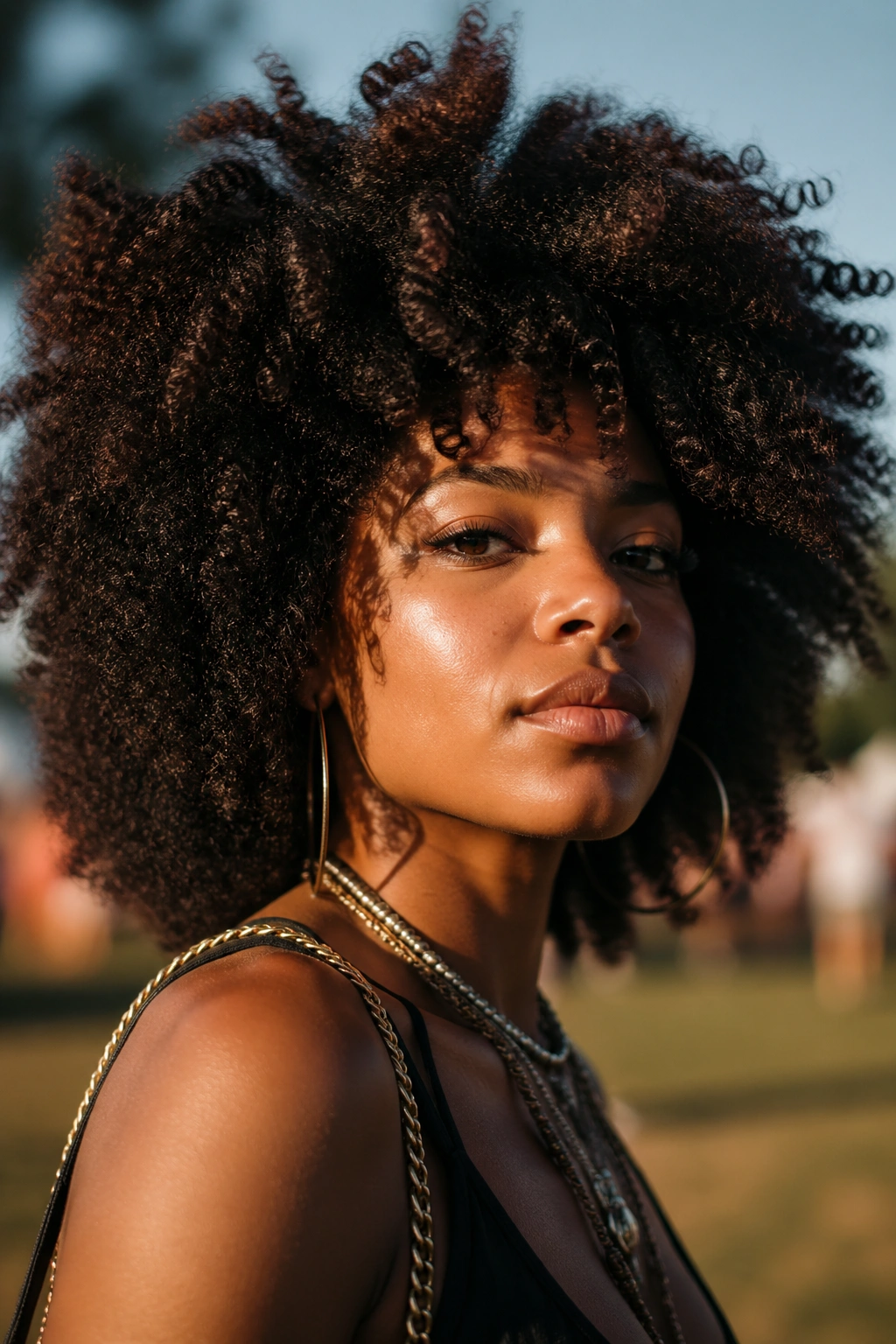
Your afro is going to be exposed to everything a festival throws at it: sun, wind, possibly rain, sweat if you’re dancing properly, and hours of whatever particulates exist in a crowd environment. That’s just reality.
Before deciding on your outfit, decide on your hair plan. Is your afro going to be loose and full — in which case you want UV-protective products and a hold that won’t collapse in humidity? Is it going to be in a protective style — a puff, a bun, box braids pinned up — that requires less maintenance management? The hair decision influences the outfit because it influences the visual volume and the silhouette of the top of your body.
Loose afros work best with outfits that don’t add volume at the shoulders — no big ruffles, no wide puffed sleeves. The hair is already the bold element. Contained styles — puffs, pinned braids — free you up to go bigger in the clothing.
Color Strategy for Festival Dressing
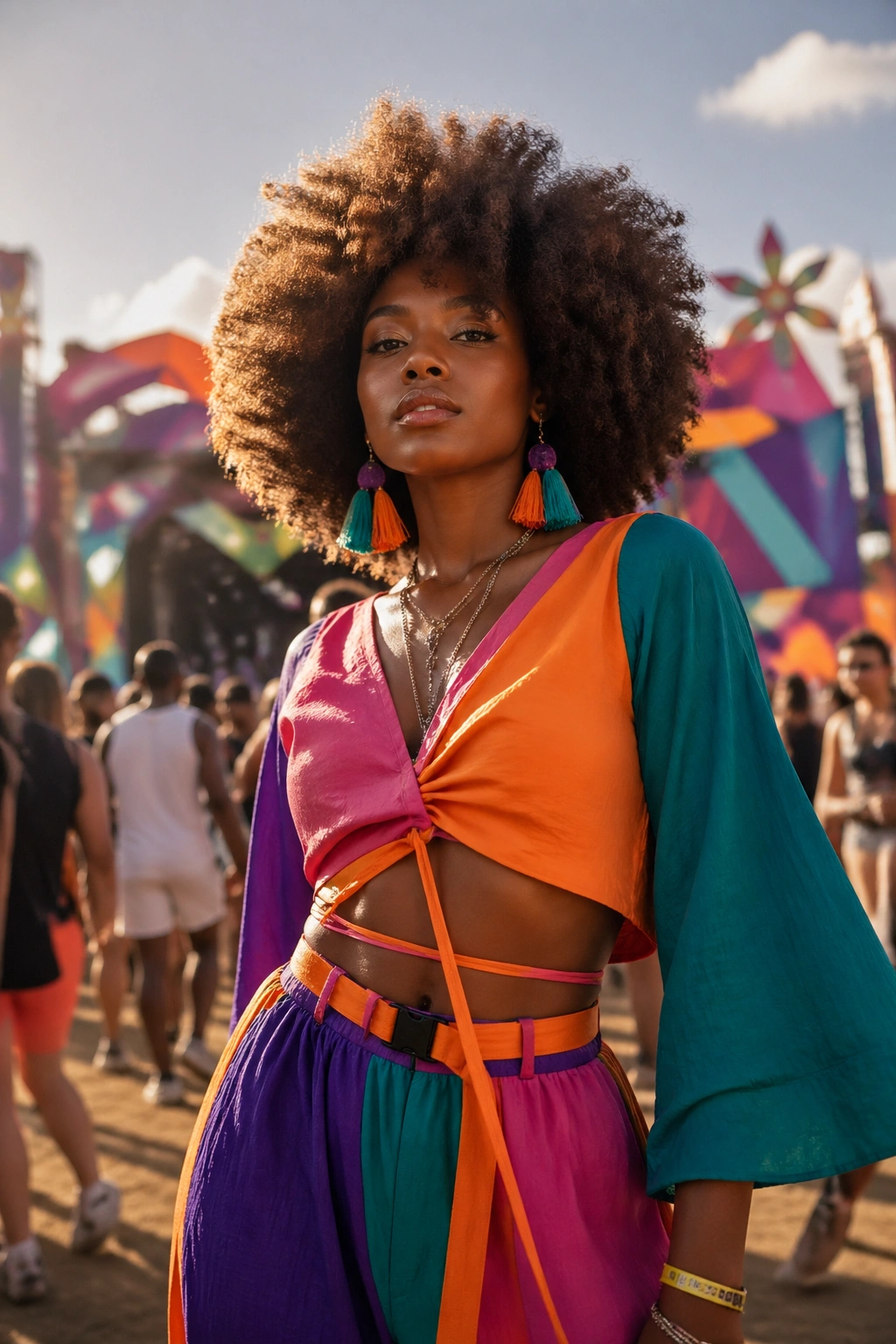
Festival environments are visually chaotic. There’s a lot competing for attention: stages, lights, crowds, other outfits. This means the same rules about color that apply in everyday life don’t quite translate.
In everyday dressing, one bold statement piece is enough. At a festival, bold reads differently against the backdrop of chaos. You often need either a stronger, more committed color story — head-to-toe in a powerful solid or a major print — or a very precise use of one or two pops of color against a clean base.
What tends not to work: a vague, medium-effort color palette. Dusty pink and light grey. Washed-out prints. These look fine in isolation but tend to vanish in a festival crowd. You want a look that registers.
Footwear Truth: What Actually Holds Up
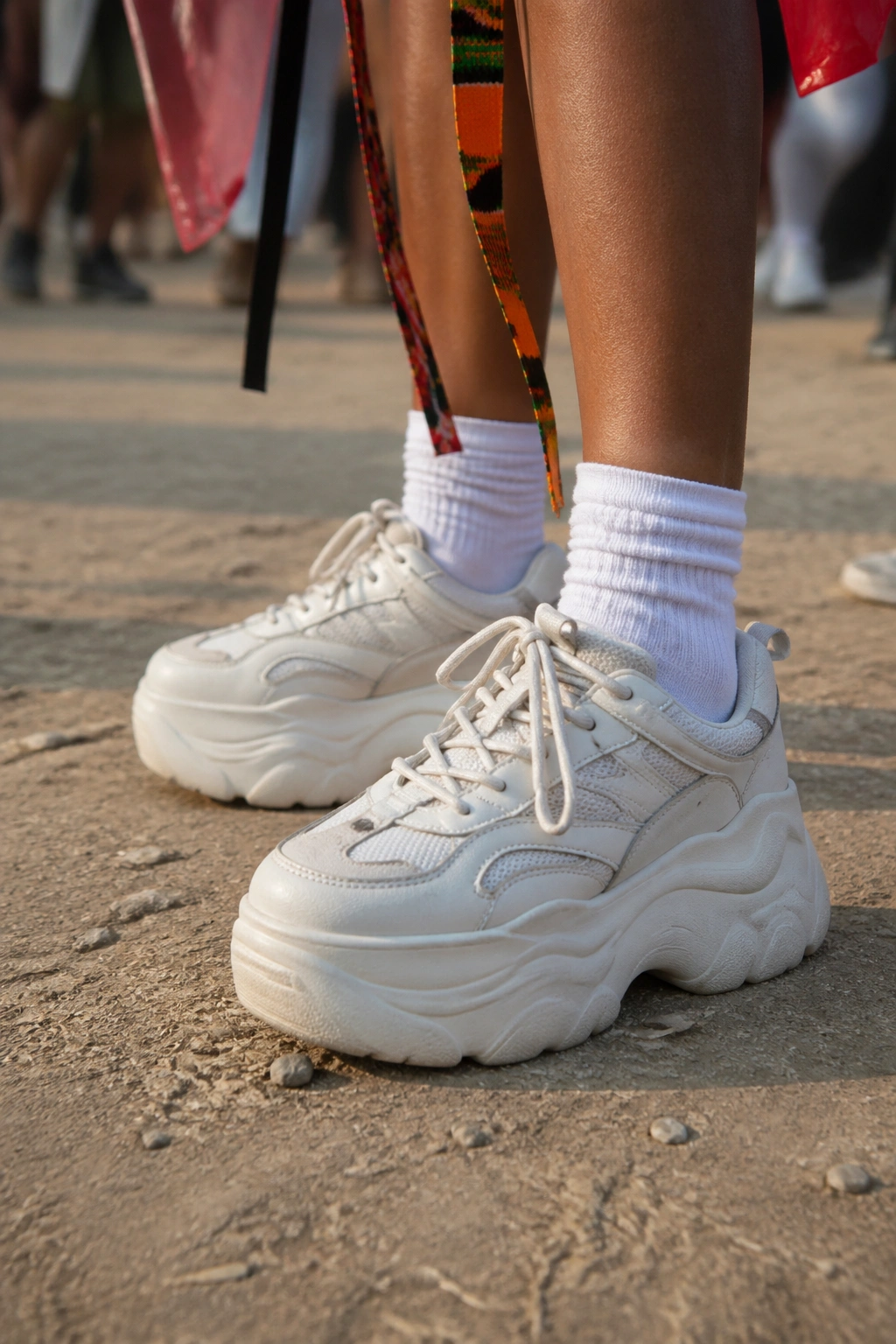
Platforms, heels, and completely flat sandals all have their place in festival fashion. But let’s be honest about what actually works for a full day.
Platform sneakers — specifically chunky platform trainers with a wide, stable sole — are the highest-efficiency festival footwear. They give height (which does matter for crowd photography), provide padding for long hours on feet, and look intentional with nearly every outfit on this list. A white or bone-colored chunky platform works. A coordinated color match goes even harder.
Flat sandals work if they have real ankle support — thin straps around a bare sole will destroy your feet by hour two. Doc Marten-style chunky boots are weatherproof and look powerful; reserve the heel-height for day sets when you know you’ll be seated or in a better-defined space.
The one thing to genuinely avoid: brand new shoes worn for the first time at a festival. Wear them a minimum of three times before the event.
1. Crochet Bikini Top and Flowy Palazzo Pants
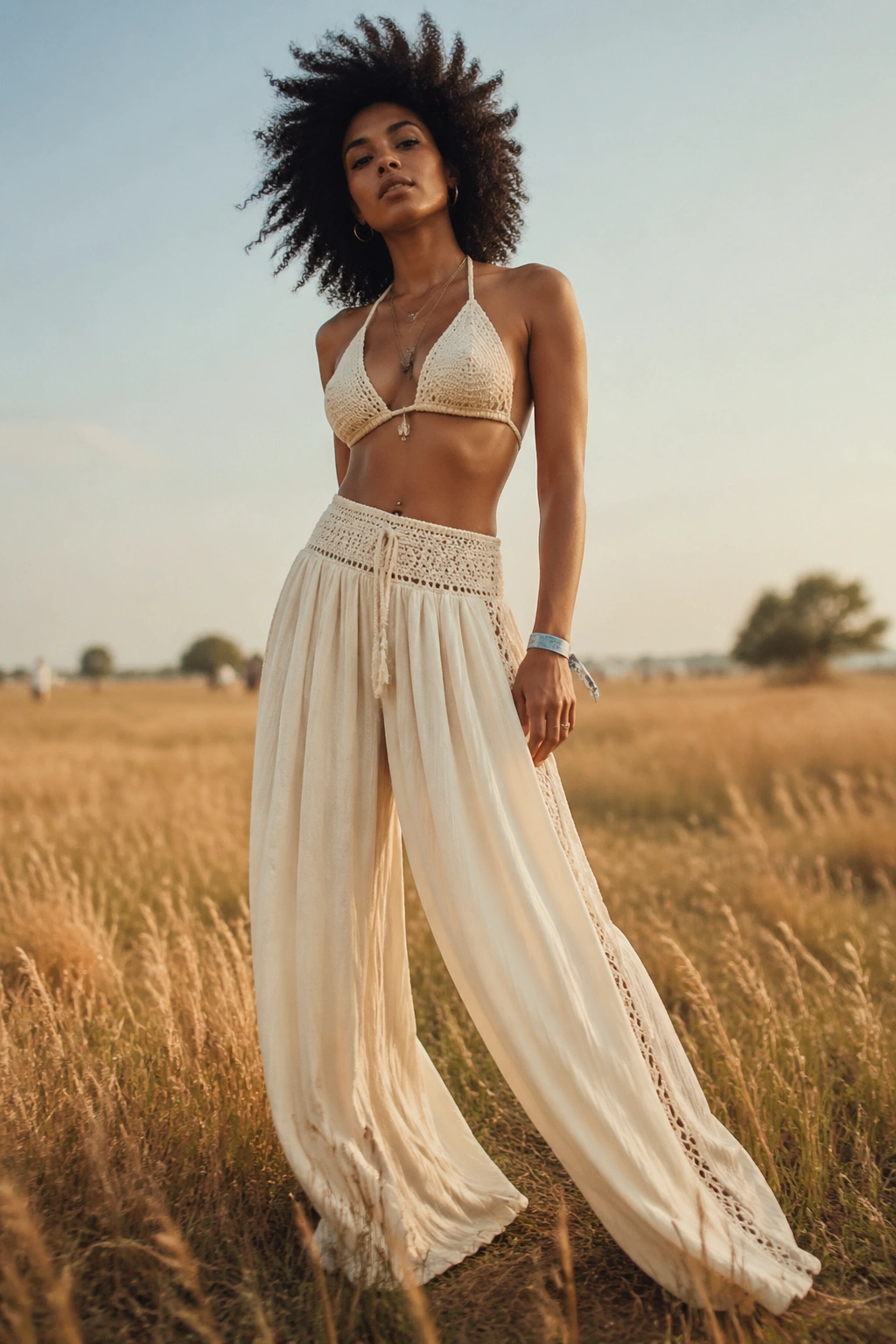
Crochet tops at festivals are not a cliché — they’re a cliché done badly when people don’t commit to the pairing. The crochet bikini top alone, in cream or chocolate or a rich mustard, is a statement. Paired with high-waisted palazzo pants in a matching or complementary color, it becomes a complete, intentional look.
Why It Works
Palazzo pants at a festival are both practical (move freely, cover completely, stay cool) and visually substantial — they don’t disappear on you. With a full natural afro, the loose, flowing lower half and the textured, fitted upper half create a balanced silhouette.
- Go with crochet in a natural fiber when possible — cotton crochet breathes; synthetic crochet makes you sweat.
- The palazzo waistband should be a true high-waist, sitting above the navel, to create definition.
- Platform slides or woven-heel mules echo the craft-textile feel of the top.
The styling move that makes this: a single long layered necklace — not a choker, not a statement collar, but something that hangs to the sternum and adds visual weight between top and pant.
2. Leather-Look Corset and Wide-Leg Trousers
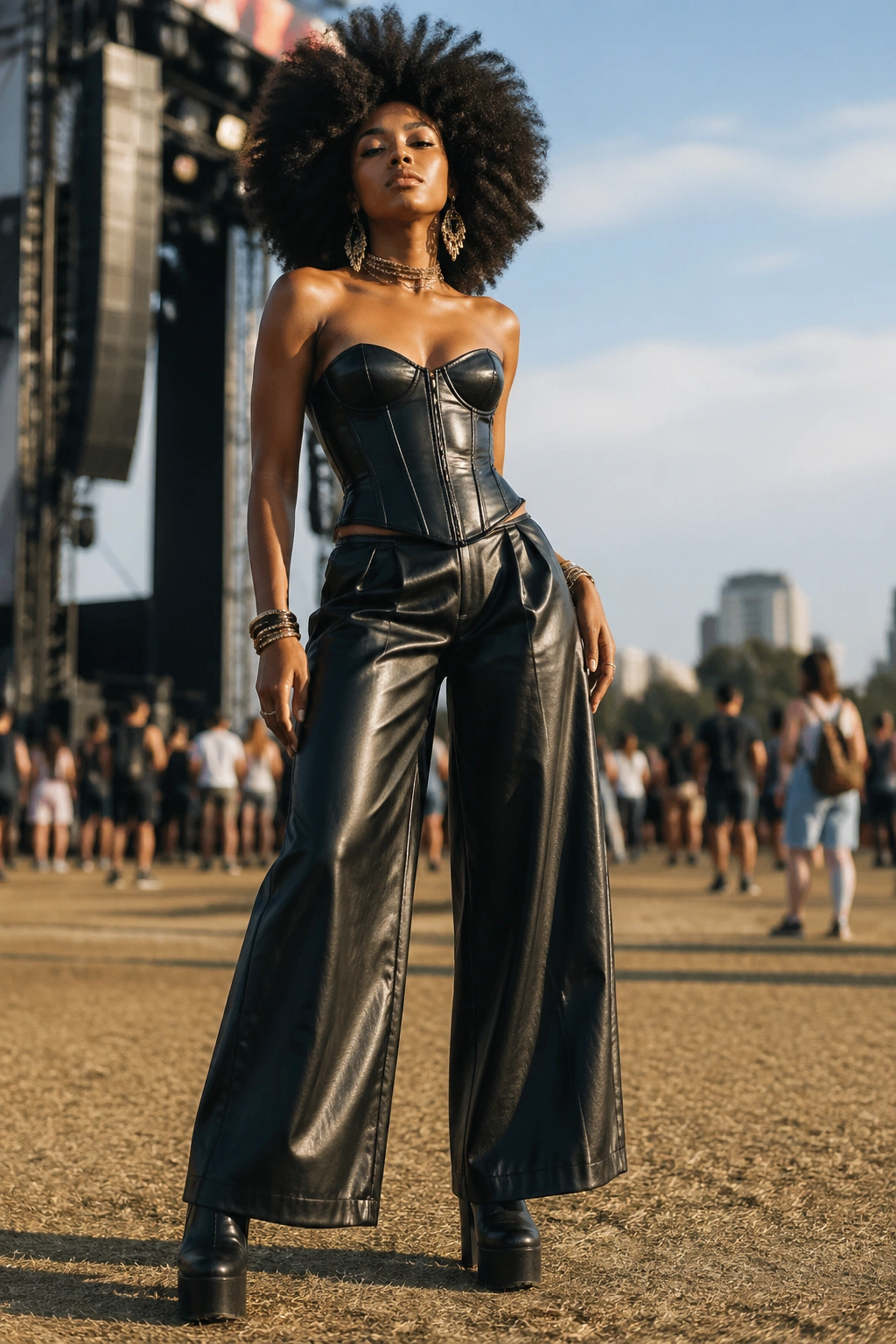
The corset is having its fully justified second life. Not the waist-training kind — the structured, boned-or-boned-adjacent corset top that creates a sharp waist and a defined torso. In a leather-look material in black, deep red, or chocolate brown, this is a bold, powerful festival top.
Wide-leg trousers below, in a solid color that matches or darkens the corset. Platform boots to complete the vertical line. This outfit reads as someone who has an editorial eye, not just good taste.
The corset must fit. An underfitted corset gaps; an overfitted one restricts breathing and movement. Try it standing, sitting, and raising your arms before you commit to wearing it for twelve hours.
3. Ankara Print Two-Piece Set (Crop and Skirt)
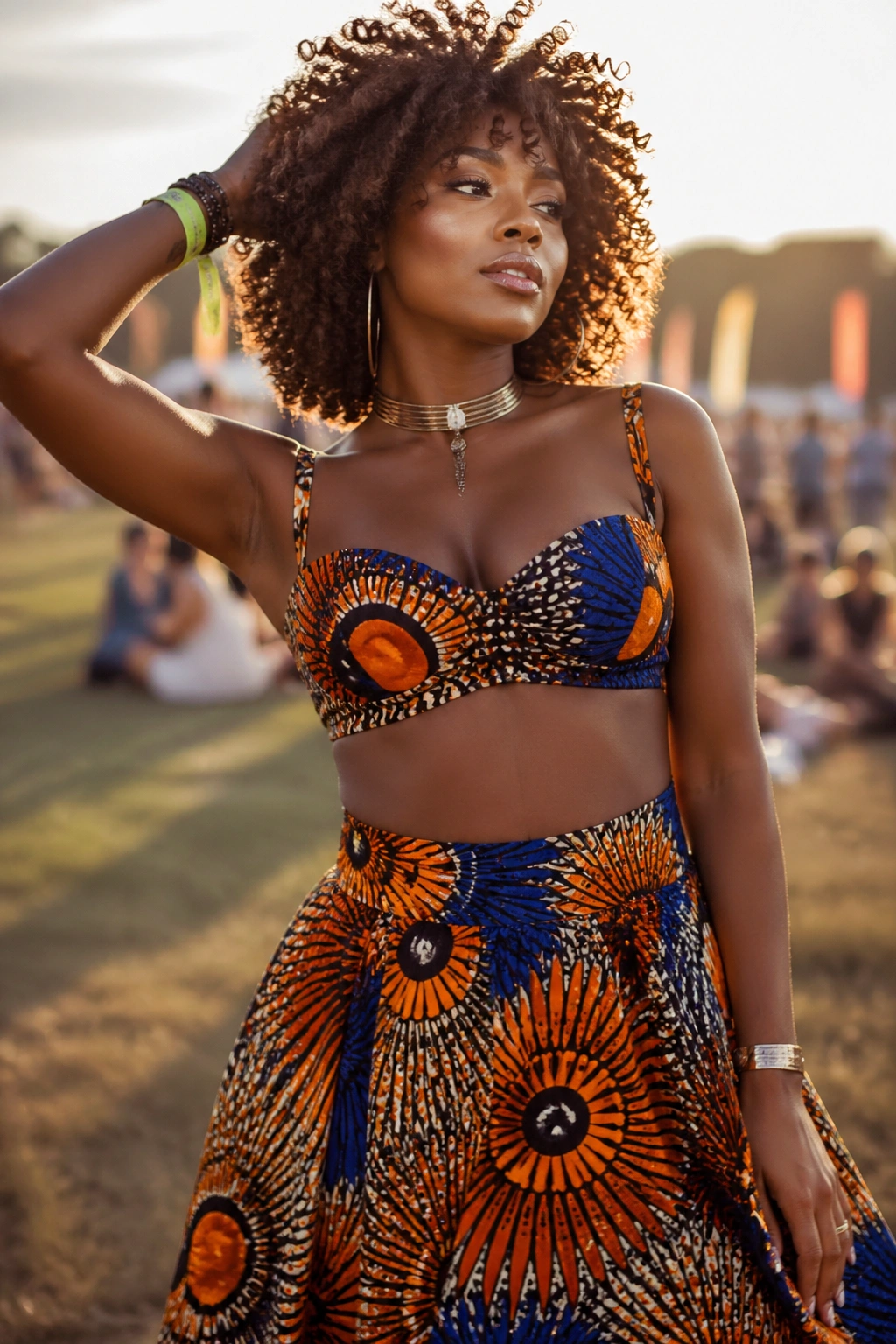
The Ankara print two-piece — a cropped top and matching midi or maxi skirt in the same wax print — is one of the most photographed, most immediately striking outfits possible at a festival. The prints are bold by design. The silhouette is comfortable. The cultural resonance is genuine.
What makes this outfit succeed or struggle is the scale and placement of the print cut. Ankara prints are designed as complete patterns that read across the full length of fabric — when you cut them into separate pieces, you need to ensure the crop top isn’t catching an awkward partial motif, and the skirt isn’t starting mid-pattern in a way that looks accidental.
Source from brands and tailors who work specifically with Ankara rather than picking up a generic “tribal print” knock-off. The difference in quality and intentionality is significant.
4. Bold-Color Bodysuit and Denim Cutoffs
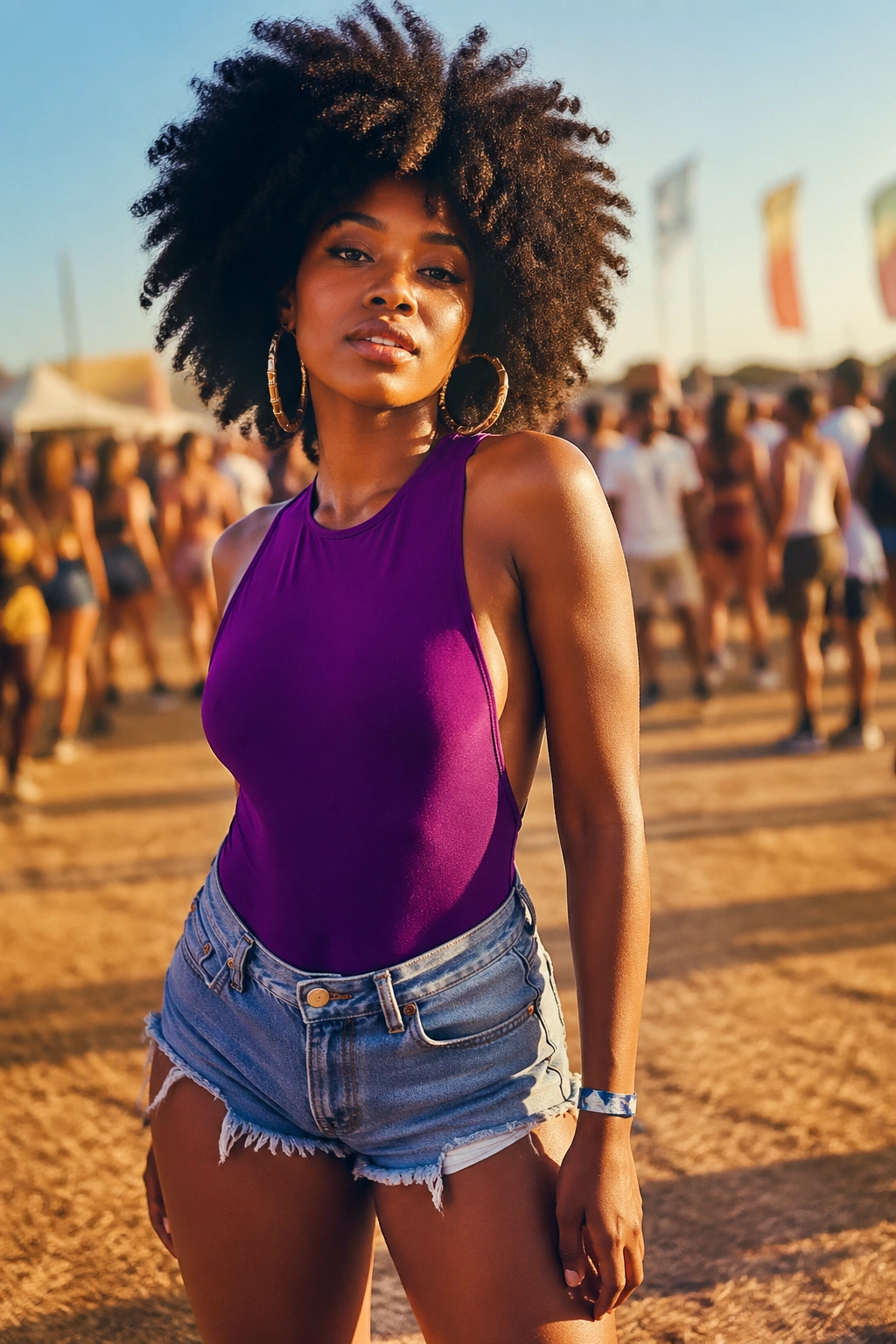
This is the festival equivalent of a uniform. Simple, functional, hard to mess up. A bodysuit — fitted, no sleeves or a thin strap, in a bold jewel tone or a sharp print — with high-waisted denim cutoffs. Add your footwear of choice and you have an outfit that takes about three minutes to decide on and consistently photographs well.
The key decision is the color of the bodysuit. With a full natural afro in its natural state, a deep jewel tone creates rich contrast. A bright pop color — electric blue, hot coral, emerald — creates high energy and photographs vividly in festival light.
Denim cutoffs should be hemmed, not raw-torn at the edge. Rough frayed edges tend to look unintentional rather than artfully casual. A clean hem that sits at the right place on your thigh looks like a choice.
5. Sheer Embroidered Blouse over Satin Shorts
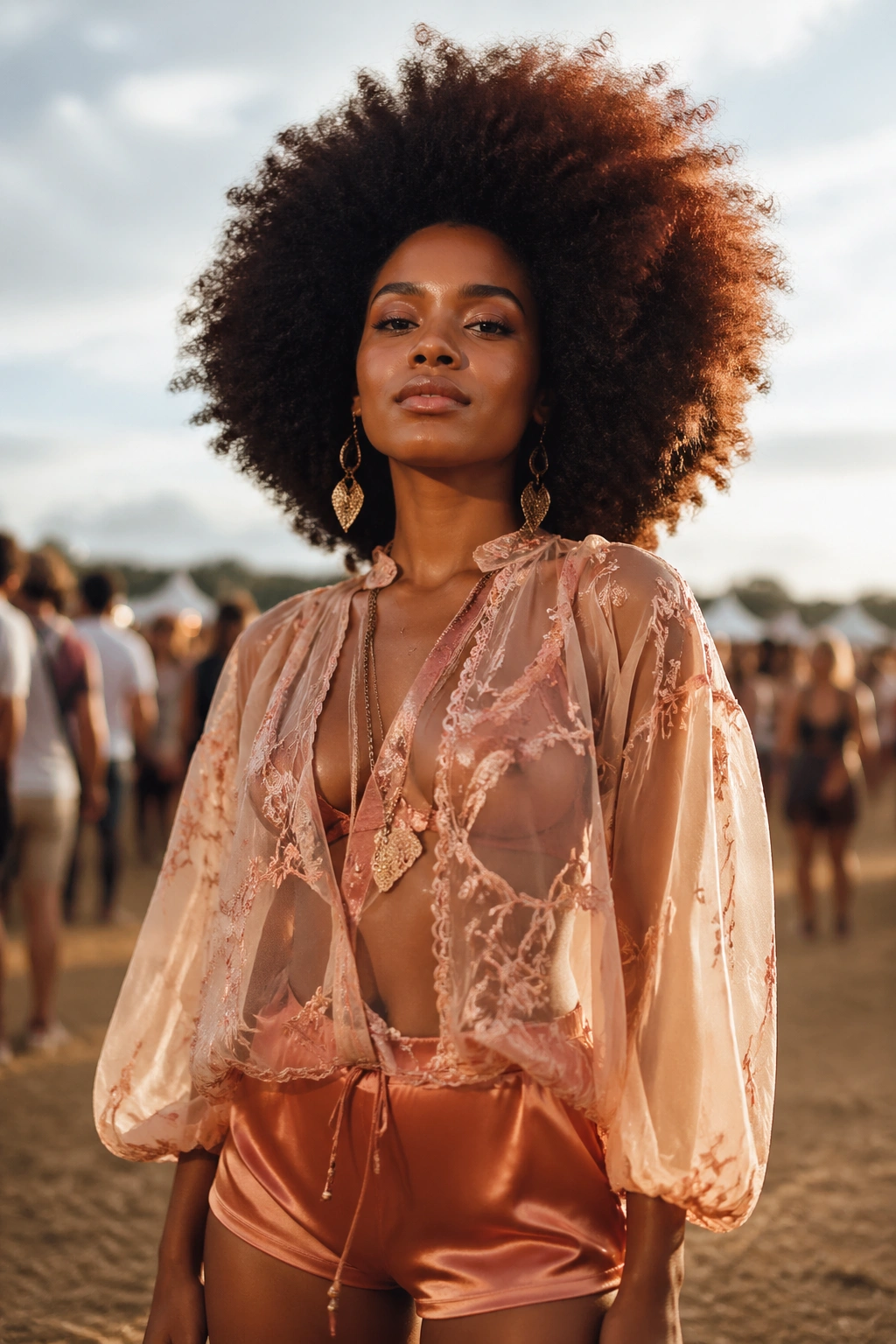
Embroidered sheer organza or chiffon blouses — the kind with floral or geometric embroidery in thread that catches light — sit in a genuinely interesting category: they read delicate but carry real visual weight because of the embroidery detail.
Worn over satin shorts in a color pulled from the embroidery thread, this outfit lands between romantic and fashion-forward. It’s not trying to be tough; it’s exactly what it is, and that confidence reads.
The hair here does a lot. A large, shaped natural afro above a delicate embroidered top creates deliberate contrast — structural, organic hair against intricate handcraft. That juxtaposition is visually compelling in a way that’s specific to afro hair and can’t be replicated any other way.
6. Jumpsuit with Architectural Detailing
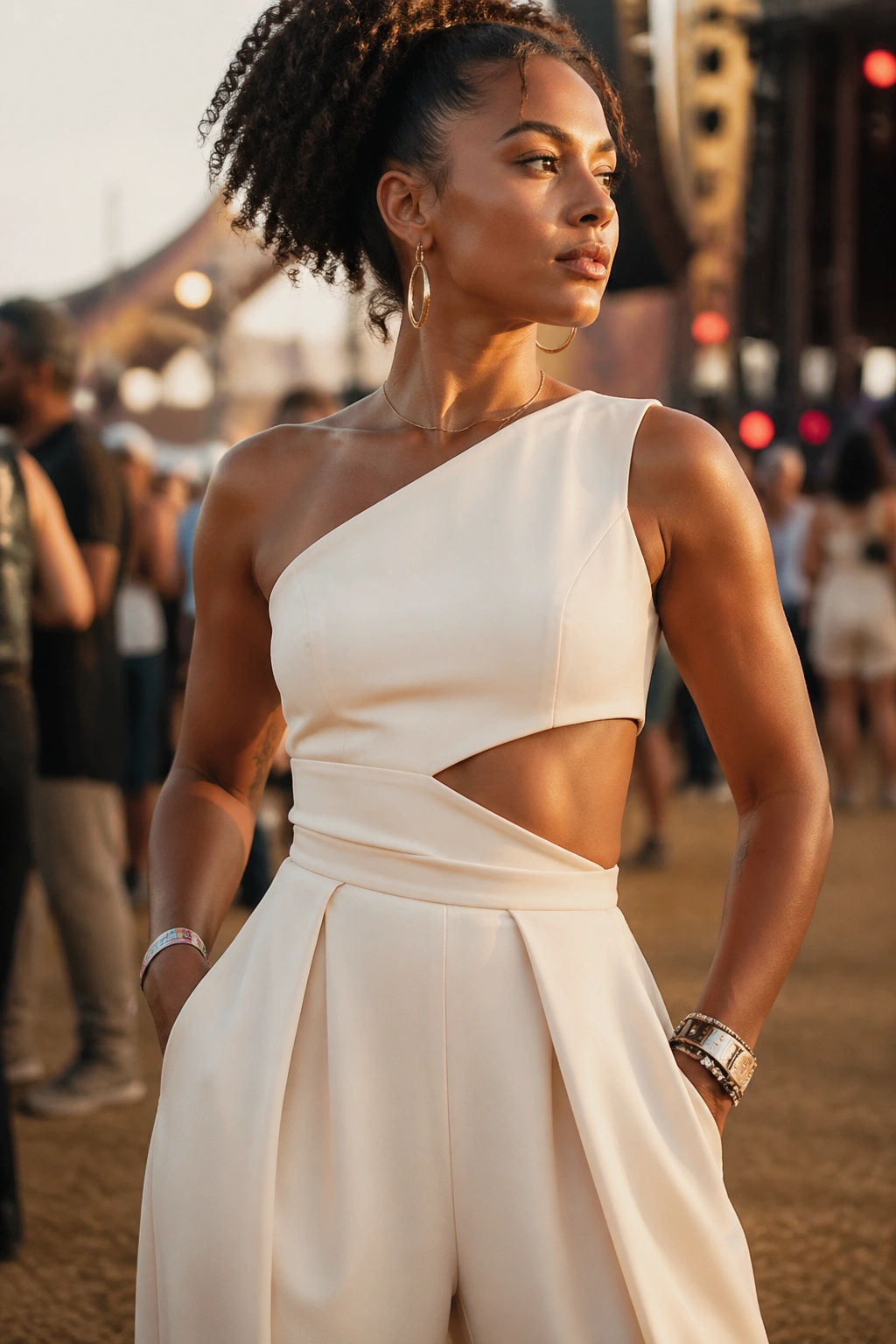
Unlike X, a standard-cut jumpsuit, a jumpsuit with architectural detail — cutouts at the waist, structured collar, asymmetric hem, sculptural sleeves — reads as a fashion statement rather than practical festival dressing. That distinction matters when you want to look like you engaged with the event rather than just attended it.
One-shoulder jumpsuits work particularly well with afro hair because the exposed shoulder on one side creates asymmetry that echoes the natural asymmetry of organic hair growth. It’s not a match; it’s a conversation.
Stick to one architectural element per garment. A cutout-waist, one-shoulder, asymmetric-hem jumpsuit is too many decisions happening at once. Pick the element that does the most work and let the rest of the silhouette support it.
7. Wax Print Maxi Skirt with a White Crop Top
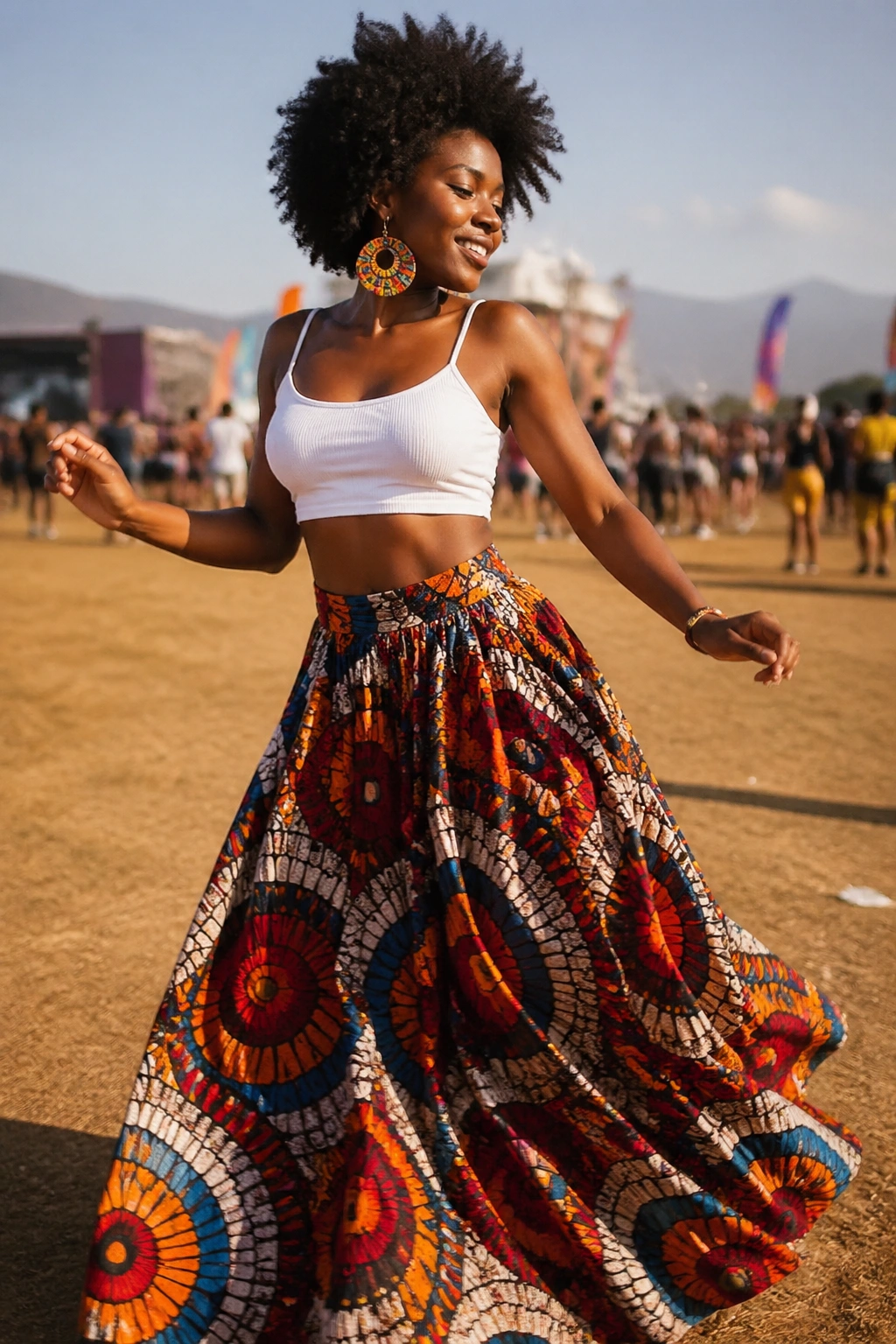
A wax print maxi skirt — full-length, preferably with enough fabric to swish when you walk — with a simple white fitted crop top is a composition that’s been perfected over decades of West African fashion. The skirt carries all the visual narrative. The white top creates a clean resting point for the eye.
This is an outfit that gets more impressive when you move. The skirt’s movement is part of the look. Stand still and it’s beautiful. Walk and it becomes something else entirely.
Who This Is Best For
This works well in warm weather when the maxi length stays comfortable rather than clammy. In unpredictable weather, bring a lightweight coordinating jacket that doesn’t break the visual logic of the skirt — a simple white denim jacket, a linen blazer in a color echoing the print’s background.
8. Bucket Hat, Oversized Vintage Tee, and Biker Shorts
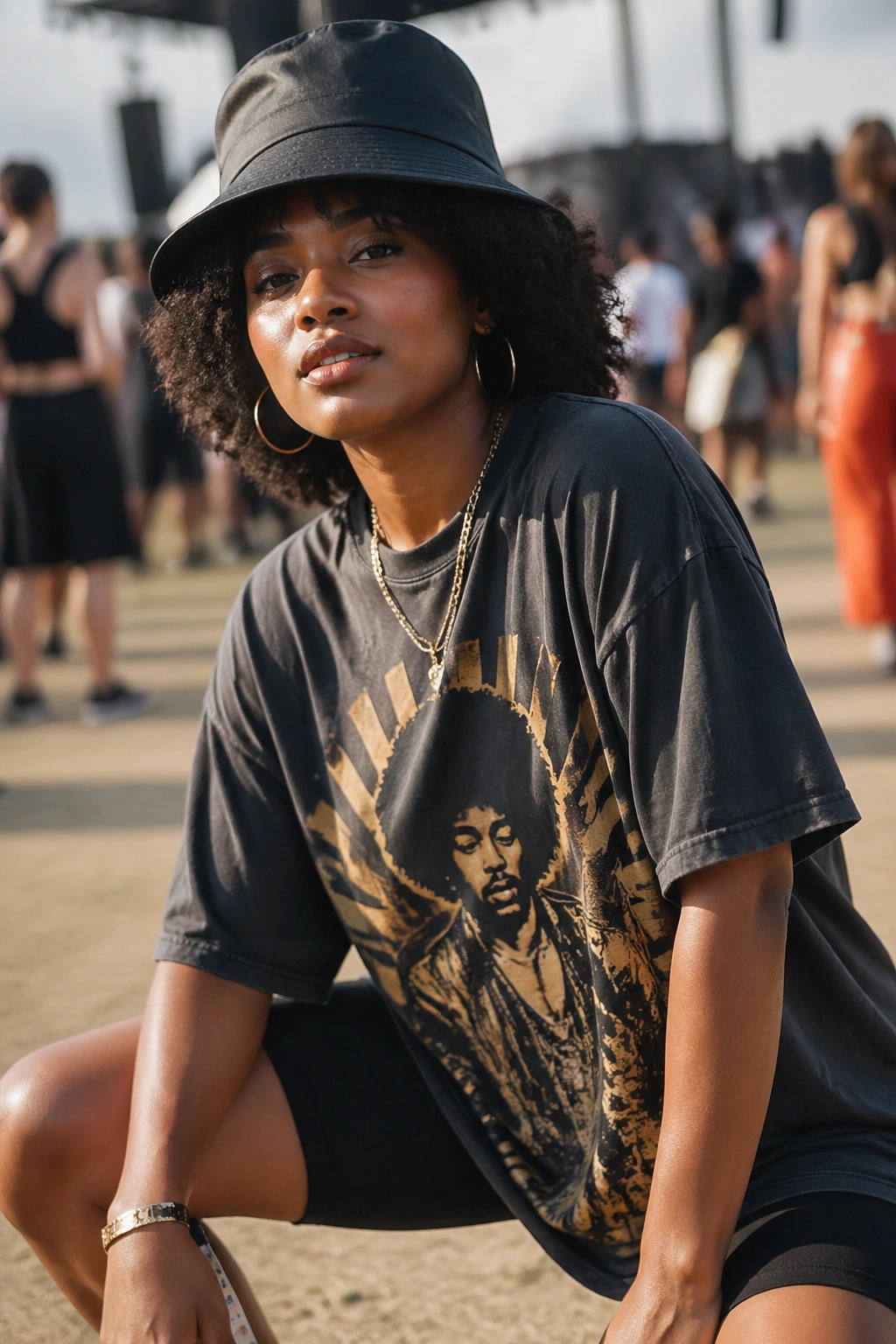
This outfit doesn’t announce itself. It’s the festival look for people who’ve stopped caring about performing effort and only care about whether they’re comfortable and whether the result is genuinely cool. Spoiler: it consistently is.
An oversized vintage concert tee — specifically from a real legacy artist, either your own or sourced from a good vintage shop, not a fast fashion knock-off — worn as a dress over biker shorts with platform sneakers. A structured bucket hat that matches or echoes one color in the tee.
Your afro either peeks out from under the bucket hat’s brim or sits fully visible above it, depending on the hat size and your hair volume. Both work. The hat adds one more deliberate element to what might otherwise read as purely casual.
9. Head Wrap and Matching Set
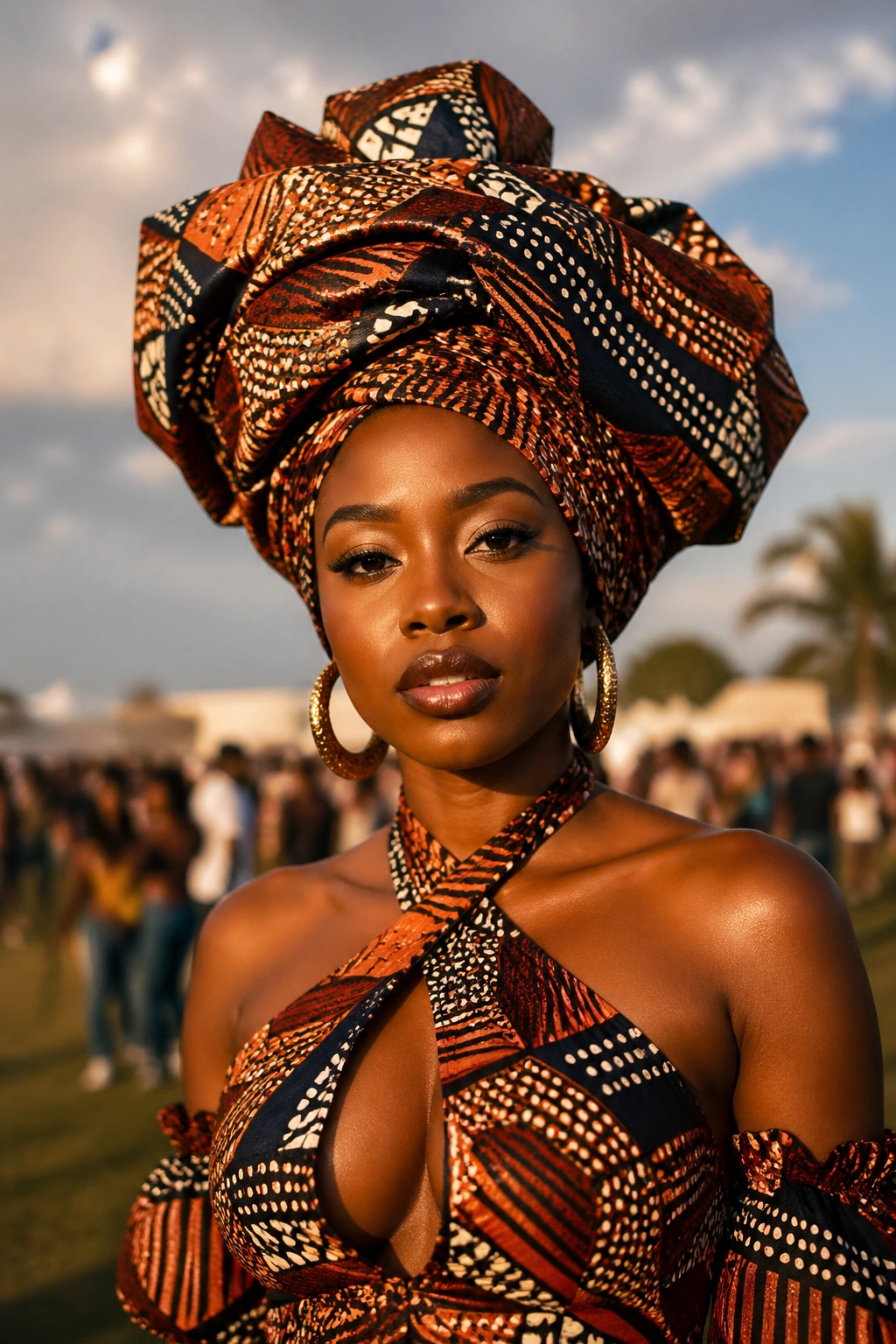
The head wrap — a length of fabric tied around the natural hair, creating structure, height, and visual drama at the top of the head — works as both practical hair protection and as the most significant visual element in a festival outfit.
When the head wrap fabric matches the outfit — a set in a matching print, or a wrap in the same color as a coord — the result is a fully unified look that requires almost no accessories to feel complete. The entire composition is self-contained.
This is one of the most culturally significant styling choices in this list. Head wraps carry meaning across multiple African and diasporic traditions. Wearing one with intention and knowledge of that tradition is different from wearing one as a decorative afterthought.
10. Festival Bralet and Draped Skirt with Hip Wrap
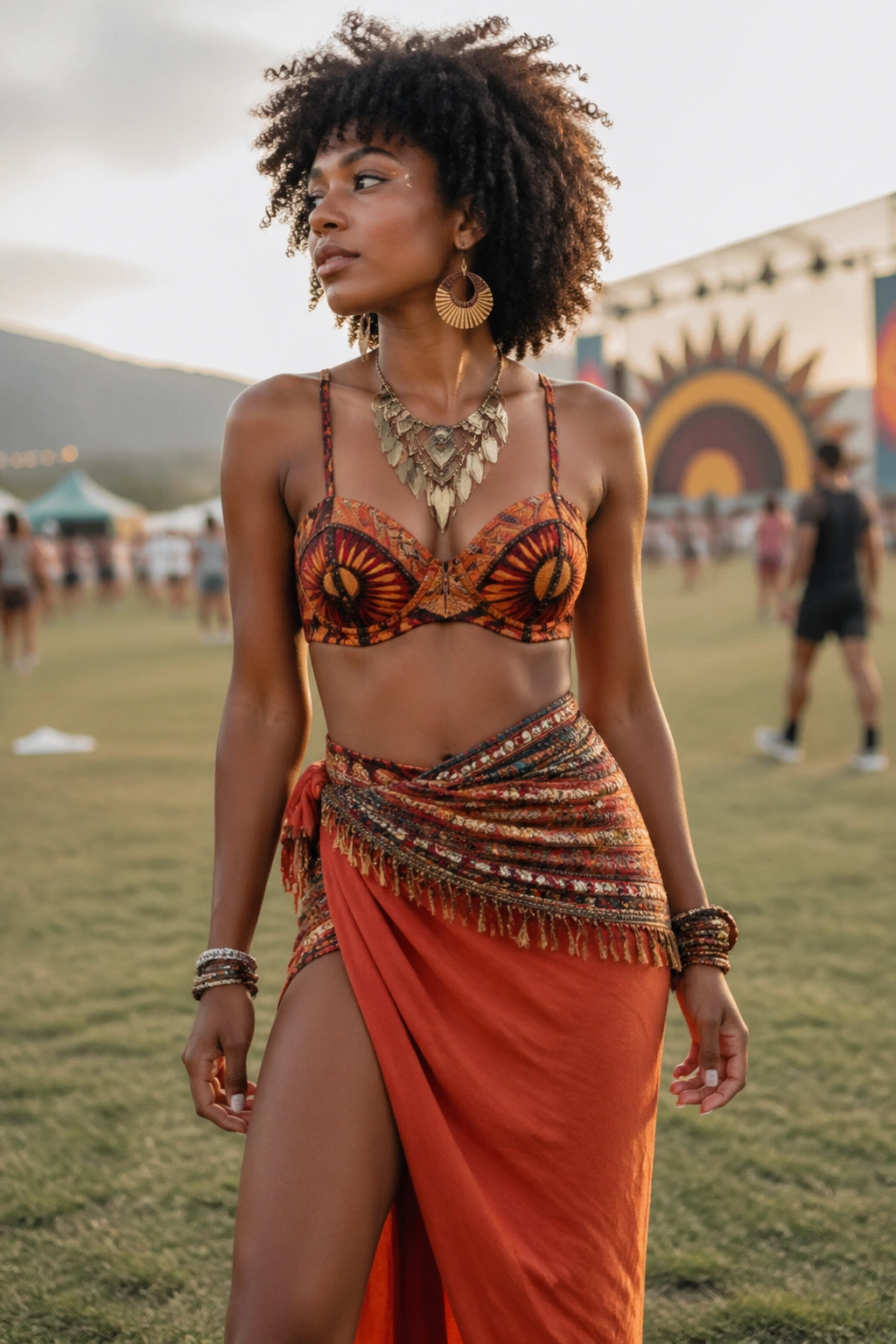
A bralet — structured enough to function as a top, detailed enough (embellishment, heavy fabric, unique texture) to register as fashion — with a draped skirt and a hip wrap or sash layered over the skirt waist creates a multi-element outfit that reads as deliberate layering rather than putting on multiple things.
The hip wrap is the key piece. It adds color, texture, and waist definition all at once. Choose a fabric with enough weight to drape rather than flutter — a silk georgette, a heavyweight cotton — and let it hang at an asymmetric angle.
This is a look that rewards photography. Movement shows every element separately. In a still frame, it reads as a complete, layered composition.
11. Denim-On-Denim with Bold Accessories
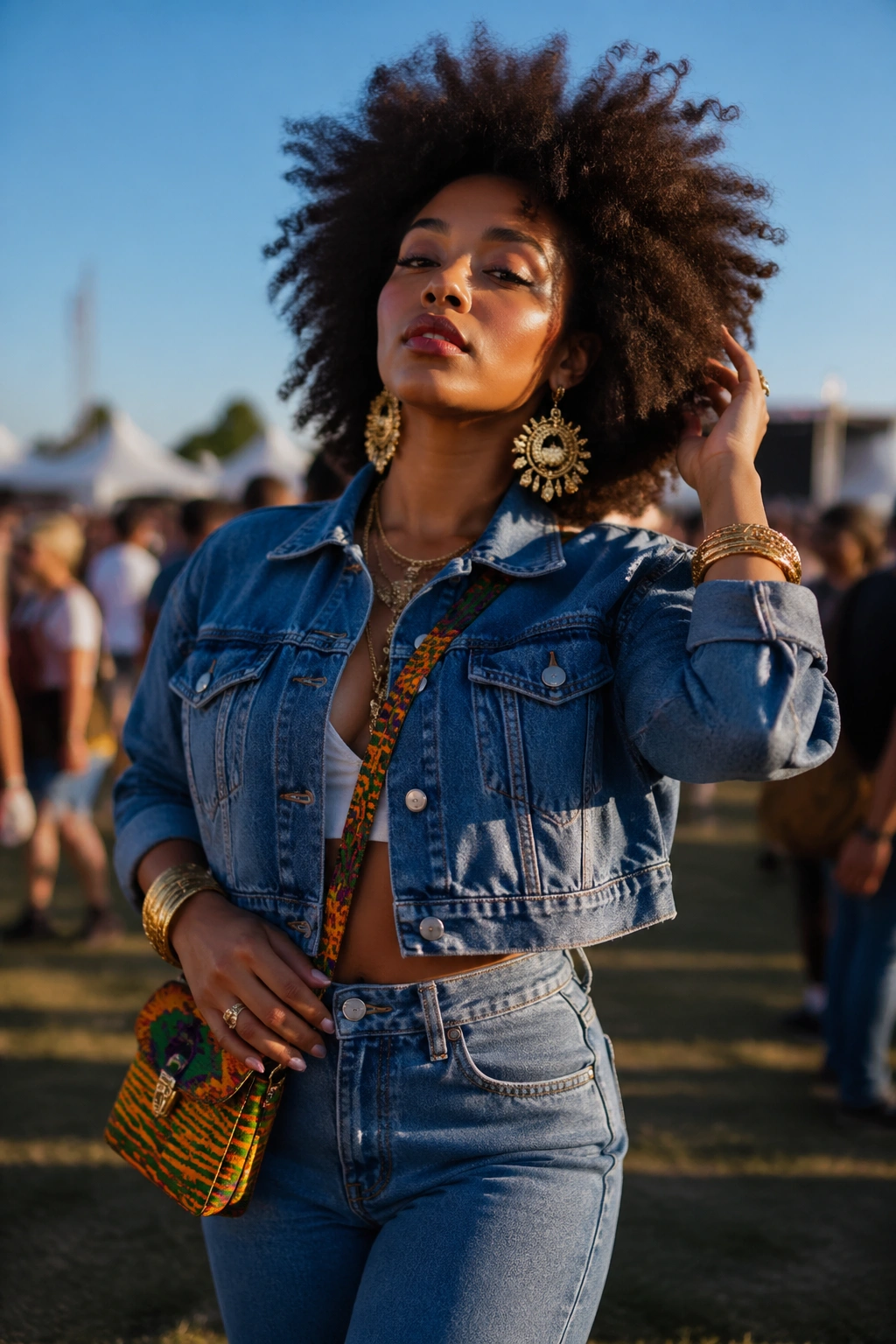
The head-to-toe denim rule — matching jacket and jeans, or shirt and skirt, in the same denim rinse — could sound like a casual mistake. It’s not. In a festival context with the right accessories, it’s a strong, cohesive base that lets the jewelry, the bag, and the hair do the work.
Choose a consistent wash: all light, all dark, or all the same mid-blue. Mixing a dark jacket with light jeans reads mismatched; matching them reads intentional.
Then: large gold earrings, a stacked-bangle wrist, a woven or embellished crossbody bag in a color that pops. Let those pieces and your afro carry the color. The denim is the canvas.
12. Open-Back Halter Dress in a Statement Print
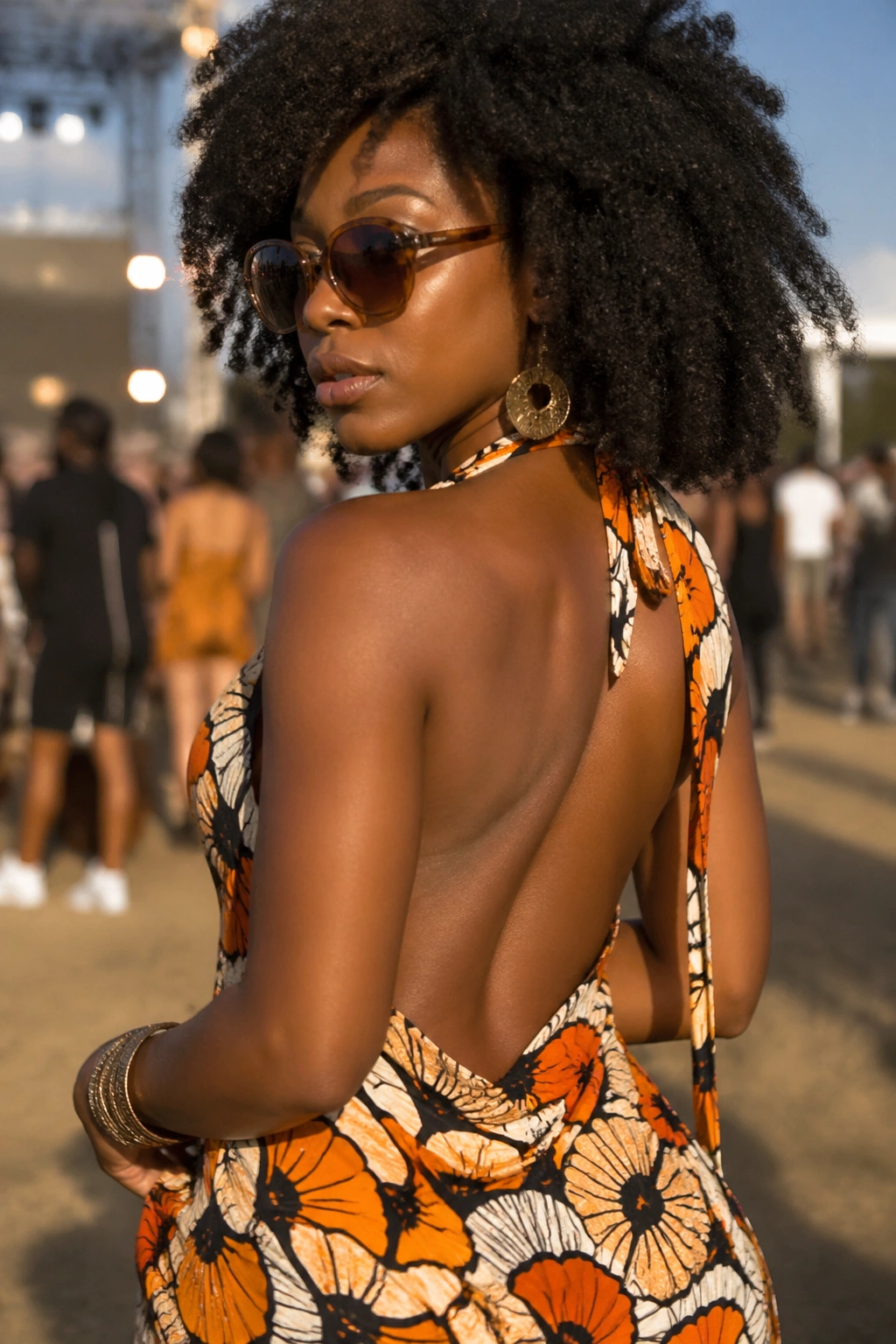
An open-back halter dress in a large-scale statement print — graphic botanicals, abstract shapes, bold geometric repeat — is one garment that solves the entire festival-dressing problem. It moves. It’s cool. It handles dance and crowd movement without restriction. And a large-scale print at a festival registers from a distance in a way that smaller prints don’t.
The open back is where the garment earns its festival credentials. It handles heat. It photographs interestingly. It creates a specific kind of sensory comfort when you’re in a warm, moving crowd.
Pair with flat sandals or chunky platform sneakers. This dress does all the work; you don’t need to add much.
13. Knitted Mesh Dress Over Shorts Set
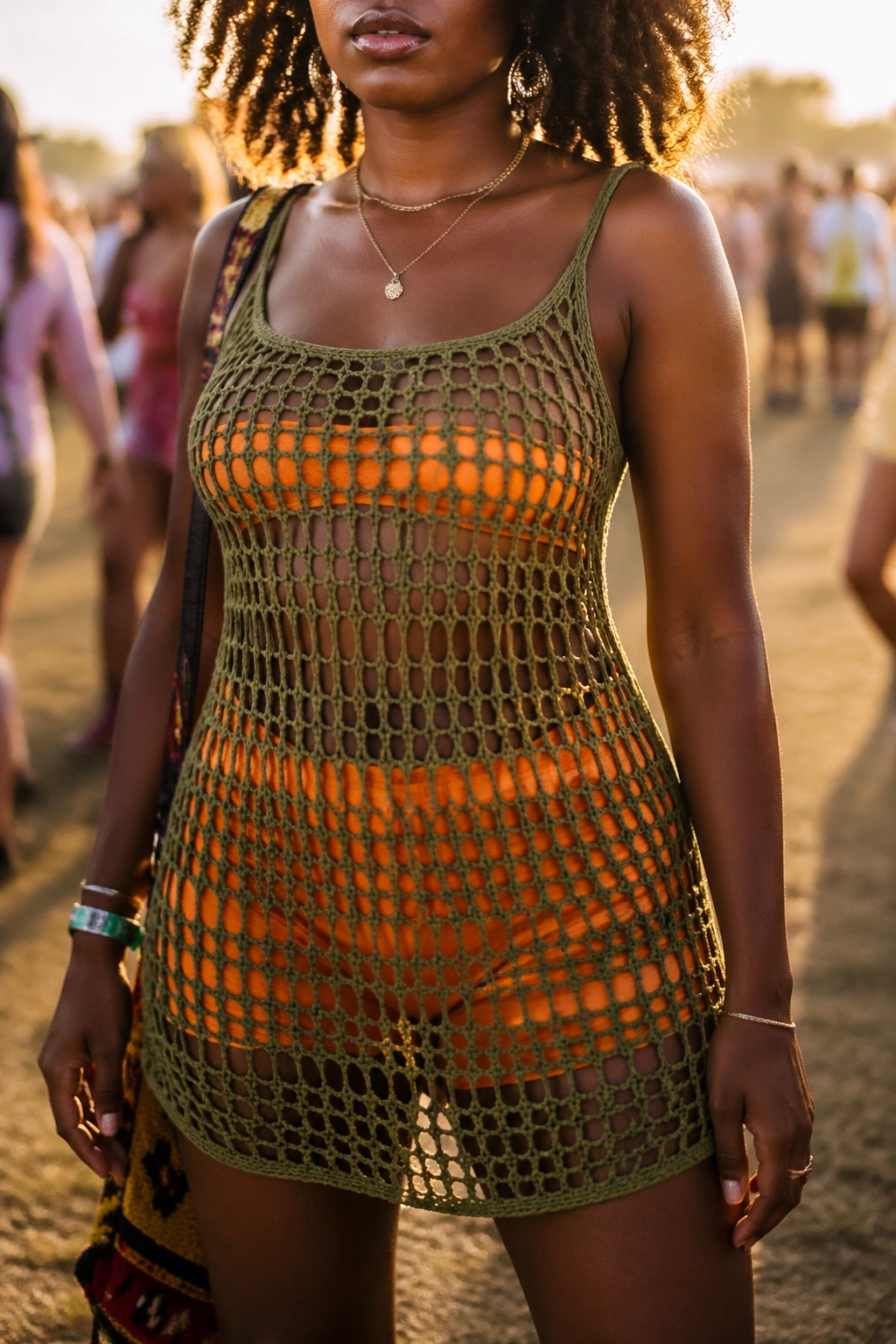
A knitted mesh dress worn over a shorts set — a matching crop top and bike short or tailored short in a solid, bold color — creates layering that’s purposeful and visual. The mesh adds texture and dimension over the clean lines of the set. The set provides coverage and creates graphic blocks of color visible through the open knit.
This is a festival look that functions differently as the day changes. At noon with full sun, it looks playful and deliberate. By evening with festival lighting, the mesh catches the light differently and the whole garment takes on a different character.
Match the under-set to one color in the mesh if it’s tonal, or go stark contrast: mesh in cream over a cobalt shorts set, mesh in black over a bright coral set.
14. Leather Jacket Over a Slip Dress
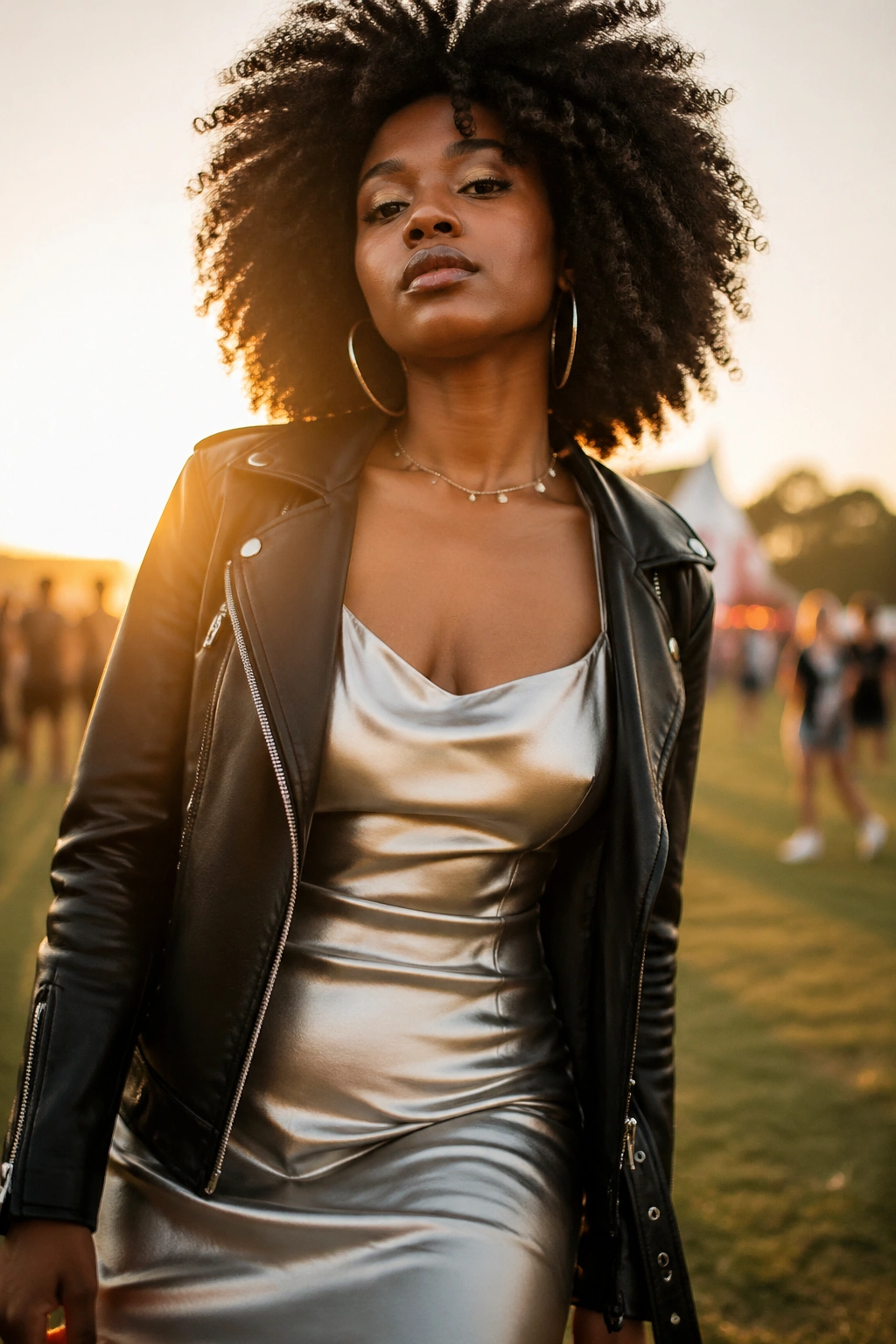
Leather jacket over a satin slip dress is not a new idea. It’s a classic because the tension between the jacket’s toughness and the dress’s softness creates a composition that works almost every time. At a festival specifically, it solves the weather-uncertainty problem: strip the jacket when it’s warm, add it back when temperatures drop after sunset.
The slip dress should hit at midi length — long enough that removing the jacket doesn’t suddenly make the look feel too abbreviated. The leather jacket should be fitted enough to read as deliberate rather than borrowed.
Your afro provides the natural volume that makes this outfit make complete visual sense — soft, textured hair above the contrast of leather and satin. The three textures together are striking.
15. Boubou-Inspired Wide Silhouette Dress
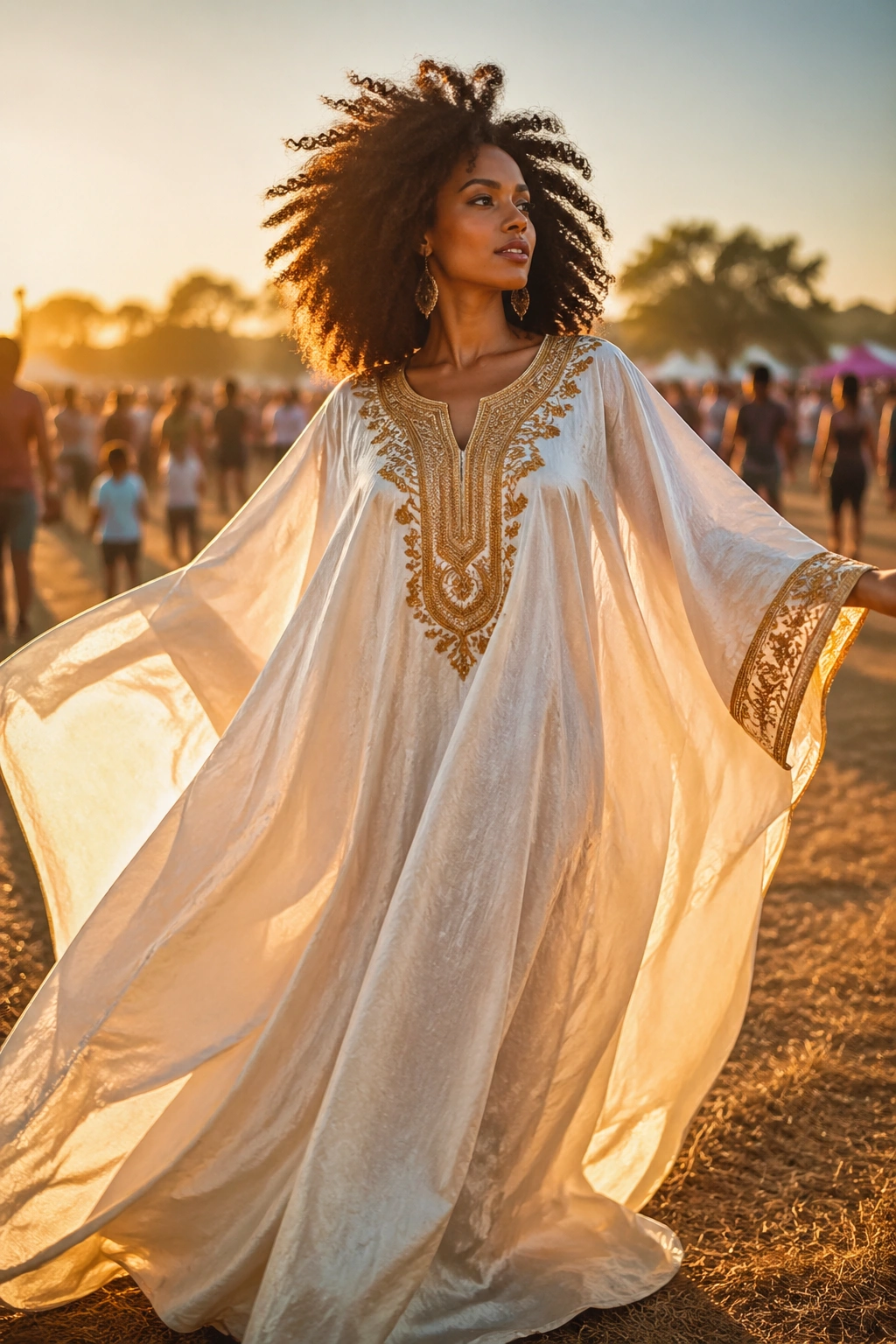
The Boubou — the wide, flowing one-piece garment rooted in West African formal and everyday dress — in its contemporary fashion interpretations creates one of the most distinctive festival silhouettes possible. A wide, floor-length dress with embroidery or embellishment at the neckline and cuffs, cut in a fabric that moves dramatically, is a garment that commands space.
At a festival, this is the look that makes people turn. It doesn’t follow any festival styling convention — it sets its own terms.
Practical notes: the width of the garment means staying mindful in tight crowds. The floor length means flat shoes or very modest platforms — nothing tall enough to create tripping hazard. These are real considerations, not dealbreakers.
16. Color-Blocked Coordinates
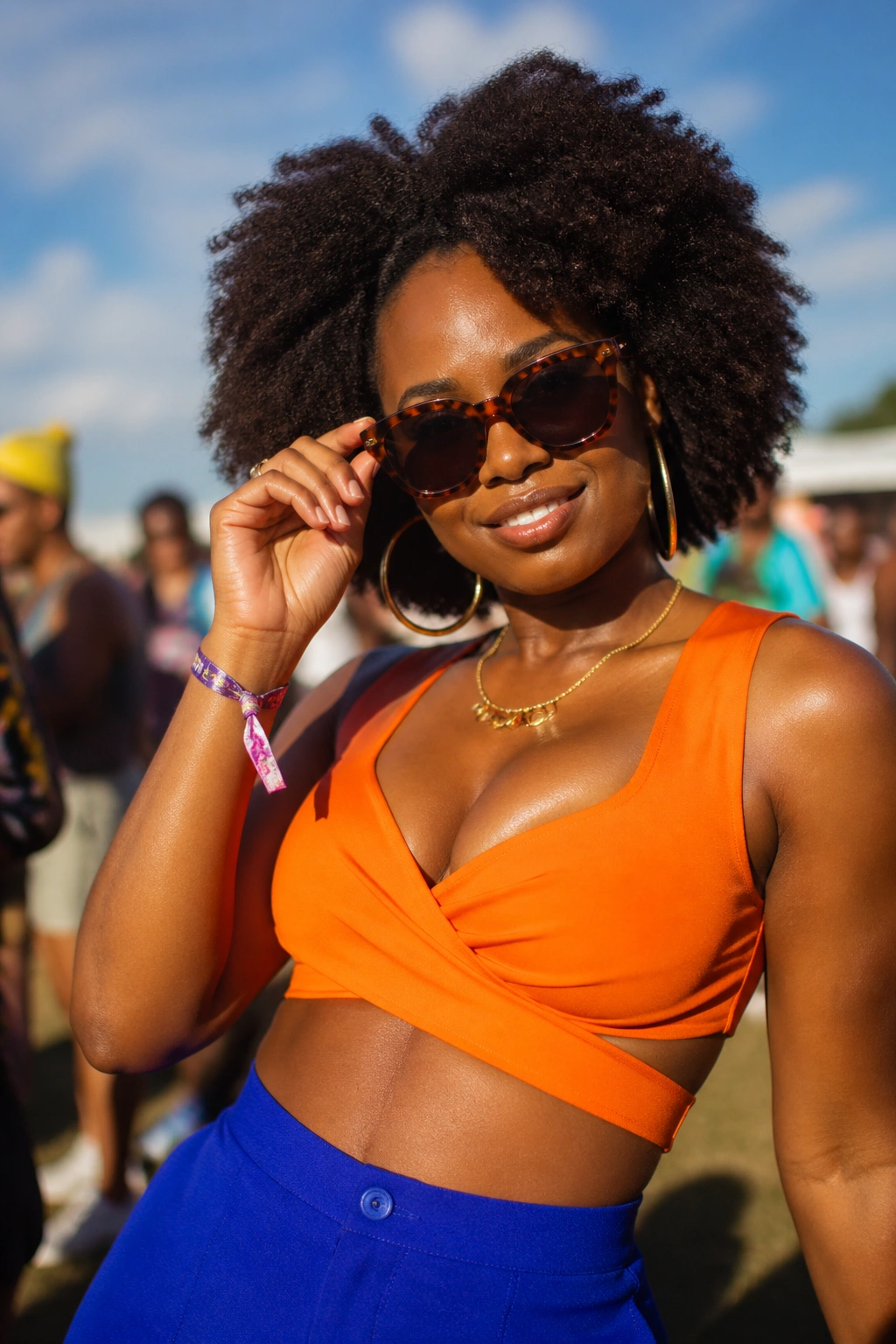
Color blocking — wearing two or three distinctly different solid colors in deliberately separated areas of the outfit — is one of the strongest visual strategies in festival dressing because it reads clearly at distance. In a crowd, a person in a matching neutral blend becomes background. A person in a precise orange-and-cobalt color block stands out.
The classic approach: a top in one color, a bottom in a strongly contrasting second color, with footwear echoing one of the two. The discipline of keeping each area pure — no gradation, no mixing — is what makes color blocking sharp rather than accidental.
With afro hair, consider how your hair’s natural color interacts with the palette. Many natural afro textures read slightly warm or cool depending on the individual — choosing a palette that harmonizes with that warmth or coolness rather than fighting it creates a full-picture look.
17. High-Low Hem Dress in a Bold Solid
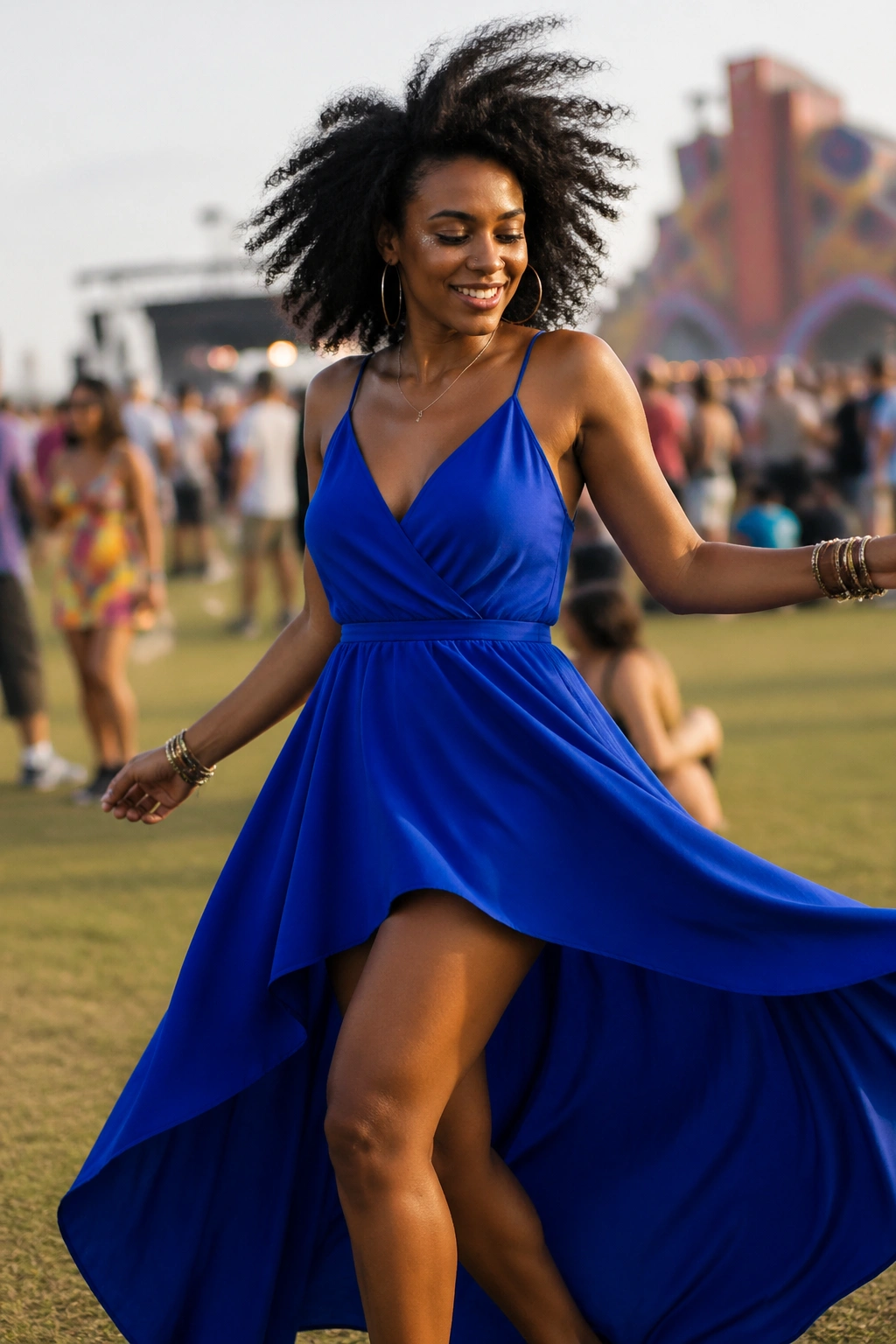
A high-low hem — shorter in the front, longer in the back, with a gradual or sharp transition — creates movement and visual interest in a single-piece garment. In a bold solid: cobalt, burnt orange, chartreuse, deep wine. Not a print — the color is the statement.
What makes this specifically useful at festivals: the shorter front hem allows for movement, dance, and crowd navigation without the drag of a floor-length garment, while the longer back creates the visual sweep and drama of a maxi silhouette when photographed from behind.
Wear with block heels tall enough that the back hem clears the ground, or have it hemmed appropriately to your height.
18. Bralette, High-Waisted Skirt, and Statement Cape
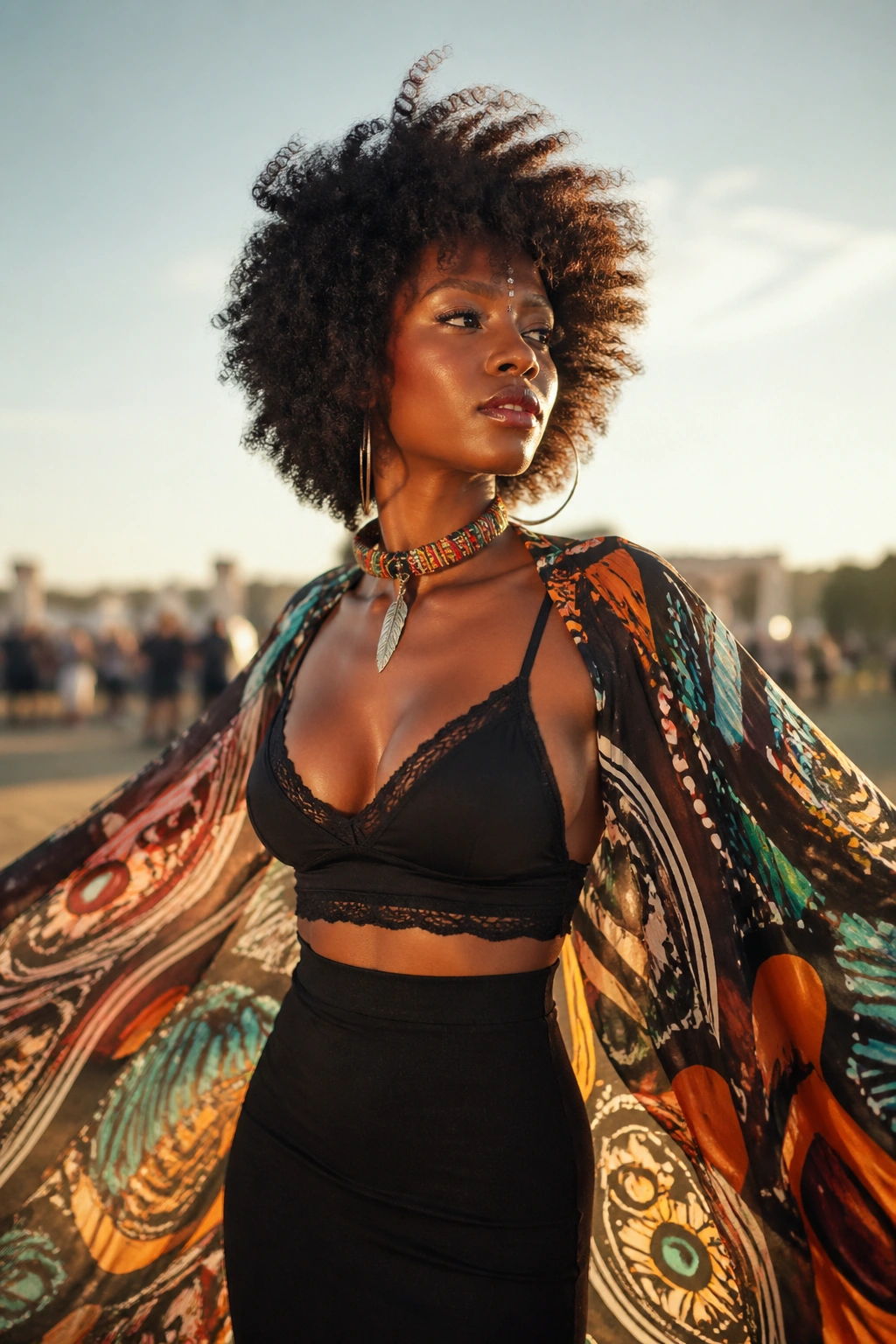
A flowing statement cape — a panel of fabric worn over the shoulders, falling to varying lengths, in a print or bold solid — is the single most dramatic piece you can add to a festival outfit without adding fuss. You don’t need to style it. It does its own work.
Under it: a simple bralette or fitted crop top, and a high-waisted skirt in a solid color. The cape is the headline; everything beneath it is the support act.
Choose a cape with some weight — a lightweight silk panel will fly up and tangle; a mid-weight cotton or structured chiffon drapes and moves with gravity as intended.
19. Kaftan with Belt and Platform Boots
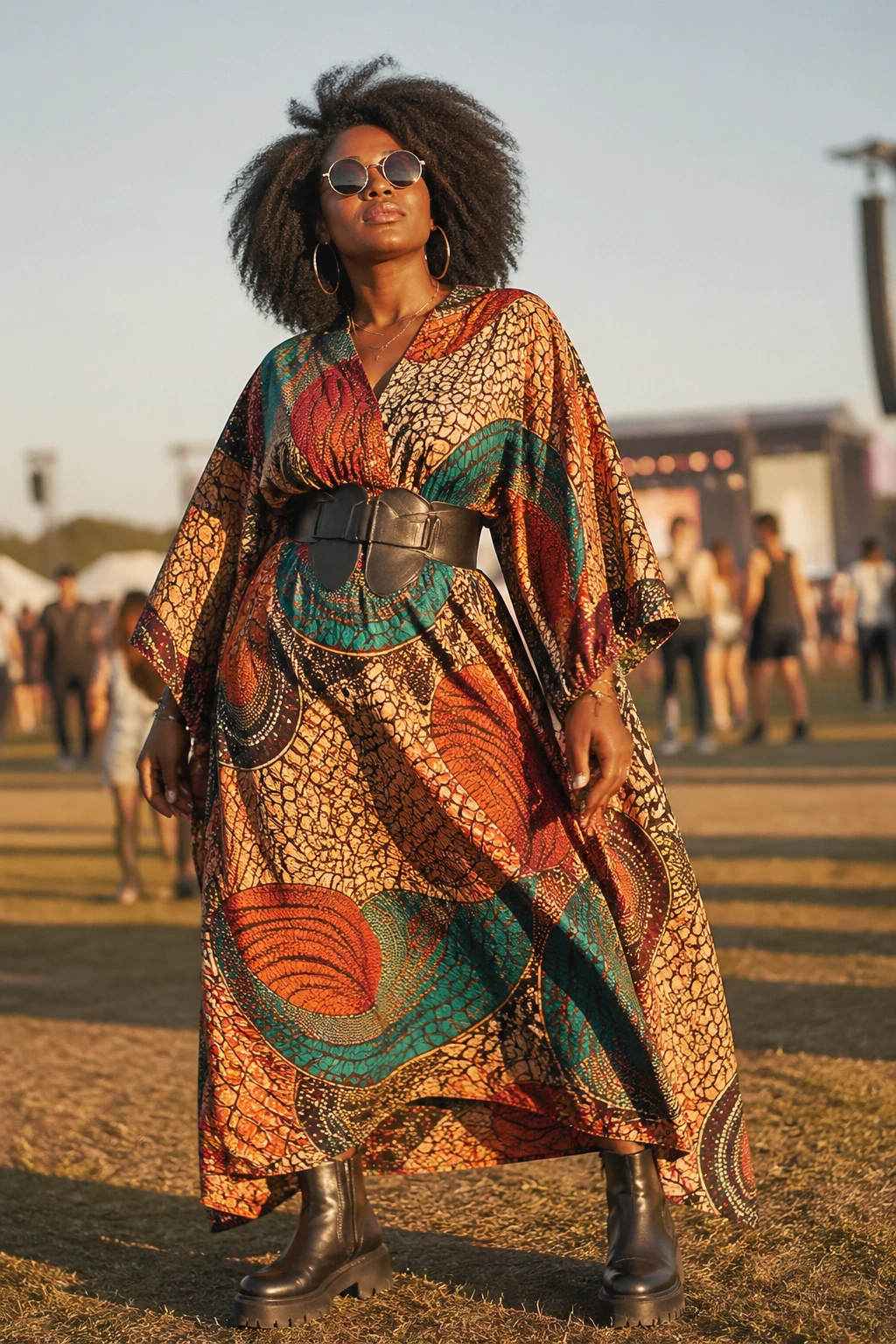
The kaftan — traditionally a long, wide-sleeved garment rooted in Middle Eastern and North African dress that has been adapted into global fashion over centuries — in a bold wax print or embroidered fabric, belted sharply at the waist, and worn with platform boots is one of those combinations that should technically feel like too many ideas at once and instead lands as a cohesive statement.
The belt transforms the kaftan from flowing house garment to defined festival silhouette. The platform boots add height and fashion-forward energy that prevents the look from reading as purely traditional.
The key: the belt needs to be wide and architectural, not thin and decorative. A wide leather or faux-leather belt in black or chocolate, four to six centimeters wide, is what creates the definition that makes this work.
20. Sequin Mini Dress for Night Sets
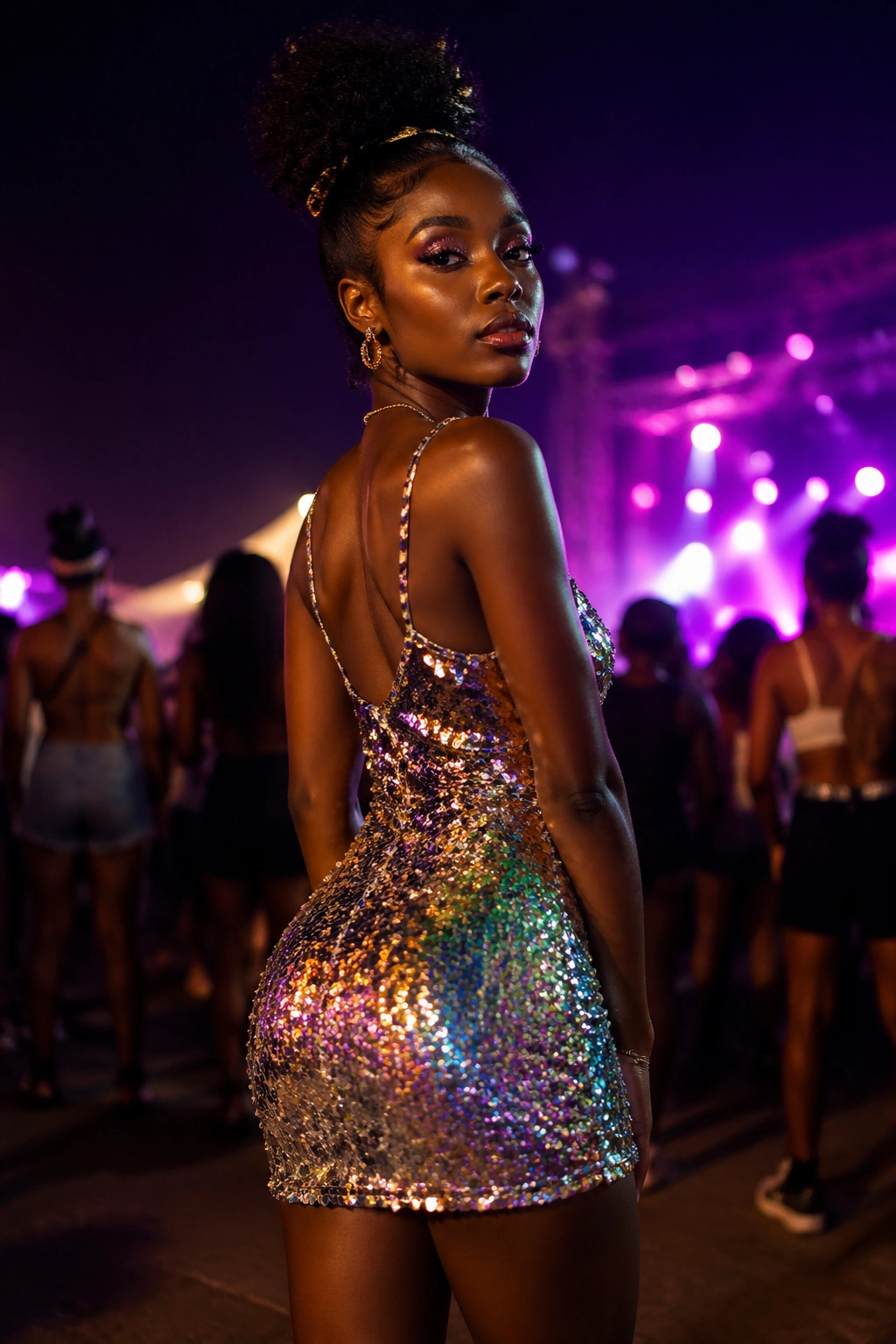
Evening festival programming — particularly night headliners where stage lighting is designed for drama — is the specific environment where a sequin mini dress earns its keep. In daylight, sequins read slightly flat. Under festival lights at night, a sequin garment becomes a reflection surface, catching and scattering light with every movement.
Keep the sequin garment simple in silhouette: a clean A-line or bodycon mini without added structural elements. The sequins are the construction. Everything else should step back.
Hair up or hair out? Both work differently. Hair out and full creates a dramatic crown above the sequin. Hair in a sculptural updo concentrates the visual weight even more sharply at the face.
21. Embellished Denim Jacket as the Statement Piece
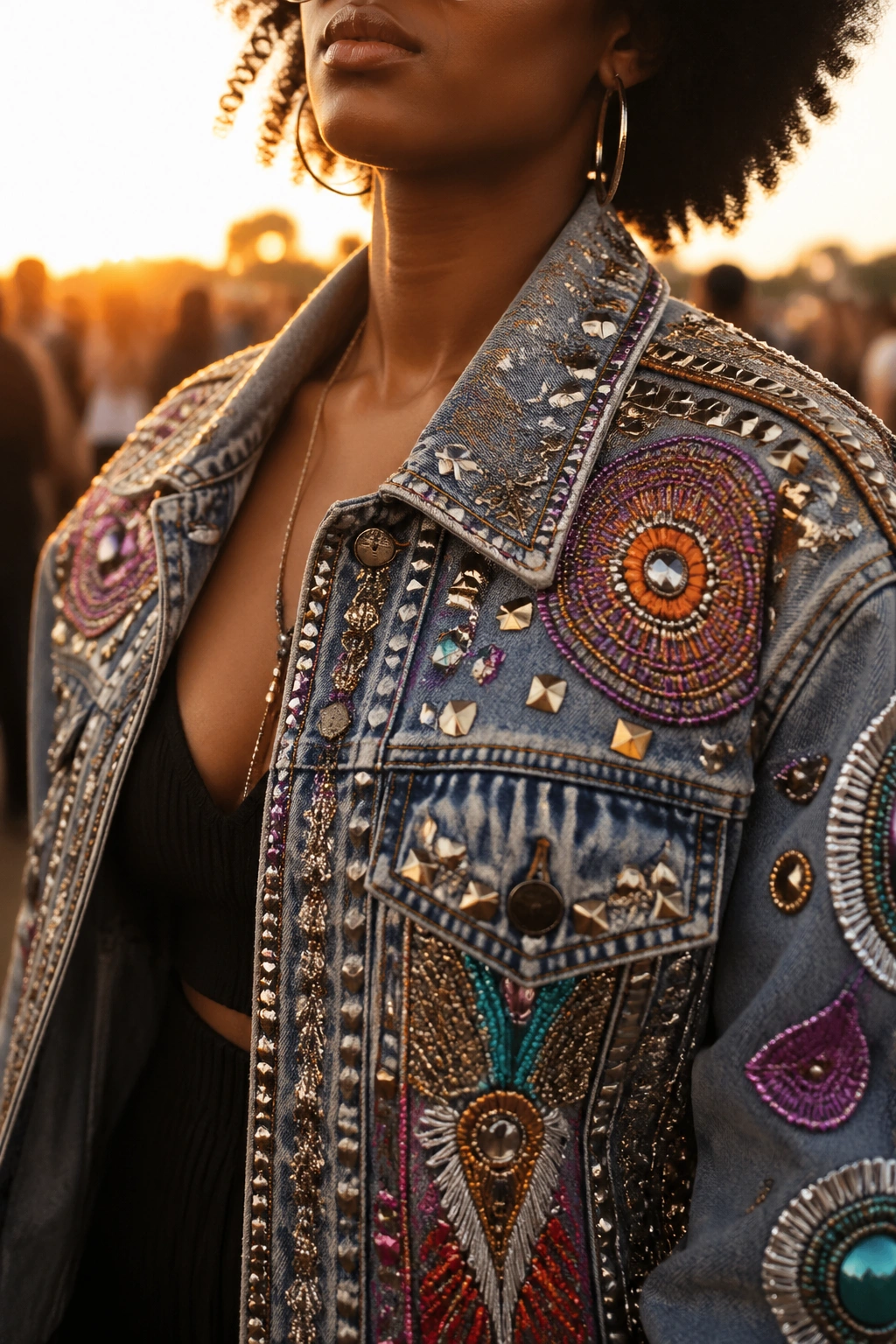
What if the jacket is the outfit? An embellished denim jacket — hand-painted, heavily embroidered, covered in patches, or decorated with beading or studs — worn over the simplest possible base (black biker shorts, a white bodysuit) is a festival look that centers a single piece with genuine craft behind it.
The jacket needs to be genuinely special, not a fast-fashion item with a few pins. The value of this approach is wearing something one-of-a-kind — a vintage jacket you’ve personalized, a commission from an independent artist, a piece with actual craft investment. That quality reads in person in a way that doesn’t photograph as clearly but feels real in the environment.
This is also a practical choice: as the day gets warmer, the jacket comes off, and the simple base underneath still makes sense.
22. Printed Wide-Leg Jumpsuit with Platform Sandals
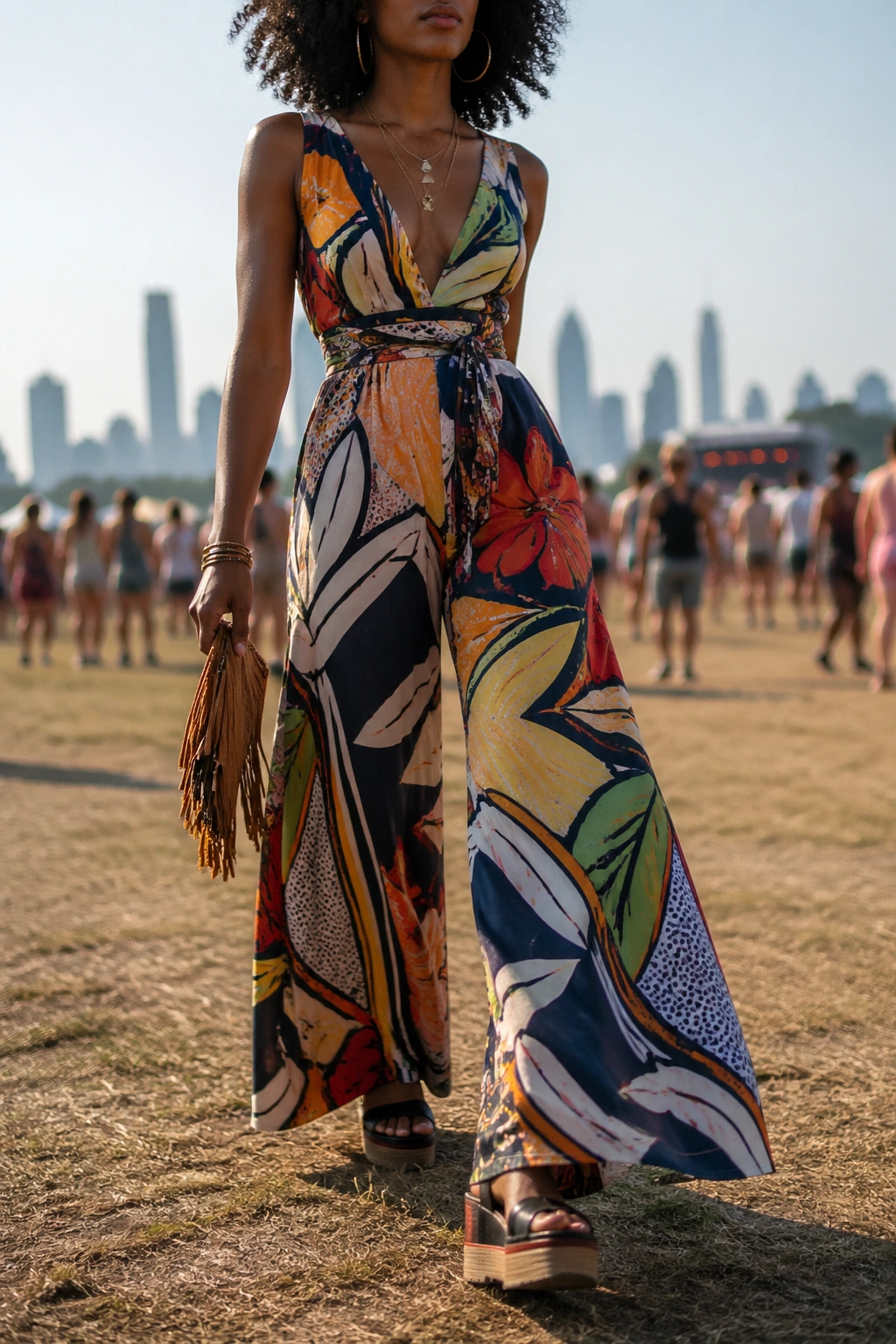
The printed jumpsuit revisited — but this time, the wide-leg cut creates a full-length silhouette that photographs differently than a standard cut, with fabric that swings dramatically when you walk. The print should be large-scale: botanical, abstract expressionist, graphic geometry.
Platform sandals — specifically the kind with a wide, stable sole in a coordinating color or clear material — extend the leg line without adding the coverage of a boot. In warm festival weather, this is an important distinction.
The one practical concern with a wide-leg print jumpsuit at a long festival: ground clearance. Know whether the venue is grass, concrete, or dust before committing. Pale-colored wide-leg jumpsuits on muddy festival grounds create a problem.
23. Monochromatic Head-to-Toe in a Festival-Ready Color
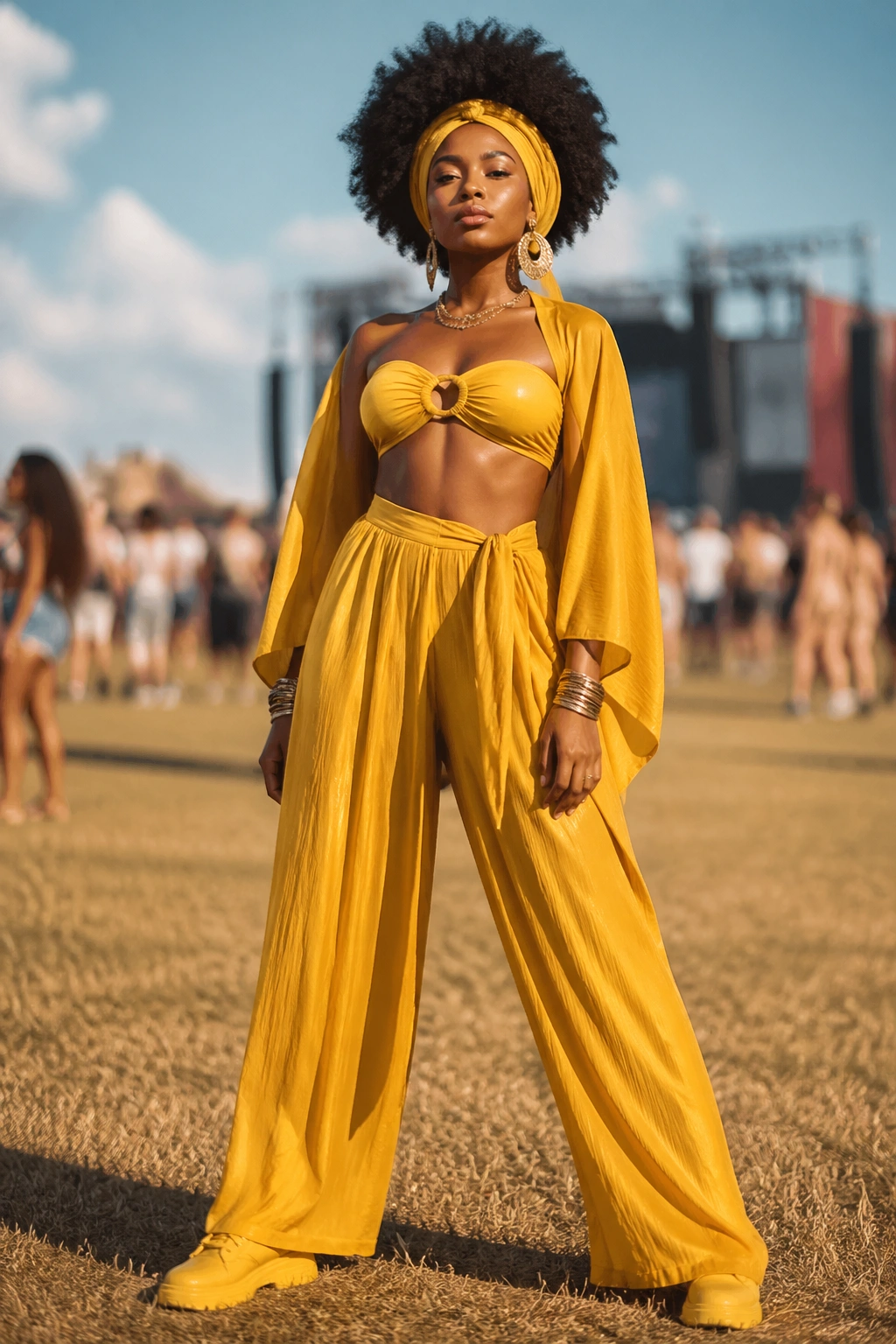
The final outfit is a strategy more than a specific garment prescription. Choose one color — ideally a bold, warm, or high-energy one: turmeric yellow, rust orange, electric green, deep violet — and wear it from head to toe. Same color wrap on the hair (or a patterned piece in a tonal range), same color top, same color trouser or skirt, same color bag.
This is the festival dressing power move. It eliminates every decision about coordination and creates a single, unified image. From anywhere in a crowd, you register immediately. There’s no visual confusion about the look; it’s one bold statement, committed to fully.
The only place variation should enter: texture. Different fabrics in the same color — matte and shine, rough and smooth — create depth within the monochrome without breaking the visual unity.
Packing and Carrying Your Look Through the Day
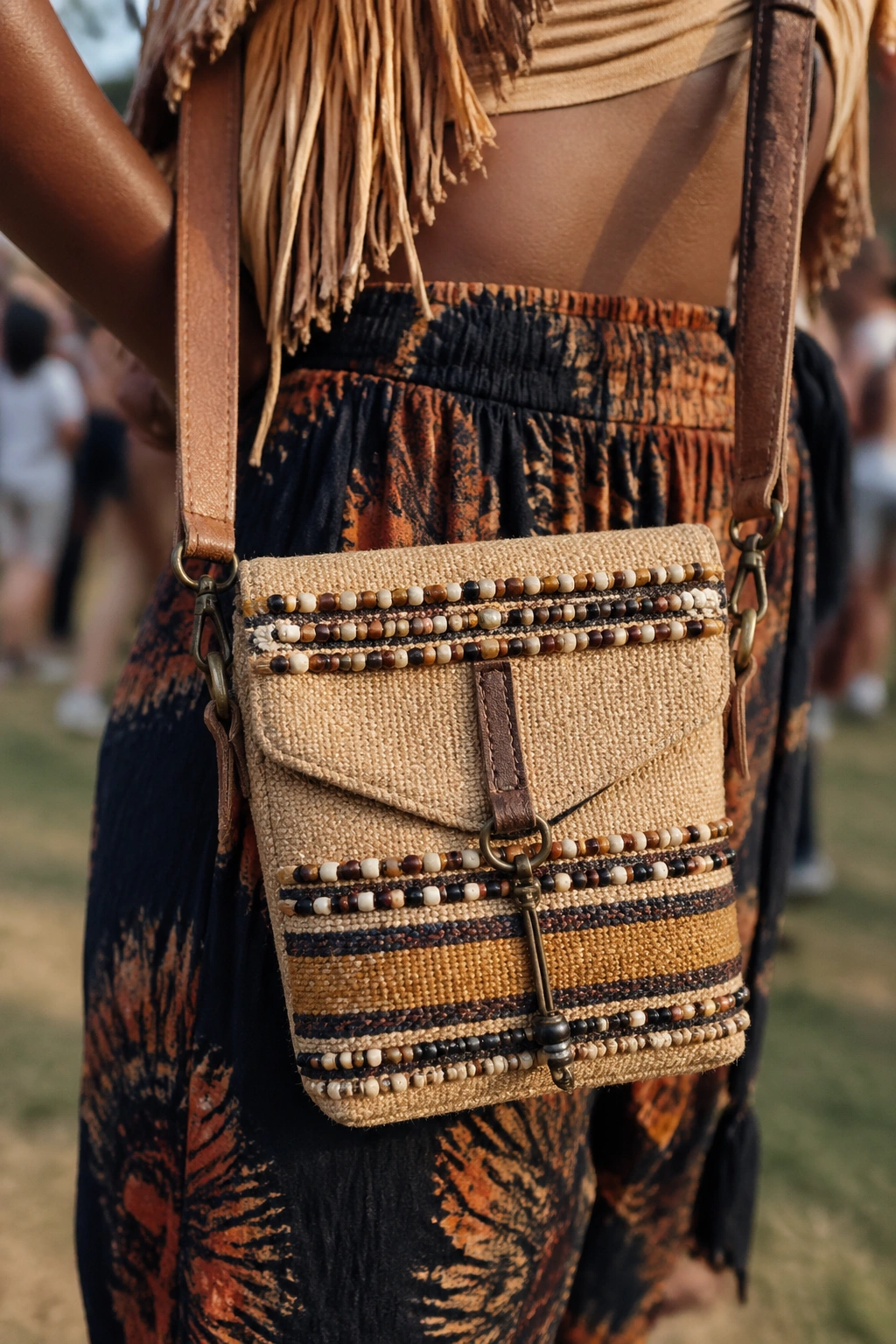
Festivals have logistics that fashion doesn’t usually account for. You’re carrying things — your phone, your card, water, maybe a small emergency kit — and whatever bag you choose becomes part of the look whether you’ve thought about it or not.
Crossbody bags in woven fabric, beaded clutches worn on a long chain, or embroidered mini-backpacks all carry the visual logic of afro festival fashion better than a standard gym bag or a see-through plastic stadium pouch. The bag should be small enough to move freely in a crowd and large enough to hold what you actually need.
A few specific items worth packing for a long festival day: a portable phone charger, a small mirror for quick outfit checks between sets, and two or three bobby pins for managing any accessories that shift during dancing. None of this requires a large bag — a small crossbody with compartments handles it all without weighing you down.
The hat question comes up constantly. A hat is both a style choice and a practical solution to sun and rain. Bucket hats, wide-brim straw hats, and structured baseball caps all have their place in festival styling — just know that any of them will compress afro volume and change the silhouette of your look significantly. That might be exactly what you want by hour six. Plan for it rather than being surprised by it.
What to Do When the Weather Doesn’t Cooperate
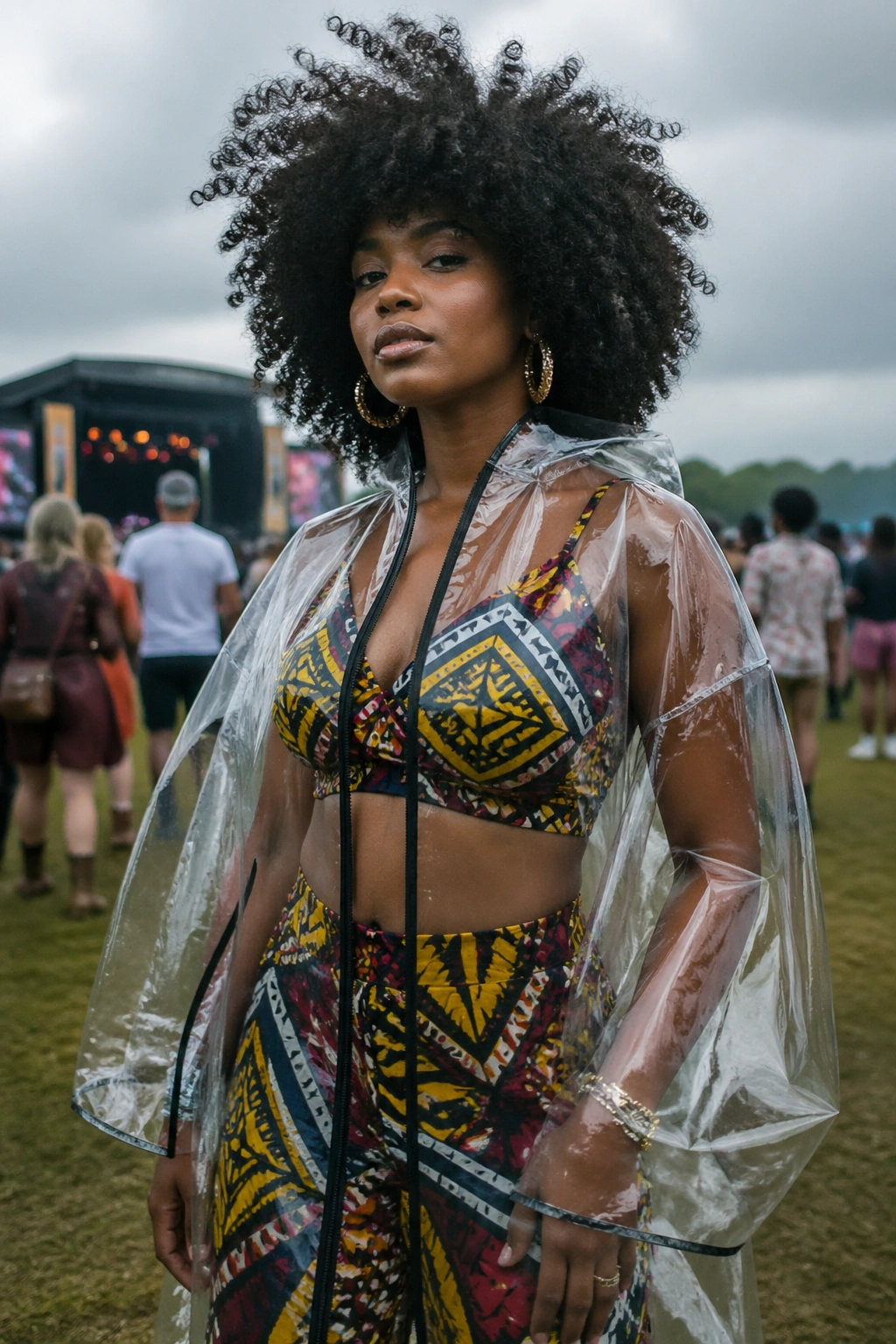
Outdoor festivals and weather uncertainty go together. No outfit you choose will be immune to what happens when the sky decides it has opinions.
The most practical approach: build a look that has an acceptable worst-case version. If your outfit works in full sun and is also wearable under a lightweight jacket, you’ve covered most contingencies. The midi slip dress under the leather jacket is a classic example — remove the jacket when warm, put it back when the temperature drops after sunset.
Rain is the harder problem. Very few festival outfits are genuinely rain-ready and still look intentional. The honest answer is to know the weather forecast and make peace with modifying your look if needed: a compact clear poncho kept in your bag isn’t stylish, but it protects the outfit underneath it. The alternative — arriving in your full look and having it destroyed by rain — is worse.
After the Festival: Garment Care for Statement Pieces
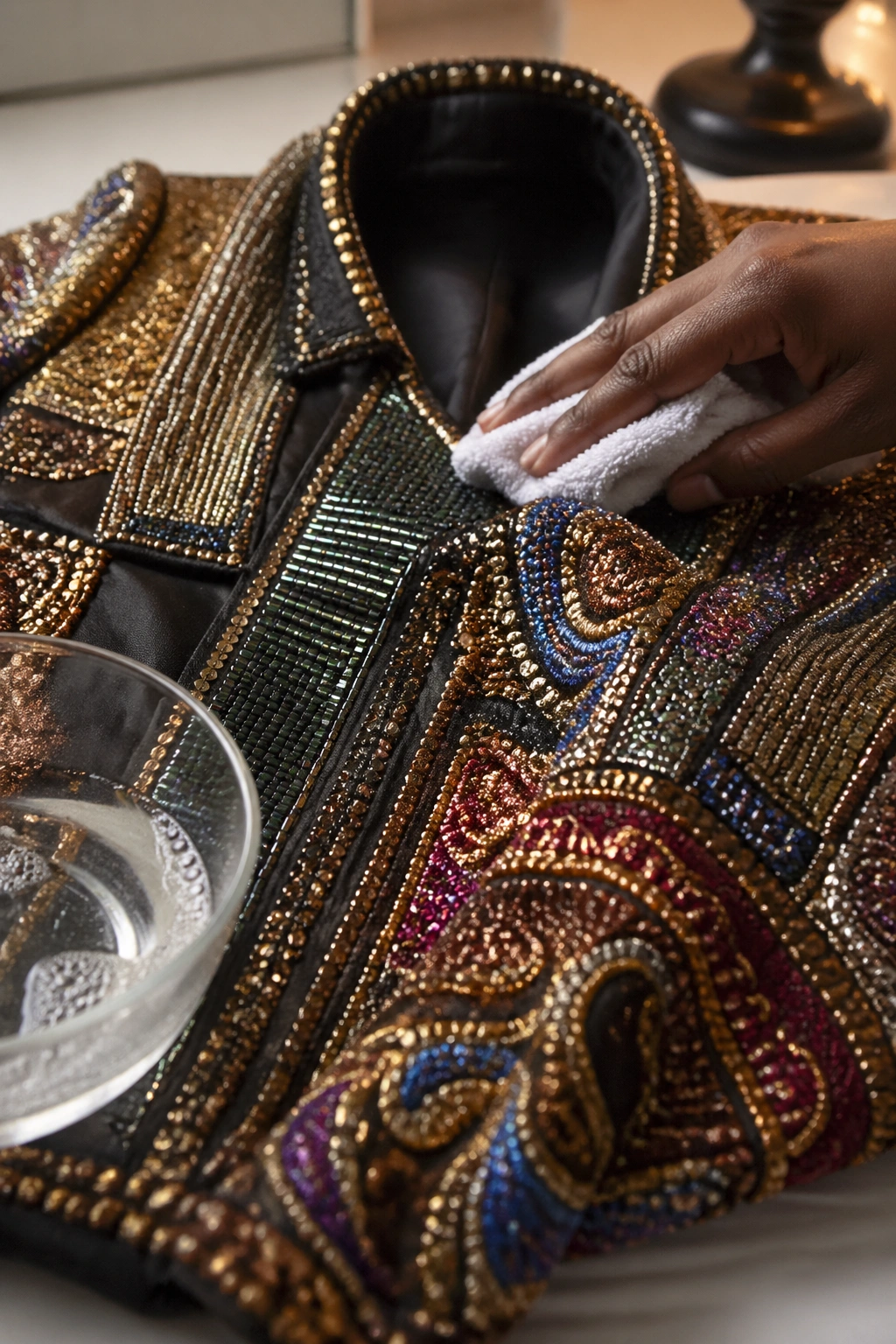
Festival wear takes a beating. Sequins, embellishment, embroidery, and delicate prints all require care that a standard machine wash won’t provide. Most embellished or sequin garments: hand wash cold or spot clean, hang to dry. Never put sequins in the dryer — the heat warps the backing and they fall off in quantities.
Wax print fabrics, including Ankara, are typically washable but may bleed color in the first two or three washes. Always wash separately until you’re confident the dye is set.
Leather and leather-look pieces need to be wiped down after a warm day of wear — salt from sweat can dry-out real leather and dull faux leather finishes. A light leather conditioner after every major event extends life significantly.
Building a Festival Wardrobe Over Time
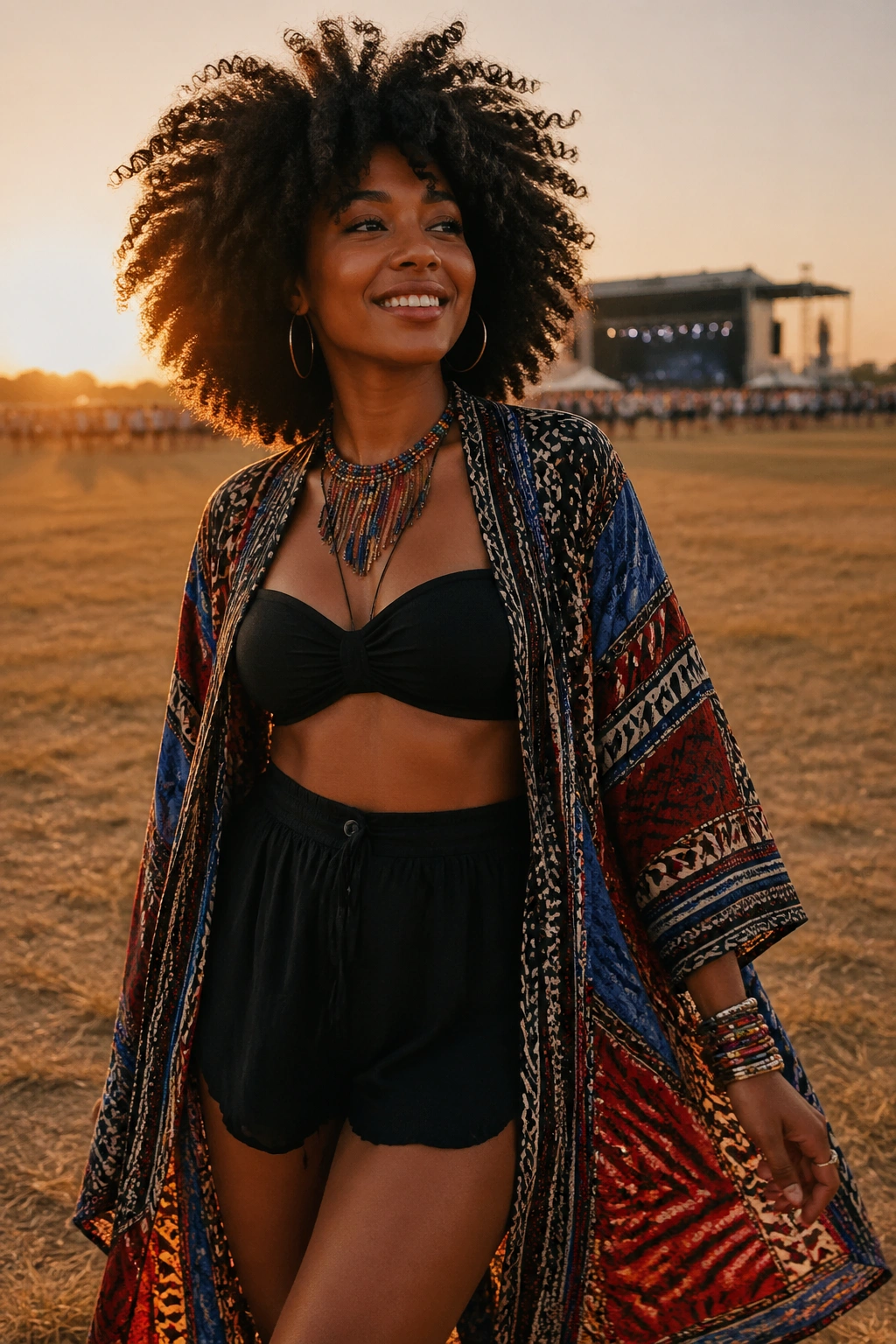
You don’t need 23 outfit options for one festival. You need three to five genuinely strong looks that you know work on your body and with your hair, and enough pieces to rotate between them for a multi-day event if needed.
The common thread through every outfit on this list: commitment. A half-committed festival look — where you went almost bold but pulled back — almost always disappoints. A fully committed look, even if it’s something some people wouldn’t understand outside the context, almost always works.
The festival environment rewards the bold choice. You’re in the right space to make it.
