
The afro bob is one of those haircuts that can either be exactly right or completely miss the mark — and the difference often comes down to a few inches of length, the angle of the cut, and how well the style accounts for your natural shrinkage. Afro bob haircuts for round faces require a specific approach: the goal is almost always to create visual length or vertical emphasis, to frame the face in a way that draws the eye upward or outward rather than purely sideways.
Round faces are one of the most common face shapes, and also one of the most misunderstood when it comes to styling advice. The typical guidance — avoid width, add height — is a starting point, but it oversimplifies a face that’s actually quite flexible. The issue isn’t roundness itself; it’s proportion. A style that creates visual balance between the face’s width and its apparent length is what works. And there are many ways to get there with a bob on natural hair.
What makes the afro bob specifically interesting for round faces is that afro texture does a lot of the visual work. A few inches of coiled, springy type 4 hair creates far more volume and height than the same length would in straight hair. That volume, placed correctly, becomes a structural asset rather than something to tame.
Understanding the Round Face in the Context of Natural Hair
A round face has roughly equal width and length, with soft curves at the jaw and forehead. The widest point of a round face tends to fall at the cheeks rather than at the temples or jaw. When choosing a bob, you want to avoid styles that add maximum width at the cheekbones — which would emphasize the roundness — and instead choose styles that create a longer visual line.
The good news is that with afro-textured hair, the natural spring and volume of type 4 coils can be directed more deliberately than straight or wavy hair. A bob that’s layered to add height at the crown and maintain minimal volume at the widest part of the face can create a completely different silhouette from the same cut worn with maximum volume all around. This directability is an advantage, not a limitation.
Don’t take the “no width at the cheeks” rule so literally that you cut yourself off from all volume. Natural afro hair is volumized by default — you don’t have to eliminate volume, you just have to direct it.
What Makes an Afro Bob Different From a Regular Bob
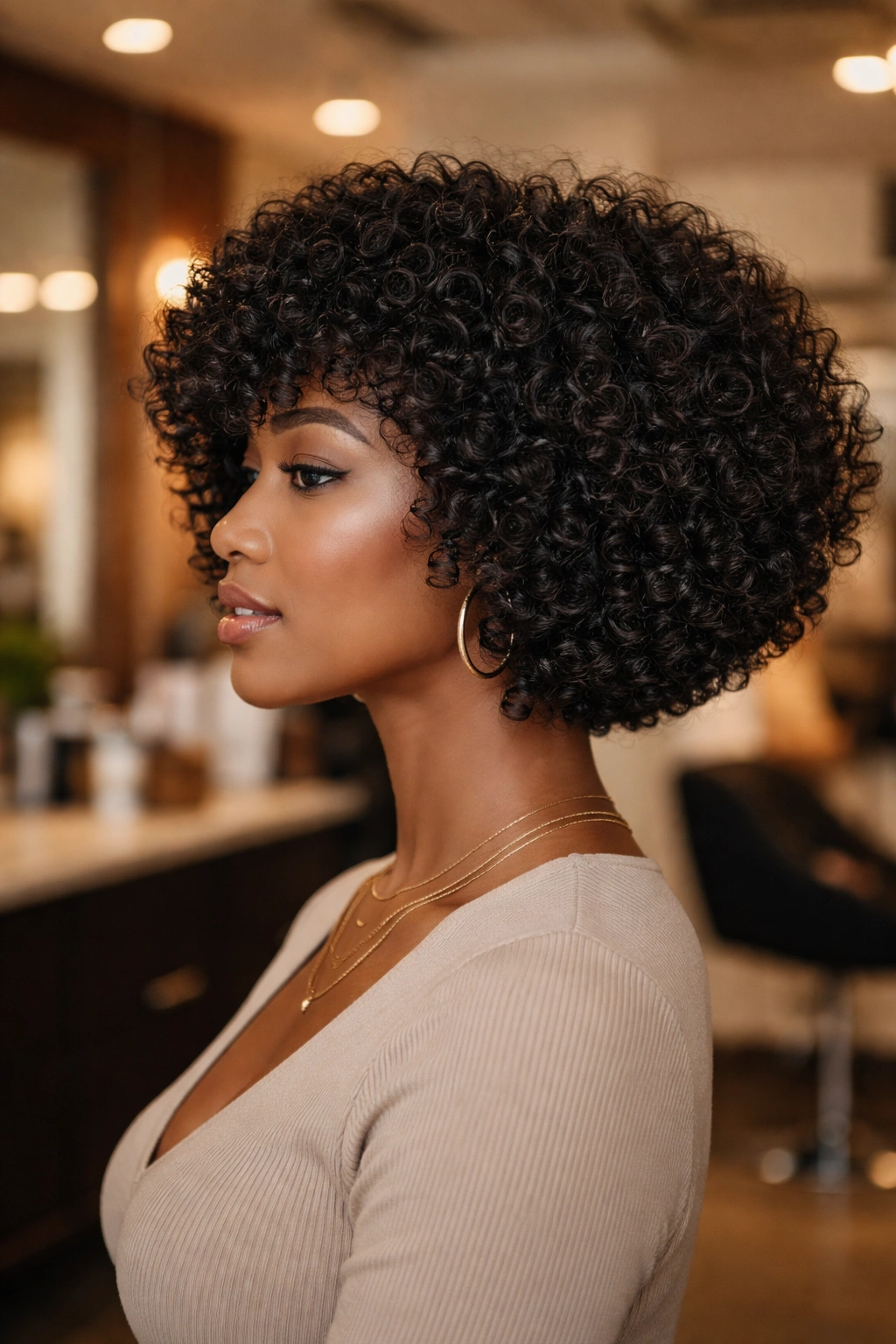
The afro bob is cut to work with natural shrinkage and coil pattern rather than against them. In a standard bob for straight hair, the stylist is cutting to a specific length that holds because the hair hangs straight. On afro hair, the stylist needs to cut accounting for how much the hair will shrink back once it’s in its natural coiled state. A bob that looks chin-length immediately after the cut might sit at jaw-level when fully shrunken — which could be exactly right or significantly shorter than intended.
The cut also needs to account for the way afro hair creates volume. A one-length bob on type 4 hair often mushrooms out at the sides rather than framing the face cleanly — because the coils at the sides spring outward at the same rate as the coils at the back. Adding layers or internal shaping to reduce bulk at the widest point and increase height at the crown changes everything. This is where a stylist who truly understands natural hair makes a visible difference.
The Best Bob Angles for Round Faces
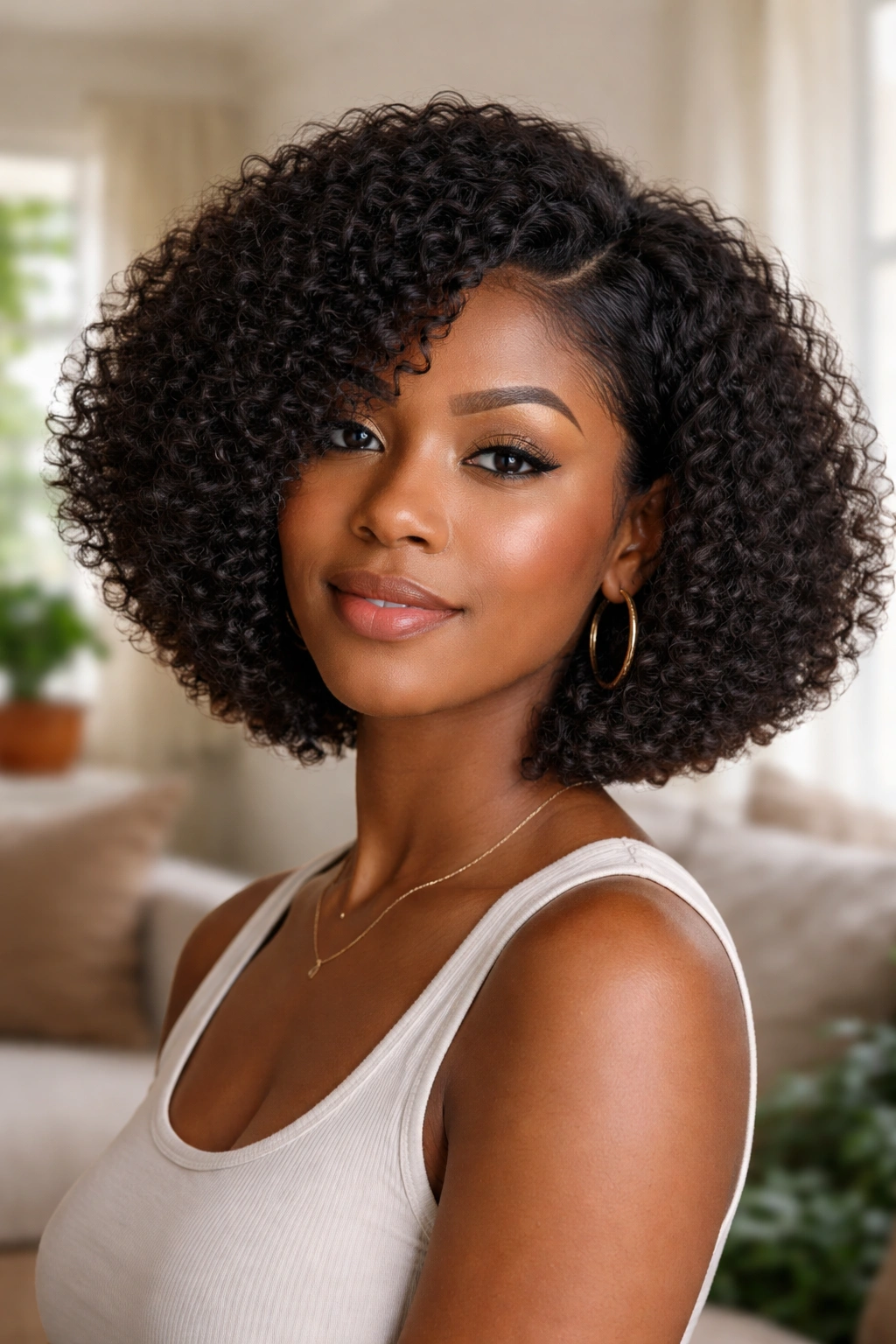
Three angles work consistently well for round faces:
The A-line bob — shorter at the back, longer at the front — creates a diagonal line that visually slims and elongates. On afro hair, the longer front sections frame the face rather than sitting flush with it, drawing the eye downward toward the jaw rather than outward toward the cheeks.
The asymmetrical bob — one side longer than the other — creates a diagonal visual line across the face. The length variation draws attention along an oblique angle that cuts across the roundness rather than emphasizing it.
The stacked bob — shorter layers at the nape that build toward a fuller crown — adds height that stretches the visual proportion of the face upward, creating a longer overall face impression.
Shrinkage Planning for the Bob Cut
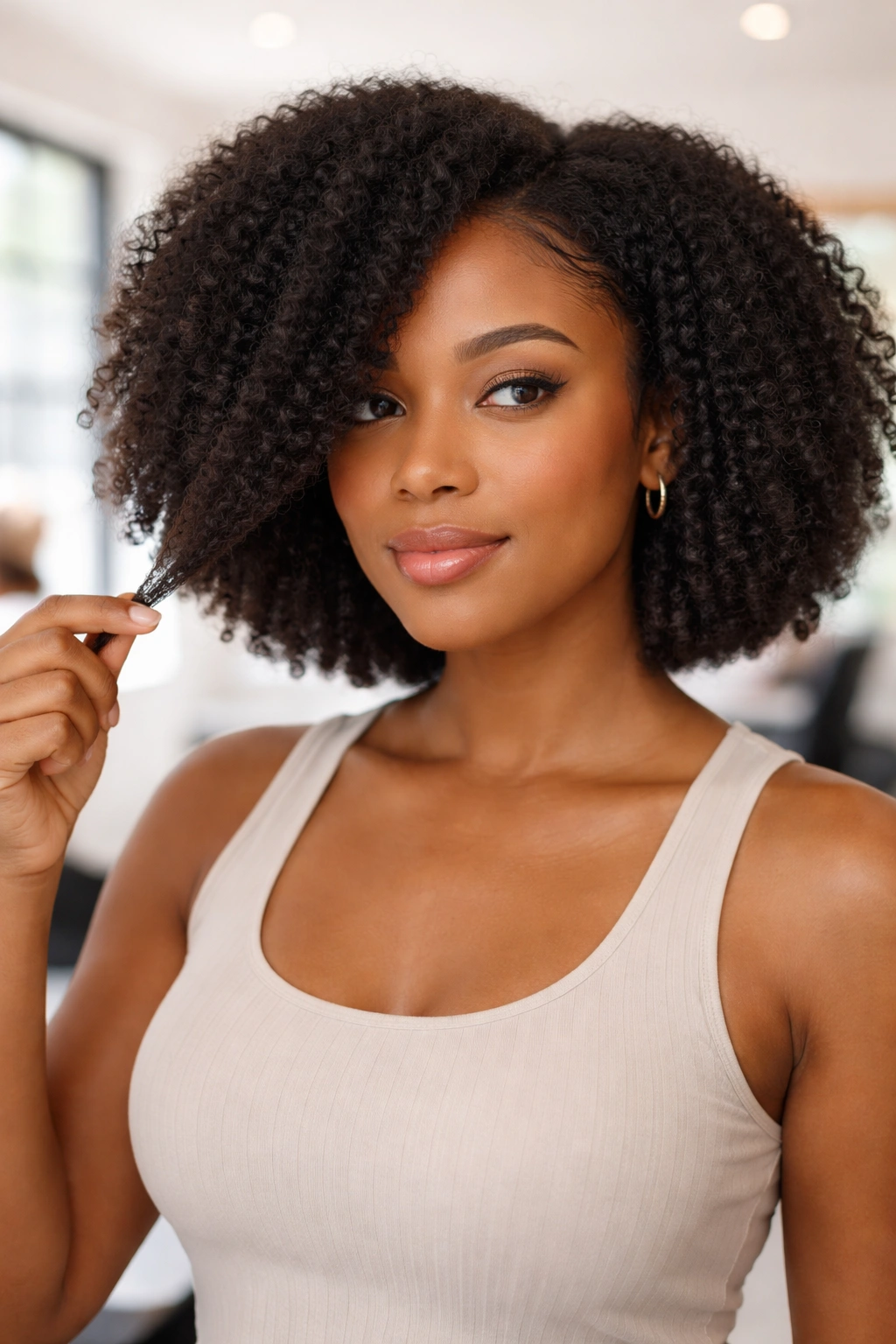
Before you go in for your afro bob appointment, be honest with your stylist about your shrinkage level. If your hair shrinks 50% when coiled, a cut at 5 inches of stretched length will sit at 2.5 inches on your actual head. That’s potentially the difference between a chin-length bob and a very short puff. Most experienced natural hair stylists will cut your hair while it’s stretched — either blow-dried on a low setting or gently stretched with banding — to ensure the cut length is intentional.
Some stylists prefer to cut on fully natural, coiled hair to see where the shrinkage will actually land. Either approach works as long as you and your stylist agree on the target length after shrinkage, not before.
1. The A-Line Afro Bob
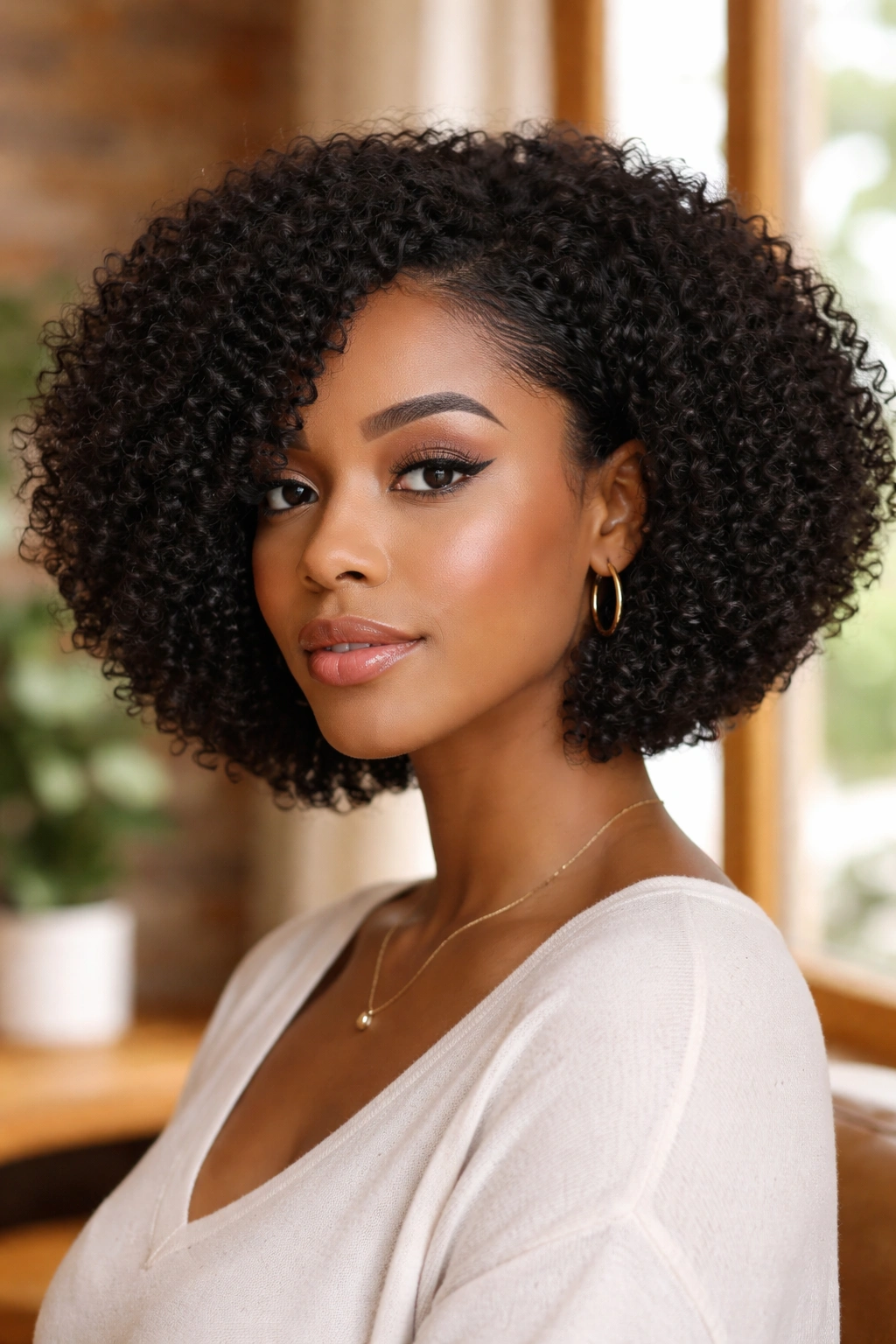
Longer at the front, shorter at the back — the A-line cut creates a diagonal that’s incredibly flattering on round faces. On afro hair, the front sections typically frame the face at chin or jaw level, while the back sections sit at the nape or slightly above.
Why It Works
That front-to-back angle creates an oblique visual line that counterbalances the horizontal width of a round face. The eye follows the angle of the cut from the longer front sections toward the shorter back, which registers as a slimming, lengthening effect. Add to that the fact that the longer front sections draw attention toward the jaw rather than the cheeks.
- Apply a curl defining cream to damp hair, scrunching from the bottom up
- Allow the front sections to fall naturally forward to maintain the A-line angle
- Avoid picking the front sections upward — this reduces the length advantage of the cut
The A-line afro bob looks best when the front sections retain their natural length and aren’t styled into a puff or upward shape. The whole point is the hanging length at the front.
2. The Tapered Afro Bob
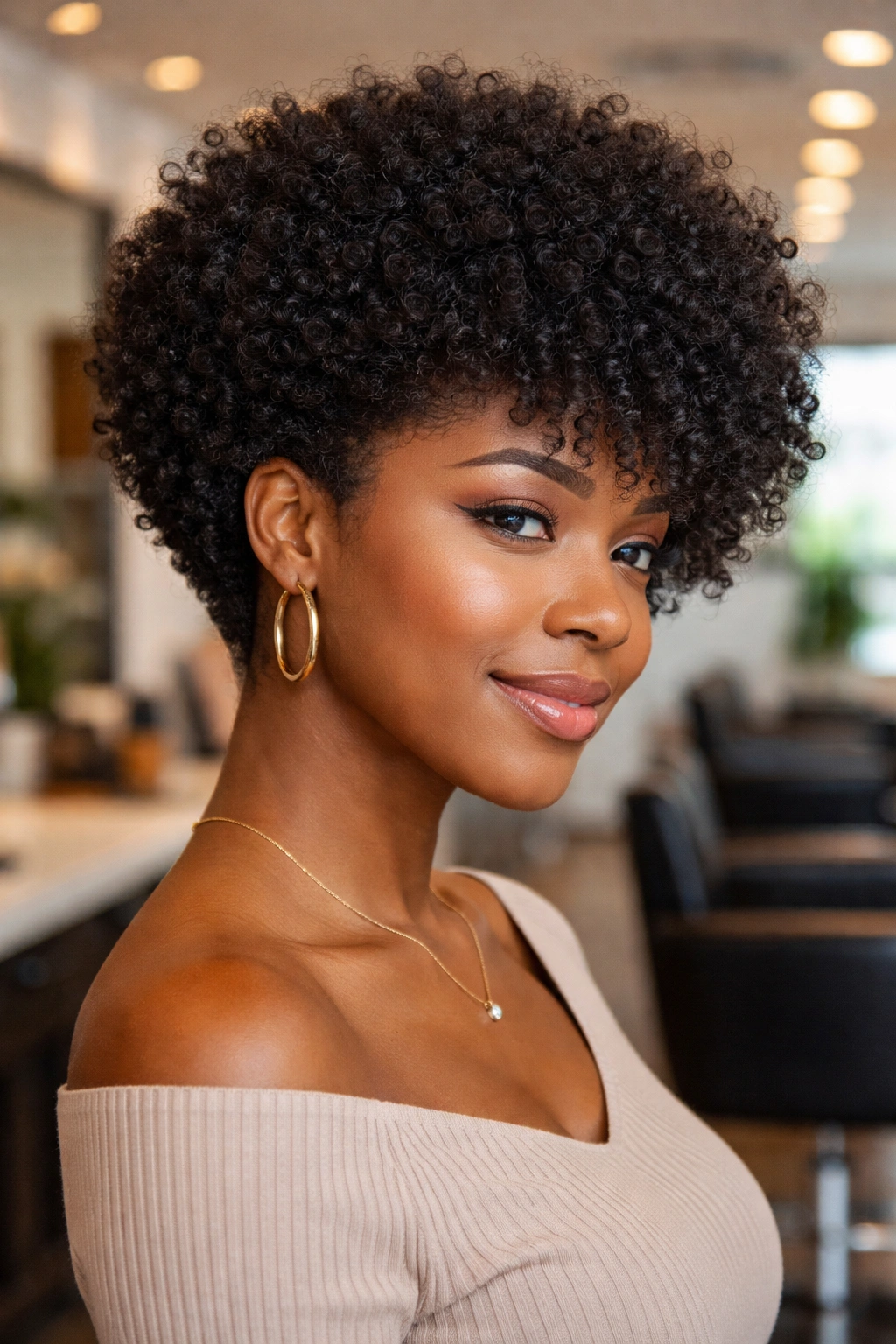
A bob with a tapered nape — the sides and back are cut close or faded, creating contrast with the fuller natural hair on top. The fuller top section creates the height you want for a round face, while the tapered sides reduce the width that would otherwise emphasize roundness.
This cut reads immediately as intentional and styled. The contrast between the tapered lower sections and the natural volume above creates a clear silhouette. It’s also extremely versatile: you can wear the top section as a wash-and-go, a twist-out, or a coil-out depending on your mood.
The taper at the sides is typically done with clippers, working from the lowest guard at the nape up to a higher guard number as you move toward where the full natural section begins. The blend needs to be seamless — a visible line between the tapered and natural sections looks like a mistake rather than a cut.
3. The Asymmetrical Afro Bob
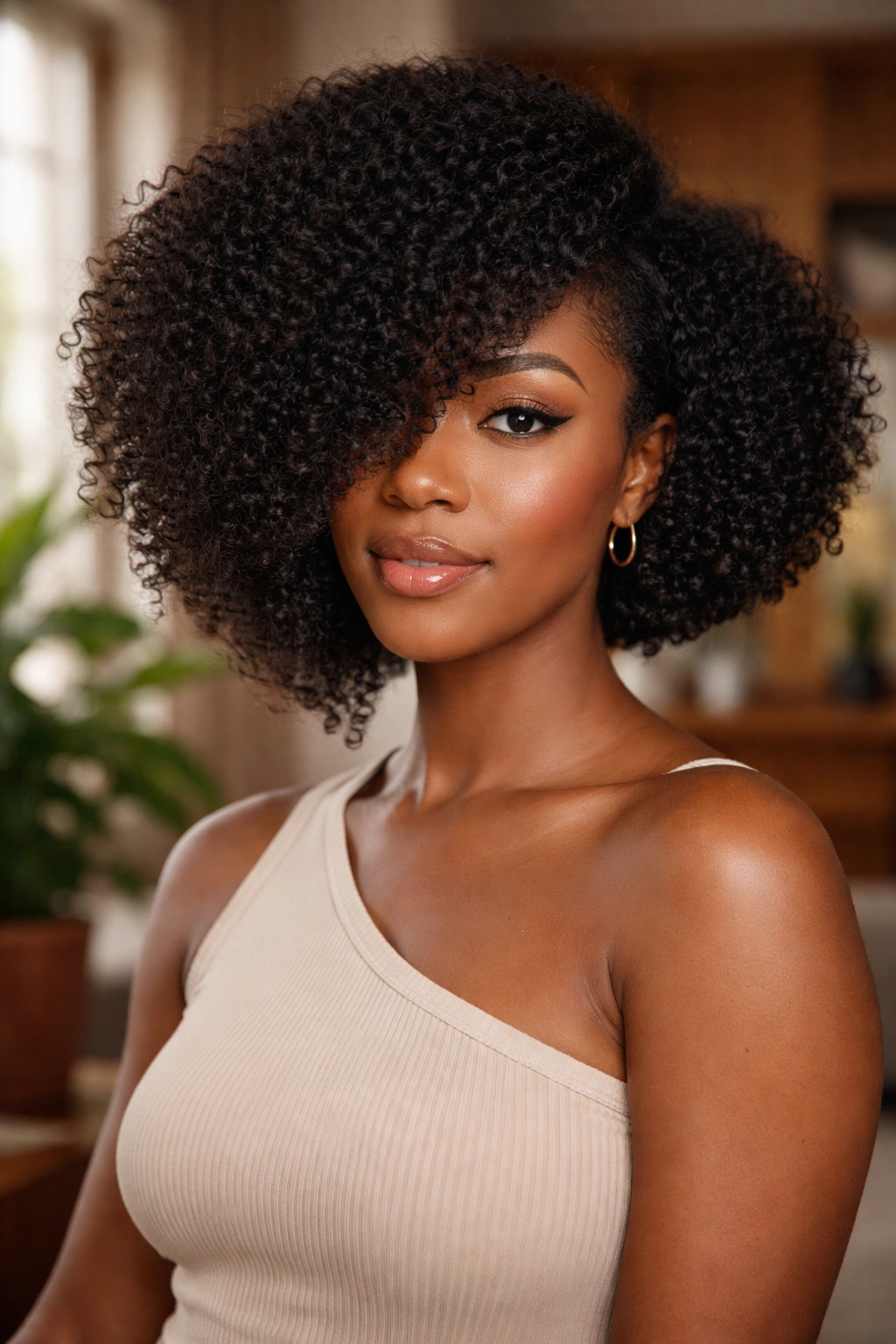
One side is noticeably longer than the other. On afro hair, the volume asymmetry this creates is bold and graphic. The eye follows the longer side, which creates visual movement across the face and breaks up the symmetrical roundness that’s characteristic of a round face shape.
This isn’t a subtle look. The side-length difference needs to be visible enough to read as intentional — usually at least an inch of difference in finished length, which translates to more when you account for shrinkage. Too small a difference and it reads as a botched symmetrical cut.
The longer side can face whichever direction flatters your face best. Some women prefer the length to fall on the side of their face that they consider their better angle; others go for the longer side on the side opposite their natural part so the length sweeps across the face.
4. The Short Stacked Afro Bob
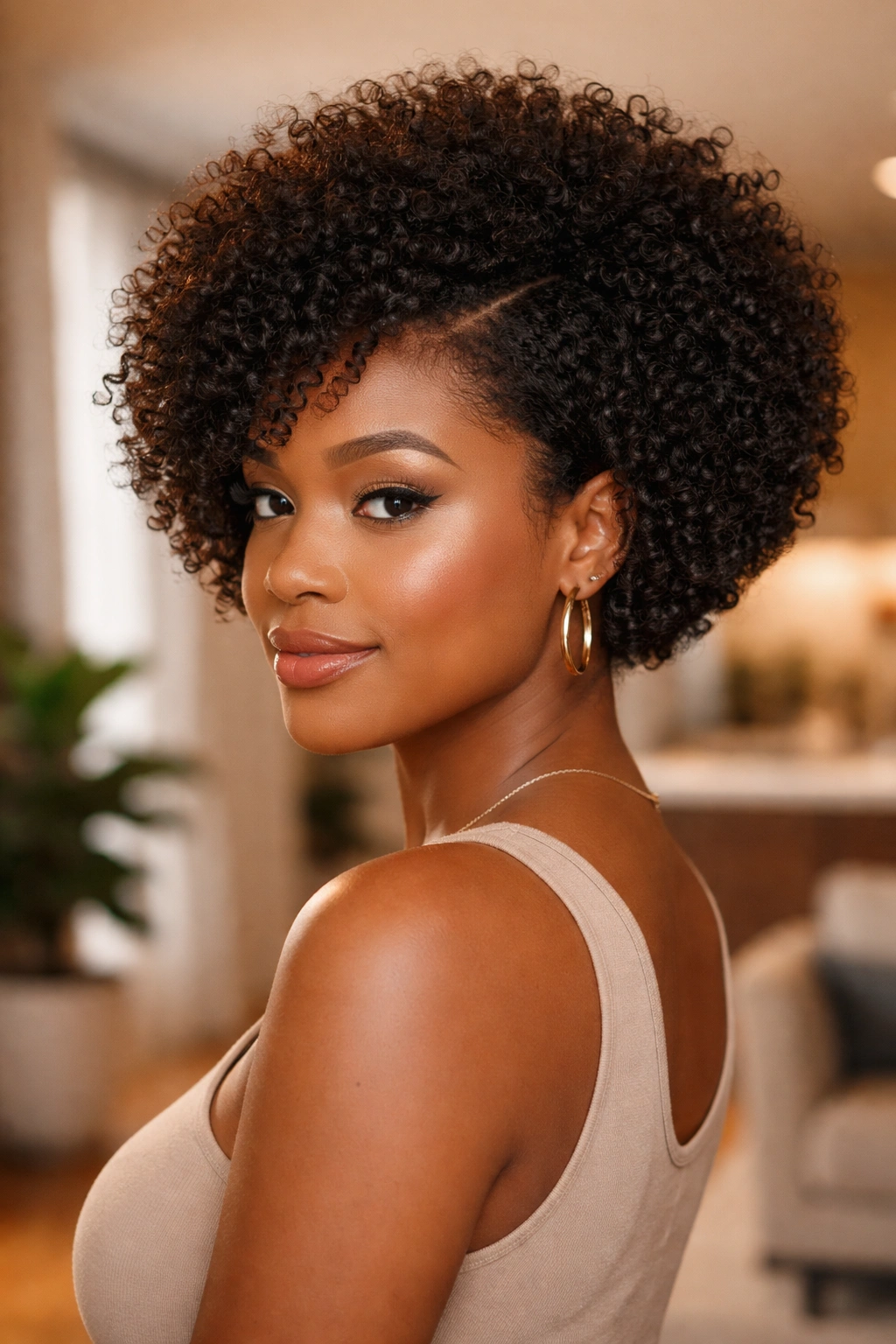
Stacked layers at the crown and back that build height upward rather than letting volume spread outward. This is done by cutting the top layers slightly shorter than the bottom layers so that the hair underneath supports the hair above in a stacked, vertical effect.
On afro hair with strong spring, the stacked bob can create significant height at the crown — which is exactly what a round face benefits from. The height shifts the visual center of gravity upward, making the face appear longer in proportion to its width.
The stacked cut is more complex than a simple one-length bob and requires a stylist comfortable with cutting natural hair in layers. Ask to see examples of stacked cuts on afro hair specifically — the technique translates differently to textured hair than to straight hair.
5. The Blunt Bob with a High Part
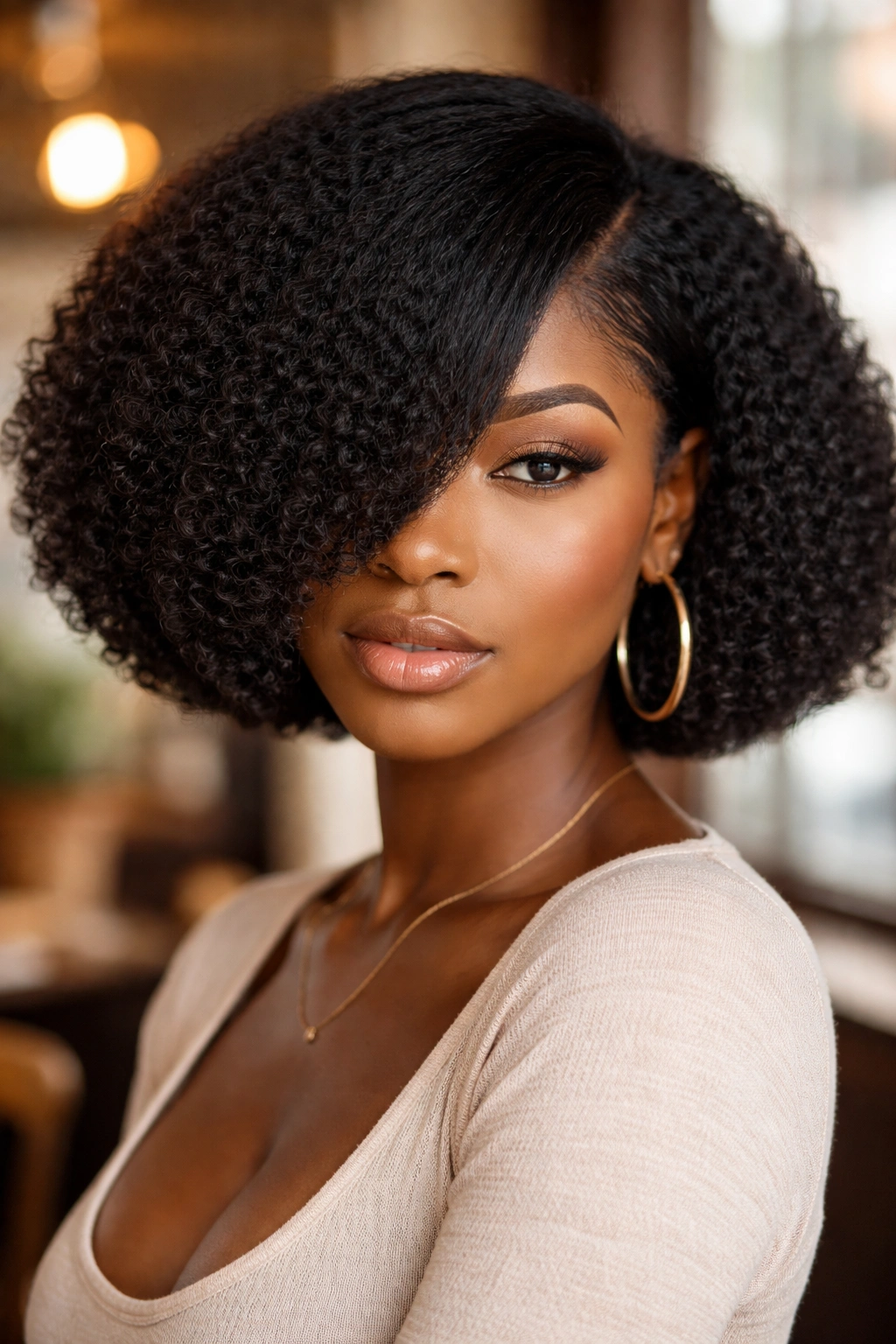
A one-length blunt bob on afro hair with a deep side part — the part starts very close to one ear, creating a sweep of hair that falls across the forehead and over one eye on the longer side. The high side part creates asymmetry in an otherwise symmetrical cut.
The part does the visual work for a round face: the high side part creates a diagonal that interrupts the even roundness, and the sweep of hair over one side of the forehead narrows the face’s apparent width at the top. This is a surprisingly powerful technique for a round face.
On afro hair, the side part needs to be actively maintained — the coils have a tendency to fill in the part line as they expand throughout the day. A small amount of pomade or edge gel along the part keeps it visible.
6. The Jaw-Length Bob for Afro Hair
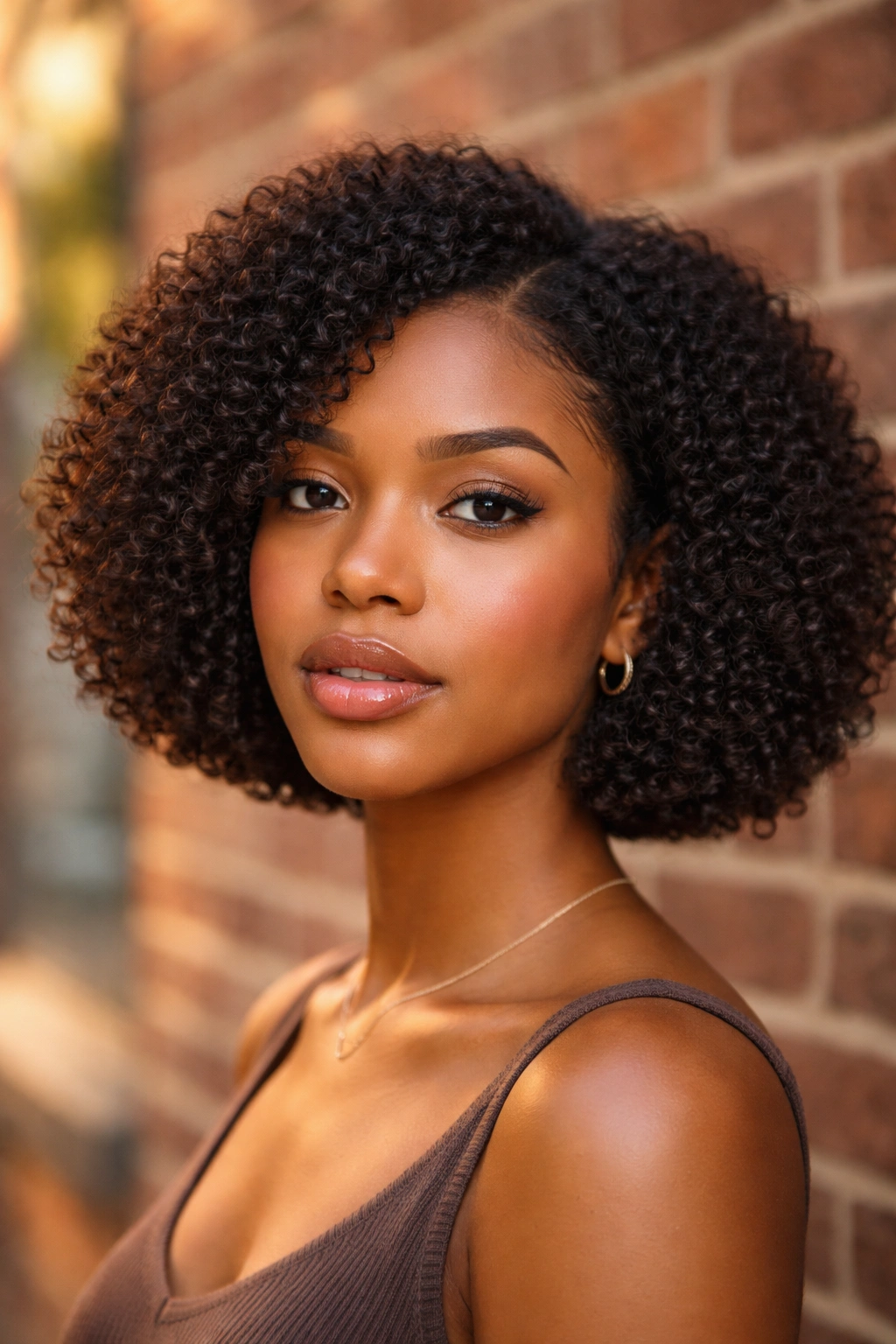
Specifically cut to sit at the jaw when fully coiled — not when stretched, not after a blowout. This means the stylist cuts it to whatever stretched length produces a finished, coiled length at the jaw. On most type 4 hair, jaw-length coiled requires cutting the stretched hair to about 5-7 inches depending on your specific shrinkage level.
At jaw length, the bob frames the face at its widest point. For some round faces, this emphasizes the width; for others, the framing creates definition that actually makes the face look more structured. Your face’s specific proportions determine which effect dominates. If you’re uncertain, try a jaw-length style with flat-ironed hair before committing to the cut — this gives you a preview without commitment.
7. The Chin-Length Bob with Volume at the Crown
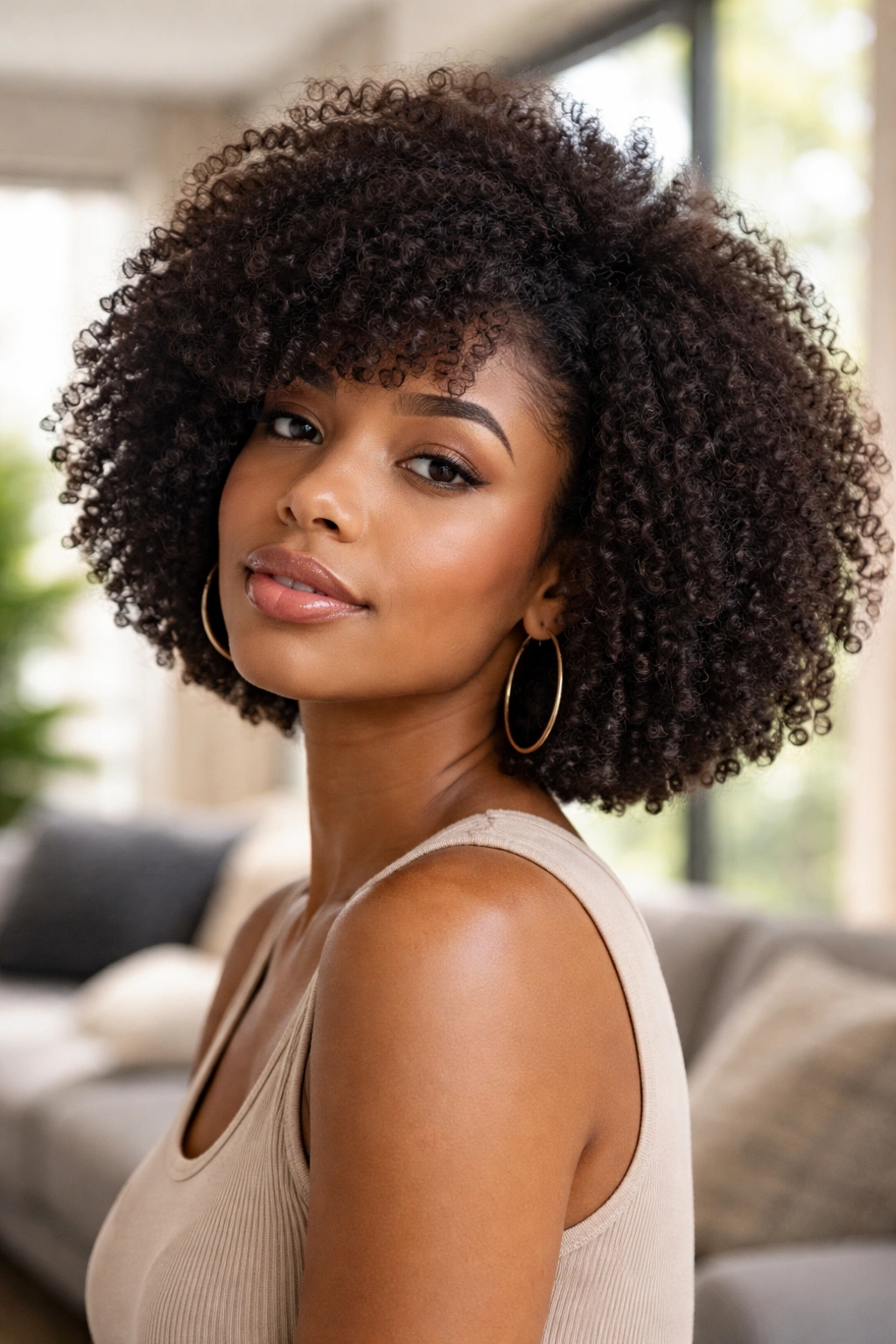
Chin-length on the sides and back, with intentional height created at the crown either through layering or styling. This bob’s success on round faces depends entirely on that crown volume — without it, the chin-length framing adds width at the jaw without adding length anywhere.
What Makes It Different
The crown volume shifts the visual center upward. When the tallest point of your hair is well above the crown of your head rather than spreading outward at the sides, the overall silhouette reads as taller and more elongated. A soft bristle brush and a pick comb, working from the roots on damp hair after product application, builds that crown height without disturbing the curl pattern.
A lightweight foam applied to damp hair at the roots before diffusing also builds height — it adds lift at the root that persists as the hair dries.
8. The Afro Bob with Face-Framing Layers
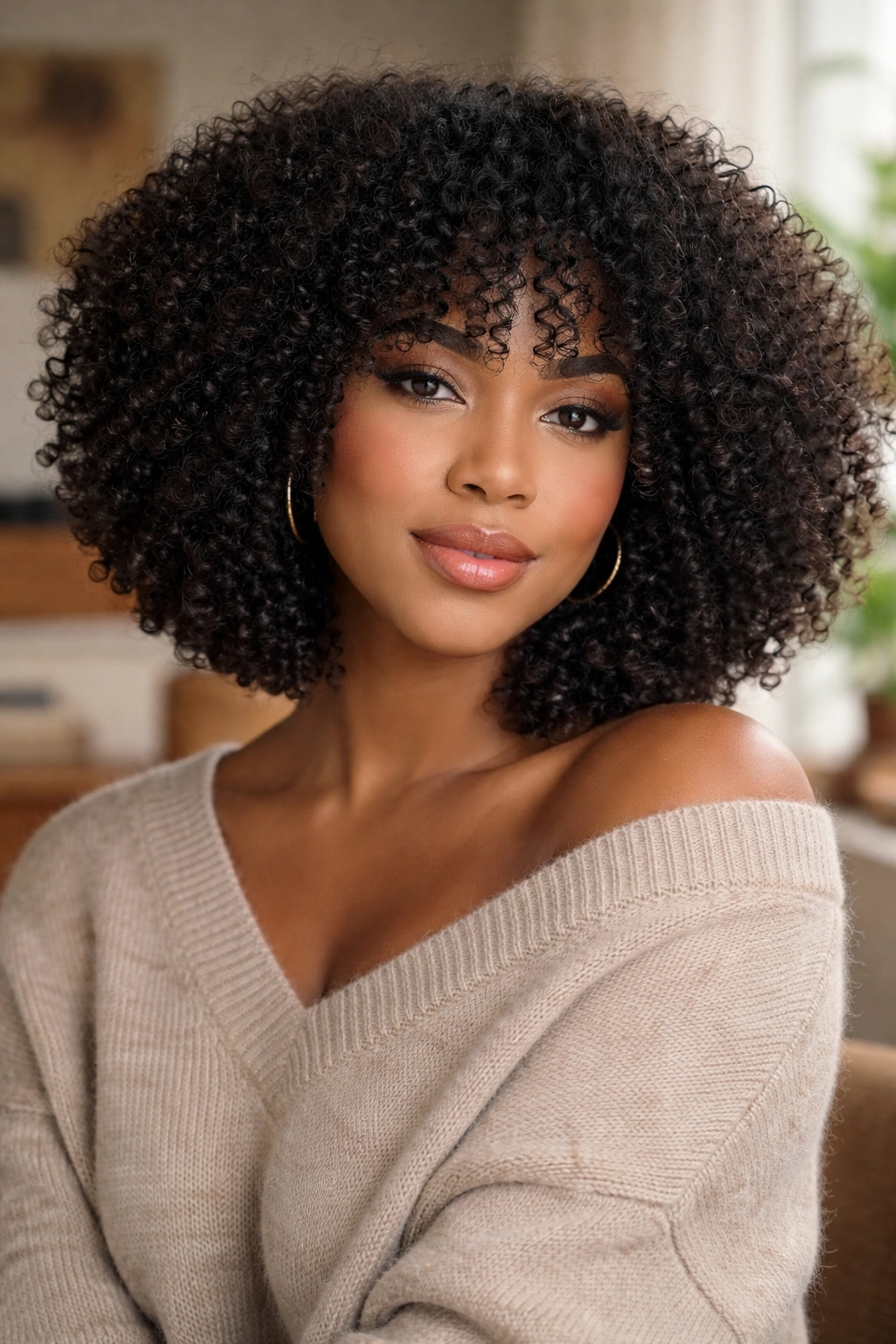
Not layers throughout the whole bob — specifically face-framing layers that sit at the cheekbones or jaw, cut to fall forward and frame the face. On afro hair, these face-framing layers usually require some subtle stretching or blow-drying to actually hang forward rather than springing upward, but when they sit correctly they create a beautiful frame.
On round faces, face-framing layers that angle toward the jaw create a narrowing effect — the layers point the eye toward the chin rather than the cheeks. The shorter layers within the bulk of the bob maintain the fullness of the overall shape while the face-framing sections do their visual work at the front.
9. The Afro Bob with a Defined Part and Flat Twists
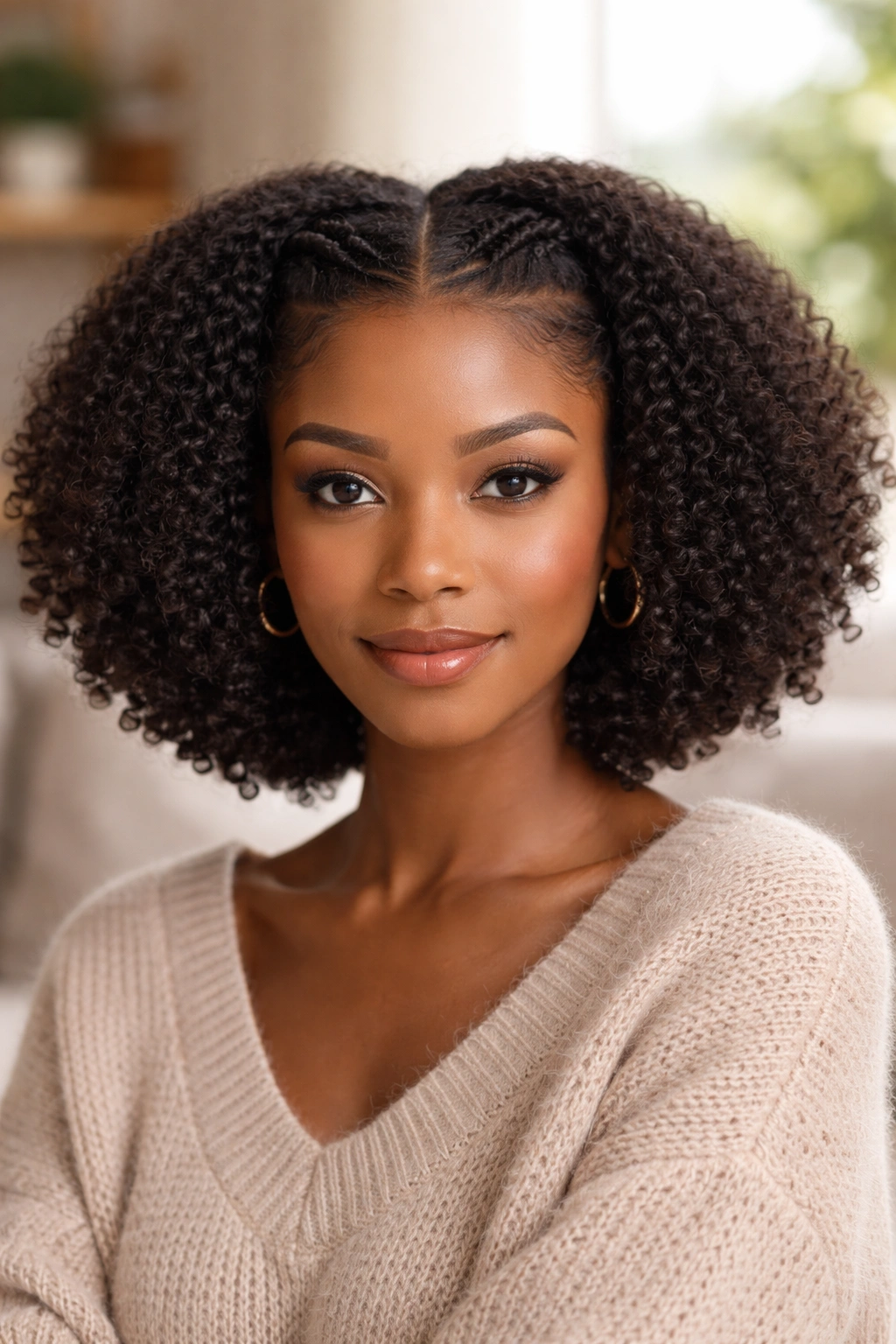
A bob-length overall cut with two flat twists at the crown — usually running from the forehead back — that add a graphic, textural element at the very top. The flat twists create height and a visual focal point at the crown, which is beneficial for round faces.
The flat twists sit closer to the scalp than regular twists, creating a ridged texture that’s visible and interesting. The rest of the bob-length hair sits in its natural coiled state below the twist section. The contrast between the structured twists and the free coils below creates visual depth.
10. The Maximized Volume Bob
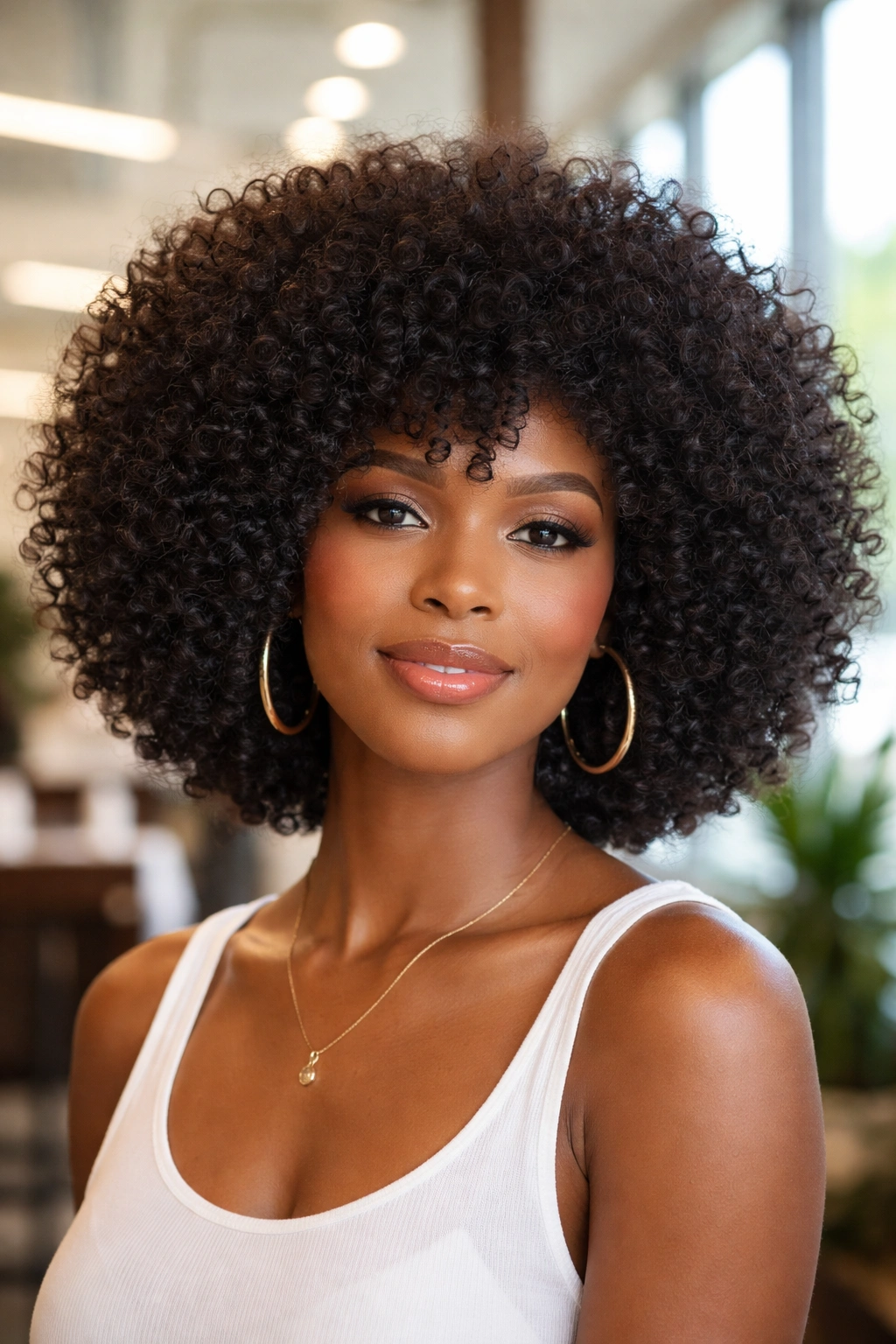
A bob that prioritizes volume over shape — fully picked out, every coil separated and freed, creating the maximum possible rounded silhouette. On round faces, this works when the total volume is balanced to be taller than it is wide. If the volume spreads mostly outward at the sides, the roundness is emphasized. If the pick focuses most of the volume upward at the crown, the face looks more elongated.
This is a style that requires deliberate product and technique to get the height-versus-width ratio right. Apply a light hold mousse or curl foam to damp hair, diffuse until mostly dry, then pick from the roots upward (not inward toward the scalp — this collapses the volume) while the hair is still slightly warm from the diffuser.
11. The Bob with Shaved Sides
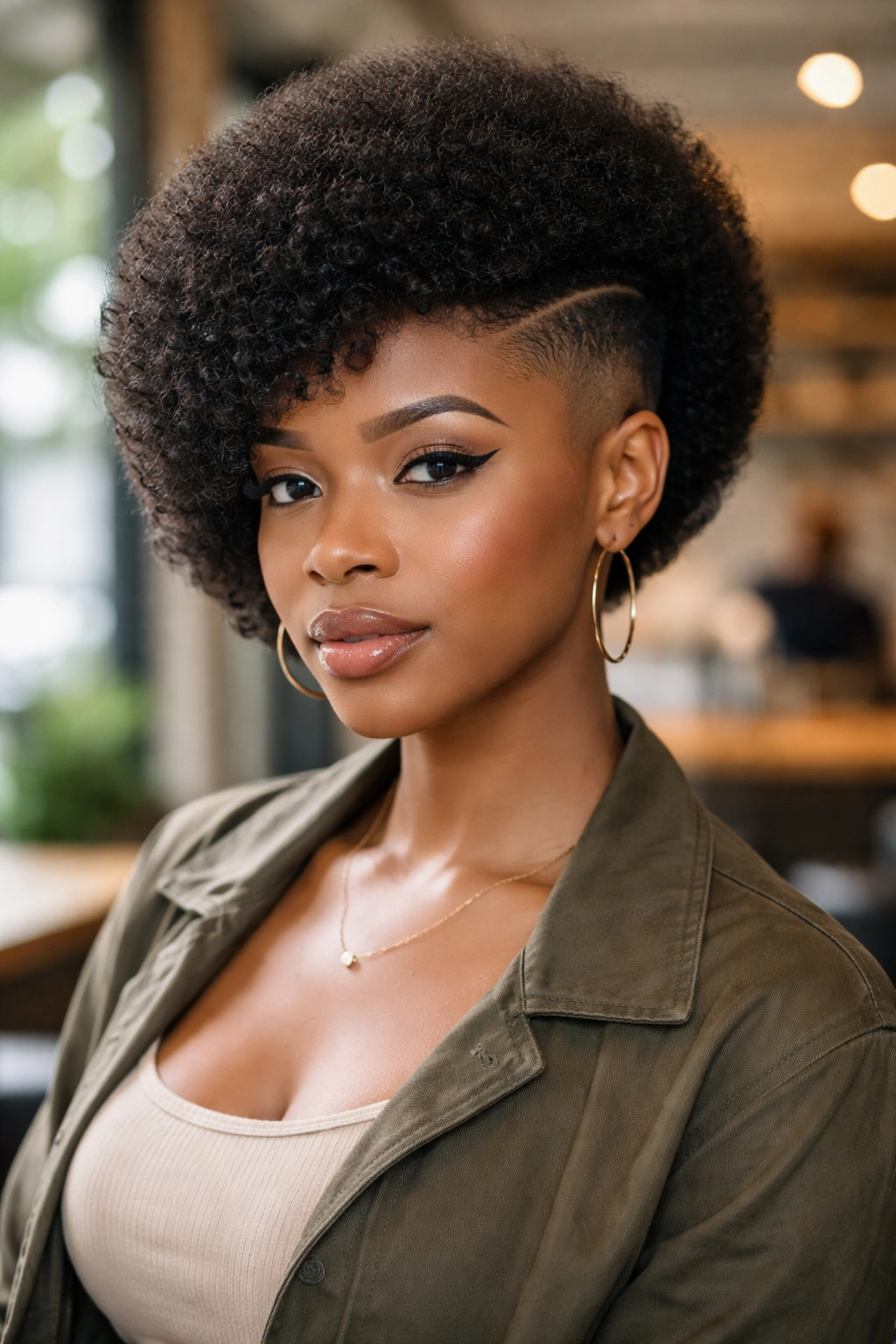
A bob at the crown and top of the head, with the sides cut very short or shaved. This reduces width dramatically at the sides — which is excellent for round faces — while the bob length on top maintains the overall silhouette. The contrast between the shaved sides and the natural bob section above is bold and graphic.
This is a significant commitment. Shaved sides grow back at about half an inch per month, which means visible regrowth at about 3-4 weeks. To maintain the shaved effect, you’re back in the salon chair regularly. If you want the effect without the commitment, ask about a very close fade rather than a true shave.
12. The Curly Bob with Edge Waves
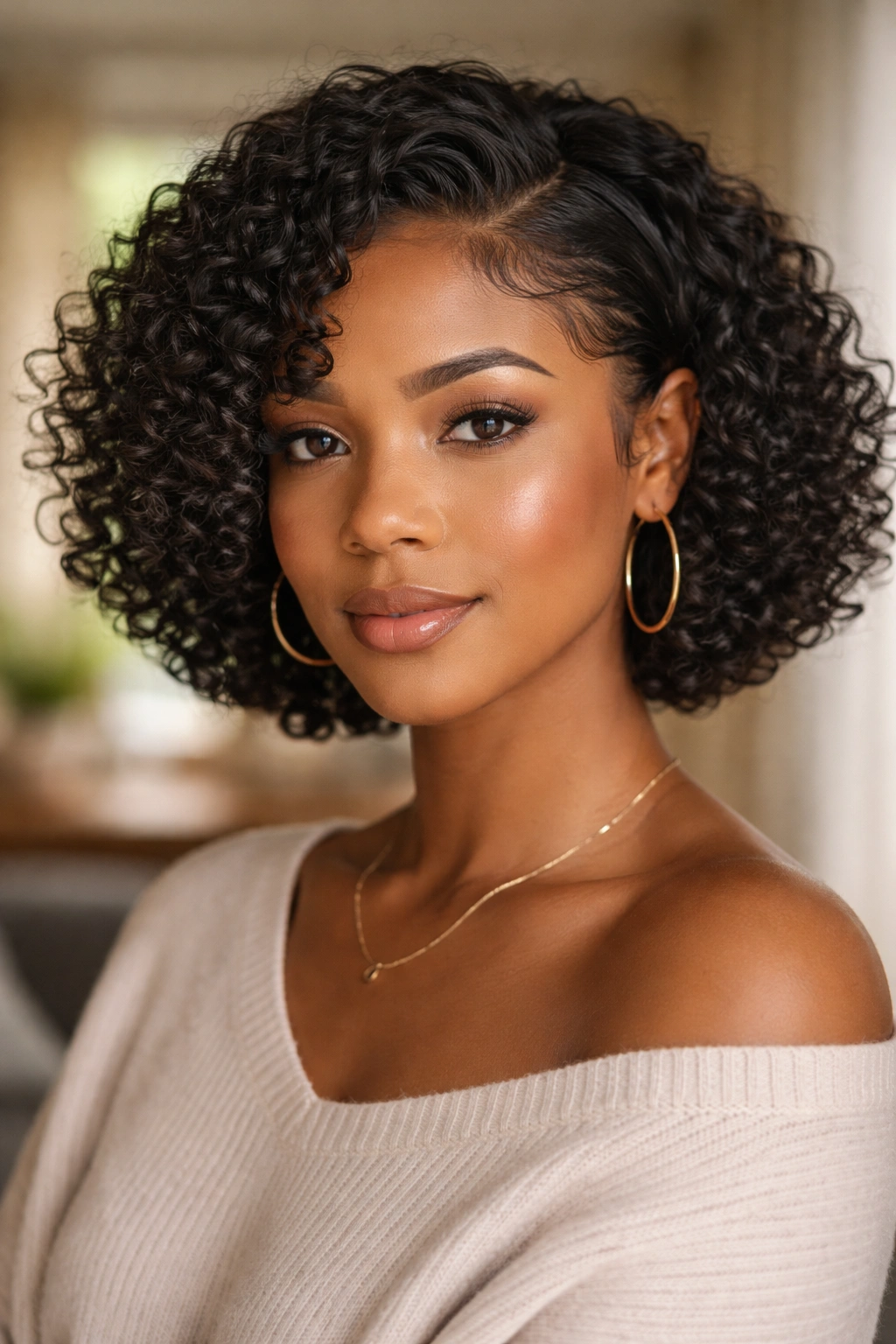
A standard bob length with the edge baby hairs set into deliberate waves along the hairline — crescents and swoops that frame the face at the forehead and temples. The contrasting texture between the free, volumized bob and the controlled edge waves gives the style a finished, intentional quality.
Edge waves at bob length look especially good when the hair has good density at the hairline — the waves need enough baby hair to be visible and shaped. If your hairline is sparse, a small amount of a fiber-texture edge gel can create the appearance of more baby hairs by thickening the individual strands.
13. The Neck-Length Bob
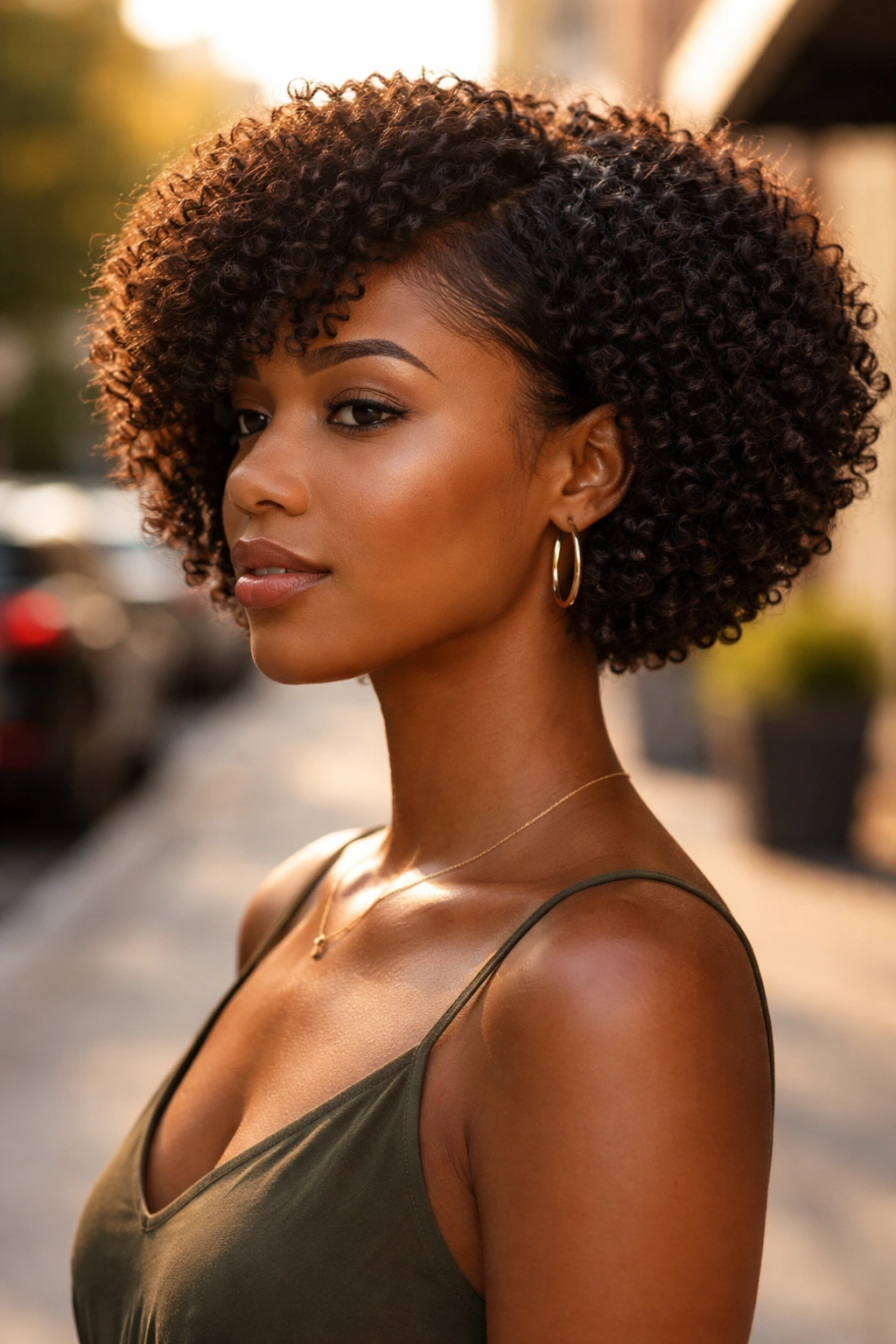
Cut to sit right at the nape of the neck when coiled — very short, very close to the head, almost more of a very full TWA than a traditional bob. On round faces, this extremely short length is either very flattering or very challenging depending on your specific facial proportions.
The neck-length bob works on round faces when the face has strong features — defined cheekbones, a clear jaw, distinct eyes — because the short length lets all of that show. On round faces where the features are softer and less sharply defined, this extreme shortness can make the face look rounder without the structural features to carry it.
This is the one bob on this list where a trial-and-error approach is harder — at this length, if the cut doesn’t work, you’re growing it out. Know your face before you go this short.
14. The Angled Bob with Color
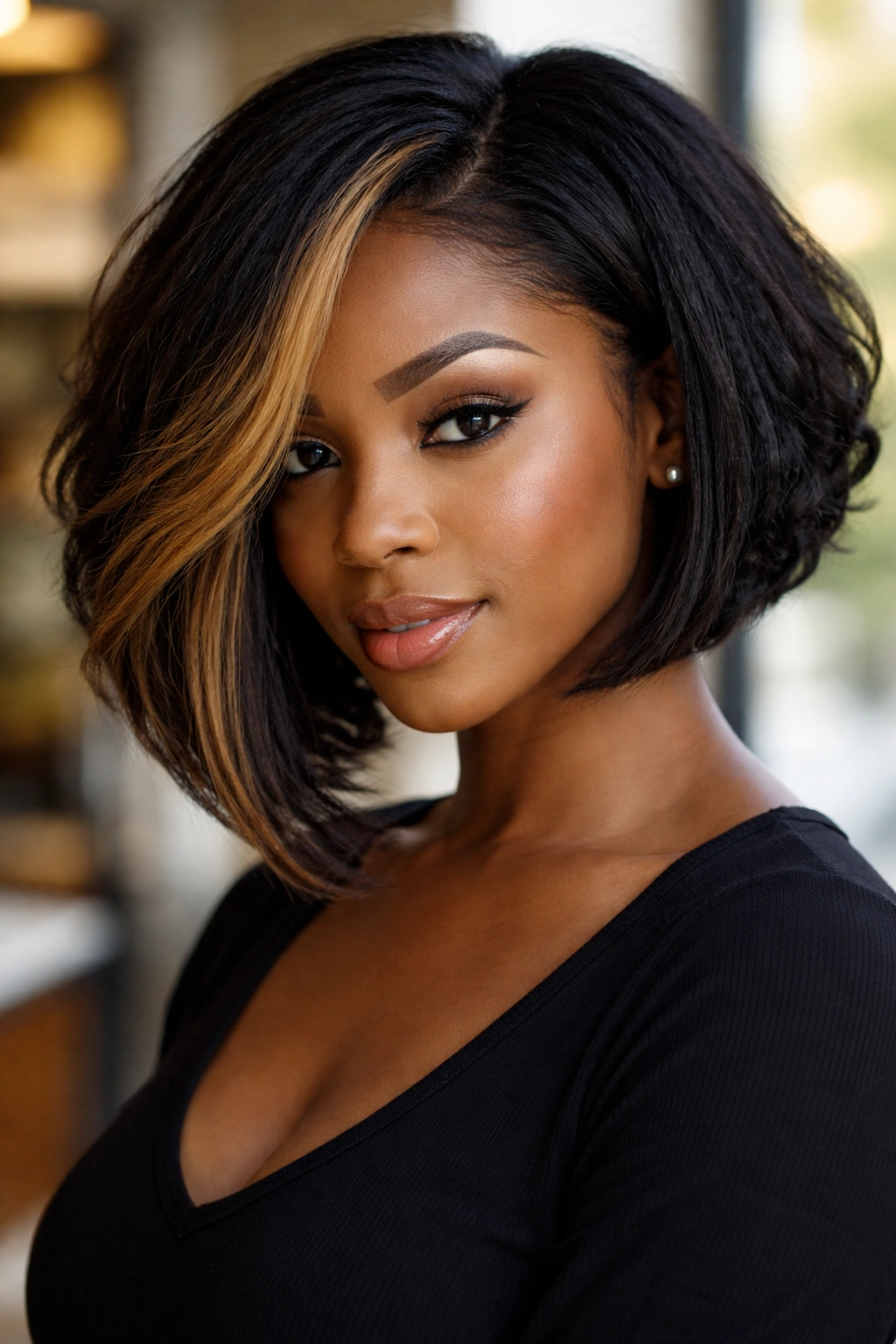
An angled (A-line) bob with a color element — highlights, an ombre, a fully colored section — placed at the front longer sections. On round faces, a color-treated front section draws the eye toward those face-framing pieces rather than toward the widest point of the face. The color creates a focal point.
The most flattering color placement for a round face in an angled bob: concentrate the lighter or brighter color at the front, longest sections where they’ll frame the face. A honey blonde front section on a dark brown base creates a natural-looking highlight that directs attention exactly where you want it.
15. The Faux Hawk Bob
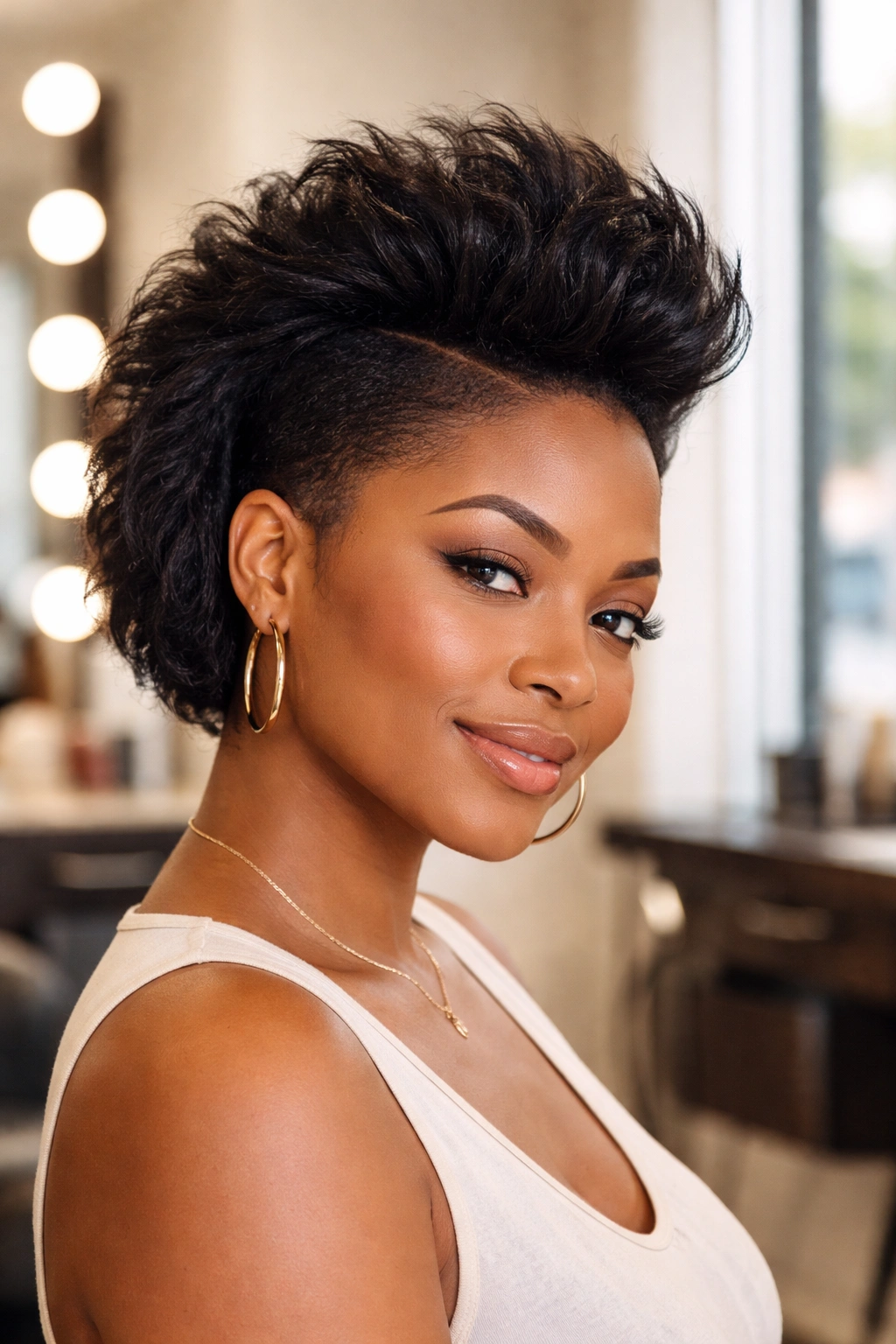
A bob with a slight mohawk effect: the center section has more volume and height than the sides, creating a soft ridge down the center of the head. Not a dramatic full mohawk — just enough height in the center to create an elongating visual line.
On round faces, the vertical ridge down the center is specifically helpful because it adds a clear, central, upward-moving element that counterbalances horizontal width. The sides of the bob sit lower and less voluminous, reducing the side width that would emphasize roundness.
This is mostly a styling technique rather than a distinct cut — the hair is set with the center section picked higher, the sides smoothed slightly. But some stylists do cut a subtle variation into the length to support the shape: slightly shorter at the sides, more length and layering at the center top.
16. The Bob with Natural Part Line
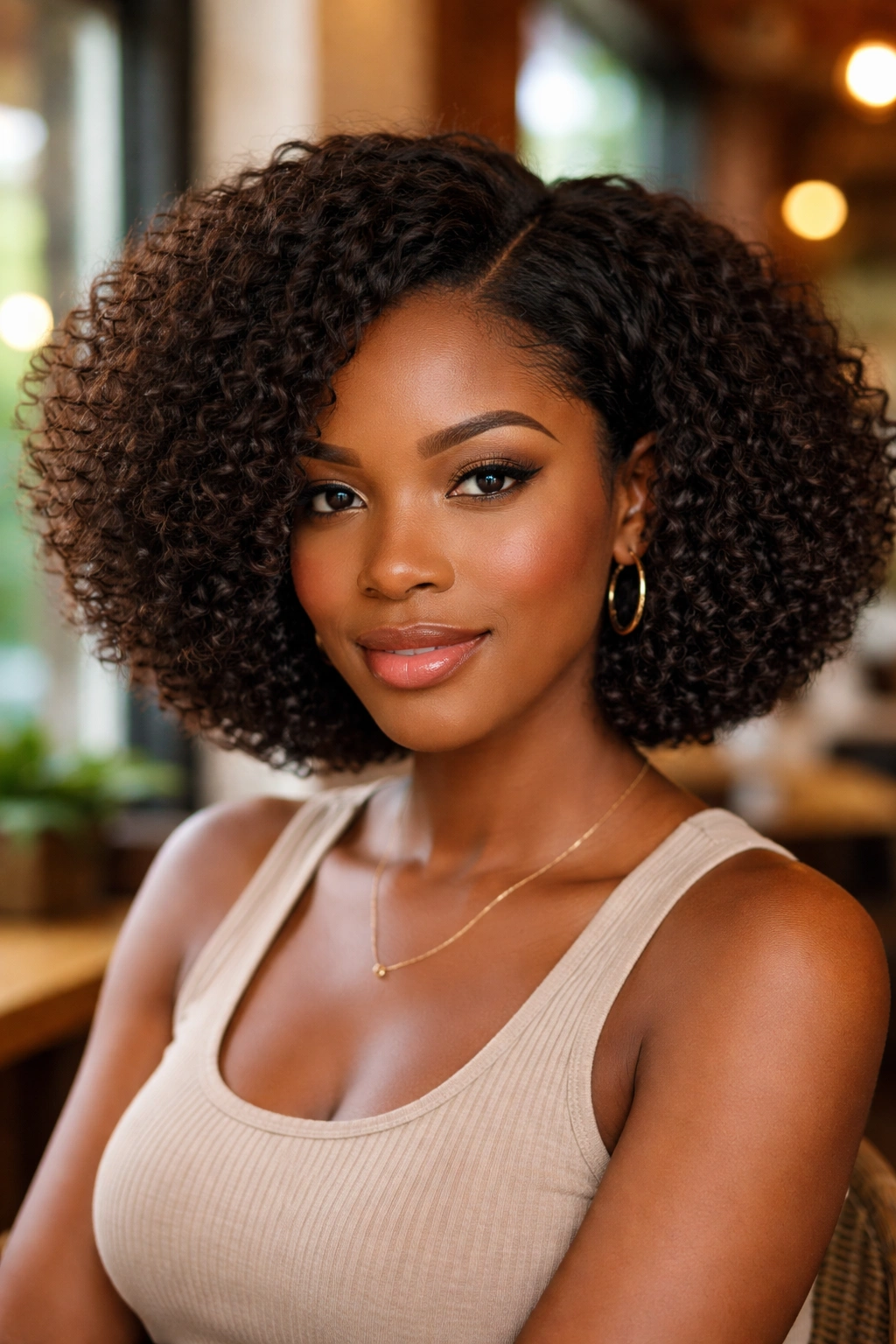
Going back to the absolute basics: a bob cut at any of the above lengths, worn with your natural parting rather than a deliberate styled part. For some women with round faces, the natural part happens to fall slightly off-center, which provides automatic asymmetry. For women whose hair naturally parts in the center, a center part can actually work on a round face if the bob is angular enough or has sufficient crown height.
The center part on a round face is the most discussed “rule violation” in face shape styling. But honestly — if your bob has strong vertical elements (height at the crown, angular cut lines, defined texture) the center part doesn’t necessarily hurt the silhouette. Trust your mirror over the general rule.
17. The Afro Bob with a Twist-Out Finish
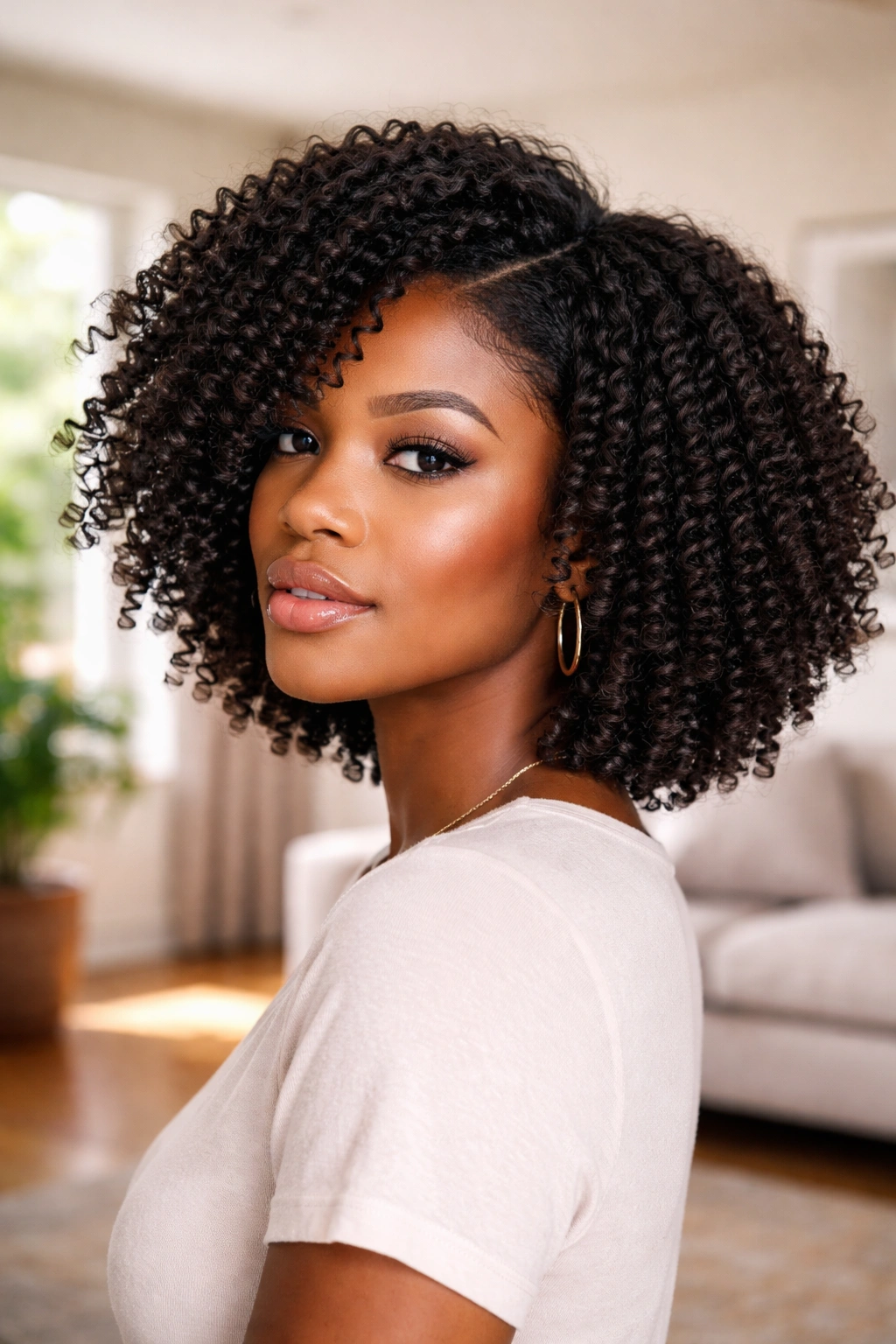
Instead of wearing the bob as a wash-and-go, set the entire bob length in two-strand twists after washing and product application, let them dry completely overnight, and then release them the next morning. The twist-out gives the bob a defined, stretched texture that has more visual length than the fully coiled wash-and-go version of the same cut.
For a round face, this extra apparent length is beneficial — the stretched coils sit longer on the face, giving the impression of a longer bob and reducing the visual emphasis on width. The twist-out texture also has a dimensional quality that adds interest without adding mass at the widest point.
18. The Poofy Bob
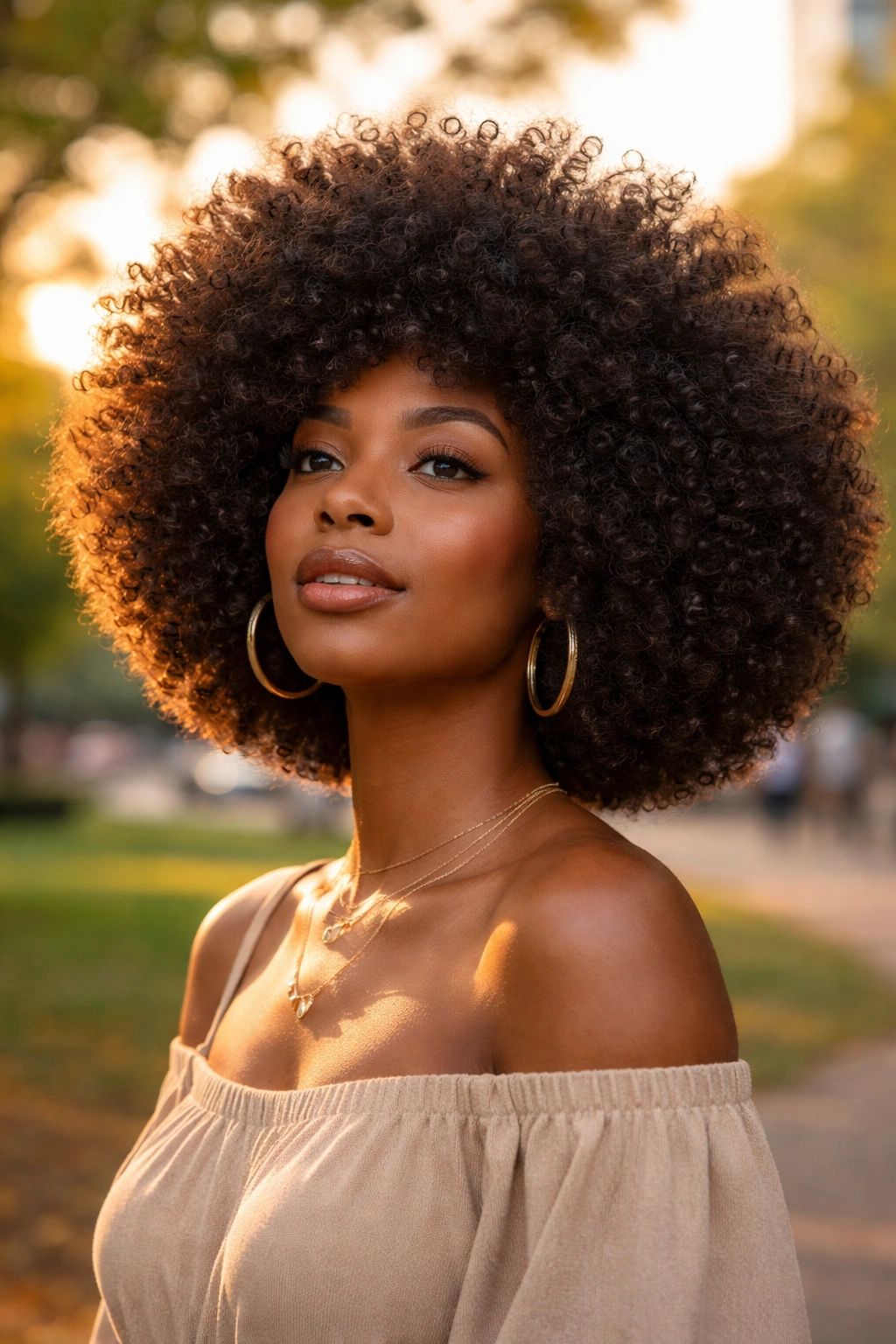
Not every bob on a round face needs to be architectural and strategic. The poofy bob — maximum volume, minimal shaping, picked out as full as possible — has a joyful, expressive quality that’s worth considering. Yes, the volume adds visual width. But if the height is also there, the overall effect can be balanced.
The poofy bob works on round faces when the total shape is taller than it is wide. If your pick-out creates a shape that’s 7 inches tall and 6 inches wide, the face behind it looks proportionate and framed, not swallowed. If it spreads to 8 inches wide and 4 inches tall, the roundness is overwhelmed by the horizontal.
19. The Long Bob (Lob) for Natural Afro Hair
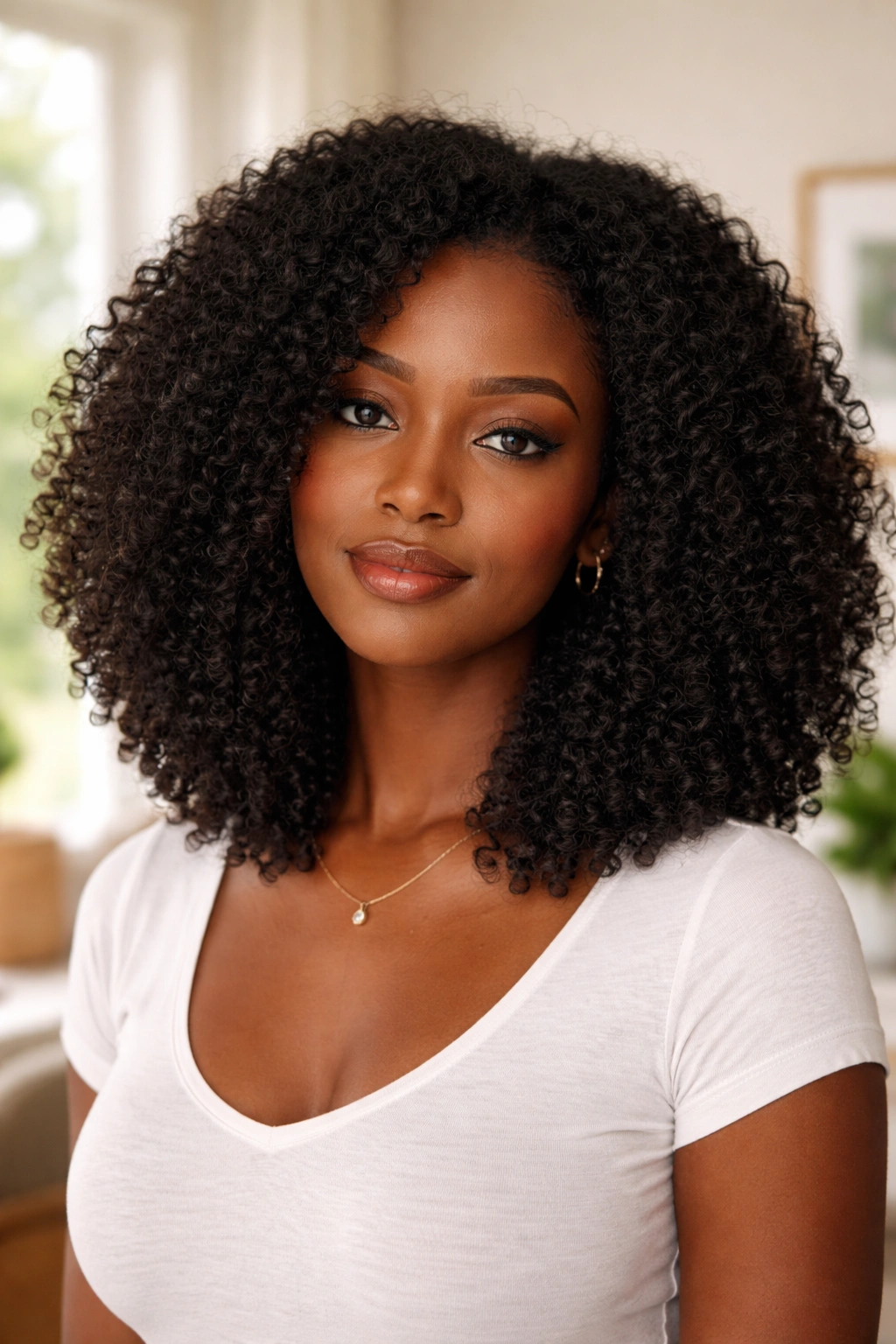
A lob at its natural shrinkage sits at the collarbone — on type 4 hair with typical shrinkage, this requires somewhere between 7 and 10 inches of stretched length. The extra length compared to a standard bob adds elongation that’s very helpful for round faces.
The collarbone-length natural lob is flattering on round faces because the length extends well below the widest point of the face, drawing the eye downward toward the longer sections rather than outward toward the cheeks. It’s also one of the most versatile natural styles — long enough for puffs, ponytails, and updos but short enough to wash and go without excessive drying time.
20. The Stacked Graduated Bob
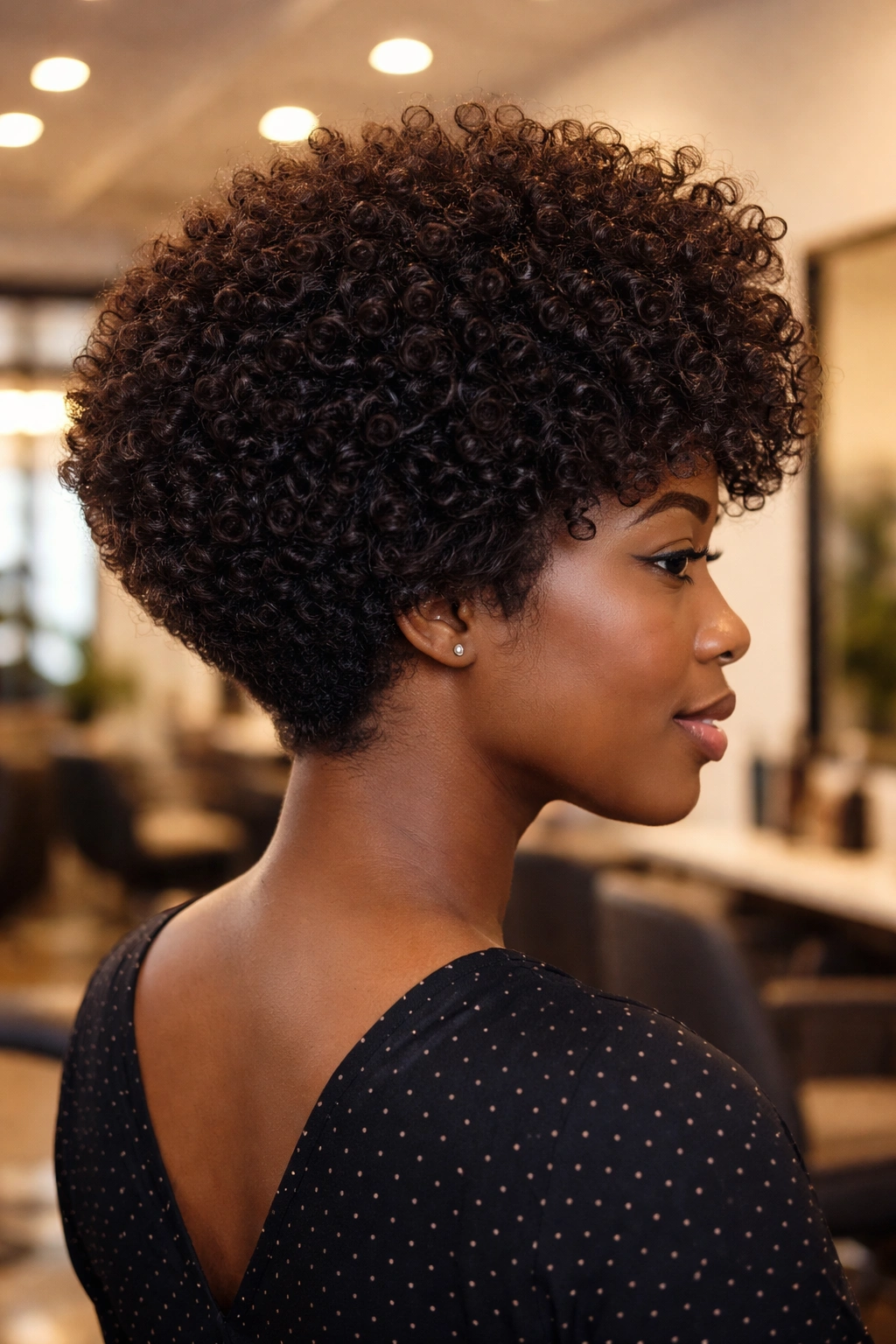
Graduated layers from the nape upward, with each layer progressively longer toward the crown, creating a stacked effect at the back. Viewed from the side, the back of the hair has a curved, stacked silhouette that adds height at the crown. Viewed from the front, the style is full and round but with obvious height rather than obvious width.
This cut requires a skilled hand — the graduation needs to be consistent, and on natural afro hair each layer needs to account for how the coils spring back at that specific length. An experienced natural hair stylist who understands layering on textured hair is essential.
21. The Bob with Edge Laid Designs
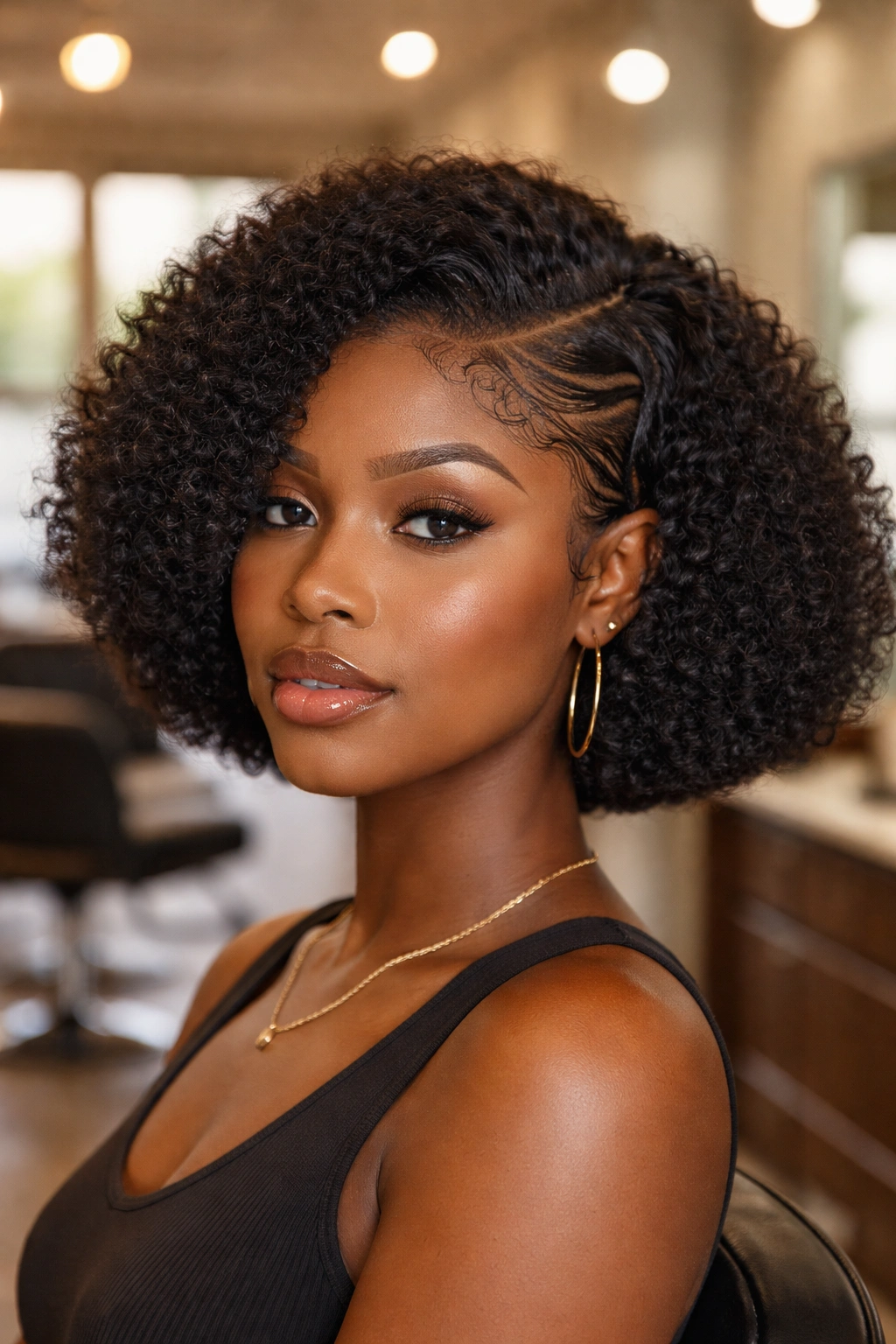
Taking the edge styling concept to a creative extreme: instead of simple waves or swoops, lay the edges into deliberate designs — geometric patterns, S-curves, loops, spirals — that create an artistic frame around the face at the bob’s perimeter. This transforms the hairline from a background detail to a feature of the style.
The designs are created with a soft brush, rattail comb, and medium-to-firm hold edge gel. They need to be set with a satin scarf or wrap for at least 30 minutes to hold their shape. The complexity of the design you can create depends on the density and length of your baby hairs — very sparse baby hairs limit the design options.
22. The Chic Minimal Bob
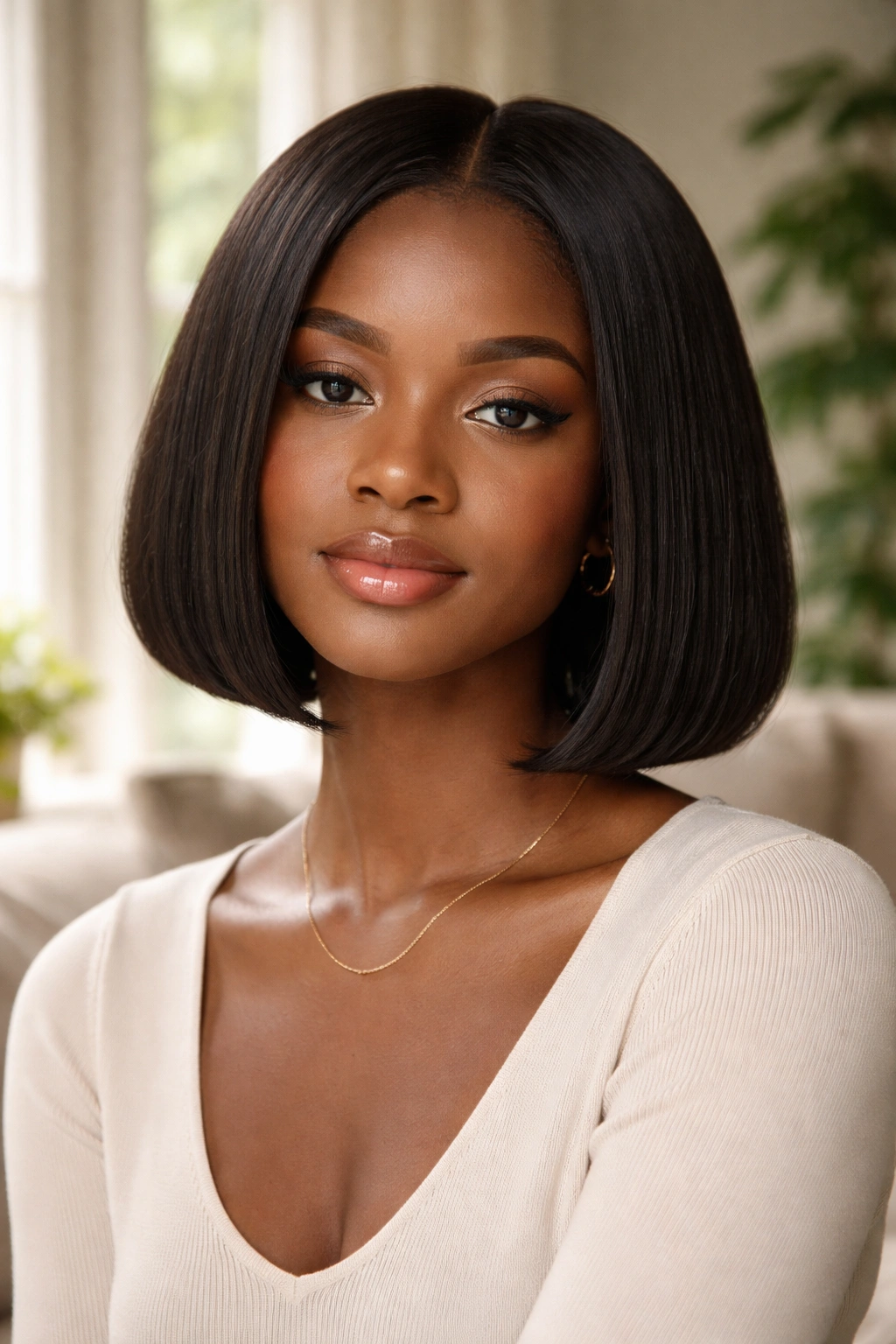
Everything stripped back: a clean, even, one-length bob at a consistent length around the entire head, no layers, no asymmetry, no special styling beyond washing, moisturizing, and letting the hair dry in its natural state. The coils determine the shape. The cut is the statement.
On round faces, the minimal bob needs to be at a length that doesn’t amplify the face’s roundness — which means chin-length or below rather than cheekbone-length. At chin length and below, the coils hanging past the widest part of the face create a framing effect. At cheekbone length, the volume sits at the face’s widest point and emphasizes it.
Simple doesn’t mean easy. A truly clean, minimal bob requires an excellent cut, well-maintained ends, and consistently healthy, defined hair. There’s no style element to hide behind — the hair itself is the whole look.
Maintaining an Afro Bob Between Cuts
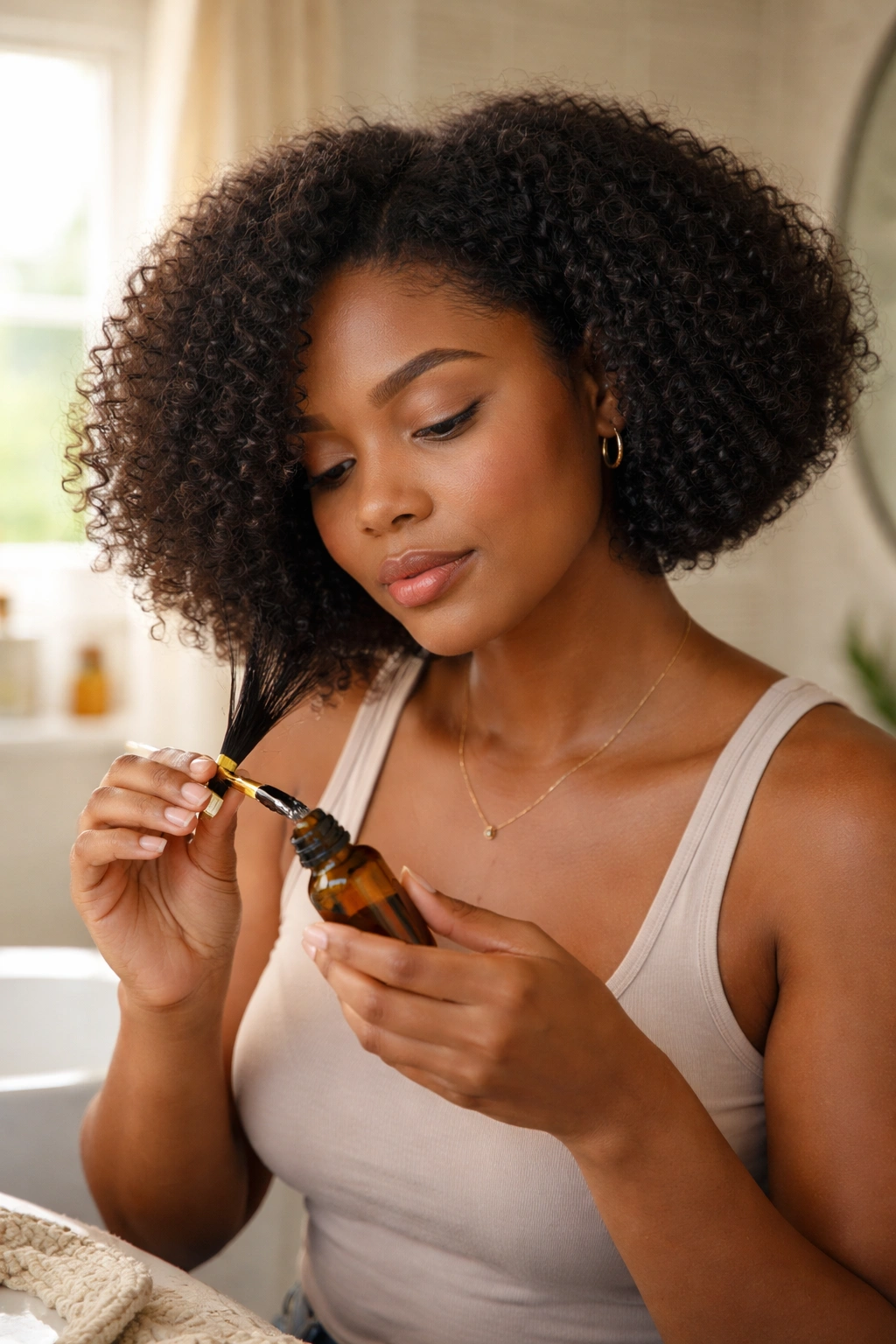
Bob haircuts on natural afro hair need trims more frequently than longer styles because uneven ends are more visible at shorter lengths. A trim every 6-8 weeks keeps the bob shape looking intentional rather than grown-out. Between trims, the ends benefit from a weekly hot oil treatment — warm coconut oil or olive oil applied to just the ends, left for 20-30 minutes under a plastic cap, then washed out — to prevent dryness and splitting.
For any of the styles that depend on edge work or a specific part, a daily or every-other-day refresh of the edges keeps the style looking fresh. Edge gel, a baby brush, 2 minutes — that’s all it takes.
The Wash Day Routine for an Afro Bob
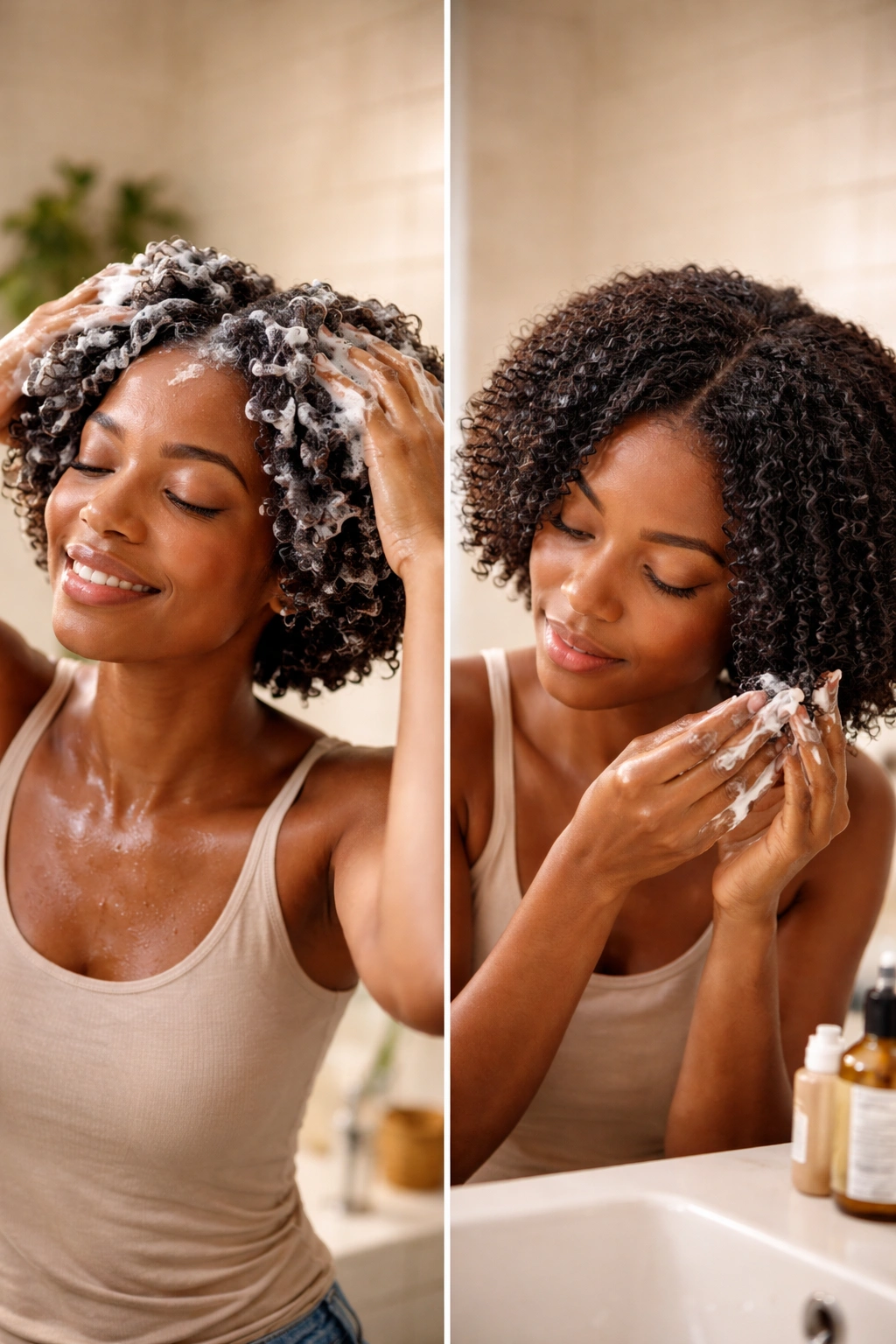
Shorter hair doesn’t mean simpler wash days — it means faster ones, which is one of the underrated practical benefits of a bob. But the routine still needs to be thorough to keep the cut looking sharp.
Shampoo with a sulfate-free formula no more than once a week on most afro textures — possibly every 10 days if your hair is on the drier side. Use a clarifying shampoo once a month to remove product buildup, which accumulates quickly on shorter styles where you apply product more frequently per inch of hair. Follow every wash with a deep conditioning mask, focusing the product on the ends rather than the roots, and leave it on for at least 20 minutes. The roots don’t need as much conditioning as the ends — roots are closest to the scalp’s natural sebum production and typically the moistest part of the hair.
On a bob, diffusing on low heat rather than air drying gives you more control over the final shape. Air drying can leave a bob looking flatter on one side depending on how you positioned your head while the hair was drying. A diffuser on medium speed and low heat, with the hair scrunched upward into the cup of the diffuser, builds volume and maintains curl pattern without disturbing it.
Product order matters more on a bob than on longer hair because shorter hair has less room for error. Apply in this sequence: leave-in conditioner on wet hair, then a curl cream or gel, then a light sealant oil pressed into the palms and smoothed over the exterior — never worked inward with vigorous rubbing, which disrupts the curl pattern.
Styling Your Afro Bob for Different Occasions
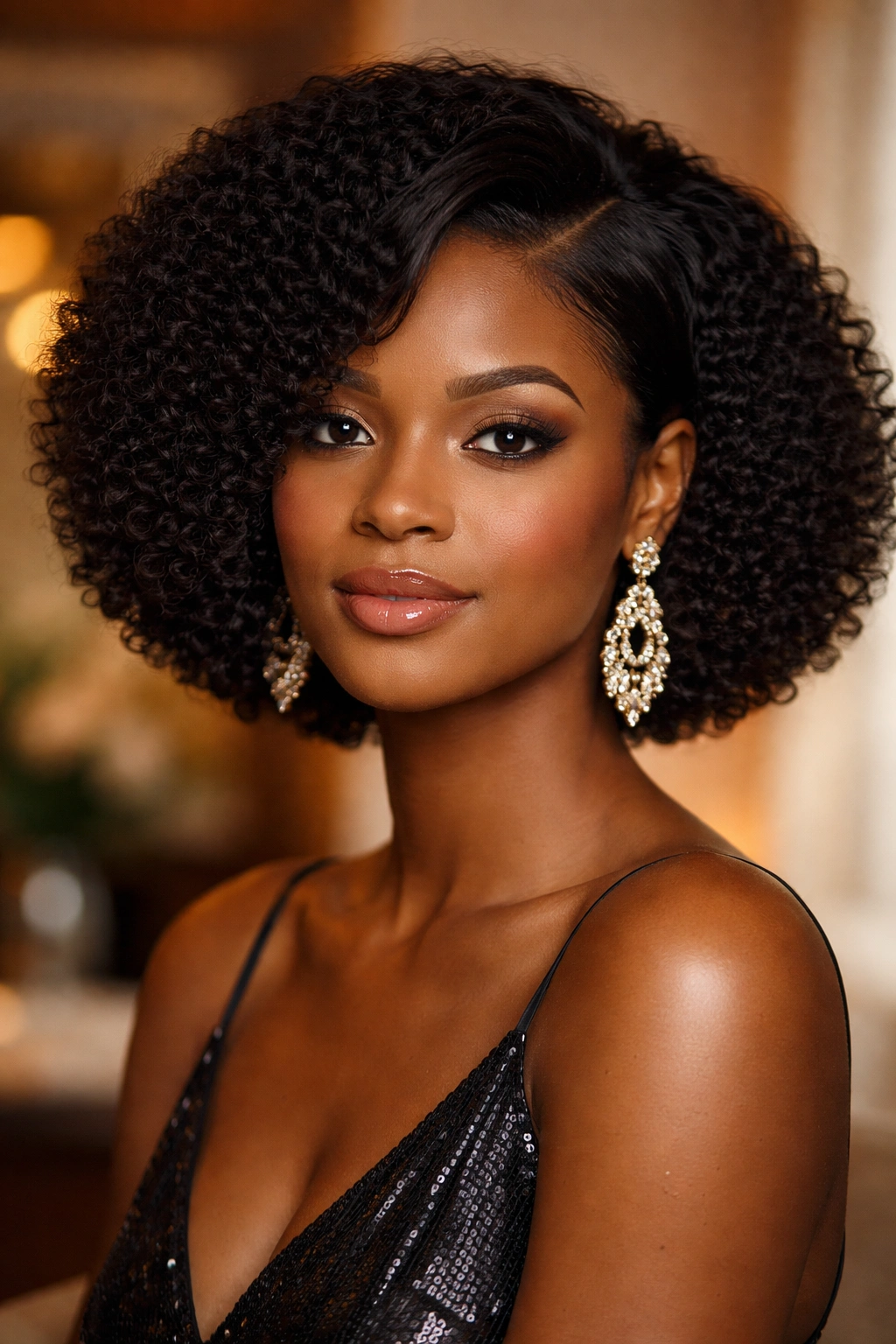
One thing that surprises women when they go from longer natural hair to a bob is how different the style reads in different contexts — not because you have to do anything different, but because the shorter length brings the face into more prominence. The same wash-and-go that reads as casual on longer hair reads as polished and deliberate on a bob. And that’s genuinely useful.
For everyday wear, a clean wash-and-go or twist-out on the bob is enough. For occasions that need more formality — work presentations, events, evenings out — the bob can be elevated by adding deliberate edge work, doing a more structured twist-out with tighter twist sections for better definition, or styling the bob with a deep part and a sculpted side. None of these require heat, extensions, or elaborate technique. The bob’s structure does most of the work.
Statement earrings are worth mentioning here. On a bob, earrings are visible in a way they’re not on longer hair. A pair of large hoops, sculptural geometric drops, or long tassel earrings transforms the visual weight of a simple bob into something that reads as a complete, considered look. The haircut frames the earring; the earring completes the haircut.
Choosing the Right Bob Length for Your Specific Round Face
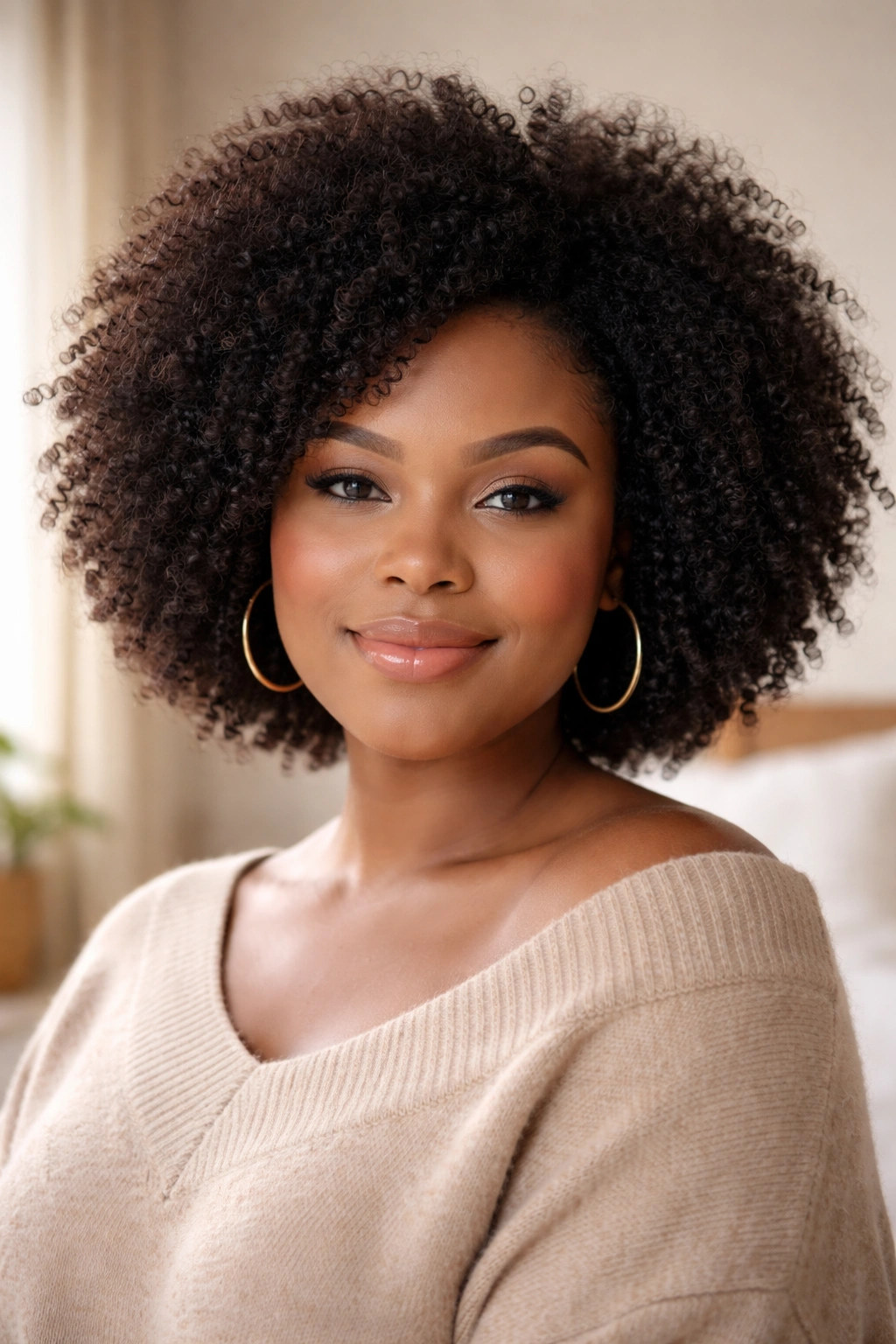
Beyond the general guidance of “avoid cheekbone-length volume,” the right bob length depends on several factors unique to your face: how much definition your jaw has, how your cheekbones are positioned, how long your neck is, and what your overall body proportions look like.
A longer neck handles shorter bob lengths better — the exposed neck creates visual length that compensates for the bob’s closeness. A shorter or less defined neck may do better with a lob or a bob that falls below the chin to create more elongation. These aren’t rules to follow anxiously — they’re variables to be aware of as you’re deciding.
The best approach: take reference photos of round-faced women with afro bobs that appeal to you, bring them to your stylist, and have an honest conversation about how the cut would need to adapt for your specific texture, shrinkage level, and face proportions. That conversation is worth more than any list.