



Ghana cornrow styles are a different animal from plain cornrows. The hallmark is the feed-in technique — starting with a whisper of hair at the hairline and adding more kanekalon gradually, row by row, until the cornrow thickens to its full weight halfway down. That taper is the signature. It’s what makes Ghana braids sit so cleanly, last so long, and read so intentional. Twenty-five Ghana cornrow styles sit on this page, each one genuinely different from the others — different parts, different shapes, different finishes, different reasons to try it.
These aren’t hypothetical styles. Ghana braids have been part of West African hair culture for hundreds of years, worn in Ghana long before any crossover into mainstream Western media. The feed-in method predates box braids and French braids as we know them. When you wear Ghana cornrows, you’re wearing a technique with lineage — not a trend with an expiration date.
What Sets Ghana Braids Apart From Plain Cornrows
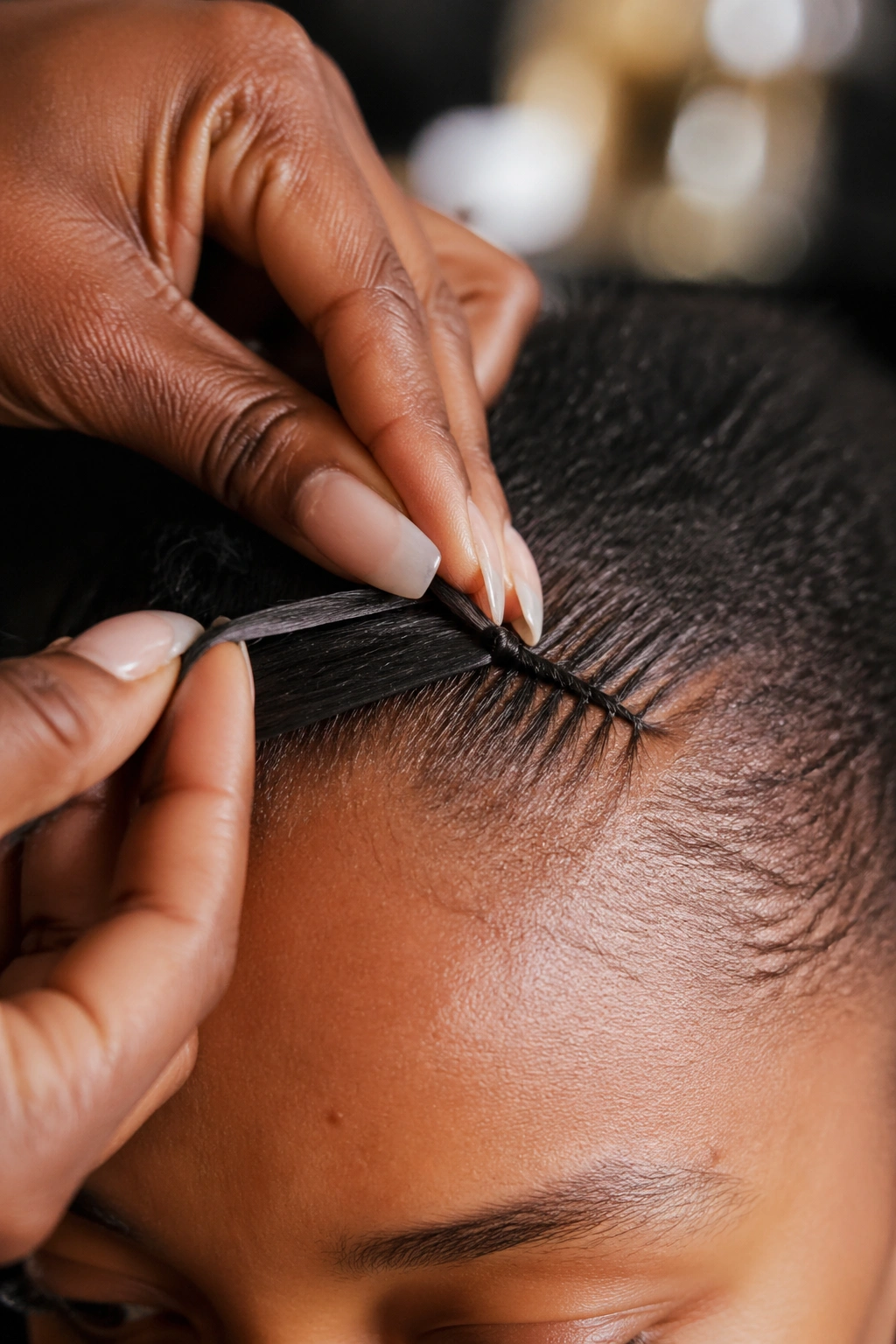
The feed-in. That’s the core difference. In a plain cornrow, you braid your own hair flat against the scalp from start to finish. In a Ghana cornrow, you braid a small section of your own hair at the hairline and gradually add small pieces of kanekalon extension as you work down the head. Each added piece feels like a layer joining the braid.
The result is a cornrow that looks thin and delicate at the hairline and blooms into a thicker, longer braid toward the nape or beyond. That taper is what gives Ghana styles their clean, sculptural look.
Why it matters: the thinner start means less tension at the edges. Less tension means healthier edges over time. Less edge damage over time means more hair, longer. That’s the practical payoff behind the stylistic one.
Hair Prep for Long-Lasting Ghana Cornrows
Ghana braids are often kept in for four to six weeks — sometimes longer if the scalp allows. That longevity demands better prep than a two-week style.
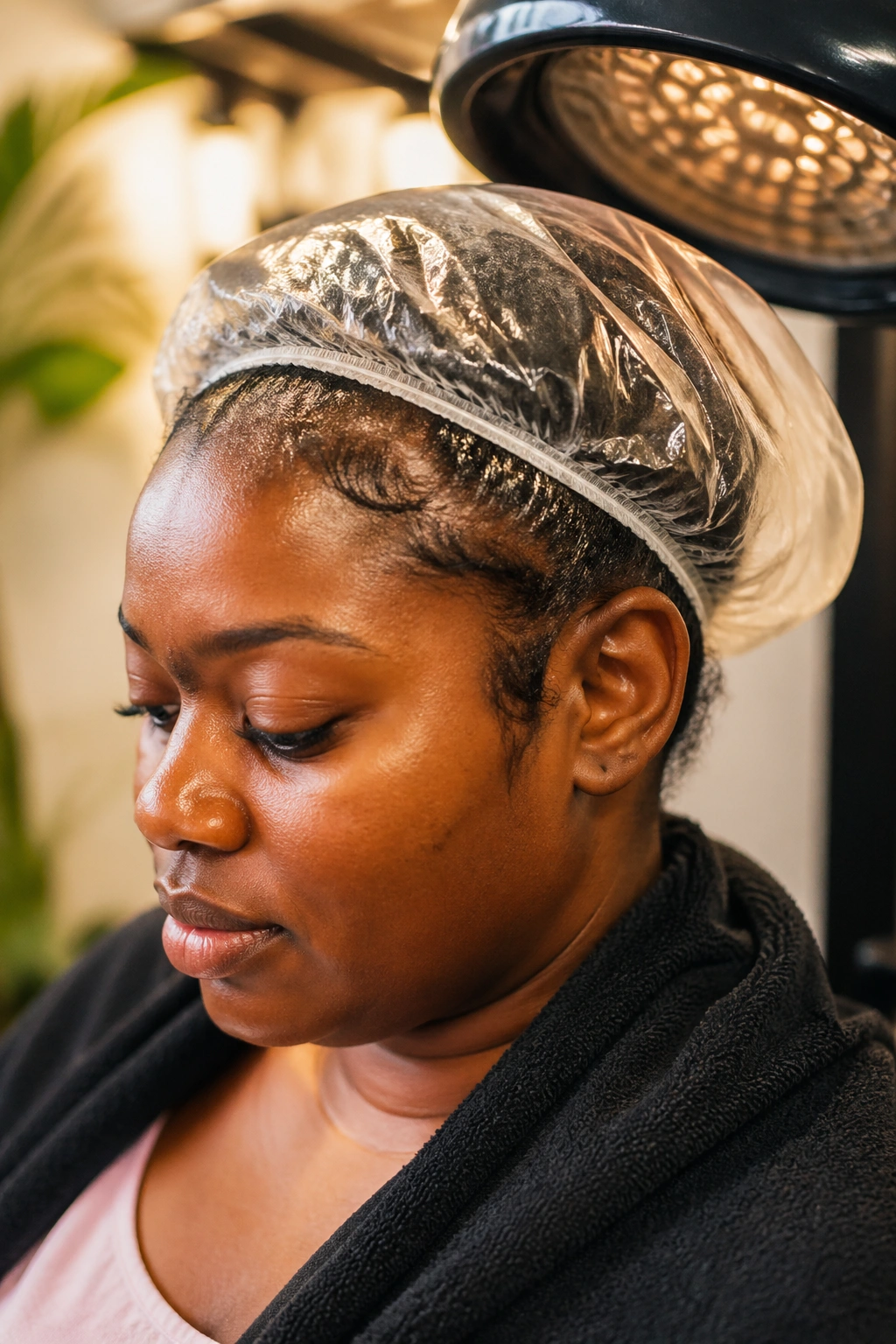
Start with a clarifying shampoo to strip buildup. Follow with a hydrating cleanser and a deep conditioner — 30-45 minutes under a plastic cap with heat if possible. Blot, apply a leave-in, then stretch the hair using braids or twists overnight. You want the hair slightly damp-dry but not wet by the time the braider starts.
Key prep tip: your natural hair should be stretched enough to blend with the kanekalon seamlessly at the hairline. Shrinkage that pops up after the first wash can bubble the cornrow and shorten its lifespan.
Choosing the Right Kanekalon for Ghana Styles
Not all kanekalon is equal. Cheap, stiff kanekalon tangles, sheds, and sometimes irritates sensitive scalps. Invest in pre-stretched or soft braiding hair — the difference in hand-feel is immediate.
Pre-stretched kanekalon saves time because the ends are already tapered. You skip the step of pulling and tearing the ends yourself. A pack of pre-stretched usually runs slightly more than standard, but the smoother finish and reduced prep time are worth it.
For the color, match your natural hair depth for an invisible blend, or go two shades lighter for dimension. Dramatic contrasts — bright colors, ombré tips, or color-blocked rows — work, but they change the style’s read entirely.
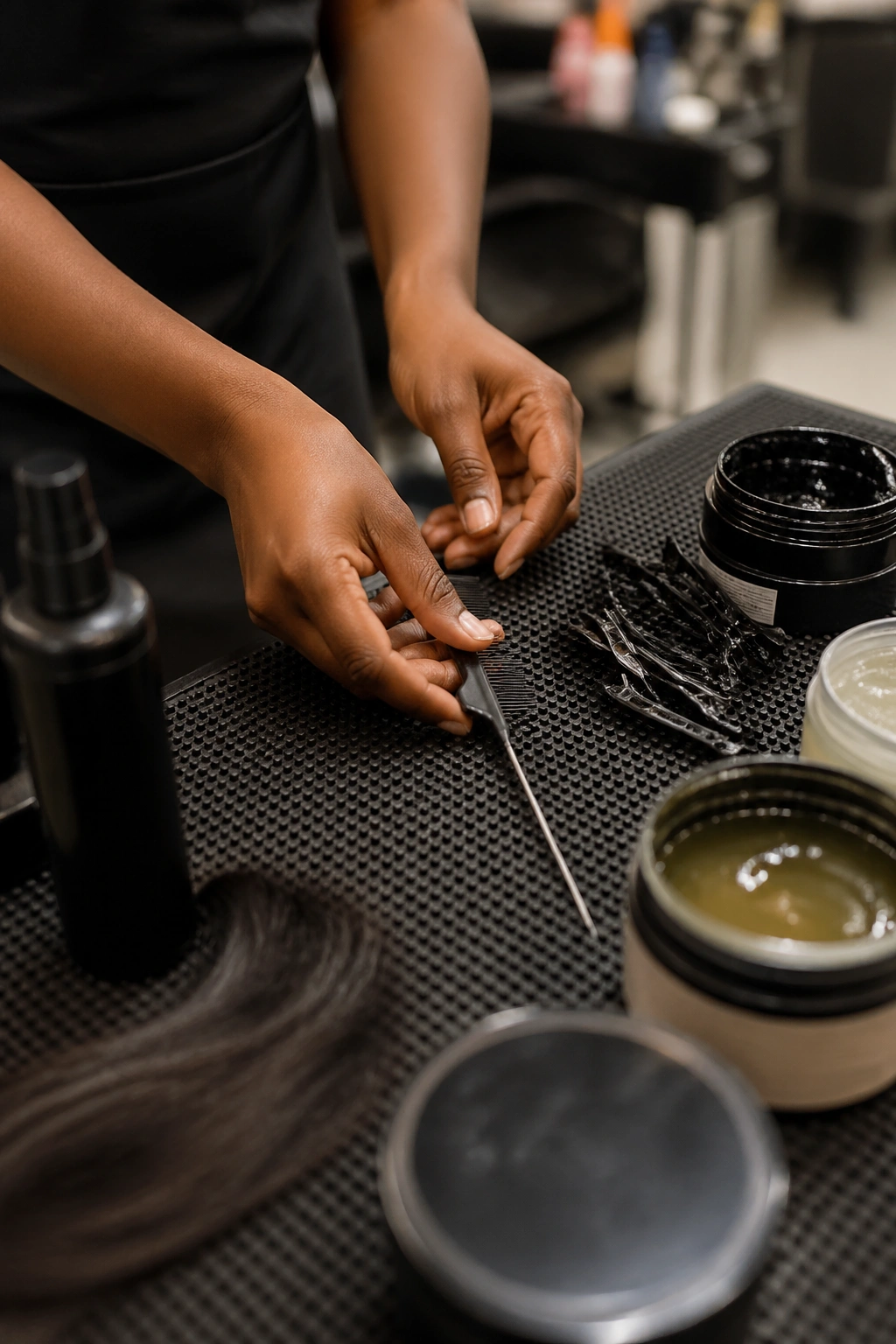
Tools You Actually Need
- A rat-tail comb with a metal tip for clean parting
- Hair clips — at least eight — for sectioning
- Edge control gel with strong hold
- A small jar of braiding wax or mousse for smoothing
- A pair of sharp hair shears for trimming ends
- A spray bottle with water and a splash of leave-in
- A lighter or hot water in a mug for sealing the braid ends
- A tail comb for flicking up parts as you work
Most of this you’ve got already. A light-hold mousse for the hairline smoothing is the one tool that often gets skipped and shouldn’t be.
Technique Fundamentals Before Starting
Feed-in hair goes in small. The first stitch of the cornrow should use only your natural hair. The second stitch adds a tiny, thin piece of kanekalon — folded in half over the strand. The third adds another. Each addition should be barely visible until you’re four or five stitches in.
If the cornrow looks chunky at the hairline, you added too much hair too fast. Take it out, go slower.
Feed below the top strand — always below. Adding hair to the top makes the cornrow look stacked and uneven. Feeding underneath keeps the top of the braid smooth.
Seal the ends in hot water (submerge for 10-15 seconds) or use a lighter held briefly near the tip. Both methods melt the kanekalon slightly and lock the braid from unraveling.
1. Classic Four Feed-In Ghana Cornrows
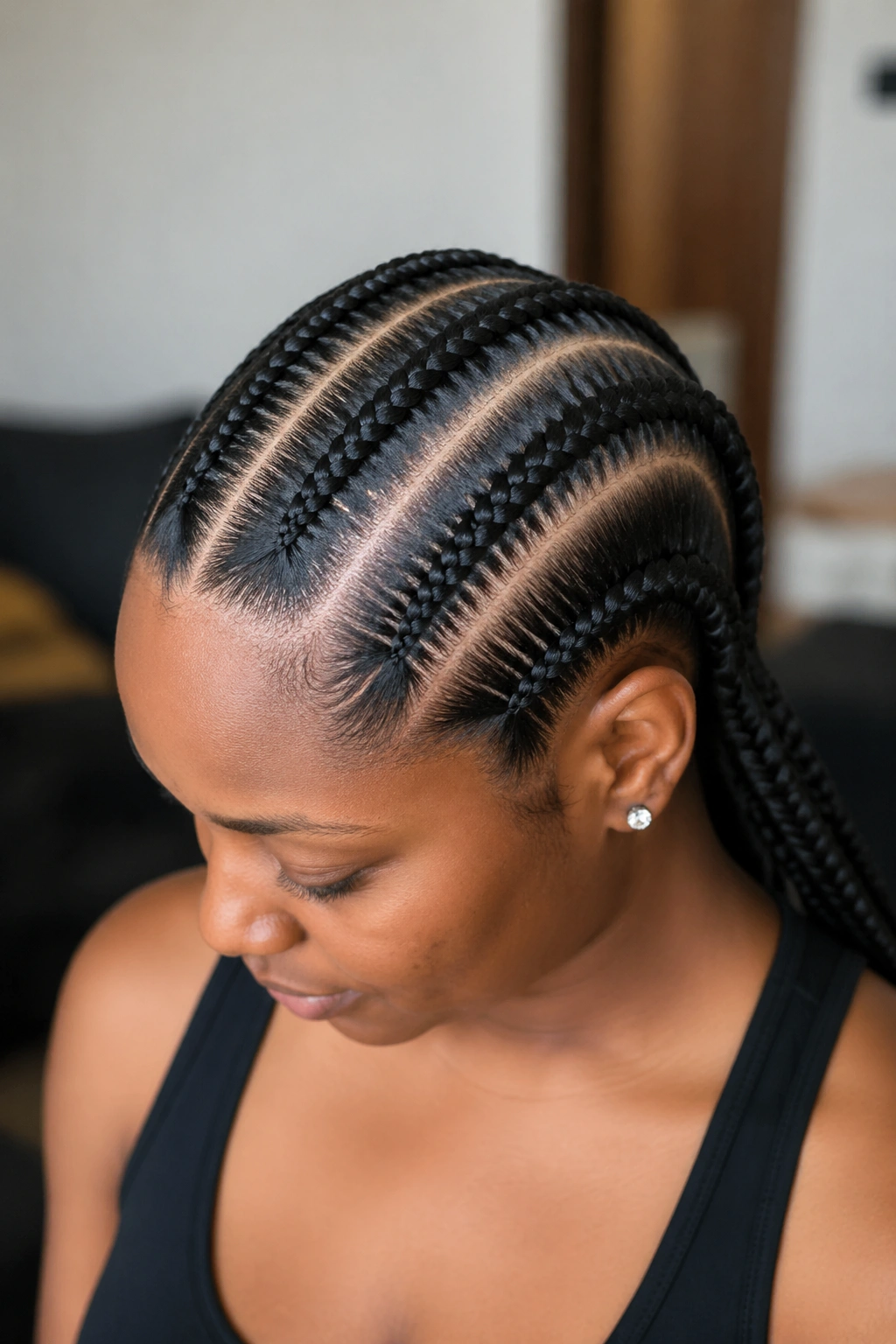
Four straight-back Ghana cornrows with a clean center part. This is the baseline — the style most people start with when trying Ghana braids for the first time.
Why It Works
- Four rows distribute weight evenly across the head
- Clean center part reads classic on any face shape
- The taper from thin hairline to thick body showcases the feed-in technique
- Takes 2-3 hours total, which is manageable for self-styling or one sitting with a braider
Best tip: aim for rows exactly the same width, from the part all the way back. Uneven rows are the number one giveaway of an amateur Ghana braid set.
2. Six Thin Ghana Cornrows With Long Ends
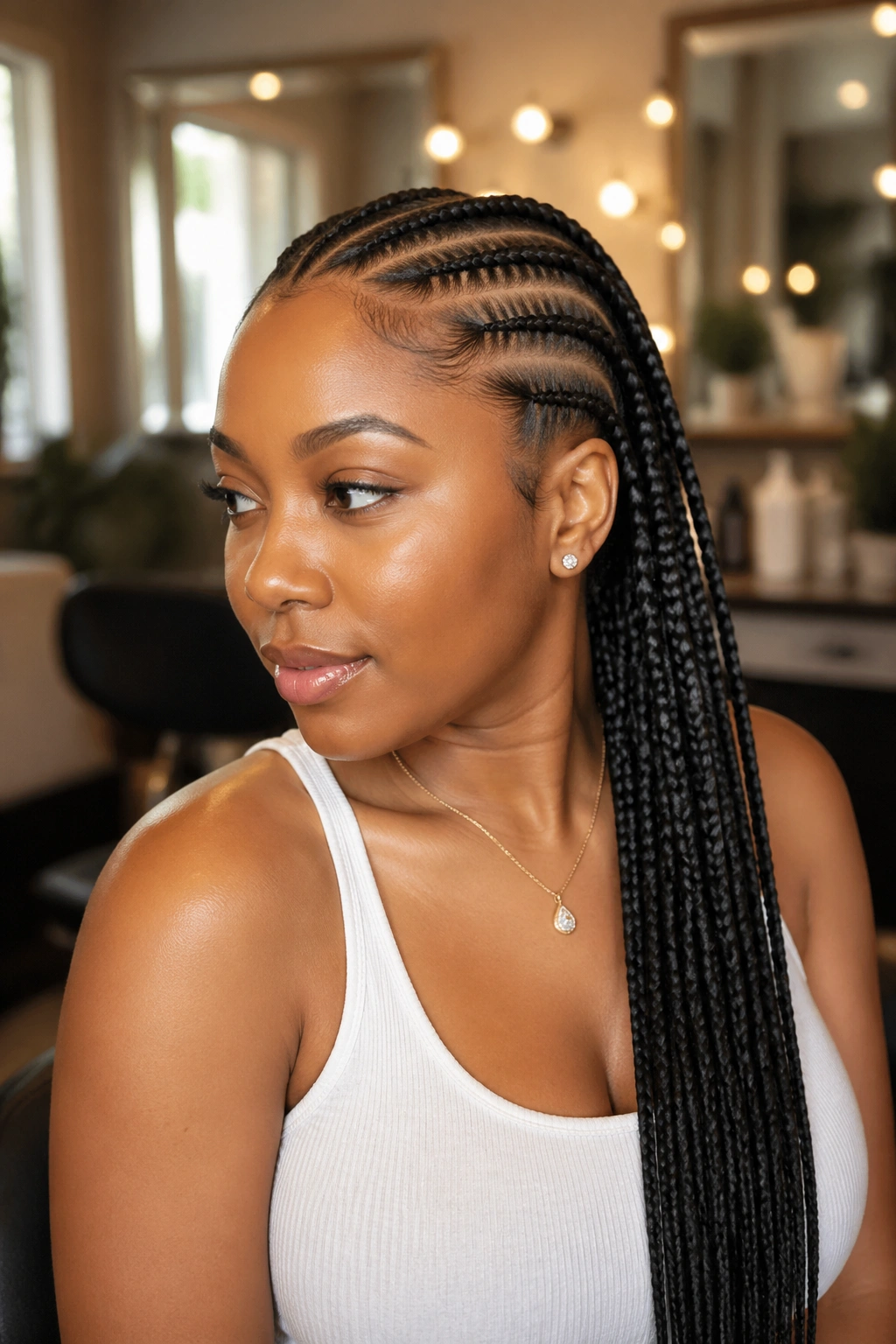
Moving to six rows gives each cornrow a narrower profile. Thinner rows, longer feed-in hair, and a length that sits at mid-back or lower. This is the style you wear when you want Ghana braids to read sleek rather than bold.
The proportion here matters. Six thin rows support longer lengths without looking weighed down. Four chunky rows at the same length would feel heavier visually and would actually pull harder on the scalp.
A longer length means a longer life — you can tuck, wrap, or style the ends differently each day. Low bun today, half-up tomorrow, over-one-shoulder the day after that.
3. Ghana Cornrows Curved Into a Side Sweep
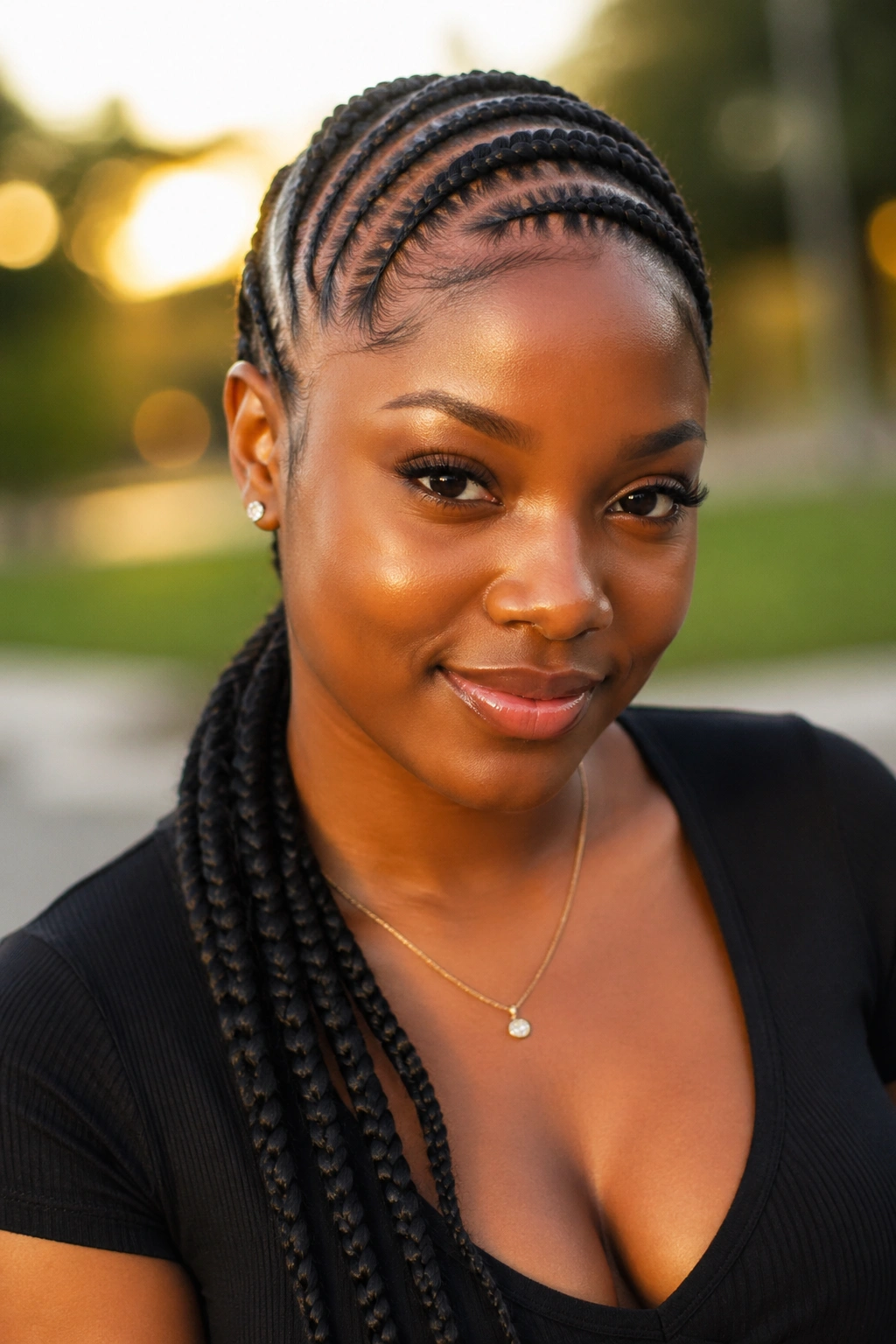
Instead of running straight back, every cornrow curves gently toward the same side of the head. Six rows, each one arching slightly, all sweeping toward the left shoulder where they gather into a side ponytail or a loose side braid.
Unlike straight-back rows, curved rows need a more skilled hand. The curve has to be consistent from row to row or the set looks haphazard. Start the curve at the hairline, not halfway down — the arc is set by your first three stitches.
Who this suits: anyone looking for a Ghana braid set that reads softer or more romantic than the straight-back default.
4. Tribal Ghana Cornrows With Beads and Cuffs
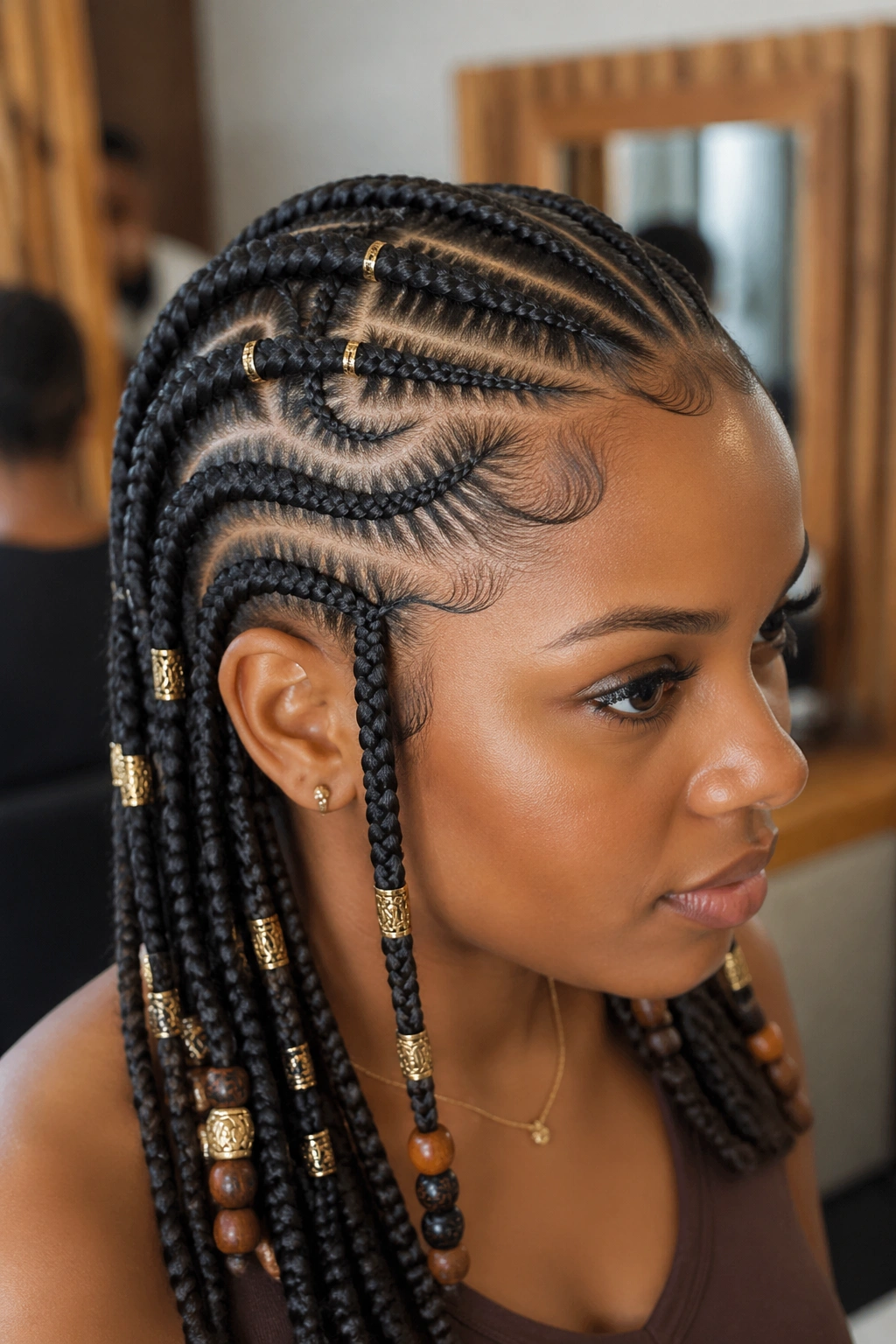
Tribal-inspired Ghana cornrows mix row thicknesses, parting patterns, and scattered metal accessories. Some rows are thick, some slim, some curve, some run straight. The parts include triangles or zigzags between the rows. Gold or bronze cuffs sit on a handful of braids.
Bold fact: tribal Ghana cornrows can take 5-8 hours to complete — more than double the time of a standard four-row set. The complexity is the point.
The accessories sit at varied heights along the braid, not clustered at the ends. A cuff at the crown, another near the temple, a third at the mid-length. Scatter placement reads intentional and original.
Two small warnings. Heavy metal accessories shorten the lifespan of a style because they add weight and tension. And cluttered accessorizing — a cuff on every braid — buries the beauty of the braiding itself. Less is usually more.
5. Halo Ghana Cornrows Around the Crown
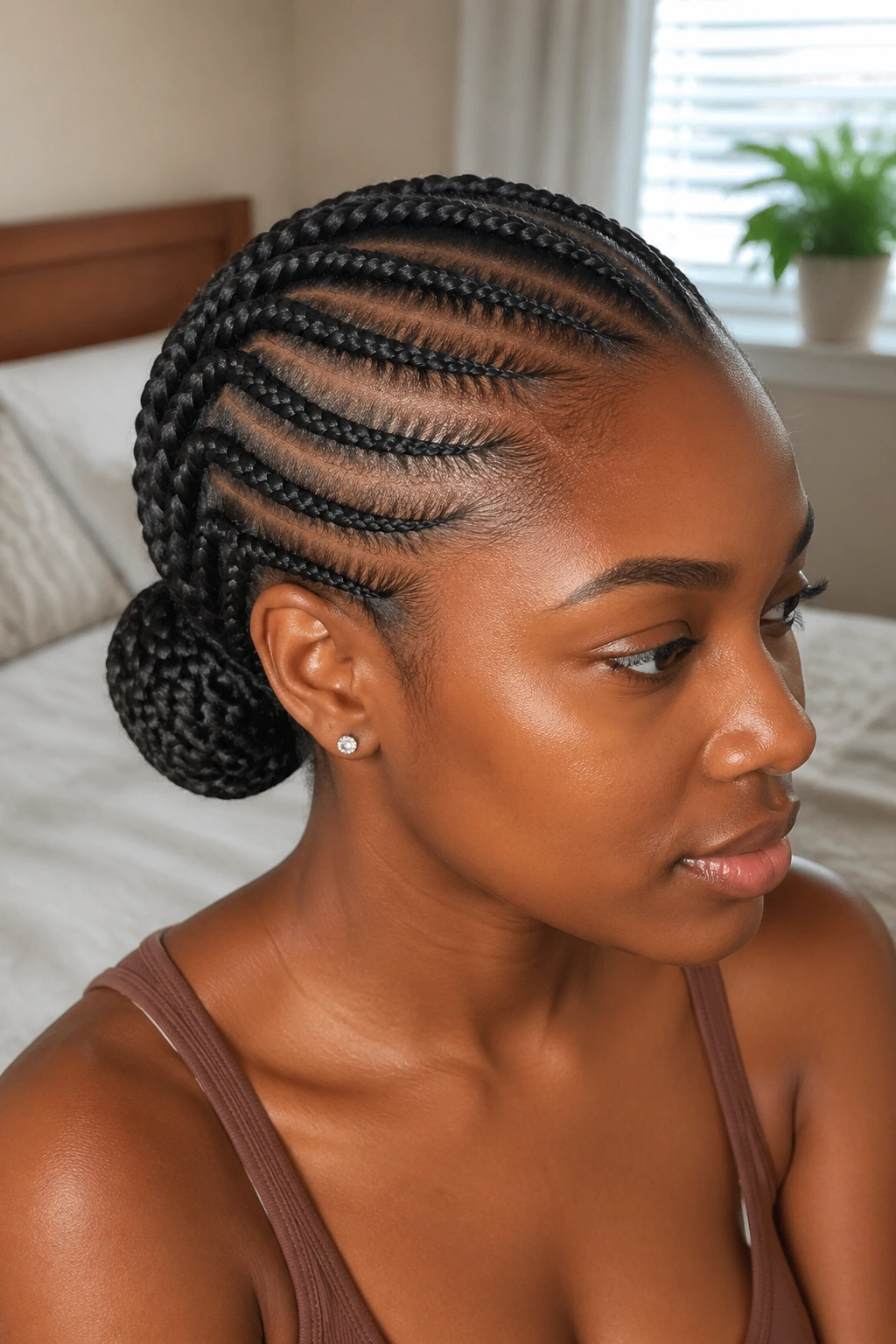
Ghana cornrows that follow the perimeter of the head in a circle, meeting at the back in a single thick braid or a small bun. The top of the head stays covered by the circular pattern; no parts run through the crown.
Picture a low fade of braids wrapping around the skull and meeting at the back, then either finishing in a knot, a bun, or a single trailing braid down the spine.
Halo Ghana cornrows are notoriously tricky to self-style. The curve around the ear and over the temple demands both hands plus good mirror access. Most halo Ghana sets are braider-done rather than DIY.
- Section out the top circle that stays unparted
- Start the first cornrow at the temple, curving toward the ear
- Add kanekalon feeds gradually as each cornrow arcs around the head
- Meet all cornrow tails at the back center and braid them into one large braid
6. Ghana Cornrows Ending in a High Ponytail
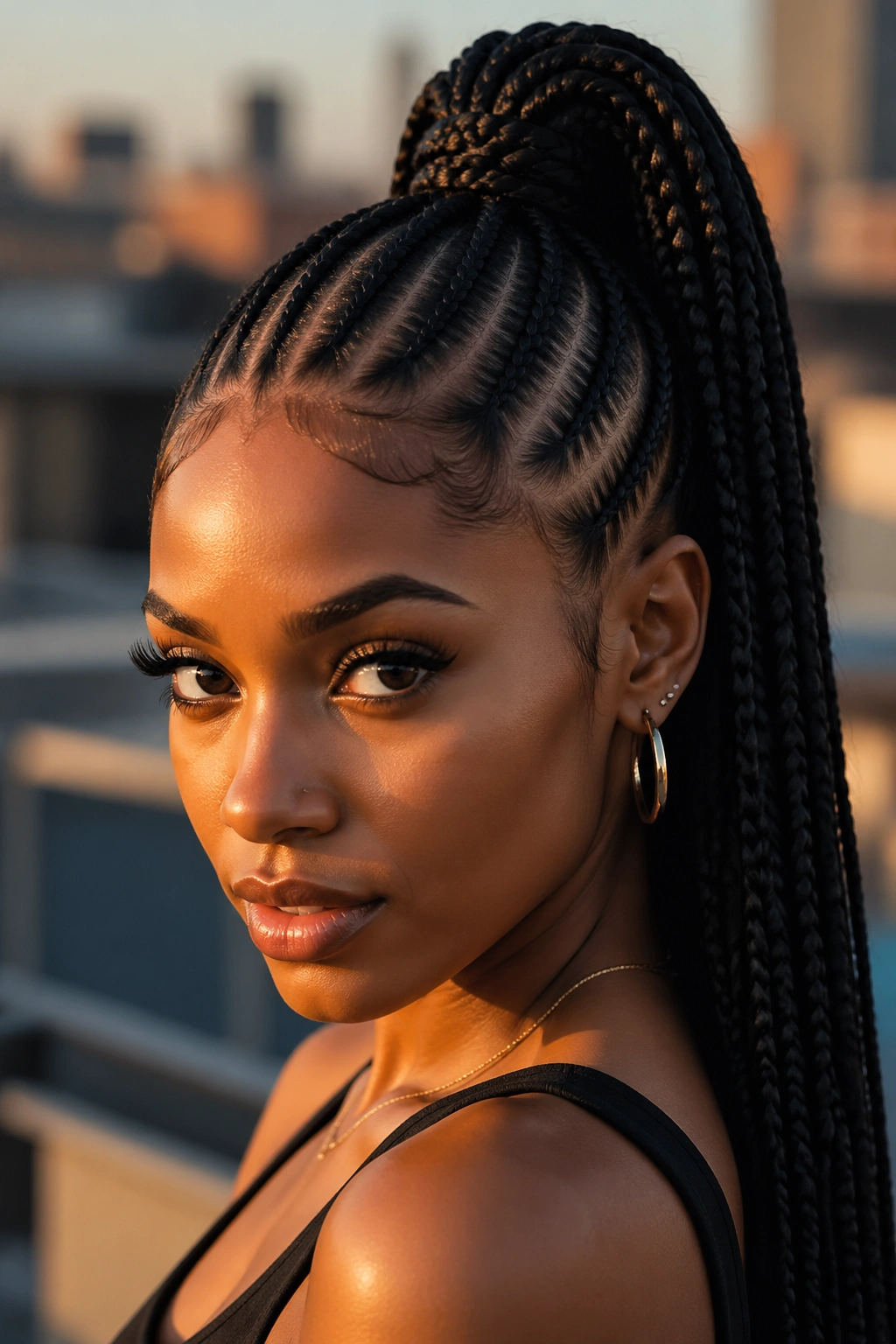
All the rows — six or eight of them — feed up into a high gathered ponytail at the crown. The cornrows don’t run straight back; they curve inward toward the gather point.
The high ponytail reads dramatic. It elongates the face and adds perceived height. For long-shaped faces it can look stretched; for rounder or heart-shaped faces it balances beautifully.
How to Style It
Use a hair tie the same color as your kanekalon for a seamless finish. Wrap a small piece of extension around the tie itself to hide it. Let the loose ends hang freely or braid them into one long single braid that dangles from the ponytail base.
This is the style that reads equally at a wedding reception and a workout — one of the more versatile Ghana cornrow finishes.
7. Chunky Two-Row Ghana Braids
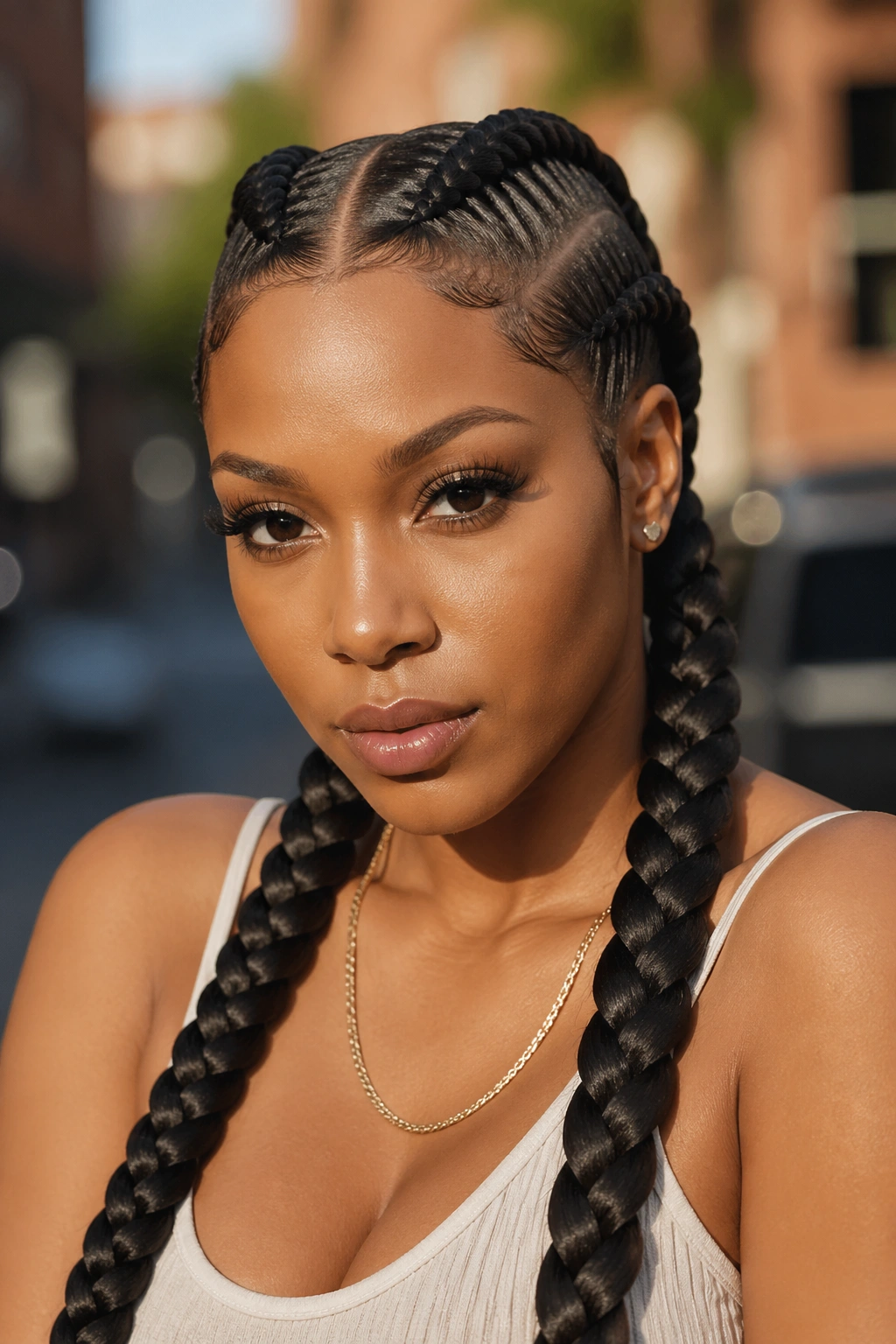
Two cornrows. That’s it. Fat, dramatic, sweeping down from a deep center part to past the shoulders. Ghana braid thickness at its most extreme.
Unlike fine Ghana cornrows, chunky two-row sets are fast — four to six hours max — and they punch hard visually. The kanekalon feed-in allows each braid to reach wrist-thick by the time it hits the shoulder.
Who this is best for: anyone who wants statement braids without the time investment of a 25-row tribal set. Also anyone with a lot of density — thicker hair supports thick Ghana braids without looking sparse at the hairline.
The downside: two rows mean two pressure lines. Scalp tension gets concentrated. Keep the base tension moderate and ask the braider to go looser at the hairline than their instinct suggests.
8. Ghana Cornrows With Diagonal Parts
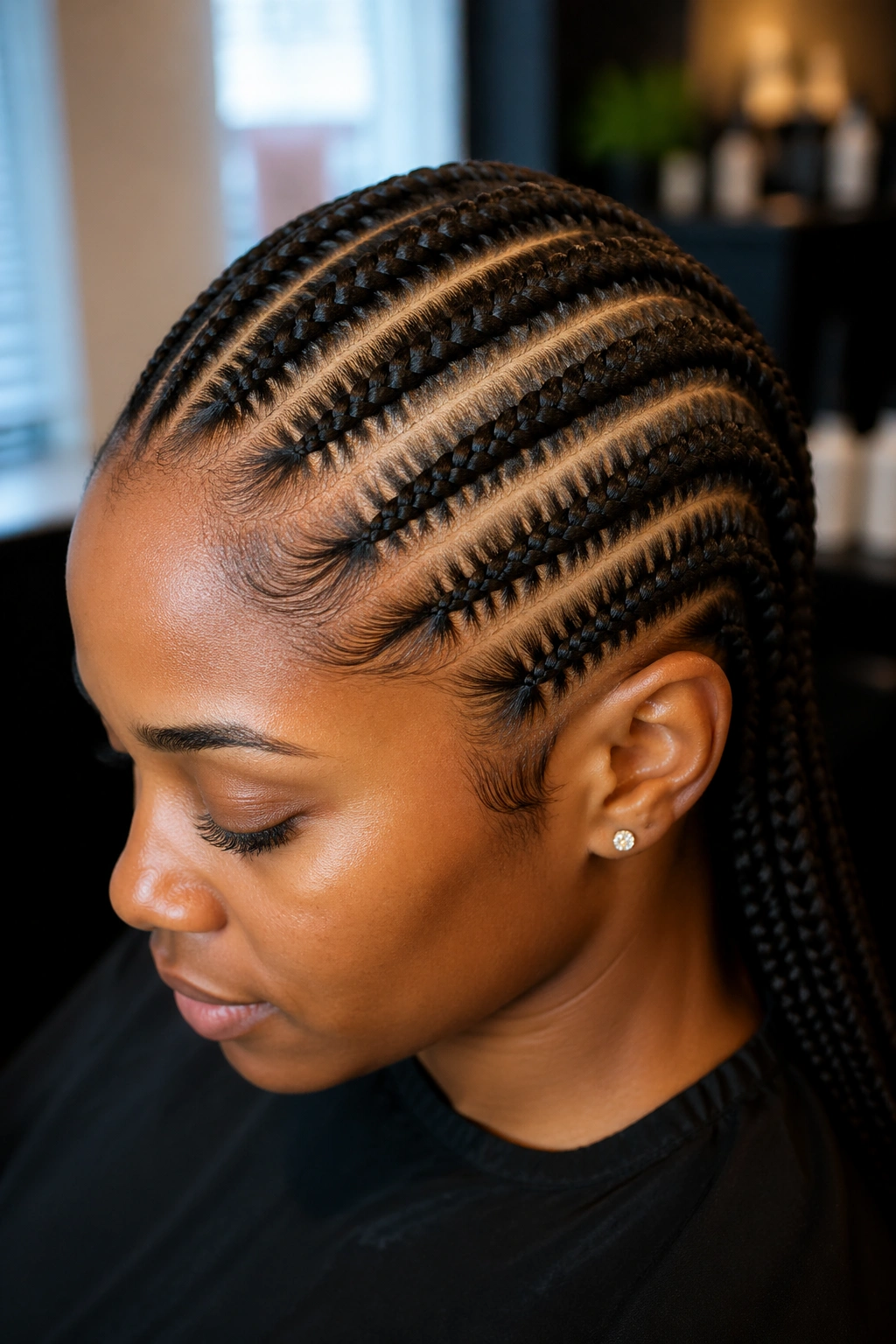
Every part runs at a 45-degree angle across the head. Six to eight diagonal Ghana cornrows all slanting from the top-right of the head toward the lower-left.
A diagonal Ghana set reads like the style is in motion. The angle gives every row a trajectory. Straight-back rows look parked; diagonal rows look moving.
The key is consistent angle. Every row has to hit the same slope. A few rows off-angle and the style looks like a tornado hit. Measure the first row carefully and use it as the template for every subsequent row.
9. Zigzag Part Ghana Cornrows
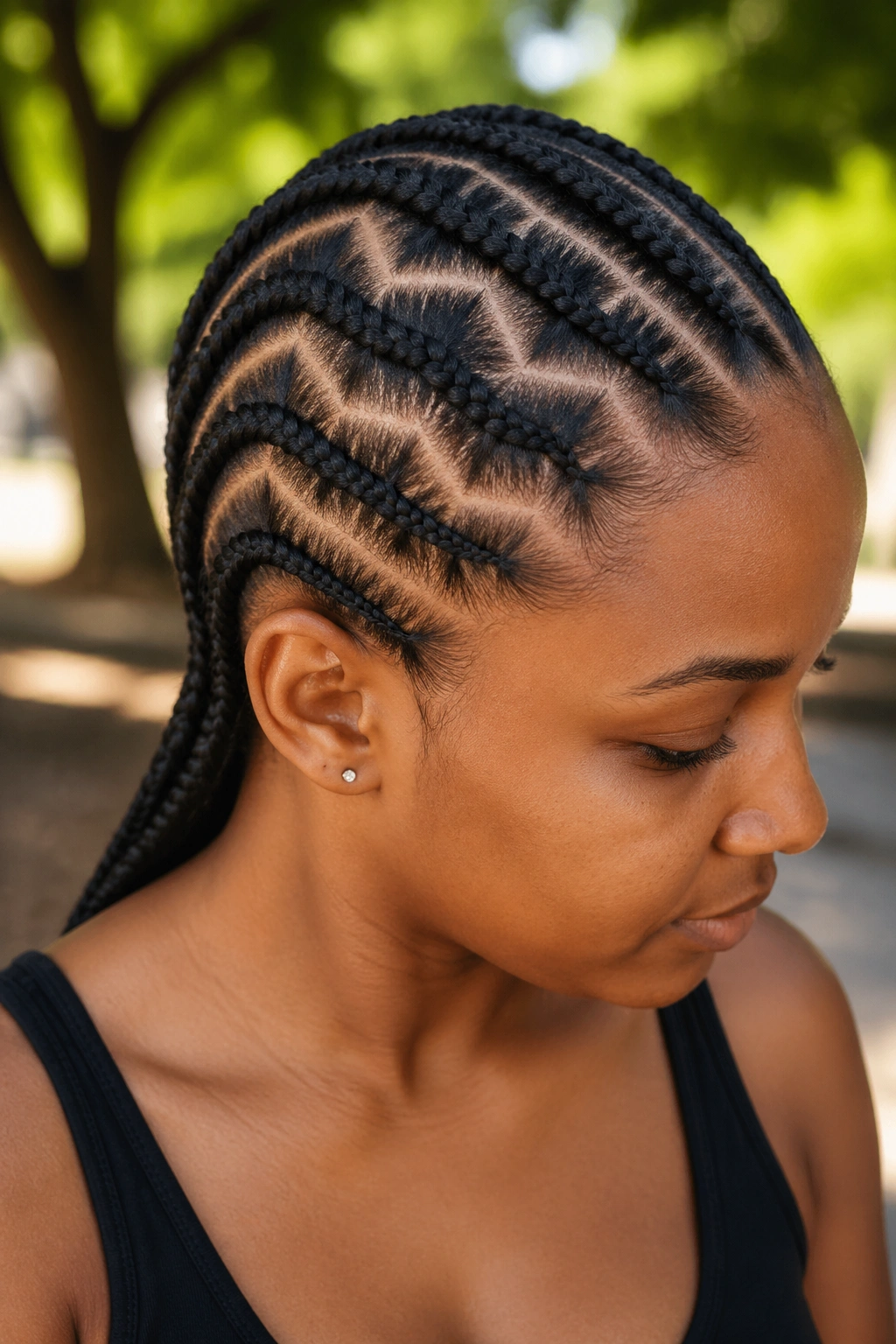
The parts between rows aren’t straight lines — they zigzag. Each part makes three or four pointed angles between the hairline and the nape. The cornrows themselves run straight back, but the space between them snakes.
This is a small modification with a big payoff. The cornrow technique doesn’t change. The braider just uses the rat-tail comb tip to carve zigzag lines instead of straight ones. It adds maybe 10 minutes of parting time and a whole lot of visual interest.
Scenario: you want Ghana braids that look different from the last set you wore without learning a new braiding technique. Zigzag parts are the answer. Same braids, different canvas.
10. Ghana Cornrows Into Waist-Length Ends
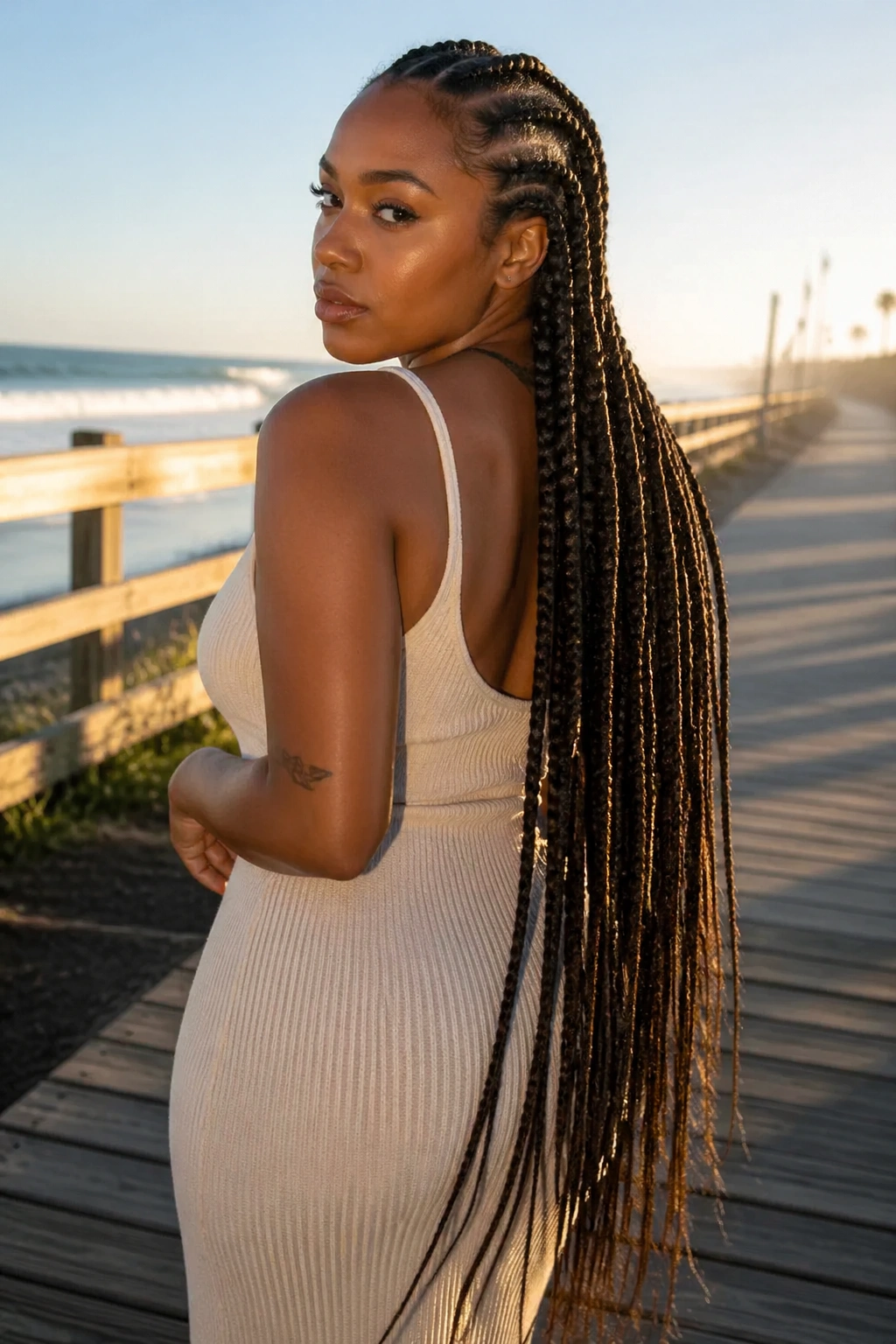
Length is the statement. Six to eight Ghana cornrows that end somewhere around the waist or lower. The feed-in goes long — two full bundles of kanekalon per row often — and the ends swing dramatically.
Waist-length Ghana braids take longer to install (four to seven hours) and demand more maintenance. The length adds weight, which adds tension. Sleep care becomes critical — a silk pillowcase plus a bonnet plus attention to not sleeping on top of the braid ends.
The drama is worth it for a lot of wearers. The way the ends move when you turn your head, the way they fall over a shoulder, the sheer length — these are specific, deliberate pleasures.
Best for: events, photoshoots, vacations, and anyone who just wants long hair for six weeks without commitment.
11. Ghana Cornrows With Color-Blocked Rows
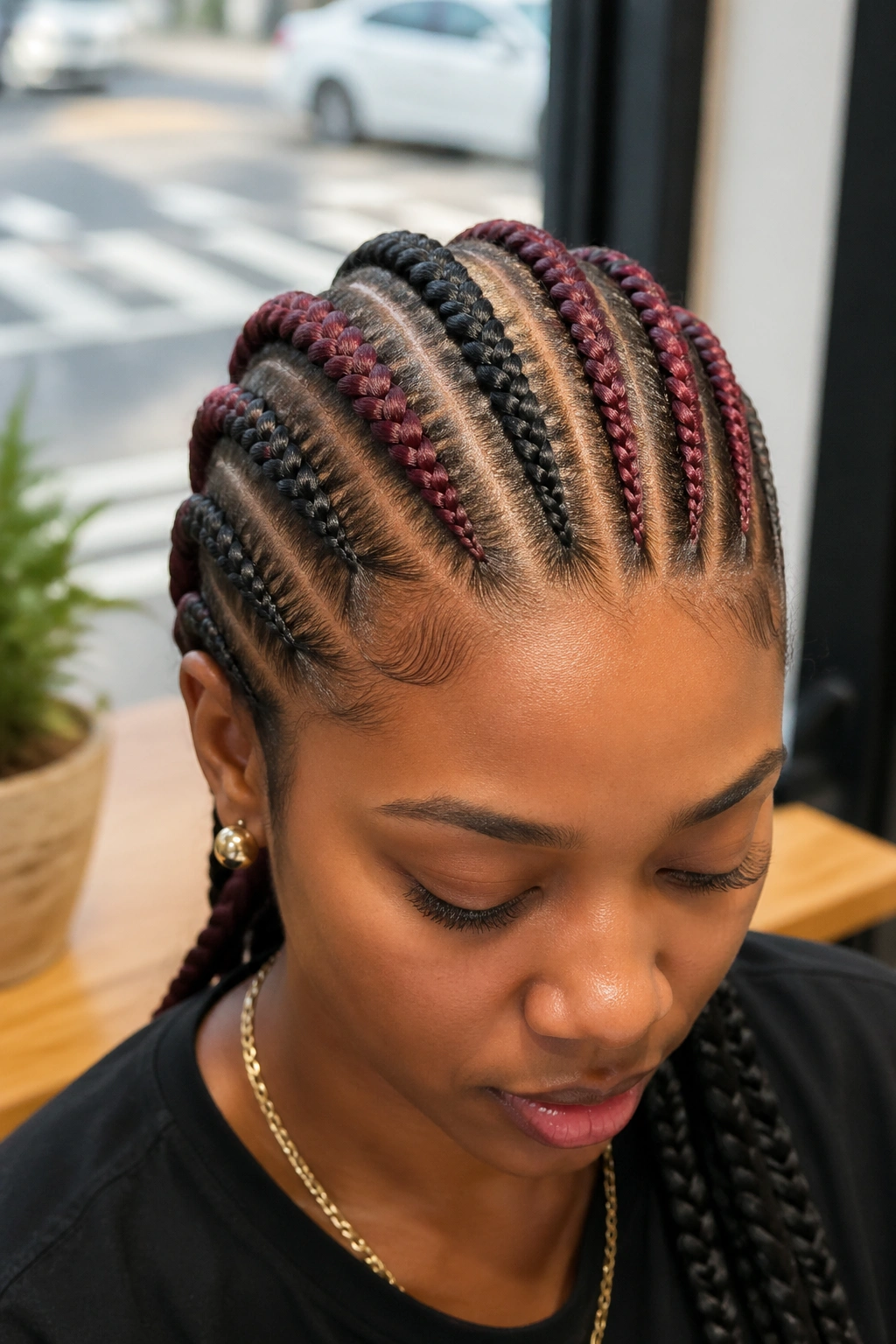
Alternate rows in different colors. Row one is the natural hair color, row two is honey blonde, row three goes back to natural, row four picks up blonde again. Or any color pairing — auburn and black, burgundy and dark brown, platinum and espresso.
Color-block Ghana cornrows photograph stunningly. The contrast between rows makes the structure of the style pop in a way that single-color braids don’t.
Choose shades with enough contrast to register. Two shades of brown too close together look muddy rather than intentional. Aim for two to three shades of difference between the alternating colors.
- Pre-wash and air-dry your kanekalon if it’s a bold color — reduces shedding
- Seal the ends immediately to prevent color bleeding on lighter natural hair
- Use a color-safe dry shampoo on the scalp between washes to protect the contrast
12. Ghana Cornrows With a Crown Braid
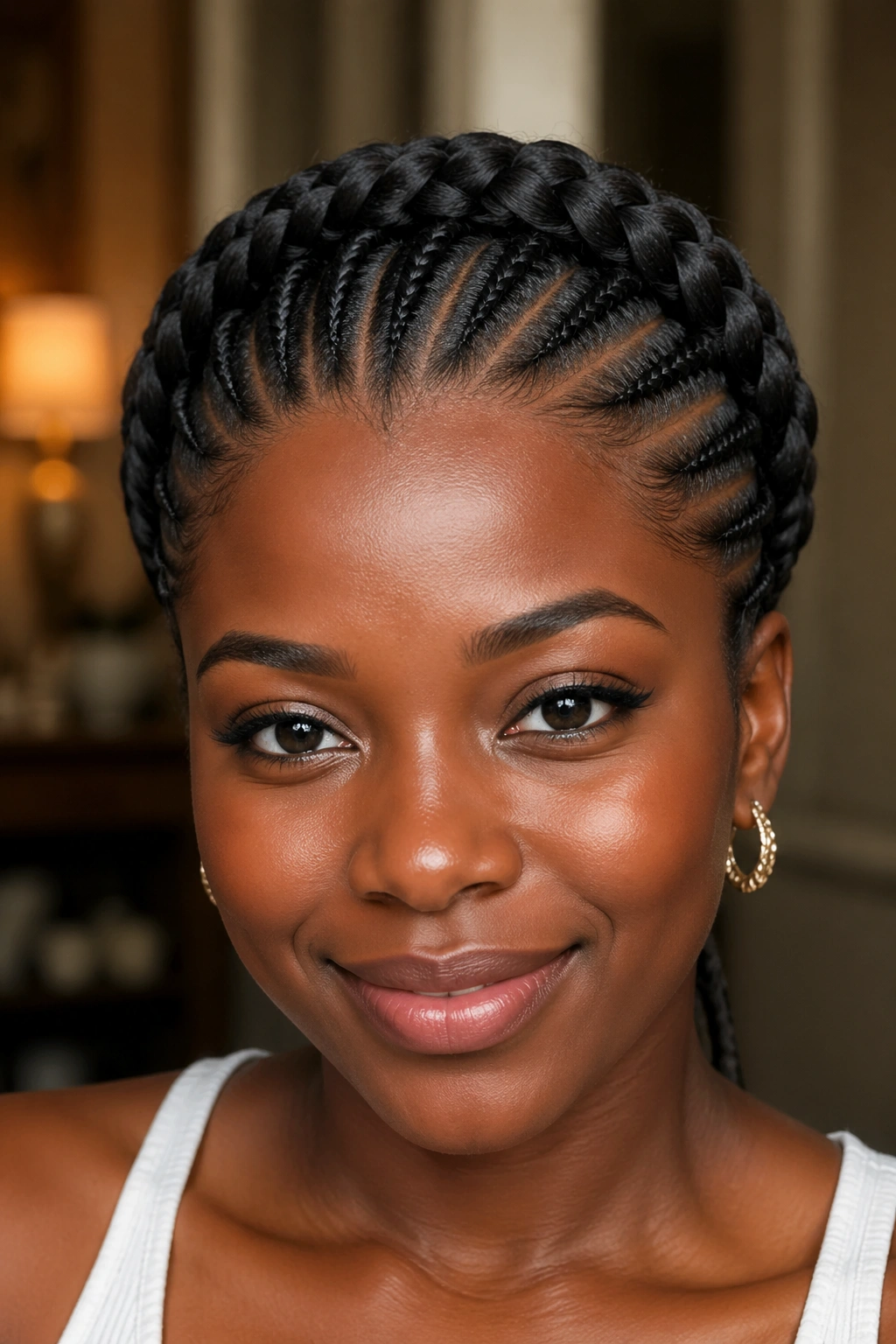
Ghana cornrows flat against the scalp all around the head, with the ends gathered into a single thick braid that wraps over the crown like a halo or crown. The wrapped braid is pinned into place and the ends are tucked under.
This combines Ghana braiding with a bridal or formal-event finish. Ghana braids alone read casual-to-dressy; a wrapped crown braid on top reads definitively dressy.
The wrapped braid has to be flat, not a tight rope. Braid the loose tails together loosely, press the braid flat between your palms, and pin at four or five points along the length. A flat crown reads elegant; a rope crown looks clumsy.
13. Asymmetric Ghana Cornrows
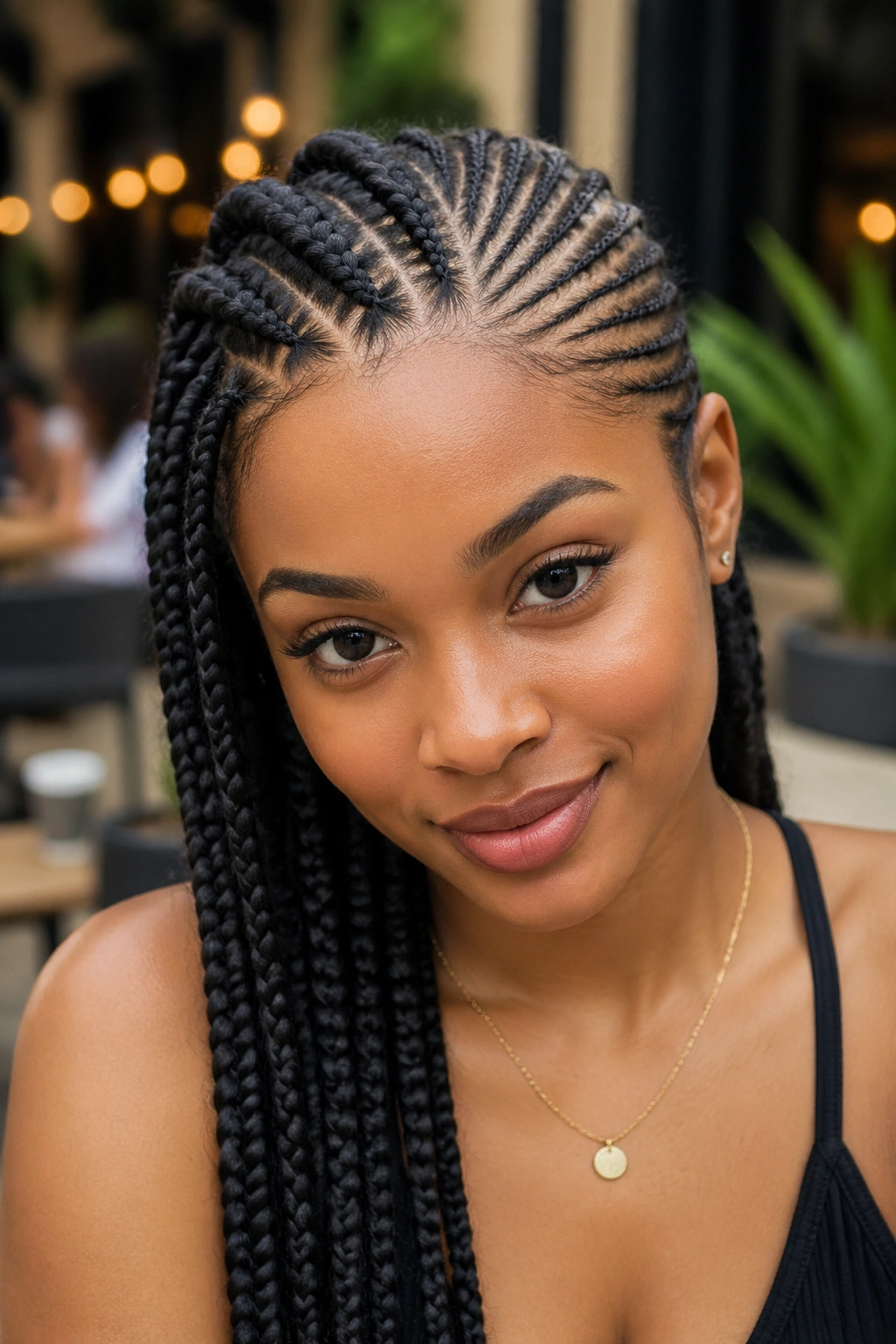
Different number of cornrows on each side of a deep side part. Three thick Ghana cornrows on one side, six thin Ghana cornrows on the other. The asymmetry is deliberate and the focal point is the difference.
The two sides shouldn’t feel random. There should be a logic — the three thick rows balance the visual weight of the six thin rows, or vice versa. Eye the symmetry in terms of visual weight, not row count.
Who this is best for: anyone who likes conceptual hair. Anyone who gets compliments on unexpected parts. Anyone who wants a set that rewards closer inspection.
The Catch
Asymmetric styles need a skilled braider. Getting the weight balance right takes judgment that comes with experience. A new braider might make the two sides feel accidental rather than designed.
14. Ghana Cornrows With a Feed-In Bun
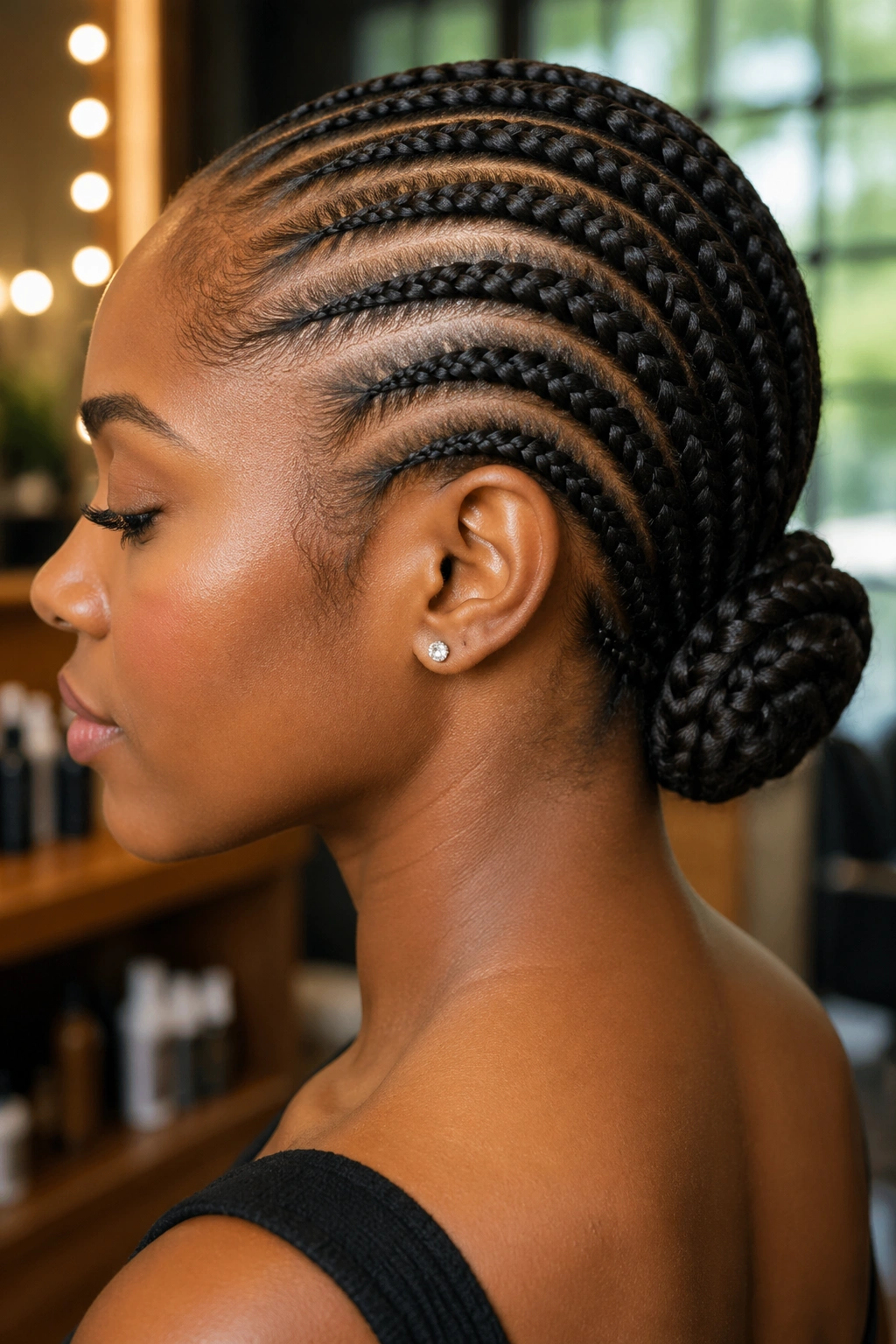
Ghana cornrows all feeding into a low bun at the nape. The bun is made from the excess braid length wrapped and pinned — not from a bun donut or extension piece.
The bun wrap uses about six inches of braid per rotation. For a medium bun, each braid contributes one or two wraps around the base. Pin as you go so the bun stays tight.
A feed-in bun is more secure than a scrunchie gather because the braids themselves do the holding. No elastic, no strap-marks, no slippage. Pins and maybe a scrunchie on top for decoration — that’s all you need.
15. Ghana Cornrows Split Down the Middle
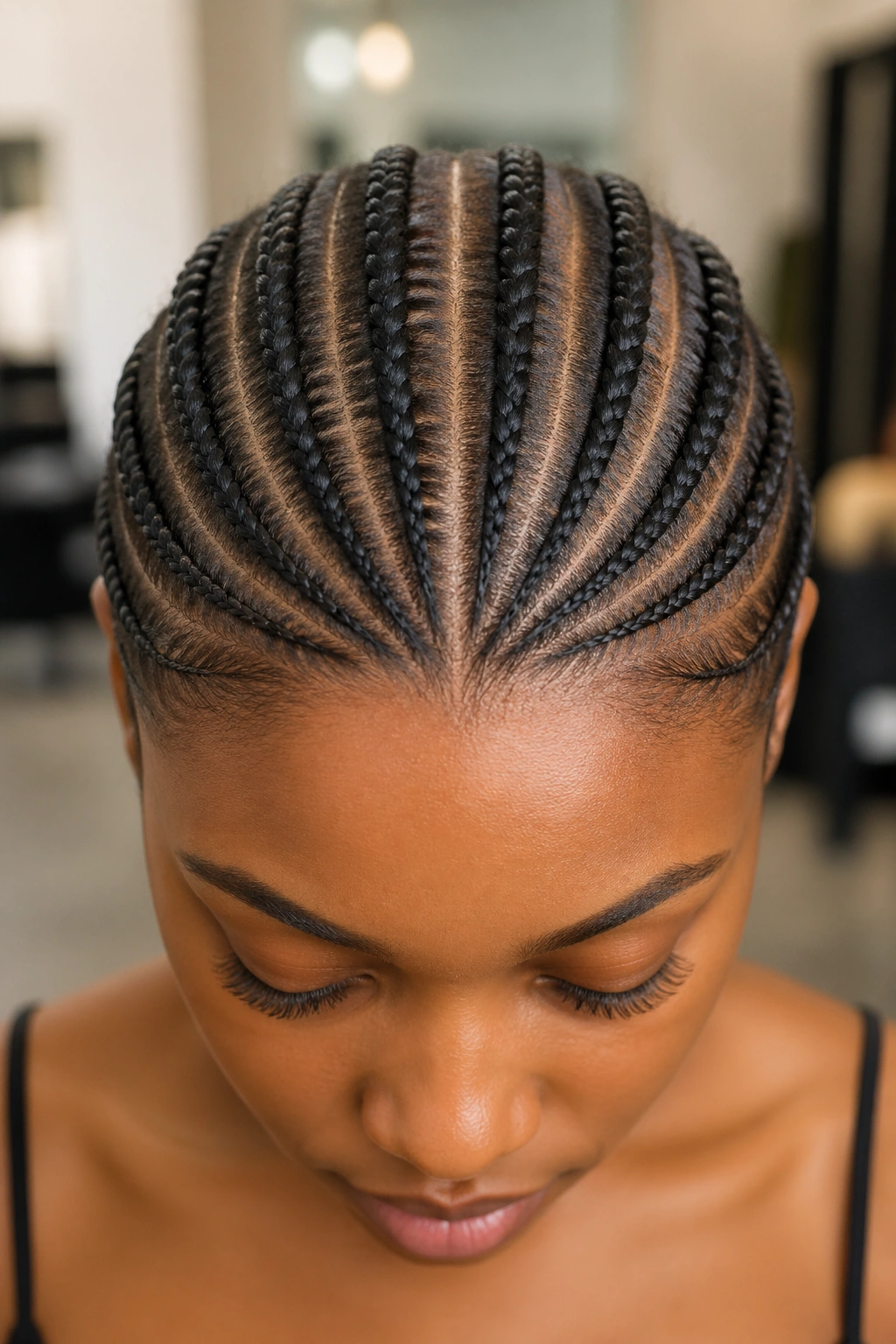
A dramatic center part from hairline to nape, with an equal number of cornrows on each side — five on each side is the classic split. The part itself reads as prominent as the braids.
A well-executed center part is pin-straight. No wobble, no angle, no drift. Use the rat-tail comb to draw the part slowly and confirm it in the mirror from front and back before starting to braid.
Ten Ghana cornrows with a center part is a long style to install — often five hours or more. But it’s clean, classic, and reads polished in a way that few other braid sets manage.
16. Side-Swept Ghana Cornrows With Baby Hair Design
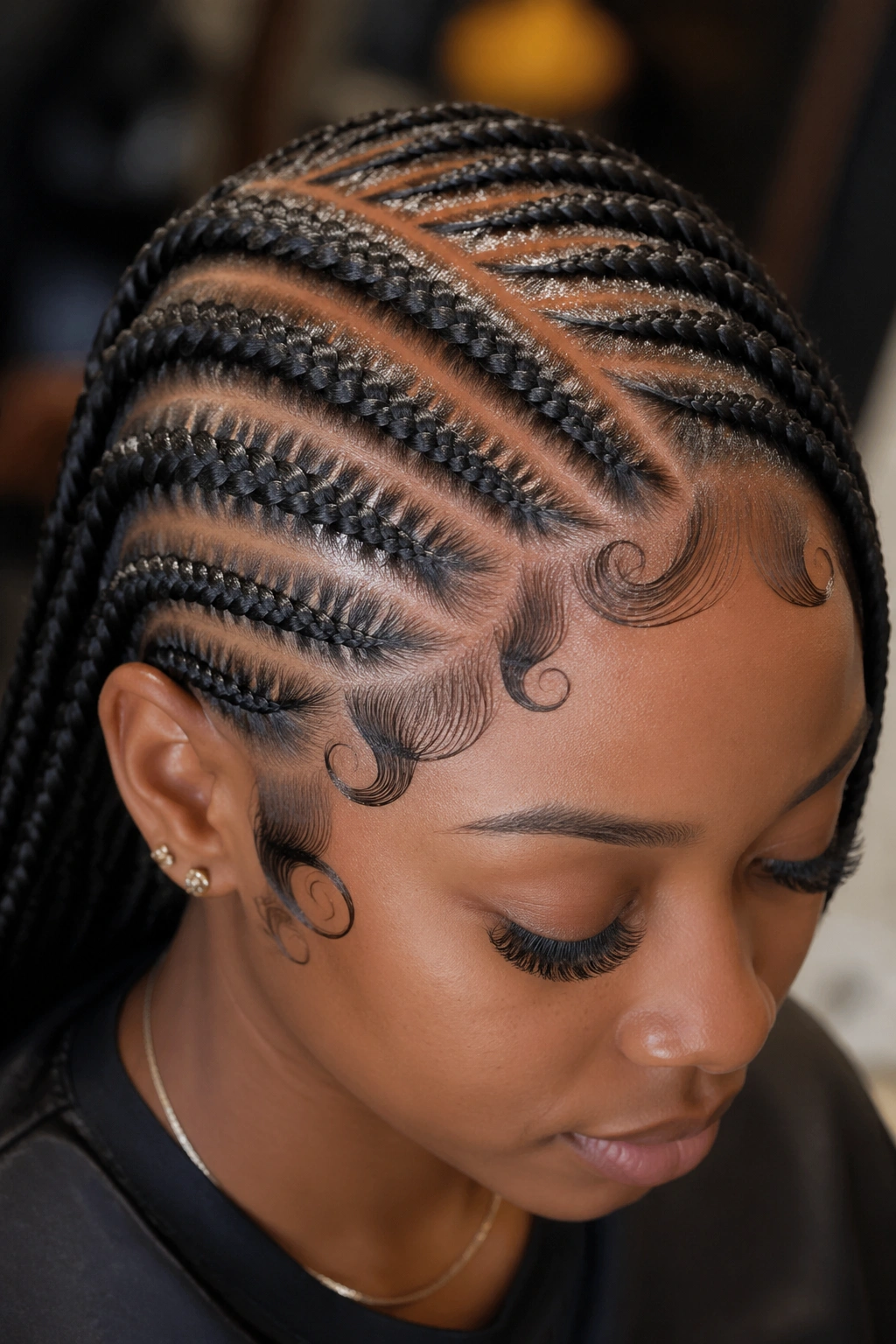
Ghana cornrows sweeping diagonally across the head, paired with a detailed baby hair design at the hairline. Swoops, swirls, hearts, or geometric shapes made from the edges using edge gel and an angled brush.
The edge design is meticulous work. Each swoop needs to hold shape for 12-plus hours without flaking. That means a strong-hold edge gel, a steady hand, and a light misting of hairspray to lock the finished design.
Ghana cornrows pair especially well with baby hair art because the straight lines of the cornrows contrast with the curves of the edge design. Straight plus curved reads balanced.
17. Ghana Cornrows With Copper Cuffs
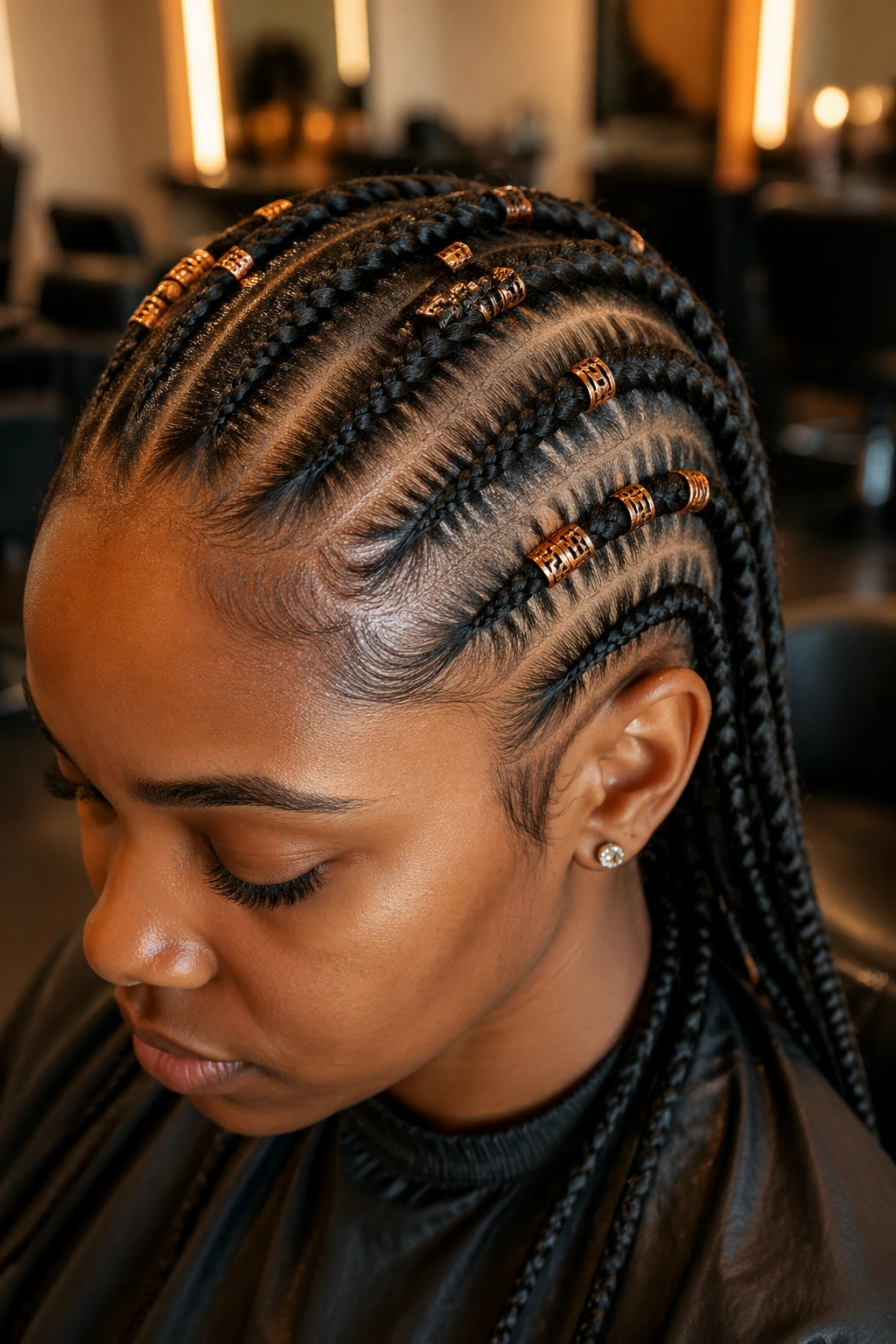
Copper-colored metal cuffs placed on the braids — either clustered at the ends or scattered along the lengths. Copper reads warmer than gold or silver and pairs beautifully with natural hair tones ranging from black to deep brown.
Copper cuffs catch warm lighting differently than silver does. Under incandescent bulbs, sunlight at golden hour, or warm-toned studio lights, copper glows. Silver can look washed out under the same conditions.
Cluster three to five cuffs on three or four of the braids — not every braid. Clusters read designed; one cuff per braid reads decorative but thin. And leave some braids with no cuffs at all for visual contrast.
18. Ghana Cornrows in a High Bun
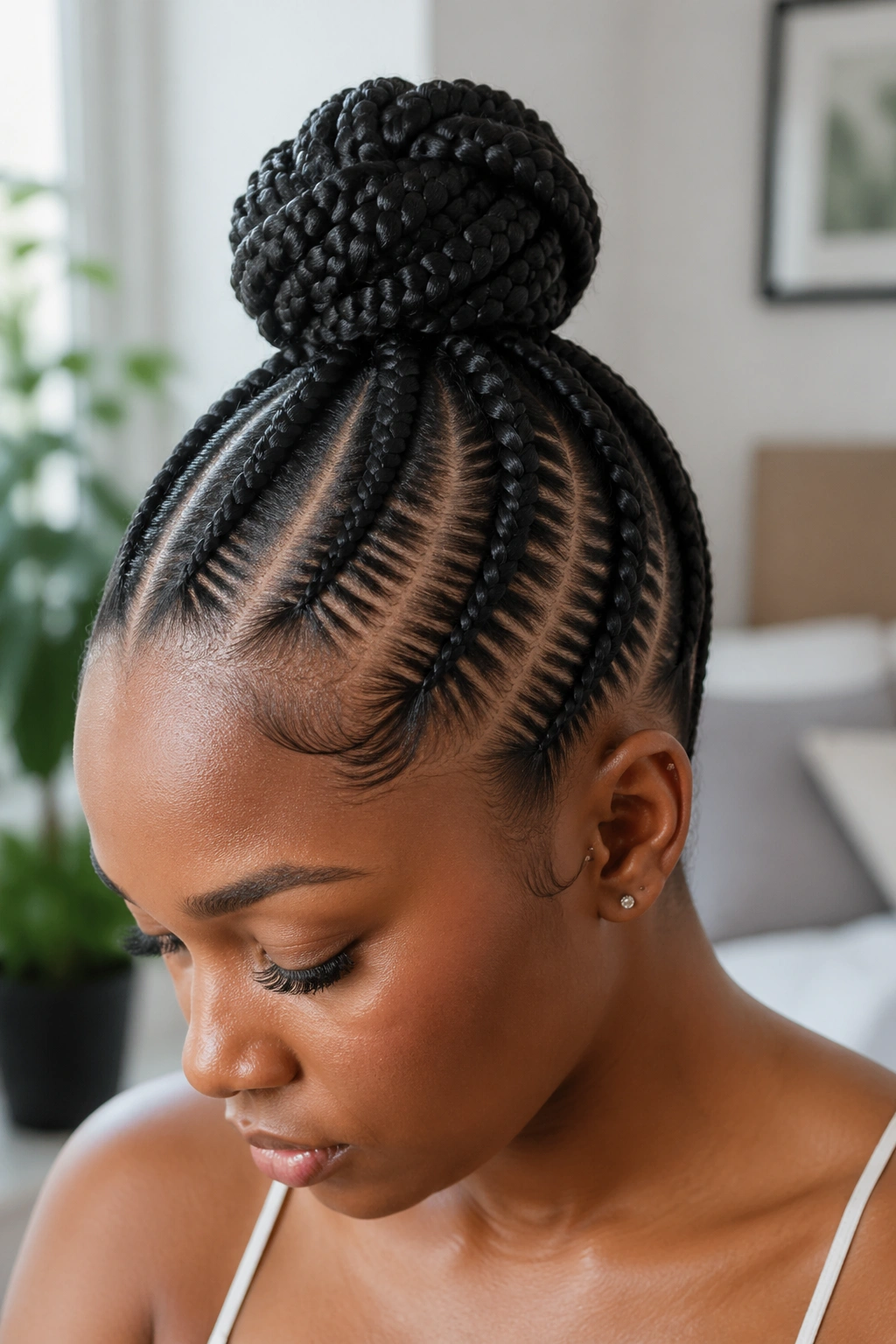
All the cornrow tails gathered into a topknot-style bun at the crown. Unlike a low bun, a high bun reads athletic, sharp, and face-lifting.
The high bun position can get tight at the hairline from the gather-and-lift direction. Ask the braider to leave the first inch of each cornrow looser than they would for a low style.
- Use a donut or bun form to shape a large high bun
- Wrap the braid tails around the donut smoothly
- Pin at the base with long bobby pins
- Smooth flyaways with a small amount of hair wax
19. Triangle Part Ghana Cornrows
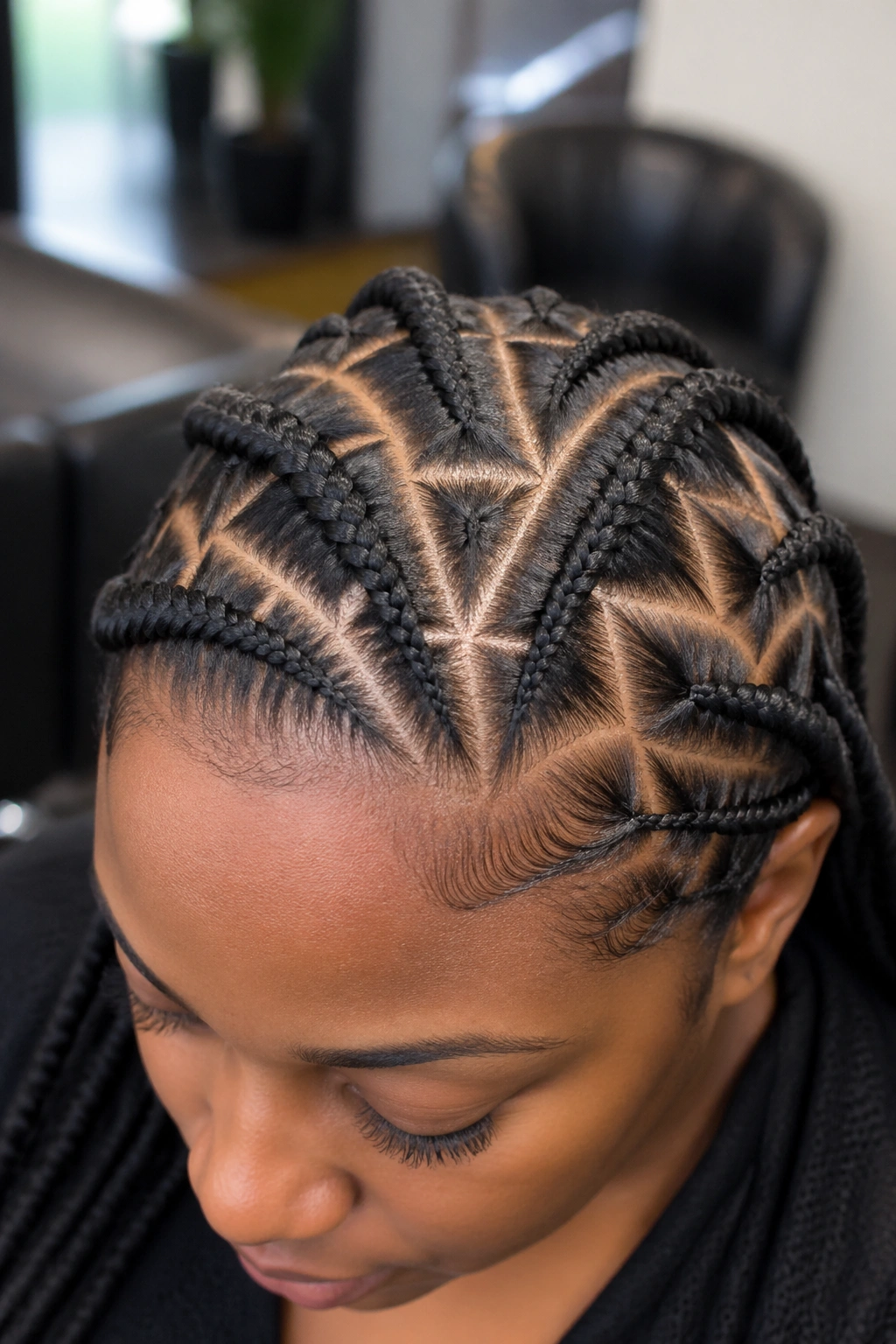
The parts between cornrows form triangle shapes instead of rectangles. Each triangle section feeds into a single Ghana cornrow, and the triangles tile across the scalp in a visible pattern.
Triangle parts borrow from triangle-box-braid styling and translate beautifully into Ghana cornrows. The triangular geometry plays against the linear braids to create visual tension.
The trick is keeping the triangles the same size across the head. Measure the first few with a ruler if needed. Eyeballing doesn’t work for this — the precision is what makes the style work.
20. Ghana Cornrows With Heart-Shaped Part Accent
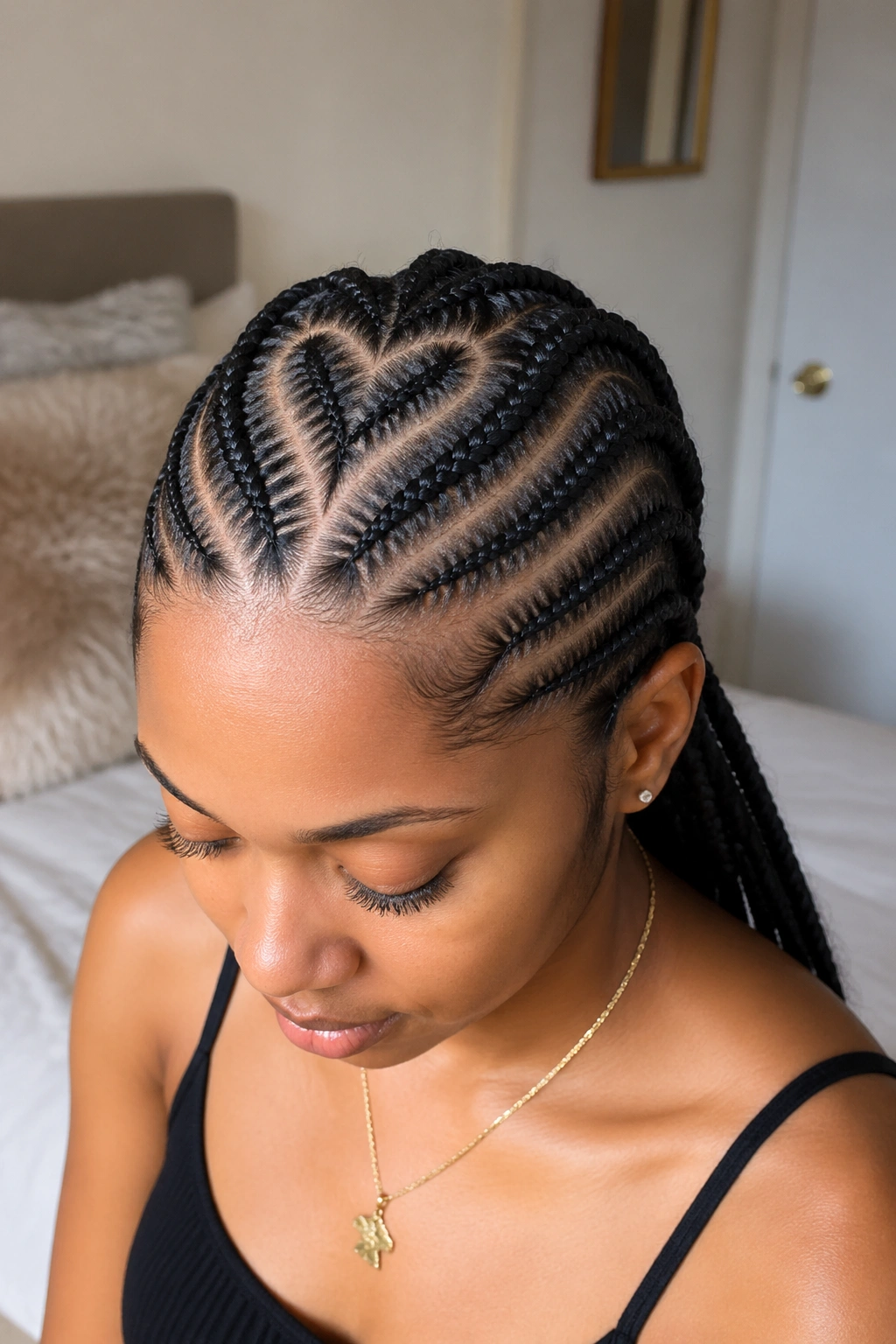
A deliberate heart-shaped part at the crown, with cornrows radiating out from the heart’s top edges toward the back of the head. The heart-shaped part becomes a small design detail set against the symmetry of the cornrows.
This one reads playful. It’s Ghana cornrows with a wink. Works especially well on young wearers, for birthday photoshoots, for anyone wanting braids with a specific personality.
The heart needs to be small — about three inches wide at most. Larger hearts start to look like awkward blobs rather than a clean shape. Use a template drawn on paper to trace the shape onto the scalp before parting.
21. Ghana Cornrows Into a Single Thick Braid
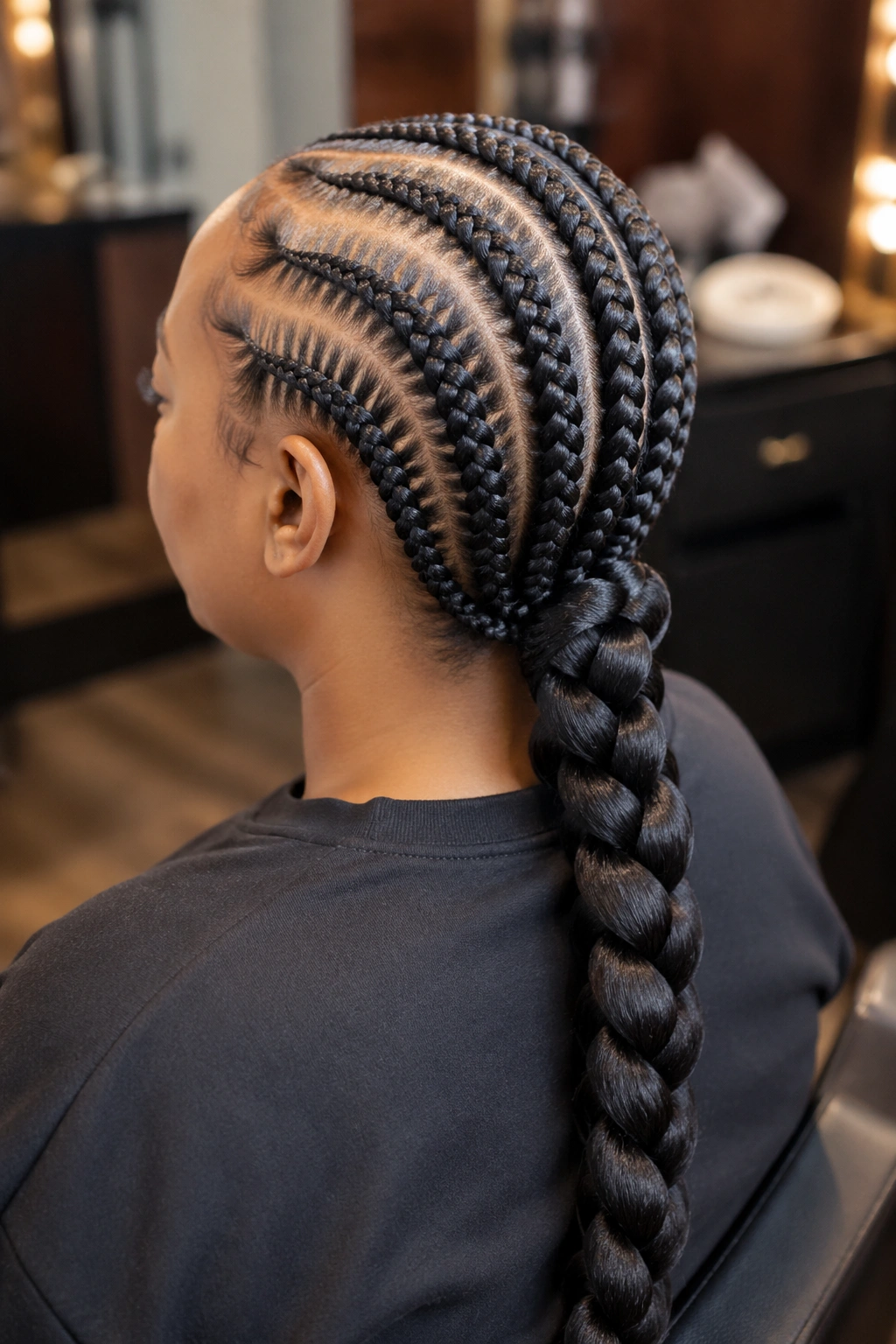
All the cornrow tails gathered at the nape and braided together into one massive three-strand braid that falls down the back. The single braid reads like a rope swinging at your back.
The three sections of the final braid need to be pre-divided. Before gathering, split the tails into three equal bundles so the final braid has balanced sections. Uneven sections make the braid look lopsided.
The result has presence. A single long braid hanging down is visually quieter than a full-length set of individual Ghana braids, but it reads more intentional and formal.
22. Ghana Cornrows With a Swoop Over One Eye
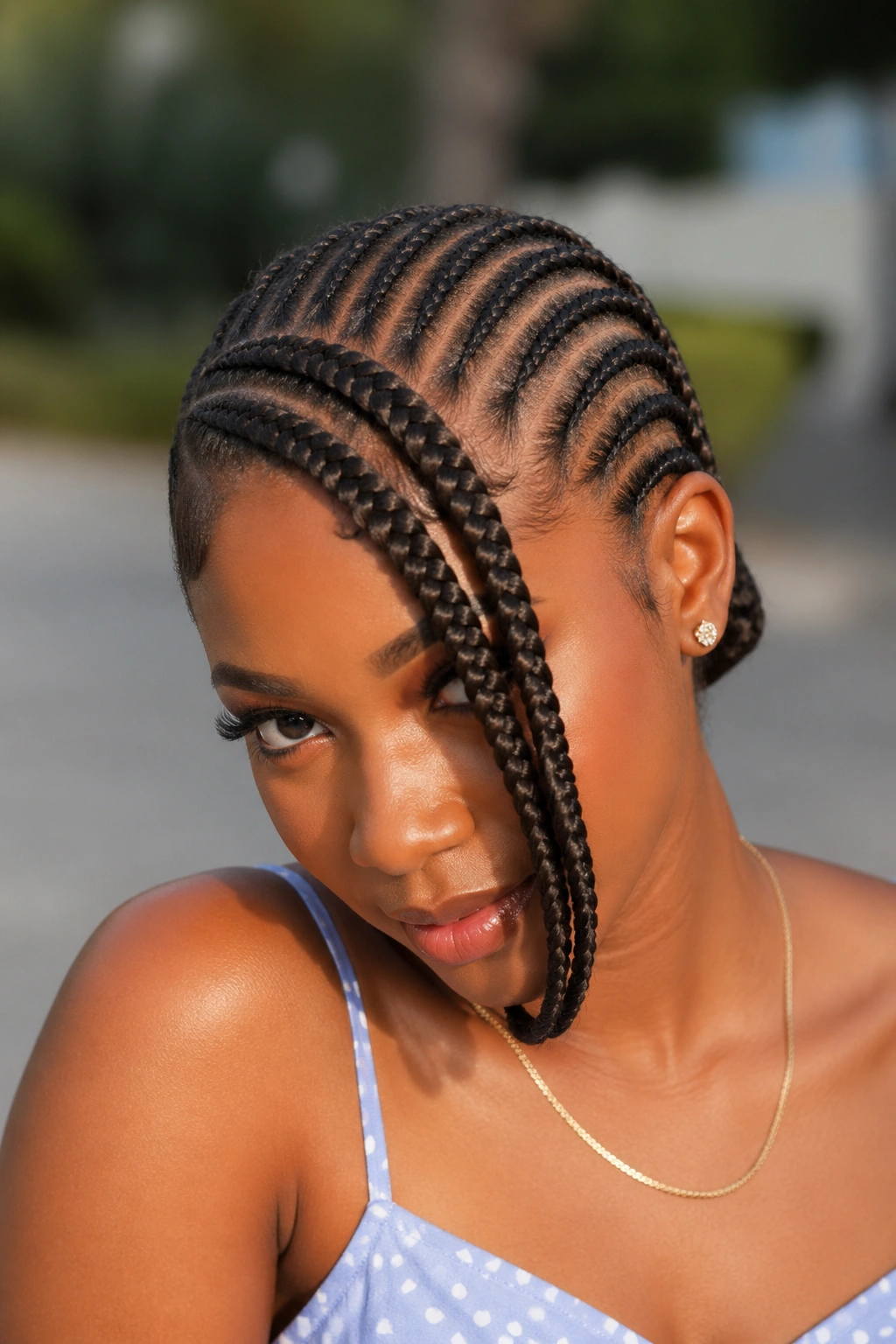
Most cornrows run back, but one thick cornrow or a twisted section drapes over the forehead and down toward one eye — almost like a side-swept bang. The rest of the head is standard Ghana cornrows; the front swoop is the design element.
Picture the old-school side-swept bang, updated with a Ghana braid execution. The swoop sits soft against the forehead and draws the eye to the face.
The swoop has to fall naturally. Pinning it stiff kills the look. Let it drape; secure only with a small, invisible pin at the anchor point.
Who this suits: anyone with a high forehead who wants a bit of visual softening, or anyone who likes the cinematic aesthetic of a swept-bang style.
23. Low Ghana Cornrows Into a Fishtail Finish
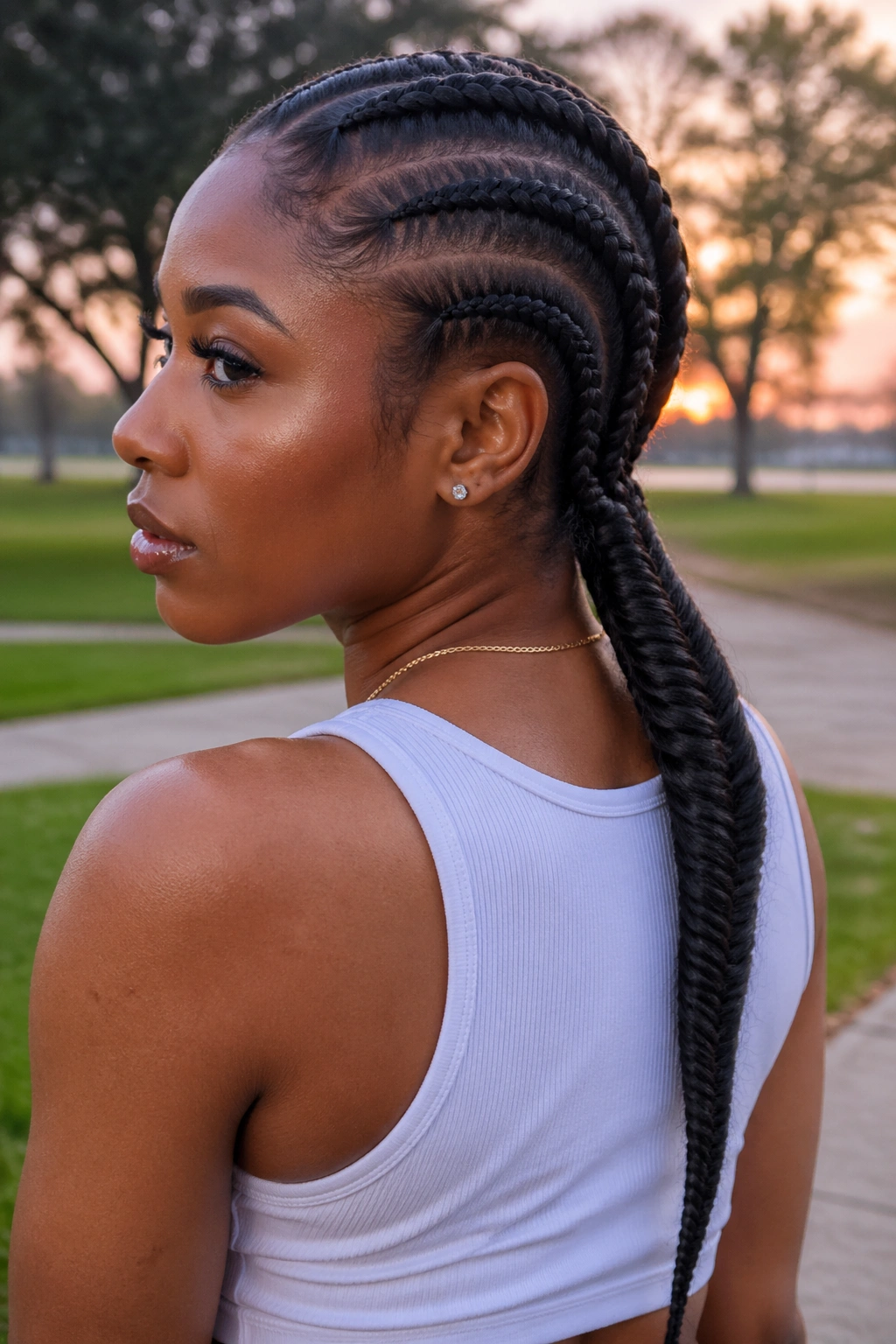
Ghana cornrows flat against the scalp ending in a low gather at the nape, where the loose tails are re-woven into a fishtail braid that falls down the back. Cornrow foundation, fishtail tail.
The fishtail is a different technique from the three-strand braid. It uses two strands passed over each other in small alternating pieces. The effect is a denser, rope-like finish that contrasts with the flat cornrows.
Fishtails eat length. A medium fishtail uses about 20-30 percent more length than a three-strand braid of the same look. Account for this in your kanekalon choice and the total length you’re aiming for.
24. Ghana Cornrows With a Neon Accent Row
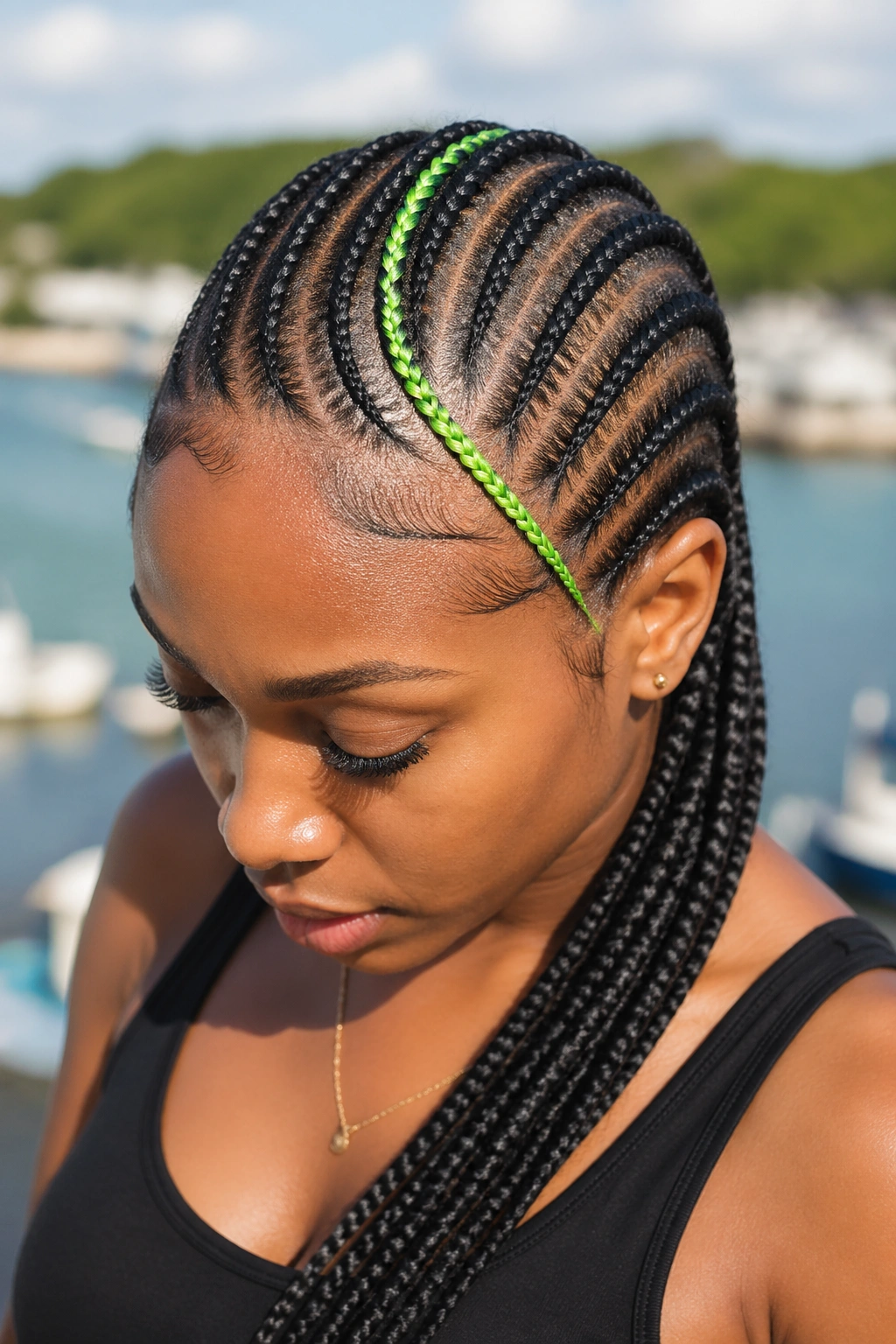
All but one row in natural color; one single row in a neon shade — electric blue, pink, or green. The neon row becomes the single focal point against the quiet background of the natural-color rows.
This is minimalism with a loud note. Neon hair on a field of black reads like a brushstroke. One color accent. No more. Multiple neon rows would overwhelm the effect and turn the style into a rainbow.
Styling Tips
- Place the neon row off-center — either one-third or two-thirds in from one side
- Match the neon row to an outfit color or accessory you wear regularly
- Re-dampen the neon section with a color-safe leave-in twice a week to preserve vibrancy
25. Ghana Cornrows With a Braided Accessory Band
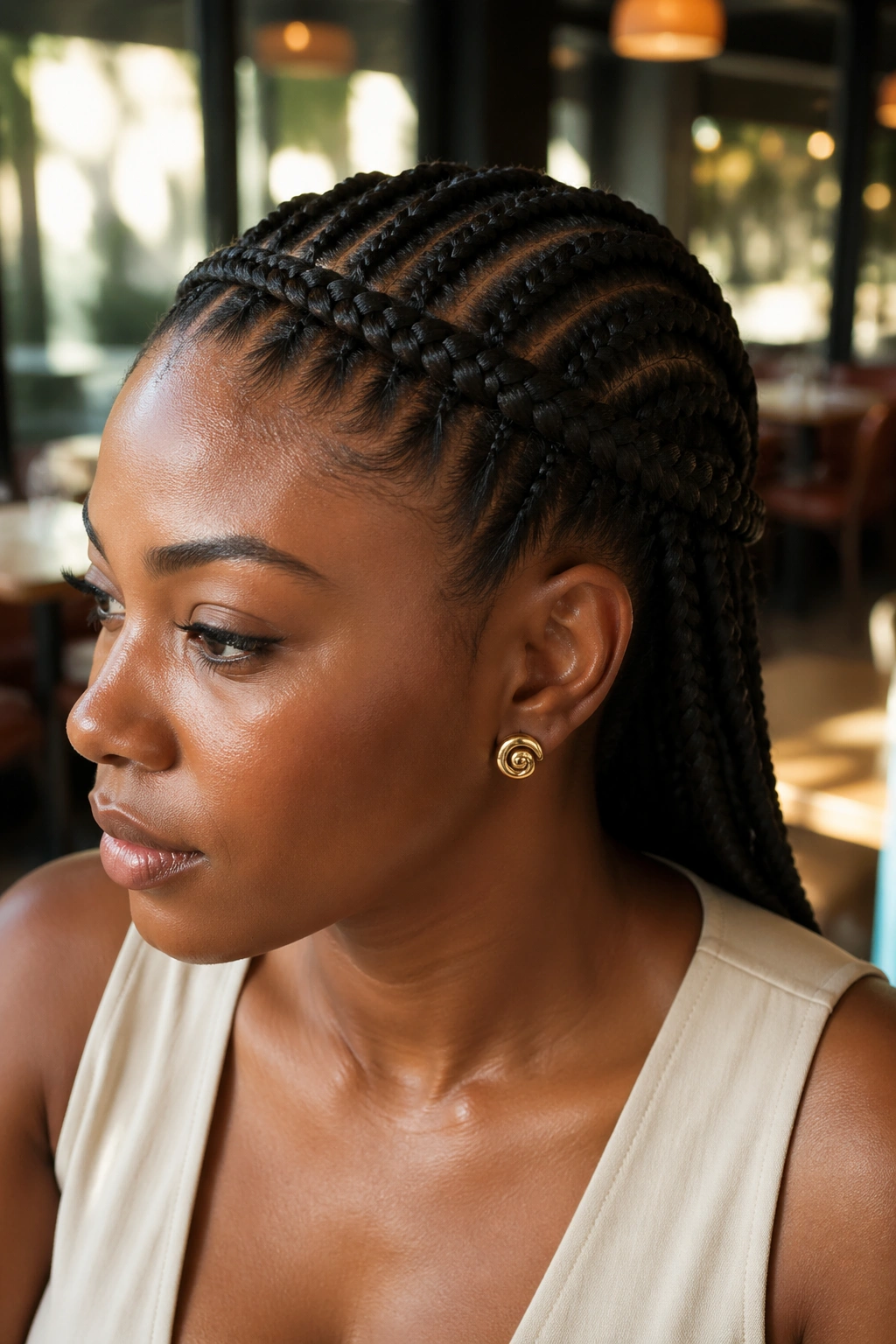
A decorative braided band sits across the head horizontally — parallel to the hairline, about two inches back — and cornrows run from the band down the back of the head. The front hair is separately braided into the horizontal band, which sits like a braided headband.
The horizontal band is a three-strand flat braid made from the front sections of the hair (or a sewn-in band of kanekalon stitched on). The back cornrows attach below the band line, running from the band to the nape.
This style reads architectural. It has structure, distinct zones, and the sort of design thinking that draws compliments from people who wouldn’t normally notice braided styles. Worth the extra hour of work it adds.
Daily Care That Keeps Ghana Cornrows Fresh
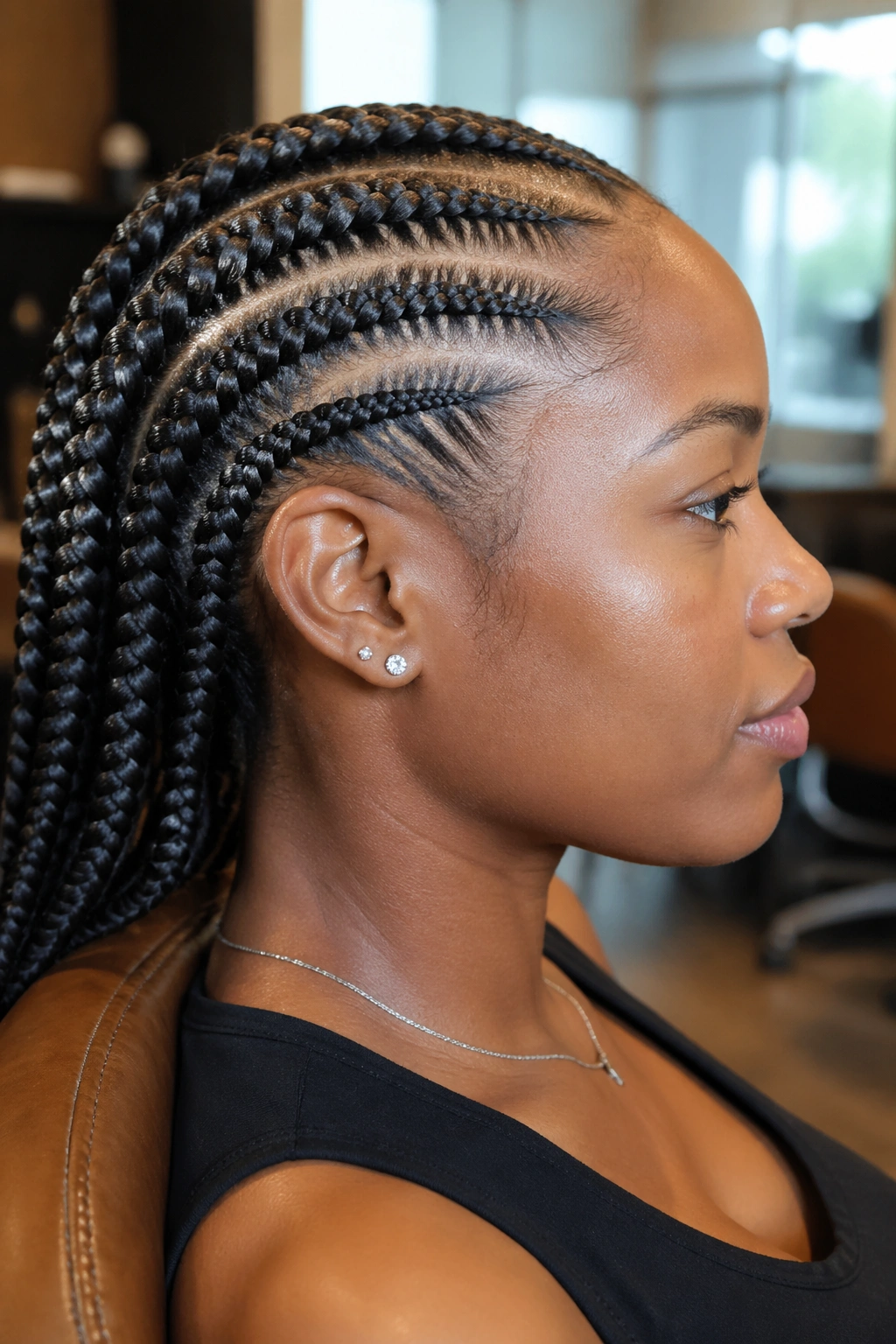
Ghana cornrows last four to six weeks — the longest of any cornrow style — but only with consistent care. Skip care and you’ll be at the two-week mark rethinking your choices.
Oil the scalp every other day with a lightweight blend — jojoba, castor, and peppermint is a solid combination. Use a nozzle-tip bottle to apply directly to the parts. Massage with fingertip pads, not nails.
Mist the braids with a water-based leave-in twice a week. Not daily. Over-misting leads to fuzzing at the roots.
Night Care and Sleep Routine
A silk or satin bonnet every night. No exceptions. A cotton pillowcase wicks moisture out of the braids and roughens the cuticle of the kanekalon. A satin pillowcase helps but a bonnet is better.
Long Ghana braids need extra attention. Don’t sleep on top of the tails — they’ll kink or mat. Arrange them to one side, over the pillow’s edge, or gathered in a loose silk scrunchie at the crown.
Edge Care and Hairline Protection
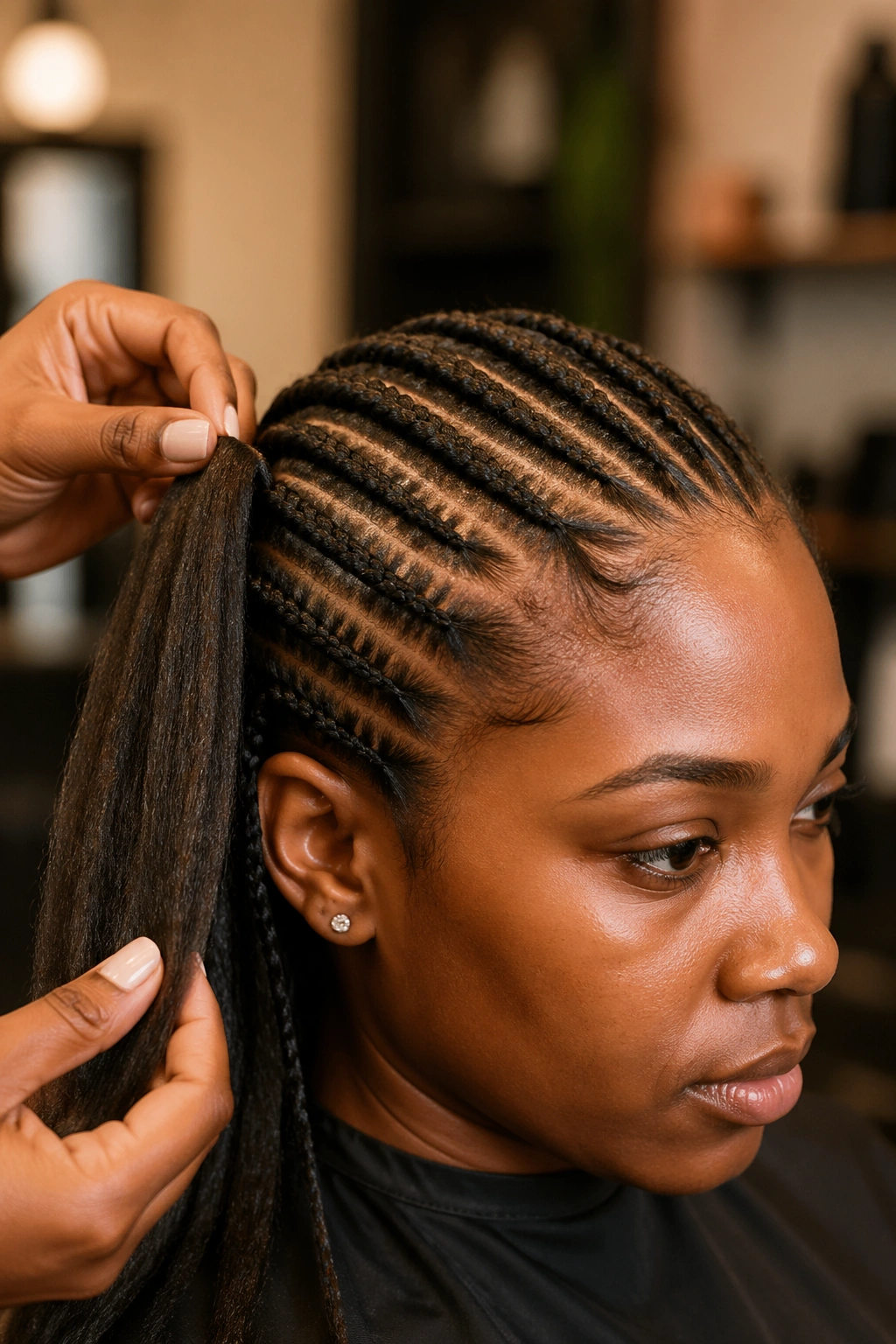
The hairline is where Ghana braids either shine or suffer. The feed-in method helps because it starts thin, but tension can still build over weeks of wear.
If the hairline starts to itch, flake, or tenderize, it’s time to loosen the front rows or take the style down. Don’t push past the warning signs. Edge regrowth is slow and traction damage can become permanent after repeated offenses.
Light oil or a growth serum on the edges every other day keeps the area nourished. Don’t apply heavy products — they clog the hair follicles and cause tiny bumps along the hairline.
Washing Ghana Cornrows Without Damage
Yes, you can wash Ghana cornrows. Do it every two to three weeks with a diluted sulfate-free shampoo applied in a squeeze bottle directly to the scalp. Rinse with cool water, then apply a light conditioner to the braids themselves. Rinse again. Air-dry completely before bed — damp Ghana braids develop mildew smell within a day.
Avoid heavy scrubbing. Pat the cornrows with a clean microfiber towel, then let them air-dry with the scalp exposed to airflow. A hood dryer speeds things up but isn’t required.
When to Take Them Down
Six weeks is the hard ceiling for most heads. Some can go eight weeks; some need to take down at four. Listen to your hair — not Instagram.
Signs it’s time:
- Itching that doesn’t stop after washing and oiling
- Visible lifting at the roots of multiple braids
- Any lingering tightness or soreness along the hairline
- Shed hair accumulating visibly at the base of braids
- Flaking scalp that oil alone doesn’t fix
Takedown should be slow and gentle. Snip the sealed ends, unbraid from the tip up, spray with water-and-conditioner mix as you work, and detangle section by section. A full takedown runs two to three hours. Don’t rush it.
Ghana cornrows reward patience at every stage — in the prep, the install, the care, and the takedown. Rush any one of those and the payoff drops. Respect the time, respect the technique, and the 25 styles above are all within reach.
