



A cornrow updo is two ideas married well. The braiding pattern carries the structure. The updo lifts everything off the neck, creating that elongated, lifted, polished silhouette that no other style quite produces. Cornrow updos for Black women hold a special place in the styling world because they pair function with serious presence — protective, beautiful, and capable of taking you from a Tuesday meeting to a Saturday wedding without restyling.
There’s something about the way a well-built updo holds the head up. Posture changes. The neck looks longer. The cheekbones catch light in a way they didn’t five minutes earlier. That’s not vanity talking — that’s the geometry of a good updo.
These styles also solve real problems. Hair stays out of your face. Sweat from a workout doesn’t ruin the install. Hot weather feels manageable. Sleep doesn’t crush the look the way it crushes loose hair.
What follows is a tour through 25 distinct cornrow updo ideas. Some are bridal. Some are office-friendly. Some are for music videos and red carpets. Each one offers something the others don’t.
The Cornrow Updo Tradition
Updos with braided foundations have been around as long as braiding itself. African royalty wore raised, intricate updo styles for ceremonies. Yoruba queens, Wolof brides, Maasai warriors — each culture had its own version of cornrows lifted into something raised and architectural.
The shapes carried meaning. Height signaled status. Specific patterns marked age groups, marital status, occasions. A cornrow updo wasn’t just a pretty hairstyle — it was a statement that could be read by anyone who knew the visual language.
That history travels with the style today. A high cornrow bun on a wedding day isn’t just a fashion choice. It’s a thread back to centuries of women lifting hair high to mark the moment as special.
What Makes a Cornrow Updo Different from a Regular Updo
A regular updo gathers loose hair into a shape — a chignon, a French twist, a pinned bun. The shape lives entirely above the scalp.
A cornrow updo splits the work. The cornrows do the bottom layer — they smooth the hair flat against the head and direct everything toward a gathering point. The updo itself takes over from there, building the shape using the cornrow ends, sometimes with extensions, sometimes with the natural hair only.
Because the foundation is braided, cornrow updos hold their shape for weeks. A regular pinned updo lasts a day. A cornrow updo can run twenty days easily.
The braided base also keeps the front of the head smooth. There’s no flyaway flying around the temples after lunch. The cornrows lock everything in place.
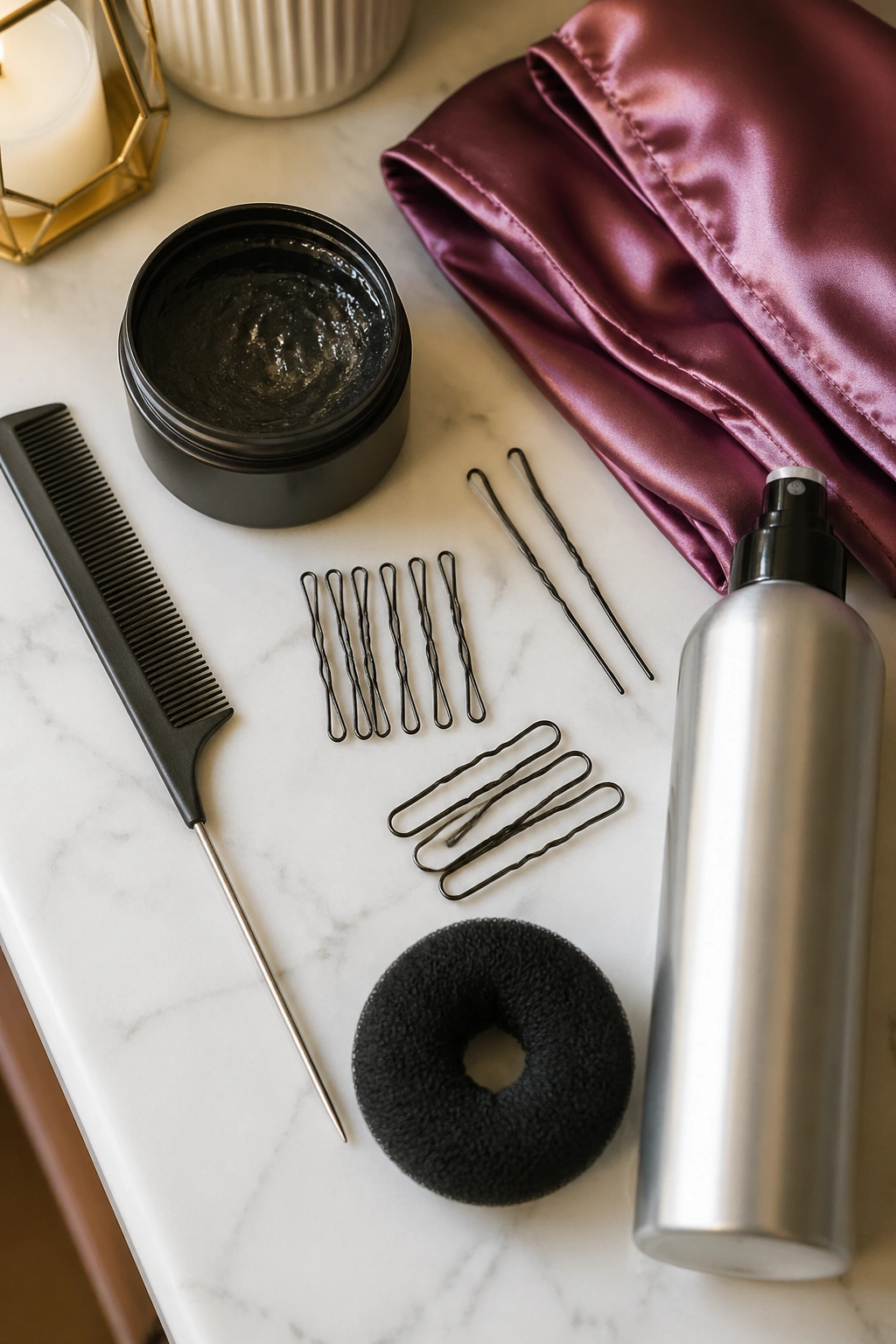
Tools You’ll Need
Most cornrow updos need slightly different tools than flat cornrows.
- A long rat-tail comb for parting
- A stronger-hold edge gel — Got2B or Eco Styler max hold work
- Bobby pins, both regular and jumbo, in colors that match your hair
- Hair pins (the U-shaped kind) for securing buns and twists
- A medium-hold hairspray
- A satin scarf for setting the updo while it sets
- Optional: a small donut form for fuller buns
Not every updo needs every tool. But having them ready means your braider isn’t stopping mid-install to send someone to the store.
Getting the Hair Ready Before the Install
Hair should be clean but not freshly washed. A two-day wash gives the right balance of cleanliness and natural slip.
Stretch the hair before the appointment. African threading, banding overnight, or a light blow-out on cool air all work. Stretched hair lies flatter under cornrows, which means the updo sits closer to the scalp instead of bumping out around the crown.
Avoid heavy butters or oils the night before. They coat the strands and cause the cornrows to slip during the install.
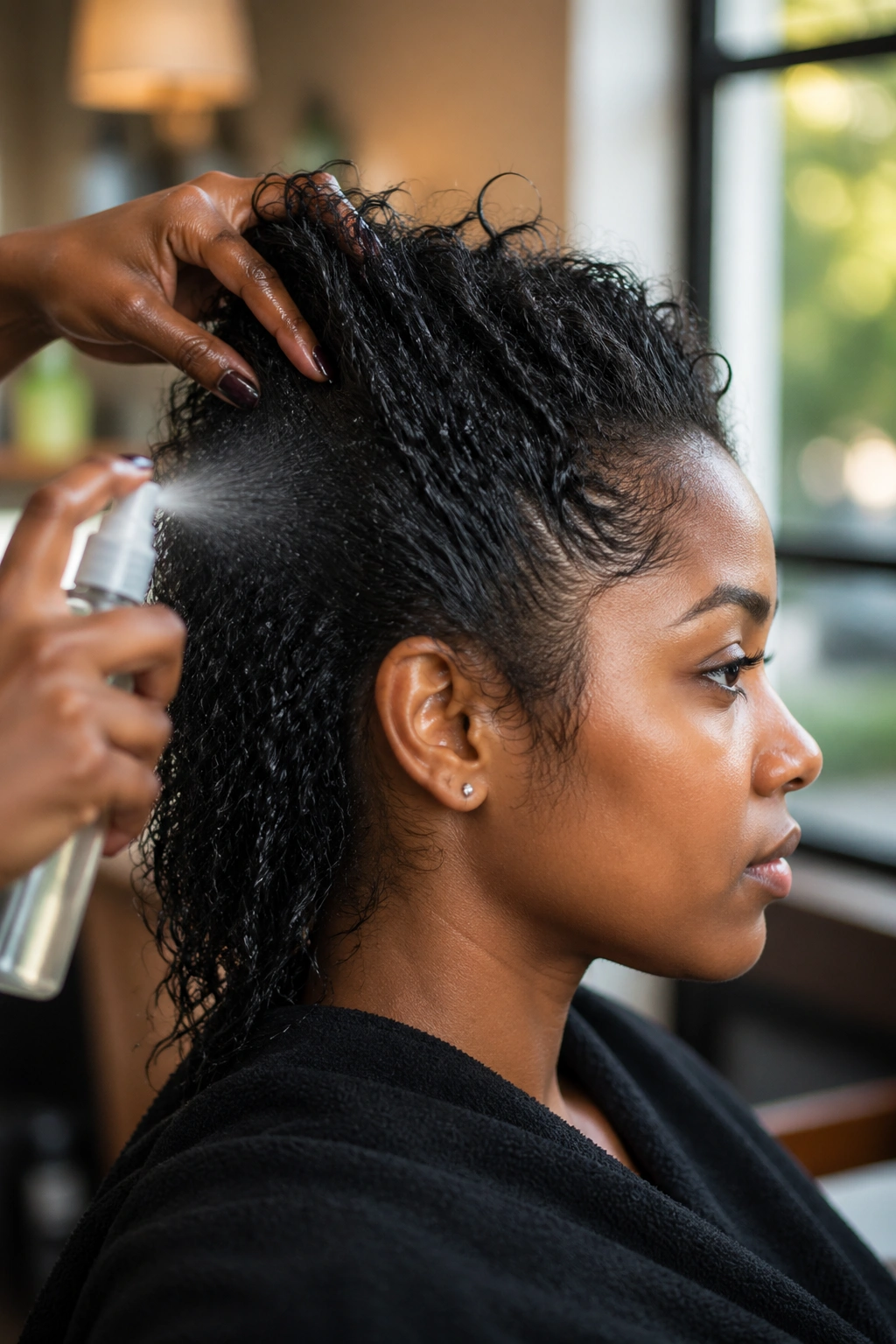
A spritz of leave-in mixed with water on damp hair, smoothed in with a wide-tooth comb, is the right pre-prep. Light, hydrating, no buildup.
Picking the Right Cornrow Updo for Your Face and Lifestyle
Updos that pile high look striking, but they aren’t for everyone. Tall buns can overwhelm petite features. Wide horizontal updos can balance round faces but throw off long ones.
Lifestyle matters too. A heavy decorative bun looks gorgeous but tugs on the scalp through an eight-hour day. A simple low chignon style is gentler for daily wear.
Think about how you’ll sleep in it. High buns require you to sleep on your side or your stomach — never on your back without crushing the bun. If you’re a back sleeper, go for a low updo.
Think about your work environment. Some workplaces are fine with dramatic styles. Others read smaller, simpler updos as more professional. Both versions exist in cornrow updo form.
1. Cornrows Into a High Bun with a Wrap
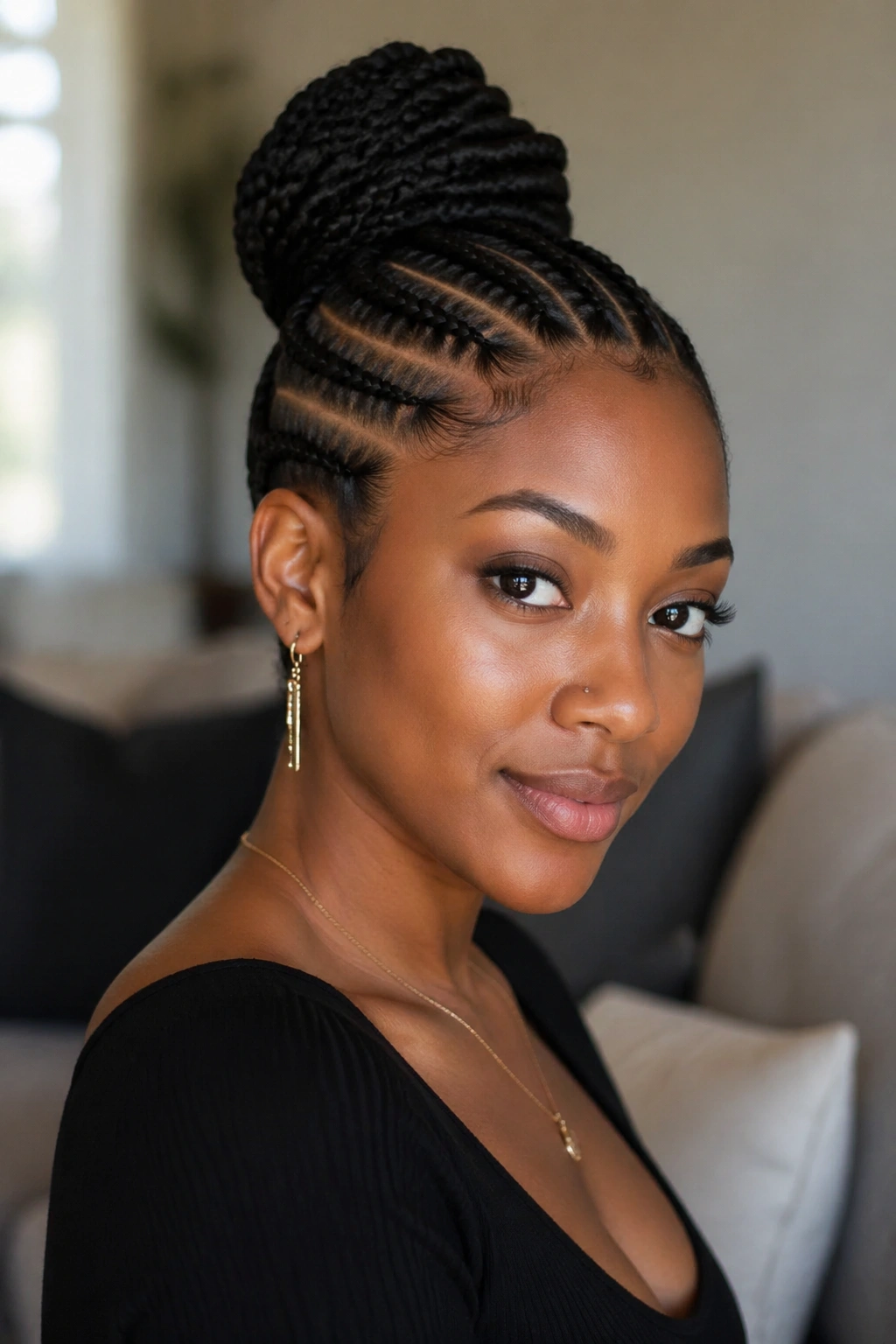
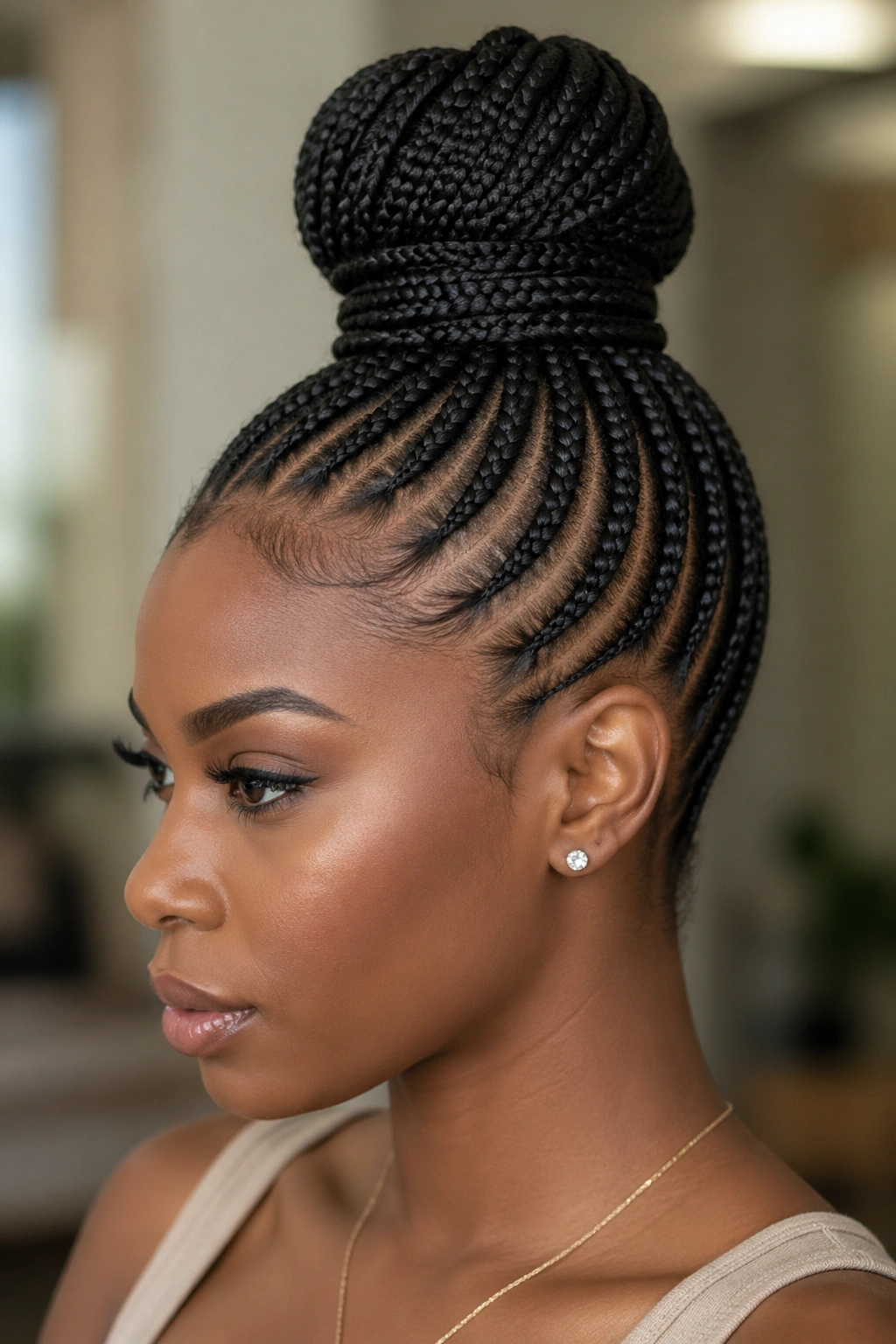
Straight-back cornrows from the hairline to the crown, then everything sweeps up into a high bun at the crown. The bun gets wrapped with one of the cornrow ends — coiled around the base, pinned in place — for a clean finish.
Why It Works So Well
- The wrap hides the elastic that holds the bun together
- Cornrows pulling up create a smooth lifted line at the front
- The bun sits in the position that gives the most height
Styling tip: Mist the wrap with a touch of hairspray before pinning to keep the wrapped section from loosening through the day.
This is the workhorse of cornrow updos. It works for offices, weddings, dinner parties, photoshoots. It rarely fails.
2. Beehive Cornrow Updo
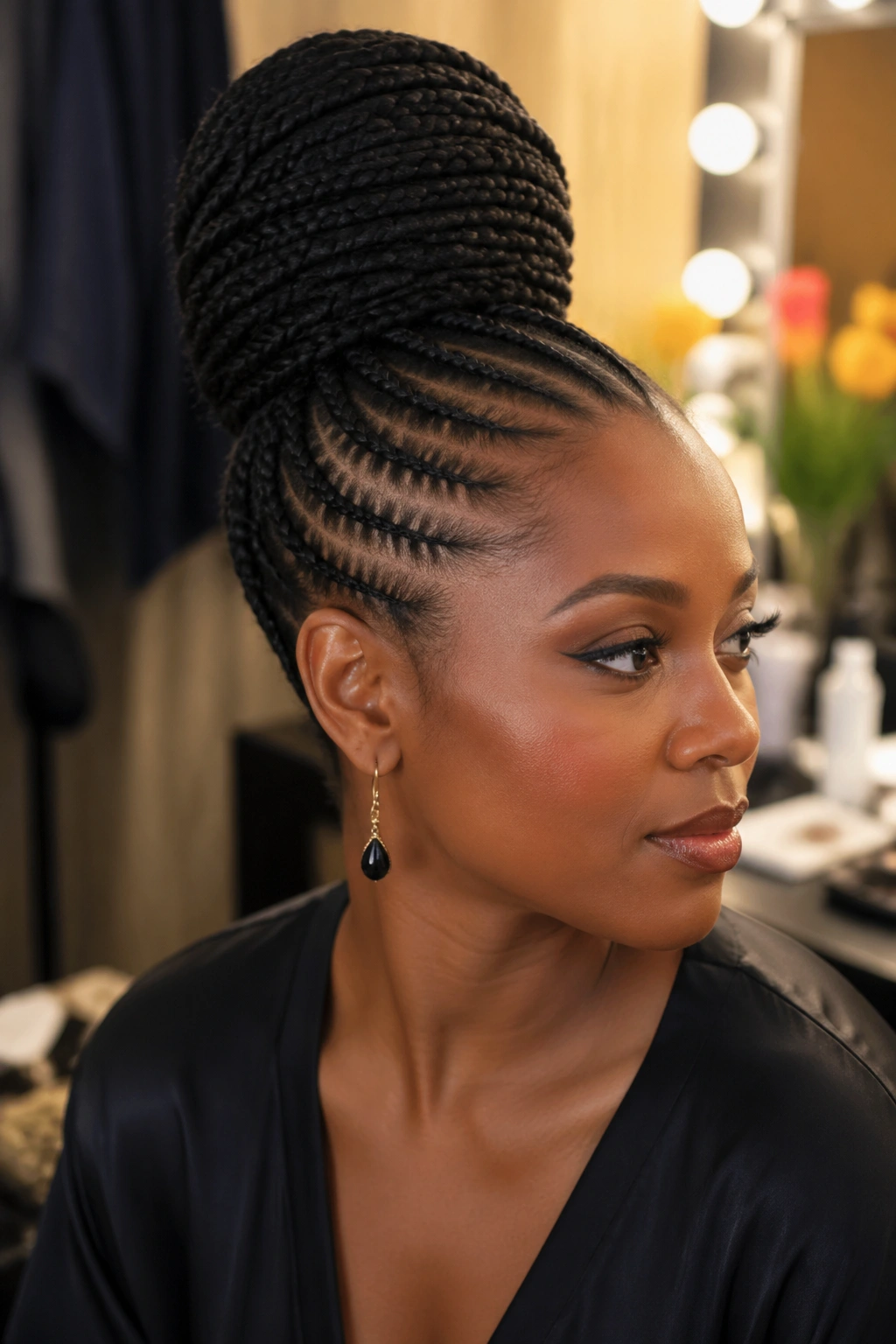
The beehive lifts the bun even higher than a standard high bun. The cornrows still go straight back, but a small piece of foam or padding sits underneath the bun base, pushing the gathered hair up and out into a rounded teardrop shape.
The padding makes the difference. Without it, you get a regular high bun. With it, you get architectural drama.
Best worn for events, theater, weddings. Not the everyday choice — but stunning when the occasion fits.
3. Low Chignon with Stitch Cornrows
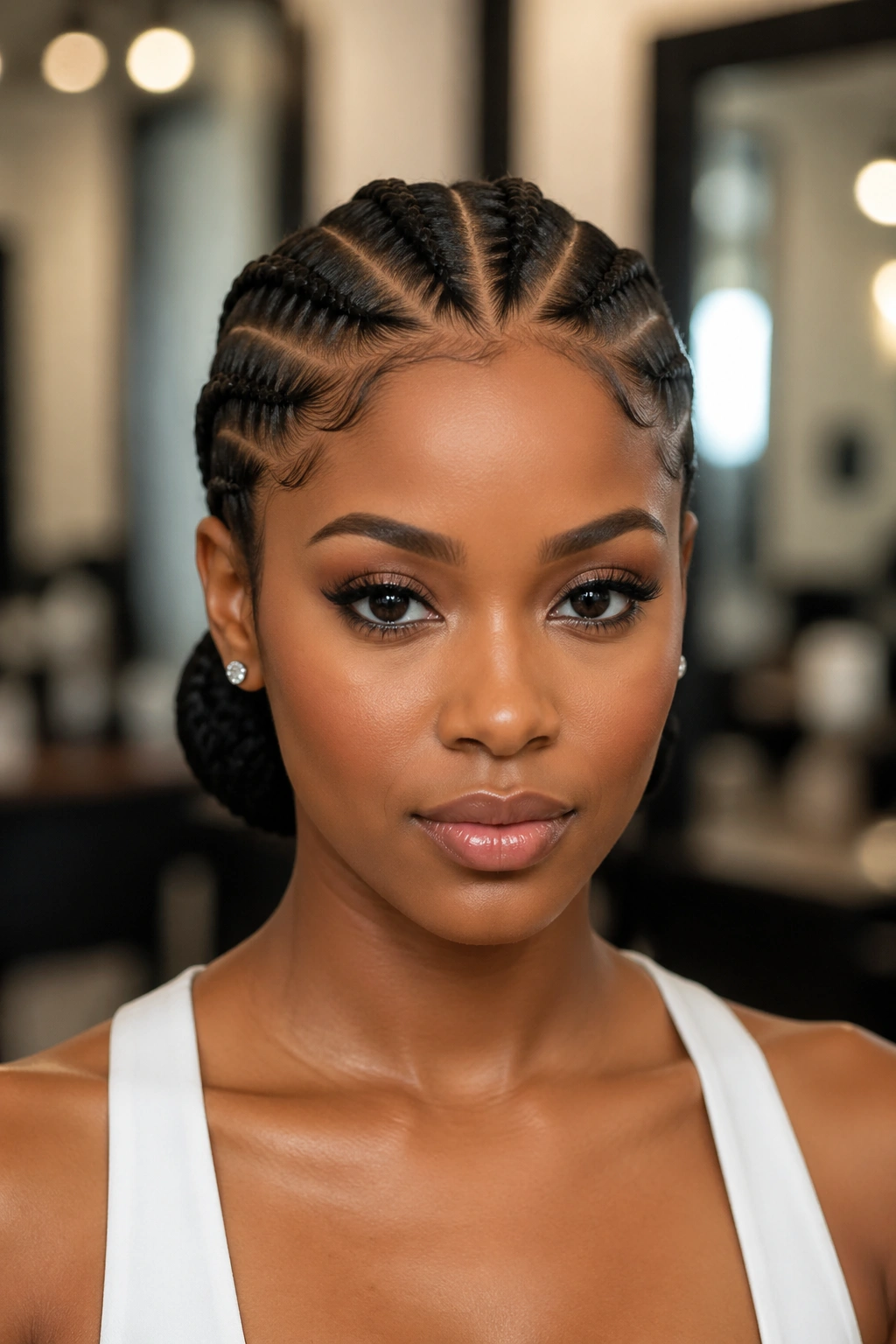
Stitch cornrows running back to a low chignon at the nape. The chignon sits low and tight, almost flat against the back of the neck.
What Makes It Different: Most cornrow updos lift. This one doesn’t. It stays close to the head, which makes it feel more refined and less performance.
The stitch detail in the cornrows reads luxurious from the front. The low chignon reads understated from behind. Together they create a style that whispers rather than shouts.
Lovely for older women who want something age-appropriate that still has character.
4. Cornrow Mohawk with a Top Bun
The cornrows on the sides of the head are tiny and tight, hugging close. The center strip — running from forehead to nape — holds three or four larger cornrows that gather at the top of the head into a tall bun.
This is the cornrow updo for the boldest occasions. A music video, a fashion editorial, a club night where you want every head to turn.
The top bun can be left as raw cornrow ends bundled together, or teased out into a full puffy bun.
5. Cornrows Into a Crown Braid Updo
Cornrows feed back from the hairline, ending in long braid tails. The tails get woven together into a single thick braid that wraps around the head like a crown.
The crown braid technique comes from Eastern European traditions, but it works beautifully on cornrowed hair. The braided base means the crown stays in place all day instead of slipping the way it would on loose hair.
How to Style It: Thread a small fresh flower into the crown for weddings. Or leave it plain. Both versions photograph well.
6. Cornrow Updo with Cathedral Twists
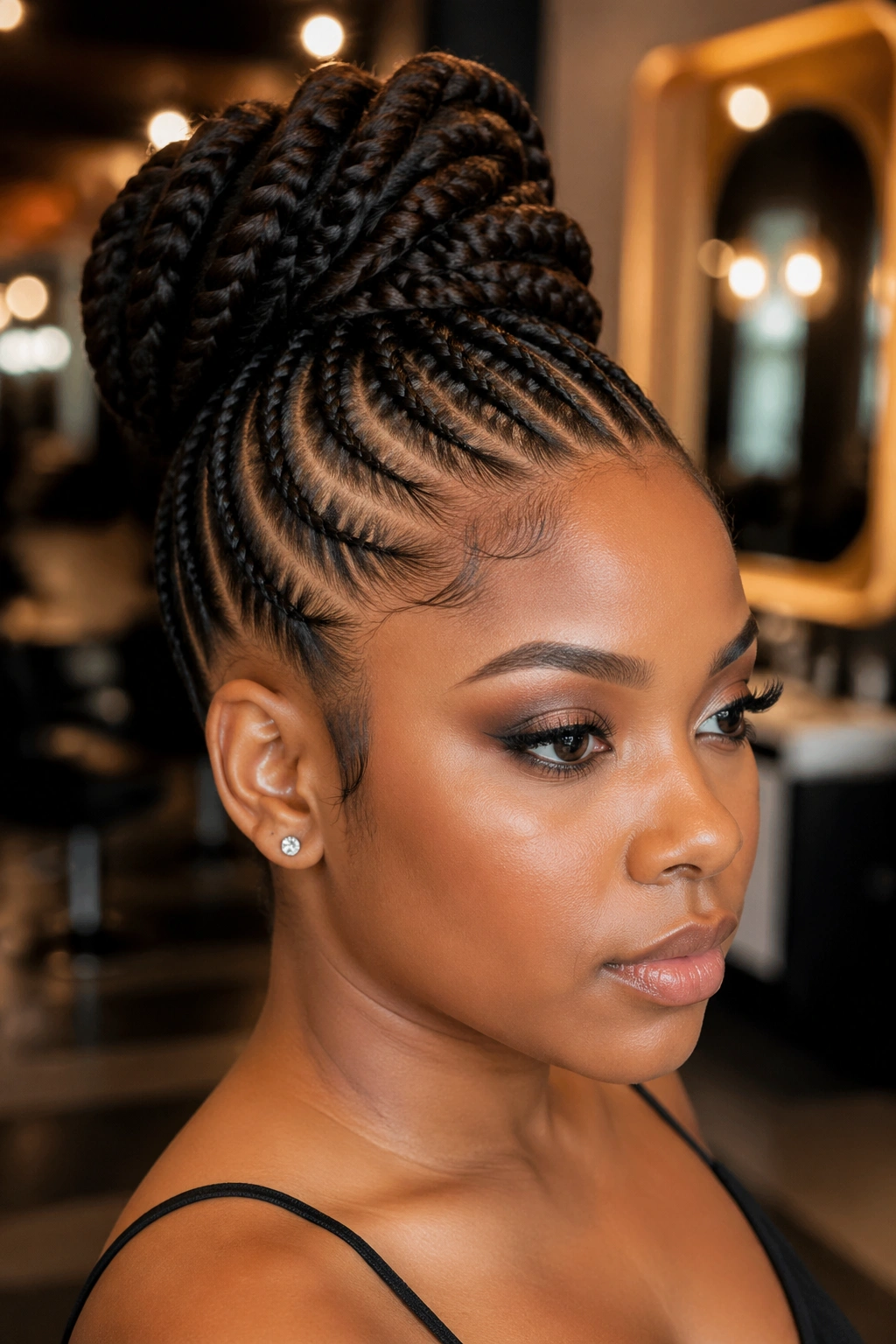
Bold claim: cathedral twists turn a regular updo into something architectural.
Cathedral twists are large twisted ropes of hair that arch up and over the crown of the head, meeting at the back. Combined with a cornrow base, they create a structure that looks built rather than styled.
The twists are usually done with the cornrow ends plus added kanekalon for length and thickness. A skilled braider can layer multiple cathedral twists on top of each other for serious height.
This style needs prep. Allow three to four hours for the install.
7. Curved Cornrows Into a Side Bun
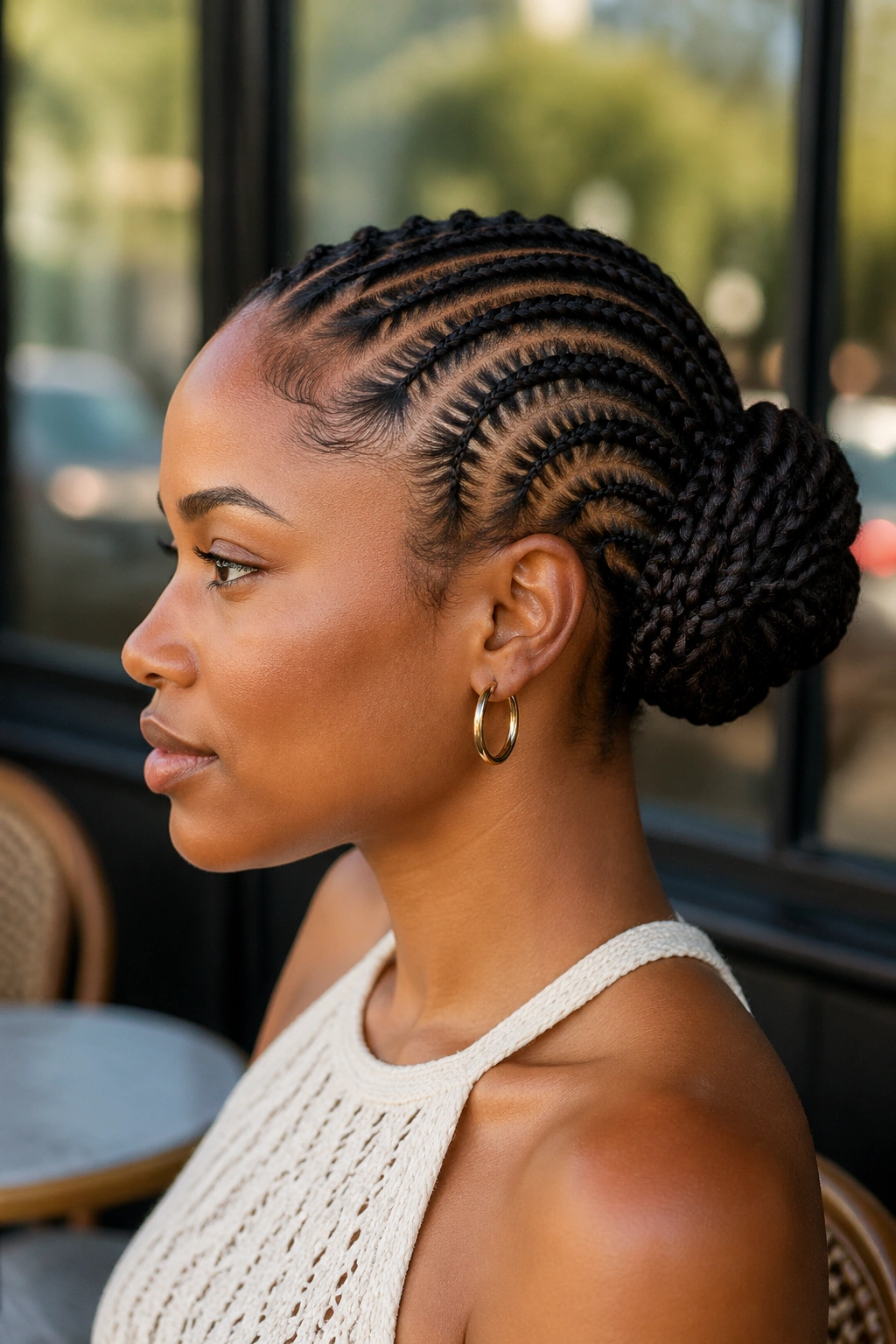
Cornrows curve diagonally from the hairline across the crown, gathering at one side just above the ear into a side bun. The curve is the signature element — straight cornrows wouldn’t create the same flow.
A side bun reads softer than a center bun. Less symmetry, more movement. Reads romantic.
Pin a small ribbon at the base of the side bun for evening wear. For daytime, leave it plain.
8. Tribal Cornrow Updo with Gold Cuffs
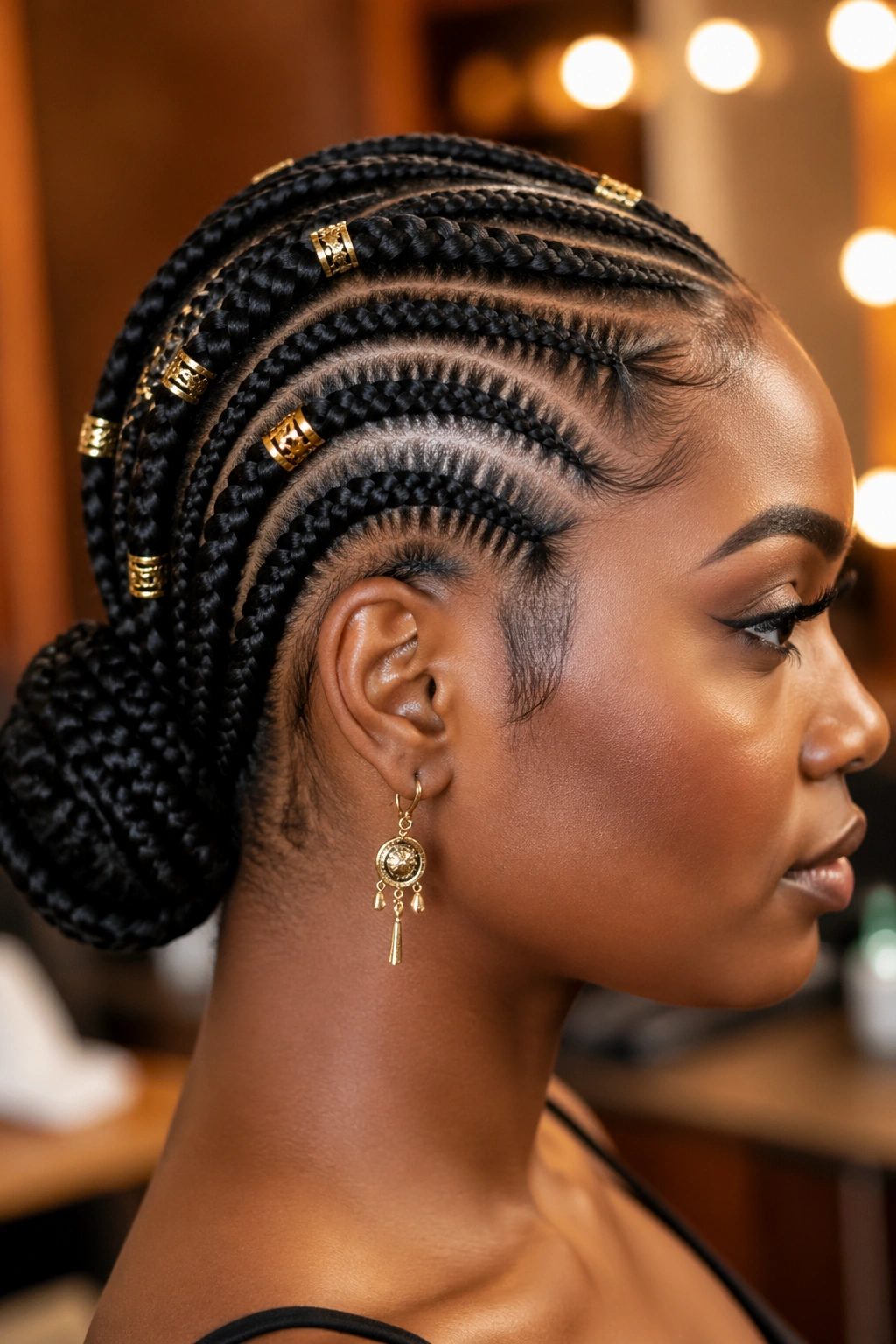
Cornrows arranged in a tribal pattern across the scalp, with gold metal cuffs sliding up several braids before they gather into an updo at the back.
The cuffs catch light. They click softly when you move. They mark the style as intentional rather than casual.
The updo itself can be a low bun, a high bun, or a halo of woven braids. The cuffs make any of those options read more dressed.
Maintenance Notes
- Polish the cuffs with a soft cloth weekly — they tarnish in humid weather
- Check the cuff grips on day three; tighten any that loosened
- Remove cuffs before bed if they sit at pressure points
9. Low Updo with a Side-Swept Cornrow Bang
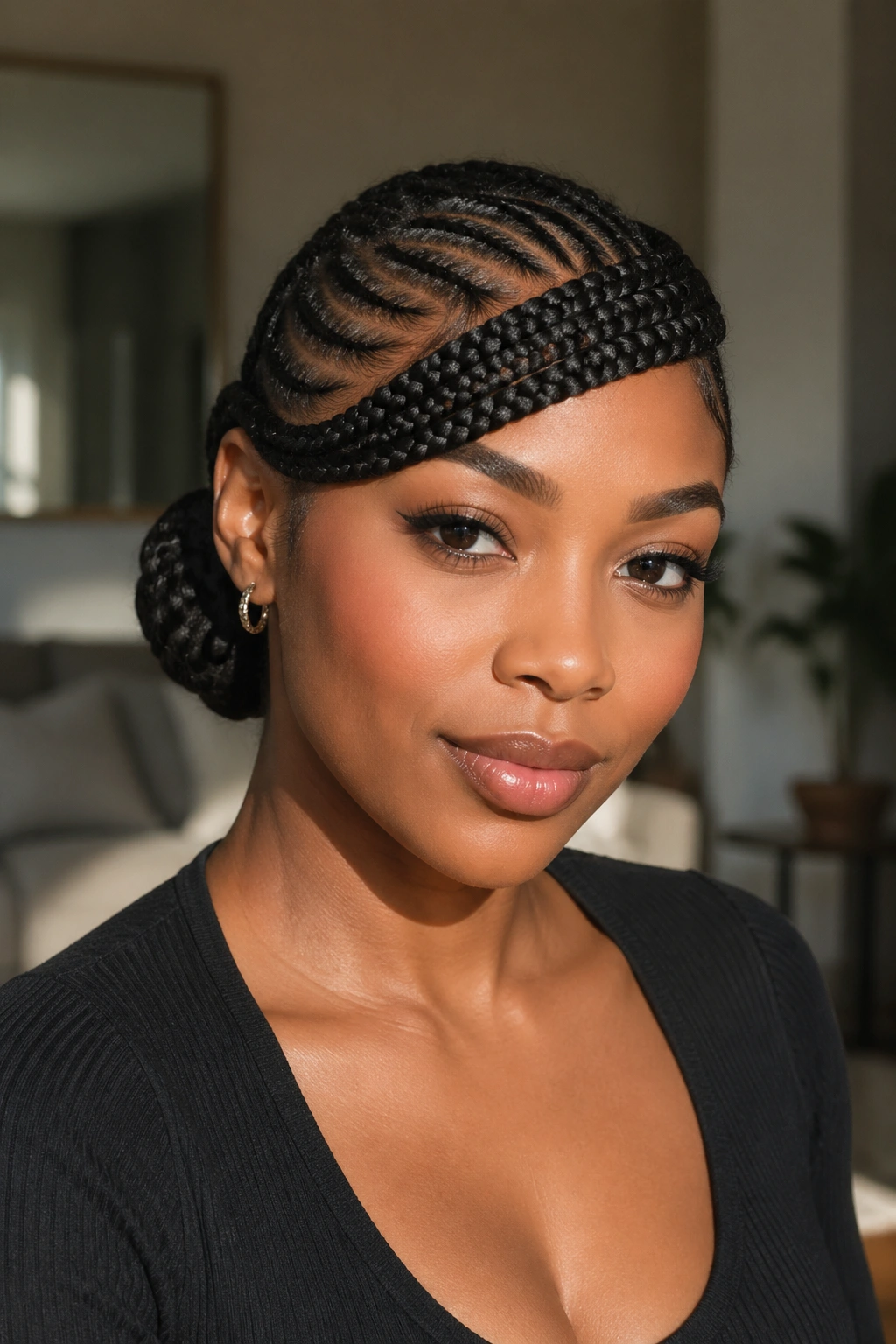
A low updo at the nape, with a thick cornrow swept across the forehead like a side bang.
The side cornrow is the feature. It curves across the face, framing one eye and softening the forehead. The low updo behind it stays out of the spotlight.
This works beautifully on heart-shaped faces. The diagonal cornrow line balances out a narrower chin.
10. Cornrows Into a French Twist
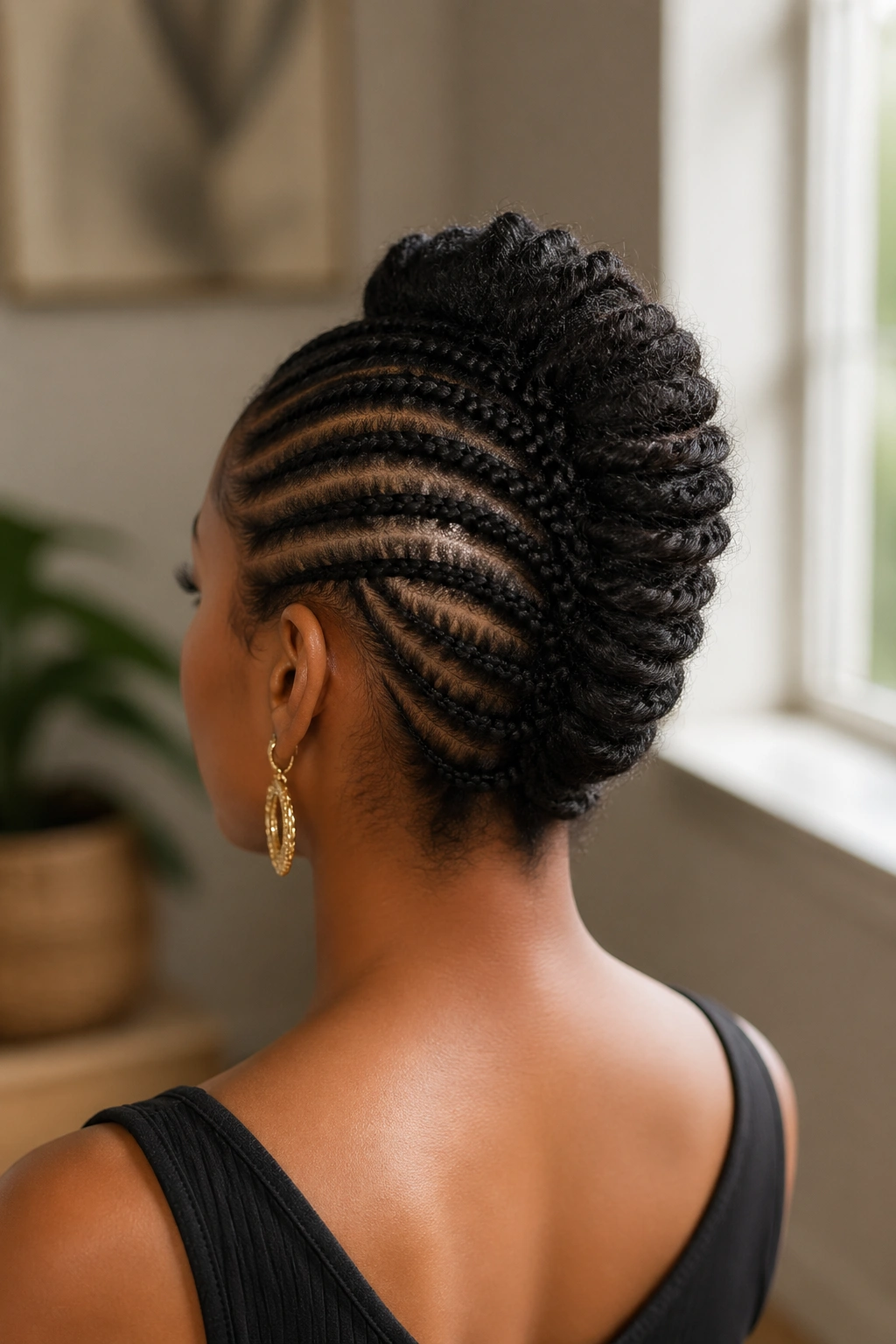
Question opener: can a French twist work on textured hair?
Yes — when the foundation is cornrowed. Loose Black hair can struggle to hold a French twist for an entire day, but cornrows lock the bottom layer in place, giving the twist a structure that won’t unravel.
The cornrow ends get gathered, twisted vertically up the back of the head, and pinned in place. The result is the classic vertical seam of a French twist with the modern texture of cornrowed hair.
How to Use It
- Smooth a small amount of pomade through the twist before pinning
- Use jumbo bobby pins — regular ones can’t hold the bulk of cornrowed hair
- Tuck the very top of the twist down for a clean finish
11. Cornrow Updo with Hanging Braids
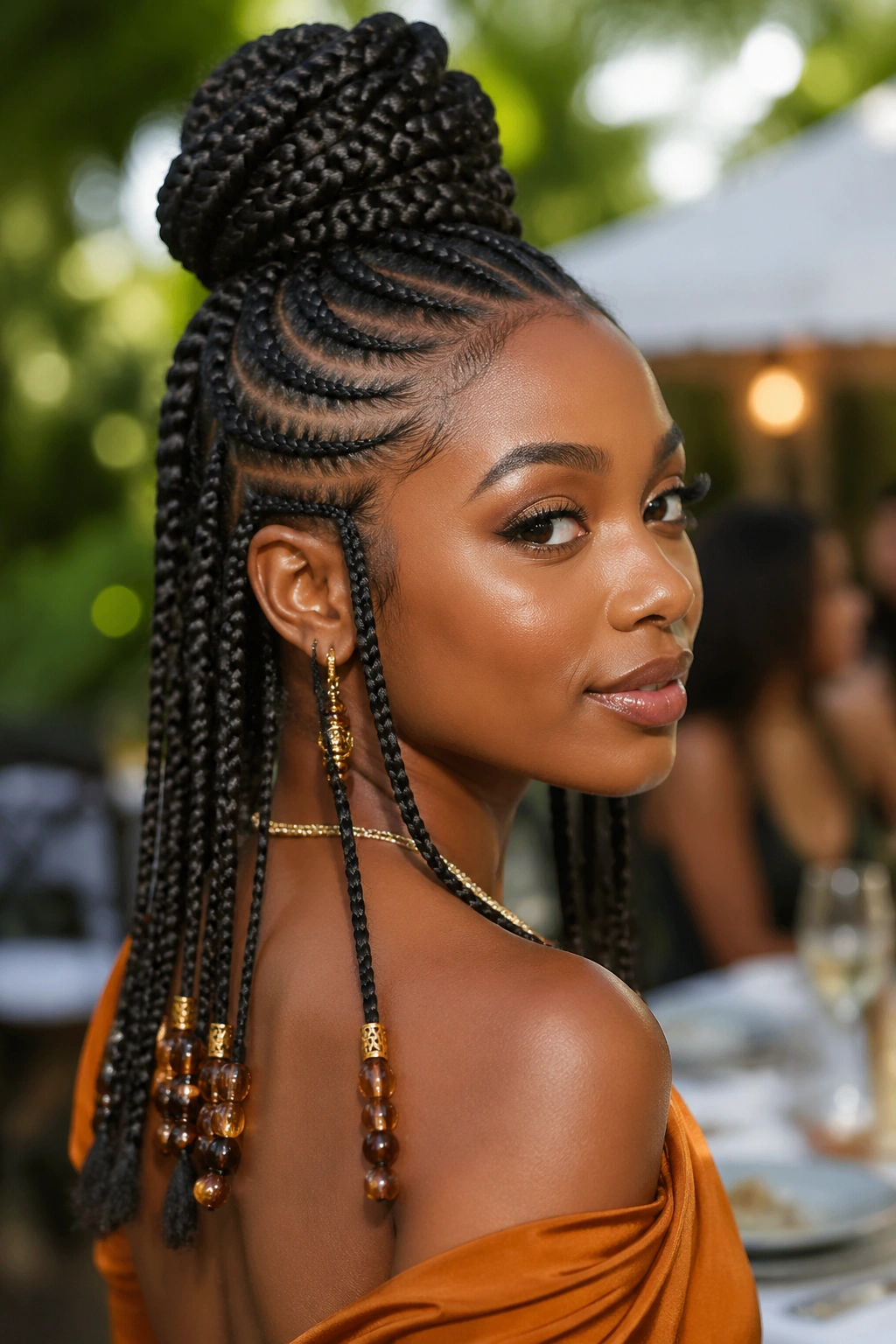
Most cornrow ends get gathered into the updo. This version leaves a few braids hanging — three or four — to fall down the back or across one shoulder.
The hanging braids create a half-updo half-down feeling without committing to a full half-up style. The bulk stays up. The accents stay down.
Great for events where you want both structure and movement. The hanging braids can have beads or cuffs at the ends for extra detail.
12. Cornrows Into Two Side Buns
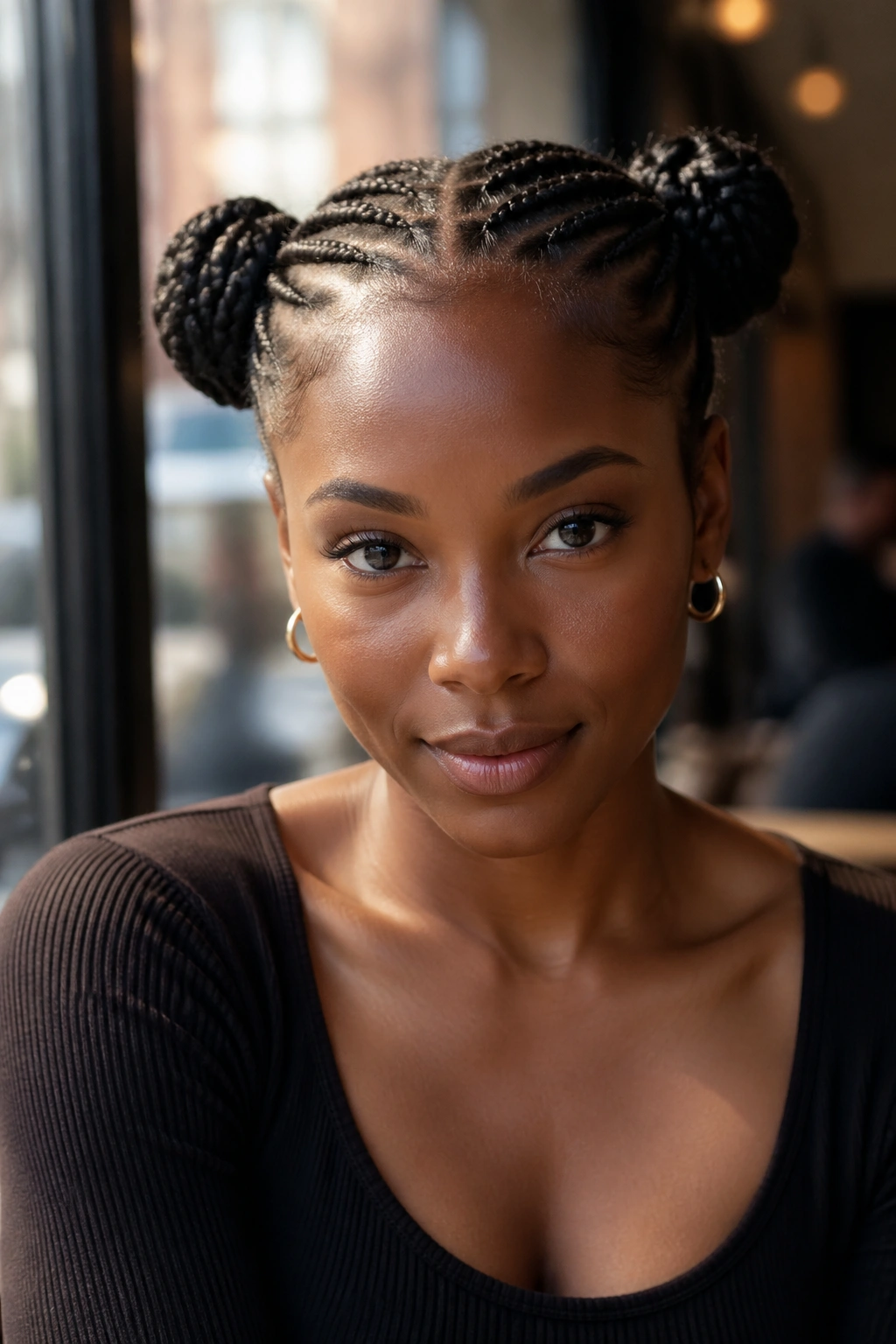
Two buns at the sides of the head, just above the ears. The cornrows split at the crown — half going to one bun, half going to the other.
The placement is the trick. Too high and the buns look like horns. Too low and they look like dog ears. Just above the ears is the spot.
This style reads playful and stylish at the same time. Perfect for weekend events, brunches, casual but cute days.
13. Stitch Cornrows Into a Donut Bun
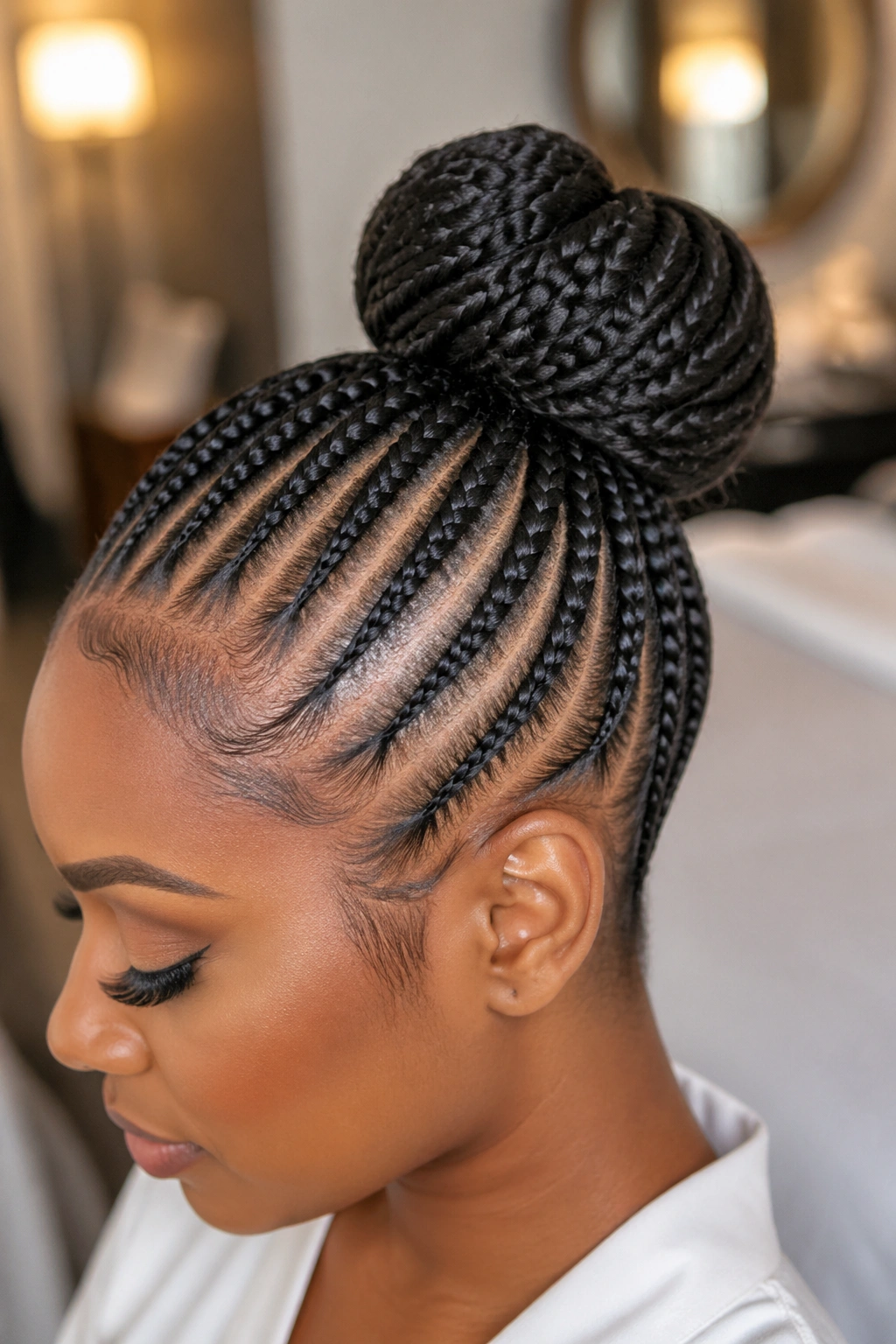
Brief scenario: you’ve got a wedding to attend in three days. You want a style that reads polished but not stiff. A stitch cornrow donut bun is the answer.
The cornrows stitch their way back to the crown. The cornrow ends gather around a hair donut form, creating a perfectly shaped round bun that doesn’t deflate through the night.
The donut form means the bun stays full no matter how much hair you have. Even fine, thin hair can pull off a substantial bun with one of these.
- Wrap the cornrow ends fully around the donut to hide the form
- Pin every quarter inch to keep the wrap tight
- Mist with hairspray after the install for hold
14. Cornrows With a Bantu Knot Cluster Updo
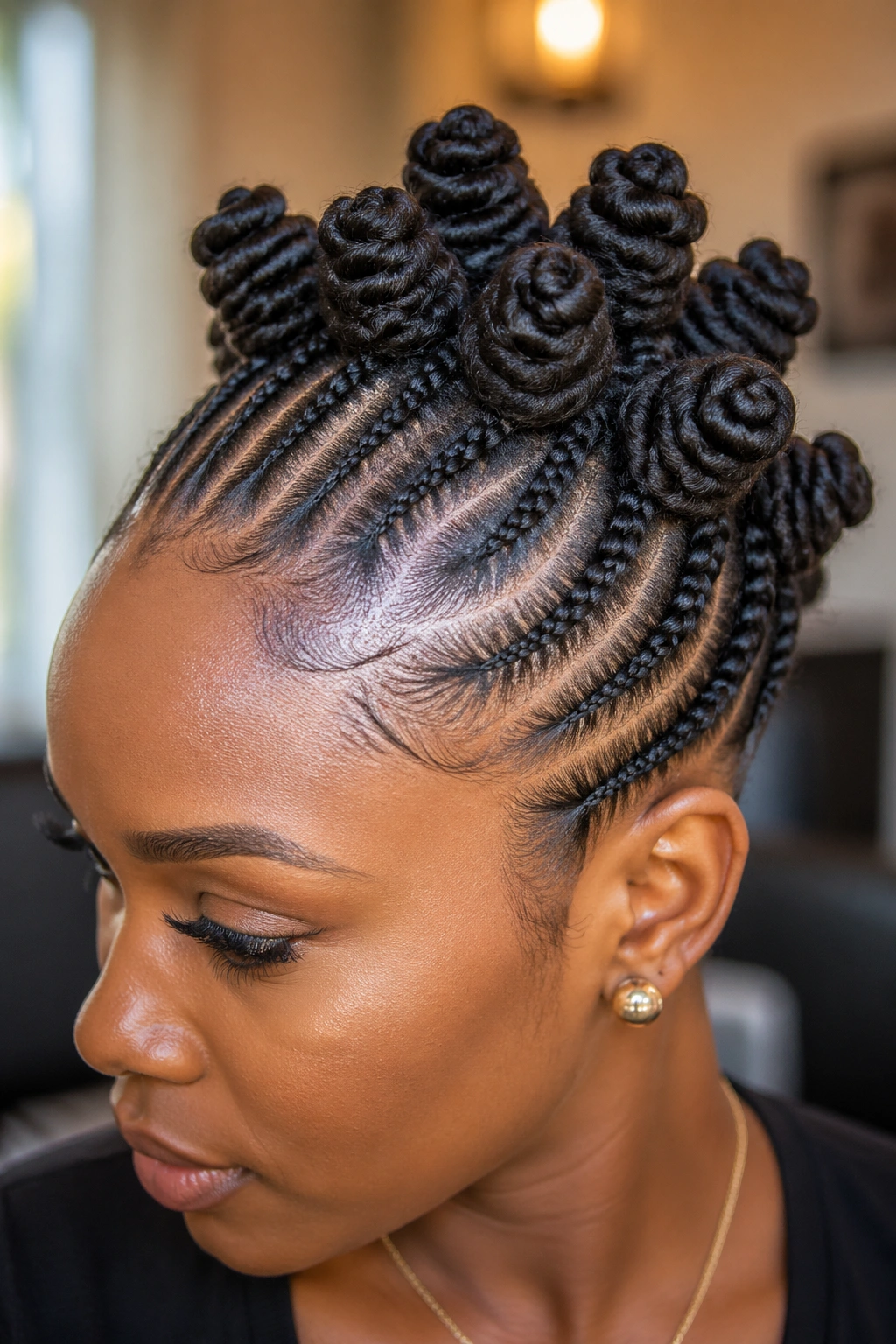
Multiple Bantu knots — five, seven, nine — clustered together at the crown of the head, with cornrows feeding into each knot.
Each knot is built from a section of the cornrows wrapped tightly into a knot. The cluster creates a textured updo with serious dimensional interest.
This is a heritage style with serious cultural weight. The Bantu knot has been a Southern African staple for centuries, and using it in updo form pays respect to that legacy.
Pull down by week one and you’ve got a knot-out curl pattern that doubles the value of the install.
15. Cornrow Updo with a Halo Braid
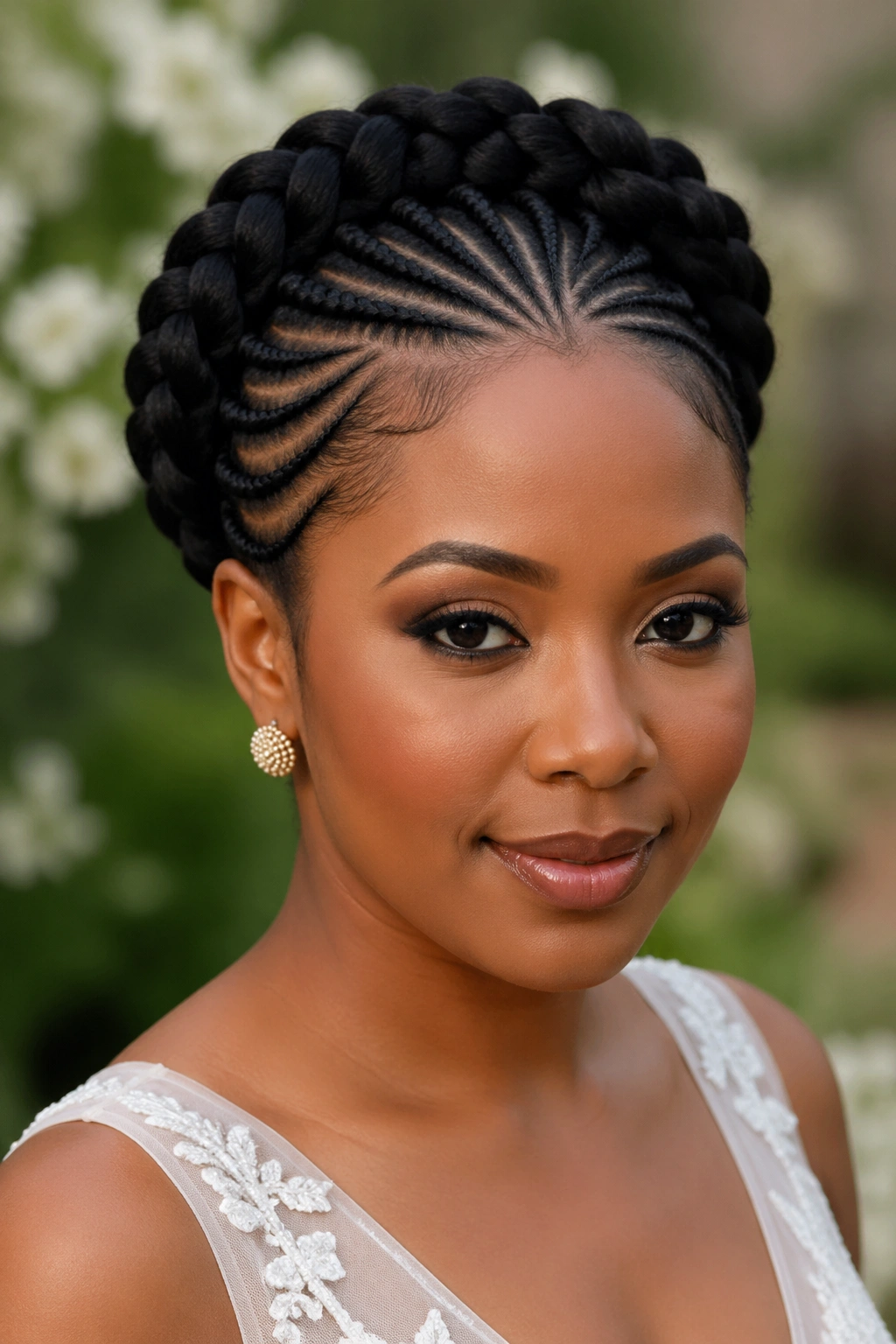
A halo is a single thick braid that wraps the entire perimeter of the head like a crown. Combined with cornrows feeding back to the base of the halo, this style is regal in the most literal sense.
The halo can be made with the cornrow ends or with separately added braiding hair. Added hair gives more thickness and length to wrap fully around the head.
Who This Is For: Brides, attendees of formal events, anyone who wants a hairstyle that says “I dressed up.”
16. Pulled-Back Cornrows With a Large Pinned Curl
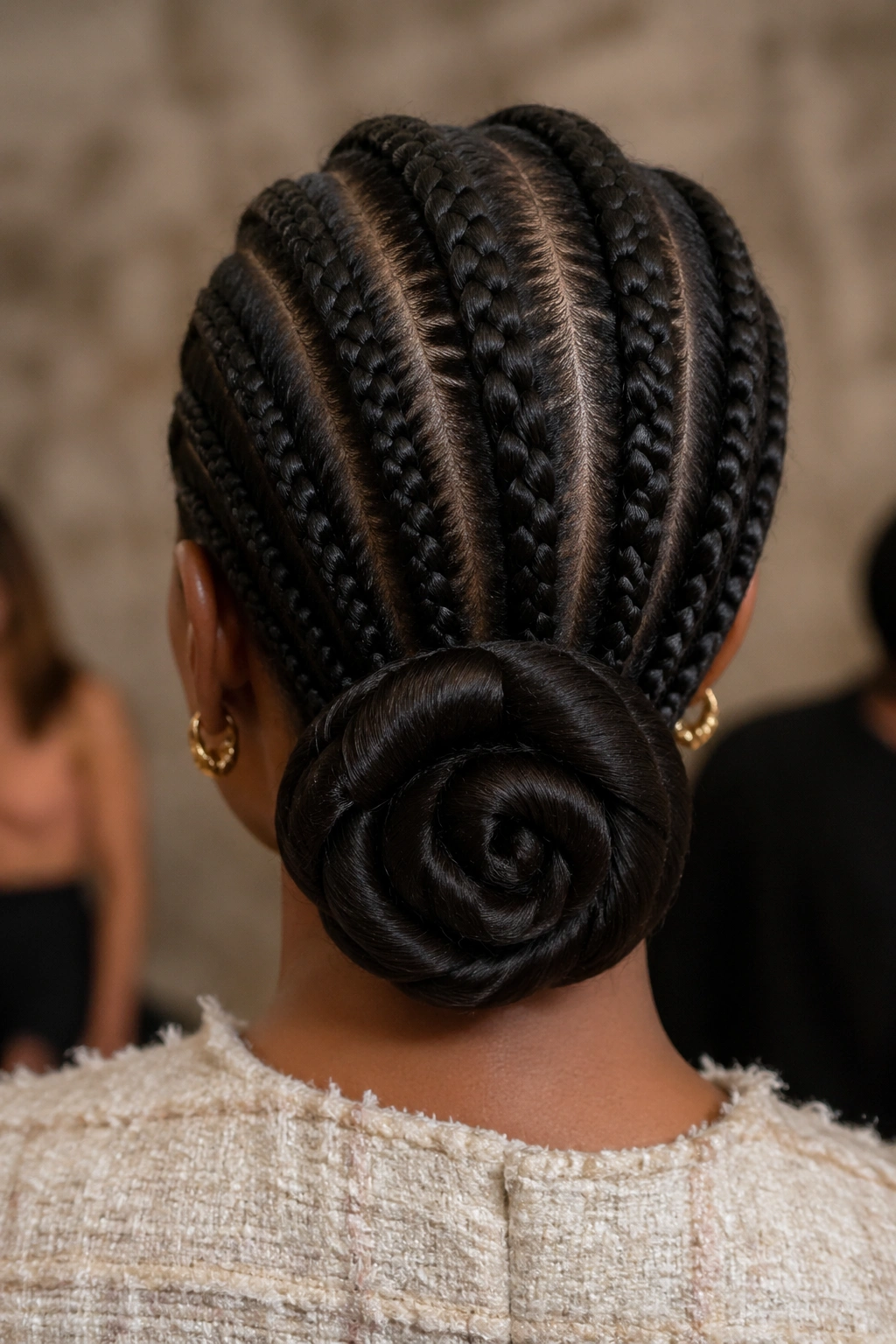
Cornrows go straight back to a low gathering point at the nape. Instead of forming a bun, the cornrow ends get bundled into a single large curl shape — wrapped around a finger and pinned flat against the back of the head.
The curl is the feature. It looks like a flat coiled rosette at the nape.
This is an editorial-style finish. Reads vintage Hollywood with a modern braided twist.
17. Cornrows Into a Faux Hawk Updo
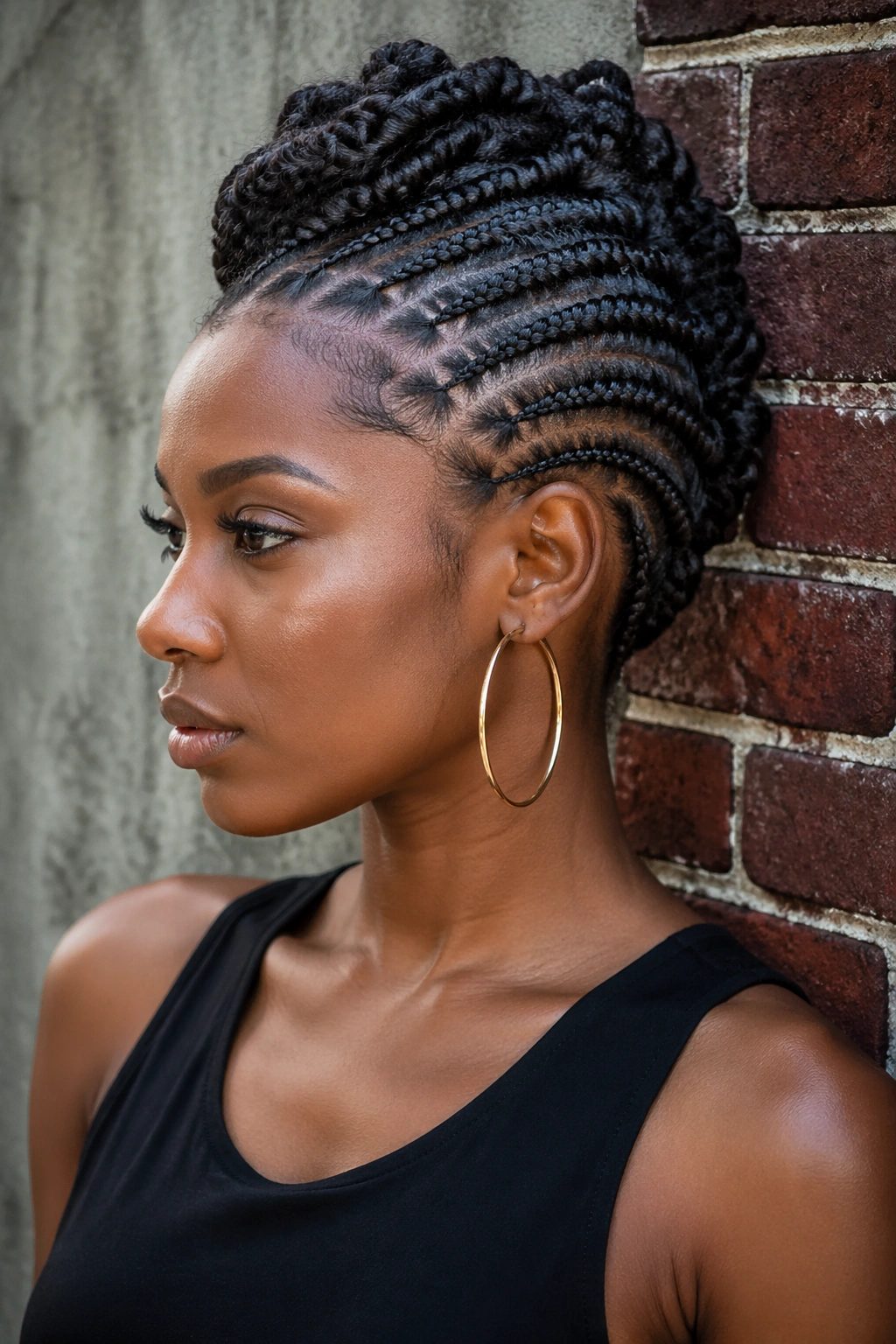
Side cornrows hug close to the head. The center cornrows raise up into a faux hawk shape, with the cornrow ends pinned into a soft ridge that runs from the front of the head to the back.
Less aggressive than a full mohawk. More dramatic than a center bun.
For a sharper version, use small cornrows on the sides and bigger ones in the center. For a softer version, keep all the cornrows similar in size and let the faux hawk be subtle.
18. Crown Updo With Decorative Beading
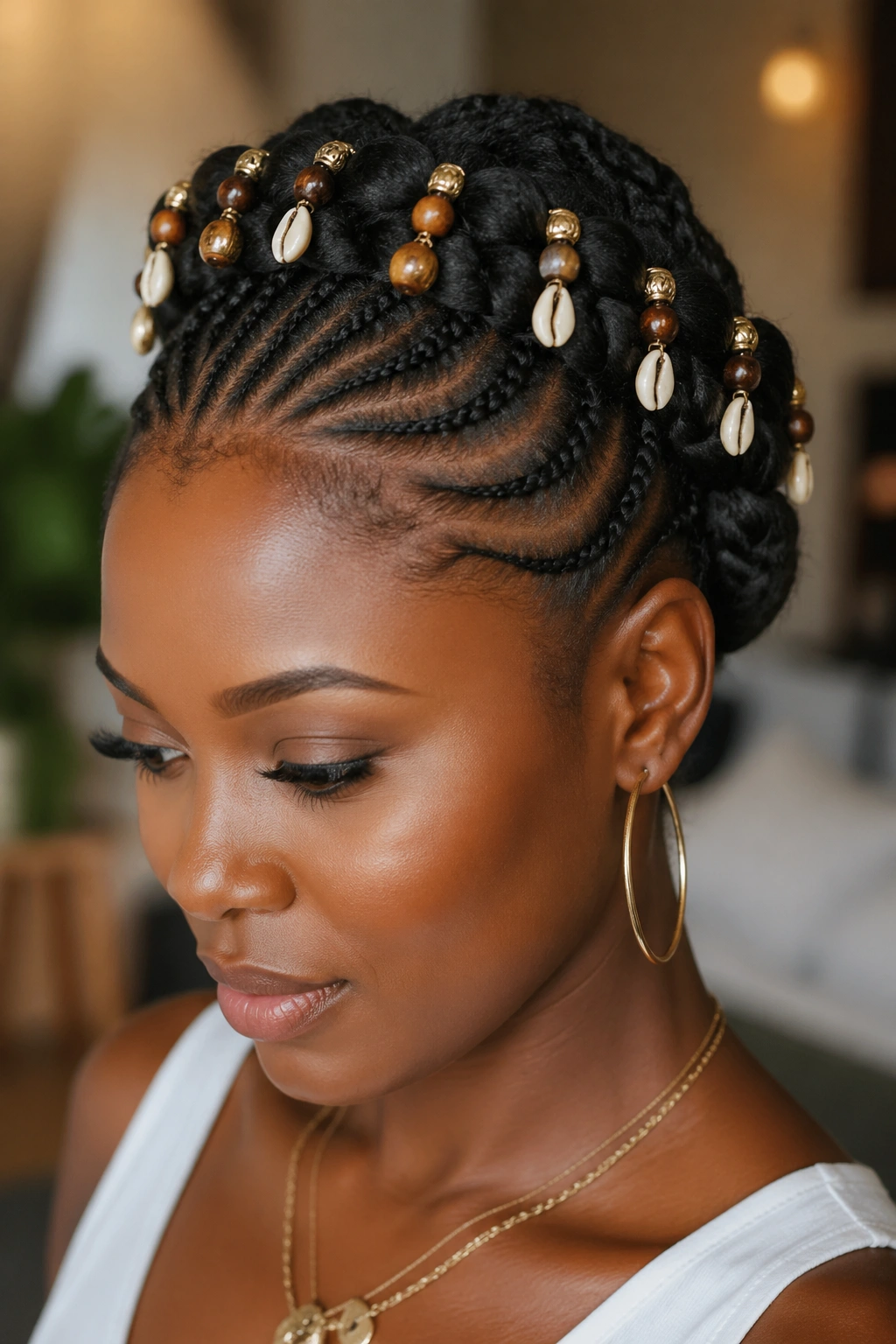
A cornrow crown braid sits at the perimeter of the head. Inside the crown, the rest of the hair is gathered into a small bun.
Beads sit only on the crown braid — cowries, gold beads, brass cuffs, or wood beads. The inner bun stays plain.
The placement of the beads matters. Cluster them at the front for a face-framing effect. Spread them evenly around the crown for a more uniform look. Both work.
19. Cornrow Updo With Front Loose Curls
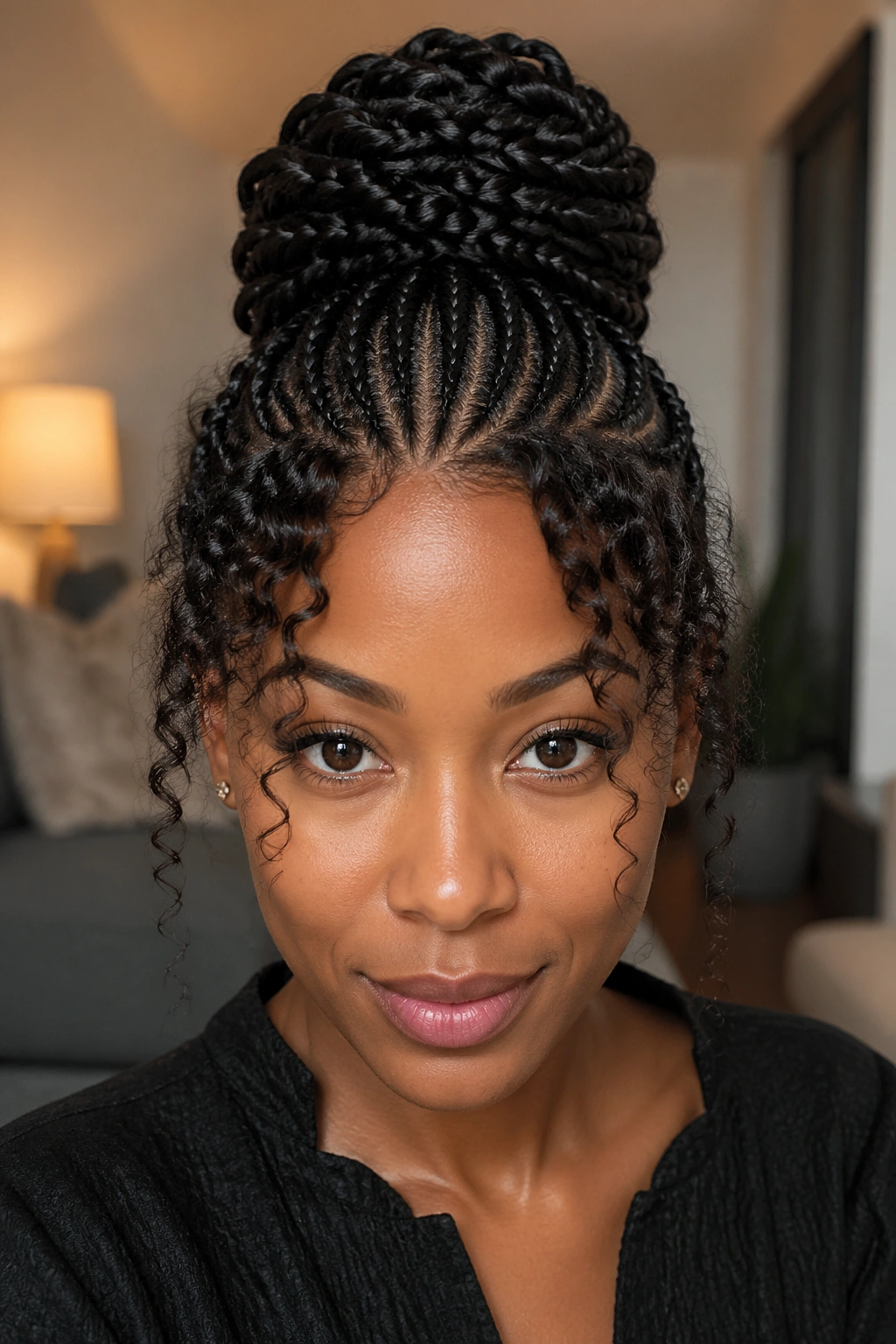
The cornrows start about two inches back from the hairline. The first two inches of hair stay loose and curly — defined into a fringe of front curls — while the cornrows take over from there and feed back into a high bun.
The loose front curls soften the entire face. The cornrow updo behind handles the structure.
This works for people who want the protective benefits of cornrows but don’t love the way a fully pulled-back style flattens their forehead.
20. Cornrows Into a Twisted Knot
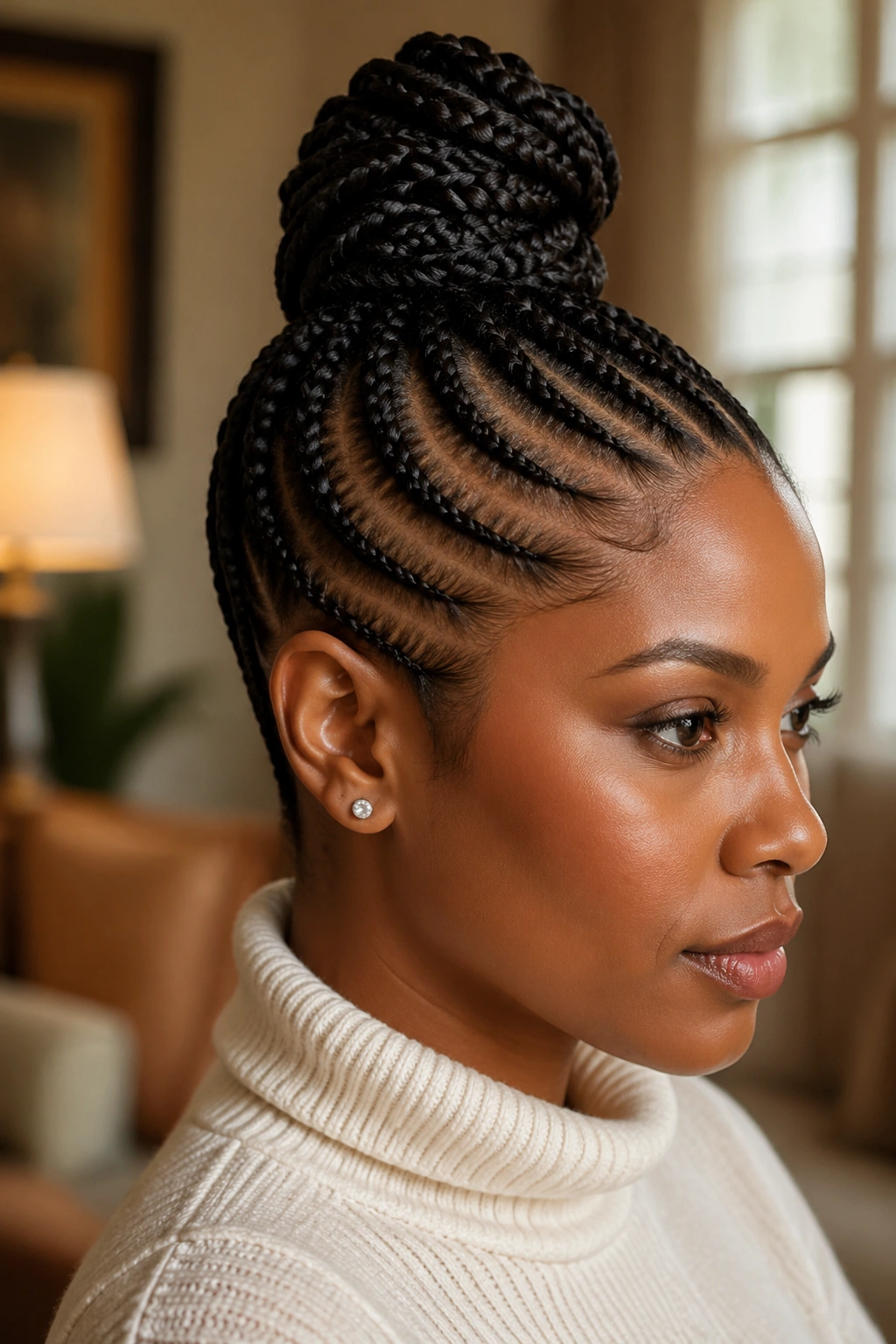
The cornrows feed back to a single point at the crown, where the ends get twisted around each other into a dense knot — not a bun, not a bantu knot, but a twisted rope coiled into a tight ball.
The knot has more texture than a bun. It catches more shadow. It reads more sculptural.
Pin every wrap to keep the knot from loosening. A spritz of hairspray after the install seals it.
21. Halo of Cornrows
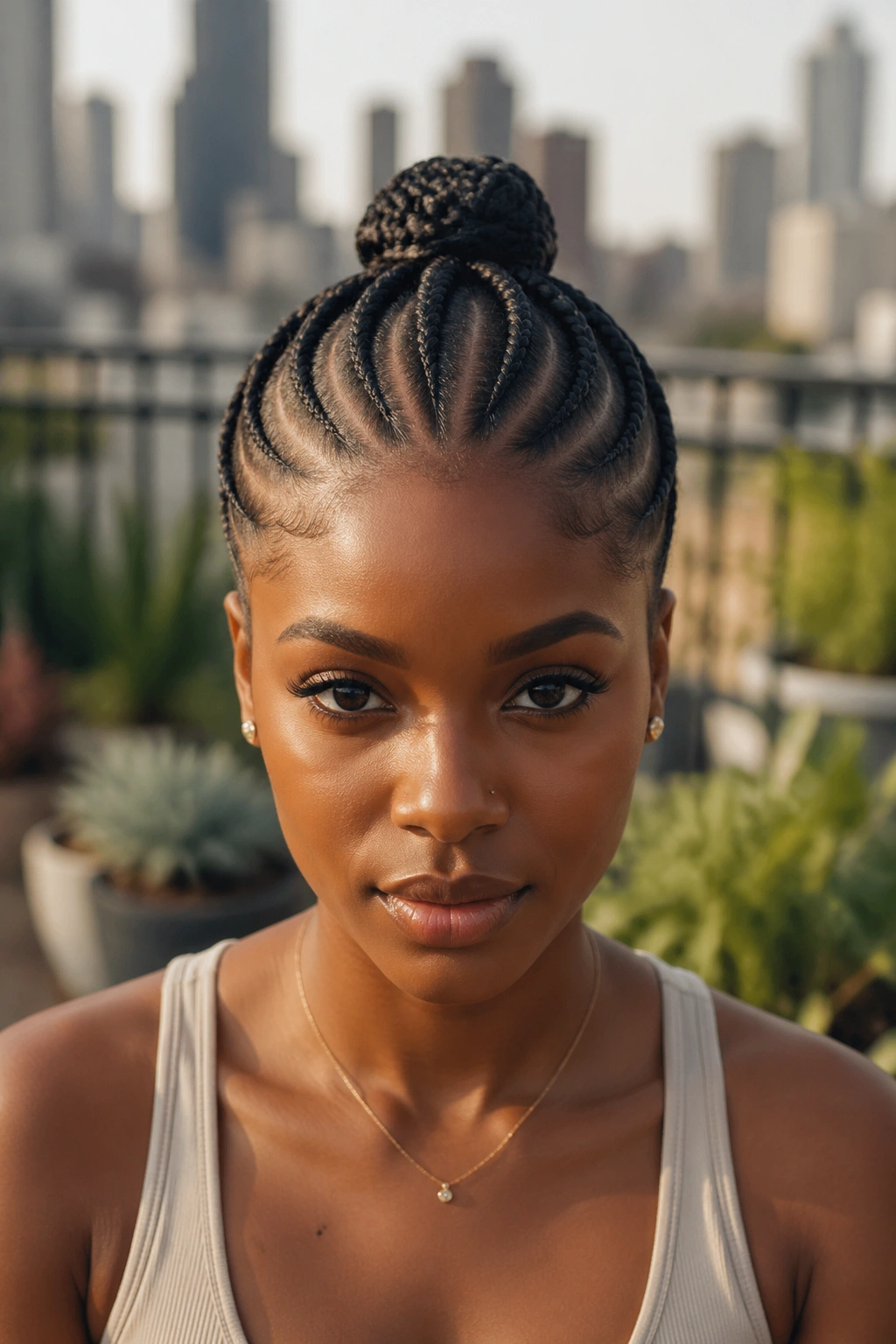
The cornrows themselves form the halo — the entire pattern is built so that all rows curve in toward a central point at the crown, where they gather into a small high bun.
From above, the head reads like a sunburst pattern. From the side, the braids appear to swirl.
This is a complex install. Find a braider with experience in pattern-based cornrowing before booking.
22. Side-Sweep Cornrow Updo
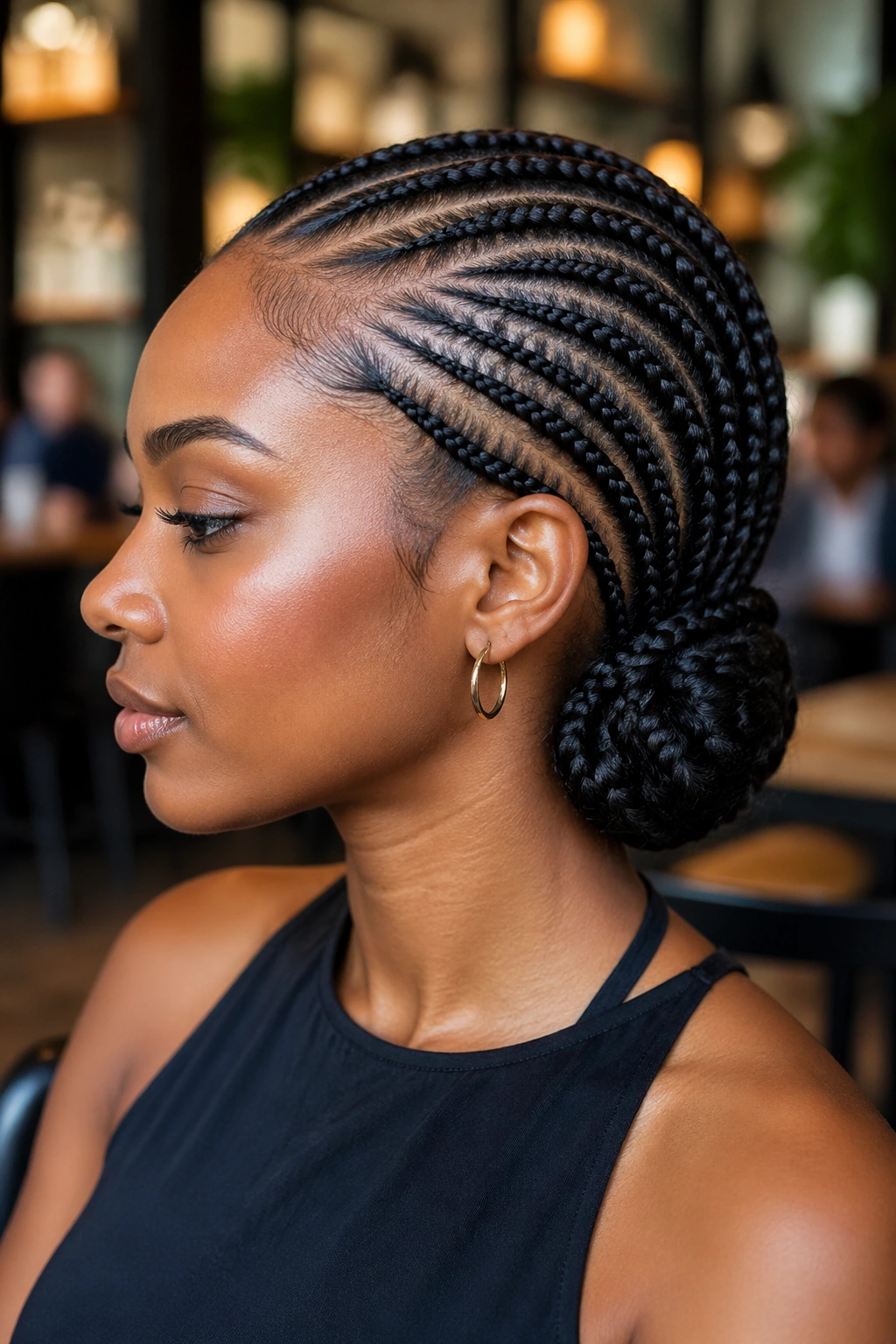
Pure prose for this one. Imagine cornrows starting at the hairline, sweeping diagonally across the head from one ear to the other. Instead of feeding straight back, they curve dramatically to one side. At the destination point, near the opposite ear, they gather into a low side bun.
The diagonal direction creates motion that a straight-back style can’t match. The eye follows the curve from one side to the other, then settles on the bun.
This style suits people with strong cheekbones and angular features. The diagonal line draws attention to the architecture of the face.
For a softer version, keep the cornrows large and the bun loose. For a sharper version, use tiny cornrows and a tight pinned bun.
23. Cornrow Pompadour Updo
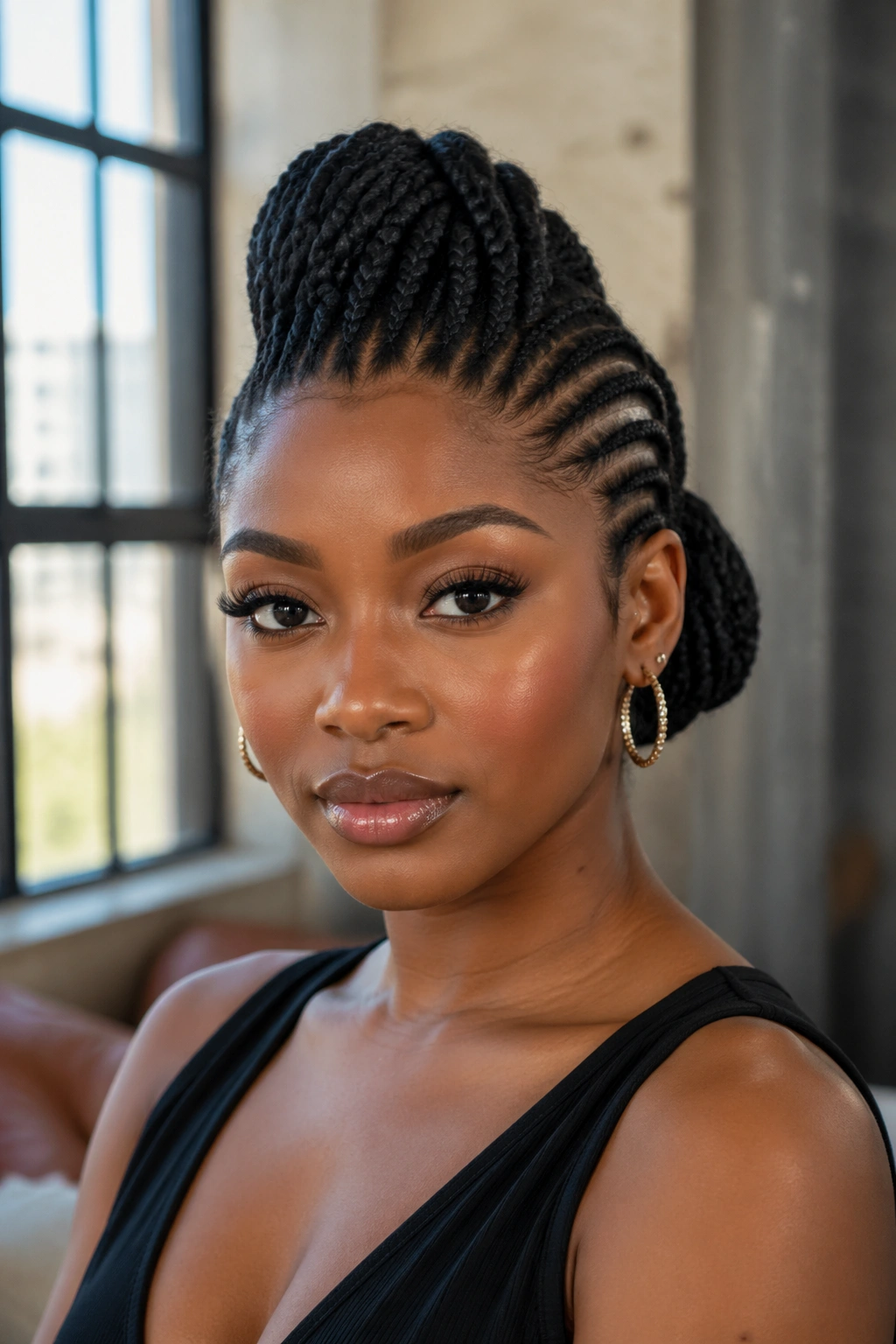
Volume in front. The cornrows on the very top of the head are teased up — actually puffed up at the roots before braiding — to create a small pompadour shape at the front. Behind the pompadour, the cornrows continue back to a low bun.
The pompadour adds height without piling everything into a tall bun. The forehead gets framed. The face gets balanced.
For 4C textures especially, the pompadour shape works beautifully because the natural volume of the hair supports the lifted front.
24. Wraparound Cornrows With a Side Knot
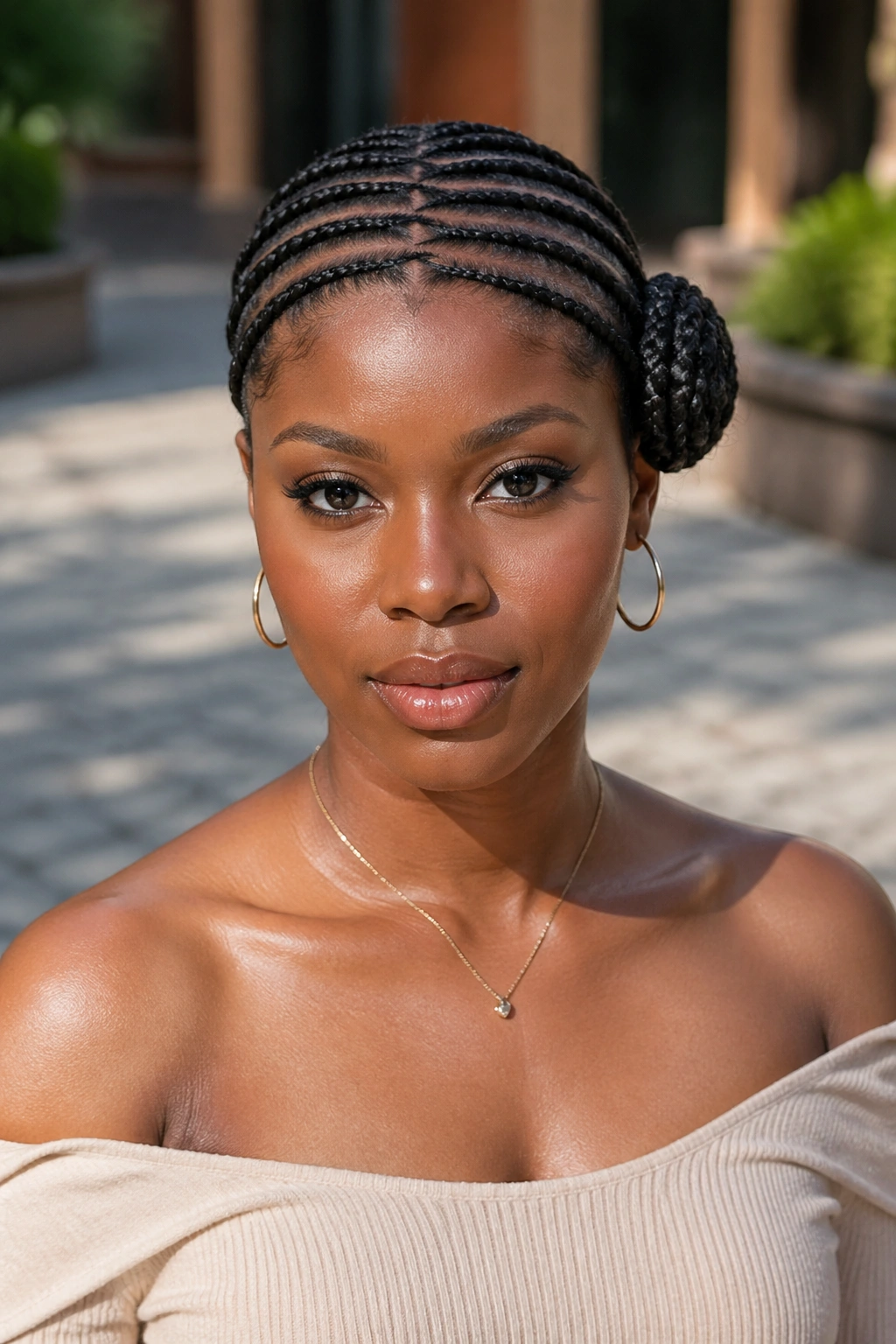
Cornrows wrap horizontally around the head — from temple to temple in arching curves — meeting at one side, where they gather into a knot.
The wraparound pattern is the feature. The horizontal lines move the eye around the head in a way vertical cornrows never do.
This is a technical install. Cornrows that follow the curve of the skull rather than running with the natural fall of the hair require a braider who understands head geometry well.
25. Cornrow Updo with a Statement Headpiece
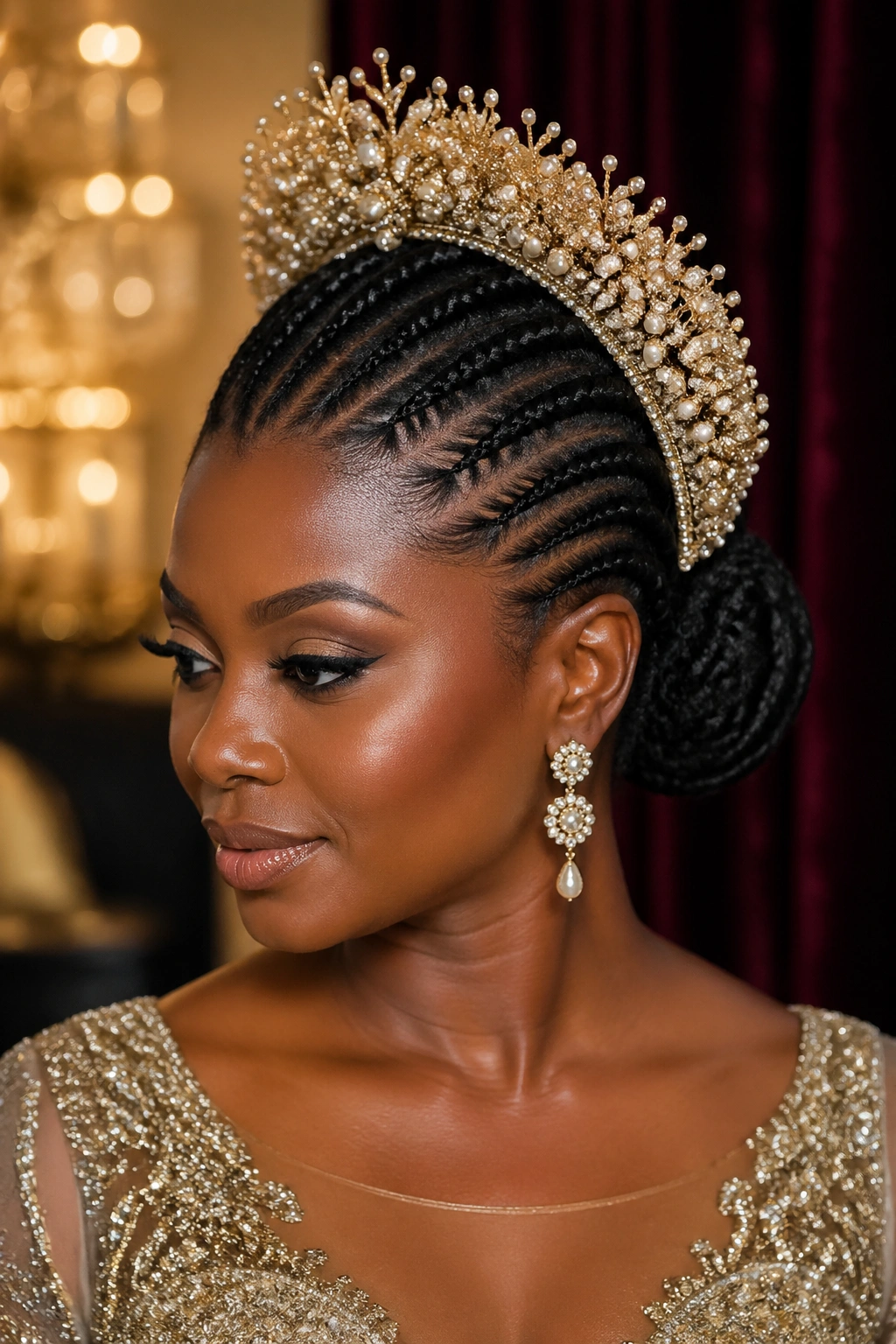
Cornrows feed into a tight low bun. The bun itself is plain. The interest comes from a statement headpiece — a beaded headband, a wide cloth wrap, a metal crown — sitting at the top of the head.
This is the cornrow updo for events that demand presence. Galas, bridal showers, milestone birthdays.
The headpiece does the work that the hair would do in a more elaborate updo. The cornrows just provide the foundation.
Wrap a silk scarf around the bun to dress it up further. Or leave it bare and let the headpiece carry the entire visual weight.
Daily Maintenance for Cornrow Updos
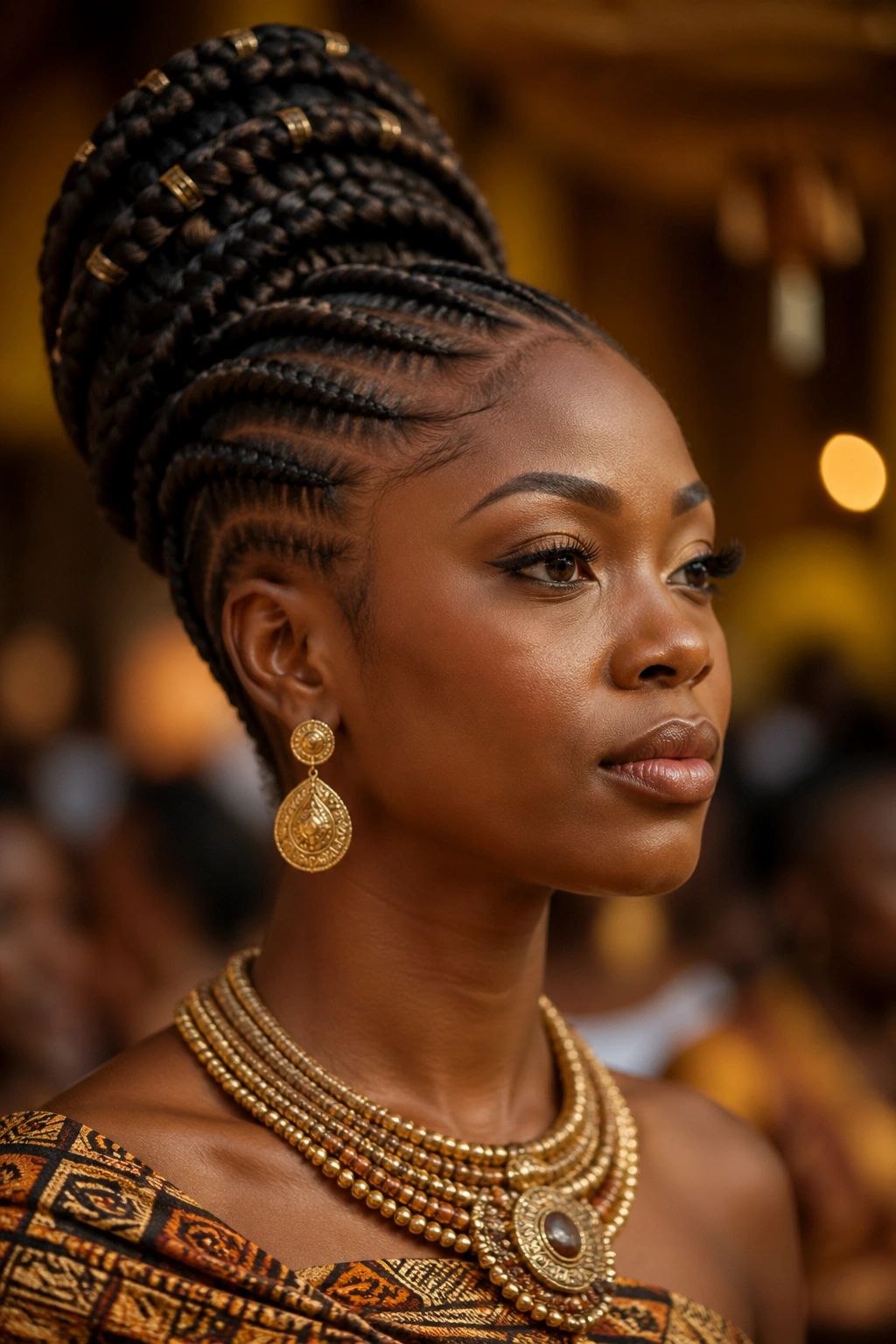
A cornrow updo asks a little more daily care than flat cornrows. The shape needs to be reset each morning.
Start with the bonnet removal. Untie slowly. Yanking the bonnet off catches on the bun and creates flyaways.
Smooth the front cornrows with a small amount of edge gel applied to your fingertips, not directly to your hairline. Press, don’t drag.
If the bun has shifted overnight, re-pin it before stepping out. One or two extra pins at the base usually solves the problem.
Avoid heavy hairsprays. They build up fast and create the kind of crunch nobody wants.
Sleeping in a Cornrow Updo Without Wrecking It
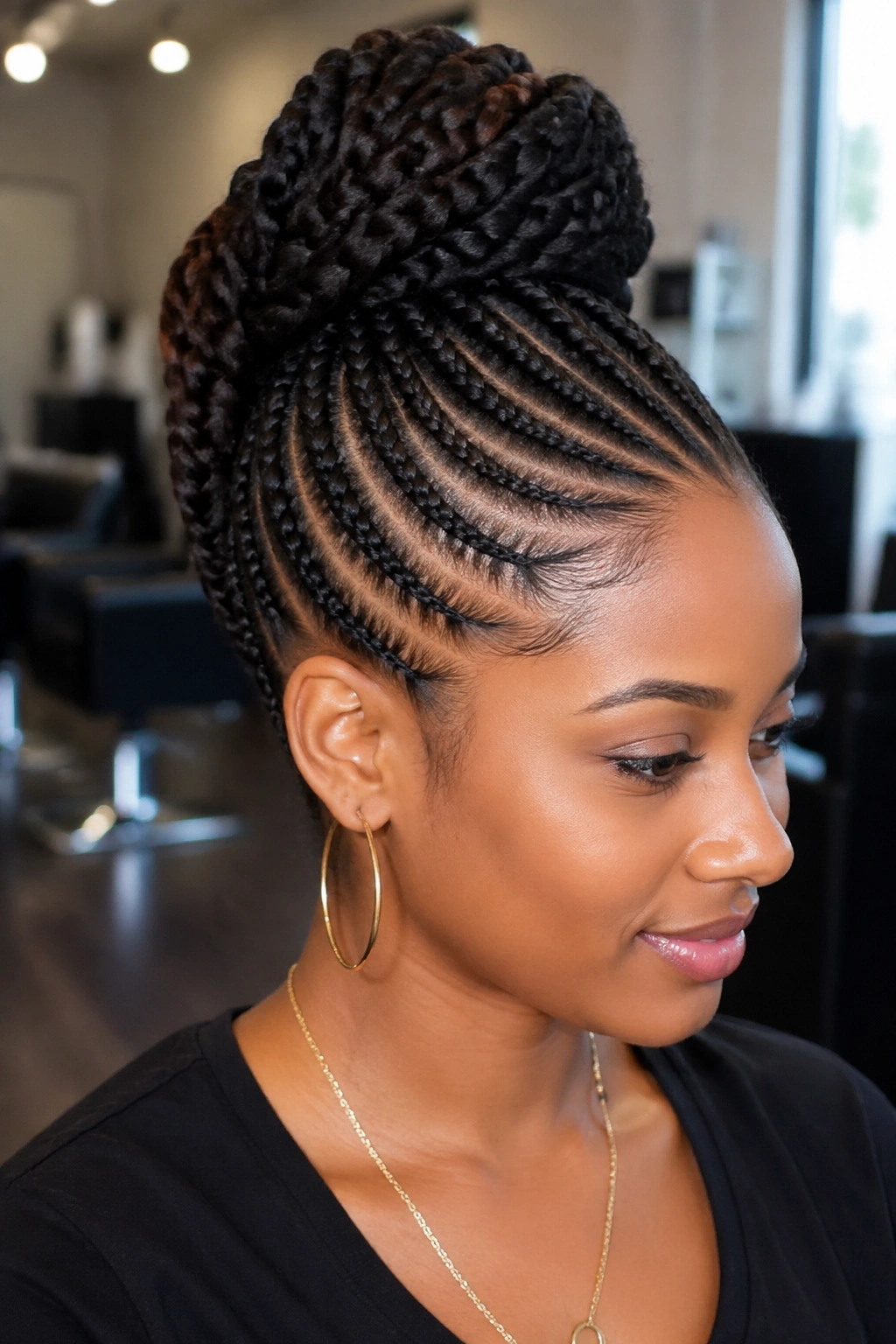
The bun is the vulnerable part. Cornrows themselves are tough — they can take pressure and bouncing back. But the bun can compress and lose its shape during sleep.
A satin pillow or pillowcase is the minimum. A satin bonnet large enough to cover the entire updo is better.
Side sleeping is easier than back sleeping. Back sleeping crushes the bun against the pillow, even with a bonnet. Side sleepers can position the bun to one side and avoid pressure entirely.
If your bun deflates overnight despite all this, refresh it in the morning by undoing the pins, fluffing the bun gently, and re-pinning.
Refreshing the Edges
The cornrows themselves can hold for three or four weeks. The edges along the hairline are usually the first to look tired.
A weekly edge refresh involves a small dab of edge control on the very front rows, smoothed in with a soft brush. Tie a silk scarf around the hairline for fifteen to twenty minutes to set the smoothness.
Avoid touching the deeper cornrows with edge gel. It’ll create buildup that mats over time.
When to Take the Updo Down
Three weeks is a common limit. Some installs hold longer if you’ve been gentle with them.
Signs it’s time to take down:
- The cornrows lift more than half an inch from the scalp
- The bun has thinned visibly
- Your scalp is itching despite regular washing
- Flyaways multiply faster than edge gel can tame them
Don’t push past five weeks. The longer cornrows stay in, the harder the takedown becomes, and the more shed hair has accumulated underneath.
The Takedown Process
Start by removing all pins from the bun. Then unravel the bun itself — slowly, end first.
Once the bun is loose, separate the cornrows. Working from the ends toward the roots, undo each braid carefully. A small dab of conditioner on each braid as you unravel helps the strands release without tearing.
After all cornrows are out, finger-detangle each section before reaching for a comb. There’s usually a lot of accumulated shed hair that needs to come out gently.
Wash twice — once to remove product buildup, once to actually clean the hair. Deep condition before doing anything else.
A scalp massage with a light oil after washing brings circulation back to the area. Your scalp has been under tension for weeks. Treat it kindly.
What Makes a Cornrow Updo Last
The difference between a cornrow updo that looks tired by day five and one that looks fresh at week three usually comes down to three things.
The first is install quality. A skilled braider creates tension that’s even, not maximum. Rushed cornrows have inconsistent tightness, which means some sections loosen earlier than others.
The second is daily care. A cornrow updo that gets a quick smooth and a bonnet at night will last twice as long as one that gets ignored after the install.
The third is patience with the long-term wear. Resisting the urge to fuss with the bun, to re-tie it five times a day, to add product after product — that restraint is what keeps the install looking intentional well into week three.
A good cornrow updo is a long game. The reward is weeks of styled hair without daily restyling. Worth the patience.
Cost Considerations and Salon Selection
Cornrow updos cost more than flat cornrows. Plan for it.
A simple high bun cornrow updo runs in the range of $120 to $180 at a skilled braider. A complex tribal pattern with a beaded crown can hit $300 or more. Adding extensions adds to that — usually $30 to $80 depending on the type and amount of hair used.
Cheaper isn’t always worse, but very cheap installs often skip prep, use insufficient product, or rush through the patterning. The result holds for half the time.
Find a braider who specializes in updos rather than someone who does them occasionally. Updo work involves placement, padding, and pinning skills that flat cornrows don’t require. Asking for portfolio photos of finished updos — not just flat cornrow examples — saves you from a disappointing install.
Some braiders charge more for a takedown service. Others include it. Ask before booking.
Common Updo Mistakes to Avoid
Pinning too tight at the base of the bun causes headaches by hour four. The bun needs to be secured, but not strangled. Test the tension by gently rocking the bun side to side — it should feel anchored but not yanked.
Choosing a style that’s too tall for your face proportions is another common error. Tall updos elongate. They flatter long necks, oval faces, narrow shoulders. They overwhelm round faces and short necks.
Skipping the prep stretch leaves the cornrows with bumps where the natural shrinkage pushed the braid up. The cornrows look uneven even though the braiding itself was fine. A good blow-out or threading session before the install fixes this.
Refusing to refresh the edges between weeks one and three. Edges go fuzzy fast. A weekly five-minute touch-up keeps the whole style looking maintained.
And the big one — sleeping without proper coverage. A satin bonnet sized to fit the entire updo (not a regular bonnet that crushes the bun) makes the difference between an install that lasts three weeks and one that looks rough by week two.
Pairing the Right Outfit with a Cornrow Updo
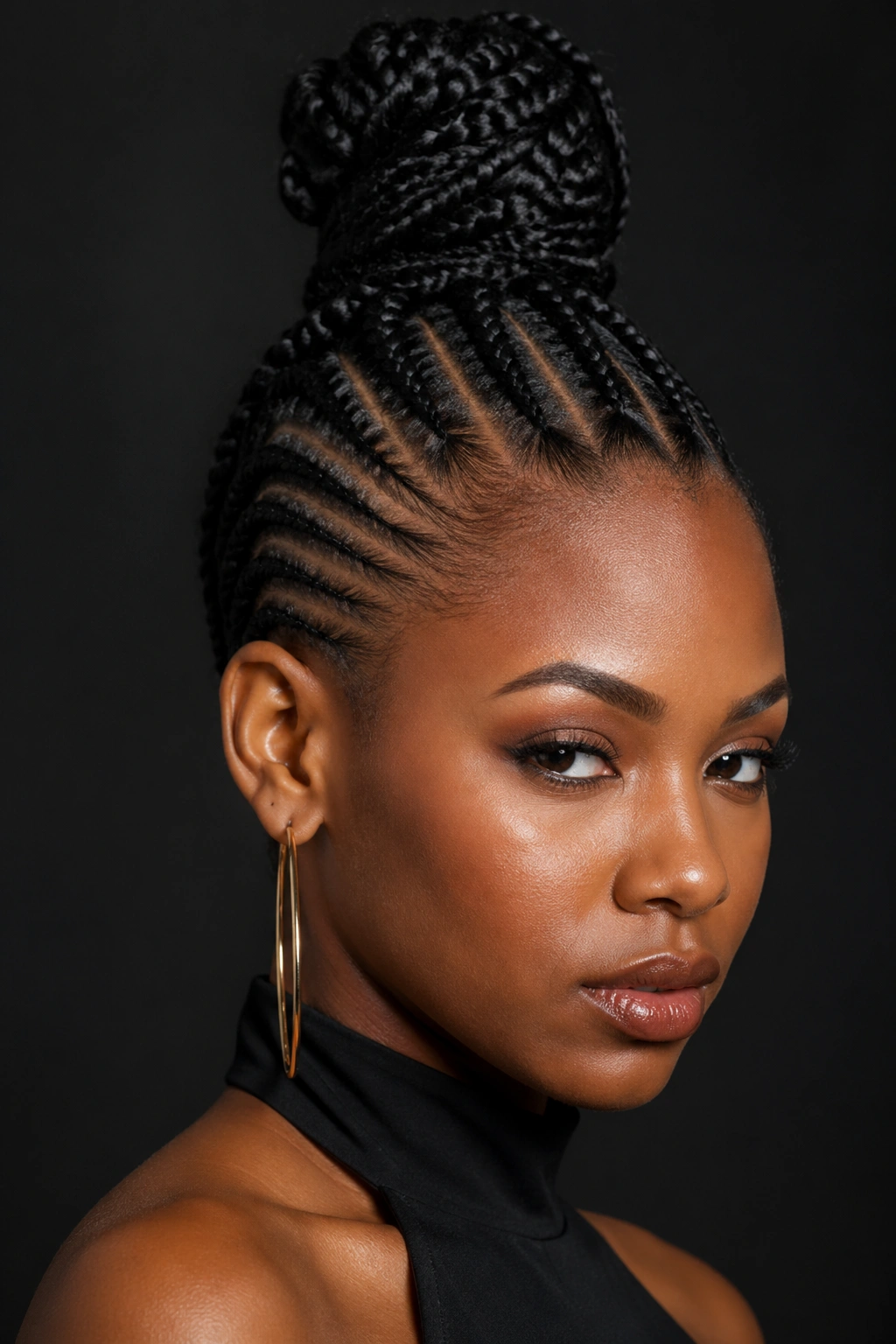
The updo doesn’t exist in isolation. What you wear above your shoulders matters.
High necklines with statement updos can crowd the visual frame. The eye doesn’t know where to rest. Pair tall updos with off-shoulder tops, V-necks, or backless cuts that give the head room to breathe.
Statement earrings either work beautifully or fight with the updo. Long dangly earrings with a tall bun can look fussy. Studs or small hoops let the cornrow pattern be the star. If you want big earrings, choose a smaller updo.
Necklaces on a clean neckline elevate a cornrow updo beautifully. A long pendant against bare skin draws the eye downward, balancing out the height of the bun.
Colors play in too. Cornrow patterns with metallic accents — gold cuffs, silver beads — read best against jewel tones, deep neutrals, and crisp whites. Pastel outfits can wash out the metal detail.
For weddings, a bridal cornrow updo paired with a fitted gown reads timeless. A trailing dress gives the updo balance. A short fitted dress lets the updo command the entire silhouette.
Notes on Bridal Cornrow Updos
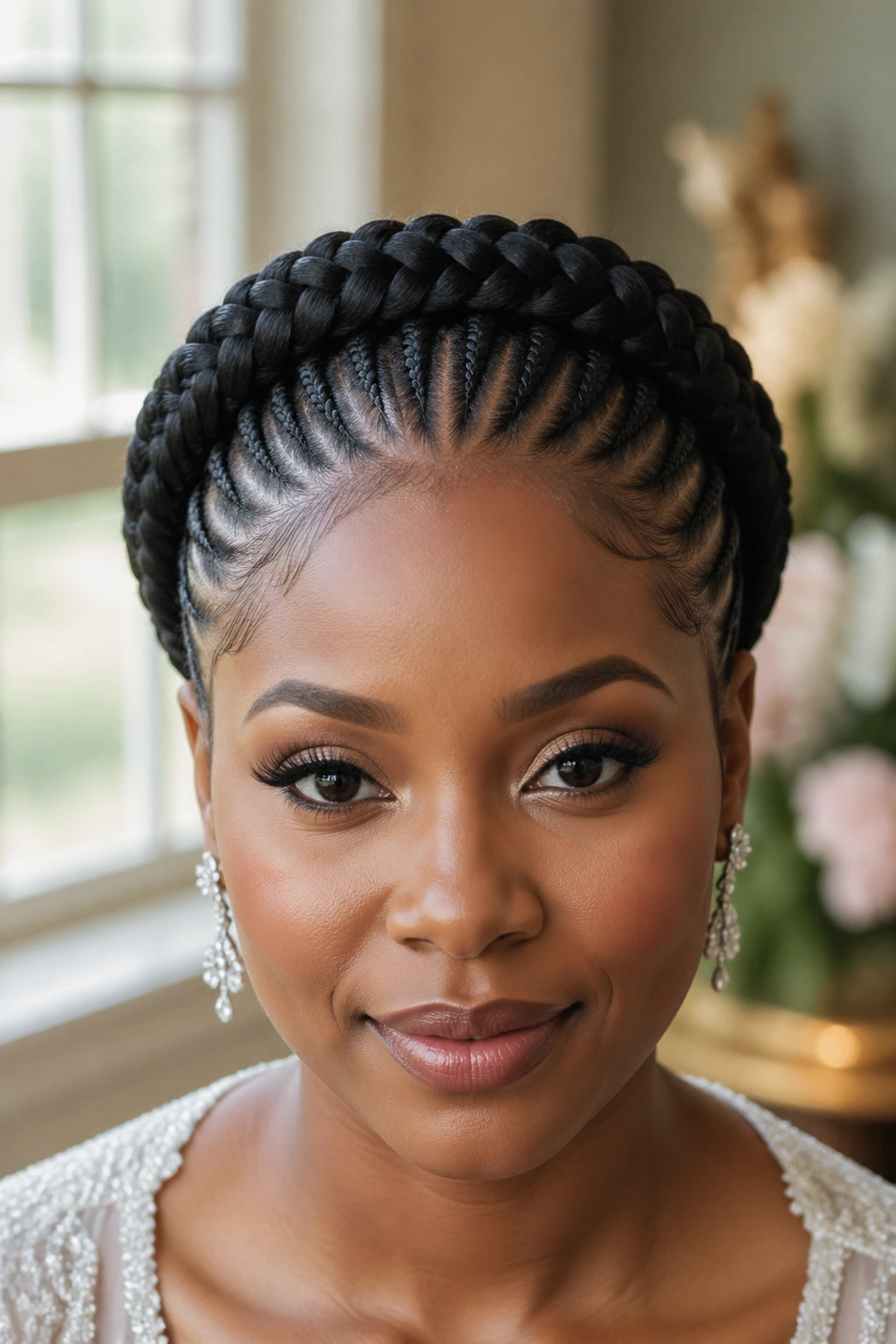
Bridal cornrow updos deserve their own thought. The wedding day is a long event with photos at every angle, and the style needs to hold up from morning prep through evening dancing.
Build the updo with extra security in mind. More pins than you think you’ll need. A medium-hold hairspray after the install. A small touch-up kit in the bridal bag — a few extra pins, an edge gel, a small mirror.
Schedule the install for two days before the wedding, not the day of. The cornrows settle in over 24 hours, looking smoother and more set the second day. A day-of install often looks tight and slightly bumpy in photos.
Consider the veil and how it attaches. Veils with combs need a flat anchor point on the head. A heavily decorated cornrow crown might not accommodate that. Coordinate with your braider before the wedding to plan around the veil placement.
