



Tribal cornrows pull from a deep well. The patterns, the beads, the cowrie shells, the sharp geometric parts — every element traces back to specific peoples, regions, and centuries of braiding tradition across the African continent. When you wear a tribal-inspired cornrow style, you’re carrying pieces of Fulani, Hausa, Himba, Mangbetu, and Ashanti styling into whatever room you walk into next.
That’s worth getting right. A tribal cornrow style done lazily reads like costume. Done with care, it reads like culture worn confidently.
The 22 styles here each bring something specific — a parting pattern that originates somewhere, an accessory that means something, a technique that separates these looks from generic braided styles. Some are faithful to traditional designs. Others modernize the aesthetic while keeping the spirit.
Where Tribal Cornrow Styles Come From
Cornrowing is older than almost any hairstyle still practiced. Ancient Egyptian statues from 5,000+ years ago show braided patterns that look nearly identical to what skilled braiders create today. Across West Africa, different peoples developed distinctive patterns — the Fulani’s signature center braid with side rows, the Mangbetu’s elongated crown shapes, the Himba’s ochre-mixed bundles.
These weren’t just pretty styles. Braid patterns communicated age, marital status, tribal affiliation, religious standing, and social rank. A woman’s head told her story before she said a word.
Understanding this context changes how you wear the styles. It’s not about perfect historical accuracy — hybrid modern versions are honest and fine. But knowing where the patterns come from separates intentional styling from accidental appropriation.
Key Elements That Define a Tribal Cornrow Look
Four details make a cornrow read as “tribal” rather than just “cornrow”:
- Geometric parts: sharp triangles, curves, zig-zags, or asymmetric divisions
- Mixed braid sizes: one thick braid paired with many thin ones, not uniform rows
- Natural material accessories: cowrie shells, wooden beads, metal rings, beads made from horn or bone
- Length drama: extensions that fall well past shoulder length, often to the waist or lower
Miss any of these and you’ve got cornrows, but not tribal cornrows. Hit all four and the style reads authentically, regardless of how hybridized the specific design is.
Prep Work That Honors the Tradition
Old-school tribal braiding sessions could take 6-12 hours. Modern women rarely have that, but the preparation matters the same. Start with clean, deep-conditioned, detangled hair. Stretch it overnight in loose twists or a wrap set. Cornrows on shrunken, unprepped hair will look crooked within days because the hair wasn’t in its proper resting length when the braider worked.
If you’re adding extensions (and most tribal styles do), pre-stretch the kanekalon by soaking it in hot water for 10 minutes, then hanging it to air-dry. This removes the plasticky shine and makes the braid blend almost seamlessly with natural hair.
Scalp prep matters too. A clarifying wash the day before removes product buildup so your scalp can breathe during the long install. Apply a light scalp oil the morning of — not heavy butters, just oil. The scalp gets enough stimulation during the braiding itself.
The Tools a Serious Braider Uses
You need more than a comb. A metal pin-tail rat-tail comb for precise parts. A smaller fine-tooth comb for smoothing sections as you work. A bowl of edge gel and a brush — not your fingers. Hair clips with teeth, not flat clips, because flat clips slip on oiled hair. A good pair of scissors for trimming kanekalon ends cleanly.
If you’re placing cowrie shells or beads, a beader threading tool is non-negotiable. Threading beads by hand onto braids is possible but slow enough that it’ll add an hour to your install.
1. Classic Fulani Cornrows
The blueprint for modern tribal cornrows. A single thick cornrow runs down the center of the head, flanked by smaller cornrows on either side angling toward the center. The look originates with the Fulani people of West Africa and has been refined across generations.
The center braid is always thicker — roughly double the width of the side braids. That contrast is the visual anchor. Without it, the style collapses into generic cornrows.
Beads along the center braid and at the tips of select side braids complete the look. Wooden or metal beads feel right. Plastic neon beads don’t belong here.
2. Fulani With Cowrie Shells
Same base structure as Fulani cornrows, but cowrie shells replace beads as the primary accessory. Cowries carry meaning — historically used as currency across Africa, they symbolize wealth, femininity, and spiritual protection.
How to Style It
- Place 3-5 cowrie shells along the center braid, spaced evenly
- Add single cowries at the ends of 4-6 side braids
- Leave the remaining braid tips clean, so the cowries become focal points
- Use the pre-drilled shells sold by beauty supply stores — they thread on with a beader in seconds
Tip: Soak new cowrie shells in soapy water for 20 minutes before use. Factory-fresh shells sometimes have a salty or fishy smell that lingers in hair.
3. Himba-Inspired Rope Braids
The Himba people of Namibia mix ochre paste with butter and herbs into their braids, creating the distinctive reddish-brown rope shapes that define their hair tradition. You won’t use actual ochre — but you can reference the look with clay-colored extensions or a temporary hair mud wash that tints the braids rust-red.
The braiding technique itself involves thick cornrows at the scalp that transition into chunky rope-twisted lengths. Not flat braids all the way down — rope twists from roughly the mid-length.
Who wears this well? Women who want real drama. The Himba aesthetic isn’t subtle, and watered-down versions lose what makes it special.
4. Tribal Curved Cornrows With Geometric Parts
The defining feature here is the parting. Instead of straight lines, the parts curve, zig, and meet at unexpected points — triangles, diamonds, curved crescents. The braids themselves are standard cornrows, but the geometry underneath transforms the look.
This takes a skilled braider 3-5 hours. The parts have to be clean and symmetrical, or the whole pattern falls apart. If your braider can’t draw a clean triangle with the pin-tail, this isn’t the style to try.
The finished look photographs beautifully from above — the pattern reveals itself fully only when someone’s looking down at the head.
5. Mohawk Tribal Cornrows
A center stripe of dense cornrows runs from the hairline to the nape. The sides are either shaved, slicked flat, or cornrowed in a contrasting pattern (diagonal or curved).
Tribal mohawks lean heavily on Mangbetu and Mursi aesthetic influences — the center elevation, the asymmetric sides, the sense of visual height that makes the wearer look taller.
Works on most face shapes. Rounder faces benefit from the vertical line; angular faces soften a bit with the surrounding contrast.
6. Triangle-Part Cornrows
Every parting is triangular. Each section of hair forms a triangle on the scalp, and a cornrow runs from the triangle’s point outward. The result is a patchwork of tiny triangular braid bases across the whole head.
The triangles should all point the same direction — usually toward the crown — to create visual coherence. Random triangle orientations look chaotic rather than intentional.
Best on naturally thick hair. Fine hair doesn’t show the triangular bases clearly, so the pattern reads muddy.
7. Goddess Tribal Cornrows With Wavy Ends
Cornrows at the scalp transition into loose, wavy curls at the ends. The curls give the style an undone goddess quality that balances the precision of the cornrow section.
To get the wavy texture: braid loose twists from the cornrow ends, dip in hot water, air-dry overnight, then unravel in the morning. The waves hold for 5-7 days.
Who This Is For
Women who want the tribal pattern at the scalp but prefer movement over structure in the lengths. Goddess hybrids suit most faces and work equally well for casual and formal settings.
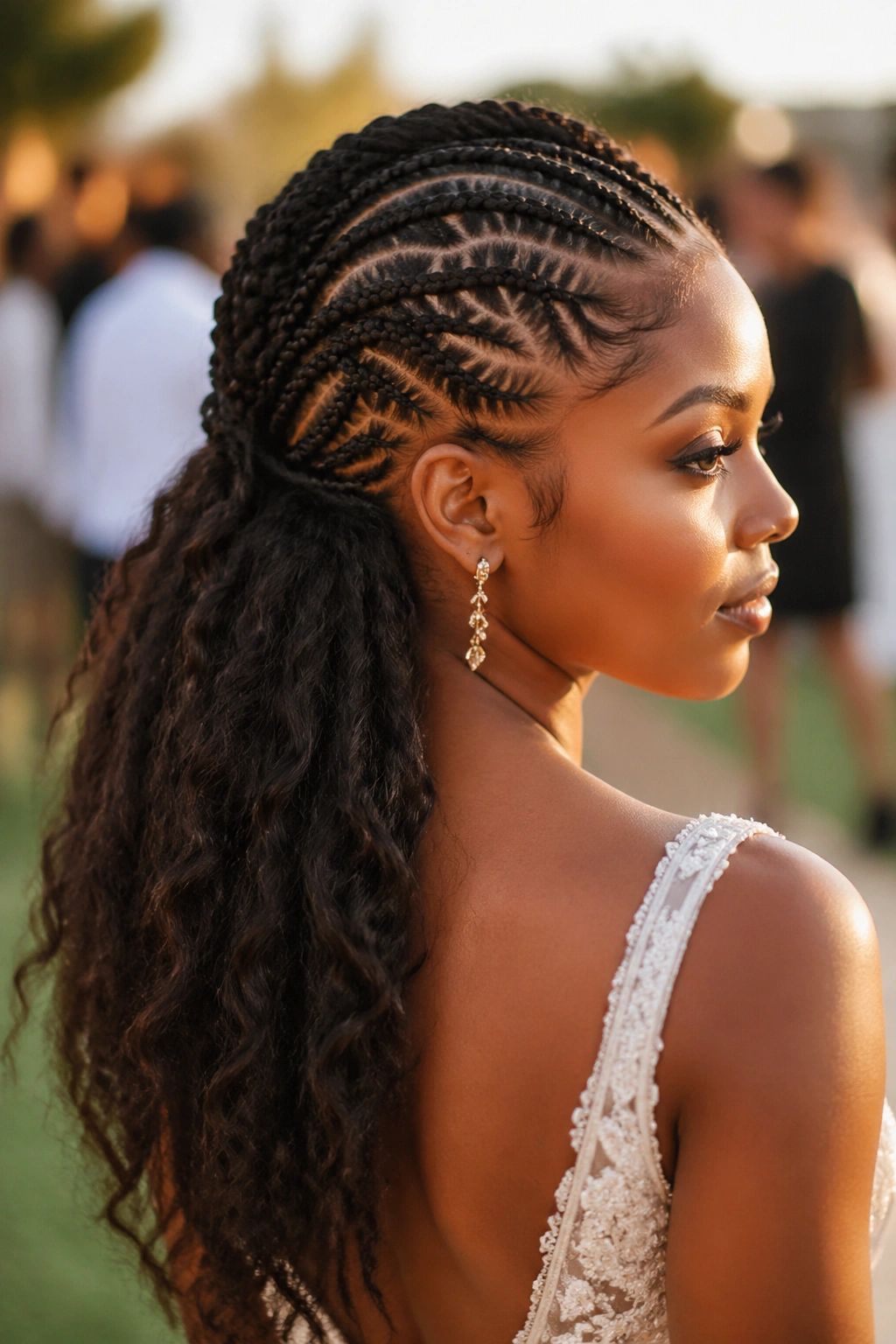
8. Cornrow Crown With Loose Back
The top of the head features elaborate tribal cornrows — curves, geometric parts, beaded details. The back half flows loose, either natural texture or soft waves.
This is a style that works beautifully for weddings and formal events because it offers two distinct aesthetics in one look: tribal precision on top, soft femininity behind.
The transition line between cornrowed and loose needs to sit at an intentional point — usually just above the occipital bone — not randomly somewhere at the back of the head.
9. Hausa-Style Cornrow Ridges
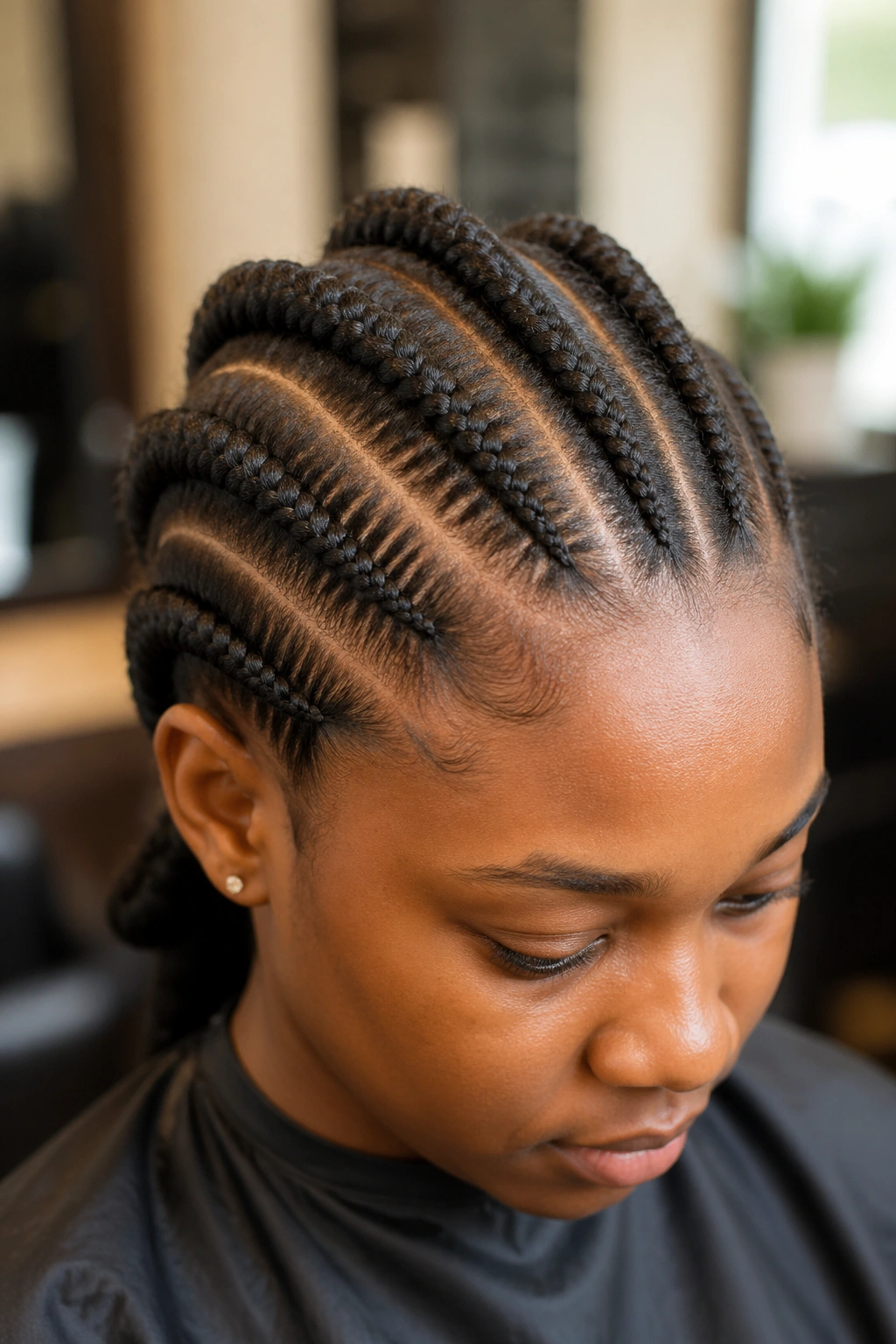
The Hausa people of Nigeria are known for raised, ridged cornrows that stand up slightly from the scalp rather than lying completely flat. The technique involves a feed-in method with extra tension at the sides, so the braid lifts.
These ridges create shadow lines that make the pattern pop visually. In photographs, the dimension reads three-dimensional instead of flat.
This is advanced technique. A braider new to ridged cornrows will end up with uneven heights that look sloppy.
10. Tribal Cornrows With Gold Cuffs
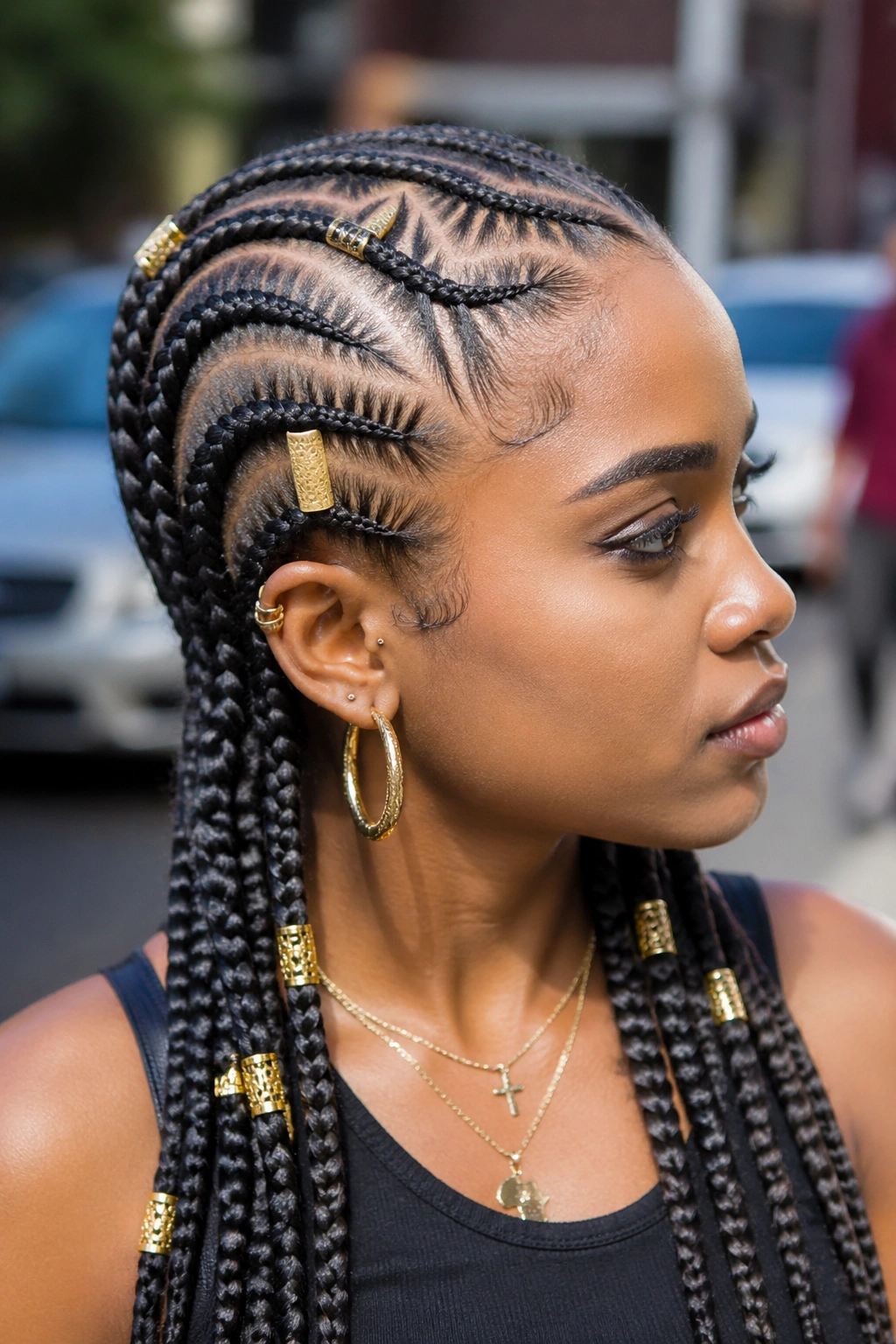
Metal hair cuffs — gold or brass, sometimes silver — slide onto the braids and catch light as you move. Unlike beads, cuffs add shine without added weight, so they work on longer braids where beads would pull.
Mix cuff sizes. A mix of small cylindrical cuffs and larger decorative rings looks intentional. All-matching cuffs look store-bought.
Place cuffs asymmetrically — not one on every braid. That’s what separates curated tribal styling from costume.
11. Half-Braided Tribal Style
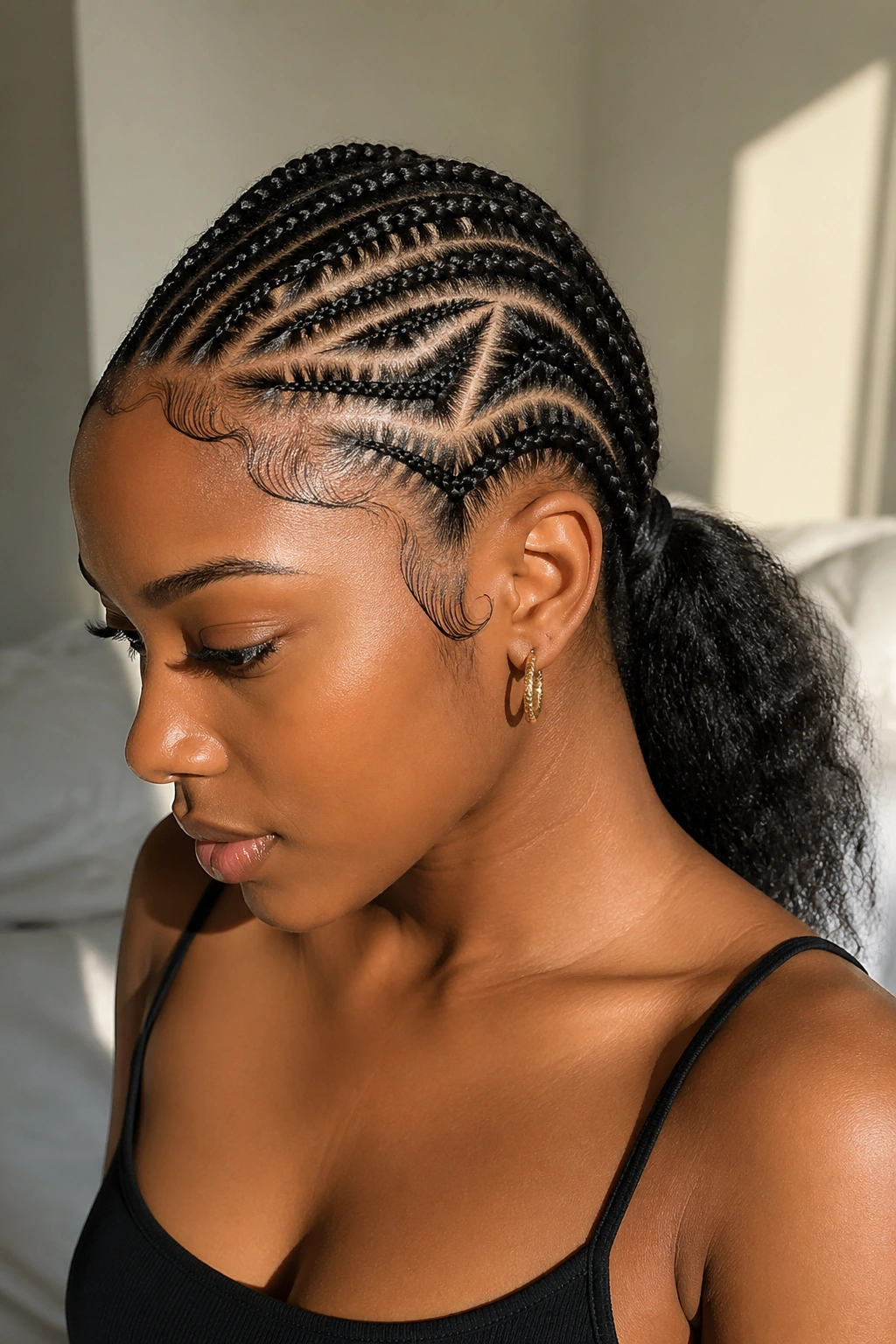
The front and top half of the head is cornrowed in a tribal pattern. The bottom half is slicked back and gathered into a low pony or loose braid. The split creates contrast — tight and intricate above, smooth and simple below.
Good for women with long natural hair who want to show off length alongside the braided pattern.
The slicked portion needs firm-hold gel and a dense brush to smooth every bump. Any lumps in the smooth section ruin the contrast.
12. Tribal Cornrows Into a High Ponytail
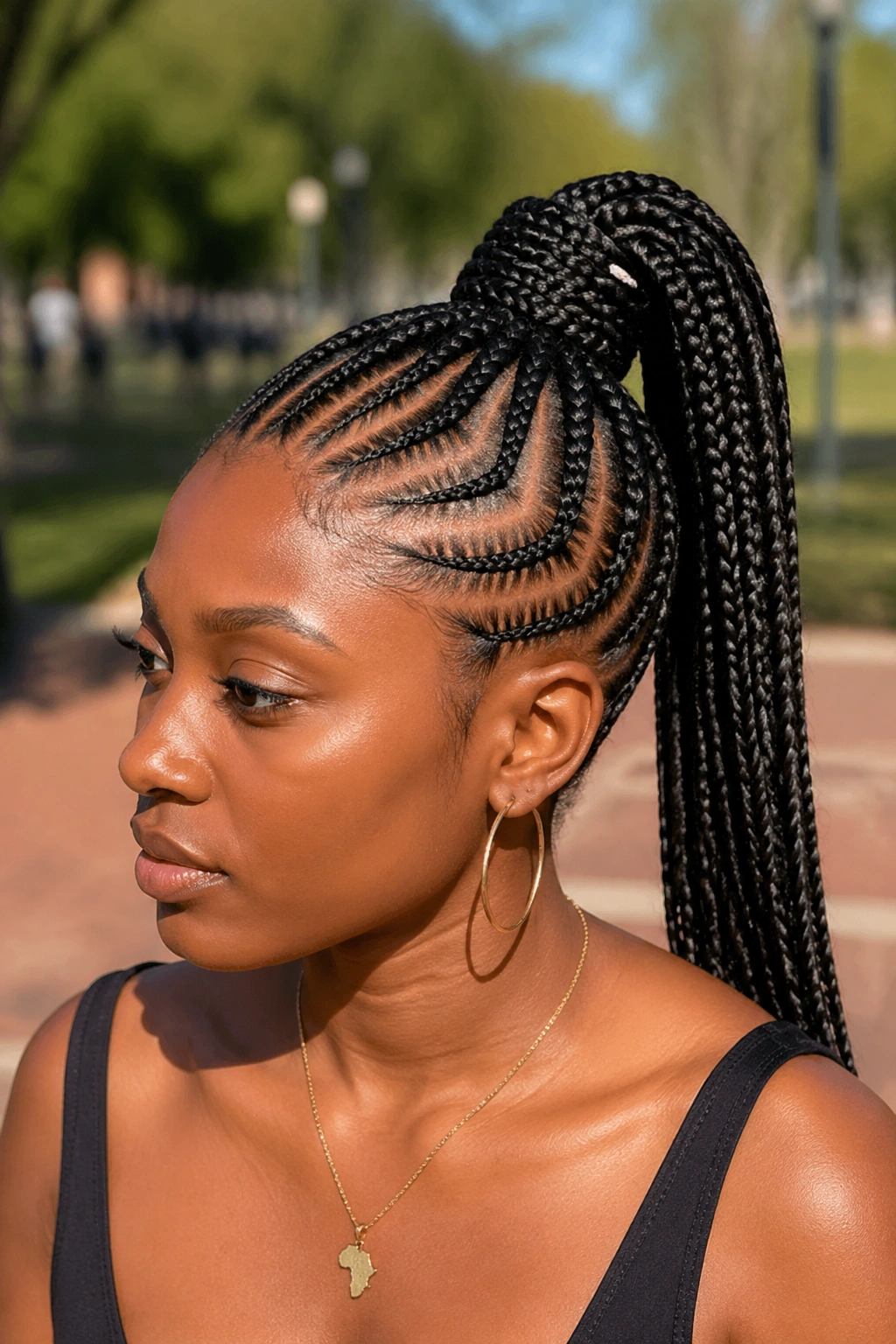
Every cornrow leads into a single high ponytail at the crown. The ponytail itself can be a braided extension, a natural puff, or a curled kanekalon piece depending on the finish you want.
This is a clean, modern take on tribal aesthetics — all the parting work and detail happens on the scalp, then everything gathers up into a single dramatic focal point.
Note: A high pony with heavy added hair puts tension on the crown all day. If your crown is sensitive, anchor the pony loosely enough to slide two fingers underneath, or you’ll end up with a headache by hour 3.
13. Tribal Cornrows With Accent Beads
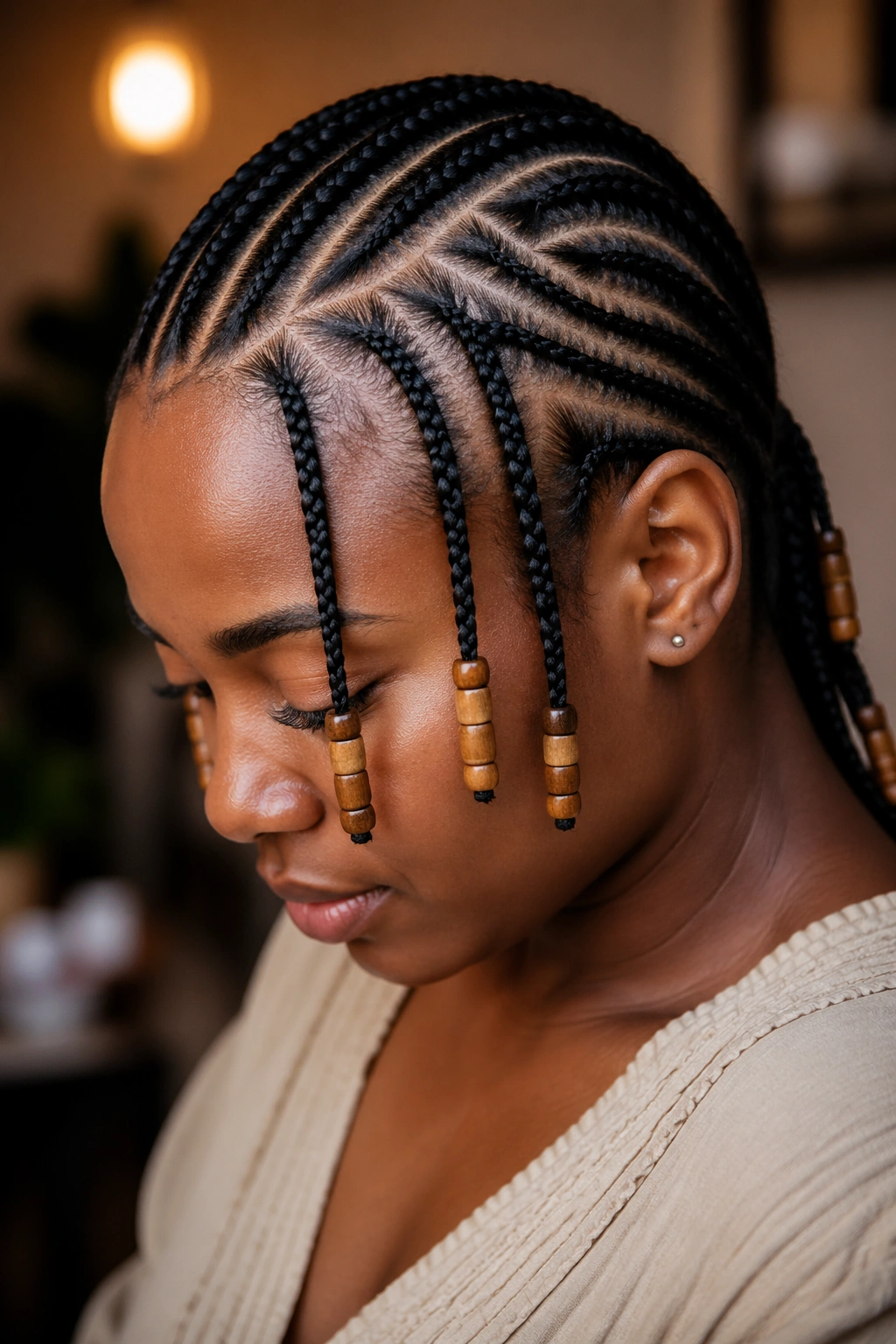
Beads are placed only on 3-5 chosen braids out of the whole set. The rest are left clean. The placement is deliberate — maybe beads on the front framing braids plus one accent braid at the back.
Minimalist tribal styling. Lets the braiding pattern carry most of the visual weight, with beads providing punctuation rather than the whole story.
Use beads in one color family only — all wood, all gold, or all natural brown. Mixed bead chaos reads busy.
14. Symmetric Mirror Cornrows
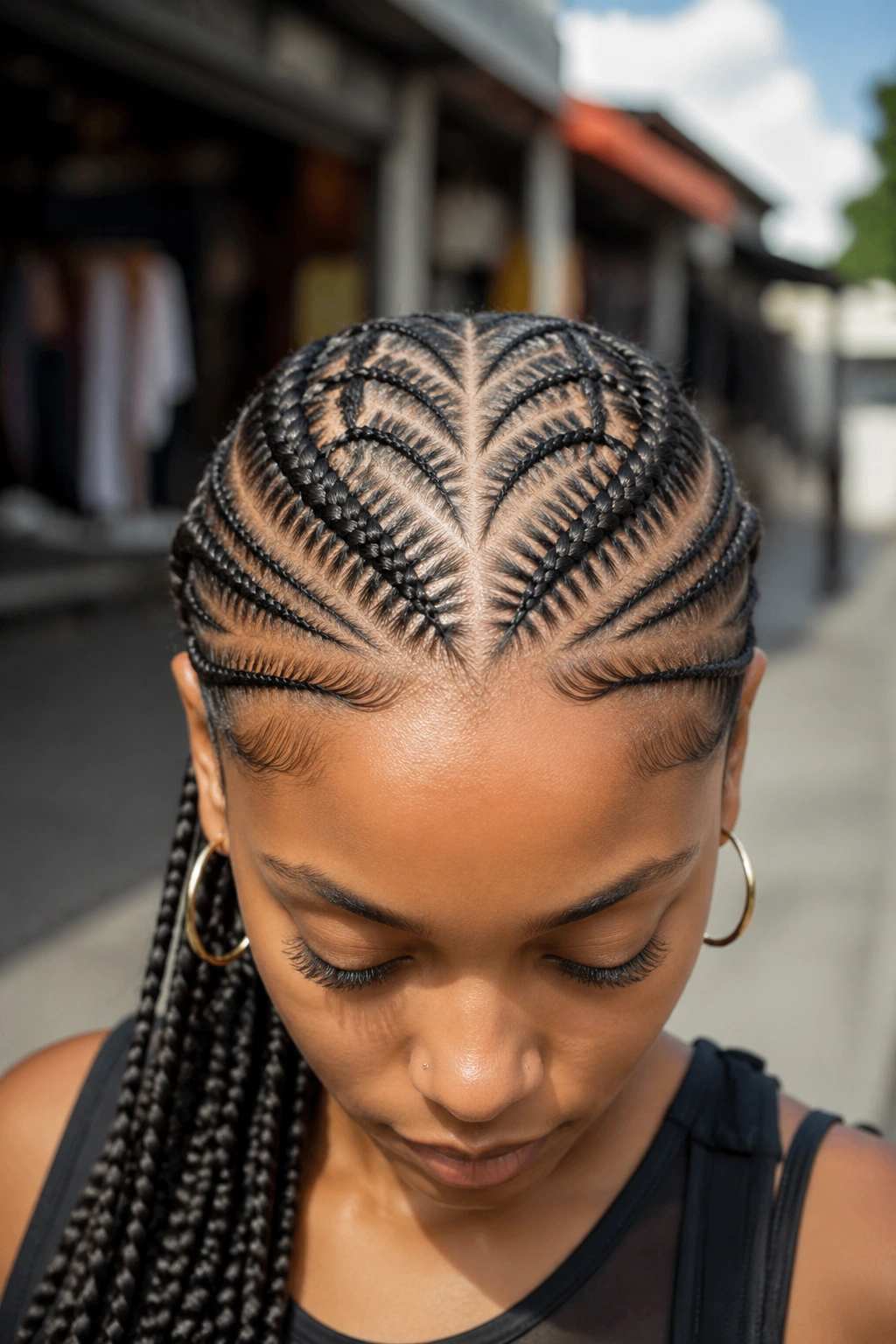
The parting pattern on the left side of the head mirrors the right exactly. Every curve, every triangle, every beaded braid has a twin on the other side.
The precision here is what makes it tribal rather than casual. Asymmetry is fine for some styles; mirror styles have to be surgical.
Takes 4-6 hours. Not a weekend afternoon project.
15. Tribal Cornrows With Cornrow Accents
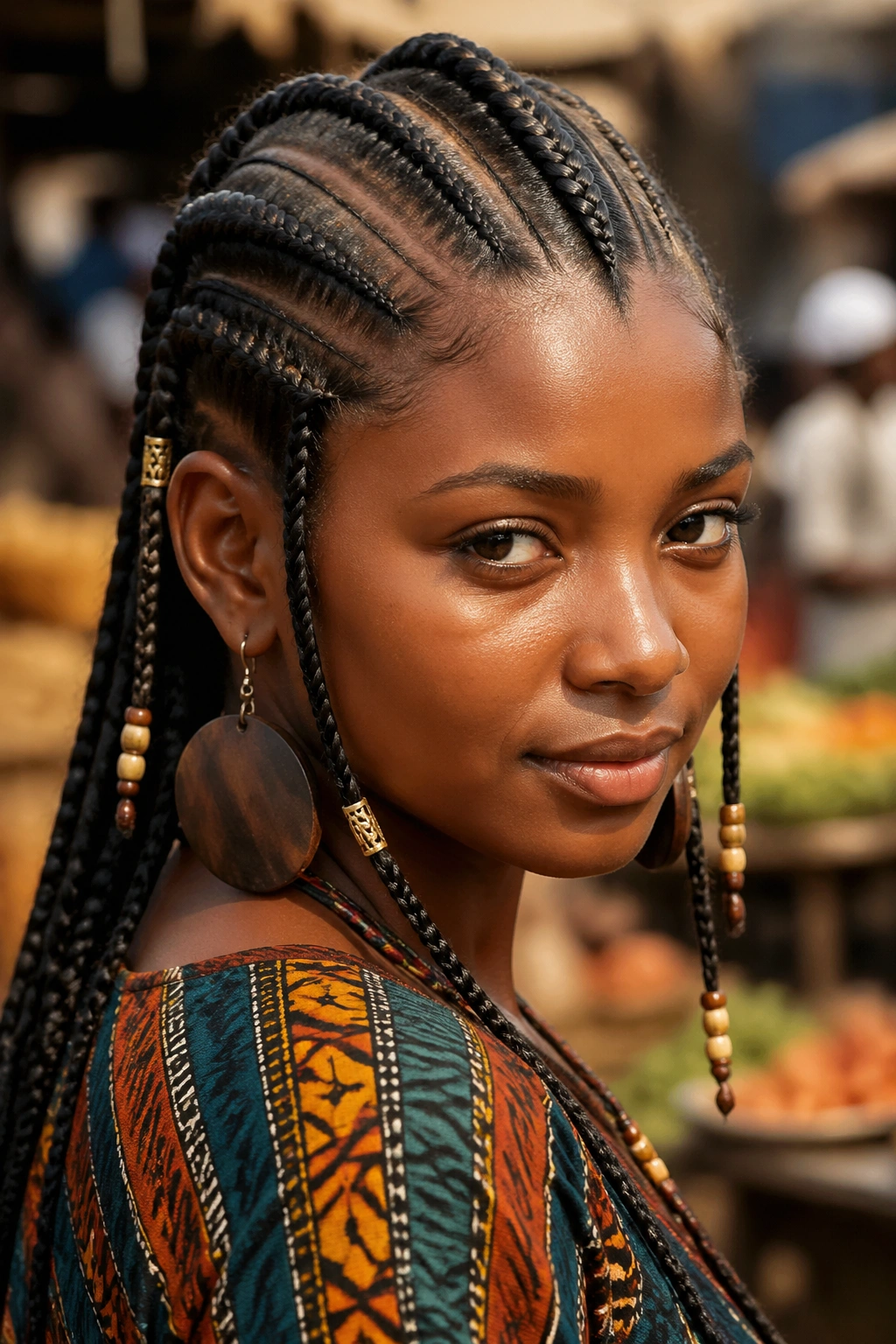
The main pattern is straight cornrows, but 2-3 “accent” braids cut across at unexpected angles — maybe two braids going diagonally across an otherwise straight-back pattern. The accents create movement without overwhelming the base structure.
A style that looks more creative than its install time suggests. 60-90 minutes if you’re efficient with parts.
Great entry point for someone who wants tribal-inspired styling without committing to a multi-hour curved-parts install.
16. Cornrows Framing a Natural Puff
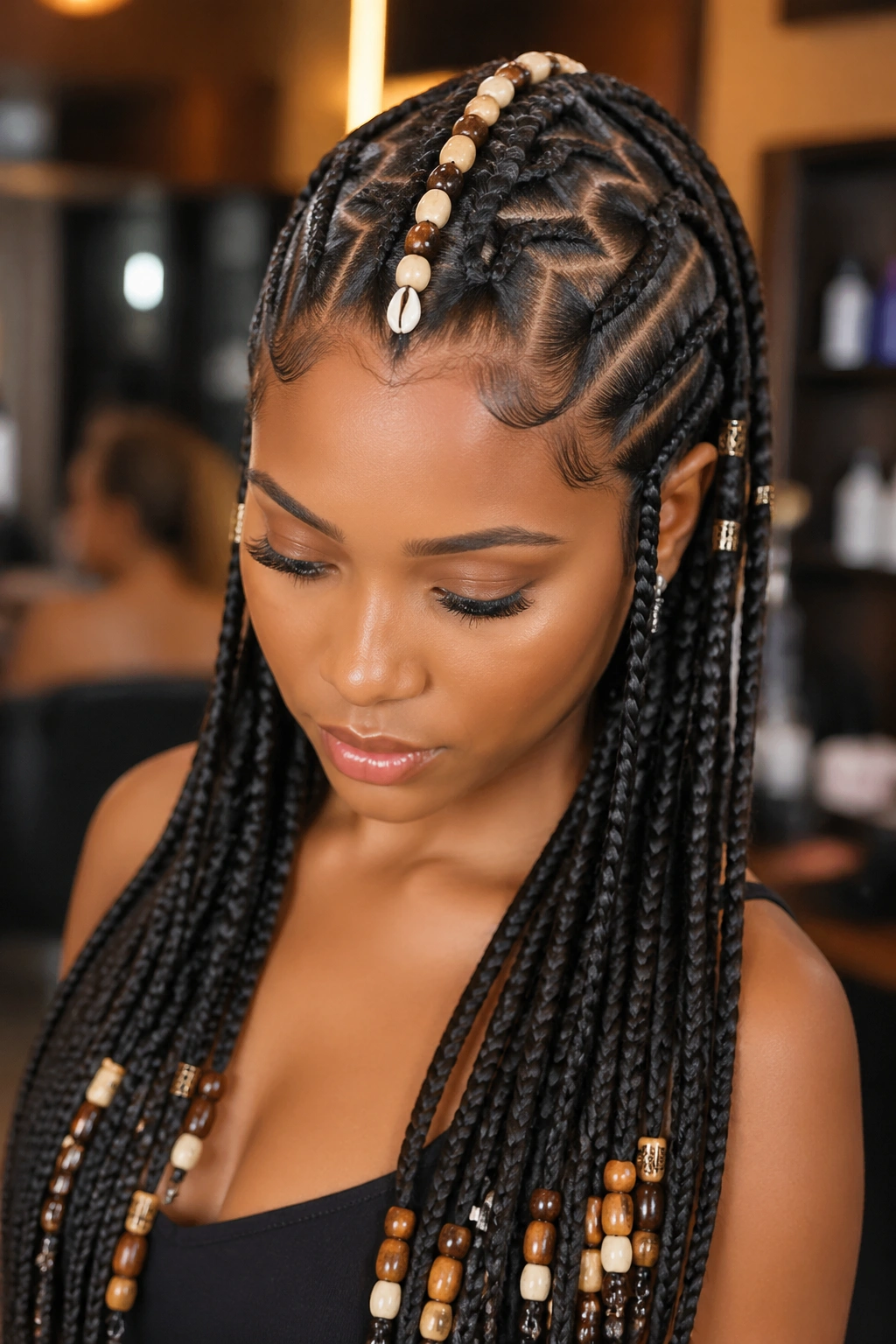
Cornrows circle the perimeter of the head, all leading toward the crown where the hair gathers into a natural puff. The puff section — natural hair, no extensions — is the focal point, with the cornrows acting as a braided frame.
Good for 4C hair that already has a strong puff shape. The puff needs density to visually balance the detailed cornrowing below. Sparse puffs look sad here.
A defining gel or curl cream on the puff keeps it picked and shaped through the week.
17. Cowrie Crown
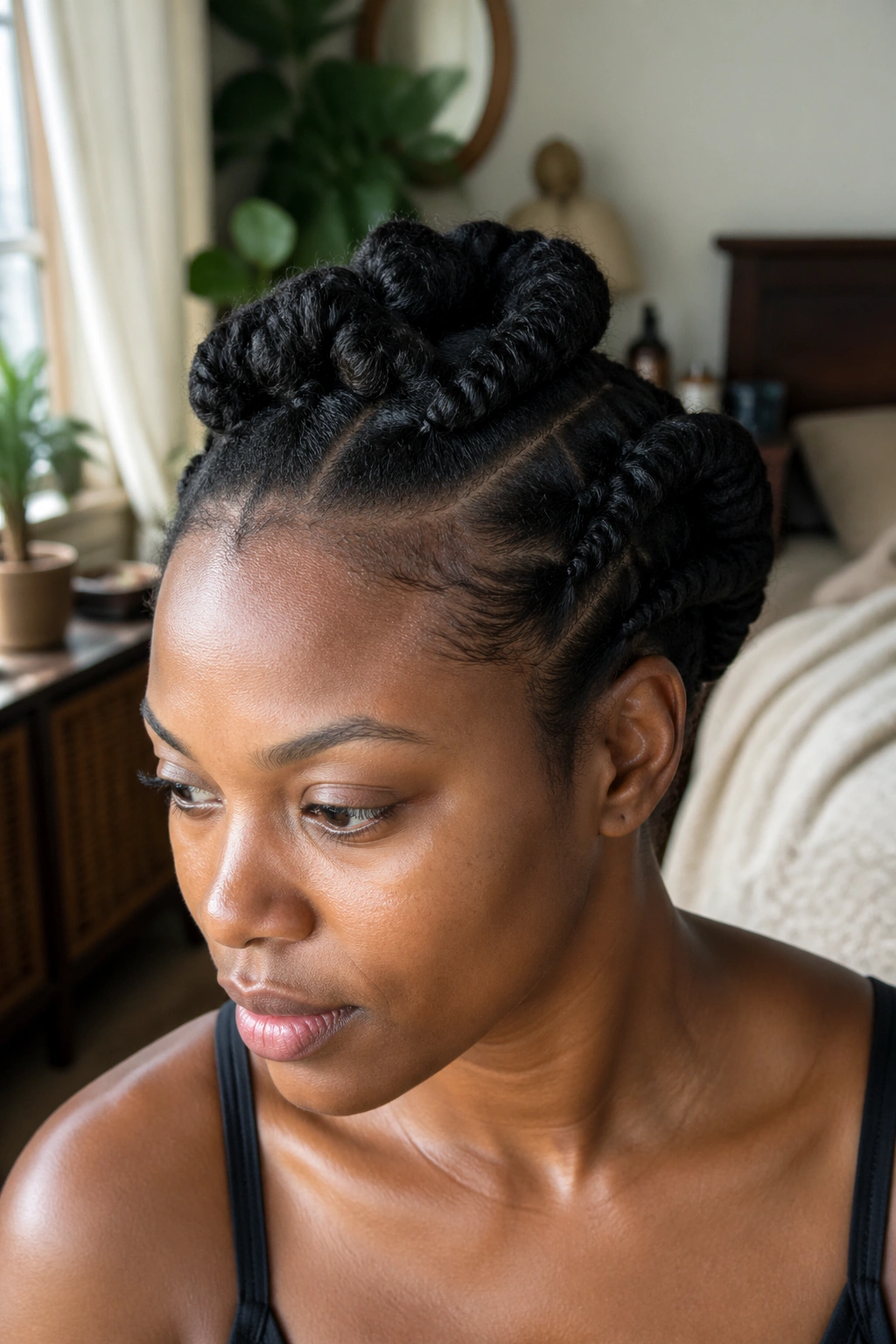
A ring of braids encircles the head at the crown level, studded with cowrie shells at regular intervals. Below the crown line, braids continue down the rest of the head more simply.
The cowrie ring sits like a jeweled headband — intentional, formal, almost ceremonial. Wedding styling. Special event styling. Not a Tuesday workday style.
Use 20-30 cowrie shells around the crown. Fewer feels sparse; more feels chaotic.
18. Zipper-Pattern Cornrows
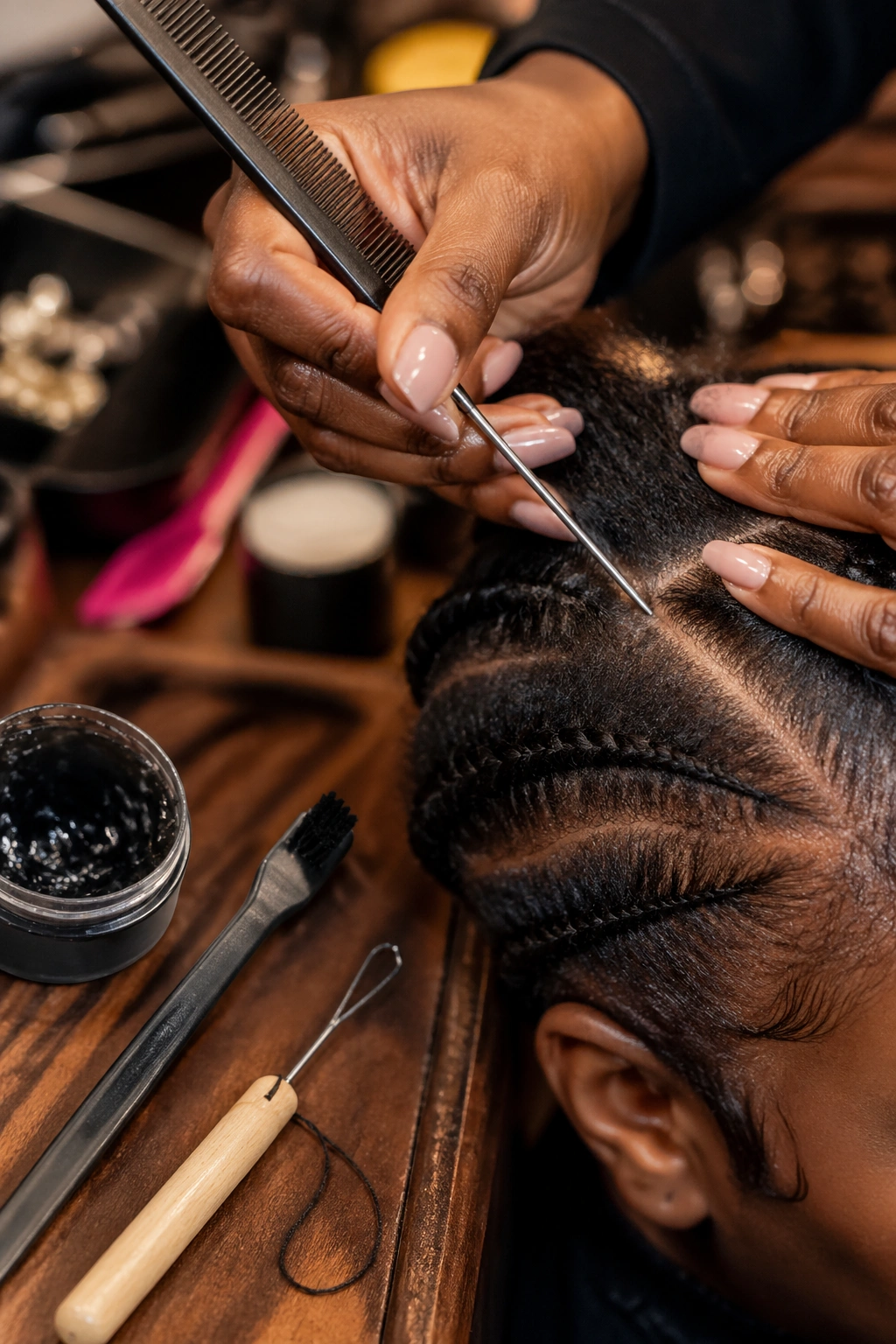
Two cornrows running the same direction interlock in a pattern that mimics a zipper — each row’s braid angles in, meets the next row’s braid at a point, then separates again. Creates a “V” pattern repeating down the head.
Geometric and precise. The illusion only works if the angles are consistent and the parts are sharp.
Difficult for the braider. Spectacular when done well.
19. Tribal Cornrows With Afro Puff at Back
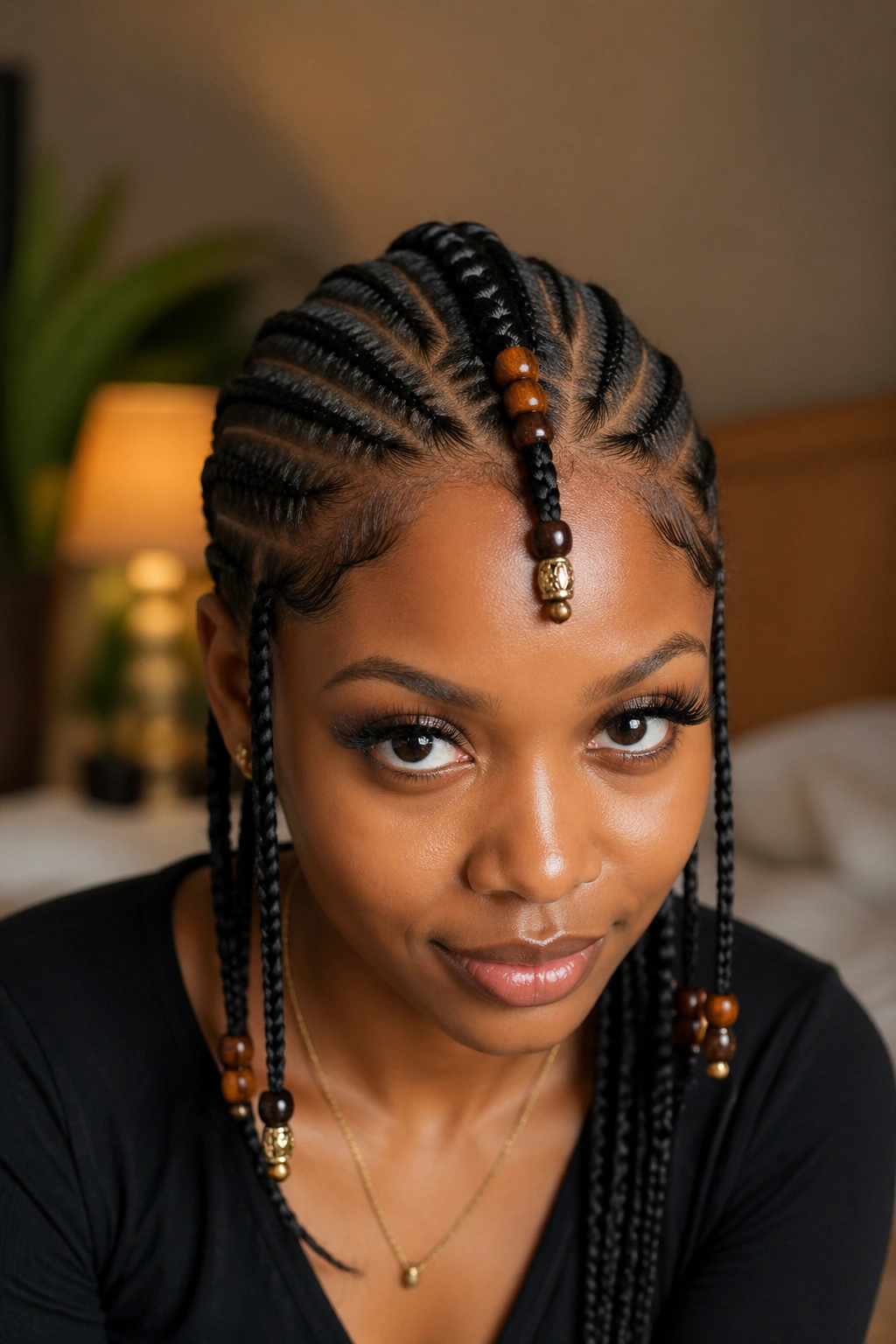
Cornrowed pattern on top and sides, afro puff at the back. The puff is natural texture, picked out for volume.
This is a style that feels like a conversation between tradition and natural hair identity. The braided front honors pattern traditions; the loose afro honors natural texture.
Use a curl sponge on the puff to define individual coils before picking. Flat picked puffs look mushed.
20. Double Crown Tribal Cornrows
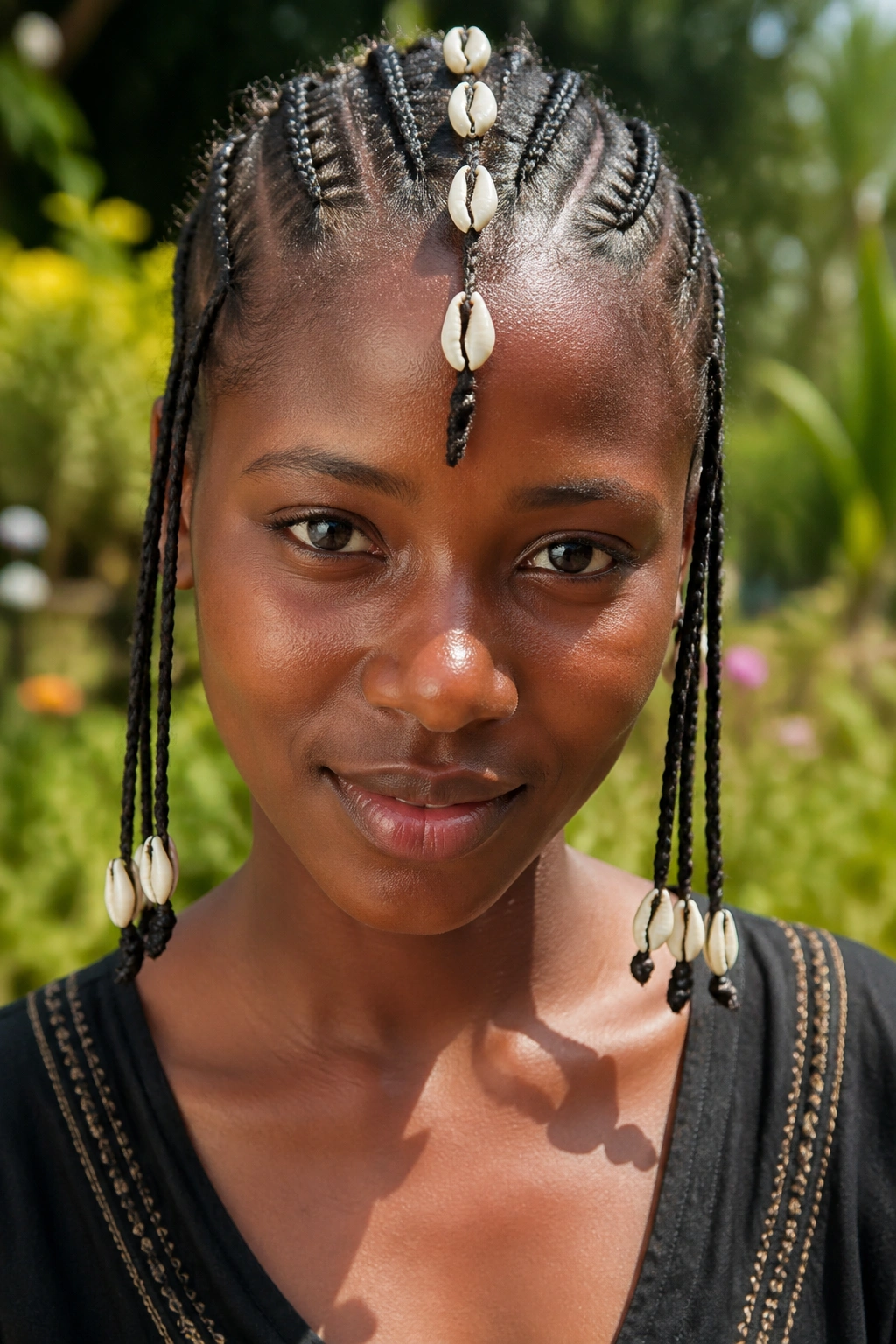
Two distinct focal points on the scalp, usually one at the traditional crown and another slightly behind it. Braids radiate out from each point, creating a two-swirl pattern when viewed from above.
Rare and striking. The two centers give the style visual complexity that single-point patterns don’t have.
What to Watch For
The space between the two centers needs to be balanced. Too close and they merge visually; too far and the pattern looks disjointed. About 3-4 inches apart usually works.
21. Tribal Cornrows With Beaded Fringe
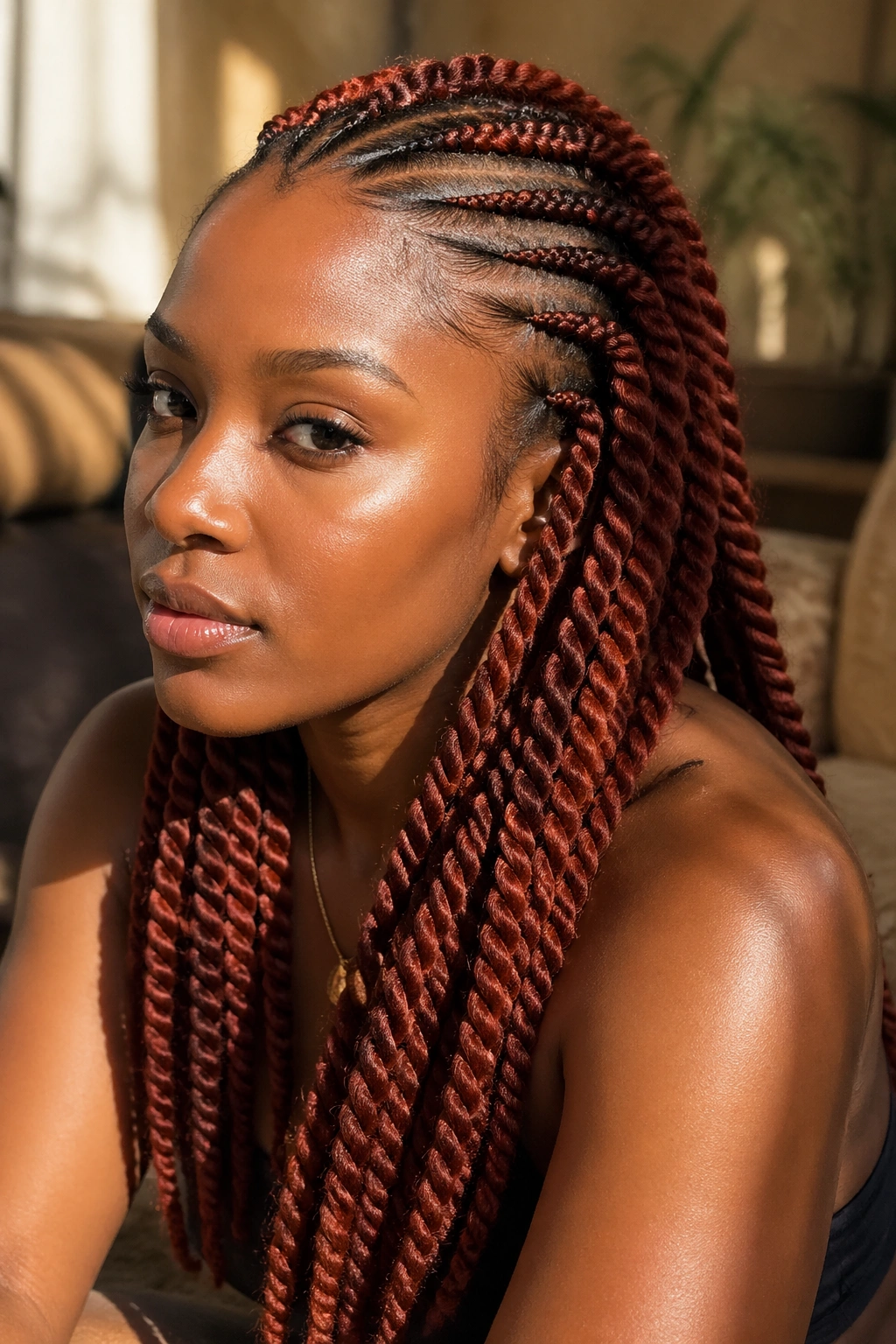
Standard tribal cornrows across the head, with an extra row of short beaded braids framing the forehead like a fringe. The fringe braids are 4-6 inches long, heavily beaded, and sit across the forehead when the head is still.
Moves beautifully when the wearer turns — beaded fringe catches light and adds motion. Very dramatic. Also noisy, so not a library style.
22. Waist-Length Tribal Cornrows
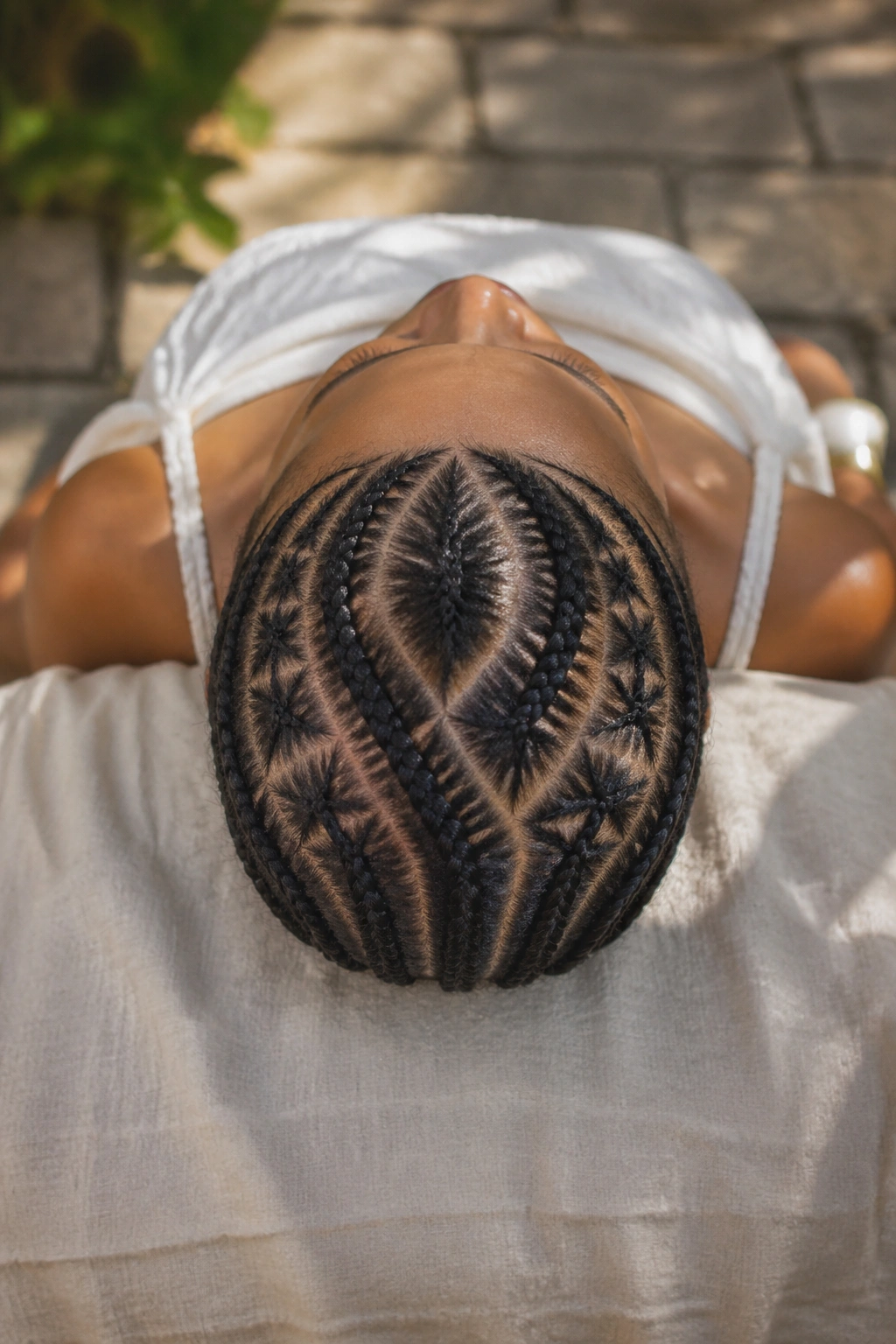
The full tribal parting pattern at the scalp, with extensions that extend well past the waist. Sometimes floor-length. The length itself becomes part of the style’s statement.
Takes 5-8 hours to install and requires heavy tension management. Distribute the weight across many braids — never concentrate on a few thick ones at the crown.
Sleep on a silk pillowcase and wrap the lengths in a silk scarf at bedtime. The weight of long braids against cotton causes breakage at the scalp over weeks.
Maintaining Tribal Cornrows
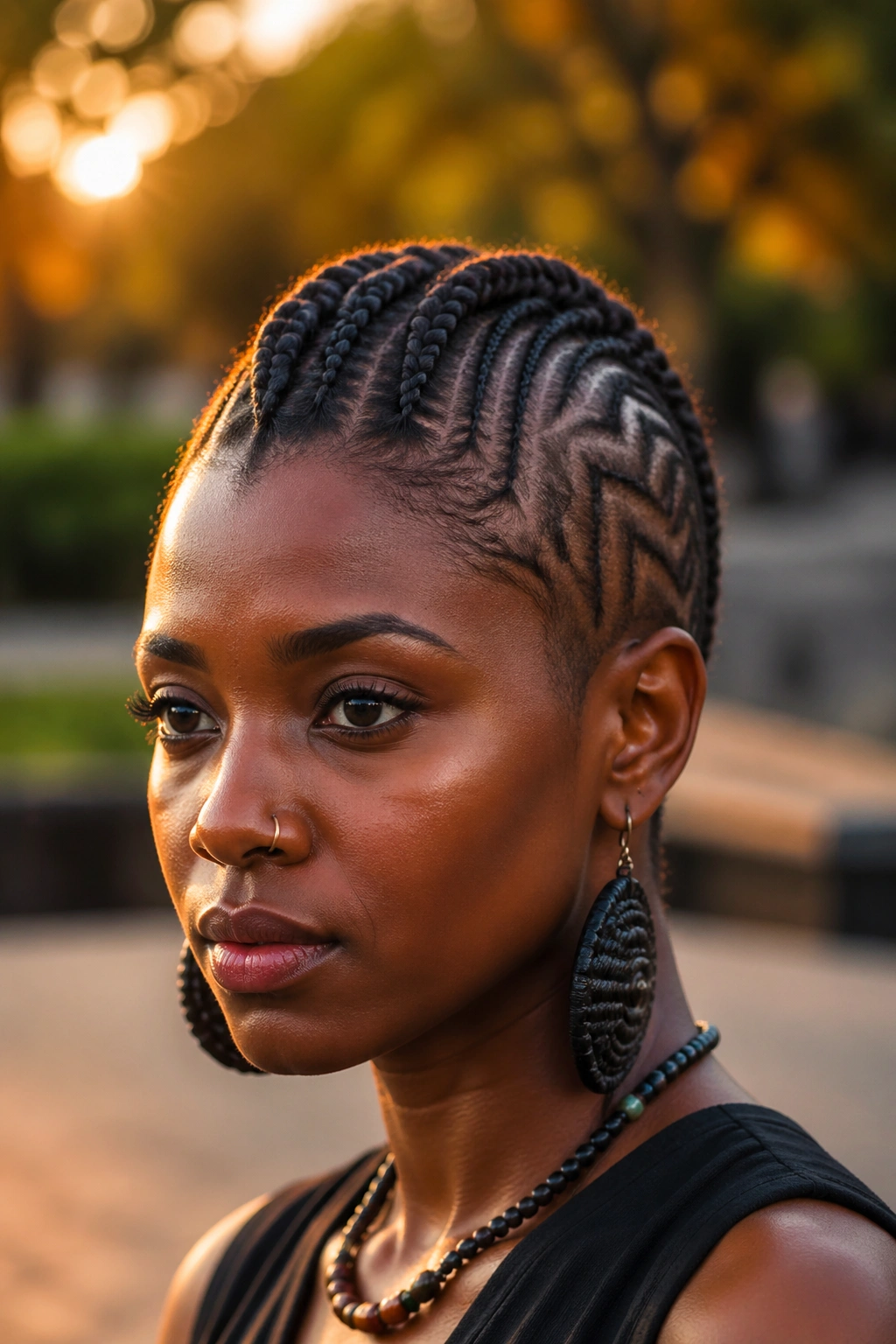
Tribal cornrows hold their beauty longer when you protect them at night. A large satin bonnet or a silk scarf wrap keeps the braids smooth and the beads from banging against the pillow. Hollow plastic beads can actually crack during sleep if unprotected.
Moisturize the scalp 2-3 times a week with a lightweight oil — jojoba, argan, or sweet almond. Heavy butters build up fast and are murder to wash out with braids still in.
The edges need daily attention. A dab of edge gel and a soft brush in the morning keeps the hairline neat. Frizz at the edges makes the whole style look old.
Refreshing Beads and Accessories
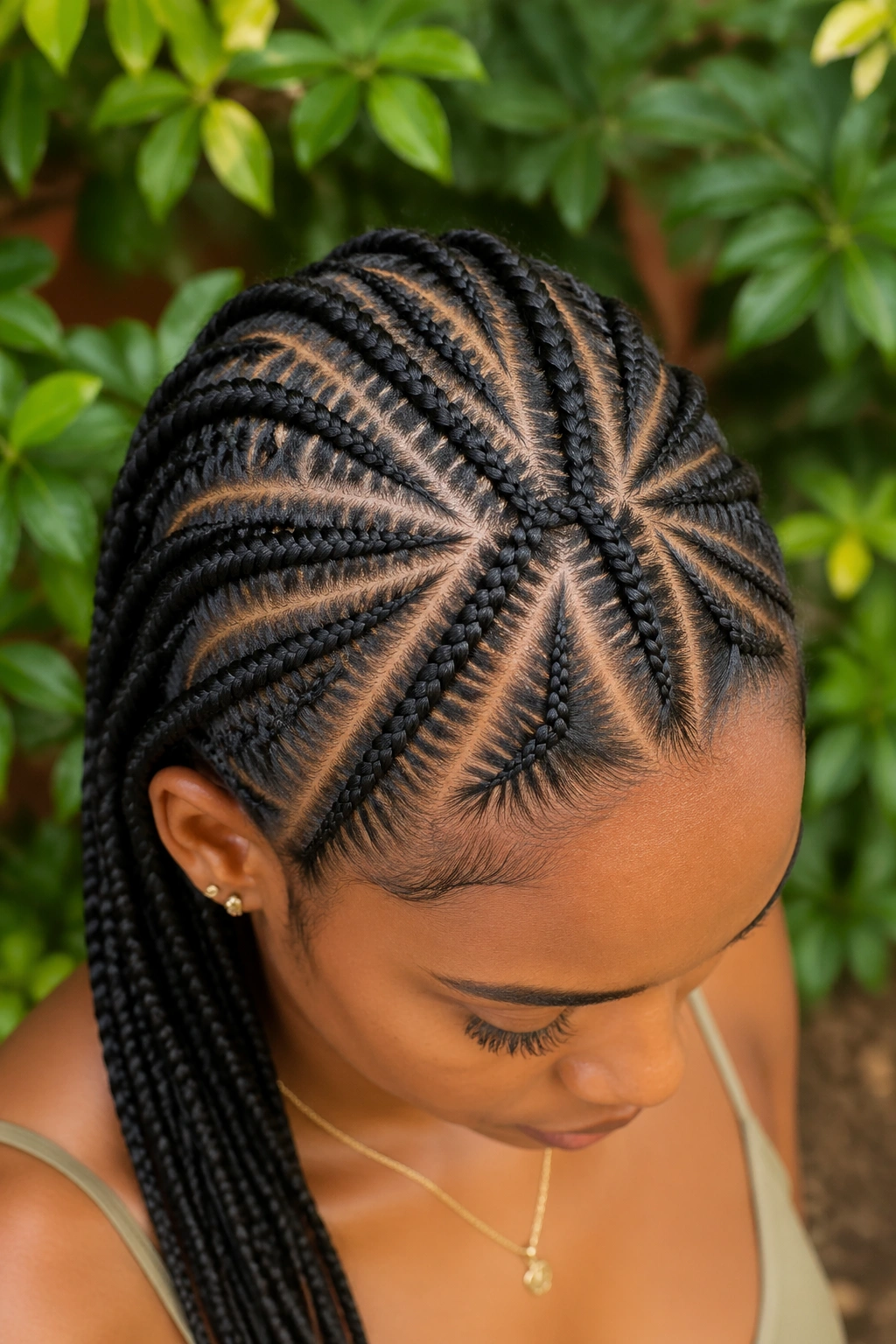
Cowrie shells and metal cuffs need occasional polishing. Rub cowries gently with a damp cloth to remove any built-up product. Gold and brass cuffs can be wiped with a jewelry cloth to keep the shine.
If a bead comes loose, thread it back on with a beader rather than removing the braid. Most braid tips can be slightly extended (with a small piece of kanekalon wrapped and sealed) to re-thread a lost bead without undoing the work.
When to Take Them Down
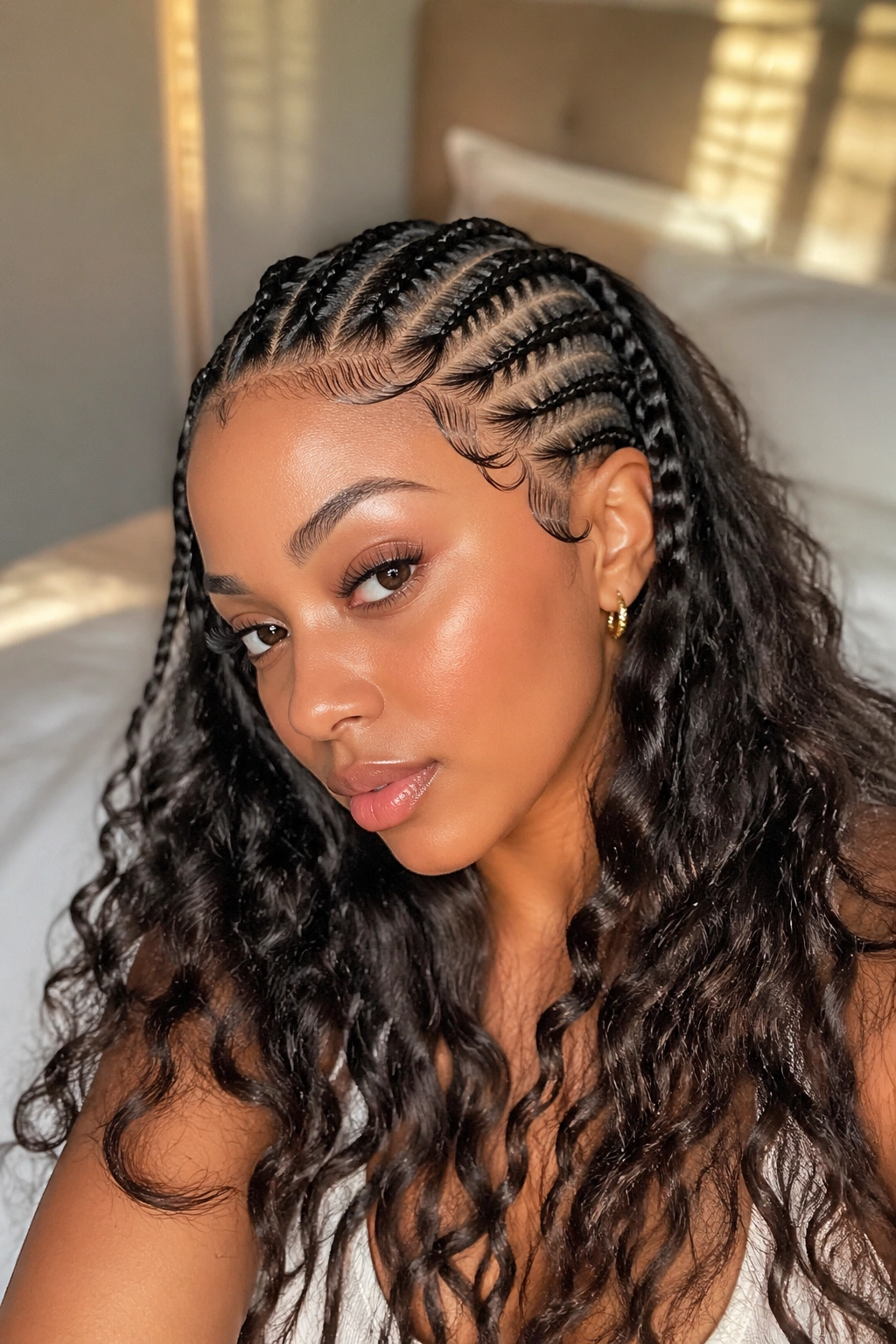
Tribal cornrows last 3-6 weeks depending on how heavy the style is and how well you maintain it. Heavier styles (long extensions, many beads) come out earlier because the weight accelerates loosening at the scalp.
Signs it’s time: visible lifting at the roots, scalp itching that doesn’t respond to moisturizing, frizz that can’t be smoothed, or a general dullness to the overall look. A refreshed style beats a tired one held past its prime.
Take them down on damp hair with a slippery conditioner. The extensions slide out smoothly when wet; they fight you when dry. Give yourself 2-3 hours for a full takedown, especially on long styles.
Choosing the Right Tribal Style for You
Match the style’s weight and complexity to your life. A woman who works in a corporate office can wear Fulani or subtle patterns without issue. A college student has room for bolder choices — waist-length beaded styles, double crowns, dramatic fringe. Someone with a young baby at home should think twice before committing to a 6-hour install.
Your face shape matters. Rounder faces benefit from vertical lines — mohawk tribal styles, high ponies, up-swept looks. Longer faces do better with horizontal interest — halo crowns, headband-style fringes, wider side-swept patterns.
Hair density matters too. Fine hair disappears under intricate patterns; dense hair supports them. If your natural hair is fine, add enough extensions to build the visual weight the style needs.
Tribal cornrows are a conversation across generations. Pick the one that feels like something you’d be proud to carry forward.
