



Lemonade cornrow styles have a specific origin. When Beyoncé released Lemonade in 2016, she wore side-swept cornrows in the visuals that quickly became known as “lemonade braids” — a name that stuck far beyond the album’s release cycle. The defining features are braids that sweep dramatically across the head to one side, often feeding into long extensions that drape over the shoulder, with a deep side part and sculpted edges that frame the face. Lemonade cornrow styles remain one of the most flattering, wearable, and versatile looks in the entire cornrow family, and the variations on the theme have multiplied into a rich catalog of options.
The appeal is obvious once you’ve worn them. A side-swept braid install instantly slims the face, creates asymmetry that flatters almost every feature, and drops the weight of the braids to one side where it frames rather than overwhelms. They photograph exceptionally well — which is part of why they went viral in the first place — and they translate across occasions. A lemonade install can read casual with jeans and a tee, formal with a gown, or commanding with a suit. Few other cornrow styles span that range.
Where the Name Comes From
The album Lemonade changed the visual vocabulary of Black hair in popular culture. Before 2016, side-swept cornrows existed — they weren’t invented in a studio — but the specific silhouette Beyoncé wore in the visual album crystallized a style that braiders had been doing for generations into a named, requestable look. Ask any Black braider for “lemonade braids” and they know exactly what you mean.
The style pulls from older traditions of side-swept cornrows worn across the Diaspora. What the album did was give the silhouette a shared name and a cultural moment that made it hard to ignore. That’s why the name has stuck: it’s a reference point for a specific kind of braid, done a specific way, with specific proportions.
The Anatomy of a Lemonade Braid
Three features define a lemonade install.
- Deep side part: The parting starts well off-center, usually an inch or two from the natural parting line.
- Directional sweep: All braids travel from the side of the head with more hair over to the opposite side where they gather or drape.
- Extended length: The braids extend well past the shoulder, often to the chest or lower back.
Any cornrow install that lacks one of those three isn’t really a lemonade braid — it’s a different style that happens to sweep sideways. Get all three right and the look snaps into recognition.
Prep That Makes or Breaks the Install
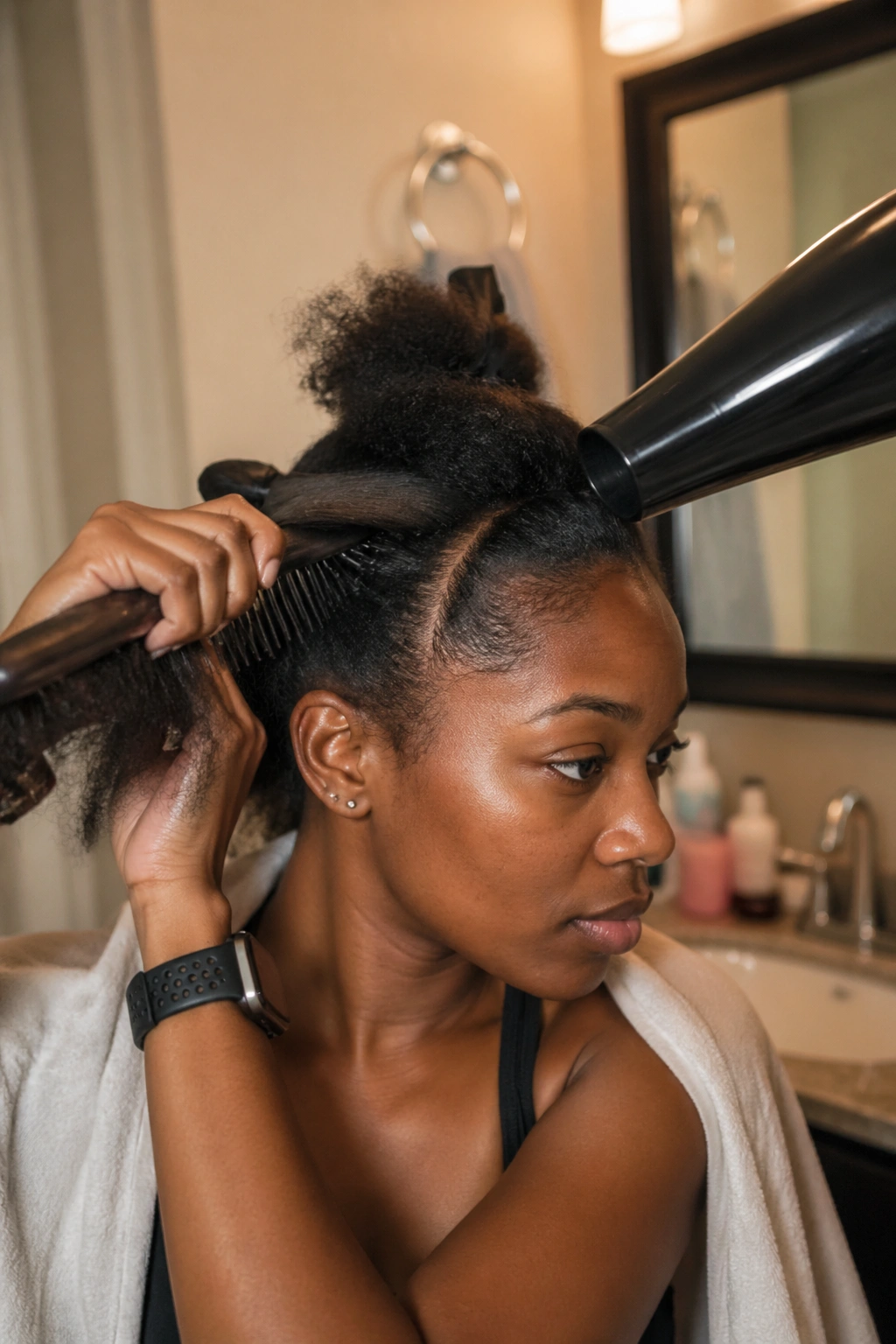
Lemonade braids need stretched hair to lie flat in the sweep. Shrinkage at the roots translates into lifting and fuzz within 48 hours. Here’s the prep I use:
- Wash with a clarifying sulfate-free shampoo.
- Deep condition with heat for 30-45 minutes.
- Blow-dry on cool to about 80% dry, stretching with fingers as you go.
- Apply a leave-in and a light oil.
- Blow the roots down flat with medium heat using a round brush or comb attachment.
Skipping the stretching step is the biggest reason home installs look puffy from day one. Don’t cut the corner.
Tools You Need on Hand
- Rat-tail comb with a metal tip for sharp parts.
- Pre-stretched kanekalon in your chosen color.
- Edge gel that doesn’t flake.
- Duckbill clips for sectioning.
- Small clear rubber bands for braid tips.
- A boiling kettle if you’re sealing ends with hot water.
- A bowl of warm water for dipping kanekalon if that’s your sealing preference.
Tip: Pre-cut the kanekalon into graduated strips for feed-ins. You’ll need roughly 3 strips per braid, each slightly longer than the last. Prepping this before you sit down saves ages mid-install.
How Long They Actually Last
Two to three weeks with good maintenance. Lemonade braids tend to last slightly longer than standard cornrows because the sideways sweep protects the most vulnerable spots at the crown and nape from direct wear.
Past three weeks and the hairline starts to fuzz, the braids loosen at the sweep, and the whole install begins looking worn. That’s when to take down.
The Side That Changes Everything
Which side you sweep to matters more than first-timers realize. Sweep to the side of your face that photographs best. Cover the side of your face you’re less confident about with the sweep of the braids. Most people have a preferred side — figure out yours before the install, not during.
1. Classic Long Lemonade
The original. Deep side part on the left, long braids sweeping dramatically to the right, ending at the waist or below. Straight-back feed-ins, all parallel, all flowing to one side.
Why It Works
This is the silhouette that defined the style. Clean. Recognizable. Flattering. When you’re not sure which lemonade to try, try this one.
- Install time: 3-5 hours.
- Lasts: 14-21 days.
- Best for: any occasion, any outfit.
Tip: Request the first braid at the hairline be slightly raised — about 1-2mm lifted off the scalp. Creates a soft shadow line along the side part that photographs dramatically.
2. Short Bob-Length Lemonade
Same side-swept silhouette, but the braids end at the jawline or shoulders instead of the waist. Lighter, less dramatic, and much easier to sleep in.
Short lemonade braids suit women who work out frequently, travel often, or just prefer less weight. They read crisp and modern without the maintenance burden of long braids.
3. Chunky Jumbo Lemonade
Thick, statement-size cornrows sweep sideways. Only 5-7 braids across the whole head instead of the usual 10-15. Each braid dominates its section.
The thicker the braid, the faster the install. Jumbo lemonade takes about half the time of standard. The trade-off: the braids sit more noticeably on the scalp rather than hugging flat.
Works best on medium-to-long natural hair. Fine natural hair struggles to fill out jumbo braids without showing thin patches.
4. Lemonade with Curled Ends
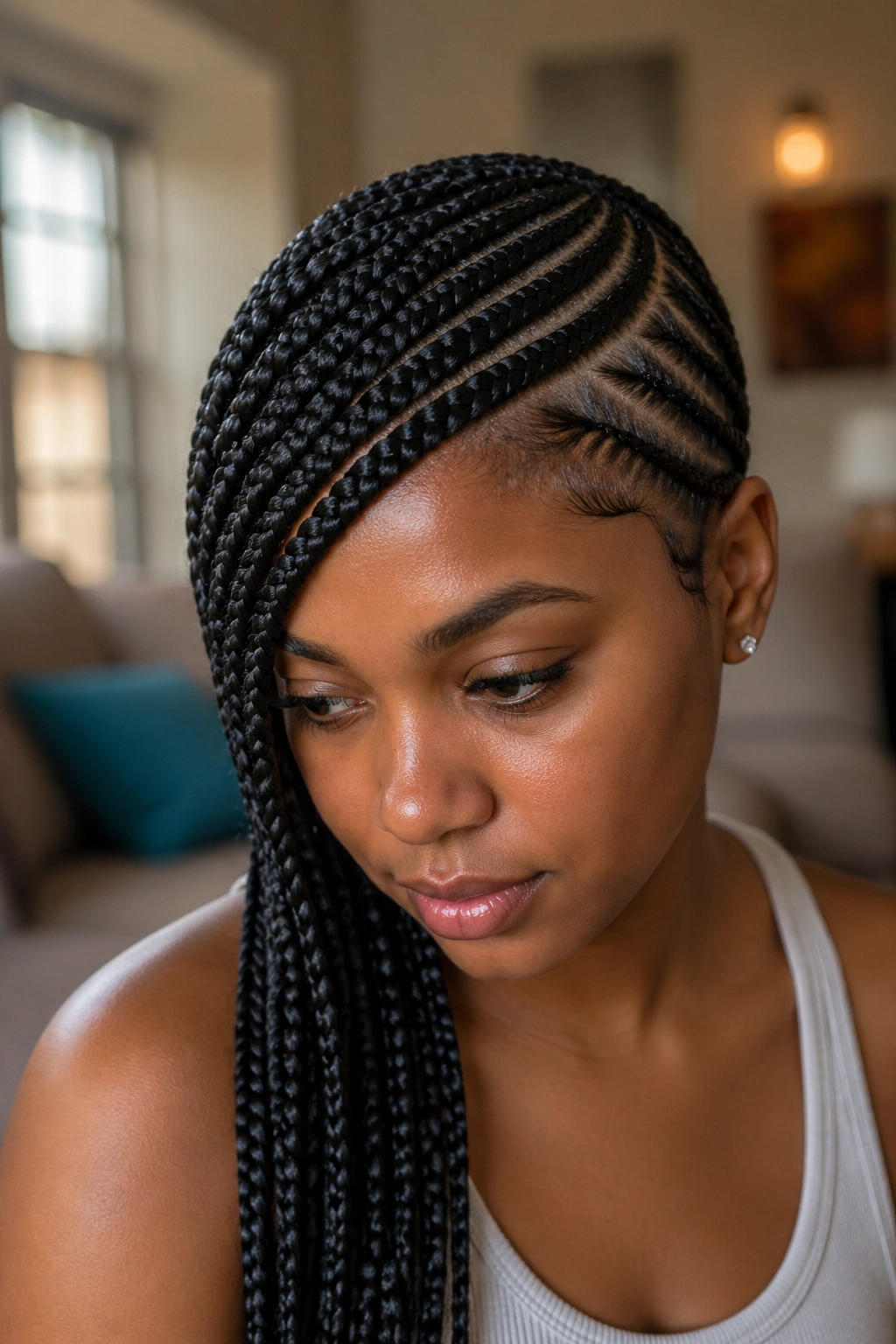
The sweep is the same, but the tails are set on flexi-rods or perm rods after the install. The ends curl into bouncy spirals that hang along one shoulder.
How to Style It
- Complete the braid install with unsealed kanekalon tails.
- Wrap sections of the tails around flexi-rods.
- Dip each rod briefly in boiling water.
- Let cool fully before removing rods.
- Finger-separate the resulting curls.
Lasts the same as standard lemonade, but the curls loosen over a week or two and need re-setting if you want to keep the spiral defined.
Tip: Use warm water, not boiling, for hair you’re going to wear to bed. Boiling heat sets tighter but creates tangles against the pillow.
5. Lemonade with Curly Ends
Not the same as curled ends. Curly ends use pre-curled kanekalon — the kind labeled “water wave” or “deep wave” — attached to the braided roots. The waves drape naturally without heat.
The curls are uniform, the texture is softer, and the maintenance is easier than flexi-rod sets. A common choice for vacations, especially beach-adjacent ones, where humidity would wreck other finishes.
6. Lemonade with Tribal Parts
Curved, wavy, or geometric parts replace straight parts between the braids. The sweep stays the same, but the scalp reads as artwork.
Ask the braider about their parting technique before booking. Not every braider does clean tribal parts. Those that do will show portfolios proudly.
Tribal-parted lemonade reads as craft, heritage, and detail. One of the most admired variations.
7. Lemonade with Beaded Ends
Wooden or metallic beads threaded onto the last few inches of the tails. The beads swing as you move and catch light against the sweep.
- Wooden beads read as grounded and traditional.
- Small metallic beads read as minimal and modern.
- Colored glass beads read as playful and bold.
Cap the bead count. More than 15-20 beads total adds real weight and strains the hairline where the braids start.
8. Half-Up Half-Down Lemonade
The top half of the braids is pulled up into a half-bun or half-ponytail at the crown, while the bottom half continues sweeping to one side. The hybrid keeps the lemonade sweep while adding a structural top element.
Good for days when you want to get braids off your neck but don’t want a full bun. Also works as a transition style — you can let the top half back down later in the day.
9. Lemonade with Cornrowed Bun
The long tails that would normally drape are instead wound into a low bun on the sweep side. The bun sits behind one ear, with the sweep directing attention toward it.
Takes the drama down a notch. Useful for work environments that want polish without the weight of long hanging braids.
10. Lemonade with Gold Thread Accents
Metallic thread wrapped around one or two of the braids along the sweep. Not all of them — that would be too much. Just one or two strategic threads that glimmer when you move.
What to Watch For
Gold thread can read cheap if the braid underneath is fuzzy. Thread only your crispest braids, and retire the thread as soon as the braid starts to loosen.
- Use real metallic embroidery thread, not plastic.
- Wrap starting halfway down the braid, not from the top.
- Secure with a small knot, not a rubber band.
Tip: Gold on black hair reads warmer than silver. Silver on black hair reads cooler and more modern. Pick based on the season and outfit you’re styling toward.
11. Colored Lemonade (Burgundy, Honey, Caramel)
The entire install uses colored kanekalon instead of black. Burgundy, honey, caramel, copper, and ash brown are the most common choices that still read natural.
Don’t go lighter than caramel unless you’re ready for the maintenance of very light extensions. They dirty faster and show flyaways more.
Colored lemonade photographs warmer and draws the eye upward toward the face.
12. Ombre Lemonade
Roots stay dark; tips fade to a lighter color. Honey, rose gold, copper, and ash gray are popular gradient destinations.
The gradient reads most natural when the transition starts about a third of the way down the braid, not near the roots. Roots-to-tips ombre extensions give that exact look without custom dyeing.
Ombre lemonade is the version I recommend for first-timers adding color. It lets you have color without a hard line that shows roots growing out.
13. Lemonade with Straight-Back Hybrid
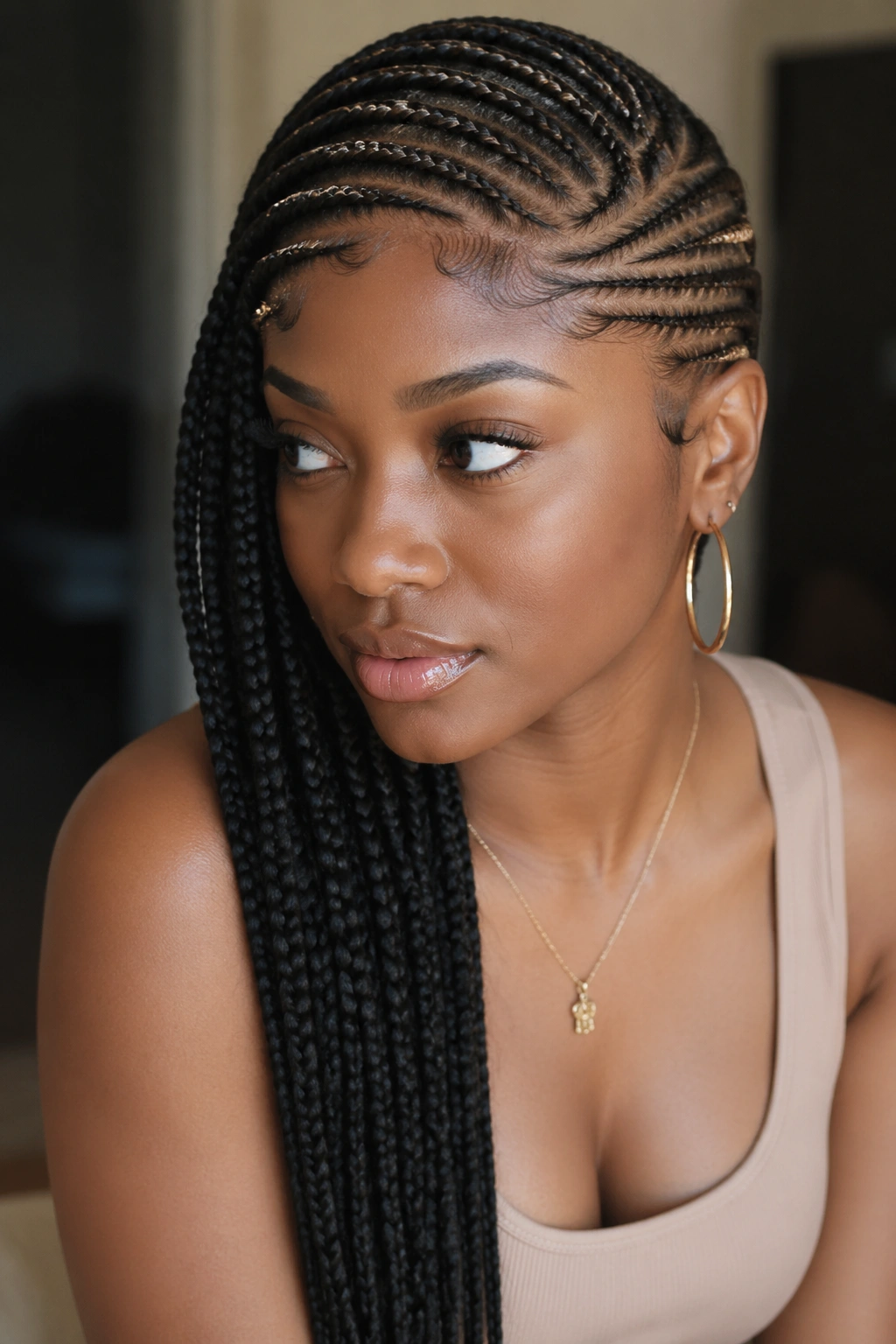
The front third of the head has side-swept lemonade braids. The back two-thirds are straight-back cornrows that feed into the lemonade sweep. The hybrid reads as two styles in one.
Technically tricky — the angle has to match cleanly at the transition point. Not a beginner install. Worth it when done right; confusing when done wrong.
14. Lemonade with Fulani Beads
Fulani braiding tradition uses small beads at specific intervals on specific braids — not scattered throughout. The Fulani lemonade hybrid places maybe six to eight beaded braids along the sweep in a deliberate pattern.
This style carries real cultural weight. If you’re wearing Fulani-style braids, know the reference you’re making and carry it respectfully.
15. Lemonade with Curly Leave-Out
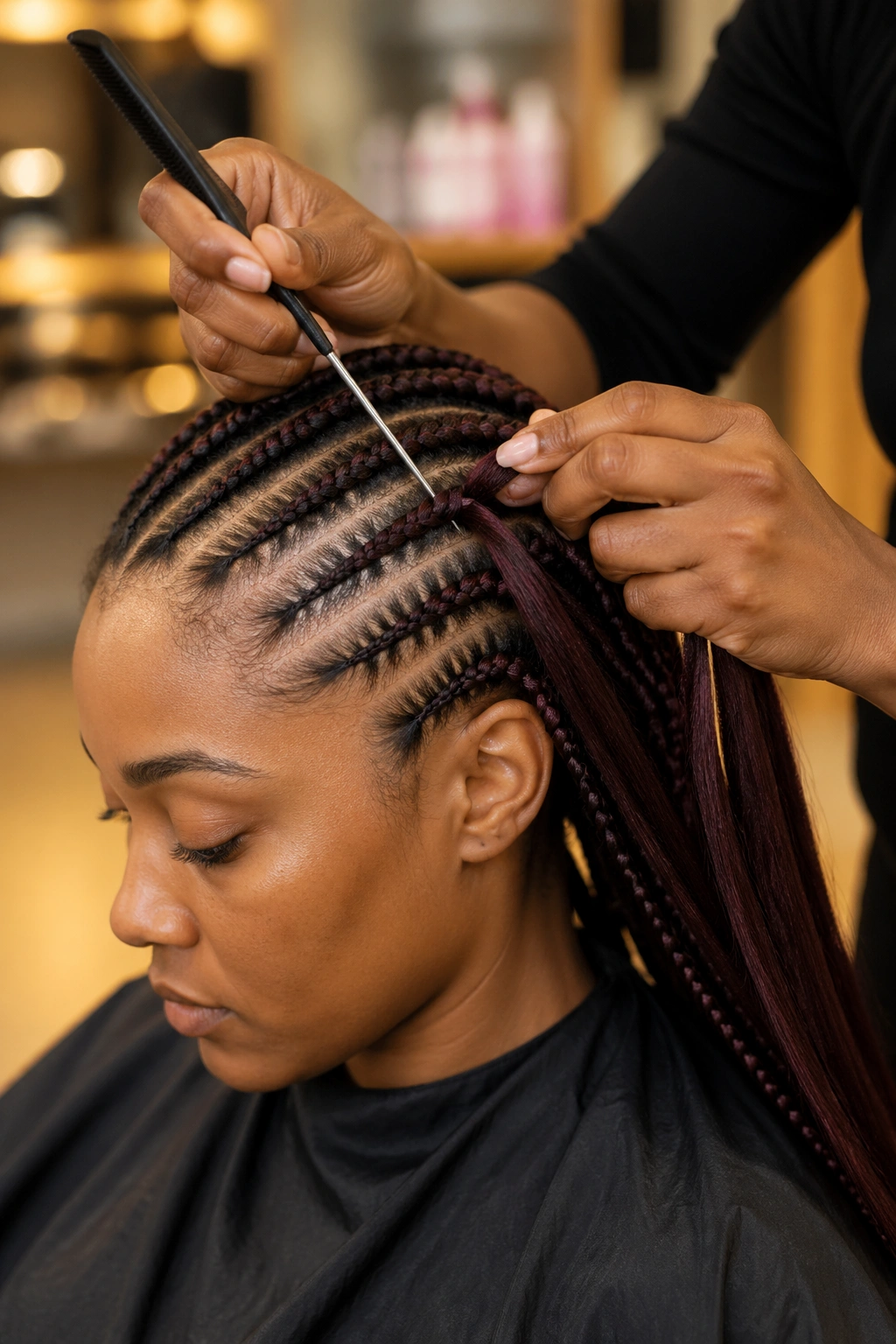
A section of hair at the front of the hairline — not braided — is left loose as natural curls. The rest of the head is lemonade braided. The curls frame the face; the sweep continues behind.
The curly leave-out softens the severity of a pulled-back install. Good for women with defined natural curls who want to showcase them while still protecting the majority of their hair.
16. Lemonade with Swooped Bangs
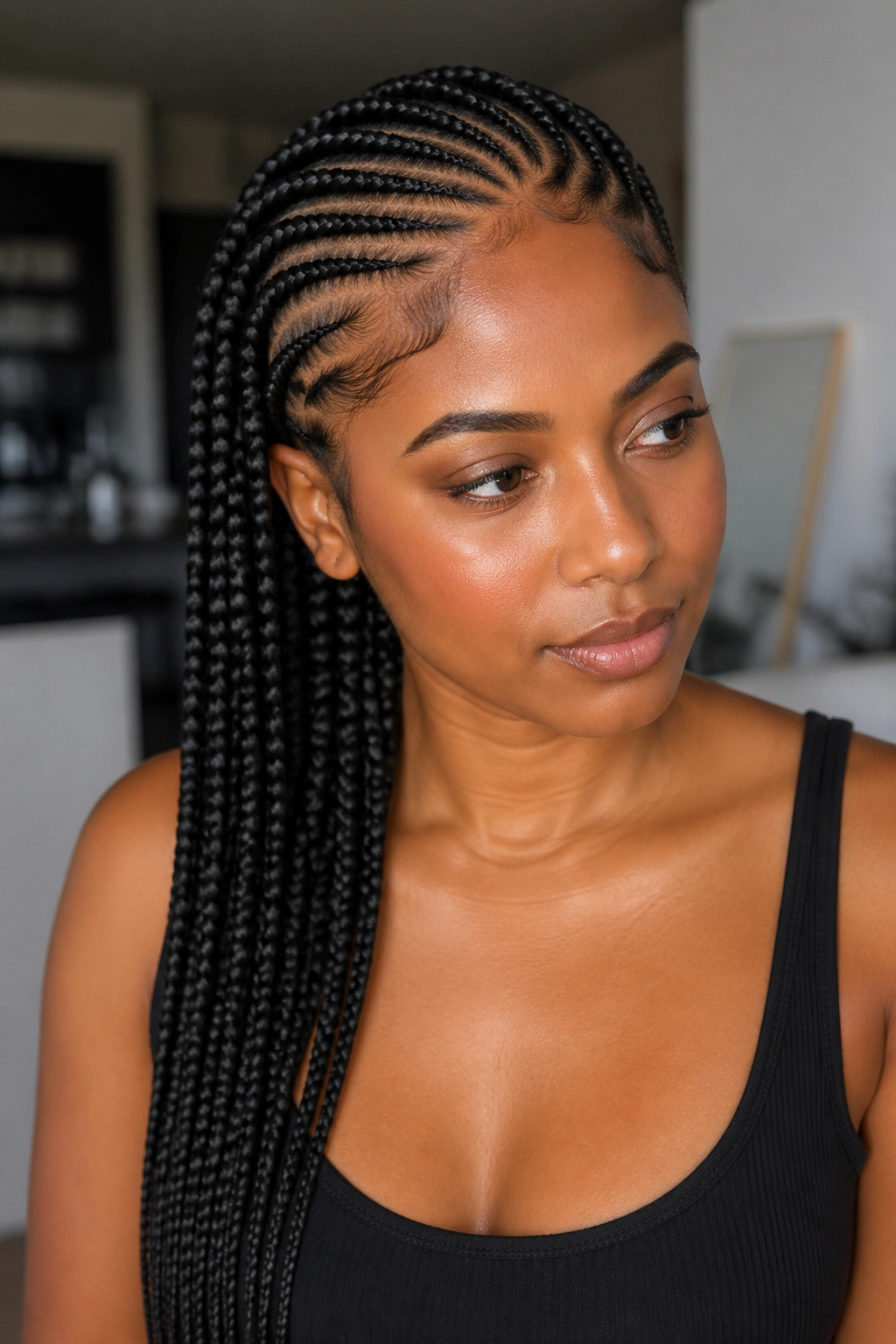
A cornrow-free section at the front forms a swooped bang that arcs across the forehead. The rest of the head is lemonade braided to one side.
Different from a curly leave-out — the bang is styled flat and sleek, usually with gel, rather than left natural. Reads more 90s-inflected, more editorial.
Pick the bang side that complements the sweep direction. Opposite-side sweep and bang creates cross-traffic and reads awkward.
17. Stitch Lemonade
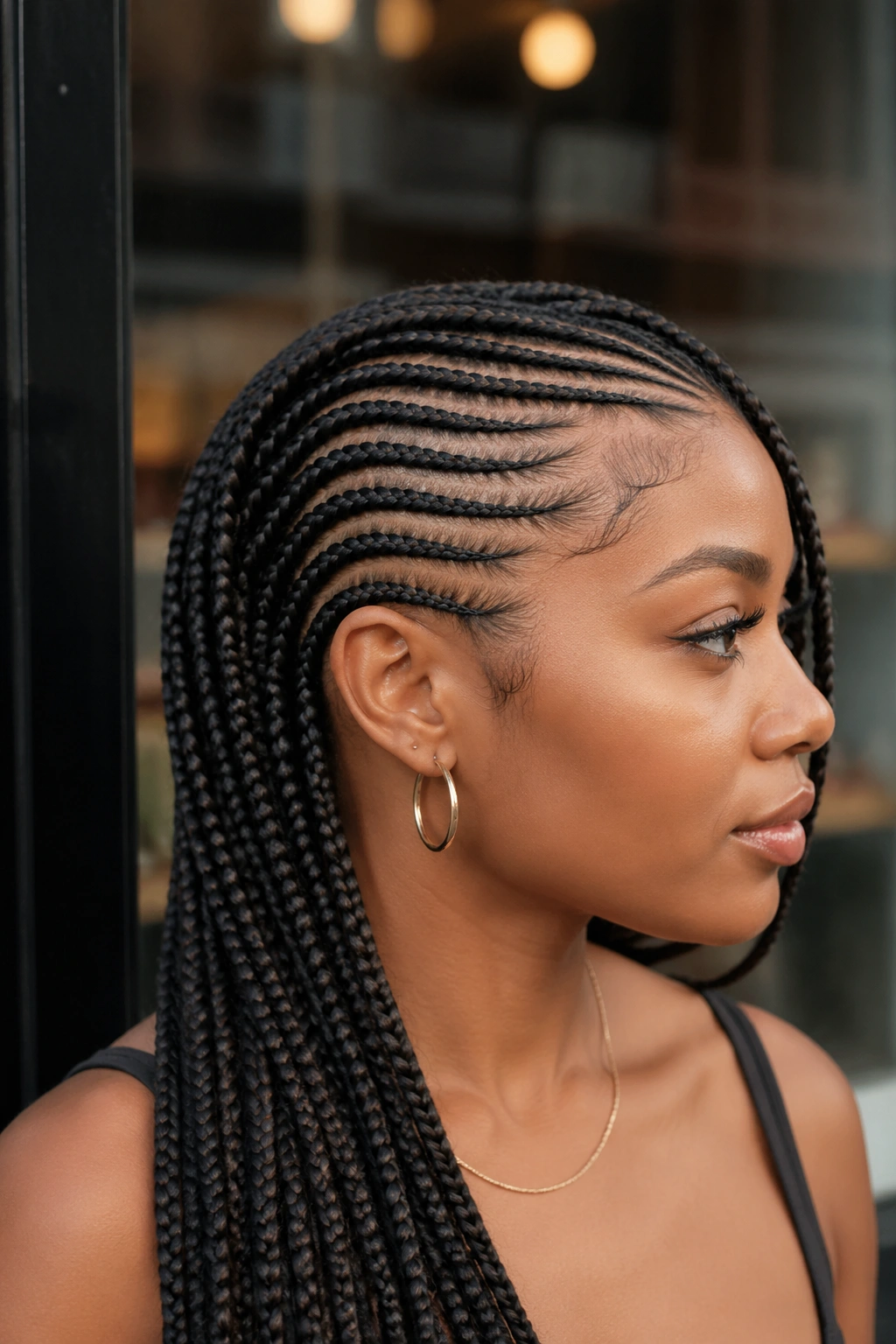
Stitch braiding — that horizontal ribbed technique — applied to lemonade’s sweep. Each cornrow has the characteristic stitch bumps every half-inch, running in the side-swept direction.
Who This Is For
Anyone who wants the drama of stitches and the flattery of lemonade at once. It’s a double-technique style, which means double the install time and usually double the cost.
- Install time: 5-7 hours.
- Lasts: 2-3 weeks.
- Best for: events where you want to be noticed.
Tip: Stitches show best in bright light. If the event is candle-lit or dim, the texture disappears. Save this install for day events.
18. Lemonade with Knotless Beginnings
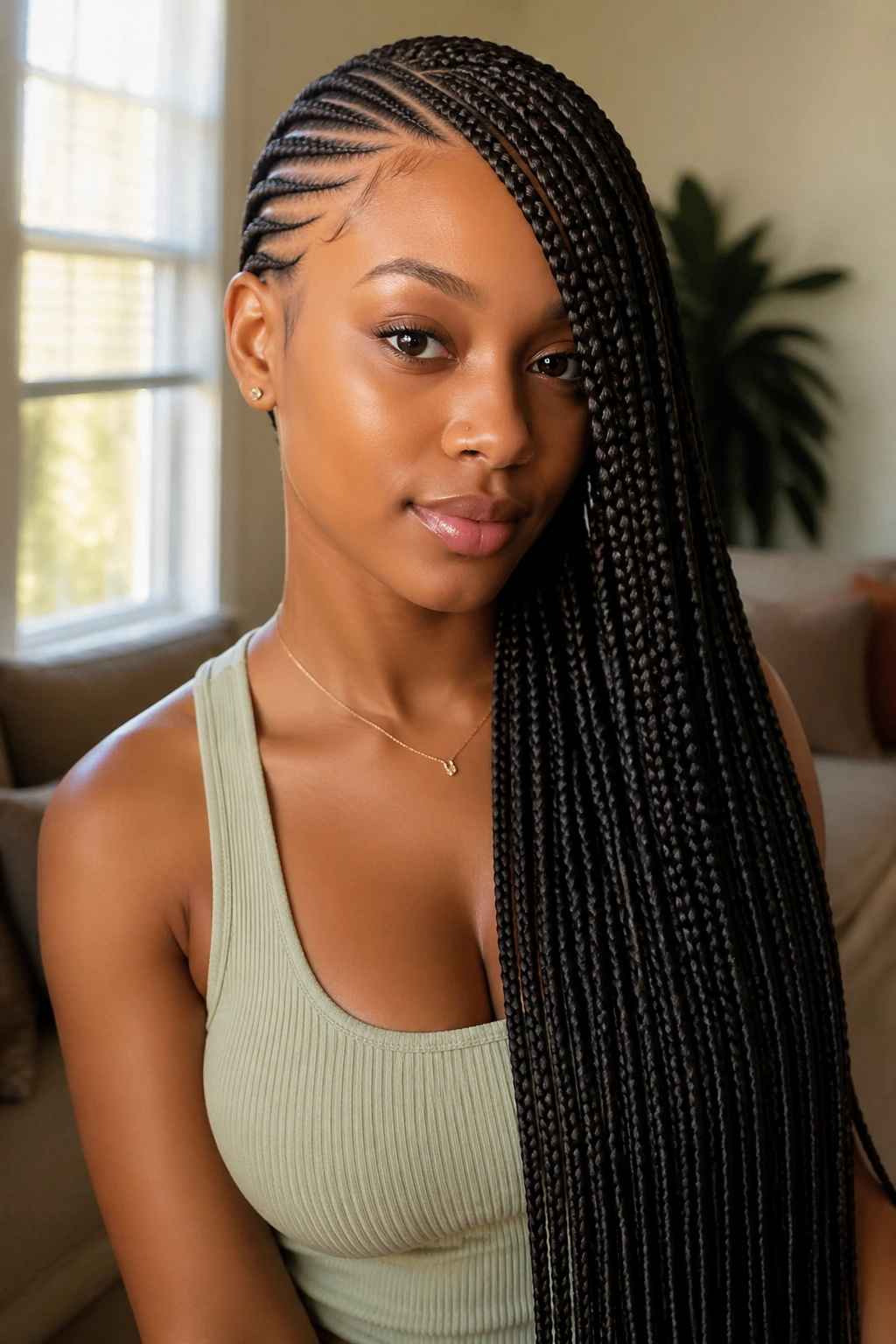
Knotless lemonade starts each braid with just natural hair — no kanekalon gripped at the base — and feeds in extension as the braid progresses. The starts are flatter and cause less tension than traditional knotted starts.
This technique has become the gold standard for edge protection. If your hairline is sensitive or recovering, request knotless starts on any lemonade install.
The trade-off: knotless takes longer. Expect an extra 30-60 minutes of install time.
19. Lemonade with Cornrowed Ponytail
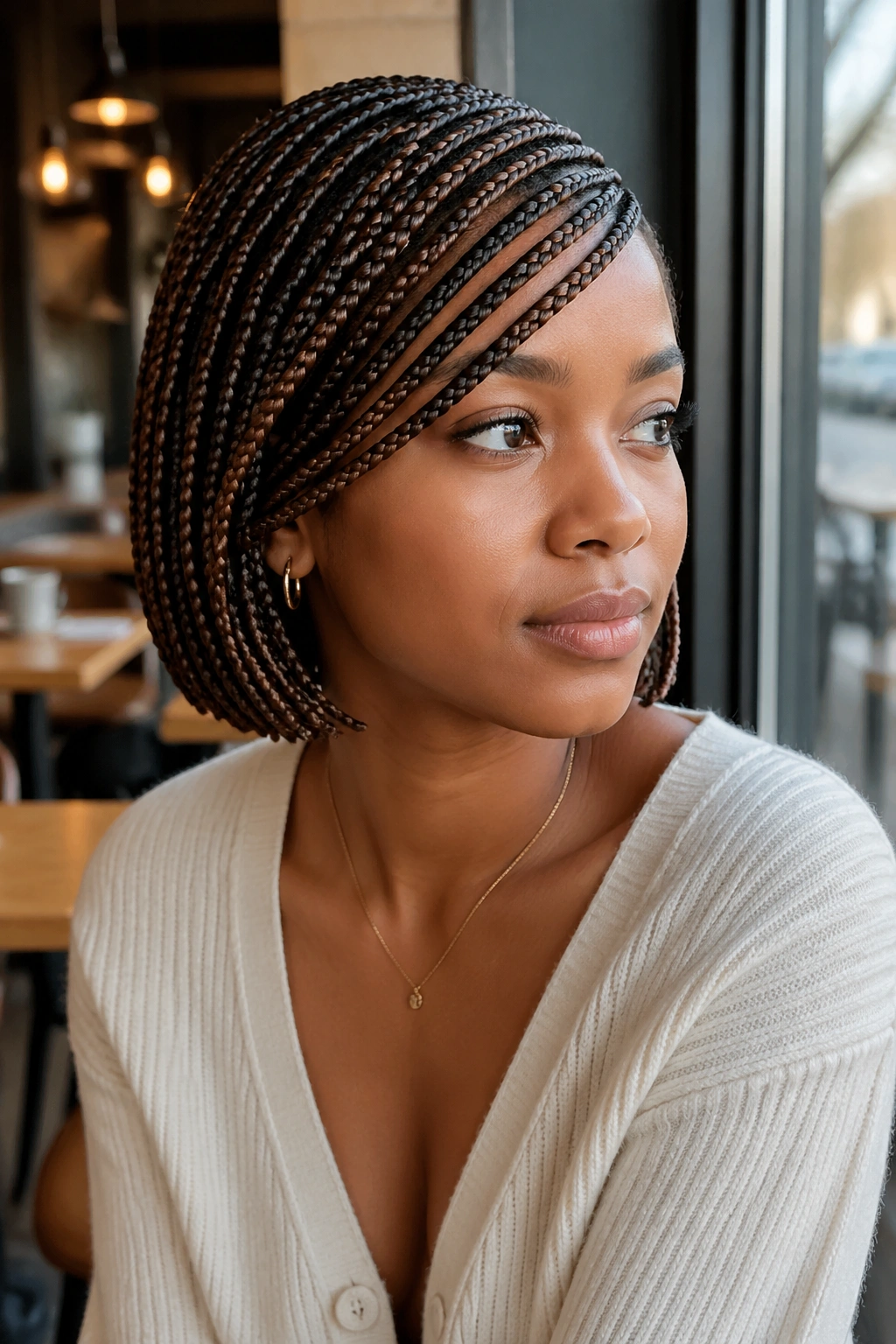
The sweep terminates in a ponytail at the side of the head rather than loose draping. The ponytail can be sleek, curled, or wrapped. The ponytail position varies from mid-cheek to behind the ear.
Good for active wear. The ponytail bundles the braids together so they don’t swing into your face or tangle in a jacket collar.
20. Baby Lemonade (Thin Braids)
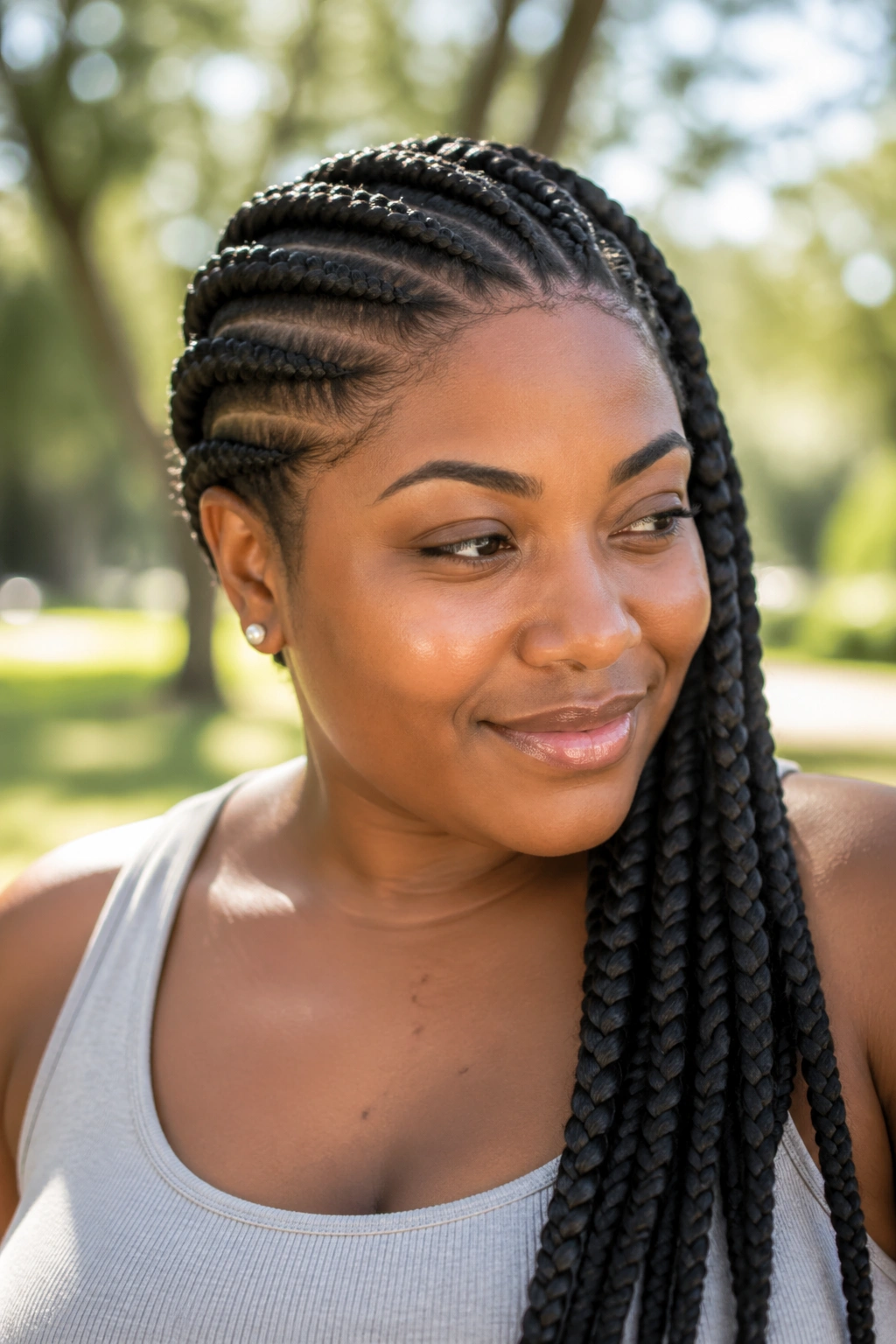
Very fine cornrows — much thinner than standard — installed in a lemonade sweep. The thinness gives the whole install a delicate, almost lace-like appearance along the scalp.
Takes forever to install. Expect 6-8 hours for a full head of baby lemonade. Lasts longer though — often 3-4 weeks — because the thin braids resist loosening.
Not ideal for very fine natural hair. Thin extensions on thin hair can read patchy.
21. Lemonade with Edge Swoops in Multiple Directions
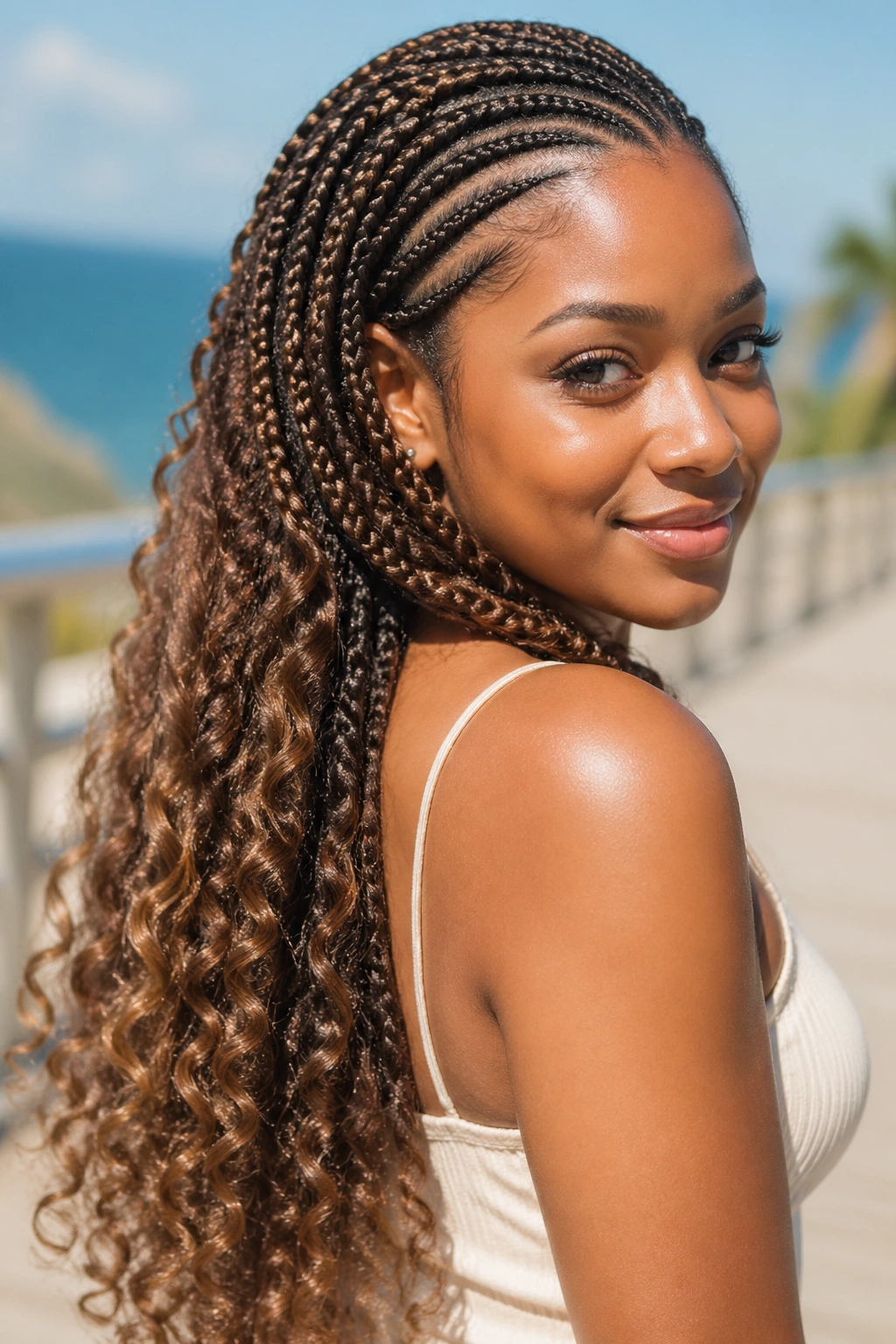
Most lemonade installs keep edges simple — swooped in the direction of the sweep. This variation plays with edges that swirl in loops, curls, and counter-directional arcs along the hairline.
The edge art becomes a feature, not just a finish. Excellent for photos, events, and occasions where you want the hairline as much attention as the braids.
Commit to the edge style at install time. Edge designs that complex can’t be reset daily — they have to hold from the start.
22. Lemonade with Hair Cuffs
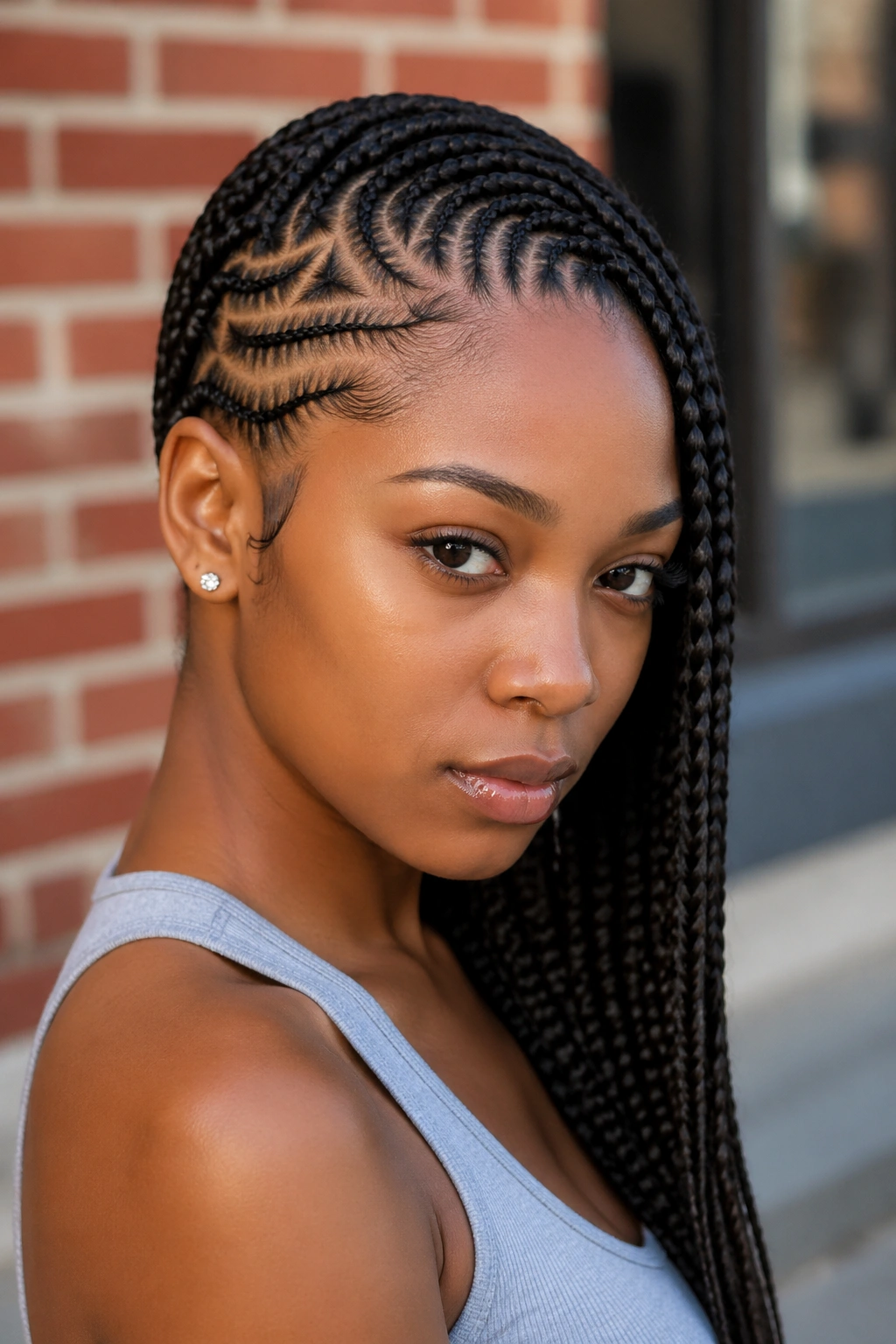
Small metal cuffs — gold, silver, or brass — clamped onto specific braids along the sweep. Usually 3-5 cuffs total across the install, placed at intervals that catch light when you turn your head.
Cuffs are low-commitment accessories. They can be added or removed anytime without affecting the braid itself. Good for testing how you like metal accents before investing in more permanent beading.
23. Lemonade with Deep Side Swoop Bang
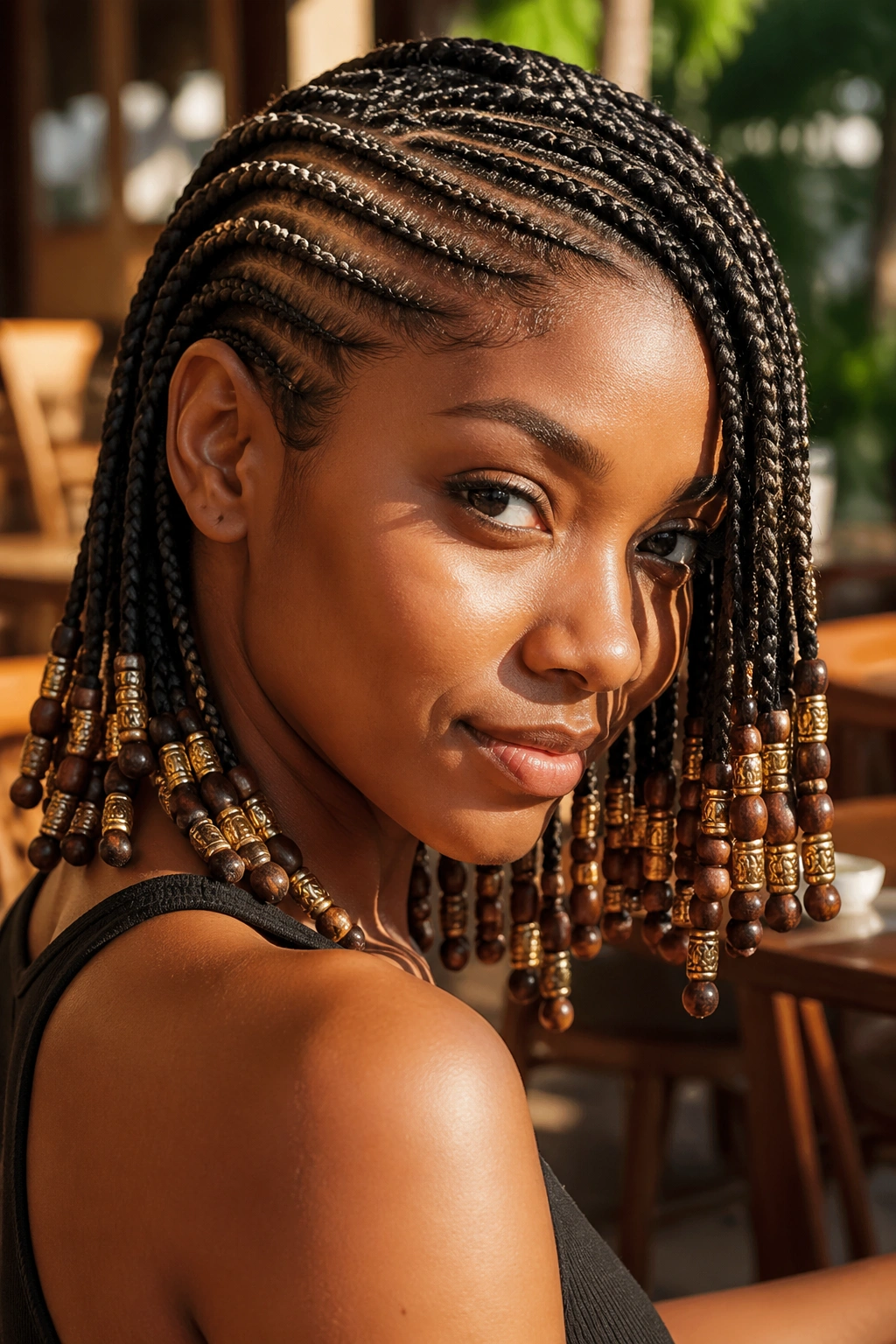
The side part is extra deep — two to three inches off center — and a dense swoop of unbraided hair falls across the forehead as a thick side bang. The lemonade sweep runs to the opposite side, creating a big visual diagonal across the head.
What Makes It Different
Standard lemonade has a subtle side part and clean cornrows at the front. This variation makes the part itself a major design feature.
- Leave out enough hair for a substantial swoop — about 2-3 inches wide.
- Style the swoop flat with gel, not natural.
- Ensure the swoop curves toward the opposite side of the sweep for visual balance.
Tip: The deep-side-swoop version reads more glamorous than minimal. Pair it with eye makeup that’s slightly elevated. A natural face with this hair can look unbalanced.
24. Lemonade with Curved Partings Along the Sweep
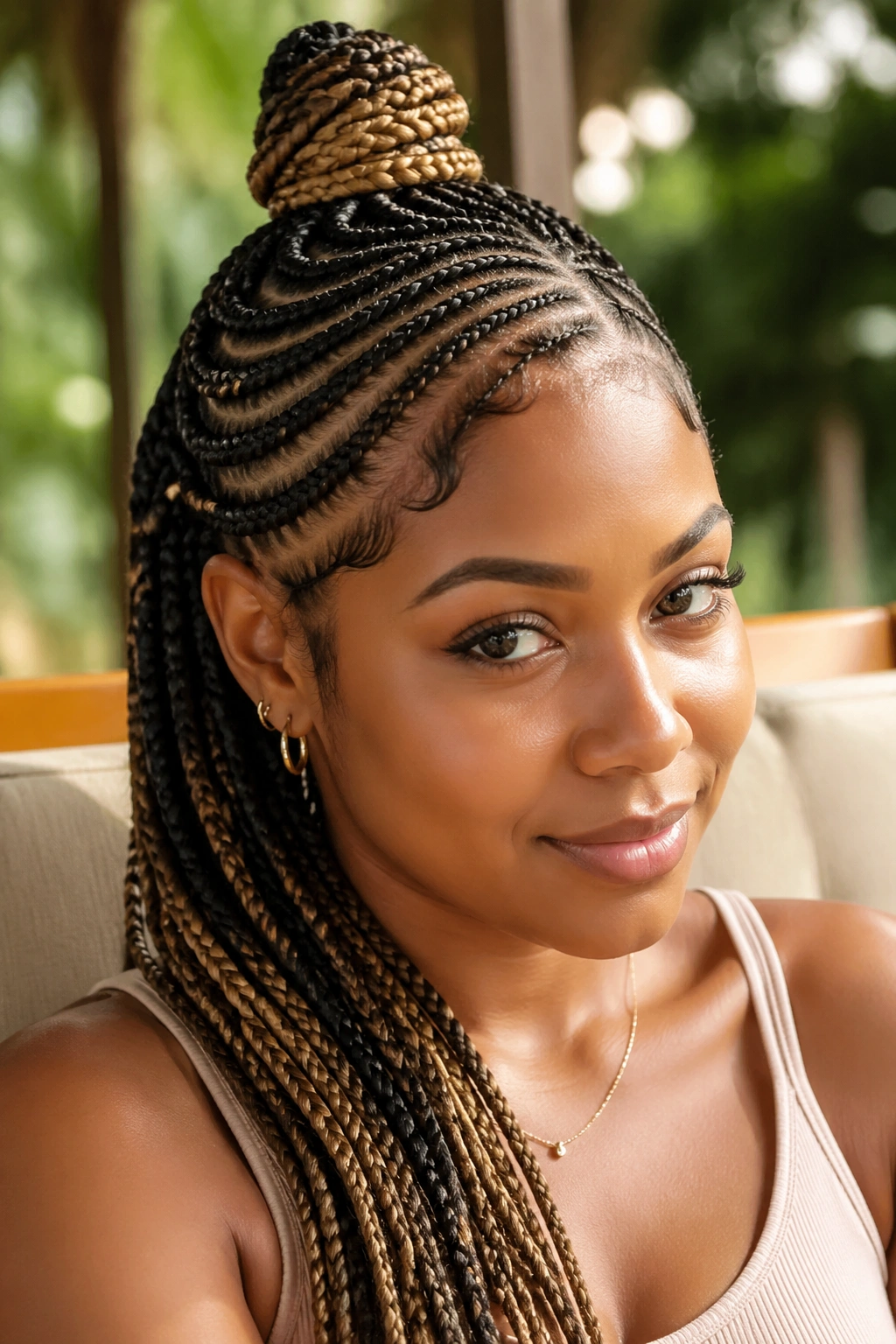
Inside the sweep, instead of straight parallel parts between the cornrows, the parts curve gently, all flowing toward the sweep side. The curves create visual flow that mimics wind moving across the scalp.
Beautiful when done right. Confusing when done poorly. Not every braider thinks in curves — some braiders only do straight parts. Verify the skill before you book.
25. Multi-Length Lemonade
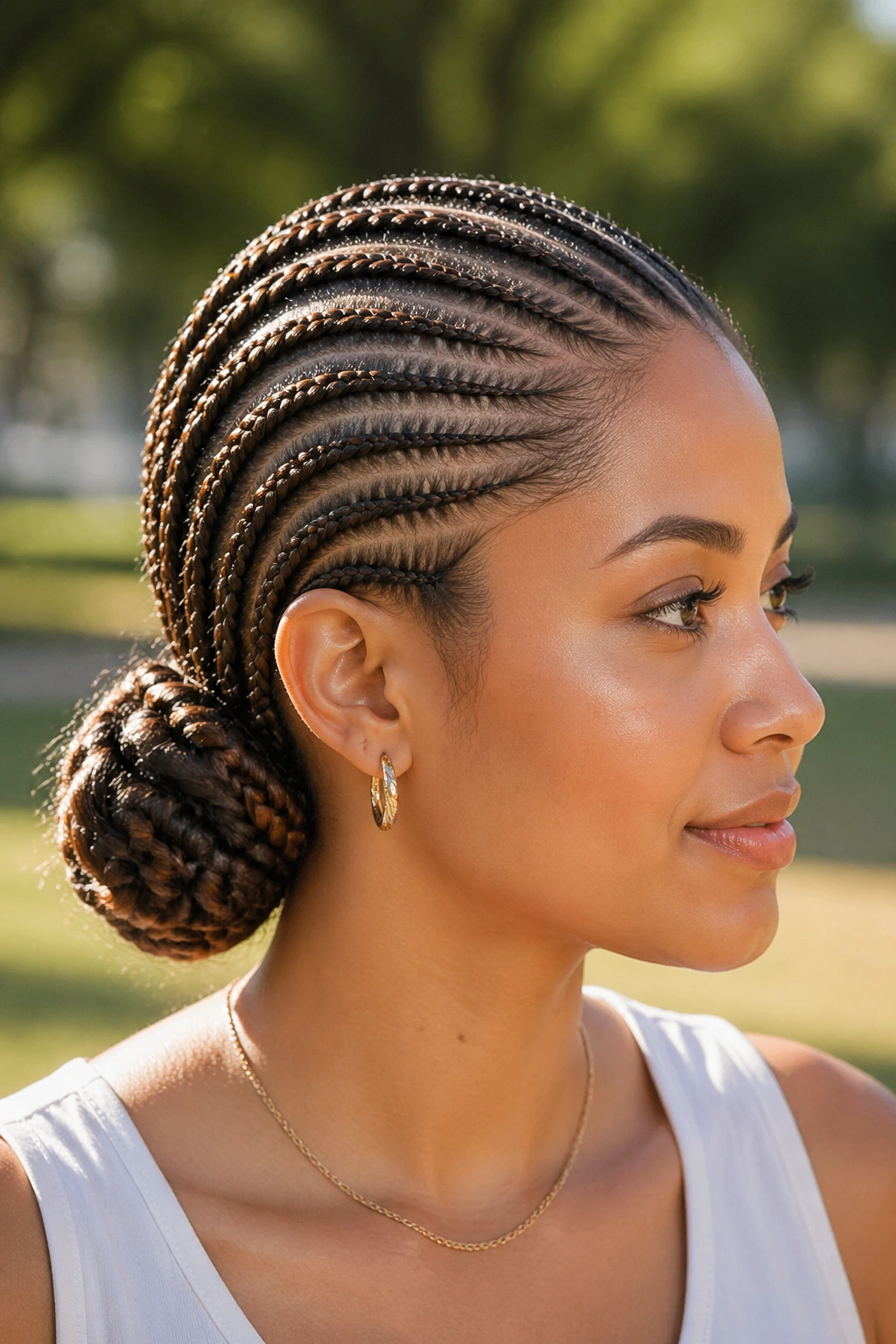
Braids of different lengths within the same install — some reaching the waist, others ending at the bust, others at the shoulder. The stagger creates dimension and movement that uniform-length lemonade can’t match.
This is the variation I recommend for anyone bored with standard long lemonade. The length variance keeps the look from reading flat.
Ask the braider to plan the length stagger before installing. Random length variation looks messy. Intentional stagger looks designed.
Maintenance That Keeps Them Fresh
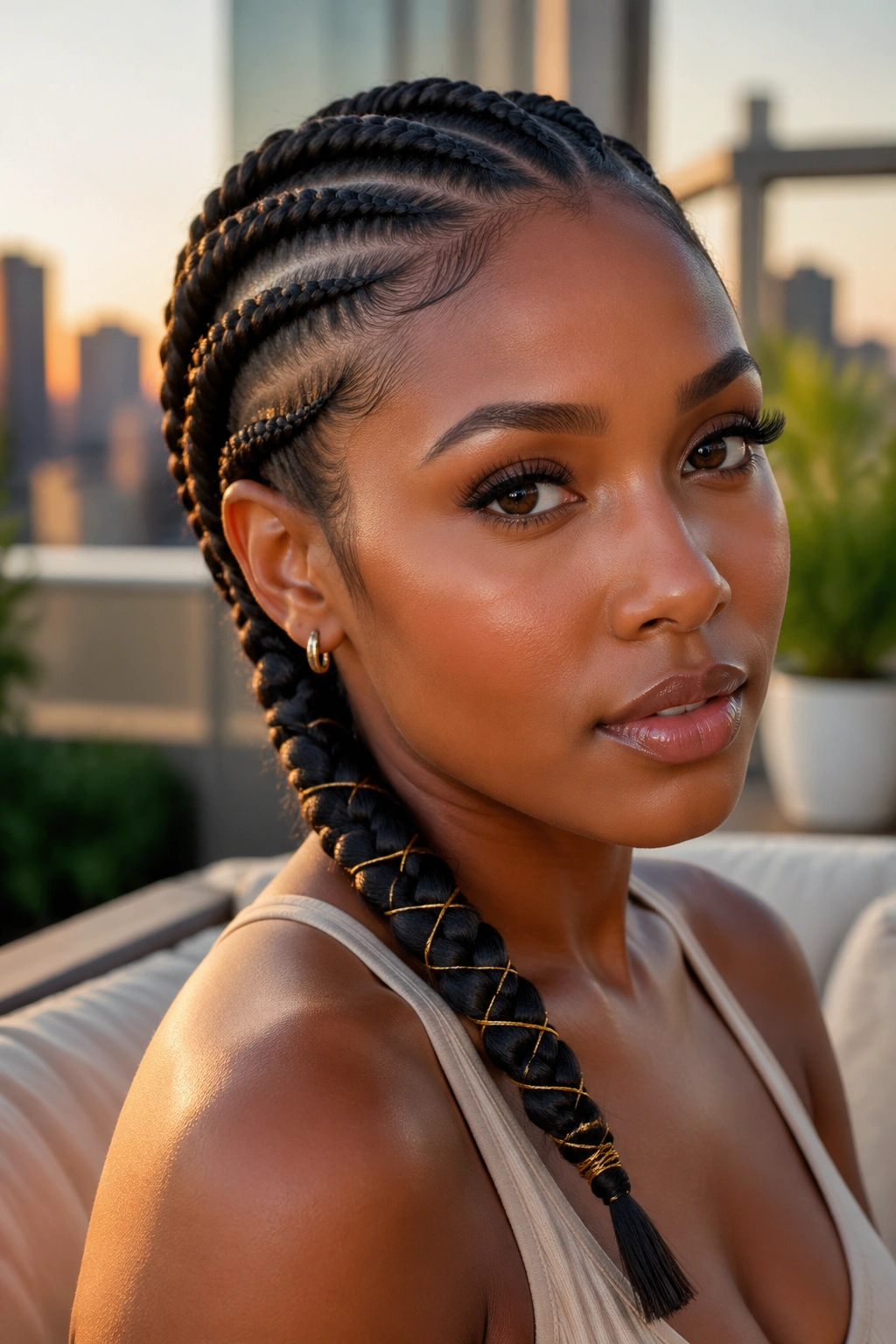
The night-one routine decides everything. A satin bonnet, a silk pillowcase, and a satin scarf tied across the hairline before bed. Miss any of those and you’ll be fixing fuzz by day three.
Sleep on the opposite side from the sweep. If the braids drape to your right shoulder, sleep on your left. Prevents the sweep from getting compressed overnight.
Use a light braid spray — not a heavy oil — every other day. Keeps the hair hydrated without buildup. Spray from 8 inches away, not directly into the braids.
Edge Care Between Weeks
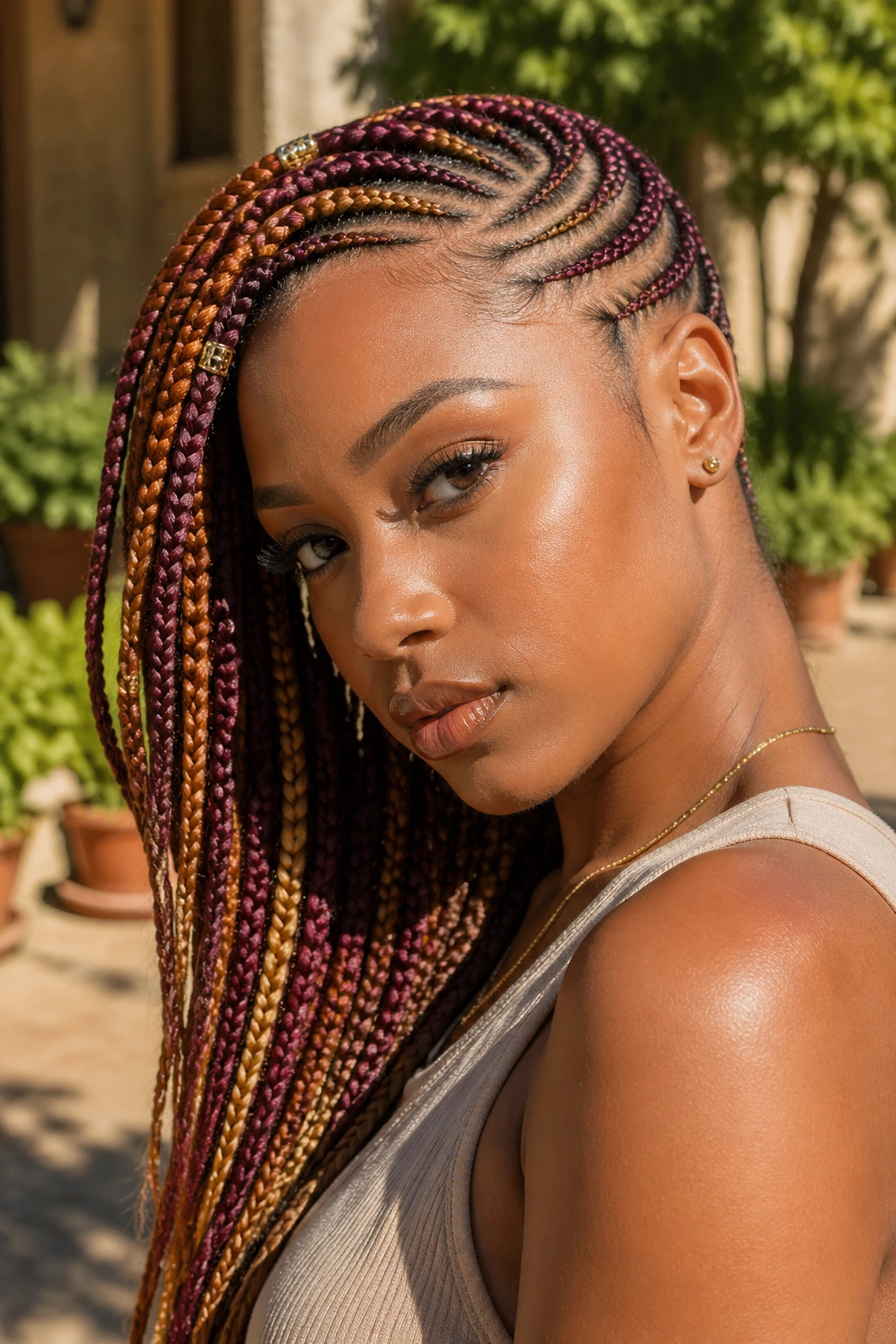
The hairline fuzzes first and loudest. Refresh edges on day 4, day 8, day 12, and day 16 of the install if you’re going the full three weeks.
Refreshing means: apply a thin layer of edge gel with a brush, press the baby hairs flat, tie down with a silk scarf for 15-30 minutes, release. Do this in the morning when you have time, not rushing out the door.
Never use heavy gel on edges that are already stressed. It cakes and flakes and makes the hairline look worse, not better.
Takedown for Long Lemonade Braids
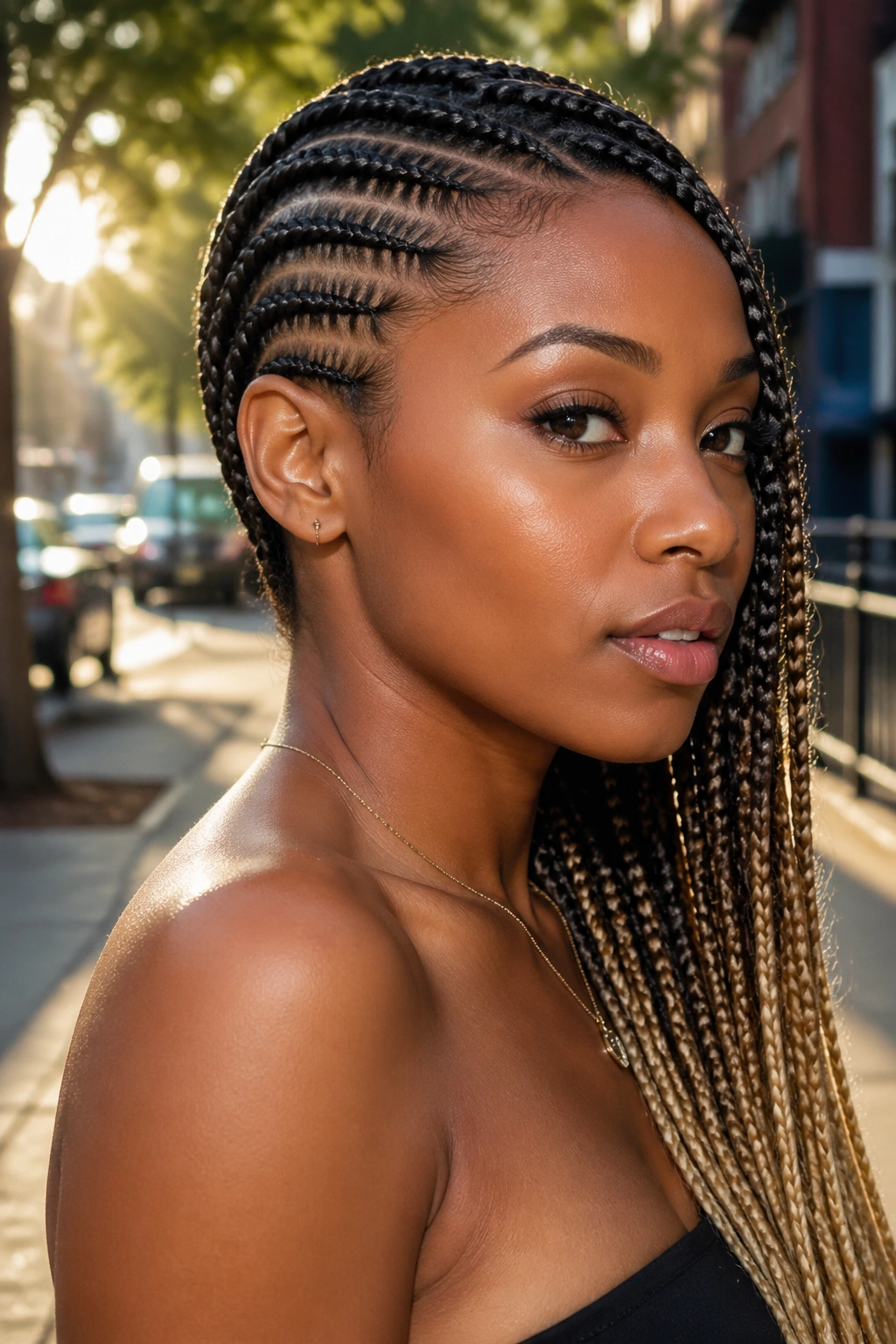
Long lemonade braids can be brutal to take down if you rush. The length adds weight and the extensions can matt against each other if you’ve worn the braids long.
Soak each braid with a conditioning detangler before unraveling. Work from the tail up, one braid at a time. Don’t batch-unravel in a hurry — you’ll tear natural hair at the root.
Set aside three to four hours for a full takedown. That sounds like a lot. It’s not, relative to the hair you’ll lose if you try to do it in 45 minutes.
Picking the Right Lemonade for Your Life
Long lemonade is dramatic but heavy. If you’re not used to long extensions, start with shoulder-length braids and work up. Going straight to waist-length can cause headaches for the first few days.
Colored lemonade is fun but maintenance-heavier. Light colors show dirt. Dark colors hide it. Pick your color with your lifestyle in mind.
Active lifestyles favor bob-length or cornrowed-ponytail variations. Ballet classes don’t work with waist-length braids swinging around.
And remember — the best lemonade is the one that matches your face shape. Oval faces work with any sweep. Round faces benefit from a deep side part to create angle. Square faces soften with curled or curly ends. Long faces balance with shorter or bob-length braids. Work with what you’ve got, and the install will flatter you in a way no random-picked Pinterest screenshot can.
