
Bangs and curly hair have had a complicated relationship — for a long time, the conventional wisdom said curly hair and bangs just don’t work well together. Shrinkage makes bangs unpredictable. Humidity makes them frizzy. And the bounce of a curl pattern means that what looks like a perfect forehead-grazing fringe in the mirror can spring up to eyebrow-level the minute you walk outside. But that narrative has shifted dramatically as more naturals and curlies have discovered that bangs for curly hair aren’t just possible — they’re genuinely stunning, often more dynamic and interesting than the straight-hair version of the same fringe.
The Case for Bangs on Curly Natural Hair
Bangs do something for curly natural hair that no other style element can replicate: they create a defined frame for the face that originates from the hair itself. Every other face-framing element — jewelry, makeup, glasses — sits on top of or around the hair. Bangs are part of it. They’re the hair doing the framing work.
For Black women with natural hair, this means a fringe that has curl pattern, bounce, and personality built right in. A straight fringe lies flat and predictable. A curly bang moves, springs, coils, and catches light. It interacts with the face rather than just covering part of it. And when done right — cut correctly for the curl pattern, styled with the right products — curly bangs become one of the most defining and expressive style elements possible.
The other case for curly bangs is that they work on face shapes that can sometimes feel like they have limited styling options. Round faces benefit from a bang that adds visual length. Long faces benefit from a bang that shortens the forehead. Oval faces can pull off almost any bang shape. Heart-shaped faces look incredible with a bang that widens the appearance of the lower face.
The Shrinkage Factor — What You Need to Know
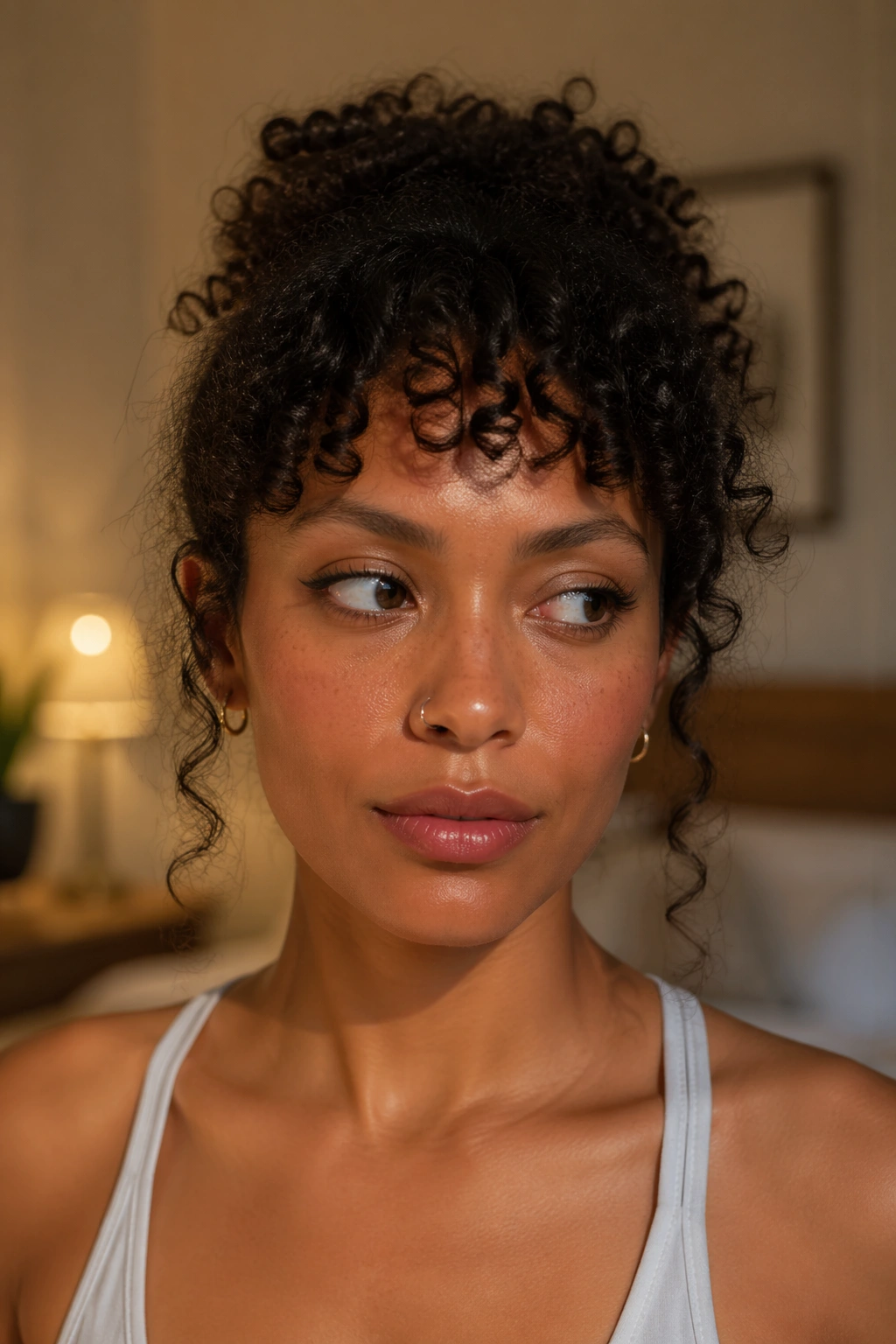
Shrinkage is the most important variable in curly bangs. A bang cut for your hair’s stretched length will sit significantly higher than intended once the hair dries in its natural curl state. Depending on your curl pattern, you could be looking at 30% to 75% shrinkage on the bang section — meaning a bang cut to eyebrow length when stretched could sit well above the eyebrows when the curl sets in.
There are two approaches to this. The first is to account for shrinkage by cutting the bangs longer than you actually want them — so they hit the right point after the curl springs up. The second is to wear the bangs with some stretching built in — a light blow-dry, diffusing while smoothing, or setting on rollers — so shrinkage is less extreme.
Which approach suits you depends on how much you want to manipulate the bang section on a daily basis versus how much you want to fully embrace your curl pattern in the fringe.
How Your Curl Type Shapes What Bang Is Possible
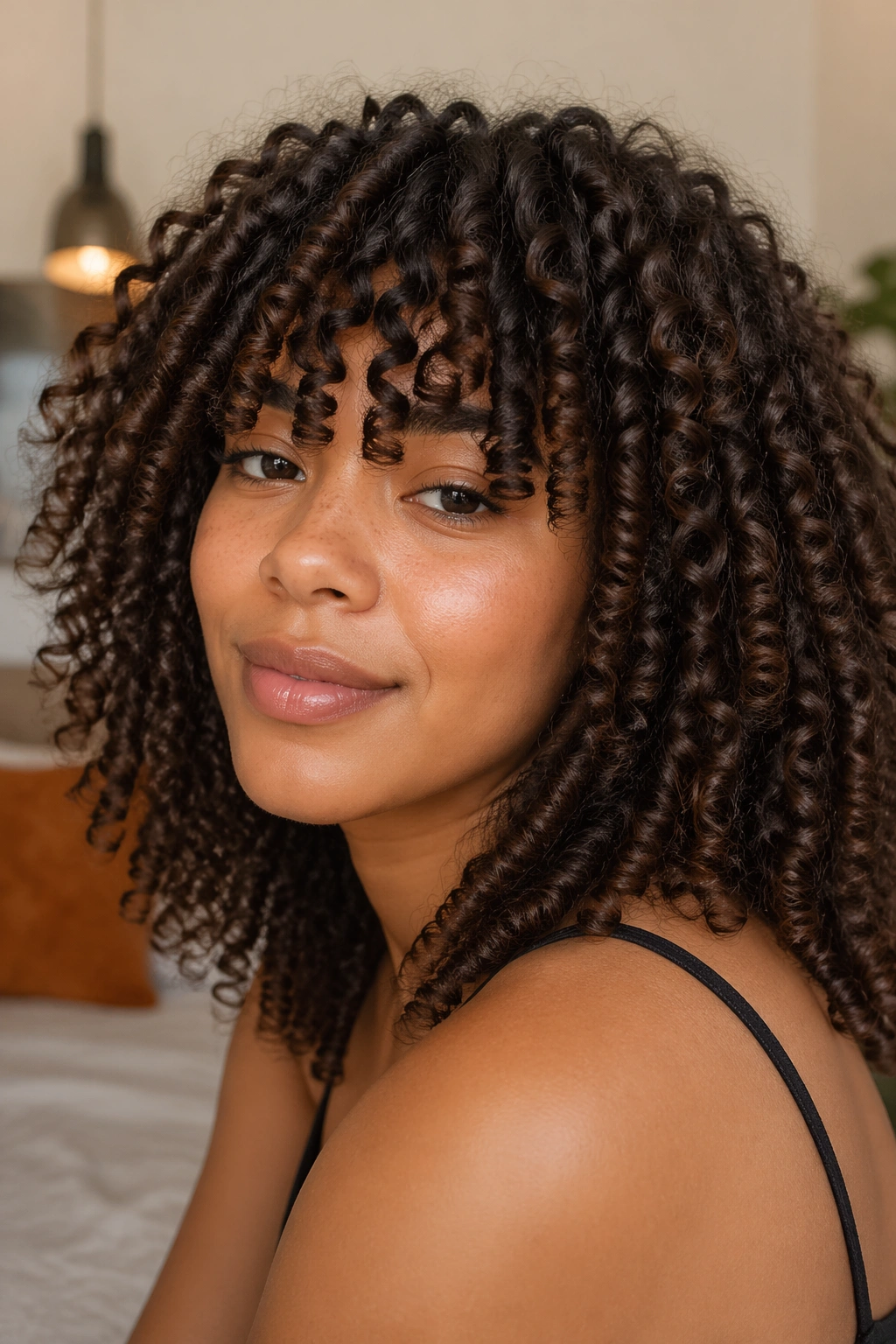
Your curl pattern fundamentally determines which bang styles are realistic for your hair. Type 3A and 3B curls — larger, looser spirals — create bangs with visible ringlets and a gentle, romantic bounce. The curl is defined enough to look intentional but loose enough that the bangs don’t spring dramatically upward.
Type 3C curls create a tighter, bouncier fringe. These bangs have real spring to them and sit very differently from a loose wave bang. They’re bold and textured and genuinely beautiful, but they require understanding how high they’ll sit once fully shrunken.
Type 4A and 4B hair creates bangs with significant spring — tight coils that bounce away from the forehead in a puffy, full fringe. This is a gorgeous look but requires intentional styling to keep the coils defined rather than frizzy.
Type 4C bangs are all about texture. The coils are so tight that the bang section may look more like a textured puff above the forehead than a traditional fringe — which is a beautiful and valid look, just a different one than what many people picture when they think “bangs.”
Getting the Cut Right — What to Tell Your Stylist
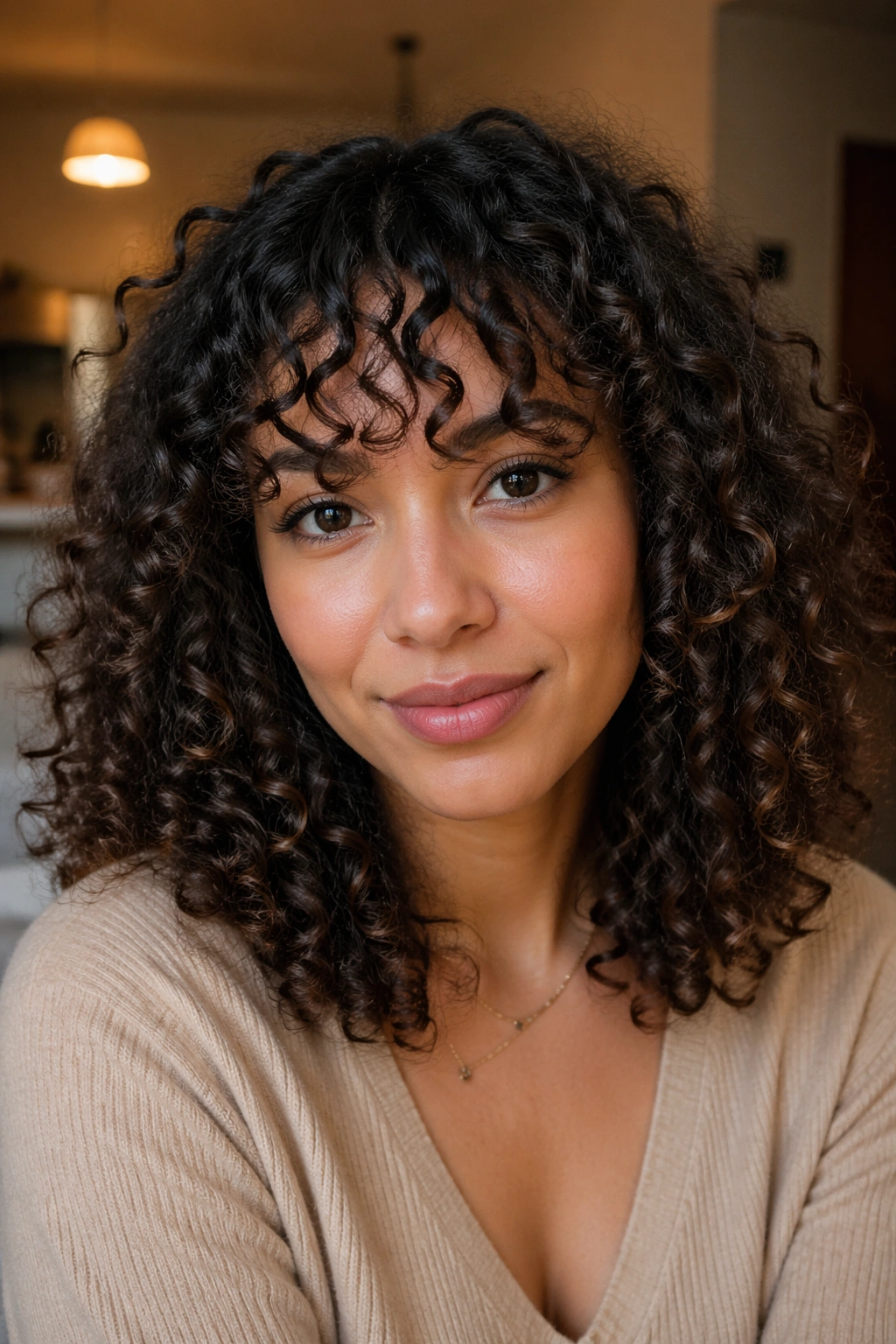
Going to a stylist who understands curly hair is non-negotiable for a curly bang cut. A stylist who cuts bangs on dry hair in their natural curl state — rather than cutting them straight on wet, stretched hair — will give you a much more accurate result. The dry cut shows exactly how the curl pattern falls before any cuts are made.
Tell your stylist exactly how much forehead coverage you want and let them account for shrinkage based on your specific curl type. Ask to see the length before they cut — hold the front section at different lengths on your forehead while looking in the mirror to visualize the finished result at different lengths.
The most common bang cut mistake is cutting too short, which then requires growing them out through the awkward in-between phase. Err on the side of longer and trim from there.
Products and Tools for Styling Curly Bangs
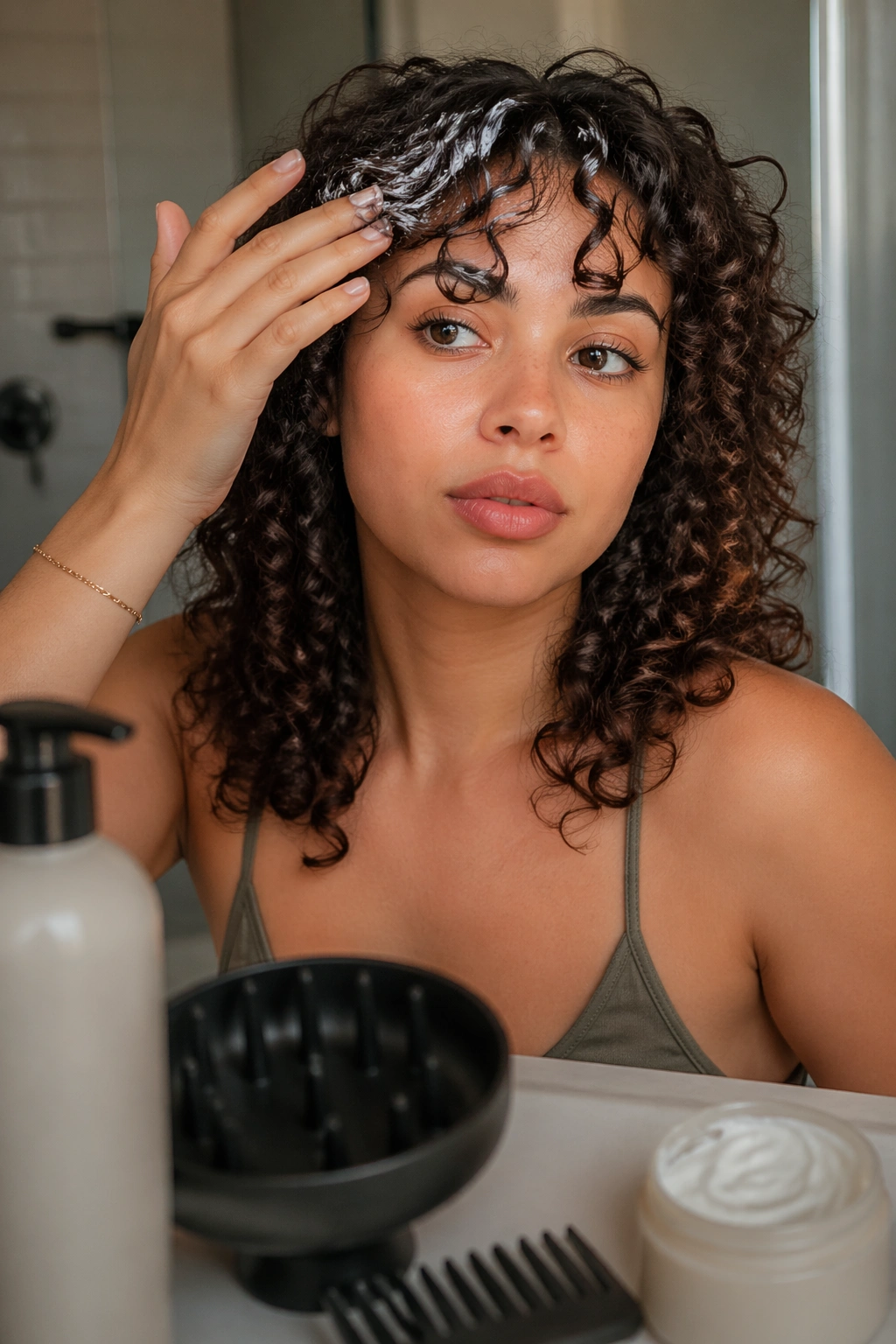
Styling curly bangs requires a slightly different product approach than the rest of the hair. The bang section is shorter, more exposed, and more prone to frizz from friction and touch than the hair on the sides and back.
A small amount of curl cream applied to the bang section while damp defines the curls without making them crunchy. A light gel over the curl cream can add hold that keeps the bang in place longer. For natural-looking definition, rake the products through the bang section with your fingers rather than brushing or combing — this preserves the curl clumps.
A mini diffuser or a diffuser sock attachment allows you to dry just the bang section on low heat without disturbing the rest of the style. This is especially useful if you air-dry the rest of your hair and just need to set the bangs quickly.
1. Curly Micro Bangs
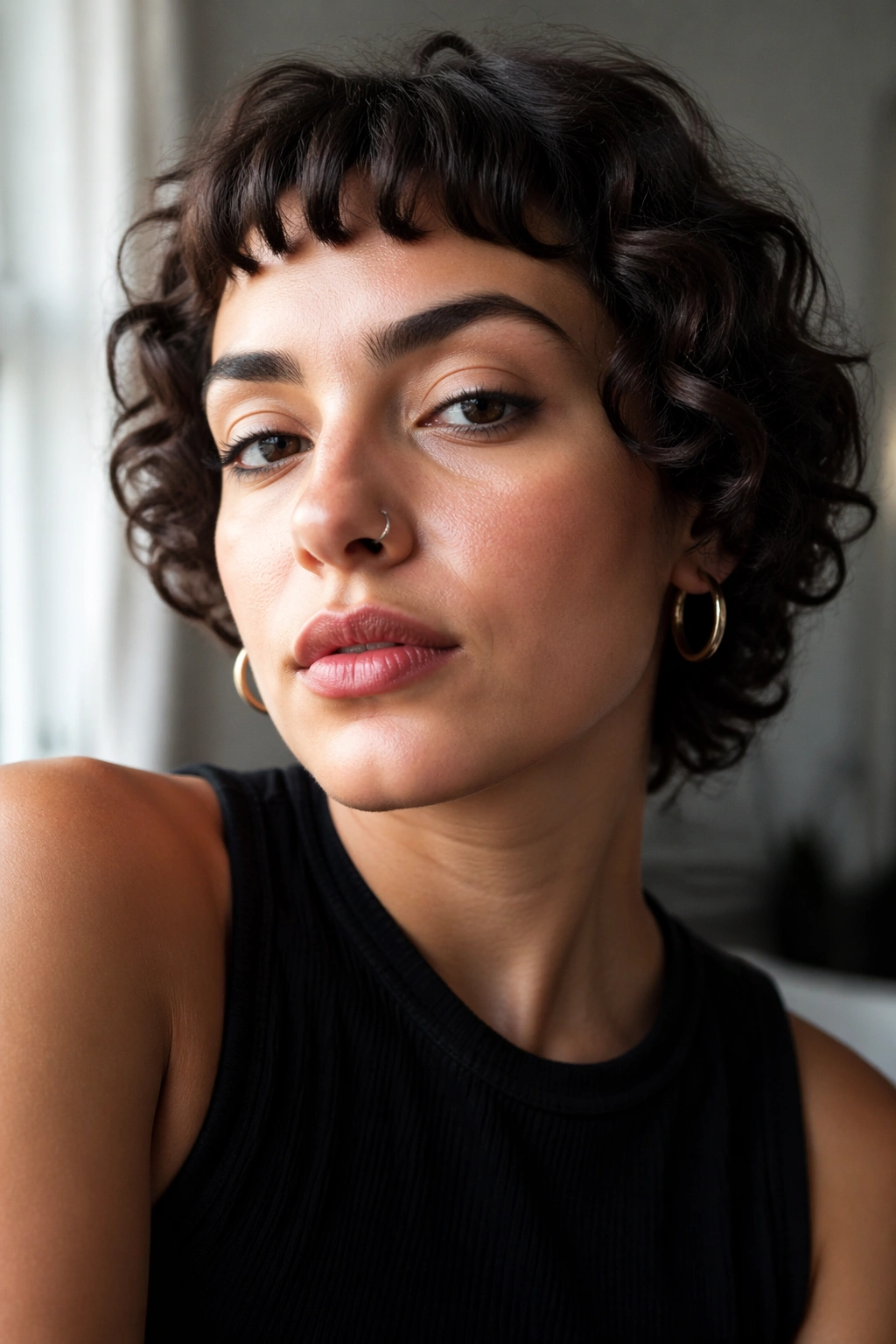
Micro bangs — very short fringe that sits well above the eyebrows — are a bold, fashion-forward choice on any hair type. On curly hair, they become even more distinctive because the curl pattern makes the short bang section spring forward as a defined cluster of coils directly above the brow line.
This is not a style for the hesitant. Micro bangs are a commitment and a statement. But on the right person — particularly with strong brows and prominent cheekbones — they’re striking in the best way.
Bold choice. Maximum impact. If you’ve been wanting to try bangs but want something that genuinely stands out, this is it.
2. Wispy Curly Bangs
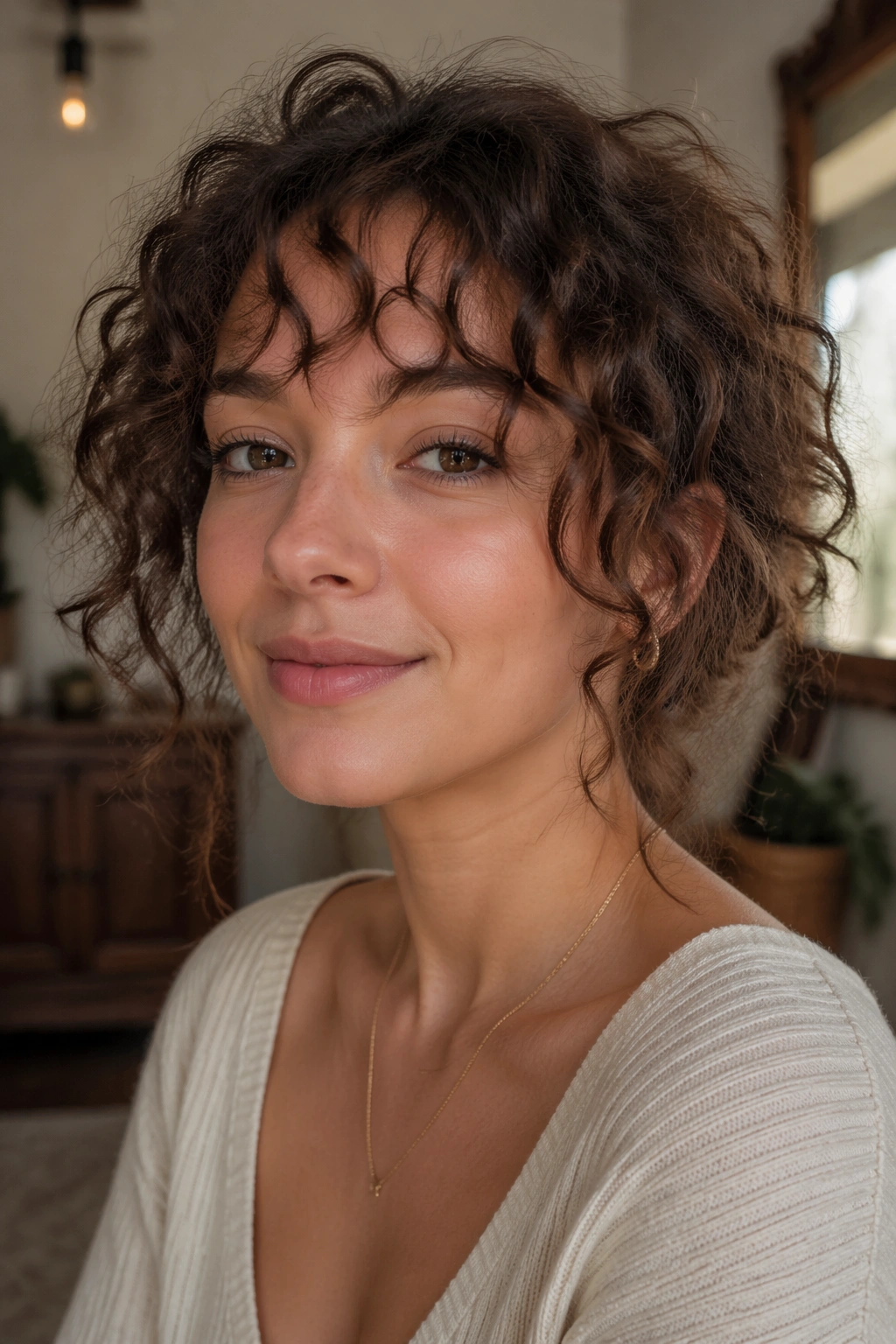
Wispy bangs are thin, light fringes that don’t cover the full forehead — they’re more of a suggestion of a bang than a full commitment. On curly hair, wispy bangs become a few defined curl tendrils that hang or bounce at the forehead, light and airy rather than dense or full.
These work best on looser curl types — 3A and 3B — where individual ringlets are thin and defined rather than thick and bunchy. The wispy quality is a natural byproduct of the lightweight curl.
For fuller, denser curl types, achieve the wispy look by only cutting a very thin front section for the bangs — just a half-inch to an inch width from the hairline.
3. Full Forehead-Grazing Curly Fringe
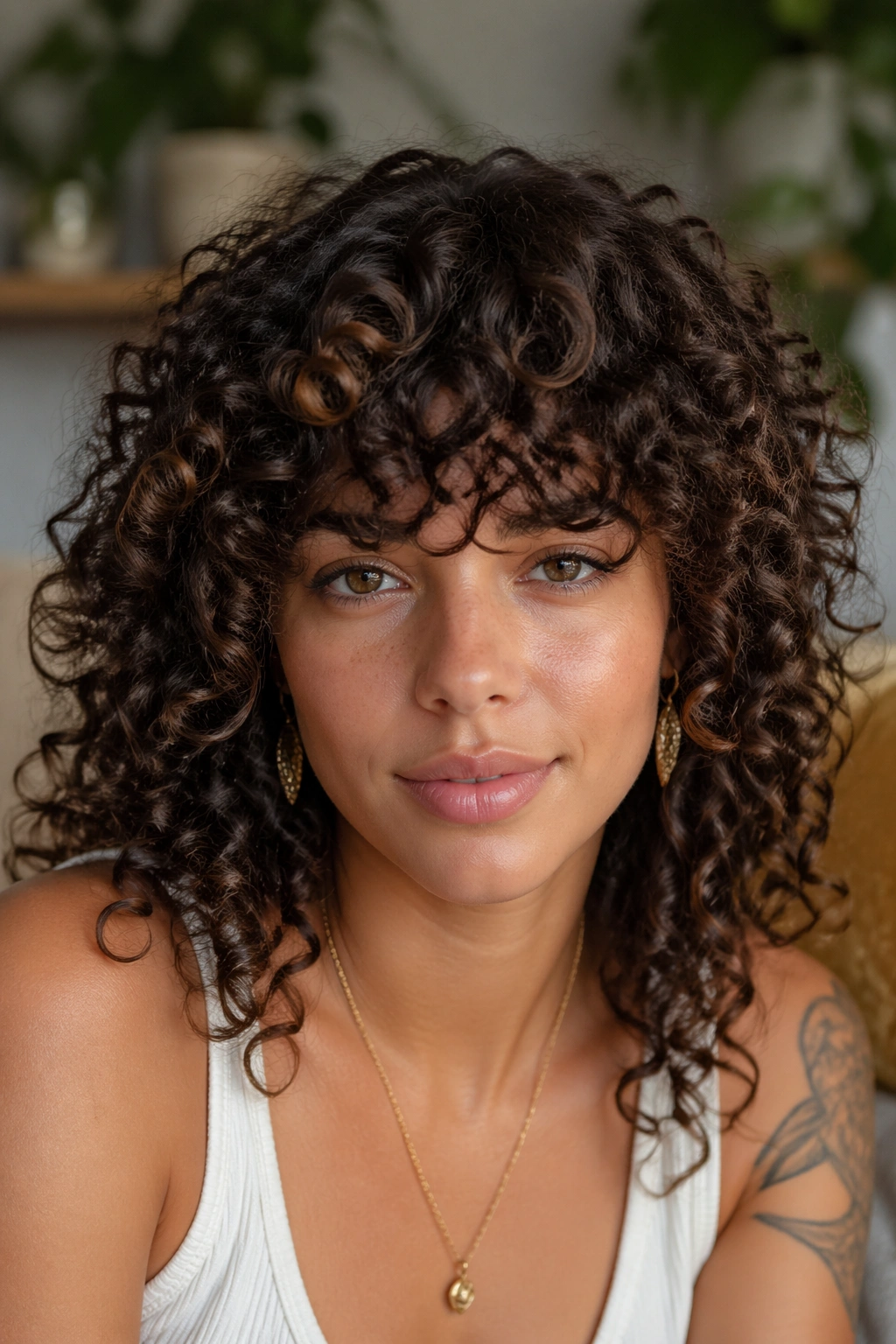
A full fringe — dense, wide, and falling just at or above the eyebrow line — on curly hair creates maximum impact. The curls in the fringe bounce against the forehead in a full curtain of defined coils. On 3B to 3C hair, this looks like a thick curtain of ringlets. On 4A hair, it’s a dense, springy puff.
This bang style requires consistent daily styling to keep all the curls pointing in the same general direction and prevent the fringe from getting frizzy or splitting in the middle.
4. Side-Swept Curly Bangs
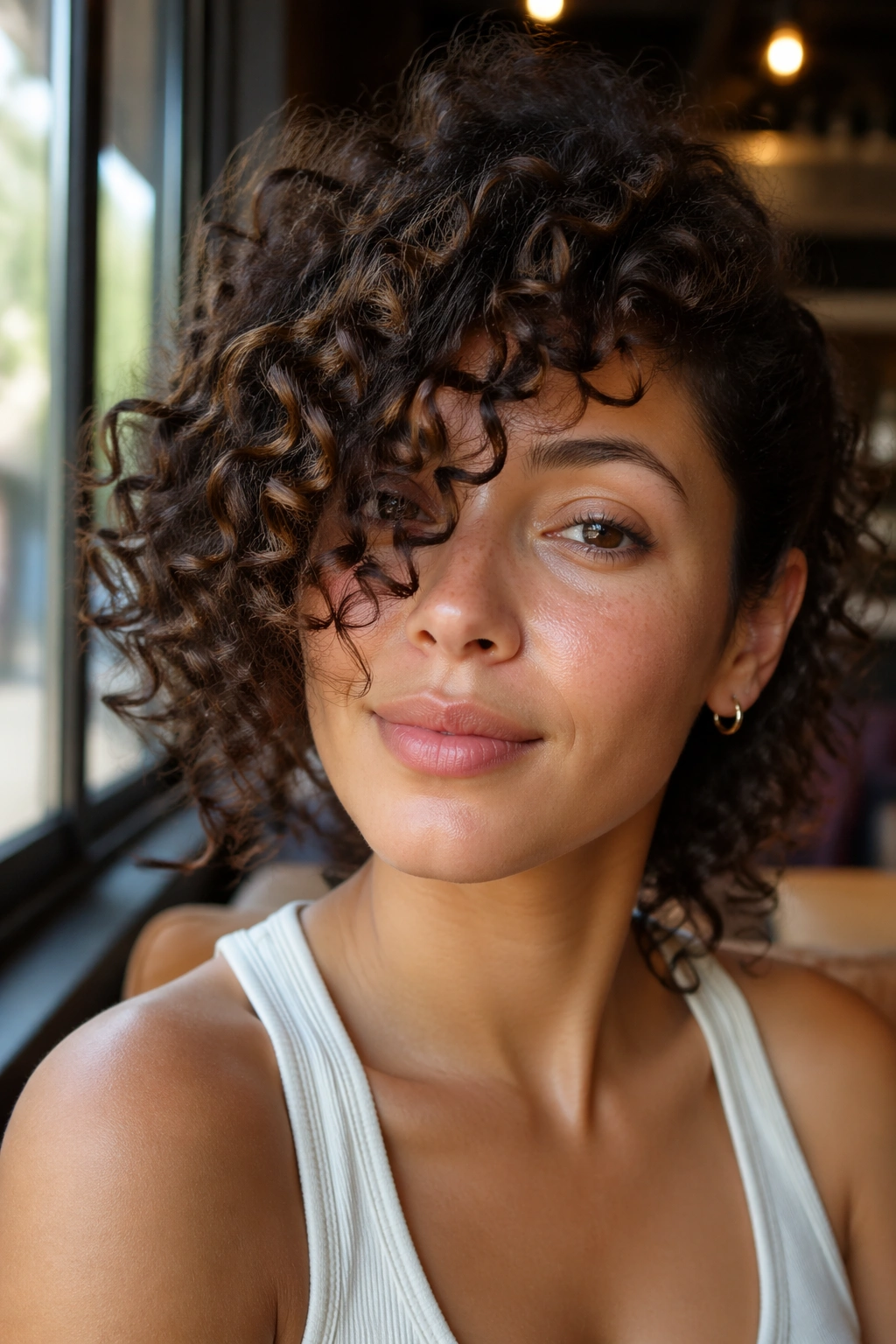
Curly bangs swept to one side of the forehead rather than hanging straight down. The curls bunch to one side, creating a lopsided, asymmetric effect that frames one eye and one cheekbone rather than the full face. This is the curly hair equivalent of a classic side bang — and it suits a wider range of face shapes than a straight-across fringe.
Encourage the side sweep by blow-drying the bangs in the swept direction on low heat, or by pinning them to one side while wet and allowing them to dry in place.
5. Blunt Curly Fringe
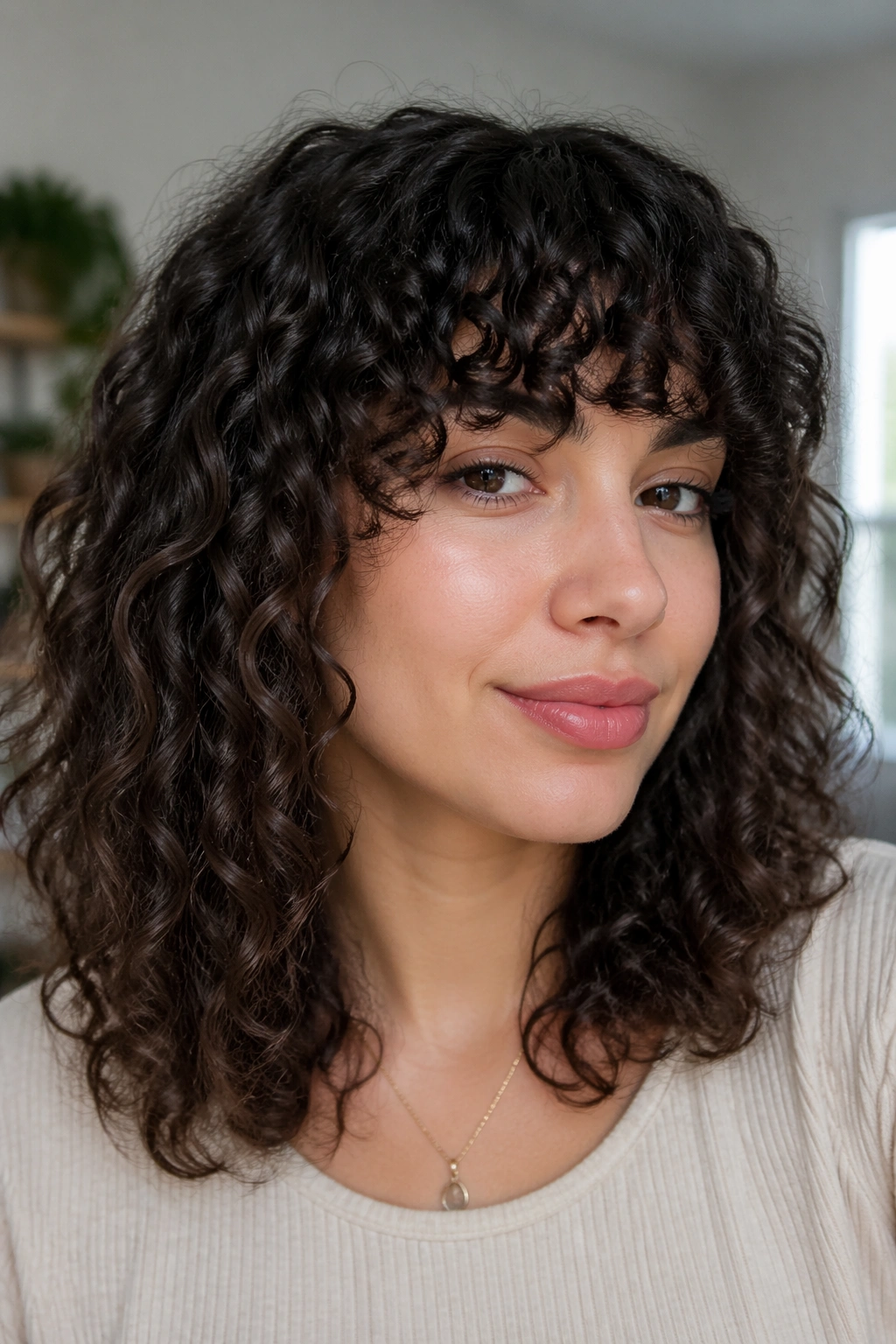
A blunt fringe is cut straight across in an even line — no tapering, no angles. On curly hair, a “blunt” cut creates a bang section where all the curls are approximately the same length, which makes them bounce and spring in a dense, even cluster. The result isn’t as geometrically precise as a blunt bang on straight hair — the curl pattern adds organic movement — but it has more definition and evenness than a layered or angled bang.
Best on type 3 hair where the curl pattern is defined enough to show the blunt cut intention while still having enough body to fill the fringe evenly.
6. Layered Curly Bangs
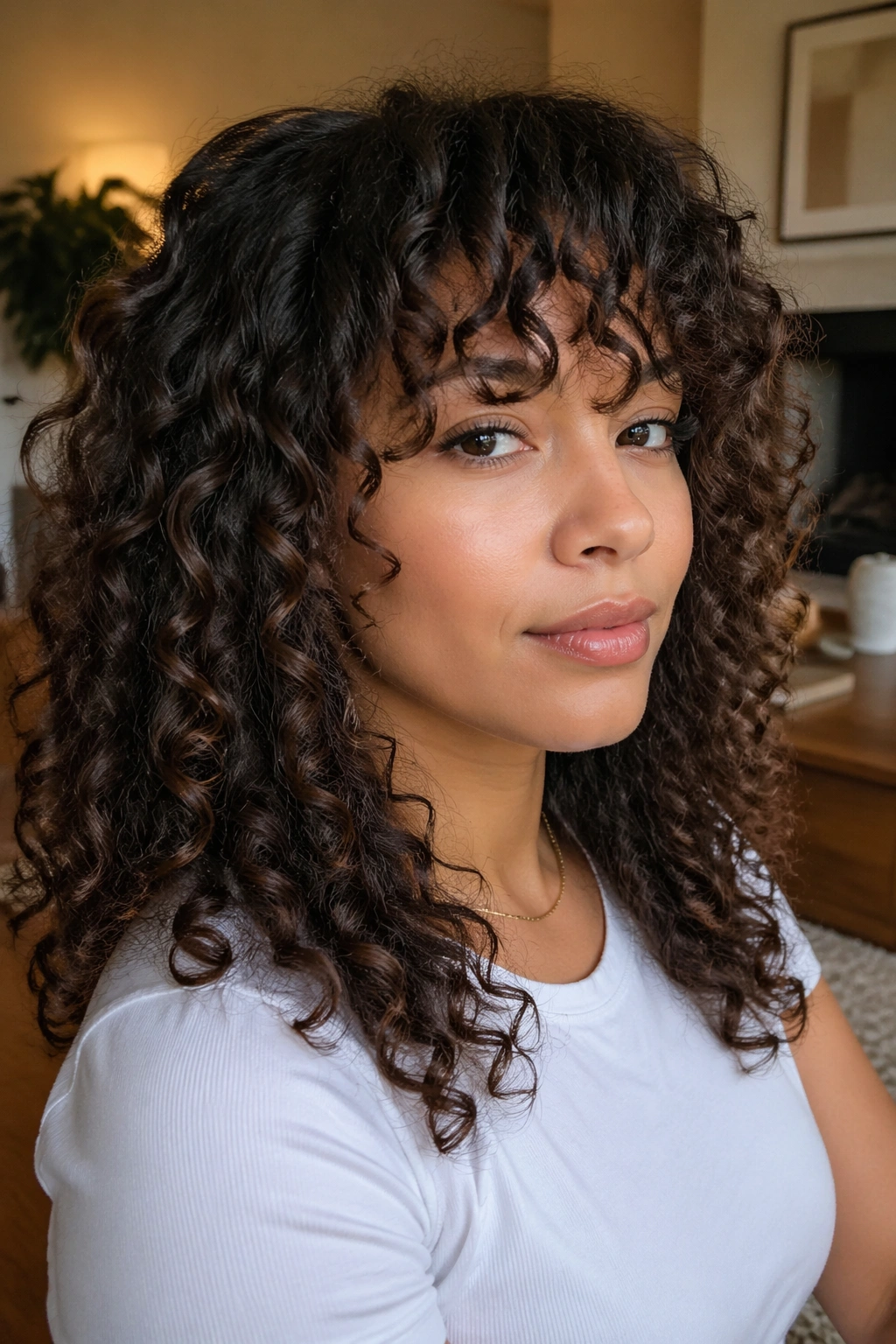
Layered bangs — with multiple lengths throughout the bang section, shorter at the center and longer at the edges — create a more dynamic fringe than a one-length cut. On curly hair, the layers let individual curl sections fall at different points, creating a textured, graduated bang that doesn’t look like a flat, dense wall of hair.
This is a flattering option for round faces — the layering adds visual interest and movement that breaks up the uniformity a blunt fringe might create.
7. Curtain Bangs With Curly Texture
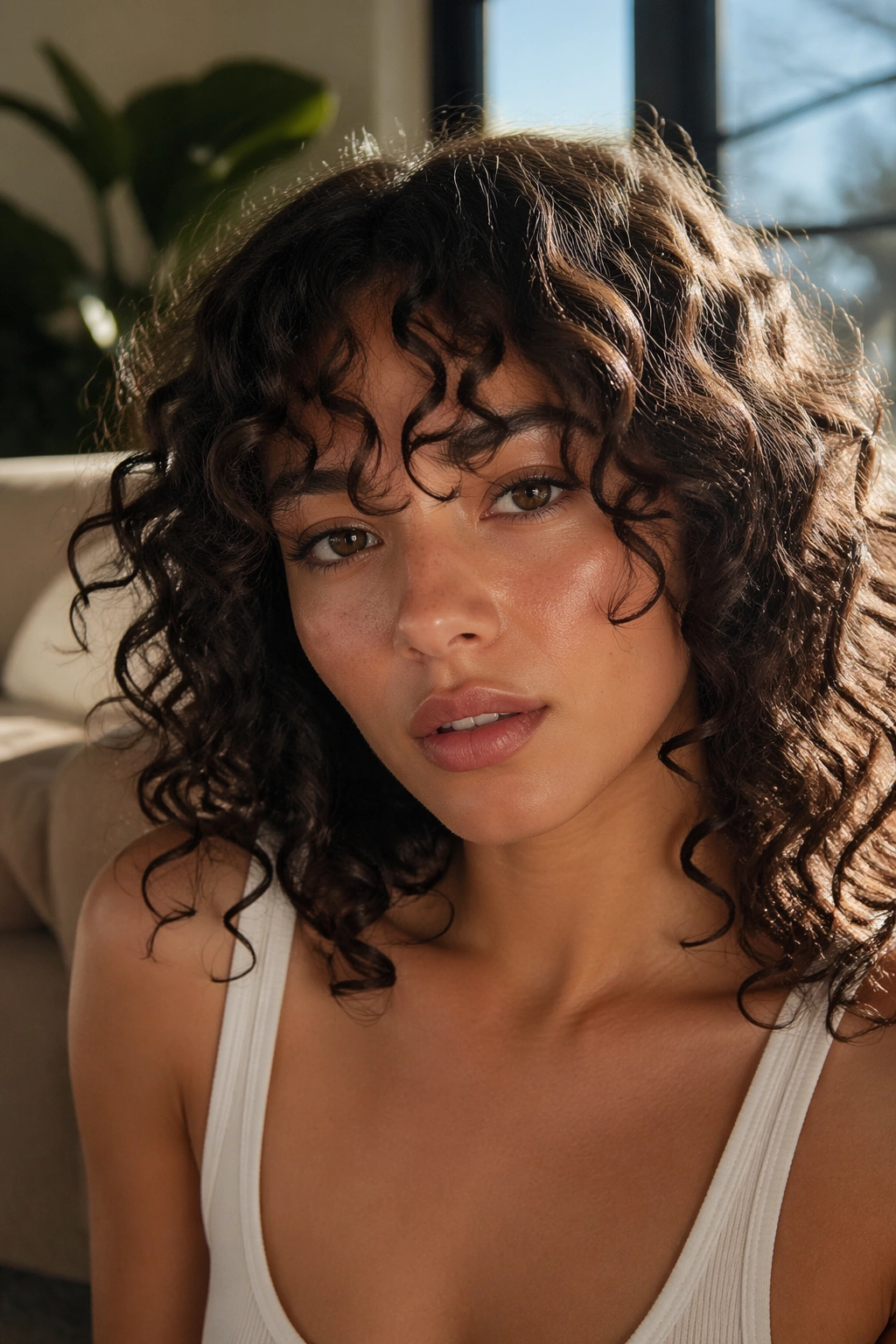
Curtain bangs are longer in the center and shorter at the sides, creating a parted-in-the-center shape that frames the face on both sides. On curly hair, the center section is the longest and falls as a cluster of curls between the eyes, while the shorter side sections spiral outward along the cheekbones.
This is one of the most universally flattering bang styles precisely because the parting in the center reduces the density at the forehead while the side sections frame the cheeks. The curly texture adds softness that makes the face-framing effect even more effective.
8. Bohemian Fringe With Natural Curls
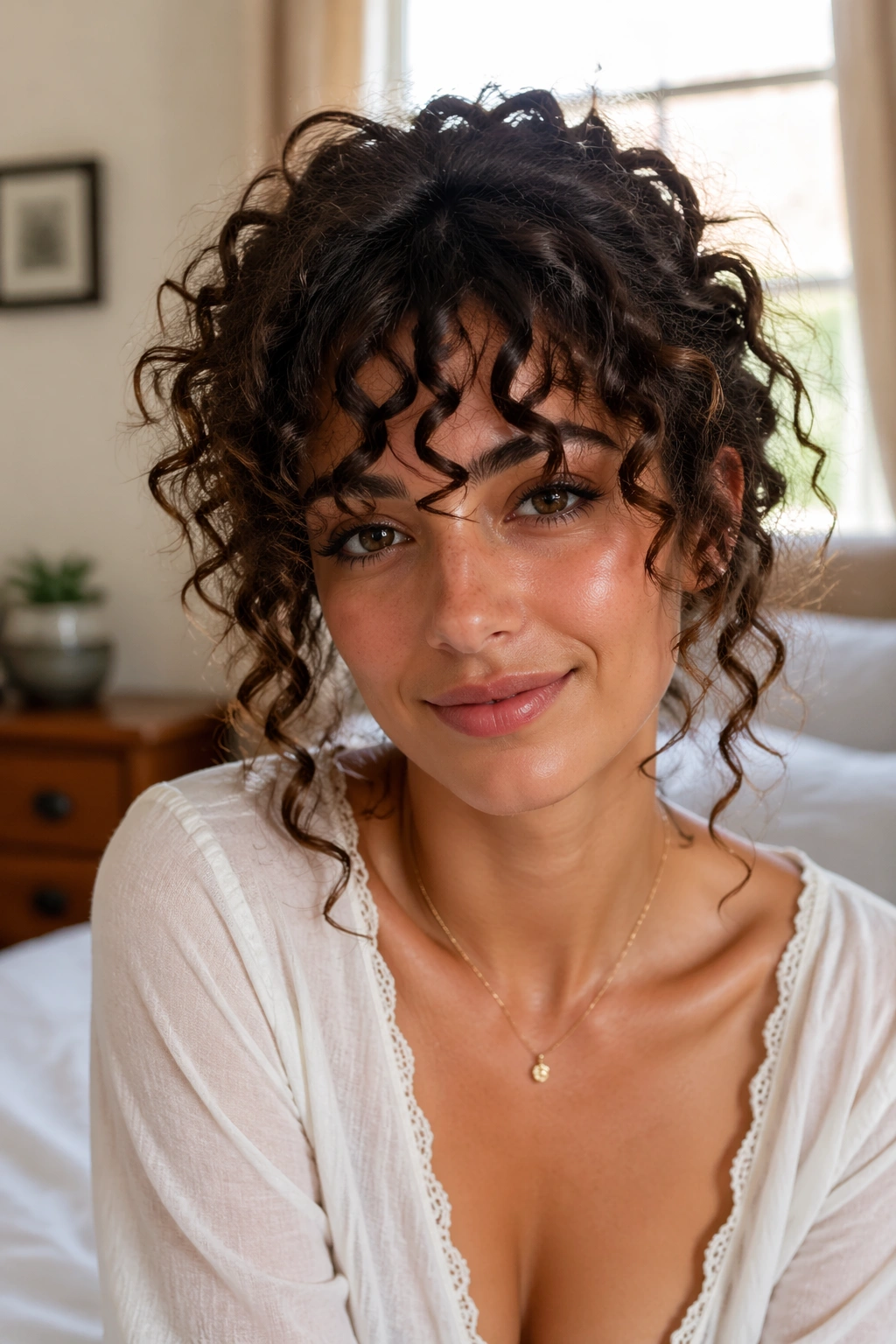
Long-ish, loose bangs that mix with the front curls of the hairstyle rather than sitting as a clearly defined, separate section. Bohemian fringe is less about a sharp bang cut and more about encouraging the front section of hair to fall forward across the forehead in a soft, carefree way.
On naturally curly hair, this happens almost organically — front curls have a tendency to fall forward anyway. A slight trim to even out the front section, combined with a styling approach that encourages the curls to frame the face rather than pull back, creates the bohemian fringe effect.
9. Chunky Curly Bangs
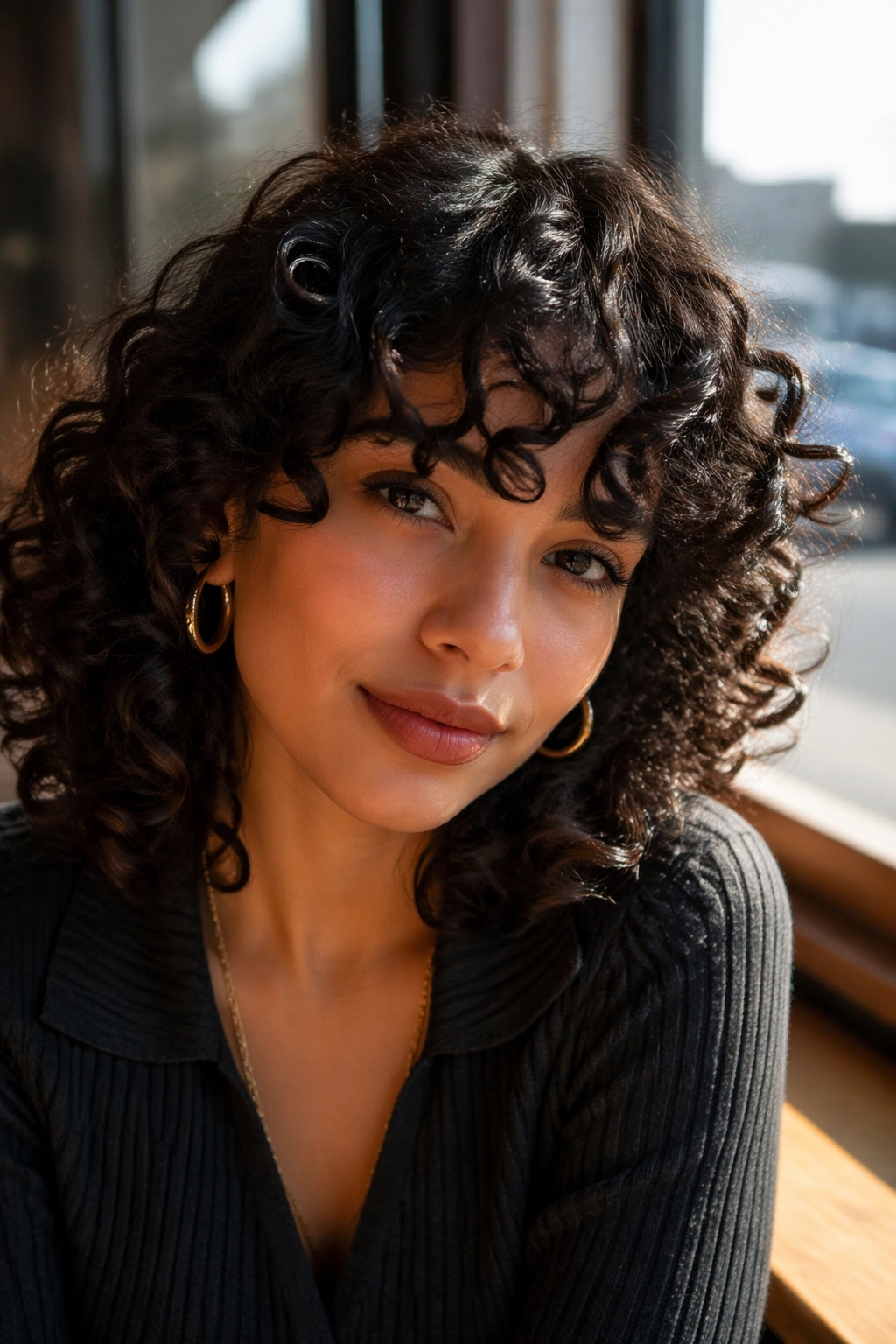
Instead of thin, individual curl tendrils, chunky curly bangs are thick curl clumps that fall across the forehead as distinct, bold sections. The chunky quality is achieved by twisting or finger-coiling the bang section into large, defined clumps before styling.
This look is particularly bold and modern. The chunky curl clumps against the forehead have a graphic, intentional quality that reads as styled and deliberate rather than accidental or frizzy.
10. Natural Baby Hairs as Fringe
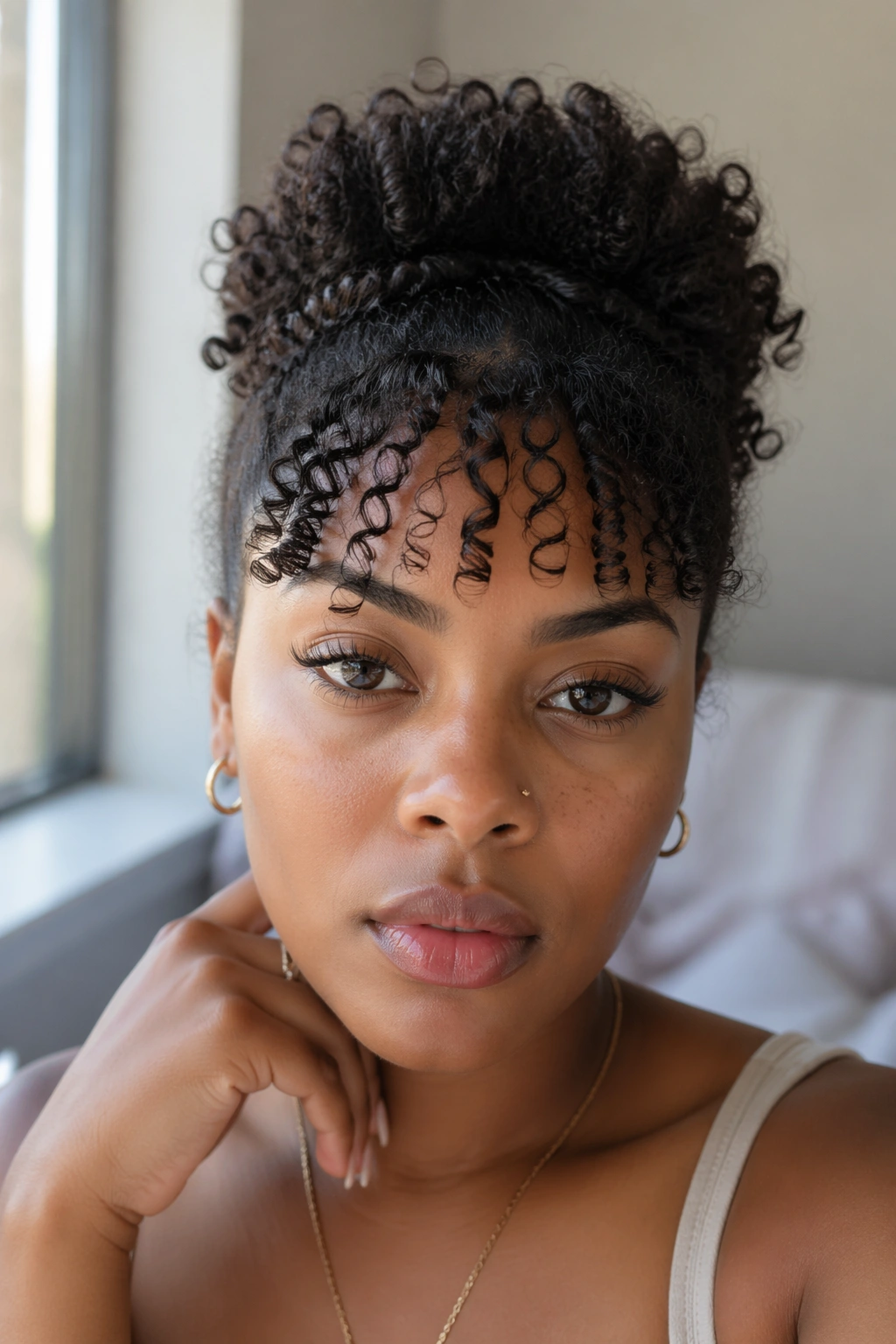
Not a traditional bang at all — but for naturalistas who haven’t cut bangs and aren’t ready to commit, styling the natural baby hairs along the hairline into a defined fringe effect creates a similar face-framing result. Use edge control and a fine brush to coil the baby hairs into swirls, waves, or a flat, defined pattern along the forehead.
This is face-framing without any scissors. It’s easily reversible and completely commitment-free.
11. Piecey Texture Bangs
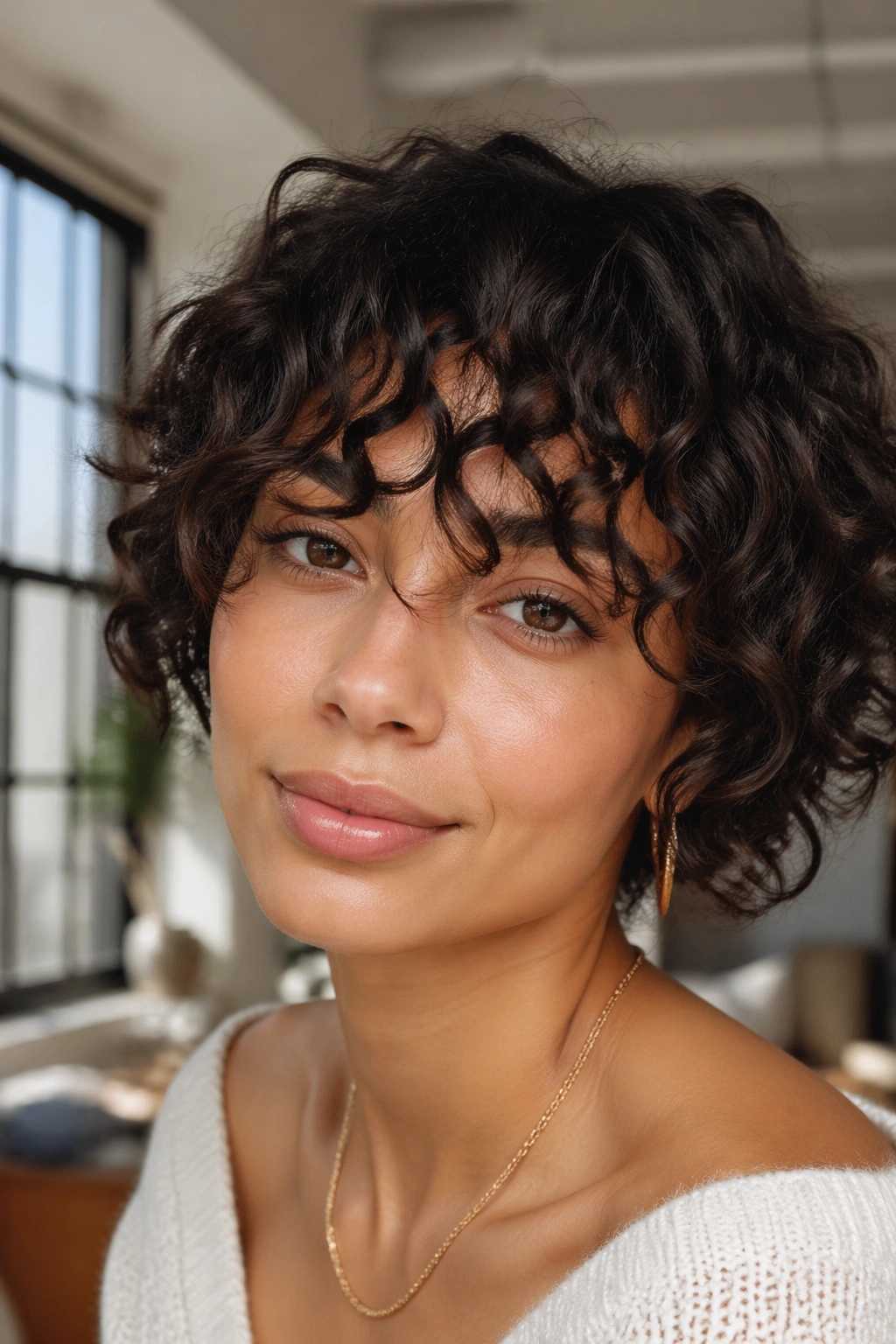
Piecey bangs have visible separation between individual curl sections in the fringe — each piece falls distinctly rather than blending into a dense cluster. On curly hair, this piecey quality can be encouraged by using a lighter product that doesn’t cause curl clumping, then separating individual ringlets with your fingers after the bang section dries.
The piecey look is more editorial and fashion-forward than a full, dense fringe. It reads as intentionally styled and pairs well with bold makeup or statement earrings.
12. Forehead-Skimming Ringlets
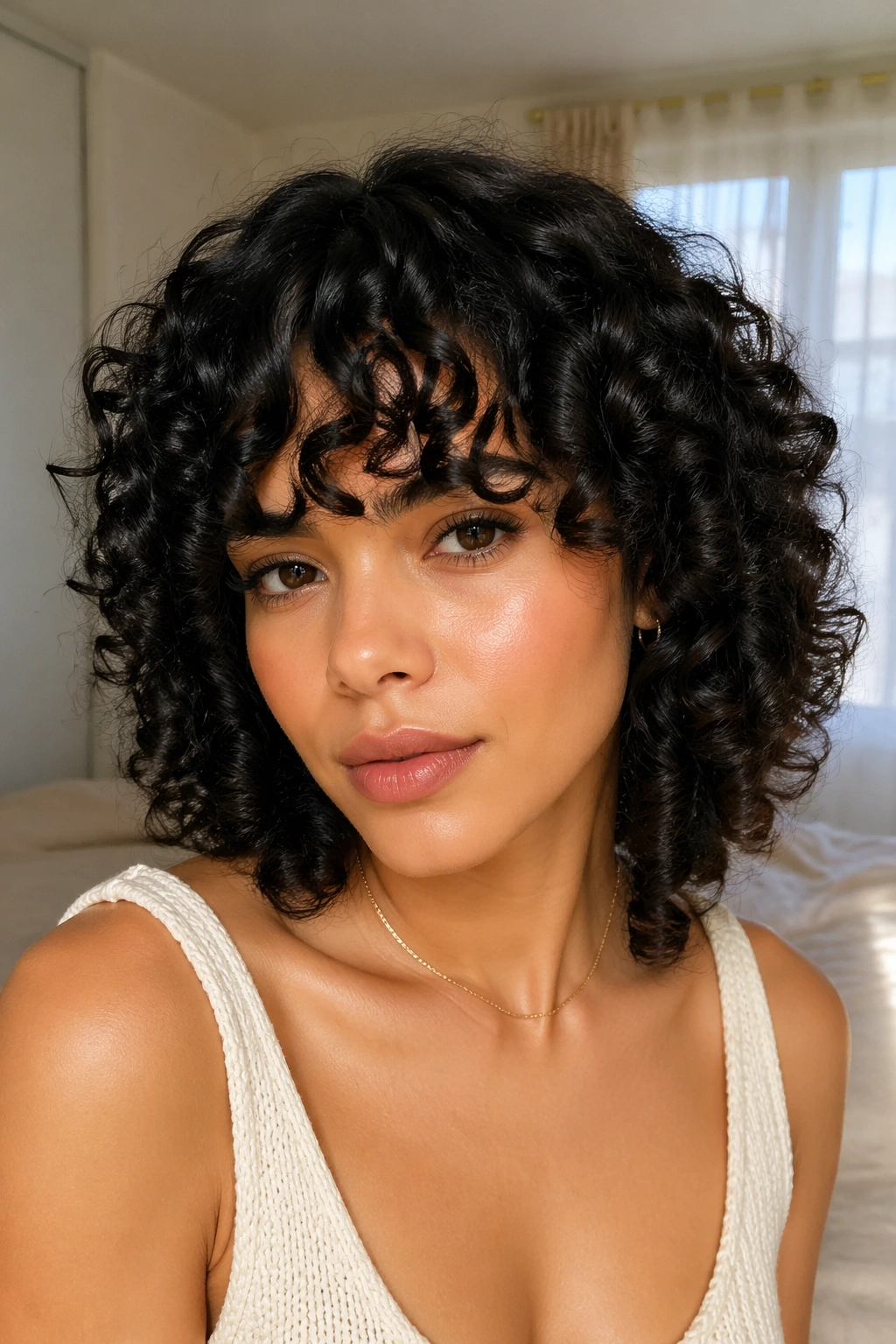
Bangs where the curls are so perfectly defined that each ringlet hangs as a distinct spiral, touching the forehead or hovering just above it. On 3B and 3C hair with good definition, this look is achievable with a strong curl cream and careful diffusing — each curl set into a clear, bouncy ringlet that hangs at the forehead.
These ringlets are magnetic. People will notice them, reach out to touch them (tell them not to), and ask about them constantly.
13. Asymmetric Curly Bangs
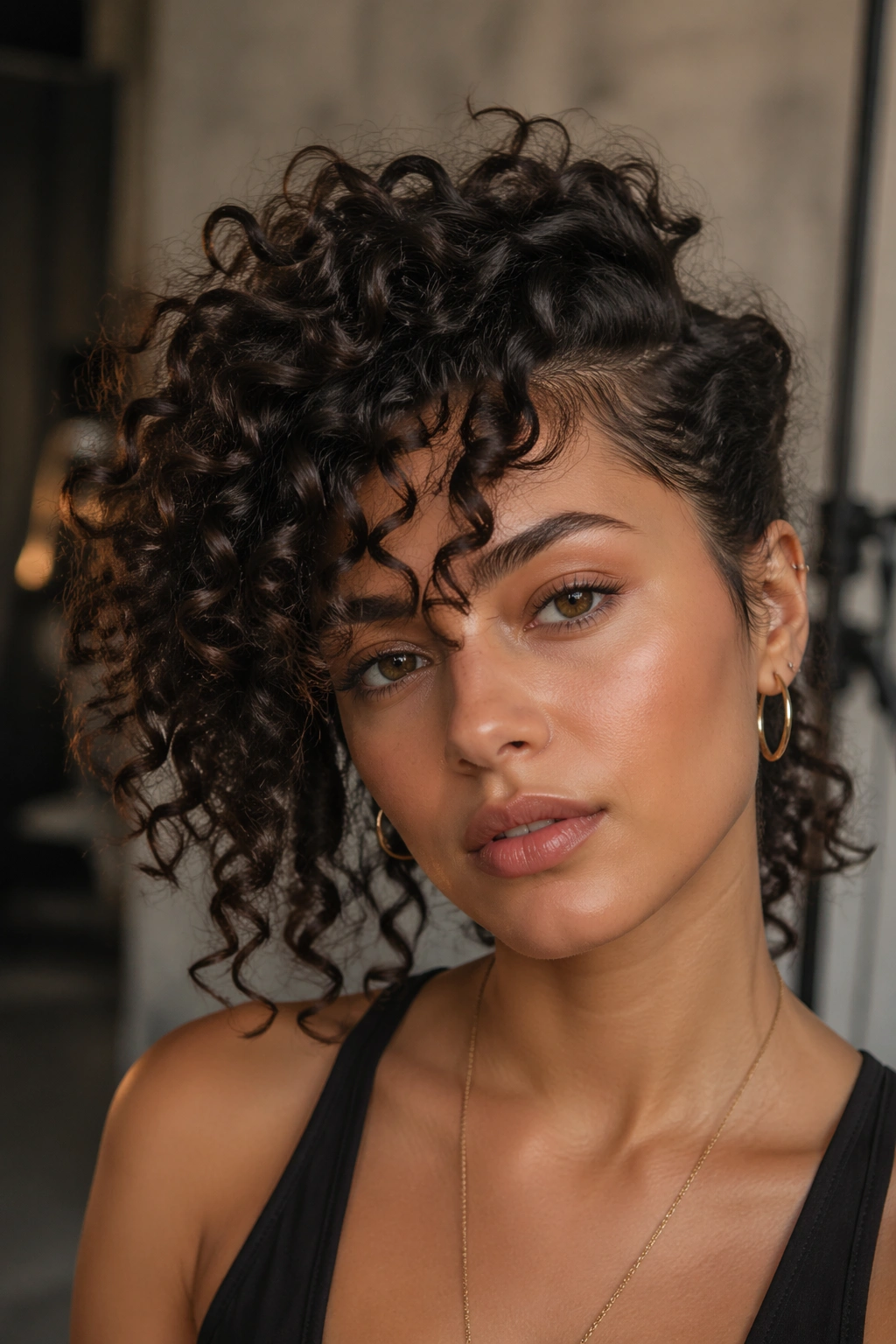
One side of the bang is longer than the other — either as a deliberate cut or as a styling choice where one side is pinned back while the other falls forward. On curly hair, asymmetric bangs create a dynamic, angled framing effect where the diagonal line draws the eye across the face.
This is a modern, slightly edgy bang shape that works well with bold outfits and creative settings.
14. Face-Framing Curls Without a Cut
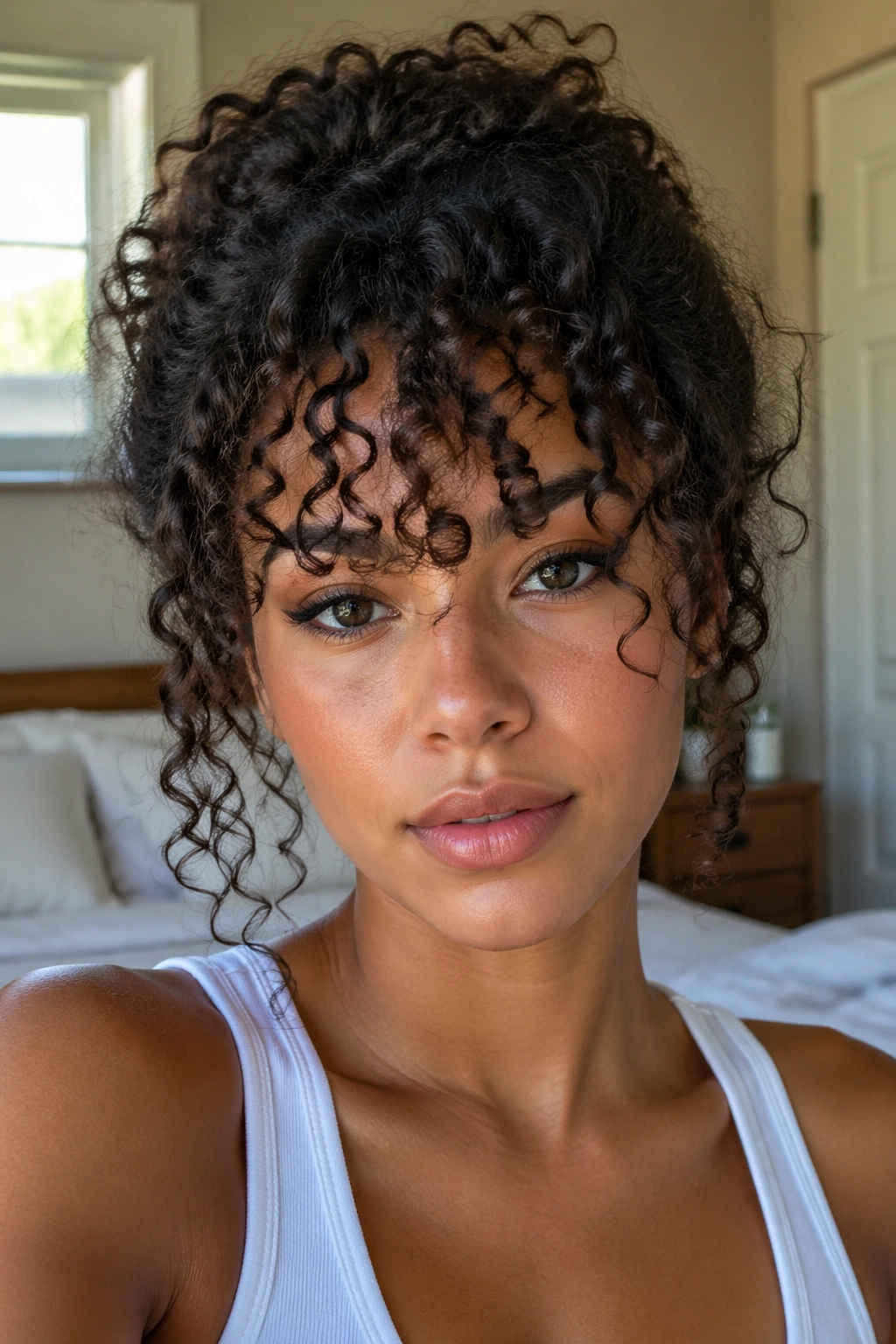
A natural hair approach to bangs that doesn’t involve cutting: encourage the front section of your wash-and-go or twist-out to fall forward across the forehead by not pulling it back or to the side when styling. Apply extra curl cream to this section, coil the curls forward while damp, and diffuse or air-dry in the forward position.
The result is a soft, curly frame around the forehead that looks bang-like without any permanent commitment.
15. Curly Bangs With a Half-Up Style
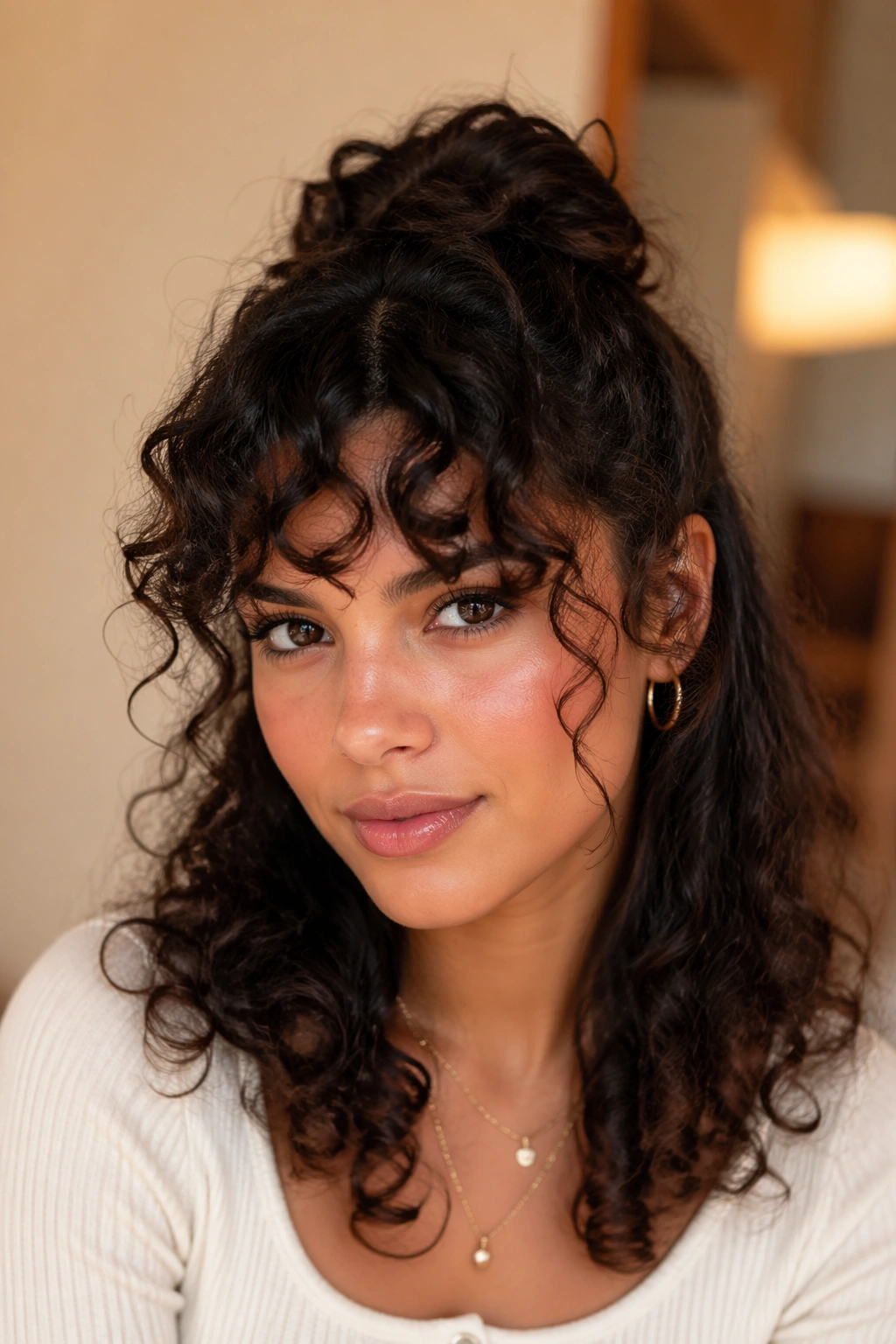
Curly bangs framing the forehead while the rest of the hair is pulled into a half-up style — ponytail, bun, or twist at the crown. The bangs do all the face-framing work at the front, while the half-up keeps the rest of the hair managed and off the neck.
This is a great everyday style for naturals with bangs who want a practical but polished look for work, school, or errands.
16. Pulled-Back Style With Bang Section Left Out
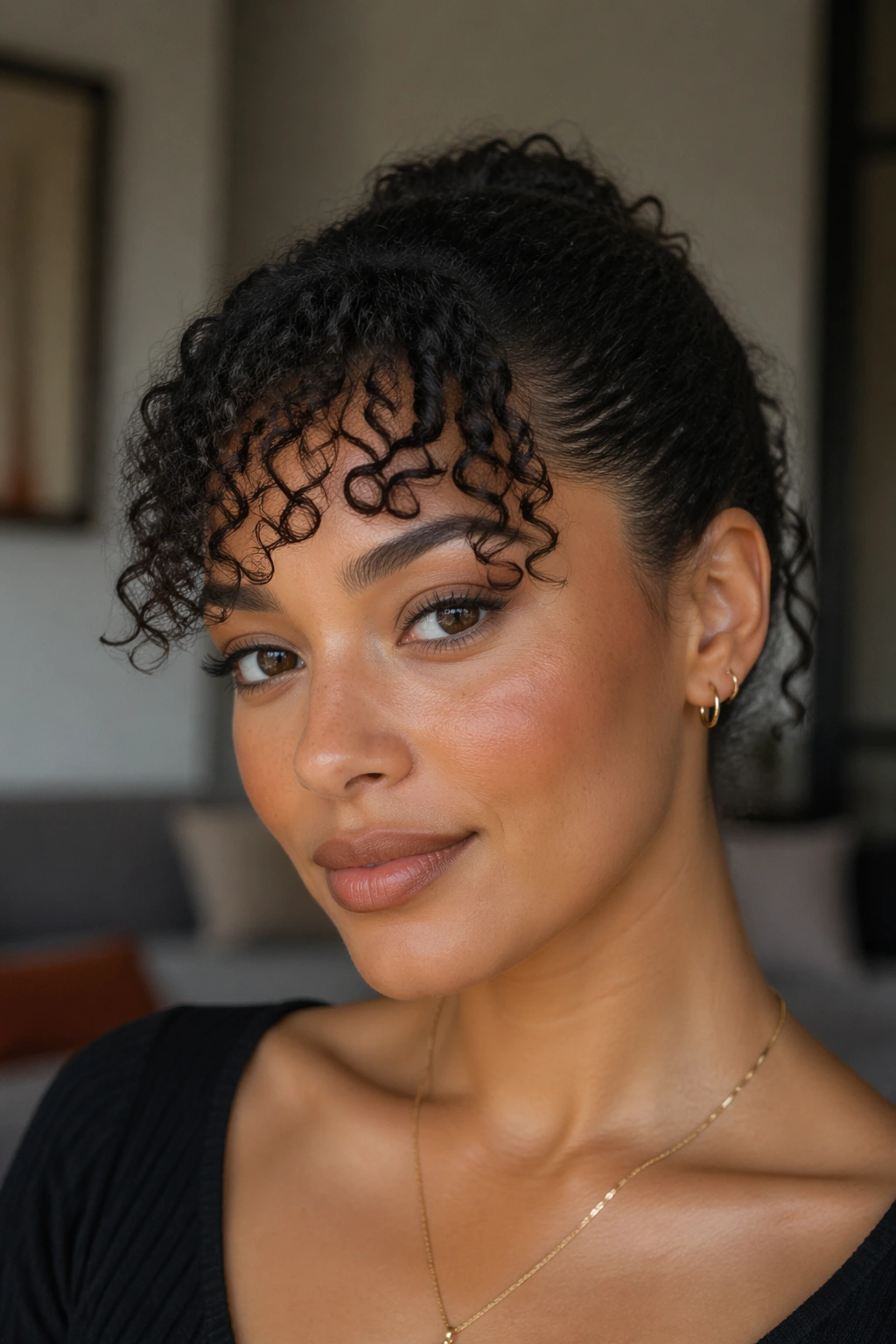
Instead of incorporating the bang section into the rest of the hairstyle, leave it completely free while the rest of the hair is pulled into a bun, ponytail, or protective style. The bang hangs freely at the forehead while the back is clean and controlled.
This combination — sleek back, textured front — is a deliberate contrast that makes the bang section even more prominent as the style’s focal point.
17. Curly Bangs on a TWA (Teeny Weeny Afro)
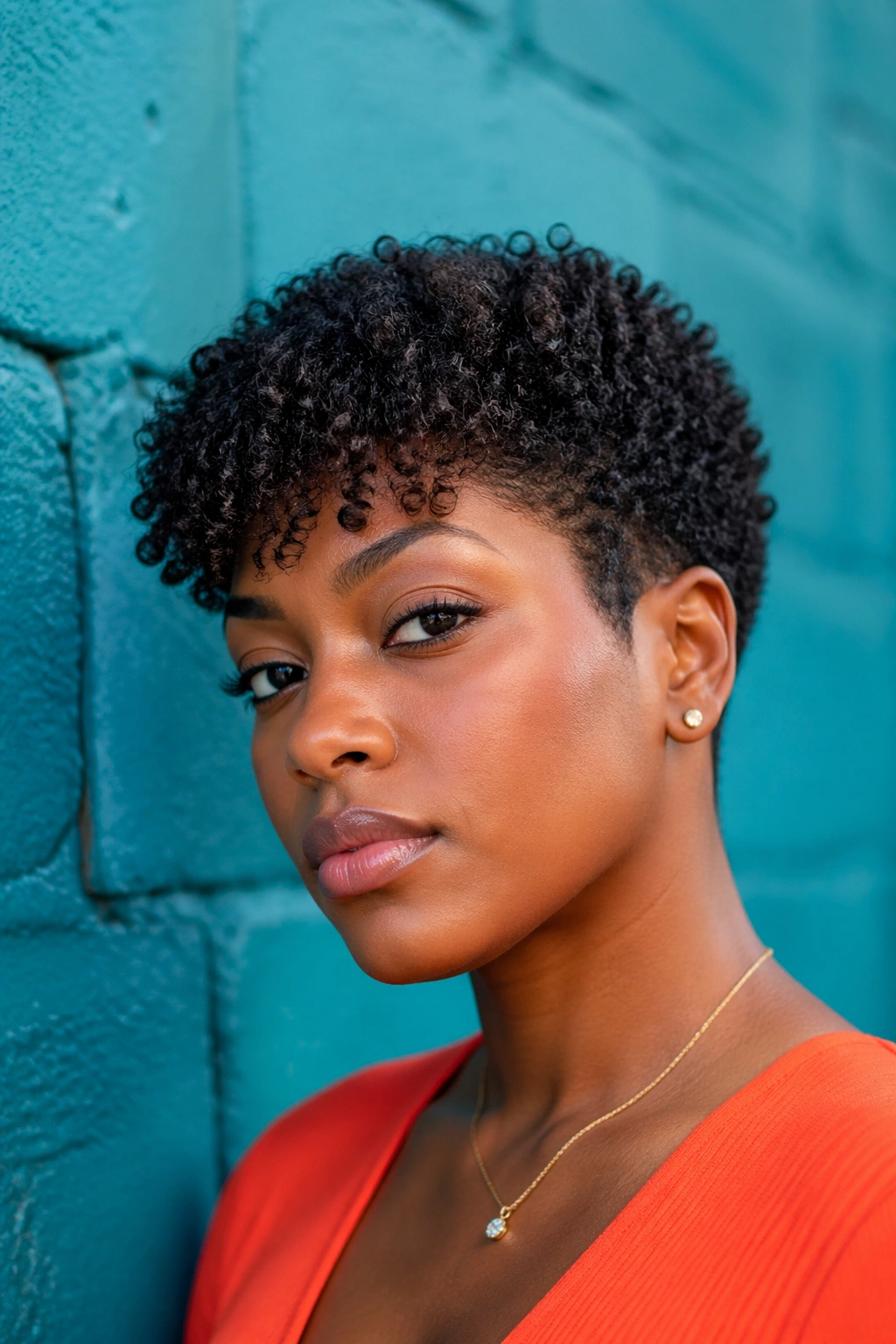
Bangs on very short natural hair are a bold move, but they’re absolutely achievable. On a TWA, the bang section is just the very front of the hair directed forward and slightly down — creating a textured, coily fringe against the forehead while the rest of the short natural hair stays in its natural shape.
This look is incredibly stylish on the right person. The short natural hair + curly bang combination is striking and unconventional in the best way.
18. Heat-Styled Bang With Natural Body
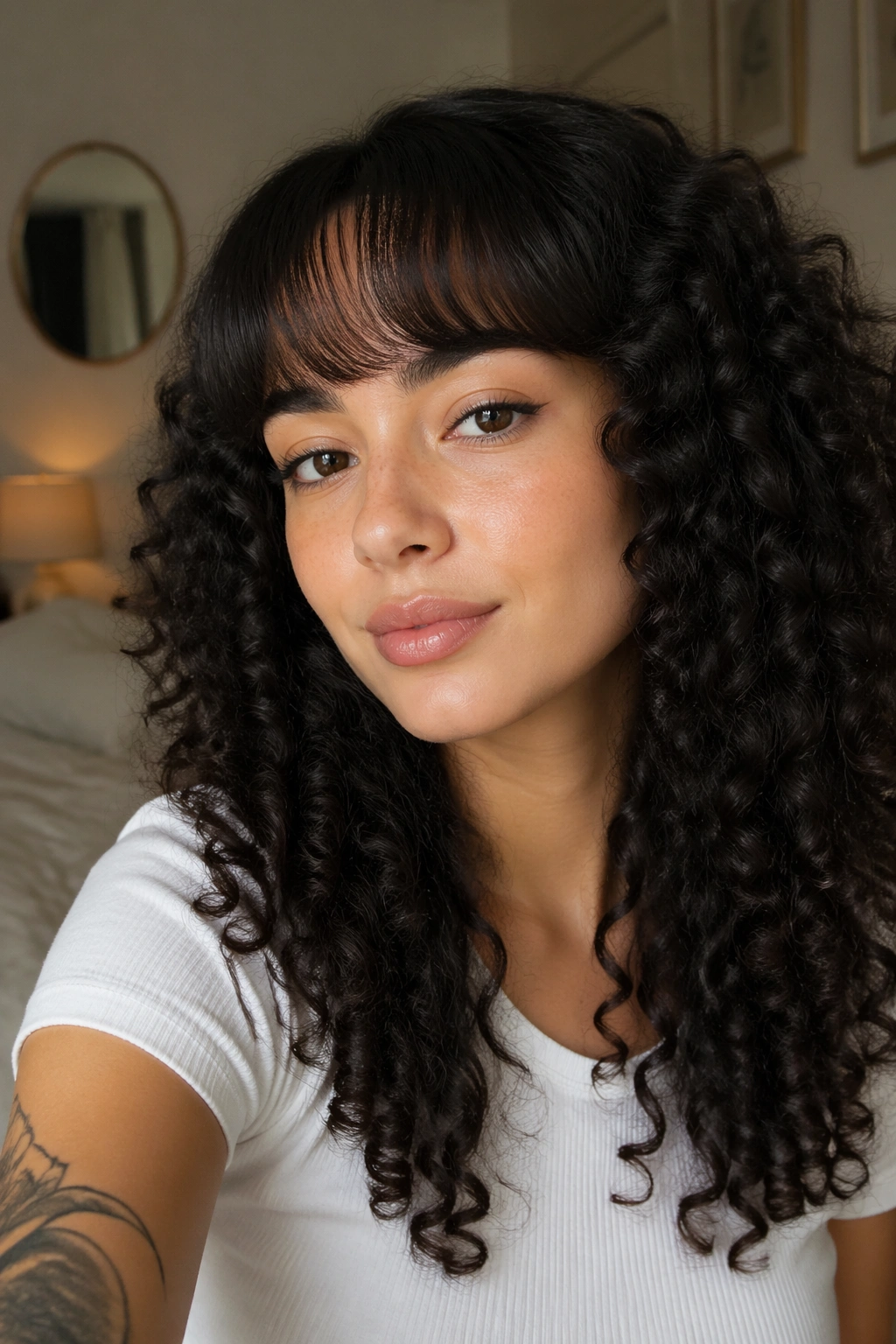
A compromise for naturals who want more control over their bang section: use a small curling iron or flat iron on the bang section only, creating a more precise curl or wave shape, while leaving the rest of the hair in its natural state. The slightly styled bang section lies more predictably than a fully natural fringe while still having movement and texture.
Apply heat protectant to the bang section before any heat and keep the iron at a low to moderate temperature.
19. Defined Coil Bangs on Type 4 Hair
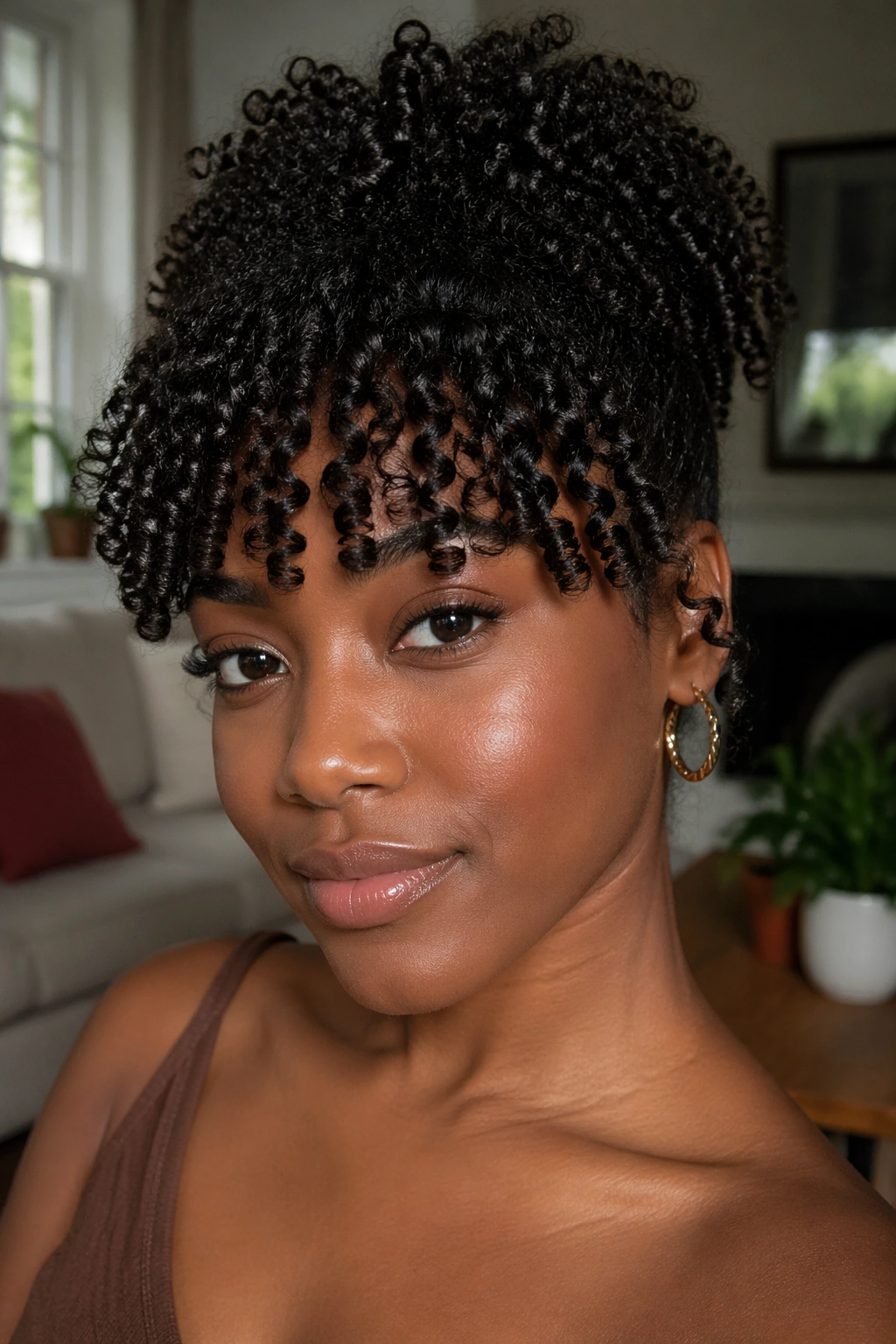
Type 4 hair bangs that are styled into defined coils using the finger-coiling method — each small section of the bang coiled around the finger from root to tip while damp, then allowed to set completely. The coils create a tight, springy fringe that has significantly more definition than an unstyled 4C bang section.
This requires patience and time on styling days, but the defined coil bang is a genuine showstopper on type 4 hair.
20. Braid-Out Bangs
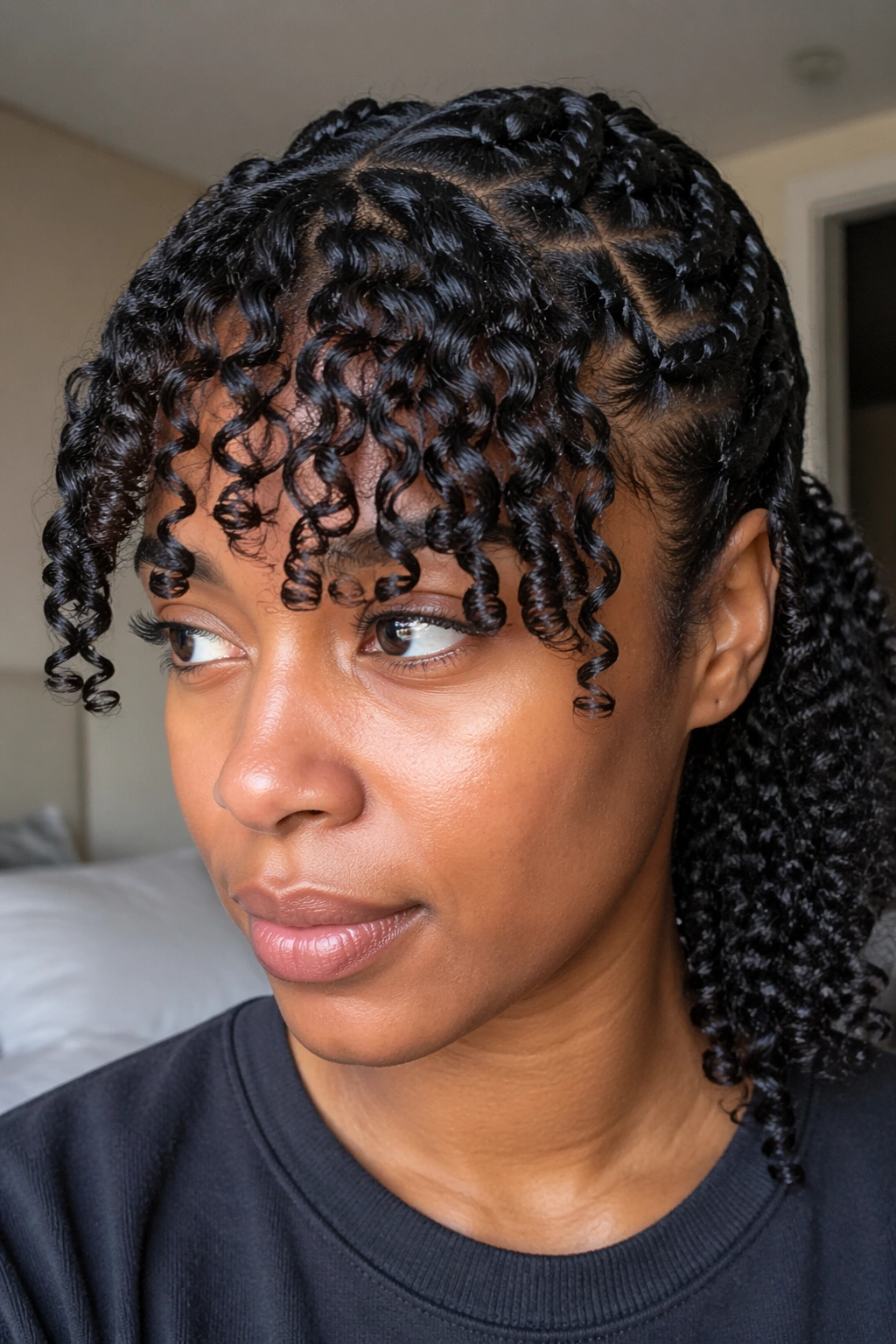
Do the bang section in small braids while the hair is damp and product-saturated. Allow to dry completely, then release. The braid-out creates a wavy, defined texture in the bang section that’s somewhere between straight and coily — stretched enough to sit more predictably at the forehead than a fully natural curl, but still textured enough to look natural.
Great for naturalistas who want a bang that behaves more predictably without using heat.
21. Protective Bangs — Faux Fringe
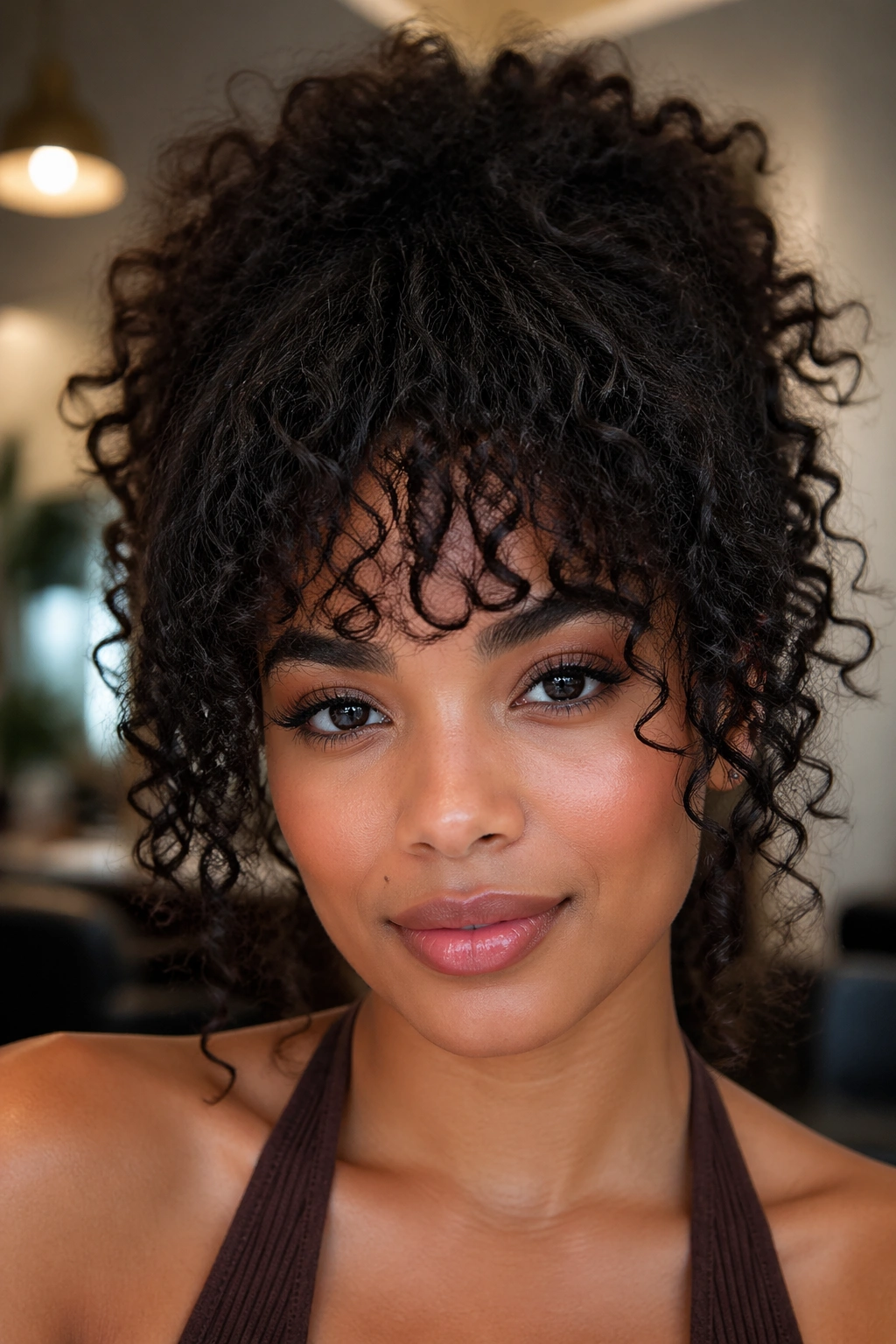
A faux fringe using extensions at the front hairline. Small clip-in pieces or glued extensions at the front hairline create a bang look without cutting your natural hair. Choose a curl texture that matches your natural hair for the most seamless effect.
This is entirely reversible and gives you the bang aesthetic without any permanent commitment.
22. Curly Bangs With Edge Laid Perimeter
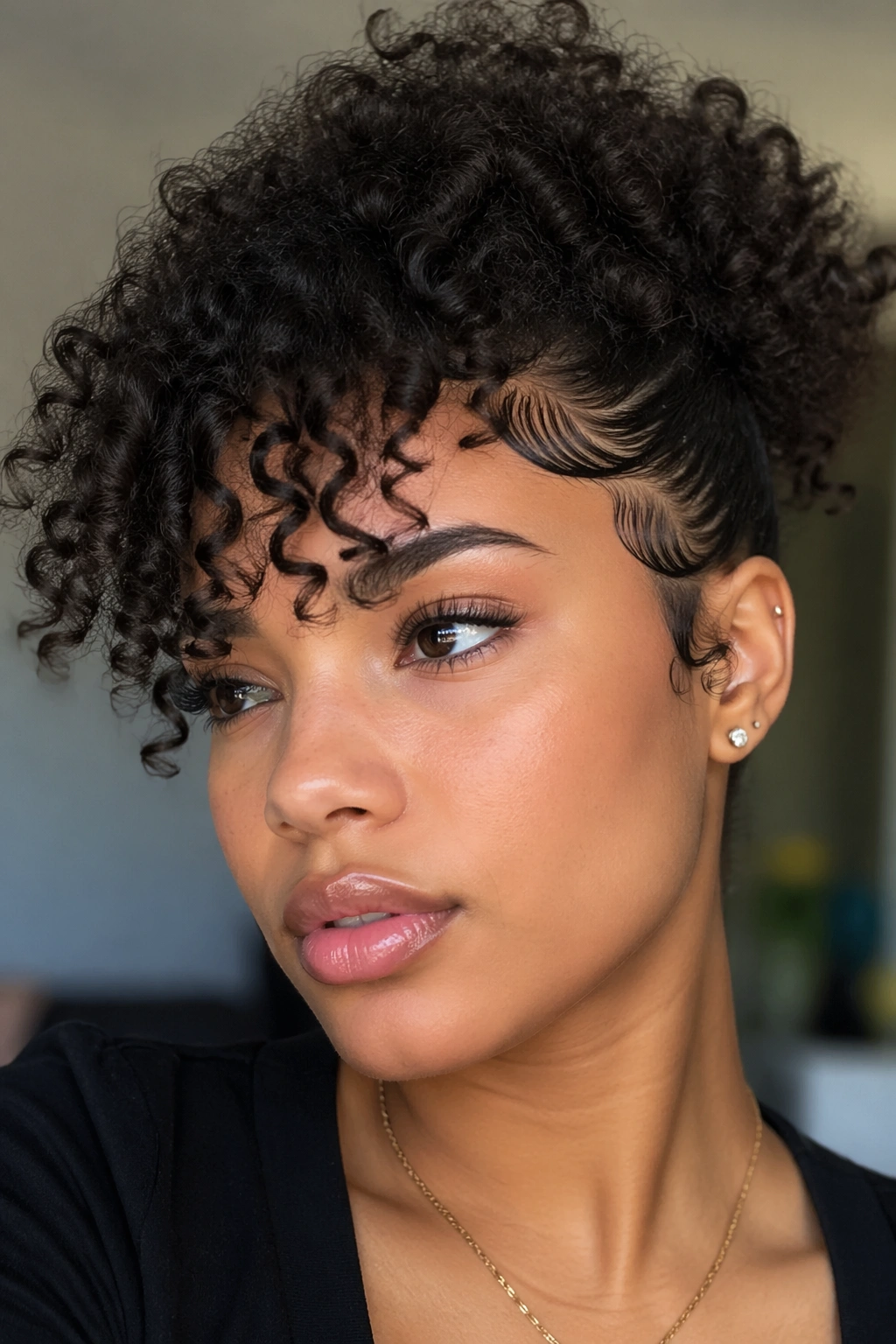
Curly bangs at the forehead combined with carefully laid baby hairs at the temples and sides. The baby hair art adds a polished, styled quality to the forehead area that ties the whole look together. The curly bangs are the main framing element, the laid edges are the finishing detail.
23. Diagonal Cut Curly Fringe
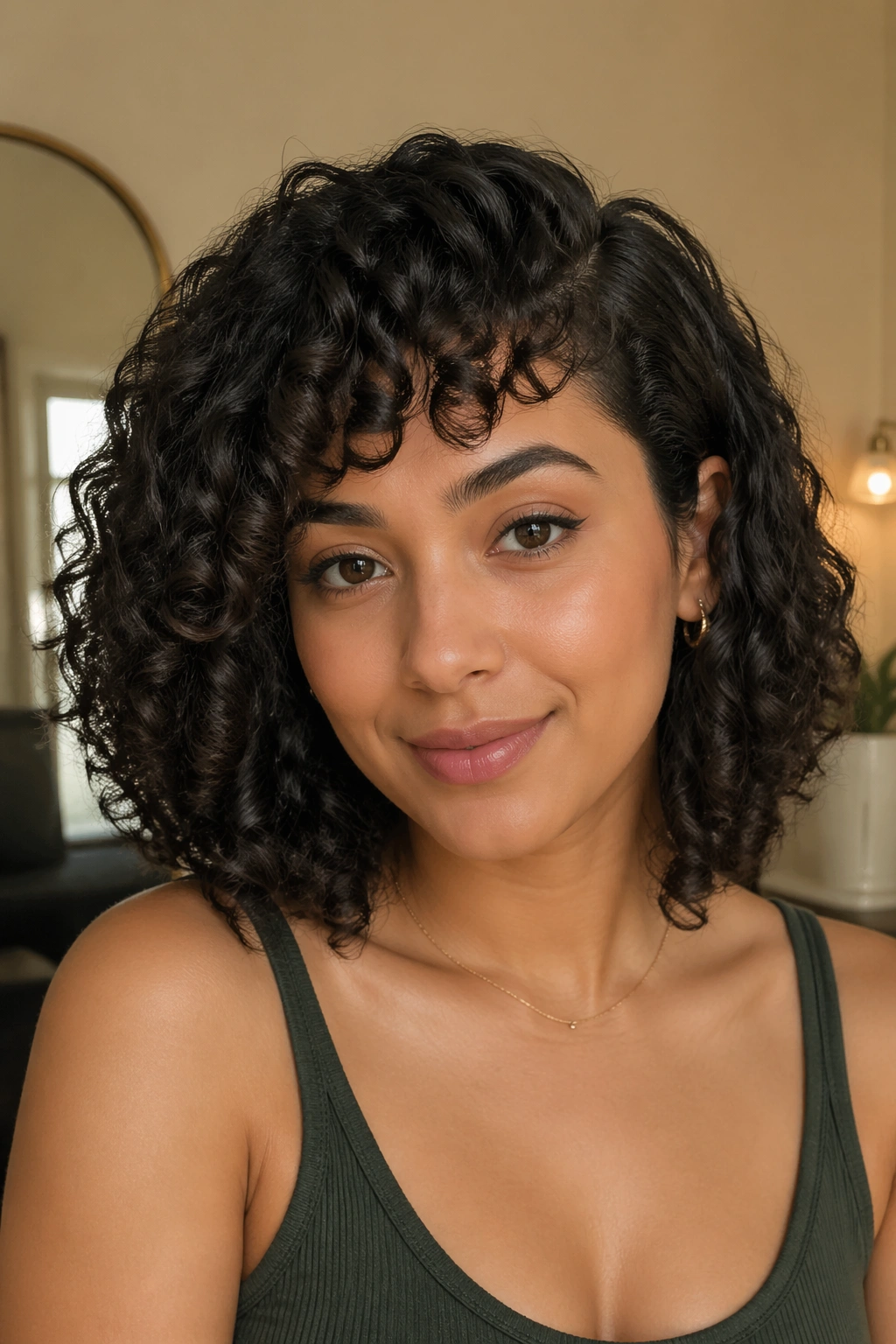
A bang cut on a diagonal — longer on one side, shorter on the other — creates an angular framing effect on curly hair. The diagonal angle draws the eye from the shorter side to the longer side, creating a directional movement that adds drama and sophistication to the fringe.
This requires a skilled stylist to cut correctly on curly hair since the diagonal must account for curl spring and shrinkage throughout the entire fringe.
24. Voluminous Puff Bang on Natural Hair
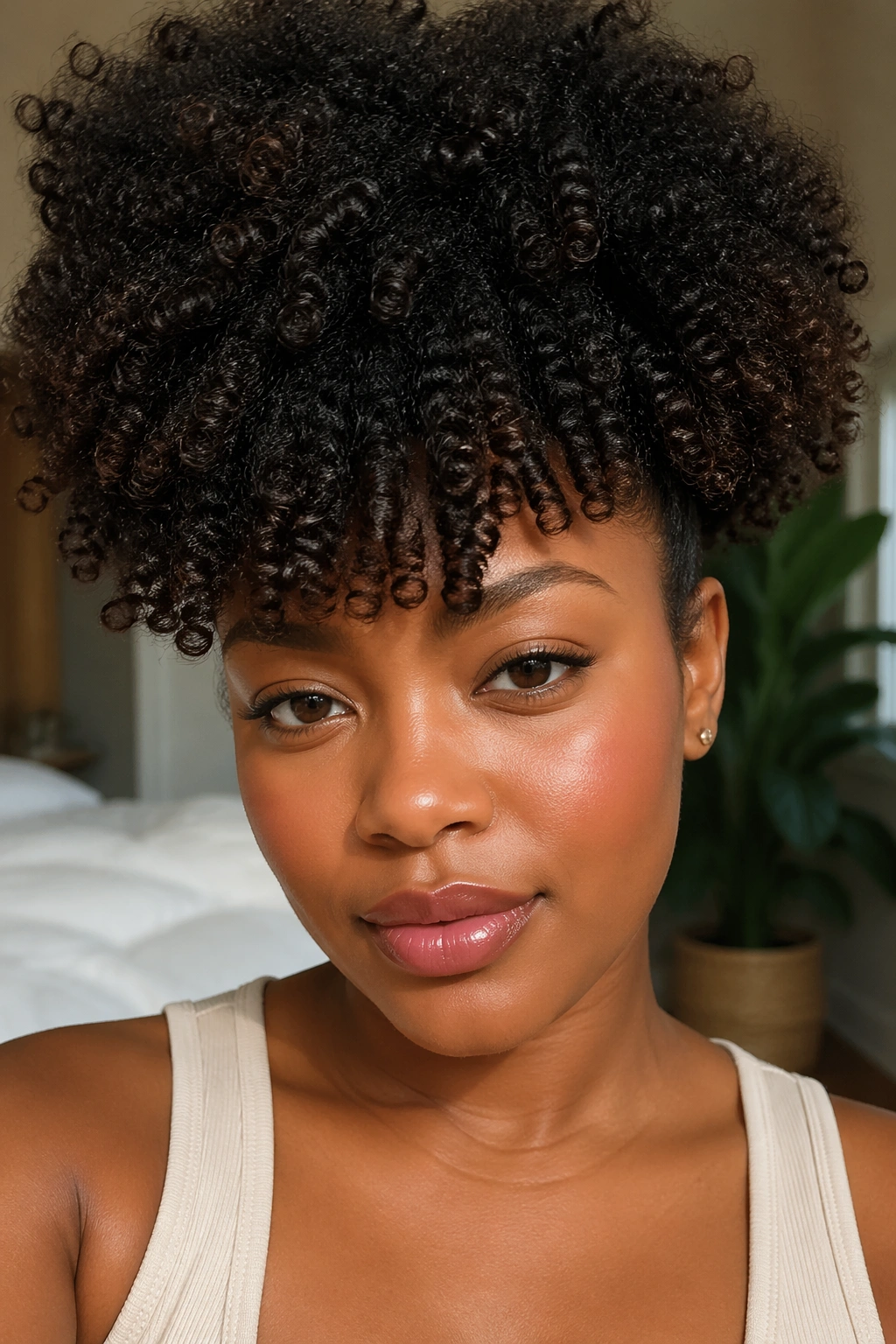
On type 4 hair, a “bang” can be a full, volumized puff section at the front of the head — not individual hanging curls but a collective mass of coils that rises forward and upward from the hairline in a cloud of texture. This is a distinctly natural hair interpretation of bangs, and it’s beautiful in its own right.
Style this by picking out or fluffing the front section of the hair separately from the rest, encouraging maximum volume at the forehead.
25. Defined Curl Bang Over a Protective Style
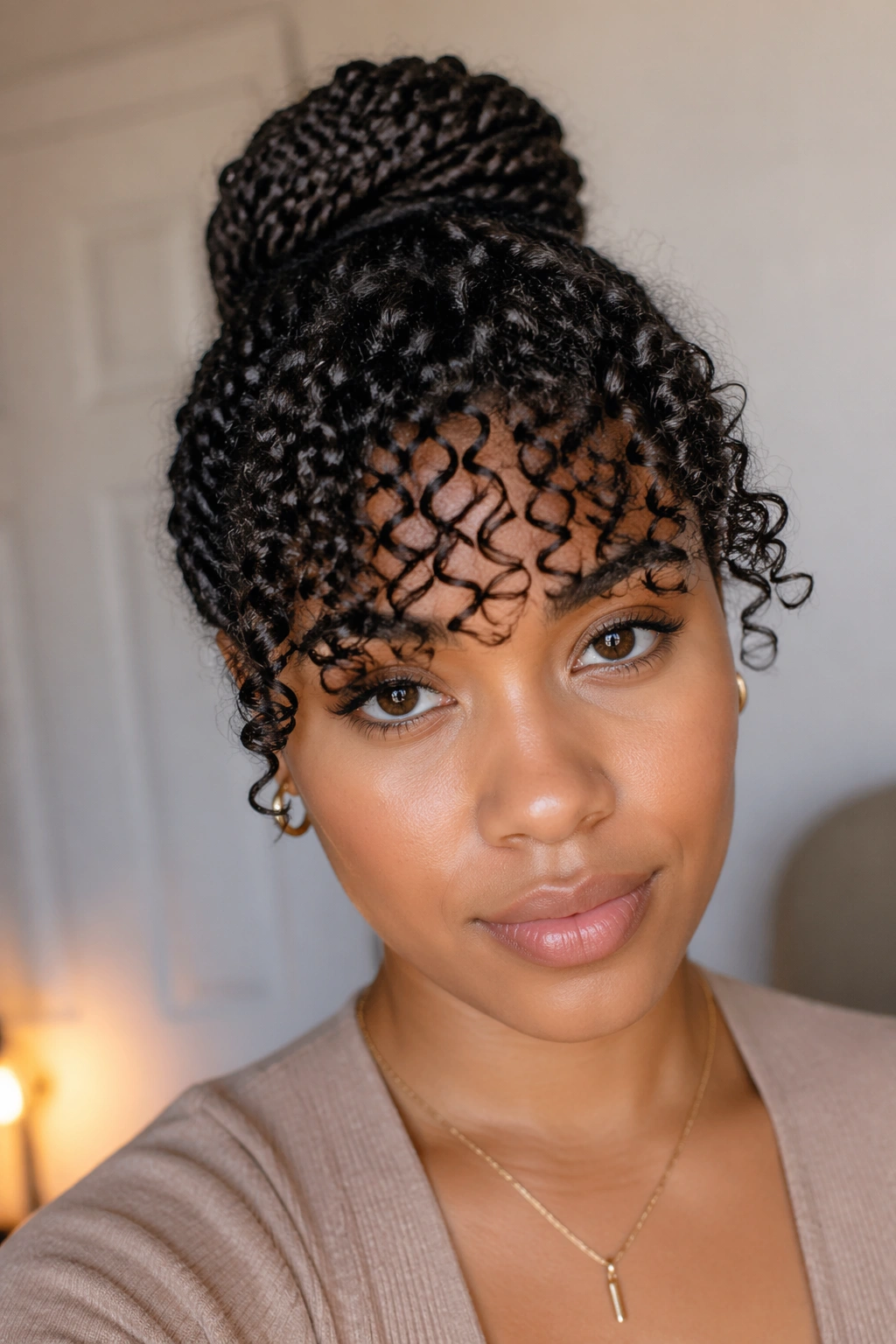
Wearing a bun, braids, or another protective style at the back while leaving the front section completely free as a curly bang. The protective style keeps the back ends tucked away, while the front section gets to show off its curl pattern in a defined fringe.
This is a practical option for low-manipulation weeks when you want your hair protected but still want some styling expression at the front.
26. Long Curtain-Blend Curly Bangs
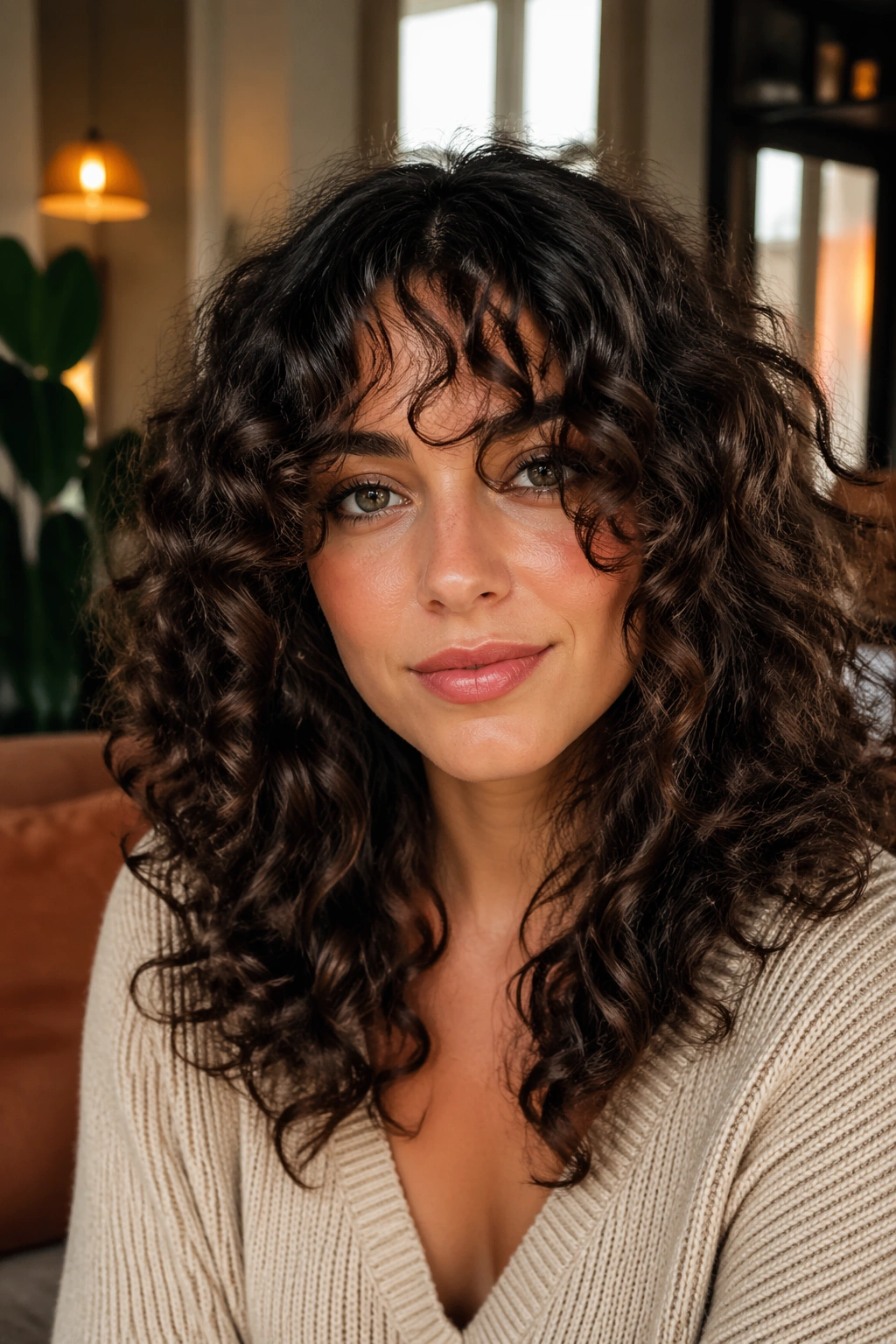
Longer bangs — past the eyebrows and approaching cheekbone length — that blend seamlessly into the rest of the curly hair at the sides. These bangs don’t have a defined ending point; they fade into the side sections as they get longer. On curly hair, this blending effect is beautiful because the curl pattern is continuous throughout.
The result is a face-framing effect that’s softer and more gradual than a traditional bang — less like a curtain and more like a gentle cascade of curls that starts at the forehead and continues around the face.
Growing Out Curly Bangs Gracefully
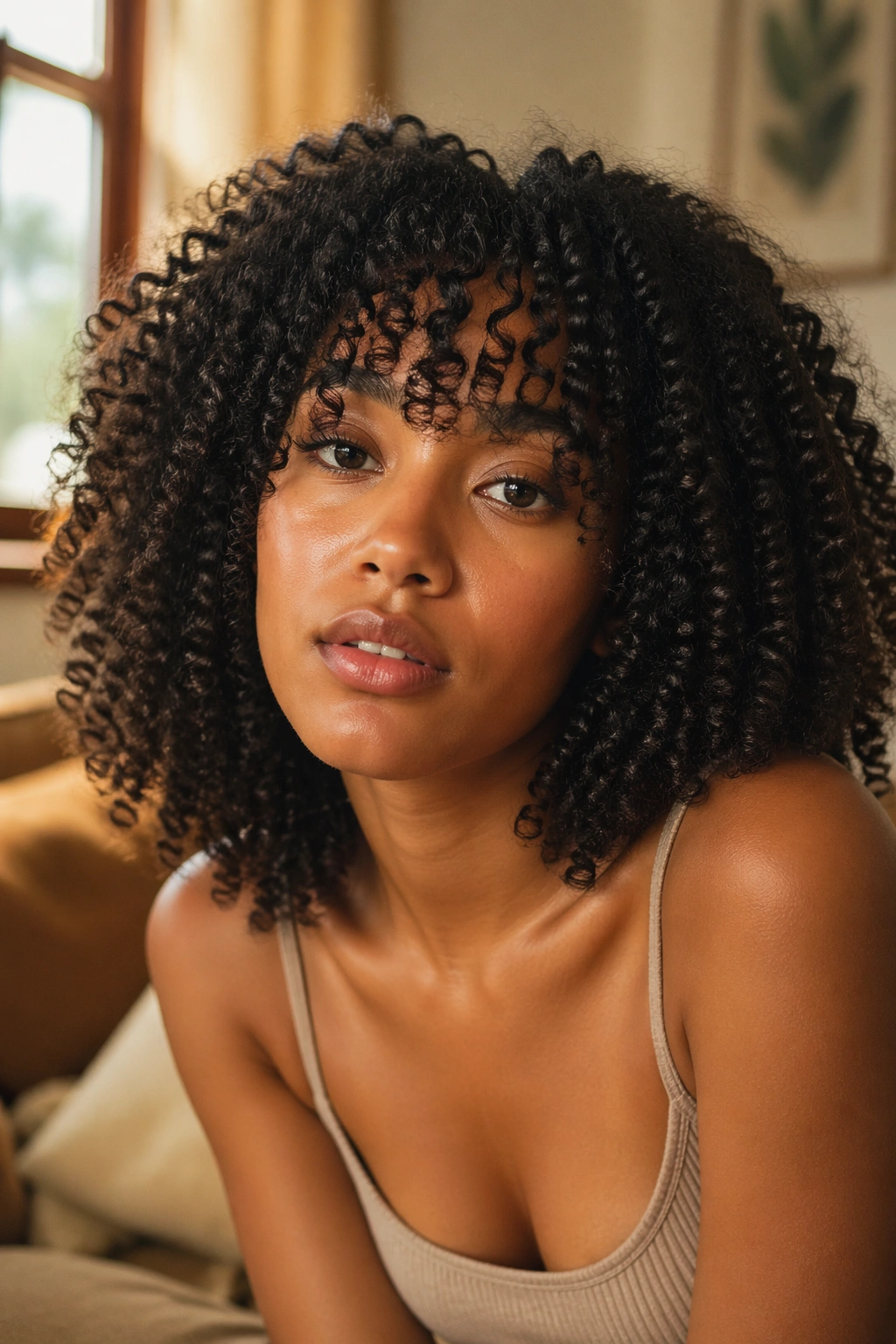
Bangs grow out differently on curly hair than on straight hair. Rather than getting into your eyes as they grow, curly bangs tend to spring upward and outward — first they get puffier, then they start blending into the rest of the curl pattern as they gain weight and length.
The awkward phase on curly bangs is often shorter than on straight hair for exactly this reason — at a certain point, the growing-out bang section just looks like part of the rest of your curly hair. Embrace the transition by styling the growing section to one side, incorporating it into the rest of the style, or using a headband to keep it off the face while it grows.