
A wedding ponytail can do a lot more than stay out of the way. Give it root lift, a clean base, and a little movement through the lengths, and it starts looking just as dressed up as a chignon — sometimes more so. That is why voluminous ponytails for weddings keep showing up in bridal inspo: they flatter veils, show off earrings, and keep the face open without going flat halfway through the ceremony.
Flat hair and formal fabric do not get along. Satin, tulle, lace, and beadwork all make limp hair look smaller; a ponytail with shape at the crown fixes that fast. A bit of teasing, a round-brush blowout, or a few well-placed extensions can change the whole mood.
Some brides want soft and romantic. Others want sleek with height. A few want something that can survive hugs, dancing, and a long reception without collapsing into a sad little tail. The styles below cover all of that, and each one leans on a different way to build volume so the look feels deliberate instead of puffed up.
1. Sleek Low Ponytail With a Lifted Crown
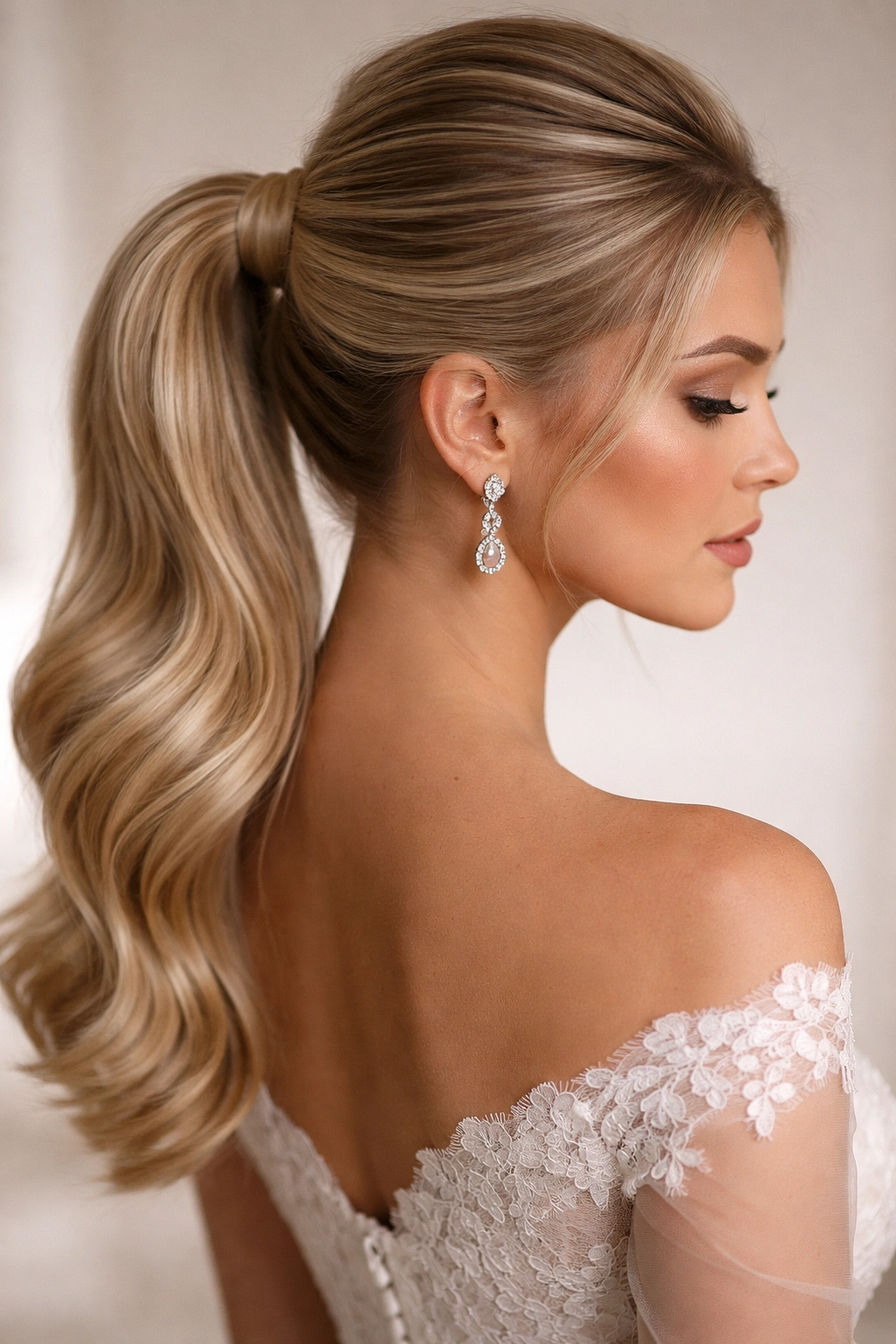
A low ponytail does not have to read as simple. If you build the height at the crown first, then smooth the sides back tight, the whole style suddenly feels tailored and expensive without trying too hard.
The trick is balance. You want a soft lift at the top and a neat base near the nape, not a helmet of backcombed hair. A medium barrel iron through the lengths gives the ponytail body, while a little teasing at the crown keeps the profile from falling flat in photos.
I like this for brides who want clean lines and a dress with drama. It sits well under a cathedral veil, and it never fights with statement earrings.
2. Side-Swept Ponytail With Old Hollywood Volume
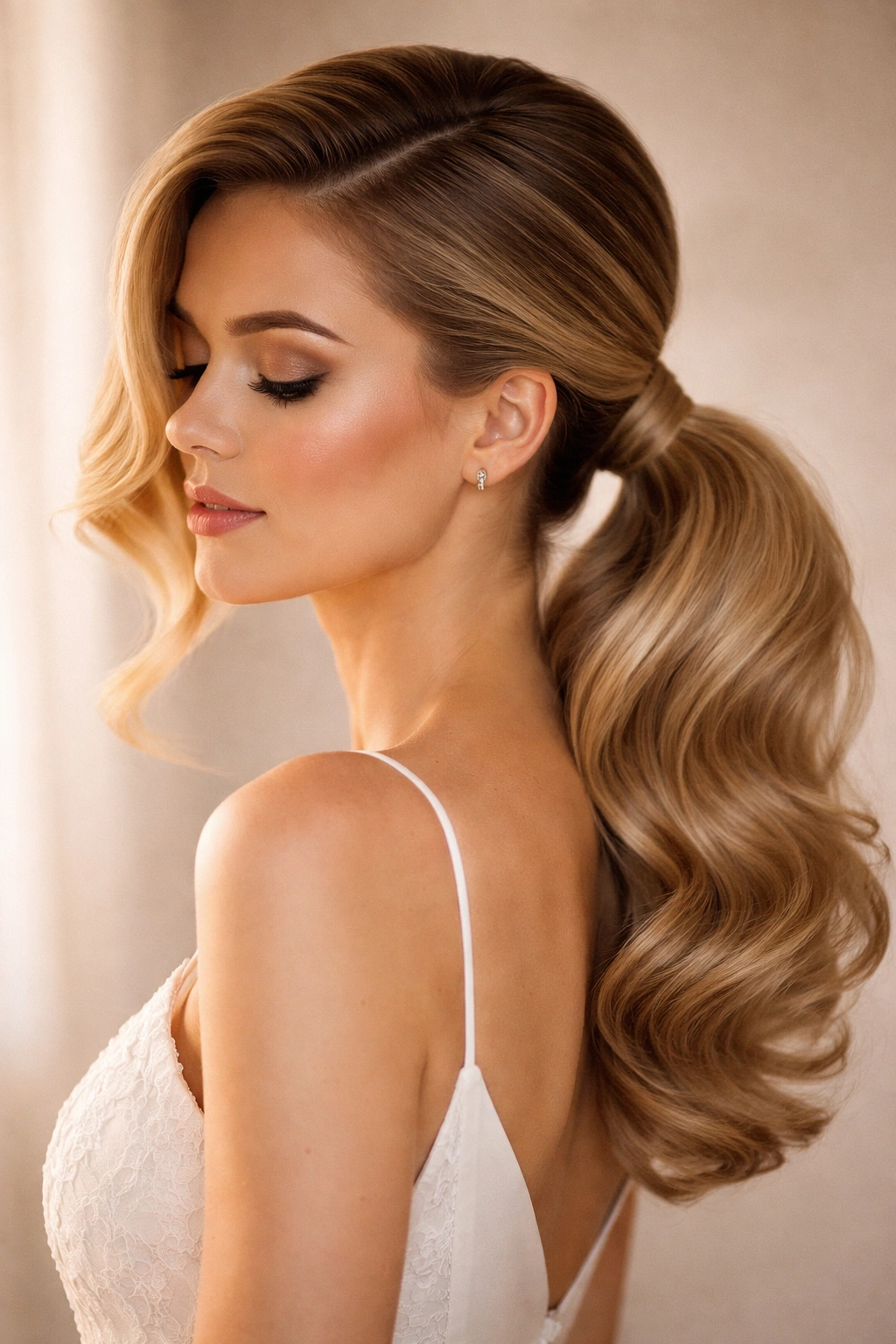
Why does a side part make a ponytail feel so dressed up? Because it changes the shape of the face right away. A deep side sweep adds curve at the front, and that curve gives the ponytail room to feel plush instead of stiff.
What Makes the Part Work
The front section should be brushed over with enough lift to avoid looking glued down. Then the ponytail itself can sit just below one ear, with the lengths curled into big, loose waves. That side placement softens strong jawlines and pairs well with one-shoulder gowns or gowns with an open back.
If you want a little extra polish, wrap a thin strand around the elastic and pin it underneath. Tiny move. Big payoff.
3. Bubble Ponytail With Wrapped Elastics
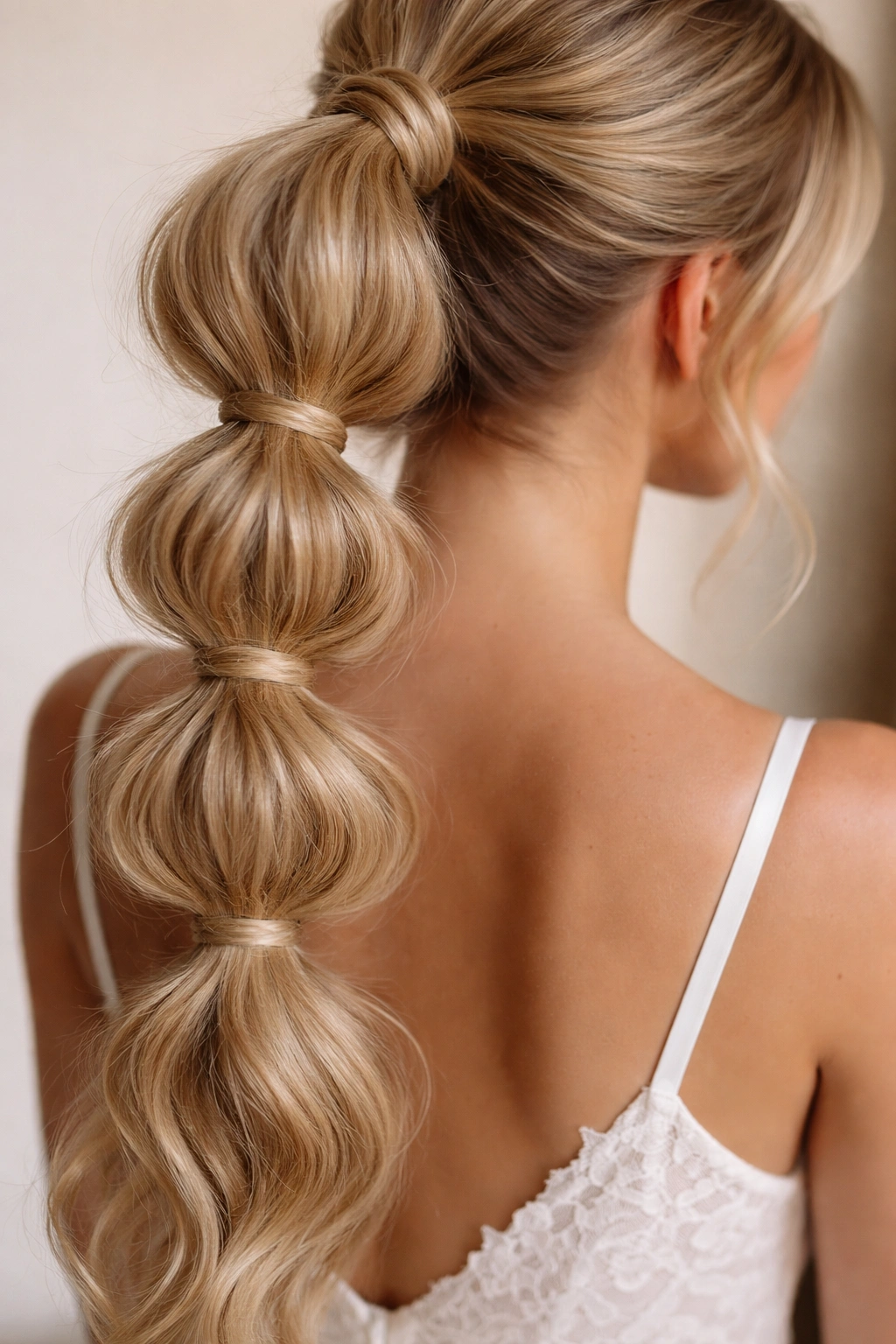
This one looks playful, but it can be bridal if you keep the bubbles full and the base smooth. The style works especially well on medium-to-long hair because each section can be tugged outward just enough to look soft instead of stiff.
- Start with a ponytail and add one elastic every 2 to 3 inches.
- Gently pull each section outward from the sides to create round, puffy bubbles.
- Hide the elastics with thin hair-wrapped bands if you want a cleaner finish.
- Add soft bends with a curling iron before you section the hair.
The best version has a little texture at the roots and a little shine on top. Too sleek, and it feels corporate. Too messy, and the bubbles disappear.
4. Half-Up Ponytail With Crown Height
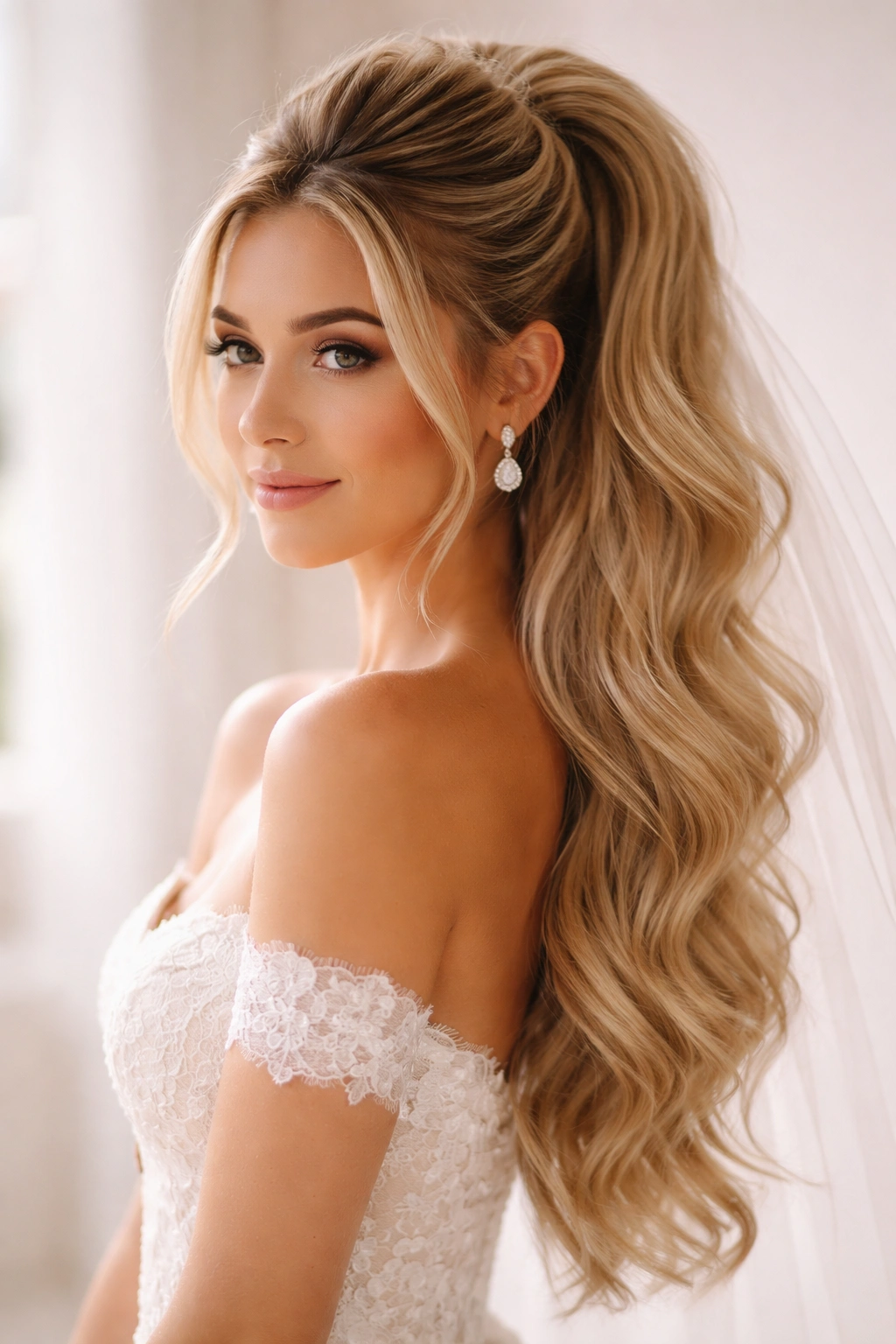
A half-up ponytail is the move when you want volume but still want hair draped around the shoulders. It gives you lift where it matters most — at the crown and through the upper half of the head — while leaving the lower lengths loose and soft.
That makes it a strong pick for brides with curls, waves, or extensions already in place. The top section can be backcombed lightly, pinned higher than you think, and then disguised with a small twist or braid at the base. The bottom half stays out of the way, which helps the whole style feel airy.
It also plays well with veils that attach underneath the top section. Handy. No awkward wrestling with pins after you’ve already gotten dressed.
5. Curly Mid-Height Ponytail
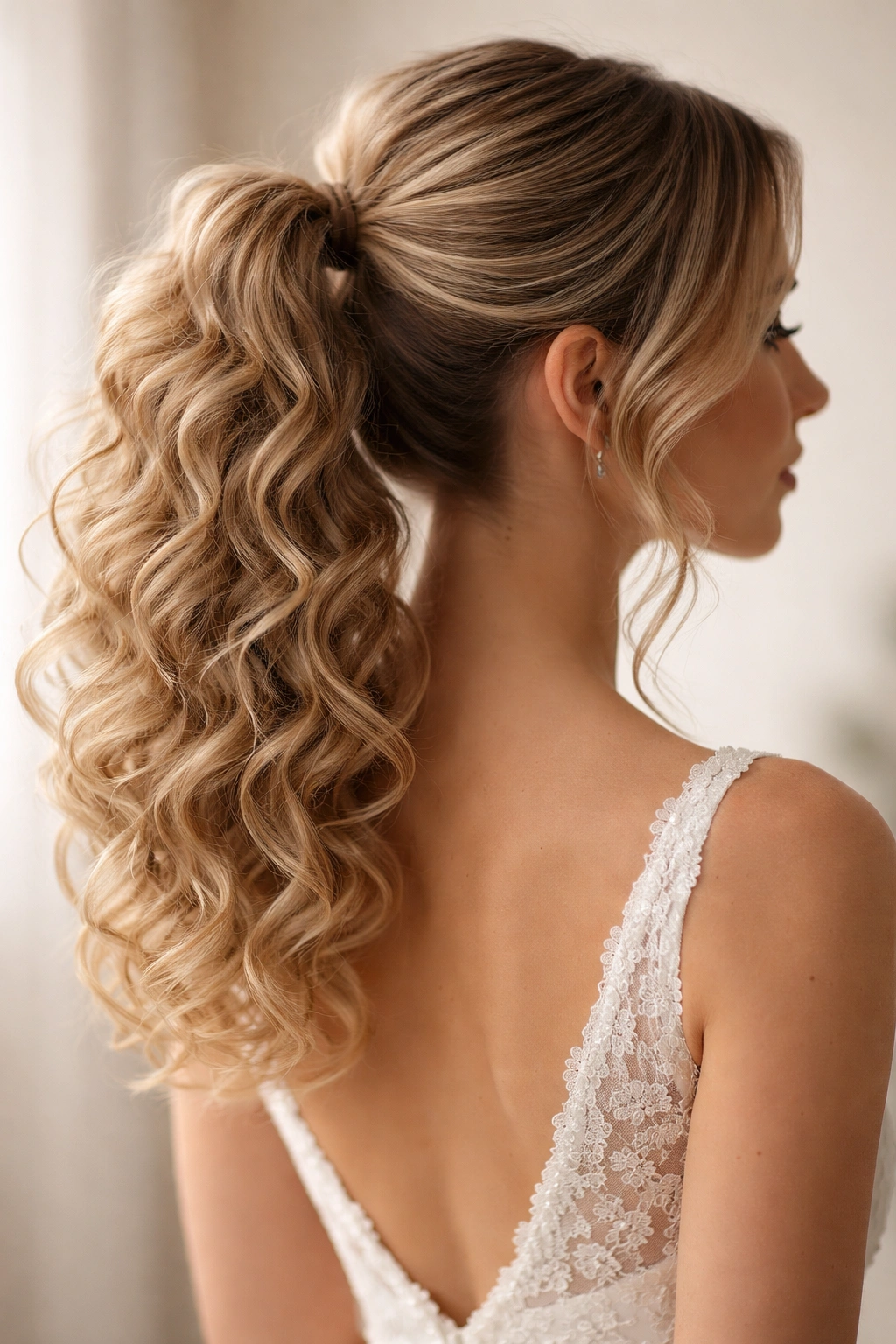
A mid-height ponytail gives curls room to bounce. Put it too low and the shape gets squashed. Put it too high and the curl pattern can look lopsided unless the roots are built carefully.
For weddings, I prefer this style when the hair has a natural wave or a defined curl pattern. The ponytail can sit just above the occipital bone, which keeps it flattering from the side and strong from the back. A few face-framing pieces help soften the line, especially if the dress neckline is structured.
Leave the ends loose and touchable. A curl that moves a little when you turn your head always looks better than one sprayed into a shell.
6. High Glam Ponytail With Curtain Bangs
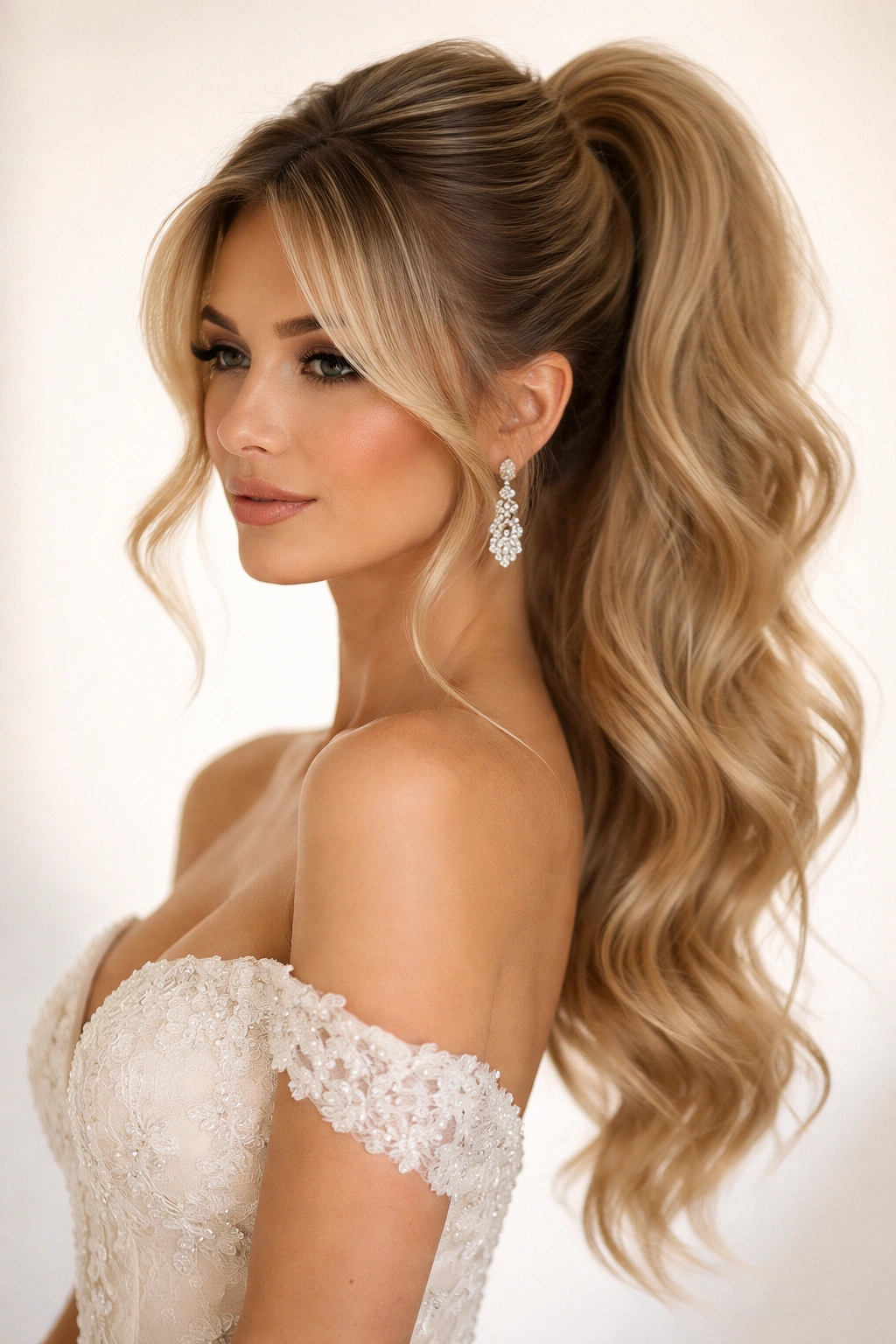
A high ponytail with curtain bangs has a lot of attitude, and that is exactly why it works for some weddings. The volume sits high, the face-framing fringe breaks up the forehead, and the tail falls with enough lift to look deliberate.
This style is strongest when the crown is blown out first, then lightly teased. Curtain bangs should fall softly to each side, not sit in a hard line. If the bangs are too blunt or too polished, the whole look starts feeling dated.
A bride in a minimalist dress can wear this and still look finished. The hairstyle brings the energy.
7. Low Ponytail With Face-Framing Tendrils
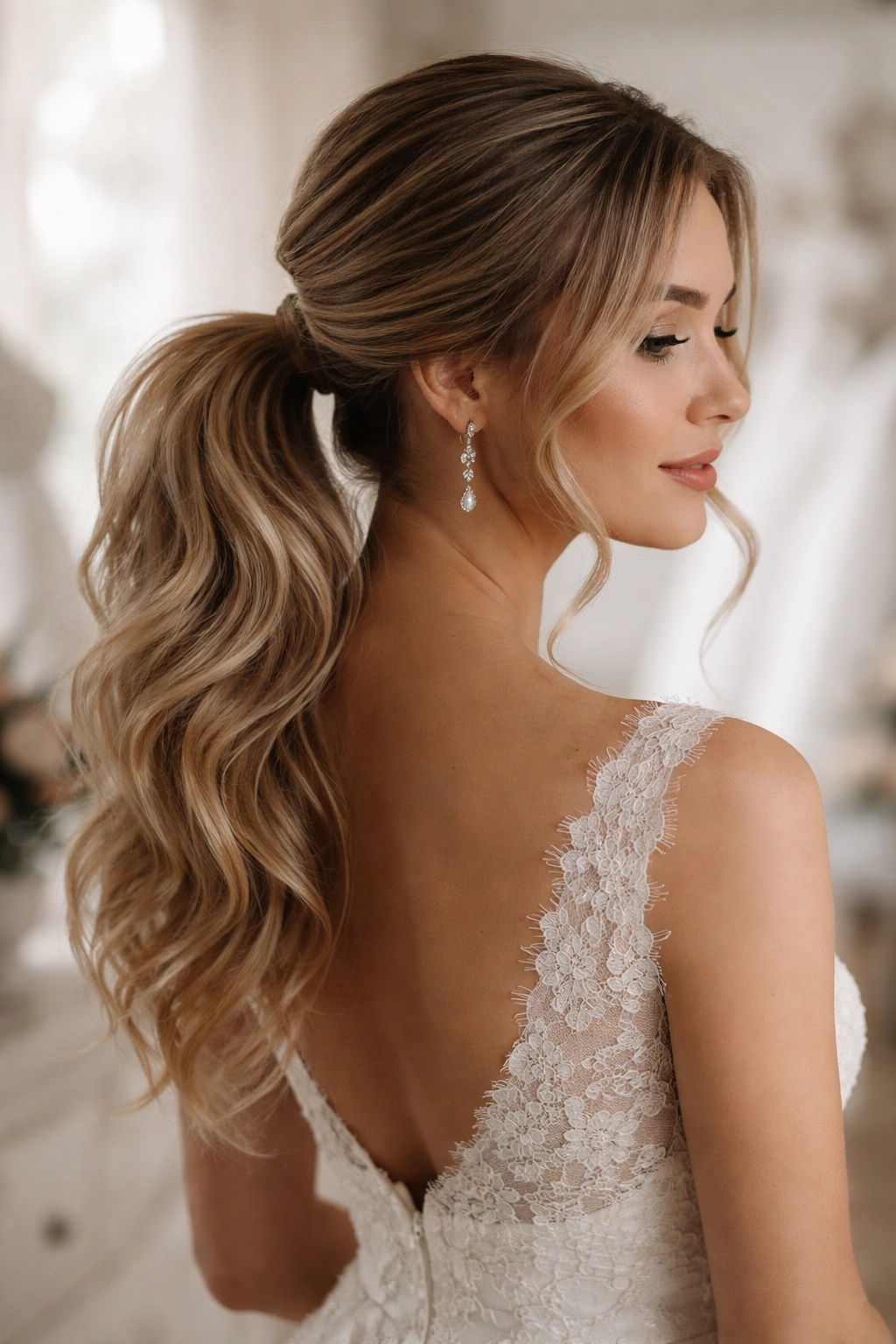
Want something softer than a tight bun but less polished than a runway ponytail? This is the one. A low ponytail with loose tendrils around the face gives you movement near the cheeks and volume through the tail, which is a nice middle ground for romantic weddings.
What to Leave Loose
The pieces around the face should be thin enough to move, but not so thin they disappear. Think two small sections, one on each side, with a gentle bend from a flat iron or small barrel iron. The ponytail itself can be tucked slightly fuller at the crown so the style does not collapse into the nape.
This is one of those looks that gets better with a few hours of wear. The softened pieces settle in, and the whole thing stops looking freshly styled in the best possible way.
8. Braided Crown Into a Ponytail
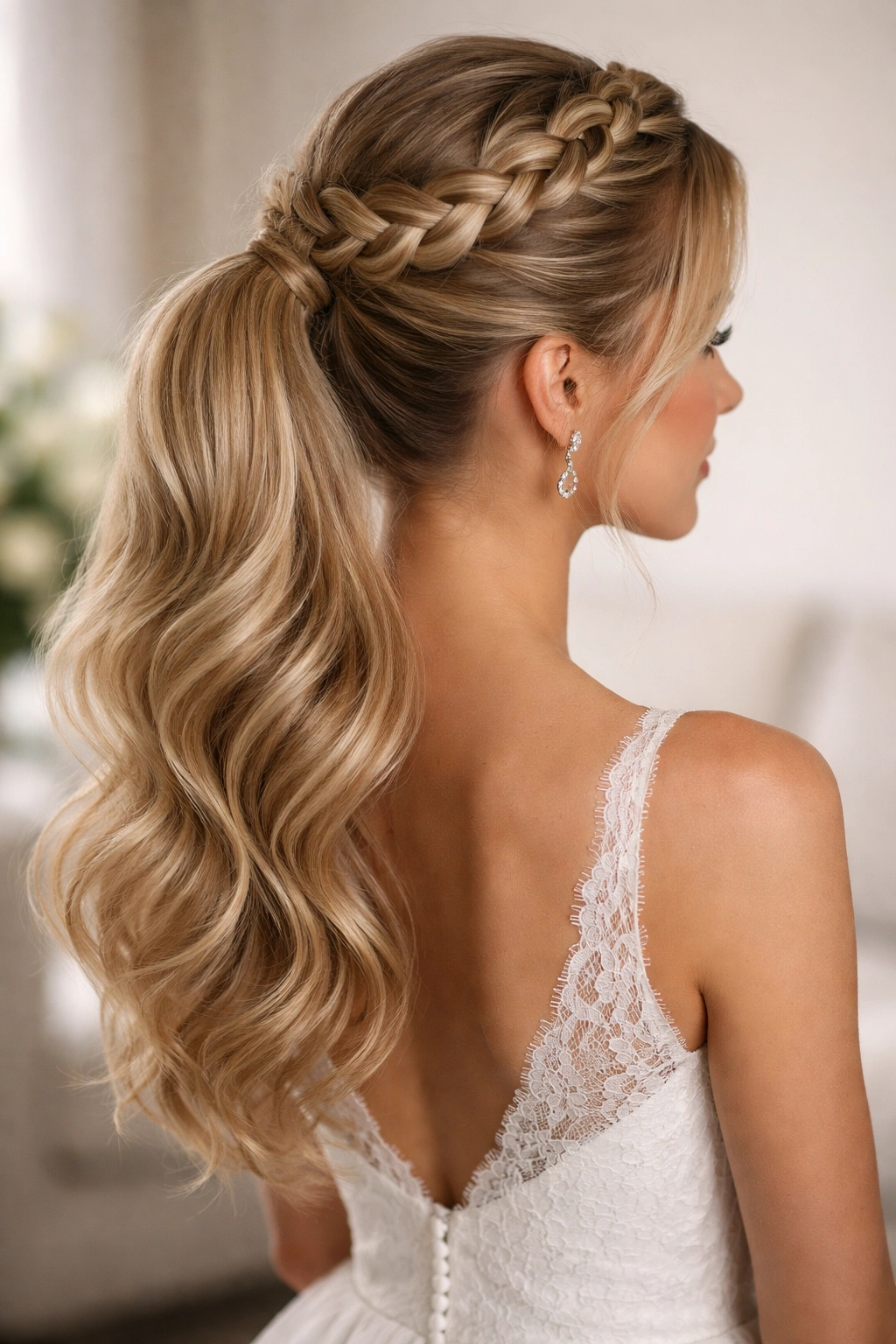
A braided crown gives volume the moment it starts. Instead of teasing the whole head, you build shape with the braid itself, then let it feed into a ponytail that looks fuller at the top and easier through the lengths.
The braid also solves a common wedding problem: slick roots that look too plain from the front. A Dutch or French braid along the hairline adds texture and keeps the hair from slipping back, which matters if the bride plans to dance or wear the look for a long stretch.
- Best on hair that holds a wave or curl well.
- Strong with floral pins or a thin gold comb.
- Good for veils that sit low on the crown.
- Easier to refresh than a fully teased style.
9. Textured Ponytail With a Tiny Accent Braid
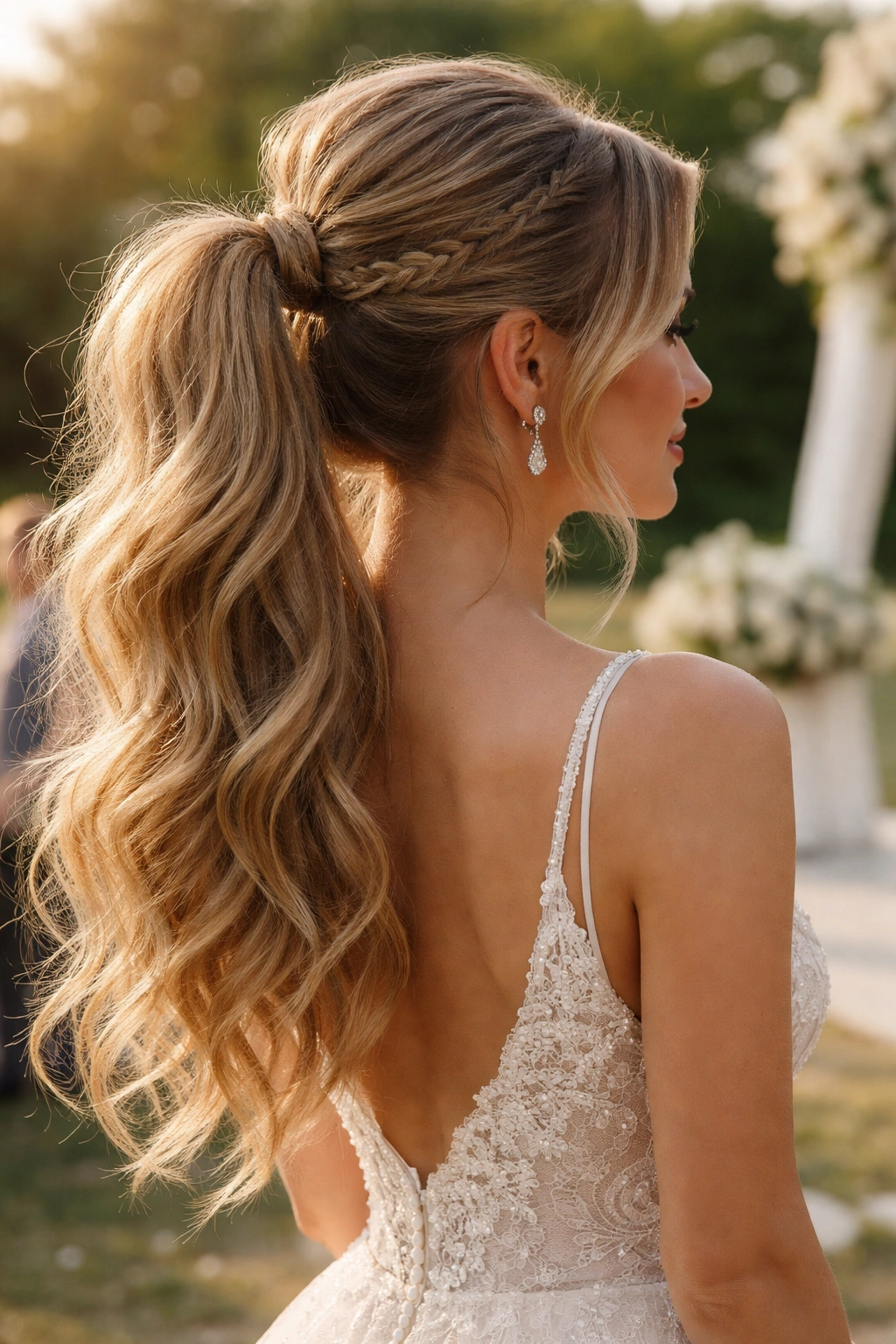
A tiny braid tucked into one side of the ponytail sounds small, but it changes the whole read of the style. It breaks up the surface just enough to keep the ponytail from looking like one smooth mass of hair.
The volume here comes from texture, not height. Mist the hair with dry shampoo or texture spray, rough up the crown lightly, then add one narrow braid near the temple or just behind the ear. The ponytail can stay mid-height, with loose bends through the tail so it feels touchable.
I like this for outdoor ceremonies and less formal dresses. It has polish, but it does not feel precious.
10. Extra-Long Ponytail With Extension Length
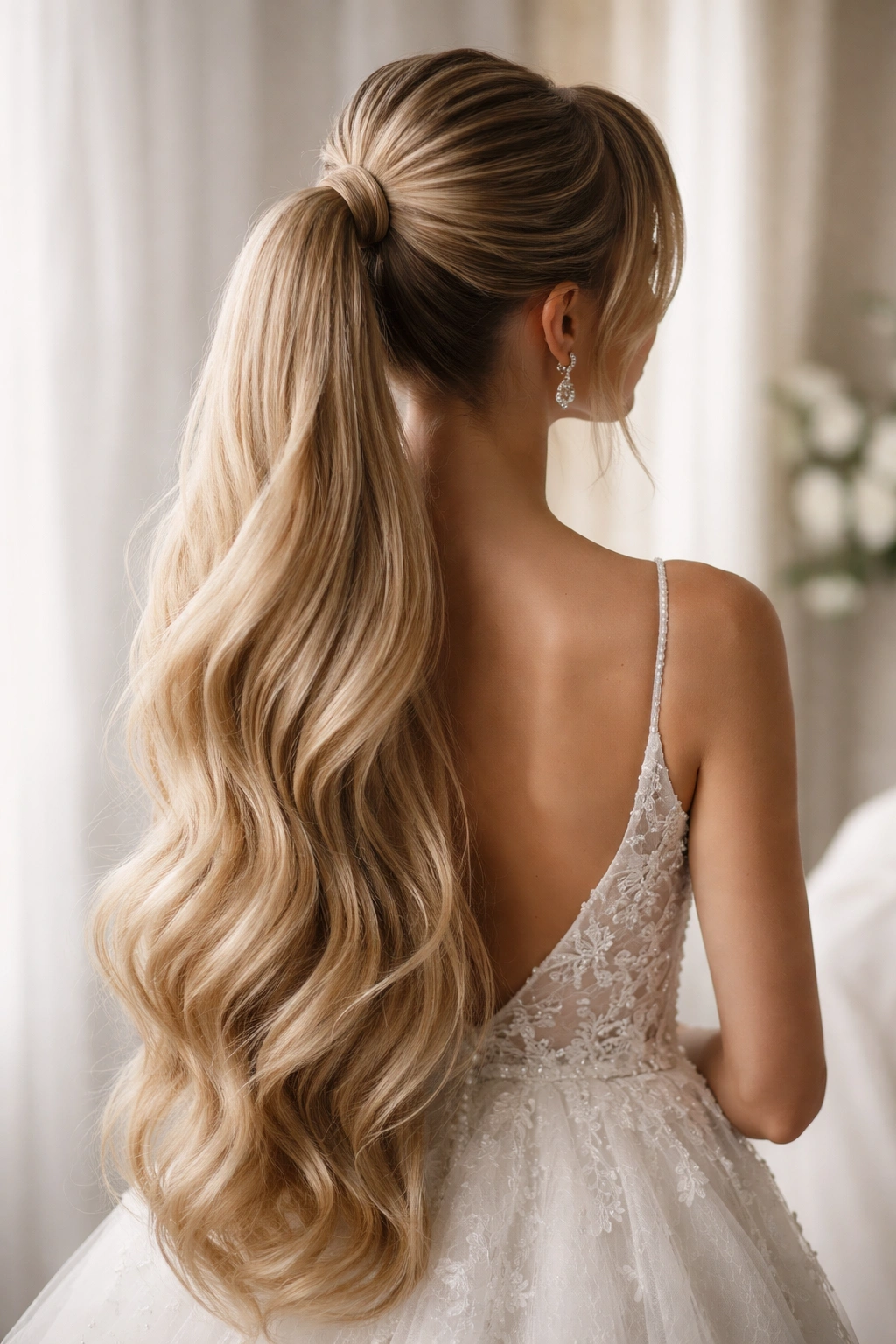
Long ponytails are a different animal. Once the tail starts swinging past the shoulder blades, it becomes the main event, so the base needs to be compact and the crown needs enough lift to support all that length.
How to Fake the Length
Extensions should be clipped or sewn in close to the base, then concealed with a small wrap of hair or a velvet tie if you want the finish to feel softer. The lengths can be curled in big sections, then brushed out lightly so they fall in thick ribbons instead of tight spirals.
This style works when a bride wants drama from the back. It photographs from the aisle, from the dance floor, and from every angle in between. Small heads-up: it does need sturdy pins and a strong elastic. No flimsy ties here.
11. Bouffant Ponytail With Soft Ends
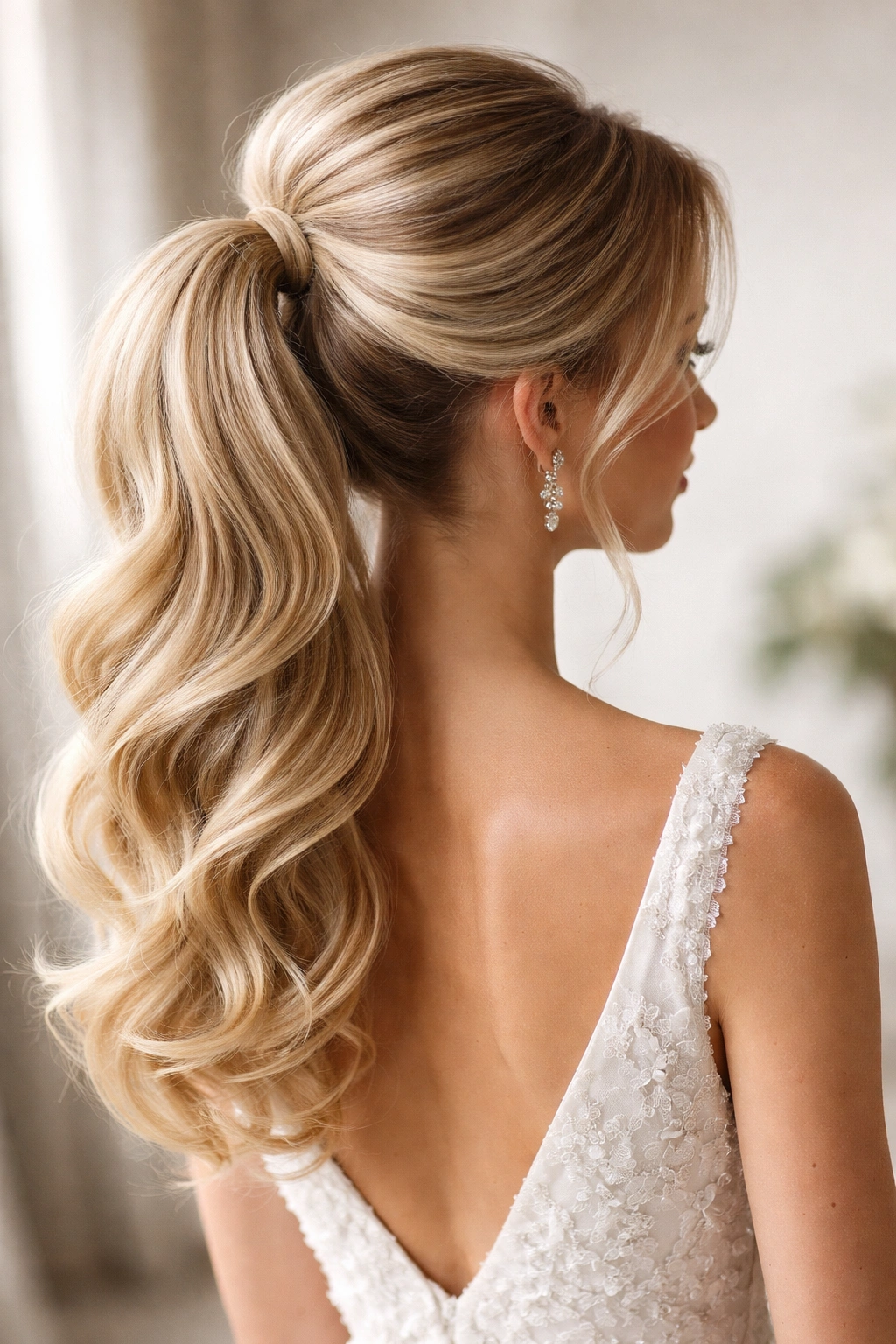
A bouffant is old-school in the best way. You build volume right at the crown, smooth the surface just enough to keep it elegant, and let the ponytail drop in a way that feels full without looking overworked.
The key is not to over-tease. You want lift, not a nest. A round brush and a light mist of flexible spray usually do more good than a mountain of backcombing. The ends can stay softly curled so the look feels bridal rather than costume-like.
This is one of my favorite choices for a gown with a clean neckline. It gives you presence up top and keeps the profile strong.
12. Fishtail-Wrapped Ponytail
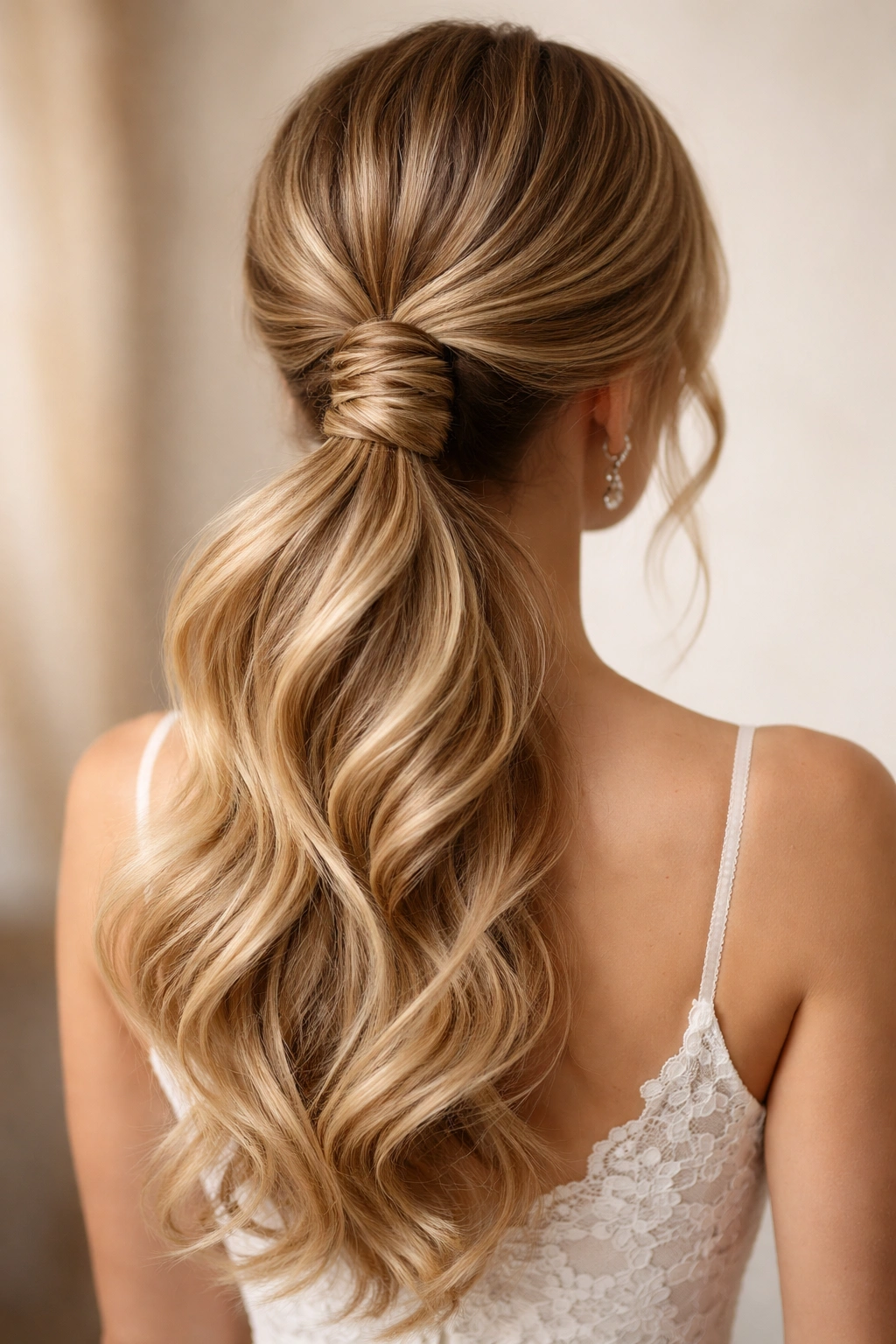
A fishtail wrap adds texture where the eye lands first. Instead of a plain strand around the elastic, you braid a small section into a fishtail and wind that around the base, which makes the ponytail look more detailed without needing extra height.
The rest of the hair can stay loose and thick, with waves brushed into broad pieces. That contrast matters. If everything is braided or everything is smooth, the style loses shape. Here, the braid is the accent, and the ponytail stays the star.
This version suits brides who like detail but do not want jewels or clips. Quietly pretty. Not plain.
13. Satin-Smooth Ponytail With Big Root Lift
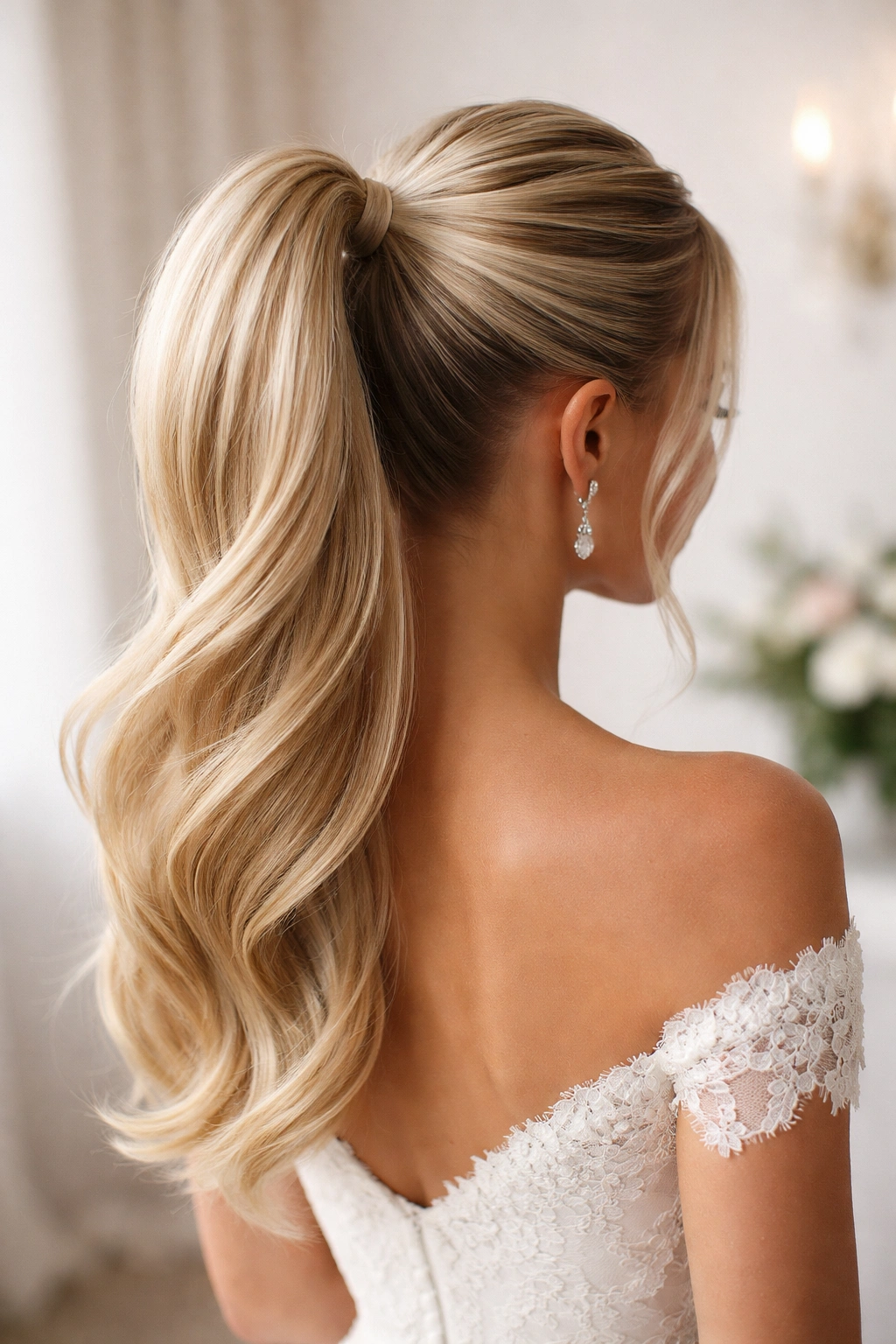
A satin-smooth wedding ponytail sounds simple until you see it in person. The shine on top, the clean part, and the high root lift make the style look carefully built, not flat or severe.
The secret is prep. Blow the hair out with tension, set the roots with clips while it cools, then smooth the surface with a light serum. The ponytail itself can fall straight or curl under slightly at the ends, depending on the dress and the mood.
This style is clean enough for modern gowns, but it still has volume where it counts. It does not need a lot of decoration. The shape does the work.
14. Messy Romantic Ponytail With Loose Waves
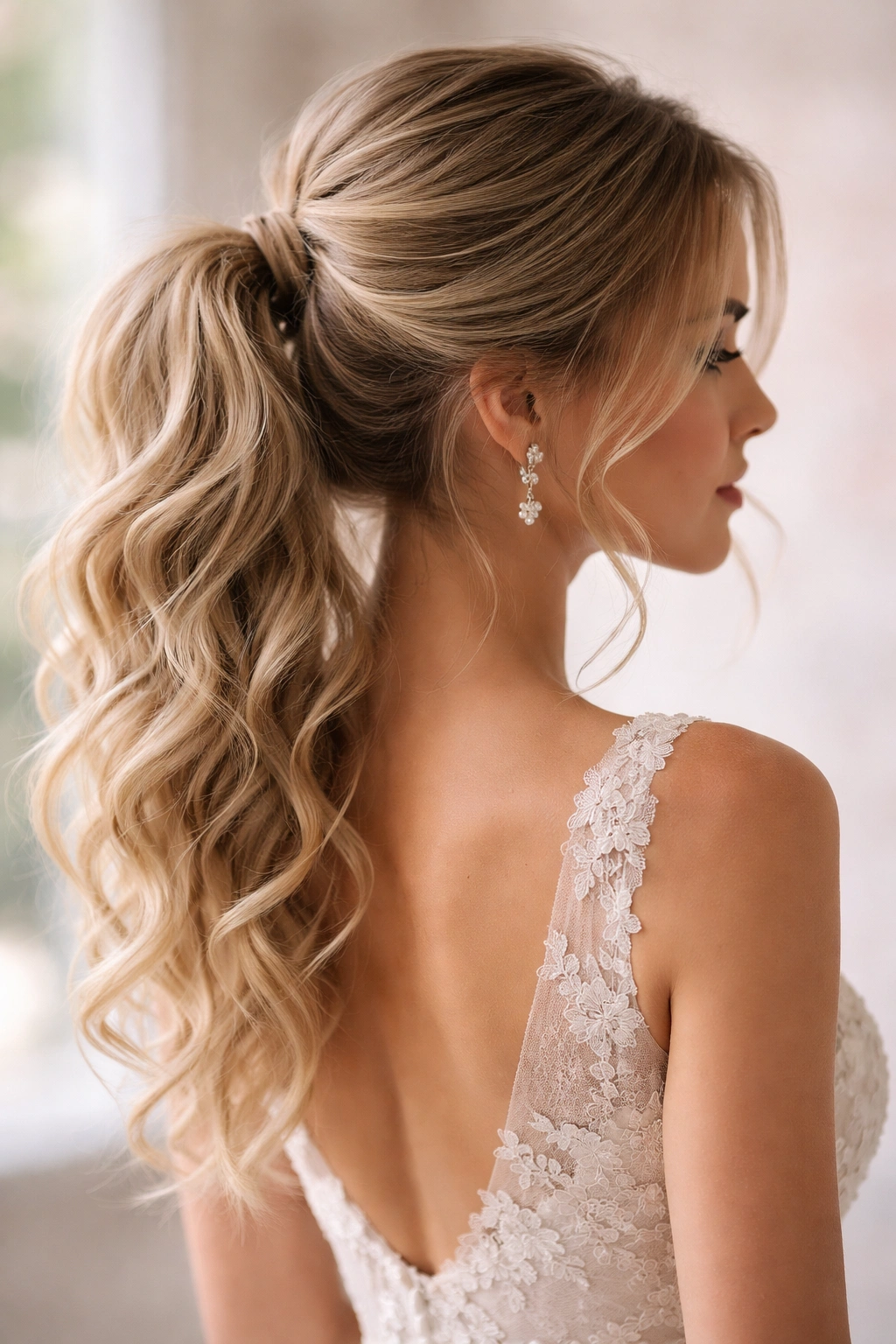
Messy does not have to mean sloppy. A romantic ponytail with soft waves, a few airy strands, and a little lift at the crown can feel dreamy in a way that a stricter style never will.
I like this when the bride wants movement. The hair should look like it has been touched, turned, and lived in for a few hours, not sprayed into place with a shellac finish. Curl the lengths, shake them out, then gather the hair loosely so the volume stays visible from the side.
A few small pins or pearl clips can keep the top from getting too undone. That’s the line to walk.
- Soft texture through the tail.
- A touch of height at the crown.
- Face-framing pieces that bend, not hang straight.
- A flexible spray finish, not a stiff one.
15. Ponytail With a Statement Hair Accessory
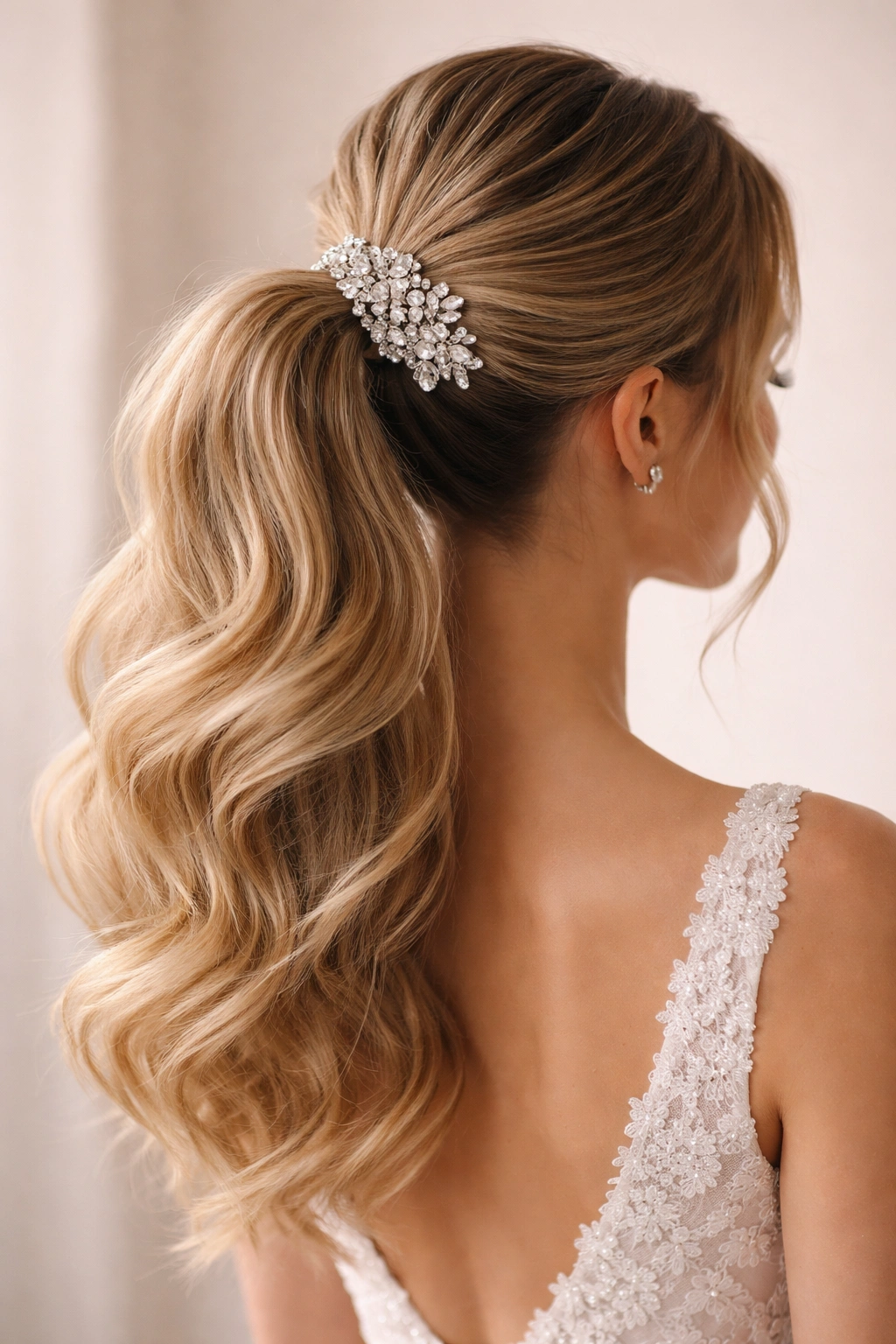
If the dress is simple, the hair can carry the shine. A statement comb, crystal barrette, or brushed-gold clip near the base of a full ponytail turns the whole style into something special without needing an elaborate structure.
Where the Clip Should Sit
Place the accessory just above the elastic or slightly off-center if the ponytail is side-swept. That keeps the visual weight near the base, where it can support the volume instead of fighting it. If the clip sits too high, the look starts to feel disconnected.
The ponytail itself should be full enough that the accessory does not overwhelm it. I’d skip this approach if the hair is very fine and the clip is huge. The proportions matter. A lot.
16. Twisted Rope Ponytail
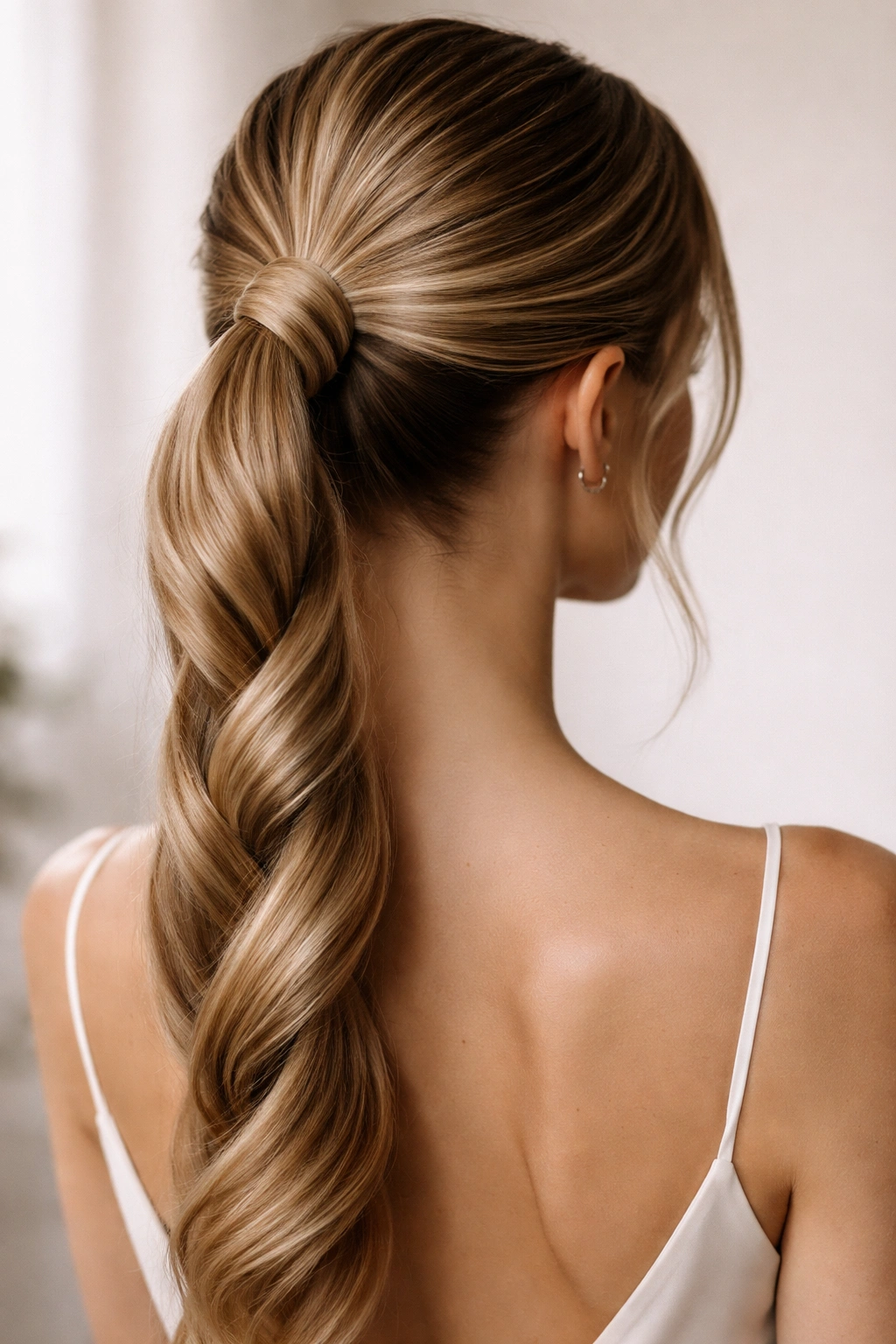
A rope twist gives the ponytail a little tension and shine, which is a nice change from braids and curls. You split the hair into two sections, twist them in the same direction, then wrap them around each other so the shape stays tight and smooth.
That twist creates a subtle spiral down the tail, and it looks polished in photos without needing extra hair accessories. The volume comes from the base, where the roots are lifted and the ponytail is set a touch higher than the nape.
This works especially well with minimalist dresses and sharp makeup. It has structure. It knows what it is doing.
17. Center-Part Ponytail With Soft Waves
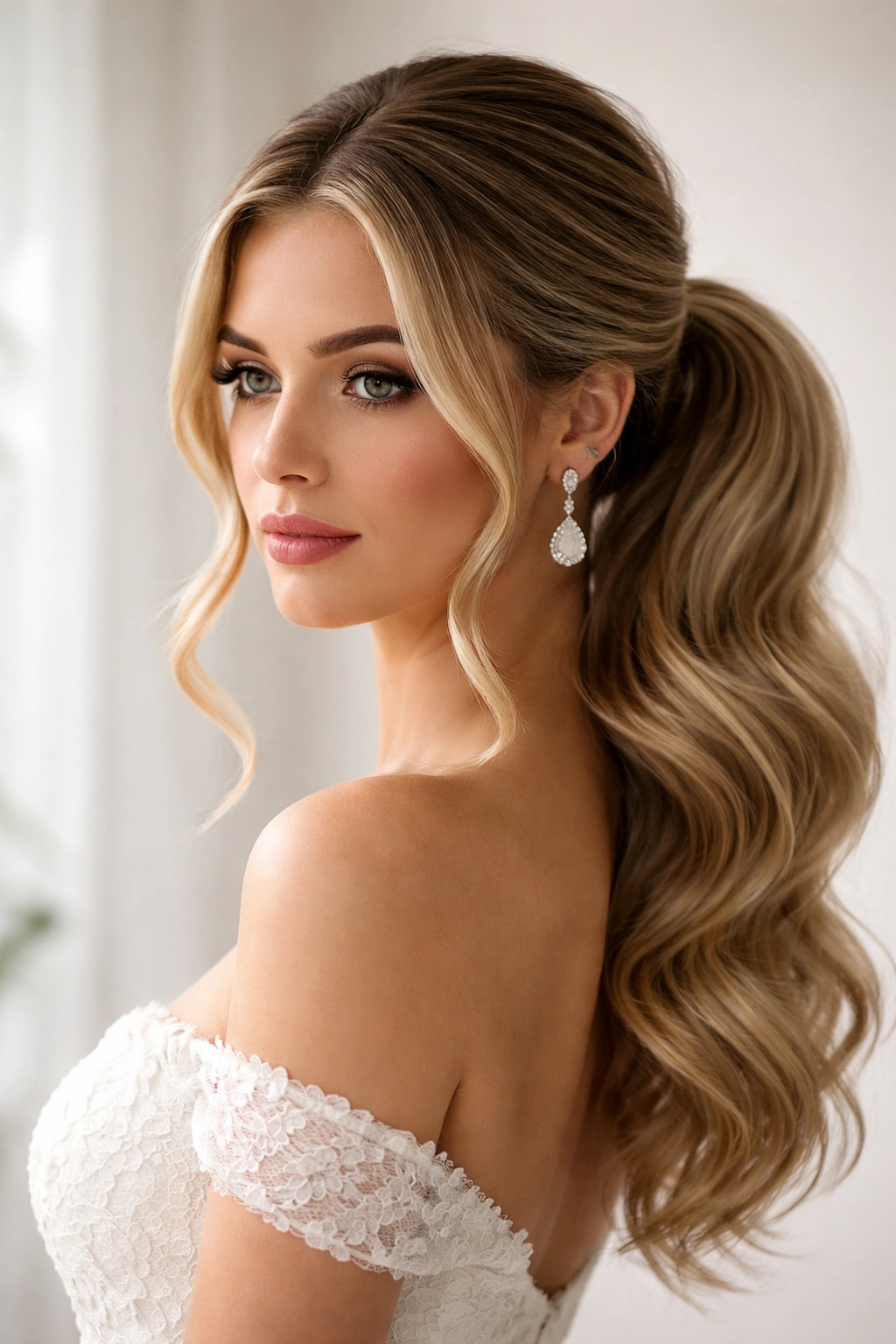
A center part gives a ponytail symmetry, and symmetry can look expensive when the rest of the hair has enough fullness to support it. The front sections frame the face evenly, while the ponytail itself sits low or mid-height with broad, brushed waves.
The first thing you notice is the clean line at the top. The second is the softness in the tail. That contrast is what keeps the look from feeling severe. I like a center-part ponytail for brides who want modern shape but not slicked-back hardness.
If the hair is fine, a little powder at the roots goes a long way. Not much. Just enough to keep the part from collapsing.
18. Pompadour Ponytail
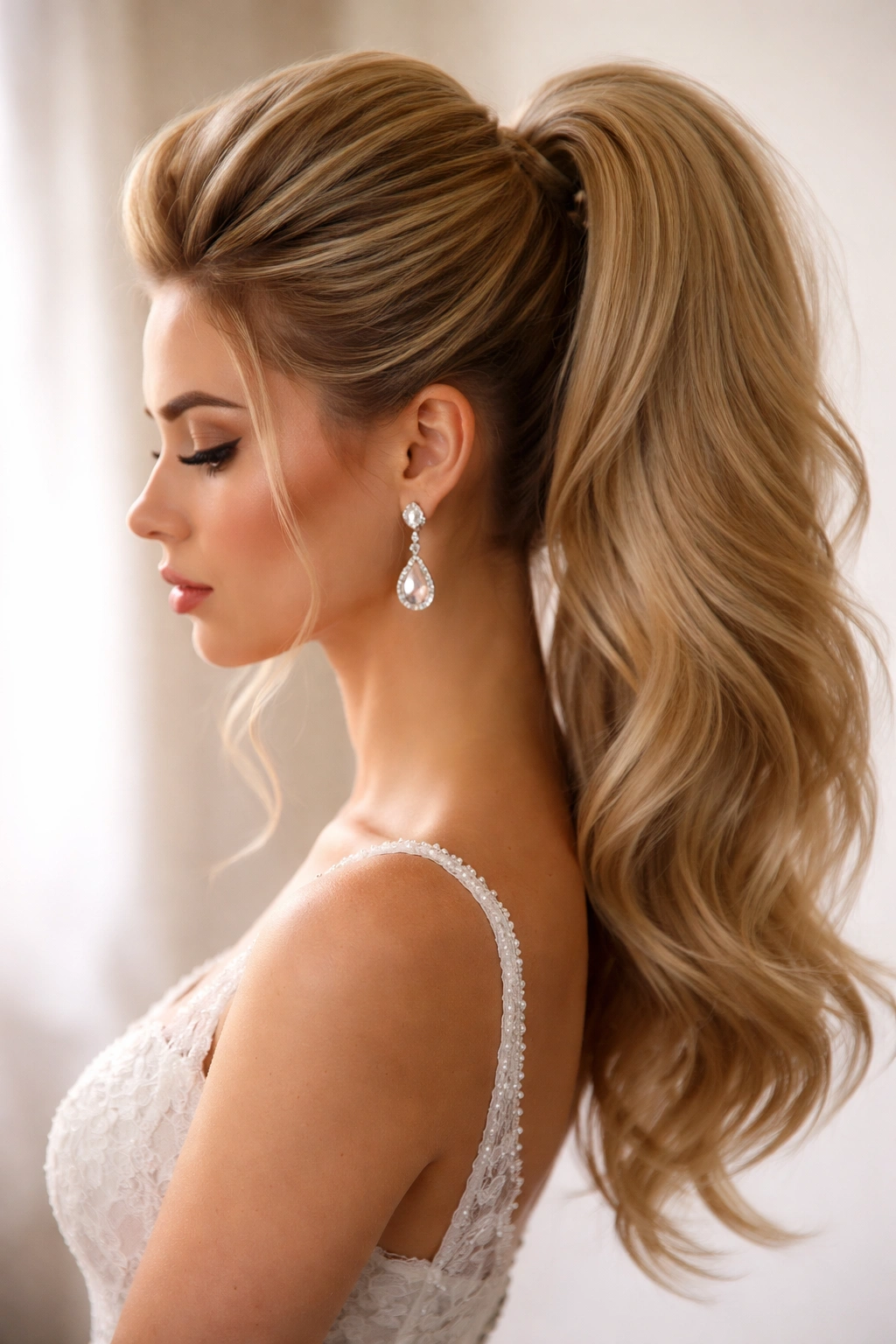
A pompadour ponytail builds drama right where you want it: at the front. The hair is lifted and rolled back at the hairline, creating a gentle crest before it meets the ponytail, which makes the whole style feel bolder than a standard high ponytail.
This is a great choice for brides who like a little edge. It pairs well with sharp tailoring, square necklines, and dresses that need a hairstyle with shape. The tail can be curled or left smooth, but the front needs height. Without that, the look loses its point.
There is a reason this style has staying power. It gives volume in a way that reads intentional from across the room.
19. Double-Texture Ponytail
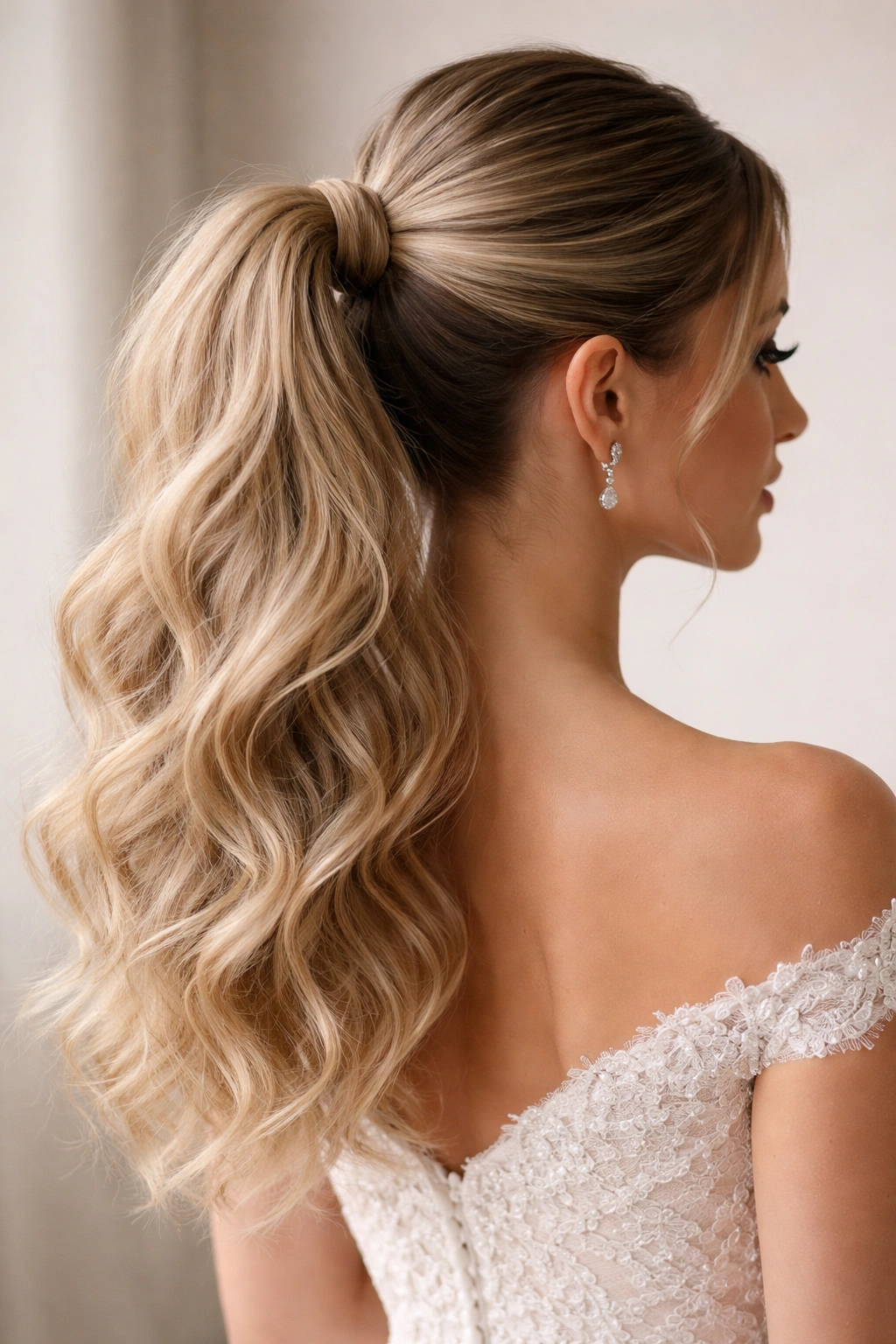
Why choose between sleek and textured when you can have both? A double-texture ponytail keeps the crown smooth and controlled, then lets the lower lengths go fuller, wavier, or more curled.
That split in texture makes the style feel more expensive than a one-note ponytail. The top section can be brushed tight and wrapped cleanly, while the tail gets broad bends with a large iron or hot rollers. The result is movement without chaos.
It’s a smart option for brides who want the front to stay neat but still want the back to feel rich and soft. Good for gowns with detail at the bodice. Good for veils, too.
20. Ponytail With Pearls Pinned Through the Lengths
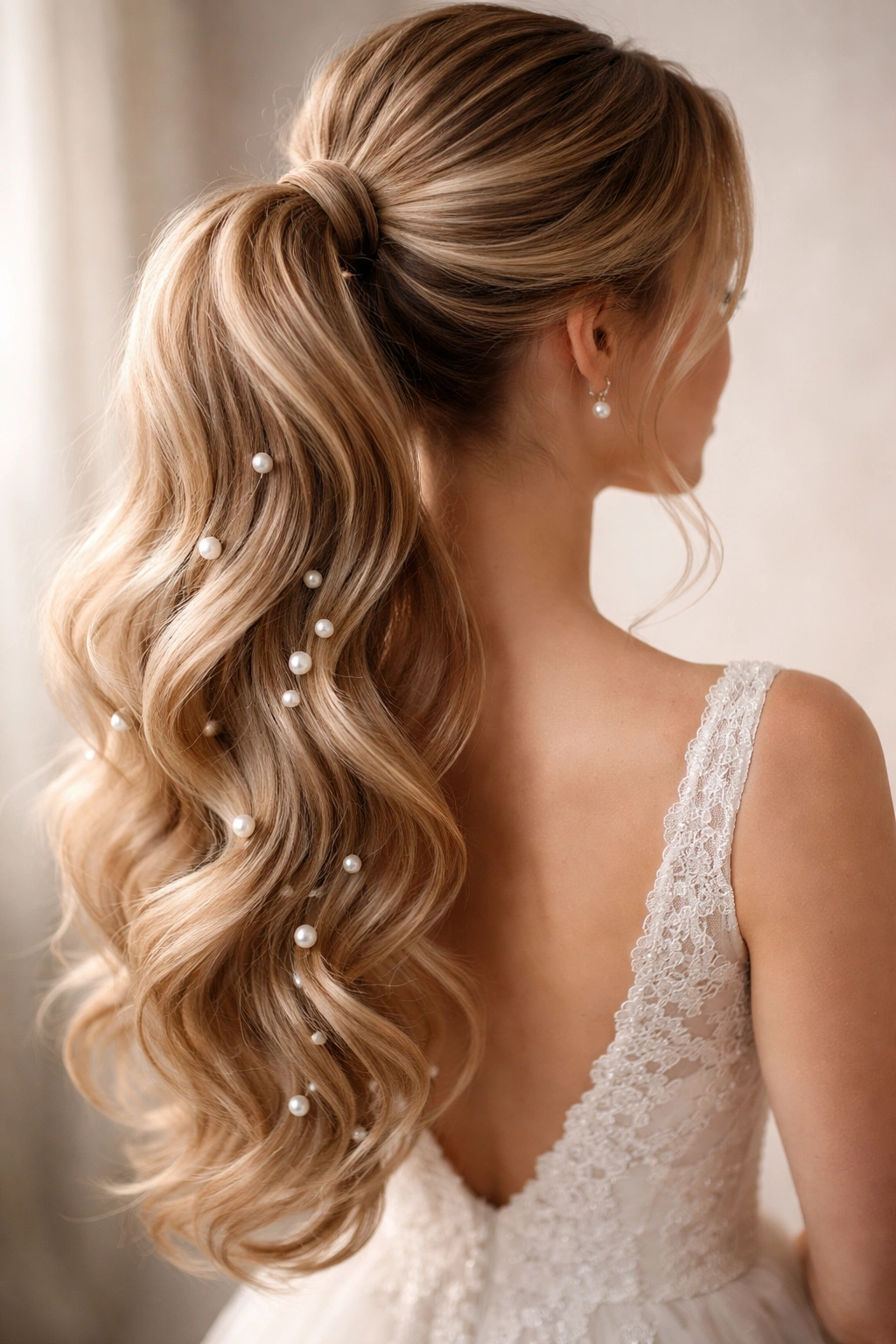
Pearls do not have to sit only at the base or in a comb. Scattered through the lengths of a thick ponytail, they create a dotted line that follows the movement of the hair and keeps the eye traveling downward.
The ponytail should be full first. Then the pearls can be pinned into selected curls or waved sections so they look placed, not random. If you use too many, the style starts to tip into costume territory. A few well-set pins are enough.
This one feels especially nice for evening weddings or gowns with pearl beading. It connects the dress and hair without copying the dress too literally, which is the trap people sometimes fall into.
21. Low Knotted Ponytail
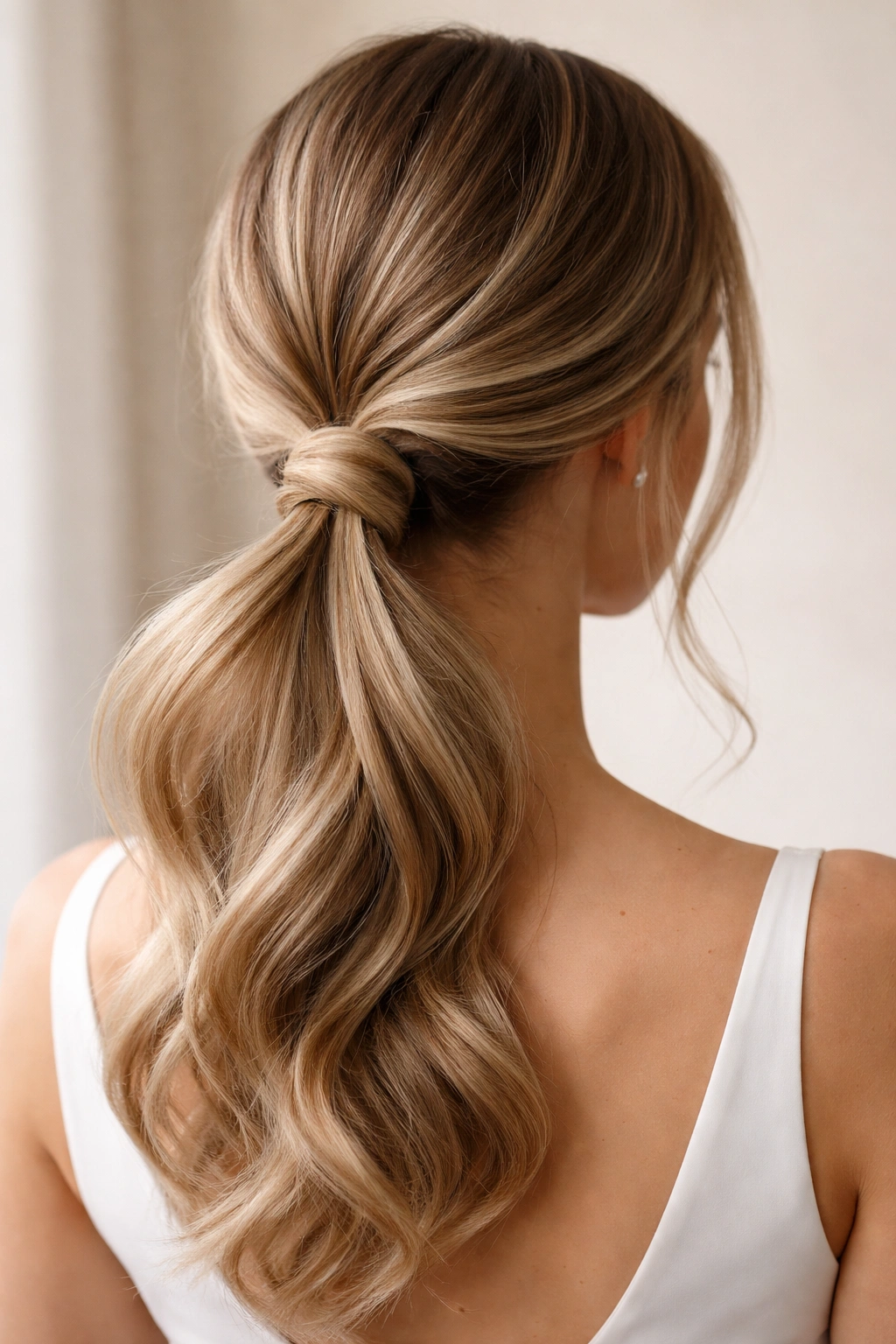
A knotted ponytail sounds casual, but on wedding hair it can read as polished and unexpected. Two sections of hair are tied or twisted together at the base, then secured into a low ponytail so the knot becomes the focal point.
The shape gives you a built-in point of interest, which is handy if the dress is minimalist and the bride wants something that looks styled from the back. Keep the knot smooth and the tail soft. If the knot is too loose, it turns messy; too tight, and it looks stiff.
I like this most on medium-thick hair. It holds the shape without swallowing the detail.
22. Curly Ponytail With Volume at the Ends
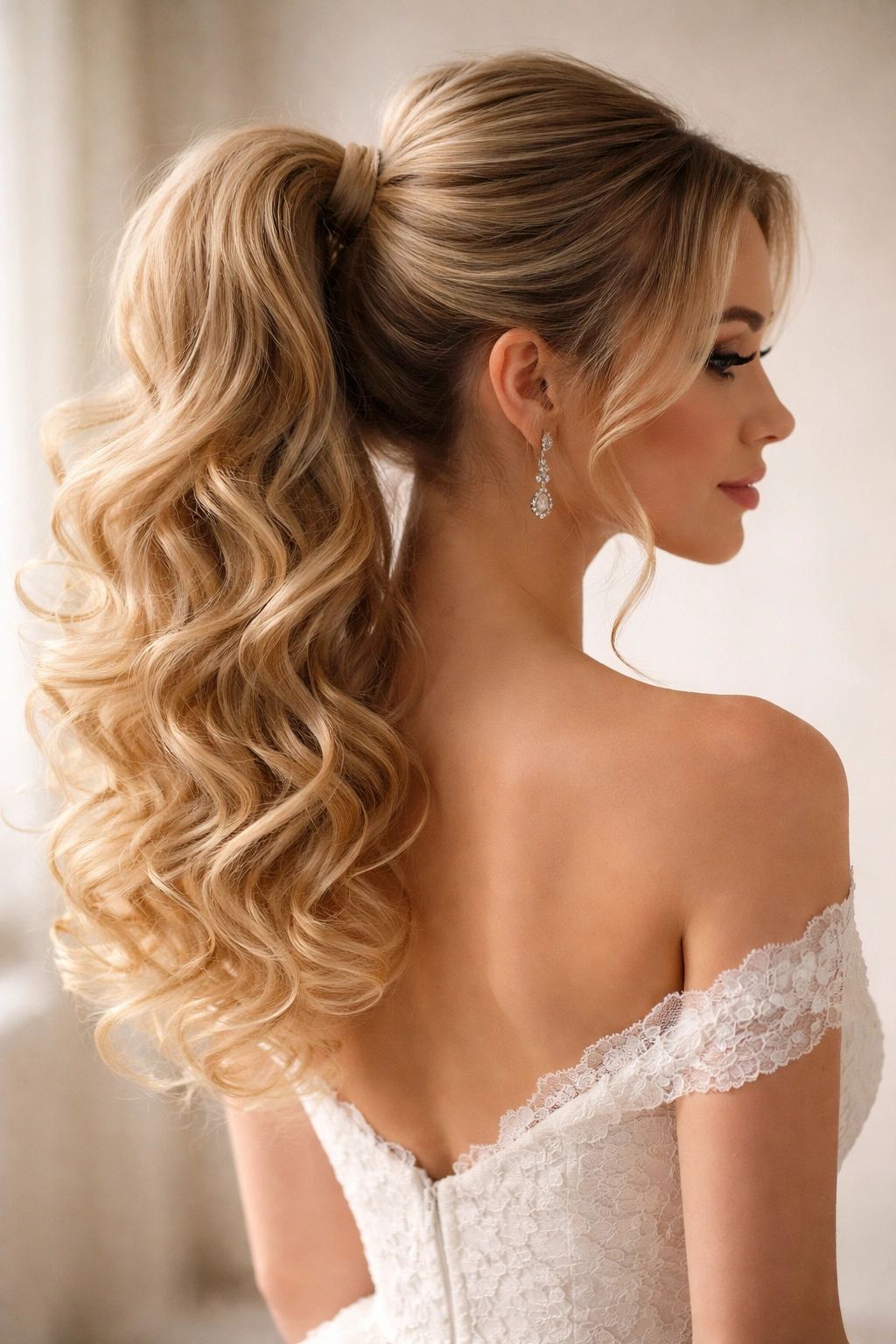
A curly ponytail can look heavy at the base if all the curl lives near the scalp. Shift that volume lower, and the style feels lighter, longer, and a little more playful.
That means building a neat base, then letting the curls stack and open through the bottom half of the tail. The ends should look full and springy, not frayed. A little shine cream on the tips helps the curl pattern stay visible without getting crunchy.
This is a smart choice for brides who want motion. Every turn of the head changes the shape. Very alive. Very photogenic from the side.
23. Side-Part Ponytail With Face-Defining Height
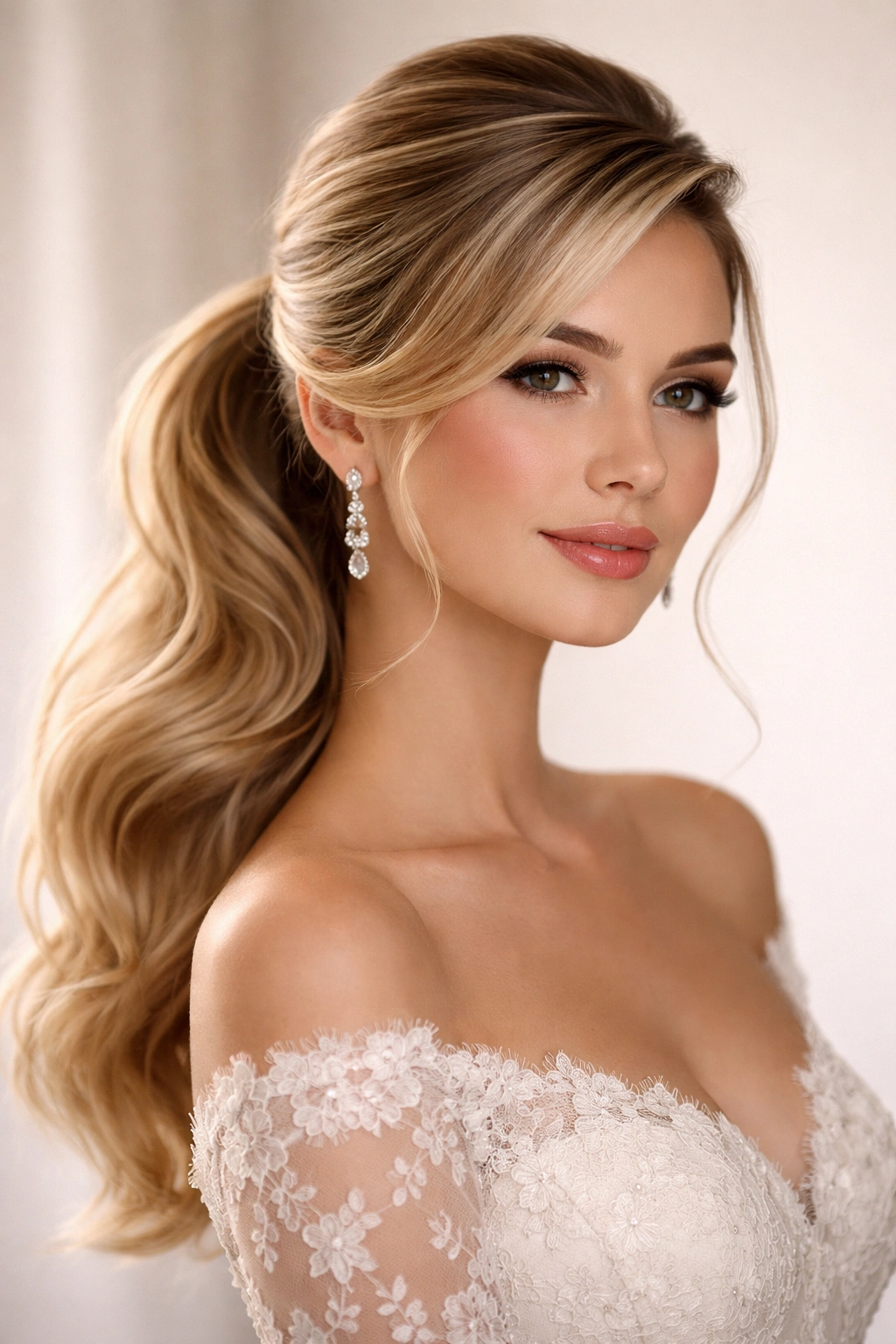
A strong side part changes a ponytail fast. It adds height on one side of the crown, draws the eye across the face, and gives the whole style a little asymmetry, which keeps it from feeling too neat.
The ponytail can sit low, mid, or just above the neck, but the front needs lift. I’d use this for dresses with one sleeve, asymmetric necklines, or very clean straps. The part becomes part of the design instead of an afterthought.
A fine-tooth comb helps set the part, but don’t drag the hair flat. Leave a little air at the roots. That’s the good stuff.
24. Ponytail Tied With Ribbon
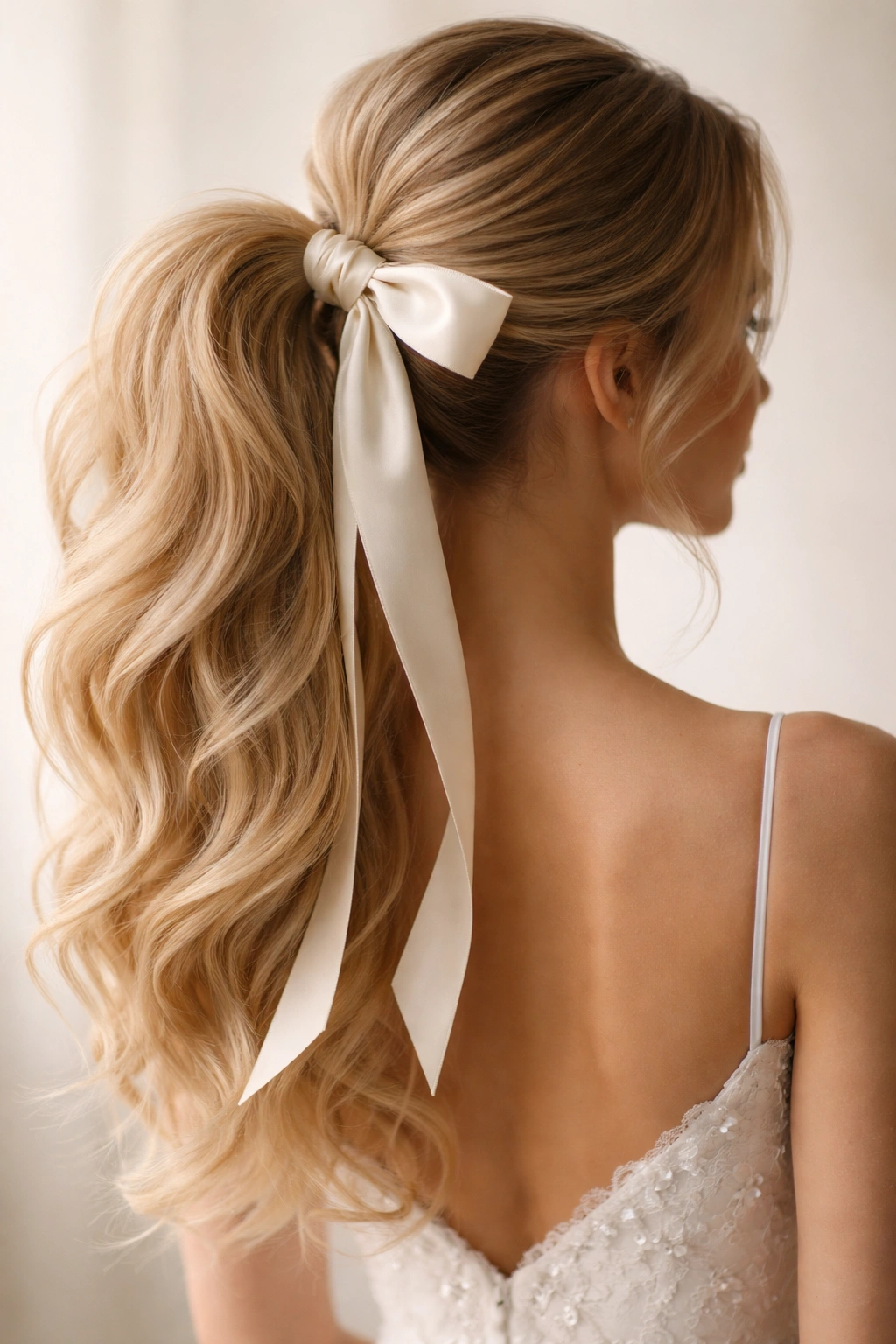
A ribbon tied around a voluminous ponytail feels soft in a way that metal clips never can. Satin ribbon gives shine, velvet gives depth, and a sheer ribbon can make the whole style feel lighter.
The ponytail should already have shape before the ribbon goes on. Otherwise the bow becomes the only thing people notice, and the hair underneath looks thin by comparison. Curl the tail, fluff it out, then tie the ribbon low around the base or let long tails trail down the back.
This works for garden weddings, indoor ceremonies, and brides who want a touch of romance without piling on accessories.
25. Faux-Hawk Voluminous Ponytail
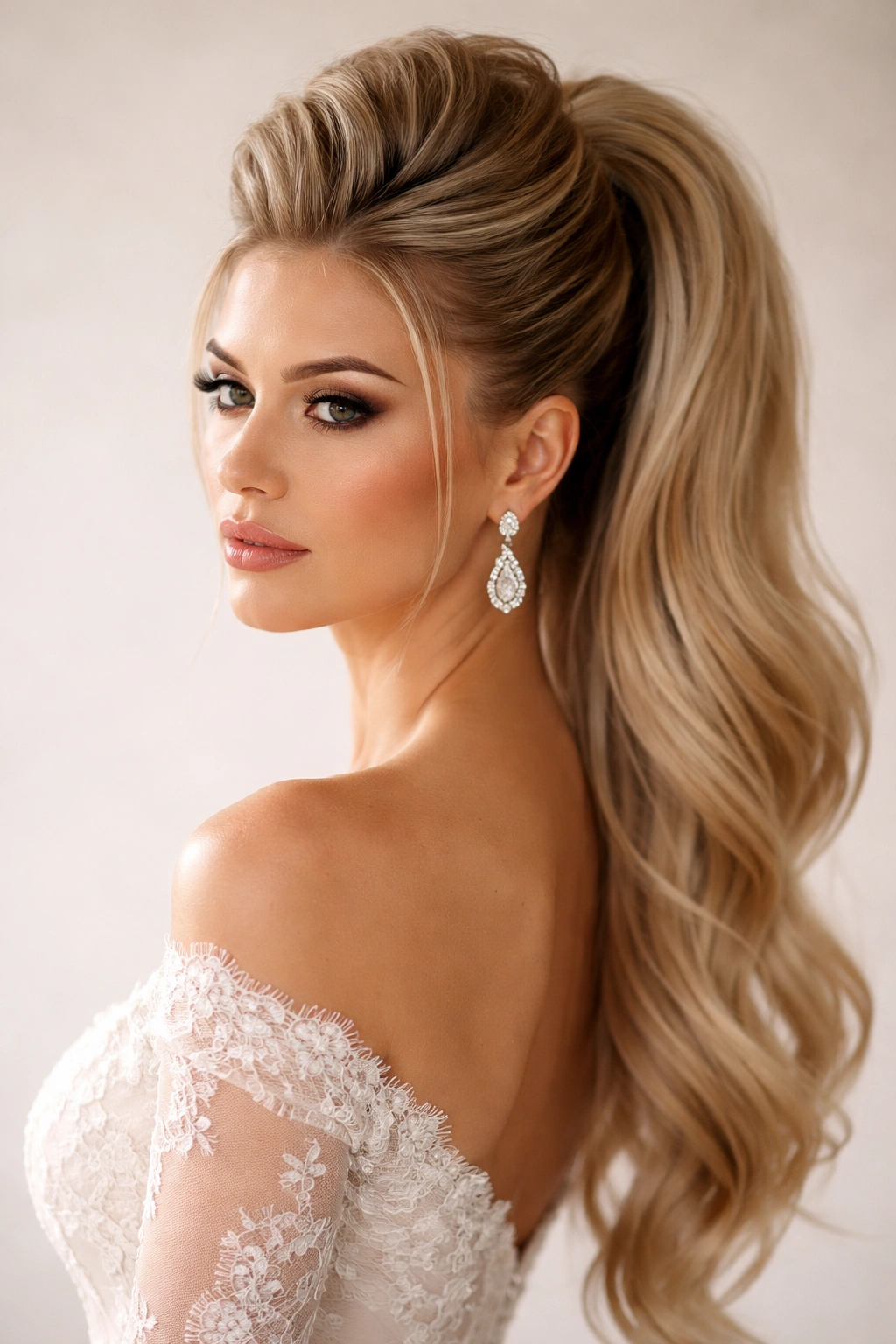
A faux-hawk ponytail is for the bride who likes a little swagger. The sides are kept tighter, the center is lifted higher, and the ponytail itself continues that line so the whole style feels long and lean with a strong top shape.
This is the least shy look in the bunch. It’s also practical, because the height keeps the style visible from every angle and the tighter sides help it hold up. If your dress has sharp lines or dramatic shoulders, this hairstyle keeps pace.
Not every bride wants softness. Fair enough. Some want shape, and lots of it.
26. Cloud-Like Airy Ponytail
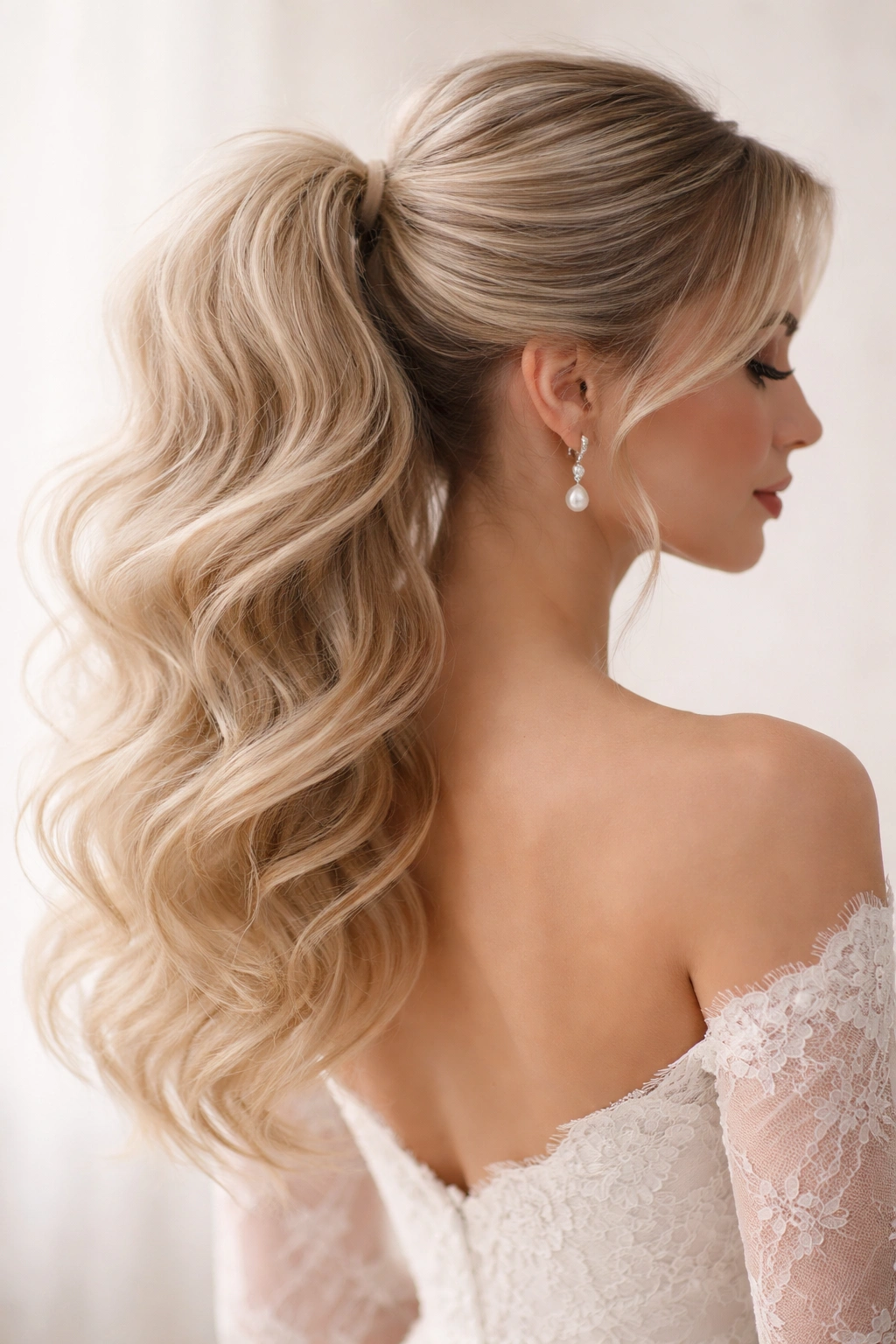
A cloud-like ponytail is built on movement, not hard edges. The hair is curled, brushed out, lifted at the crown, and then allowed to fall in soft, puffy waves that look almost weightless.
The feel here matters. You want the ponytail to move when you walk, not sit in a rigid rope. That means using a flexible spray, separating the curls with your fingers, and leaving enough softness around the hairline that the style breathes. It’s especially good for chiffon dresses, sheer sleeves, and anything that already has a lot of texture.
Pretty. But not fussy.
27. The Dress-Matching Ponytail
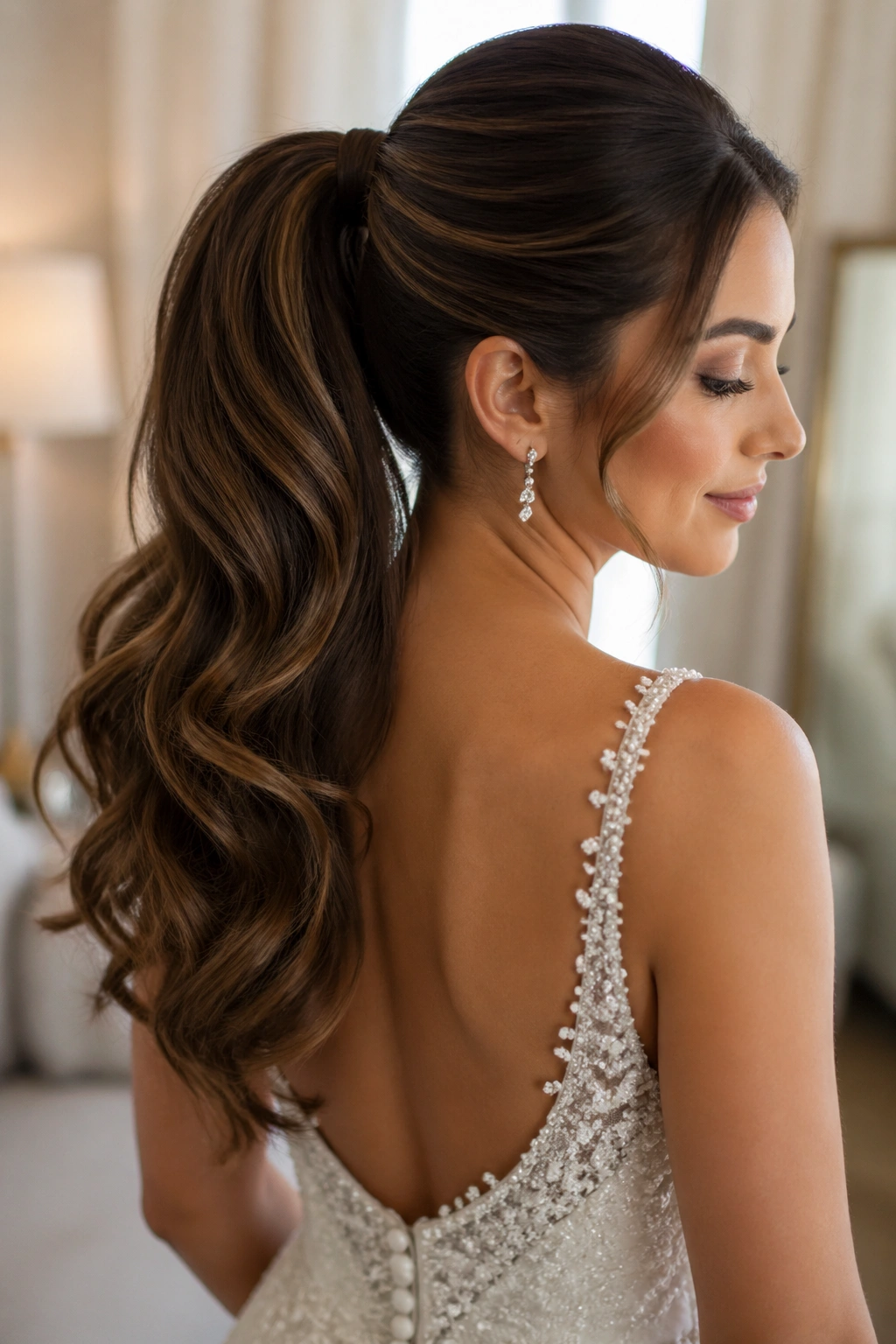
The smartest wedding ponytail is often the one that answers the dress instead of ignoring it. A high neckline usually wants lift and face-framing shape. A deep back can handle a low ponytail with clean lines. A gown with heavy beading may need a simpler tail so the hair doesn’t compete.
That is the part people skip. They pick a style they like in isolation, then wonder why it feels slightly off once the dress goes on. The neckline, earrings, veil placement, and even the fabric weight all change how a ponytail should sit. Pay attention to that, and the hairstyle starts working with the outfit instead of sitting next to it.
If I had to narrow the whole list down, I’d say this: the best voluminous wedding ponytail is the one with enough lift to feel special and enough softness to survive a long day. That usually means some root work, a clean base, and a finish that still moves when you turn your head. Not stiff. Never stiff.