



Thick natural hair is not a problem to solve. It is a specific kind of abundance that requires its own approach — the right techniques, the right products, and braiding styles that actually work with density rather than fighting it. Afro braid styles for thick hair operate on different rules than braids for fine or medium-density hair: section sizes need adjusting, product amounts increase, drying time factors in differently, and the final result has a visual weight and presence that thin hair simply can’t replicate.
The misunderstanding around thick natural hair is that everything takes longer and costs more and is harder. That’s true for some things. But for braiding specifically, density is often an asset. Thick hair creates fuller, more substantial braids that hold their shape longer, hang with more presence, and look more dramatic at every length. The braider who knows how to work with thick afro hair will tell you this openly: it’s satisfying to work with because the result is always substantial.
The challenge is tension management. Thick hair requires more of it to braid cleanly, which means the risk of over-tightening is real. Every braiding style on this list can be done beautifully on thick afro hair as long as the installation prioritizes scalp health alongside aesthetics.
Why Thick Hair Changes the Braiding Equation
Hair density — the number of individual strands per square inch of scalp — determines how much hair is in each section when braiding. Dense, thick afro hair can easily triple the volume of a section that would look standard on fine hair. This changes several things practically.
First, installation time is longer. Cornrows on fine hair might take 2-3 hours. On thick afro hair, the same cornrow pattern might take 4-6 hours because each row takes longer to braid through the denser mass. Box braids scale similarly: a medium box braid installation that’s 4 hours on medium-density hair is 7-8 hours on thick hair.
Second, tension is harder to calibrate. With more hair in each section, the pull on the scalp distributes differently. A tension level that feels comfortable on fine hair may be too much on thick hair — or the reverse. Communicate constantly with your braider during installation about comfort level.
Third, the look of the finished style. Thick hair makes every braid style look bigger, fuller, and more substantial. A “medium” box braid on thick hair is often comparable in visual impact to a jumbo braid on thin hair. Size down your section expectations if you want a specific finished size.
Product Requirements for Thick Hair Braiding
The product amounts that work for fine or medium hair underestimate what thick afro hair actually needs. For a thorough pre-braid moisture base, thick hair typically needs:
About 3-4 tablespoons of a deeply penetrating conditioner during the conditioning phase before braiding, left on for a minimum of 30 minutes with heat. A leave-in conditioner applied generously — not the half-pump appropriate for fine hair, but a full tablespoon distributed throughout. And a sealing oil to lock the moisture in before the braider starts working. Jojoba or argan oil work well — they’re light enough not to make the hair feel greasy but substantial enough to seal effectively.
During the installation, a light braid spray or water-based spritz applied to each section just before the braider works on it keeps the hair pliable without making it slippery. Slippery hair braids lose their grip faster.
Managing Scalp Care on Thick Hair During Braid Wear
Thick afro hair can mask scalp issues more than fine hair can. You might not see or feel buildup, dryness, or inflammation as quickly because the volume of hair insulates the scalp. This means intentional scalp care during braid wear is more important, not less.
Every 2-3 days, apply a lightweight scalp oil — diluted tea tree in jojoba oil is excellent for its gentle antiseptic properties — directly to the scalp at the parts. Don’t rely on the oil to absorb down through the bulk of the hair to the scalp; apply it directly where the scalp is exposed. A bottle with a pointed applicator tip makes this much easier.
At the 4-6 week mark, most thick-haired women start to feel scalp buildup even with regular oiling. A diluted apple cider vinegar rinse worked into the scalp before washing at takedown helps clear the buildup without over-stripping.
How Long Should You Keep Braids In?
The standard 6-8 week guidance for braid longevity applies to all hair, but thick afro hair has one advantage and one additional consideration. The advantage: the extra density and volume means the braided sections often stay neater longer because there’s more hair to fill each braid row even as the roots grow out. The braids look less obviously grown-out at week 5 than the same style would on fine hair.
The additional consideration: shed hair. Every person sheds 50-100 hairs per day. With braids in, that shed hair stays inside the braided section rather than falling away. On thick hair, the shed hair accumulates faster simply because there’s more hair overall. Leaving braids in past 8 weeks means more shed hair accumulation, which creates more potential for matting at the root during takedown. Eight weeks is genuinely the maximum for most thick-haired women.
1. Jumbo Box Braids
The jumbo box braid on thick afro hair is a statement. Each braid is large — section sizes roughly an inch square at the scalp — and the finished braids swing with serious weight and presence. On thick hair, jumbo sections create braids that are noticeably substantial at the base, tapering slightly toward the ends.
Why It Works
The scale of jumbo braids matches the scale of thick afro hair’s natural volume, so the style looks proportionate in a way that micro braids on the same hair might not. The braids balance the head and frame the face without being visually overwhelmed by the hair’s density.
- Section size: approximately 1-inch squares for a true jumbo result
- Length options: shoulder to waist, depending on how much extension hair is added
- Expect 5-7 hours for installation on thick hair
Bold tip: Jumbo box braids on thick hair almost always need some thinning of each section before braiding — not the actual root, but the bulk of the length — to ensure the braid closes evenly from top to tip. Too much hair in a section makes the braid look bulging and uneven.
2. Medium Knotless Box Braids
Unlike traditional box braids that start with a knot at the root, knotless braids begin with your natural hair and gradually feed extension hair in as the braid progresses. This creates a root that looks more natural and distributes weight more evenly — a significant advantage for thick hair where the weight of heavy braids pulling on the scalp is already a consideration.
On thick afro hair, medium knotless braids typically come out looking like large braids would on fine hair. The mathematics of density mean that medium sections on thick hair produce substantial braids. The knotless method also tends to be more comfortable for thick-haired women who find standard knotless braids too heavy at the root.
This is a longer installation — the feeding-in process takes more time than a single knot at the root — but the comfort and scalp health payoff is worth it for most thick-haired women.
3. Goddess Braids
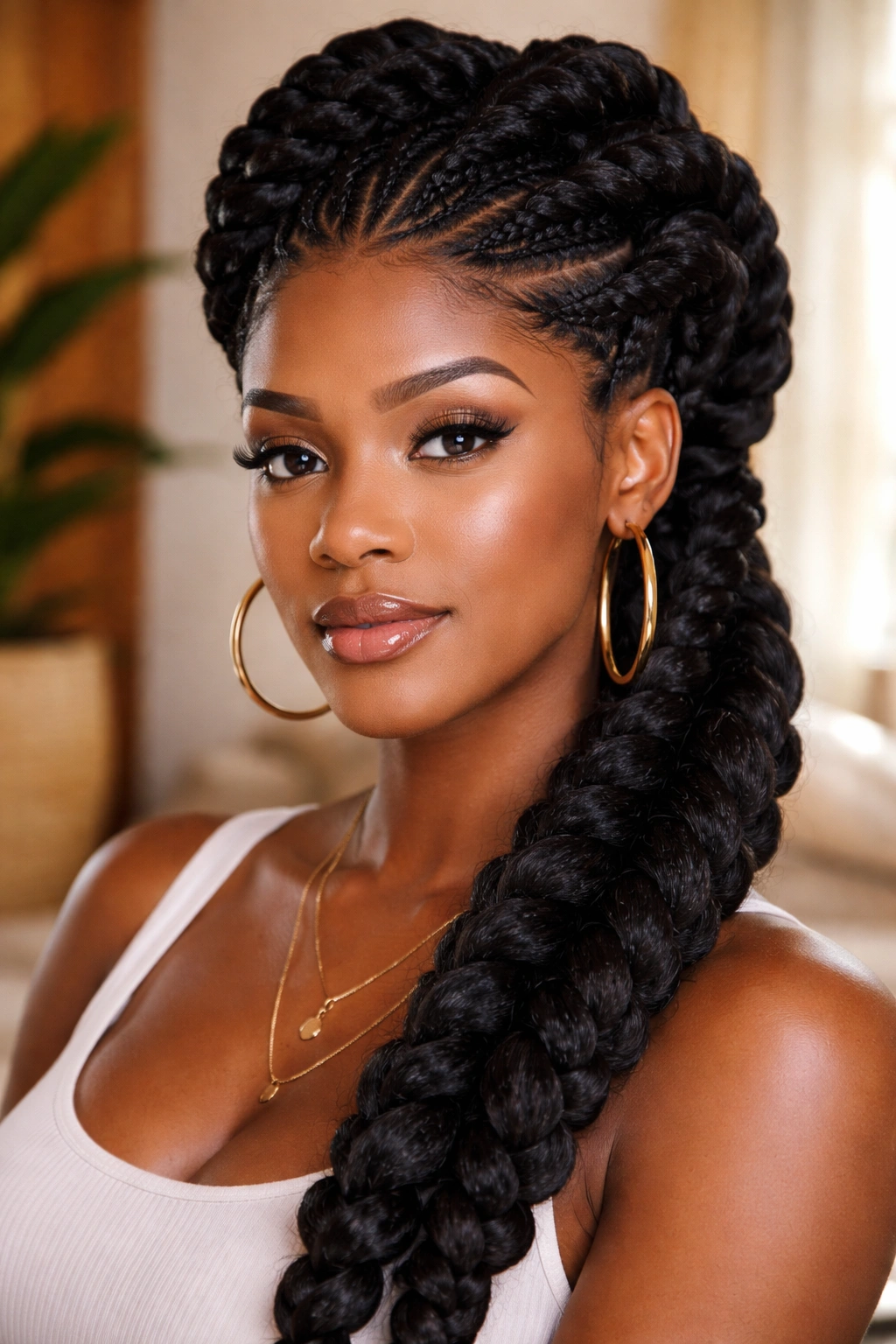
Large, elevated braids worn close to the scalp — similar to cornrows but with a bigger, rounder profile because more hair is incorporated in each row. On thick afro hair, goddess braids have an imposing, sculptural presence that’s genuinely regal.
Goddess braids can be styled in any pattern. Straight rows from front to back. Two large braids framing the center part. Four diagonal braids sweeping across the scalp. A single large goddess braid wrapping around the head in a crown. The thick afro hair density makes each goddess braid look especially full and rounded.
The texture of the finished braid surface on thick hair is notably smooth and even when the installation is done well. Each individual hair is pulled into the continuous braiding pattern, giving a tight, clean finish that looks polished even in casual settings.
4. Senegalese Twists
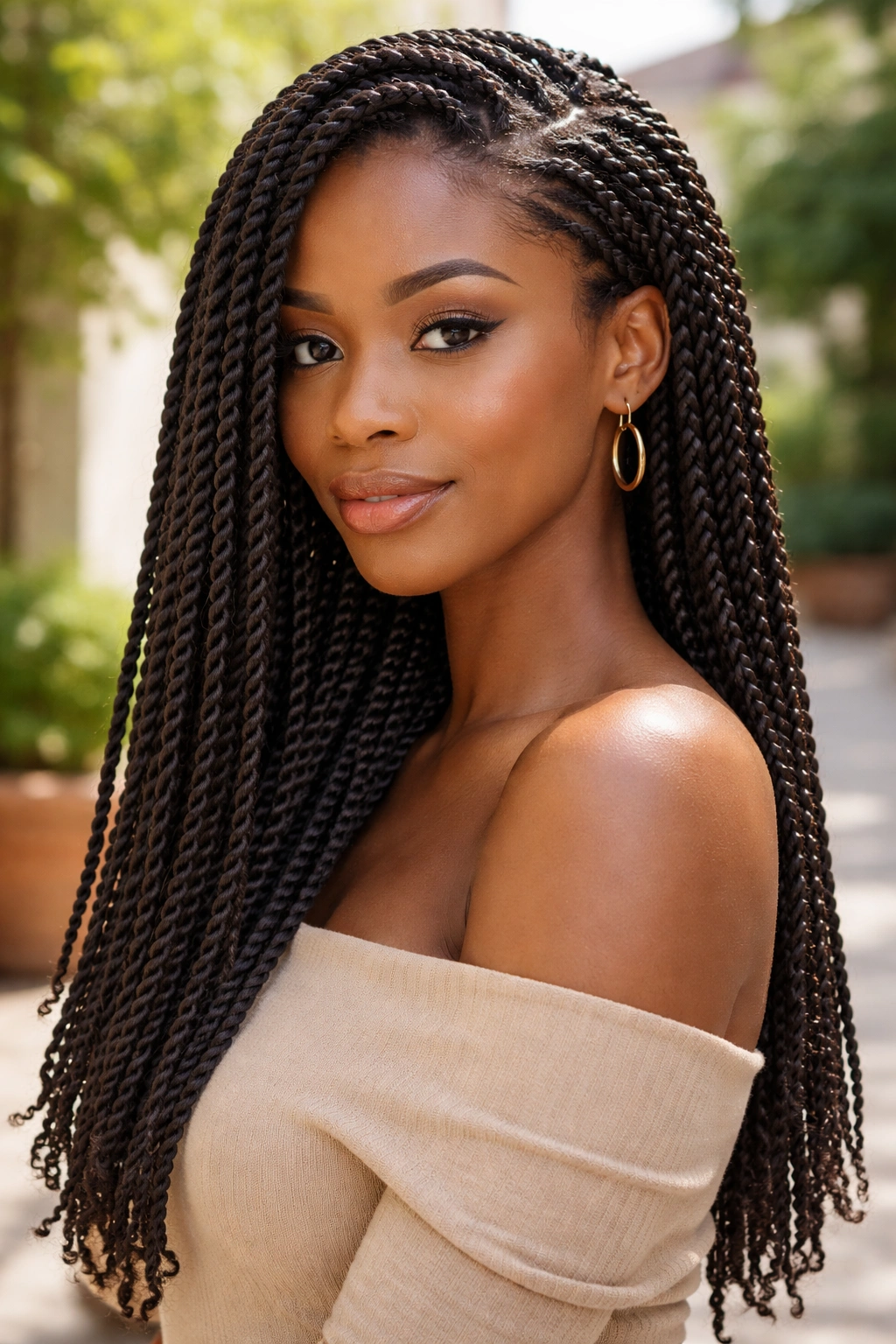
Two-strand rope twists using extension hair — thinner than standard box braids, with a tighter, more spiral twist. The spiraled surface of Senegalese twists catches light differently from box braids and gives the style a more elegant, fine-detailed finish.
On thick afro hair, Senegalese twists in a medium size hang beautifully — the extension hair has enough weight to stretch the twist slightly so it hangs in a clean column rather than shortening up. The thickness of the natural hair underneath contributes to the base volume that makes the twist look full from the root.
Senegalese twists typically last 6-8 weeks on thick hair. They can be refreshed at the roots by re-twisting any new growth that’s come through as the weeks pass, adding 2-3 more weeks of wear before a full takedown is needed.
5. Passion Twists
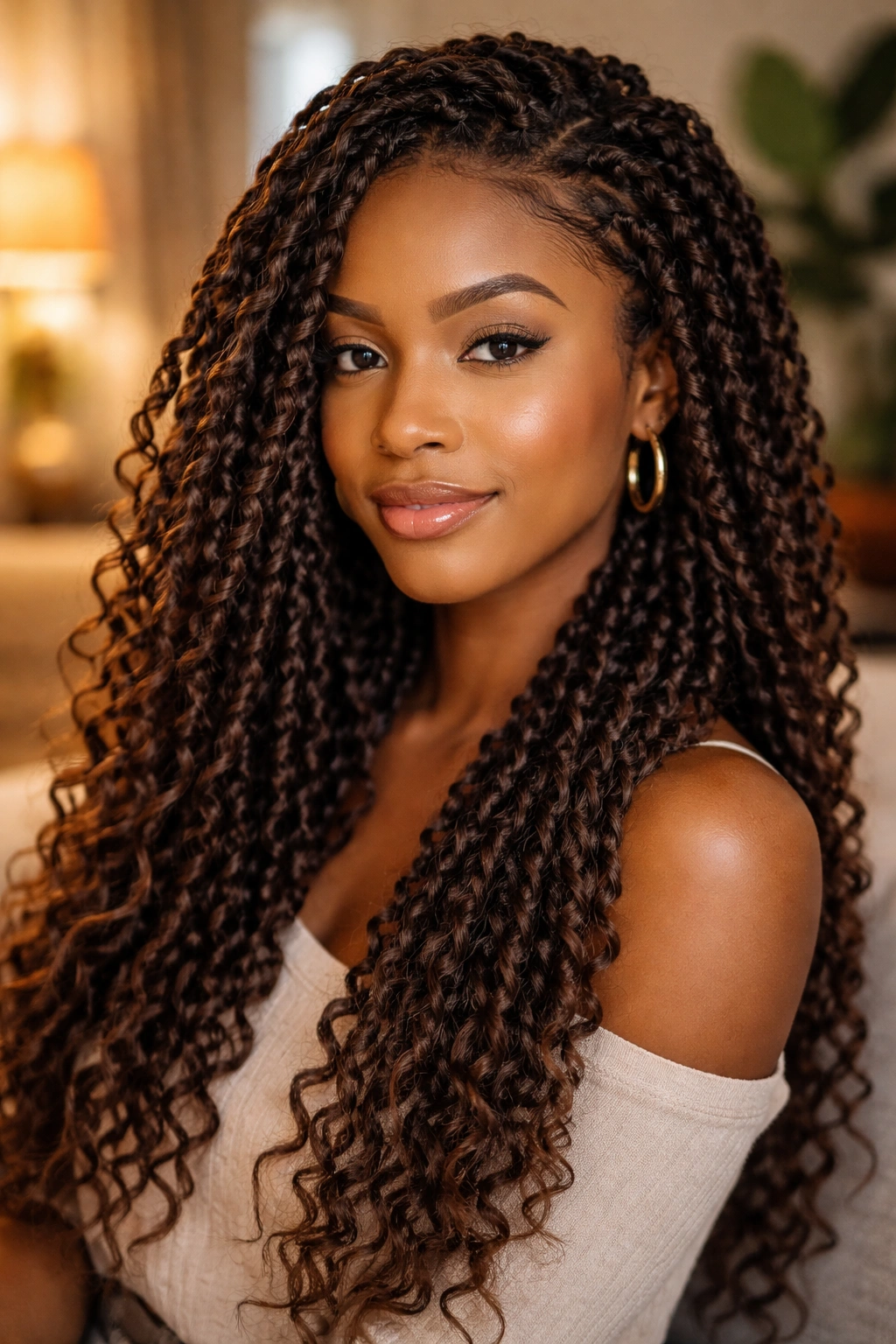
An offshoot of the spring twist and Senegalese twist family, passion twists use wavy extension hair that creates a slightly undone, springy texture. The texture is less uniform than a Senegalese twist — more organic-looking, with the wave pattern in the extension hair visible at the surface. On thick afro hair, passion twists have a lush, full quality.
The wavy extension hair for passion twists is typically freetress water wave hair or a similar textured extension product. The waves in the extension hair create a slightly messy, lived-in look that many people find more relaxed and natural than the polished column of a Senegalese twist.
They’re installed similarly to standard twists but feel lighter because of the extension hair type — freetress water wave hair has less mass than braiding hair. This is actually welcome news for thick-haired women who worry about total weight.
6. Marley Twists
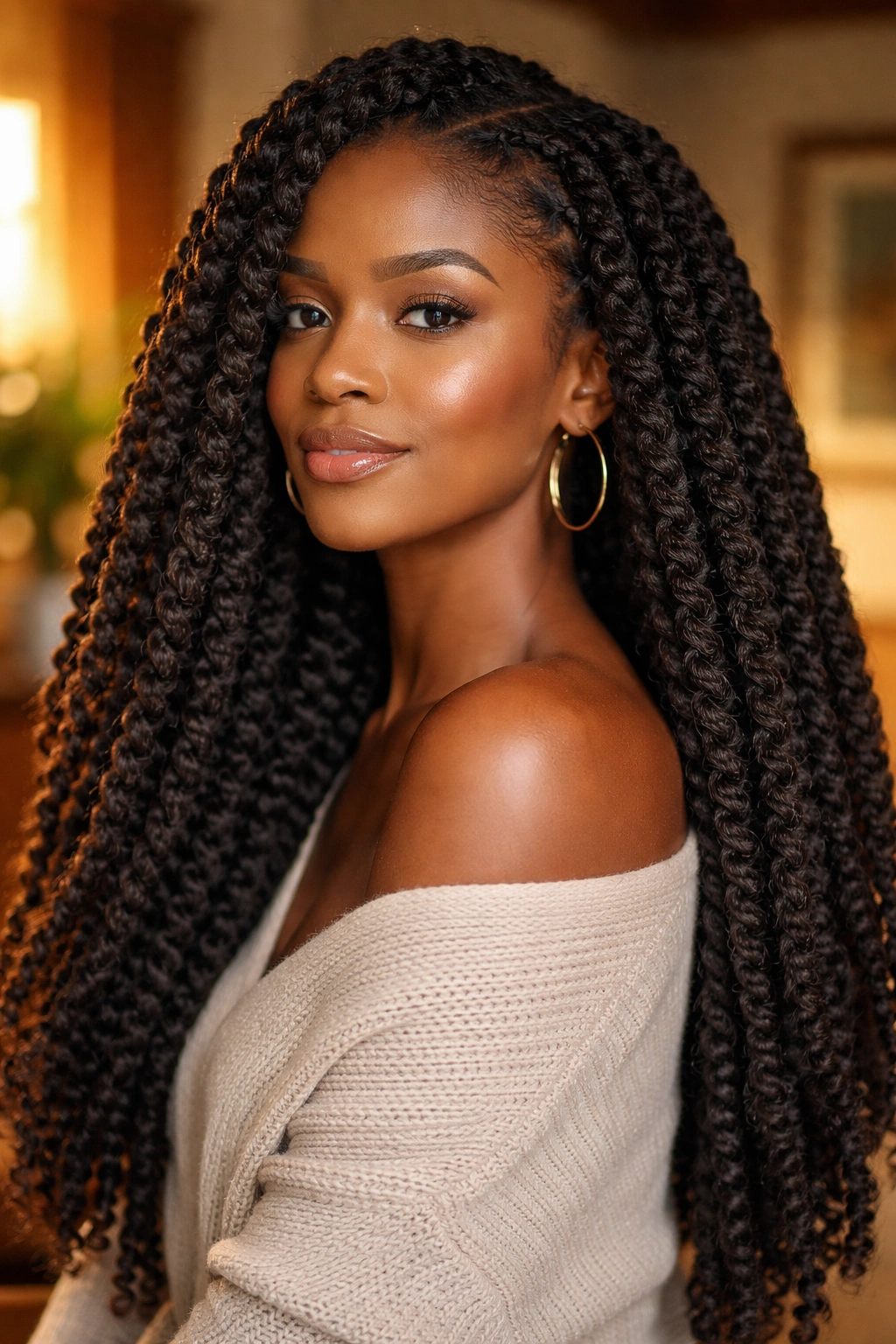
Marley twists use Marley hair — a textured, kinky extension that mimics the look and feel of natural afro hair — twisted around the natural hair in a large, two-strand twist. The result looks like a natural hair twist-out but with added length and volume from the extension hair.
On thick afro hair, Marley twists look incredibly full and natural — the texture match between Marley extension hair and type 4 natural hair is close enough that it’s hard to tell where the natural hair ends and the extension begins at the roots. This seamless blend is especially good for thick-haired women who want the length of extensions without the obvious extension-hair look.
Marley twists tend to frizz slightly over time as the kinky extension hair relaxes, which is part of their natural look. A light oil applied to the surface of the twists every few days keeps them looking fresh without weighing them down.
7. Cornrow Updo
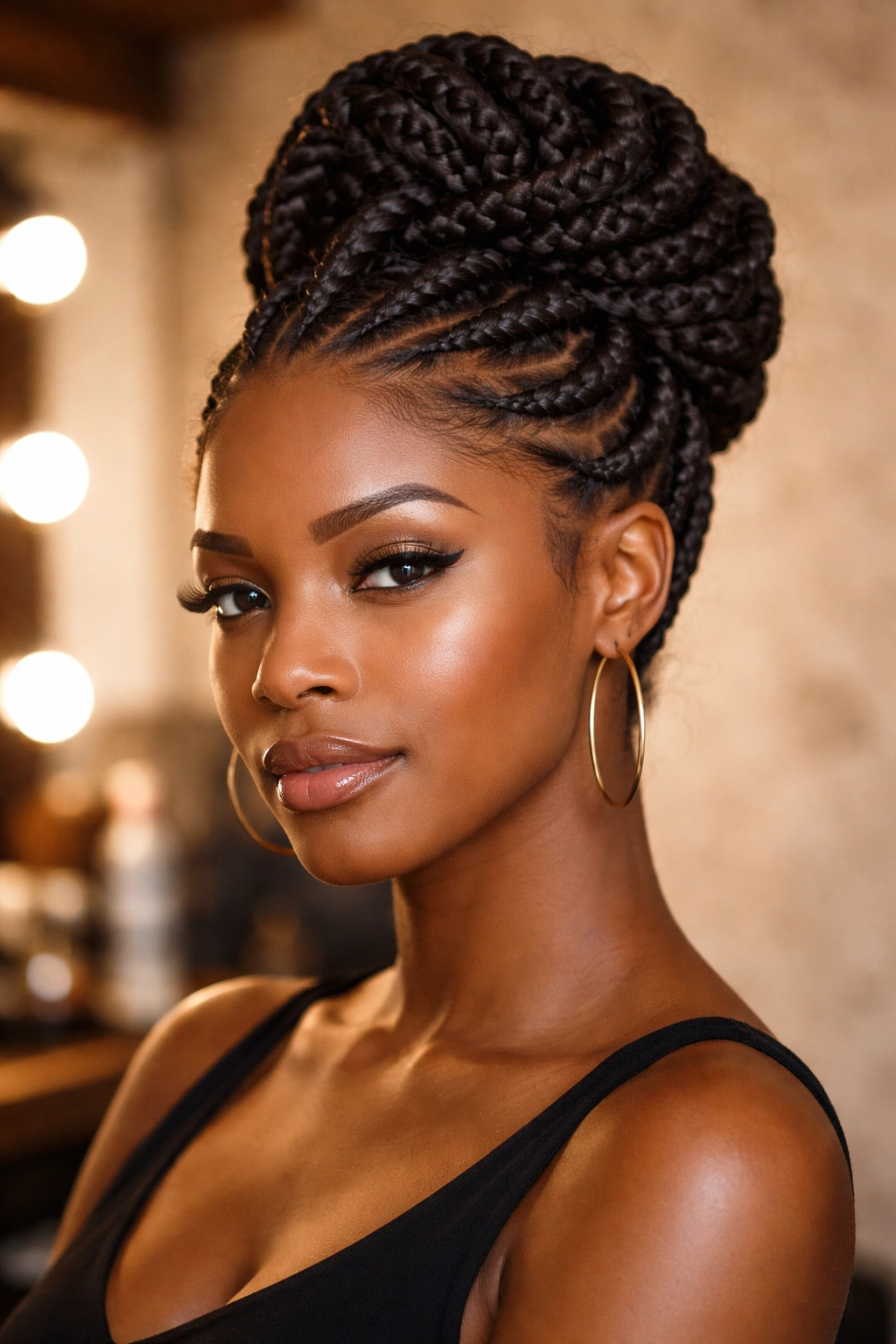
All the hair cornrowed upward or around the head and then arranged into a sculptural updo at the crown — a gathered bun, a stacked fold, a looped structure. On thick afro hair, this updo has volume and presence that creates a genuinely dramatic look.
The cornrow base provides structure that thick natural hair benefits from — the braids anchor the updo shape so it doesn’t droop or shift through a long day. Extension hair braided into the cornrows can add to the length available for the updo shape, or all natural hair can be used if the length is sufficient.
This is an excellent formal style. The updo lifts attention toward the face and creates a clean, elongated neck line. Paired with statement earrings, it’s a complete look.
8. Feed-In Cornrows with Thicker Rows
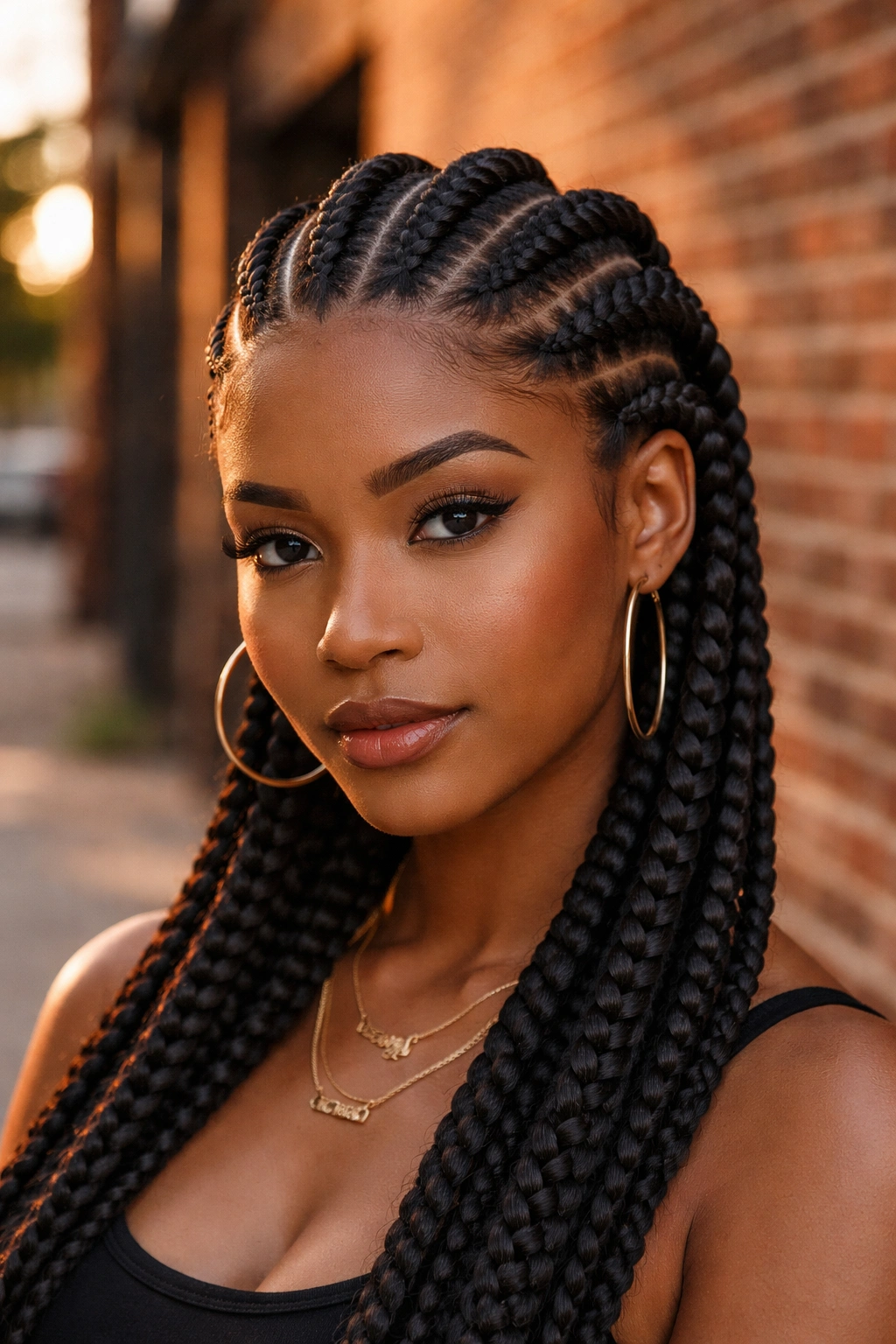
Standard feed-in cornrows, but done with sections sized specifically for thick hair — slightly fewer rows than a fine-haired person would have, with each row wide enough to incorporate the denser hair without creating crowded, overlapping sections.
Fewer but wider rows on thick hair create a bolder, more graphic pattern. Instead of 12 thin rows, 7 wide rows create a different visual rhythm. Each row has more presence. The scalp is less visible. The overall look reads as more substantial.
Feed-in installation is particularly good for thick afro hair at the hairline. Instead of a bulky knot at the hairline where extension hair attaches, the gradual feeding-in method creates a smooth, natural root that doesn’t add extra tension at the most fragile part of the hairline.
9. Box Braids Updo
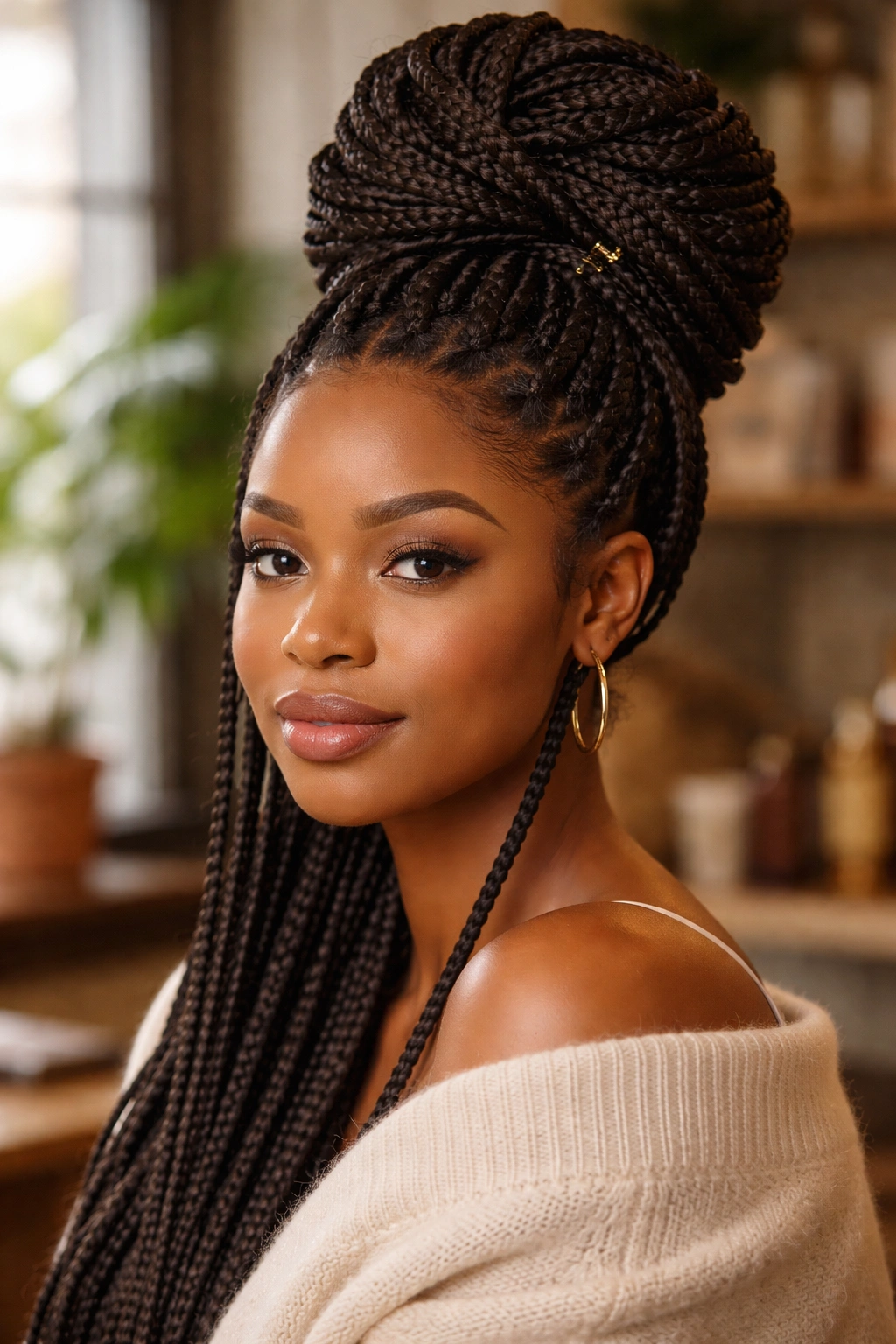
Box braids gathered and arranged into an updo rather than left to hang freely — braids wrapped into a bun, gathered into a high ponytail, looped into a structured shape, or pinned into a side-swept arrangement. On thick afro hair with heavy braids, the updo can be physically impressive in size.
The box braid updo has a practical advantage for thick-haired women: taking all that braid weight off your shoulders and back is genuinely more comfortable. Long, thick braids are heavy. An updo distributes the weight differently and reduces the strain on the neck.
Secure the updo with hair pins rather than hair elastics — the pins distribute across the braid base and don’t create pressure points the way elastics do.
10. Micro Braids
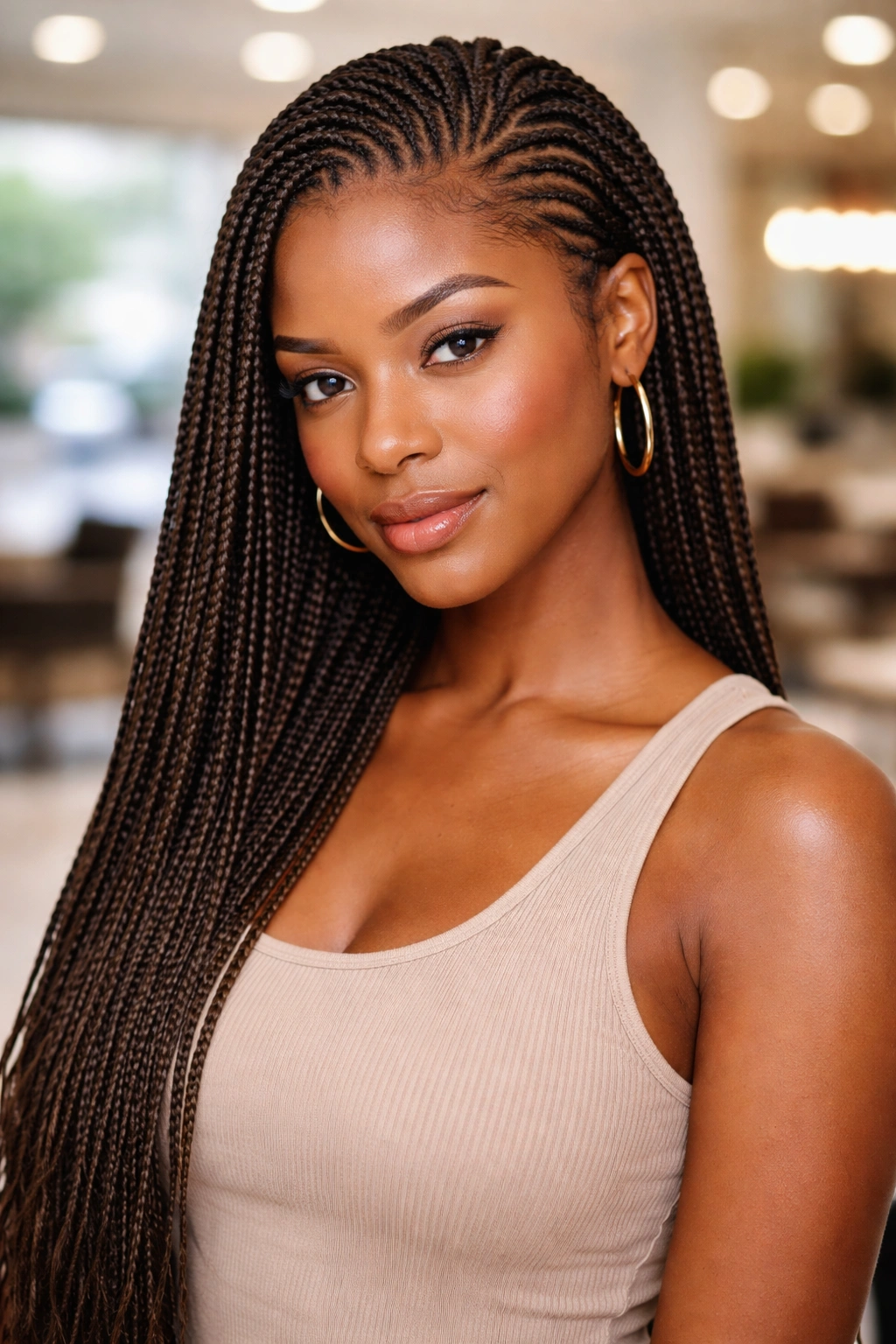
The opposite direction from jumbo: very fine, very small braids installed in large numbers across the scalp. On thick afro hair, micro braids take significantly longer — expect 10-14 hours for a full head — but the result lasts up to 8 weeks and allows for an enormous amount of styling flexibility because the braids are small enough to be gathered, parted, and arranged like regular hair.
The challenge with micro braids on thick hair is section management. Creating evenly sized micro sections on very thick, dense hair without losing track of the pattern requires extreme precision and patience. This is an advanced installation that you should not attempt at home or with an inexperienced braider.
The Catch
Micro braids require very careful tension management on thick hair. Fine sections mean fine attachment points, which means potential stress on the follicle even from moderate tension. If your thick hair is also fine in individual strand diameter (which is possible — density and individual strand thickness are separate characteristics), your follicles may be more vulnerable to traction than you’d expect from hair that looks dense.
11. Faux Locs
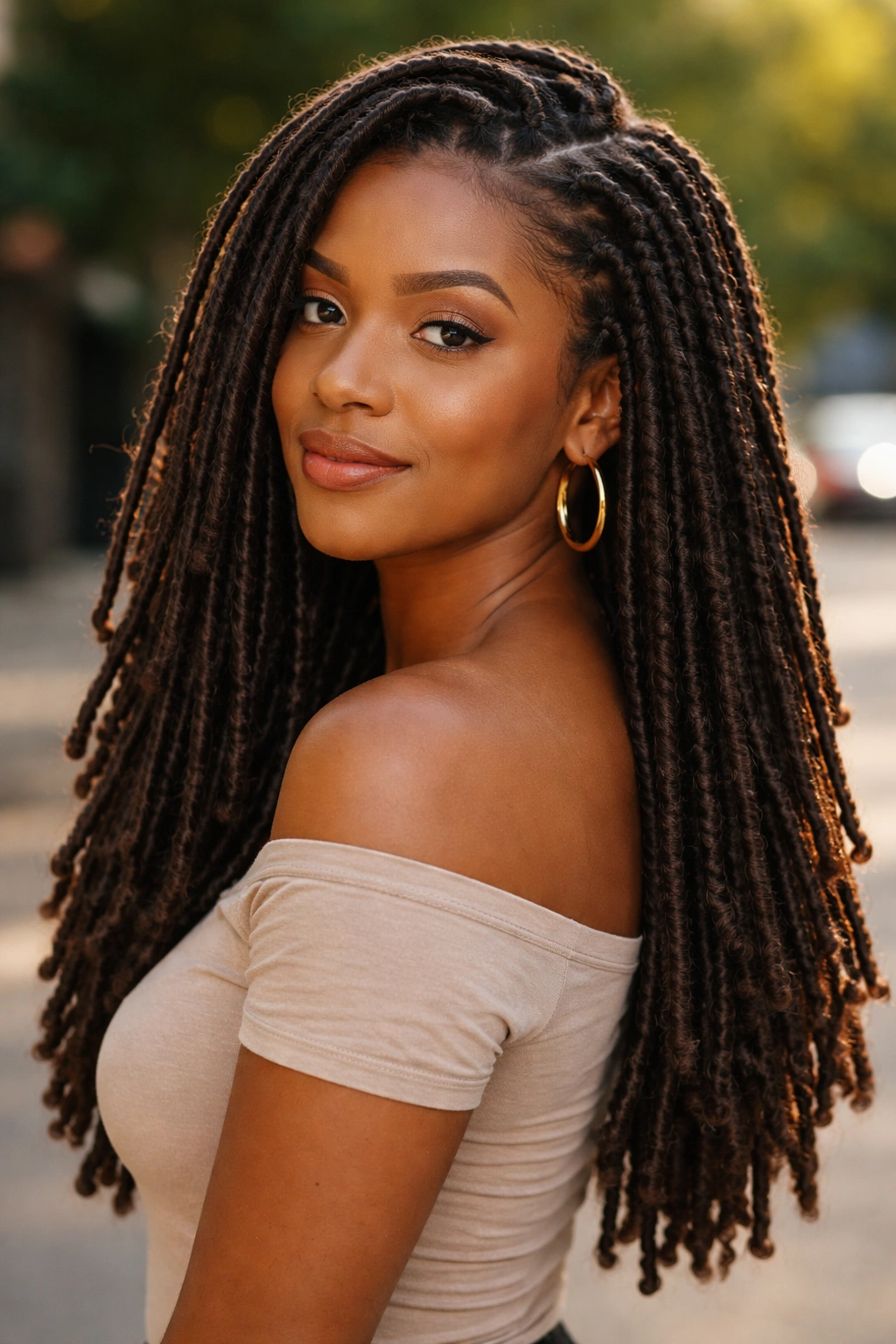
Wrapping individual sections of hair with extension dreadlock hair — either synthetic dreadlock hair wrapped around a two-strand twist base or crochet faux locs threaded through a cornrow base — to create the look of mature locs without the years of commitment. On thick afro hair, faux locs have an especially authentic appearance because the natural hair density supports the volume of each loc.
The weight of faux locs is worth considering on thick hair. Long, fully installed faux locs can be heavy — the combination of the extension hair wrapping and the natural hair inside creates substantial weight per loc. A shorter faux loc length (shoulder to mid-back) is more comfortable for most women on the first installation. Going waist-length on thick hair means a lot of weight on the scalp over a 6-8 week wear period.
12. Distressed Faux Locs
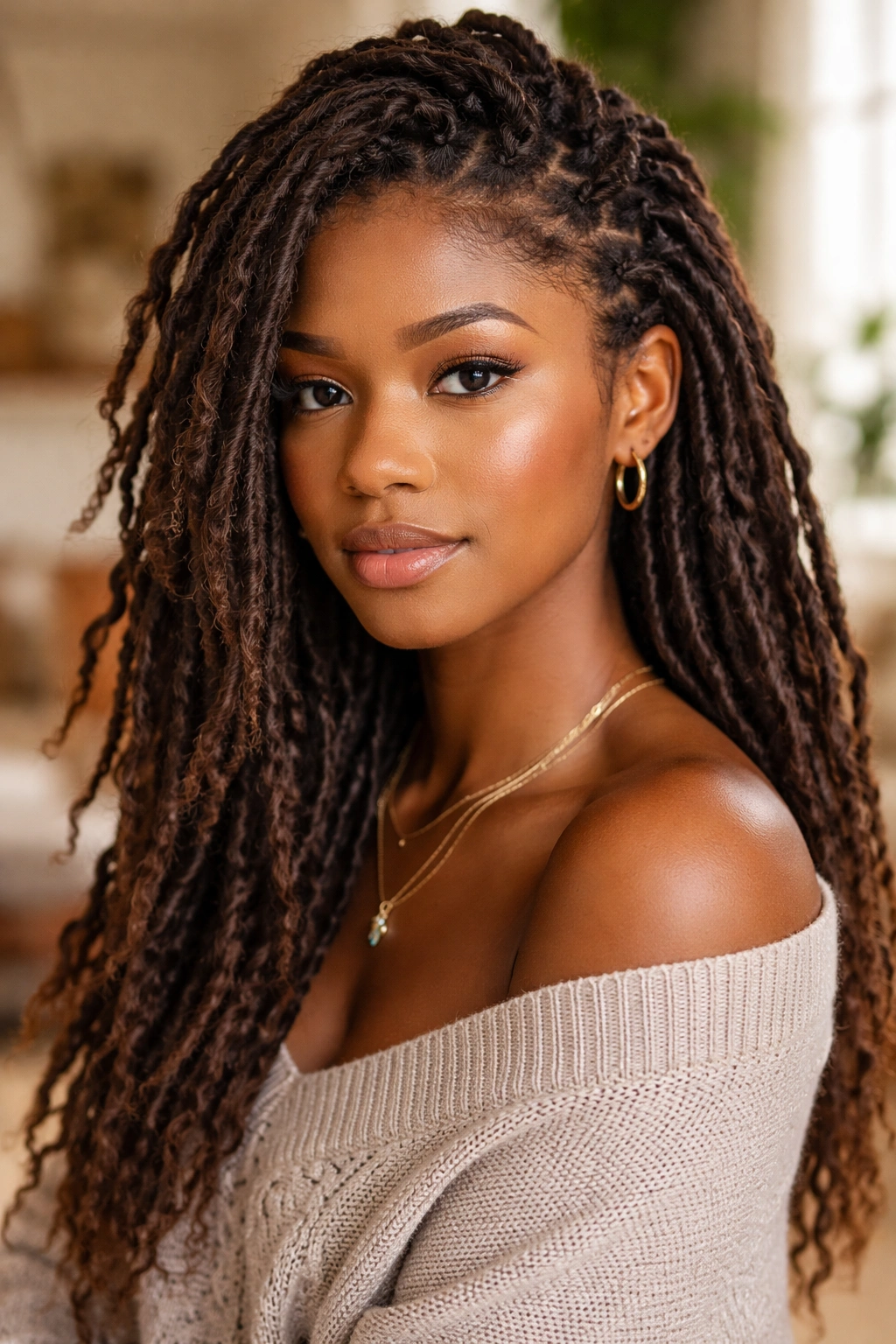
Faux locs styled to have a lived-in, bohemian texture rather than a perfectly wrapped, smooth finish. The distressing is done during installation: the extension hair is wrapped less tightly and with intentional variation, and some sections are slightly frayed or left with visible texture rather than smoothed down.
On thick afro hair, distressed faux locs look spectacularly organic. The texture variation across the locs, combined with the natural coil pattern of the afro hair visible at the base of each loc, creates something that honestly looks very close to actual mature locs that have developed their own personality over time.
13. Spring Twists
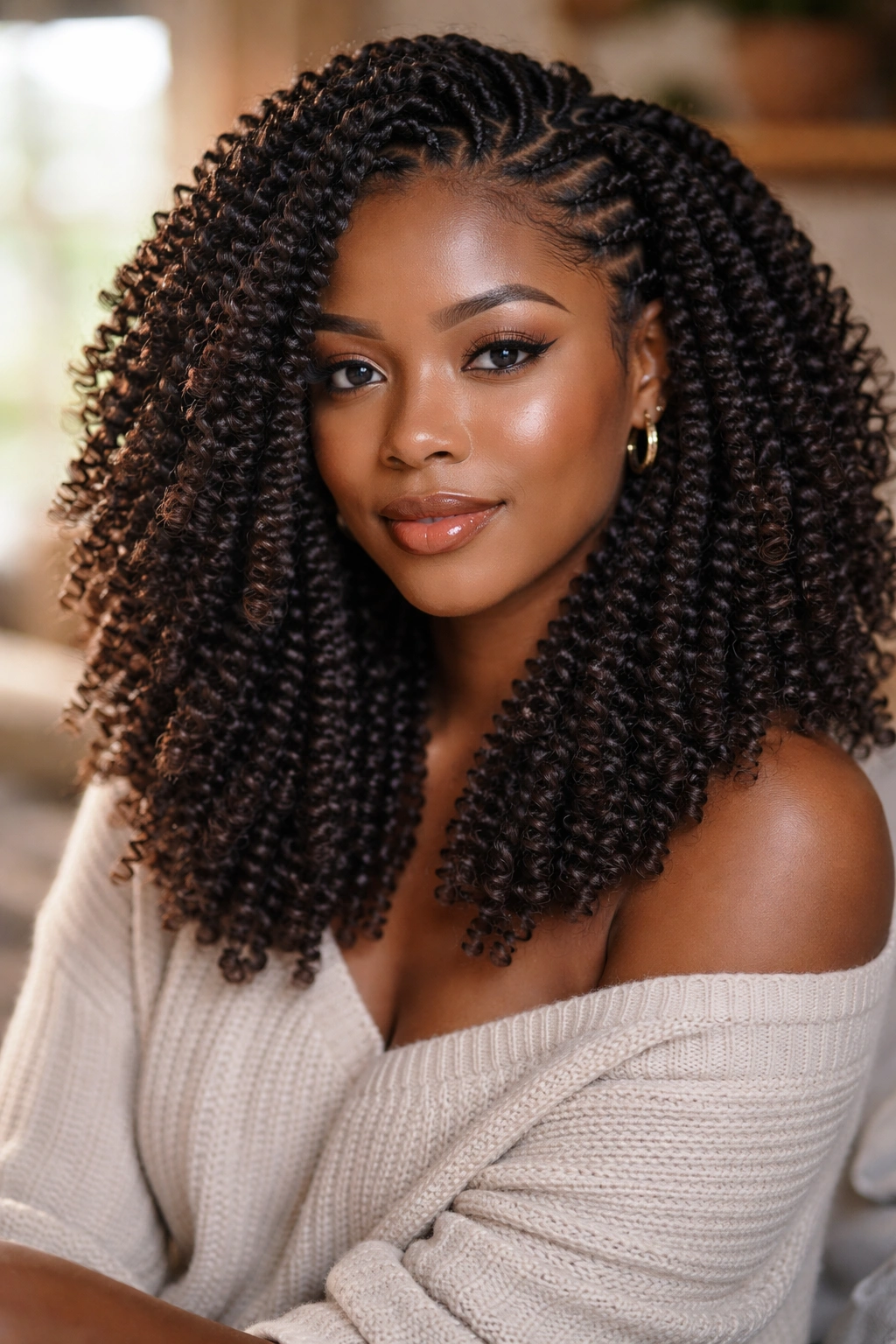
A crocheted protective style where pre-twisted spring extension hair is looped through a crochet-cornrow base. The spring twist extension hair has a compressed, coiled texture that bounces back when pressed — that springiness gives the style its name and its texture. On thick afro hair, spring twists create a voluminous, cloud-like texture.
Installation is faster than most braided styles because the spring twists are pre-made — you’re attaching ready-made twists rather than braiding them from scratch. A full installation on thick hair takes about 3-4 hours, significantly less than box braids or cornrows.
The bouncy texture is also gentler on the ends of natural hair because the extension hair does most of the movement while the natural hair underneath is anchored at the braided base.
14. Havana Twists
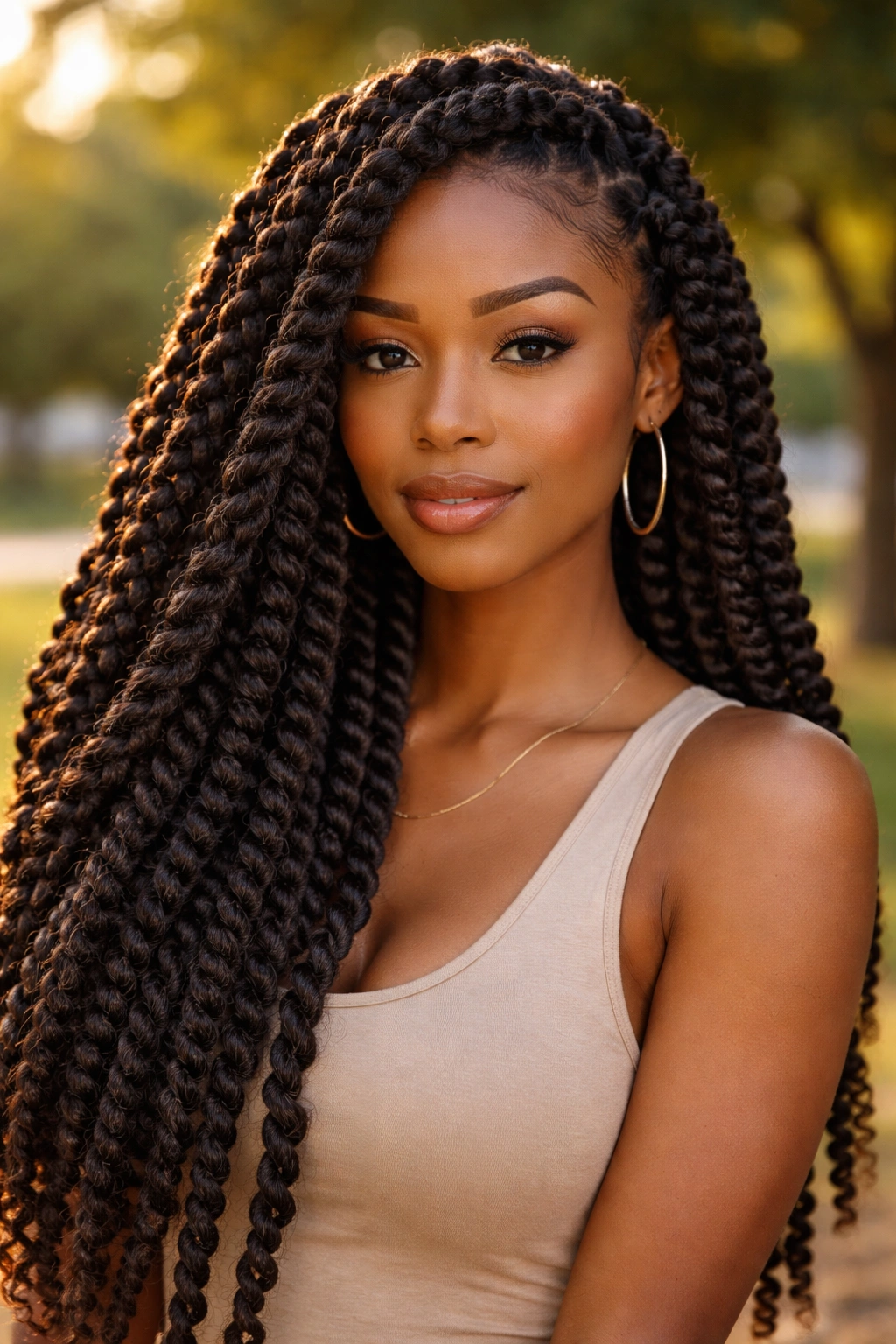
Similar to Marley twists but using Havana hair — a slightly thicker, more voluminous kinky extension that creates bigger twists. Havana twists are larger in circumference than Marley twists and hang with more weight and presence. On thick afro hair, Havana twists look luxuriously full.
The size of Havana twists on thick hair means fewer twists overall (usually 30-50 across the whole head rather than 80-100 smaller twists), which means faster installation. Each twist takes a bit longer to complete because of its size, but the total number of twists is lower.
15. Braided Ponytail on Thick Hair
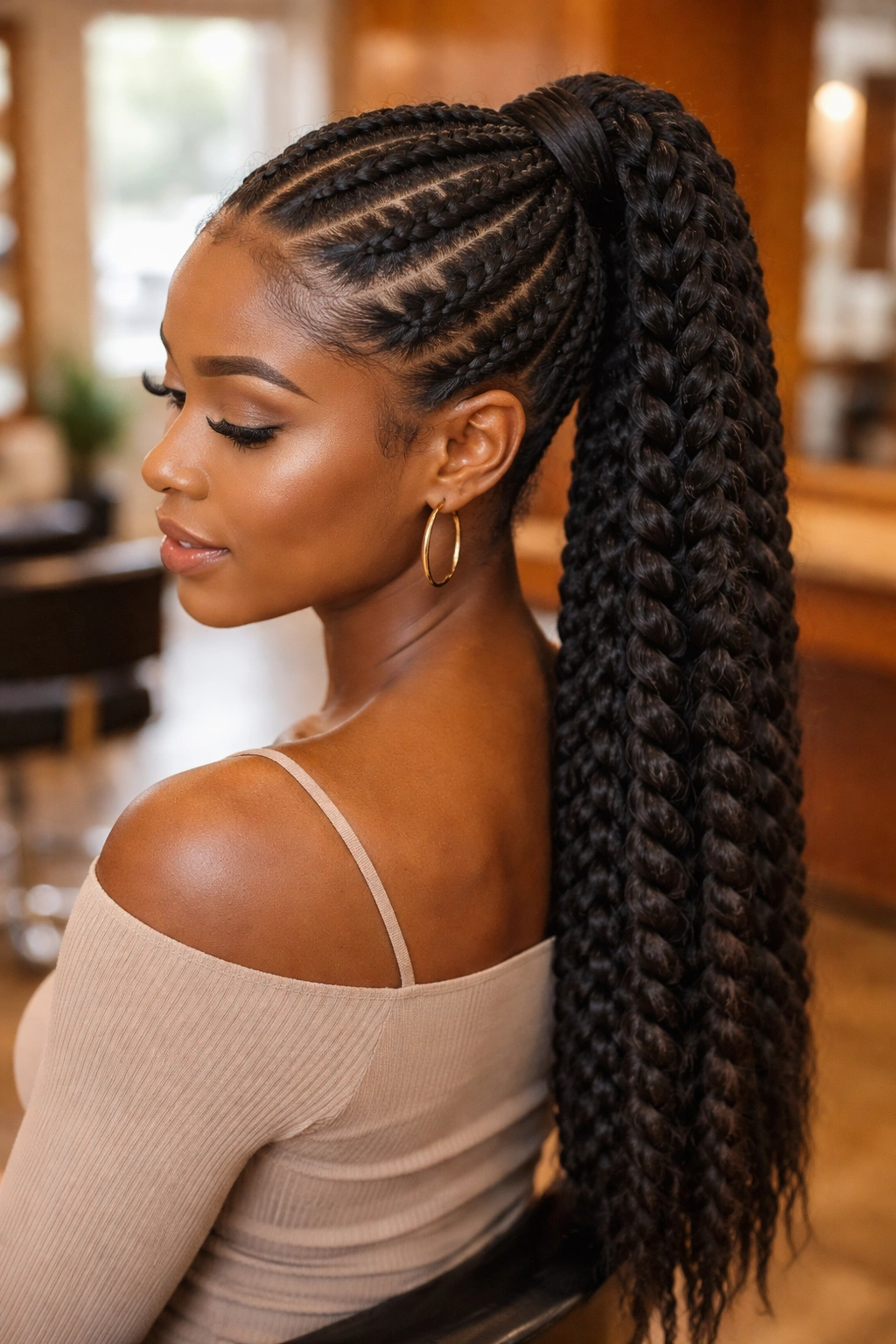
All the natural hair cornrowed or flat-twisted into a base, then extension braids attached at the center back to create a long, full braided ponytail. On thick afro hair, the base cornrows are substantial in themselves — the visual interest of the braided base is its own design element before the extension ponytail even comes into view.
The ponytail placement can be high (above the crown), medium (at the nape), or low (below the nape). High placement elongates. Low placement feels sleeker and more formal. Both look excellent on thick natural hair.
16. Side-Swept Individual Braids
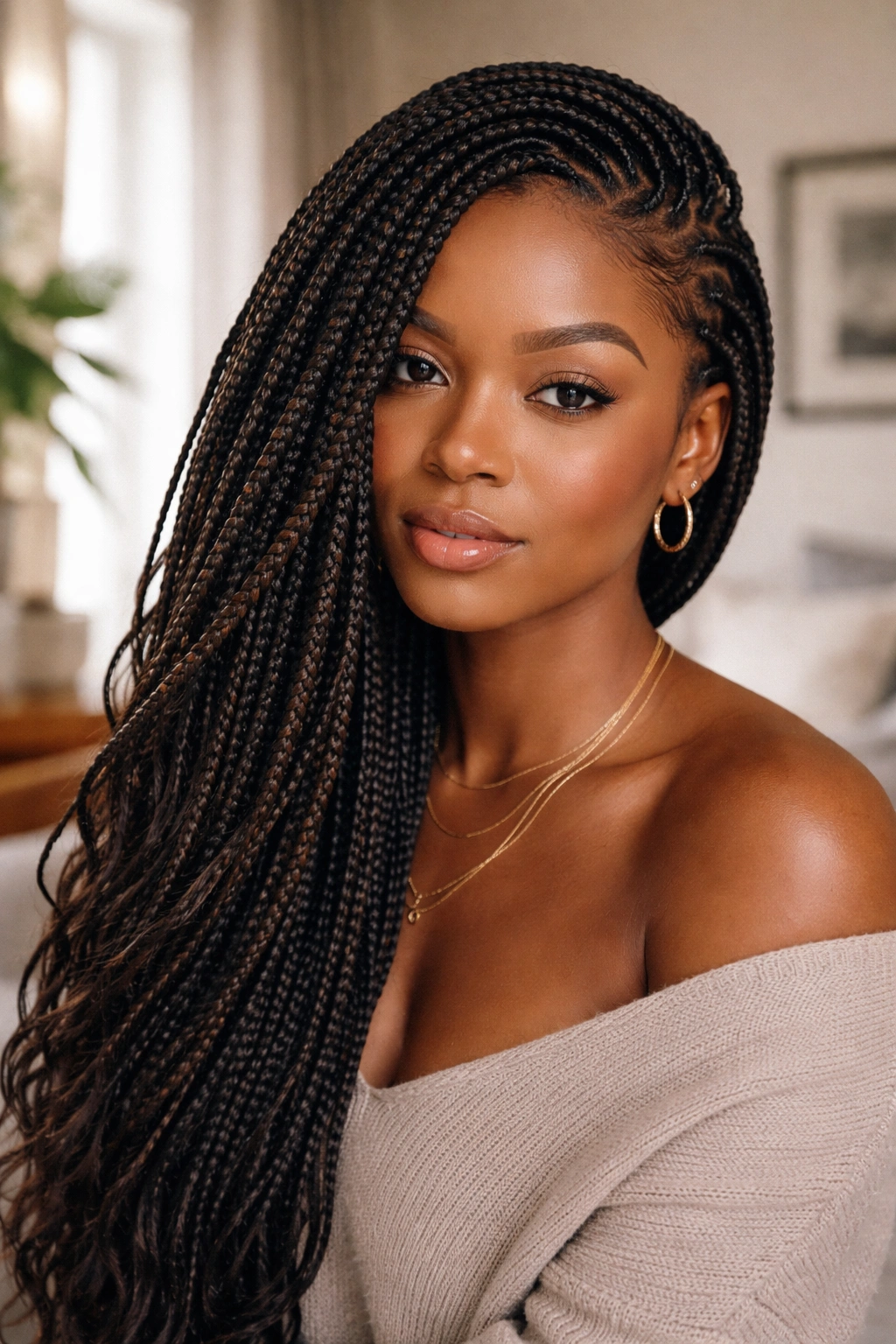
Box braids or knotless braids installed to fall predominantly to one side rather than straight down — created partly through the installation direction (the braids at the part side fall naturally toward the face) and partly through styling after installation. On thick hair, a full side sweep of heavy braids creates a dramatic, face-framing effect.
This is a styling choice as much as an installation choice. Most braiders can adjust the root direction of box braids during installation to encourage falling to one side. You can also create the side sweep post-installation by gathering all the braids to one shoulder and securing them loosely at the nape with a single braid or hair elastic.
17. Braided Crown on Natural Hair
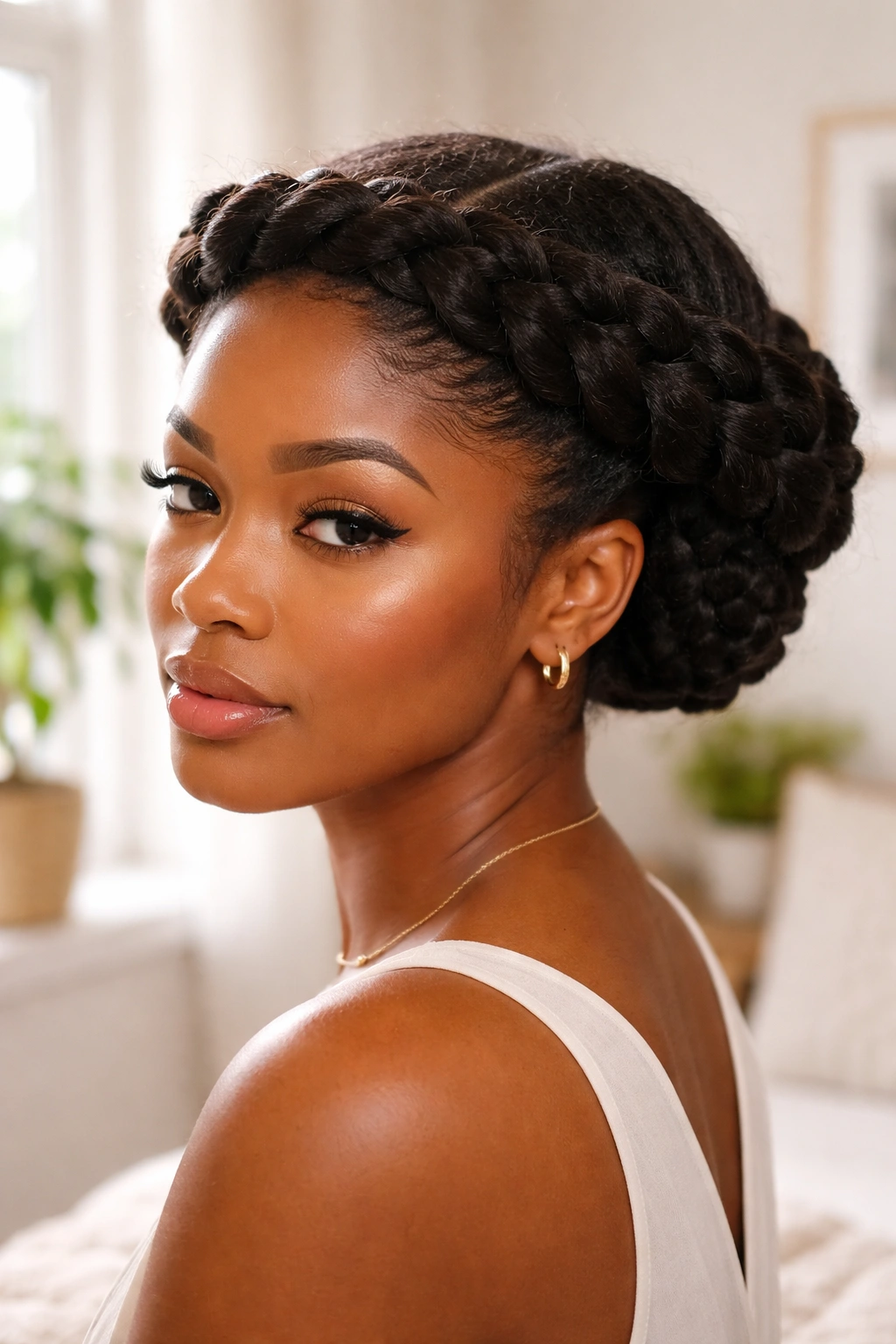
Two large braids wrapped around the head — from one side, over the crown, and around to the other — creating a braided crown or halo effect. On thick afro hair, these crown braids are substantial and visible, creating a regal silhouette that doesn’t need any accessories to be complete.
The crown braid is typically created from the natural hair without extension — which means you need enough length (at least 5-6 inches of stretched length) to reach from one ear over the crown to the other and be secured. The braids are pinned at the nape or wherever the ends meet.
Crown braids hold for 1-2 weeks on most hair types. Thick afro hair can sometimes hold them slightly longer because the density keeps the braids from loosening as quickly.
18. Tribal Braids with Accessories
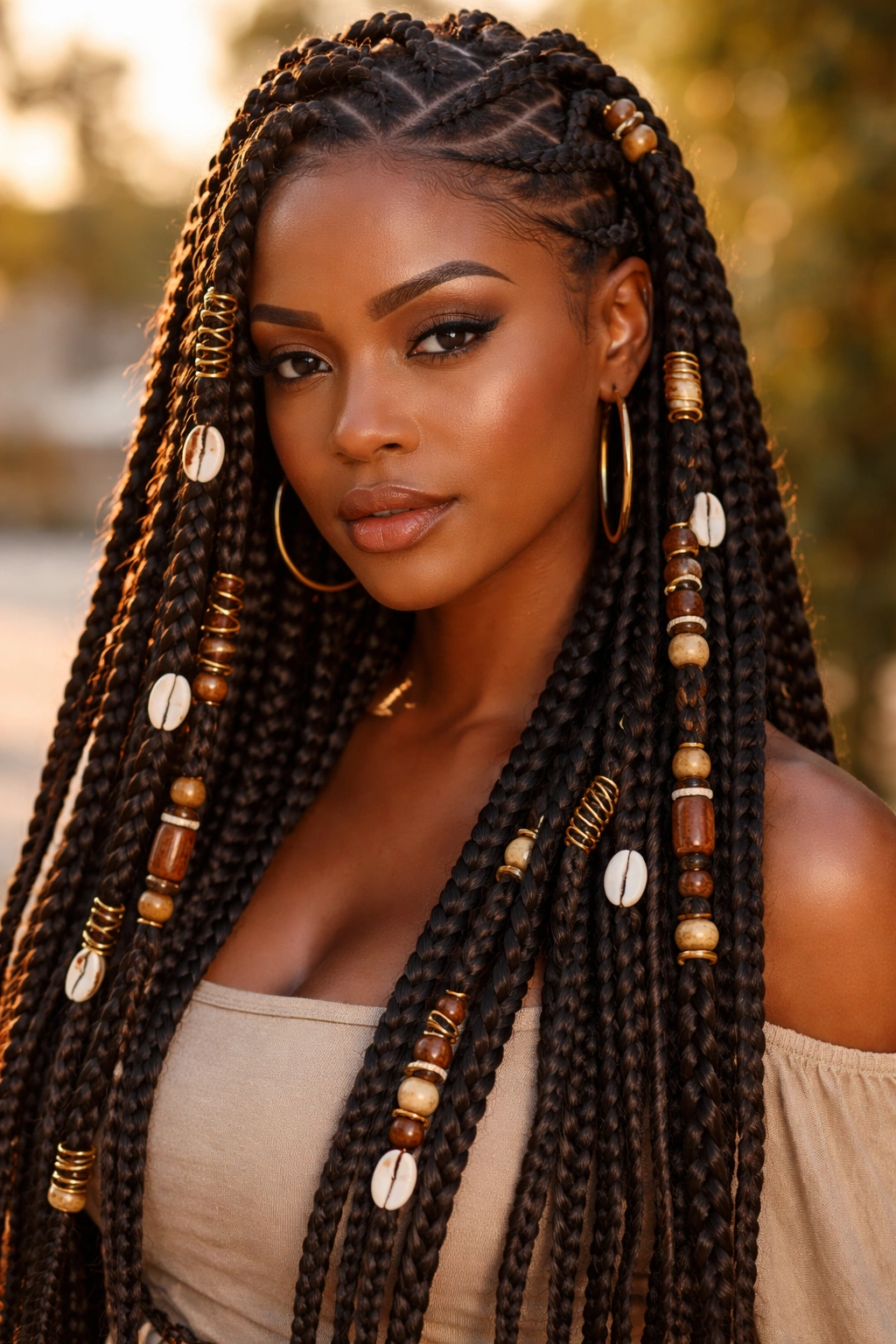
Individual box braids or cornrow patterns combined with traditional accessories — gold cuffs, wooden beads, shells, wire coils — placed throughout the braids in meaningful arrangements. The accessories elevate the braided style from protective to statement. On thick afro hair, the braids themselves are already substantial, so the accessories amplify rather than create the style’s presence.
Accessory placement on thick braids: the cuffs or rings need to be large enough to slide comfortably over a thick braid without being forced. Standard braid cuffs sold for fine or medium braids may not fit heavy thick braids. Seek out sizes labeled “jumbo” or measure your braid circumference before purchasing.
19. Waterfall Braids
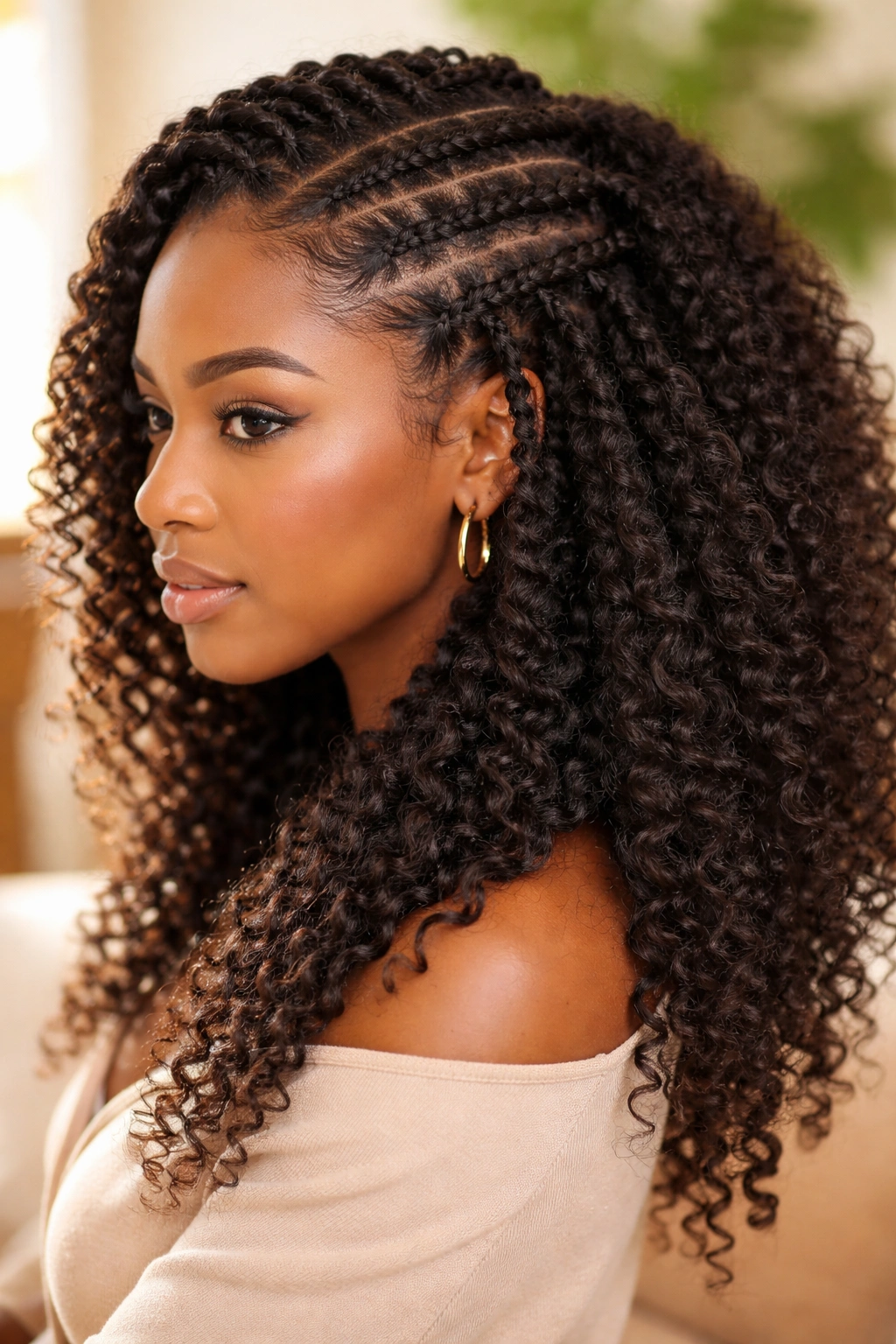
A loose, flowing cornrow variation where sections of hair are dropped out of the braid as you progress — creating a “waterfall” effect of loose hair cascading through the braided sections. On thick afro hair, the dropped sections are voluminous and substantial, creating a cascade of coiled natural texture flowing through the braid structure.
This style requires healthy enough natural hair to be left loose in the dropped sections, which means it’s not a purely protective style — the loose sections are exposed and need daily moisturizing. But it’s beautiful and unlike most styles on this list.
20. Updo Cornrows with Afro Puff
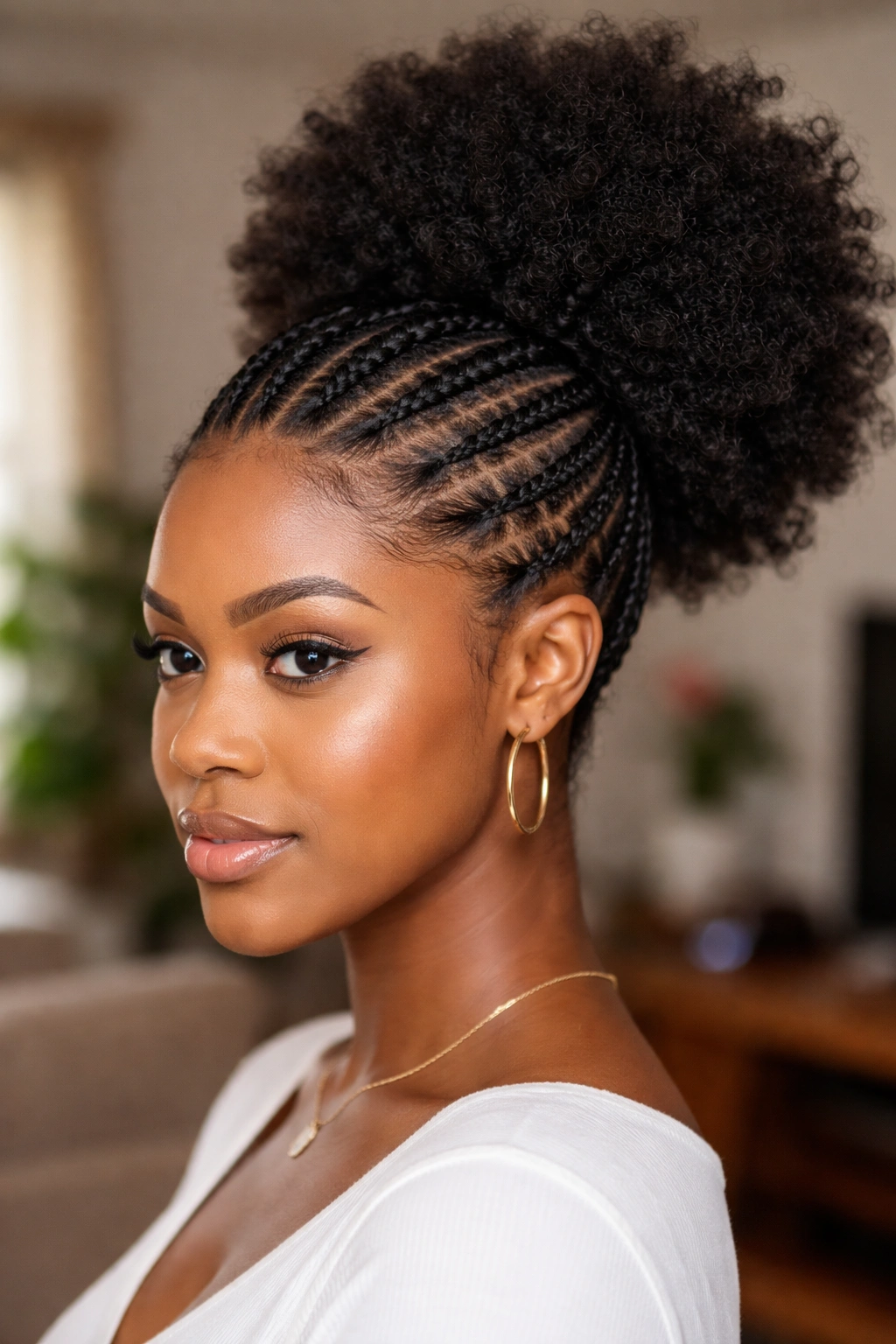
Cornrows across most of the scalp, converging at the crown, with the crown section left unbraided and styled into a natural afro puff. The braids provide a sleek, graphic foundation and the puff at the top adds softness and volume. On thick hair, the puff is genuinely impressive in size.
This style works at any cornrow length — the braids don’t need extension hair, though they can have it. The important dimension is the amount of natural hair left free for the puff. More natural hair left out equals a bigger puff, which reads differently depending on how much crown height you want.
21. Butterfly Locs
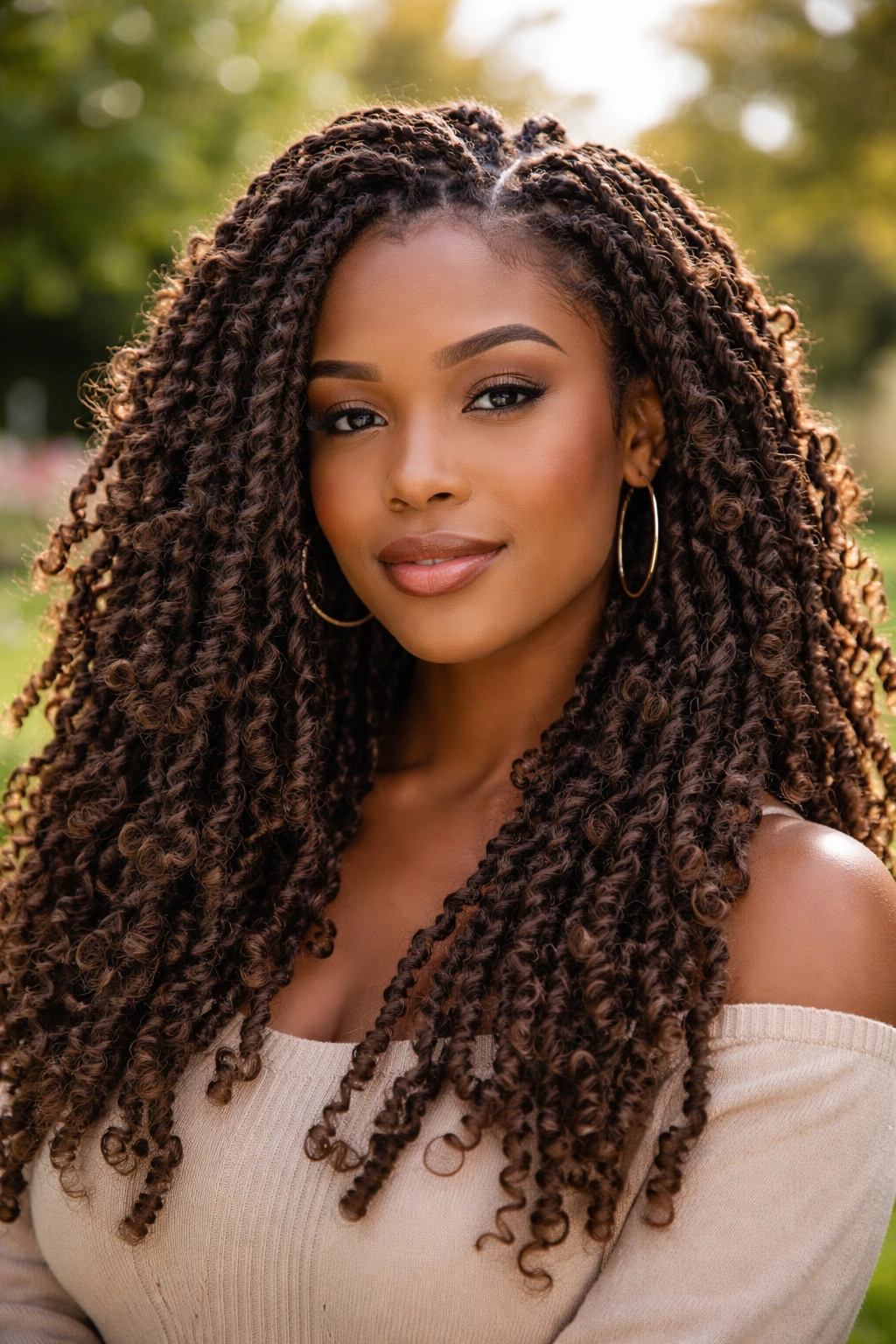
A variation of faux locs with intentionally looped and messy extension hair that creates a fluttery, undone texture along each loc. The butterfly effect comes from small loops of extension hair left protruding from the surface of each loc, creating a dimensional, textured surface rather than a smooth wrapped finish.
On thick afro hair, butterfly locs have an organic, full texture that suits the hair’s natural exuberance. They’re one of the more forgiving installation styles in terms of perfect uniformity — the intentional messiness of the butterfly texture means slight variations in each loc actually contribute to the overall aesthetic.
22. Box Braids with Curly Ends
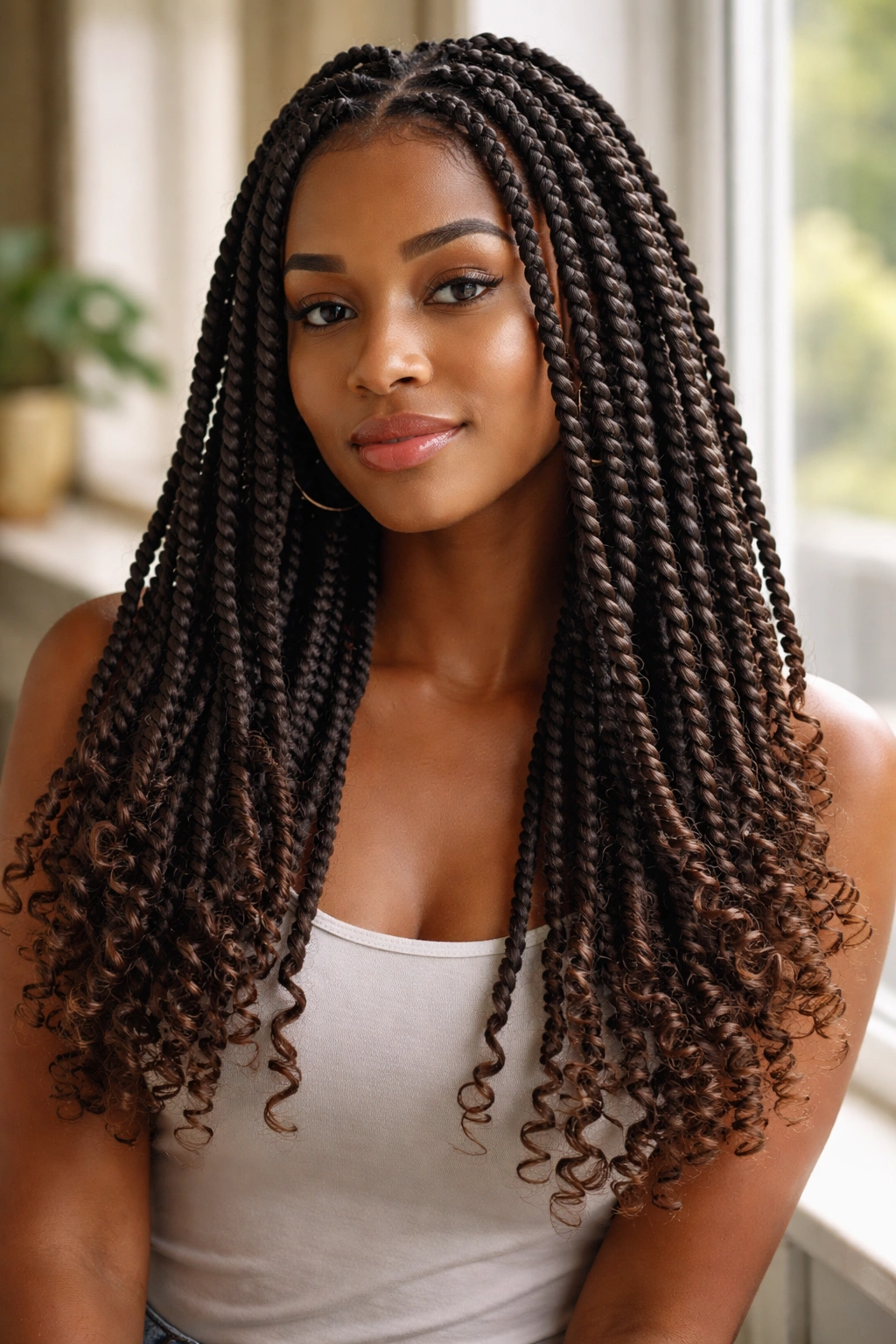
Standard box braids, but the extension hair is left un-braided at the last 2-3 inches and styled into curls — either by dipping in hot water to set the extension hair or by using pre-curled extension hair. The contrast between the smooth, braided column and the curly finish at the ends is eye-catching.
On thick hair, the curly ends add volume to the tips of already substantial braids. When you move or when wind catches the braids, the curly ends move differently from the smooth braid above — creating a layered visual effect.
The curly ends typically need a light moisture refresher every few days to maintain their definition, especially in dry conditions.
23. Loc Extension Installation on Afro Base
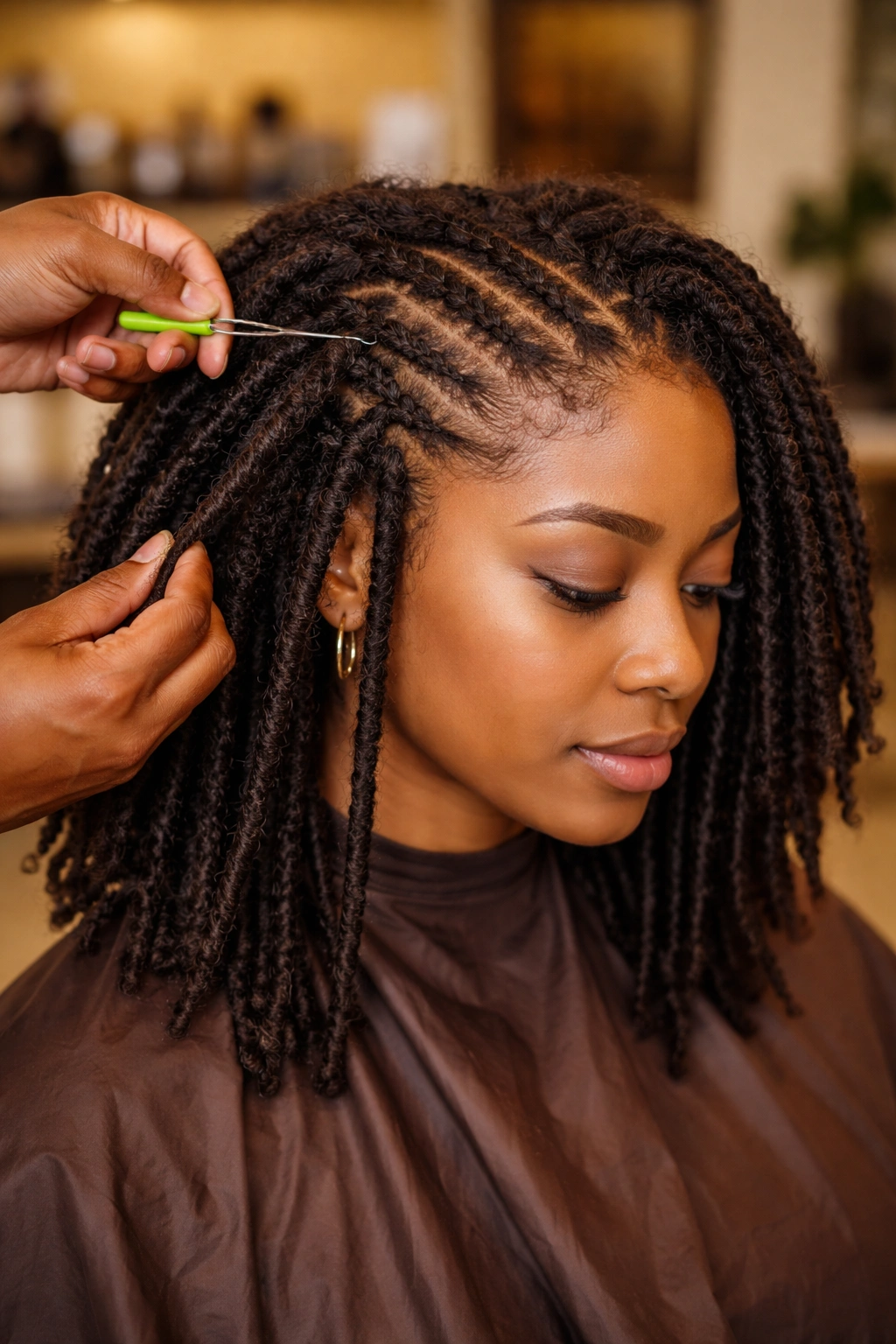
Loc extensions — pre-made synthetic or human hair locs — installed on a cornrow or twisted base using a crochet or needle method. The locs are fed through loops in the base and secured, creating the appearance of long, mature locs in a single session rather than years.
On thick afro hair, this installation is one of the weightier options on this list. Each loc has some mass, and a full head of long loc extensions represents a substantial amount of weight over weeks of wear. Shorter loc lengths (shoulder to mid-back) are more comfortable. Ensure the base cornrows are not over-tightened before the loc extensions are attached — the combined weight of the loc and the attachment tension at the cornrow can stress the follicle.
24. Chunky French Braid
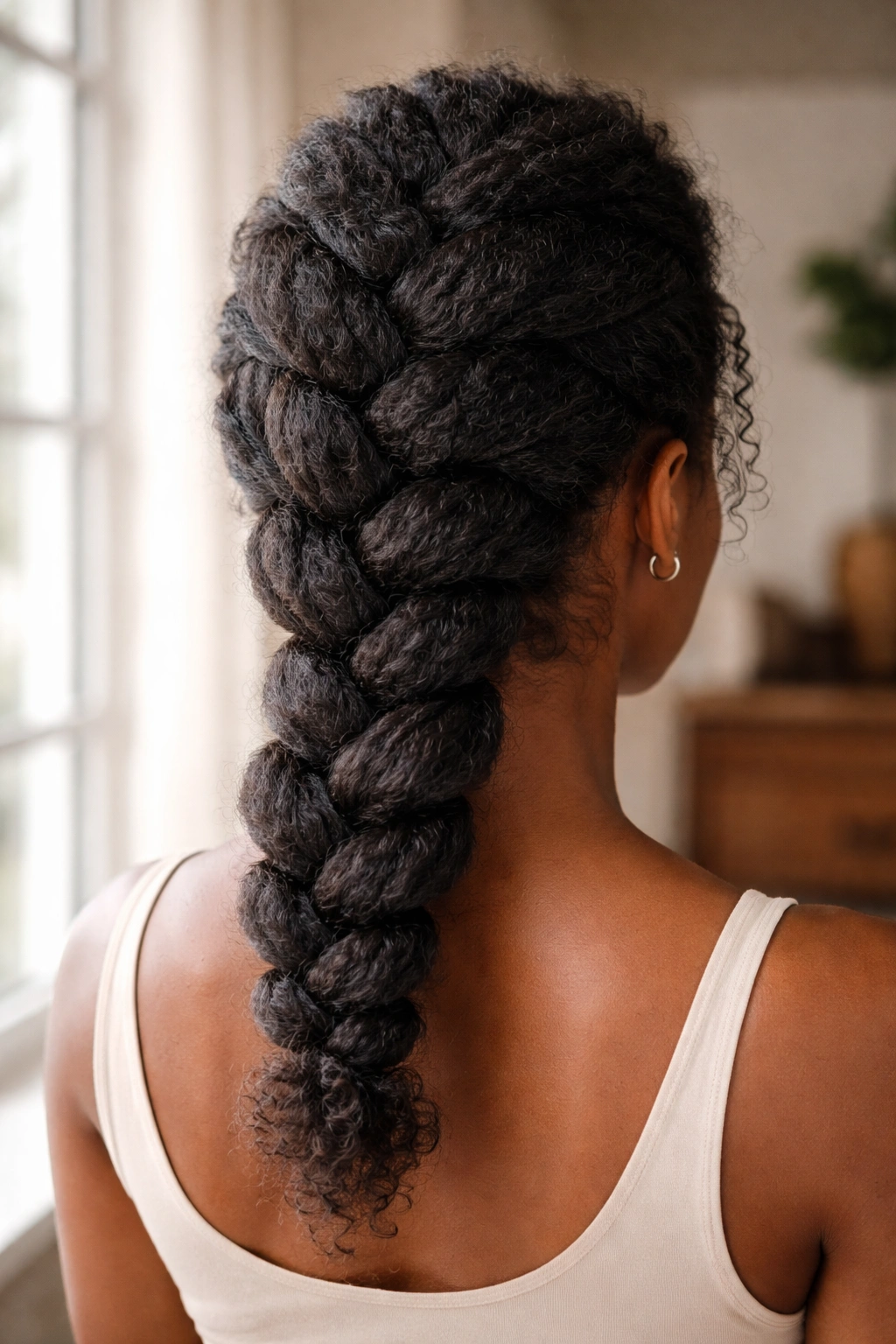
A large, center-back French braid that incorporates all the hair as you work from the crown toward the nape. On thick afro hair, this braid is genuinely chunky — the natural hair volume that gets incorporated into the braid as you work makes it expand to a substantial size by the time you reach the nape.
French braids on afro hair look different from French braids on straight hair — the natural coil texture means the incorporated sections have spring and volume even after being braided in, creating a more textured surface than the smooth, flat surface of a straight-hair French braid. This is more interesting, not less.
25. Tribal Cornrows with Shaved Design Elements
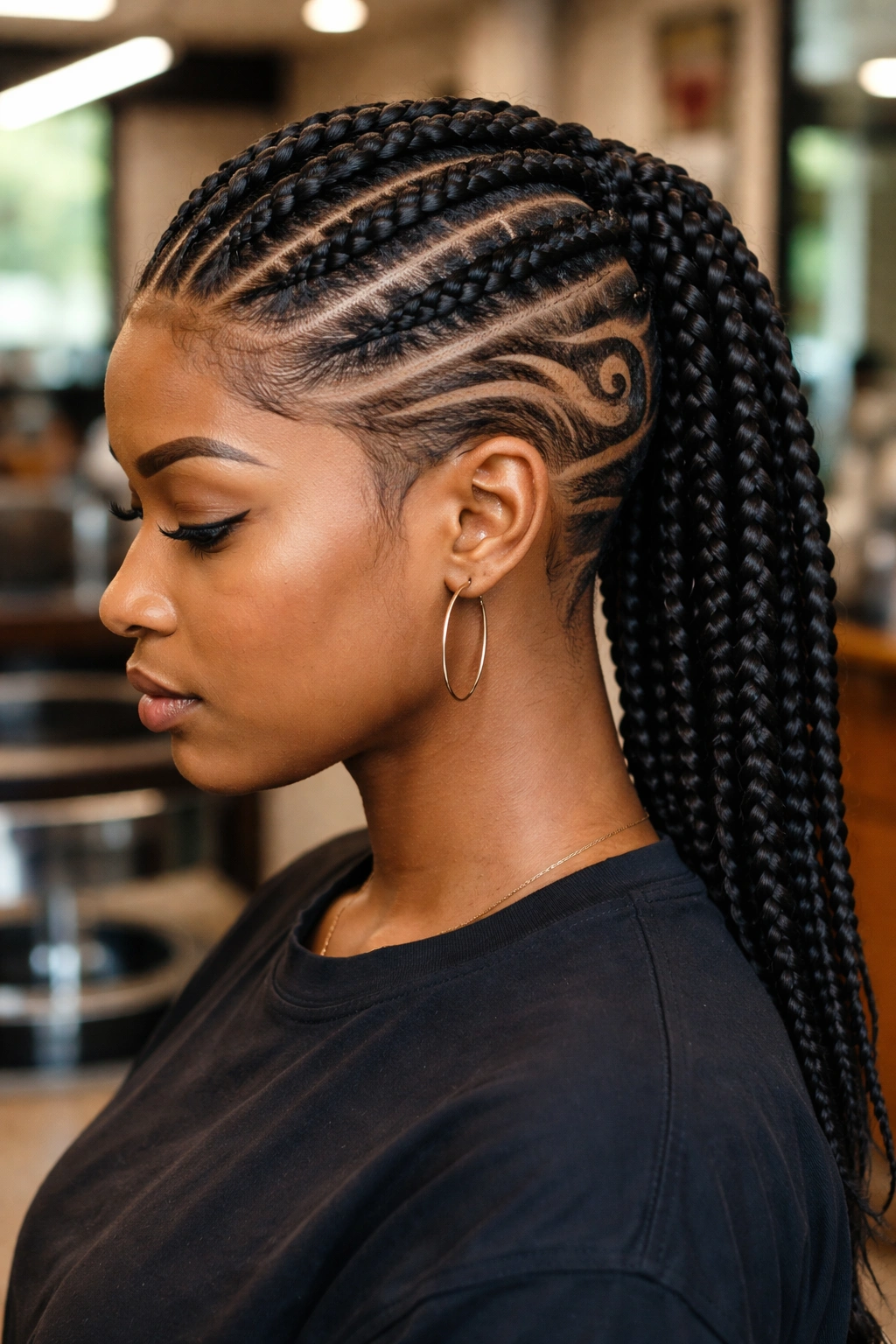
Cornrow patterns combined with shaved or etched designs in sections of the hair — graphic shapes, geometric patterns, or minimal line work etched into areas that are cut very close, contrasting with the raised cornrow sections. On thick afro hair, the contrast between the shaved sections (very close to the scalp) and the full, substantial cornrows is extremely striking.
This requires both a skilled braider and a barber or stylist comfortable with clipper work — two skill sets that aren’t always combined in one person. If your salon stylist doesn’t do clipper work, have the shaved elements done first at the barbershop, then go for the cornrow installation.
26. Fulani Braids with Full Afro Volume
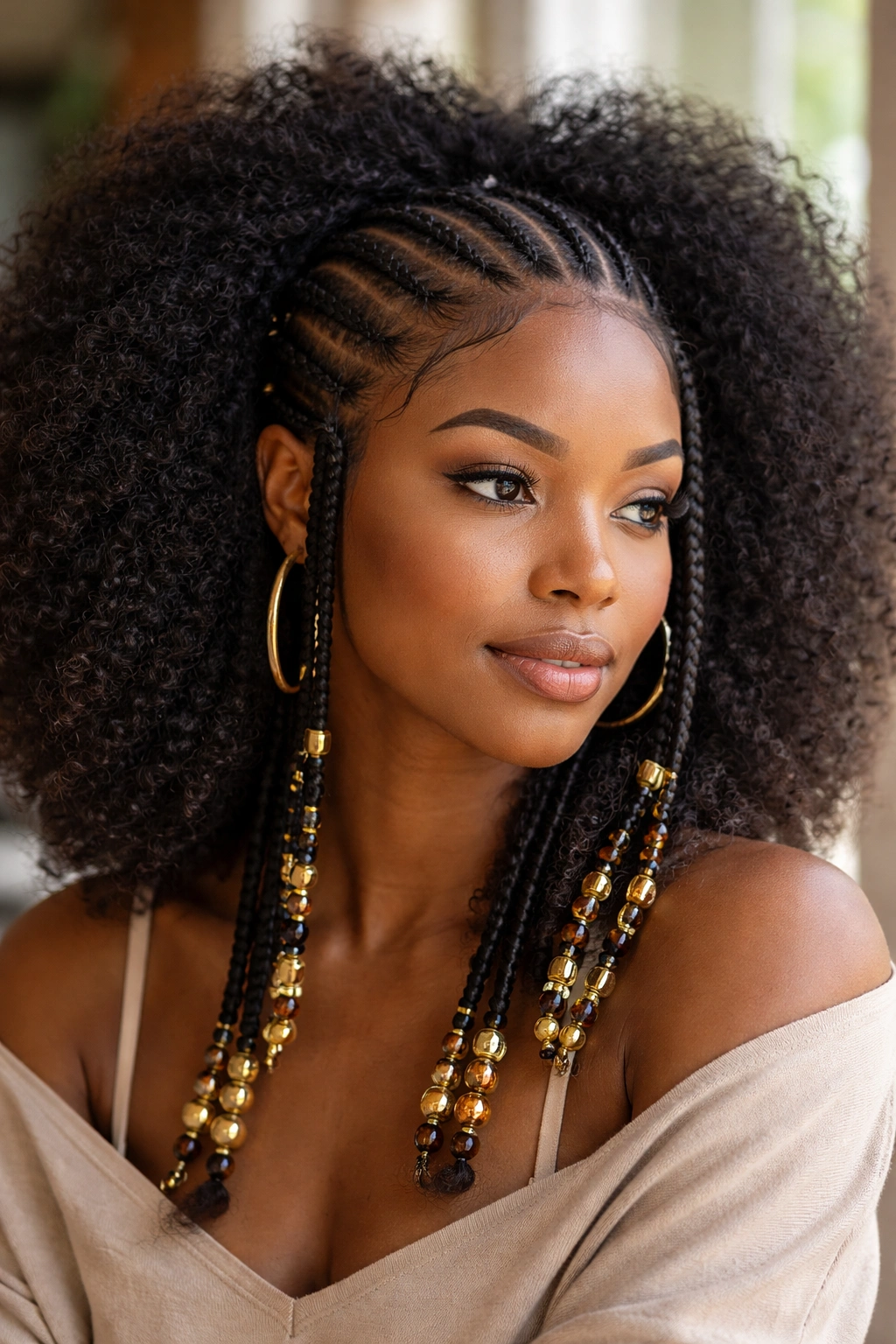
Inspired by Fulani braiding traditions: a center-back cornrow from the forehead to the nape, rows on each side that swoop from the front to the back at curved angles, and individual braids (with beads and cuffs) hanging at the temples and sides. On thick afro hair, the full scalp coverage of the cornrowed sections provides a neat, graphic base while the hanging individual braids frame the face.
The hanging temple braids are typically thinner than the cornrowed sections — single individual braids, usually two to four per side, that hang in front of the ears. On thick hair, even these thinner hanging braids are substantial in size compared to fine-haired versions.
27. Protective Topknot with Braided Base
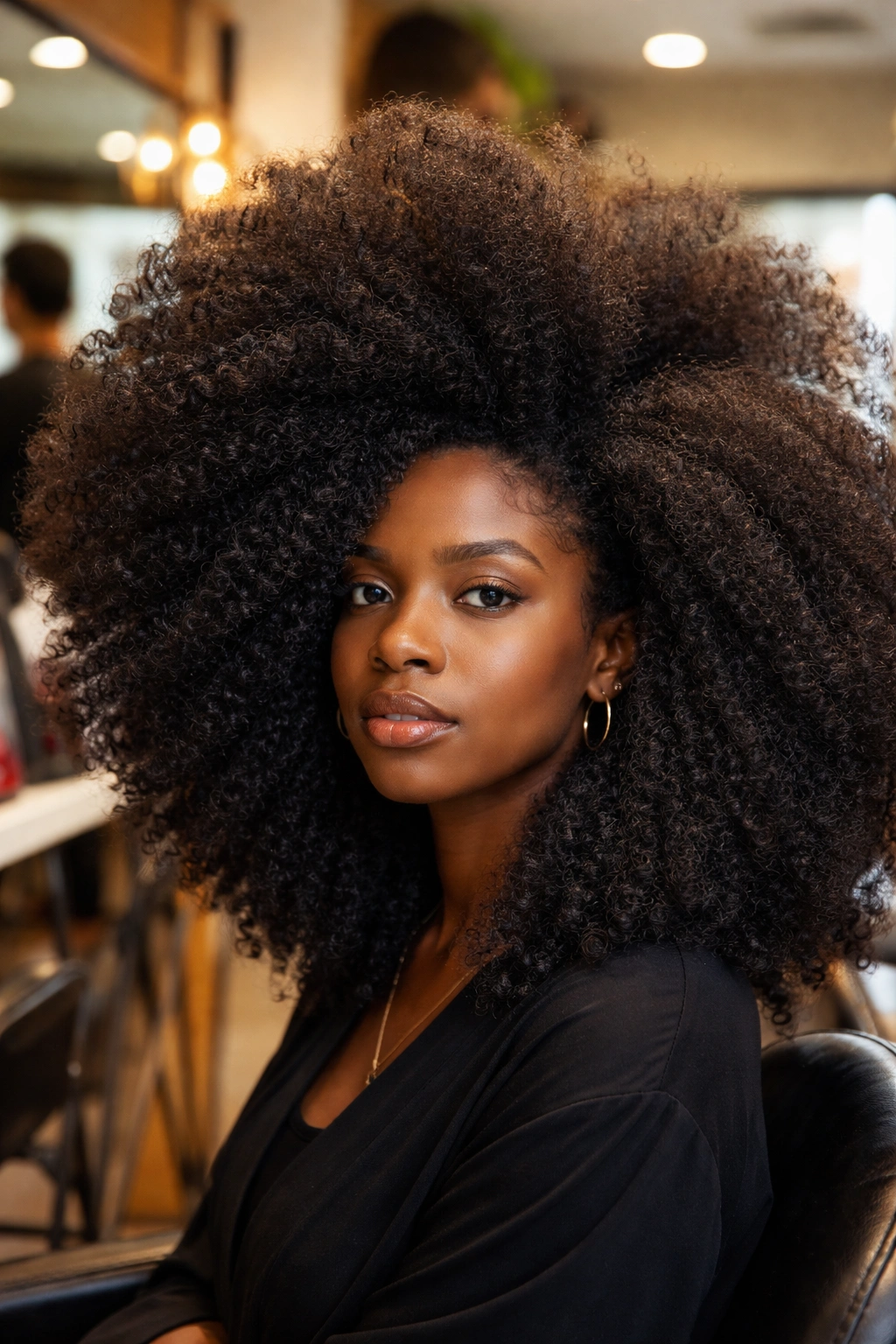
All the hair gathered into a high topknot, with the base section (the gathered root area) incorporated into a loose, decorative braid structure rather than just being wrapped with an elastic. On thick afro hair, the topknot bun itself is impressive in size — a full, rounded globe of natural hair at the crown.
This style doesn’t require a full head of braids — just the bun’s base section is braided decoratively. The styling takes 15-20 minutes, which makes it one of the most practical options on this list for everyday wear.
28. Cornrow Crown with Natural Locs Hanging
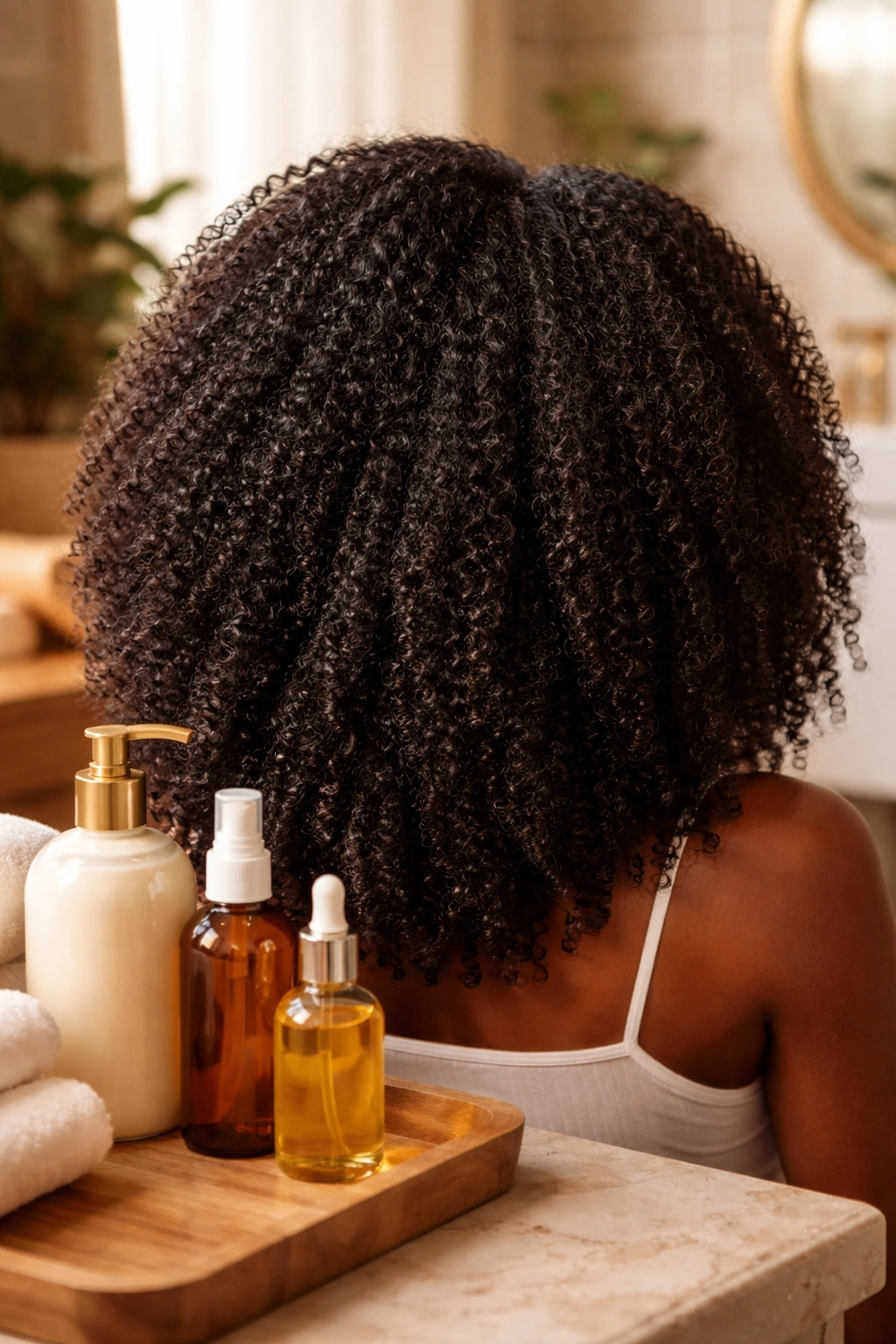
For women who have natural locs (not faux locs) at a length that allows for styling, cornrow the front and top sections of the scalp flat while leaving the locs themselves hanging freely. The cornrowed front creates a sleek, graphic base while the hanging locs provide all the length and volume.
On thick afro hair with mature locs, the hanging locs have serious presence. This style works best when the locs are at least shoulder length — enough to create visible movement and framing.
29. The Braided Bob
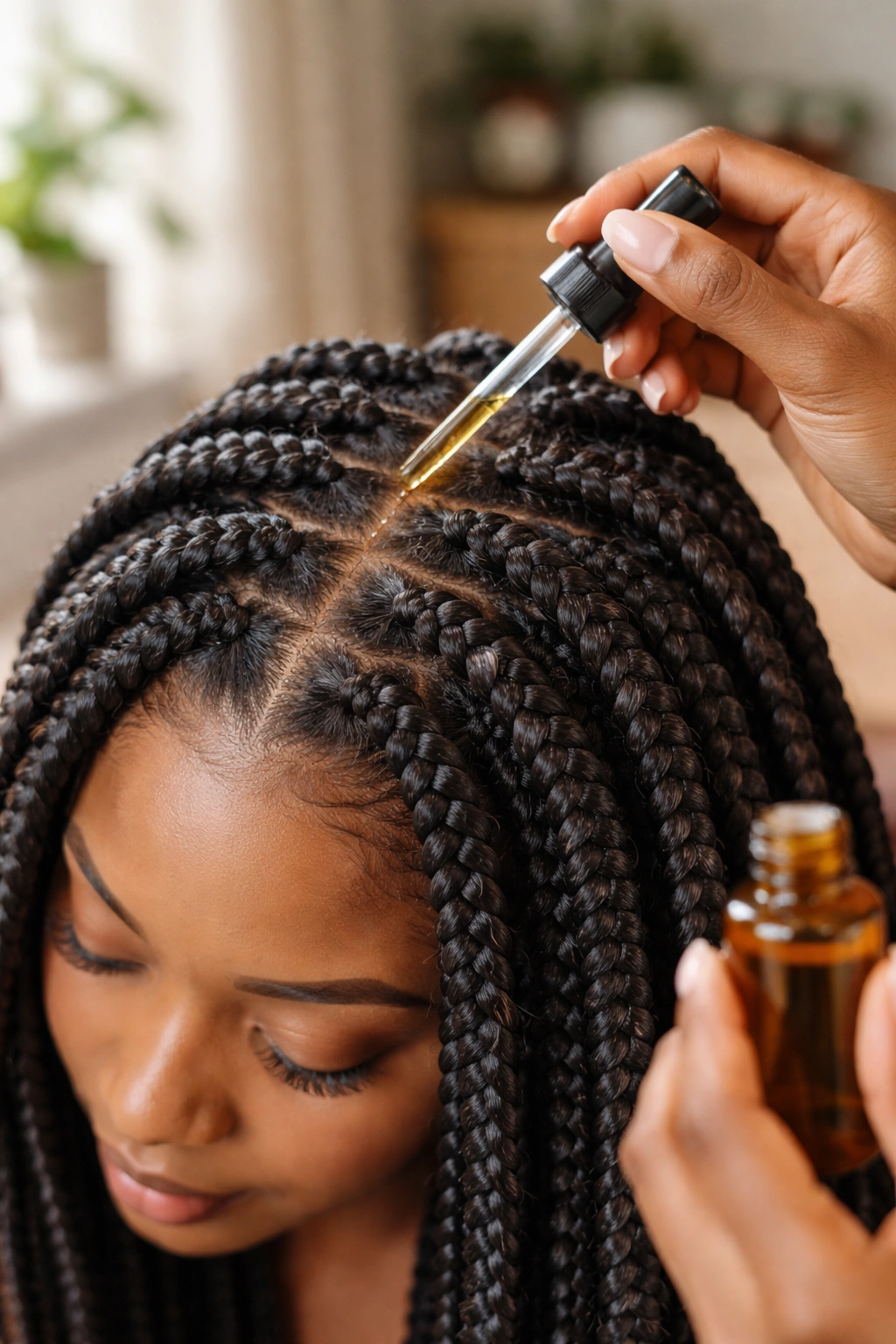
Box braids or knotless braids cut or installed to hang at bob length — jaw or chin length — rather than extending to the back or shoulder. On thick afro hair, a braided bob has significant volume and visual weight despite its shorter length. Each braid is substantial, and the total number of braids at that shorter length creates a dense, full style.
The braided bob works particularly well when combined with a taper or fade at the sides — the shorter fade reduces the visual bulk at the widest point of the head while the braided length on top maintains volume and character.
30. Jumbo Senegalese Twists
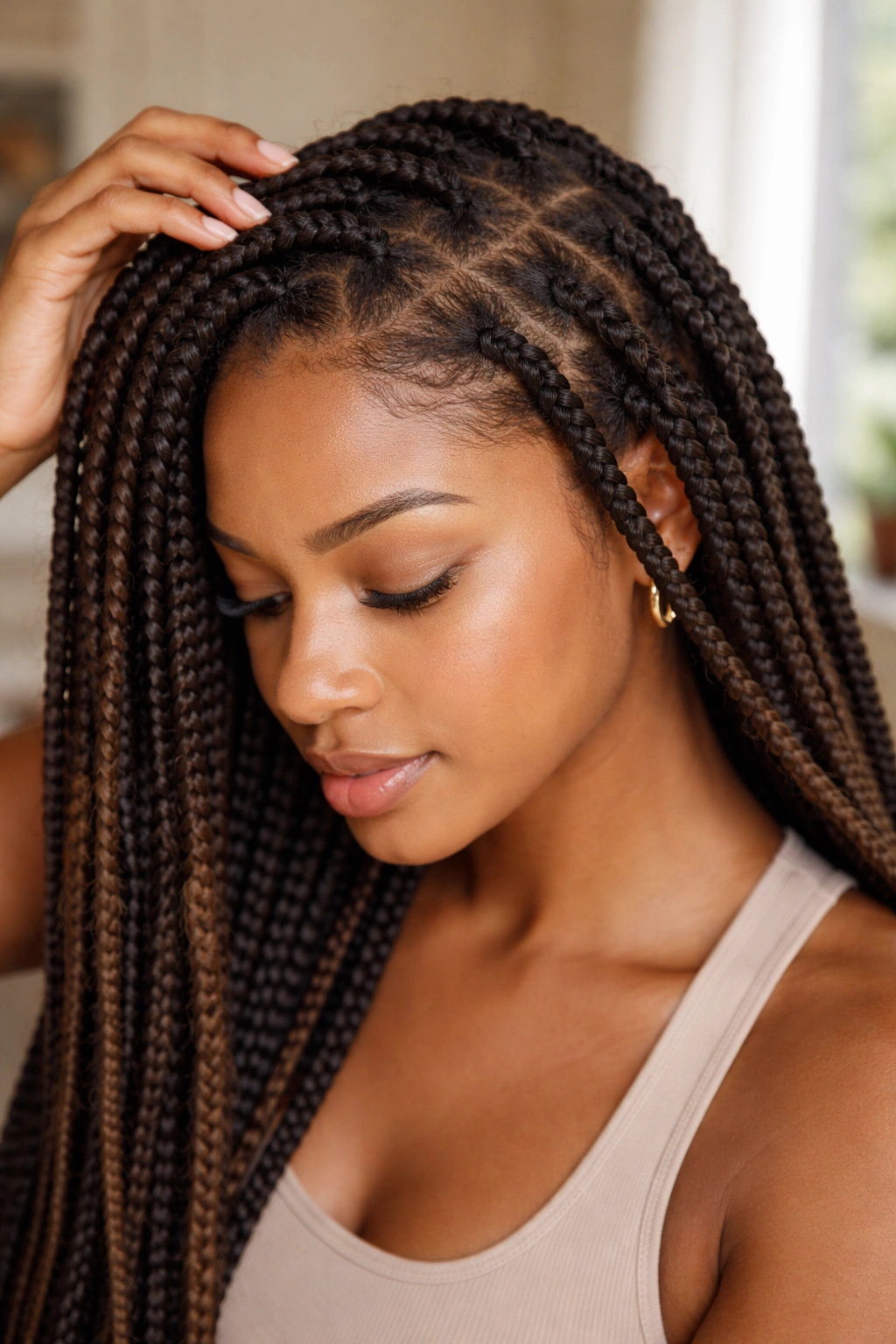
The jumbo version of the Senegalese twist — large, heavy, substantial spiral twists on thick afro hair. Where a standard Senegalese twist might use a half-inch section at the root, jumbo uses sections close to an inch. The result on thick hair is a twisting installation that hangs with extraordinary presence.
Jumbo Senegalese twists on thick afro hair are genuinely heavy. Long installations can strain the neck after wearing all day. Consider the length carefully — mid-back is typically the comfortable maximum for everyday wear at the jumbo size on thick hair. Waist-length is achievable but may become uncomfortable over the course of a full day. Short styles at shoulder length are the most comfortable and still look proportionate and intentional.
Takedown Techniques for Thick Hair
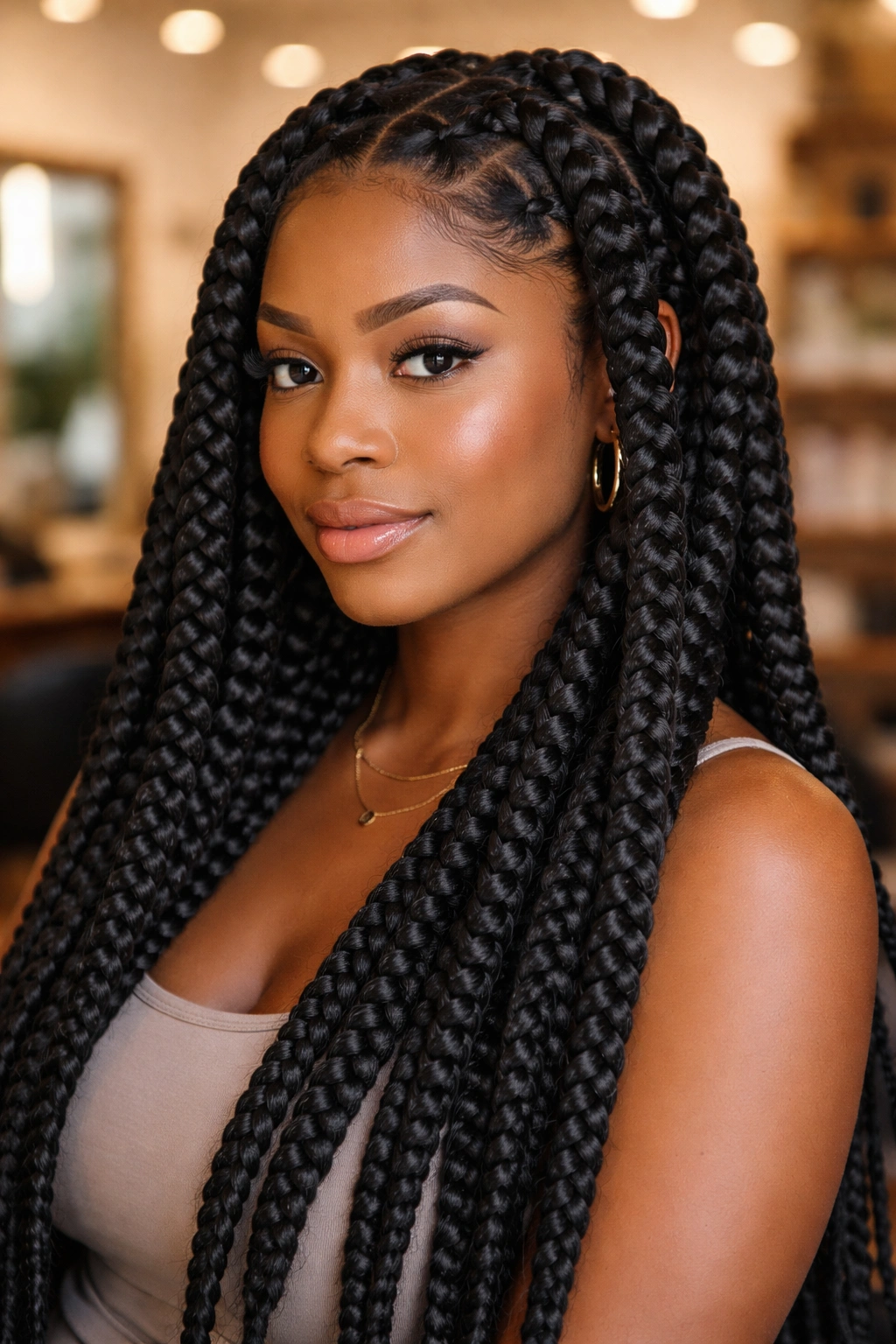
Taking down braids, twists, or locs on thick afro hair requires more patience and product than on other hair types. The shed hair accumulated inside the braids is proportional to the hair’s density — more hair means more shed. Start with a generous amount of a slippery conditioner worked through each braid before unraveling, and work from the end upward rather than pulling from the root down.
After all the braids are out, do not immediately wash. Detangle first while the conditioner is still in. On thick hair, this step alone can take 30-45 minutes for a full head. Working in sections, using a wide-tooth comb starting at the tips and moving toward the roots in short strokes, prevents the mass detangling experience from becoming a breakage event.
Scalp Recovery After a Long Braid Set
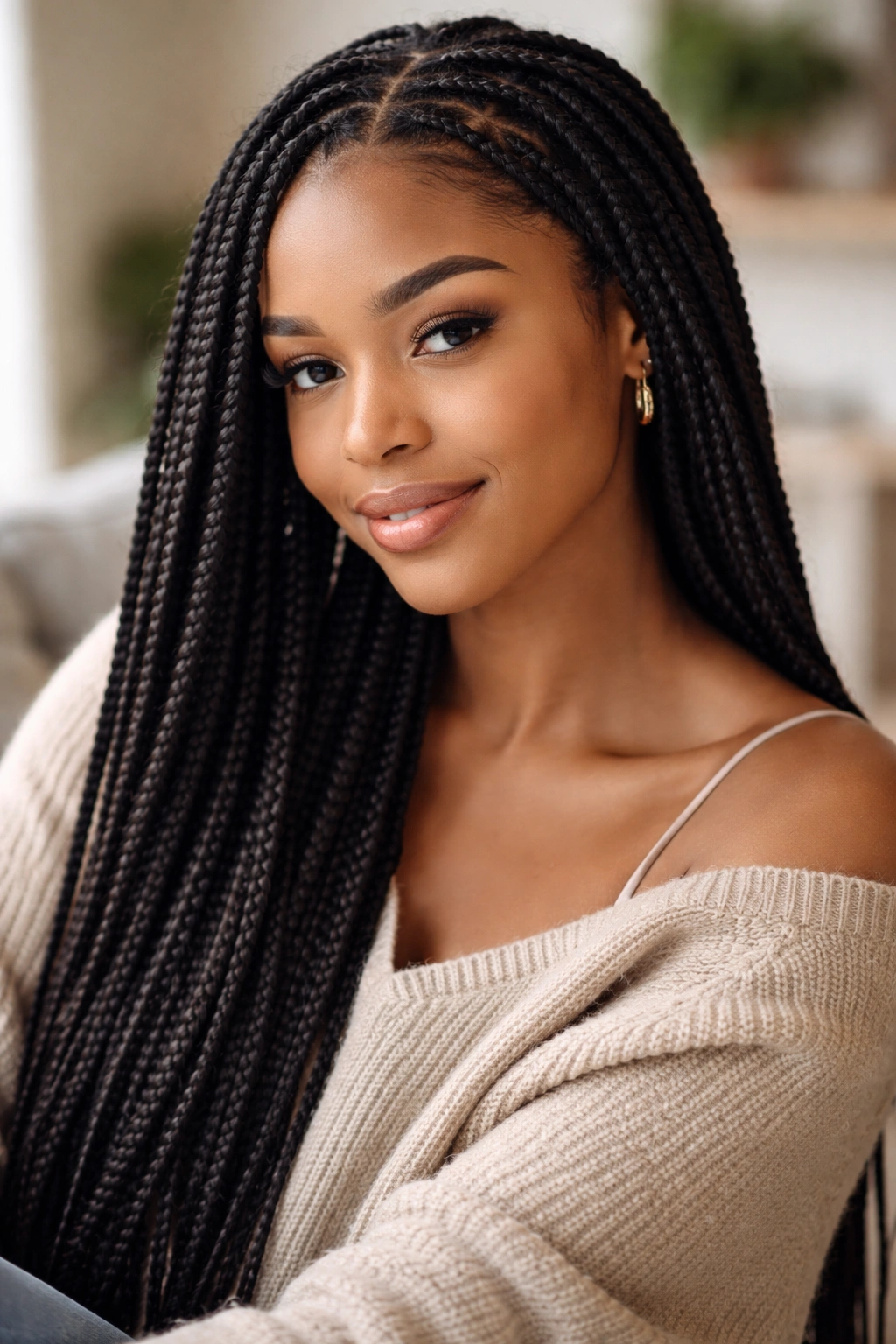
After a 6-8 week braid wear on thick afro hair, the scalp typically needs some recovery time. A warm oil scalp massage (about 2 tablespoons of a warm oil blend applied directly to the scalp, massaged in small circular motions for 5-10 minutes) before washing promotes circulation and helps dislodge any remaining buildup. Follow with a clarifying shampoo wash, then a deep conditioning treatment for 30-45 minutes with heat.
Your scalp will likely have visible flaking or dryness after this long of a covered period. This is normal and typically resolves within one or two wash days. Give your hair a week or two of fully loose natural styling — with all the daily moisture it needs — before your next braid installation.
