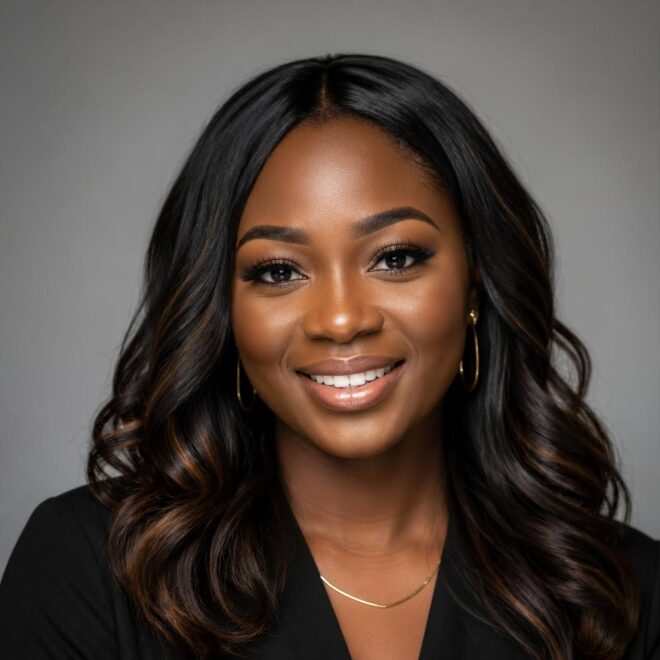


All back cornrows with curls hit a particular kind of sweet spot. You get the clean, pulled-back structure of cornrows — and the softness of curls flowing past your shoulders. I’ve worn this combination through every season, every mood, every hair phase, and it keeps earning its place in rotation. The pattern stays neat. The curls give it life. It photographs from every angle without looking staged.
The hardest part isn’t the install. It’s picking which version you want — tight spiral ends, loose waves, half curls, jumbo curls, rod sets. That’s where this guide comes in. Twenty-two all back cornrow styles with curls, each one with its own angle on how the braided front meets the curled back.
What “All Back” Really Means
All back cornrows run from your hairline straight to the nape or beyond. No sideways patterns, no angled parts, no zigzag crown — just rows moving front to back in parallel lines. It’s the most traditional cornrow pattern and also the most versatile because you can add anything to the ends.
The number of rows varies. A standard install has 6 to 9 rows across the crown. Finer parts create more rows (10 to 14), which suits thicker hair. Chunkier parts work for people who want fewer rows with more visible scalp between them.
Adding curls to the ends shifts the whole style from protective to playful. The braids handle the structure. The curls handle the drama.
Why Curls Change Everything
Curls soften the geometry. Cornrows alone read sharp and linear — each braid a straight line along the scalp. Loose curls flowing from the ends break that rigidity. Your head stops looking like a patterned surface and starts looking like a full hairstyle.
The curls also add movement. Flat cornrows don’t sway when you walk. Curled ends do. That shift in visual energy matters for everyday wear, not just photos.
Longevity wise, curls can extend the usable life of an install because they distract from frizz building up around the parts. A curl-forward style looks fresh even when the cornrow base is past its peak.
Choosing the Right Curl Texture
Not every curl suits every face or outfit. Tight spiral curls photograph tighter and read more defined. Loose waves fall softer and flatter. Jumbo curls make a bigger statement — think glamour, not casual.
Texture of the added hair matters too. Kanekalon holds curl well but can frizz in humidity. Synthetic brands like Xpression and Sensationnel offer hair that takes a hot water dip or rod set better than cheaper alternatives. Human hair extensions curl the most naturally but cost 3 to 5 times more.
If you’re pairing curls with long cornrows, pick curl patterns with more separation. Tight ringlets on long hair can tangle against themselves.
What You’ll Need for the Install
- 4 to 6 packs of braiding hair (fewer for shorter styles, more for waist-length)
- Edge gel, clear and light-hold
- Perm rods or flexi rods in the size matching your desired curl
- A pot of hot water for the dip method
- Hair pins and a satin scarf for setting overnight if rolling the curls
Skip the cheap hair. A bad braid hair choice can shed so much during the first wash that you end up with shorter curls than you started.
Prep and Timing
Book 4 to 7 hours depending on length and the curl method. Washing the night before is ideal. Hair should be clean, detangled, and slightly stretched — not freshly conditioned and slippery. A light mousse at the roots gives the braider grip without stiffness.
Decide on curl placement before you start. Are the curls starting at the shoulder? At the collar bone? Halfway down the braids? Tell your braider specifically. Changing your mind mid-install costs time.
1. Classic All Back with Loose Spiral Curls
Why It Works
The loose spiral is the most wearable curl shape because it doesn’t commit to tight definition or flat waves. Each curl is about 2 inches wide, catches light softly, and lasts through a full work week without re-setting.
- Use half-inch perm rods for this curl size
- Dip the ends in hot water for 15 seconds, then set on the rods for 2 hours
- Spray with a light mousse before removing rods to extend the curl
Tip: Leave the top 3 to 4 inches of the braid straight before the curl begins. The contrast between the flat section and the curl makes the transition feel intentional.
2. Long Cornrows with Tight Ringlet Ends
Tight ringlets show off definition and texture but demand commitment. The ringlet is small — a third of an inch across — and requires a hot water dip on thin rods. The result is bouncy, doll-like curls that stay sharp for 2 to 3 weeks.
This style reads vintage when paired with short cornrows (ending at the shoulder) and modern when paired with long cornrows (past the chest). That single choice changes the whole vibe.
The hair near the scalp stays completely flat. Only the last 6 to 8 inches get the ringlet treatment. Keep a satin bonnet for sleep — ringlets frizz faster than looser curls.
3. Waist-Length Cornrows with Beach Waves
Beach waves read loose and undone. They’re the least “styled” curl shape. On cornrows, they create a soft silhouette that feels lived-in rather than engineered.
The waves start around the mid-back and continue to waist. Use large flexi rods or the sock-curl method for this texture. Skip hot water dipping — it sets waves too tight.
Mist with sea salt spray after setting. The texture it leaves on the strands helps the waves look natural instead of uniform.
4. Shoulder-Length with Half Curls
Half curls mean the curl starts about halfway down the braid. So the top half reads as a long, straight braid, and the bottom half bursts into curls. It’s a contrast style.
The curl half usually measures 6 to 10 inches, curled into medium spirals. The cornrow above stays crisp and visible through the curls until the curl volume takes over near the ends.
People with round faces love this because the visual weight sits low, lengthening the face.
5. Bob-Length Cornrows with Flipped Curls
What Makes It Different
A bob-length install with curls that flip outward at the ends creates a retro silhouette. The braids stop at the jawline. The curls flare out instead of hanging straight down.
The flip is set with a curling iron on the extensions or by pinning the wet ends upward while they dry. Both methods work. The iron is faster. The pin method lasts longer.
Who This Is For
Anyone who wants a shorter style without actually cutting hair. The flip adds shape so the bob doesn’t sit too severely against the face.
6. Jumbo Curls at the Ends
Jumbo curls are 3 inches or wider. They sit like soft pillows at the ends of the braids. This style shifts cornrows from protective-practical to outright glamorous.
Large flexi rods, the 1.5-inch size, hold this shape. Set overnight for best results. In the morning, finger-separate the curls instead of brushing — a brush flattens the jumbo shape into a wave.
The curls need more product than smaller sizes. A curl cream with some slip prevents the volume from collapsing by midday.
7. Mid-Back Length with Crimped Ends
Crimped curls are angular and bouncy — not really curls in the traditional sense. They zigzag in tight angles. The texture catches the eye immediately.
Crimping the ends of cornrow extensions takes a crimping iron or a perm-rod wrap with tight angles. The effect is modern when paired with sleek cornrows and playful when paired with a chunkier cornrow pattern.
Crimps don’t hold up in humidity. If you live somewhere humid, consider another texture or plan to refresh often.
8. Cornrows with Ombre Curled Ends
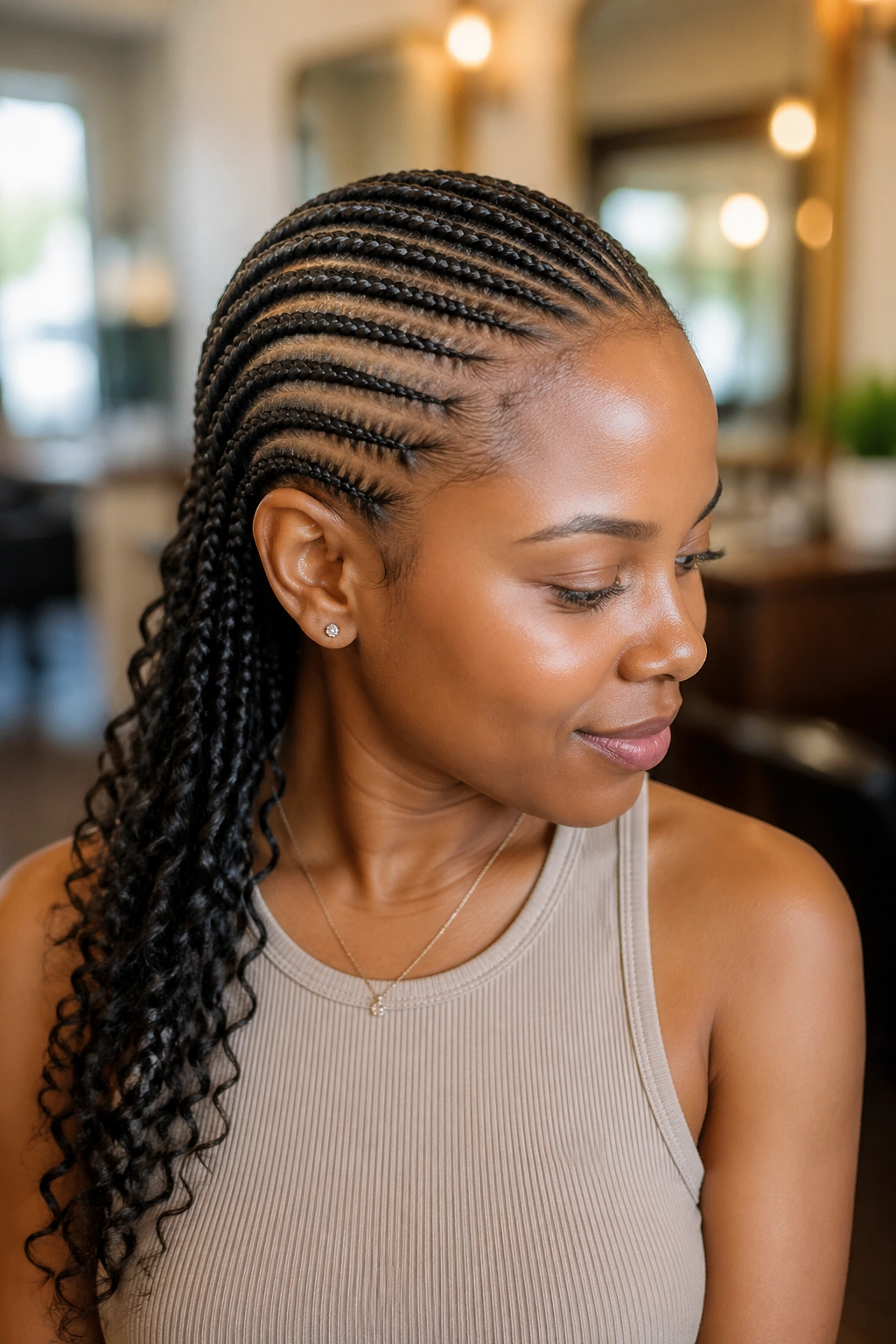
Color and curl together. The braids start dark at the root, transition to a lighter shade near the mid-length, and end in curls of that lighter tone. Caramel-to-auburn or black-to-honey are the combinations that show up most often.
Feed in the lighter hair partway down each cornrow. The transition should be gradual — no sharp color block. Curl the ends after the braid is complete.
The curl pattern shows color better when it’s looser. Tight curls compress the gradient. Loose waves let the color flow.
9. Straight Back with Body Wave Tips
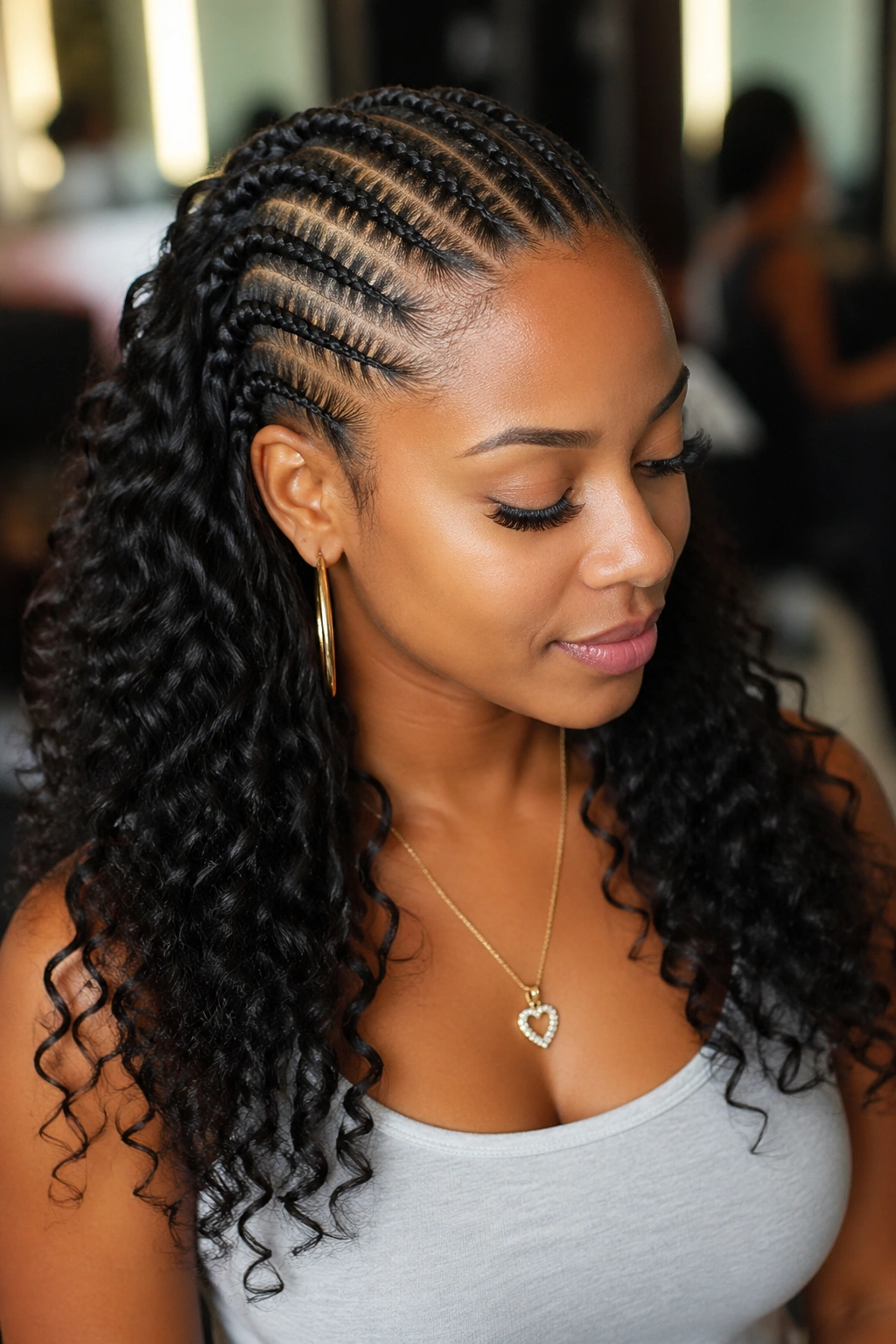
Body wave is a gentle, S-shaped wave. It’s not a curl exactly. It’s what happens when you want movement without committing to a spiral.
The technique is simple — loose-rod the ends for 2 hours, don’t use hot water, finger-separate after. The result is a soft wave that lasts about a week before loosening.
Body wave suits business-casual environments where tighter curls might read as “too much.”
10. Long Cornrows with Spiral Drop Curls
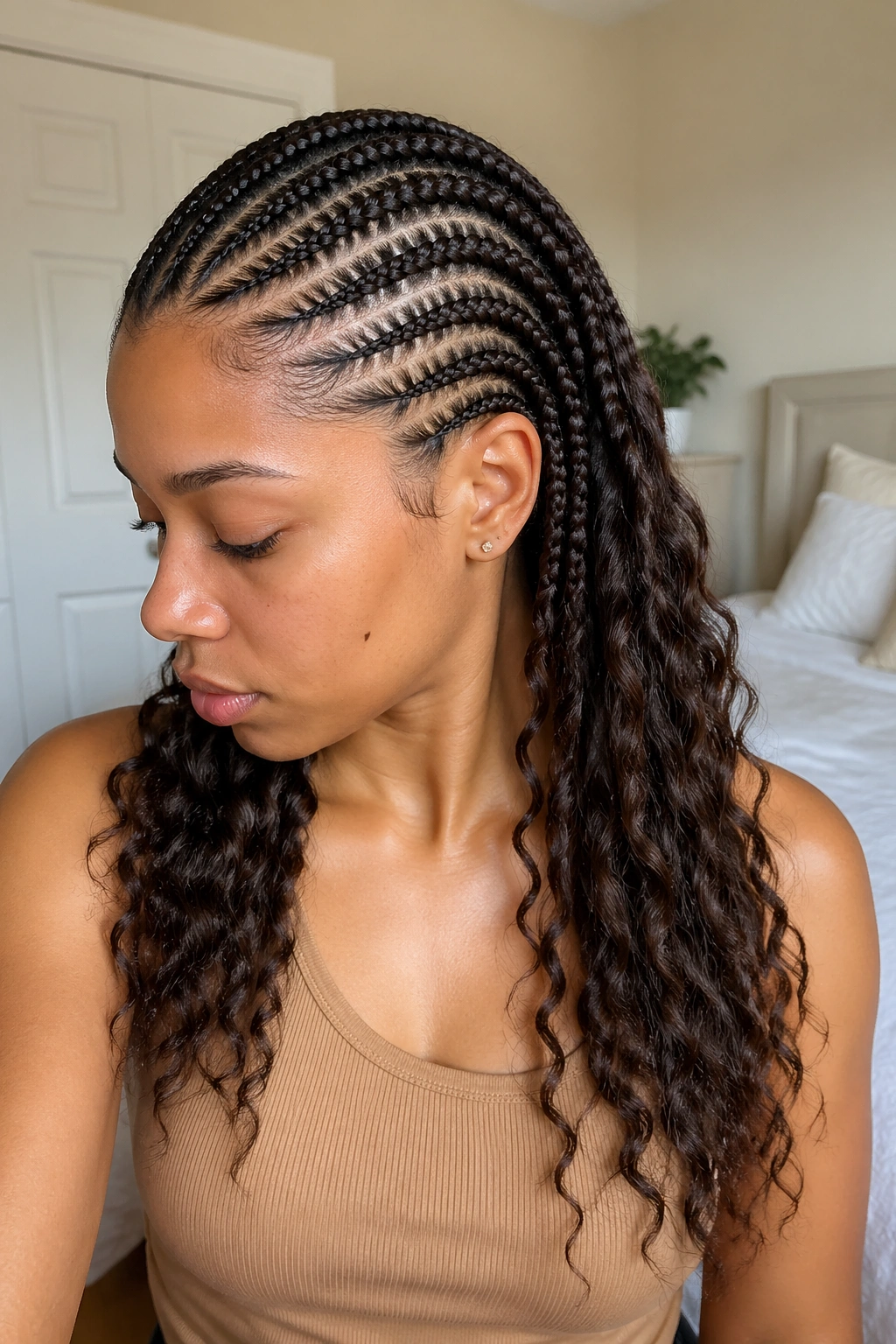
Drop curls hang in long vertical spirals — like a tight ringlet but drawn out over 10 to 12 inches. The drop curl is longer, softer, and more cinematic than a standard ringlet.
Use the rag-curl method or long flexi rods. Set time is longer — 4 to 6 hours. But the finish lasts 2 to 3 weeks with basic care.
One note — drop curls look best on mid-length to long cornrows. On short styles, they compress and lose the “drop” shape.
11. All Back with Curls Starting at the Nape
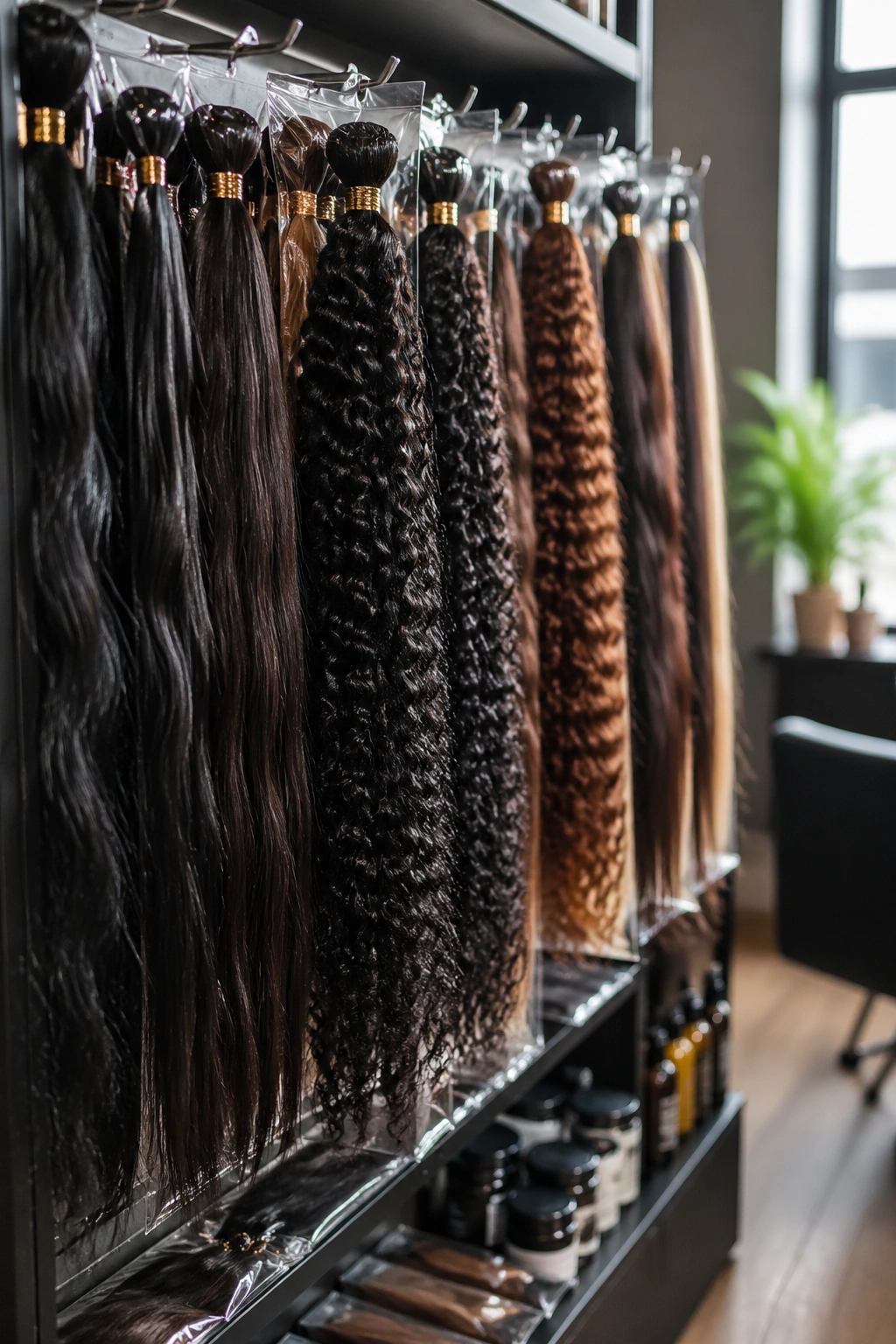
What if the curl pattern begins right at the nape and not further down? The whole back of your head becomes a curled section while the top stays braided. It’s a visual flip on the standard long-braid-with-curls approach.
The effect is cleaner from the back. You see the cornrow pattern from the front, but when you turn, the braids melt into curls immediately.
How to Wear It
This works well with updos where the back hair stays down. Half-ponytails from the crown let the nape curls flow free.
12. Cornrows with Deep Curls and Volume
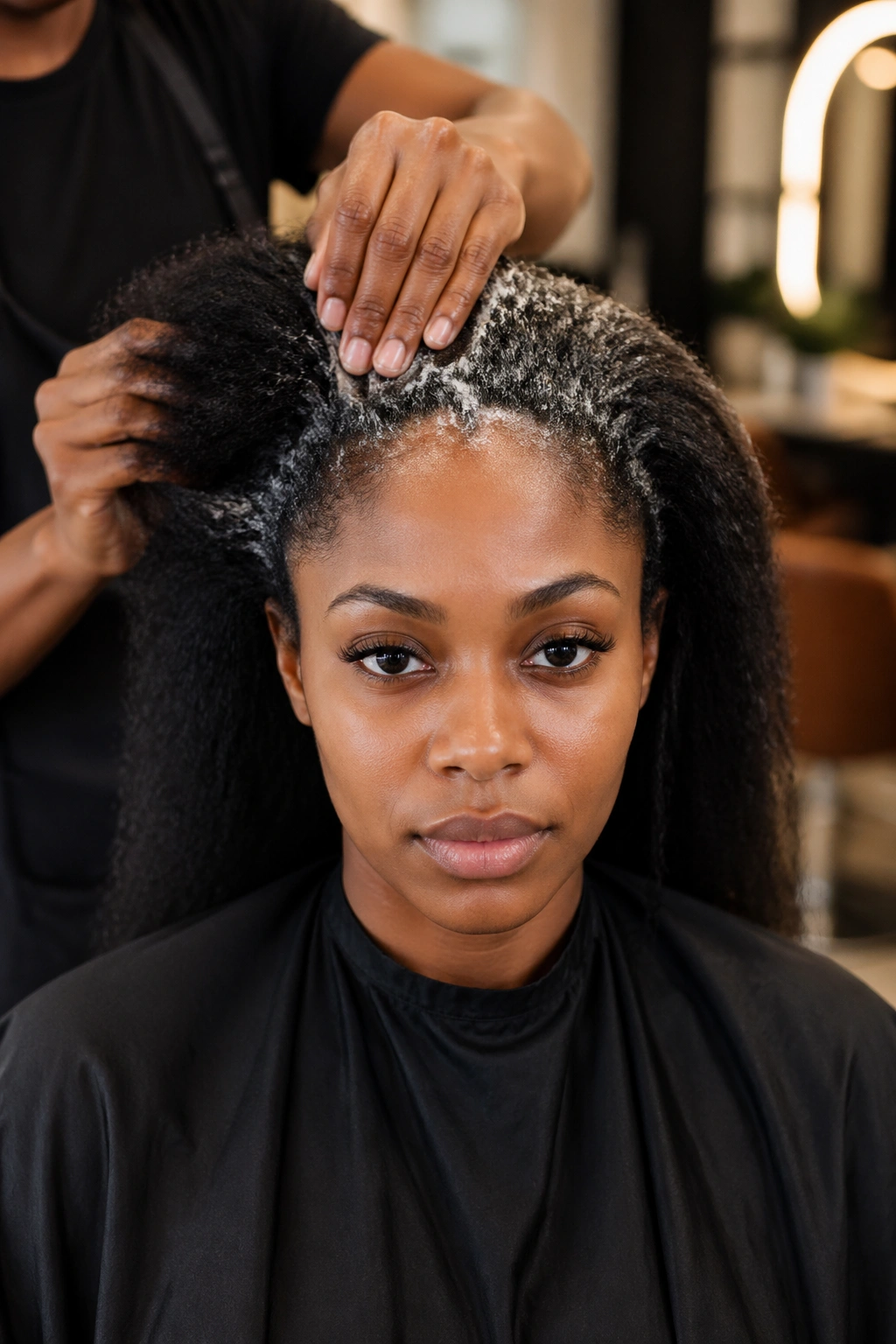
Deep curls are tight at the scalp end and loosen toward the tip. They look natural — like someone’s own curl pattern flowing down from braids.
Use multiple rod sizes during setting. Small rods at the top of the curl, medium rods in the middle, large rods at the ends. This creates the graduation.
Volume is the point. Let the curls puff. Don’t try to tame them with serum or oil for the first two days — let them expand into their full shape first.
13. Short Cornrows with Bouncy Curled Bob
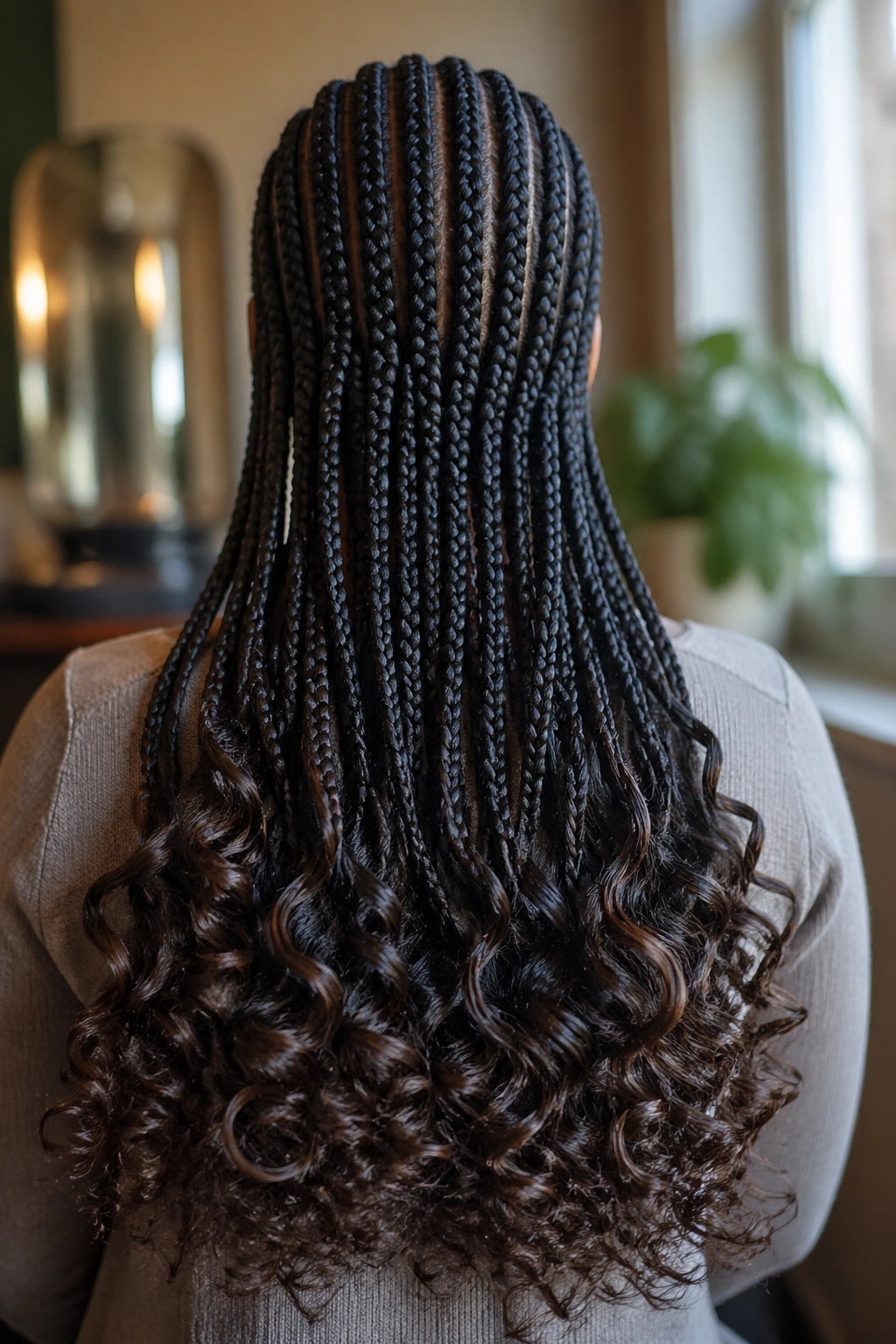
A short cornrow-to-curl bob sits at the chin or upper neck. It reads sharp and professional while keeping the softness of curls against the face.
- Cornrows are 3 to 4 inches long before the curl starts
- Curls are medium-tight spirals, about three-quarters of an inch
- Total length hits at the jawline or just below
Tip: Ask your braider to leave a few face-framing pieces slightly longer. The asymmetry flatters most jaw shapes.
14. Long All Back with Side-Swept Curls
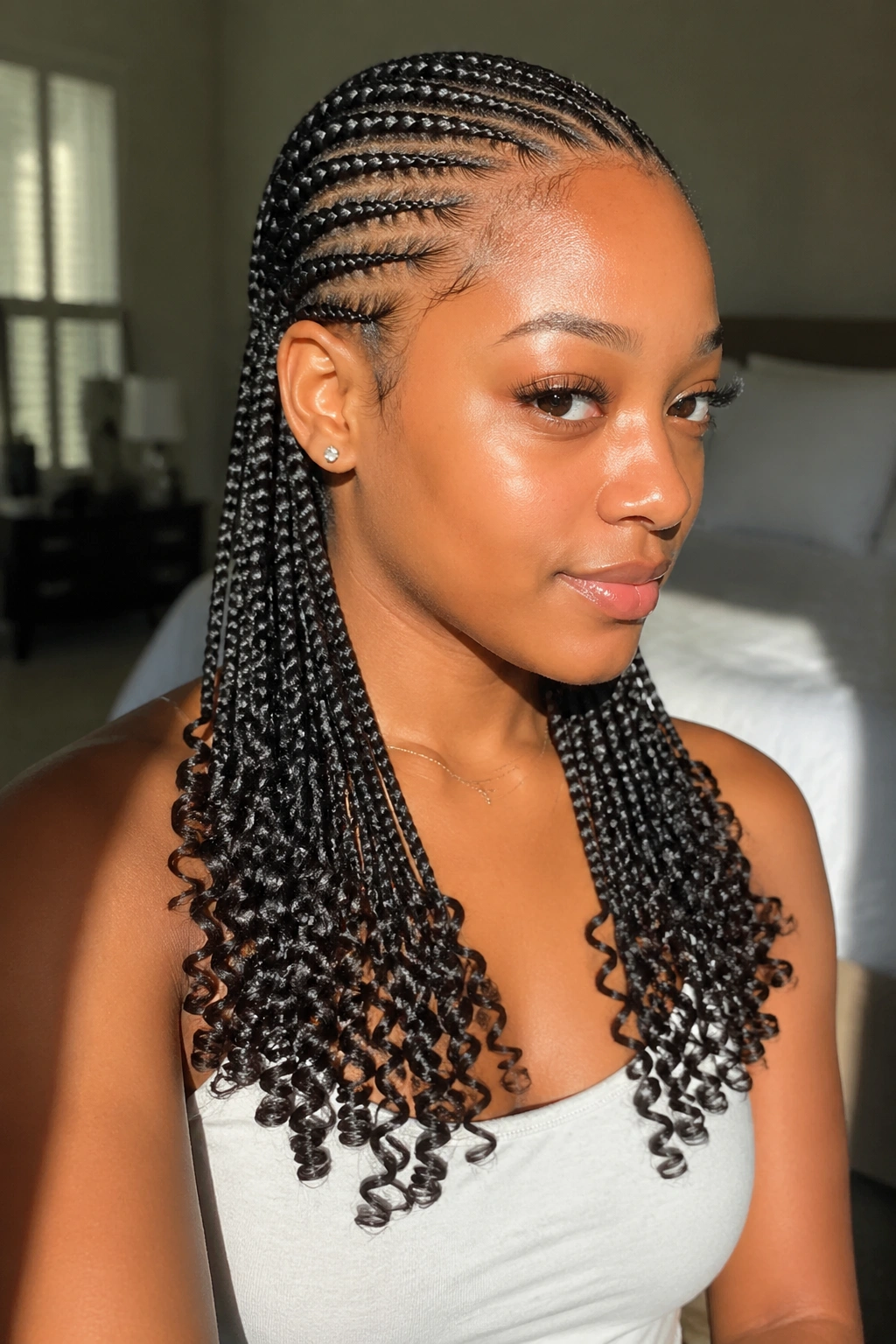
The braids go straight back, but the curls get swept to one side of the shoulder. The asymmetric cascade softens the symmetric braid base. It’s a contrast play.
Sweeping is done after the curls are set and released. Use your fingers to gather the curled sections and pin them to drape across one shoulder. A decorative hair clip at the base of the gather adds polish.
It’s a great wedding guest style. Neither overdone nor underdone.
15. Cornrows with Finger Coils at the Ends
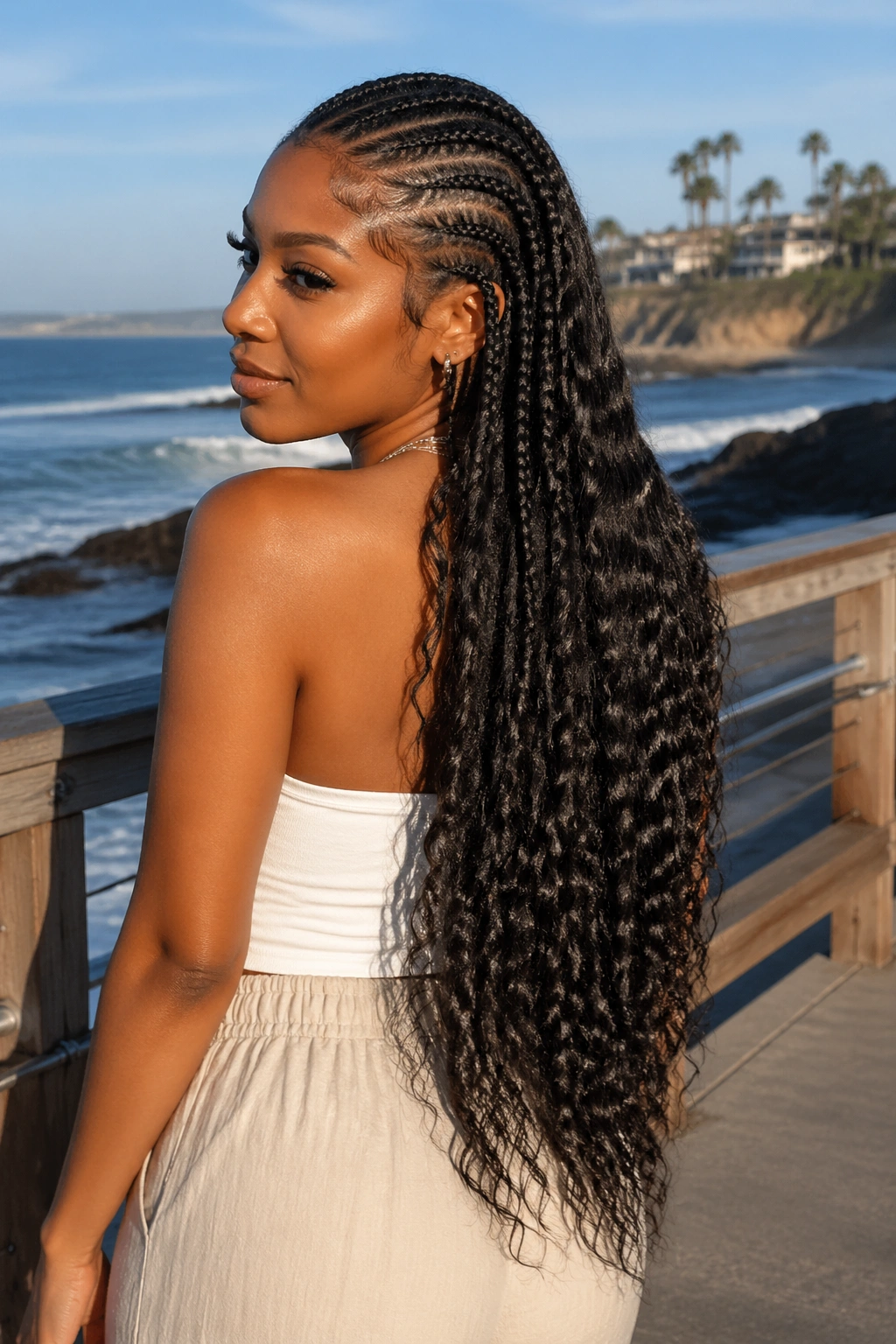
Finger coils are small, tightly wound spirals created by twisting sections of hair around a finger. On cornrow extensions, they look like clean, defined springs at the ends.
The coils are small — about half an inch wide each. They stack against each other for a dense, textured finish. The look is distinctly natural-hair-inspired even though it’s built on extensions.
Styling Tips
Use a gel with slip to set each coil. Hold for 10 seconds, release, move to the next section. Skip silicone-heavy products — they weigh coils down.
16. Bohemian Cornrows with Wavy Curl Mix
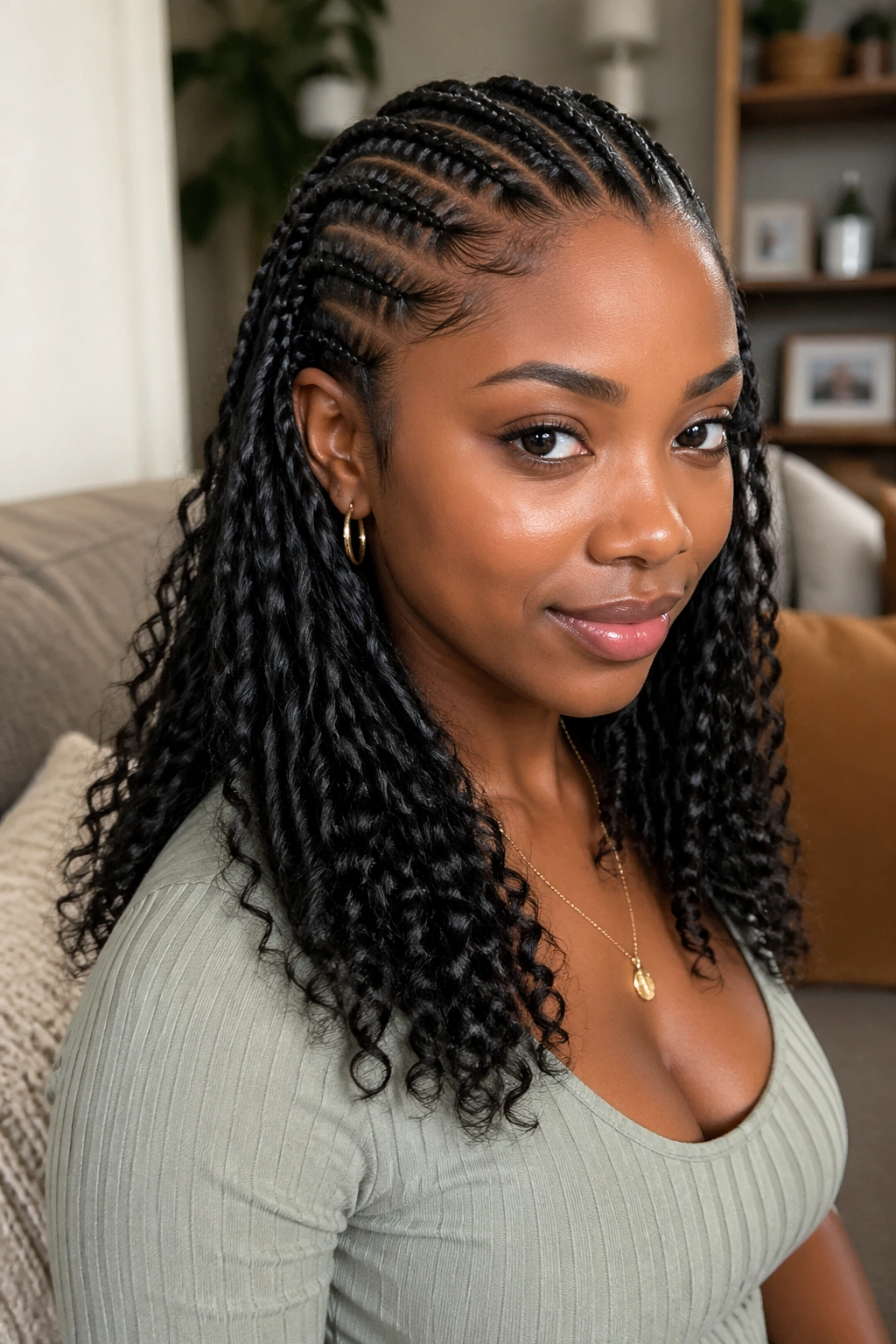
A mixed-texture style uses both straight sections and curled sections on the same head. Some braids have tight spiral ends. Others have loose waves. A few stay completely straight.
The mix reads intentional only when there’s balance. Roughly a third of the braids get one texture. Another third gets a second texture. The last third stays neutral.
Bohemian styles look best with accessories — a single wooden bead here, a shell cuff there. Sparse accessorizing matches the relaxed aesthetic.
17. Cornrows with Curled Fringe
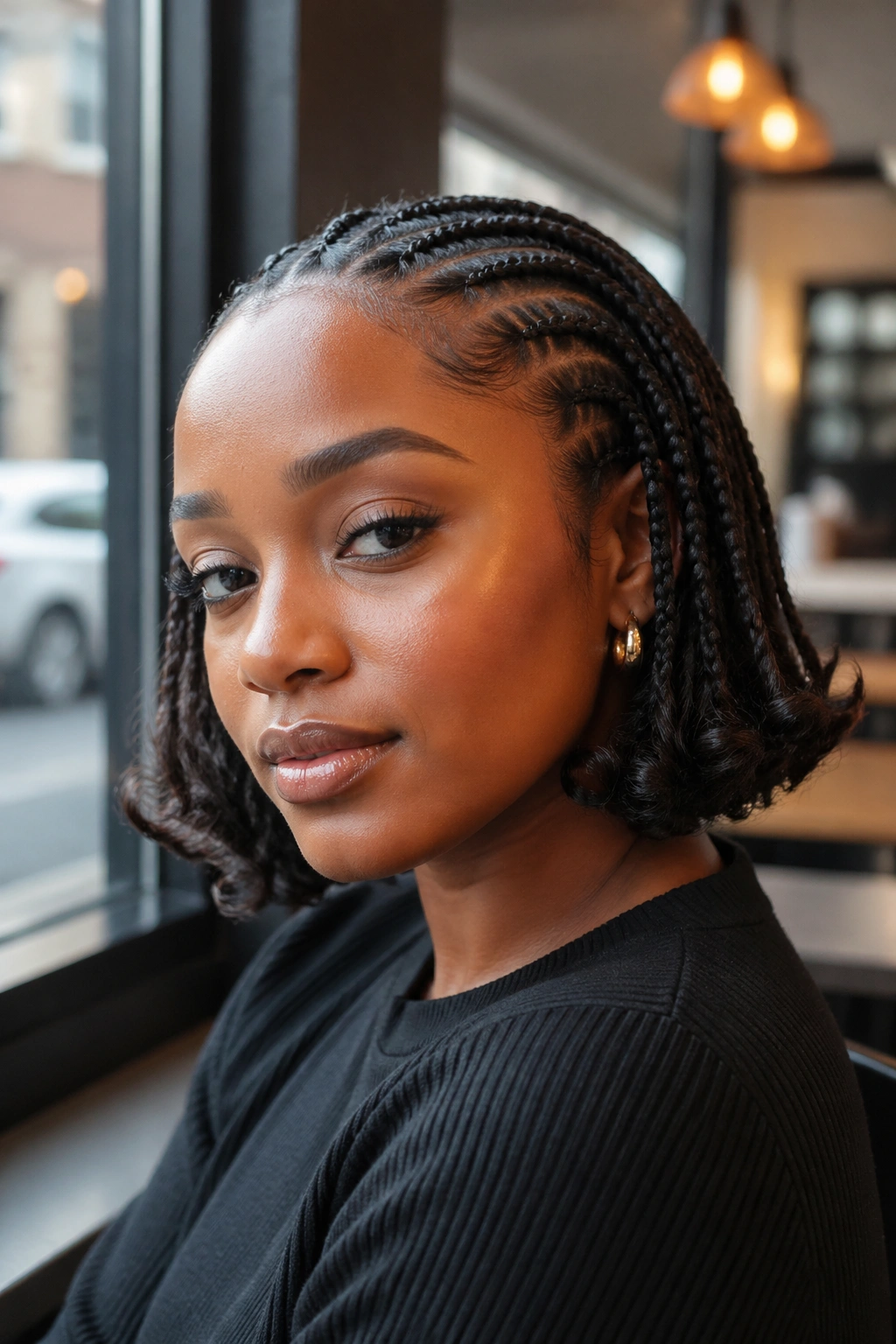
A curled fringe over the forehead pairs with all-back cornrows behind. The fringe is a small section — 2 to 3 inches deep from the hairline — curled into a soft wave or piece of ringlets.
The fringe hair is loose, not braided. It frames the face while the cornrows pull everything back from behind.
Pay attention to where the fringe lands. A fringe that covers the eyebrows reads romantic. One that stops above the brow reads structured. Neither is wrong; it depends on the mood.
18. Crown-Forward Cornrows with Cascading Curls
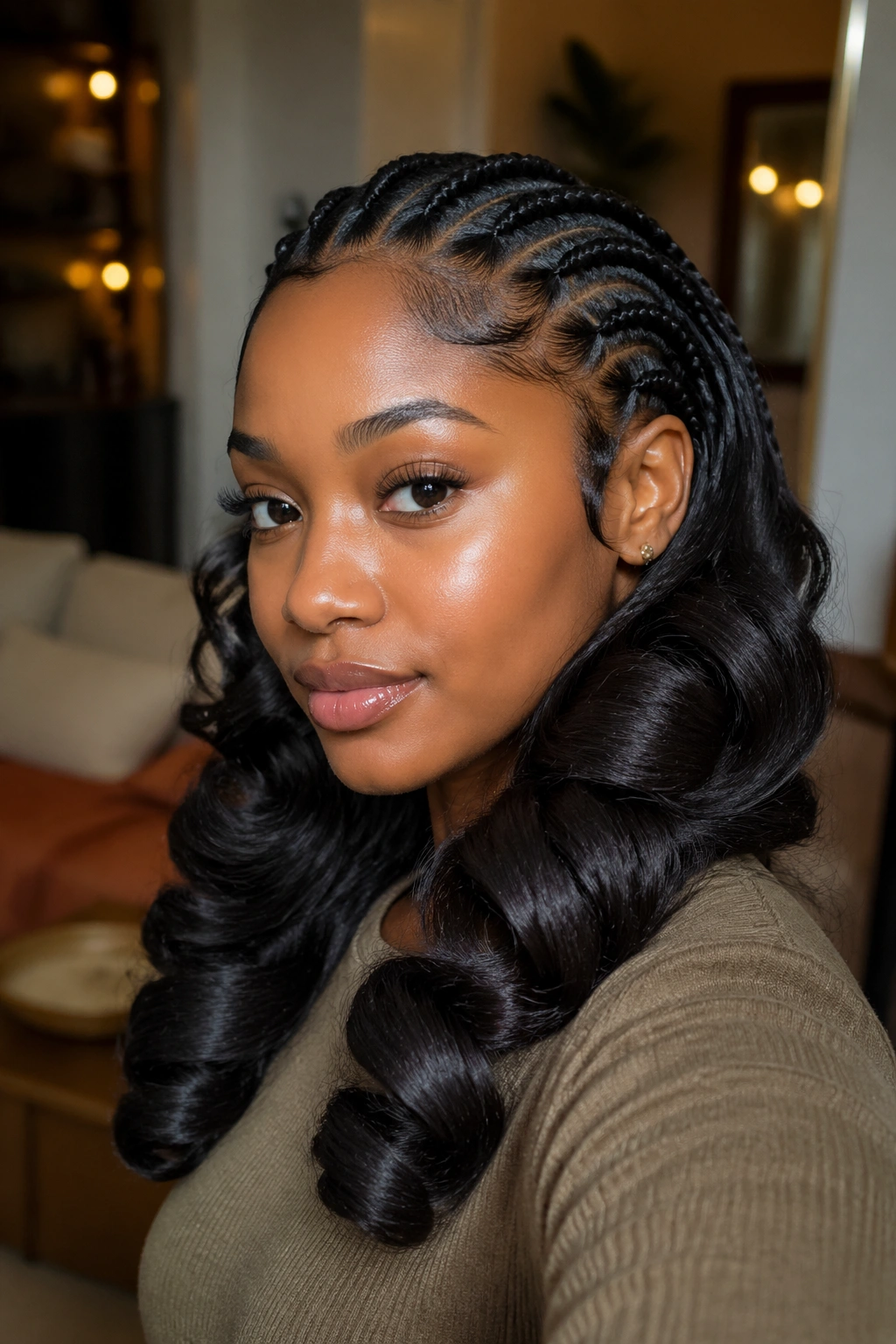
The braids are densest and most defined at the crown, then release into curls earlier than usual — sometimes right at the back of the ear. This style emphasizes the top of the head where curls are cascading from.
It’s a great choice for people with round or wide face shapes. The upward visual emphasis elongates.
Keep the crown section clean — no stray baby hairs, no frizzy parts. That area draws the eye, so any imperfection shows.
19. Long Cornrows with Mermaid Waves
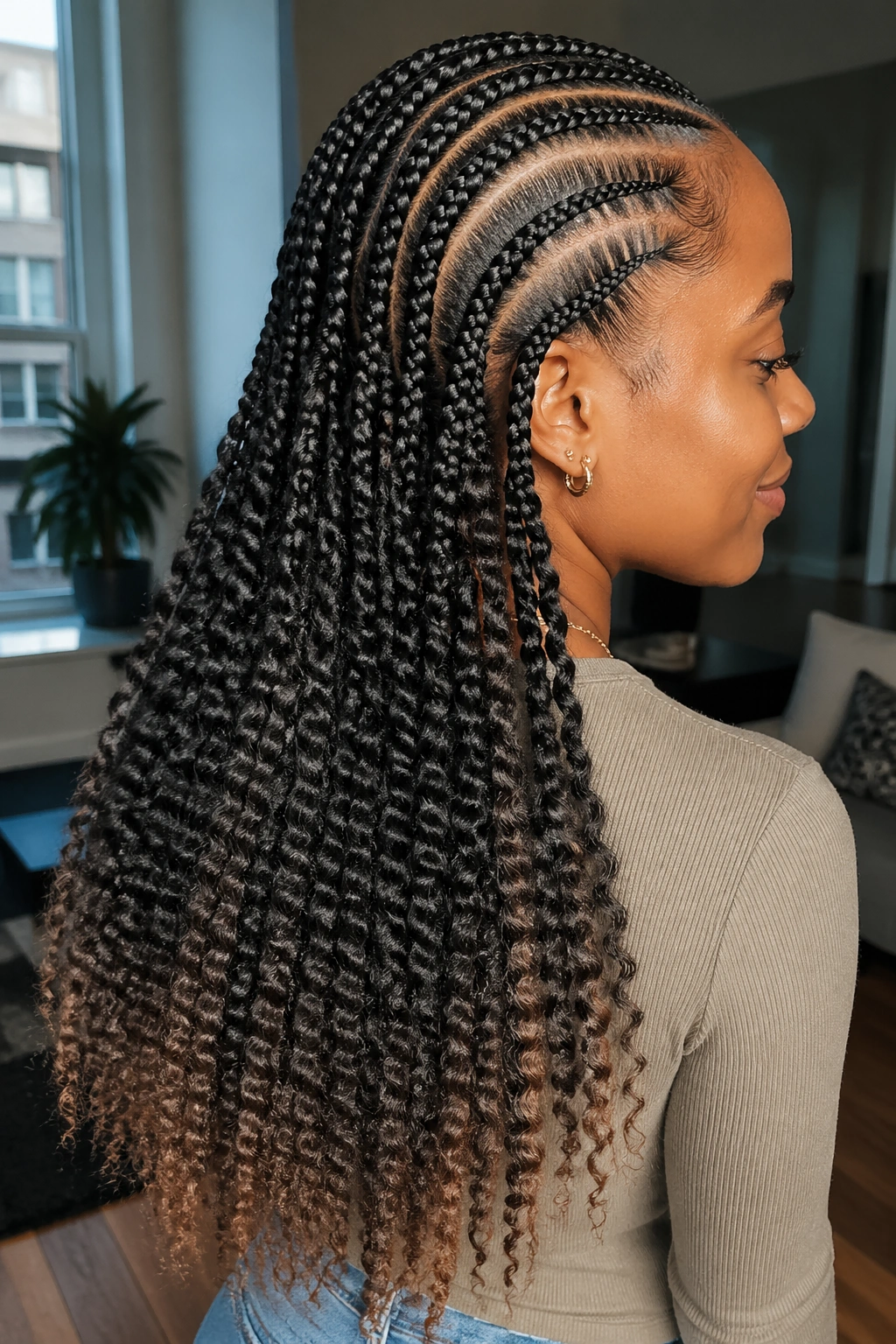
Mermaid waves are long, flowing S-waves that make the braids look like they’ve been in water. The waves are soft, wide, and continuous.
Set with large rollers or a rag method, avoiding perm rods. The goal is a flowing shape, not a defined spiral.
These waves suit waist-length installs especially well. The length gives the waves room to undulate.
20. Cornrows with Spiral Half-Up
Half of the braids stay down, braids with spiral curls at the ends. The other half pulls into a high bun or puff. The contrast between the down curls and the up bun is the whole style.
The bun sits high — at the crown or just above. It can be a sleek bun (wrapped tightly) or a puff (left slightly loose for texture).
Pin the half-up carefully. Any loose bobby pins will catch on the curls below.
21. Mid-Length Cornrows with Soft Wand Curls
Wand curls are made with a curling wand, which gives a softer, more random curl than a rod set. The result is less uniform and more natural-looking.
Wand curls fall in different directions. Some spiral left, some right. That randomness is the appeal.
Heat the wand to medium, not high. Synthetic hair burns at high heat. Hold each section for 8 to 10 seconds, then release.
22. Cornrows with Twisted Ends
Instead of curls, the ends twist into rope-like coils. It’s a sibling of the curl family — similar in spirit, different in execution. Two strands are twisted around each other for the last 8 to 12 inches of each cornrow extension.
The twist gives structure without heat. No rod setting needed. Just patience while twisting each braid end.
Finishing ends in a loop or small knot at the bottom keeps the twist from unraveling. Or you can dip the very tip in hot water to seal it.
Caring for Curled Cornrow Ends
The curls need different care than the cornrow base. Moisture matters most.
- Mist curls with a water and leave-in mix every other day
- Apply a lightweight curl cream once a week to maintain definition
- Sleep with a satin bonnet — silk scarves can snag on tight ringlets
- Avoid brushing curls; use fingers for separation
The base cornrows, meanwhile, want lighter care. Spray the scalp with a witch hazel toner weekly. Massage a small amount of scalp oil into the parts. Don’t over-product the base — it migrates into the curls and dulls them.
Refreshing Curls Mid-Wear
Curls loosen over time. A week-old curl might be half the tightness of the day-one version. That’s not failure — that’s normal.
Refresh by re-dipping the ends in hot water for 10 seconds, then patting dry and letting the curl re-set on the rod for 30 minutes. Or spray the ends with a curl-refresh spray (water plus a small amount of leave-in) and finger-twist the sections back into shape.
Don’t rely on heat every day. Hot water occasionally is fine. A curling iron every few days damages synthetic hair and shortens the life of the install.
Sleep Routine for the Whole Style
Nightly care keeps the curls and the cornrows in shape longer. A satin pillowcase alone is not enough when you have curled extensions — the curls still compress against the pillow.
Gather the curls into a loose, high ponytail using a silk scrunchie. This lifts them off the pillow. Wrap a satin bonnet over everything. The bonnet protects both the braids and the curls from friction.
Side sleepers should rotate which side they sleep on. One-sided compression shows up after a week as a flattened section.
Taking Down Cornrows with Curls
Takedown is straightforward. Undo the cornrow from the scalp outward. The curled ends untangle easily if they’ve been cared for — a few days of skipped maintenance, and you’ll be combing through matted curls.
Start by spraying the whole install with a mix of water and conditioner. Let it sit for 10 minutes. Begin unraveling each cornrow at the base, working toward the curl section.
When you hit the curl section, finger-detangle before you comb. The curls are the most delicate part of the install and can snap if you force a comb through.
Budget 2 to 3 hours for a full takedown.
Picking the Right Style for Your Face and Life
Face shape, hair density, and routine all affect which version suits you.
- Round faces work best with longer styles and curls sitting below the shoulders
- Long faces pair with shorter cornrow-to-curl transitions — the horizontal volume of curls at the shoulder breaks the vertical line
- Square jaws soften with any curl texture that flows rather than being highly defined
- Hair density matters — fine hair looks thinner with tight ringlets; go for loose waves instead
Routine is the other filter. Curled cornrows need more maintenance than plain ones. If you can’t commit to nightly bonnet wrapping, choose a curl pattern that holds loosely — waves rather than spirals. If your schedule allows for daily refresh, tight ringlets stay defined for longer with care.
Mistakes That Kill the Curl
Rushing the set is the biggest. A 30-minute rod set gives you a 2-day curl. A 4-hour set gives you a 2-week curl. Patience during setting pays off for the whole wear.
Skipping the dip in hot water when using synthetic hair leads to curls that unravel fast. The heat sets the shape into the fiber. Cold-set curls are softer at first, but they fall out within days.
Over-combing damages both the curls and the braid base. Finger detangling is the standard for curl maintenance. Only comb during takedown.
Using heavy products — thick butters, greasy oils — weighs down the curls and dulls the shine. Lightweight curl creams and water-based sprays are the right toolkit.
All back cornrows with curls are one of the most versatile looks in the cornrow catalog. You can dress them up or down, wear them for weeks, and switch the curl style without changing the base braid. Pick the curl texture that matches your mood, book the time, and let the combination do what it does best — sharp on top, soft below.