



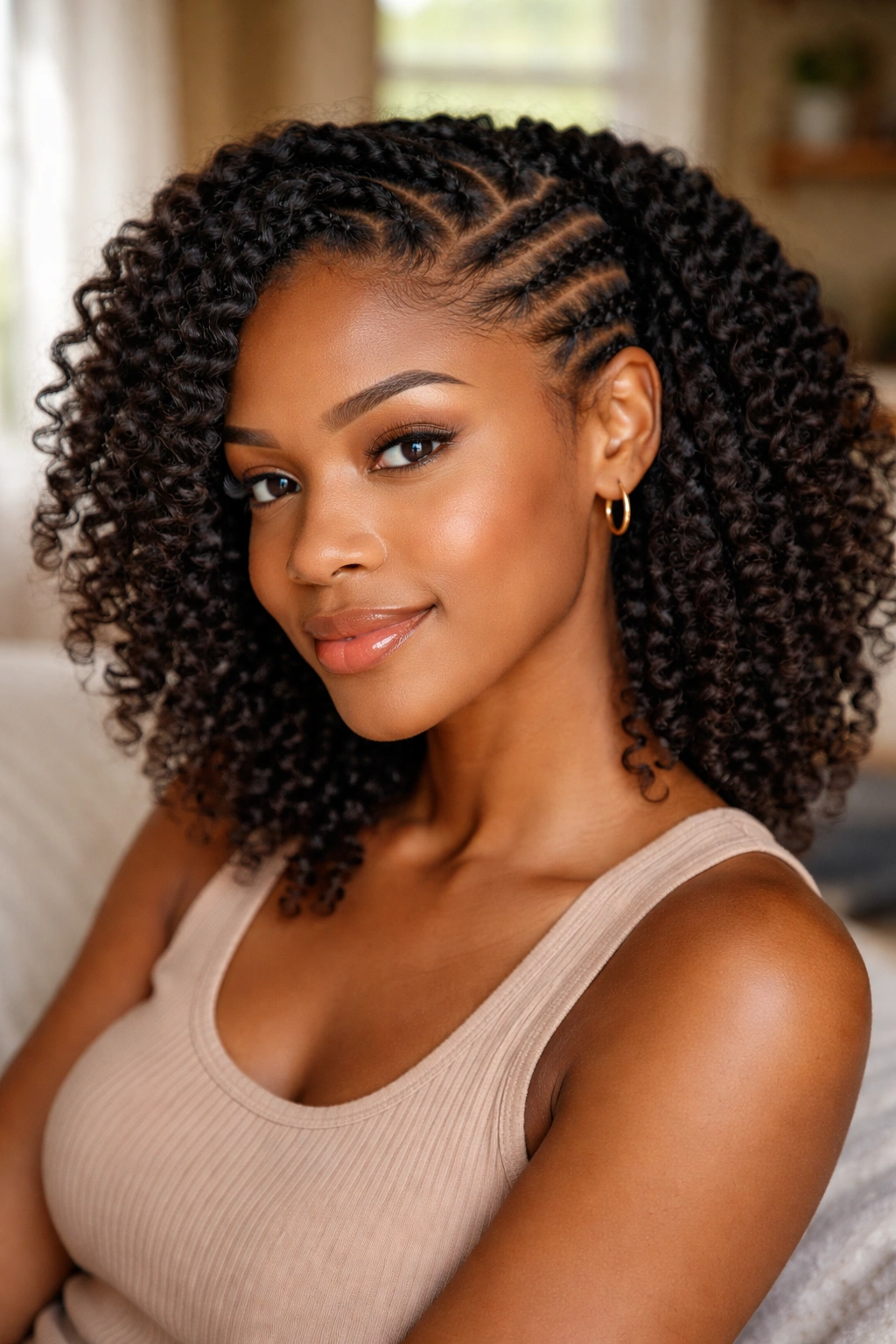
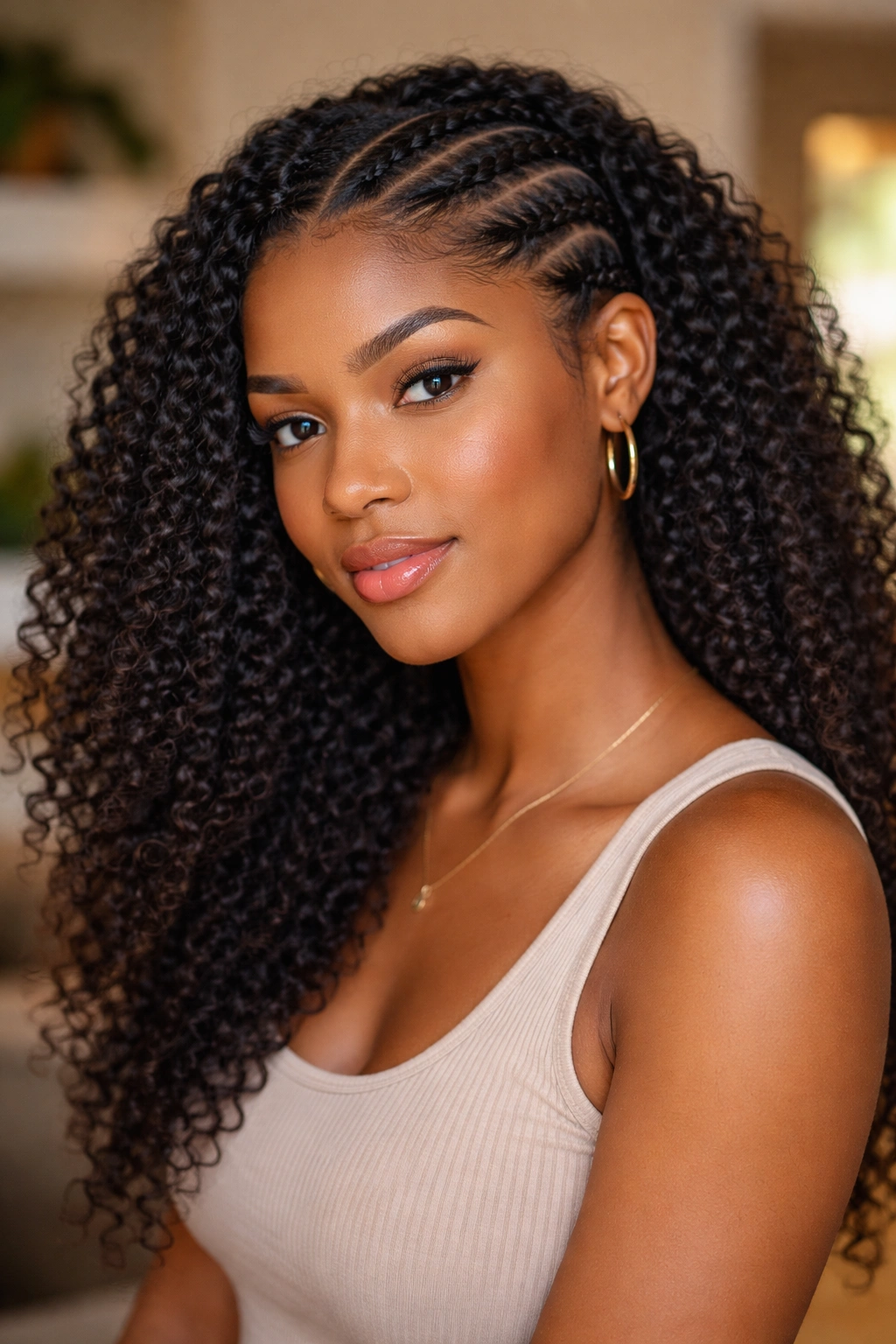
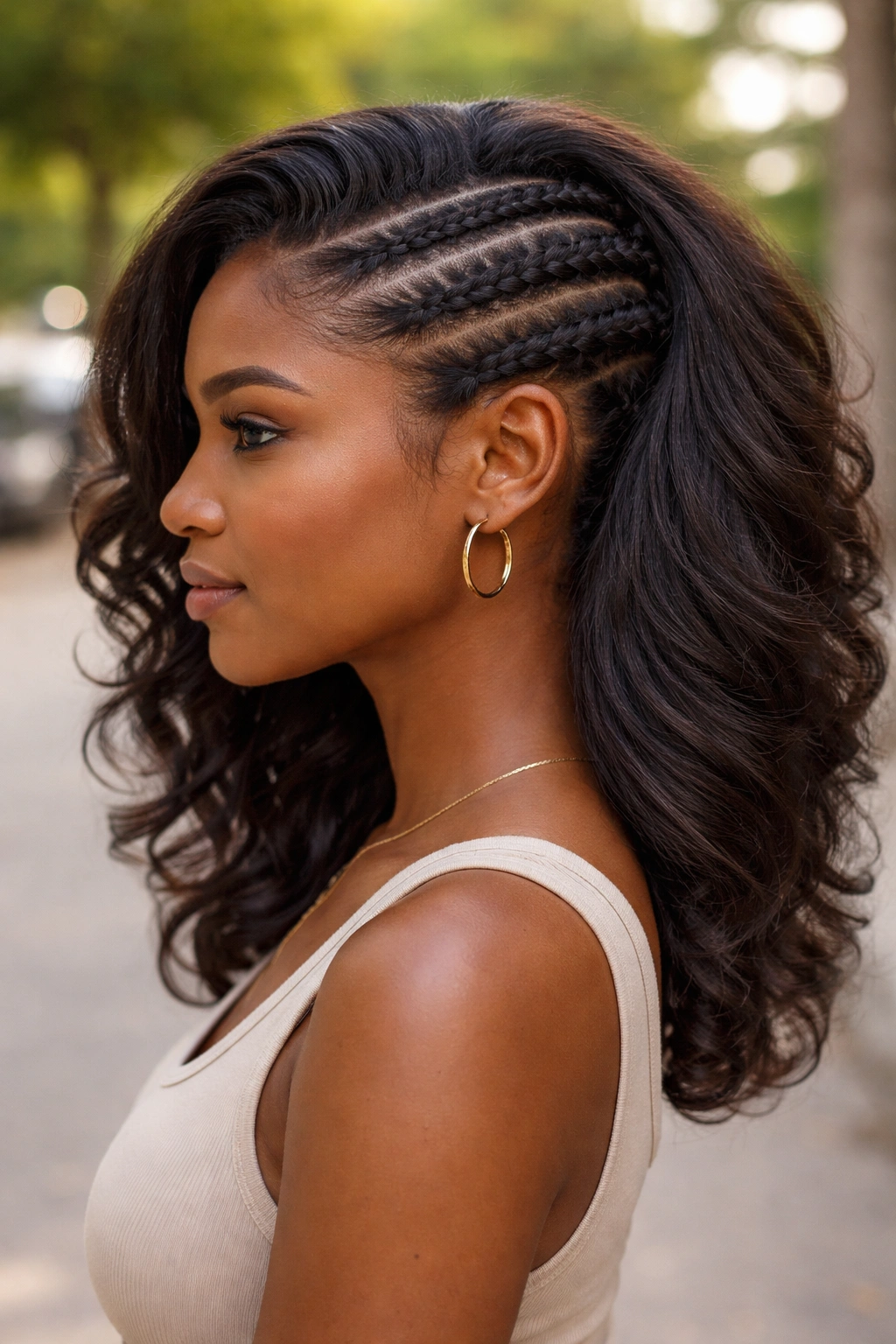
Side cornrows on natural hair sit at the intersection of protective styling and everyday expression. You part the hair deeply to one side, braid a few cornrows along that heavier section, and leave the rest of the natural hair free — whether styled into a puff, left as a twist-out, or pulled into a bun. The braided side holds everything in place. The loose side does the talking.
The appeal for natural hair specifically is real. Side cornrows don’t require the full commitment of a head-covering install. You’re not braiding 10-12 hours. You’re not sitting still through a whole day. The install usually takes 90 minutes to 3 hours depending on the count, and the rest of your hair stays free to show its actual texture. That free texture — the curl pattern you’ve been working on, the definition you’ve earned — becomes part of the look rather than hidden under a full set of braids.
I’ve worn side cornrows on natural hair through most of my adult life. Different coil patterns, different lengths, different seasons of my routine. What I’ve learned is that they flatter 4A through 4C textures better than almost any other partial braid style. The contrast between the structured braid lines and the expansive loose curls creates visual balance that fully-braided styles can’t deliver.
Below are 22 side cornrow variations specifically built for natural hair. Some keep the braiding small and subtle. Some use the cornrows as a foundation for elaborate natural hair styling. A few are unusual takes I’ve picked up from braiders who specialize in working with natural texture.
Why Side Cornrows Suit Natural Hair
Natural hair has body. Coils, curls, and kinks create volume that takes up space. A full cornrow install tames all of that — which is the point, for protective styling — but it also means losing access to the texture for the duration of the install.
Side cornrows let you keep most of your natural texture visible. The braided section (usually one-third to one-half of the head) handles the styling and control portion. The rest stays loose and lets you continue to see and style your own coils.
The practical benefit is big. Your wash-and-gos, twist-outs, and defined styles all stay accessible. You’re not locked out of your routine for 6 weeks.
Prepping Natural Hair for Partial Braiding
The section being braided needs different prep than the section staying loose.
The braid-side prep: clean and lightly moisturized. Apply a leave-in conditioner focused on that side the night before. Don’t layer heavy butters — they make parting difficult and cause the braids to slide.
The loose-side prep: whatever your usual routine would dictate. If you’d normally do a twist-out the day before styling, do it. If you’d wash-and-go, do that. The loose side should arrive at the braiding appointment in the state you want it to be in for the next few weeks.
How Deep the Side Part Should Go
The depth of the side part determines how much hair gets braided versus how much stays loose. A conservative part (2 inches off center) puts about 40% of the hair into cornrows and leaves 60% loose. A deeper part (4 inches off center) reverses that ratio.
For natural hair, the deeper part usually works better. The loose side has more volume and visual weight, and a deeper part puts more of the head’s structure into the braided section — which keeps the overall style from feeling lopsided.
Tools for Natural Hair Side Cornrows
Standard cornrow tools plus a few additions specific to natural texture.
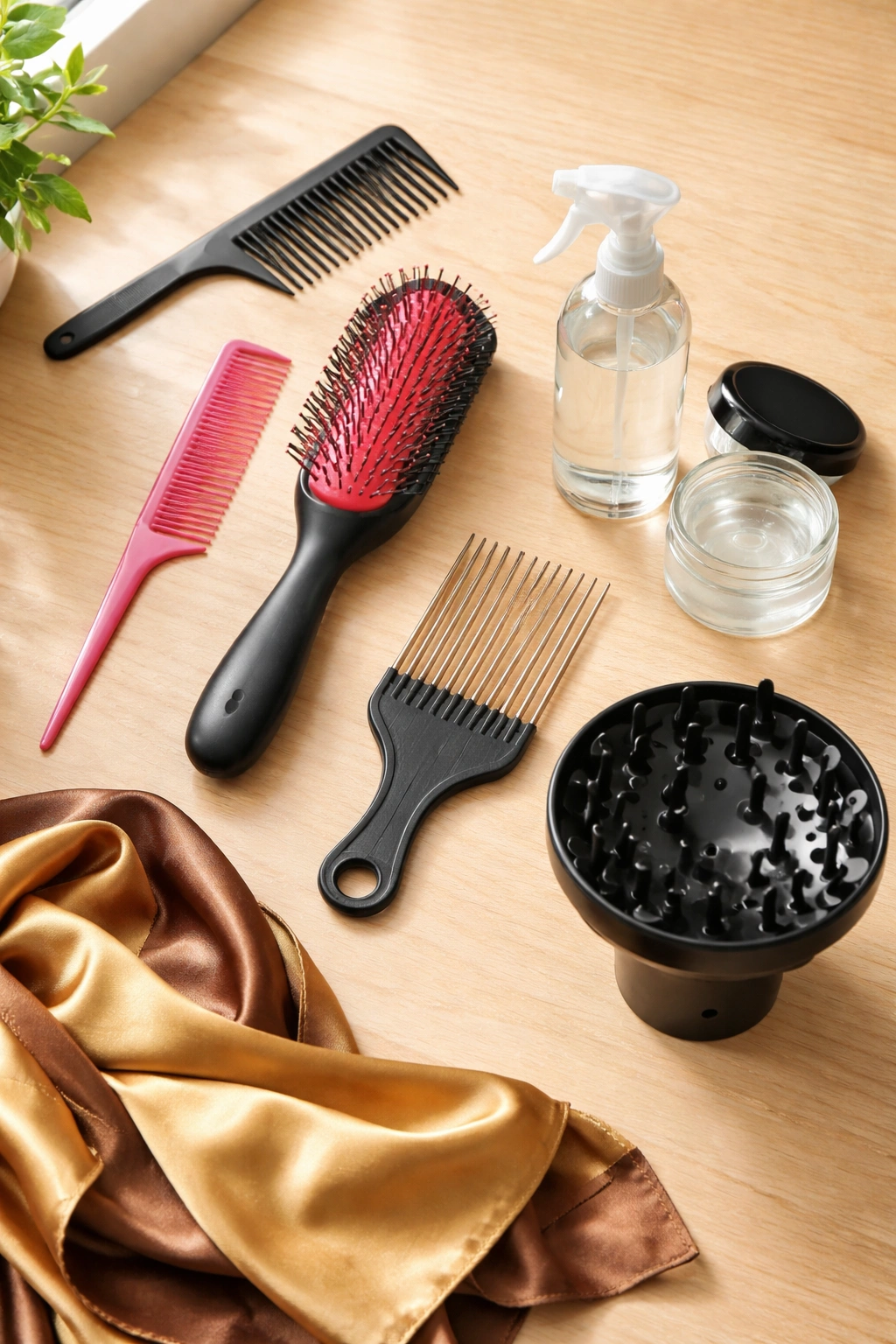
A wide-tooth comb for detangling the loose section. A fine-tooth comb for parting. A denman brush or curl brush for defining the loose section before or after braiding. Leave-in spray. Edge gel for the hairline. Silk or satin scarf for nightly protection.
A pick or afro comb for the loose section if you’re going for volume. A diffuser if you’re air-drying the loose hair.
Choosing the Right Count
With side cornrows, fewer is usually better. The braids are an accent, not the whole style. 3-6 cornrows along the side gives you visual interest without overwhelming the free-textured portion.
More than 6 cornrows on one side starts to feel heavy and unbalanced. The braided section dominates the look, and the loose hair reads as an afterthought rather than a feature.
1. Three Cornrows Into a Natural Puff
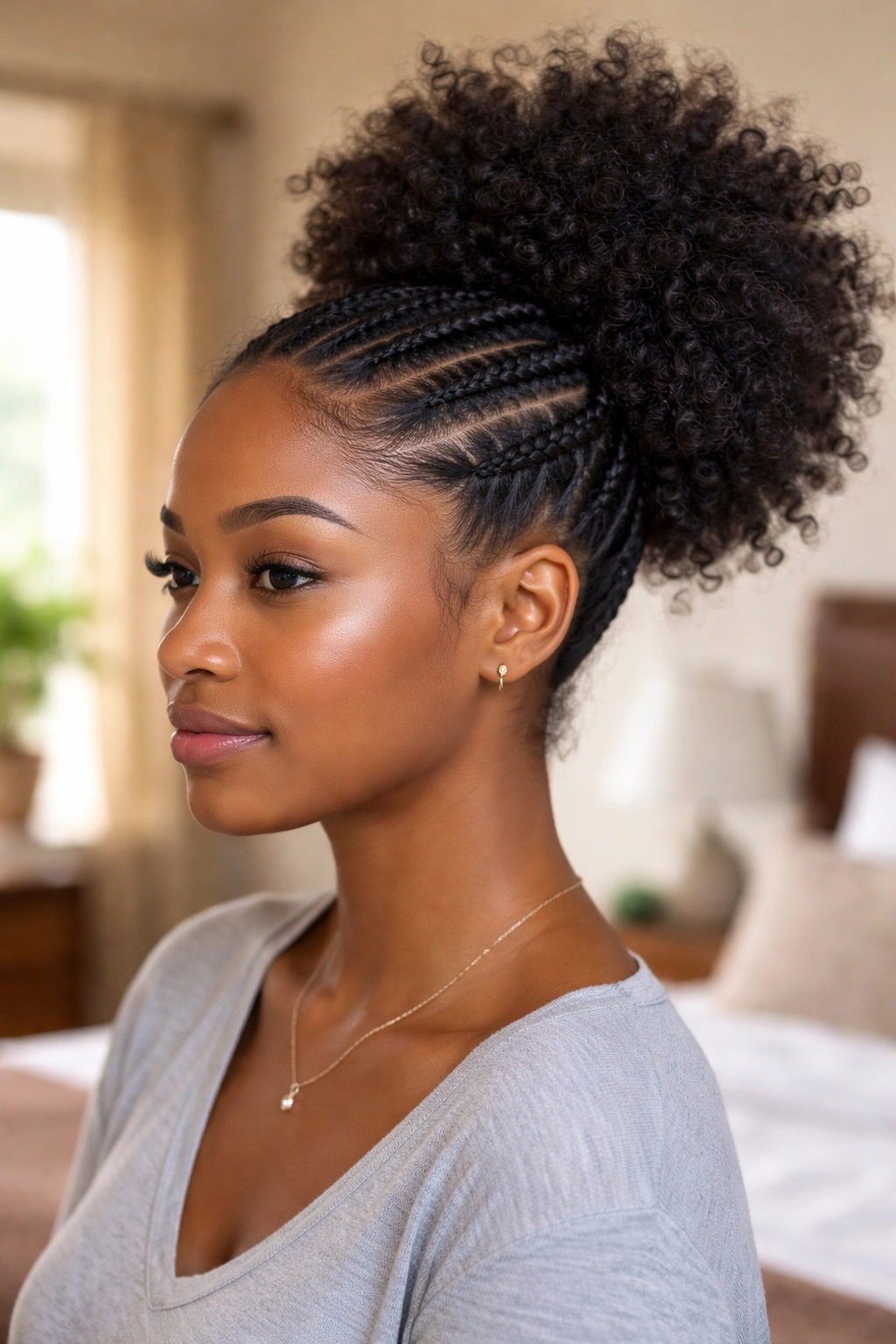
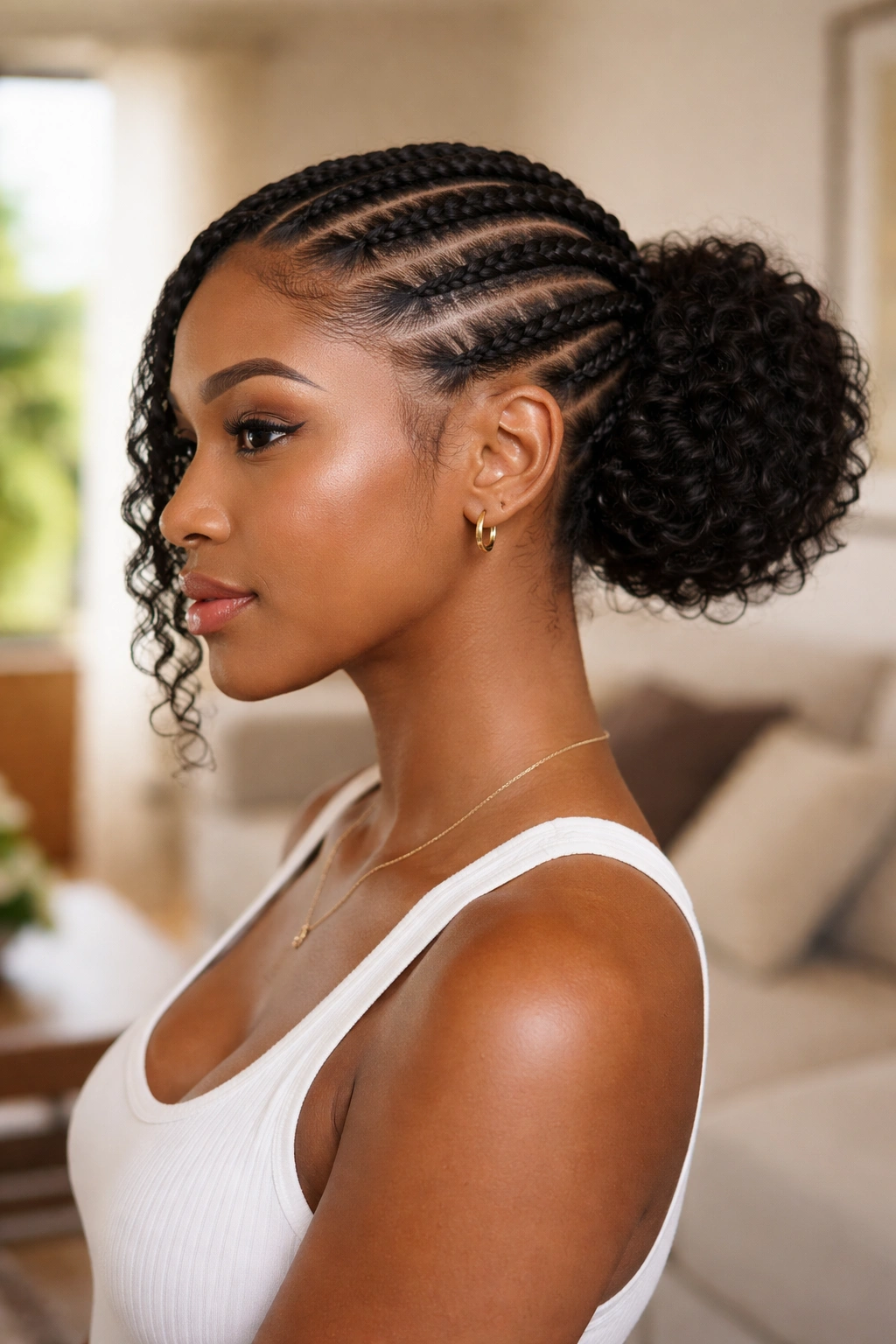
Three medium cornrows running from the hairline back to the crown along one side of the head. The rest of the natural hair is pulled into a high puff at the top back of the head.
Why It Works
The three cornrows do just enough containment to let the puff hold its shape cleanly. The puff itself shows off the full natural texture of the rest of the hair. The combination reads as polished without feeling forced.
- Part the hair deeply to one side (about 3 inches off center)
- Braid 3 medium cornrows running back along the side
- Gather all loose hair into a high puff secured with a soft hair tie or cuff
- Pick out the puff with an afro comb for volume
Tip: Use a wide, stretchy cuff at the base of the puff rather than a thin hair tie. The wider base creates a more rounded puff shape and prevents breakage at the gathering point.
2. Four Cornrows With a Side Twist-Out
Four smaller cornrows along one side, with the loose section styled into a classic two-strand twist-out the night before braiding.
The twist-out side shows defined coils and curls. The cornrow side provides the architectural contrast. The whole look reads polished but still celebrates natural texture clearly.
The twist-out doesn’t need to be fresh to work here. A second- or third-day twist-out, slightly fluffed, actually blends better with the cornrows than a day-one set.
3. Two Big Cornrows With Full Loose Hair
Just two big cornrows running back along the side — one high, one slightly lower. The rest of the hair hangs free in its natural texture.
Minimal braiding, maximum natural texture showing. The two cornrows read as intentional styling without taking over the look.
Install time is under 60 minutes. Wear duration is typically 2-3 weeks before the loose section needs re-styling, though the cornrows themselves can last 4-5 weeks.
4. Five Cornrows With a Loose Bun
Five medium cornrows along one side, with the rest of the hair gathered into a low bun at the back or side opposite the cornrows.
The bun can be sleek (smoothed with brush and gel) or natural-textured (left fluffy and bouncy). Both work. The braids dictate polish; the bun can adjust the formality.
Low side buns read dressier than center buns. Match the bun placement to the occasion.
5. Cornrows Over a Side-Swept Tuck
Three cornrows along one side, with the rest of the hair brushed across to the same side and tucked or pinned at the back. The whole head reads as one continuous sweep of texture.
This is a sleek styling that still shows natural texture. The tucked side has body and coils visible, but the cornrows direct the visual flow sideways rather than vertically.
Good for 4A-4B textures where the natural hair has enough body to tuck. Very tightly coiled 4C textures can make the tuck look bulky unless the hair is stretched first.
6. Side Cornrows With Curl Definition on Top
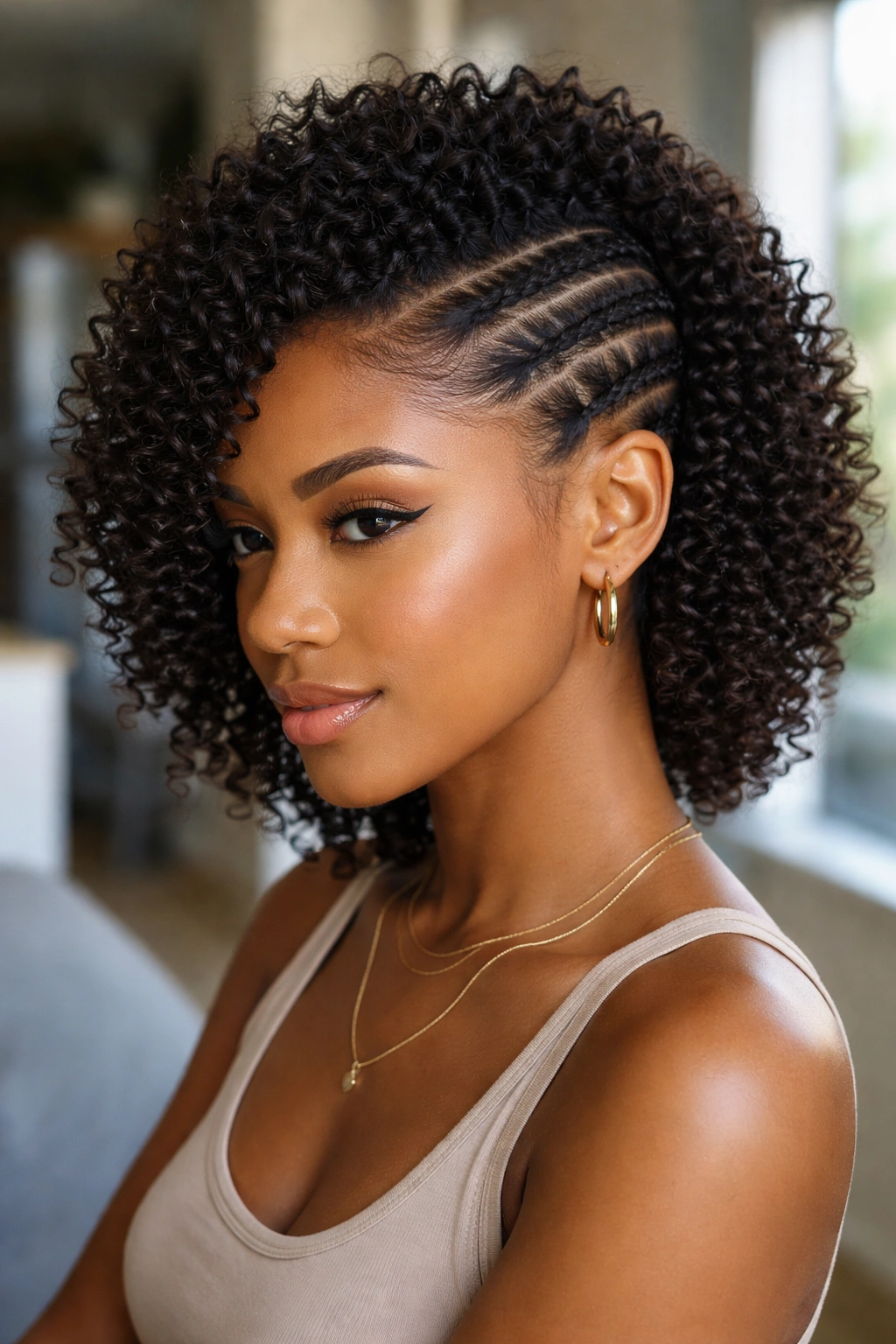
Four cornrows along the side, with the loose section re-defined just before braiding using a gel-based wash-and-go or braid-out.
How to Style It
The curls should be freshly defined to match the crispness of the new cornrows. Older, fluffier curls will look undone next to tight new braids.
Use a styling gel and a denman brush on wet or damp hair, section by section. Let air-dry or diffuse. The defined curls will complement the braid lines rather than fighting them.
7. Six Cornrows With a Half-Up Puff
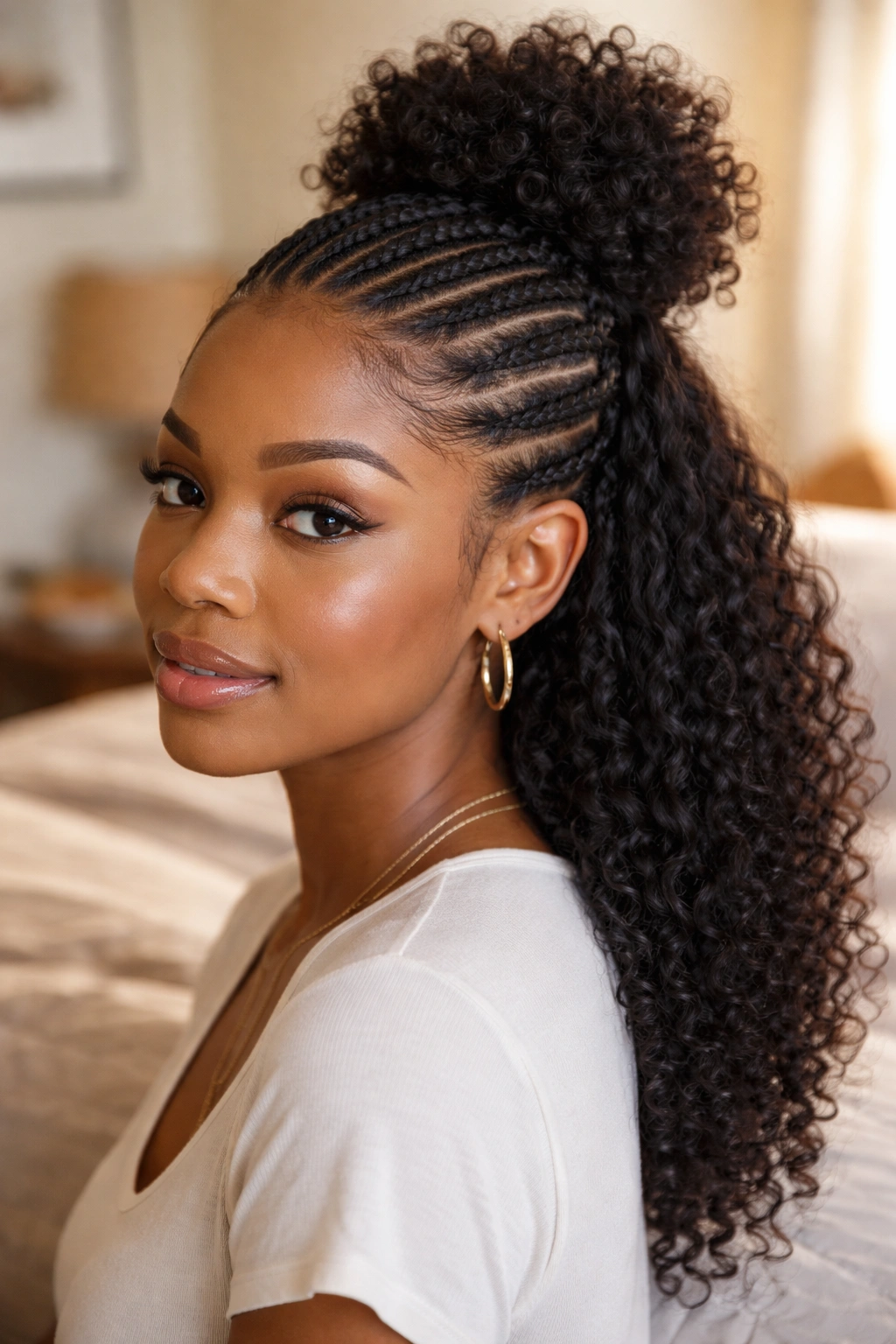
Six cornrows along one side (a heavier braid count), with the loose hair separated into two sections — a top half pulled into a small puff at the crown, and a bottom half left free.
The half-up puff adds a focal point at the top of the head. The free hair below maintains the natural texture presentation.
Secure the puff with a stretchy cuff rather than a tight hair tie. Tight ties at the gathering point cause breakage over time.
8. Side Cornrows Into a Low Braid
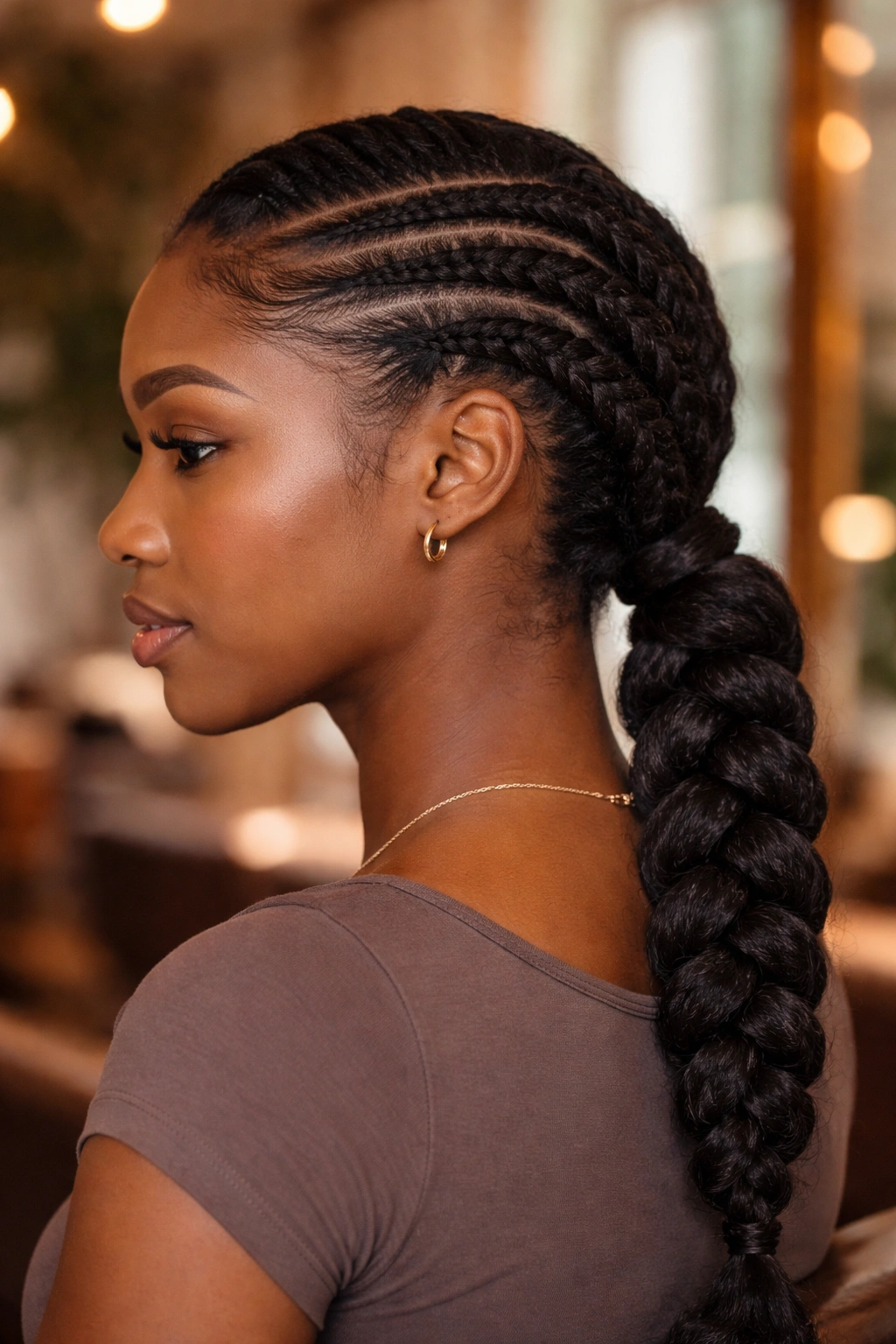
Four cornrows along the side, with all the loose natural hair gathered and braided into a single thick braid that hangs down the back.
The single braid converts the loose texture into a structured element that complements the cornrows. The whole style becomes more uniform in its “braidedness.”
Use a two-strand or three-strand braid technique on the gathered loose hair. Don’t try to cornrow it — that’s a different style entirely.
9. Side Cornrows With Front Face-Framers
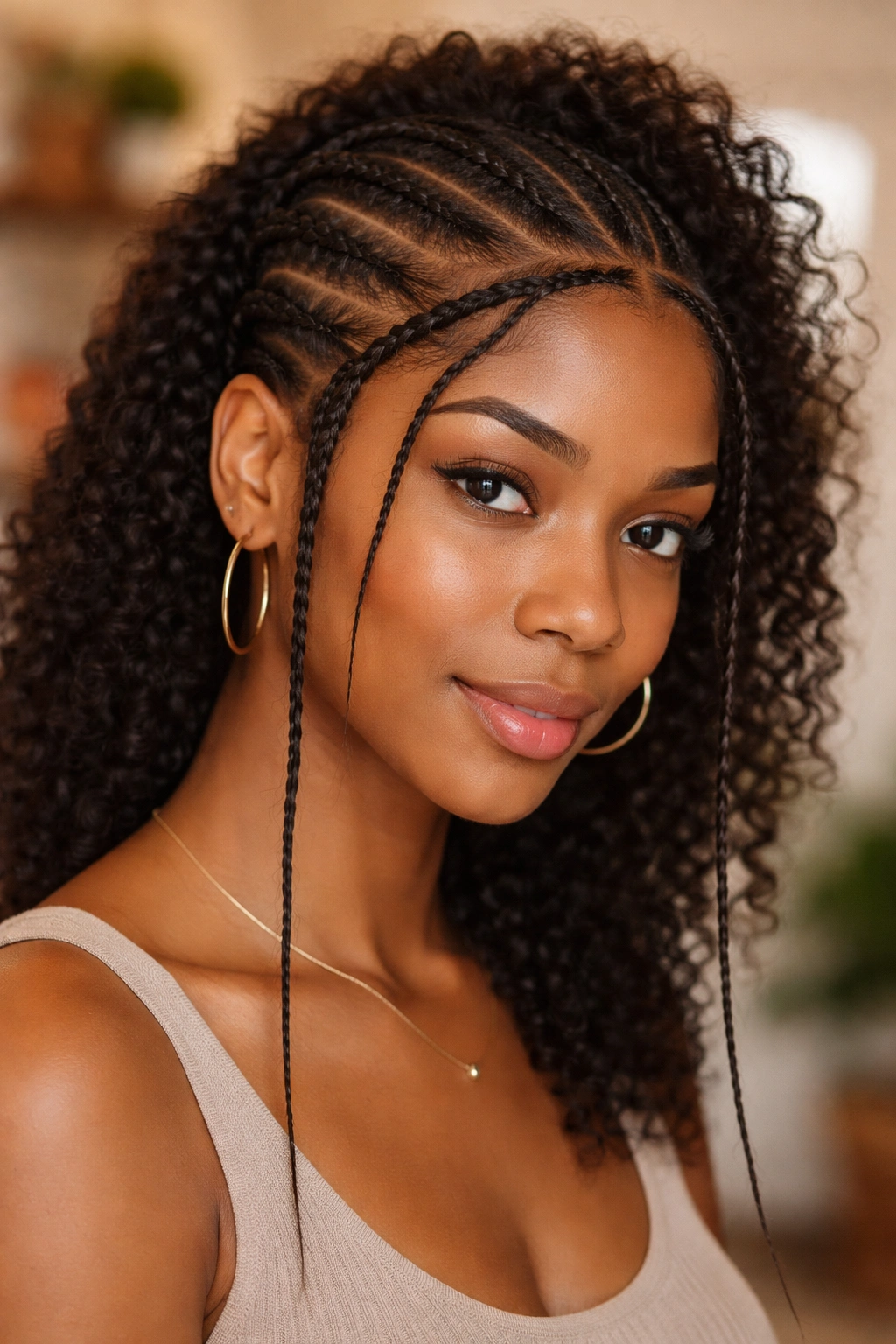
Three cornrows along one side, with two thin cornrows running horizontally across the front of the forehead (acting as a thin braid-band framing the face).
The face-framing cornrows create a deliberate front accent. They’re different enough from the side cornrows (different direction, different size) that they read as separate design elements.
The face-framers should be smaller than the side cornrows. Matching sizes makes the front look too busy.
10. Side Cornrows With Natural Hair Twists on the Other Side
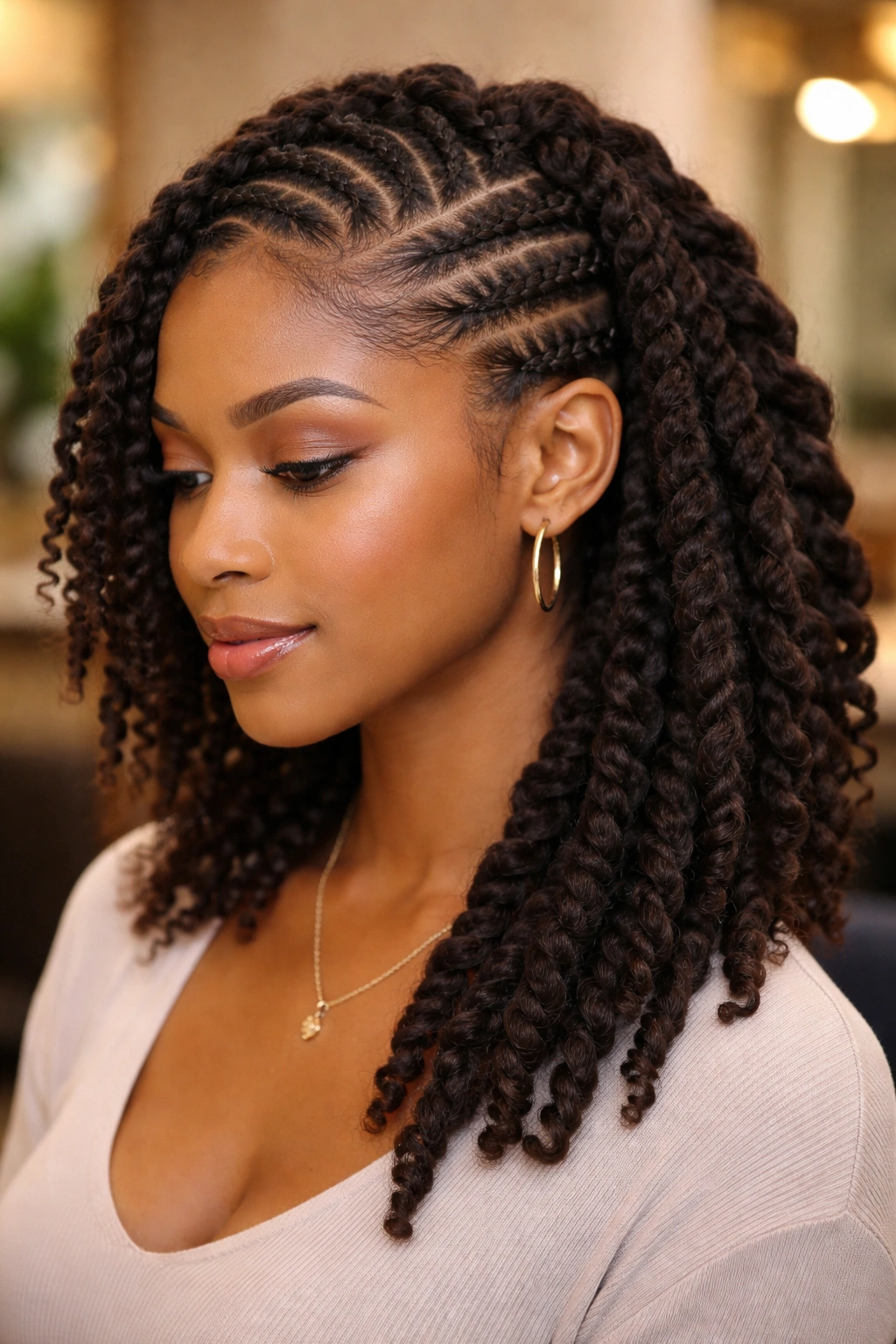
Three cornrows along one side, with the opposite side styled into chunky two-strand twists (not left fully loose). The head is fully braided/twisted but with two different techniques on each side.
The asymmetric styling creates strong visual interest. The cornrow side reads sleek; the twist side reads textured. Both are structured, but differently.
This is a longer install than pure side cornrows — figure 3-4 hours including both sides.
11. Side Cornrows With a Side Part That Curves
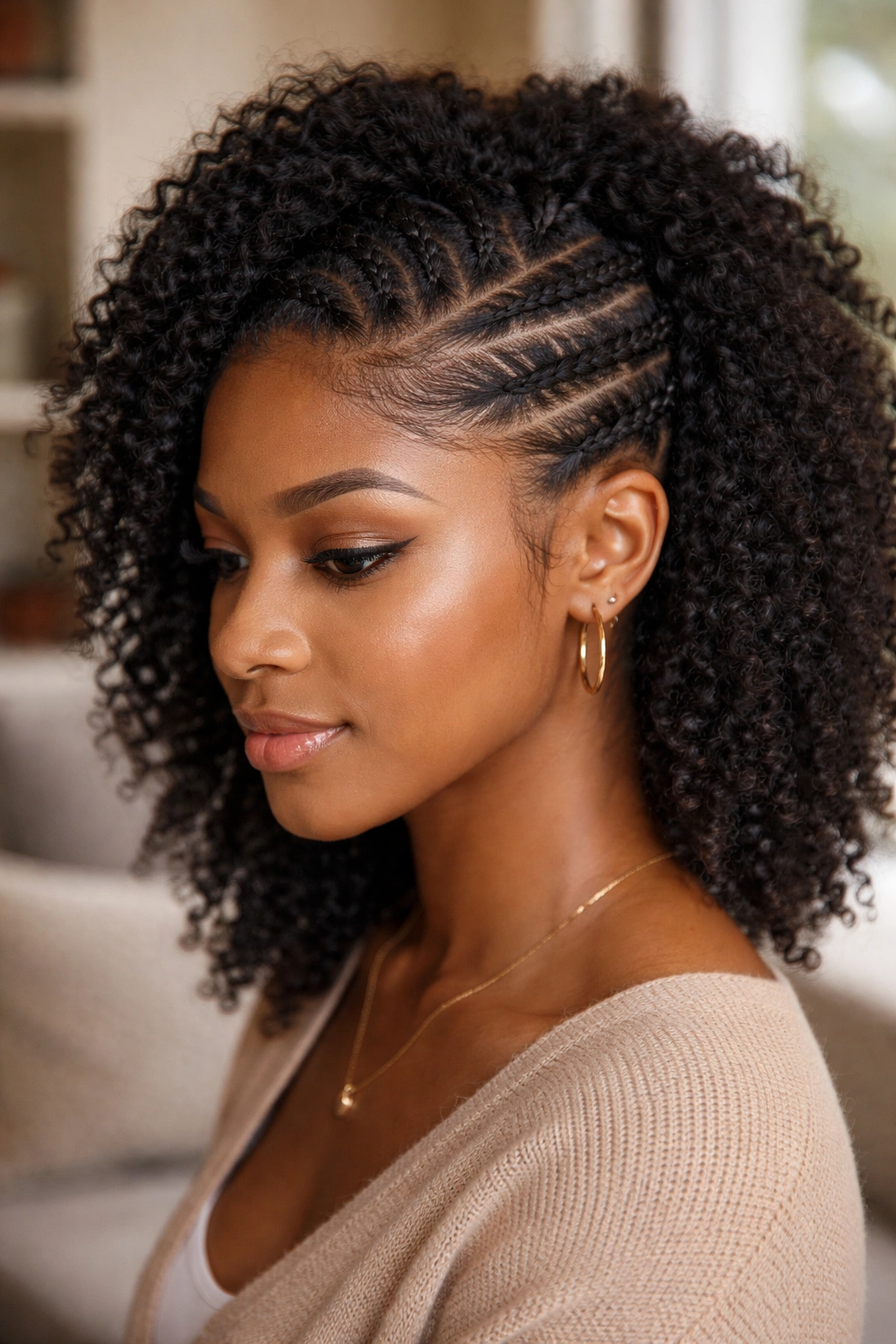
Three cornrows along the side, but the center part that separates the braided from loose section doesn’t run straight. It curves gently along the scalp, creating a softer border between the two textures.
The curved part adds motion to the styling. Straight parts can feel harsh; curved parts feel more organic and match natural hair’s own wavy character.
The curve should be subtle. Aggressive curves fight with the linear cornrows and create visual chaos.
12. Side Cornrows With Beaded Accent Braid
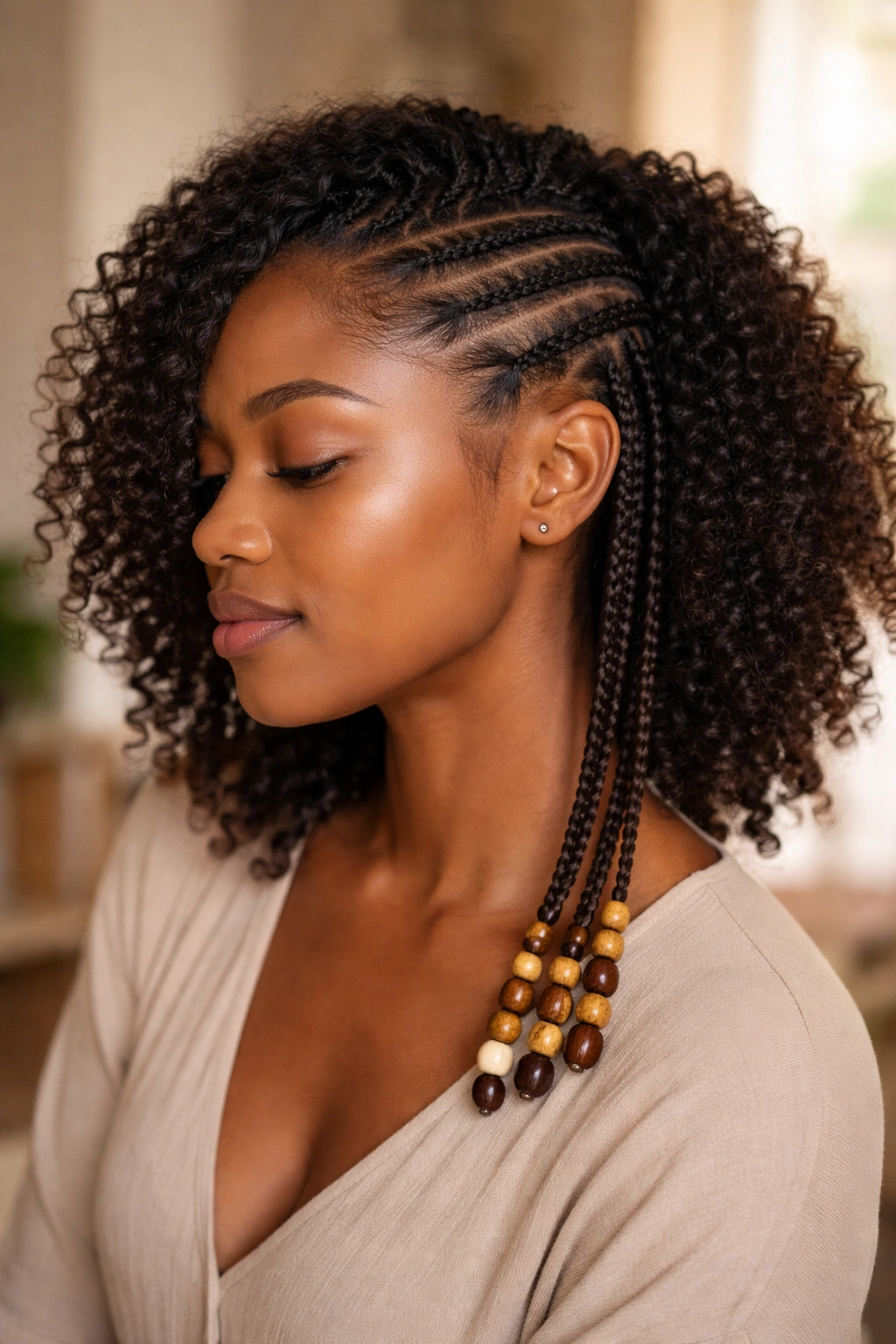
Three plain cornrows along the side, plus one single cornrow with 5-7 wooden beads at the tip. The beaded braid is the visual accent.
The beads sit at about shoulder level depending on your hair length. They make a soft sound when you move, which adds a sensory element to the style.
Wooden beads work better than plastic or glass for natural hair because they have more texture and visual interest. Match bead tones to your skin tone for the most flattering look.
13. Side Cornrows With Big Hoop Earrings
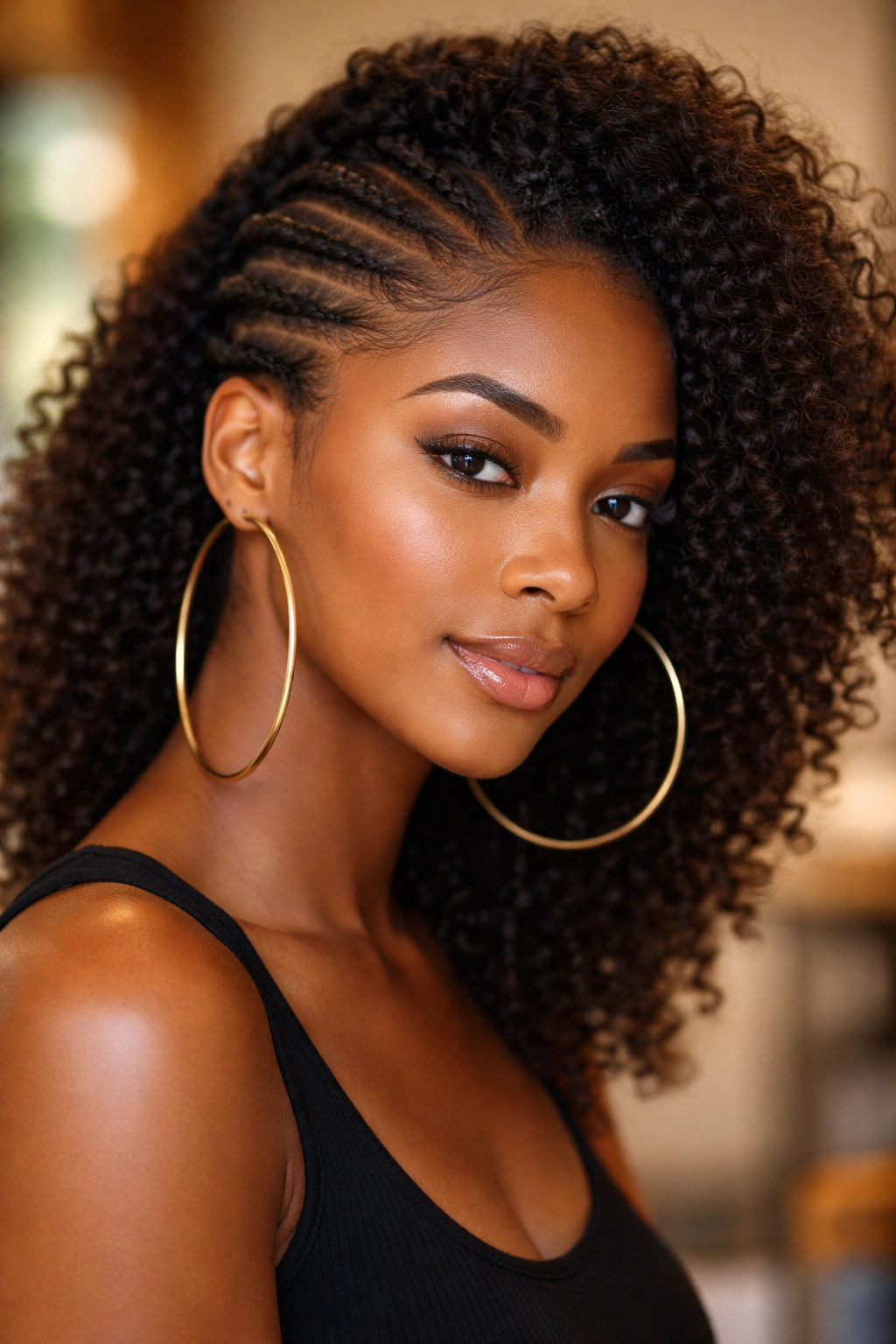
Four cornrows along one side, paired specifically with large hoop earrings on the loose-hair side.
The hoop earring on the side without cornrows creates visual punctuation. The cornrow side has its own structural interest; the earring side has accessory interest. Balanced asymmetry.
This isn’t a hair-specific variation so much as a styling one, but it’s worth listing because the right earring completely changes how side cornrows read.
14. Side Cornrows With Long Kanekalon Extensions
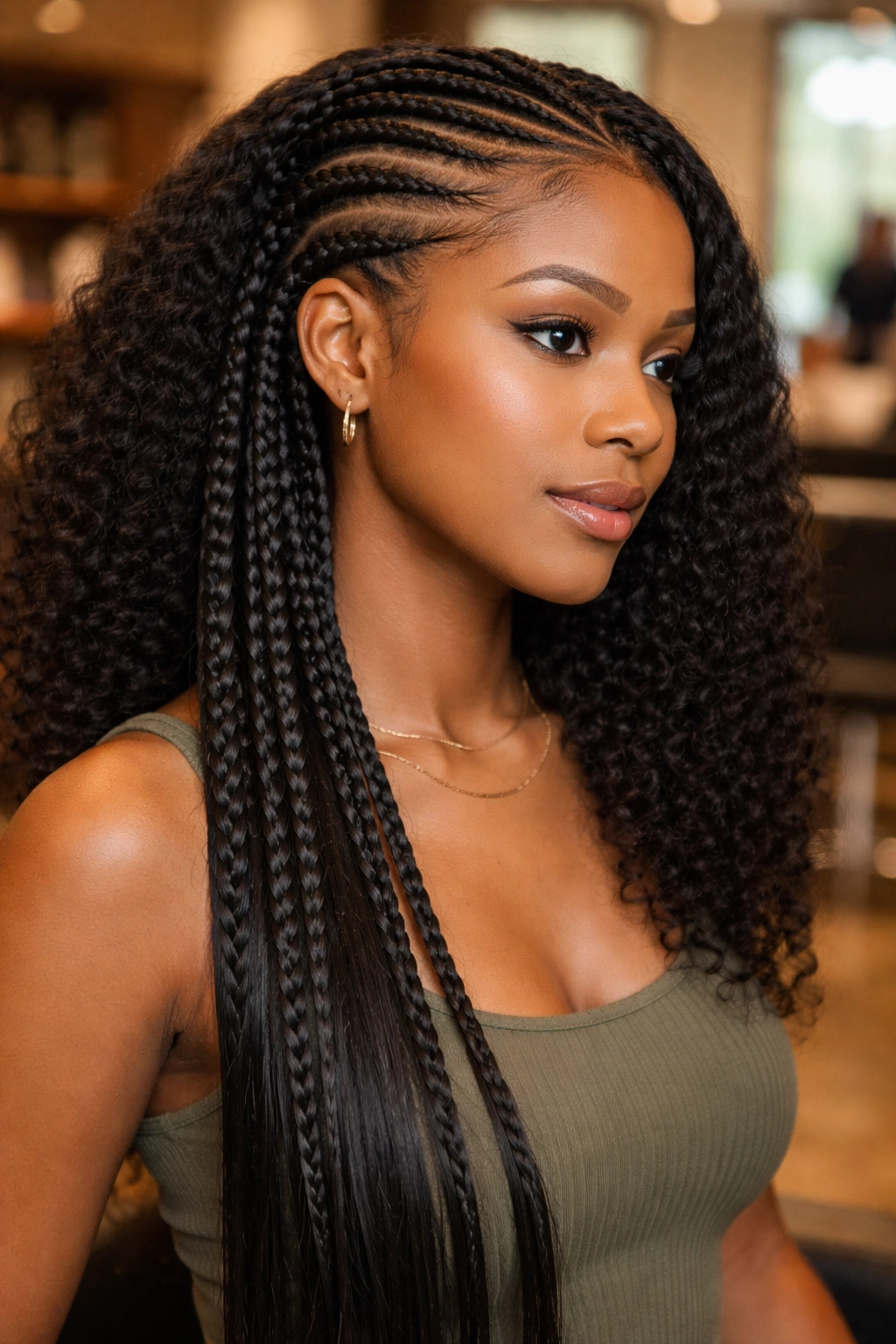
Four cornrows along the side, with extensions feed-in style that extend the braided section past the shoulders to mid-back. The loose side stays in natural texture.
What Makes It Different
The length contrast between the extended braided side and the natural-length loose side is the whole point. Dramatic asymmetry.
Use kanekalon that matches your natural color or a deliberate contrast. Don’t settle for “close enough” — visible color mismatches between the extensions and your loose natural hair look accidental.
15. Side Cornrows With Pinned-Back Front
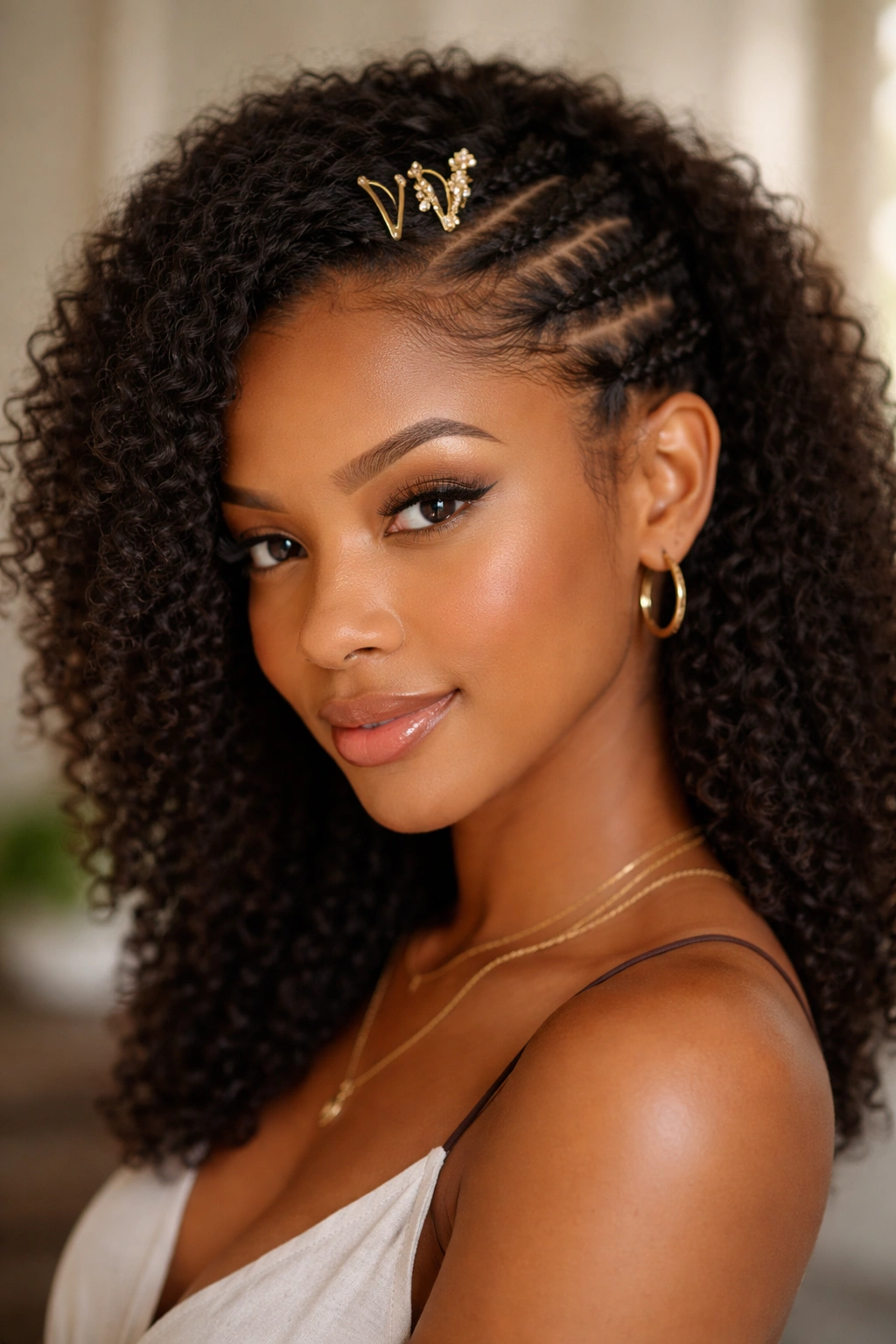
Three cornrows along the side, with the loose hair pulled back from the forehead and pinned at the crown using decorative hair pins or flat metal clips.
The pinned-back front exposes the forehead cleanly and makes the cornrows more visible from the front. The clips themselves become a visual element.
Use gold or silver metal clips rather than plastic. The metal reads as intentional jewelry rather than functional hair tool.
16. Side Cornrows With an Afro Puff Bun
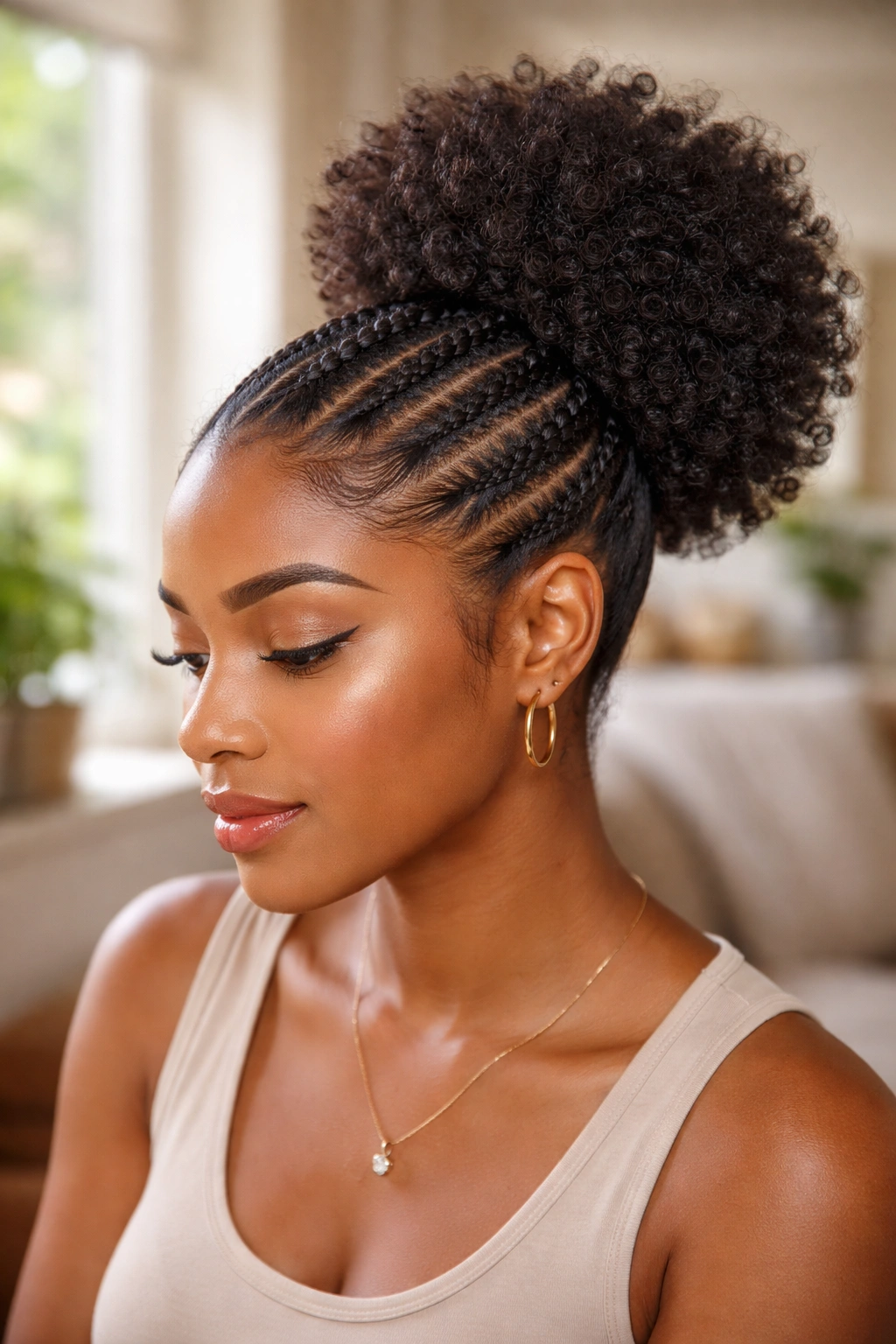
Four cornrows along the side, with the loose hair pulled into a high, round, dense puff-bun at the crown. The puff-bun is styled to emphasize its afro texture — not smoothed.
The rounded volume of the afro puff-bun contrasts against the sleek cornrow lines below. High contrast between structure and softness.
Use a wide, soft hair tie at the base. Pick the puff out generously with an afro comb before setting.
17. Side Cornrows With a Twist on Top
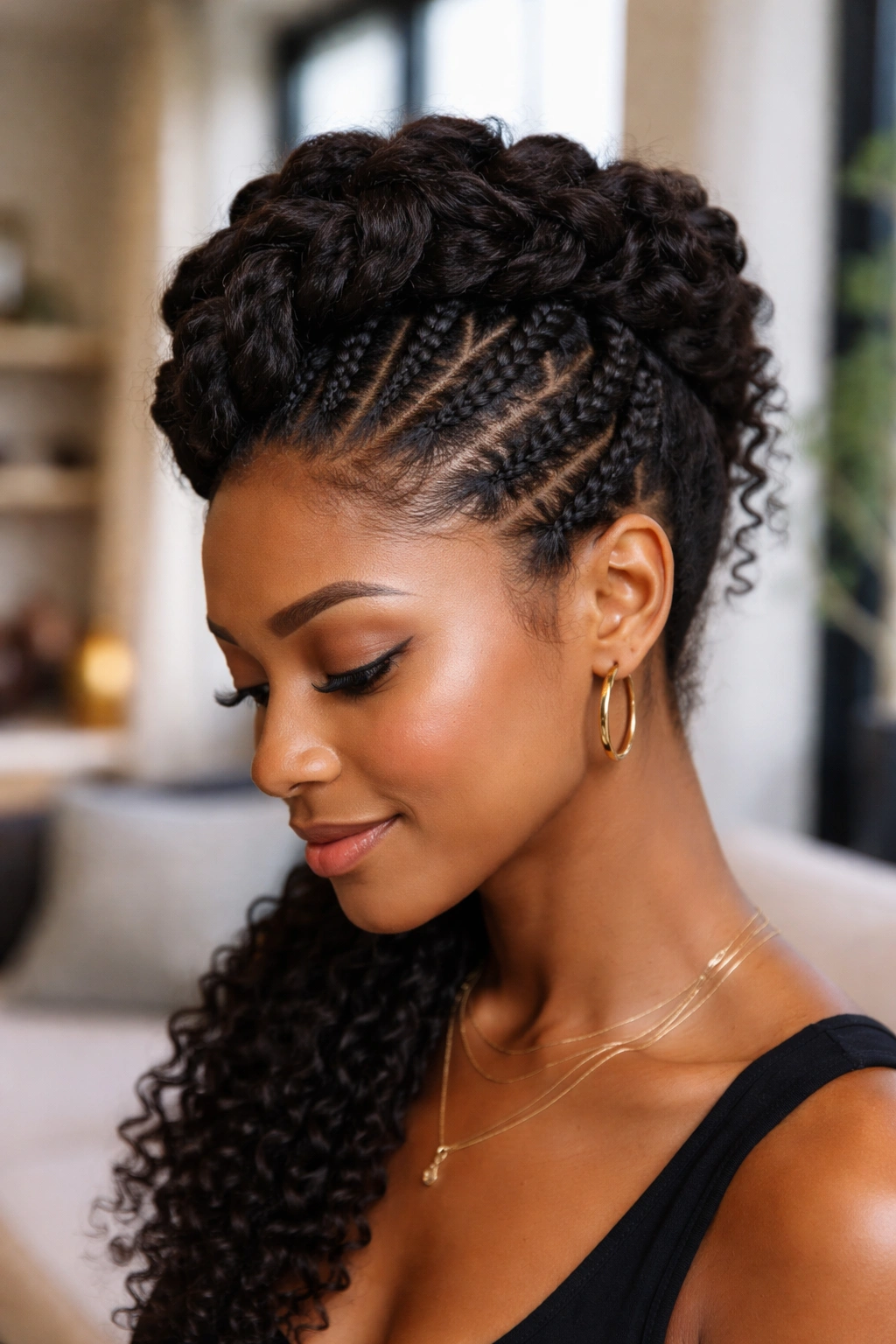
Three cornrows along one side, with the loose hair gathered on top of the head and styled into a large two-strand twist that sits like a crown above the cornrows.
The twist-on-top creates height at the crown of the head. Helpful for elongating round face shapes.
The twist should be big — not small. A tiny twist on top looks lost. A substantial twist reads as intentional styling.
18. Side Cornrows With Undercut Effect
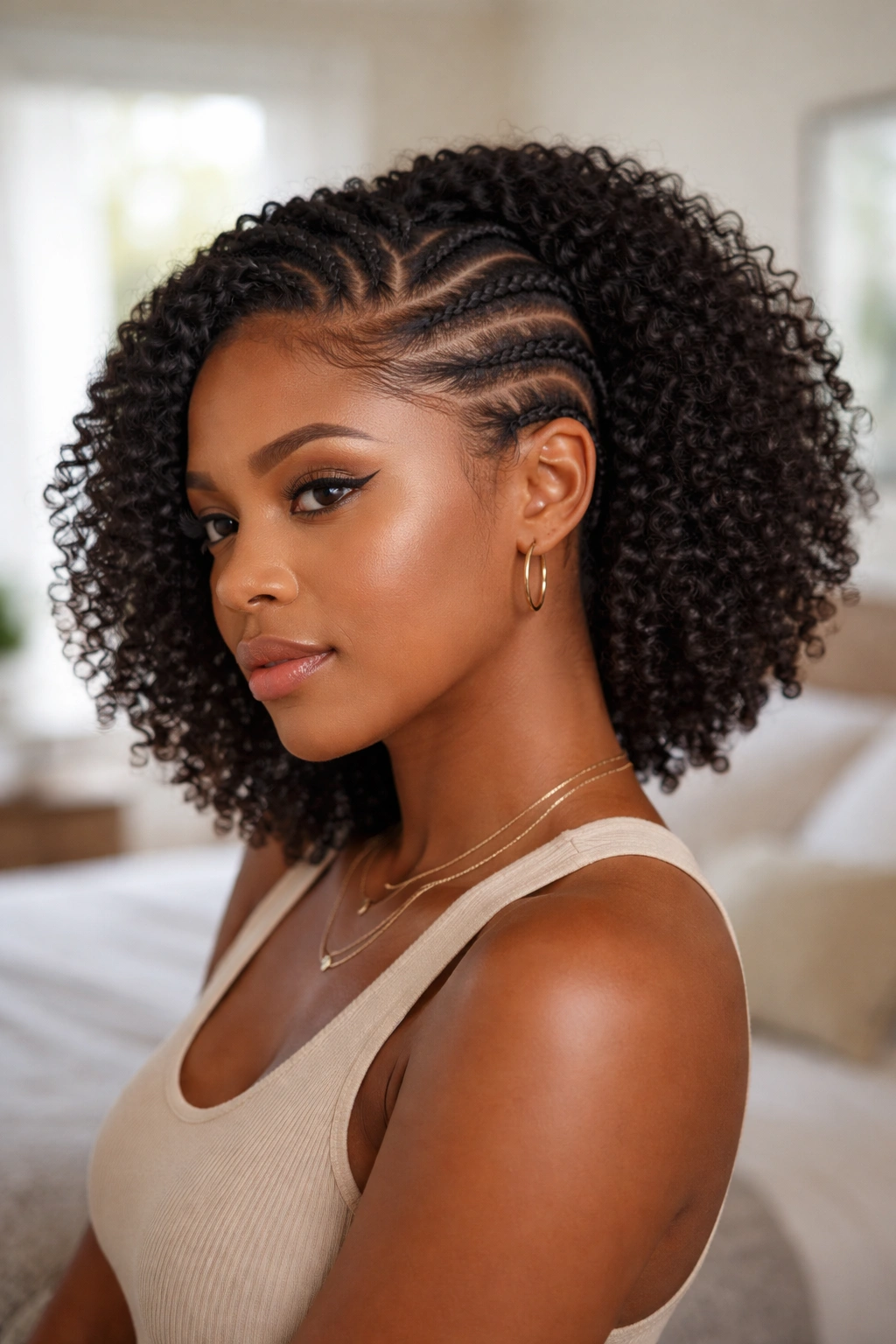
Three cornrows along a heavily side-parted head. The parting is so deep that the braided side almost looks like an undercut when viewed from certain angles.
The effect only works on 4A-4C hair with enough density. Fine hair can’t create enough contrast between braided and loose sides to get the undercut illusion.
The braids should be tight and close to the scalp to enhance the effect. Loose or fluffy braids break the illusion.
19. Side Cornrows With a Natural Hair Mohawk
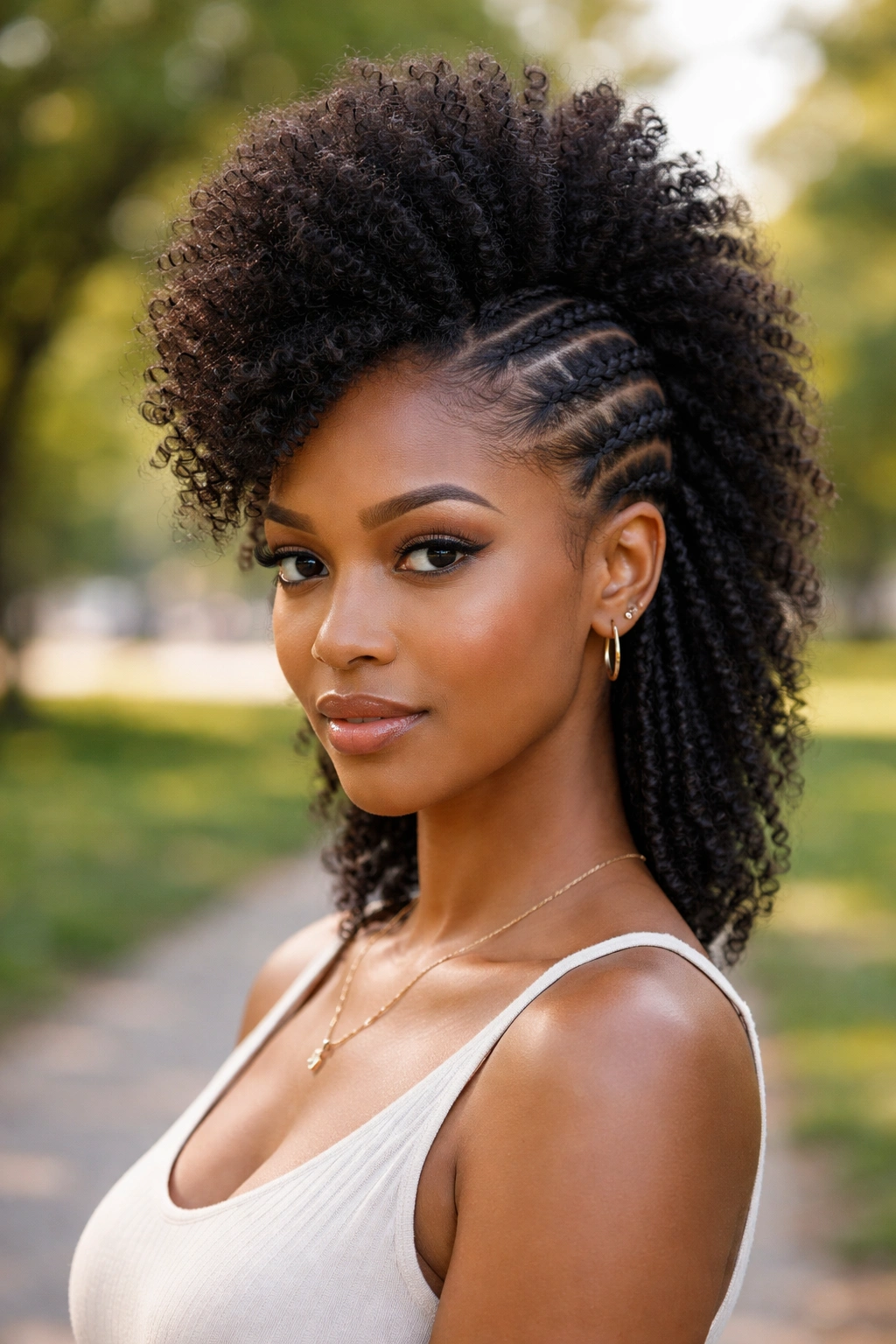
Three cornrows along each side of the head (so six total), with a wide strip of loose natural hair running down the center, styled up into a mohawk-like ridge.
The cornrows on both sides direct the eye upward to the mohawk ridge. The central loose hair becomes the focal point.
Pick out the mohawk section with an afro comb and shape it into a defined ridge. Use light hold gel to hold the shape if needed.
20. Side Cornrows With Scarf Accent
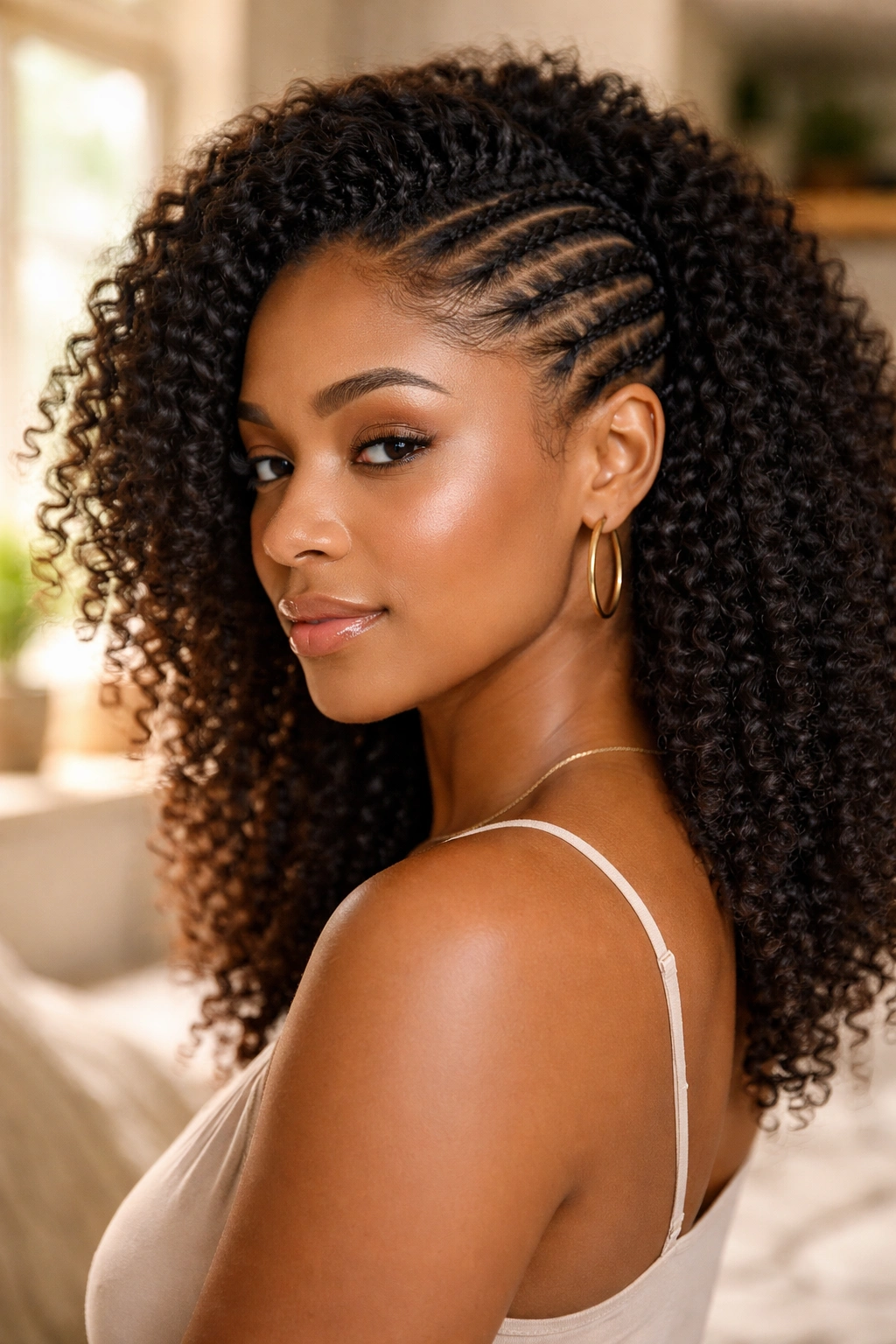
Three cornrows along the side, with a silk or satin scarf tied around the base of the head or woven through the loose hair as a decorative element.
The scarf adds color and texture without requiring more braiding. Easy to change day-to-day based on outfit.
Pick scarves with small prints or solid colors. Big bold prints compete with the braid lines for attention.
21. Side Cornrows With Flat Twists on the Opposite Side
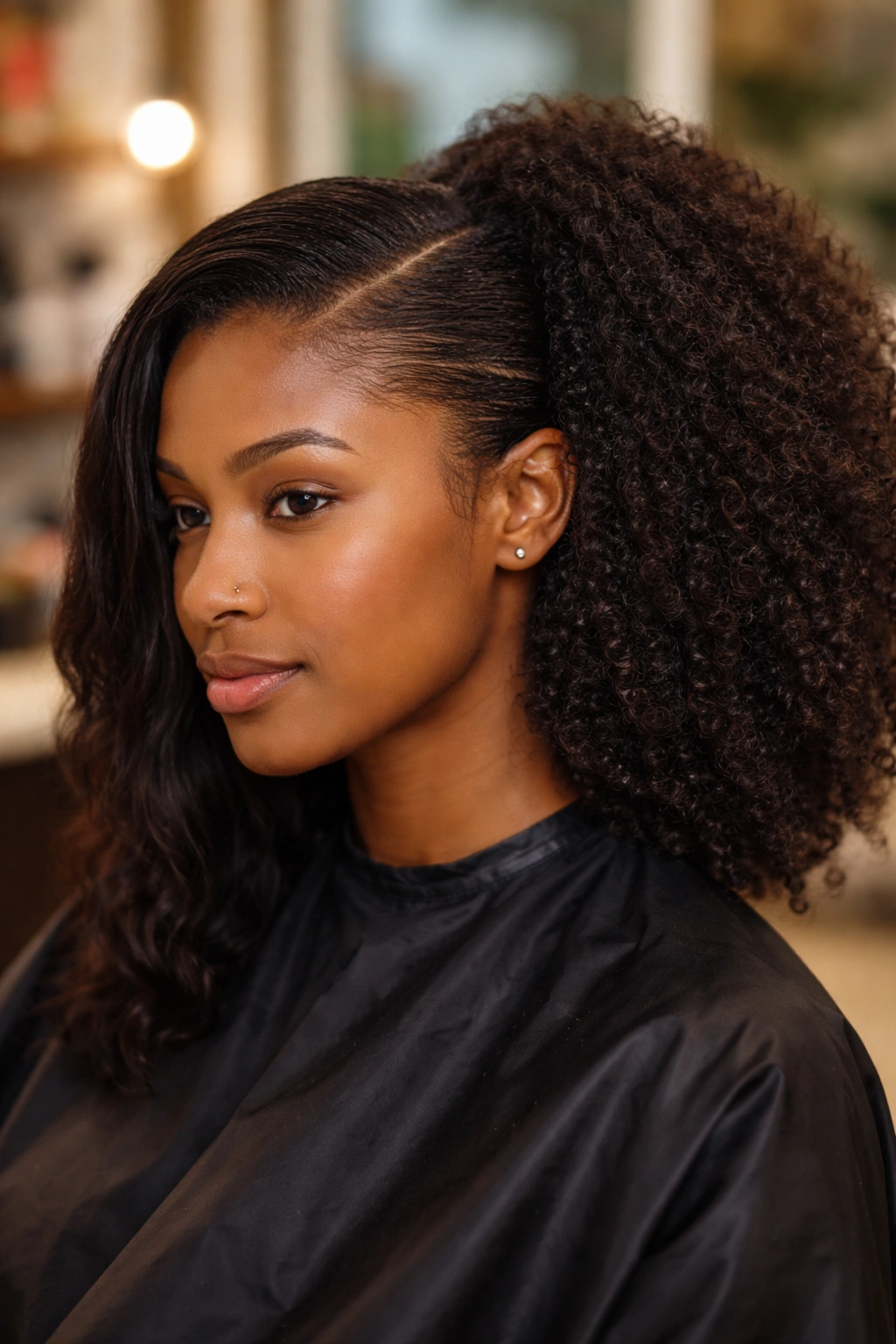
Three cornrows along one side, with flat twists (twist-on-the-scalp, similar to cornrows but with two strands instead of three) along the opposite side.
The flat twists have a different texture than cornrows. Looser, softer, more organic-looking. The two techniques on opposite sides create visual dialogue.
This is a longer install — 3-4 hours for both sides.
22. Side Cornrows With a Full Natural Wash-and-Go
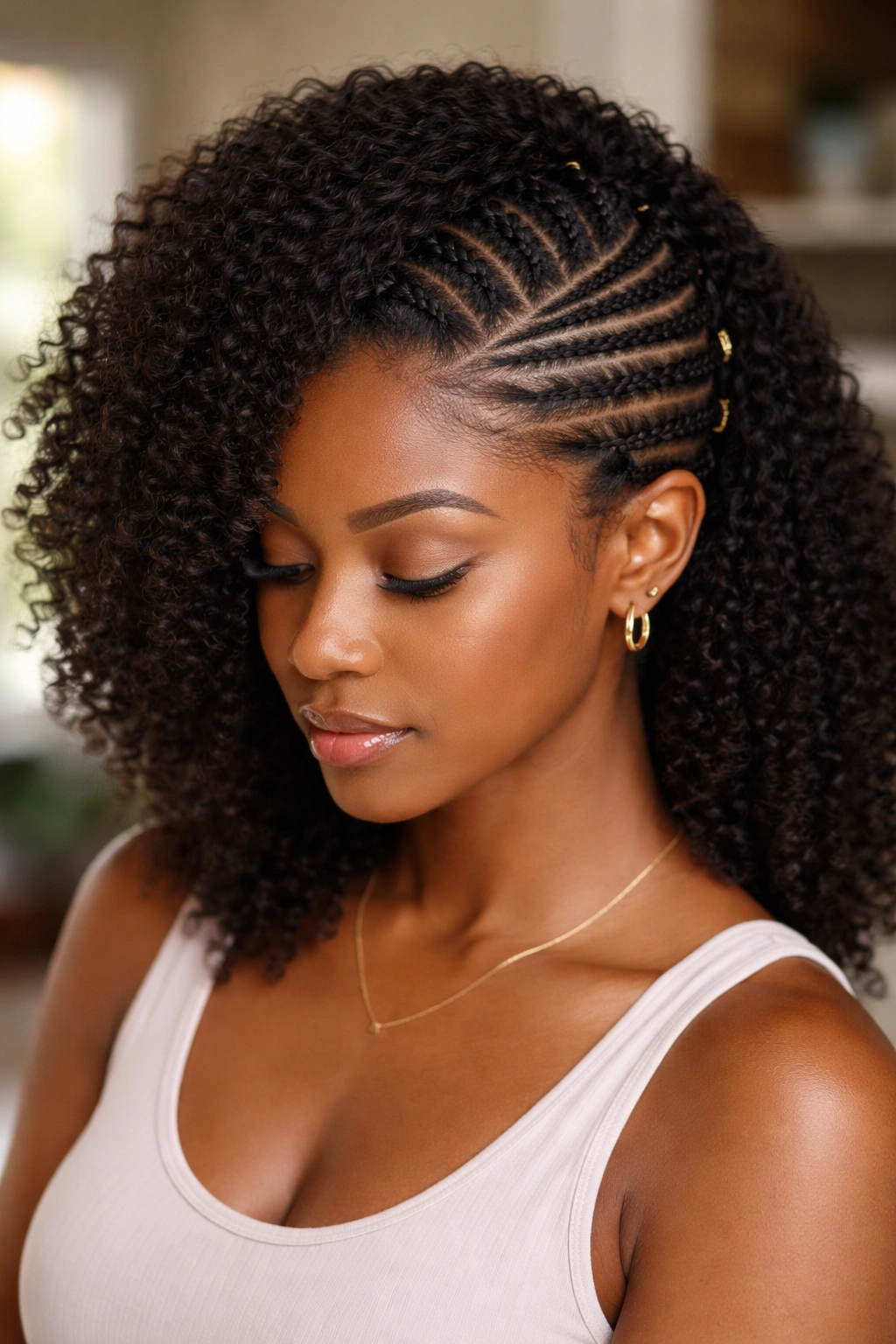
The simplest version. Three or four cornrows along one side, with the rest of the hair in a fresh, full wash-and-go — natural coils defined and free.
Maintenance Notes
The wash-and-go portion needs refreshing every 2-3 days with a light mist of water and leave-in. The cornrow side needs almost nothing — just a satin scarf at night.
This is the style that most celebrates natural hair. The braids are minimal. The texture is maximum. The combination is practical and photogenic.
Daily Maintenance for Side Cornrow Styles
The maintenance has two tracks — one for the braided side, one for the loose side.
Braided side: a light mist of water-and-leave-in spray every other day. Edge gel touch-up at the hairline every few days. Satin scarf or bonnet coverage at night.
Loose side: depends on the styling. Wash-and-gos need daily refreshing with a spray bottle. Twist-outs need nightly re-twisting of the front sections. Puffs need re-wetting and reshaping every morning.
The loose side takes more daily time than the braids. Build that into your morning routine.
Sleeping With Side Cornrow Styles
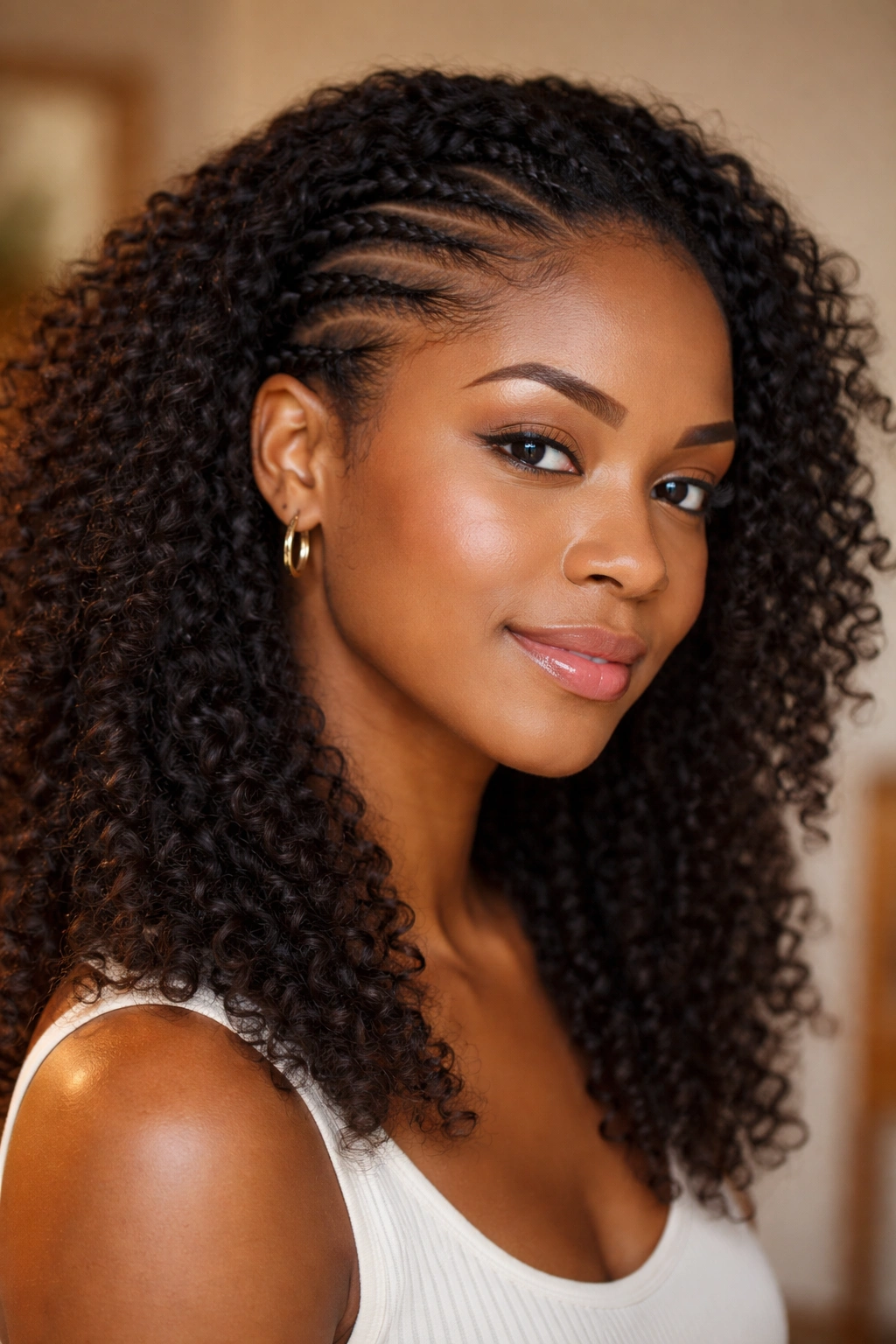
Protecting both sections overnight requires some thought. A single bonnet covers everything, but compresses the loose section’s volume.
A better approach: a satin scarf tied around the cornrowed side only, with the loose section gathered loosely into a pineapple (high, loose ponytail at the crown) on top of the head. The pineapple keeps the loose section’s volume from being crushed.
For particularly defined wash-and-gos, skip any tie and just sleep on a silk or satin pillowcase. The pineapple can break the definition at the gathering point.
Scalp Care While Wearing Side Cornrows
Because only part of the head is braided, scalp care is simpler than with a full cornrow install.
The braided side gets a weekly apple cider vinegar rinse (2 tablespoons to a cup of water) applied along each part line with a squeeze bottle. Massage gently, rinse with cool water.
The loose side gets whatever your usual scalp routine calls for — pre-shampoo oil treatments, scalp massages, clarifying washes — all uninterrupted.
Washing the Style Without Wrecking It
Partial cornrow styles are easier to wash than full ones.
Co-wash the loose section first, detangling with fingers or a wide-tooth comb while the conditioner is in. Rinse thoroughly.
For the braided side: use a sulfate-free shampoo diluted 50/50 with water, applied only to the scalp along the part lines. Rinse with cool water.
Dry by patting with a microfiber towel and air drying. The loose section can be styled however you’d normally after washing — twist-out, wash-and-go, whatever.
Taking Down Side Cornrows
Fastest takedown of any cornrow style. Three to six cornrows come out in under 30 minutes.
Remove any elastics at the braid tips. Unravel each cornrow slowly, fingers only. Apply conditioner for slip.
Once the cornrows are out, the whole head is effectively natural and ready to detangle. Co-wash, detangle with conditioner in, and style as usual.
Picking the Right Variation for Your Hair
Side cornrows on natural hair reward matching the style to your actual texture:
For 4A hair with defined curls: styles that show off the natural pattern (wash-and-go combinations, curl-definition approaches).
For 4B hair with coiled texture: styles with dimensional loose sections (twist-outs, braid-outs, defined twists on top).
For 4C hair with tight coils: styles that work with natural shrinkage (puffs, fluffy buns, afro-textured tops) rather than trying to fight it.
For fine natural hair: lower braid counts (2-3 cornrows) to avoid looking over-braided.
For dense natural hair: higher counts (5-6 cornrows) to balance the visual weight between braid and loose sections.
Mistakes Worth Avoiding
Three patterns come up often with side cornrow styles:
Over-braiding one side. Too many cornrows on a single side makes the head look unbalanced. Three to six cornrows max.
Neglecting the loose section. The loose side isn’t “automatic.” It needs styling the same way a wash-and-go or twist-out would need styling. Plan for that time commitment.
Matching textures sloppily. If the cornrows are crisp and new, the loose section should also look intentional and styled. A freshly-braided side next to a neglected loose side looks inconsistent.
Side cornrows on natural hair are one of the most forgiving and expressive styles available. They celebrate natural texture. They require less installation time than full cornrows. They look current without feeling trendy. Pick the variation that matches your texture, your time, and your week — and the combination will carry you through any setting.
