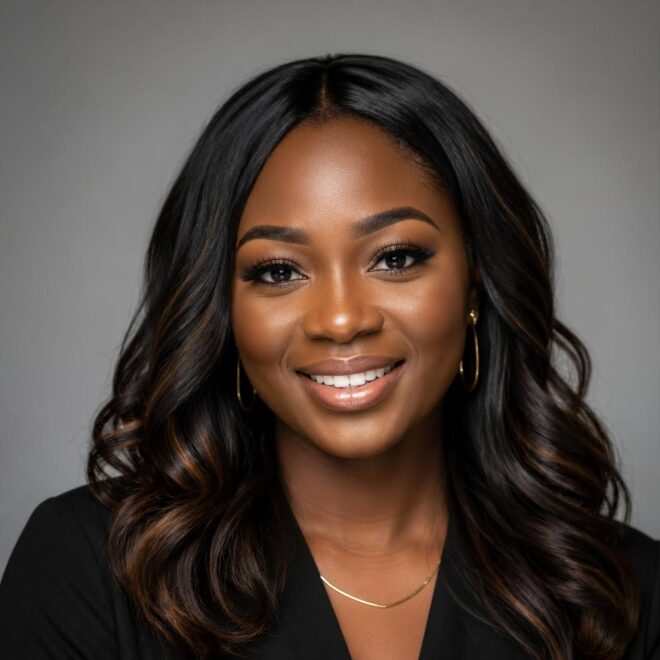


Cornrow styles with curly weave solve a problem that protective styling has always struggled with: how do you get the low-maintenance benefits of cornrows without losing the soft, feminine texture of loose curls? The answer is to braid your natural hair flat against the scalp in cornrow sections, then sew or clip in curly weave wefts over the back and sides — leaving a combination of sculpted scalp work and flowing curly length that behaves like versatile, full-bodied hair.
The hybrid approach has been popular for decades. It draws from both traditional cornrowing technique and modern weave-installation methods, and the combinations have only gotten more refined over time. Done well, nobody can tell where the braids end and the weave begins. Done poorly, the wefts sit awkwardly against the braided base and the whole install looks mismatched.
What Makes Curly Weave Different From Straight or Wavy
Curly weave carries a specific spring and texture that straight or wavy wefts don’t have. The coils grip each other, which means the hair moves as a unit rather than in individual strands. A bundle of curly weave holds its shape even after a full day of movement.
That gripping quality also means curly weave tangles differently than straight hair. The coils catch on each other, creating matted sections if the hair isn’t regularly detangled. This is the main maintenance difference between curly and straight weave styles — curly needs more attention to prevent matting.
Curl pattern matters too. Tight 3C-4A curls look different from looser 2C-3A waves, and both look different from spiral 4B-inspired textures. Match the curl pattern to your natural hair if you want a blended look, or deliberately mismatch for contrast.
Why Cornrows as a Weave Base Beats Other Methods
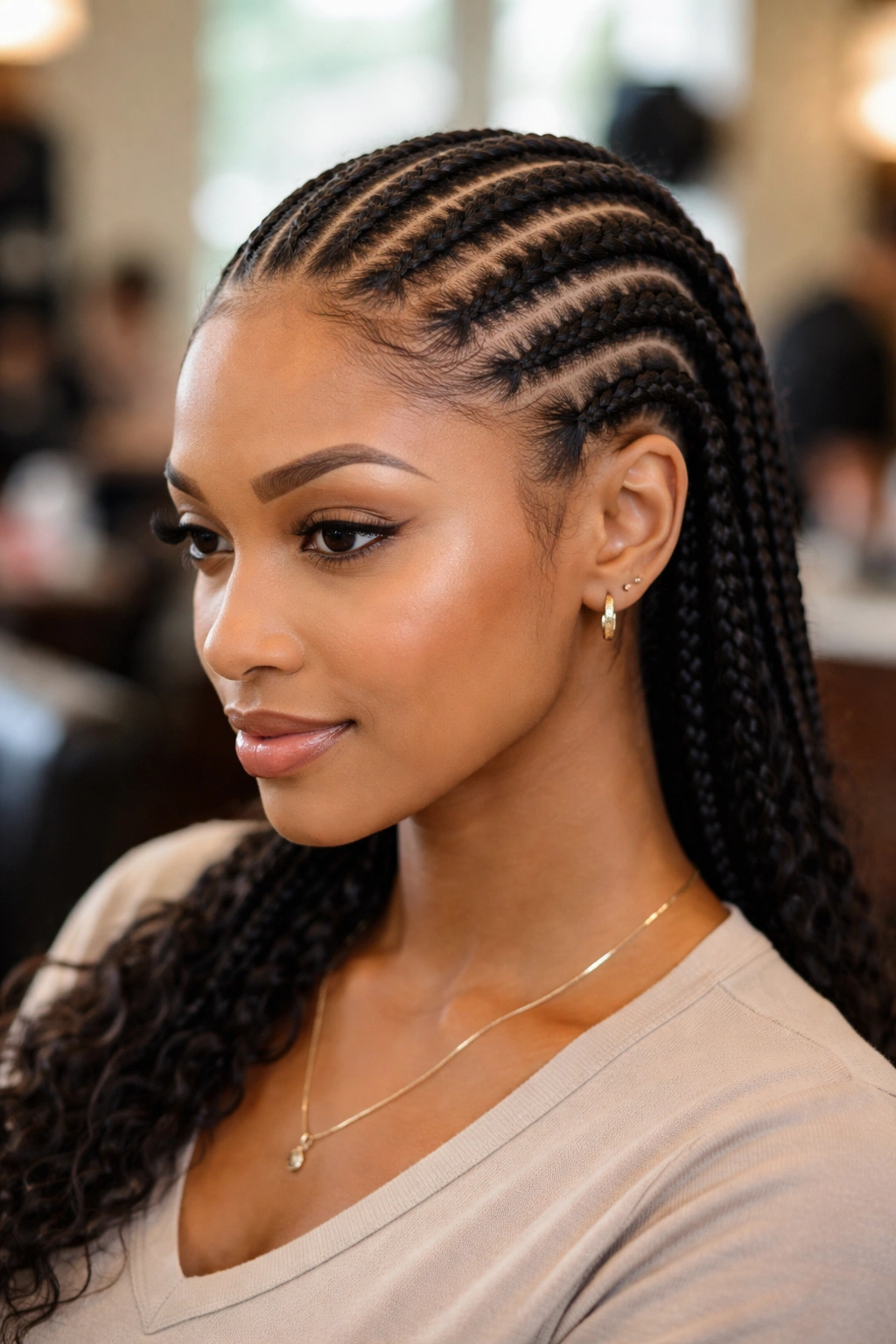
Installing weave requires a base. Some methods use micro braids, some use individual braids, some use a glue-in quick-weave technique. Cornrows remain the most popular base because:
- They lie flat against the scalp, so the wefts sit close and look natural
- They distribute tension across many small points rather than concentrating it
- They last 6-10 weeks with proper care — longer than most other bases
- They can be refreshed mid-wear without removing the weave
- They allow natural hair to rest completely under the style
The braiding pattern for a weave base is different from standalone cornrows. Weave-base cornrows are designed to sit low against the scalp and accommodate sewing needles, so they’re often thinner and straighter than decorative cornrows.
Choosing Between Full Sew-In and Partial Sew-In
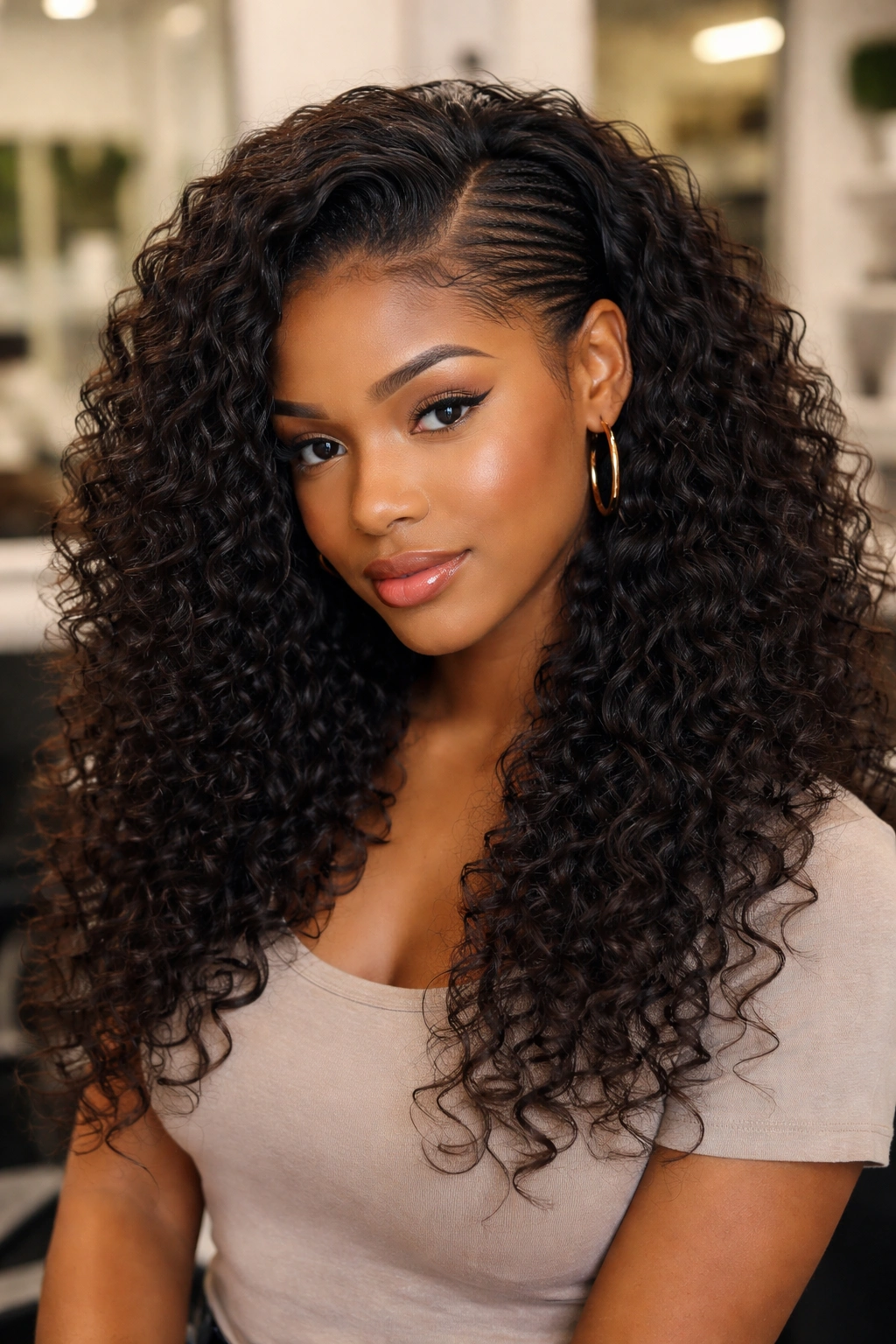
There are two main approaches to cornrow-base curly weave installs:
Full sew-in: The entire head is cornrowed, and weave wefts are sewn onto every section — no natural hair showing. Gives the most versatility in styling but requires more wefts and longer install time.
Partial sew-in (sometimes called leave-out): The top section of natural hair is left out and blended with the curly weave, while the back and sides are cornrowed and sewn with wefts. Looks more natural and allows the natural hair to show, but requires the wearer’s natural texture to match the weave curl pattern.
Full sew-in is the more common approach for bold curly weave styles. Partial sew-in works better for minimal styling where the natural hair blends seamlessly with the wefts.
Weave Quality Matters More Than Cornrow Technique
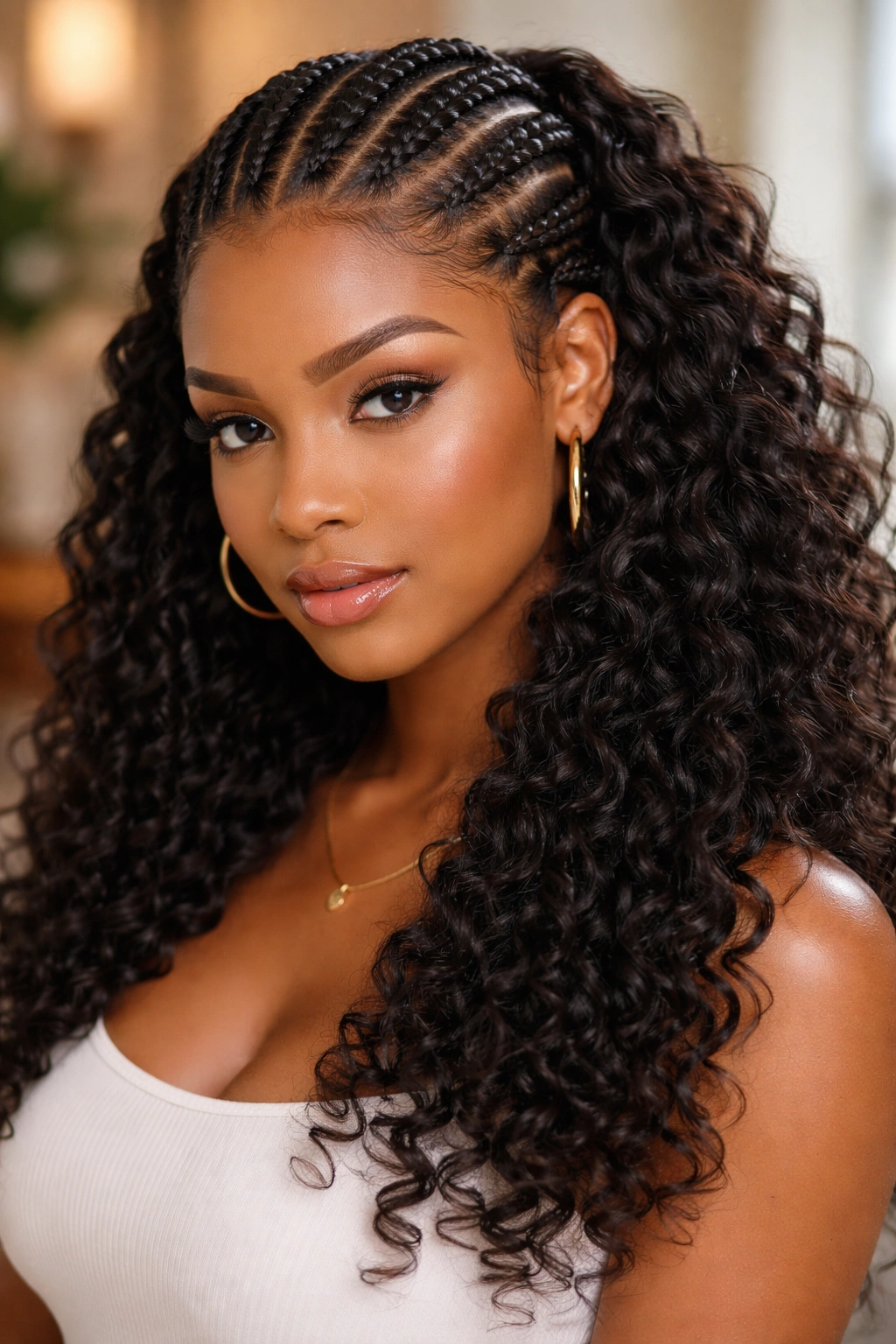
The cornrow base only shows along the parts and at the hairline. The weave is what most people see. So while a good braider is important, the weave quality determines whether the style looks expensive or cheap.
Look for curly weave labeled as Remy human hair or high-grade synthetic blends. Cheaper packs shed, tangle within days, and lose their curl pattern after one wash. Premium bundles hold curl through multiple wear cycles and detangle smoothly.
Bundle count depends on thickness: 2 bundles for a thin natural look, 3 bundles for medium volume, 4 bundles for thick dramatic styles. Always buy one extra bundle beyond what you think you need. Running out mid-install is avoidable and unpleasant.
Install Tools Beyond the Standard Cornrow Kit
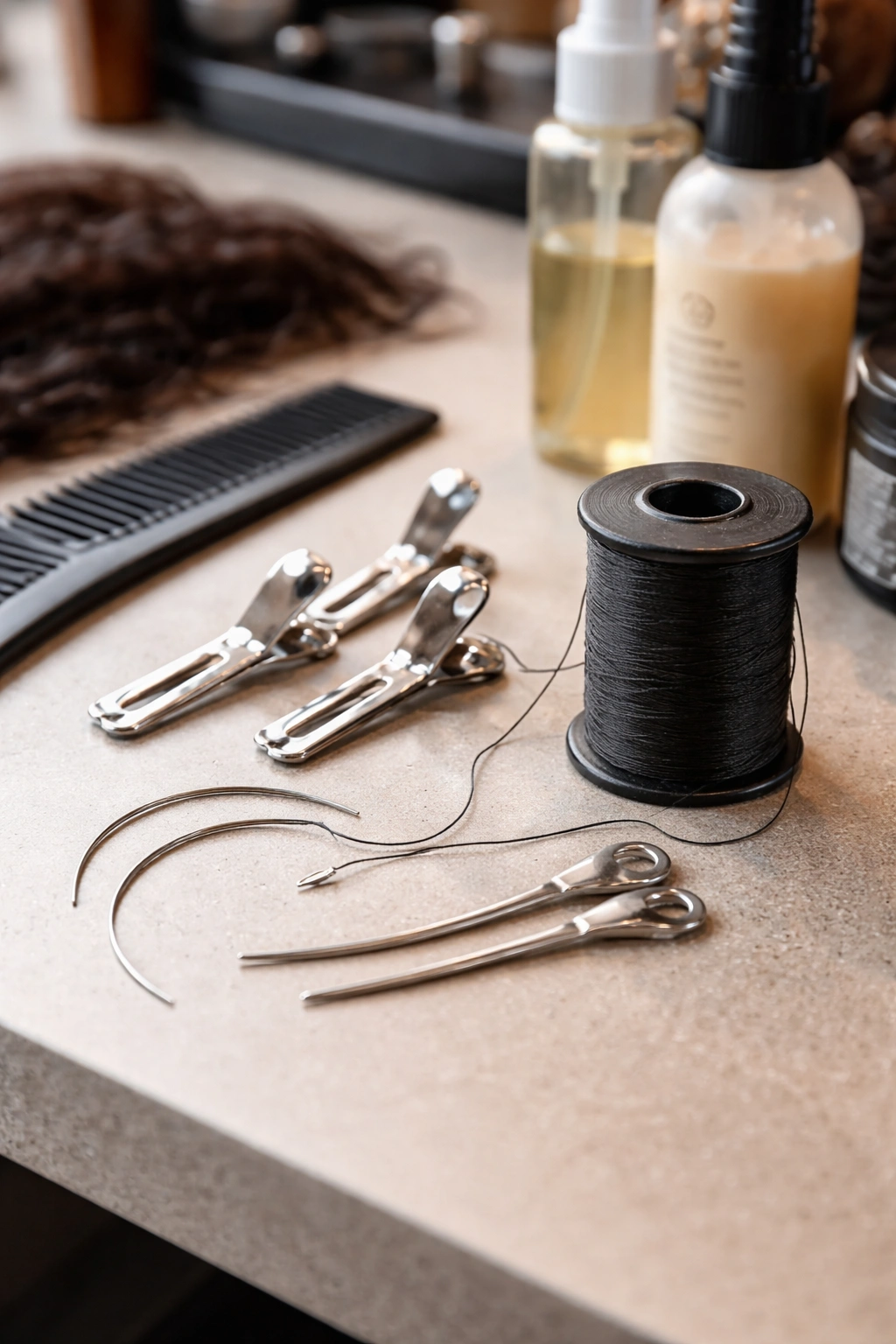
Curly weave installs add several tools to the standard cornrow setup:
- Curved sewing needle — specifically shaped for weave installation
- Weaving thread (in color matching your weave) — strong, waxed cotton or polyester
- Bulldog clips — for sectioning during the sewing phase
- A spray bottle with water and conditioner — for detangling the curly weave during and after install
- A wide-tooth comb or paddle brush — for the weave, not the cornrow base
- Curl-defining cream or mousse — for refreshing the weave curls after install
Skip small items at your peril. A missing curved needle means the weave won’t sew properly; a missing conditioning spray means the curls tangle before the install is finished.
Prep Work Specific to Curly Weave Installs
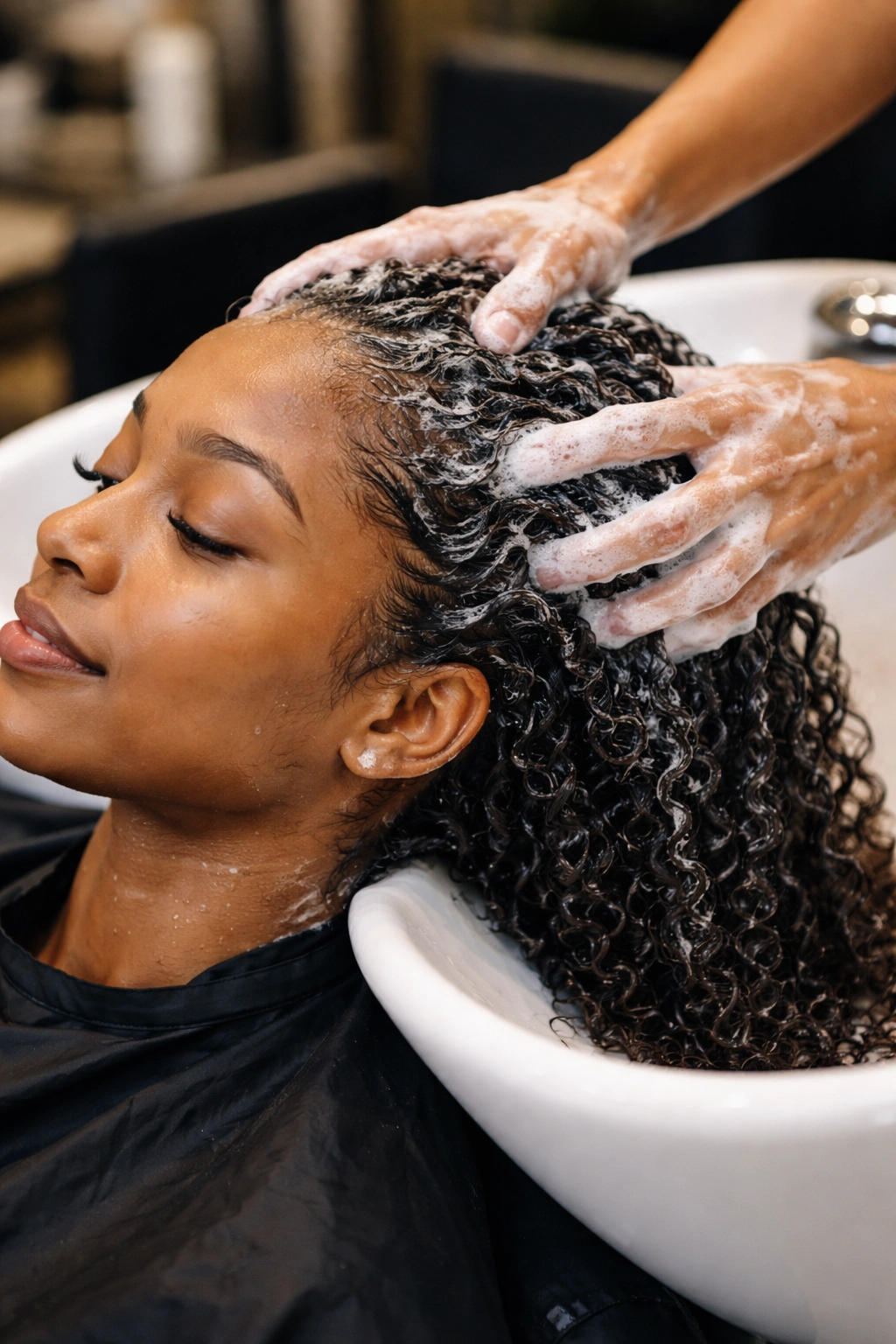
Pre-install prep is critical for long-lasting curly weave styles. Wash your natural hair with a clarifying shampoo 2-3 days before the install to remove all buildup. Deep condition. Blow dry on cool-medium to stretch without flattening.
For the weave itself, most people co-wash the bundles before installation to soften factory coatings and prevent initial shedding. Use a curl-friendly co-wash, rinse thoroughly, and let the bundles air dry on a foam head or flat surface. Do not bag the bundles wet — they’ll mildew.
After co-washing, detangle the weave with fingers first, then a wide-tooth comb. Work from the ends up to the weft. Curl pattern will relax slightly during the wash but should return when you apply a curl refresher after the install.
1. Full Curly Weave With Center Part
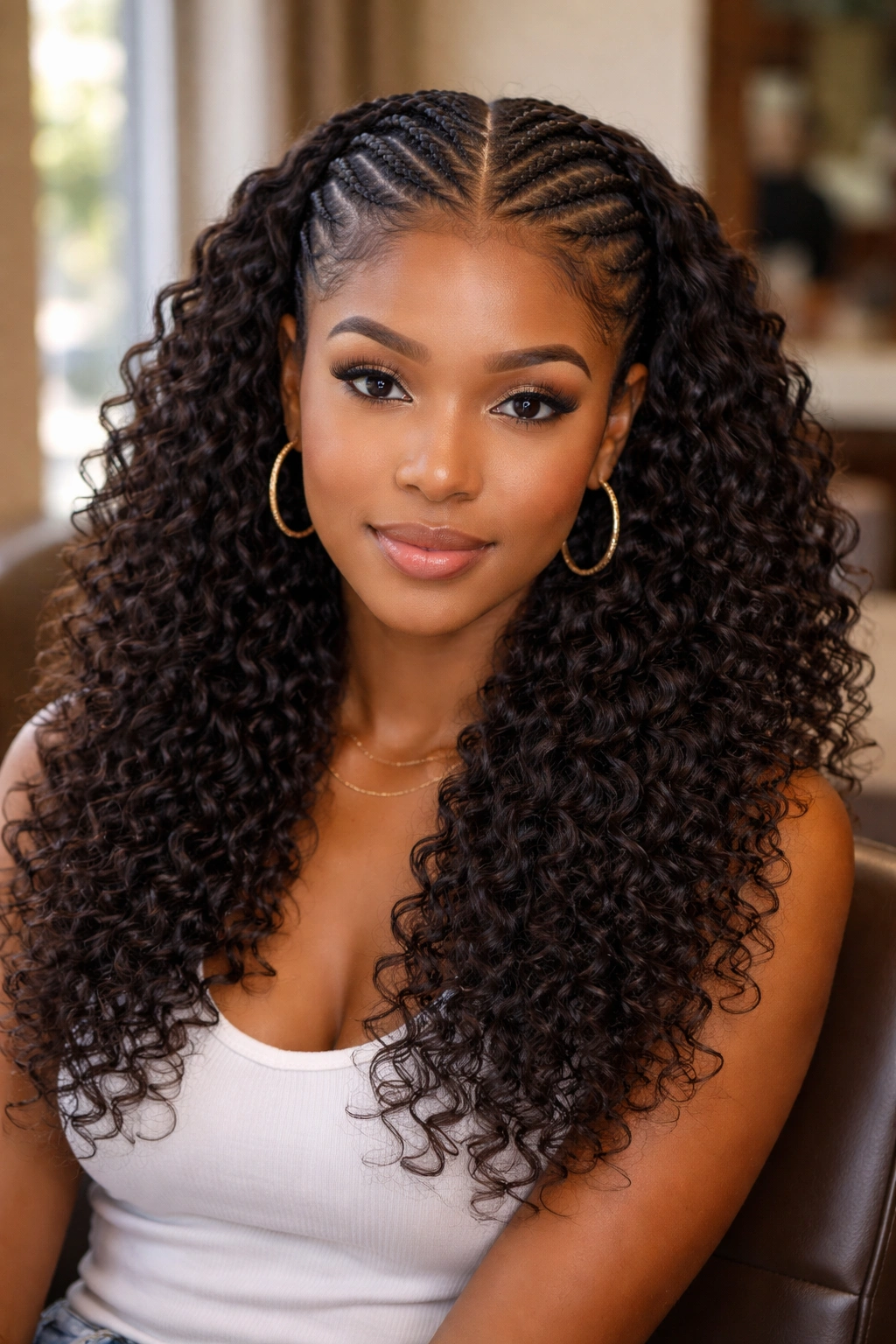
Cornrows run straight back across the whole head; curly weave wefts are sewn in to completely cover the braids, with a clean center part down the middle.
Why It Works
The center part creates visual symmetry that anchors otherwise abundant curls. Without the part, full curly weave can read as overwhelming; with it, the volume is balanced and organized.
- Bundles needed: 3 of 18-inch curly weave
- Install time: 4-5 hours total
- Curl pattern recommendation: loose 3B-3C
Pro tip: Ask your braider to cornrow a small section at the center crown specifically to create a flat channel for the part. Without this, the part won’t lay flat and will fluff up unevenly.
2. Side-Parted Curly Weave With Face-Framing Layers
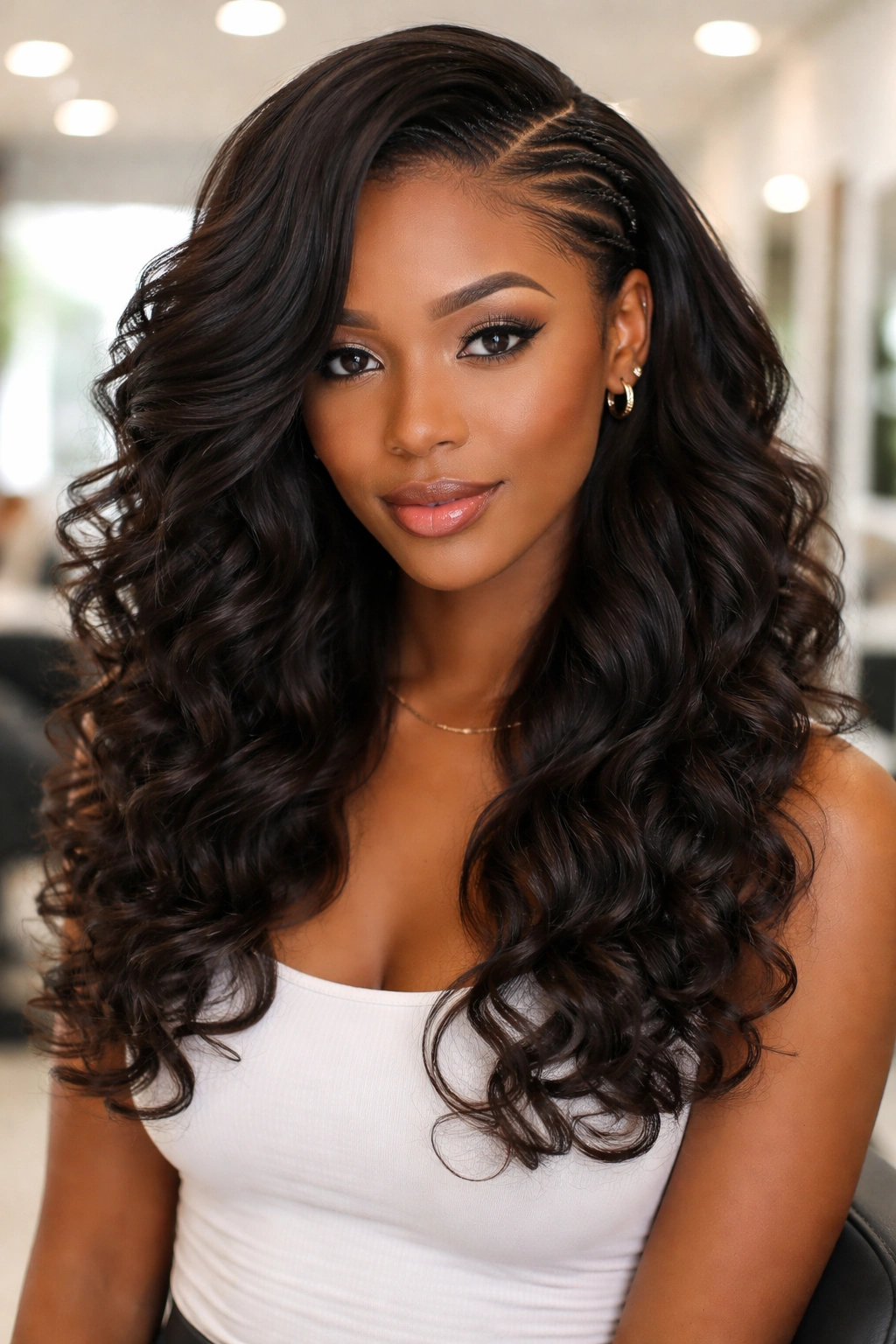
A deep side part with curly weave cut into layers that frame the face. The shortest layer hits at the cheekbone; the longest falls mid-chest.
Side parts are more flattering for asymmetrical face shapes than center parts. The heavier side adds volume where it’s wanted; the thinner side stays lighter and less structured.
Face-framing layers require cutting the weave after installation. A stylist with curly hair cutting experience is essential — cutting curly hair wet or straight creates problems when the curls bounce back to their natural length. Always cut curly weave dry, in curl formation.
3. Half-Up Half-Down With Curly Weave Ponytail
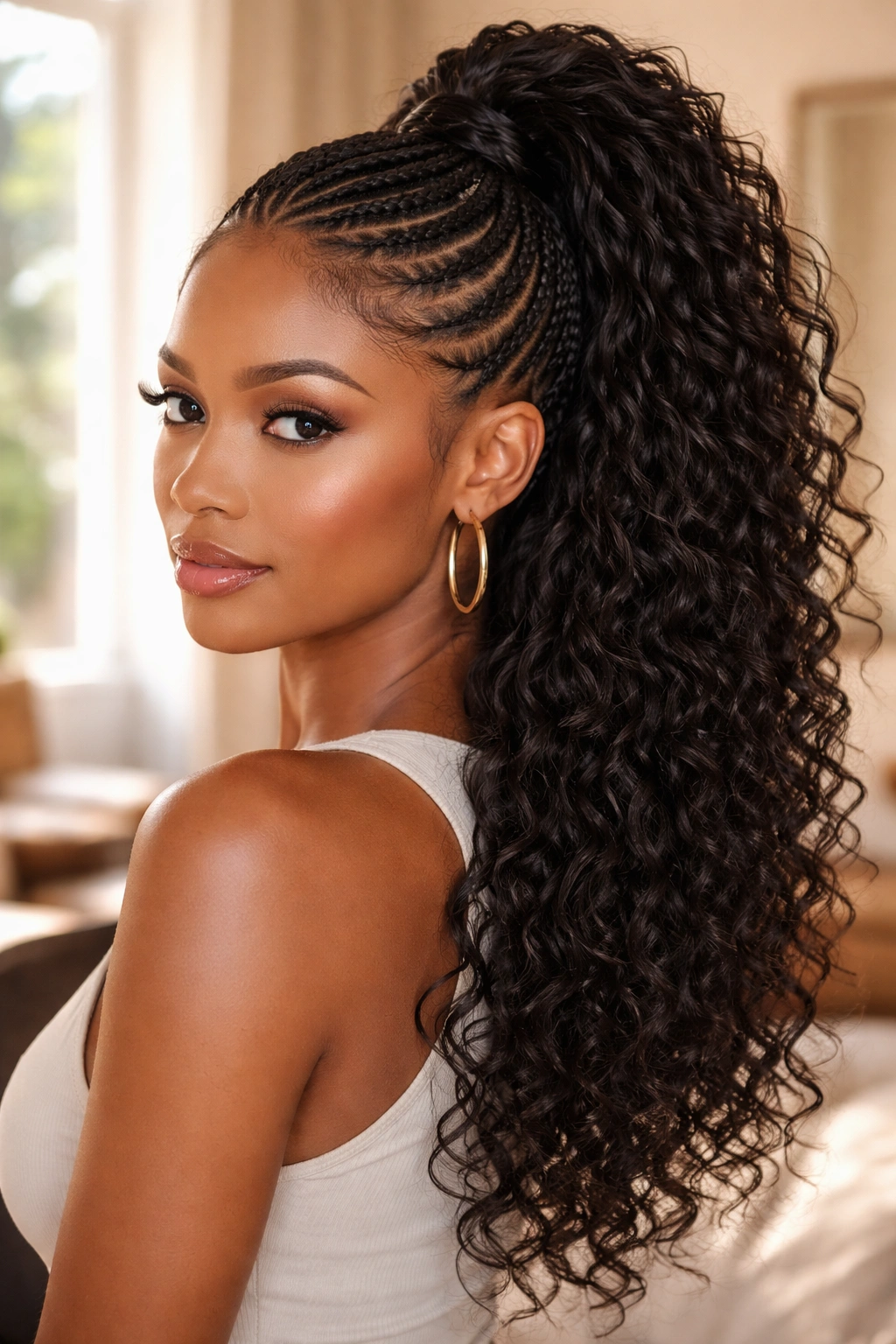
Full cornrow base with curly weave covering the entire head, but the top half is pulled up into a high ponytail leaving the bottom half loose in curls.
The half-up styling shows both the weave’s volume and its length simultaneously. The ponytail at the top gathers the curls into a dramatic focal point; the loose curls at the bottom flow over the shoulders.
Use a silk scrunchie or a fabric-covered elastic to secure the ponytail. Rubber bands snag on curly weave and cause tangling and breakage.
4. Short Bob Curly Weave Over Cornrows
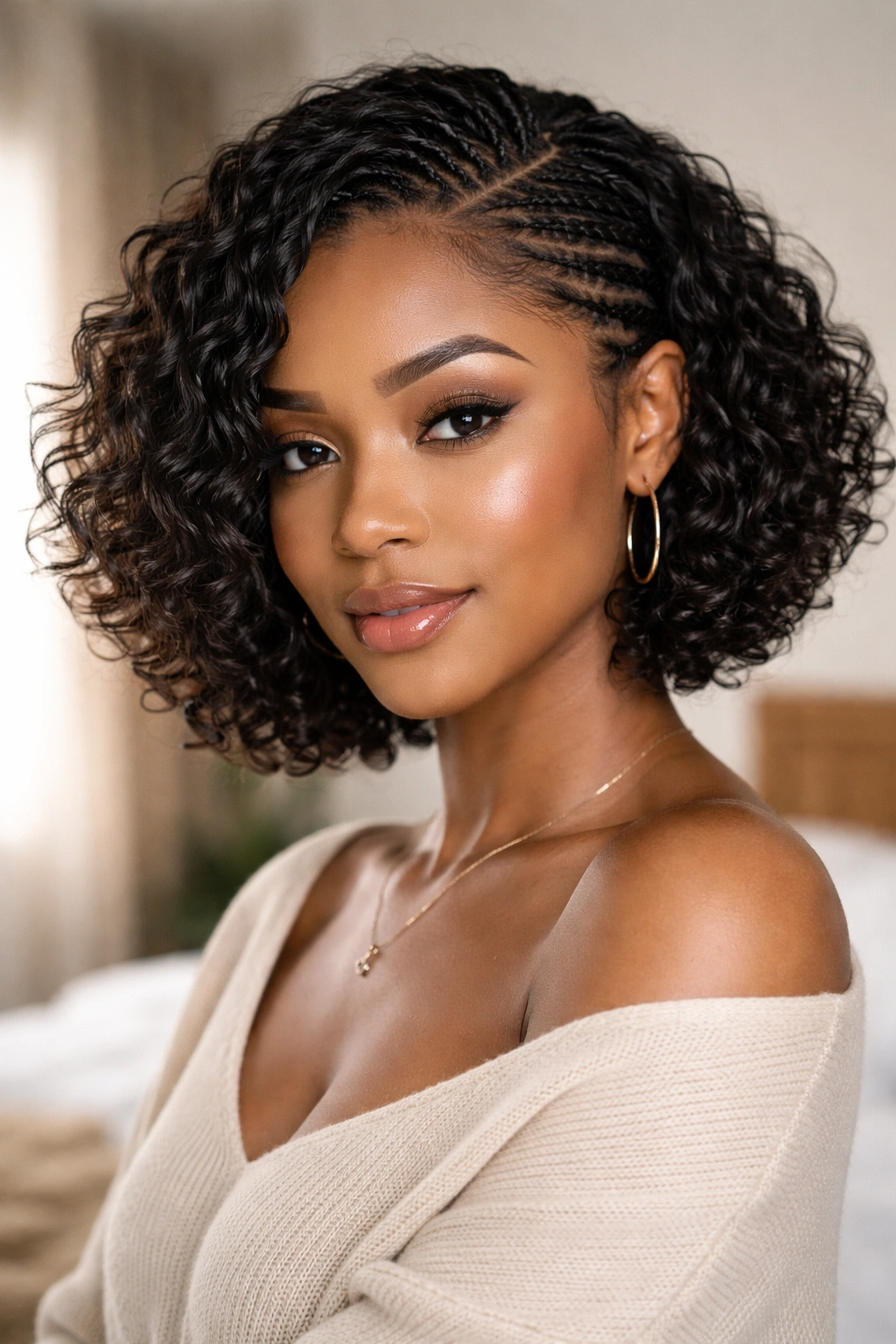
Cornrows run in a compact pattern; curly weave wefts are cut to chin-length for a short curly bob silhouette.
Short curly styles are bold and low-maintenance compared to long curly weaves. The shorter length means less tangling, less drying time after washing, and less weight on the cornrow base.
Cutting the weave to bob length is best done after installation, with the wearer sitting upright. Cutting bundles before install leads to uneven lengths once the wefts are distributed across the head.
5. Long Curly Weave With Middle Part and No Layers
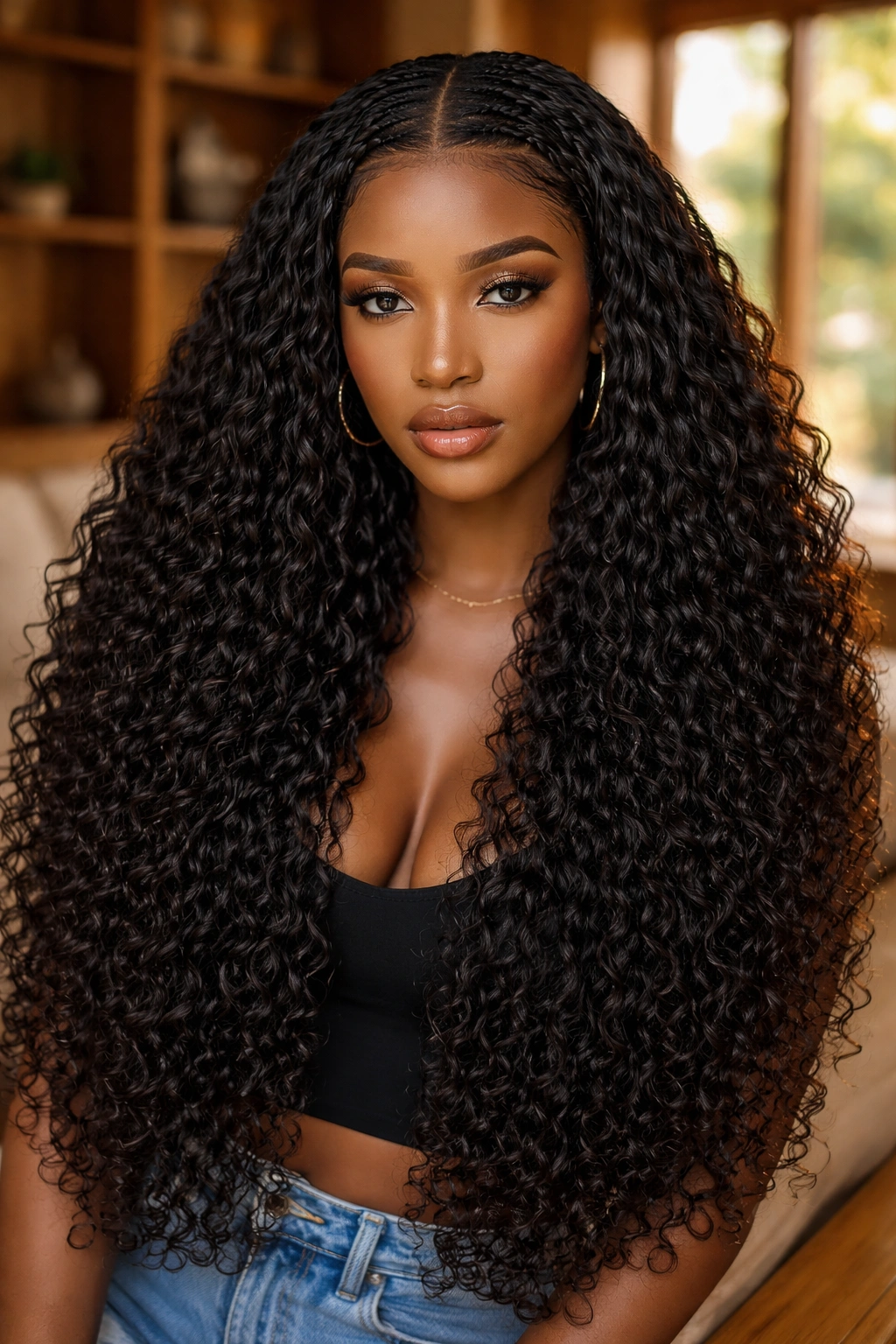
Waist-length curly weave installed over cornrows with a middle part and no layering — just uniform curly length from crown to waist.
The long, unlayered look is dramatic and bohemian. It reads as abundant, natural, and confident. The lack of layers means the curls fall straight down as a heavy curtain rather than framing the face.
This style requires the most bundles — typically 4-5 for full coverage without thinning at the bottom. The weight is significant, and the cornrow base has to be installed tightly to support it without stretching.
6. Pineapple Updo With Exposed Cornrow Sides
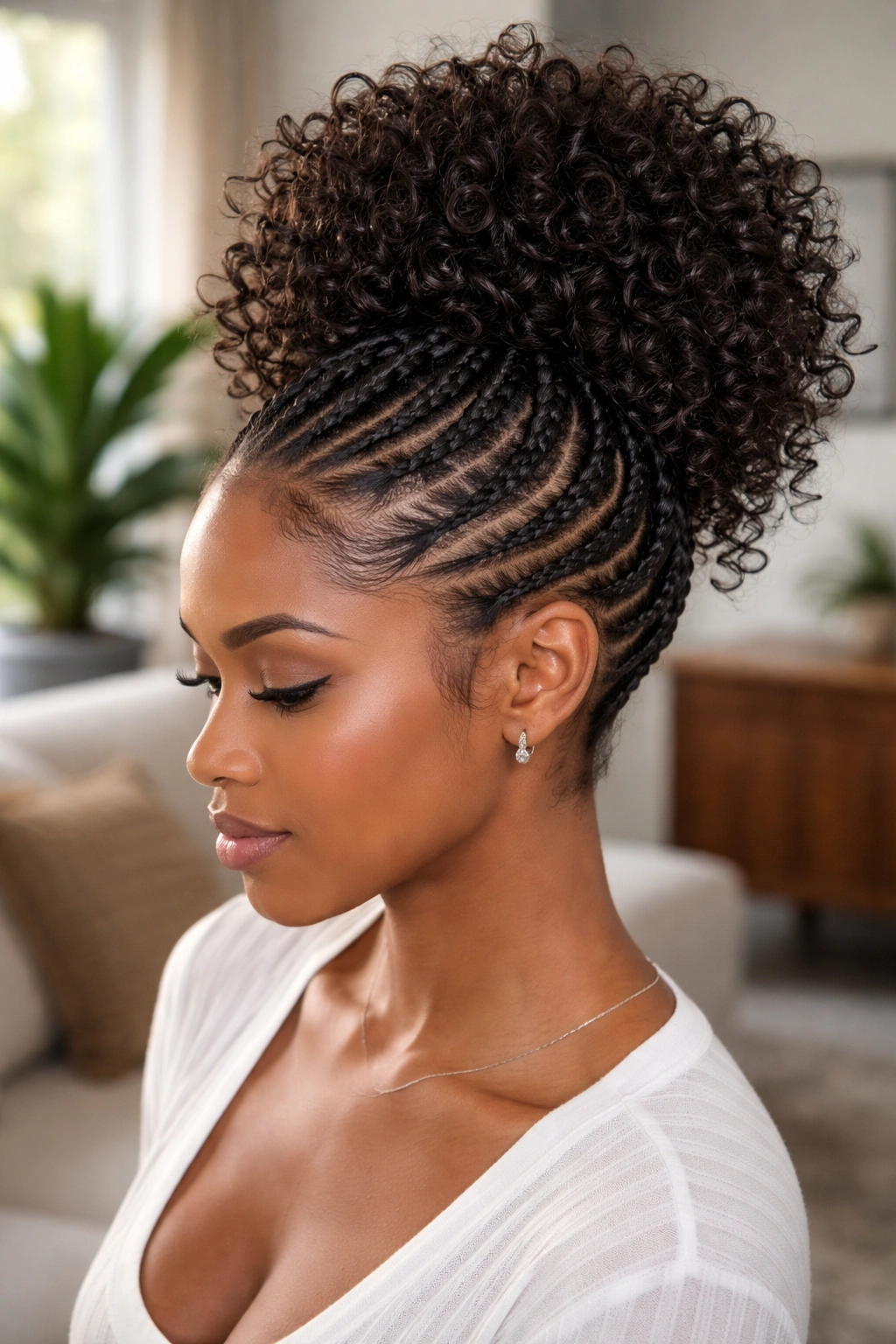
The curly weave is gathered high at the crown in a “pineapple” updo, with the cornrow sides visible beneath.
This hybrid approach celebrates both the braids and the curls. The pineapple updo at the top shows off the curly weave volume; the exposed cornrows at the sides show off the braiding technique.
The pineapple works best when the cornrow sides feature some decorative element — a simple stitch pattern, a color accent, or a zig-zag parting. Plain cornrows at the sides can look like an afterthought rather than a design element.
Styling Tips
- Secure the pineapple with a silk scrunchie, not an elastic
- Leave a few curls loose around the face for softness
- Touch up the exposed cornrow edges with edge gel daily
7. Curly Weave With Blonde Highlights
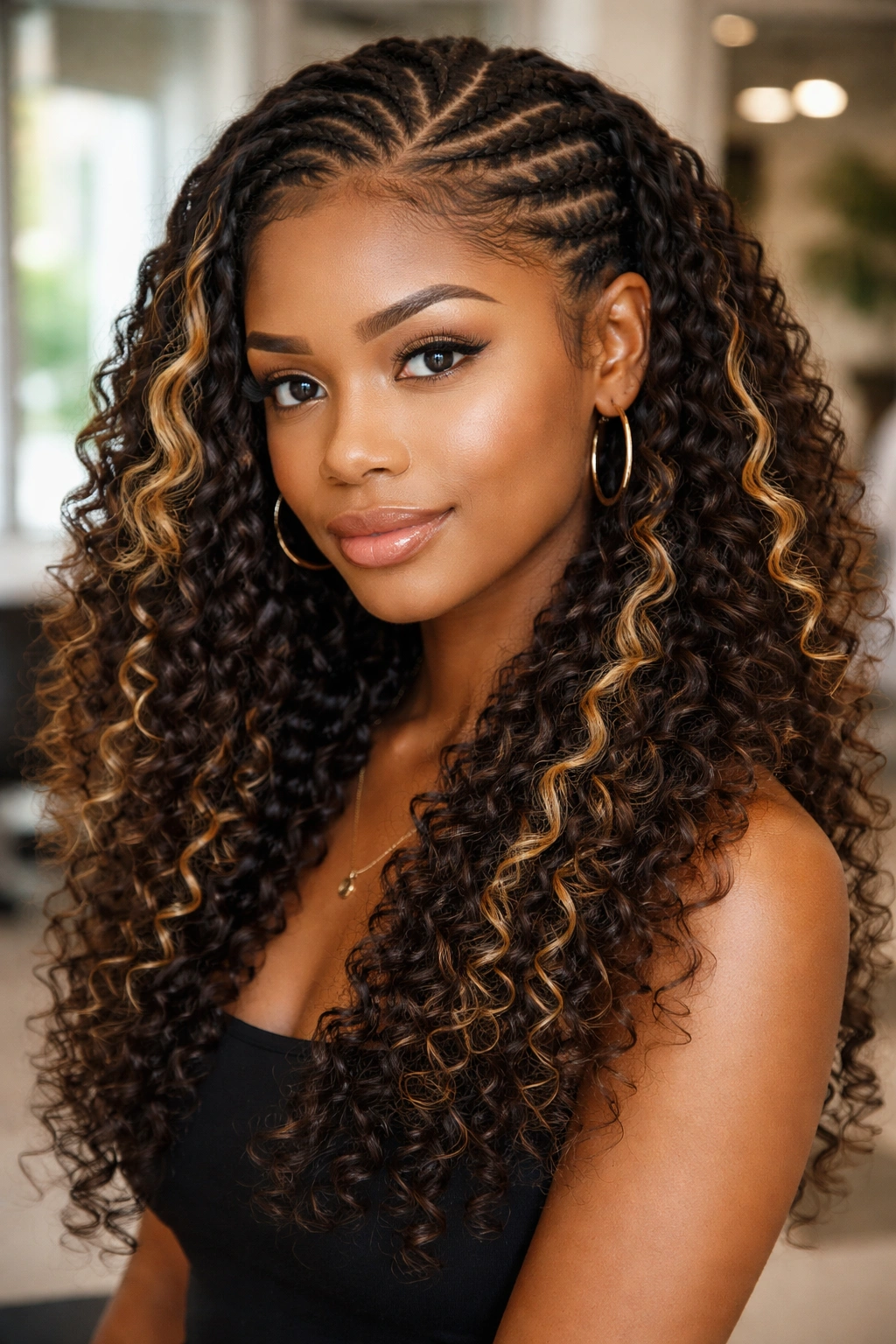
Cornrow base with curly weave bundles that include blonde-highlighted pieces mixed with natural dark bundles.
Highlighted curly weave creates dimension without committing to full-color treatment. The blonde pieces catch light and add visual interest; the dark bundles keep the overall look grounded.
Pre-highlighted curly weave bundles are sold at specialty shops, or you can alternate bundles of different colors during installation to create the highlight pattern. Pre-highlighted is easier and more consistent.
8. Deep Wave Weave for Defined Curls
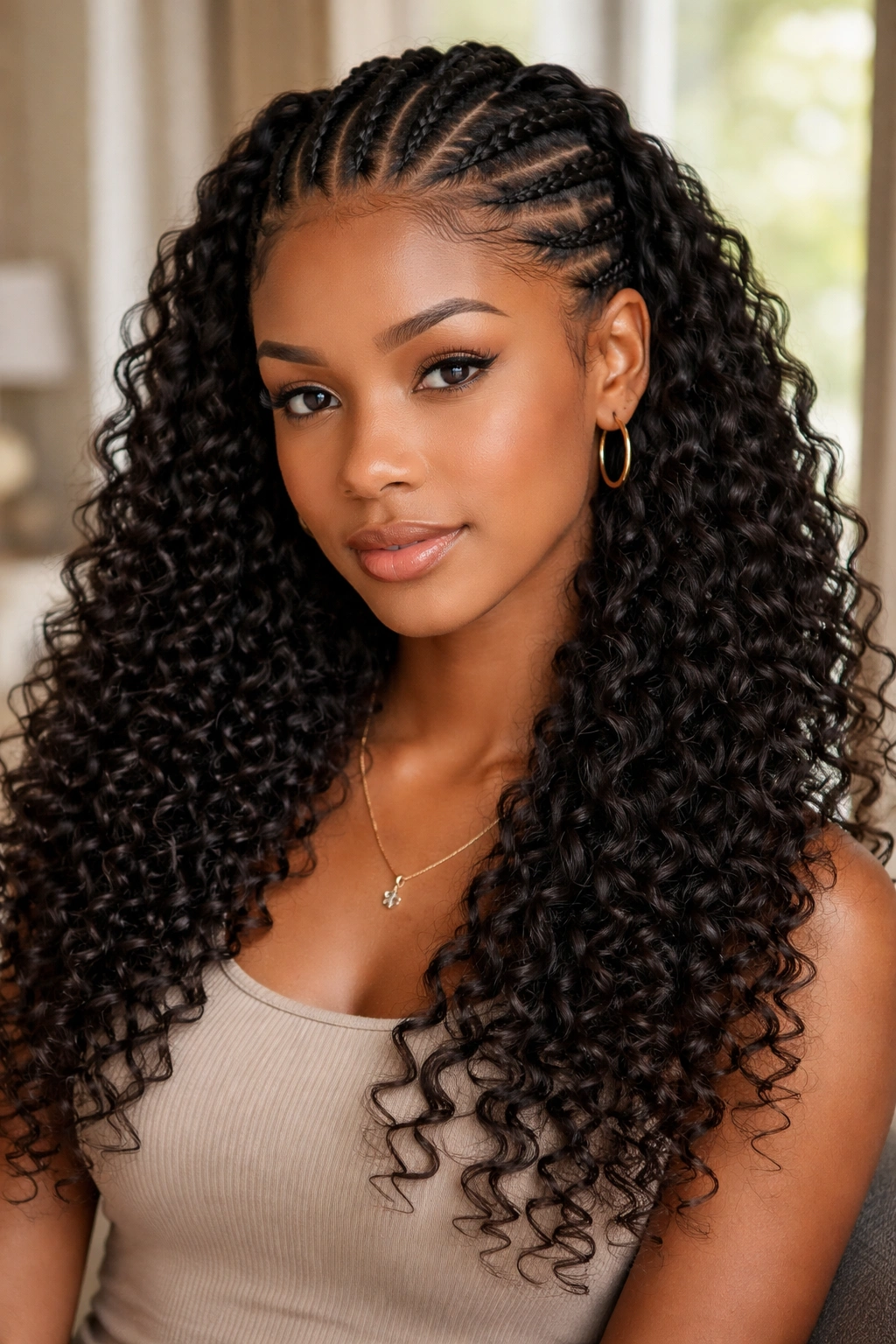
Cornrow base with deep wave weave (tighter curl pattern than standard curly) for a more defined, spring-like curl texture.
Deep wave curls are tighter and more uniform than casual curly weave. They photograph with extraordinary definition and maintain their curl pattern longer than looser waves.
Deep wave requires more attention to detangling — the tighter coils tangle more aggressively than loose curls. Comb through with a wide-tooth comb every 2-3 days, using a conditioning spray to keep the curls lubricated.
9. Loose Curly Weave With Roots-Out Styling
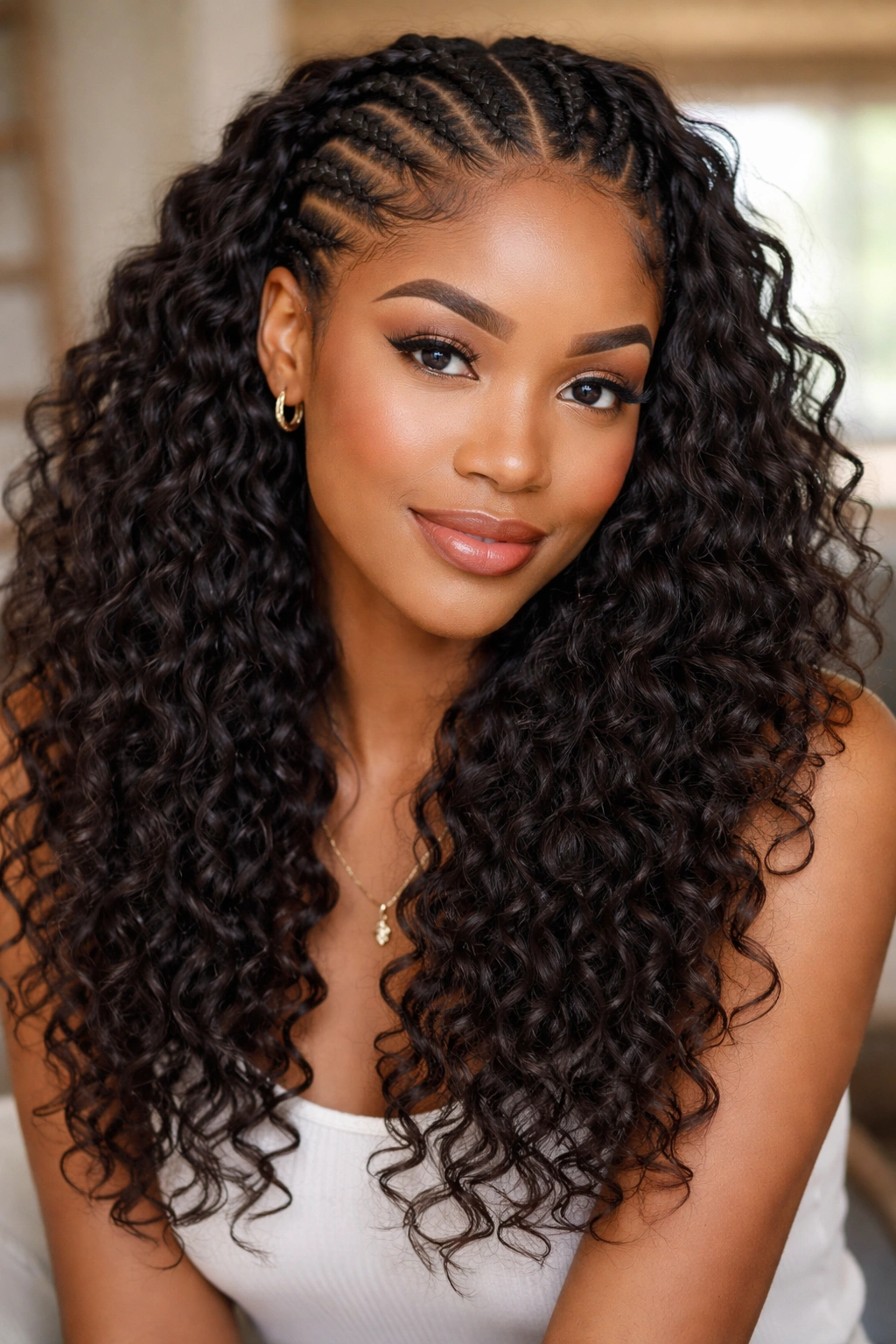
The cornrow base is installed with the top layer of natural hair left out at the roots, then blended with loose curly weave below — creating a natural curl pattern continuation.
This partial leave-out style only works if your natural hair matches the curl pattern of the weave. The transition from natural hair at the roots to weave below has to look continuous, which requires similar textures.
Loose curly weave with 3A-3B curl pattern blends well with most natural textures. Tighter weaves (4A-4C) can clash with looser natural patterns.
10. Ombre Curly Weave Over Clean Cornrows
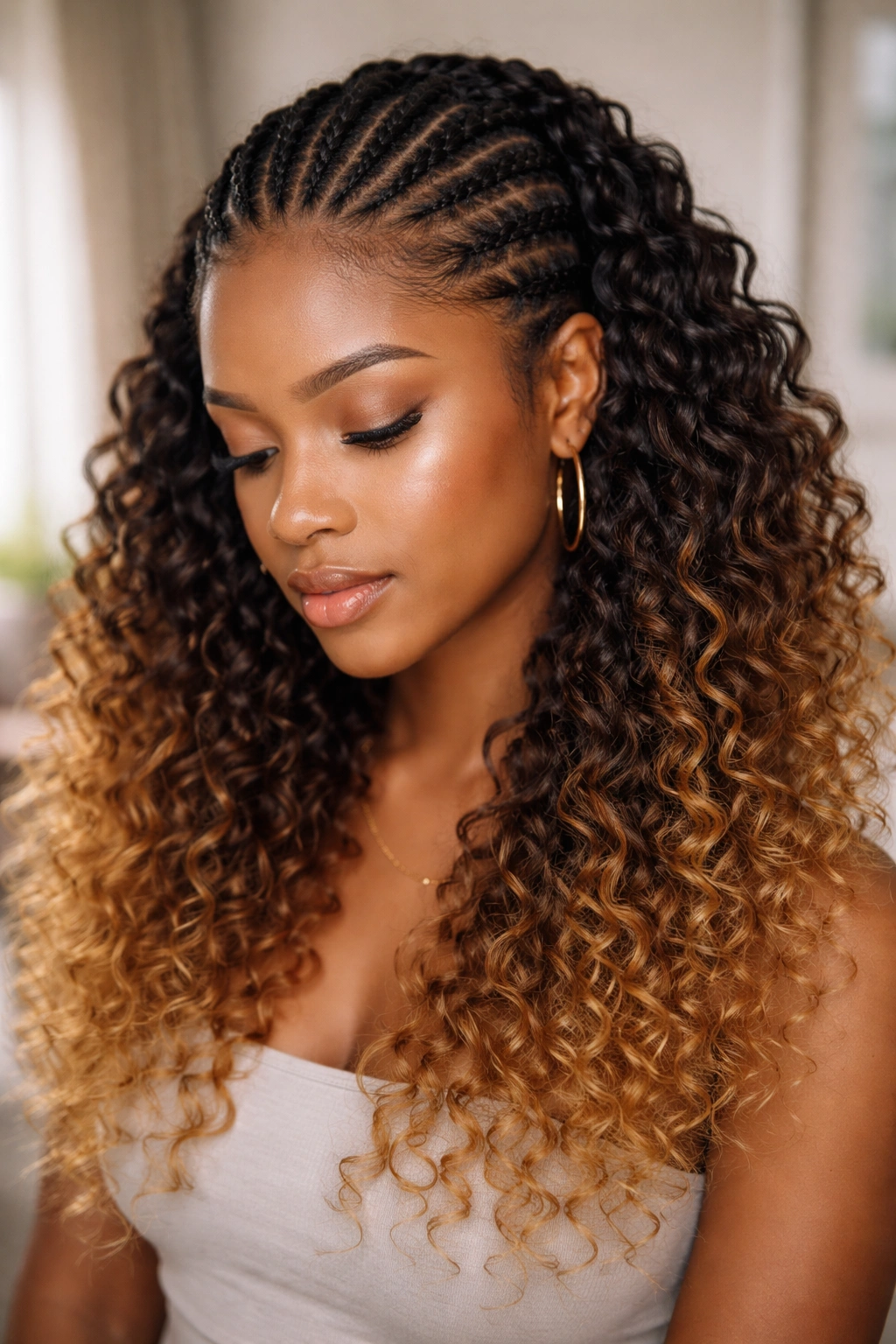
Cornrow base with ombre curly weave — dark at the roots, gradually lightening to honey or copper at the tips.
Ombre curly weave is striking because the color gradient follows the curl pattern. As the curls spiral downward, the color shifts, creating a layered color effect that solid colors can’t achieve.
Pre-made ombre bundles are available in most hair supply shops. Installation is the same as for solid-color weaves — no special technique needed.
11. Beach Wave Curly Weave for Casual Length
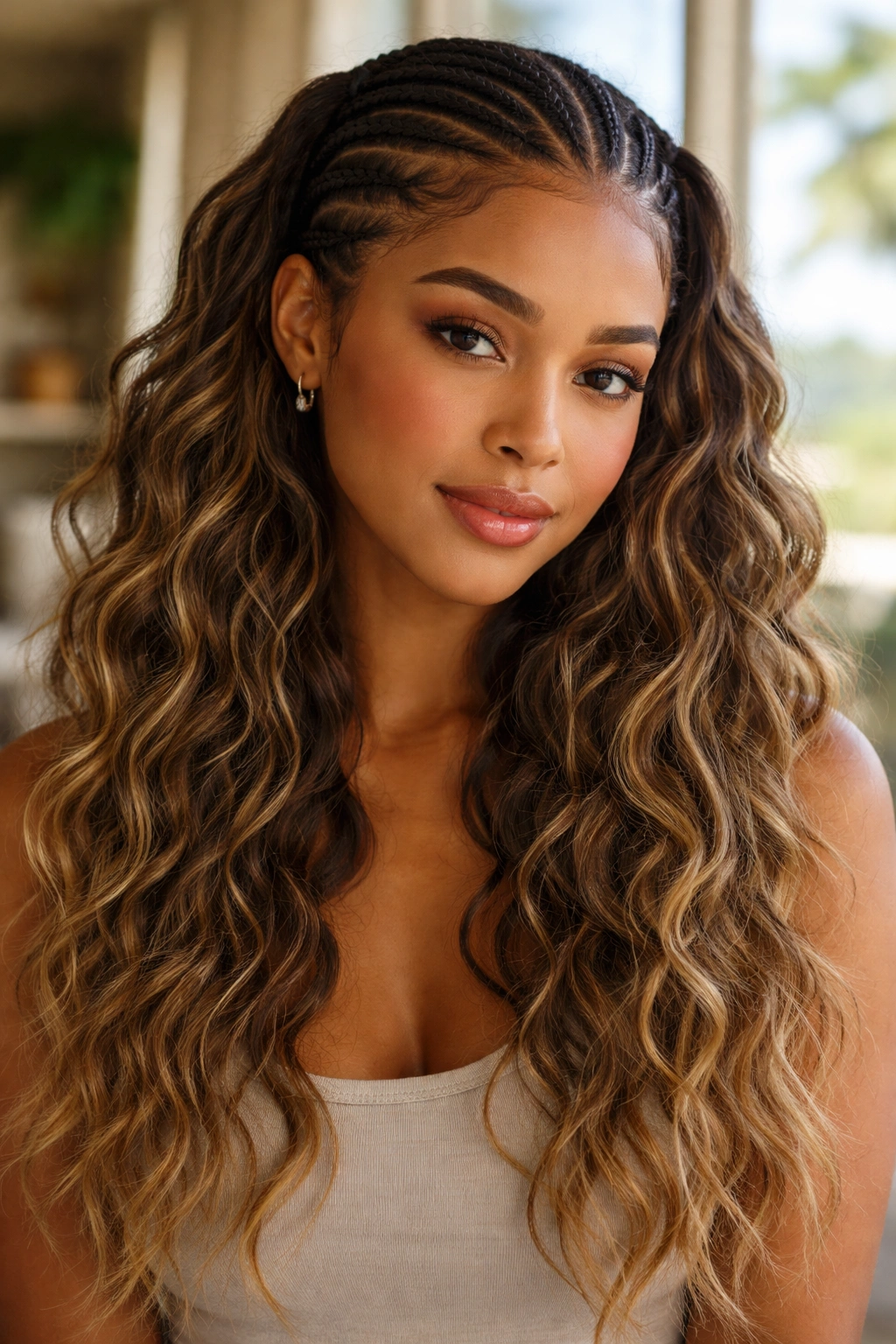
Cornrow base with beach wave weave (loose, tousled curls that look like sun-and-surf hair) installed for a casual, effortless look.
Beach waves are less defined than standard curly weave but more textured than straight wefts. The in-between quality reads as natural and unstudied, even though it requires the same install time as any other weave style.
Beach wave bundles are sometimes marketed as “body wave” or “loose wave” depending on the brand. Look for tag photos showing the wave pattern, not just written descriptions.
12. Voluminous Curly Weave With Big Hair Silhouette
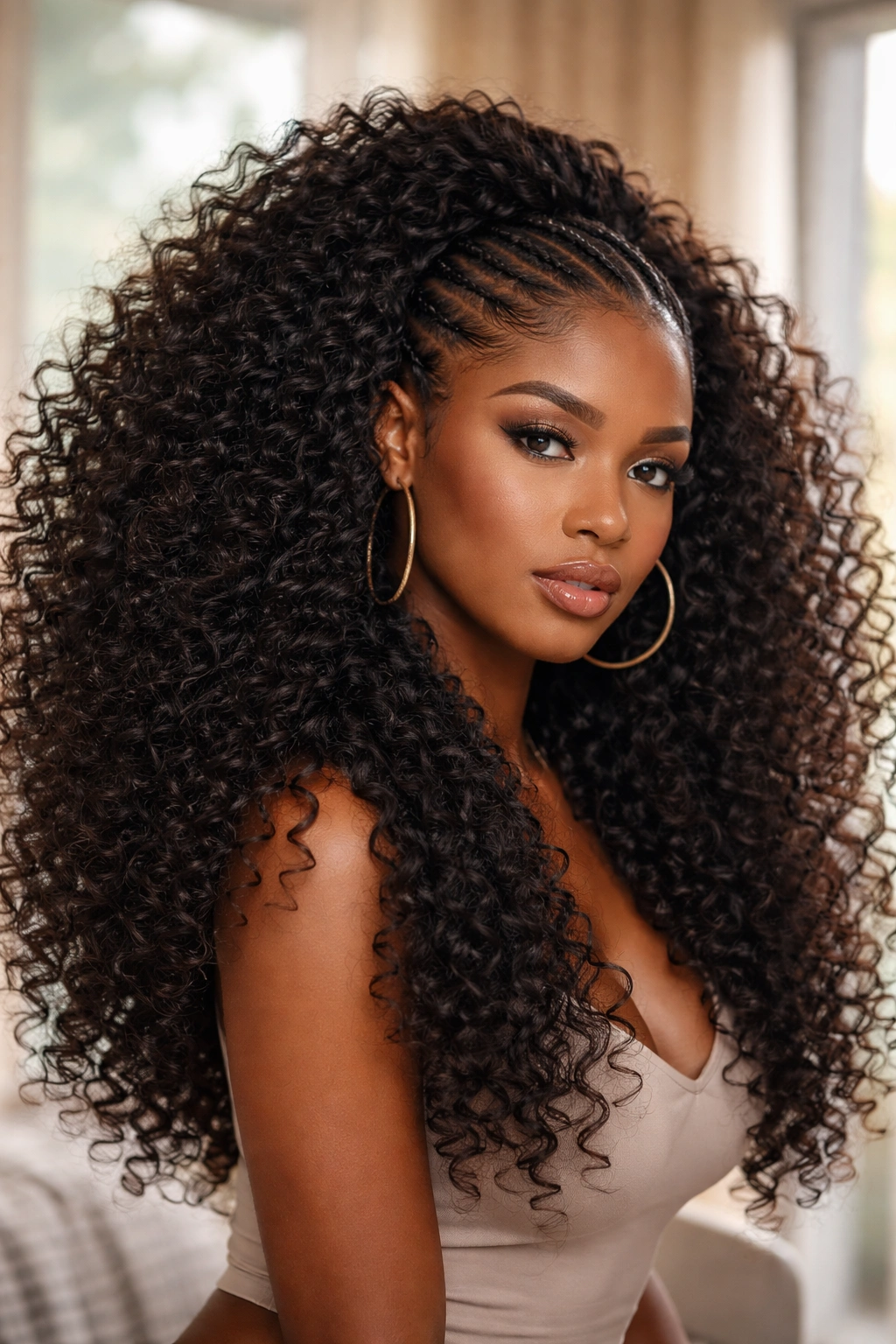
Cornrow base with multiple bundles of curly weave creating maximum volume — the kind of big, dramatic hair that takes up space in all directions.
Big curly hair is a confident styling choice. It requires 4-5 bundles for a full head and careful distribution so no section looks thin. The silhouette reads as bold, glamorous, and impossible to ignore.
Volume is built during installation through weft placement. Stack wefts closer together at the crown for height, and layer wefts beneath each other at the sides for width.
13. Kinky Curly Weave for Natural Texture Match
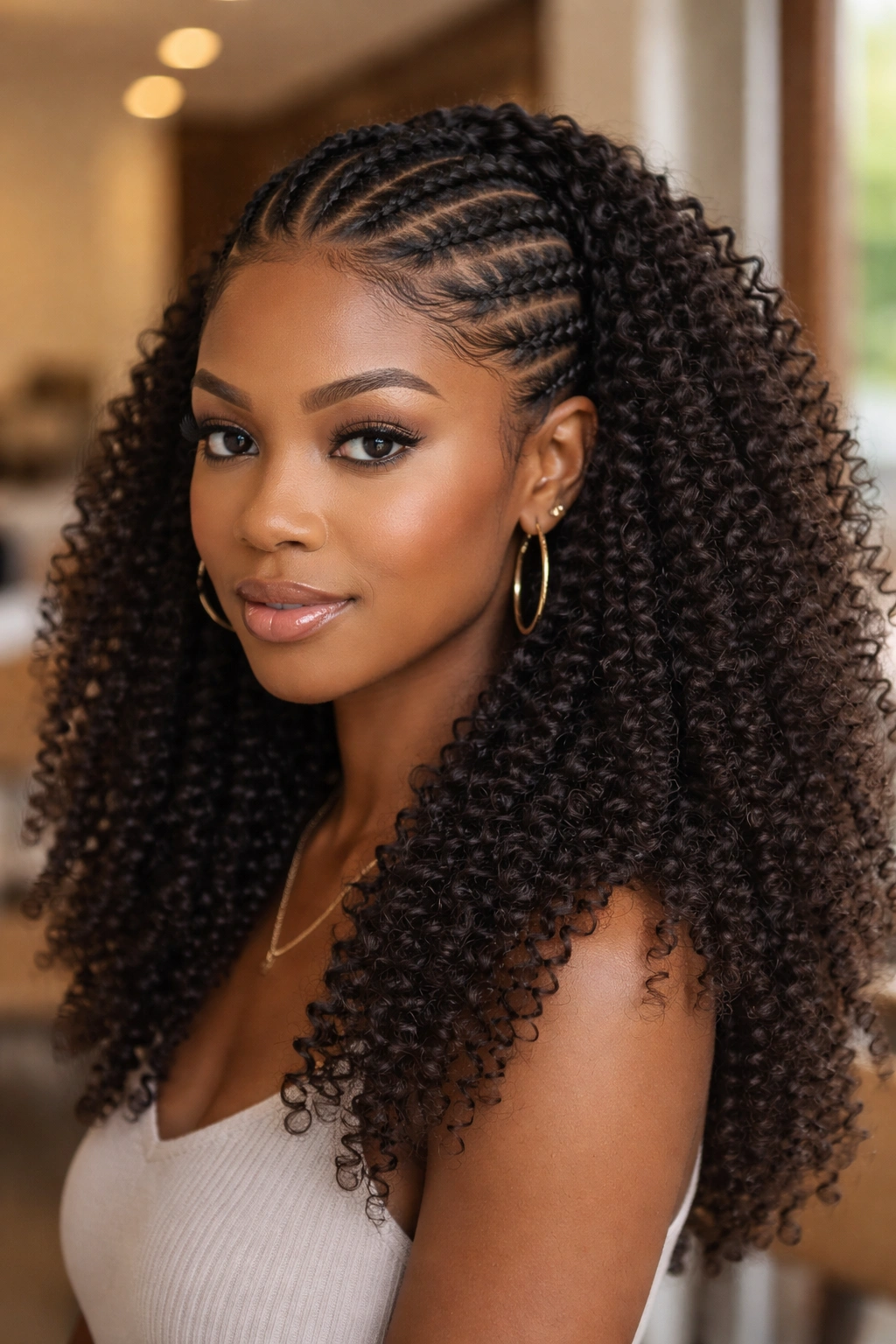
Cornrow base with kinky curly weave (tighter, 4A-4B-inspired curl pattern) for a look that matches or complements natural Black hair textures.
Kinky curly weave is the most natural-looking of the curly options. The tighter curl pattern mimics actual 4A-4B natural hair, which means the install blends seamlessly for wearers with those textures.
Kinky curly bundles tangle most aggressively of any curl type. Plan for daily detangling with a conditioning spray and wide-tooth comb to prevent matting.
14. Curly Weave With Highlighted Money Piece
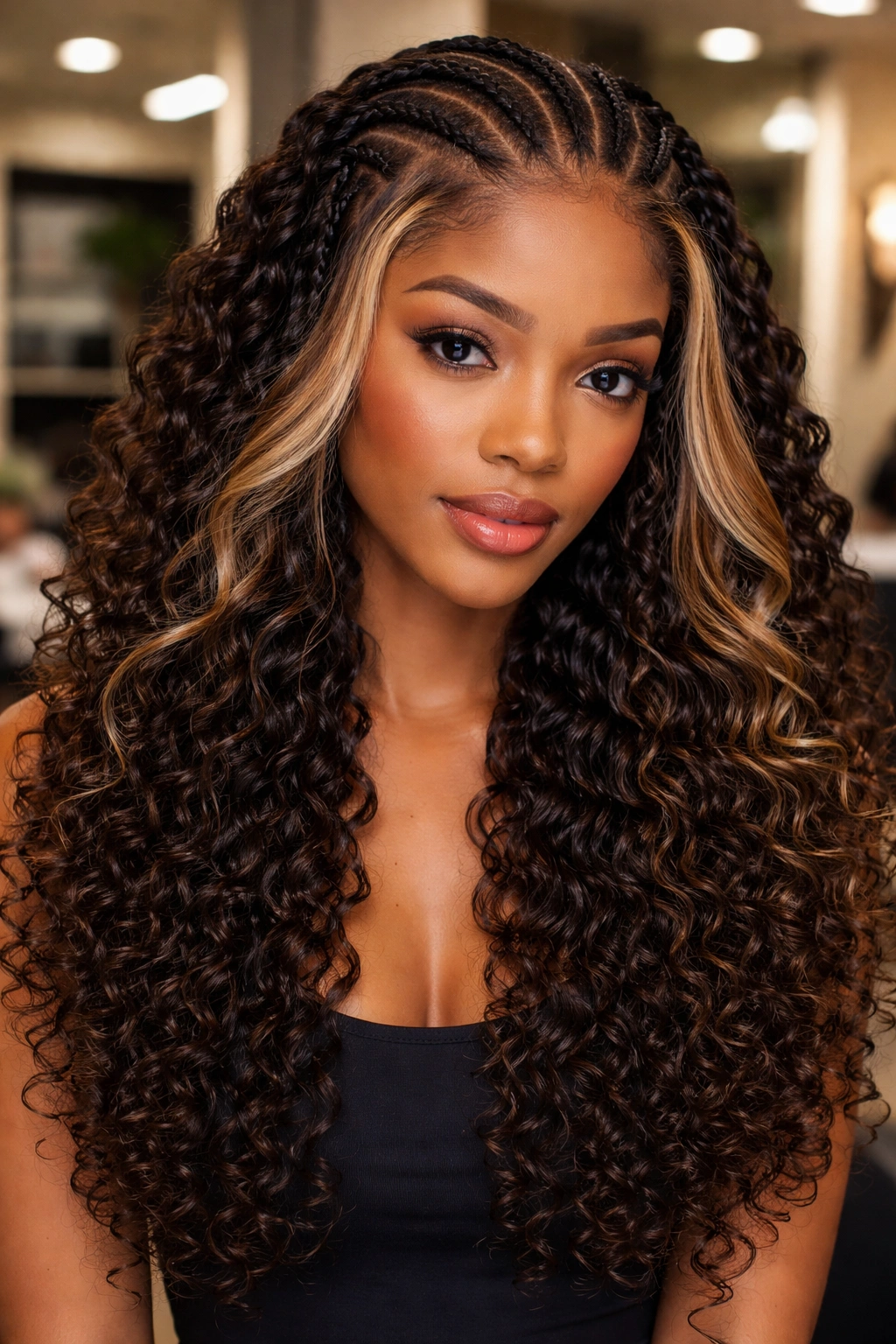
Cornrow base with standard curly weave throughout, except two highlighted bundles placed to frame the face (the “money piece” styling).
The money piece is a color technique borrowed from general hair styling. Bright highlights on either side of the face draw attention to the features and create a flattering frame.
Highlights should be noticeably lighter than the base color — blonde on black, honey on dark brown, caramel on medium brown. Subtle color differences disappear against curly weave.
15. Low Curly Ponytail With Cornrow Crown
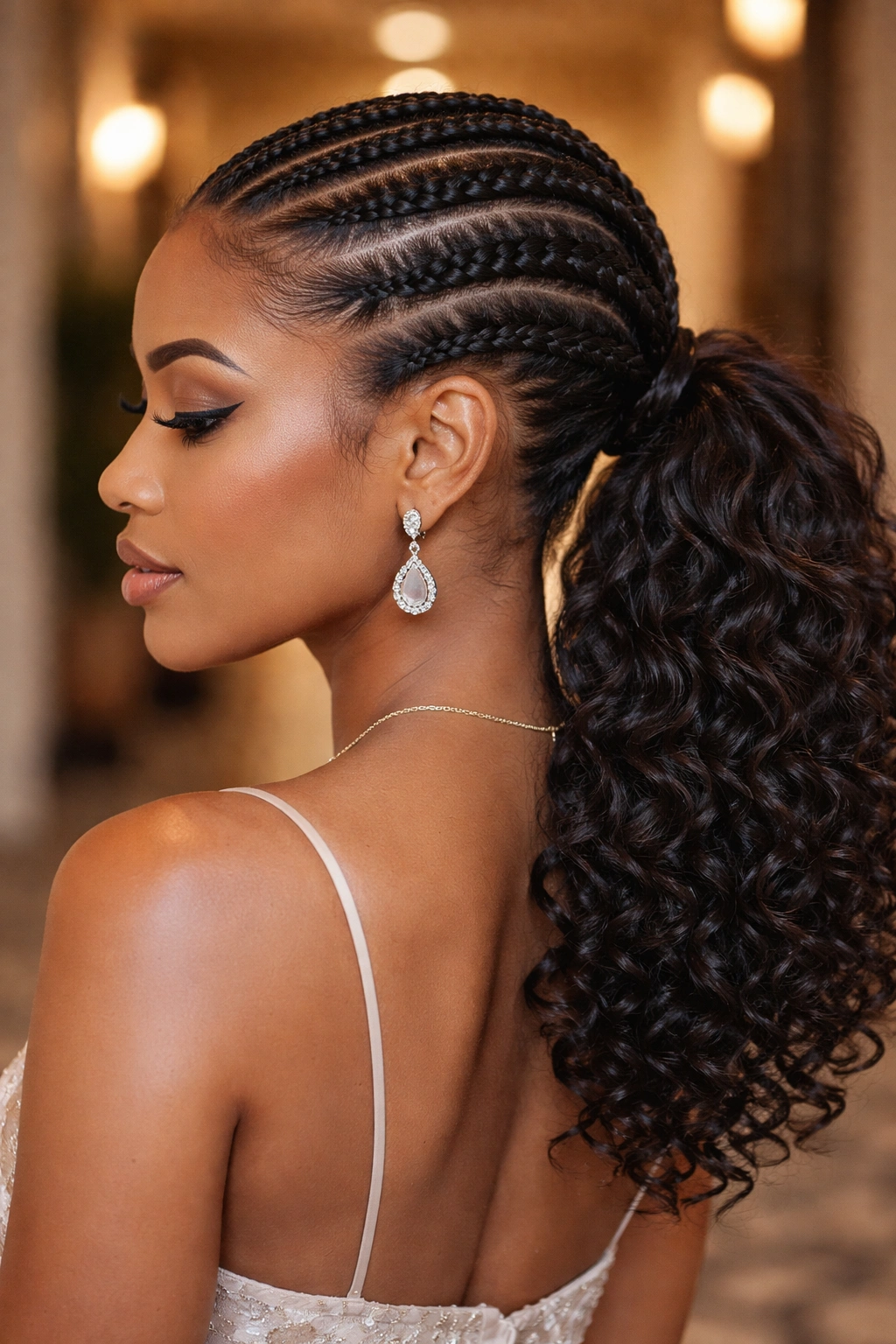
The top of the head features decorative cornrows; the bottom is curly weave gathered into a low ponytail at the nape.
The combination of top-visible cornrows and bottom-visible ponytail creates two focal points. Face-on, the cornrows dominate; from behind, the curly ponytail takes the stage.
This is a good style for environments where the front and back of your head get seen at different times — conferences with presentations, weddings with receptions, events with dancing.
16. Curly Weave With Red Bundle Accents
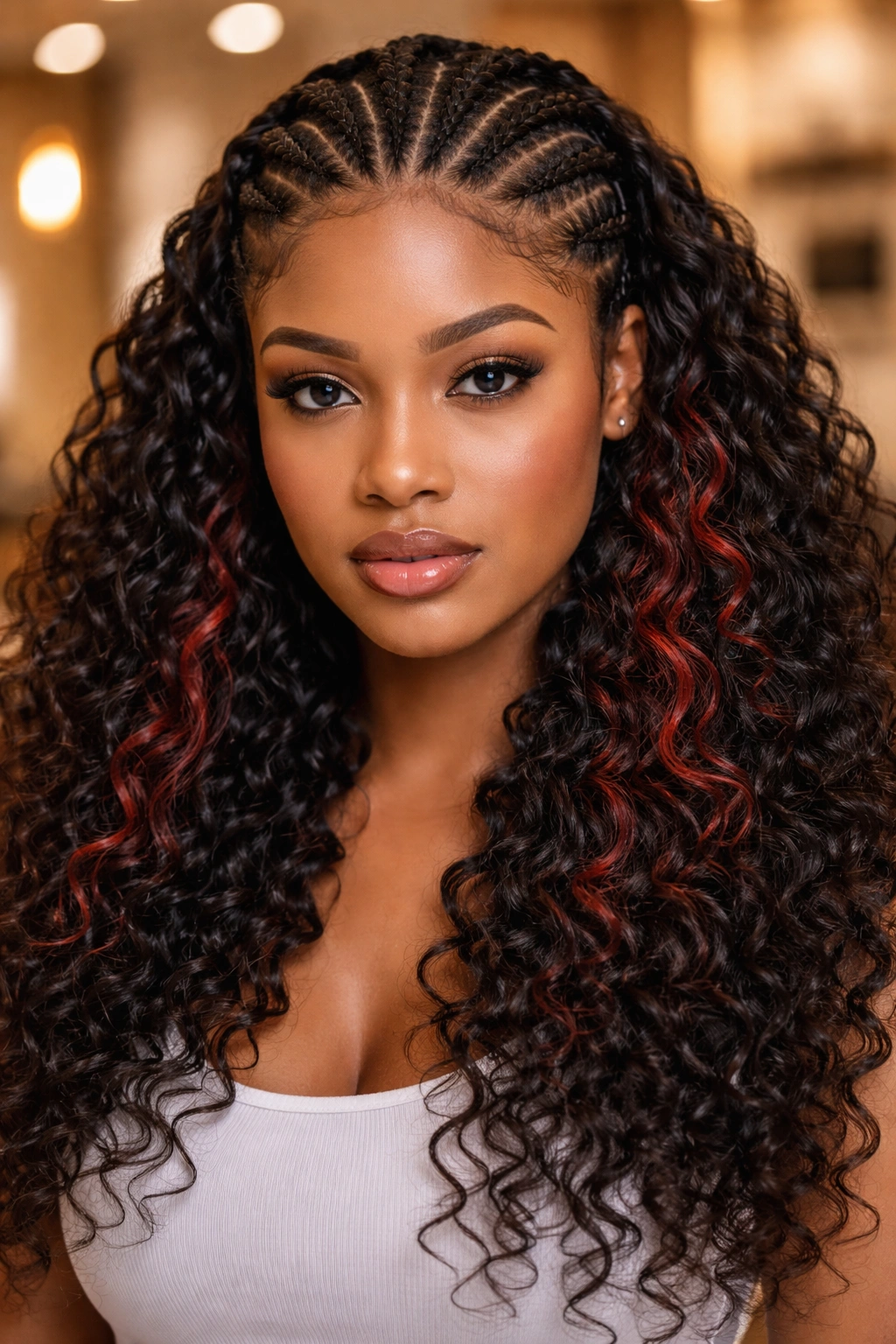
Cornrow base with primarily natural-color curly weave but 1-2 bundles of red or copper weave mixed in for subtle color interest.
The single-color-accent approach is lower commitment than full color installation. The red pieces show up strategically without dominating, and they can be removed in future installs if you tire of the color.
Place red accents where they’ll show best — around the face, at the crown, or in the layers at the shoulders. Hidden accents read as mistakes.
17. Bohemian Curly Weave With Loose Front Piece
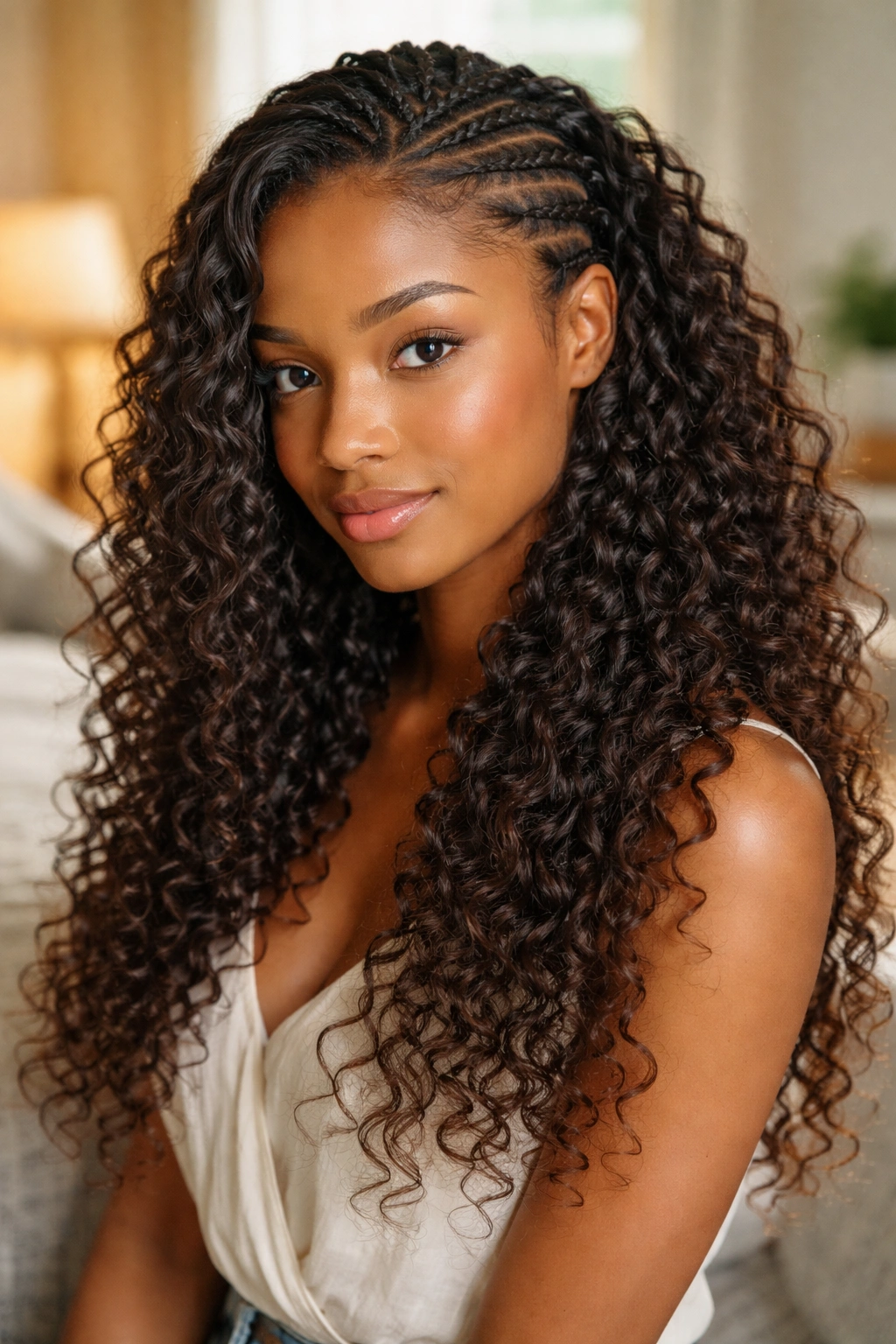
Cornrow base with curly weave, but a small section of natural hair at the very front is left out and blended loosely with the weave for a bohemian, undone look.
The loose front piece adds a softness that full-sew-in styles can lack. It reads as “real hair” because actual natural hair is visible, which makes the overall install seem more natural.
The front piece should be small — no more than 2 inches across. Larger leave-outs become harder to blend and can look like a separate section rather than integrated styling.
18. Curly Weave Updo for Formal Events
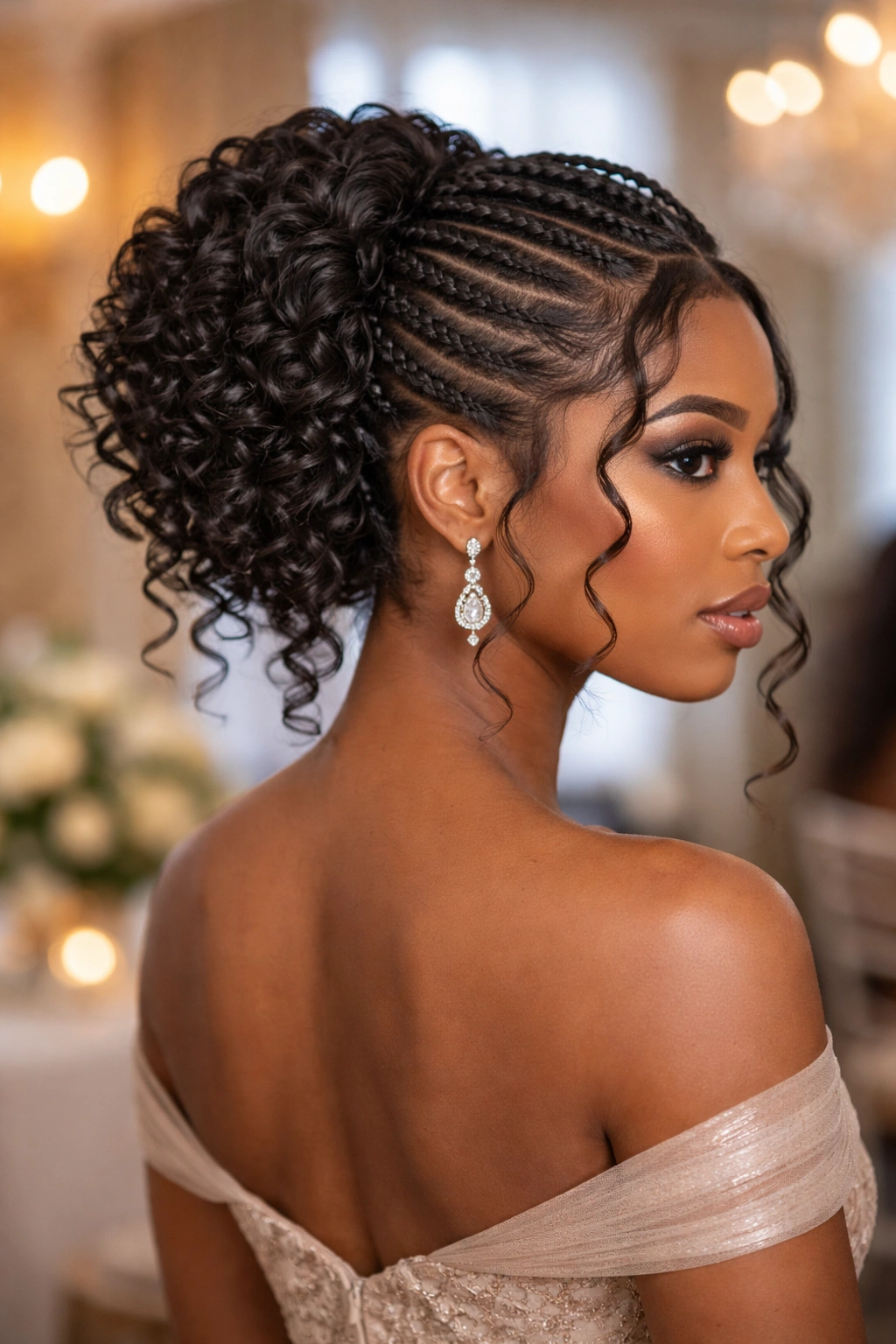
Full cornrow base with curly weave installed and styled into a formal updo — pinned curls gathered at the back of the head with some loose face-framing tendrils.
Curly weave makes exceptional updos because the curls have built-in volume and shape. Pinning and arranging curls is easier than trying to build an updo from straight hair.
For formal events, use bobby pins matched to the weave color and finishing spray to set the style. A light misting of hairspray holds the curls in place without making them crunchy.
19. Curly Weave With Half-Bun Top Section
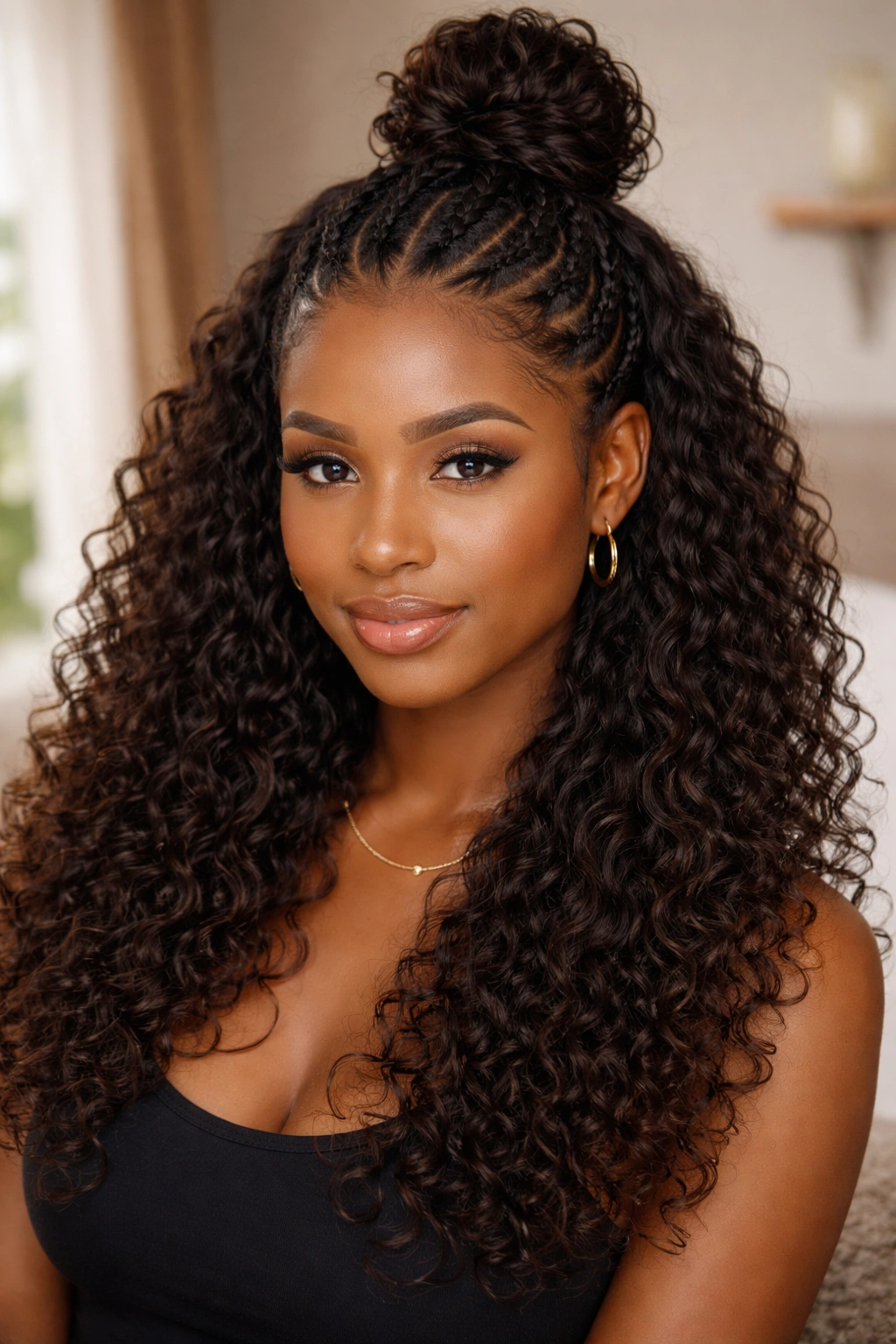
Cornrow base with curly weave covering the head; the top section is pulled into a half-bun while the bottom half falls in loose curls.
The half-bun is a casual alternative to a full updo. It shows off both the curl pattern and the overall volume while keeping the bulk of the hair off the face.
Half-buns look best when they’re not perfectly neat. A slightly messy, pulled-forward bun reads as effortlessly stylish; a tight, precise bun can look overdone.
20. Curly Weave With Hidden Cornrow Base Using Deep Part
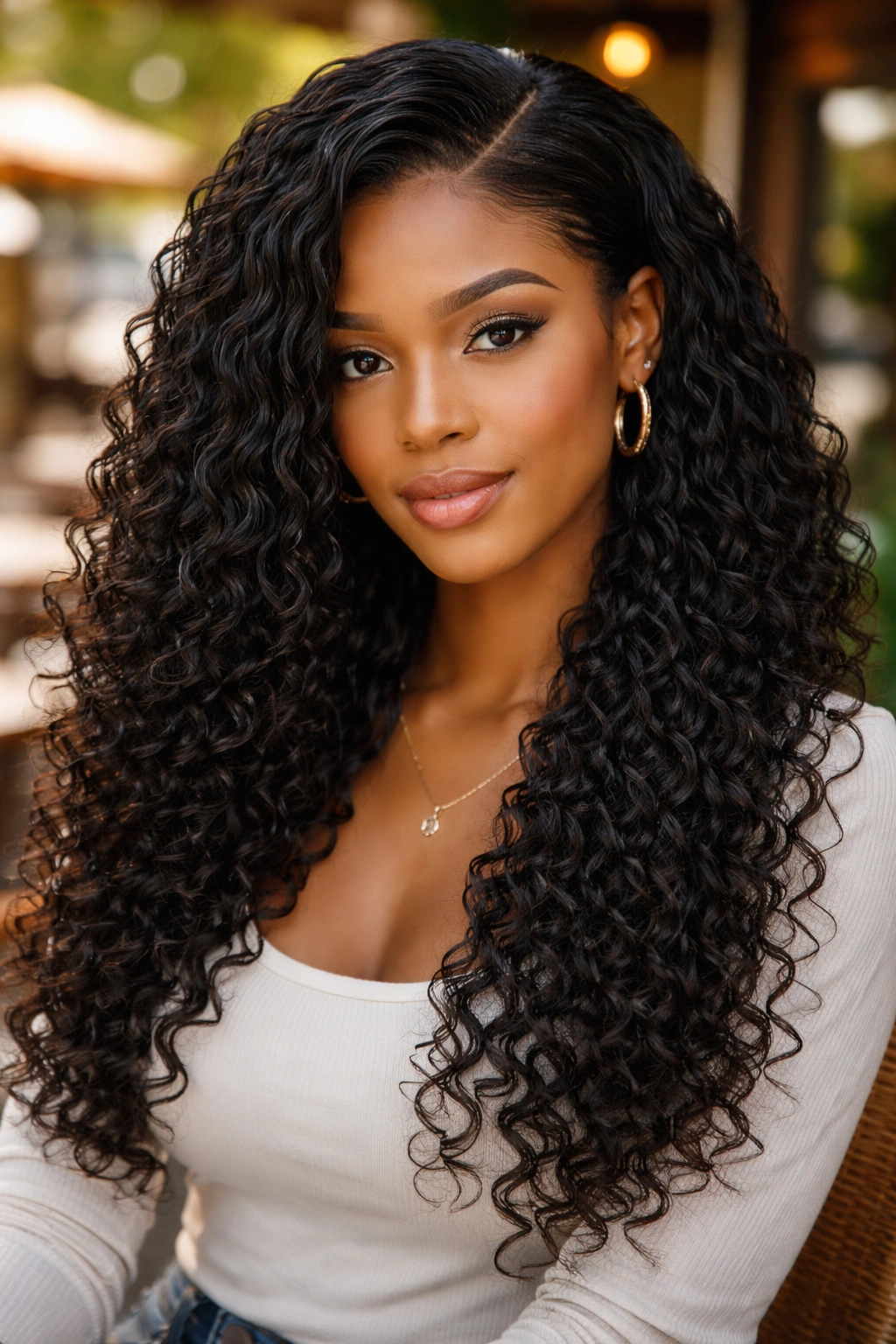
Cornrow base hidden by a deep part placement that shifts to expose only sewn-in weave — no braiding visible from most angles.
The deep part technique is a styling trick that hides the cornrow base from casual view. By parting the weave to fall over the cornrow edges, you create the illusion of a full head of curly hair without seeing the braids.
Works best with longer, fuller weaves that can drape to cover the sections where cornrows meet weft seams. Shorter styles show the base more easily.
Maintenance Notes
- The covered cornrows still need scalp oil every few days — use a thin-nozzle applicator
- Washing is slightly harder because you can’t access the braids directly
- Sleep in a silk bonnet to prevent the curly weave from separating and revealing the base
21. Textured Layered Curly Weave for Movement
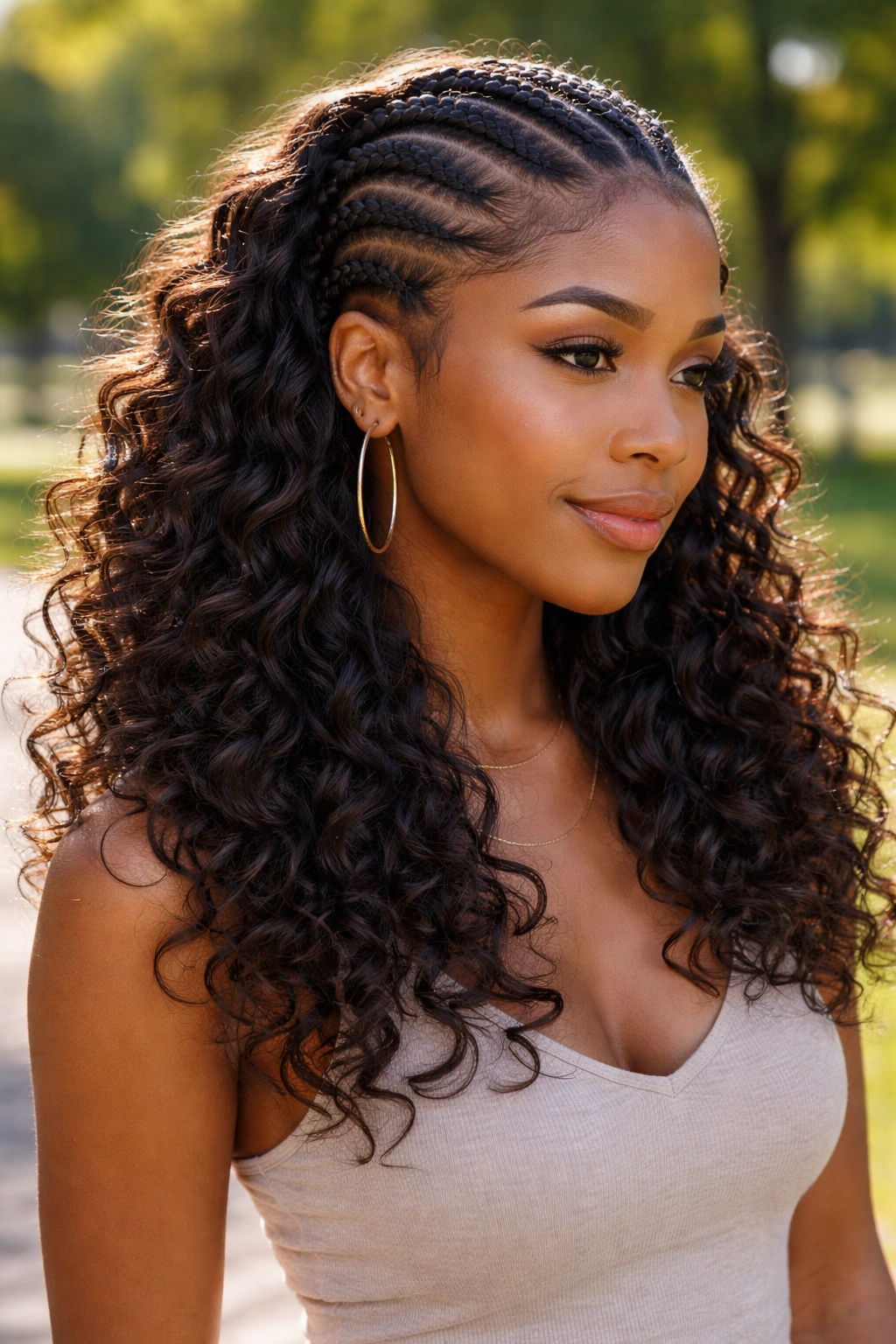
Cornrow base with curly weave cut into multiple strategic layers throughout, creating visible movement and dimension as the curls bounce differently at different lengths.
Layered curly weave is more interesting visually than uniform-length curls because the shorter layers spring back differently than longer ones. The result reads as naturally textured rather than uniformly styled.
Cut layers dry after installation, never wet. Curls shrink when wet and expand when dry, so wet cuts lead to unexpectedly short layers when the curls return to their natural length.
22. Minimalist Curly Weave With Defined Cornrow Crown
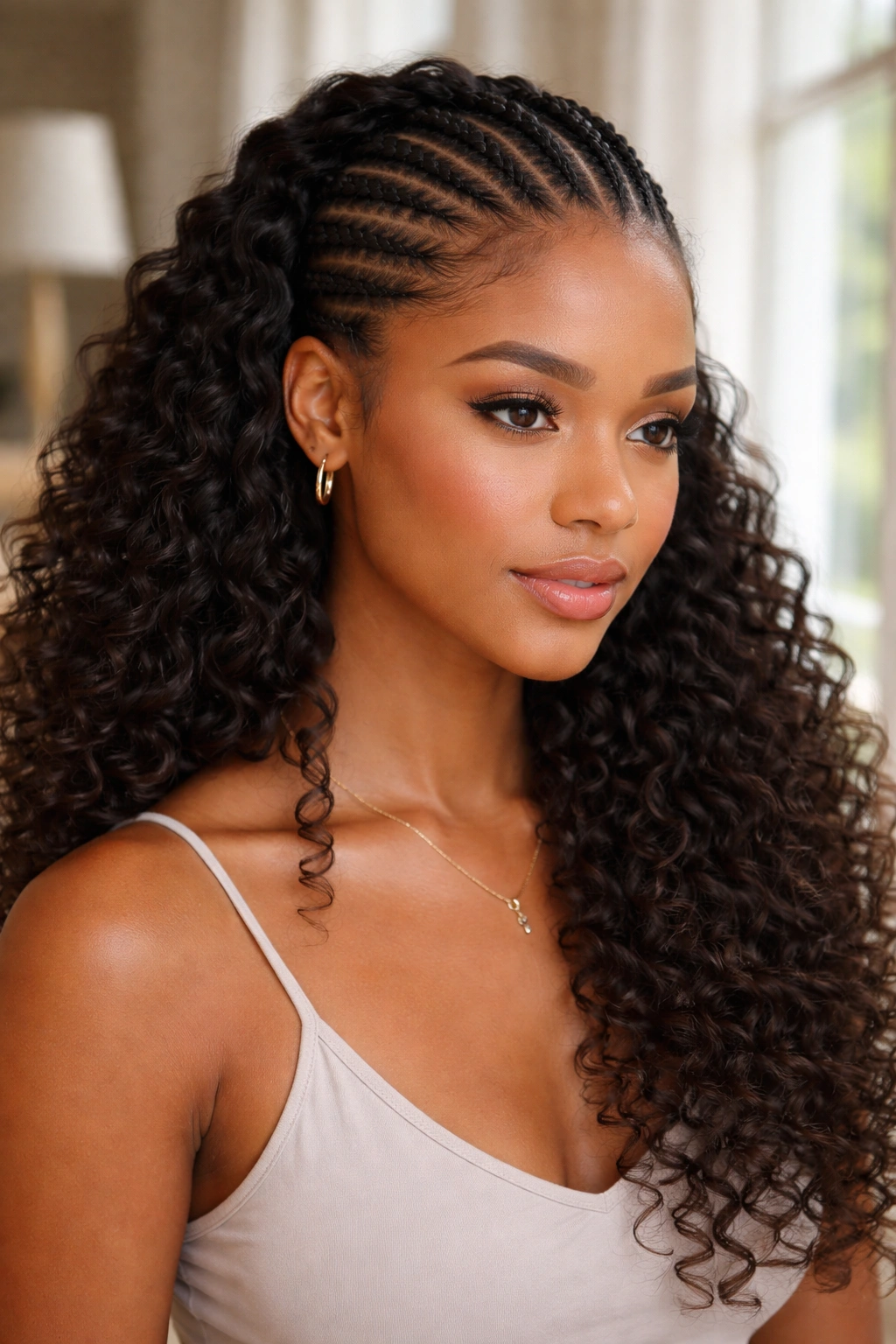
Clean cornrow pattern visible at the crown (a few decorative rows), with simple unlayered curly weave falling from the back of the cornrow section.
This minimalist approach treats the cornrows as intentional styling rather than hidden base. The visible braids at the crown become a design feature; the curly weave below provides length and movement.
The cornrow section should be small — 3-5 decorative rows at most — so it reads as an accent rather than a divided zone. Larger cornrow sections compete with the weave for visual attention.
Maintenance Routine for Curly Weave Longevity
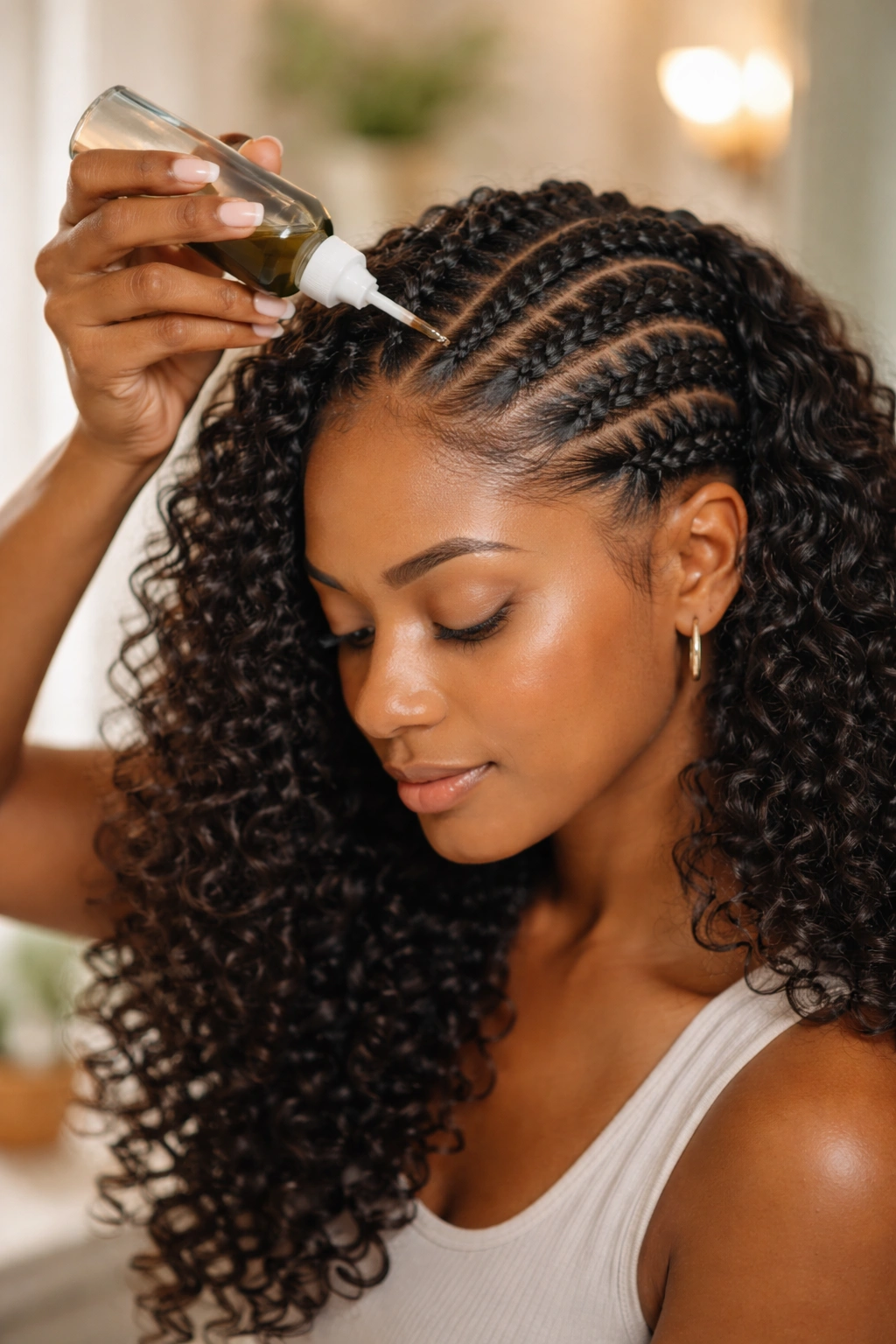
Curly weave styles last 6-10 weeks with proper care. Here’s what the maintenance looks like through that window:
- Daily: Gently finger-detangle or comb with wide-tooth comb, focusing on the lengths not the roots
- Every 2-3 days: Mist curls with a water-conditioner spray to maintain hydration and shape
- Weekly: Apply scalp oil along the part lines using a thin-nozzle applicator bottle
- Every 2 weeks: Wash the scalp with diluted shampoo, being careful not to over-wet the weave
- As needed: Apply curl-defining cream to refresh curl pattern after sleeping or humidity
Curly weave responds to moisture but also gets weighed down by too much product. Find the balance by testing small sections first before applying anything to the whole head.
Washing Cornrow-Base Curly Weave Installs
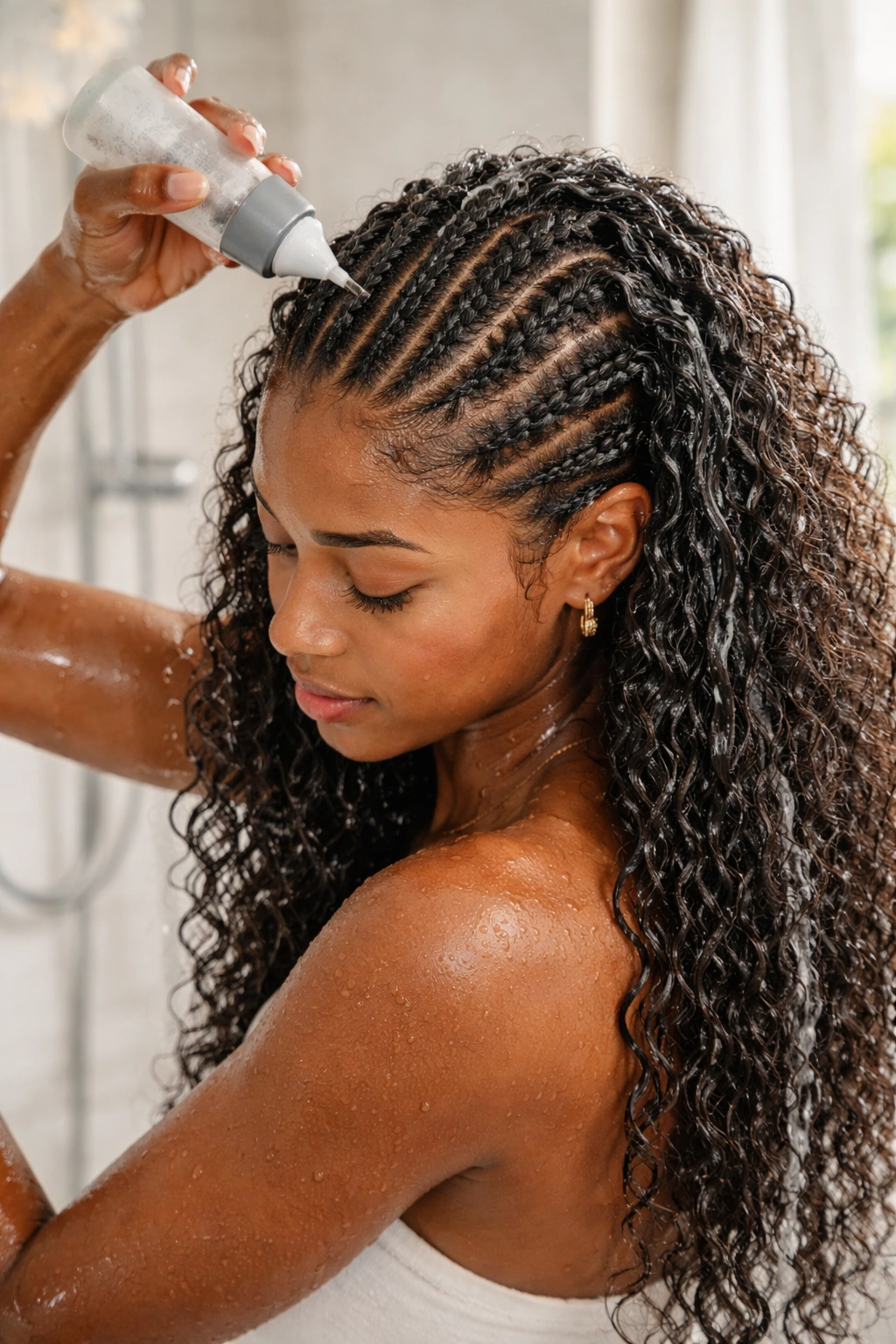
Washing is more complicated than for standalone cornrows. The weave needs water and conditioner to maintain curls, but the cornrow base under the weave can develop scalp issues if overwet.
Approach: Section the weave into 4-6 parts. Apply diluted shampoo to the scalp through the sections using a thin-nozzle bottle. Gently massage with fingertips. Rinse section by section with a handheld shower head, letting water run through rather than scrubbing.
Apply conditioner to the weave lengths (not the scalp). Let sit 3-5 minutes. Rinse thoroughly. Pat dry with a microfiber towel. Air dry as much as possible, with a hooded dryer on low for final drying if needed.
The whole wash cycle takes about 2 hours. Budget accordingly.
Refreshing Curls Mid-Wear
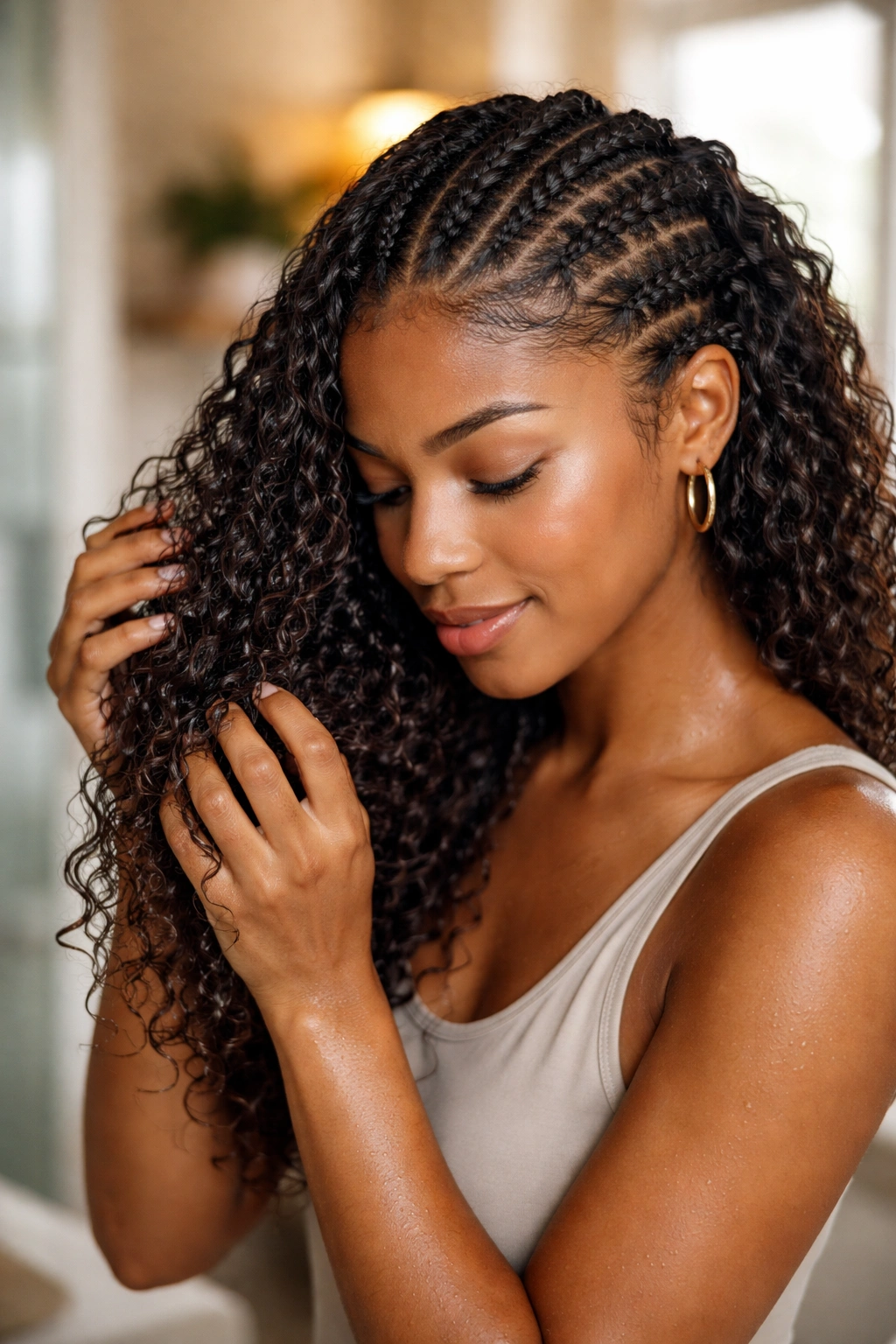
Curls flatten over time from sleeping, friction, and general daily wear. Refresh them weekly by:
- Misting the weave with a water-conditioner spray until damp but not soaked
- Scrunching the curls upward with hands to encourage spring-back
- Applying a small amount of curl-defining cream or mousse
- Letting air dry without touching
Fresh curls last 3-5 days depending on weather and activity level. Humid environments stretch the time; dry environments shorten it.
Taking Down Curly Weave Without Damage
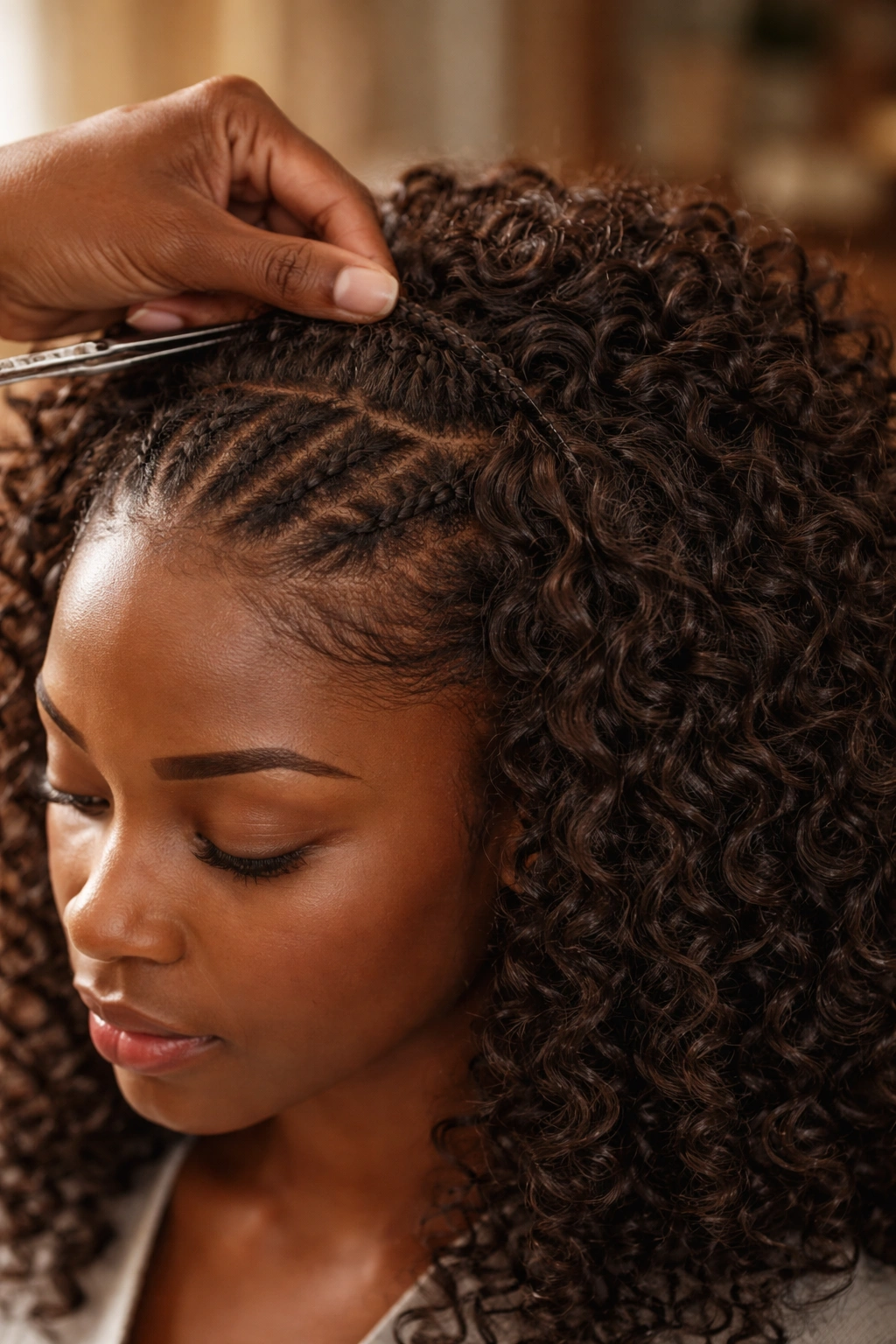
The takedown process is reversed installation:
- Cut the sewing thread at multiple points along each weft (don’t pull thread through long stretches)
- Gently lift each weft from the cornrow base
- Remove all wefts before unbraiding the cornrows
- Unbraid each cornrow slowly from tip to root
- Spray detangling conditioner as you unbraid
Full takedown of a curly weave install takes 2-3 hours. Don’t rush — cutting corners causes tangling that takes even longer to resolve.
After takedown, deep condition your natural hair before washing. The long install can dry out hair, and a conditioning mask restores moisture before the cleansing process.
Picking Curly Weave Styles for Your Life
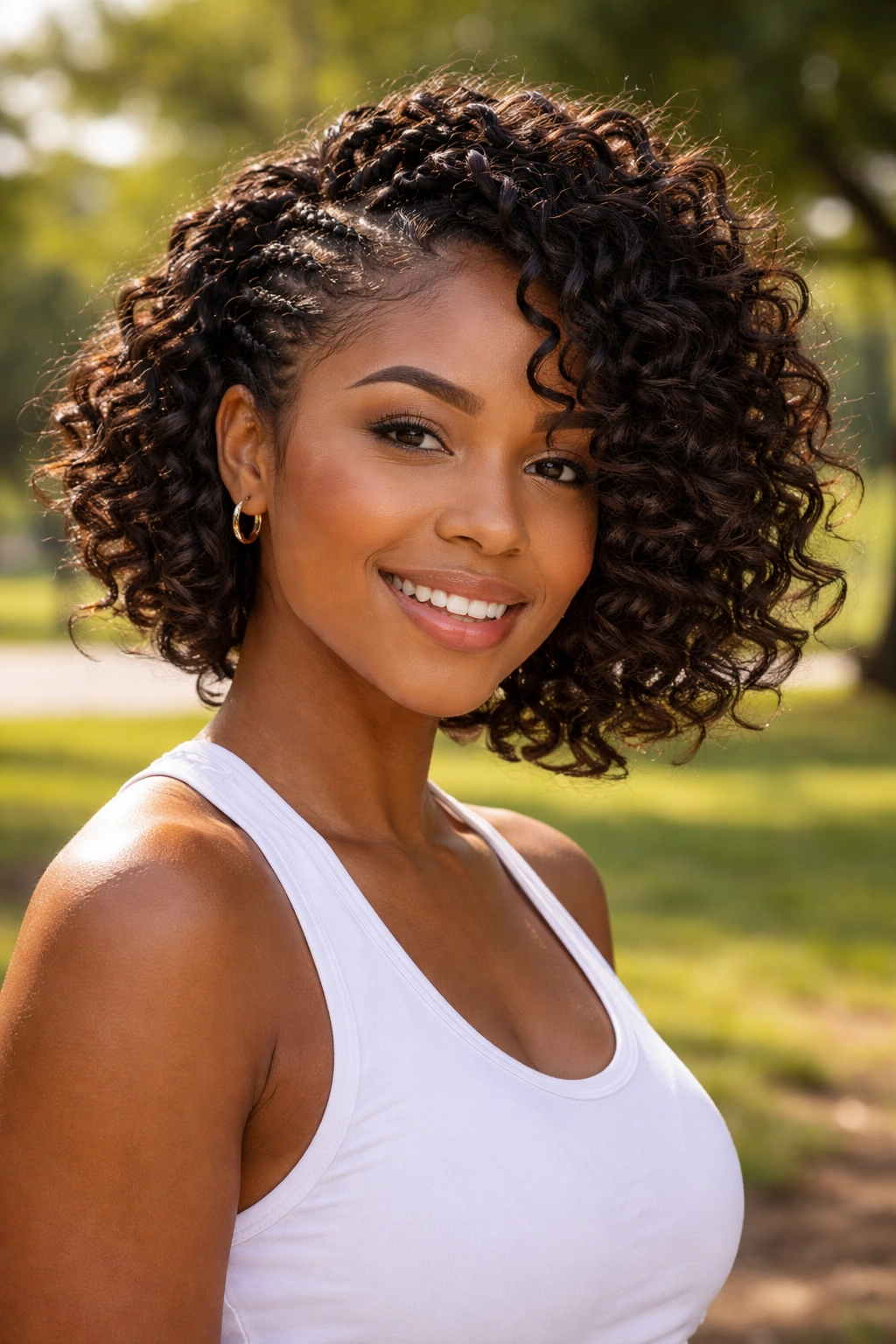
Curly weave cornrow styles work best when matched to your routine and environment:
- Active lifestyle: Shorter, layered curly bobs that dry faster and tangle less
- Formal environment: Structured curly updos or sleek center-parted styles
- Creative or casual: Bohemian loose curls, beach waves, or voluminous big hair
- Minimal maintenance: Simple sewn-in styles with clean parts and no elaborate styling
The curl pattern is also climate-dependent. Tight curls hold up better in humidity. Loose waves frizz in damp air. If you live somewhere humid, lean toward defined curls rather than loose waves.
Common Mistakes With Curly Weave Cornrow Styles
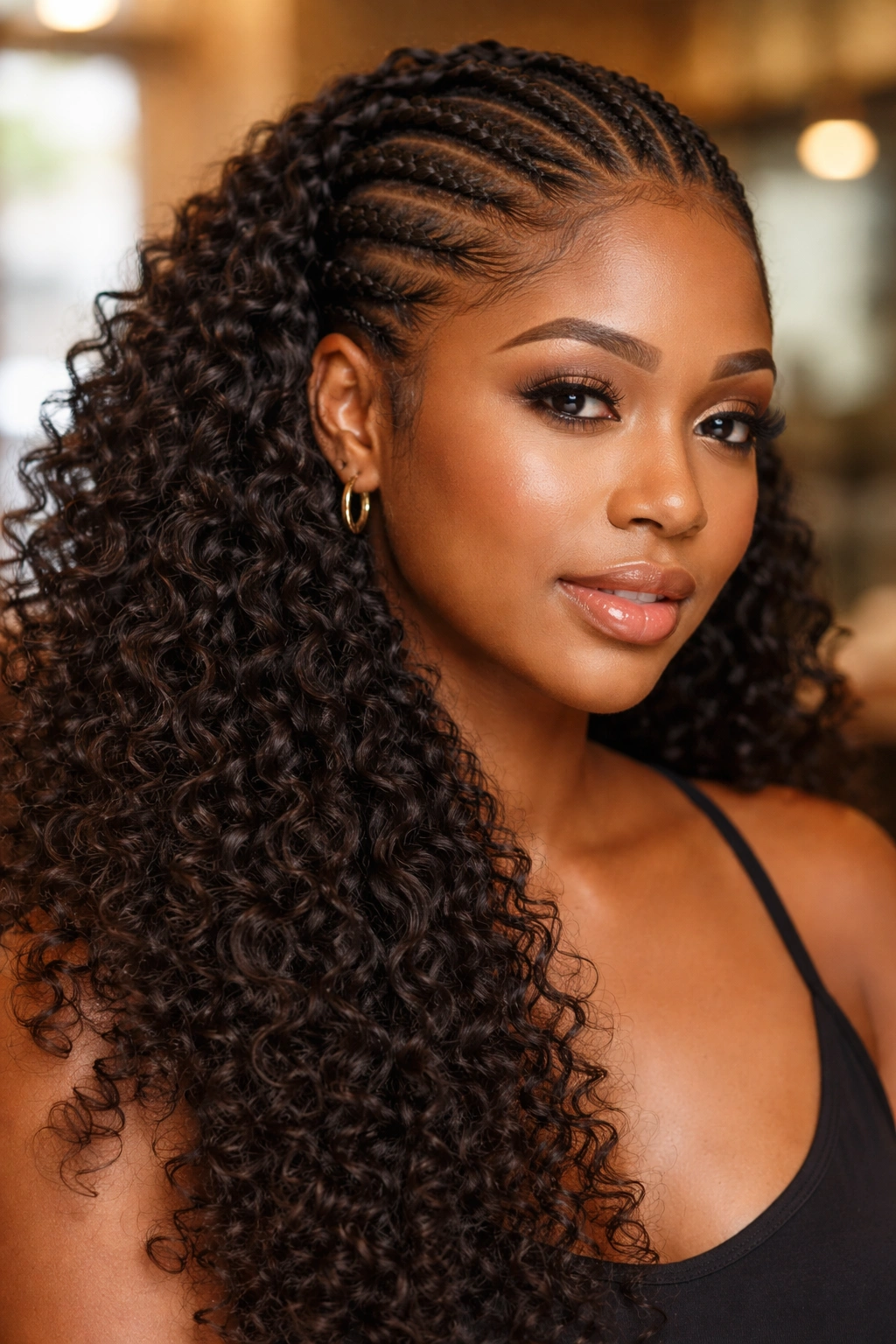
The biggest mistakes are: choosing cheap weave, skipping the co-wash before install, and over-styling the curls during daily wear.
Cheap weave looks cheap by day three. The shine is wrong, the curls don’t hold, and the shedding is constant. Investing in premium bundles pays off in both appearance and wear time.
Skipping the co-wash means the factory coating remains on the weave, which causes the curls to fall flat quickly and the hair to feel stiff. Thirty minutes of pre-install prep saves weeks of disappointment.
Over-styling — constantly touching, scrunching, combing, brushing — destroys curl pattern over time. Touch the weave less, not more. Daily detangling is necessary; constant manipulation is counterproductive.
One more point. Curly weave feels different to wear than cornrows alone. The volume is bigger, the movement is different, and you’ll catch glimpses of curls in your peripheral vision that take getting used to. Give yourself a few days to adjust before deciding whether you like the style. Many people love it by week two even if they weren’t sure on day one.