



Feed-in cornrows with beads pull off something most braid styles can’t. They give you the clean, natural-looking gradient of feed-in braiding — where synthetic hair is added gradually rather than tied on at the base — combined with the movement, sound, and visual texture that beads bring to every strand. The result is a style that reads as both modern and rooted, technical and decorative at the same time.
Feed-ins alone look polished. Beads alone add personality. Together, they create a style that feels finished without feeling fussy. You get the seamless fullness at the back of the head where the synthetic hair blends into the cornrows, plus the sound and movement of beads clicking gently as you walk. It’s intentional hair. Styled hair. Hair that took time and shows it.
The execution, though, matters. Feed-in technique is harder to do well than standard cornrows. Bead placement is easy to overdo. Poor beads cause tension, poor feed-ins cause visible lumps, and both together can sink a style that should have looked stunning. Here’s how to plan feed-in cornrows with beads properly, plus 22 distinct versions across every mood and occasion.
What Feed-In Actually Means
Feed-in cornrows aren’t just cornrows with extensions. The technique itself is different.
In standard cornrow-with-extension work, the braider attaches a bundle of synthetic hair at the base of your natural hair with a knot, then braids the bundle into the cornrow. The attachment point is visible as a small lump or knot — usually at the hairline — that never fully disappears.
In feed-in cornrows, the synthetic hair is added gradually as the braid progresses. Small amounts are fed into the braid every few inches, so the cornrow starts narrow at the hairline and thickens gradually. There’s no single knot — just a smooth, progressive blend that looks natural.
This is why feed-in braiding takes longer and costs more. The technique is harder, the result is smoother, and the style reads as more refined.
Why Beads Work With Feed-Ins
Feed-in cornrows on their own can look too clean. The smooth gradient and even thickness can read as almost corporate — controlled to the point of feeling impersonal.
Beads fix that. They add texture, rhythm, and cultural weight. They introduce asymmetry and sound. They signal craftsmanship — someone chose these beads, placed these beads, threaded these beads by hand.
The combination creates a style that balances technical precision with personal expression. The feed-ins say “this is well-made.” The beads say “this is mine.”
Bead Choice Makes or Breaks the Look
Not all beads are equal for feed-in cornrows.
- Wooden beads add warmth and organic texture. Pair with earthy tones and natural fiber clothing. Won’t yellow over time.
- Brass and gold-tone beads create warm metallic accent. Photograph beautifully. Can tarnish if not maintained.
- Ceramic or clay beads offer artisan feel and unique coloring. Often handmade, so each looks slightly different.
- Glass beads catch light and come in endless colors. Can be heavier — choose carefully.
- Plastic beads are cheapest but look cheap. Avoid for any style meant to read polished.
Choose beads with holes large enough to thread on a cornrow plus a small wrapping of thread or rubber band beneath to hold them in place. A hole that’s too tight rips at the braid. A hole that’s too loose lets the bead slip off.
Planning Before the Install
Feed-in cornrows with beads need clear planning. Decisions you should make before sitting in the chair:
- How many cornrows total? (Fewer thicker, or more thinner?)
- What bead style — wooden, metal, or glass?
- Bead placement — at ends only, along the length, or scattered?
- How many beads per braid?
- Natural color or added synthetic color?
- Length when finished?
Bring photos. Show your stylist exactly what you want. Feed-in work has too much variation to leave decisions to chance.
Tools and Time Required
Feed-in cornrows with beads demand more than basic cornrow tools:
- Rat-tail comb with a fine needle tip for clean parting
- Pre-stretched braiding hair — X-Pression Pre-Stretched is the standard
- Beading threader (looks like a floss threader but bigger) for sliding beads on
- Small rubber bands in matching color to secure beads
- Edge control and brush
- Clips to hold sections
Time: expect 4-7 hours for a full head of feed-in cornrows, plus another 30-60 minutes for bead placement. More beads means more time.
1. Classic All-Back Feed-In Cornrows With Beads at the Ends
The entry point for the style. Six to eight feed-in cornrows running straight back across the head, with three to five wooden beads at the end of each braid.
Why It Works
The all-back pattern is universally flattering and easy to wear. The feed-in technique keeps the front looking natural. The beads at the ends provide classic accent without overwhelming the clean lines.
- Works for professional settings, casual wear, and everyday life
- Photographs well from every angle
- Beads can be changed out without redoing the cornrows
- Lasts 4-6 weeks with proper care
Tip: ask your stylist to secure each bead with a small rubber band underneath. Without the band, beads slide off as the style loosens. The rubber band adds seconds to install and weeks to bead retention.
2. Feed-In Stitch Braids With Beaded Sections
Stitch-braid pattern cornrows — with the signature horizontal ridges — done in feed-in technique, with beads threaded at the ridge points. Each ridge section gets a single bead, creating a dotted pattern down each braid.
The beads mark the stitches. What would be a subtle textural detail in plain stitch braids becomes an obvious decorative rhythm when beads are placed at each stitch.
Use smaller beads for this pattern. Three millimeters or so. Larger beads overwhelm the stitch detail instead of complementing it.
This is craftsmanship hair. It takes time, shows time, and rewards viewers who notice the precision.
3. Feed-In Cornrows With Beaded Center Part
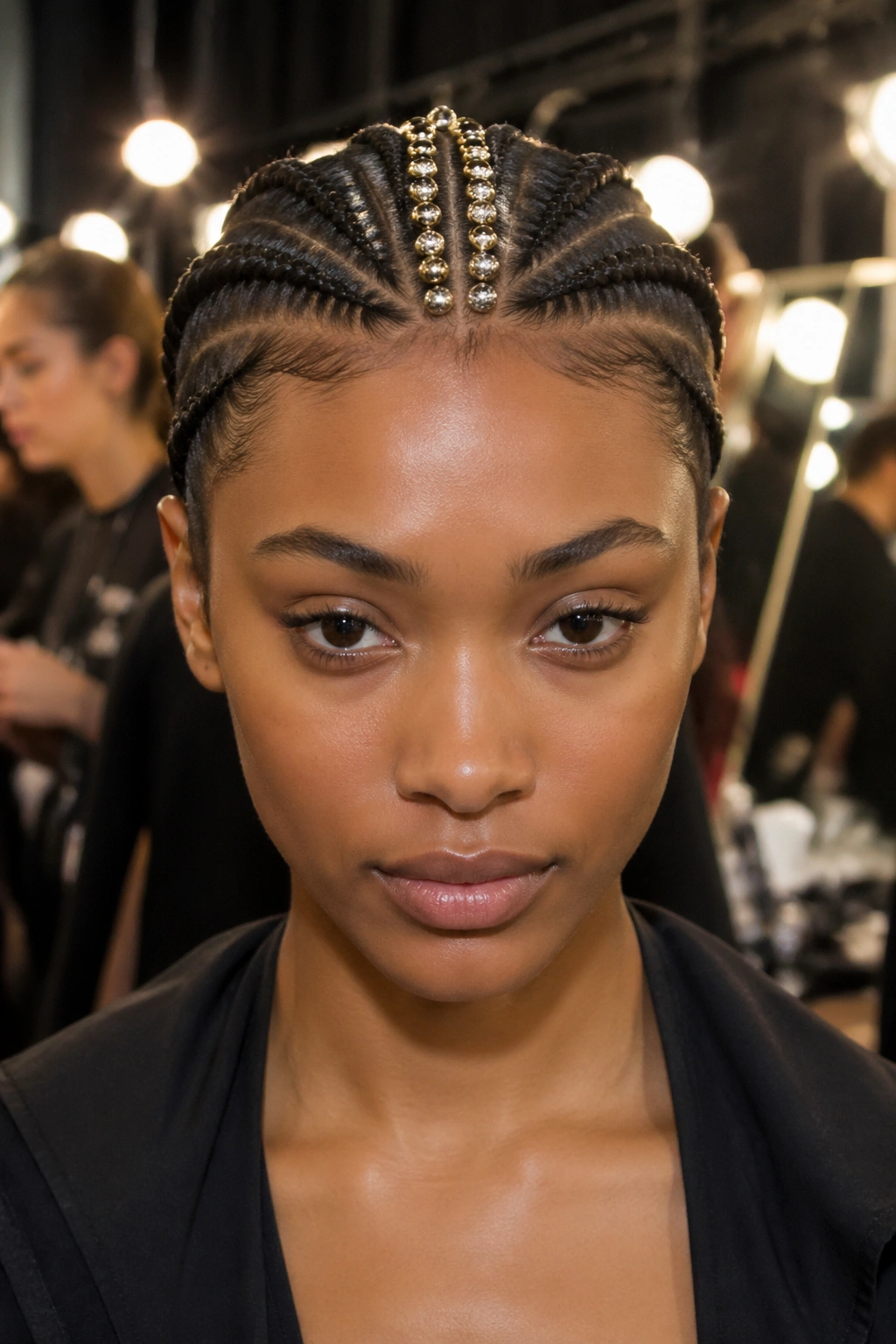
Two large feed-in cornrows on each side of a deep center part, with beads clustered at the part itself where the braids begin. The beads sit like a jeweled crown along the scalp.
The beaded part is distinctive. Most bead placement happens along the braid length or at the ends. Placing beads right at the parting creates a focal point at the top of the head instead.
Choose beads with some sparkle for this version. Glass beads with metallic finishes work well. The beads sit in direct light at the crown, so reflective materials show off.
Best for events and occasions where people will see the top of your head — photo days, seated events, stages. Not ideal for situations where you’ll be the shortest person in the room, since the beaded part needs to be visible.
4. Boho Feed-In Cornrows With Scattered Beads
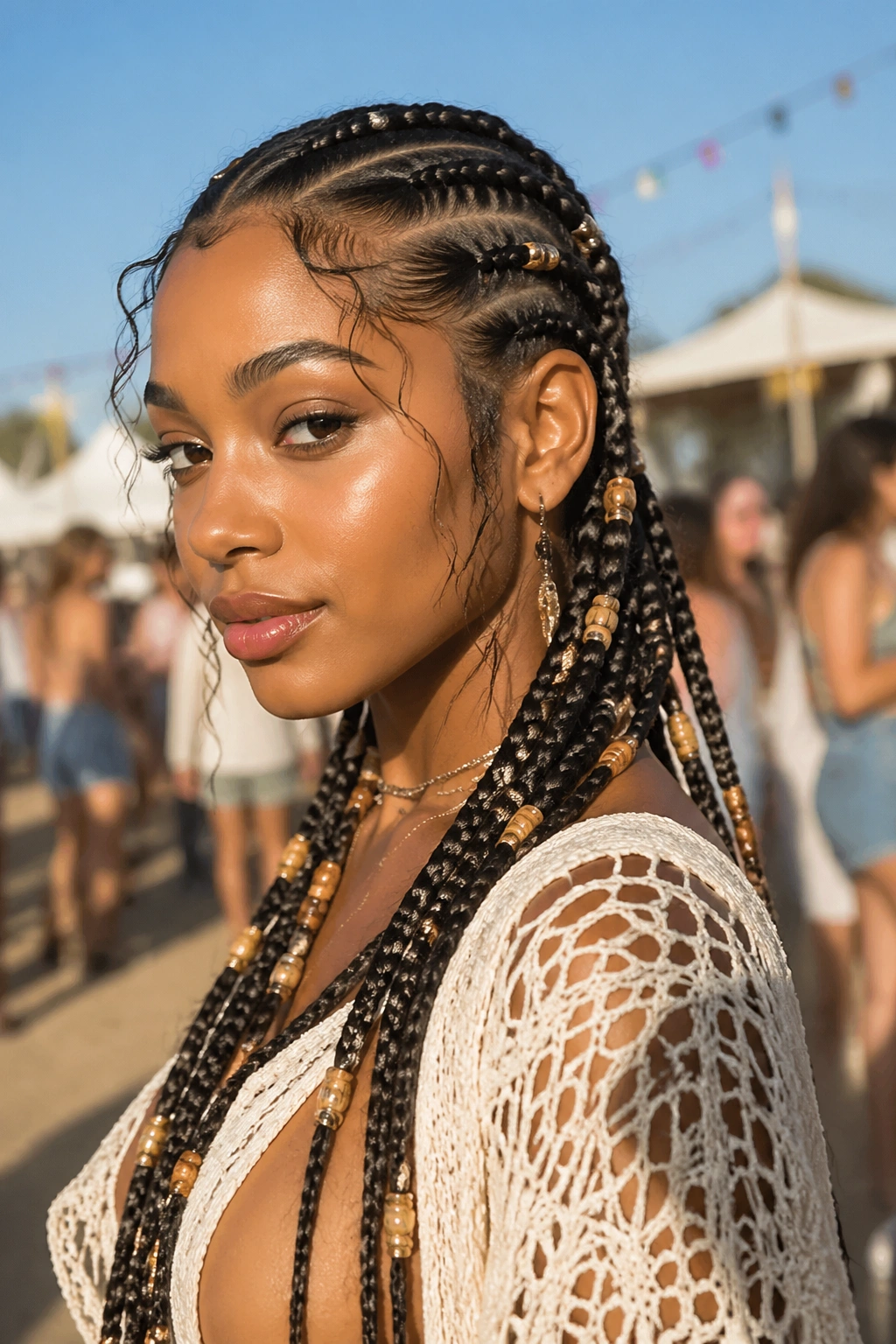
Four to six feed-in cornrows braided slightly loose, with beads scattered irregularly along the braid length rather than grouped at the ends. A few tendrils are pulled out at the temples for softness.
Beads scattered randomly — not in patterns, not clustered — give the style a lived-in quality. It reads as if the wearer has been adding beads one at a time over weeks, rather than having them all placed at once.
Styling Tips
- Use three to four different bead types mixed together
- Space beads 3-5 inches apart along the braid length
- Include some natural fibers — hemp cords, leather tassels
- Pair with earth-tone clothing and natural makeup
The scattered approach suits bohemian wear, festival settings, beach trips, and casual everyday styling.
5. Feed-In Cornrows With Gold Bead Clusters
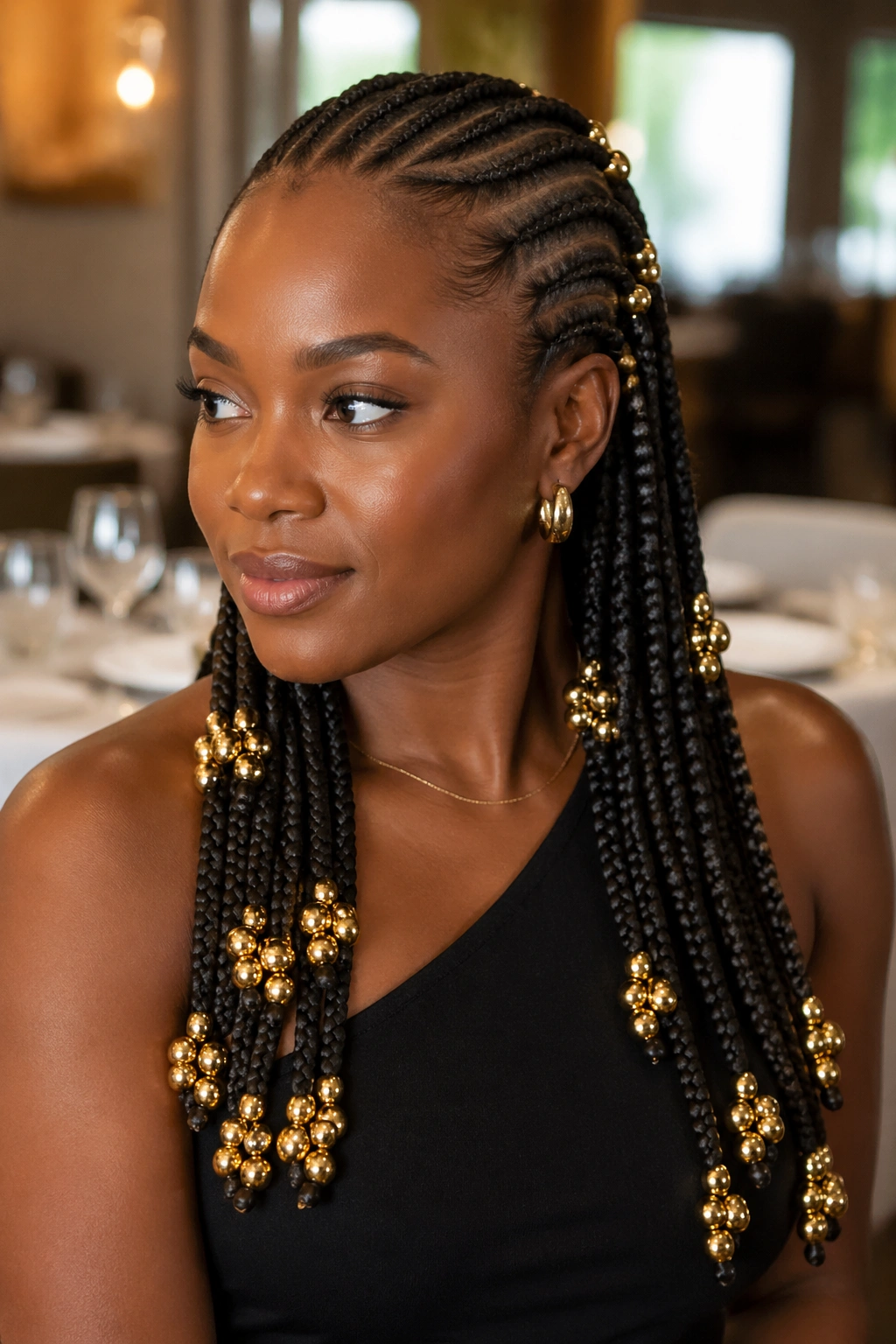
Multiple gold or brass beads clustered together at specific points along each braid. Rather than spacing beads evenly, groups of 3-5 gold beads sit together at 2 or 3 points per cornrow.
The cluster approach creates visual weight and drama. Individual beads fade into the background. Clustered beads demand attention.
Gold beads photograph richly and signal occasion-worthy styling. This version is formal — dinner parties, evening events, portraits.
Make sure the cluster placements are consistent across all cornrows. Clusters at the end of each braid plus clusters at mid-length create visual rhythm. Random placement creates chaos.
6. Small Feed-In Cornrows With Tiny Seed Beads
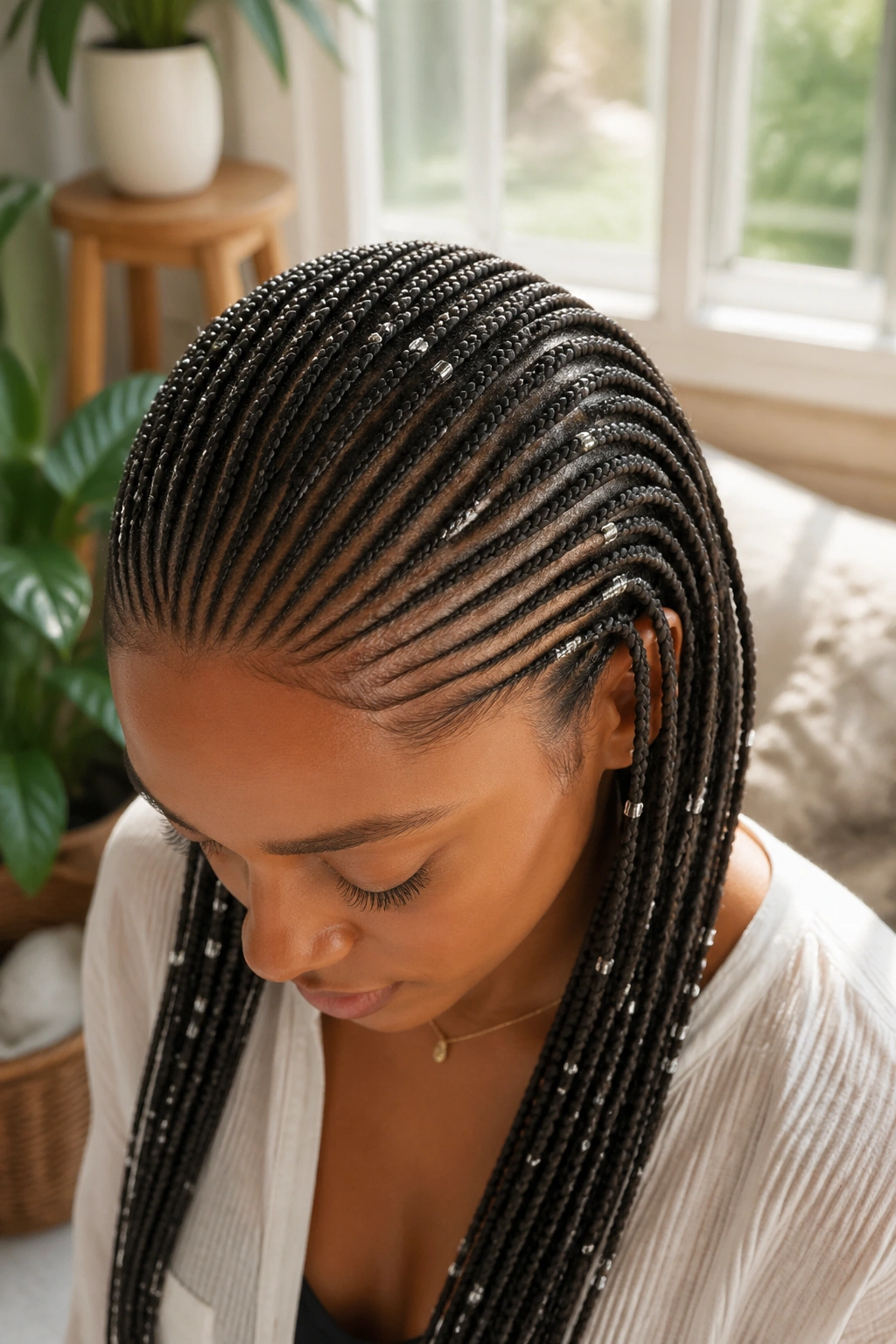
Very thin feed-in cornrows — 16 to 20 across the head — with small seed beads scattered along the braids. The small beads match the delicate scale of the braiding.
Scale matters. Large beads on small braids look like boulders on twigs. Small beads on small braids look like dewdrops.
Seed beads add subtle shimmer without demanding attention. The style as a whole reads refined and detailed rather than flashy.
Takes longer to install. Budget an extra hour for the bead placement — tiny beads require more precision and patience.
7. Feed-In Cornrows With Colorful Bead Pattern
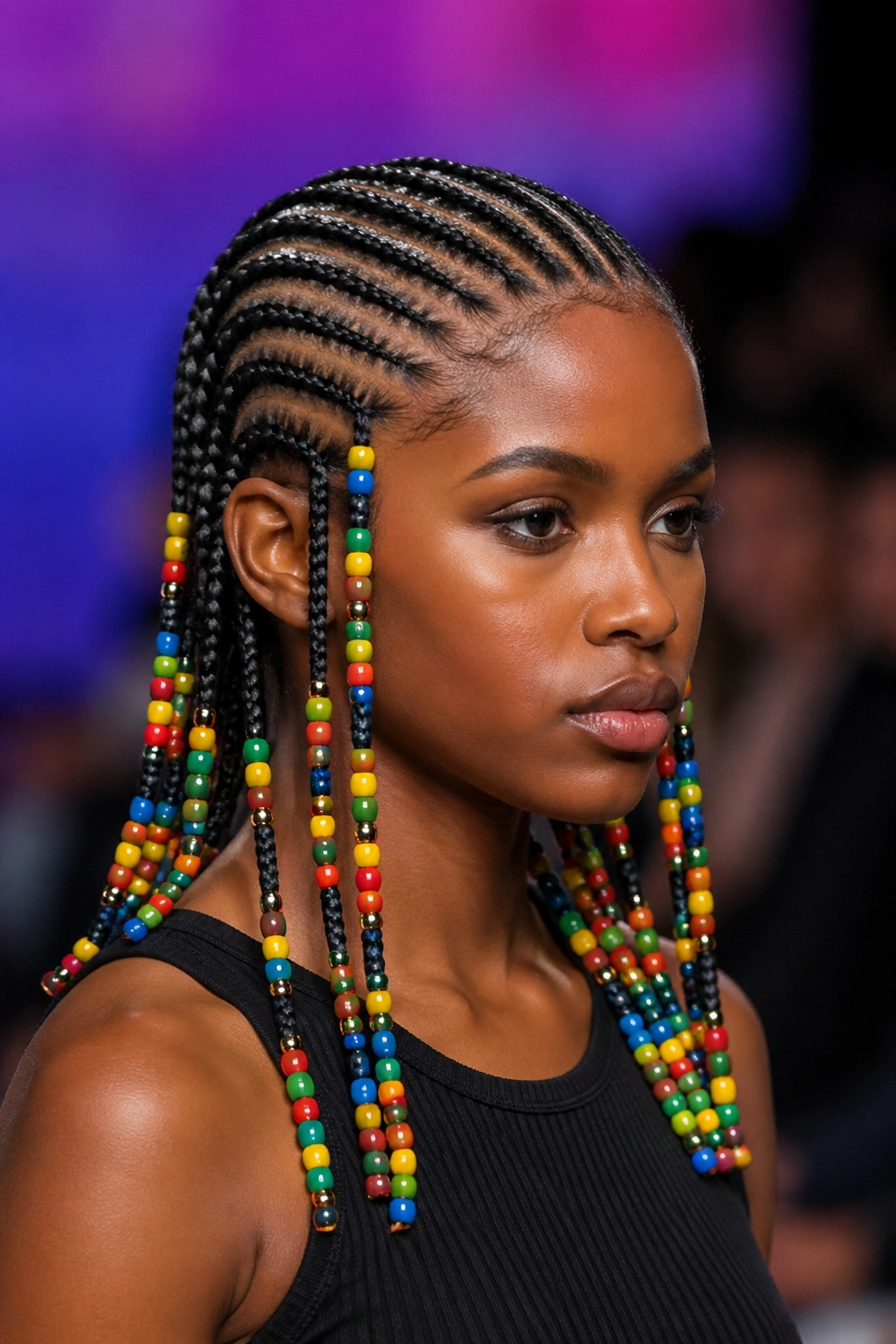
Feed-in cornrows in natural or matching color, with vibrant colored beads — reds, blues, yellows, greens — arranged in specific patterns. Each cornrow might feature one dominant color, or a repeating color sequence.
The colorful beads add personality without requiring colored synthetic hair. Your base cornrows stay neutral and wearable. The beads provide the energy.
Color pattern options:
- Each cornrow a different dominant color
- Repeating rainbow sequence across all cornrows
- Traditional patterns from specific cultural beading traditions
- Coordinated with outfit or event colors
Be thoughtful about cultural specificity. Many bead colors and patterns carry meaning in African, Caribbean, and Native American traditions. Research before choosing — some patterns belong to specific cultures and shouldn’t be borrowed casually.
8. Feed-In Cornrows With Shell Beads for Coastal Feel
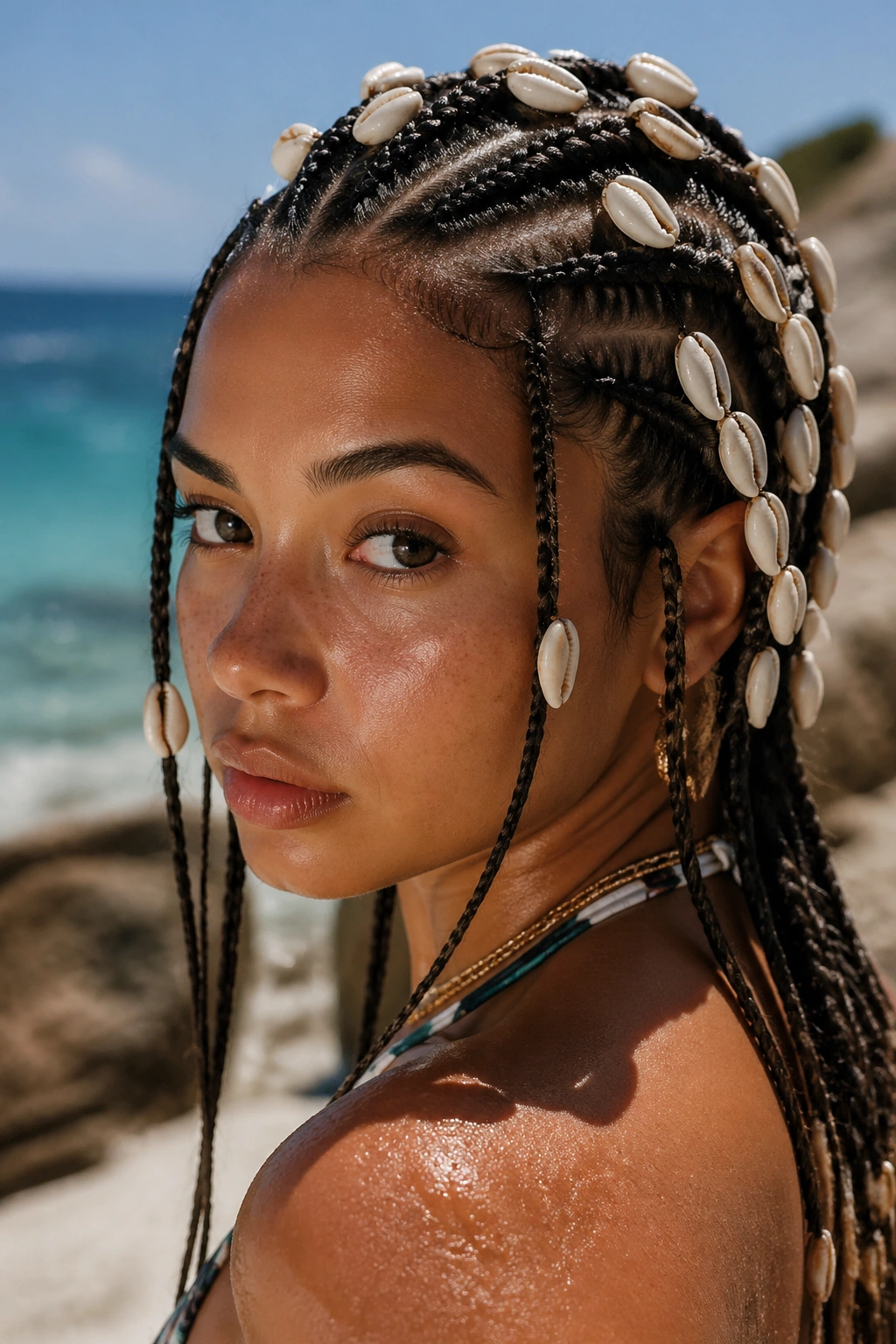
Cowrie shells, small conch fragments, or polished shell beads threaded through feed-in cornrows. The shells add unmistakable coastal and African cultural signaling.
Cowrie shells have deep history in West African adornment and carry cultural weight. They also photograph beautifully against any hair color — the cream and brown of the shell contrasts with dark hair and complements lighter tones.
What Makes It Different
- Rooted in centuries of African adornment tradition
- Adds organic, natural texture that manufactured beads can’t match
- Each shell is slightly different, which gives handmade feel
- Works across formal and casual contexts
Use real shells, not plastic imitations. Real cowries have a subtle sheen and natural color variation. Plastic versions look hollow and cheap.
9. Feed-In Cornrows With Wrapped Thread and Beads
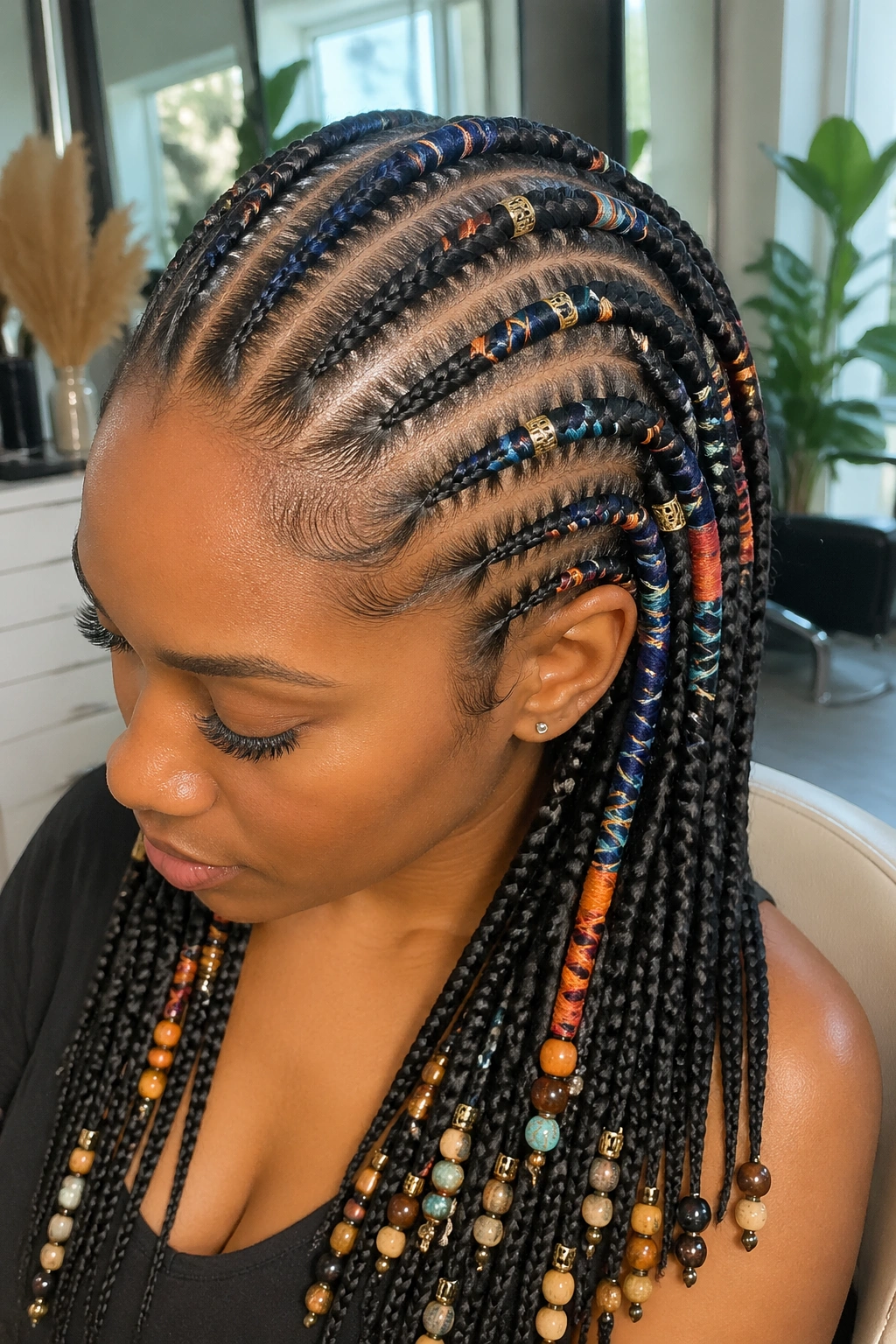
Some sections of each cornrow are wrapped with colored embroidery floss — creating bands of solid color along the braid — with beads placed at the edges of each wrapped band. The thread and beads work together as a unified decoration.
Thread wrapping is having a moment in braid styling. Combined with beads, it creates layered texture that plain beading can’t achieve.
Choose thread colors that complement the bead colors. Wooden beads with rust-and-cream thread. Gold beads with navy-and-white thread. Glass beads with black thread. Matched palettes make the decoration read as designed.
The thread-and-bead combination lasts longer than beads alone because the thread helps anchor the beads in place.
10. Feed-In Lemonade Braid With Beaded Drop
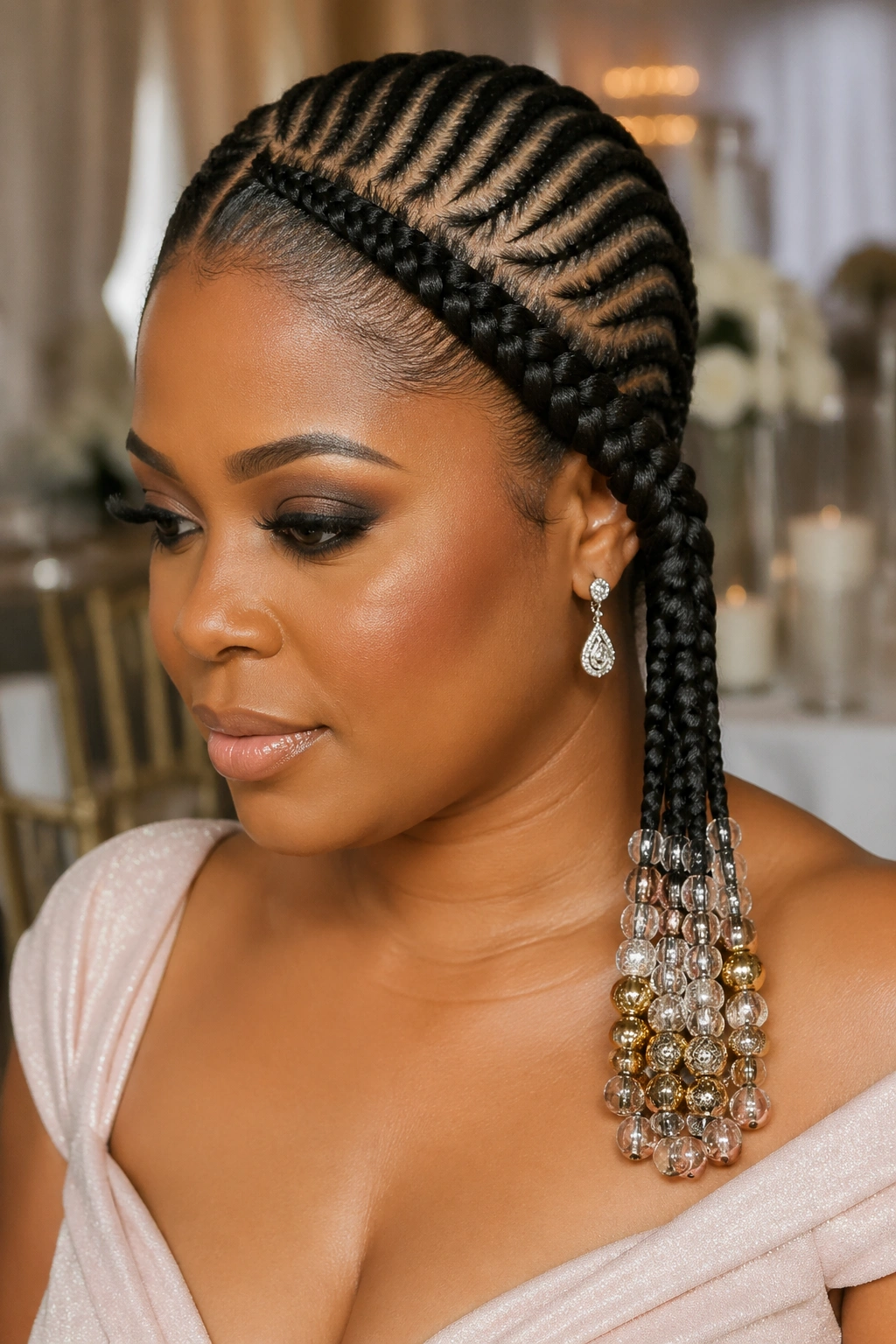
A single feed-in cornrow swept diagonally across the head — lemonade braid style — with a substantial beaded drop at the end. The beads at the tip can be ten or more, creating a heavy decorative finish.
The lemonade braid swept across the head is already a strong statement style. Adding an elaborate beaded drop at the end amplifies the drama. The beaded end becomes a counterweight to the braid’s diagonal sweep.
Works particularly well for wedding attendees, formal events, and photo sessions. The sweeping line plus the beaded finish photograph like an engineered composition.
Choose beads with substantial weight for the drop — wooden or metal rather than glass — so the drop has visible mass rather than just decoration.
11. Feed-In Cornrows With Pearl Beads
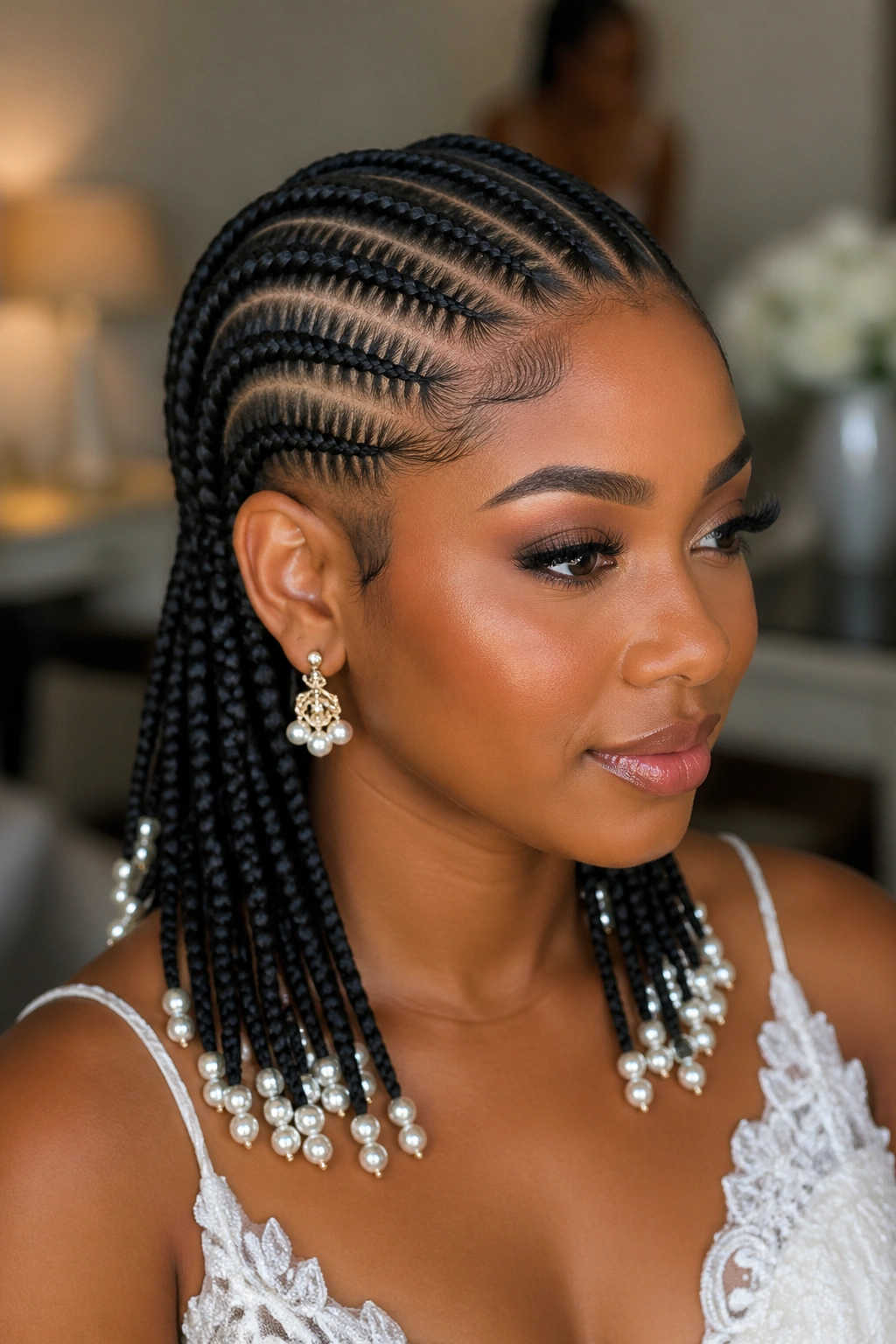
Feed-in cornrows in natural color, with small freshwater pearls threaded at the ends of each braid. Pearls add elegance that other beads can’t match.
Pearls read as more refined than any other bead material. They take feed-in cornrows from casual or bohemian into wedding-worthy, bridal, or formal event territory.
Choose pearls sized to match the braid thickness. Small 4-6mm pearls for thin braids. Larger 8-10mm pearls for thicker braids. Oversized pearls pull the cornrows down and create tension.
Freshwater pearls are more affordable than cultured pearls and have more character — slight irregularities in shape and color that look handmade rather than manufactured. Both work; choose based on aesthetic preference and budget.
12. Feed-In Cornrows With Bone or Horn Beads
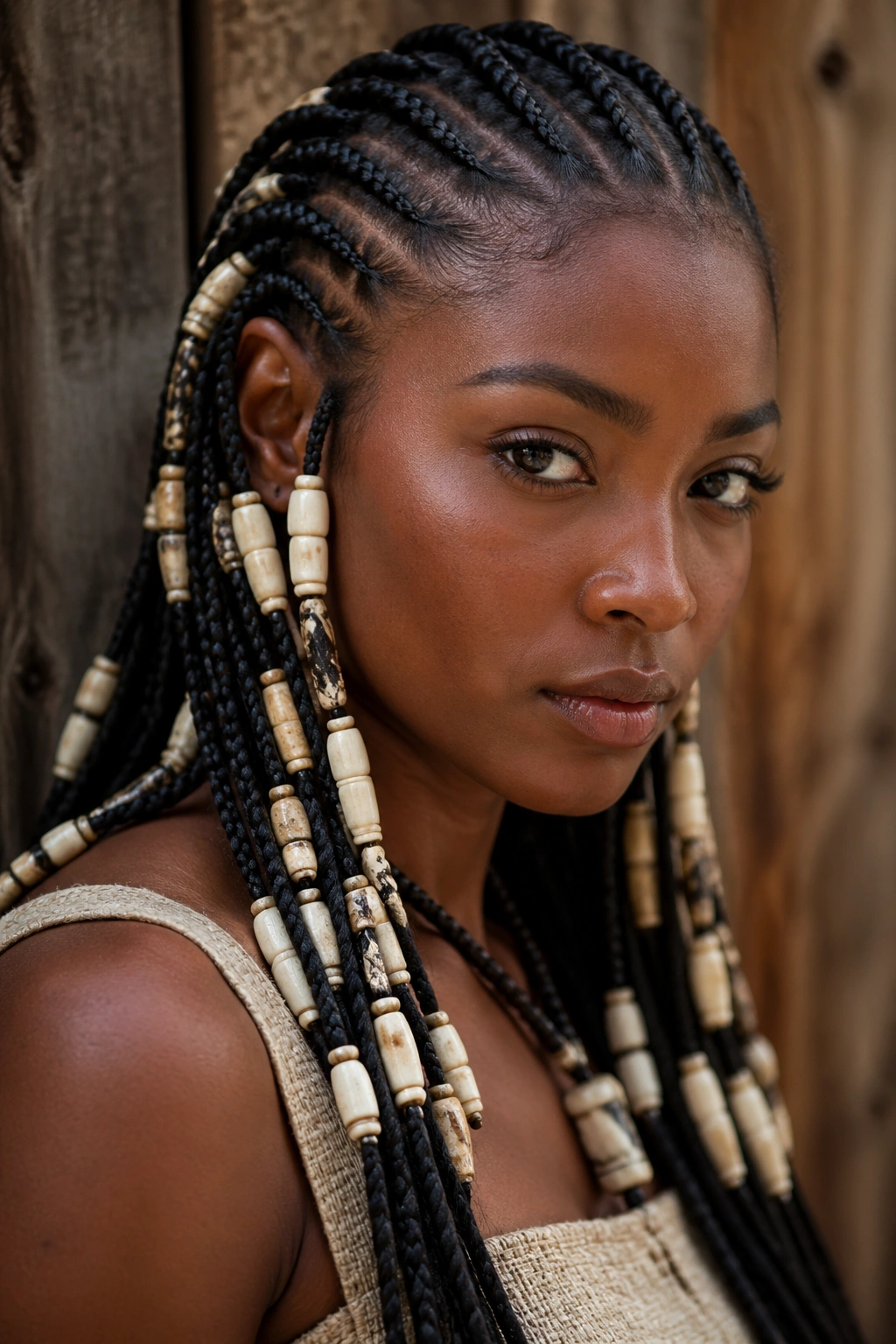
Traditional cream or tan beads carved from bone or horn — or modern equivalents in quality resin — threaded through feed-in cornrows. The beads add earthy, primal texture.
Bone and horn beads connect the style to traditional African, Caribbean, and Native adornment practices. They carry visual weight and authenticity that synthetic beads can’t replicate.
The cream and ivory tones work beautifully against dark hair, creating natural contrast without competing with the braid color.
Who This Is For
- Those drawn to earthy, tribal-influenced styling
- Wearers who connect with heritage and traditional adornment
- Anyone wanting beads that don’t read as costume
- Best for events with natural, organic dress codes
Ethically sourced bone or horn beads are available from specialty suppliers. If bone or horn doesn’t align with personal values, high-quality resin alternatives mimic the look convincingly.
13. Side-Parted Feed-In Cornrows With Beaded Bangs
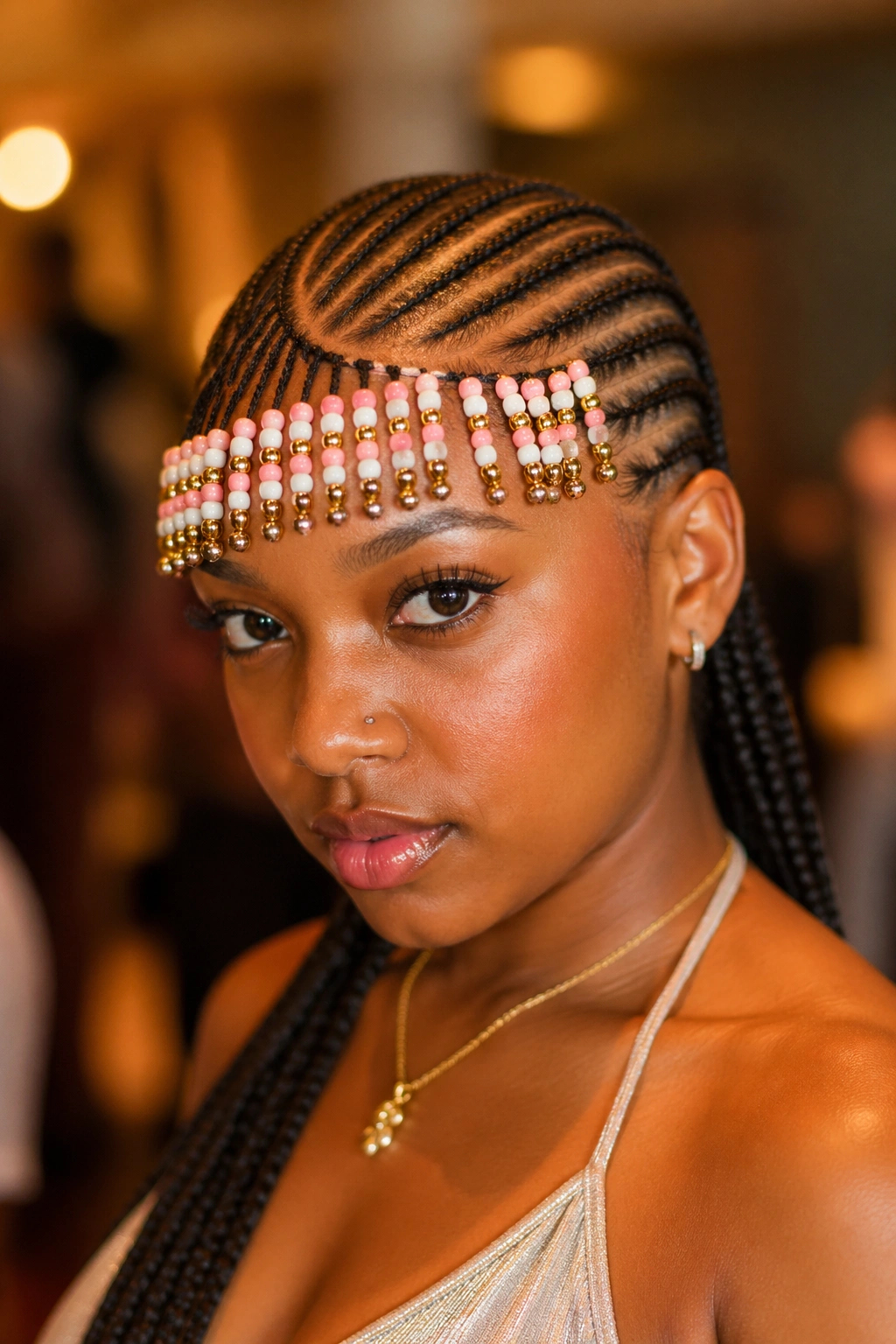
Hair is parted sharply to one side, with feed-in cornrows running across the scalp. A section of cornrows near the hairline is threaded with beads to form a decorative “beaded bang” across the forehead.
This is unusual. Most beaded braids let the beads fall down. The beaded bang holds beads horizontally across the forehead, creating a headpiece effect without any separate accessory.
The bangs require careful planning. The cornrows along the hairline need to be laid flat against the forehead, with beads placed at even intervals. Any lift or unevenness ruins the effect.
Use small beads so the weight doesn’t pull the front cornrows down. Seed beads or 4mm beads work best.
This version is event hair — shoots, performances, festivals where distinctive styling is expected.
14. Curly Ends With Beaded Cornrows
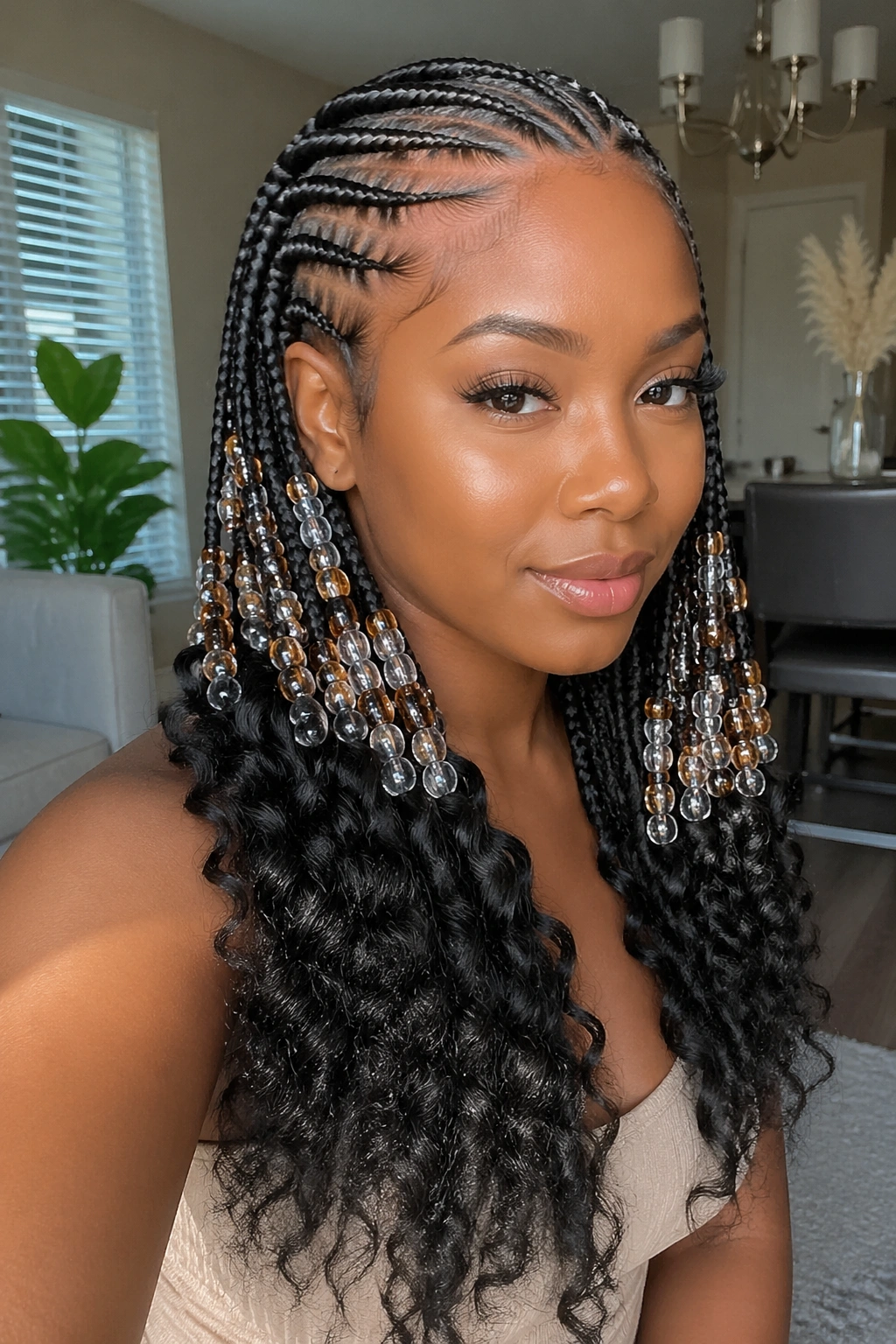
Feed-in cornrows with beads along the braid length, but the ends transition into curly synthetic hair rather than staying straight. The curls add movement, the beads add decoration.
The combination gives you everything — structured scalp work, decorative beading, soft curly movement at the ends. It’s three styles in one.
The beads should be placed on the braided portion, not in the curls. Beads in curly hair get tangled and pull painfully. Keep them in the flat cornrow section where they can hang cleanly.
Use water-wave kanekalon for the curls. It holds shape without tangling in beads.
15. Feed-In Cornrows With Oversized Statement Beads
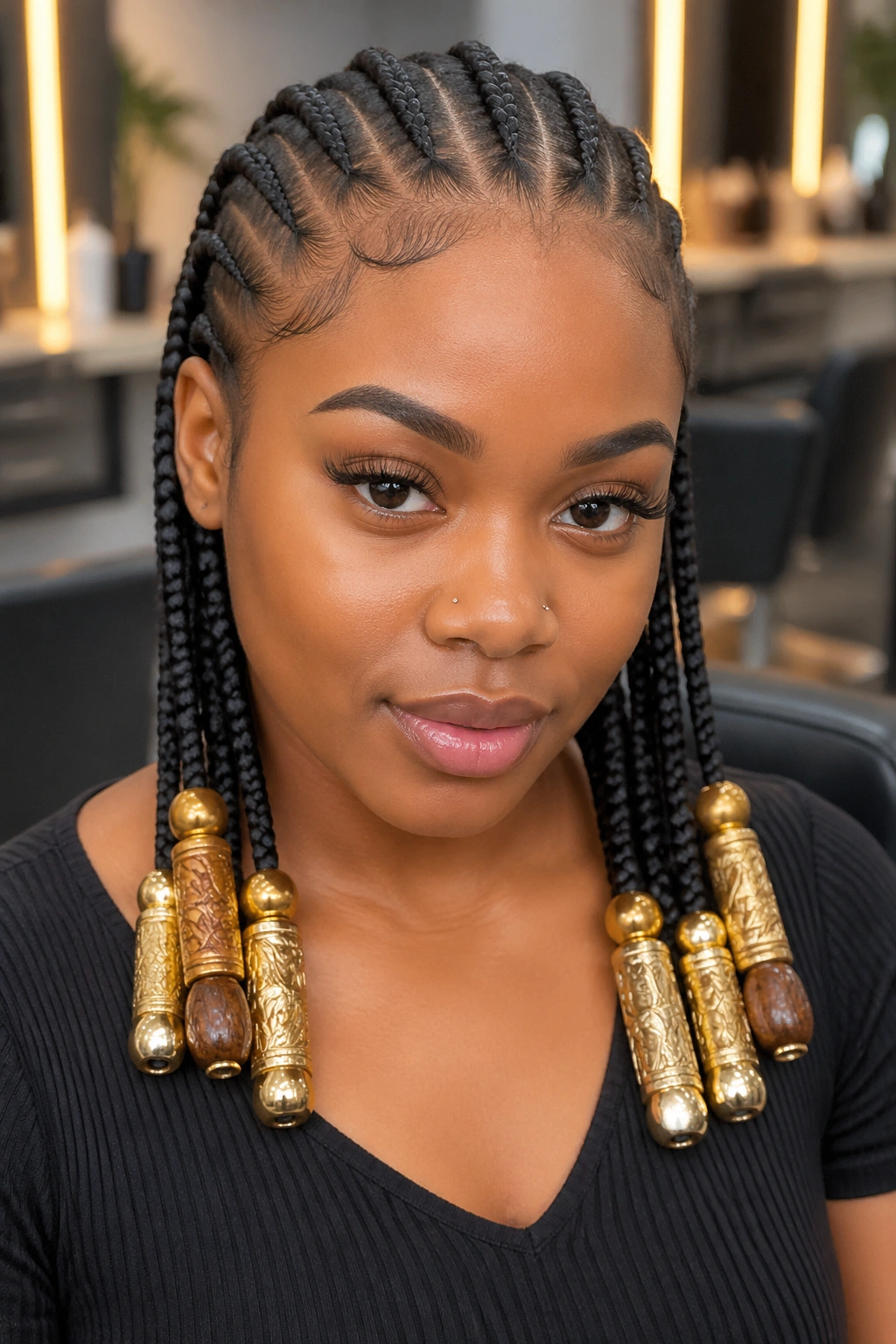
Rather than many small beads, this version uses a few oversized statement beads per cornrow — maybe just one or two large beads at the end of each braid. The individual beads become the focus.
Large beads demand quality. A single oversized resin bead with interesting color or pattern reads as sculptural. A cheap plastic bead reads as costume.
Invest in better beads for this version. Handmade ceramic beads, vintage glass beads, quality resin beads with pattern work.
The large beads are heavier. Make sure the cornrows are tight enough at install to support the weight without lifting at the roots.
16. Feed-In Cornrows in Pigtails With Beaded Tips
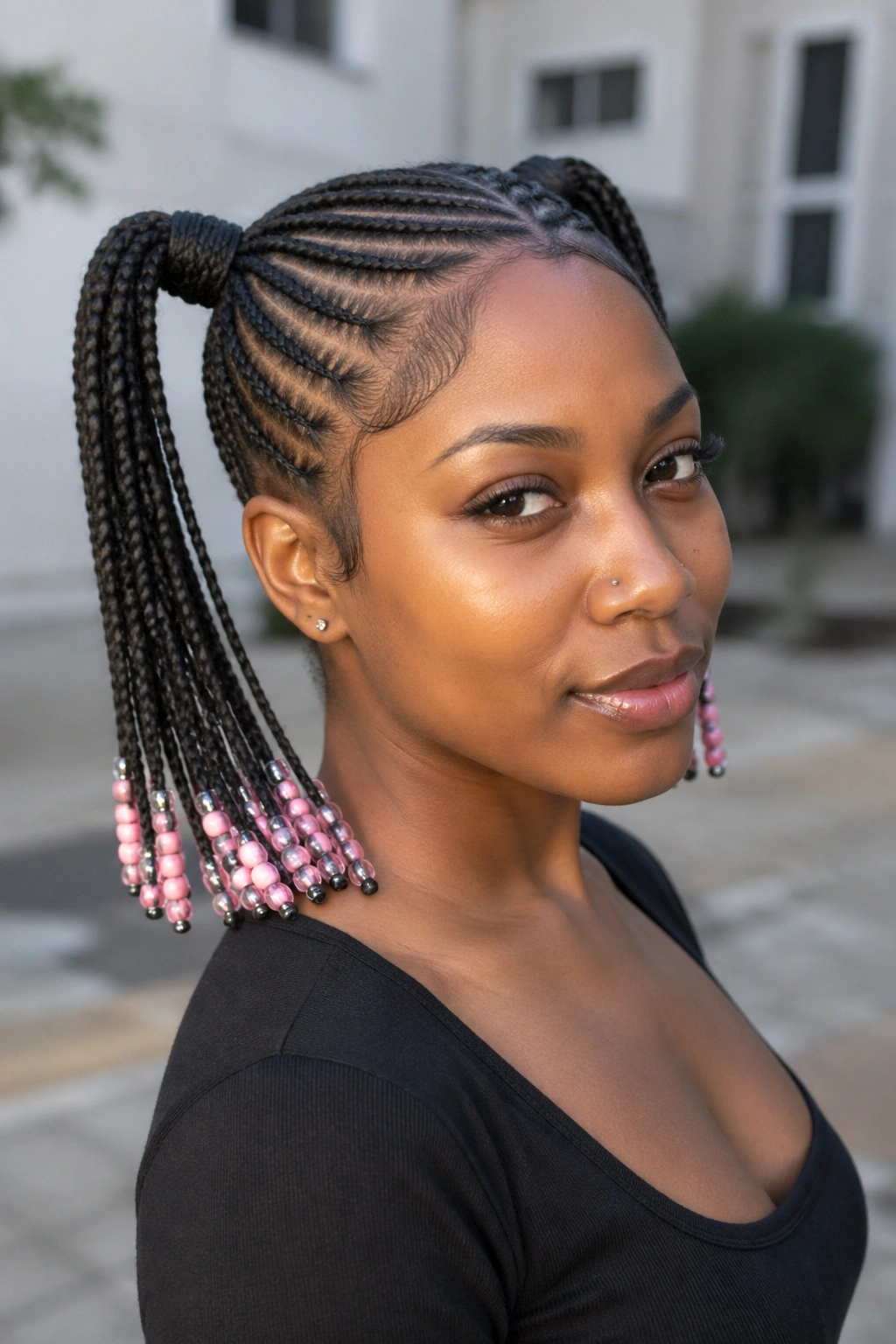
The feed-in cornrows gather into two pigtails at the back or sides of the head, with beaded tips completing each pigtail. The pigtails provide the shape, the beads provide the finish.
Pigtails with beaded tips read younger and more playful than straight-back cornrows with beads. Good for casual occasions, weekend wear, or festival looks.
The bead finish should be substantial at pigtail tips — five to seven beads minimum. Sparse beads on pigtails look anemic. Generous beads anchor the pigtails with visible weight.
Keep both pigtails identical — same length, same beads, same count. Any asymmetry reads as accident.
17. Cornrow Bun With Beaded Crown
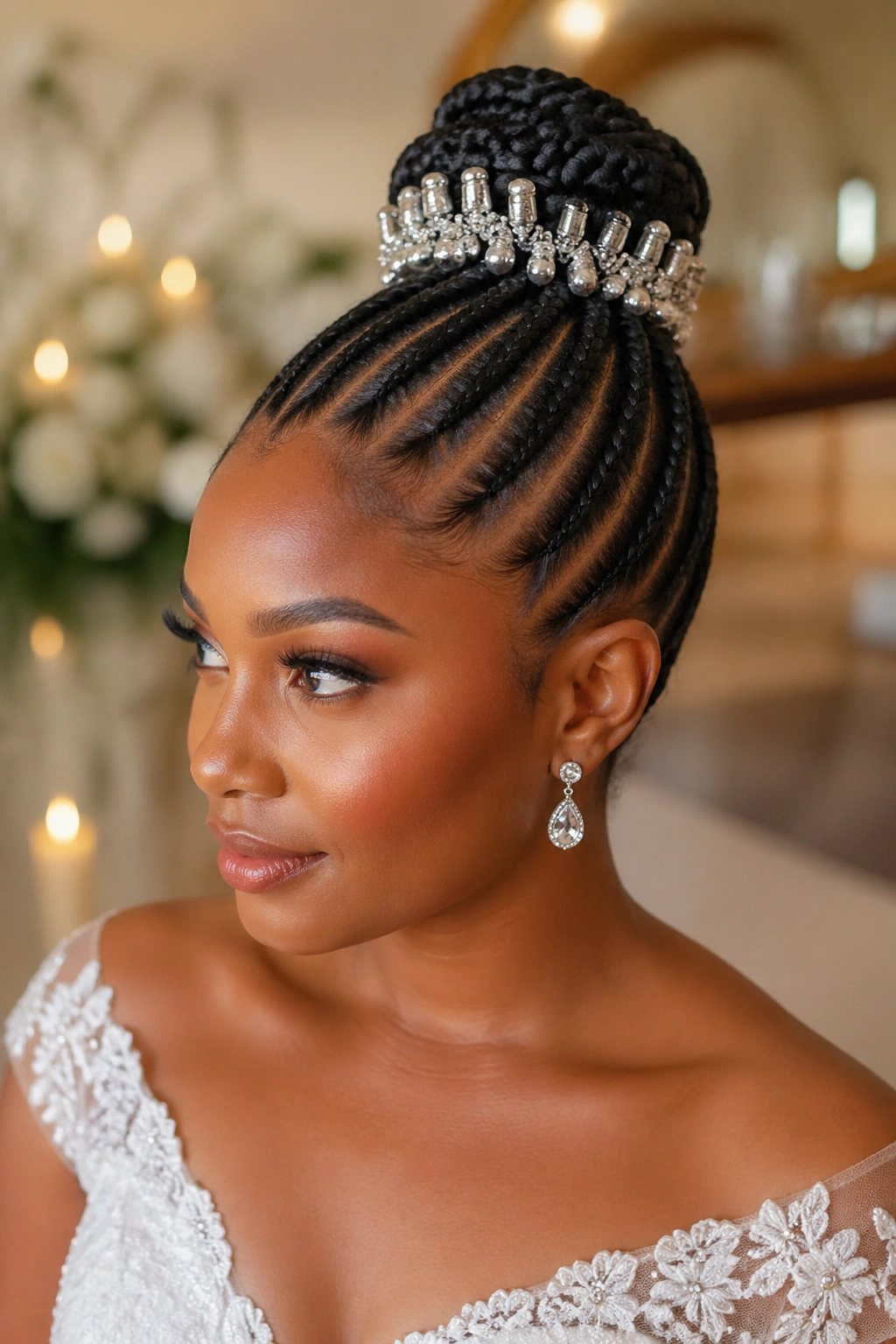
Feed-in cornrows running up to a central bun at the crown, with beads placed around the base of the bun like a crown. The bun is the sculptural element; the beads are the jewelry.
The beaded crown transforms an ordinary bun into a focal point. The beads function almost as ornaments added to the bun structure itself rather than as part of the braid decoration.
Use coordinated beads for this version — matching color family, matching size range. A beaded crown with mismatched beads reads as chaotic. A beaded crown with uniform beads reads as designed.
This is wedding hair. Gala hair. Formal event hair at its most elaborate.
18. Half-Up Half-Down Feed-In Cornrows With Beads
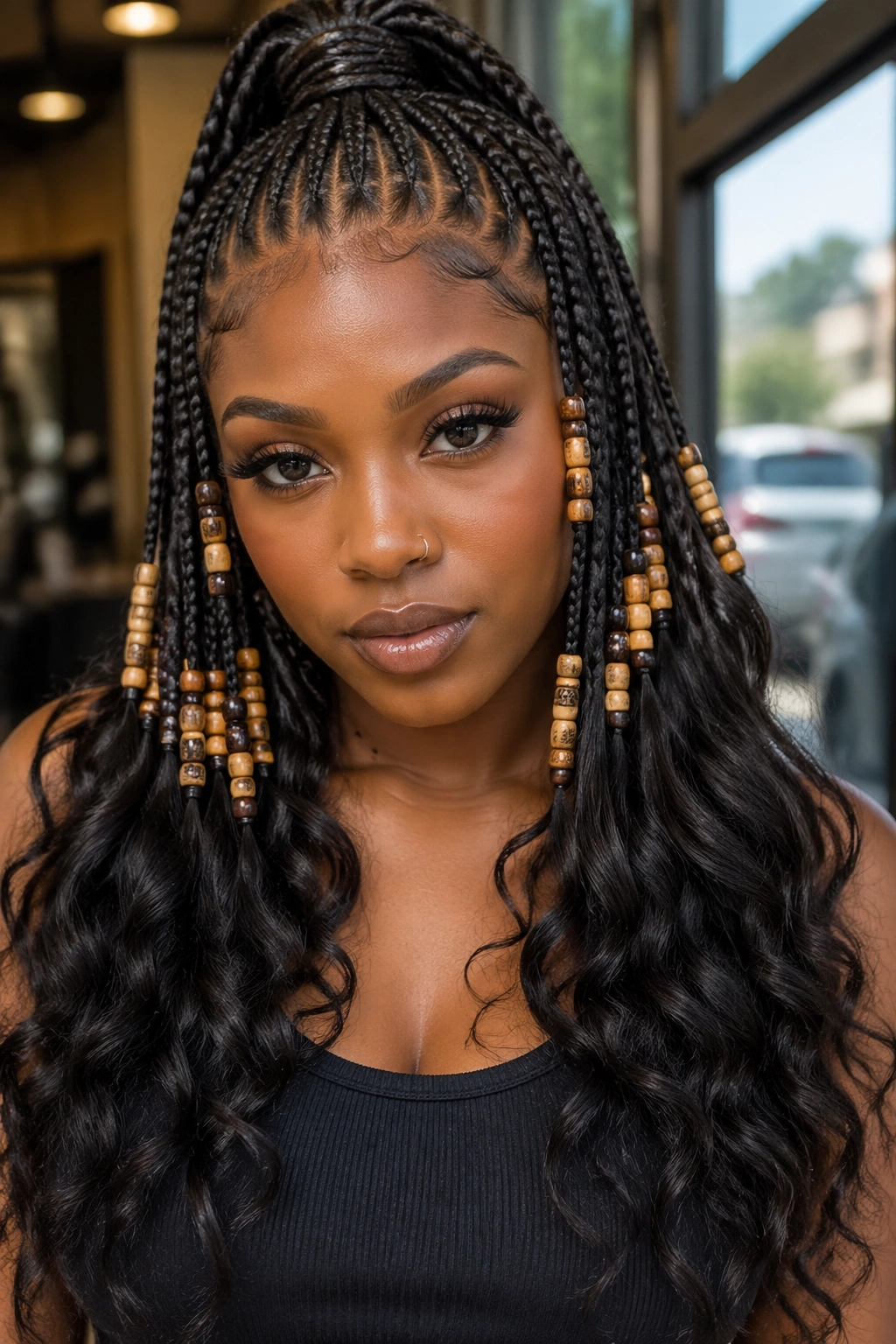
Only the top and sides are done in feed-in cornrows with beaded ends. The bottom portion of the natural hair is released and styled separately — curled, twisted, or left loose.
This version suits transition periods or situations where full cornrows feel like too much. You get the scalp decoration and bead accents without committing to a full-head install.
The transition point — where cornrows end and loose hair begins — should be hidden at the crown, so the visual effect is cornrows visible only from the front view.
Takedown is faster for half-up styles. About 15 minutes instead of the 30-60 minutes a full install requires.
19. Feed-In Cornrows With Metallic Cuff Beads
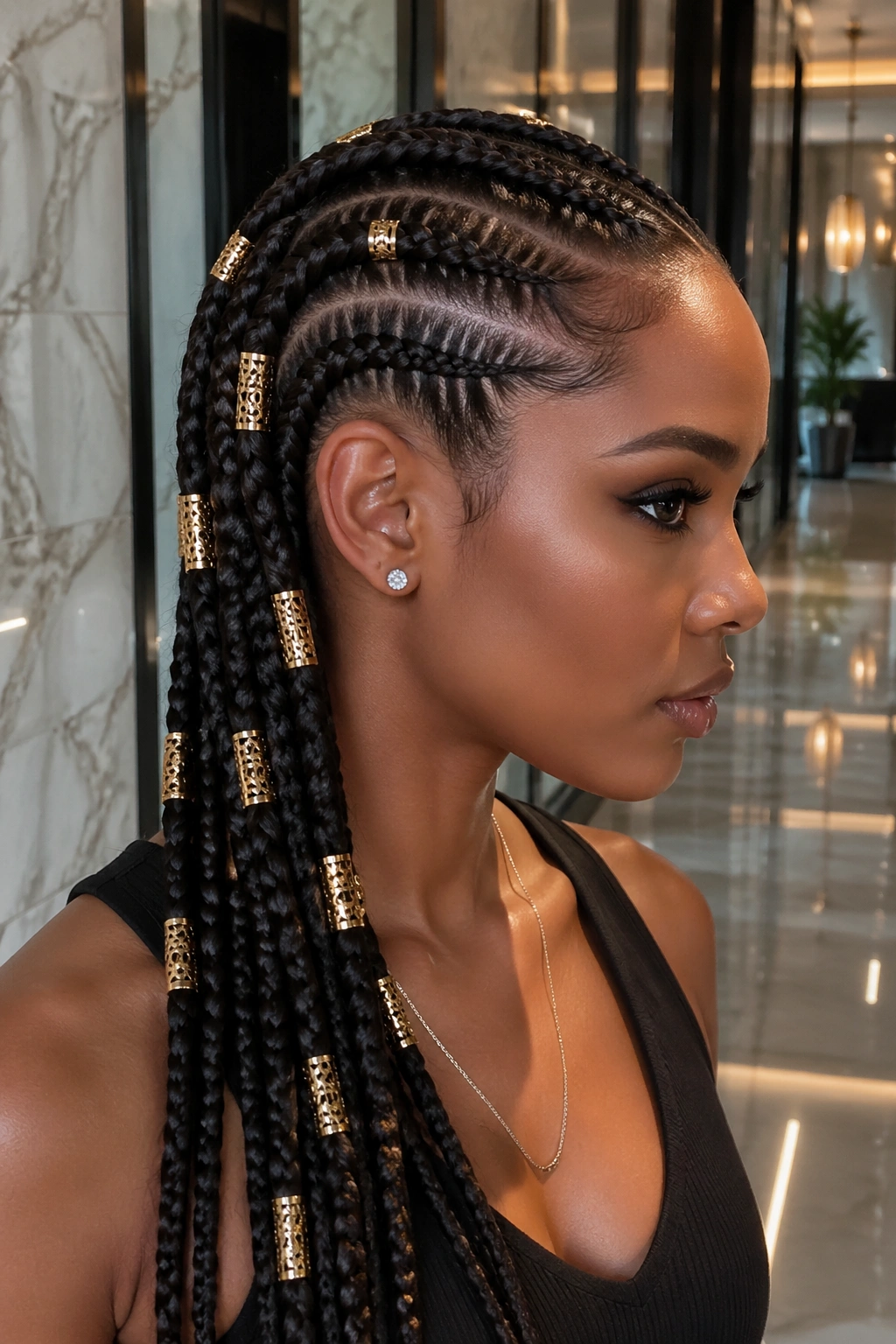
Long metal cuffs — cylindrical beads that can be an inch or more long — threaded onto feed-in cornrows. Unlike round beads, the cuff shape creates a different visual texture.
Cuffs are substantial. Two or three per cornrow is plenty. More and they cover the braiding entirely, which defeats the feed-in display.
Metal cuffs photograph beautifully — the length catches light along its full surface, creating highlights that round beads can’t produce.
How to Style It
- Choose matte metal finishes for everyday wear
- Choose polished or hammered metal for evening events
- Place cuffs at 2-3 points along each cornrow for balance
- Pair with matched metal jewelry for a coordinated look
20. Feed-In Cornrows With Beaded Fringe
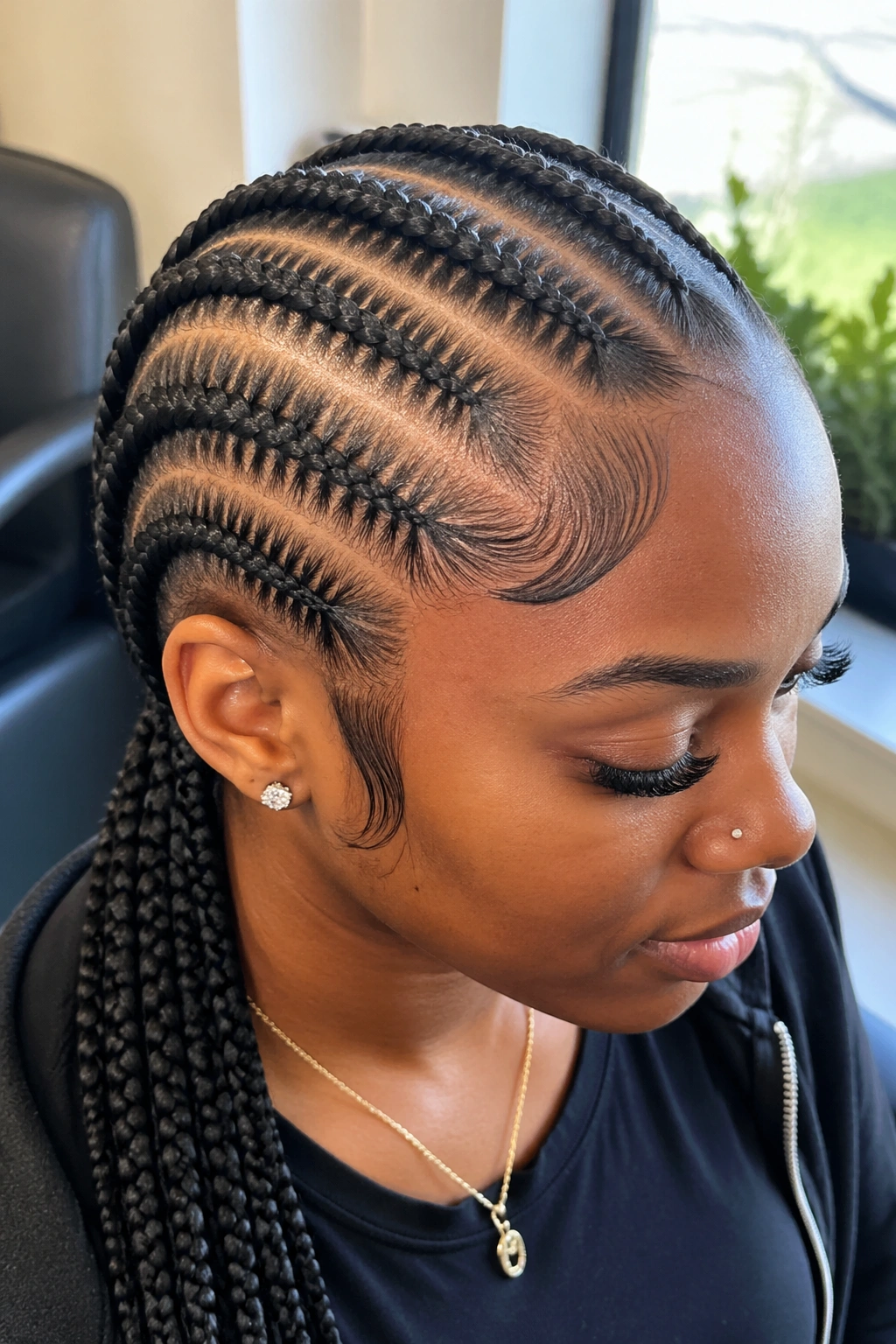
Beads are threaded along the forehead hairline — not on the cornrows themselves, but hanging from hidden thread wrapped around the front cornrows. The beads dangle like a beaded fringe or headband.
The fringe effect is striking. Beads hang at irregular lengths across the forehead, creating movement when the head turns. It’s decorative jewelry built into the braiding rather than worn separately.
The fringe requires careful execution. The beads must be evenly spaced, hang at coordinated lengths, and stay secured through movement. A skilled braider familiar with bead-fringe techniques is worth seeking out.
Most flattering on longer face shapes — the horizontal bead line breaks up a long face visually.
21. Feed-In Cornrows With Mixed Bead Textures
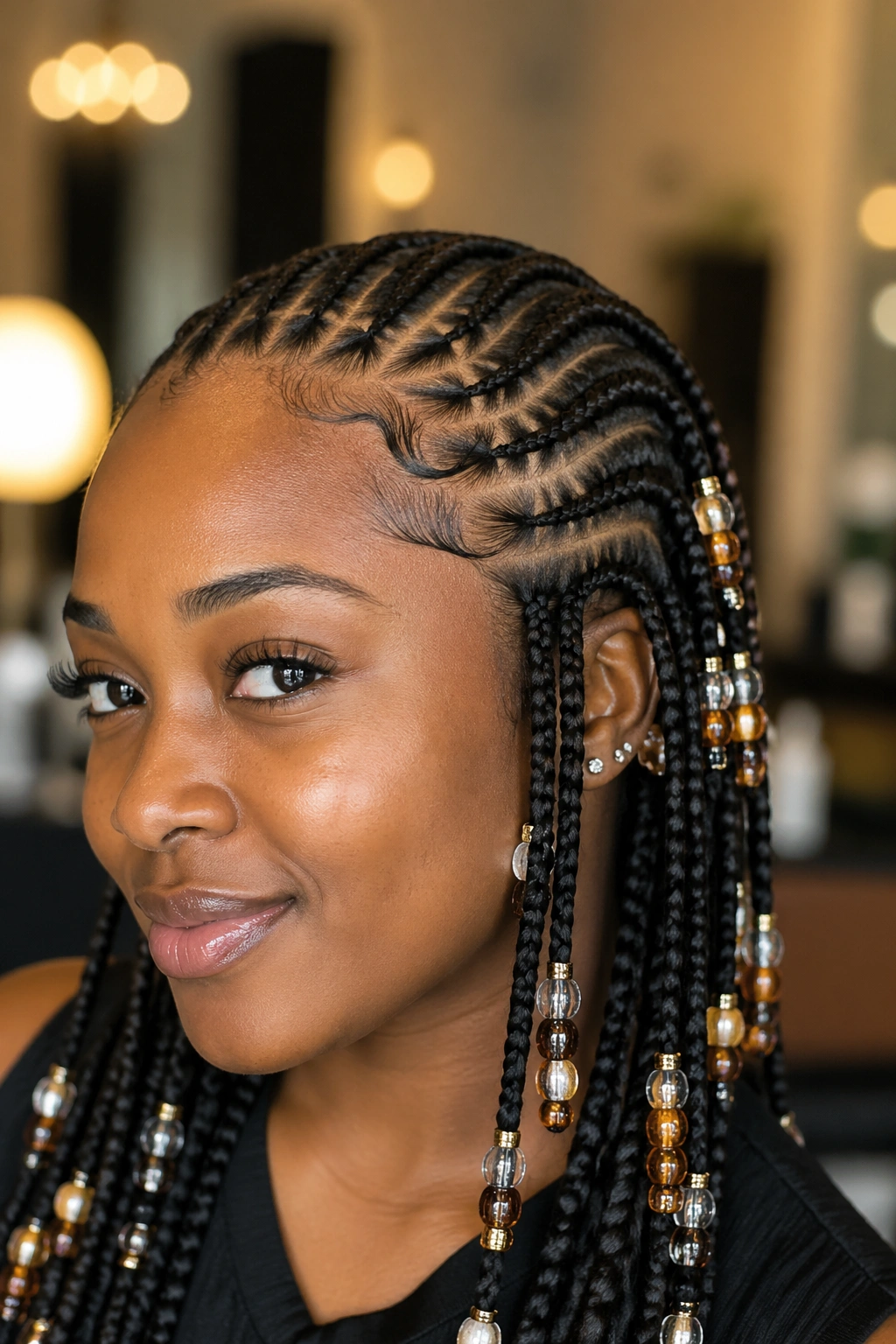
Wooden, glass, metal, and ceramic beads mixed across the same style. The variety creates visual depth — no two beads exactly alike.
Mixed beads can work or fail dramatically. The difference is in the coordination. A mix where all beads share a color palette (browns, coppers, creams, tans) reads as artisan and intentional. A random mix of unrelated colors and materials reads as leftover beads from five different projects.
Limit the palette to 2-3 dominant colors across all the different materials. This creates variety within a coherent design.
Works best for handmade, craft-oriented, bohemian wear. Less suited for formal settings where uniformity reads as more appropriate.
22. Feed-In Cornrows With Beaded Tassel Drops
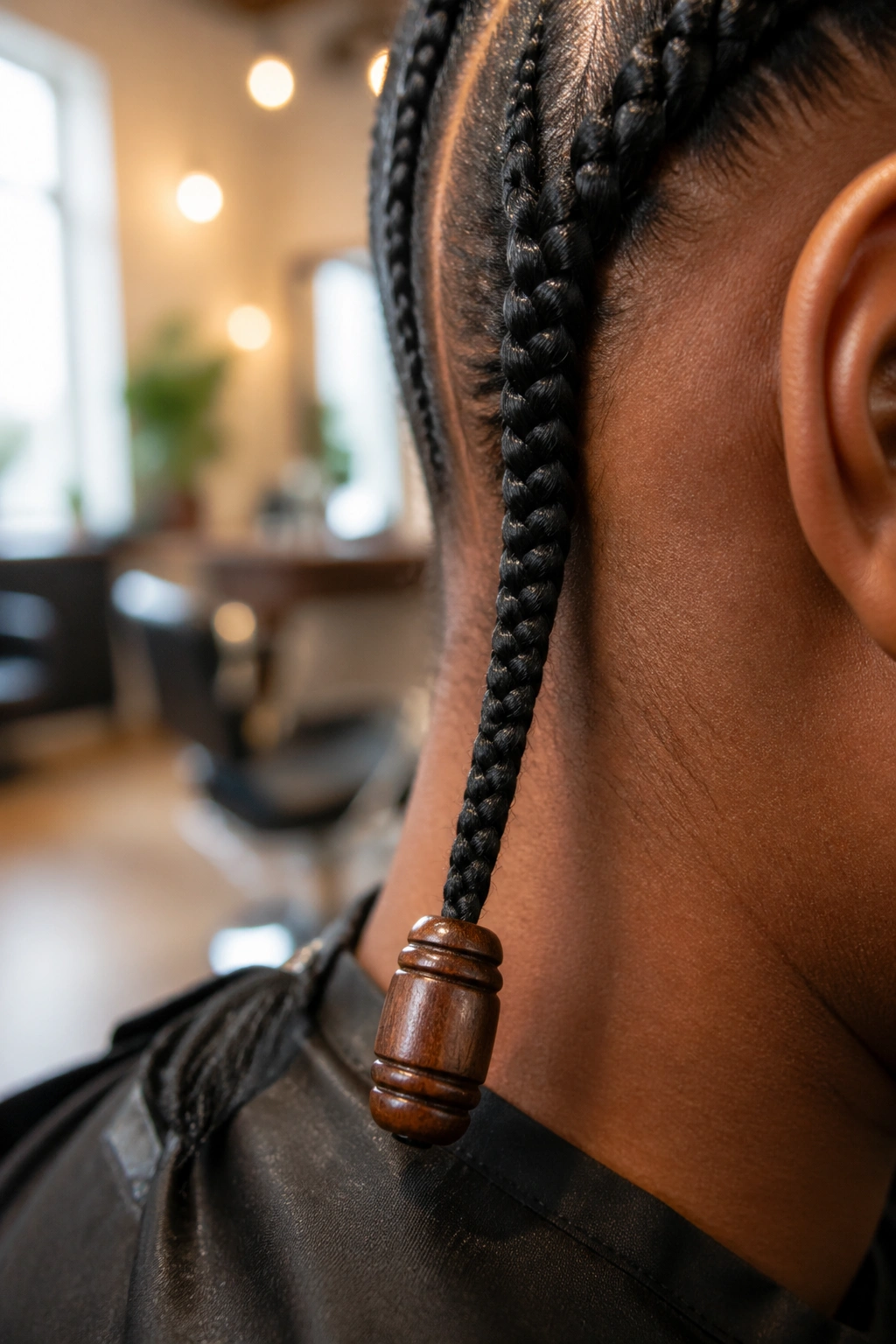
Each cornrow ends not with beads threaded directly onto the braid, but with a decorative tassel drop — multiple strands of thread hanging below the cornrow, each strand ending in a small bead. The tassels add fringe-like movement.
Tassel drops are dramatic. Instead of simple bead finishing, each cornrow ends in a decorative object that moves independently.
The tassels can be 2-4 inches long below the cornrow. Longer tassels read more dramatic; shorter tassels read more subtle.
Works beautifully for performance wear, dance hair, photo shoots, and festival styling. Probably too dramatic for daily wear or professional settings.
Keeping Feed-In Cornrows With Beads Fresh
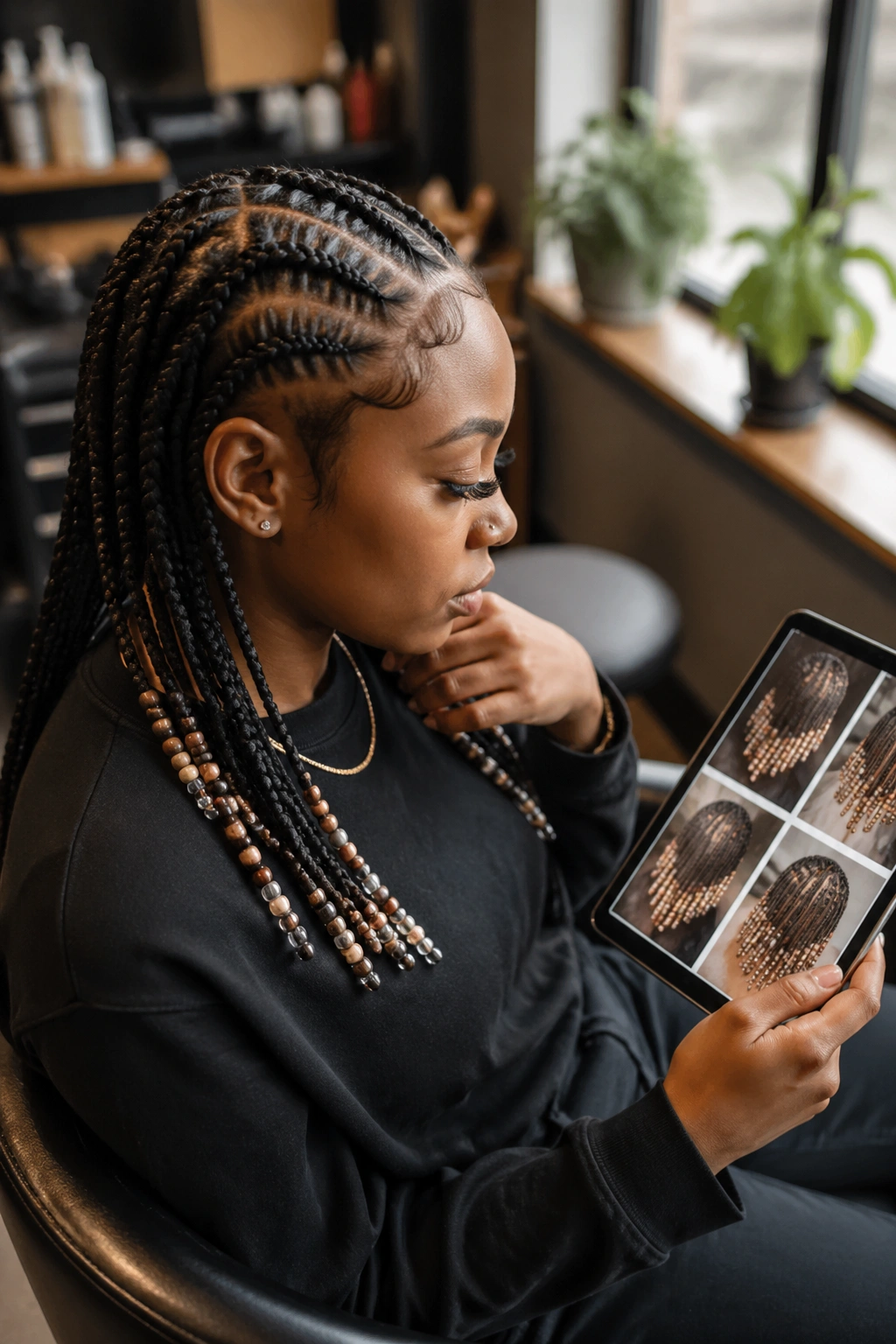
Beads complicate maintenance. Here’s how to handle it.
Every morning, shake beads gently to redistribute weight — beads that sit in one position overnight can create pressure points on the scalp.
Every 4 days, oil the scalp lightly between the braids. Avoid oiling the beads themselves — it creates buildup.
If beads start slipping, re-secure with small rubber bands at the base. Don’t wait until they fall off completely. Retrieving lost beads is harder than preventing the loss.
Watch for tension. Heavy beads can pull cornrows down over time. If a specific cornrow starts lifting or sagging, remove some beads from that braid to reduce weight.
Sleeping in Beaded Feed-In Cornrows
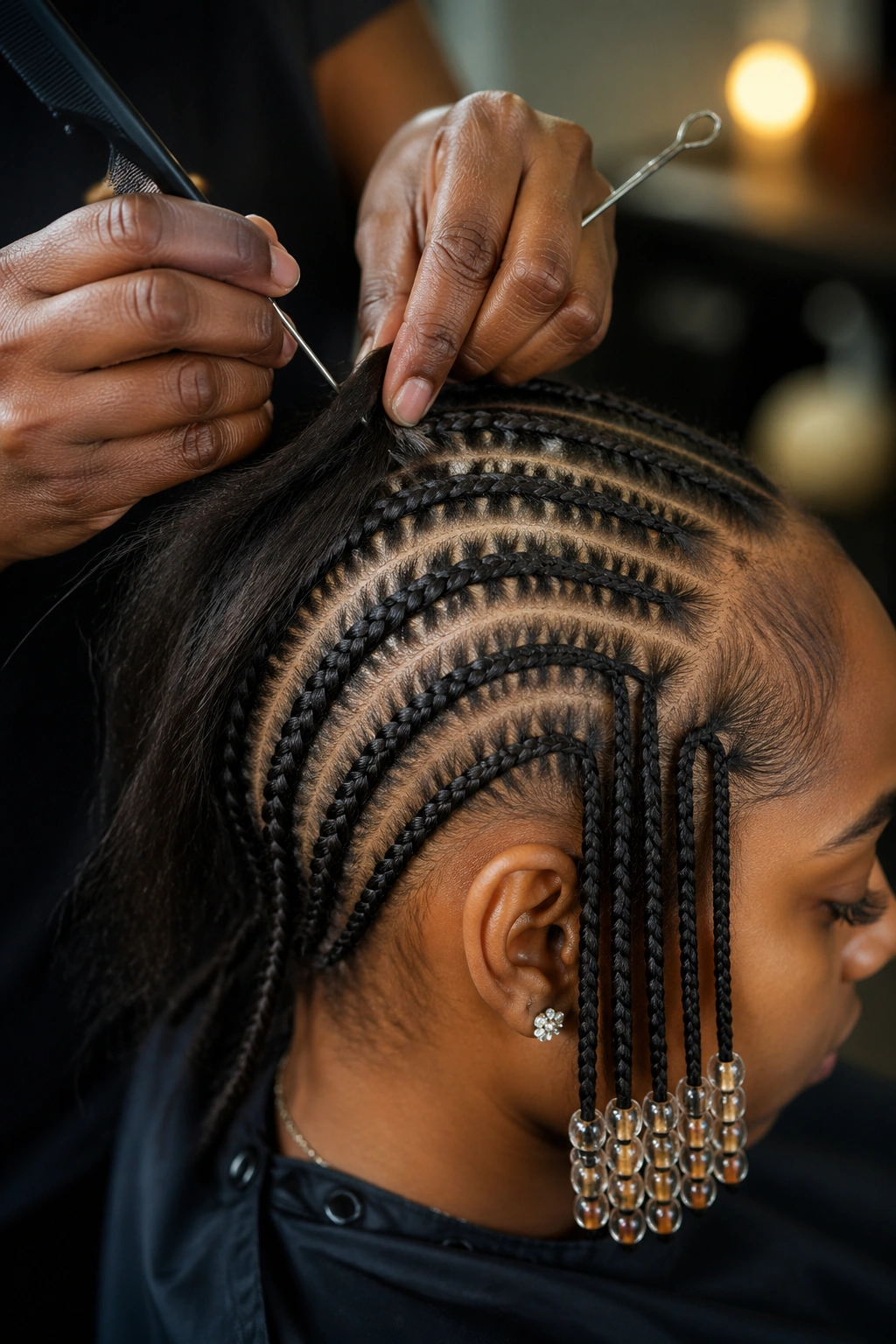
Beads and sleep are challenging. The beads clack against the pillow, pull the cornrows sideways as you roll, and can even leave impressions on your skin.
Solutions:
- Wrap all beads toward one side of the head before lying down, so you’re sleeping on the other side
- Use a large silk pillowcase — beads slide on silk rather than dragging
- Wear an oversized satin bonnet to contain the bead weight and keep the beads quiet
- Consider removing beads before bed if they’re lightweight plastic (but not for wooden or metal, which can’t be easily re-threaded)
If beads are disturbing sleep, the style isn’t working. Adjust — either fewer beads or a different placement.
Takedown of Beads and Feed-Ins
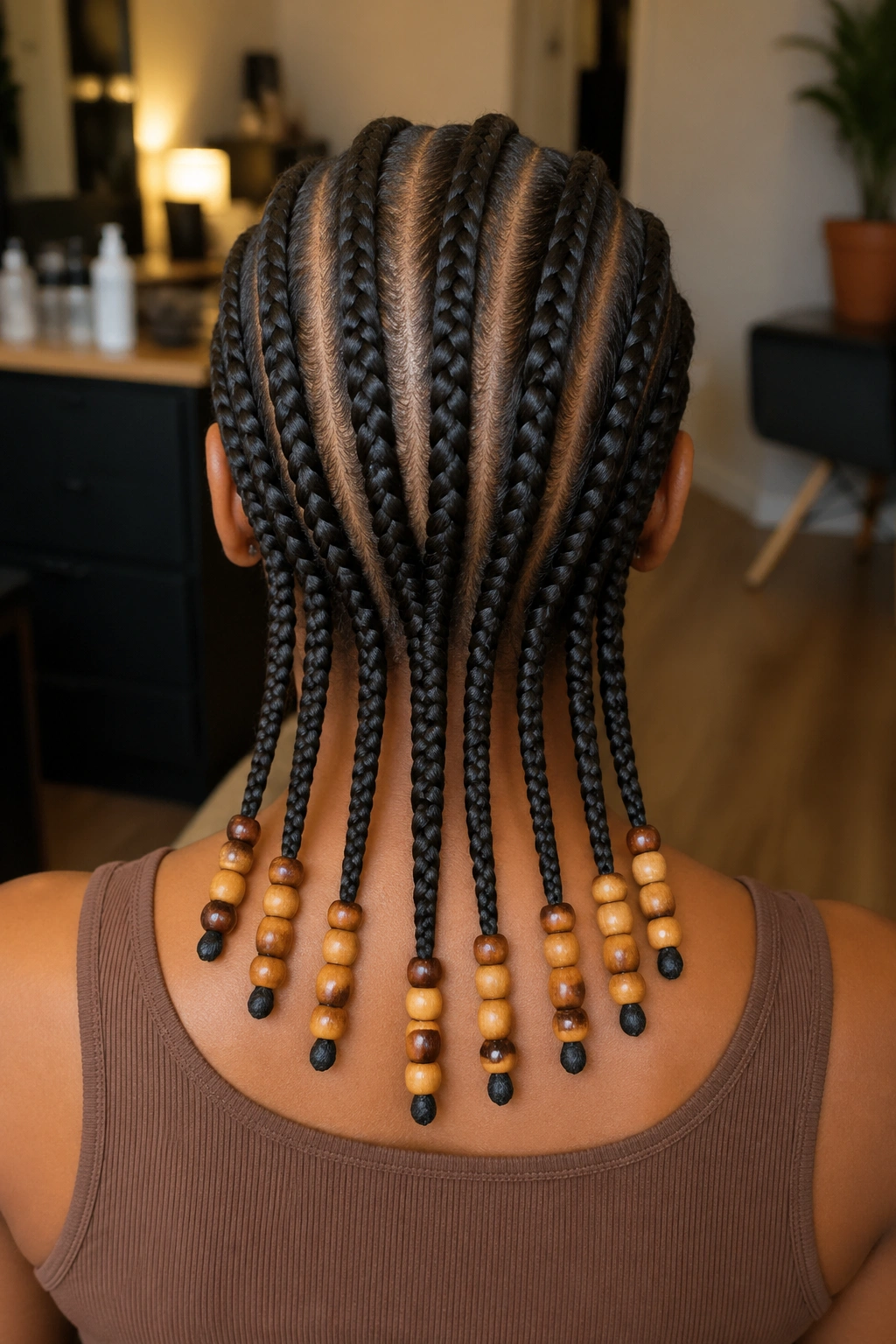
Start with beads. Remove each bead one at a time, cutting the rubber band securing it first. Don’t try to slide beads over the rubber bands — you’ll damage the braid.
Save the beads. Clean them gently with mild soap and water, dry completely, and store for the next install.
Once beads are off, cut the feed-in synthetic hair at the end of each cornrow. Feed-in hair shouldn’t be unraveled from the tip upward — you’ll lose hair as you go.
Unbraid each cornrow carefully from tip to scalp, applying conditioner generously as you reach the area near the roots where shed hair has collected.
After full takedown, shampoo twice and deep condition. Feed-in cornrows hold moisture less than natural styles, so your hair benefits from extra moisture after the install cycle ends.
Choosing the Right Version
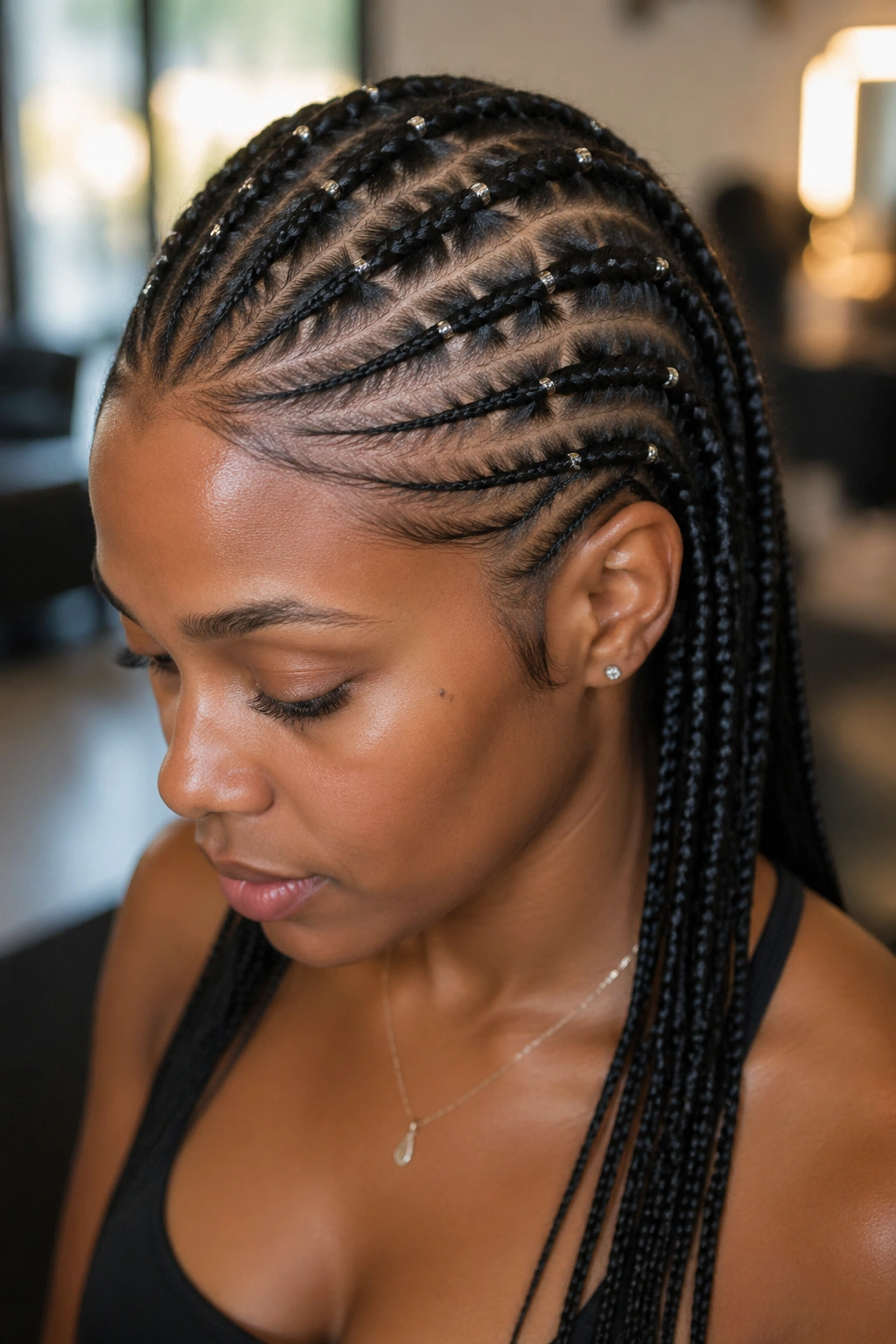
Match the style to the purpose.
- Daily wear: Classic All-Back, Small Seed Beads, Boho Scattered
- Professional settings: Stitch Braids, Pearl Beads, Feed-In With Curly Ends
- Events and occasions: Beaded Crown Bun, Gold Clusters, Oversized Statement
- Cultural or heritage events: Cowrie Shells, Bone and Horn, Traditional Patterns
- Festival and creative: Colorful Bead Pattern, Beaded Fringe, Mixed Textures
- Softer romantic looks: Curly Ends With Beads, Half-Up Half-Down, Pearl Beads
Feed-in cornrows with beads reward planning and patience. The install takes longer than standard cornrows. The maintenance requires more attention. But the finished style — when done well — carries weight, shows craftsmanship, and lasts through weeks of wear looking as intentional on day 20 as on day 1.
