



Goddess cornrows with curls sit in a sweet spot that most protective styles can’t quite reach. You get the sleek, scalp-hugging lines of traditional cornrows, but softened by loose, spiraling curls that tumble around your face and shoulders. The effect is part warrior, part siren. And unlike rigid box braids or stiff lemonade braids, goddess cornrows with curls carry movement — the curls bounce when you walk, the braids anchor the shape, and the whole look reads as intentional rather than fussed over.
This isn’t a beginner style, though. The fusion of tight cornrows with soft curly ends demands real technique, and the curls themselves need the right prep or they’ll frizz by day three. That’s where most people go wrong. They nail the braid pattern and then pick the wrong hair for the curl bundle, or they curl with too much heat, or they forget to wrap the curls at night.
So here’s the honest breakdown. What goddess cornrows with curls actually are, how to plan the style, what hair works best, and 22 specific variations you can bring to your braider or try yourself. Each one is genuinely different — different parting, different curl placement, different mood.
What Goddess Cornrows With Curls Actually Mean
The term gets tossed around loosely, which isn’t helpful. In strict usage, goddess cornrows with curls means cornrowed hair along the scalp that ends in loose, wavy, or tightly curled ends — usually achieved with water-wave, deep-wave, or loose-curl kanekalon bundles added during the braid-down.
The cornrows themselves can be any pattern. Straight back, zigzag, side-swept, or stacked into a central motif. What defines the style is the transition zone where the flat braid releases into curls. Done well, the transition is nearly invisible — the braid softens into a curl cascade with no obvious seam. Done poorly, you see a hard knot at the end with a pigtail of straight synthetic hair sticking out.
The fix is technique. Curls should be added during the braid, not tied on at the end. That’s the difference between looking styled and looking stuck.
Why Curls Change the Whole Equation
Adding curls doesn’t just change the look. It changes the weight, the care routine, the lifespan of the style, and how you sleep. Straight cornrows with loose ends or beads are low-maintenance. Curls demand a little more attention.
You’ll need to keep the curls defined, which means a leave-in spray and sometimes a light mousse. You’ll need to sleep in a satin bonnet big enough to hold the curl volume without crushing it flat. And you’ll need to accept that by week three, the curls will have loosened into waves — which many people prefer anyway.
The trade-off worth knowing: goddess cornrows with curls usually look their best between day 2 and day 14. Freshly done, they can look too perfect. After two weeks, they soften into something lived-in and gorgeous.
Choosing the Right Hair for the Curl Bundle
Not all synthetic hair holds curl. Here’s what works.
- Water-wave kanekalon — gives you loose, beachy spirals that don’t tighten up over time
- Deep-wave bundles — tighter, more defined, looks more polished
- Freetress Equal water-wave — widely available, pre-curled, great for beginners to the style
- Human hair blends — more expensive, but curls reshape after wet-sets and last the full life of the style
Avoid yaki straight hair and try-to-curl-later approaches. You’ll burn the fiber or end up with frizz you can’t fix.
Tip that matters: dip the synthetic curls in hot water (near boiling, about 180°F) for 3-5 seconds before braiding in. This resets the curl and removes the plastic shine that makes cheap kanekalon look obviously fake.
Prep, Tools, and Time Commitment
Before sitting down for goddess cornrows with curls, your natural hair needs to be clean, moisturized, and stretched. Not bone-straight — stretched. Blown out gently or banded overnight. This stops the cornrow base from bumping and lifting at week two.
You’ll want:
- Rat-tail comb for parting
- Edge control or hair gel (avoid anything flaky — check it under a light after it dries)
- Two to four packs of curly synthetic hair depending on fullness desired
- Hair clips to section off
- Scissors for trimming ends after braiding
Expected time? Four to seven hours for a full head, depending on how detailed the parting is and how experienced your braider is. Budget the whole afternoon.
1. Center-Part Goddess Cornrows With Loose Spiral Curls
This is the foundation version — and honestly, the one most people should start with. The hair is parted straight down the middle, with roughly 6-8 cornrows on each side, braided back and angled slightly toward the crown before releasing into water-wave curls that hit mid-back.
Why It Works
The center part frames both sides of your face evenly, which is flattering on almost every face shape. The loose spiral curls add softness around the shoulders without overwhelming the clean geometry of the braid-down.
- Parts remain visible from every angle, which keeps the style looking sharp
- Curls fall naturally over the shoulders and back rather than hiding the braid work
- Works at almost any length — chin-grazing bob curls or waist-length cascades
- Pairs well with hoop earrings because the ears stay visible
Styling tip: when the stylist adds the curl bundle, the fiber should meet the natural hair about two inches past your ear. Any higher and the curl volume fights the braid. Any lower and you get a visible straight section before the curls start.
2. Side-Swept Goddess Cornrows With Face-Framing Curls
Every cornrow here sweeps diagonally from one side of the head toward the opposite shoulder, with the curls released into a lopsided cascade. A few tendrils are pulled out at the temples to soften the effect.
The mood is cinematic. Something between a red-carpet look and a beach photo. The asymmetry keeps your eye moving around the style instead of locking on one feature, and the pulled-out tendrils trick the eye into reading the braids as more natural than they are.
It looks best on round or oval face shapes, because the sweep elongates the face vertically. On longer face shapes, it can stretch the proportions too much — stick with symmetrical parts instead.
What you’ll want to watch for: the side-swept angle puts uneven tension across the scalp. The braider needs to keep the pulling consistent or you’ll develop a sore spot on the opposite side from the sweep direction. Mention it if anything feels tight before the first braid is finished.
3. Zigzag-Parted Goddess Cornrows With Coily Ends
Can a simple parting change really shift the whole style? Yes, completely. Replace the straight back lines with zigzag parts — sharp angles that pivot every 2-3 inches — and you’ve gone from standard goddess cornrows to something editorial.
The curls at the ends should match the energy of the part: tighter, coilier, more defined. Think kinky-curly or deep-wave rather than loose spiral. The tight coils echo the sharp zigzag and keep the eye engaged. Loose waves would fight the geometry.
How to Style It
- Ask for zigzag parts that change direction 3-4 times before releasing the braid
- Choose kinky-curly synthetic hair — Freetress Bohemian or X-Pression Brazilian Twist work well
- Keep the ends trimmed even and blunt for contrast against the jagged parts
- Finish with a light-hold spray, not a heavy one, or the coils turn crunchy
4. Small Cornrows, Big Curls
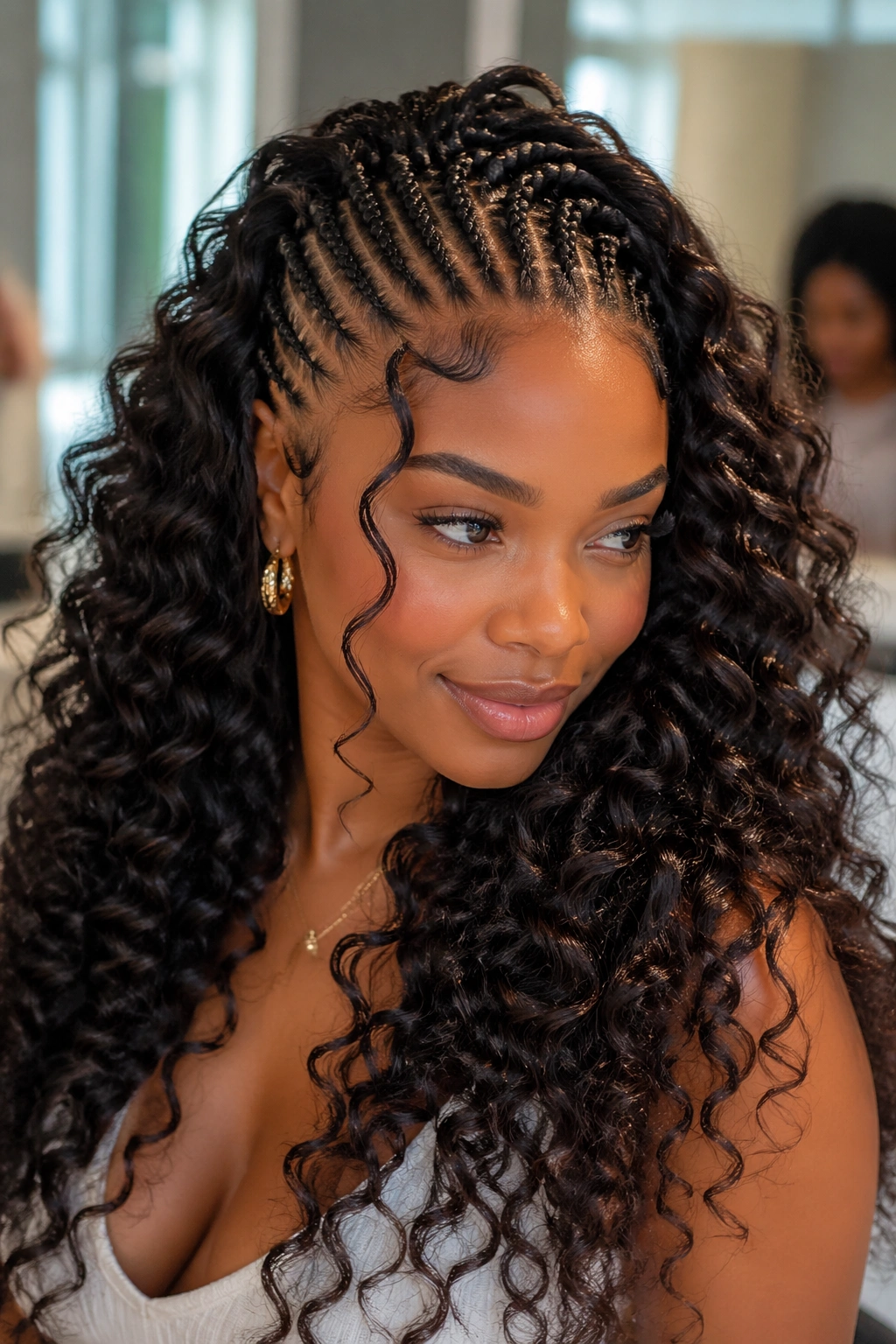
Here’s the contrast that makes this version so strong. Very thin cornrows along the scalp — sometimes 16 to 20 braids total — release into oversized, voluminous curls that double or triple the apparent width of the head.
The visual trick is all about proportion. Tiny braids read as a restrained, almost austere crown. Then the curls hit and the whole look expands outward. The effect is architectural, and photographs exceptionally well because the two textures create strong contrast.
You need patience for the install. Small cornrows can take six or seven hours for a full head, and the curl bundles need to be generous — at least four packs — to get the volume right. But the payoff is a style that genuinely looks different from almost anything else in the goddess family.
One caveat. The small cornrows put more tension per square inch than bigger braids. If your edges have been under stress recently, size up. Medium cornrows with big curls work nearly as well with less strain on the hairline.
5. Halo Cornrows Ending in a Back Cascade of Curls
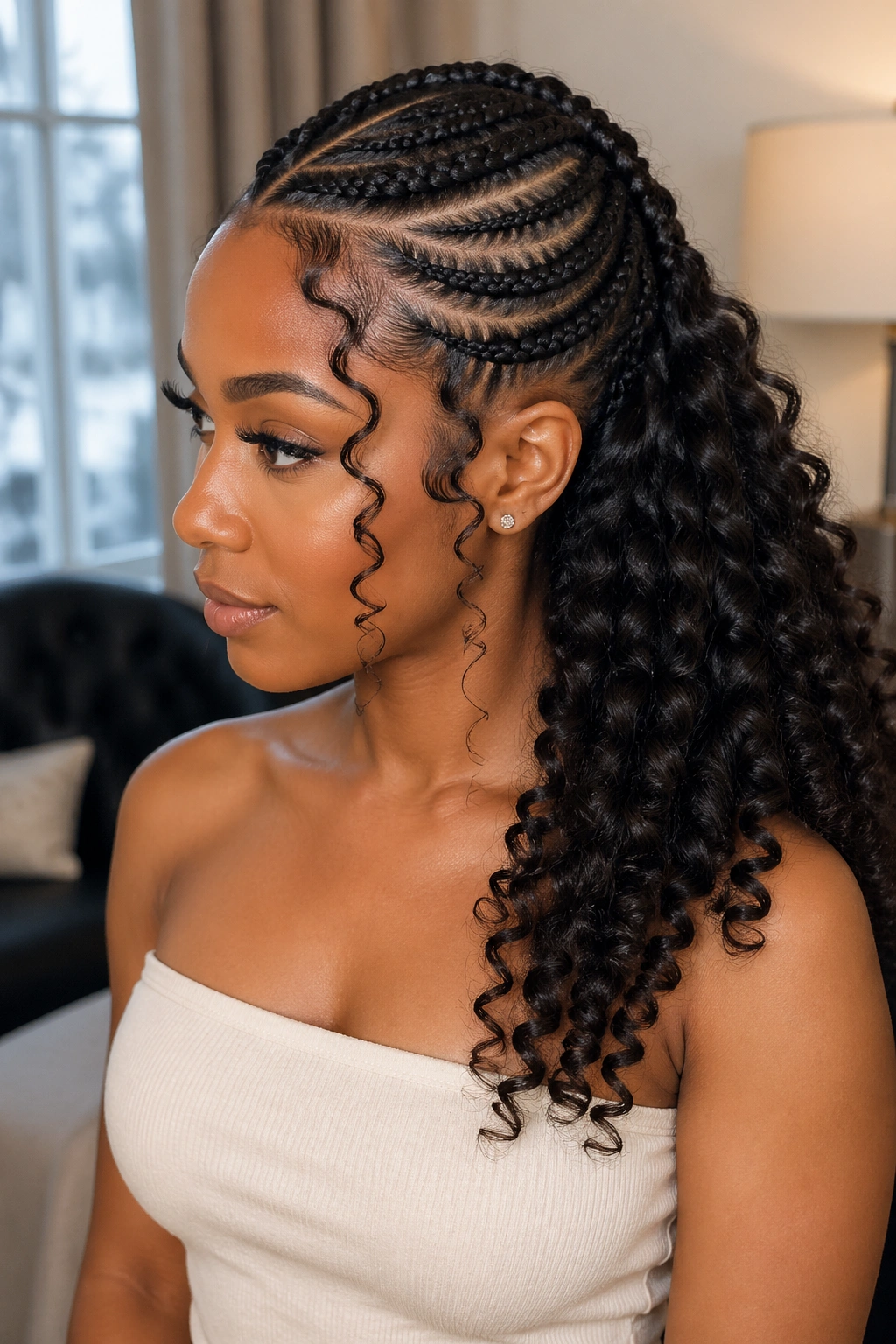
Unlike the straight-back versions that dominate the style, this approach runs the cornrows in a circular pattern — around the crown like a halo — before releasing them all down the back of the head into a thick wave of curls.
What’s different: the halo pattern hides the transition almost entirely. The cornrows spiral into each other at the back, and when the curl bundles are added at the merge point, the result looks more like a waterfall than a set of braids with curls tacked on. It’s the goddess style that reads most like one continuous piece of hair rather than a braid-plus-curl assembly.
Who This Is For
- Anyone who wants a softer, less obvious braid pattern
- Those who dislike the look of visible scalp parts
- People with round face shapes — the halo elongates the crown
- Anyone planning to wear the style for a formal event
Not recommended for very short natural hair — the halo pattern requires at least 3-4 inches of natural length to hold the circular braid tension.
6. Boho Goddess Cornrows With Curly Wisps and Beads
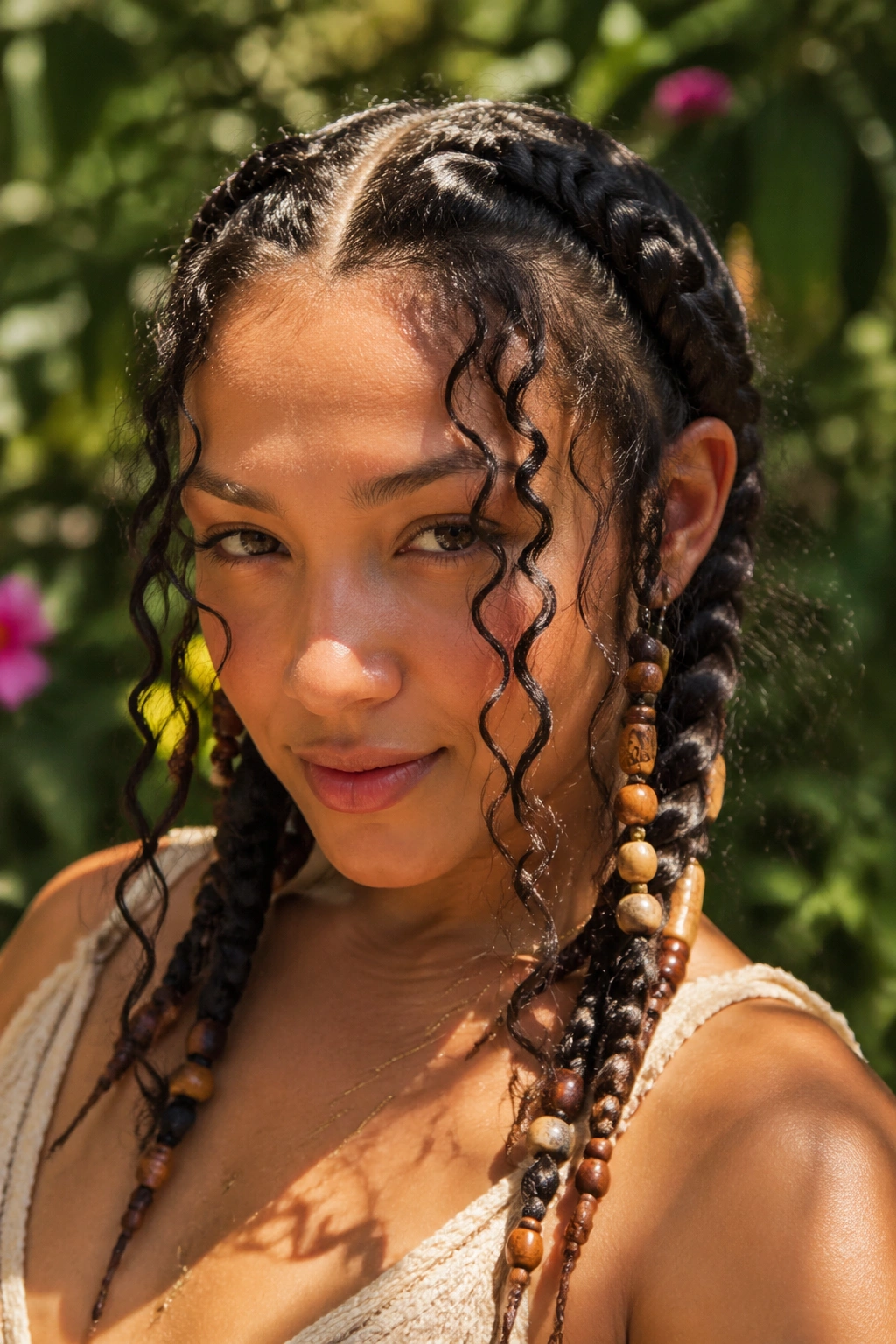
Two cornrows, usually — one on each side of a deep center part — with loose curly strands pulled out along the braid line to create a lived-in, beachy feel. A few wooden or gold beads are threaded through the braids and into some of the curly wisps.
The wisps are what separate this from standard two-braid goddess styles. Ask the braider to reserve thin sections of curly hair as they go, tucking them out at irregular intervals so they fall loose rather than braiding in. When it’s done right, the braids look half-unraveled in the best possible way.
A word on the beads: wooden beads photograph better than plastic and won’t yellow over time. Gold-tone beads work well with warm skin undertones but can look cheap if they’re too shiny — matte gold reads more expensive. Stick to three or four beads per braid maximum. More than that and the look crosses into costume territory.
Lifespan is shorter on this version. About 3 weeks compared to the 5-6 weeks tight goddess cornrows can hold. The loose wisps tangle faster.
7. Stacked Goddess Cornrows With Cascading Curls at the Nape
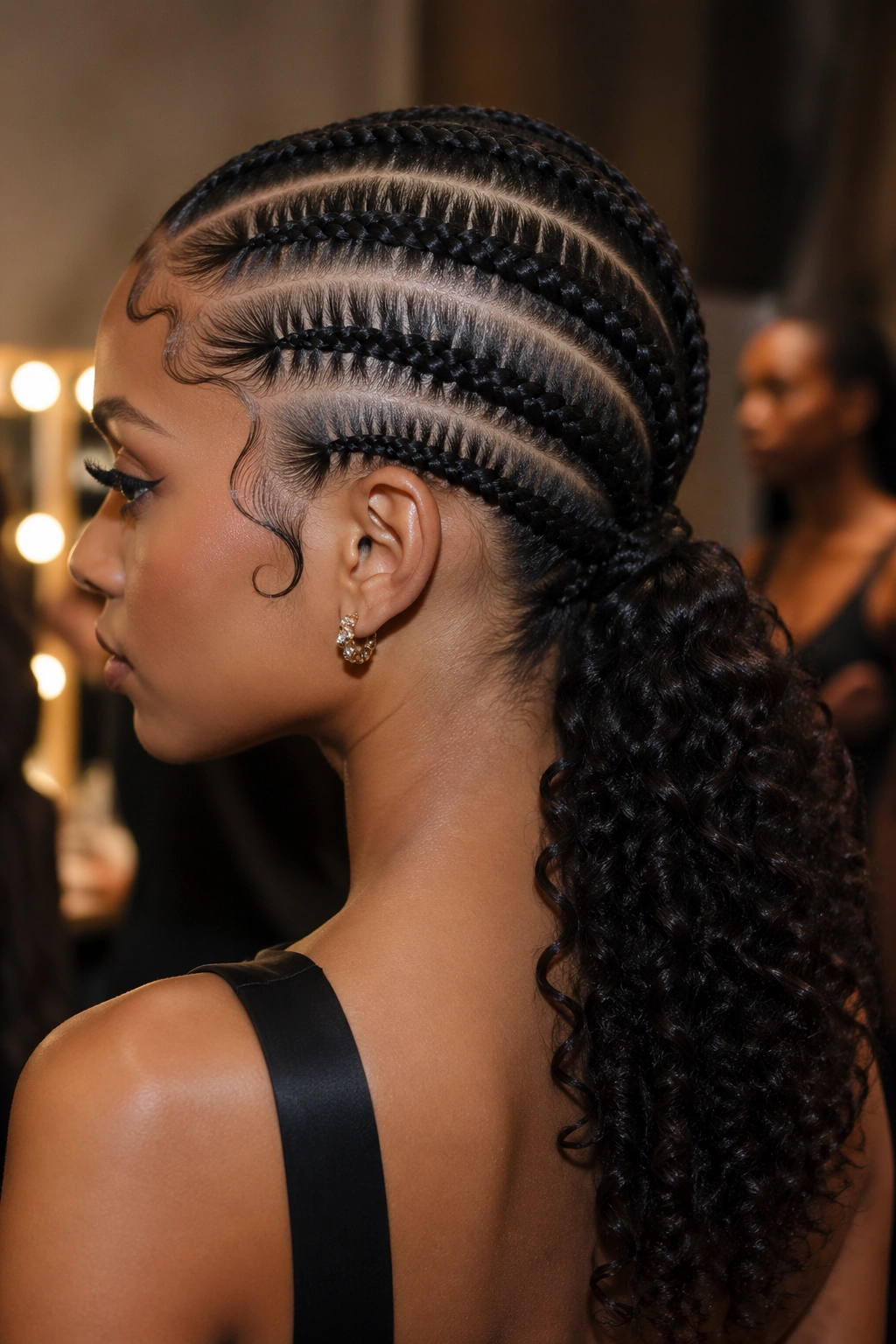
Picture four to six cornrows stacked horizontally across the crown — running ear to ear — that all converge at the nape and release into curls that cascade down the back. It’s an unusual pattern that creates a strong horizontal line at the top of the head.
Most people haven’t seen this version and aren’t sure what to make of it at first. That’s the point. It’s editorial. It sits closer to the runway than the daily rotation, but worn with confidence, it draws genuine compliments. Especially in photos where the horizontal stack creates a visual weight at the top that the curls balance underneath.
The technique demands a skilled braider. The stacked horizontal rows need to sit at even intervals — about an inch apart — and all the braid ends need to meet at roughly the same point at the nape before the curl bundle is attached. Get one braid running off at the wrong angle and the whole look falls apart.
Save it for events or shoots. For everyday wear, it attracts more questions than you might want to answer.
8. Middle-Part Cornrows Fading Into Soft Romantic Curls
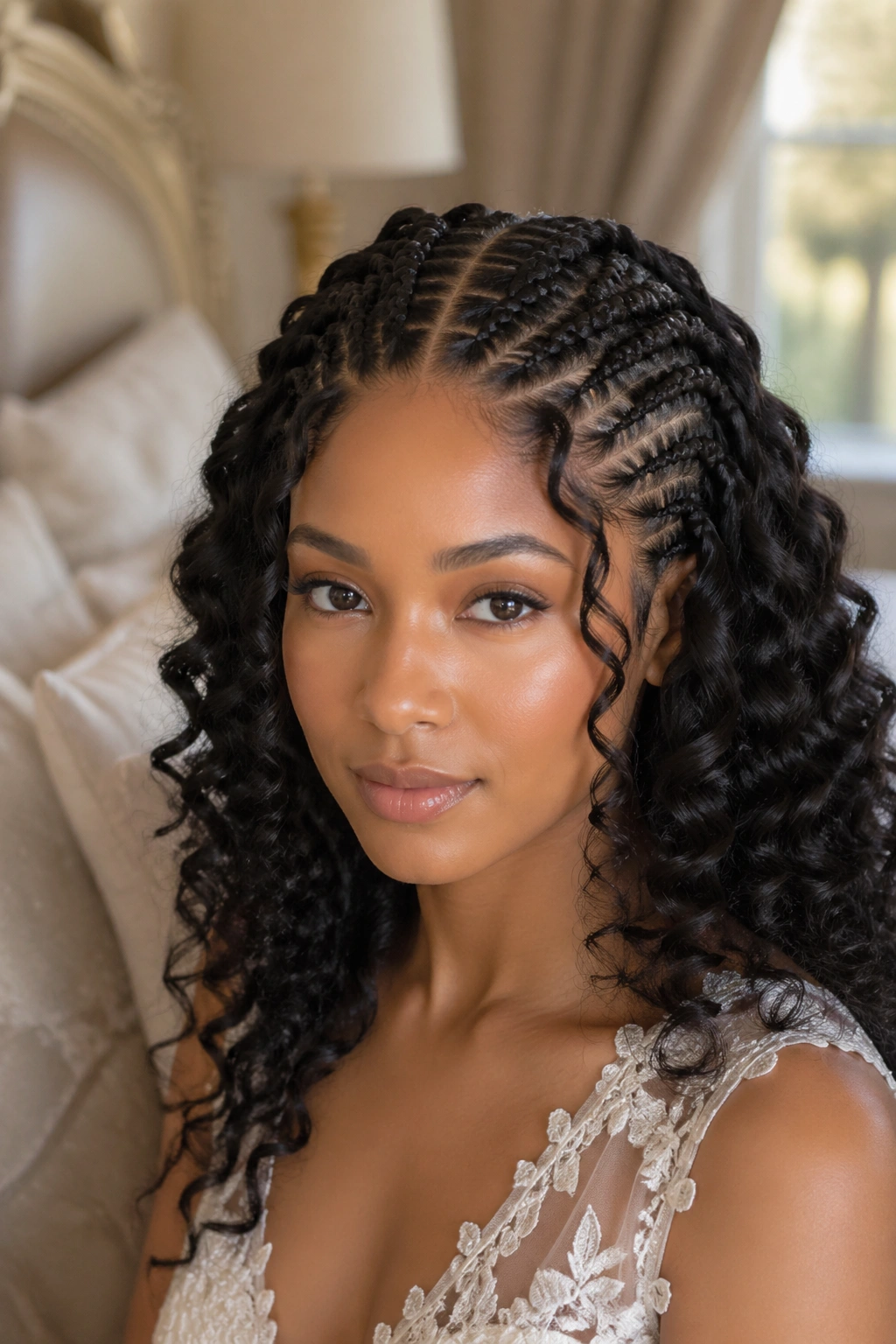
The parts are clean and crisp down the middle and sides, but the curl bundles used are a loose 1-inch barrel wave rather than tight spirals. The effect is bridal — soft, polished, genuinely romantic.
This is my favorite goddess variation for formal events. The clean parts keep the style looking done and intentional, while the loose curls soften everything so you don’t read as armored or severe. Pair it with pearl drop earrings and you’re dressed for any occasion that calls for lace.
The tension between structure and softness is what makes the look work. Too tight on the curls and you get a prom-2002 feel. Too loose and the style looks undone. A barrel-wave synthetic — or human hair wet-set with rollers — hits the right middle ground.
For the best finish, ask your stylist to brush through the curls gently once they’re installed. Just a light brush. This breaks up the uniform spiral pattern and gives the curls a brushed-out, fuller texture that reads more elegant.
9. High-Ponytail Goddess Cornrows With Curl Cascade
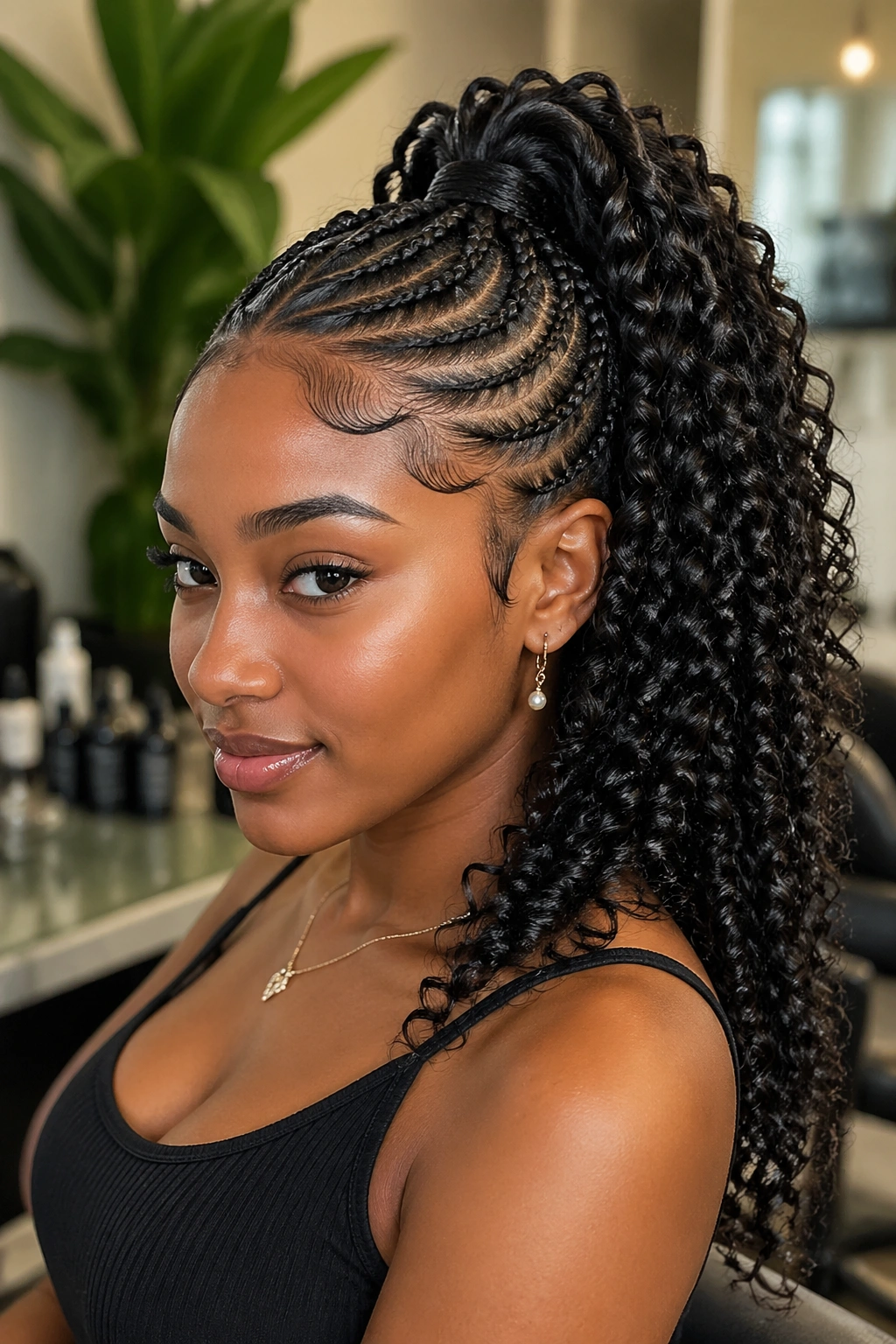
Every cornrow on the head funnels up and back toward a single high gathering point at the crown, where the braids release into one dense cascade of curls that falls from the top of the head down the back.
What Makes It Different
Unlike standard goddess cornrows where the braid ends spread across the back, this version concentrates the curl volume at the crown, creating a true ponytail effect without needing a separate attached pony piece.
- Puts the focal point high and central — the curl cascade becomes the star
- Elongates the neck and shoulders visually
- Needs longer synthetic hair — 24-30 inches minimum — to get the proportions right
- Should be paired with minimal jewelry so the ponytail reads clearly
Watch for: the concentrated tension at the crown. All the braids pulling toward one point creates more strain than standard goddess patterns. If you feel throbbing at the crown within the first hour, ask for the braids to be loosened immediately.
10. Freestyle Goddess Cornrows With Mixed Curl Types
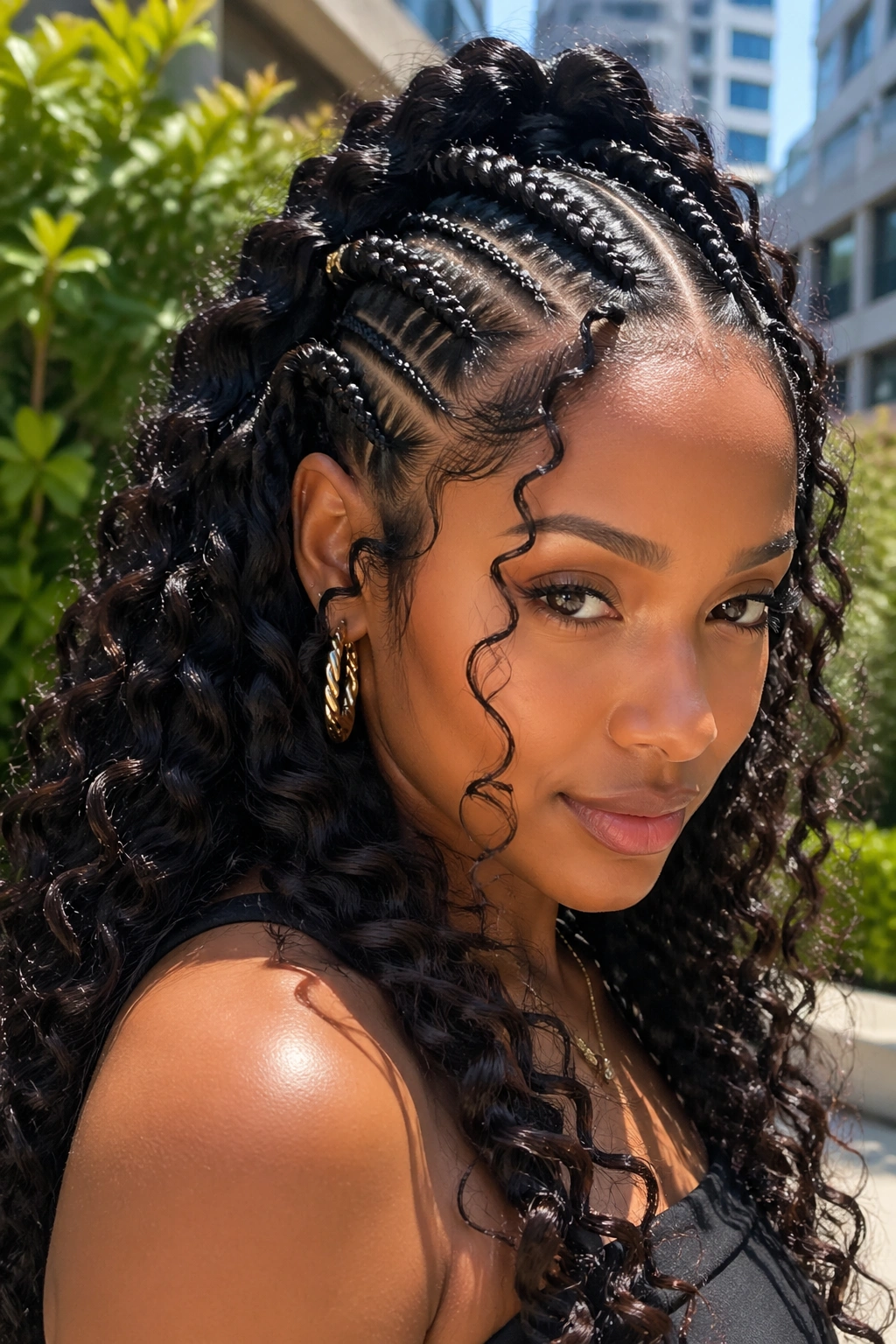
Instead of one uniform curl texture across the entire style, this version uses two or three different curl patterns in different sections — maybe deep-wave on the sides, loose spiral at the back, and a few face-framing tendrils in kinky-curly.
It sounds chaotic. In practice, the mixed textures feel organic — more like naturally varied hair than synthetic at all. The eye reads the variation as authenticity, which is the whole trick.
The challenge: coordinating the curl types so they blend rather than clash. I’d recommend staying in the same curl family. All waves, just different sizes. Or all spirals, just different tightnesses. Mixing a loose wave with a tight coil on the same head usually reads as a mistake instead of a choice.
Done right, you’ll hear a lot of “is that your real hair?” Which is, of course, the highest compliment a protective style can earn.
11. Thick Jumbo Cornrows With Curly Ends for a Bold Statement
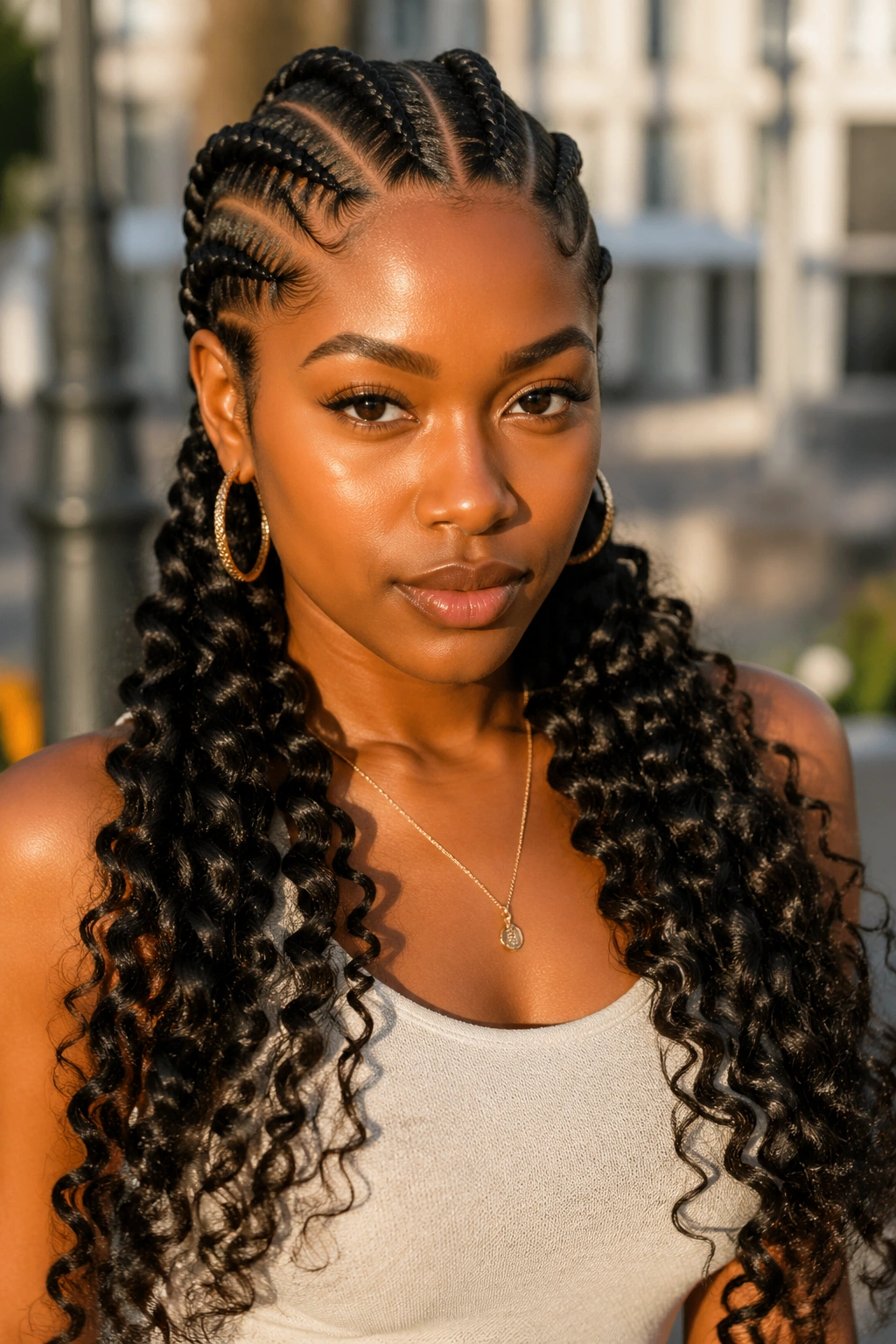
Four to six jumbo cornrows — each about an inch wide — braided straight back, ending in loose, voluminous curls. This is goddess cornrows at their most confident. No fussy detail. No tiny braids. Just big, strong lines leading into big, strong curls.
The payoff is speed and impact. A skilled braider can finish jumbo cornrows with curls in under three hours, and the resulting style reads dramatic from across a room.
What’s less discussed is how quickly jumbo cornrows lose their crispness. The thick braids are heavier, which means they sag against the scalp by week two. To extend the life, sleep on a silk pillowcase in addition to the bonnet, and consider a light re-tightening of the front row around day 10 if you plan to wear the style past three weeks.
Big braids also mean visible parts. The part lines between jumbo cornrows need to be sharp and clean at install or the whole style looks sloppy. Ask to see a mirror before the curl bundle goes in, and speak up if any part is crooked. Easier to redo one braid than live with it for a month.
12. Goddess Cornrows With Curls and a Baby Hair Statement
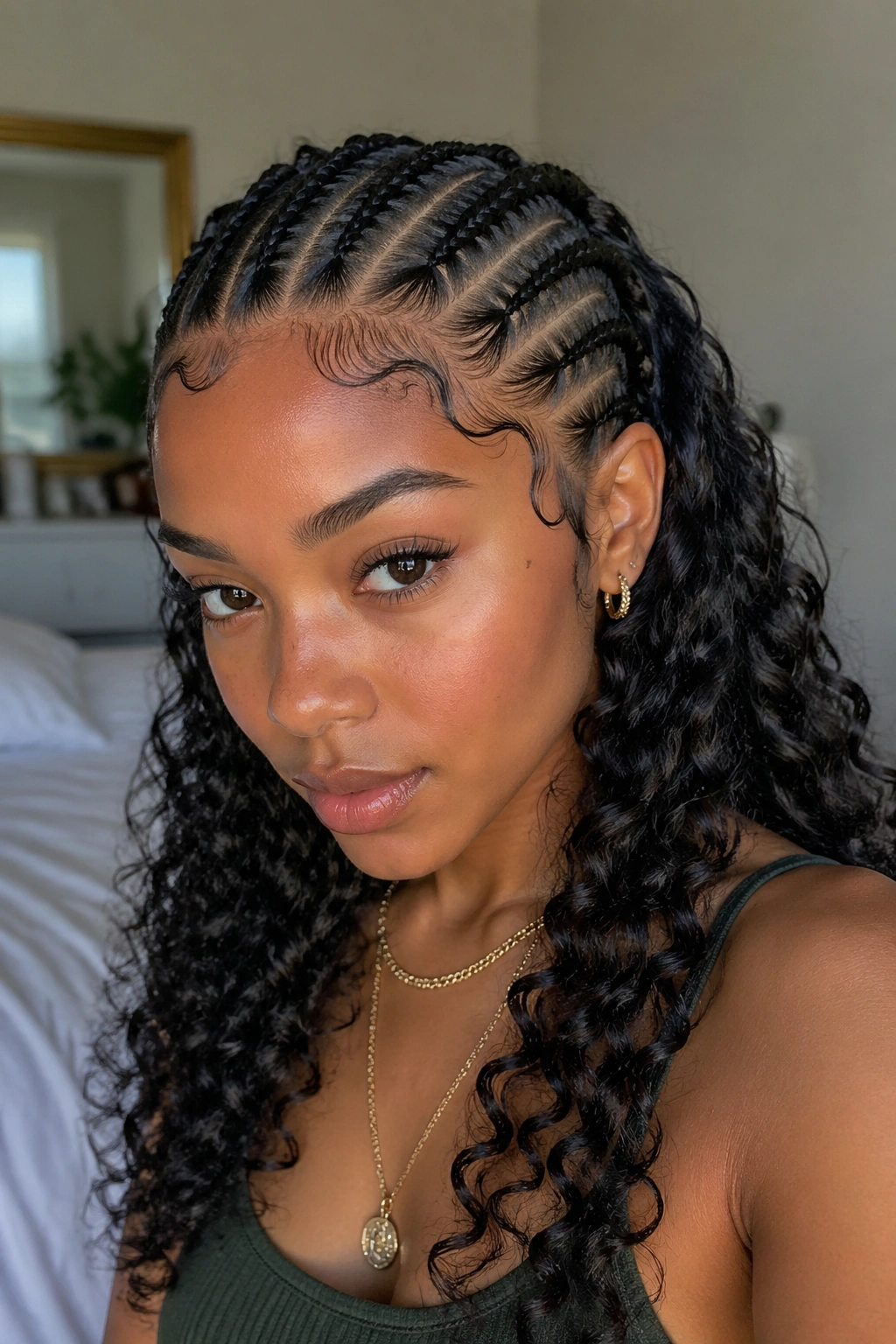
The braiding and curls are classic goddess — two to four cornrows on top, curls released at the back — but the baby hairs become the feature. Swoops, curls, and swirls laid along the forehead and temples with edge control, set with a soft-bristle brush.
Good baby hairs can take an average install from nice to striking. They’re the punctuation marks at the start of the sentence, and when someone does them well, everyone notices.
Styling Tips
- Use a soft-bristle edge brush, not a toothbrush (which leaves hard tracks)
- Apply edge control in a small amount — a pea-sized dab per section
- Wait for the first layer to set fully before adding another
- Keep the swoops at or above the brow line, never dipping toward the eye
Baby hairs fade fastest of anything in the style. Expect to redo them every 2-3 days. Keep your edge gel and brush in your bag.
13. Middle Cornrow Stripe With Curls on Either Side
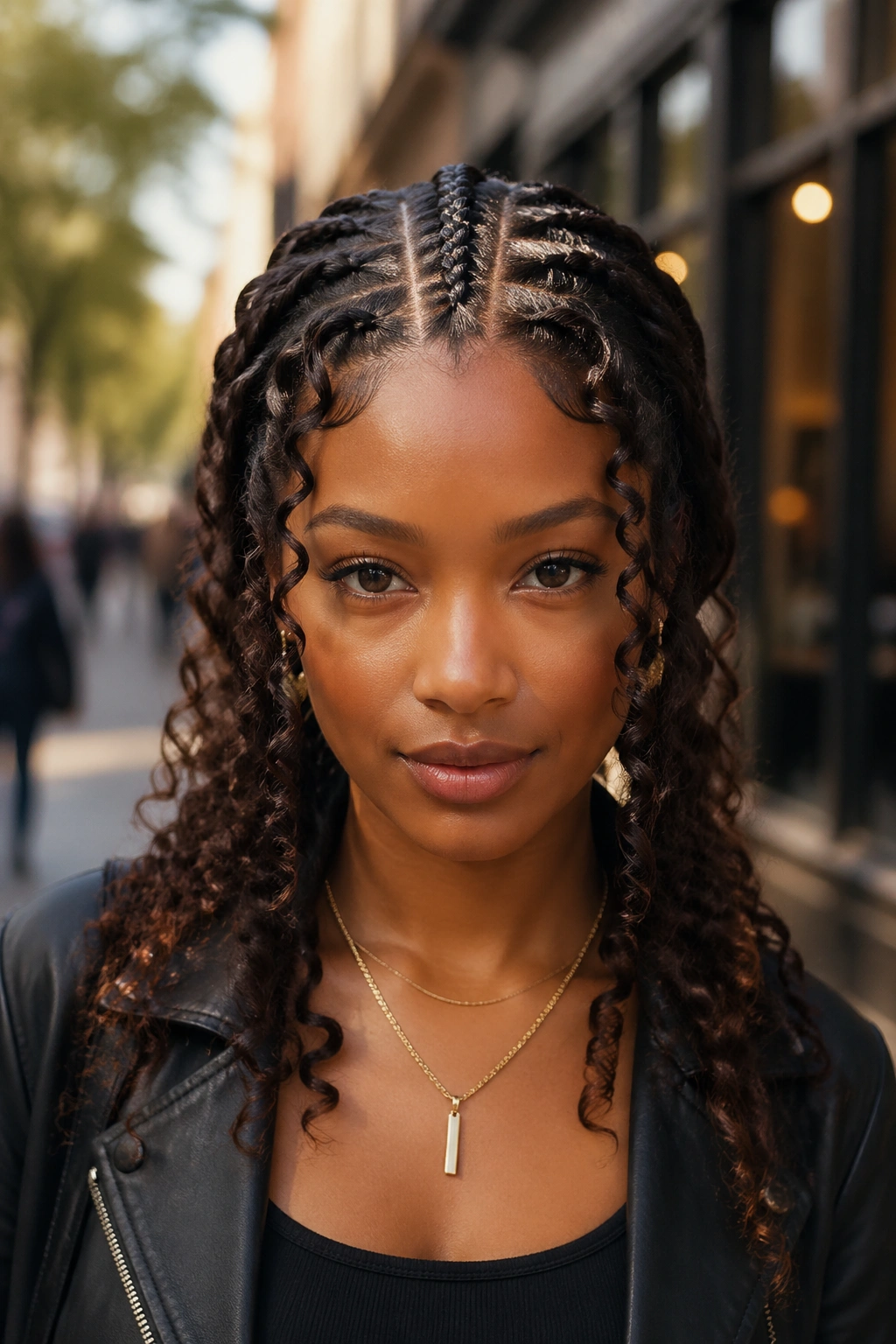
One single, dominant cornrow down the middle of the head — sometimes thicker than the rest, sometimes feed-in — with shorter, smaller cornrows on each side, all releasing into loose curls that fall from the temples and back.
The central braid becomes a strong vertical line, almost like the spine of the style. The smaller side braids frame it and the curls soften the edges. It’s a thoughtful, architectural look that works beautifully for someone who wants goddess cornrows but finds the standard versions too soft.
It photographs well from the front because the central stripe draws the eye right up the middle of the face. From the side, it reads more conventional, which makes it a flexible choice for work and special occasions alike.
A small warning: the central cornrow is doing most of the visual heavy lifting, so if it comes loose or gets fuzzy, the whole style suffers. Keep it protected at night with extra care, and carry a small tub of edge gel for touch-ups.
14. Goddess Cornrows With Curly Side-Fringe
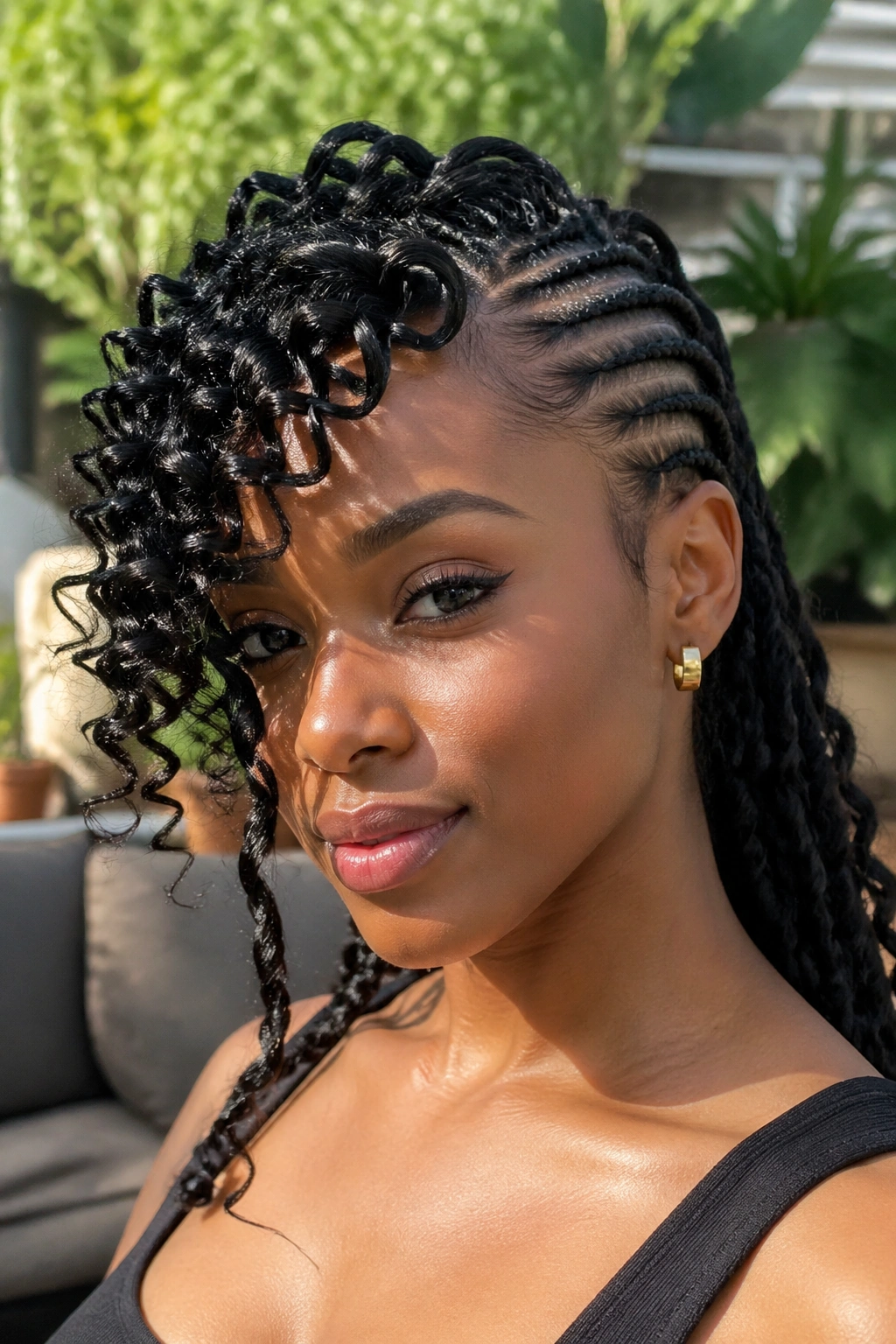
The cornrows go back traditionally, but on one side near the temple, a section of curly hair is left loose to fall across the forehead like a side-swept fringe. It’s a small detail that changes the whole personality of the style.
The fringe reads as a wink. It softens the protective-style seriousness and gives you a piece of curl near your face that you can actually play with during the day. Tuck it behind an ear, let it fall across your eye, pin it back — the fringe becomes a daily styling choice.
Choose a curl texture for the fringe that matches the back curls. A loose spiral fringe with tight coils at the back will look disconnected. Keep the same curl family so it reads as one style, not two.
Real talk: a curly fringe transfers oil and product from your face to the hair faster than back curls do. Wash or rinse the fringe more often than the rest of the style — about every 4-5 days with a cleansing conditioner. Otherwise it’ll feel greasy and look stringy by week two.
15. Cornrow Braids With Curls in Two Ponytails
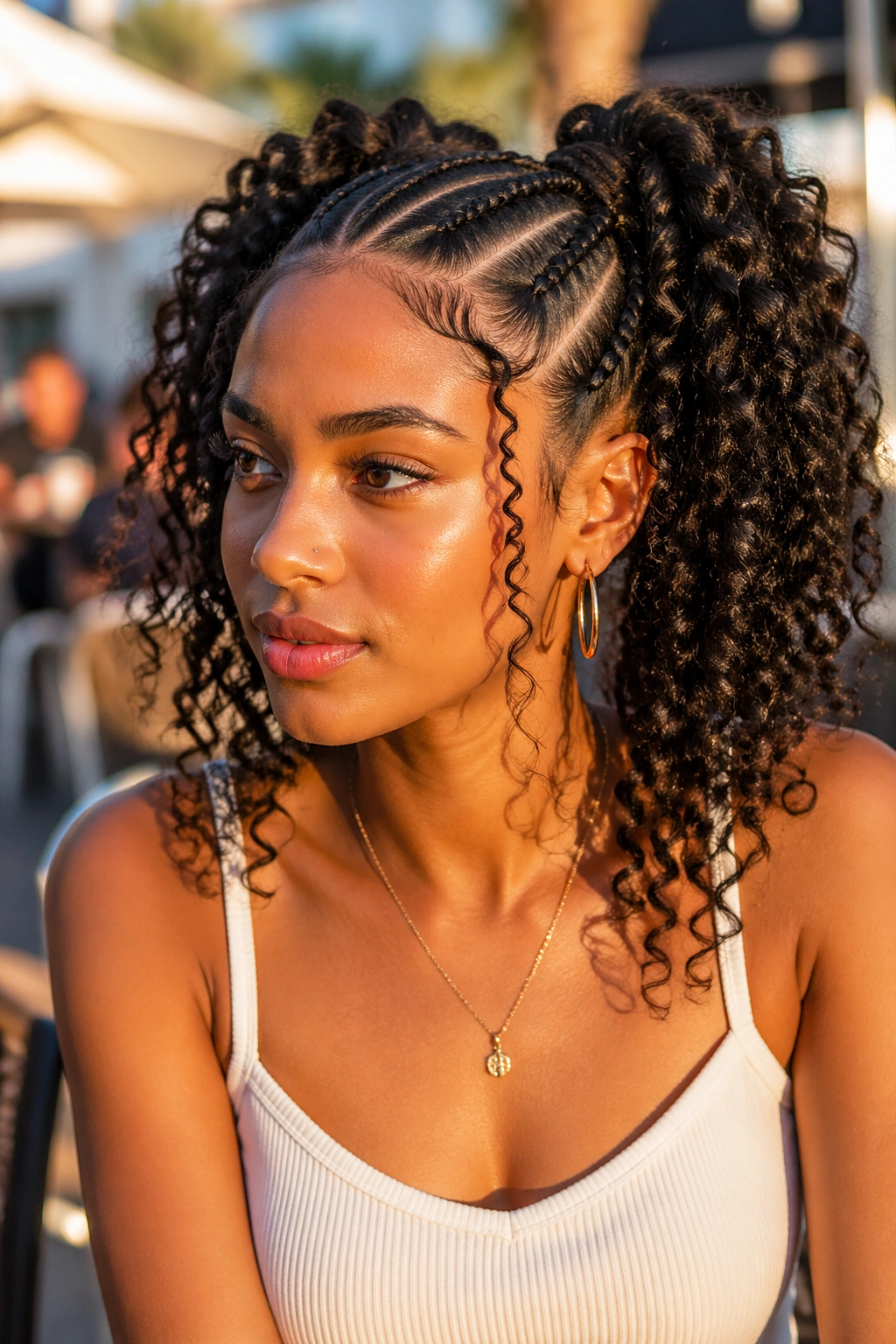
Two medium cornrows run diagonally from the part to the crown, where they release into two high curled ponytails — one on each side, bouncy and defined.
It’s playful and young, without tipping into costume. The double-pony anchoring keeps the proportions balanced, and the curls give the style enough maturity that it works past college age.
Who This Is For
- Festival-goers and concert-bound folks
- Vacation hair for beach or resort trips
- Anyone who wants a style that feels light and fun rather than formal
- Works especially well for women in their 20s and early 30s
Skip this one for professional settings where a more subdued look is expected. The double-pony is joyful but it’s not meeting-room hair.
16. Sleek Cornrows With Undone Curls and Flyaway Texture
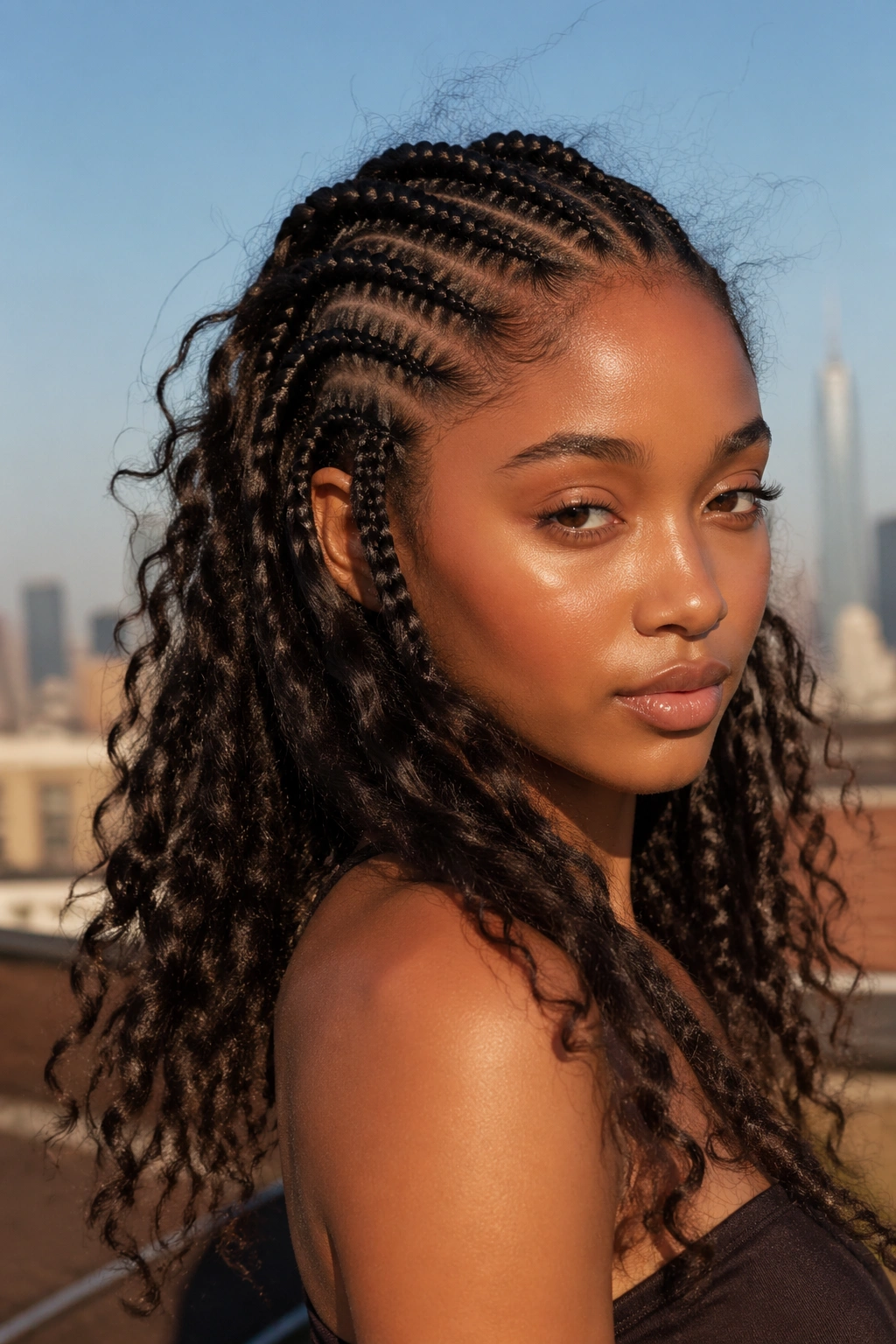
The cornrows are laid with precision — sharp parts, tight braids, impeccable edges — but the curls are deliberately loose, slightly frizzy, with flyaways left unstyled. The contrast is what sells it.
Perfection on the scalp. Wildness at the ends. The style draws on the same visual logic as a runway model in a couture gown with bedhead — the polished and the imperfect living side by side on purpose.
Most people resist the frizz. Fight that instinct. For this specific style to work, the curls need to feel like they haven’t been touched in three days. Use a light mousse on the curls at install, skip the finishing spray, and let the curl dry without scrunching. The result is hair that moves.
If you want this style and you’re naturally a polish-everything person, ask your stylist not to touch the curls once they’re installed. It’s harder to leave messy hair alone than it is to fuss with it.
17. Pattern-Parted Goddess Cornrows in Diamond or Triangle Shapes
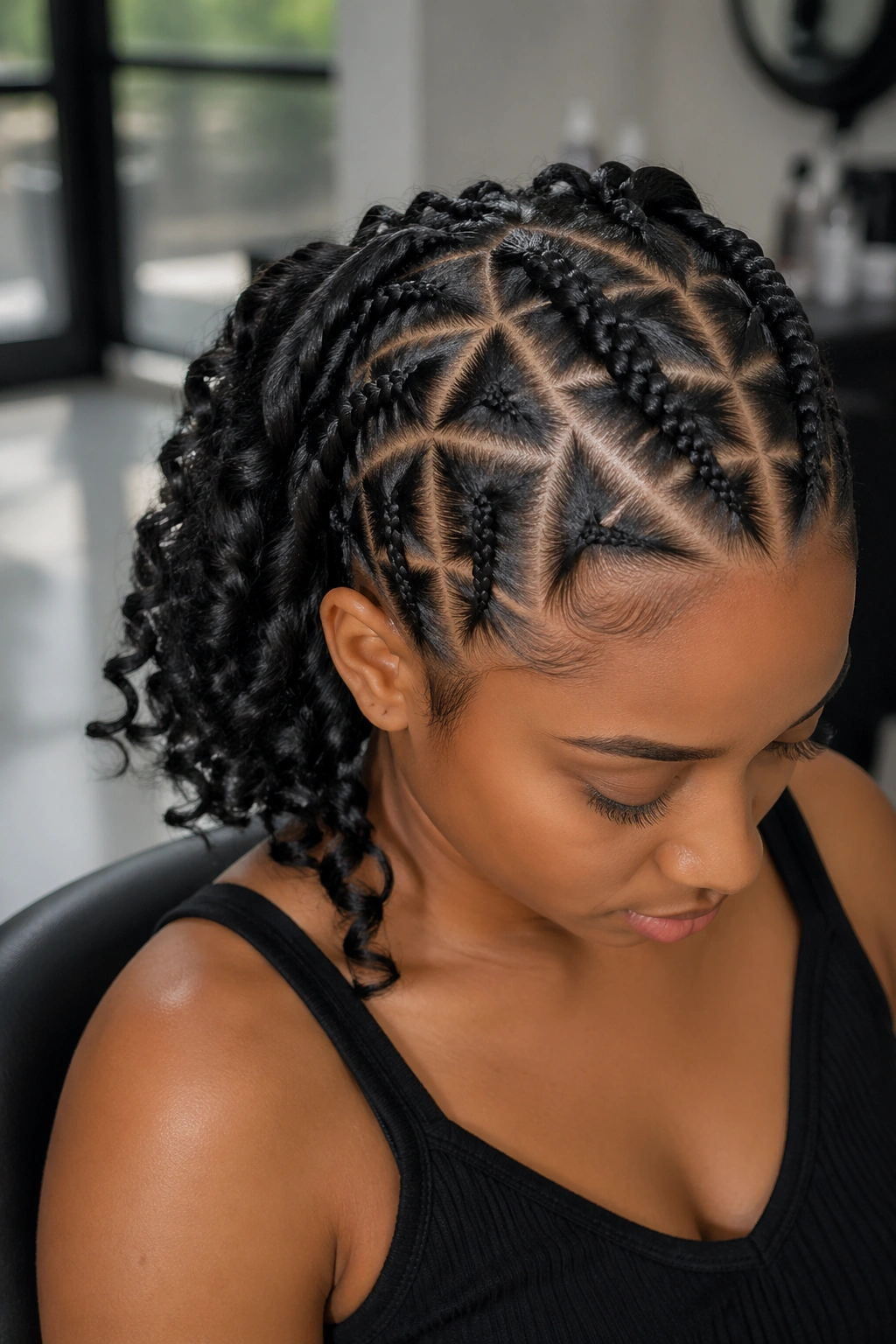
Rather than straight back, the parts form diamonds, triangles, or other geometric shapes across the scalp, with cornrows following those lines before releasing into curls at the nape or mid-back.
The parting is the art here. A skilled braider can create a pattern that looks like a tattoo on the scalp — clean lines intersecting at sharp angles, the curls almost an afterthought to the architecture underneath.
Popular pattern choices:
- Diamond repeats across the crown
- Single large triangle pointing forward, cornrows fanning from it
- Multiple small triangles creating a mosaic
- Chevron stripes running side to side
The pattern is the reason for the style, so don’t waste it by covering the crown with curls. Most stylists will release the curls lower — closer to the nape or even at the back of the neck — so the scalp design remains visible.
18. Classic Stitch-Braid Cornrows With Loose Wavy Ends
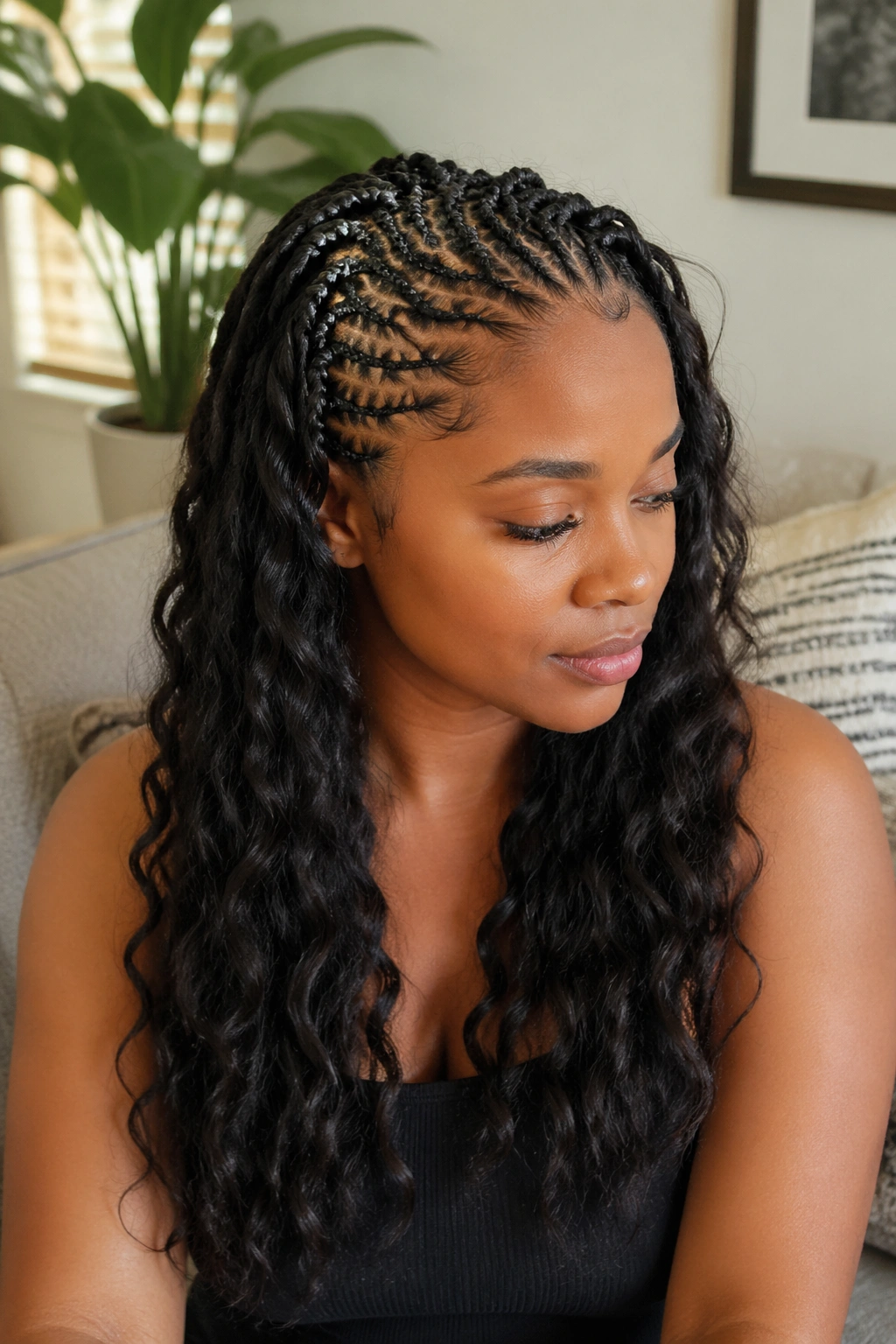
Stitch braids have overtaken plain cornrows in sheer popularity, and for good reason. The tiny horizontal ridges that run across the braid give it texture and depth, and when they end in loose wavy curls, the full effect is more intricate than standard cornrows suggest.
What to Watch For
- Stitch braiding takes longer — budget an extra 1-2 hours
- The stitch pattern requires small, even sections — not every braider is trained in it
- Ask to see examples of their stitch work before booking
- Loose waves complement stitch braids better than tight spirals
The waves at the ends should be soft and undulating, not curly. Body-wave kanekalon works well here, or human hair tapered and beach-waved. Tight curls fight the delicate stitch pattern — keep the ends soft to let the stitching shine.
The practical truth: stitch braid cornrows last about a week less than standard cornrows because the intricate stitching is more prone to unraveling at the front. Trade-off worth making for the look, but factor it into your calendar.
19. Long Waist-Length Goddess Cornrows With Bouncy Curls
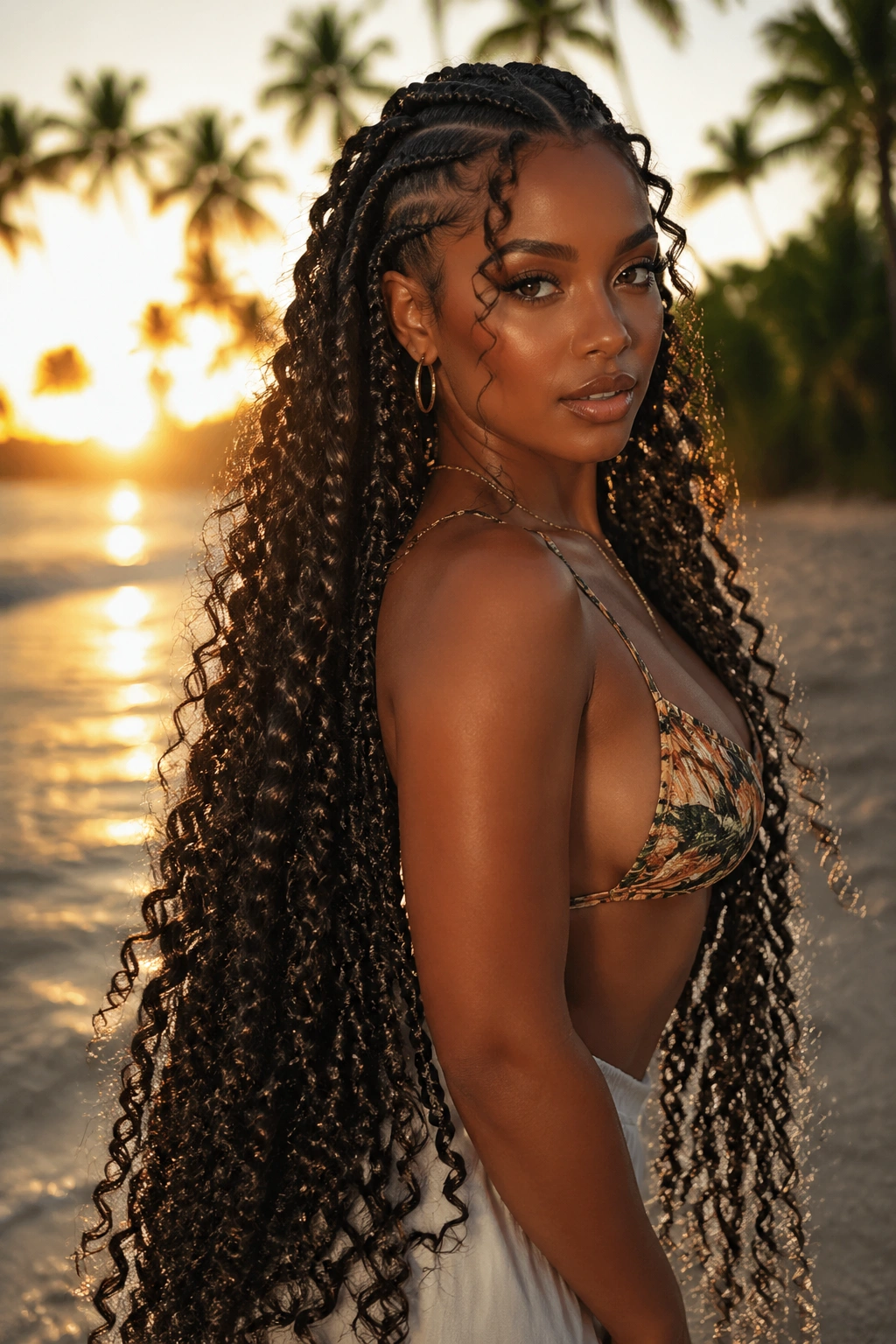
Sometimes the point is the length. The cornrows themselves are a classic straight-back pattern — nothing unusual on the scalp — but the curl bundle is exceptionally long. Waist-length. Nearly hip-length. The kind of hair that moves when you turn your head.
Long curl cascades need heavier synthetic hair so the curls hold their shape instead of flattening under their own weight. Look for deep-wave human hair blends rather than all-synthetic. Three to four packs minimum for full body.
The maintenance is real. Waist-length curls tangle faster, catch on zippers and bag straps, and need more time to moisturize. If you work with your hair down most of the time, budget an extra 15 minutes each morning to detangle gently with fingers before stepping out.
Worth noting: waist-length goddess cornrows have a shorter overall lifespan because the tension of long hair pulls on the braids faster. Expect 3-4 weeks instead of the 5-6 you might get with shoulder-length curls.
20. Goddess Cornrows With Curls and Decorative Cuffs
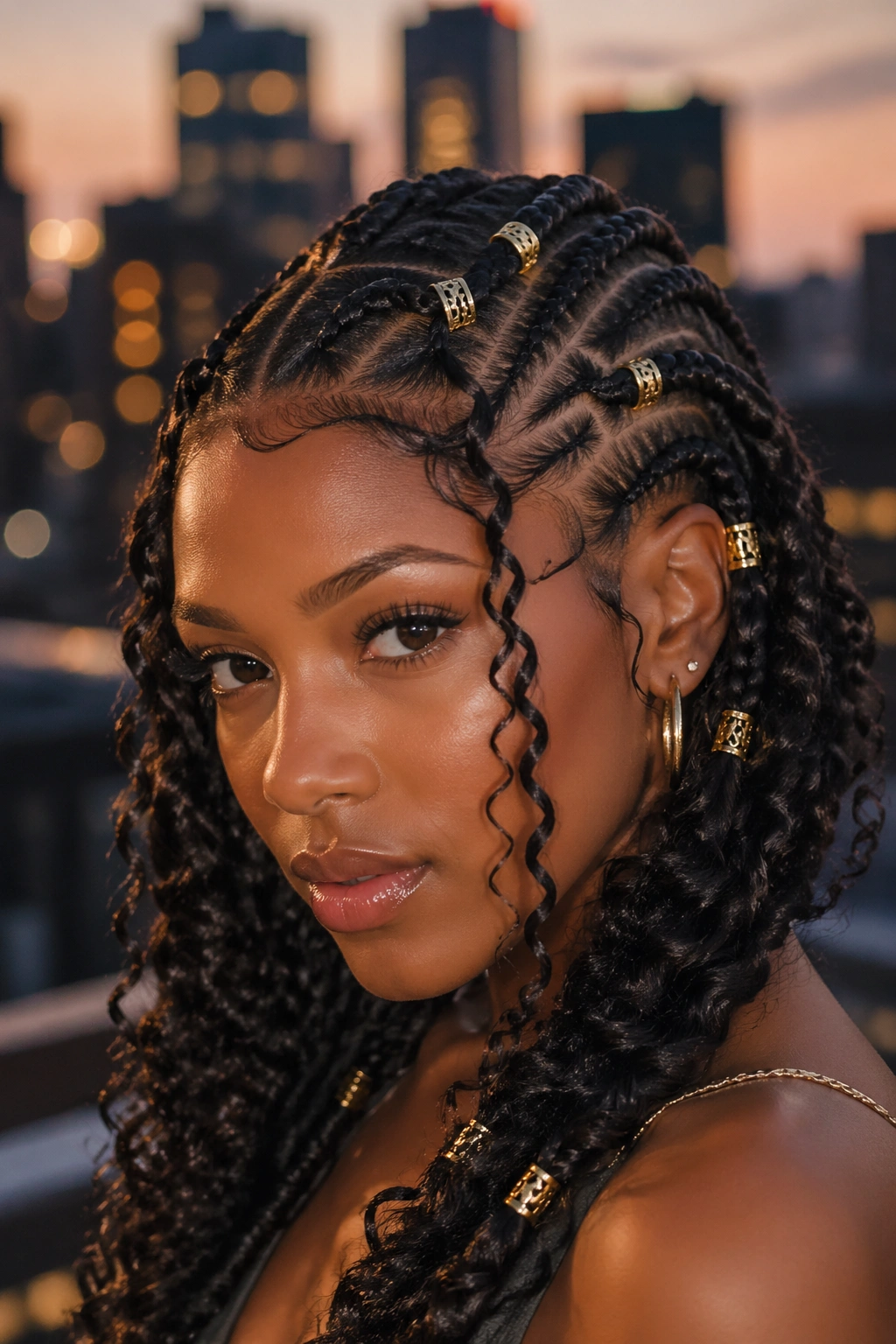
Small metal cuffs — gold, silver, or brass — threaded onto individual cornrows before the curl release. Usually three to five cuffs total, placed irregularly across the braids so the effect looks collected rather than symmetrical.
Cuffs are lower commitment than beads and read as more refined. They can be added after install and removed whenever, which gives the style flexibility across days and events. For a casual day, leave two cuffs. For a night out, add five and tuck a few near the face.
Material matters. Cheap cuffs dent and lose their finish fast. Invest in solid-brass or actual gold-plated cuffs if you plan to reuse them. They’ll hold up across multiple installs.
Placement Ideas
- Cluster two cuffs near the front of one braid for an asymmetric accent
- Space them evenly along one central braid for a linear pattern
- Use a single large cuff at the curl transition for a focal point
- Mix sizes — a big cuff plus two small cuffs on the same braid
Don’t overdo it. Fewer cuffs, better placement, more expensive finish. Always.
21. Tribal-Inspired Goddess Cornrows With Curls
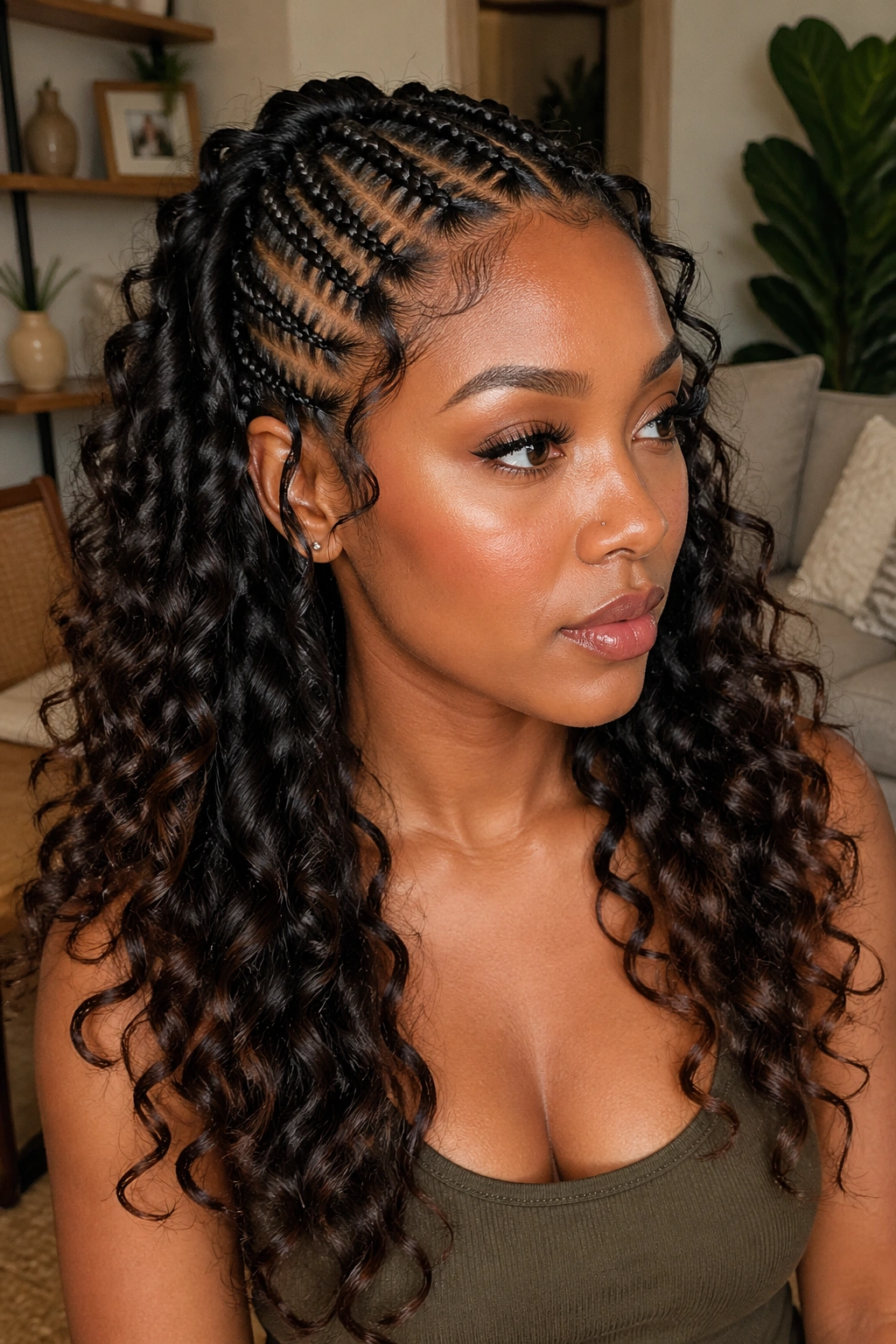
Drawing from traditional African braid patterns — Fulani-inspired middle part, thin cornrows at the sides, thicker braids framing the face — with curly ends that tumble past the shoulders. The detail in the braiding is what gives the style depth.
Unlike clean, symmetrical goddess cornrows, the tribal-inspired version uses irregular widths, unexpected part lines, and small decorative cornrows running at different angles. It’s layered, intentional, and rooted in centuries of braid artistry.
Work with a braider who knows the references. Fulani braids, Ghana braids, and Senegalese patterns each carry cultural weight, and they look best when executed by someone who understands the tradition. The curly ends are a modern addition, but the braid pattern itself deserves respect and attention.
Photographs exceptionally well because every angle shows a different detail. Front view gives the face-framing braids, side view shows the irregular pattern, back view reveals the curl cascade. A skilled braider makes every viewing angle worth a photo.
22. Pulled-Back Goddess Cornrows With a Curly High Bun
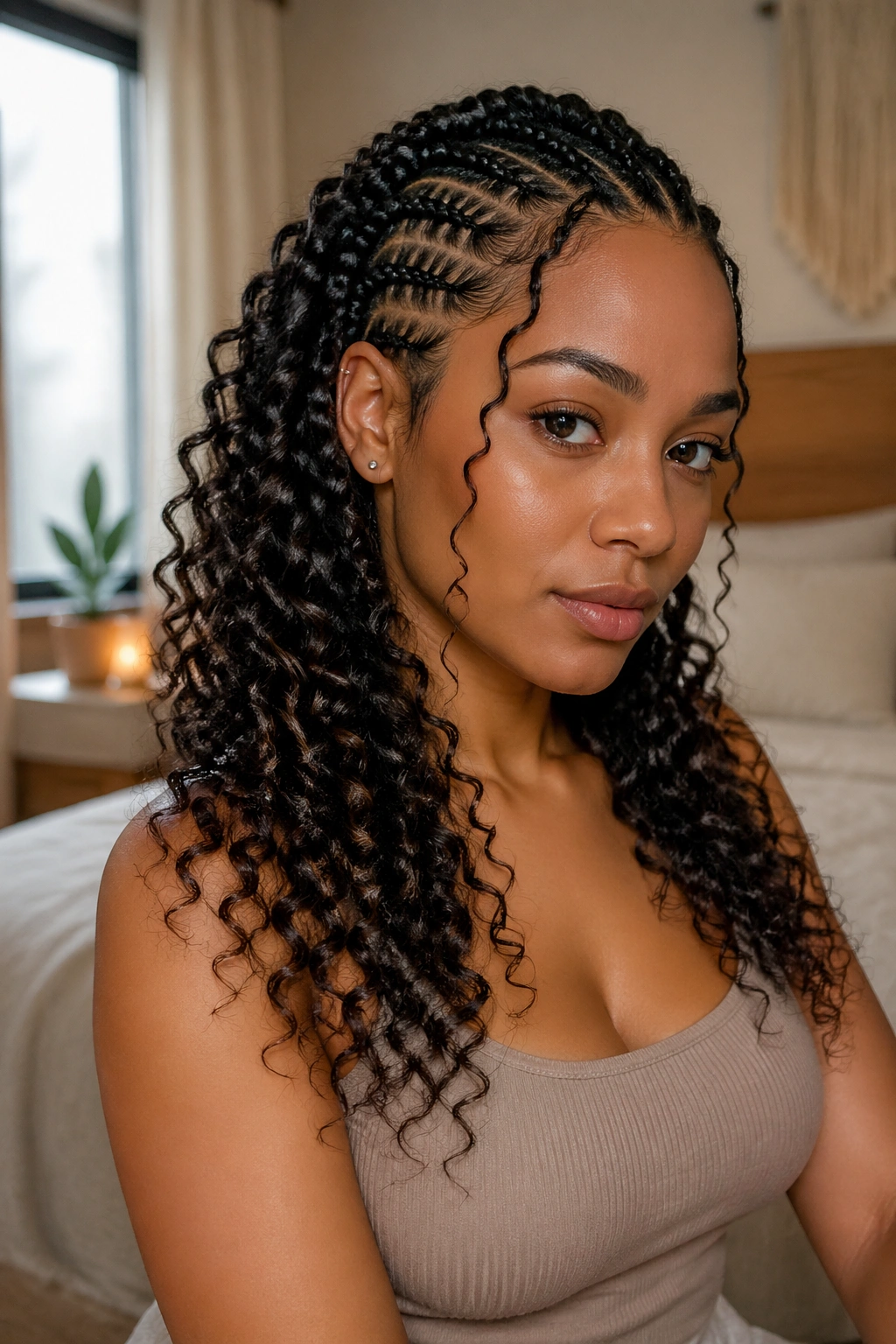
Instead of letting the curls fall freely, this version gathers them at the crown into a large, bouncy curly bun. The cornrows run clean up the back and sides, the bun sits high and full, and a few tendrils are pulled loose at the temples to soften.
Why It Works
The updo approach changes the entire shape of the style from long-and-flowing to architectural-and-contained. It’s goddess cornrows for workdays, weddings, and settings where hair out of the face is the priority.
- Keeps the curls protected and out of the way
- Shows off jewelry, especially statement earrings and necklaces
- Can be loosened at the end of the day for a different look
- Works on any face shape because the bun placement is adjustable
The secret: don’t make the bun too tight. A perfectly round, sleek bun looks stiff. A loose, slightly messy curly bun with volume and texture reads far more elegant. Pull out a few curls after pinning and let them fall.
Daily Maintenance: Making the Style Last
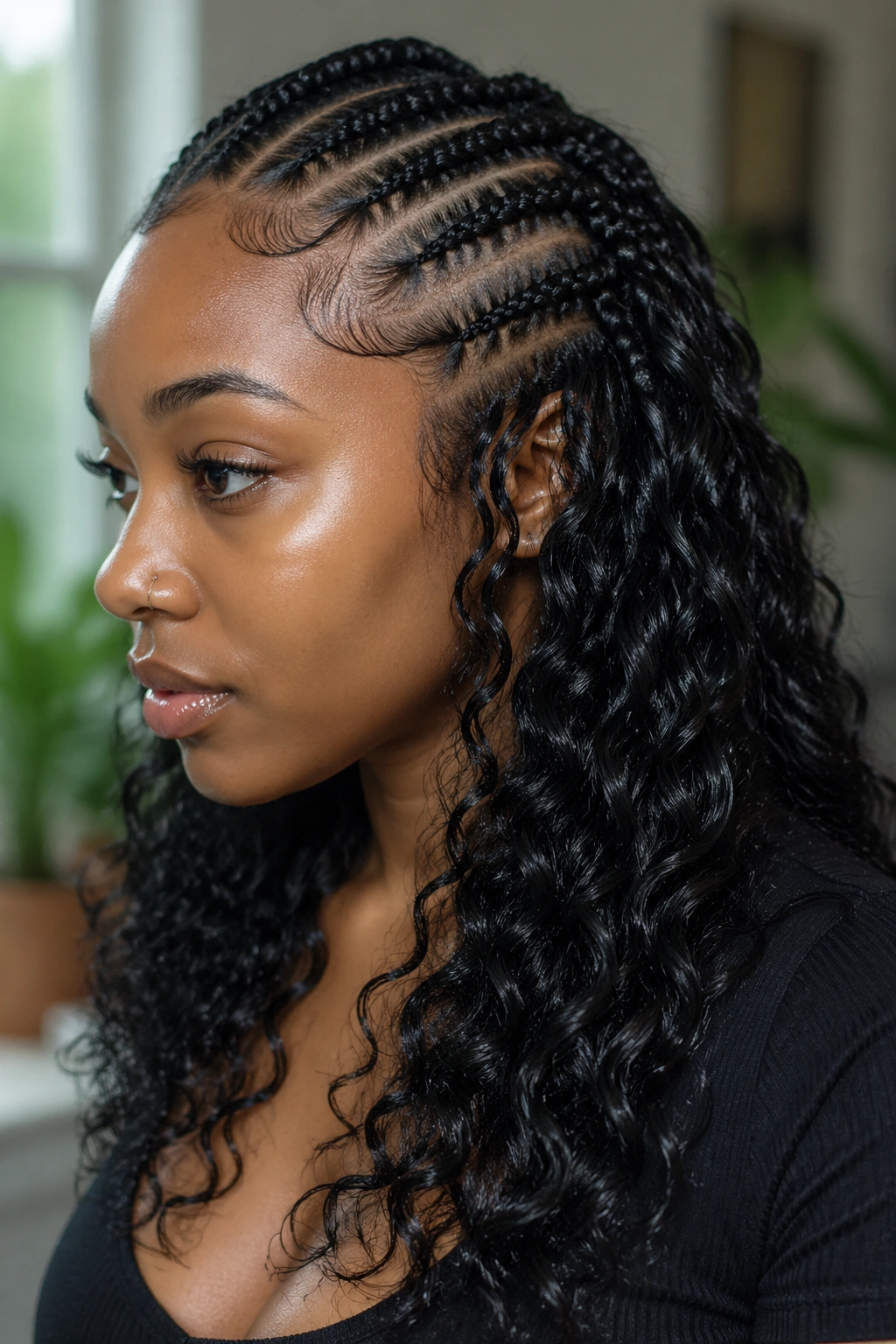
The braids themselves last weeks. The curls are what degrade fastest. Here’s how to stretch the lifespan.
Every morning, shake out the curls gently with your fingers — no brushing. Spray a light water-and-leave-in mix (50/50 ratio) from about 10 inches away so the curls get mist, not soak. Let them air-dry as you get ready.
Every 3-4 days, do a proper refresh. Mix 1 tablespoon of mousse into a spray bottle with 4 ounces of water, shake well, and spray over the curls section by section. Scrunch gently. Let dry. The curls will snap back to near-fresh definition.
Avoid touching the curls constantly. Hands transfer oil, and oil kills definition. Style in the morning and leave alone.
Scalp Care With Cornrows Underneath
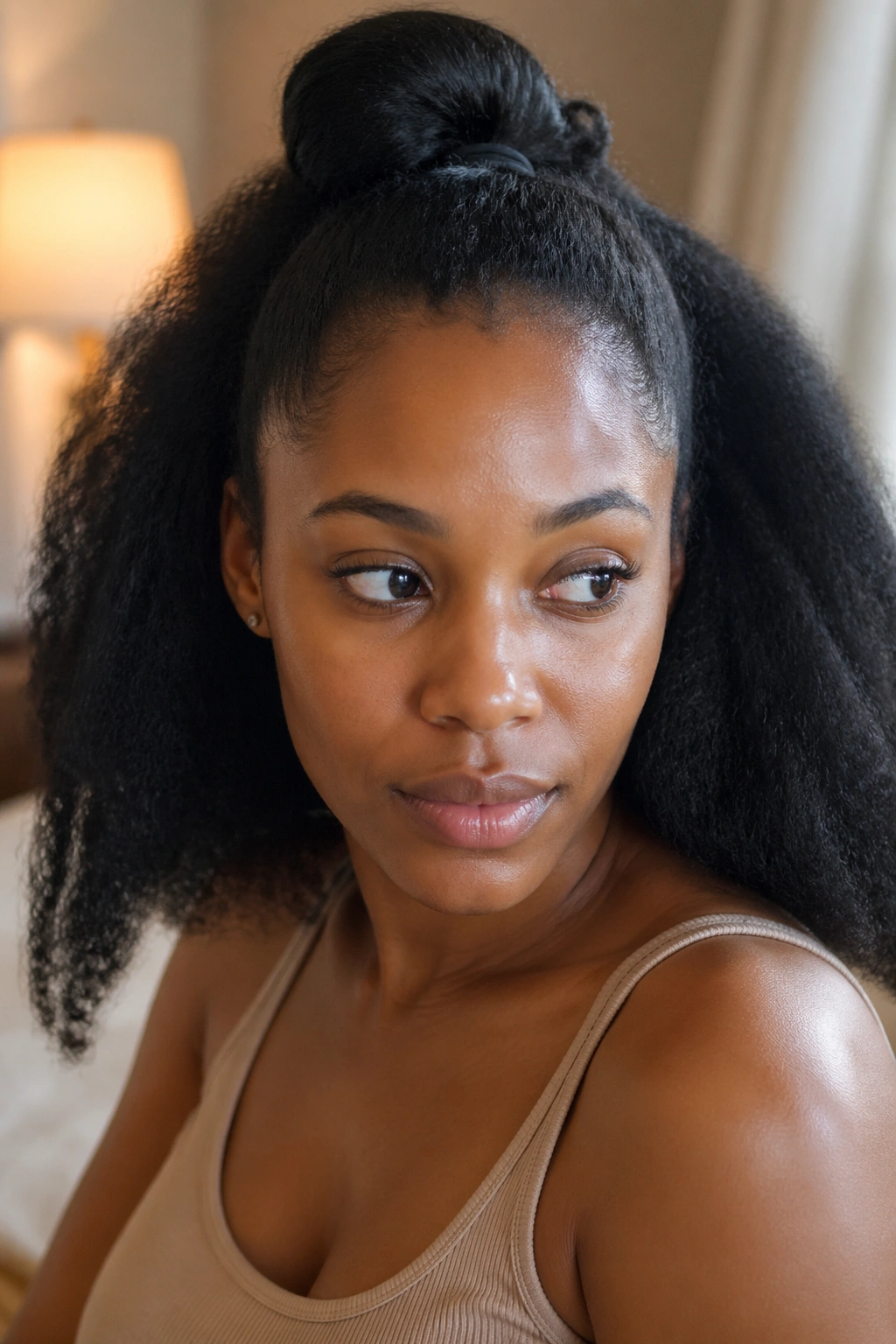
The cornrows cover your scalp for weeks, but your scalp still needs care underneath. A dry, itchy, flaking scalp is more than uncomfortable — it signals buildup that can lead to breakage when you take the style down.
Every 4-5 days, use a scalp oil with a nozzle applicator. Apply directly between the braids, focusing on any area that feels tight or itchy. Tea tree, peppermint, and rosemary oils work well. Avoid thick butters — they coat the hair and build up.
Between oilings, a gentle witch-hazel-based scalp spray does wonders for itch relief. Spray lightly, don’t saturate. Dab dry with a clean microfiber towel if needed.
Don’t scratch the scalp with fingernails. A loc pick or the rounded end of a pen works for those deeper itches that don’t respond to product.
Sleeping in Goddess Cornrows With Curls
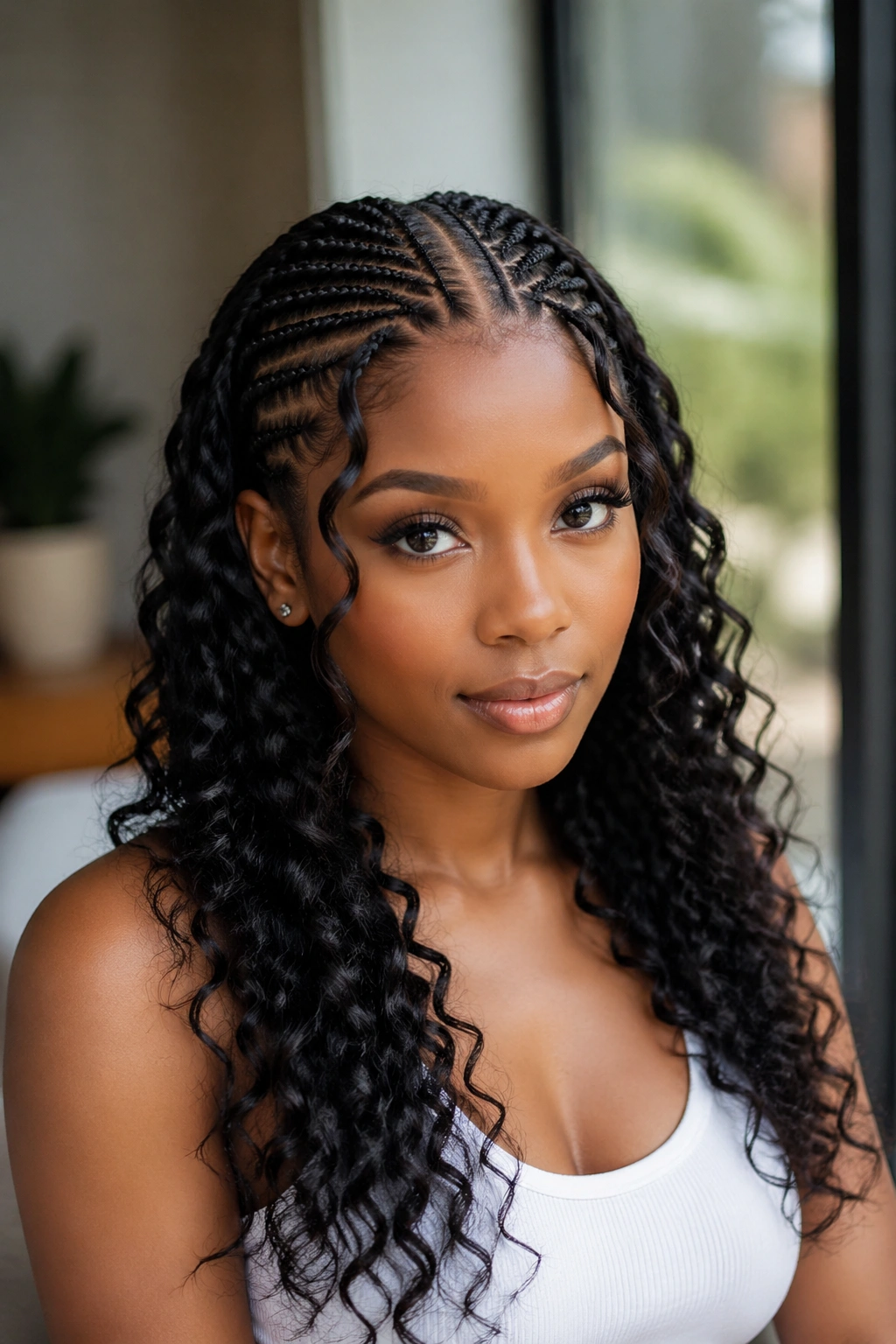
Sleep is where protective styles either live or die. For goddess cornrows with curls, a standard sleep bonnet isn’t enough. The curls need room, or they flatten on the side you sleep on and look lopsided by morning.
An oversized satin bonnet — the kind with elastic that still has slack — lets the curls breathe overnight. Gather the curls to one side before putting the bonnet on, rather than trying to stuff them all underneath. This reduces compression.
For extra protection, sleep on a silk pillowcase. Even with the bonnet, some contact happens, and silk reduces the friction that causes frizz.
If you toss and turn a lot, consider a silk scarf underneath the bonnet. Tie the scarf snug around the braids at the scalp to keep the front from lifting, then cover everything with the bonnet. It’s two steps. It adds about a week to the life of the style.
Taking the Style Down Without Damaging Natural Hair
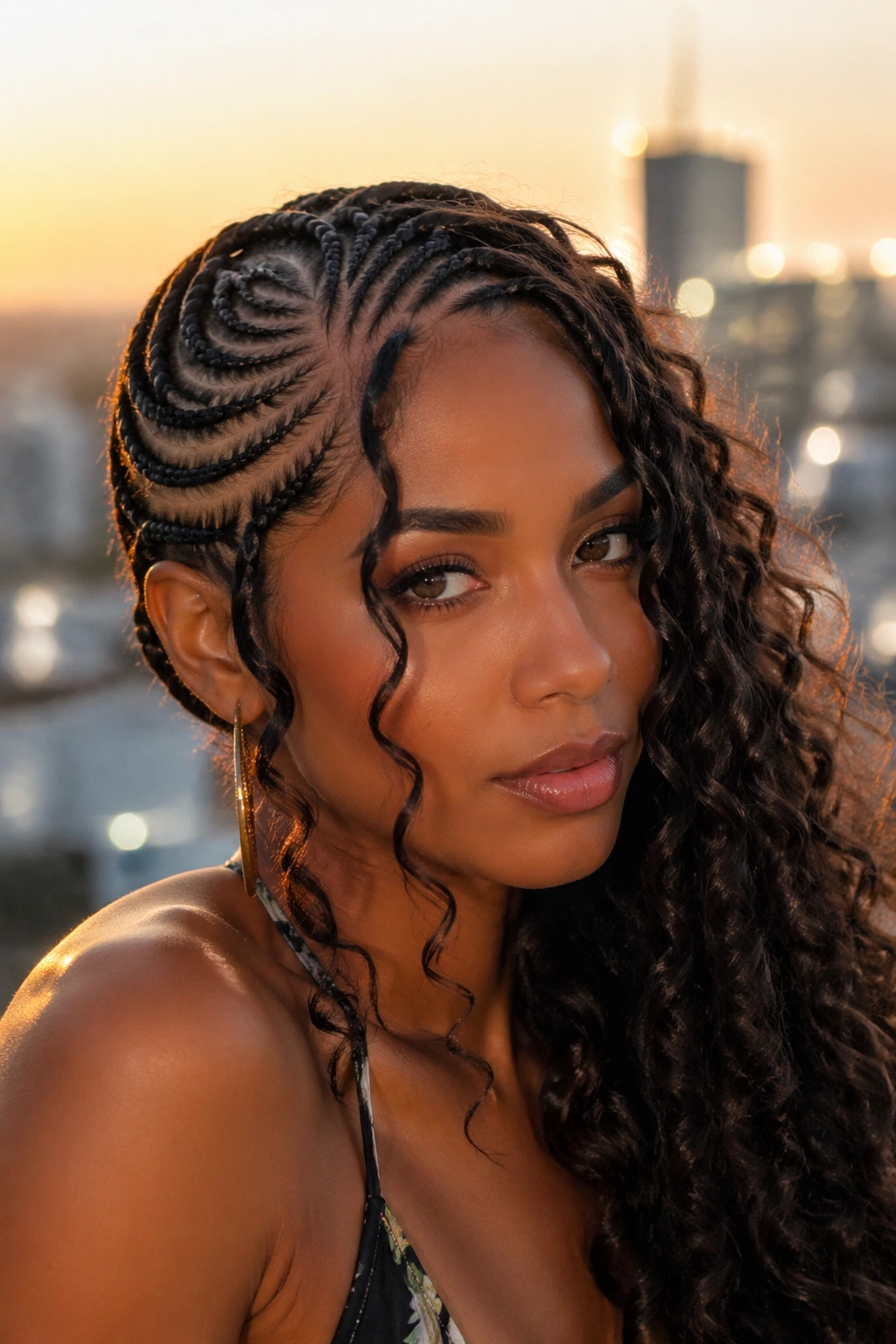
Takedown is where most damage happens with any braid style, and cornrows with curls are no exception. Rushed takedown rips out hair. Careful takedown preserves every strand.
Start by cutting the curl bundle off at the last cornrow point — don’t try to unbraid through the curls. They’ll tangle and pull.
Once the curls are gone, you have a clean cornrow ending. Unbraid each cornrow slowly, finger-detangling as you go. The first few inches come loose easily, but the section closest to the scalp — where shed hair has accumulated — is where most tearing happens.
Work a generous amount of conditioner or detangling spray into that section. Let it sit for 10 minutes before continuing. The product softens the shed hair and lets it release without pulling.
Once fully unbraided, co-wash the hair — don’t go straight to shampoo. The co-wash removes surface buildup while putting moisture back in. Follow with a protein-free deep conditioner, and give your hair a full 48-hour break before installing any new style.
Your scalp has been working hard. Give it rest.
Mistakes That Kill the Style Early
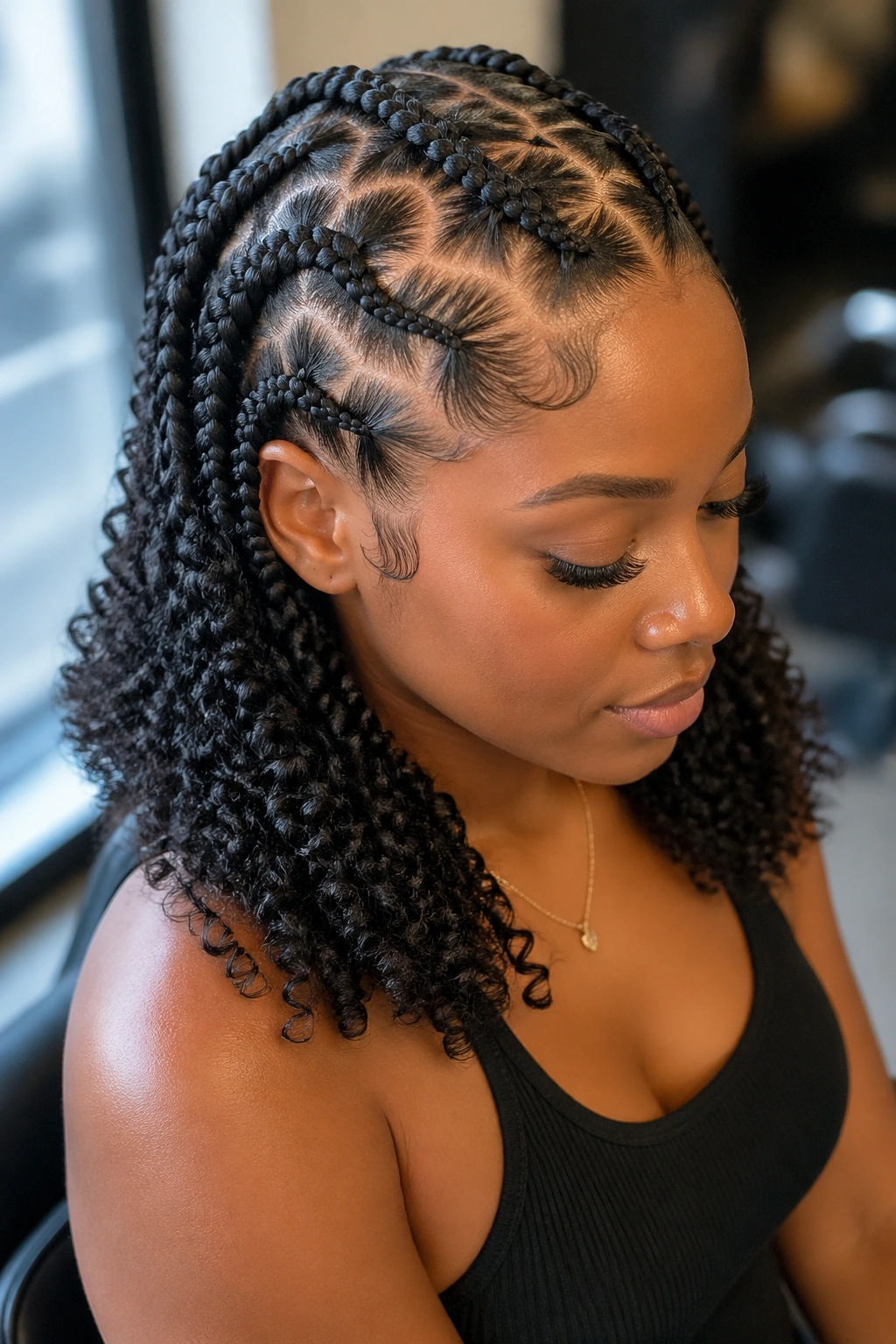
A few common errors cut the lifespan of goddess cornrows with curls in half.
Installing on dirty hair. Scalp oils and buildup loosen braids from day one. Wash and deep condition 24-48 hours before install — not immediately before, which leaves hair too slippery to braid.
Skipping the edge control test. Some edge gels dry flaky. If you’re trying a new brand, test it on a small section before the install day. You don’t want to find out about flakes halfway through a 6-hour appointment.
Over-tightening. If the braider is pulling hard enough to give you a headache, the style is too tight. Speak up. Bumps along the hairline and lifted braid bases come from tension, not technique.
Forgetting curl refresh. The curls won’t refresh themselves. Skip the mousse mist for a week and you’ll look like you’ve worn the style twice as long as you actually have.
Sleeping without protection. Even one night without a bonnet shows by morning. The curls flatten, the edges fuzz, and you spend 20 minutes the next day trying to fix damage that takes 30 seconds to prevent.
Goddess cornrows with curls reward care. Put the care in, and the style will carry you through events, workdays, workouts, and weekends looking put-together the whole time.
