



A high ponytail can look expensive in a minute and flat in the next. The difference usually lives right at the crown: a little lift, the right base, and a ponytail extension that gives the hair some actual weight instead of a sad little puff.
That’s why high ponytail extensions have such a loyal following. They give you height without waiting for your own hair to grow, and they hide the boring part of the style — the elastic, the flattened roots, the strands that refuse to cooperate. Fine hair gets a bigger shape. Thick hair gets more swing. Curly hair gets definition. Straight hair gets drama.
The sweet spot is not just length. It’s shape. A ponytail that sits high, holds its curve, and moves cleanly down the back reads very differently from one that looks stuffed or pinned together in a rush. A good extension makes the style feel deliberate, not desperate.
Some versions are sleek and sharp. Others are textured, braided, curled, or wrapped with fabric and hardware. The right one depends on your hair texture, how much time you have, and how much volume you want people to notice from across the room.
1. Sleek Wrap-Around High Ponytail Extension
If you want the cleanest way to fake a thicker hairline, start here. A sleek wrap-around ponytail extension gives you that smooth, lifted shape people love on red carpets without asking your own hair to do every bit of the work.
The magic is in the wrap. The extension hides the elastic and also disguises the point where your real hair ends and the added hair begins. When the base is smooth and the wrap sits snugly, the whole ponytail reads as one piece instead of a cluster of separate parts.
Why the wrap matters
A wrap-around piece gives the style structure. It also gives you a cleaner silhouette at the crown, which is where most ponytails fall apart visually.
- Best for straight, relaxed, or lightly waved hair.
- Works well with 120 to 160 grams of added hair for medium fullness.
- Needs a firm base, usually a tight ponytail or a small bun underneath.
- Looks best when the surface hair is brushed flat with a boar-bristle brush.
A tiny bit of styling cream on the top section goes a long way. Too much product makes the hair look greasy; too little leaves flyaways that break up the shine. I’d rather see a ponytail that is smooth and controlled than one that is drowning in gel.
Best tip: wrap the extra strand tightly and pin the end underneath the ponytail, not right on the side where it can poke out and ruin the finish.
2. Curly Clip-In High Ponytail Extension
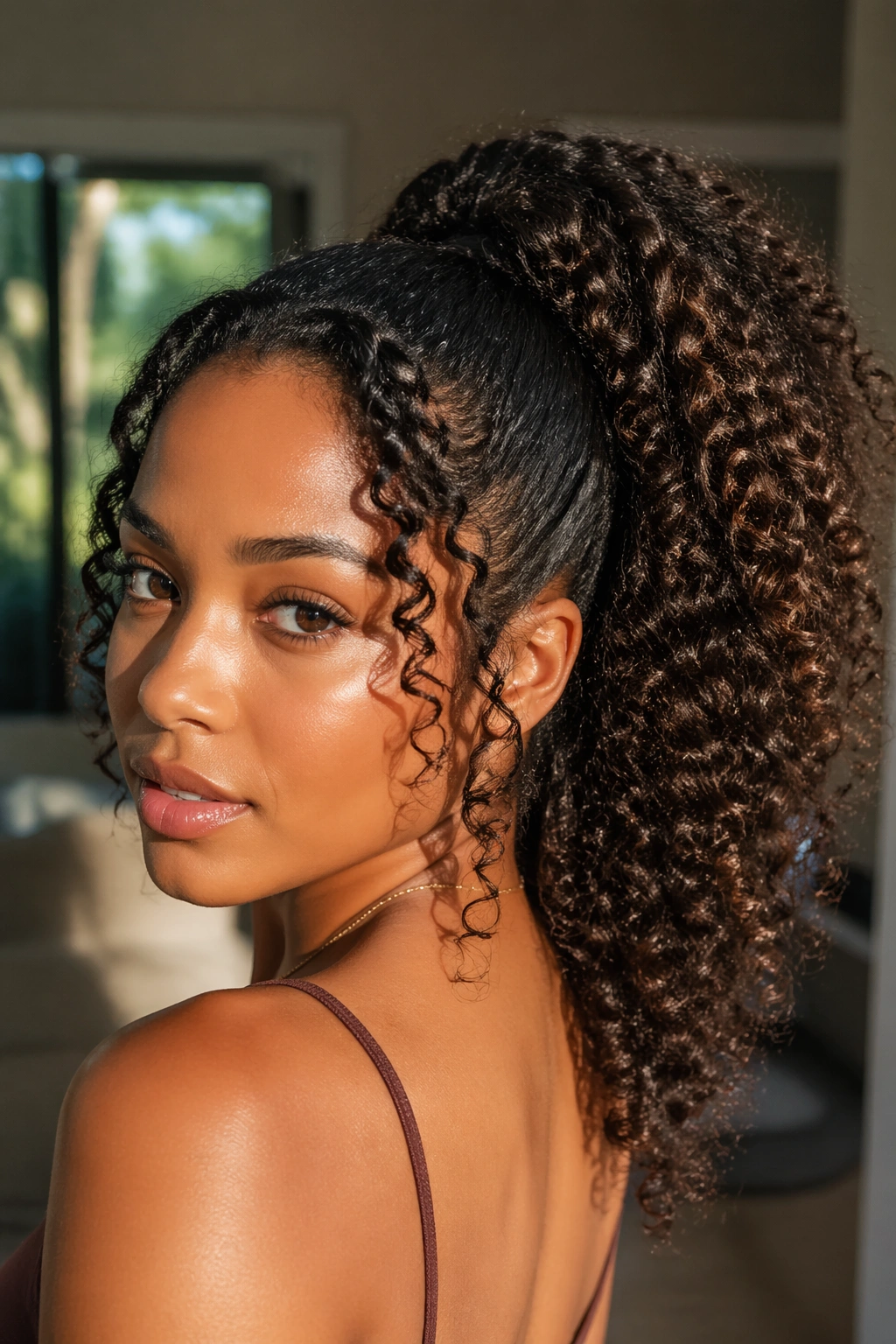
Why do curly ponytails look fuller even when the extension weight is almost the same? Because curls trap air. That extra space between the coils makes the hair read as bigger, softer, and more alive.
A curly clip-in high ponytail extension is a smart move if your own hair has bend, wave, or coil. It blends better than a silky straight piece on textured hair, and it keeps the whole style from looking like one heavy rope hanging from the head. A 3B to 3C curl pattern usually gives the best mix of bounce and body.
How to keep the curls fluffy
The biggest mistake is brushing the curls like straight hair. Don’t do it.
- Separate the curls with your fingers.
- Use a wide-tooth comb only when the hair is damp.
- Scrunch in a lightweight mousse if the curls start to go limp.
- Avoid heavy oils near the top of the ponytail; they flatten the shape fast.
A curly ponytail looks best when the base stays neat and the ends stay soft. You want the top to feel polished, not shellacked, and the curls to look touchable instead of stiff. If the extension is human hair, you can refresh it with water and a little leave-in conditioner. Synthetic pieces usually need gentler handling and lower heat, if any heat at all.
3. Bone-Straight High Ponytail Extension
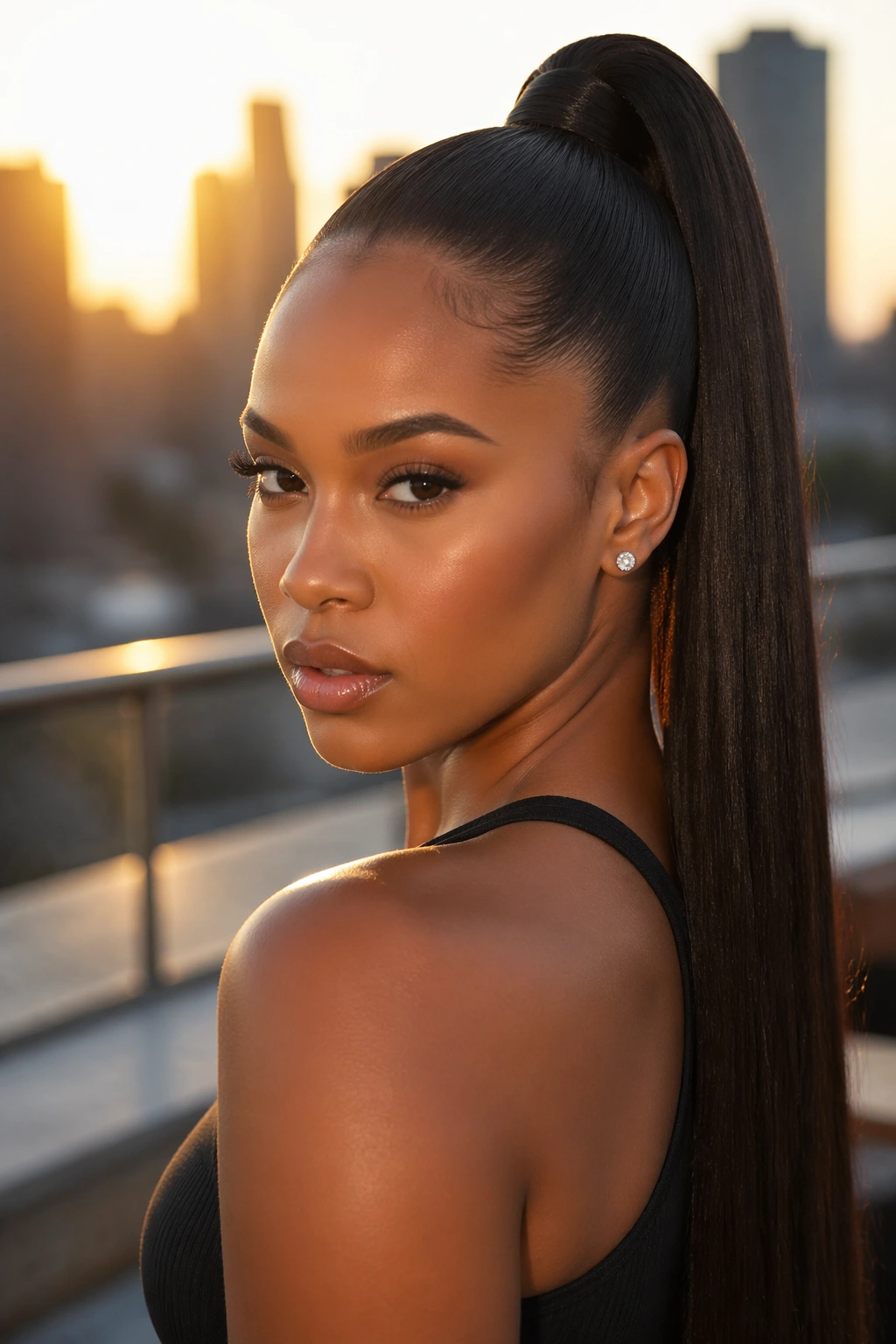
The first thing you notice is the shine. A bone-straight high ponytail extension gives you that long, glossy line that feels almost graphic in the best way.
This style works because straight hair makes length look longer. No curl pattern interrupts the view, so the eye follows the ponytail all the way down. That is also why the base has to be clean. If the crown is lumpy, the whole style loses its edge fast.
A straight ponytail usually looks best with 24 to 28 inches of length. Shorter can work, but the drama changes. You get more of a neat lifted ponytail than a true statement piece. I like this style when the outfit is simple and the hair needs to do more of the talking.
One thing people miss: a straight extension shows every little snag. Brush it before and after attaching it, then smooth the surface with a tiny bit of serum on your palms. Not on the roots. Just the lengths.
And keep the ends blunt or lightly feathered. Ragged ends make the whole thing look older than it is.
4. Yaki-Texture High Ponytail Extension
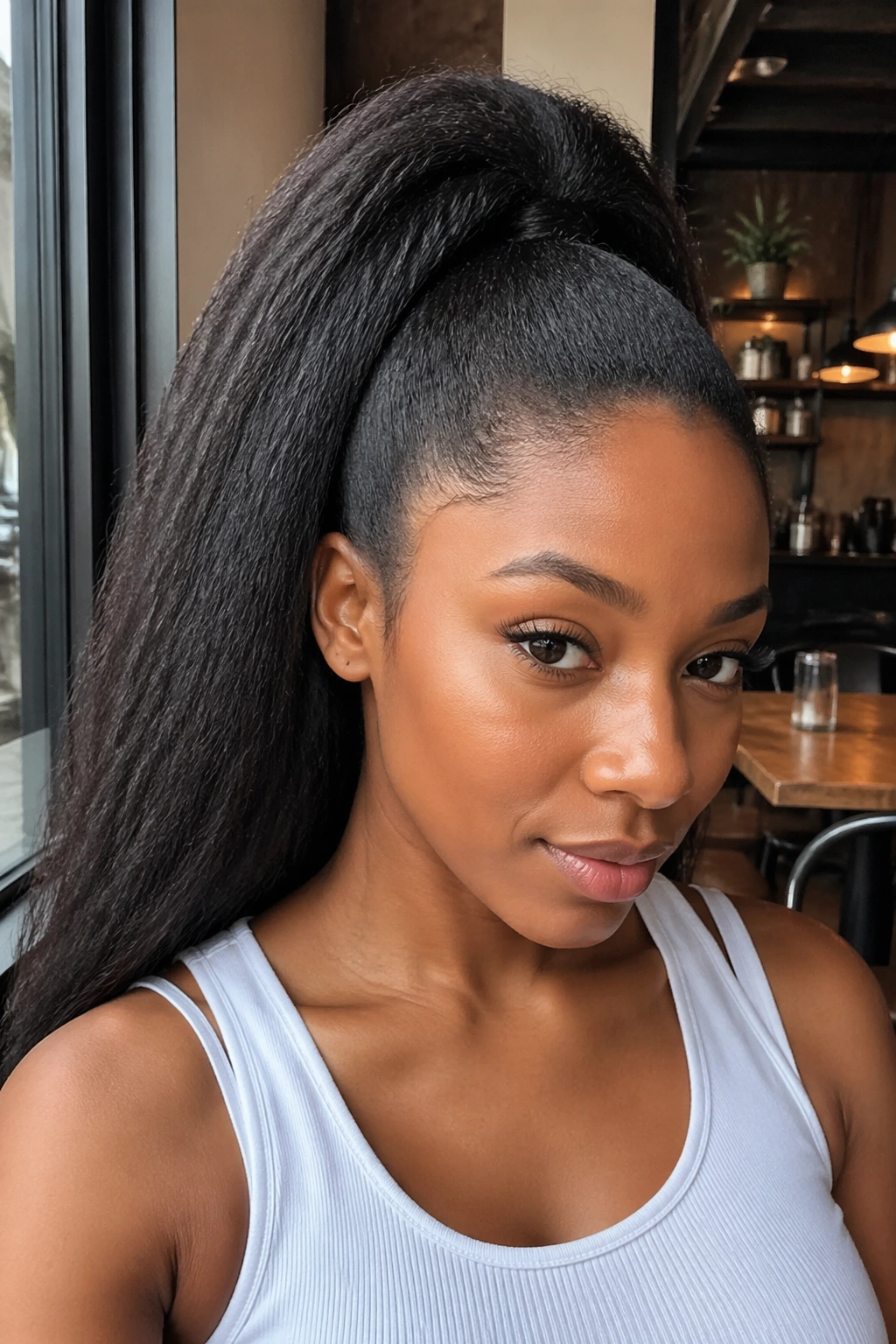
Not every full ponytail should look silky.
A yaki-texture high ponytail extension is the one I reach for when I want volume that blends with coarser, blow-dried, or pressed hair. The texture has a soft, natural-grain finish that looks less shiny than bone-straight hair, which is exactly why it works so well on a lot of real heads.
It also saves you from the “my ponytail is thick but somehow still fake” problem. Yaki texture has enough body to look full, but not so much puff that it swallows the face. That balance matters.
What makes yaki different
- It blends better with hair that has been flat-ironed or silk-pressed.
- It reads less glossy, which helps in daylight.
- It holds shape well after brushing and light heat styling.
- It usually gives more visual density at the same weight than a sleek piece.
If you’ve ever put in a silky extension and felt like the top looked too polished for your own texture, this is the fix. It sits closer to the look of real blown-out hair. That alone makes the style easier to wear.
Quick opinion: yaki is one of the most underrated textures in ponytail extensions, and it deserves more credit than it gets.
5. Bubble High Ponytail Extension
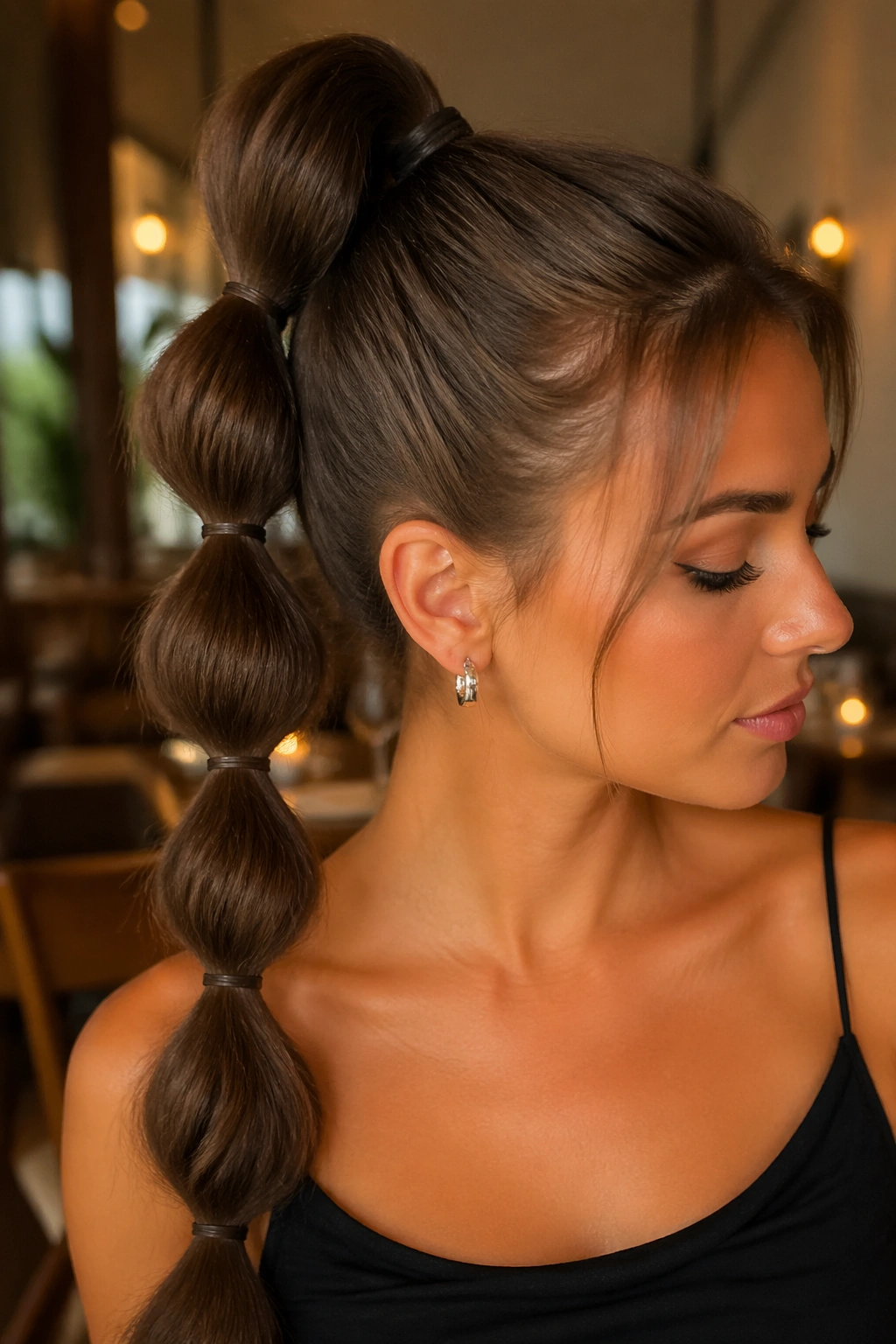
You see this style on someone walking out of a dinner spot, and the ponytail looks twice as thick as it really is. Bubble ponytails have that kind of trickery built in.
A bubble high ponytail extension uses sectioned ties placed down the length of the ponytail, then each section is gently tugged outward to form the “bubbles.” The extension does most of the volume work for you, and the elastics create the shape. It’s one of the easiest ways to make a long ponytail look expensive without needing perfect hair.
What makes the bubbles hold
The spacing matters more than people think.
- Put the first tie about 2 to 3 inches below the base.
- Keep the next ties at even intervals.
- Tug each section gently from both sides until it rounds out.
- Use clear elastics if you want the sections to look clean.
This style is especially useful if your own hair is thin at the ends. The bubbles hide unevenness and make the ponytail look intentionally puffed out. The only real trap is over-pulling. If you tug too hard, the section starts looking stretched and skinny instead of round.
A bubble ponytail feels playful, but not childish. That’s the part I like.
6. Braided High Ponytail Extension
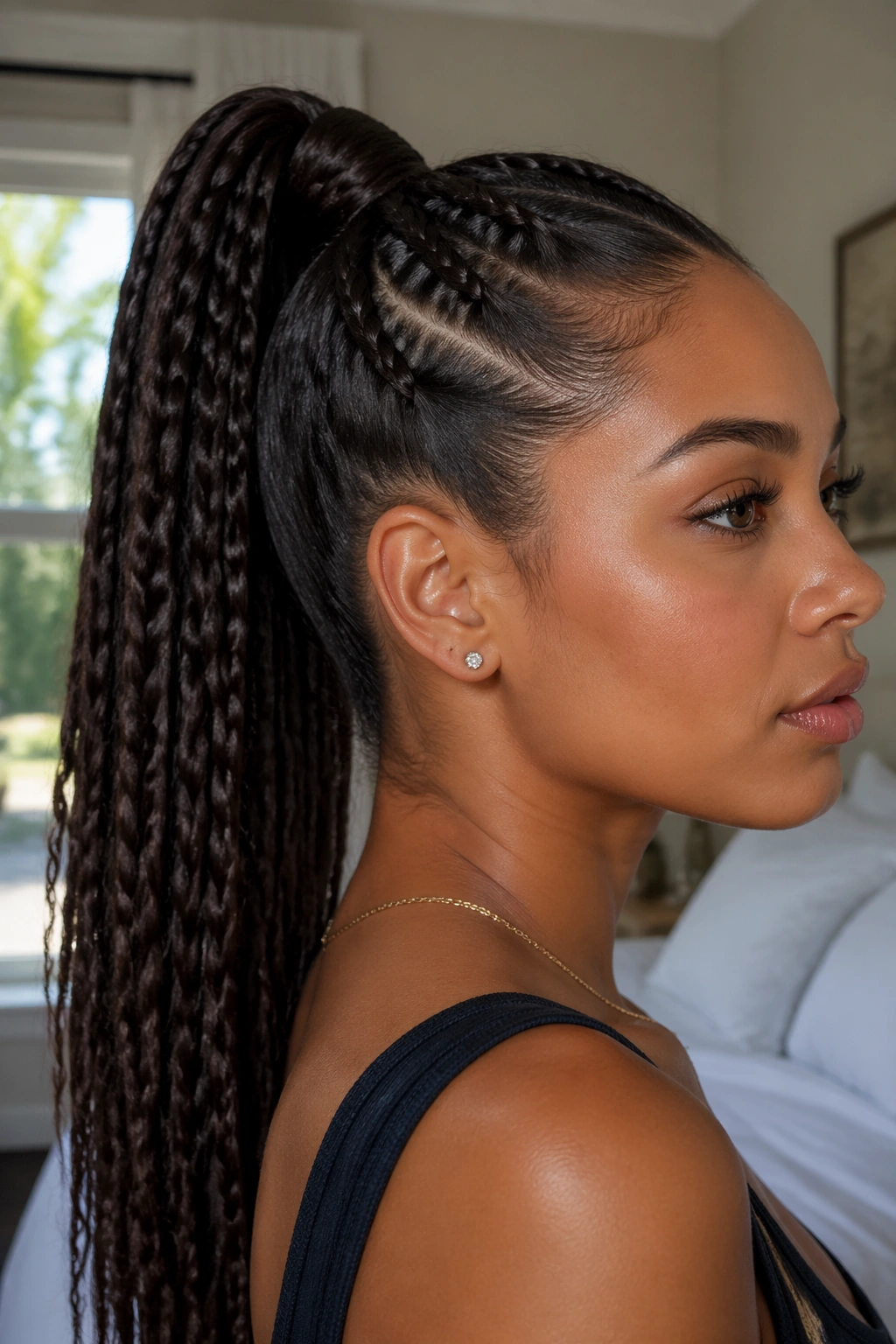
Three inches of braid at the base can change the whole thing. A braided high ponytail extension gives you instant structure, which is useful when you want volume that still feels controlled.
This style works in two ways. Sometimes the ponytail itself is braided all the way down, which gives you a long, thick rope of hair. Other times, the base is braided before the extension is attached, which helps anchor the style and adds a detail that keeps the eye interested. Either way, the braid adds grip.
A braid also helps hide a less-than-perfect attachment point. That matters more than people admit. A clean braid can make the ponytail look intentional even if the root area wasn’t having its best day.
- A three-strand braid feels classic and easy to wear.
- A jumbo braid gives more visual weight.
- A fishtail braid looks a bit softer and more intricate.
- A feed-in braid base helps the ponytail sit very securely.
One caution: tight braids can pull at the scalp fast. If your head starts aching, loosen it. A good style should look firm and feel wearable.
7. Wavy High Ponytail With Face-Framing Pieces
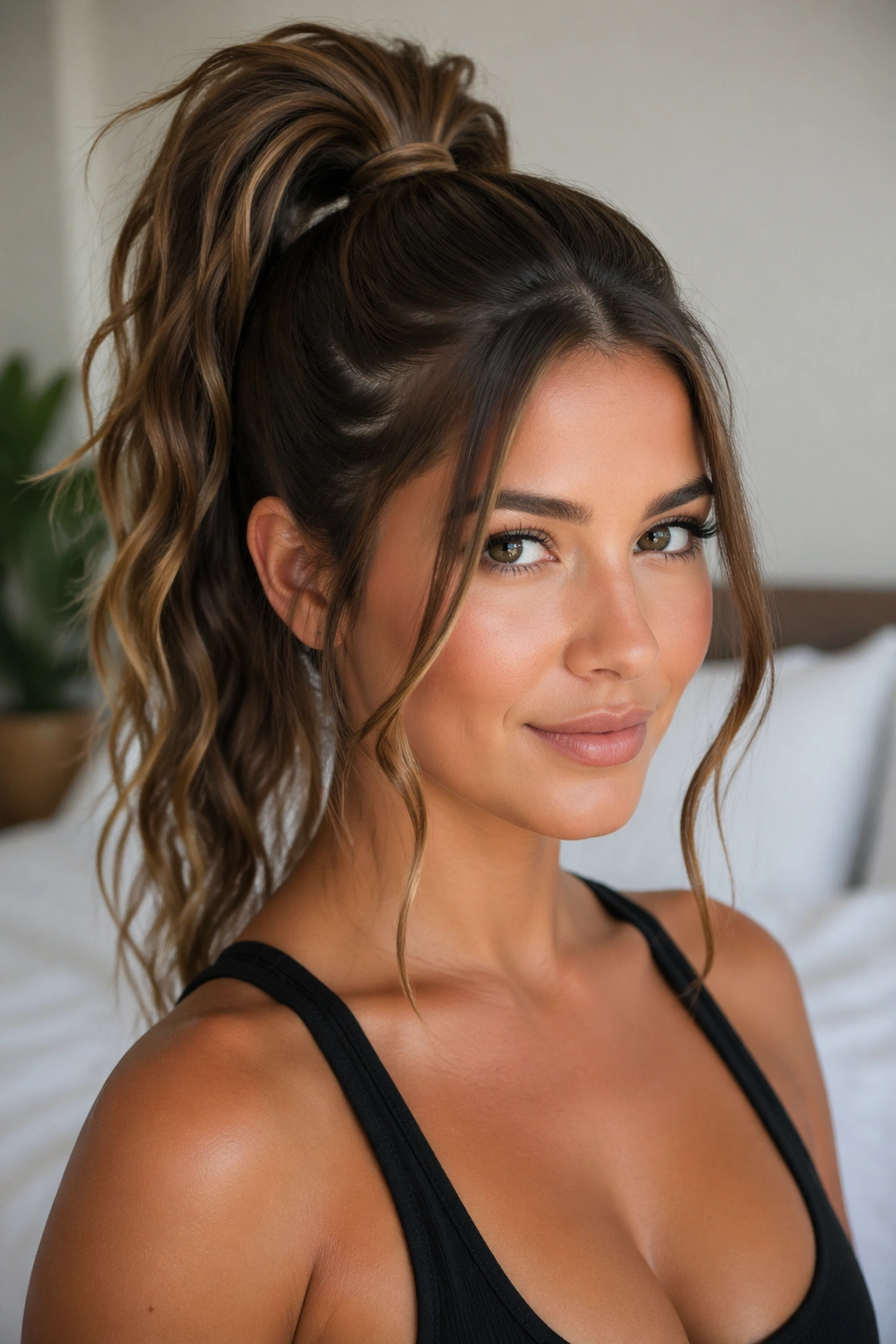
Want height without the severe look? Leave a few pieces out.
A wavy high ponytail with face-framing strands gives you the volume of an extension and the softness of a looser finish. The wavy texture keeps the ponytail from looking too rigid, while the pieces around the face break up the line and make the style feel easier on the eyes.
This is a good choice if your features feel a little strong under a super-sleek pullback. It softens the forehead and cheek line without lowering the ponytail itself. That’s the trick. You keep the lift, but the face doesn’t look boxed in.
Where the softness comes from
The face-framing pieces should be thin enough to move, not thick enough to compete with the ponytail.
A 1-inch section on each side is usually enough. Curl them slightly away from the face, or leave them with a loose bend if you want a softer finish. The ponytail itself can be body wave, loose curl, or a brushed-out wave with a little movement at the ends.
This style reads as polished but not stiff. And that’s why people wear it again and again.
8. Afro Puff High Ponytail Extension
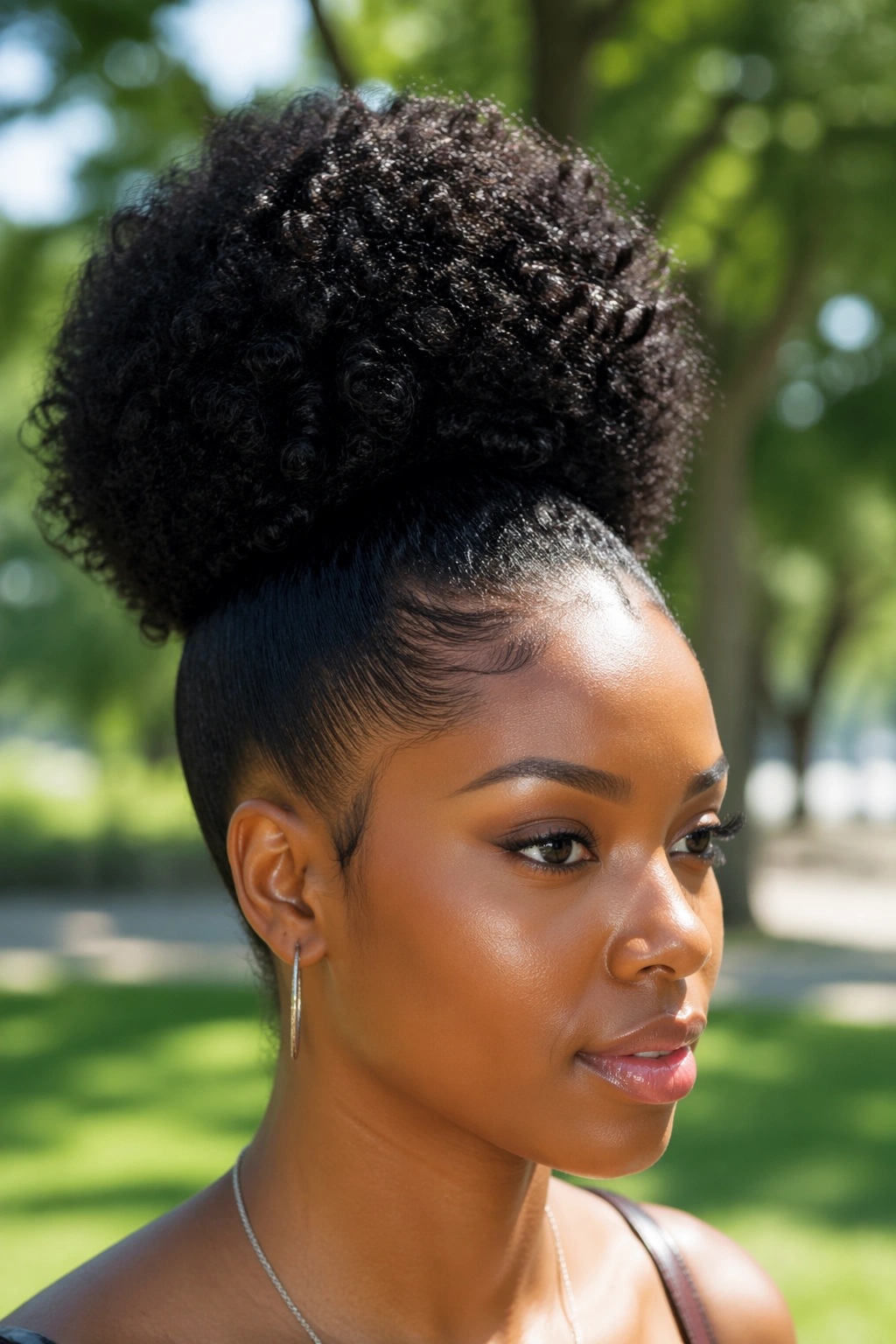
For coily hair, volume is not the problem. Shape is.
An afro puff high ponytail extension gives you a lifted, rounded silhouette that celebrates texture instead of trying to flatten it into something else. It works best with kinky-curly or afro-textured pieces, because the hair expands in a way that looks full from every angle.
The base can be a puff with a drawstring attachment, a clipped piece, or a ponytail extension built to match natural coils. The key is not to over-smooth the hair at the top. A little edge control is fine. A helmet-like slicked base is not.
The shape should feel airy and full, not crushed. That’s what makes this style so good.
A 150 to 200 gram piece often gives a convincing amount of density, especially if you want the puff to sit visibly above the crown. If the extension is too small, it can look like a token puff instead of a real style. If it is too heavy, the base can sag. Balance matters here more than shine.
Let it stay big. That is the point.
9. Drawstring High Ponytail Extension
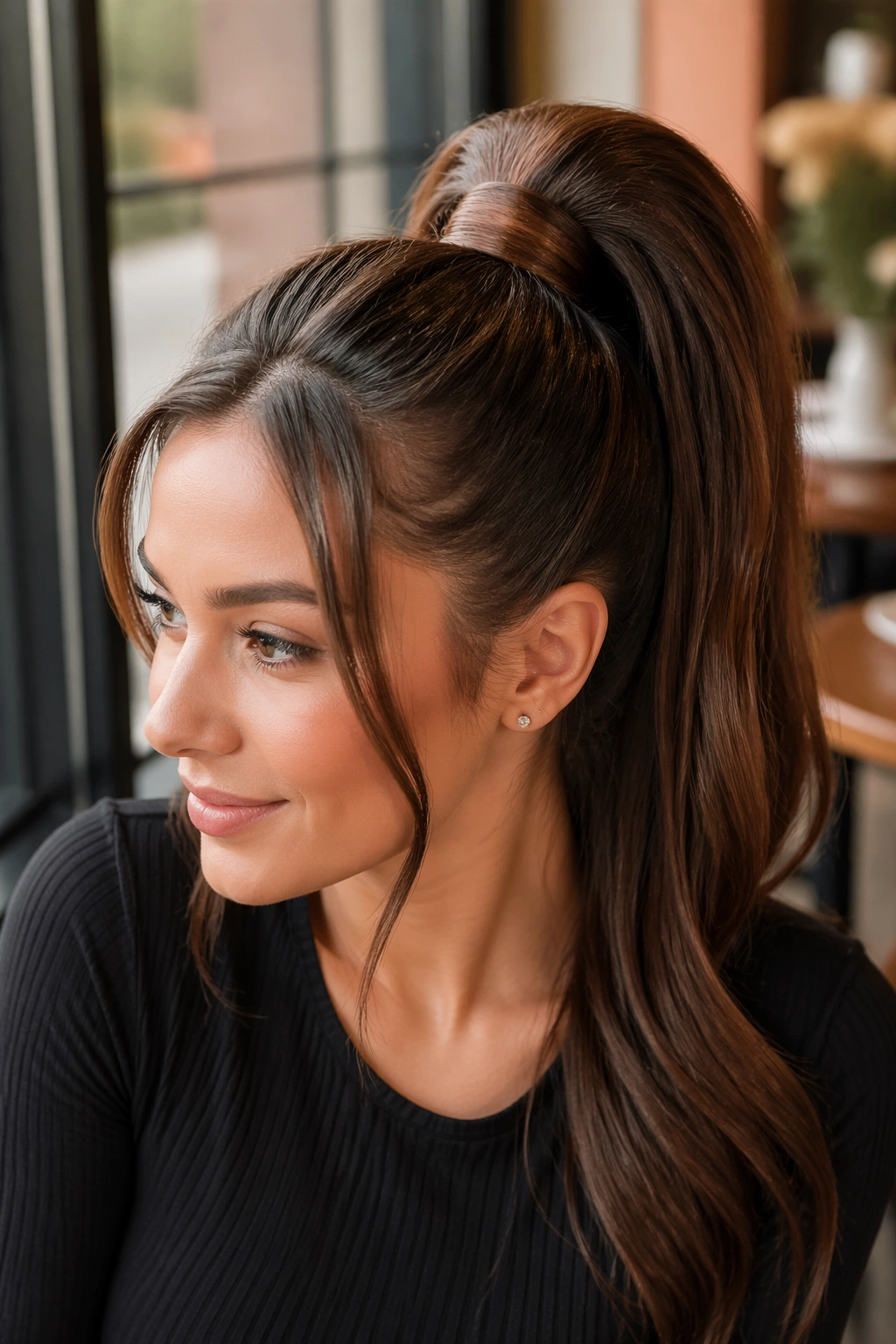
If you have 15 minutes and one mirror, a drawstring ponytail is the one I’d reach for.
Drawstring high ponytail extensions are practical in the best way. You pull your own hair into a secure base, attach the piece, tighten the drawstring, and wrap the extra strand around the base so the whole thing looks finished. No guessing. No hunting for five separate clips.
Why drawstring works on busy days
It gives you volume without a long install.
- Good for medium to thick natural hair.
- Useful when you want the ponytail to sit high but still feel secure.
- Easier to remove than more complicated extension methods.
- Works well with both straight and curly ponytail pieces.
The important part is the anchor. If the base is loose, the drawstring does nothing useful. I prefer a small bun or a tight ponytail first, then the drawstring piece over that. If your hair is fine, add a few bobby pins crossed in an X under the base for extra grip.
This style is fast, but it is not lazy. The neatness of the base still decides whether it looks polished or tossed together.
10. Half-Up High Ponytail Extension
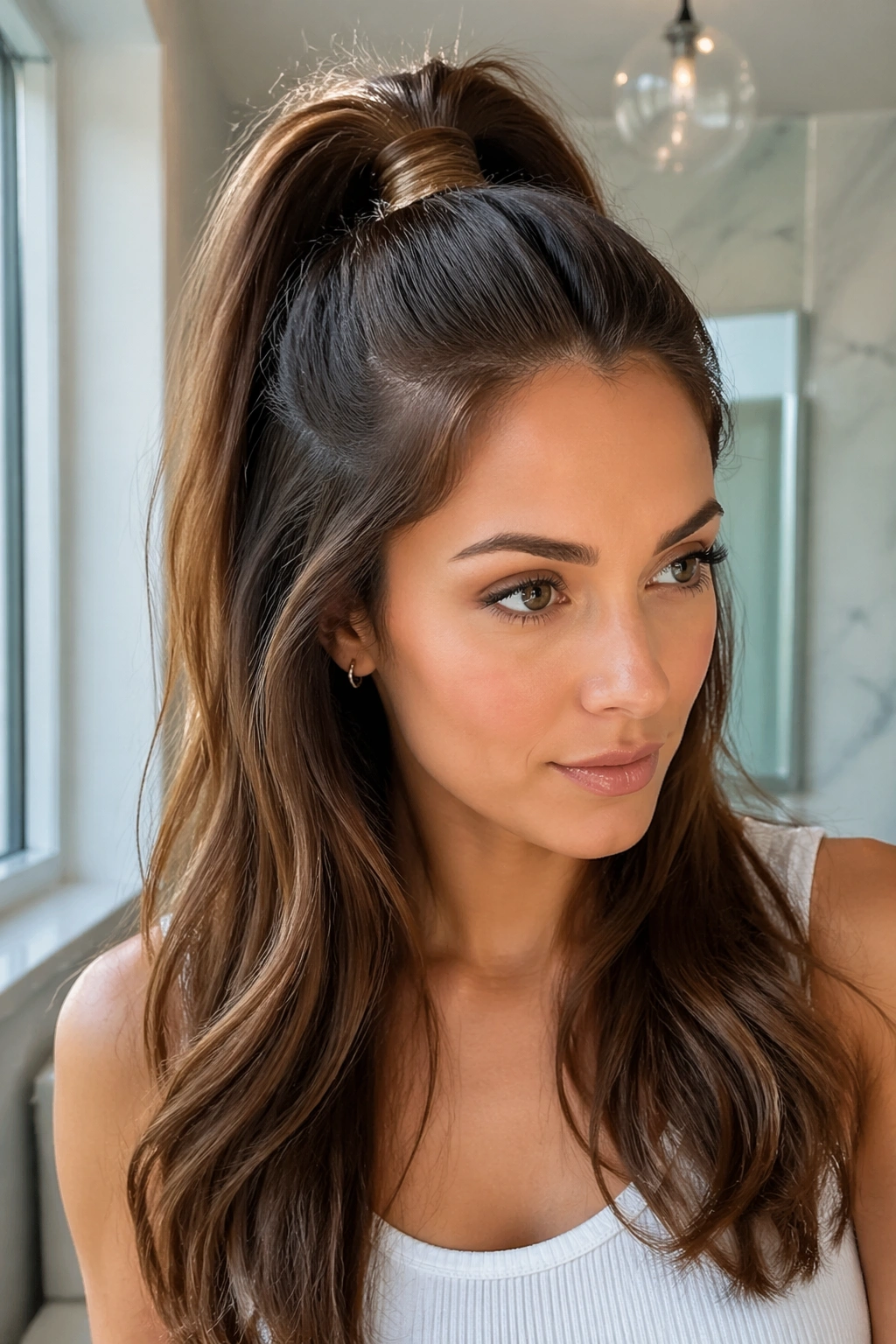
A half-up ponytail sounds modest until you see what it does to the crown.
This style is a nice option when you want volume at the top without pulling every strand up and away from the face. The extension sits on the upper section only, so you get lift and length on top while the lower hair stays down. That makes the whole look feel softer, and it takes some weight off the scalp too.
It’s also a smart move for medium-length hair that doesn’t need a full ponytail to make an impression. The lower hair acts like a frame. The added ponytail gives height. Together, they look balanced in a way a full slick-back sometimes doesn’t.
One of my favorite things about this style is how forgiving it is. If your hair has a few shorter layers around the back, the half-up section covers most of that. You do not need every strand to behave.
The best version keeps the top section snug and the bottom section smooth, so the two parts feel connected instead of separate.
11. Scarf-Wrapped High Ponytail Extension
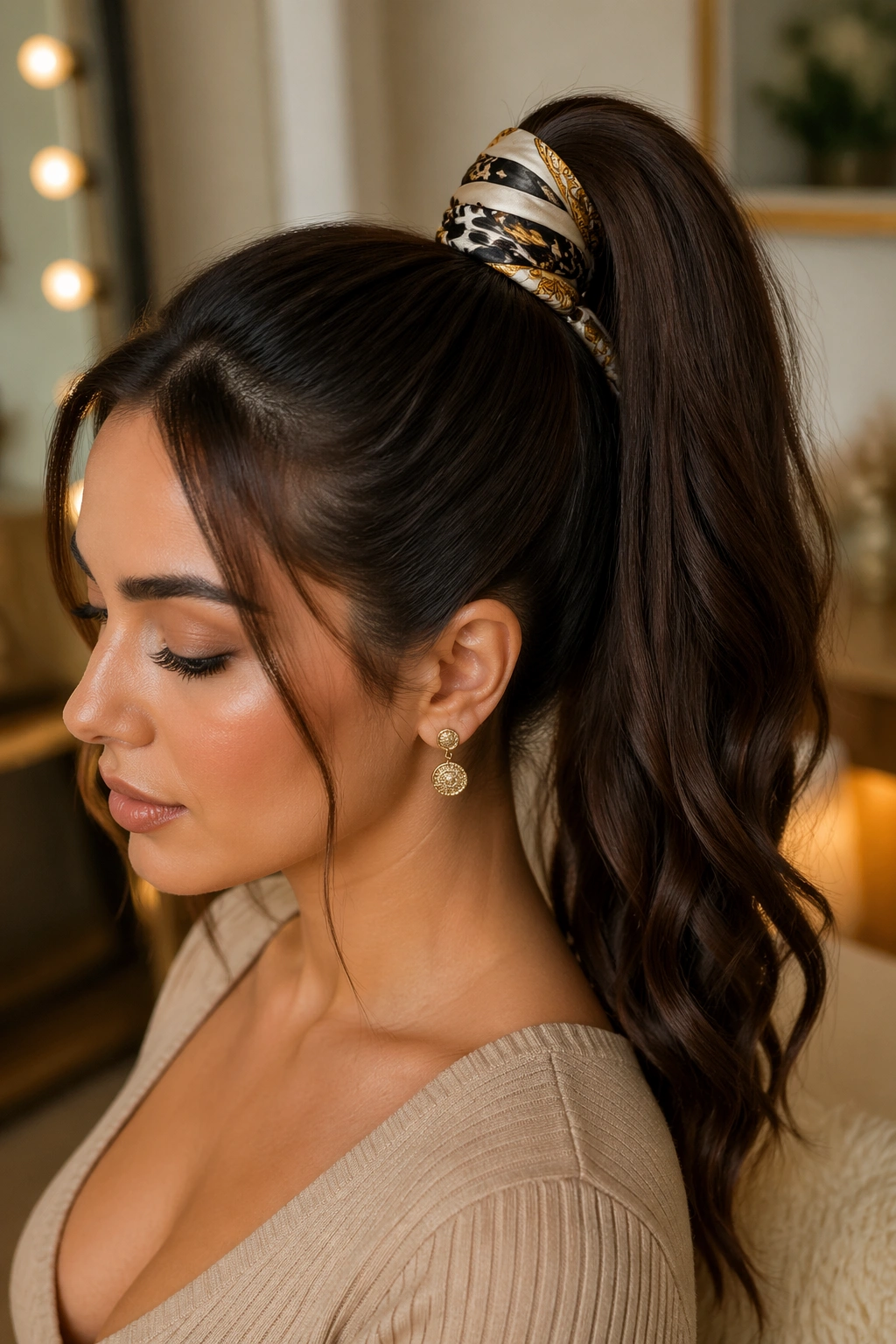
A strip of silk changes the whole read of the ponytail.
A scarf-wrapped high ponytail extension adds volume, yes, but it also brings texture at the base. That little bit of fabric helps break up the hard line of an elastic, and it gives the ponytail a more styled, finished look without needing extra hair.
Silk or satin works best because it glides against the extension and doesn’t rough up the surface. Cotton scarves can grip too much and leave the base looking bulky. A scarf that is about 1 to 2 inches wide is usually enough. Anything much bigger starts competing with the ponytail instead of supporting it.
Best fabrics for the wrap
- Silk for the smoothest finish.
- Satin for a similar look at a lower cost.
- Lightweight printed fabric if you want a louder accessory.
- Avoid thick knits; they make the base heavy.
You can wrap the scarf tight for a cleaner look or leave the tail ends loose so they hang with the ponytail. Both work. The style feels especially good with straight or wavy extensions, where the fabric gives the eye a place to rest.
It’s a small change, but it changes the whole mood.
12. Side-Swept High Ponytail Extension
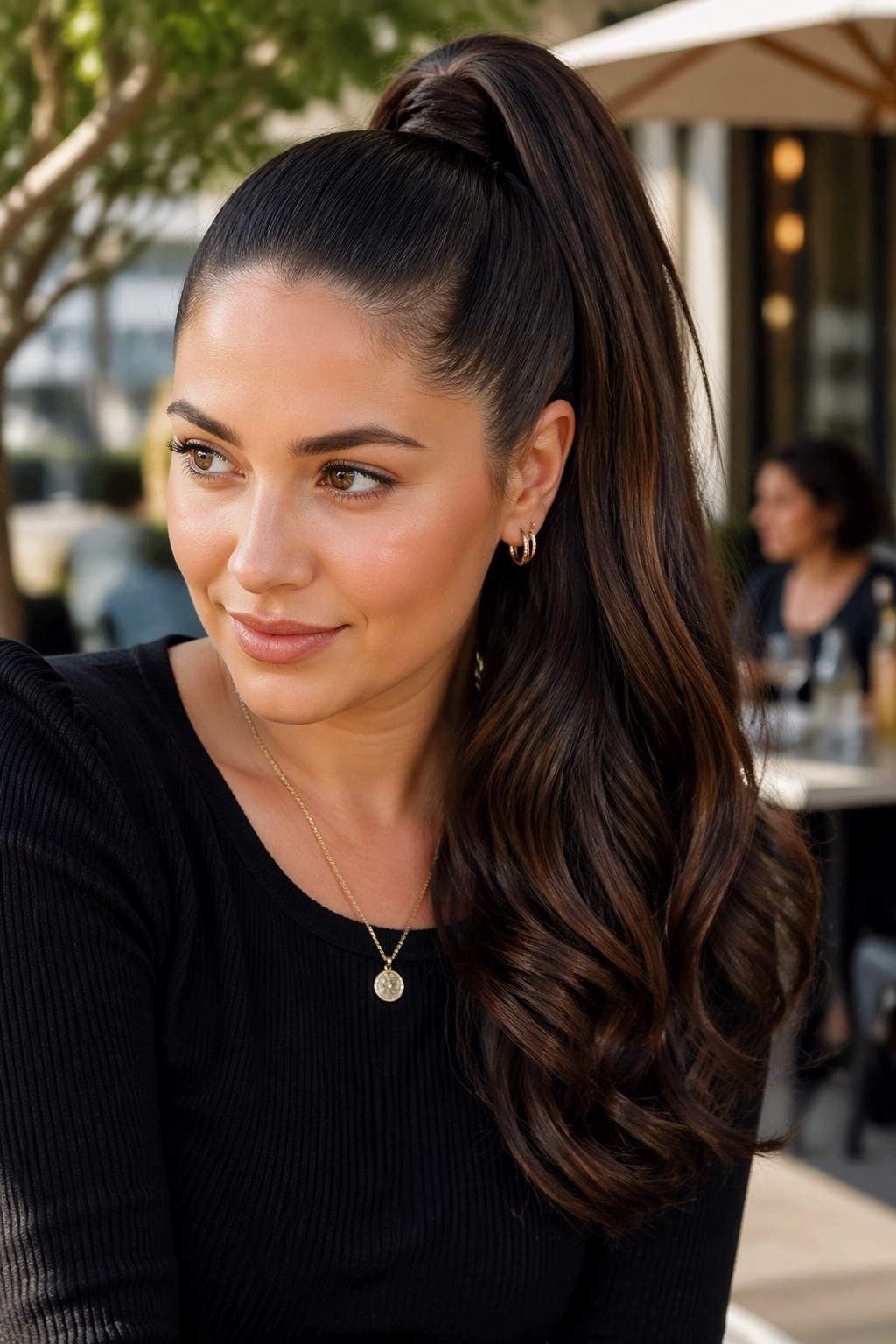
Shift the base one inch to the side, and the whole face changes.
A side-swept high ponytail extension keeps the height, but it removes some of the severity that can come with a perfectly centered style. The ponytail lands over one shoulder or just slightly off the spine, and that asymmetry makes the shape feel softer and a little more personal.
This works well if your face is already narrow or if a dead-center ponytail makes your features feel too rigid. The side-swept version gives you movement around the neckline and collarbone, which is where this style really shines. A long extension makes the sweep dramatic. A medium-length one keeps it easy to wear.
The part doesn’t need to be extreme. A subtle shift is enough. Too much offset and the style starts looking accidental, which is not the goal.
I like this version with a light wave in the lengths, because the movement carries the sweep. Bone-straight can work too, but the line becomes sharper and more formal.
13. Crimped High Ponytail Extension
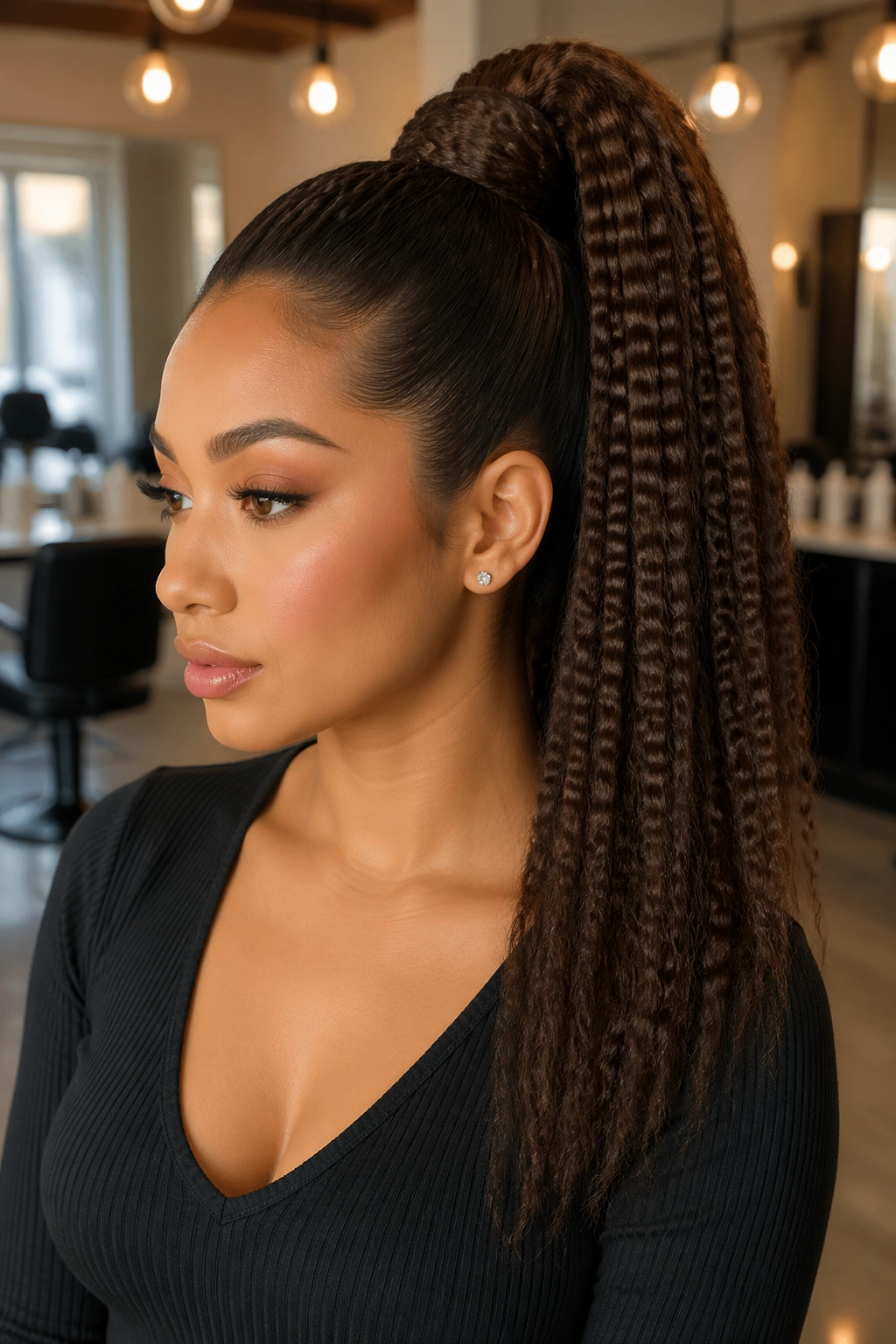
Why does crimping make a ponytail look thicker? Because it creates a lot of tiny bends, and those bends take up space.
A crimped high ponytail extension is one of the fastest ways to build visible fullness without piling on more hair. The texture catches light differently, the surface looks denser, and the ponytail ends up with that slightly retro, high-impact feel that straight hair cannot quite copy.
If the extension is human hair, you can crimp the lengths before attaching them or crimp the finished ponytail in sections. Synthetic hair is trickier; some pieces handle heat poorly, so check the fiber before you start pressing hot plates onto it. That’s a messy mistake to make at the last minute.
How to keep it from going frizzy
Crimping is all about control.
- Use a heat protectant on human hair pieces.
- Work in small sections so the texture stays even.
- Let each section cool before touching it.
- Mist a light spray at the end, not a heavy lacquer.
The style is bold, but it is also practical. The texture gives the ponytail grip, which helps it hold shape longer than a freshly straightened piece. And if you want the ends to feel a little softer, brush only the bottom two inches very lightly.
14. Deep Side Part Sleek Ponytail
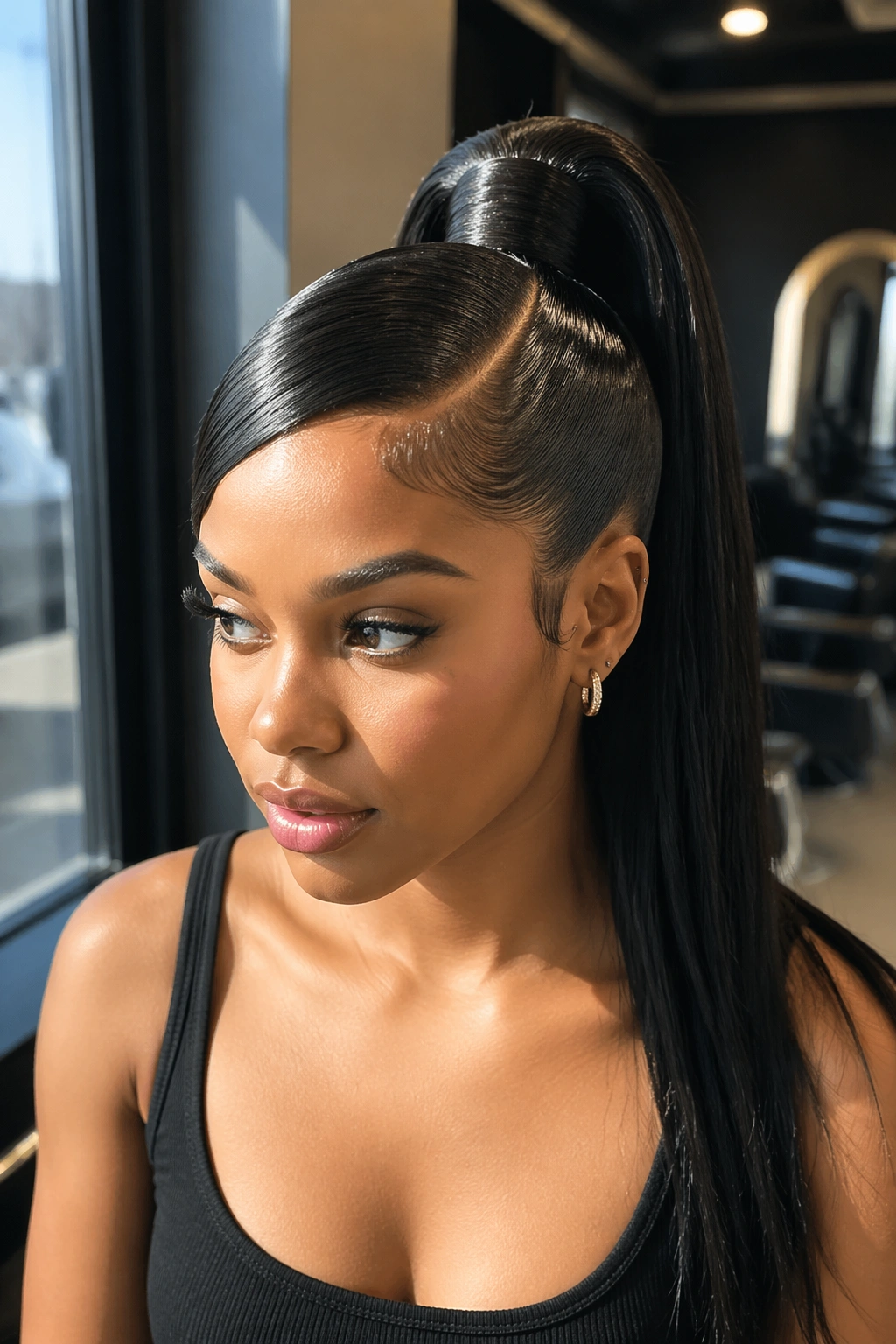
A part that sits about two inches off center changes the whole face line.
A deep side part sleek ponytail extension keeps the base high, but the part creates a deliberate slant before the hair is pulled back. That little shift adds visual shape around the forehead and temple, which is why the style can feel more flattering than a straight middle part on some faces.
The big benefit is balance. A deep side part gives the eye somewhere to land before it travels back to the ponytail. It also helps if one side of the hair is less dense than the other, since the part can disguise that difference better than a centered style.
This is one of those ponytails that looks more complicated than it is. You need a sharp part, a smooth crown, and an extension that hangs cleanly. That’s enough. No need to overwork the surface until it feels like lacquer.
A fine-tooth comb and a touch of gel near the roots are the whole game here.
15. Layered High Ponytail With Face-Framing Pieces
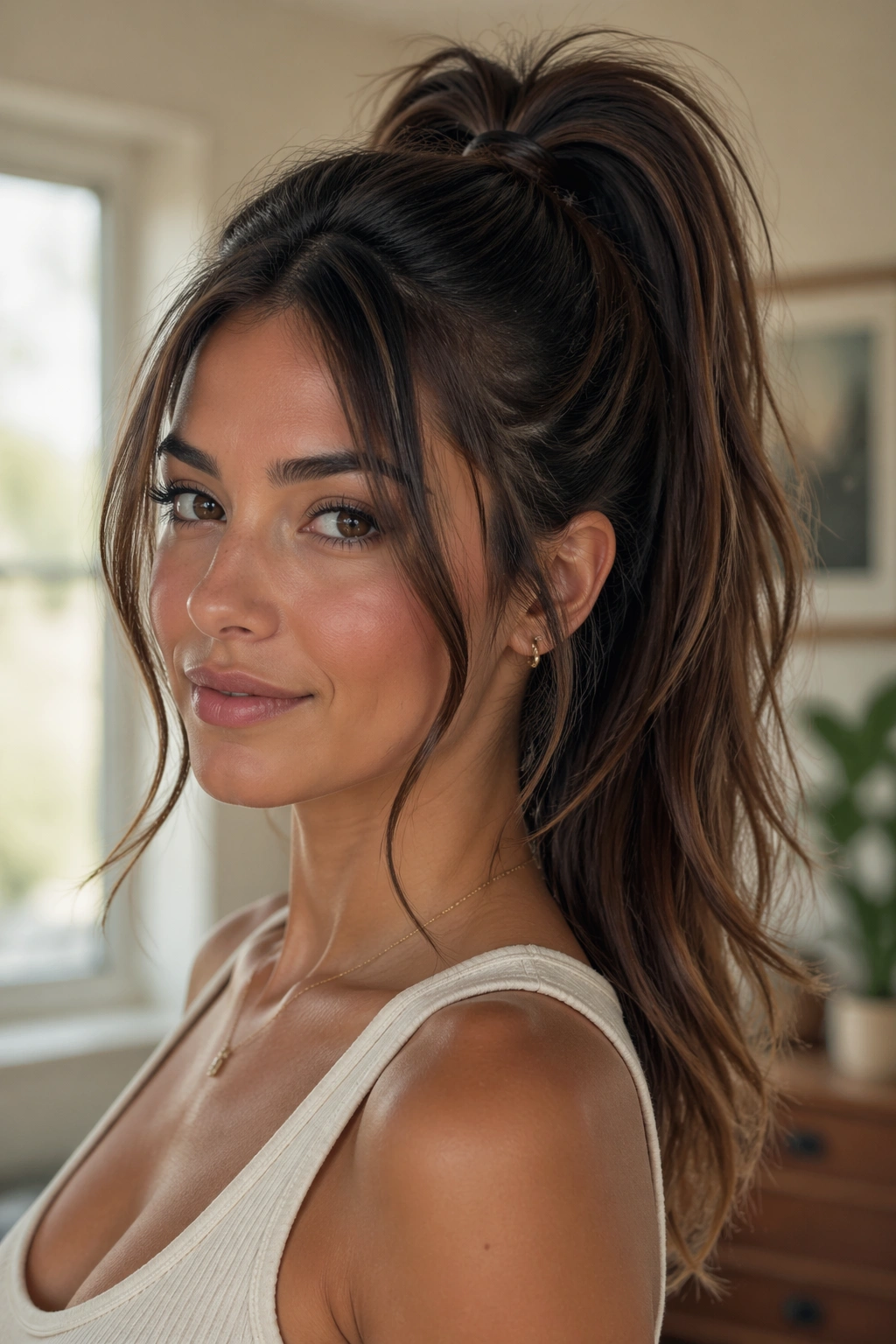
The smartest volume trick is sometimes subtraction.
A layered high ponytail with face-framing pieces uses extension length, but it avoids the blunt, heavy look that can happen when every strand is the same length. Layers give the ponytail movement, and the front pieces soften the overall outline so the style doesn’t feel too hard around the face.
This is a good choice if you like high volume but hate the feeling of having your whole head pulled tight. The layers also help the ponytail move naturally when you walk. That matters more than people think. Hair that swings in one block can look fake fast.
The front pieces do not need to be dramatic. Sometimes one shorter bend at the cheekbone is enough. Sometimes a longer strand near the jaw works better. The point is to interrupt the straight line just enough so the ponytail feels less severe.
If you wear layers in your own hair, this style blends even easier. The extension doesn’t have to fight your cut. It can follow it.
16. Braided Base High Ponytail Extension
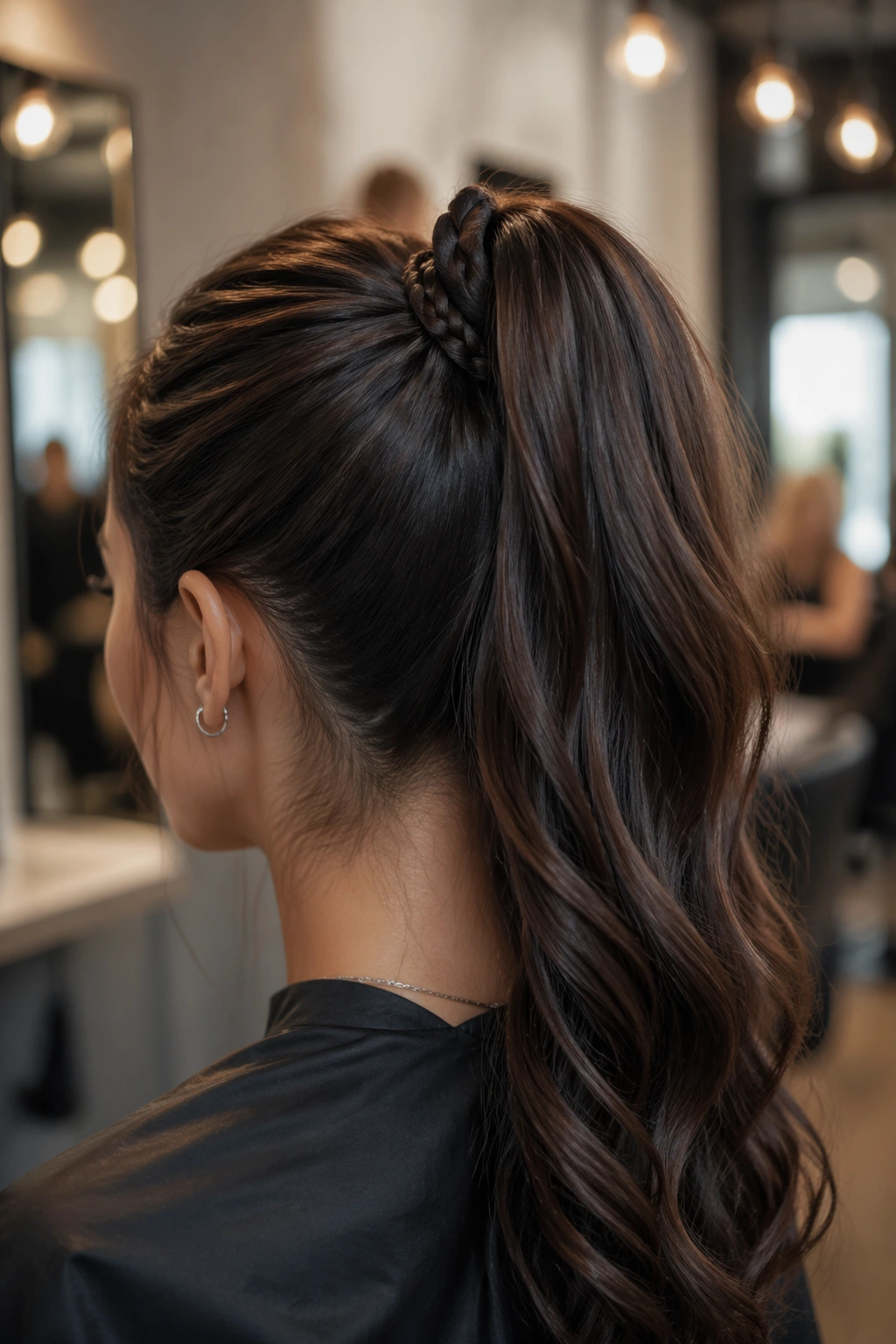
A tiny braid around the base hides everything that usually gives a ponytail away.
This style focuses on the anchor, not the length. You pull the hair into a high ponytail, then use a small braid or braided wrap around the elastic to hide the connection point. The extension sits on top of that base and looks cleaner because the eyes never get stuck on the hardware.
It’s a small detail, but it gives the whole style polish. A visible elastic can make even a thick ponytail look unfinished. A braid makes it feel planned.
What the braid does for the shape
- Covers the band or wrap point.
- Adds a little texture at the crown.
- Helps the base look tighter and more deliberate.
- Works with straight, wavy, or curled ponytail pieces.
I like this move when the rest of the look is simple. It gives enough detail to matter without turning the ponytail into a craft project. Keep the braid narrow. A big braid can swallow the base and make the crown look bulky.
17. Curls-Only-at-the-Ends High Ponytail
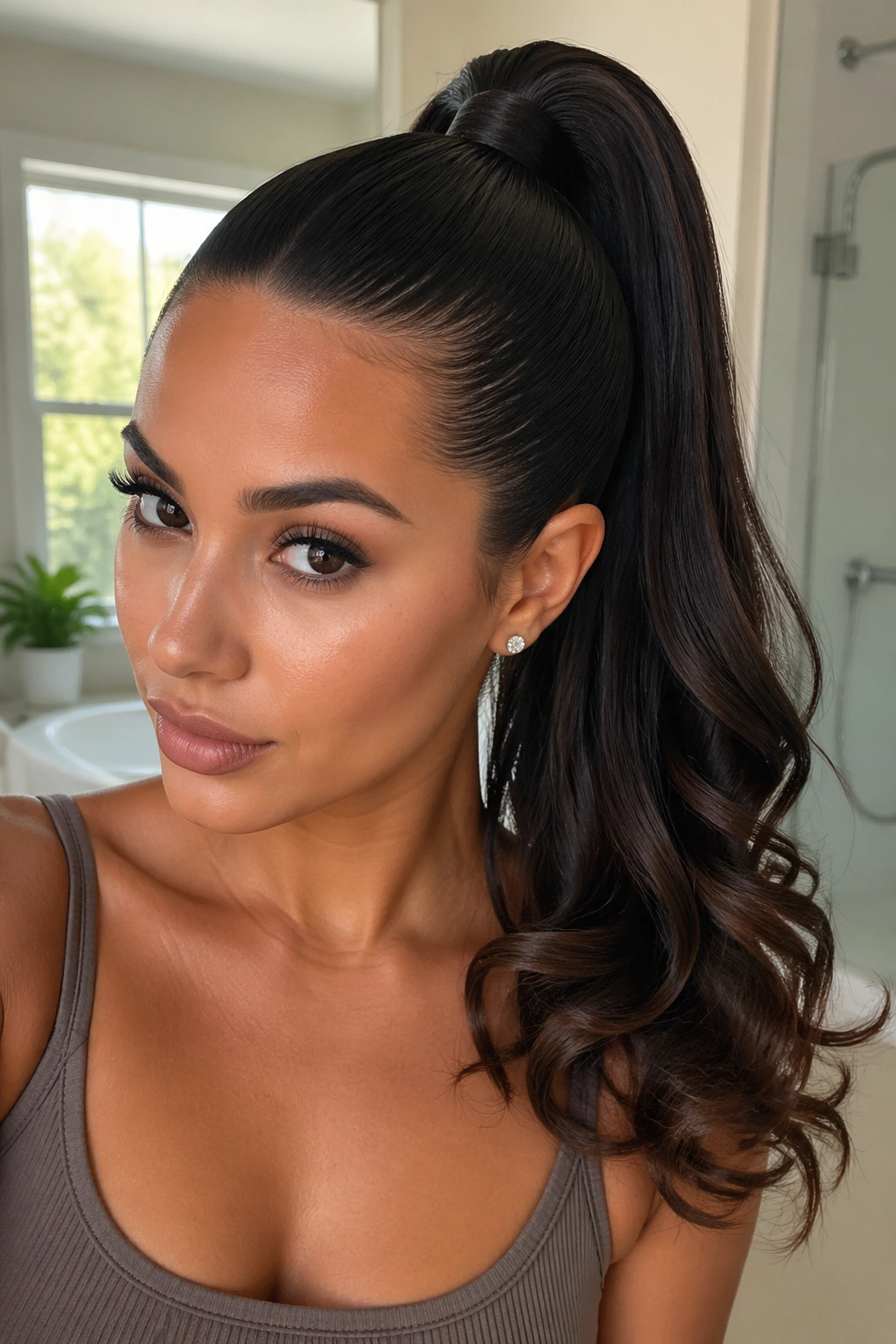
Why do curled ends look fuller than a fully curled ponytail? Because the eye notices the swing at the bottom first.
A curls-only-at-the-ends high ponytail extension keeps the root sleek and lets the lower half do the talking. That gives you movement without a lot of fluff near the top, which is useful when you want the crown to stay smooth and the length to feel soft.
This style also makes the ponytail appear thicker at the bottom. Straight ends can look narrow, especially on longer extensions. A curl or bend at the final 8 to 10 inches gives the hair a little body where it needs it most.
Use a 1.25-inch curling iron or wand for loose bends, not tight spirals. You want the ends to move, not to look like ringlets fighting each other. Human hair extensions handle this well when you use heat protectant and let the curl cool in your hand before releasing it. That cooling step matters more than people think.
The root stays crisp. The ends feel alive. Nice contrast.
18. Teased Crown Volume Ponytail
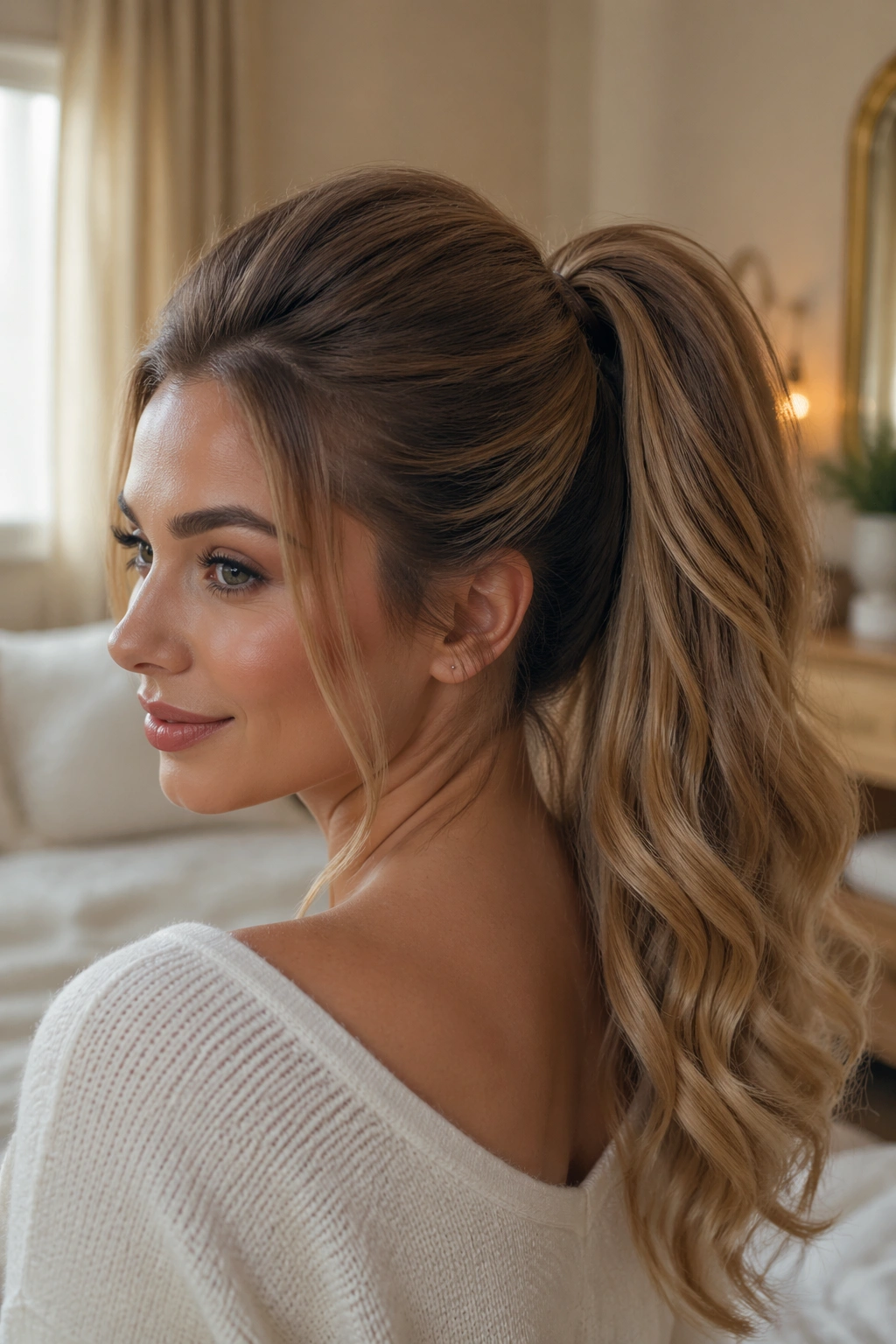
If the crown is flat, no extension in the world saves it.
A teased crown volume ponytail uses backcombing at the root to build a base before the extension goes on. The point is not to create a bird’s nest. The point is to create lift that keeps the ponytail from hugging the head too closely. A little crown height changes the whole silhouette.
You only need a few sections at the top and back of the head. Lift, backcomb gently with a fine comb, mist with flexible spray, then smooth the outer layer over the top. The outside should still look neat. The volume lives underneath.
This trick is especially useful for fine hair or hair that collapses after an hour. The teased base gives the extension something to sit on. Without it, the ponytail can droop and start looking attached instead of intentional.
A lot of people tease too aggressively and then wonder why the top looks fuzzy. Keep the backcombing near the roots, not halfway down the strand. That is where the lift comes from.
19. Wet-Look High Ponytail Extension
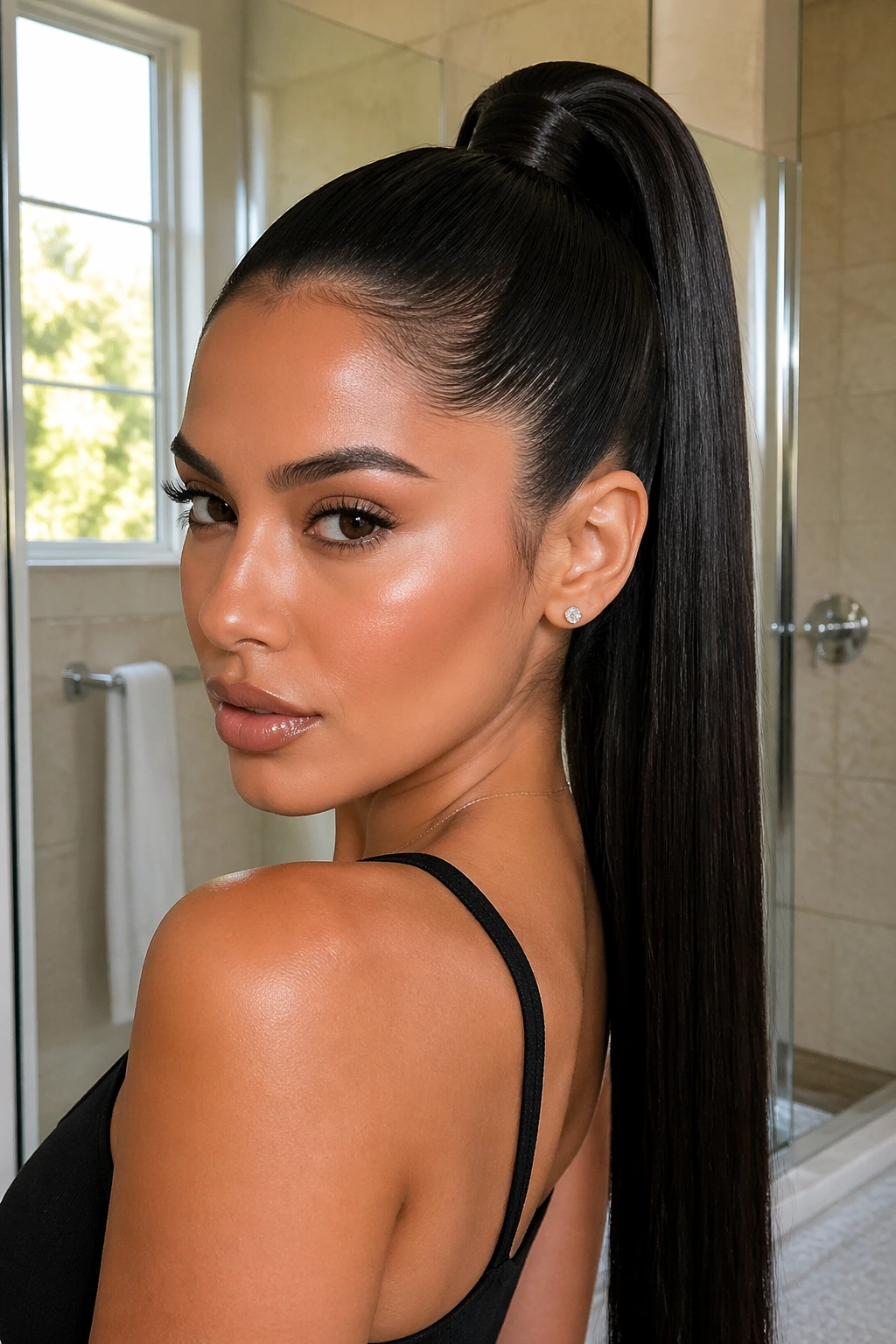
Shiny does not mean flat.
A wet-look high ponytail extension gives you that sculpted, slick finish that feels modern without needing a lot of decoration. The surface looks wet or damp, but the hair underneath should still have structure. That’s the part people get wrong. A true wet look is controlled shine, not actual soaked hair.
This style works well with straight or softly waved extensions because the gel helps lock the shape in place. You want the top to stay close to the scalp and the tail to hang in one clean line. A water-based gel or styling cream usually gives the best finish. Heavy wax can make the hair feel sticky and hard to move.
The best wet look has a hard boundary between the smooth crown and the loose lengths. That contrast is what makes it interesting. If the whole ponytail is plastered down, it loses life fast.
A rat-tail comb, a strong hold gel, and a light hand around the edges are enough. No need to drown the hair.
20. High Ponytail Extension With Metallic Cuff
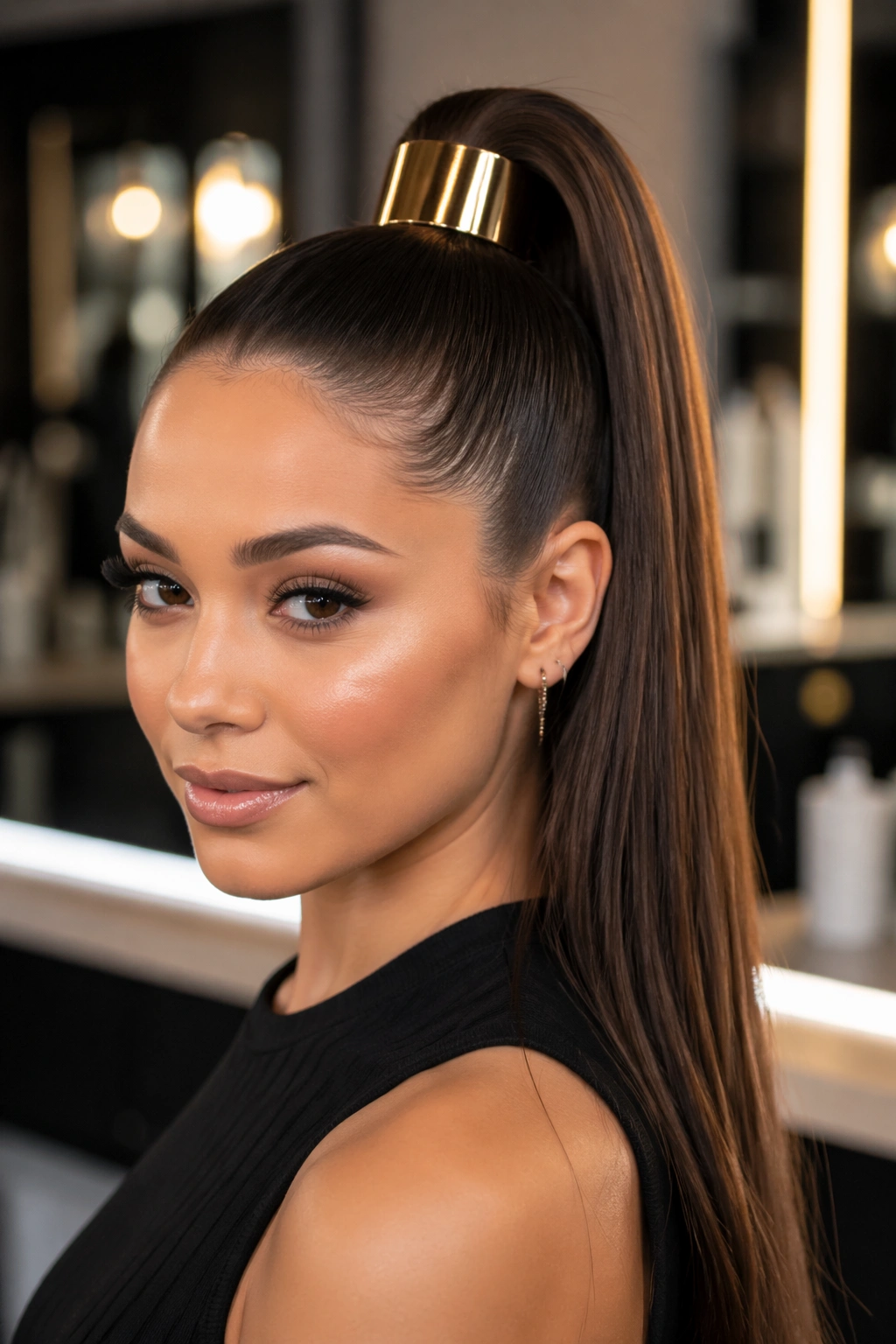
One metal cuff can make a ponytail look finished.
A high ponytail extension with a metallic cuff uses a simple accessory to cover the base and add a little shine. Gold, silver, or gunmetal all work, but the cuff should fit the size of the ponytail instead of rattling around it. If it is too big, the style starts to look sloppy. If it is too small, it looks pinched.
This is a good choice for sleek ponytails, braided bases, or long straight extensions where you want one clean accent rather than more texture. The cuff gives the eye a stopping point. It also makes the style look more deliberate in photos, which is probably why people keep coming back to it.
A cuff can sit right at the base or slightly lower where the wrap ends. I prefer the lower placement when the ponytail is very thick, because it avoids crowding the crown. If the cuff has a hinge or clip, make sure it closes firmly. A loose one slides and scratches.
Simple accessory. Big payoff.
21. Gym-Proof Secure High Ponytail Extension
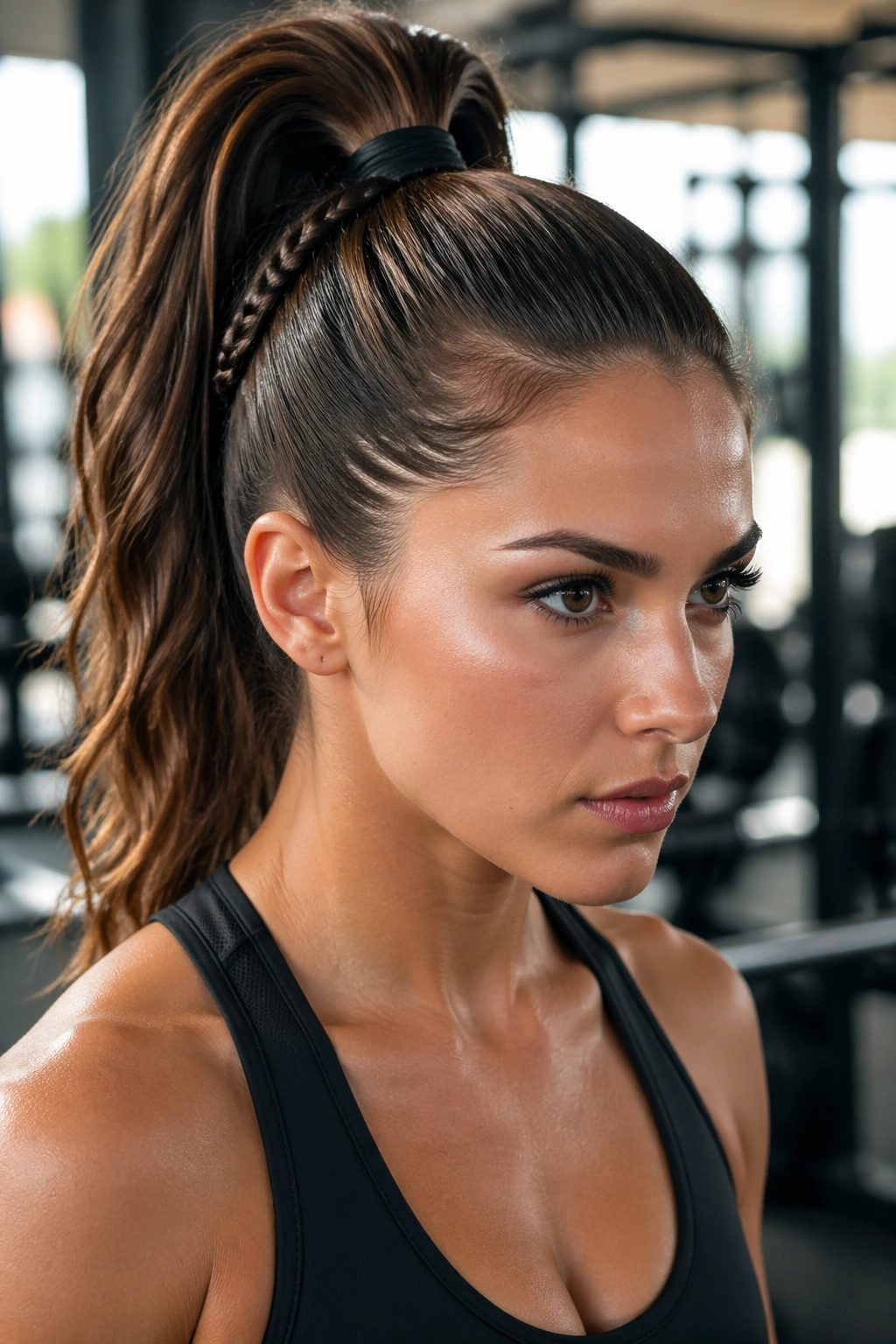
Movement changes everything.
A gym-proof secure high ponytail extension is built for hold first, beauty second. That does not mean it has to look bad. It just means the anchor needs to be tighter, flatter, and lighter than a party ponytail. The goal is no bouncing base, no slipping clips, and no head pain halfway through the session.
I’d keep the extension weight modest here — something around 80 to 120 grams if you want it to move without dragging on the scalp. Two elastics help. So do crossed bobby pins under the base and a braid or bun underneath the attachment point. If your hair is slippery, a little dry texture spray at the roots can give the grip you need.
What to watch for
- Too much weight pulls the base down.
- Too much product makes the hair sticky.
- Too tight a base gives you a headache fast.
- Loose clips are worse than no extension at all.
A ponytail that gives you a headache within an hour is too tight, period. The style should stay put, not punish you for wearing it.
22. Bridal High Ponytail Extension
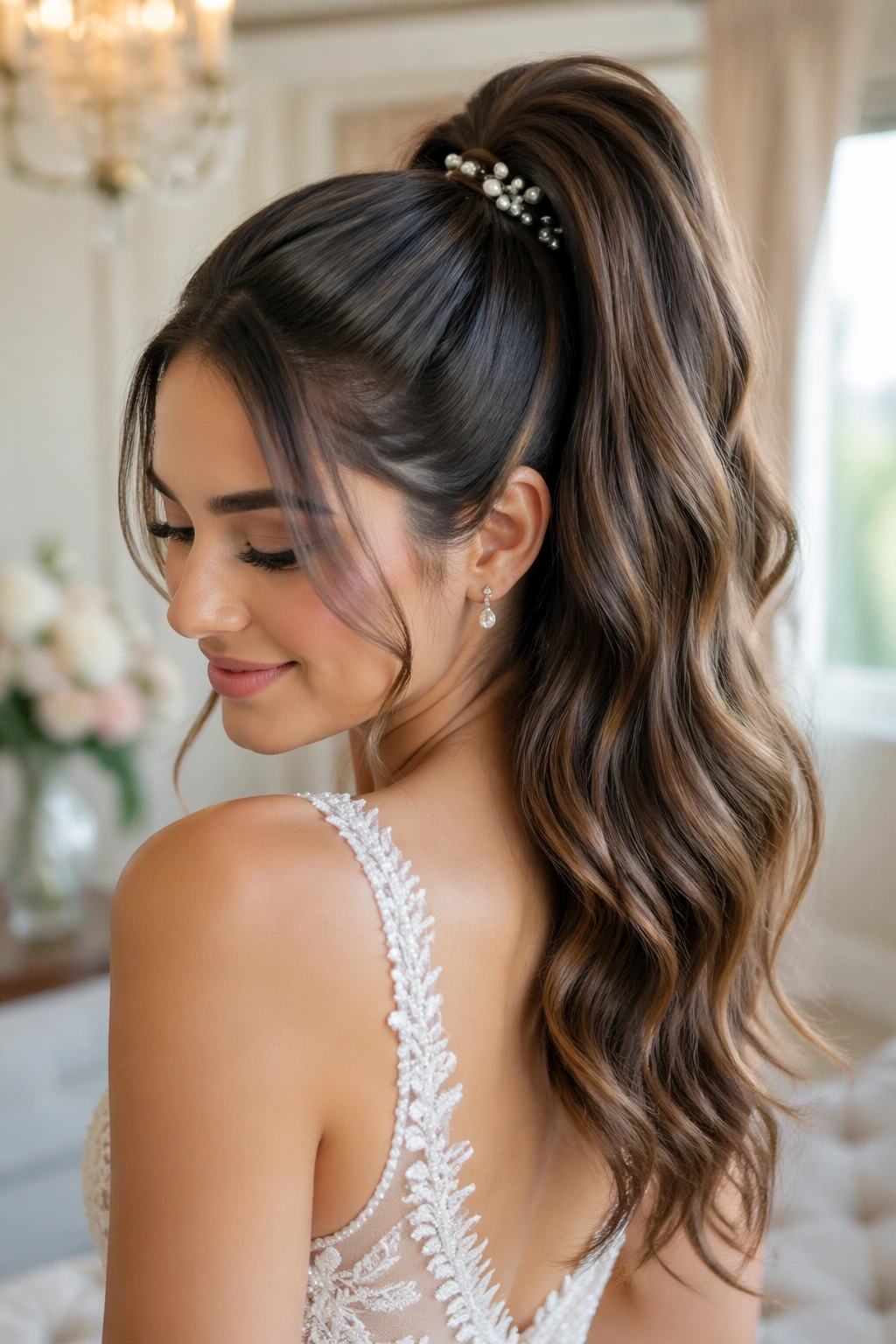
A wedding ponytail does not need to be stiff.
A bridal high ponytail extension works because it gives height, polish, and enough movement to feel romantic without falling apart. Soft waves, a wrapped base, and a few pinned accents can make the style look graceful instead of overdone. It’s a strong choice for people who want hair up and away from the face but still want length in the photos.
Pearl pins, tiny crystals, or a fine ribbon can sit near the wrap point. Keep them sparse. A bridal ponytail gets prettier when the details are spaced out, not packed in like a jewelry box exploded. The hair should still be the main event.
If the style needs to hold through a long day, ask for a secure base with hidden pins and a ponytail piece that matches the texture of your own hair. Human hair extensions are easier if you want touchable waves. Synthetic can work for a set shape, but it often looks less alive in close-up.
The best version feels elegant without being frozen in place.
23. Everyday Five-Minute Clip-In High Ponytail Extension
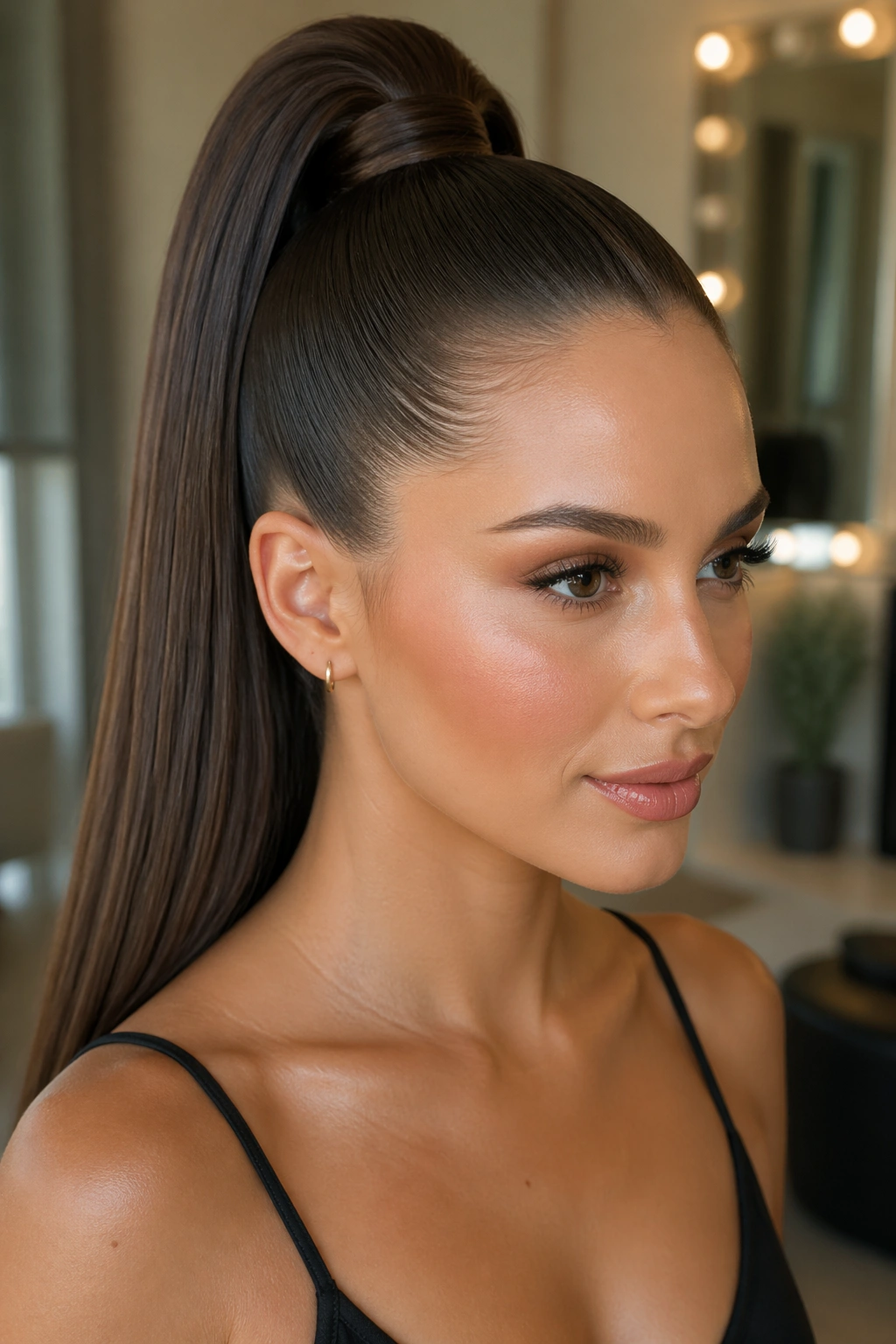
Need volume fast and no drama?
A five-minute clip-in high ponytail extension is the one that gets worn the most, because it fits real life. School drop-off, office days, dinner plans, running errands with wet hair still hidden under a hat — this is the ponytail that can keep up. It doesn’t need a deep part or a full styling session. It just needs a clean base and a piece that matches your texture closely enough to disappear into your own hair.
Start with the highest ponytail that still feels secure. Brush the crown smooth, attach the piece, wrap the extra hair around the base, and pin the end underneath where it won’t show. If the extension is straight, give the ends a quick brush and leave it. If it is wavy, finger-comb it so the texture stays loose. That’s enough.
The reason this version lasts in a rotation is simple. It does not ask much from you. It just makes your hair look thicker, longer, and more awake than it was ten minutes earlier.
And honestly, that is the ponytail most people want: the one that looks like you planned your hair, even when you didn’t have time to plan much at all.
