



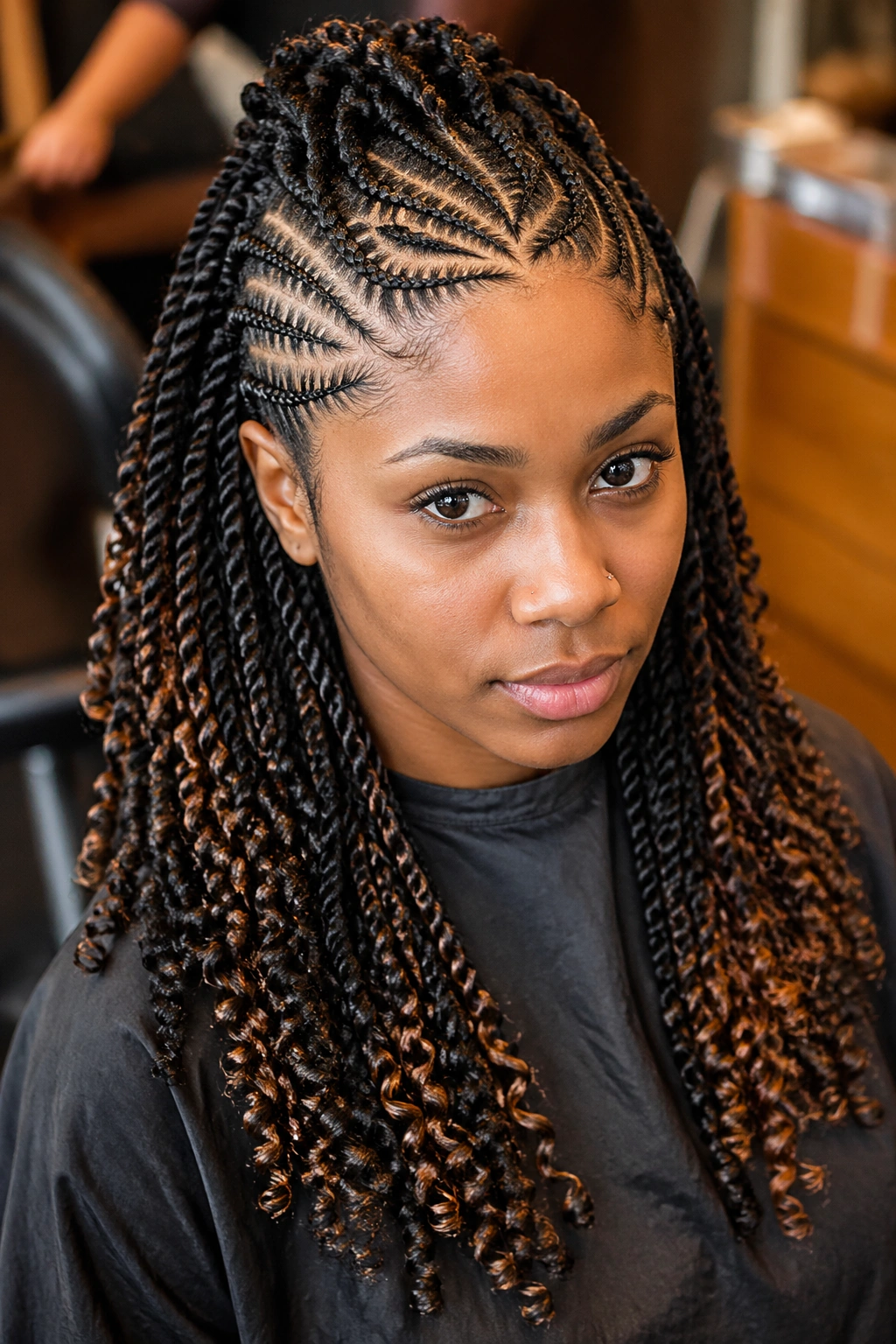
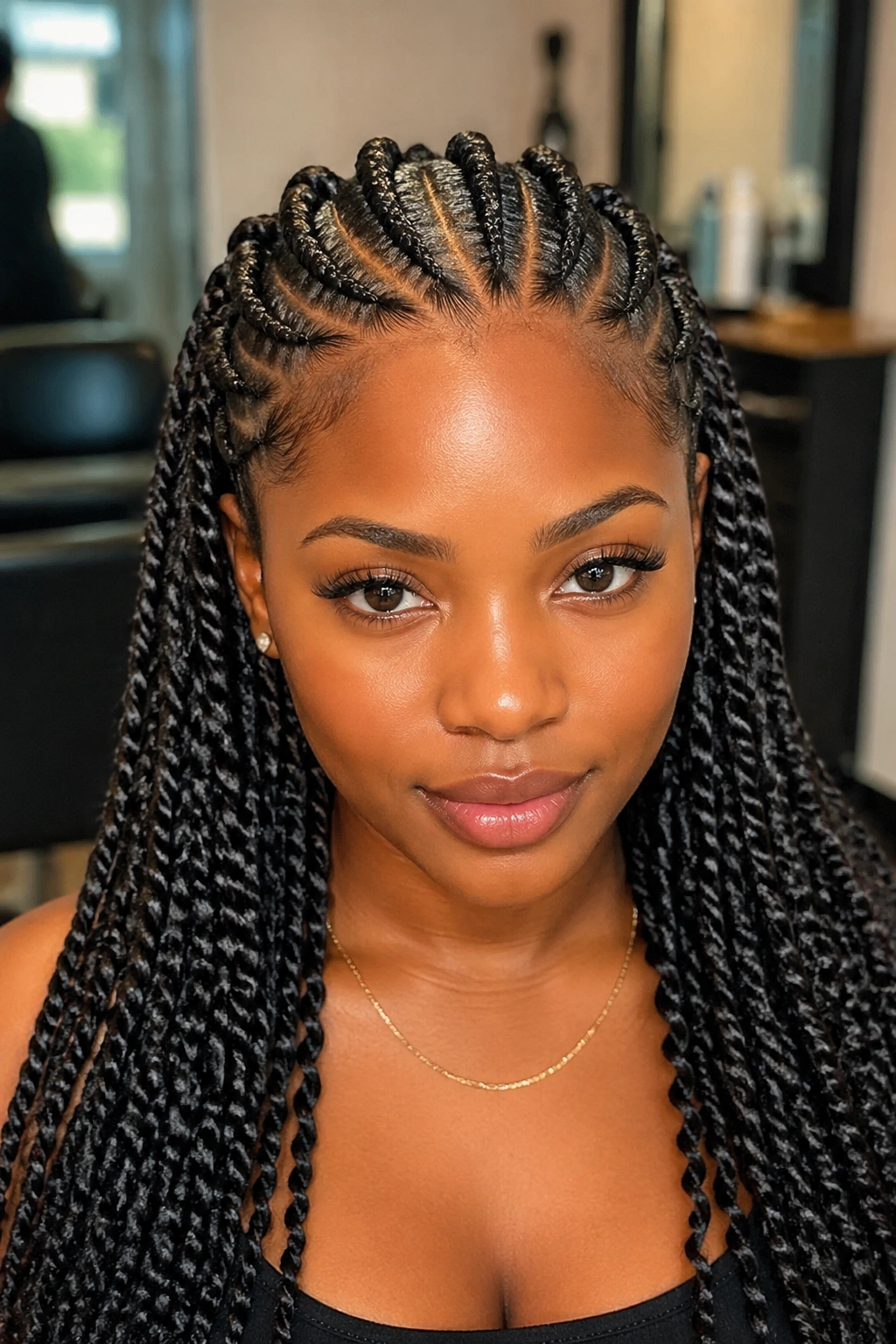
Cornrows and twists make an odd couple on paper. One is flat and sculpted against the scalp, pulled tight in rigid lines. The other is soft, rounded, often loose at the ends, with more movement than structure. Put them together, though, and something shifts. The cornrow handles the framework. The twist handles the texture. And the result, when done thoughtfully, sits somewhere between architecture and sculpture — which is exactly why cornrow styles with twists keep showing up in salons, on runways, in everyday weeks at work, and in weekends of doing nothing at all.
I’ve worn this combo in about fifteen different versions over the years. Some held for four weeks. Some unraveled by day six because I got greedy and left the ends too loose. The ones that worked taught me something specific about where the twist should start, how the cornrow should feed into it, and why a tiny detail like parting width changes everything downstream.
That’s what this guide is about. Twenty-five distinct cornrow-plus-twist styles — not twenty-five versions of the same look with a color swap. Real differences in technique, finish, length, parting, and wearability.
Why Cornrows and Twists Work Together
The mechanical reason is simple. Cornrows keep the hair close to the scalp, which means the scalp stays cool, the parts stay visible, and the overall shape stays neat for longer than loose braids ever could. Twists, on the other hand, create volume and softness that flat braids can’t. When you blend the two, you get a foundation that lasts and a finish that moves. It’s the best of both textures without the weight of a full braid-out.
There’s also a longevity angle. A head of twists alone can start to frizz at the roots within a week if the hair is fine or the twists are small. A head of cornrows alone can look severe, especially if your face shape doesn’t love a tight pull-back. Merge the two, and the cornrow does the root-holding while the twist handles the visible length. Frizz shows up later. The style holds better.
Tools and Prep That Actually Matter
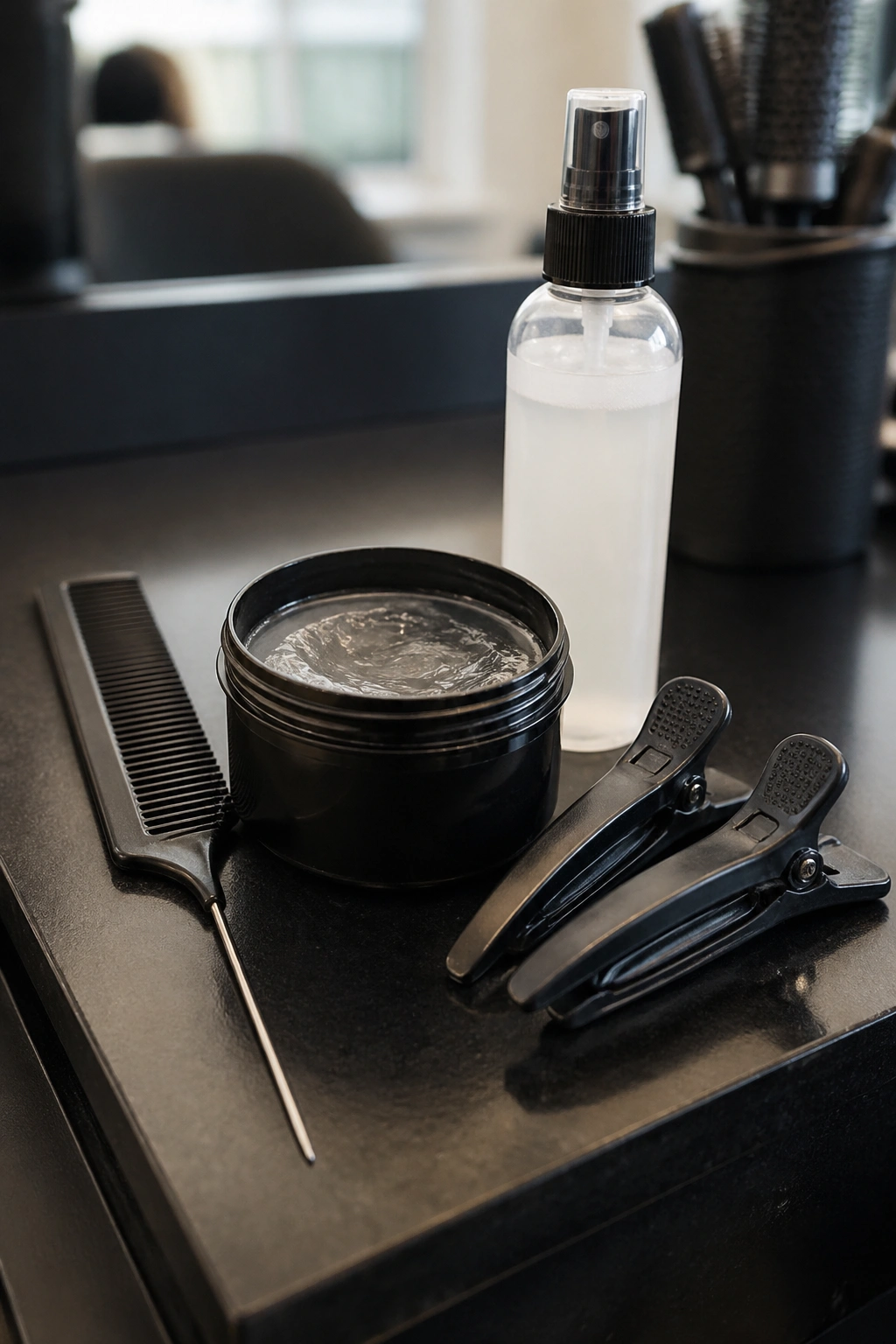
Rat-tail comb. Not a paddle brush, not a wide-tooth comb. The fine end for parting, the tail for lifting sections. A clean part changes how the whole style reads.
Edge control, not grease. Grease softens the cuticle and makes the hair slip — which is the opposite of what you want at the hairline. A firm-hold edge gel, roughly a dime-sized dollop per temple, is enough.
Water-based leave-in. Heavy butters weigh down twists and make them look wet on day one, dull on day three. A light leave-in with slip is all you need for the twist portion.
Clips. Jaw clips, not duckbills. You’ll be working in sections for anywhere from two to six hours depending on the style, and duckbills leave dents that photograph badly.
Hair type awareness. 4C hair holds twists better than 3B hair but needs more moisture control. 3C sits in the middle. Knowing your texture changes your product choice more than any tutorial will.
A Quick Note on Parting
The difference between a cornrow-twist style that looks polished and one that looks messy almost always comes down to the part. Straight, clean, sharp — run the rat-tail comb along the scalp in one continuous motion. Don’t saw back and forth. Sawing creates flyaways that fuzz the whole style by day three.
And if you’re parting into curves — horseshoe shapes, S-curves, zigzags — use two clips to pin the already-parted sections out of the way. Never try to hold sections with your hand while parting new ones. You’ll lose the line.
Timing Expectations by Style
A simple six-cornrow-to-twist style takes about 2.5 hours on medium-length hair. A freestyle cornrow pattern with micro-twist ends pushes 5-6 hours. Jumbo versions run shorter — sometimes under 90 minutes — but require better finishing because any fuzz shows more on thick braids.
Block out more time than you think you need. Rushing the last two cornrows is where most styles fall apart visually.
1. Six Cornrows into Senegalese Twists
This is the workhorse — the style I default to when I need something reliable that photographs well and lasts four weeks.
Why It Works
Six even cornrows give you symmetry without the density of ten. The Senegalese twist finish adds a clean, rope-like texture that holds shape better than flat twists.
- Use pre-stretched kanekalon at the feed-in points
- Twist tension should feel firm at the root, slightly looser at the ends
- Seal ends in hot water for 20 seconds to lock the twist
Tip: Keep the cornrow portion ending just past the crown. If you extend the cornrow too far back, the twist section gets top-heavy.
2. Stitch Cornrows with Mini Marley Twists
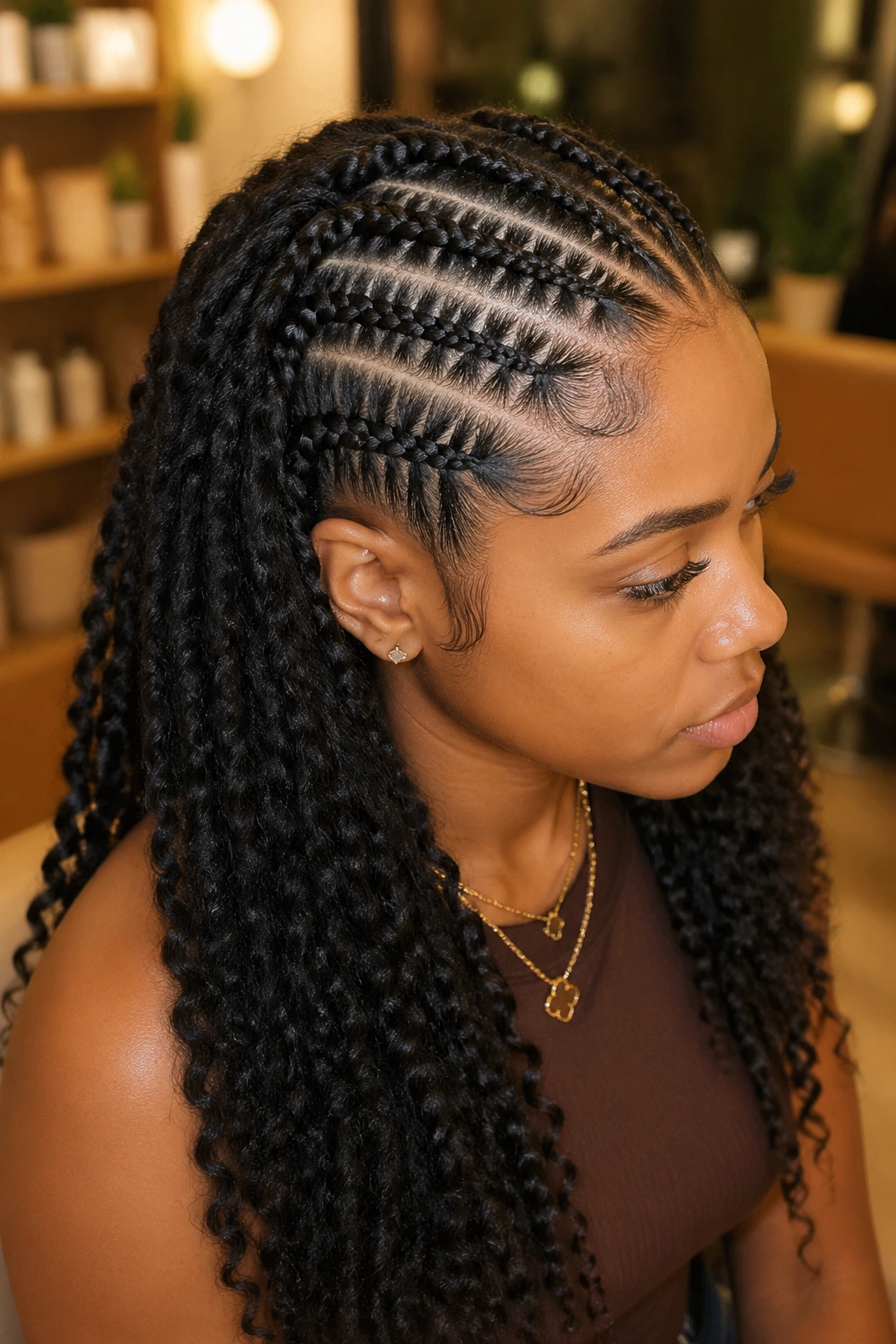
Stitch braids — those horizontal ridges you see running along each cornrow — demand patience. Done right, the pattern looks like fabric weaving. Done wrong, it looks like the braider got tired halfway through.
The mini Marley twist finish is what keeps this style from feeling too structured. Marley hair has a coarser, more matte texture than kanekalon, which softens the tight-scalp look. Pair stitch cornrows across the top half of the head with Marley twists falling from the back, and you get contrast — sharp where it needs to be, soft where it should be.
Most people underestimate how long this takes. Plan six to seven hours for a full head.
3. Fulani Cornrows with Twist Tails
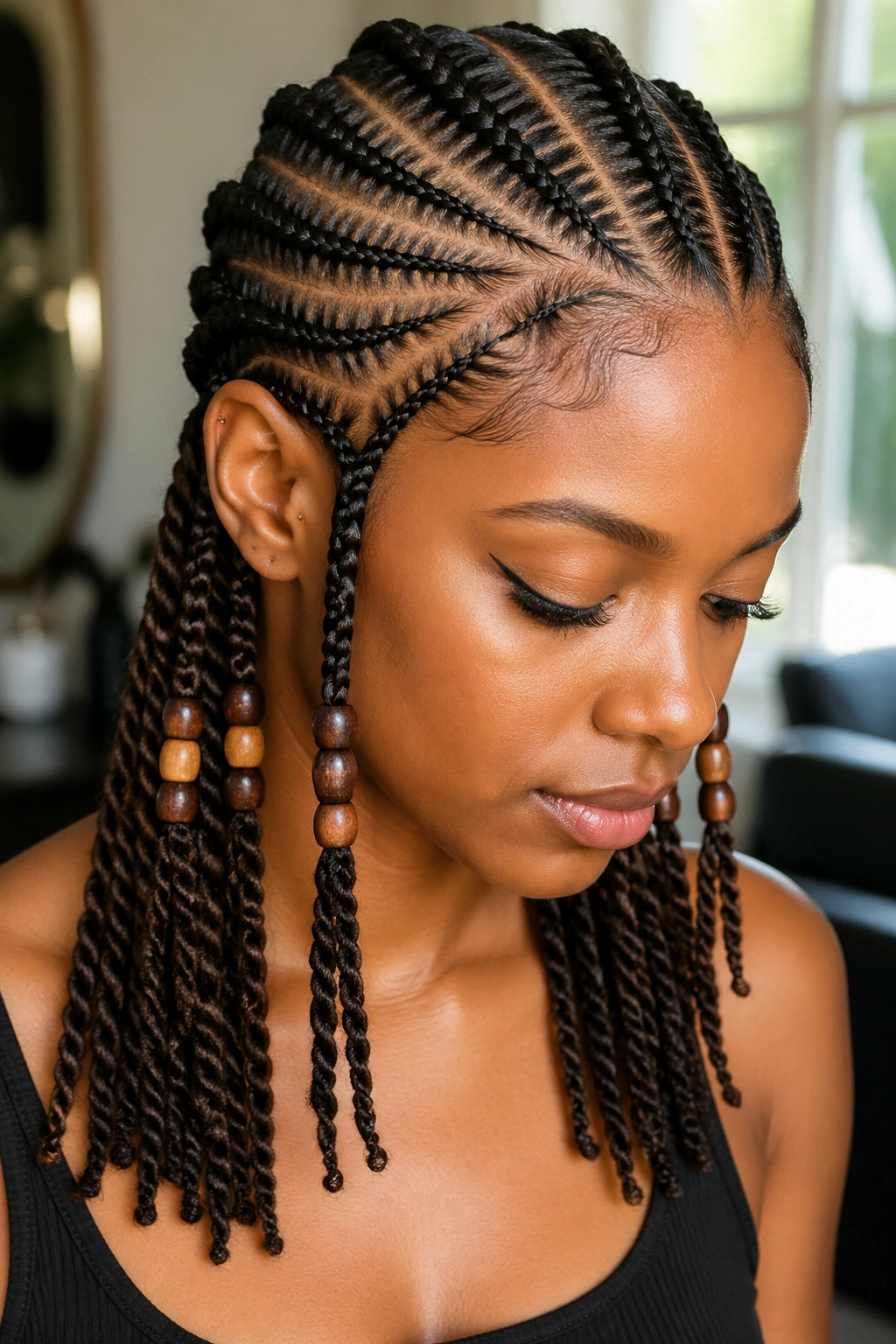
What happens when you take the classic Fulani parting pattern — the center cornrow, the side-swept design, the bead-heavy tradition — and swap the braided tails for twists?
You get something that honors the pattern without copying it. Fulani parting is iconic: a single line down the center of the scalp flanked by angled cornrows that sweep toward the temples. Instead of finishing with braid-outs or straight extensions, finish each cornrow tail with a two-strand twist. The twist reads softer, almost feminine in a way the traditional finish doesn’t.
How to Use It
Keep the beads at the twist-transition point, not scattered throughout. Concentrating the beads where cornrow meets twist draws the eye to the change in texture and makes the whole design feel intentional.
4. Lemonade Cornrows with Rope Twists
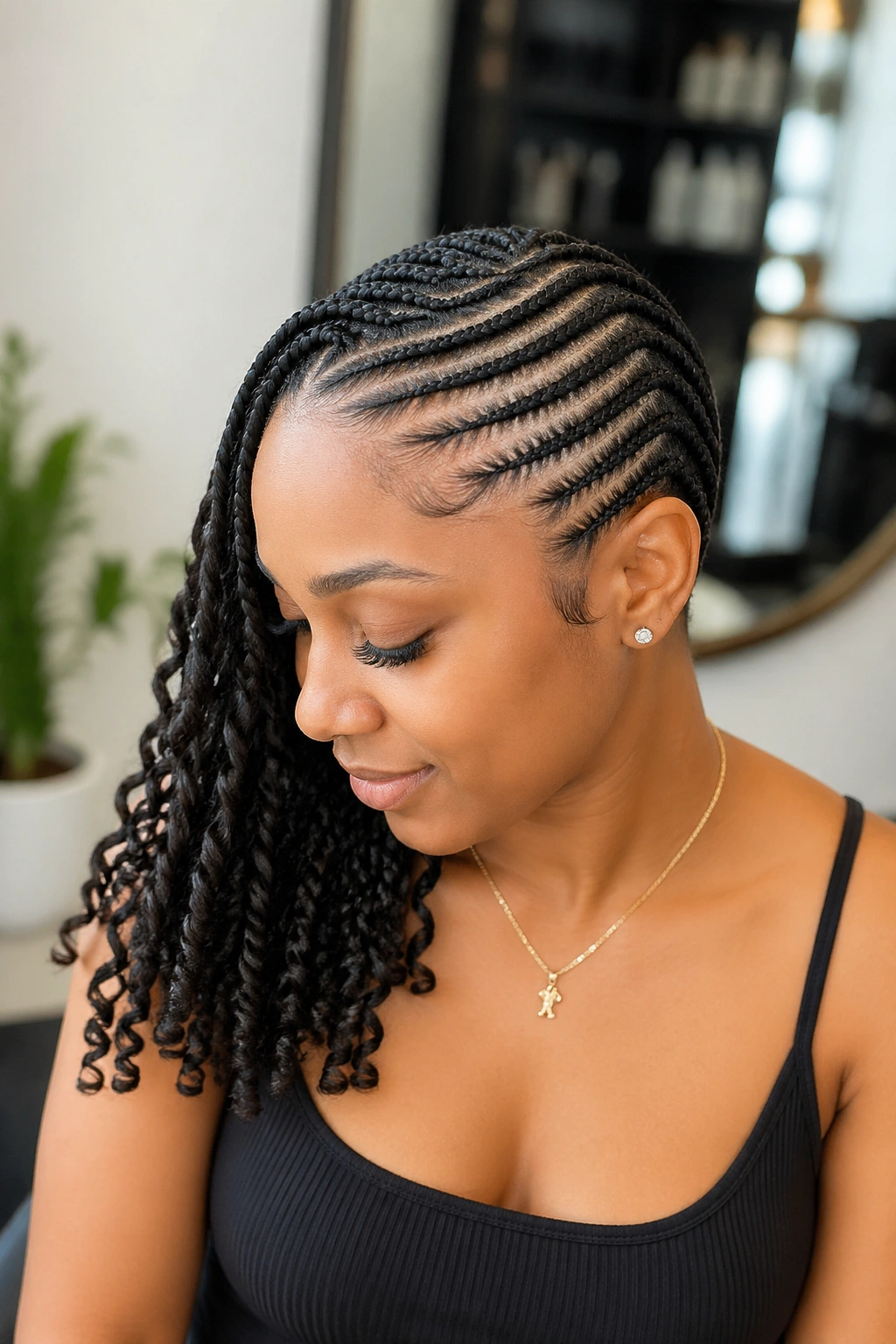
Angled side-swept cornrows that fall across the scalp. The tails finish in two-strand rope twists instead of standard braids. Smoother line. Softer ends.
The cornrow angle should start at the opposite temple and curve across the head. Five to seven cornrows is the sweet spot. Fewer than five, and the parting looks heavy. More than seven, and the style gets busy.
Rope twists — where you twist each strand to the right before wrapping them together to the left — hold their curl pattern longer than standard two-strands. Expect 3+ weeks of wear.
5. Jumbo Cornrows into Chunky Passion Twists
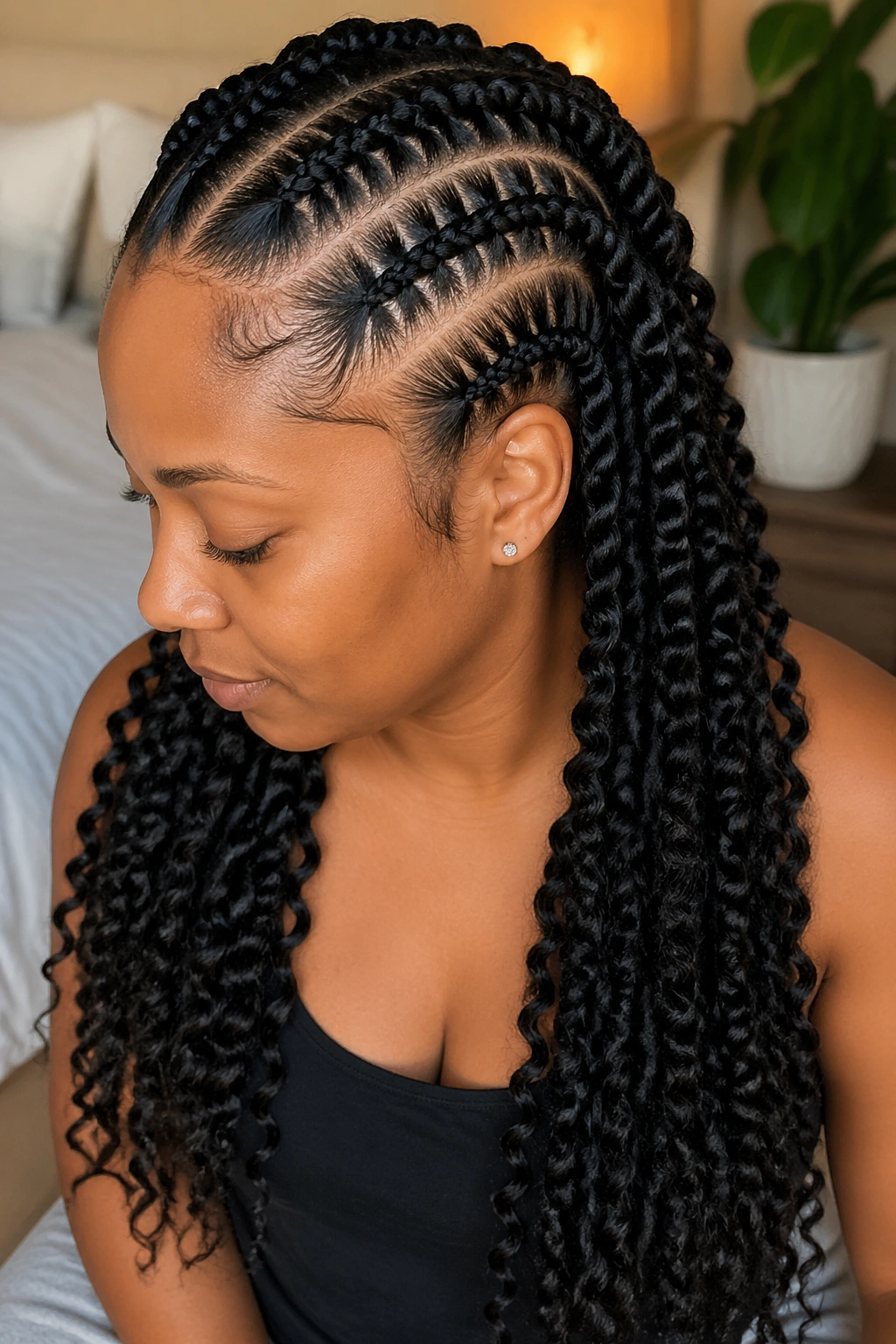
Jumbo cornrows move fast. Three or four across the scalp, no more. The twist finish should match the scale — passion twists done large, not micro, with pre-curled water wave hair.
This is the style for when you need to be braided, done, and out the door in under three hours. It’s also the style that reads best on shorter natural hair because jumbo cornrows don’t demand much leave-out to look full. The passion twist portion adds the drama the cornrows can’t.
The catch is durability. Jumbo anything loosens faster than smaller versions. Expect 2-3 weeks max before the cornrow base starts lifting at the roots.
6. Tribal Cornrow Pattern with Flat Twist Finish
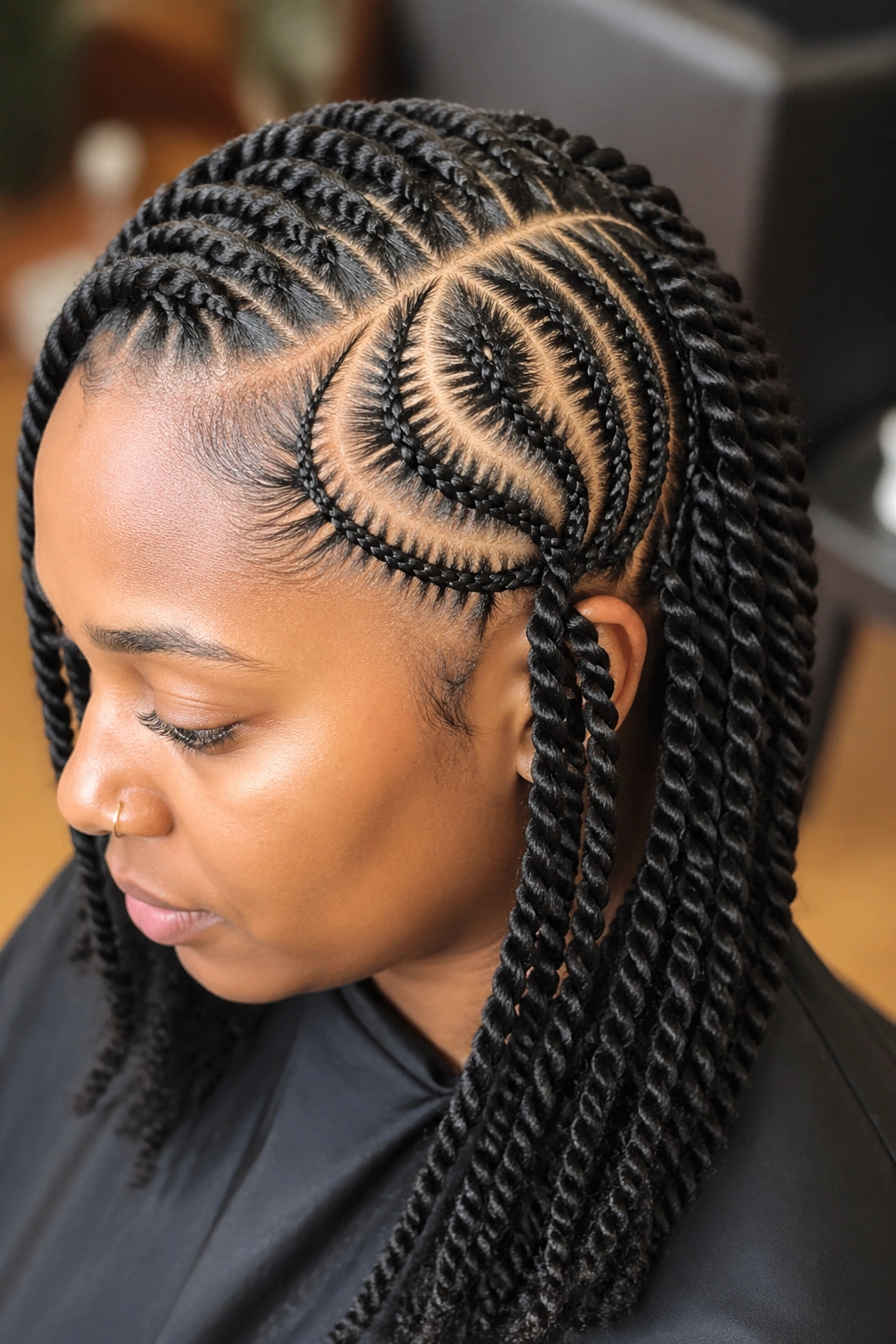
Is there a way to do cornrows that reads cultural without feeling like costume? Yes. Combine a freestyle tribal parting — asymmetrical, with curved sections and varying widths — with flat twists finishing the tails instead of round three-strand braids.
The flat twist finish keeps the style grounded and graphic. Round braids tend to round out the silhouette. Flat twists preserve the sharp geometry of the parting pattern.
What Makes It Different
Most cornrow-to-braid combos finish with volume. Cornrow-to-flat-twist finishes with line. The whole head reads like a graphic design, not a hairstyle. If your face shape is angular — strong jaw, sharp cheekbones — this frames it beautifully. Softer faces tend to find it severe.
7. Halo Cornrow with Cascading Twists
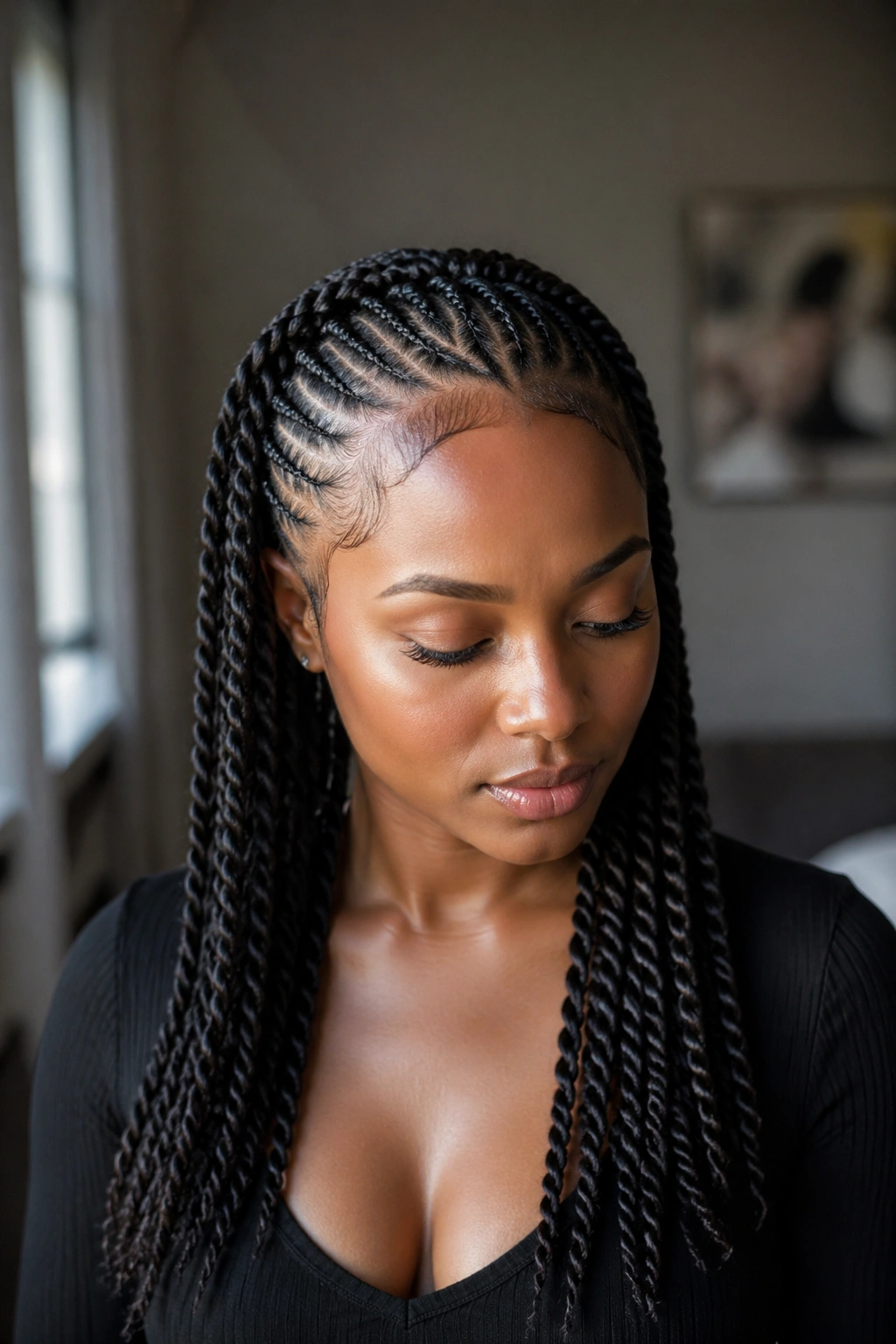
A single cornrow circling the head like a crown, with twists falling from the inside of the circle down the back.
Halo styles sound simple. They’re not. The circle has to be perfectly round — every inch too far forward on one side throws off the symmetry from every angle. Braid the halo first, then work the twist section loose from the crown downward.
Best worn with the face clear and the twists reaching at least to the collarbone. Shorter twists make the halo look disconnected from the rest of the hair.
8. Zigzag Cornrows with Spring Twist Ends
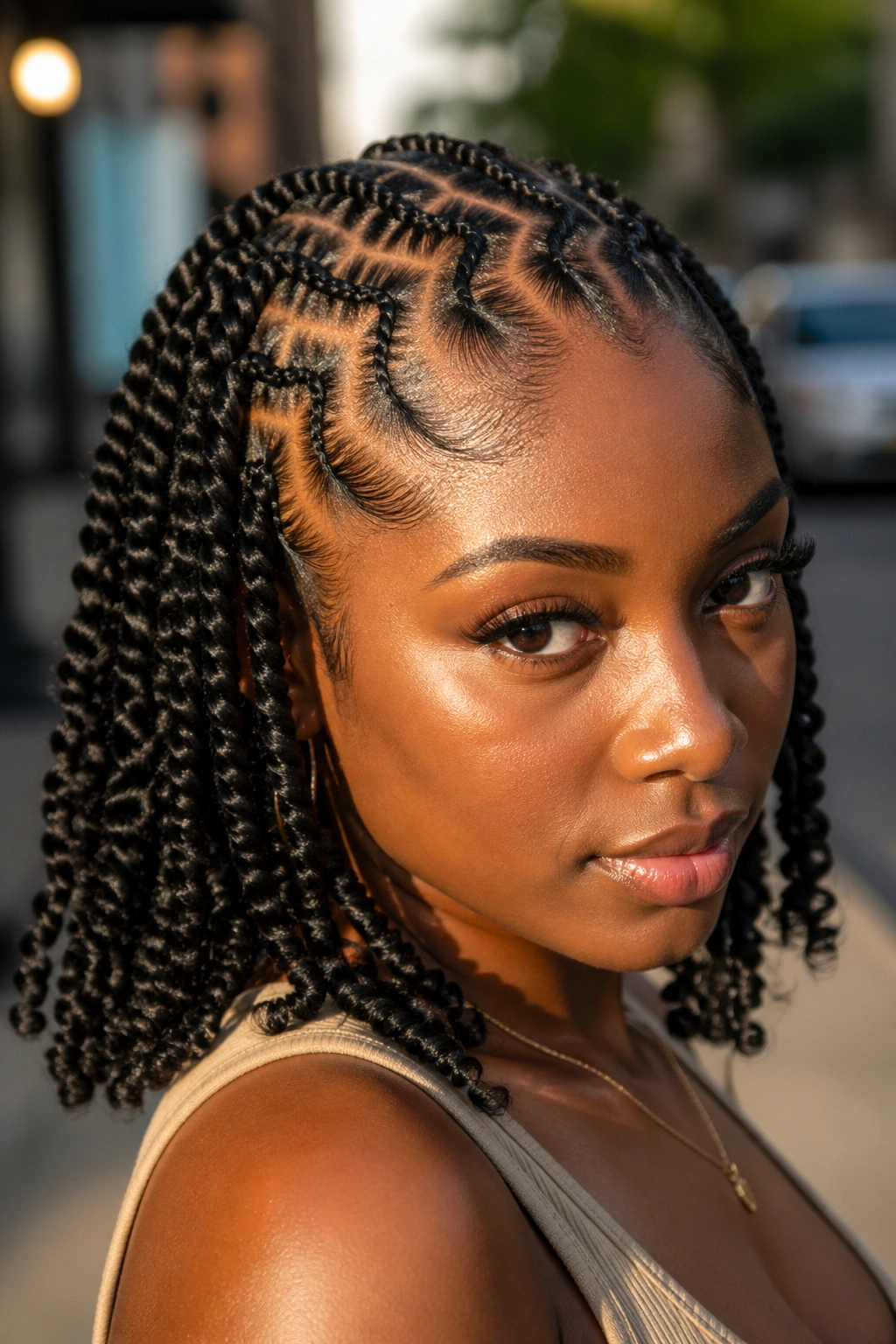
Flat zigzag parting across the top half of the head. Spring twist extensions from mid-head down. The zigzag breaks up the grid-like feel of straight-back cornrows without going fully freestyle.
Spring twists — also called Afrikiko or coil twists — are pre-coiled kanekalon with a natural spring pattern. They don’t need to be actively curled, which saves a step.
The contrast between angular zigzag cornrows and round bouncy spring twists is what sells this style. Don’t ease the zigzag into gentle waves. Make the angles sharp.
9. Side-Part Cornrows with Havana Twists
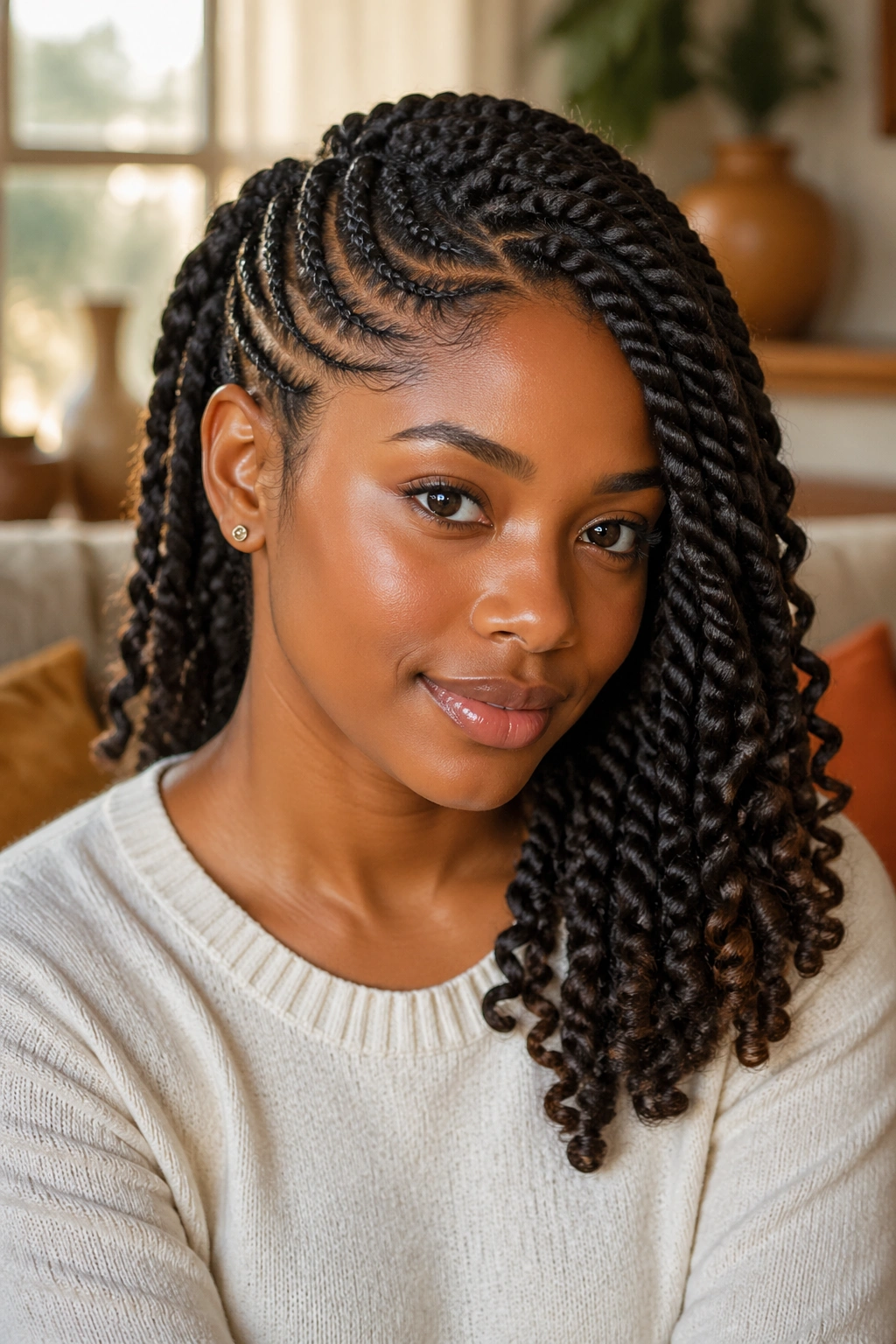
A deep side part. All the cornrows sweep from the part toward the opposite side. The tails finish in Havana twists — chunkier than Senegalese, thicker per strand, with more visual weight.
Havana twists originate from the Havana hair brand known for its coarser, fuller texture. The result looks more like a chunky rope than a smooth twist. That weight balances the asymmetry of a deep side part.
This style suits medium-length to long finished hair. Shorter versions lose the drama of the sweep.
10. Cornrow Ponytail with Twist Hang
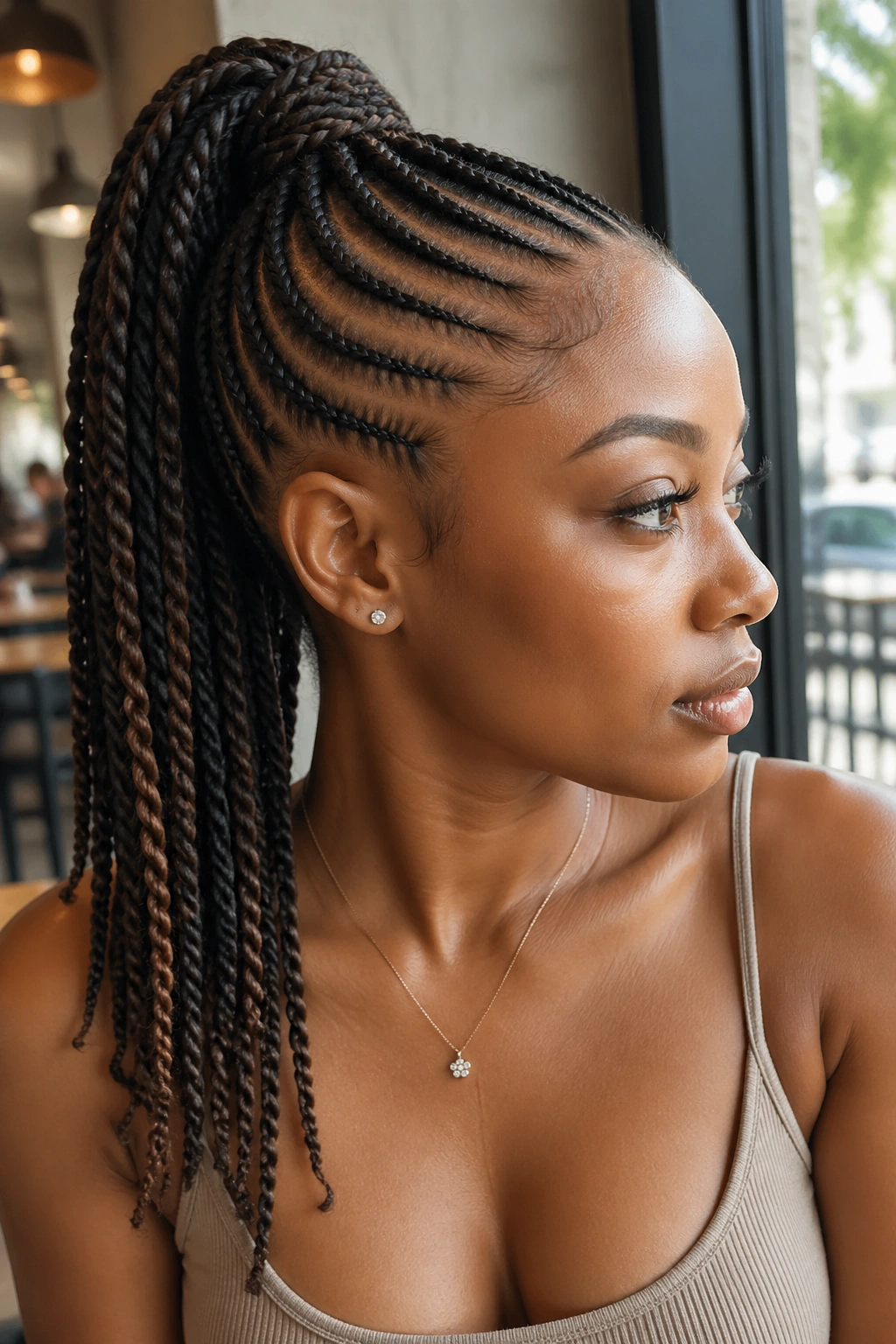
Cornrows all gathered into a high or mid-level ponytail. Everything past the gather point becomes freely hanging twists.
Styling Tips
The gather point matters more than the cornrow count. A high crown gather elongates the face. A nape gather reads sleek and formal. Mid-head gathers are the hardest to get right because they can look accidental if the parting isn’t deliberate.
Wrap a single twist around the base of the ponytail to hide the band. That one detail makes the difference between finished and unfinished.
11. Curved Cornrows with Kinky Twist Finish
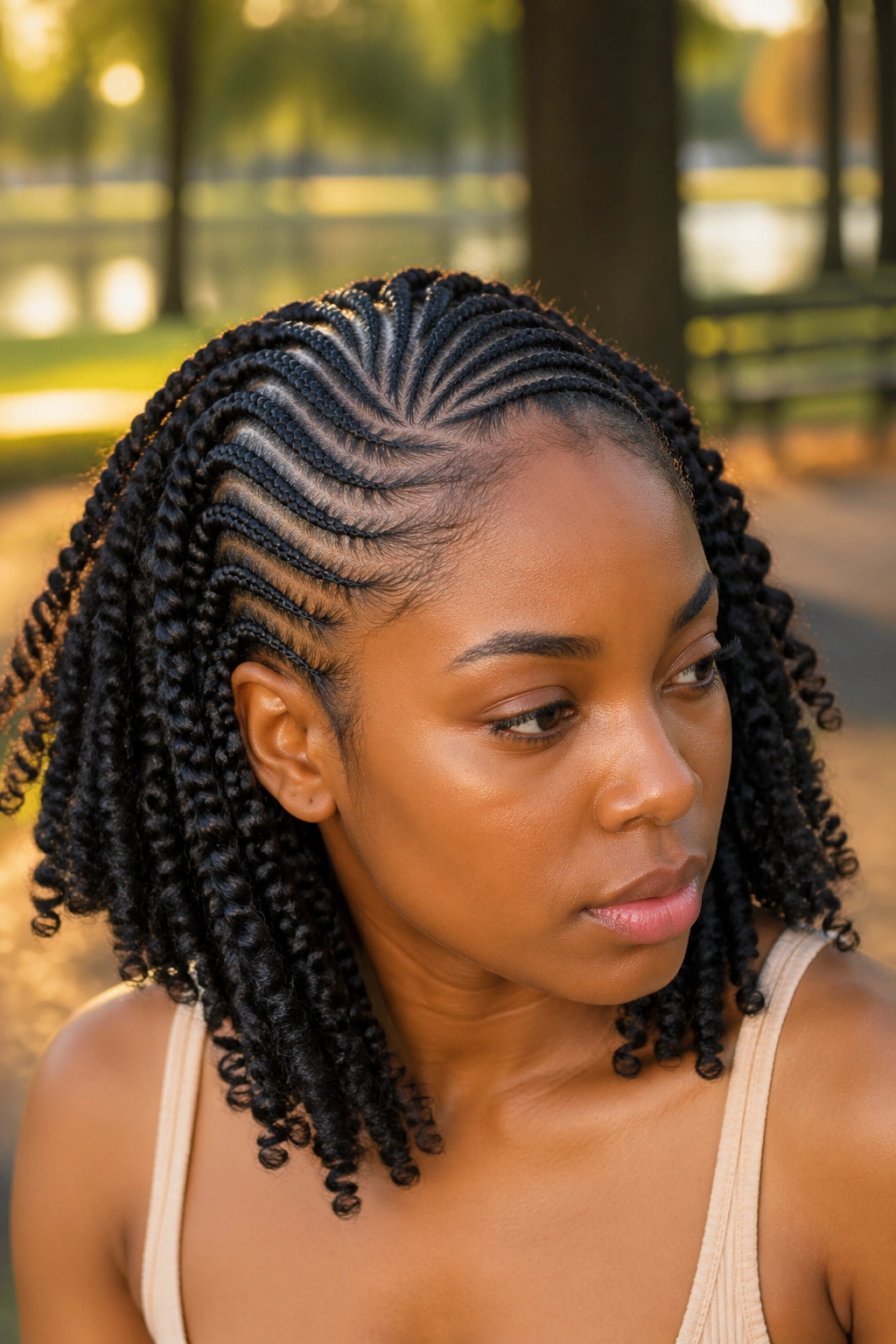
Curved cornrow paths that spiral from a central point outward. Kinky twist ends — twists using pre-coarsened kanekalon that mimics natural Afro texture.
The spiral cornrow base takes practice. Most braiders without regular spiral experience will drift the curves into semi-straight angles as they go. Watch for this. The whole style loses its movement if the curves flatten out.
Kinky twists, unlike Senegalese, don’t need sealing. The coarse texture grips itself. Leave the ends raw or trim them straight for a blunter finish.
12. Micro Cornrows into Butterfly Locs
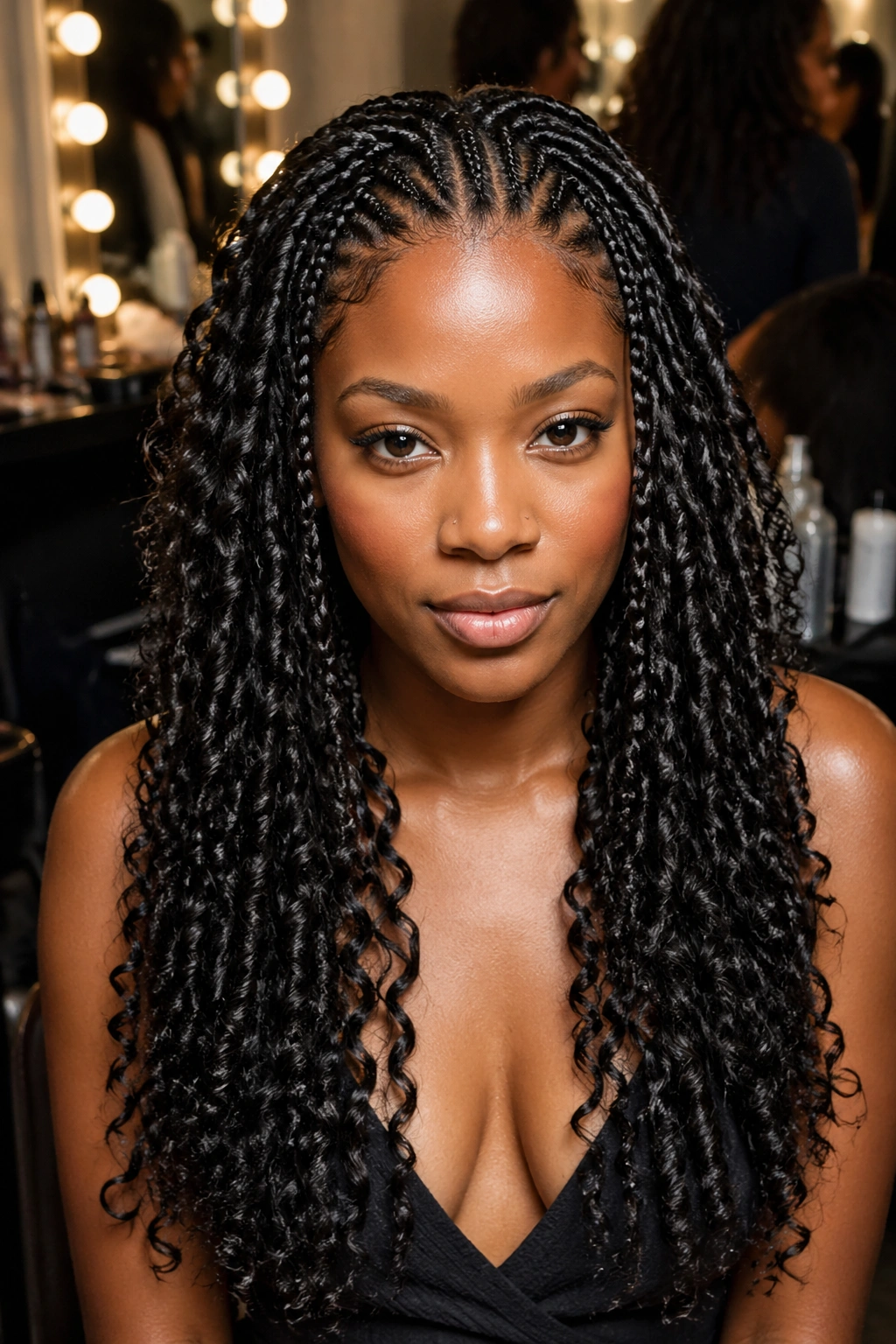
Imagine twenty to thirty thin cornrows across the scalp, each transitioning into a butterfly loc. Butterfly locs are a distressed, crochet-style finish — messy on purpose, with loops and loose strands that look undone.
The micro cornrow base is almost invisible under the dense butterfly loc section. What you see is the loc texture with a peek of scalp parting underneath. Heavy. Bold. Expect 5+ hours of install and 4+ weeks of wear.
13. Cornrow Bangs with Hanging Twists
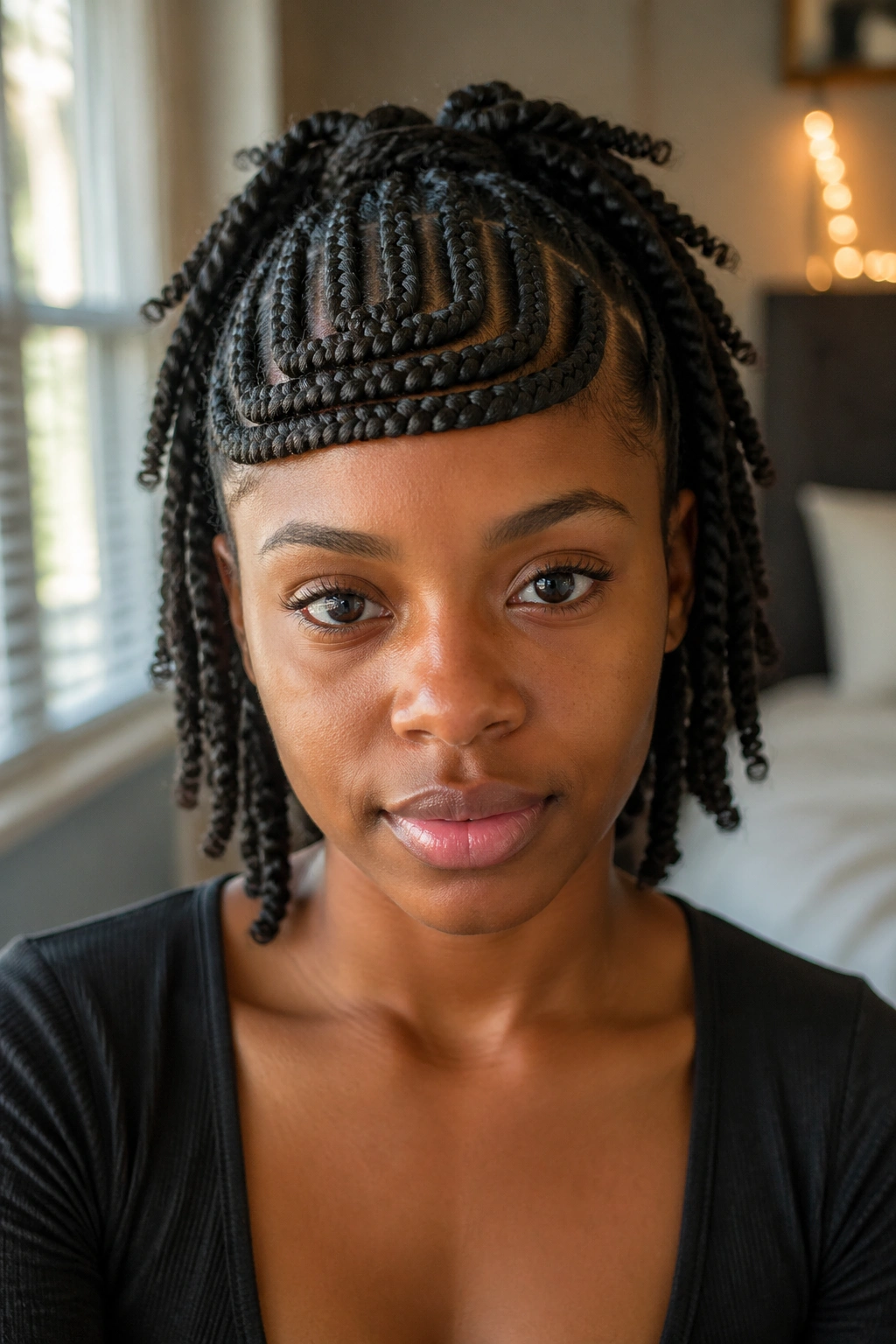
A thick cornrow bang covers the forehead. The rest of the hair — from the bang-stop point back — falls in loose twists.
This is one of the few cornrow-twist combos that works on shorter hair without extensions. The bang gives you structure. The loose twists past the crown add softness. No feed-in needed if your natural hair reaches past your shoulders.
The bang line should sit about an inch above the natural hairline, not flush against it. Flush-against bangs look like helmets.
14. Cornrow Updo with Twist Bun
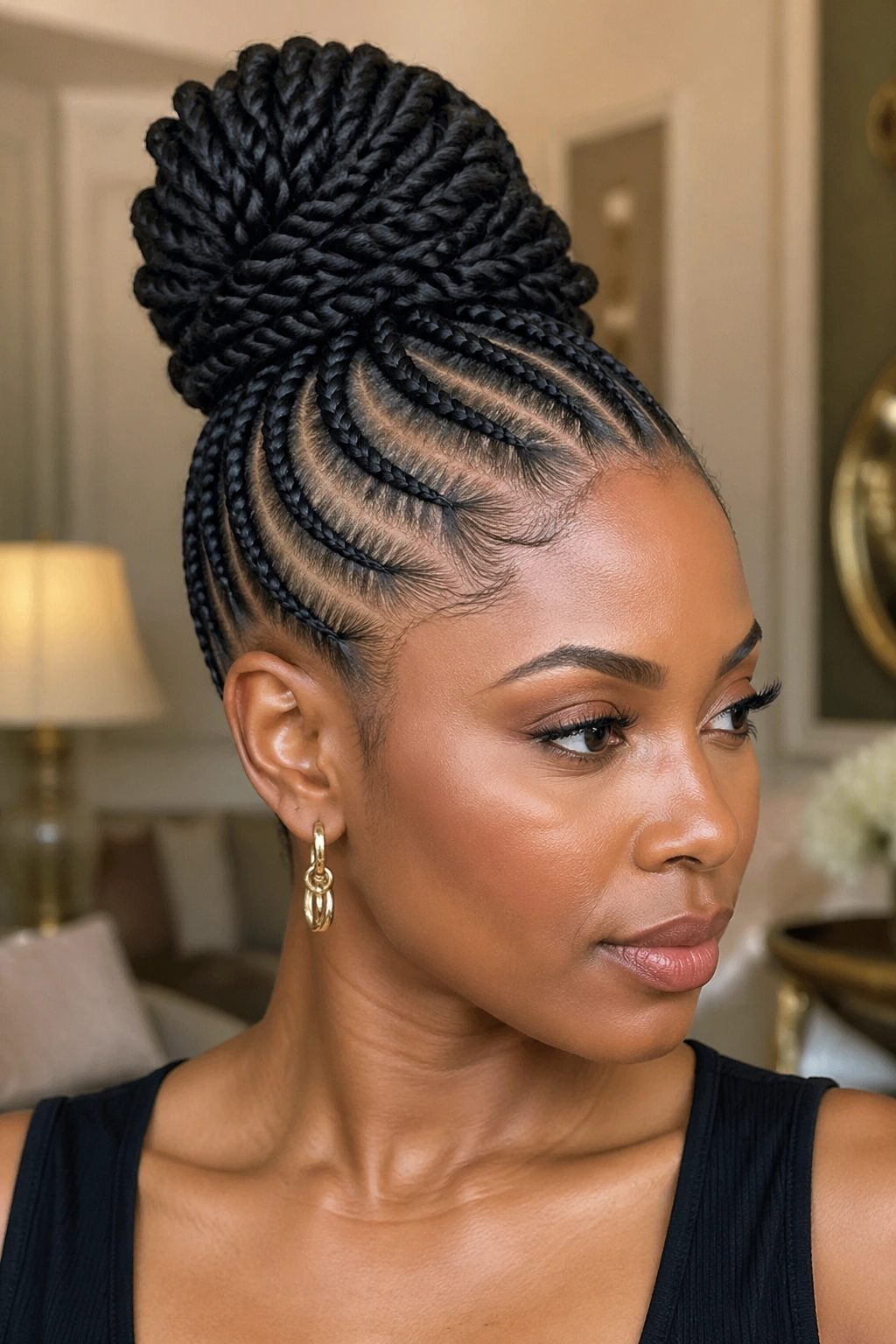
All the cornrows sweep up and terminate at the crown, where they gather into a large twisted bun.
Who This Is For
Anyone who wants a cornrow style that can transition from day to evening without restyling. The bun reads polished at work, formal at weddings, and casual when paired with hoops and a tee.
The bun itself should use kanekalon or Marley hair for volume. Using only your own hair tends to produce a flat, disappointing bun unless your natural hair is very thick and long.
15. Center-Part Double Cornrows with Twists
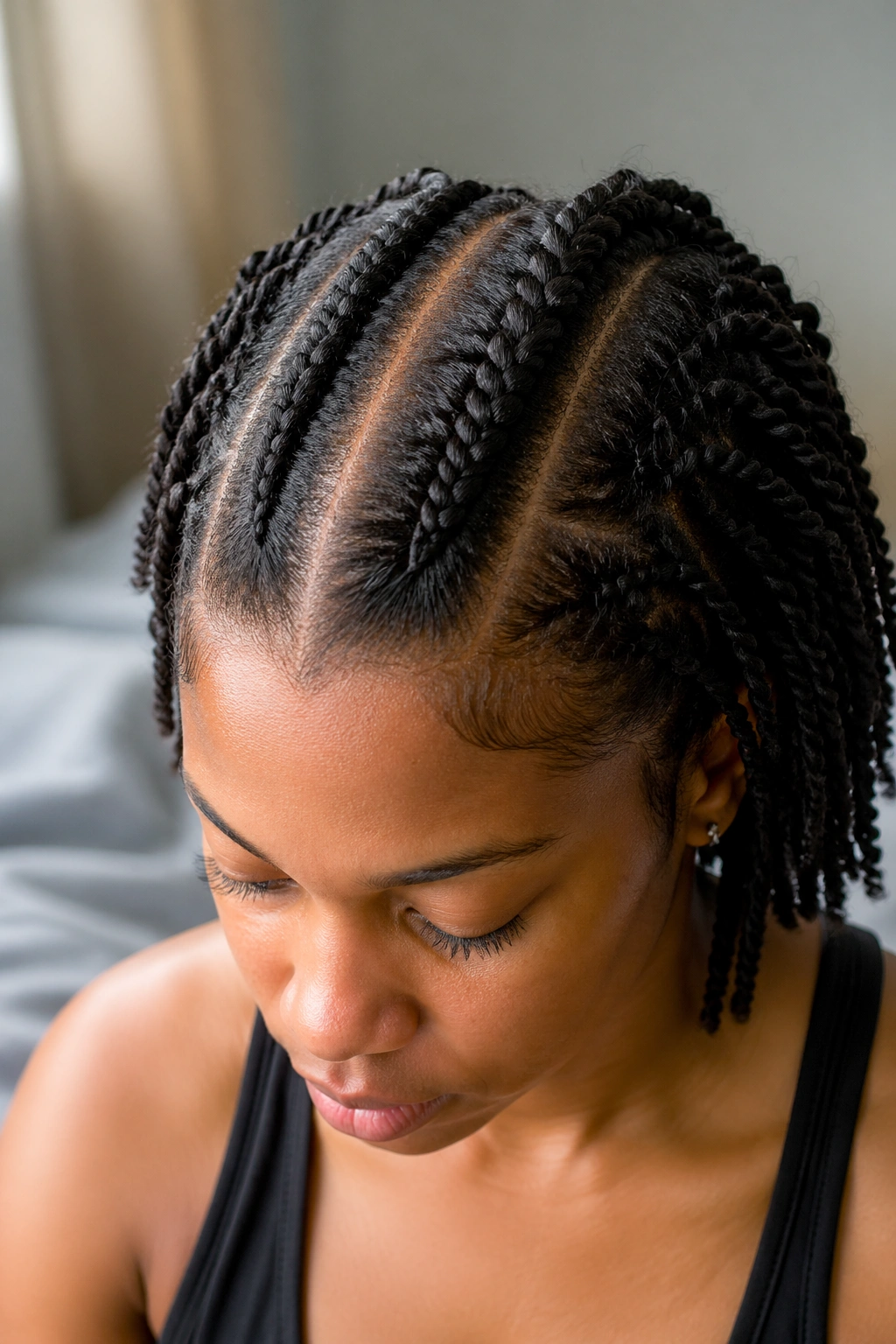
Two thick cornrows — one on each side of a center part — running from forehead to nape. The rest of the head is twisted.
Simple. Striking. Works on hair as short as chin-length if you use extensions for the twist portion.
The two cornrows should match in thickness and tightness. Asymmetry in a two-cornrow style reads like a mistake, not a design choice.
16. Asymmetrical Cornrow Pattern with Twist Drape
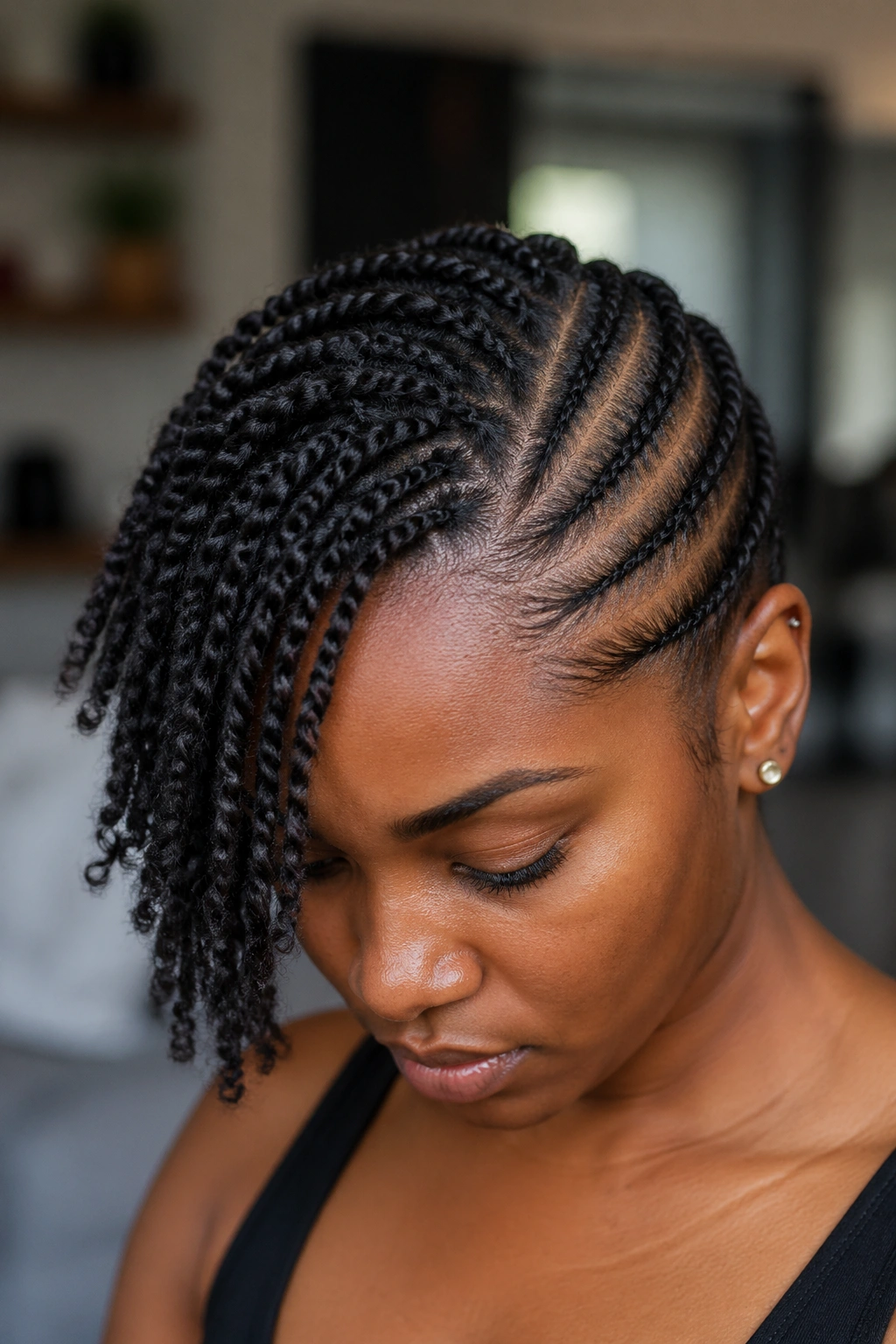
Five cornrows on one side, two on the other. The heavy side finishes with a short twist cluster. The light side drapes with longer twists across the head.
Why does this look intentional and not accidental? Because the eye reads the weight imbalance as a design choice when the twist drape crosses from one side to the other. That crossover is the whole trick.
17. Cornrow Cap with Protruding Twists
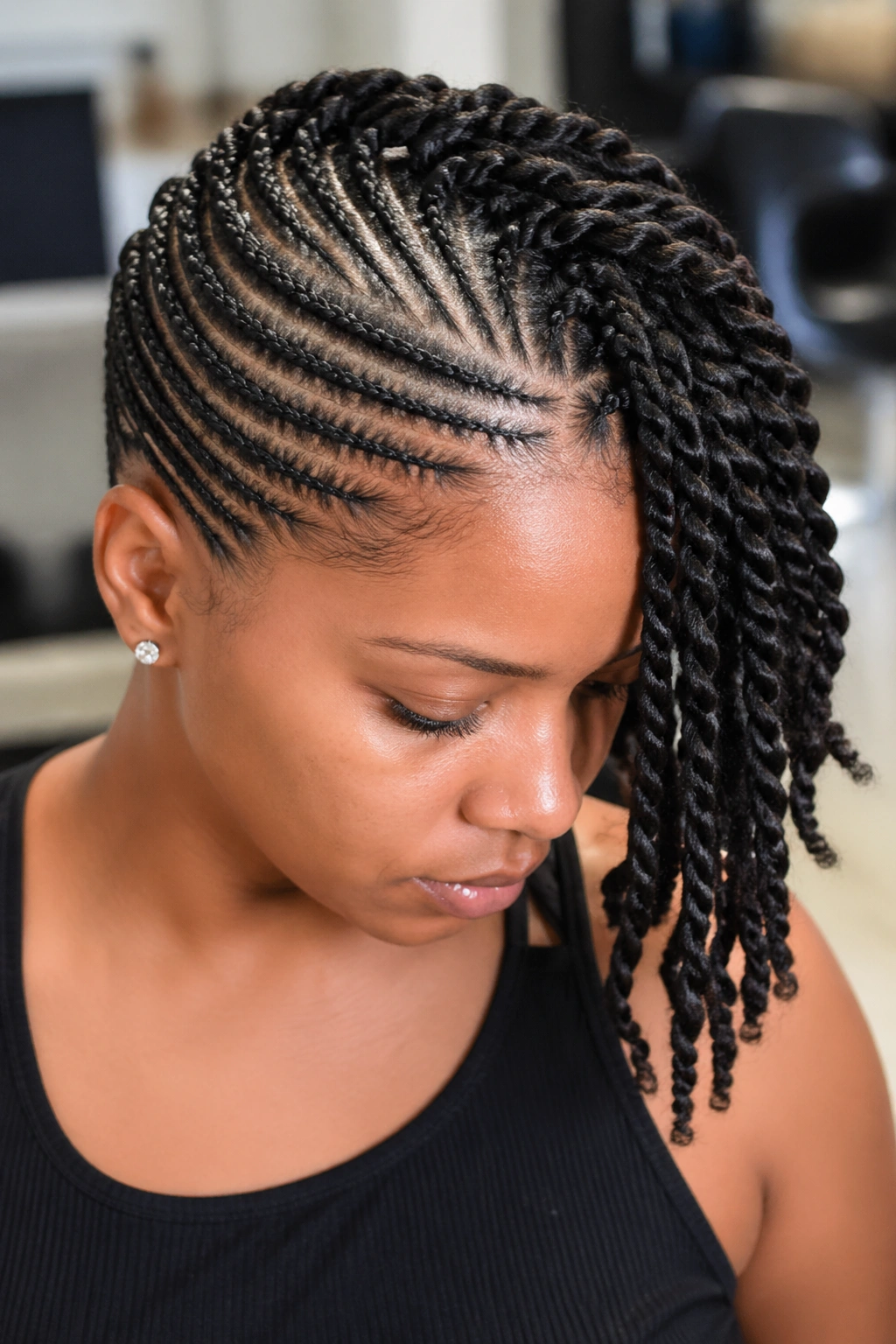
The cornrows cover the entire top of the head in a dense, uniform pattern — almost like a cap. Twists emerge from the crown and fall in a contained section to one side.
This is a high-contrast style. The cap portion is tight and flat. The twist portion is thick and free. Pick one side for the twist drop — shifting it across the head midway through install will unbalance the cap pattern.
18. Beaded Cornrows with Twist Tails
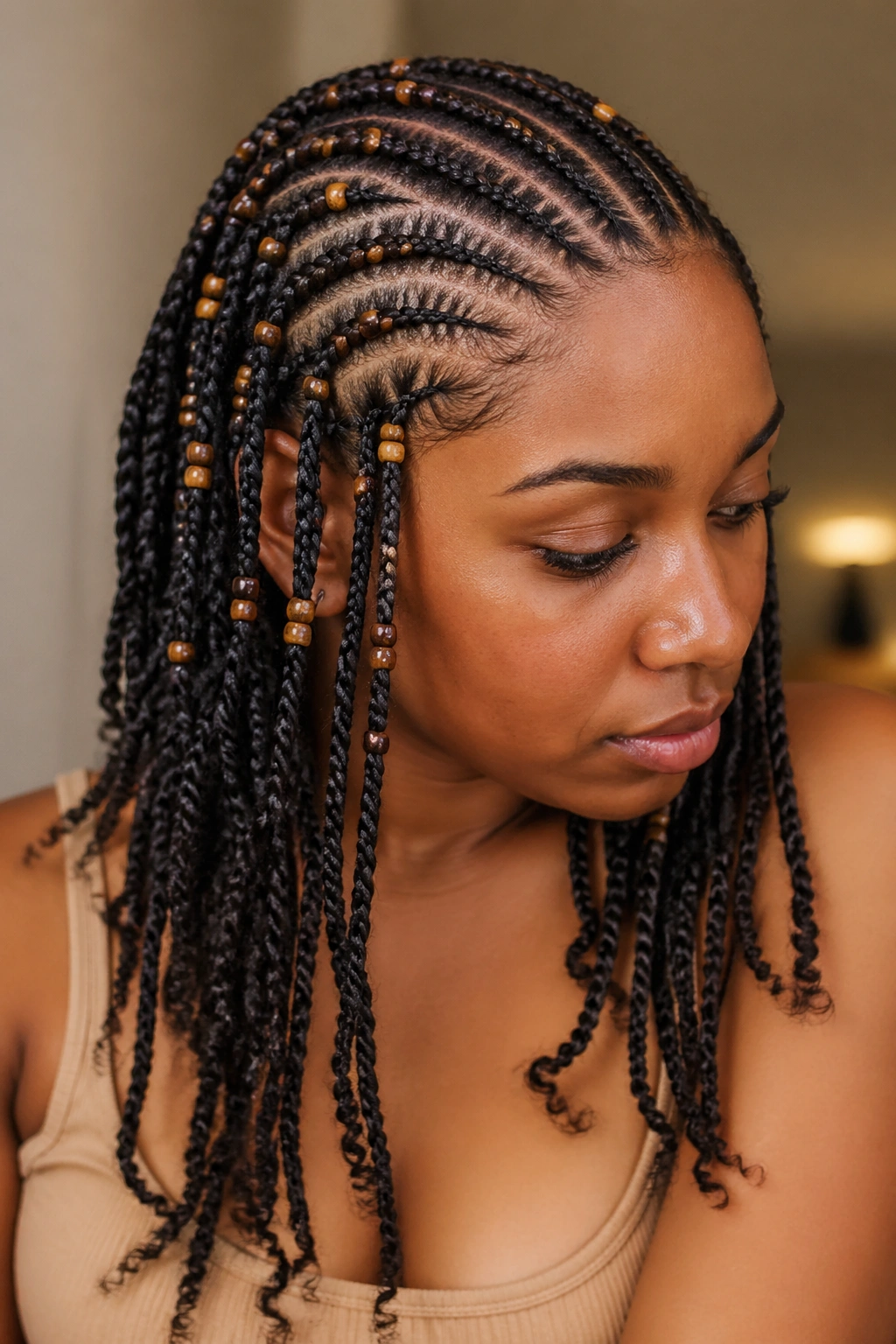
Cornrows studded with wooden beads running their full length. Twist tails hanging free from the ends.
The Catch
Beads weigh down the cornrow. If you overload the beads — more than eight per cornrow — the roots will start pulling within two weeks, especially if your hair is fine. Four to six beads per cornrow is the sustainable count.
Pick beads by weight, not just color. Wooden beads are lighter than glass. Metal beads are heaviest and only work on thick, strong hair.
19. Cornrow Mohawk with Side Twists
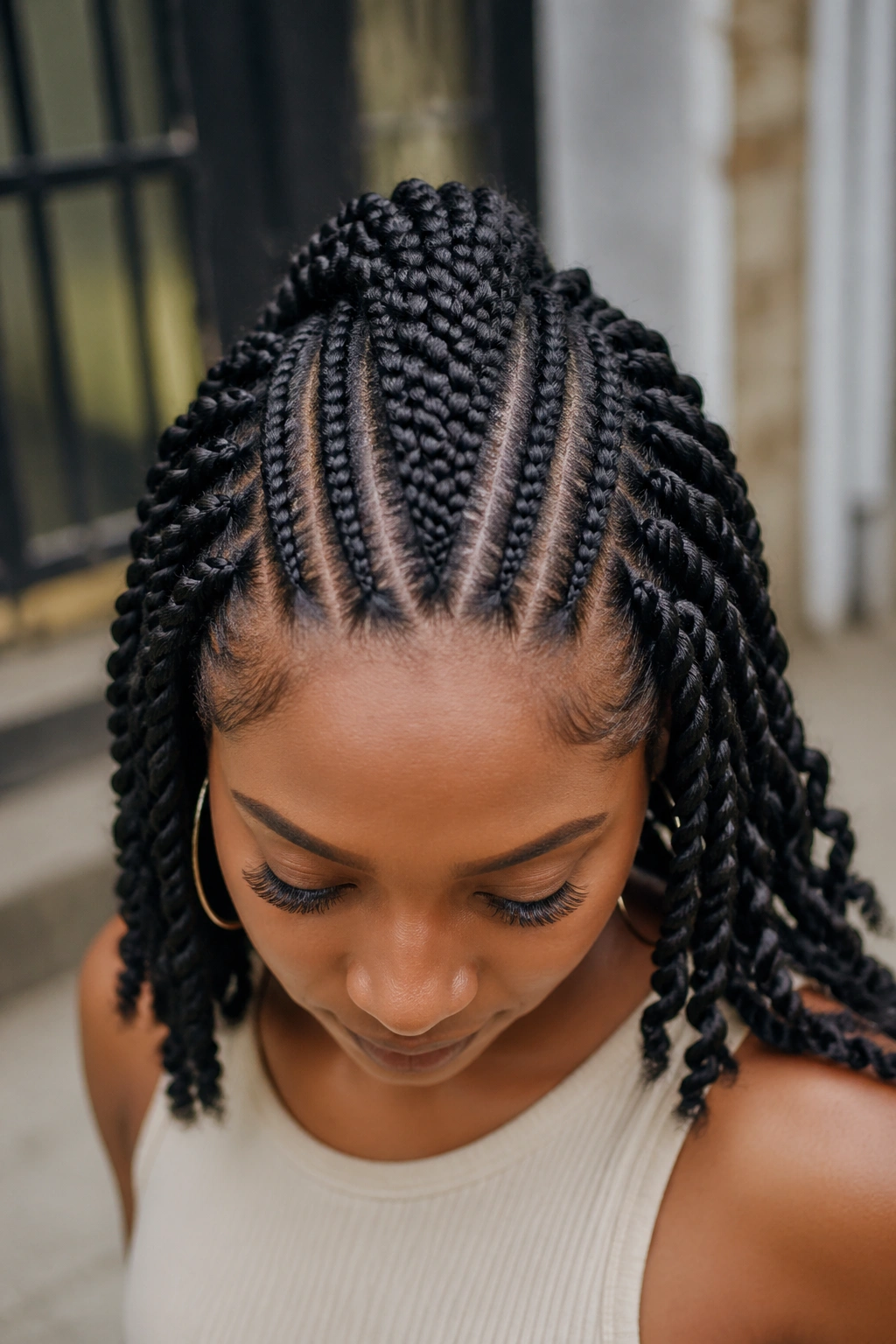
A strip of cornrows running down the center of the head, forehead to nape. Twists flanking both sides, shorter at the front, longer at the back.
The mohawk cornrow strip should be about three inches wide. Narrower strips look stingy. Wider strips lose the mohawk effect and just look like a random center section.
The side twists should be hair-color-matched to your own, not contrast color. Contrast emphasizes the strip, which is already the focal point — adding more attention to it clutters the style.
20. Short Cornrows with Chunky Two-Strand Twists
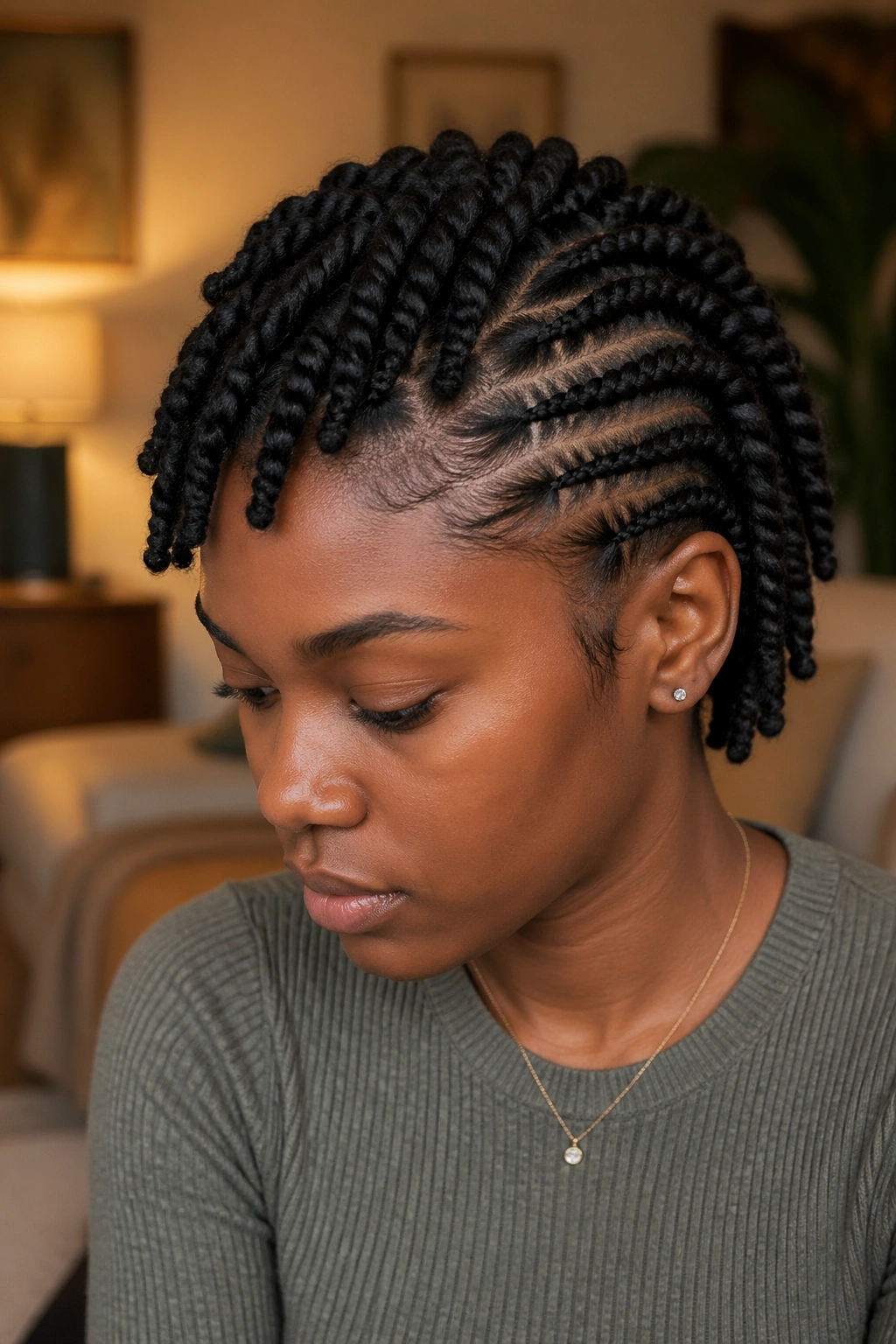
This one’s for shorter natural hair — TWA to chin-length. Cornrows cover only the perimeter. The center crown is left out and twisted into chunky two-strands.
The chunky twist size should be wider than you think — roughly the width of two fingers pressed together. Thinner twists on short hair disappear into themselves.
Keep the cornrow perimeter neat. The whole style rests on that clean border. If the border fuzzes, the whole look collapses.
21. Cornrow Crown with Mixed Twist Textures
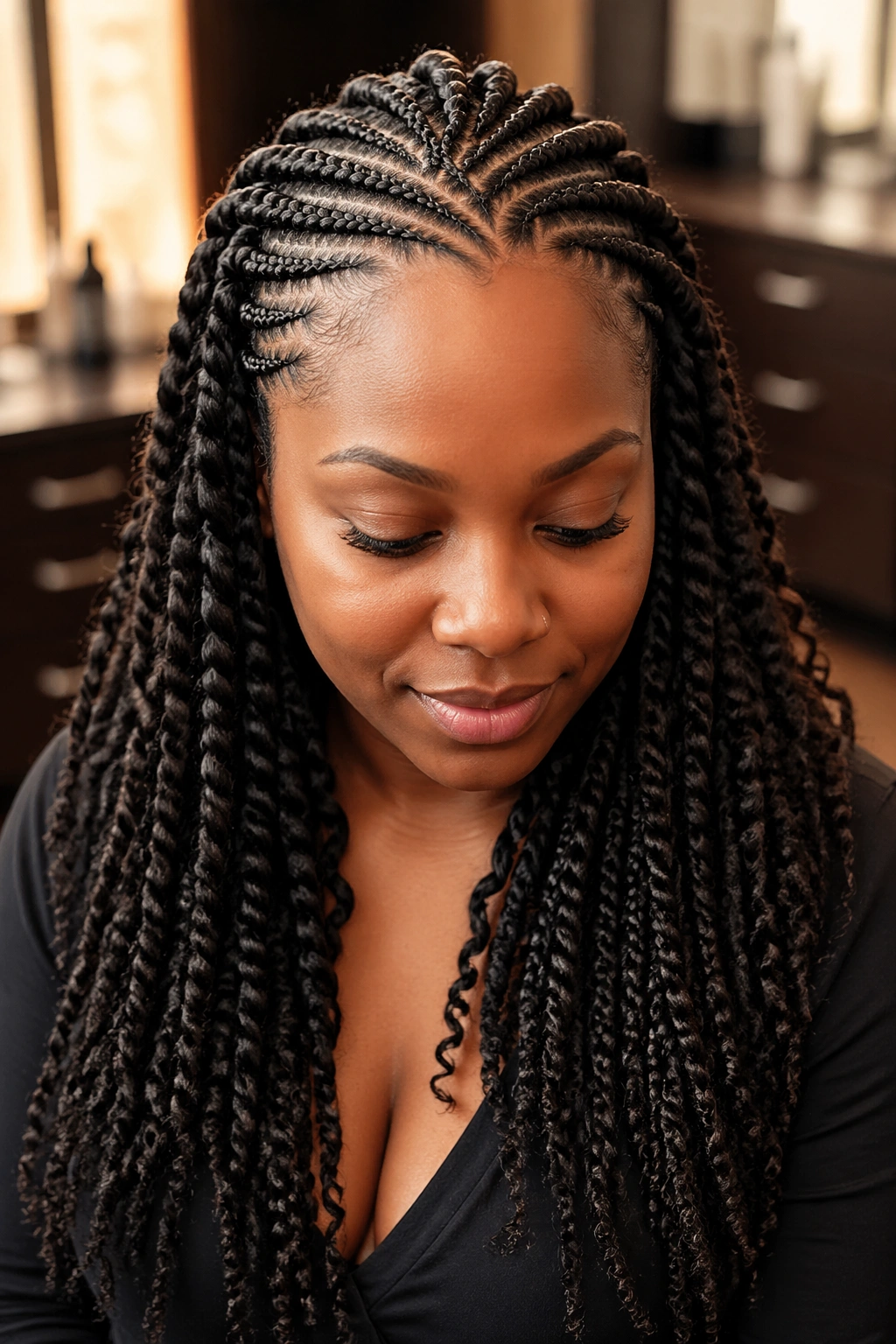
The cornrow section crowns the top of the head. Below it, a mix of twist sizes — some mini, some medium, some chunky — creates visual texture.
Most cornrow-twist styles commit to one twist size. This one breaks that rule deliberately.
Randomize the size placement, but keep the chunkiest twists away from the face. Chunky face-framers look heavy. Chunky back pieces anchor the style visually.
22. Pull-Through Cornrows with Twist Extensions
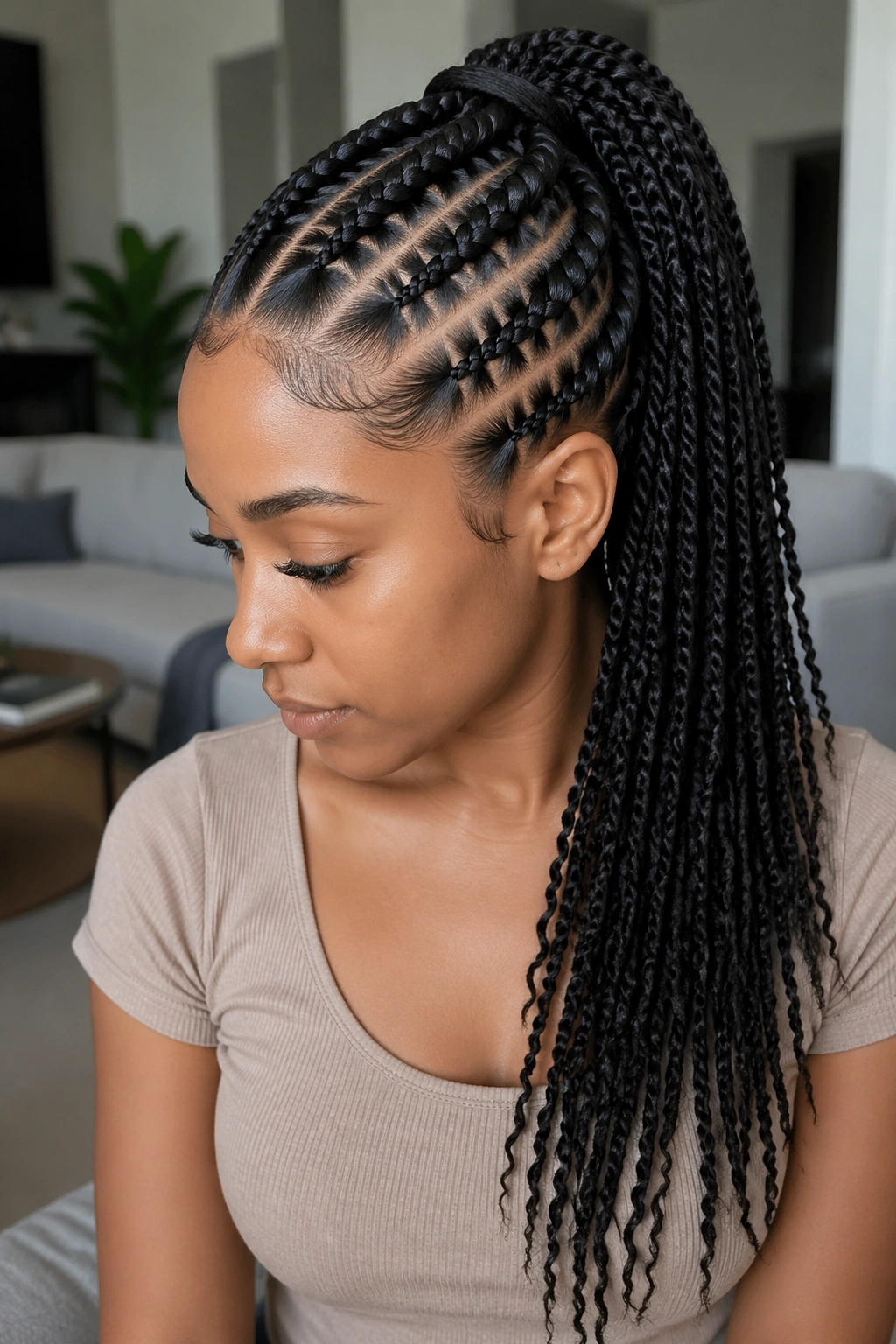
Pull-through technique: starting with feed-in cornrows, then pulling small sections of the braid loose to create a pineapple-like texture along each cornrow.
The pulled sections should be tiny — no more than a half-inch wide. Larger pull-throughs destabilize the braid structure, and the whole cornrow loosens within days.
The twist extensions at the end come in straight down from the pulled portion. Contrast between puffy pulled texture and smooth twist read-out is the whole effect.
23. Cornrow Mohawk with Crochet Twists
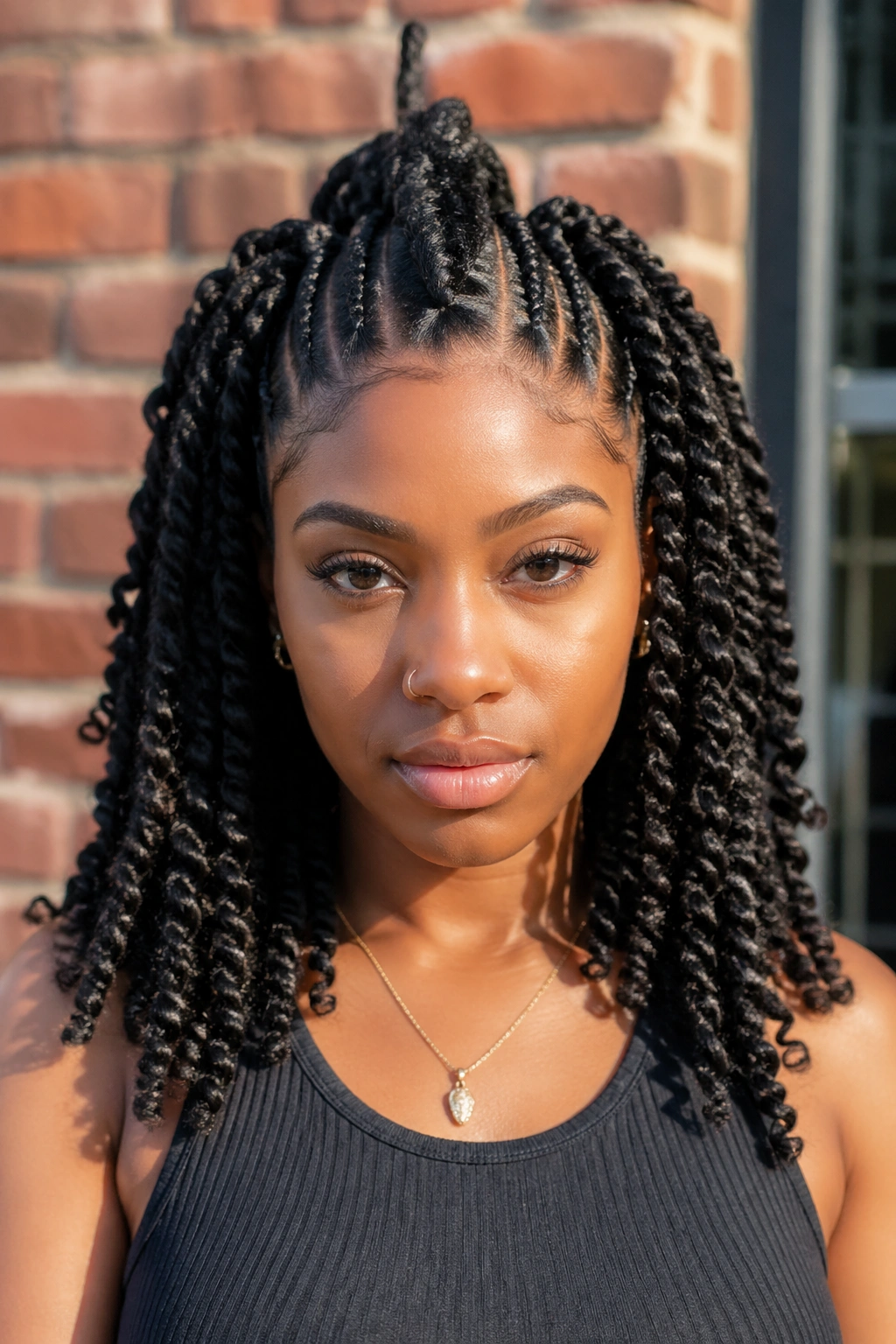
Center-strip cornrows. Crochet-installed twists on either side.
Crochet twists install fast — sometimes under two hours for the full twist section, since the cornrow base is the only real part being braided from scratch. The twist portion is pre-made and hooked in.
Maintenance Notes
Crochet twists last about 6-8 weeks before the base cornrows need to be redone. That’s longer than almost any other cornrow-twist combo. The trade-off is less customization. You can’t change twist density mid-install once the crochet is in.
24. Cornrow Halo with Twist Pompadour
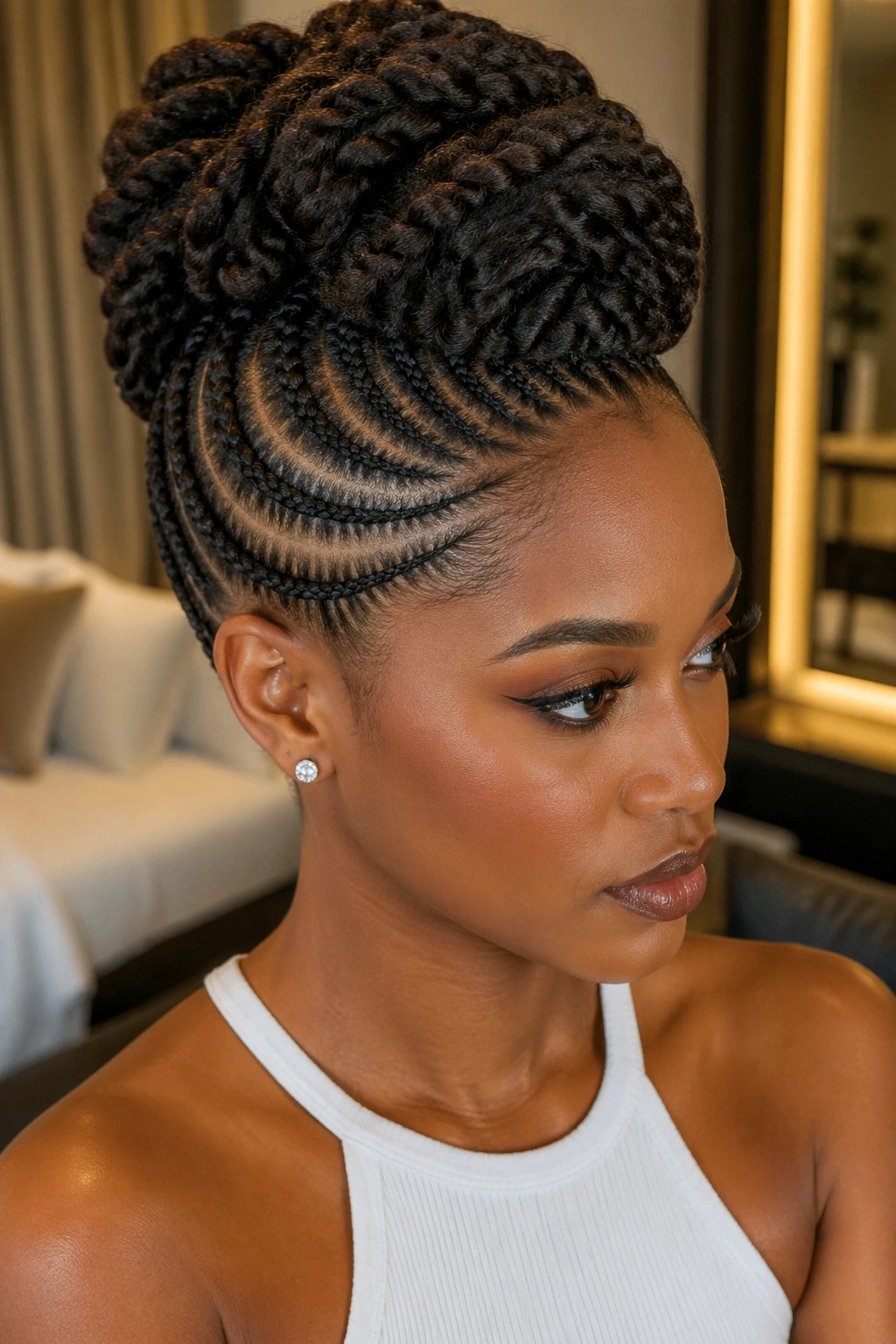
A horseshoe-shaped cornrow running from ear to ear across the front. The rest of the hair behind that line is twisted and gathered upward into a pompadour-shaped pile.
This is a dramatic, sculptural style. The horseshoe cornrow reads graphic. The gathered twists read voluminous. Together, they feel like a statement hairstyle, not just a protective one.
Use edge gel only at the cornrow section. The twist pompadour should look slightly undone — tightly gelled twists in a pompadour look rigid.
25. Freestyle Cornrows with Micro Twists
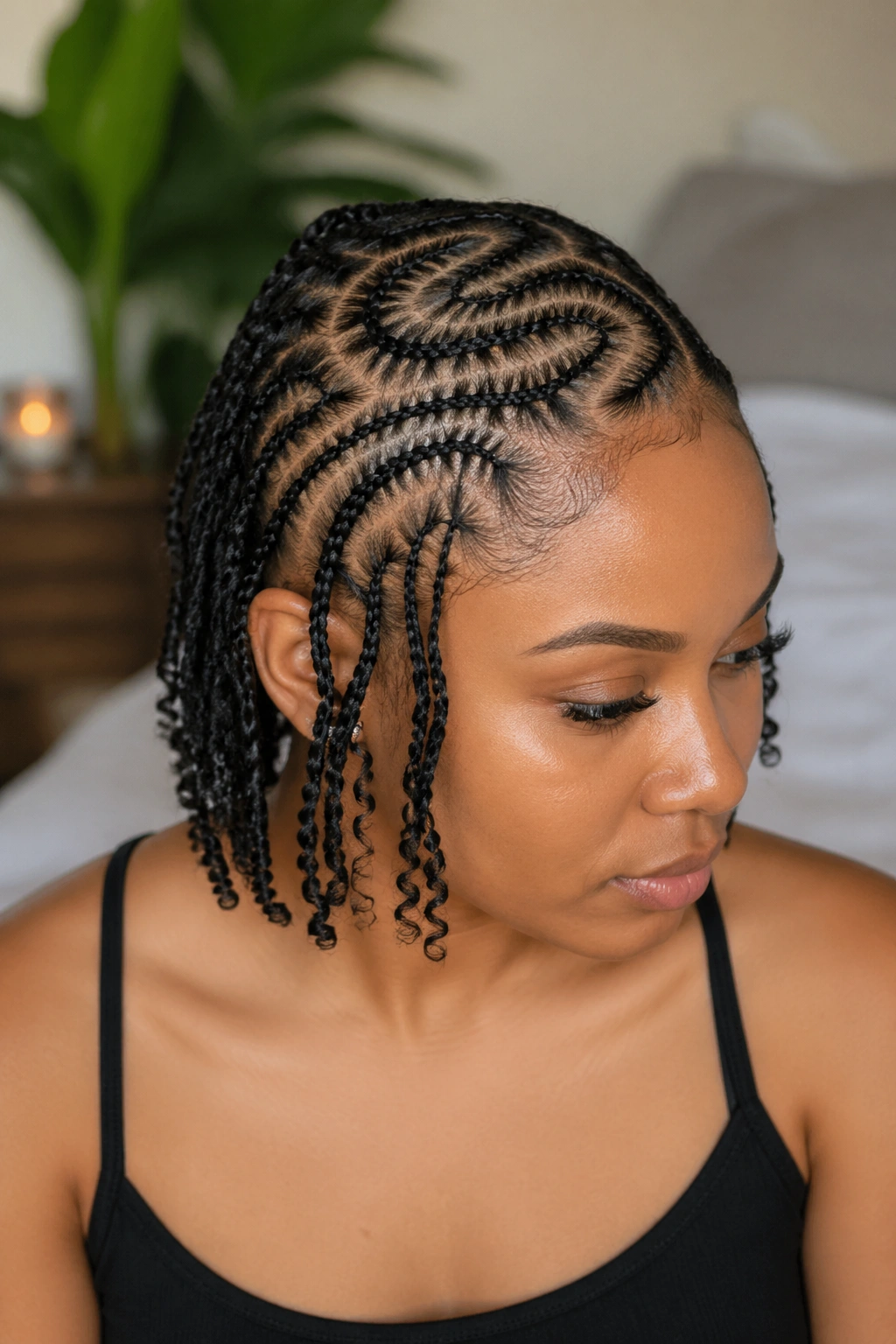
Freestyle cornrow parts — no grid, no symmetry, just flowing curves that follow the natural shape of the head — with micro twist finishes from the cornrow ends down.
Freestyle cornrows are the hardest to execute well. There’s no template. Every decision is the braider’s call, and small mistakes compound across the head.
But when it works, nothing else looks like it. The curves read organic. The micro twists read precise. The contrast between freeform and controlled is the whole appeal.
Final note on this one: commission this style only from a braider whose freestyle portfolio you’ve actually seen. Freestyle is where experience shows — and where inexperience hides until the finished head reveals it.
Maintaining Cornrow and Twist Styles
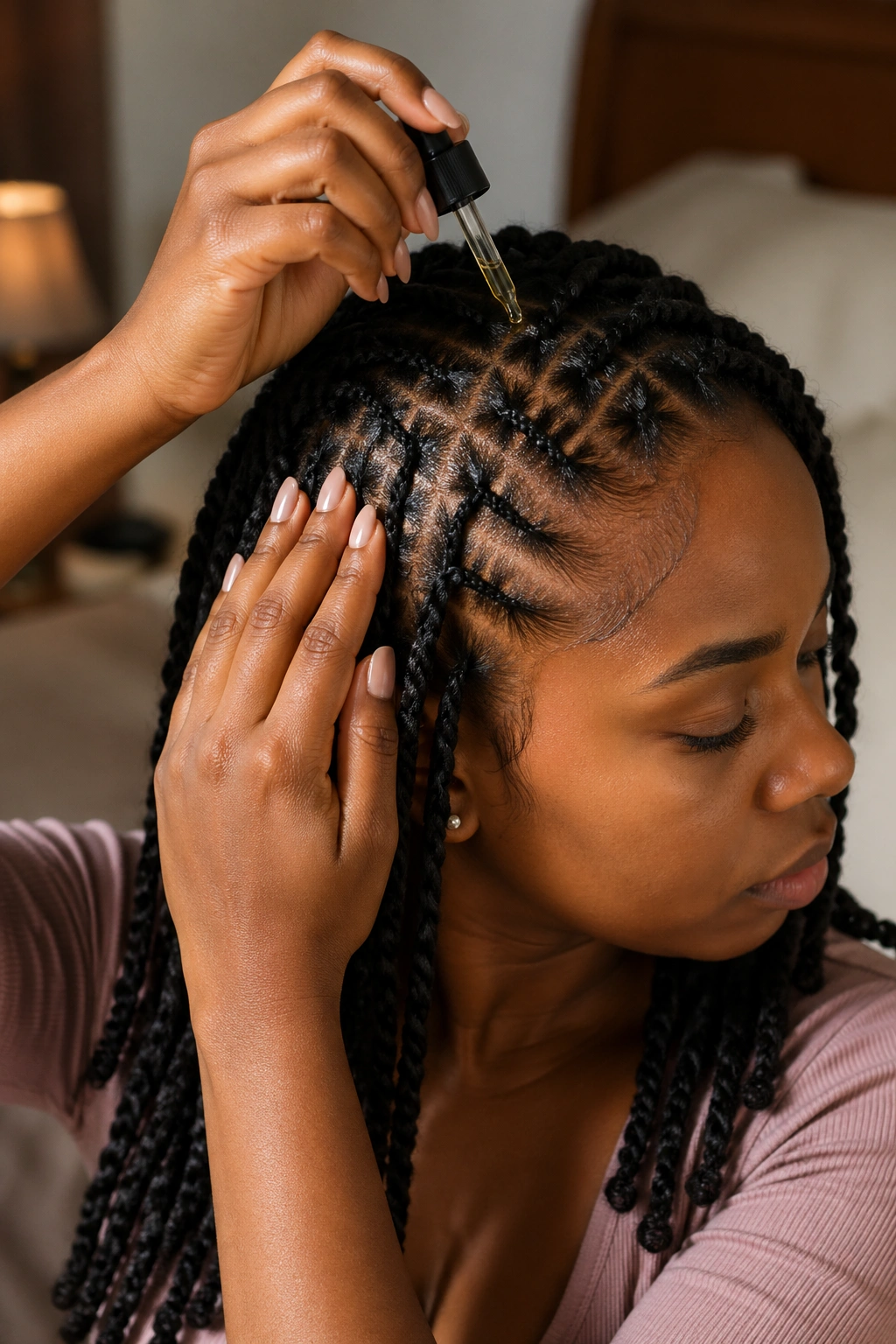
The first 48 hours after install matter most. Don’t wash, don’t swim, don’t do anything that introduces friction or moisture. Let the cornrow base settle into the scalp. The braid sets at the roots during this window.
After the first two days, switch to a light oil routine. Avoid heavy creams — they build up at the cornrow parts and look dingy within a week. A few drops of jojoba or argan oil massaged into the scalp, not the braids, keeps the base hydrated without adding gunk.
Sleep in a satin bonnet. Every night. No exceptions. Cotton pillowcases wick moisture from the hair and cause frizz at the twist ends within three sleeps. A satin pillowcase is an acceptable backup if the bonnet slips off, but the bonnet is the first line of defense.
Use a light edge refresh spray on the hairline every 3-4 days. Don’t re-gel the edges unless they’re fully loose — re-gelling over existing gel creates flakes, and flakes kill the neat hairline faster than anything else.
Scalp Care While Braided
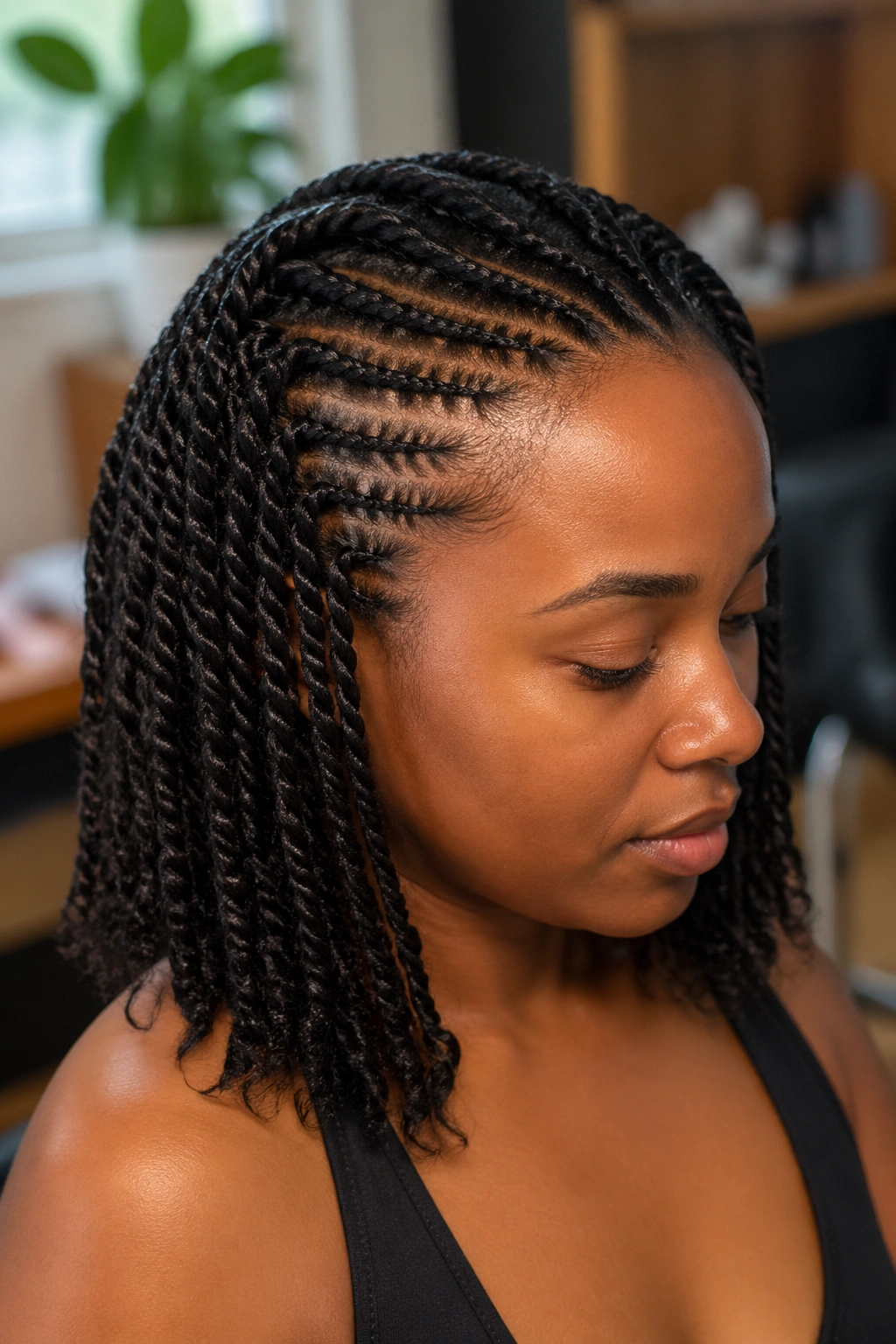
Cornrow-twist styles create ventilation issues. The cornrow section traps product and sweat close to the scalp, and the twist section shields the scalp from direct air exposure. Without care, this leads to itchiness, flakes, and sometimes worse.
Do a weekly scalp cleanse with a diluted apple cider vinegar rinse — one part ACV to four parts water, applied with a nozzle bottle directly to the scalp. Let it sit for five minutes. Rinse with cool water. Pat dry with a microfiber towel.
Follow with a lightweight scalp oil — tea tree blended with jojoba is the combination I’ve had the best luck with. Heavy oils sit on the scalp and block pores. Light oils absorb.
Avoid dry shampoo products designed for unbraided hair. They leave residue at the cornrow parts that’s nearly impossible to remove without full takedown.
When to Take Them Down
The honest answer: 4-6 weeks, depending on the style and your hair type. Longer than 6 weeks and you’re asking for matted roots, breakage at the scalp line, and a takedown process that can take 3+ hours and leave you with shed-looking hair for days.
Signs it’s time:
- Cornrow roots lifting more than a half-inch from the scalp
- Twist ends unraveling despite sealing
- Persistent itch at the scalp line
- Parts fuzzing to the point of obscuring the pattern
Don’t extend wear time out of convenience. Every additional week past the style’s natural end adds hours to the takedown and cost to your hair’s health.
Takedown Without Breakage
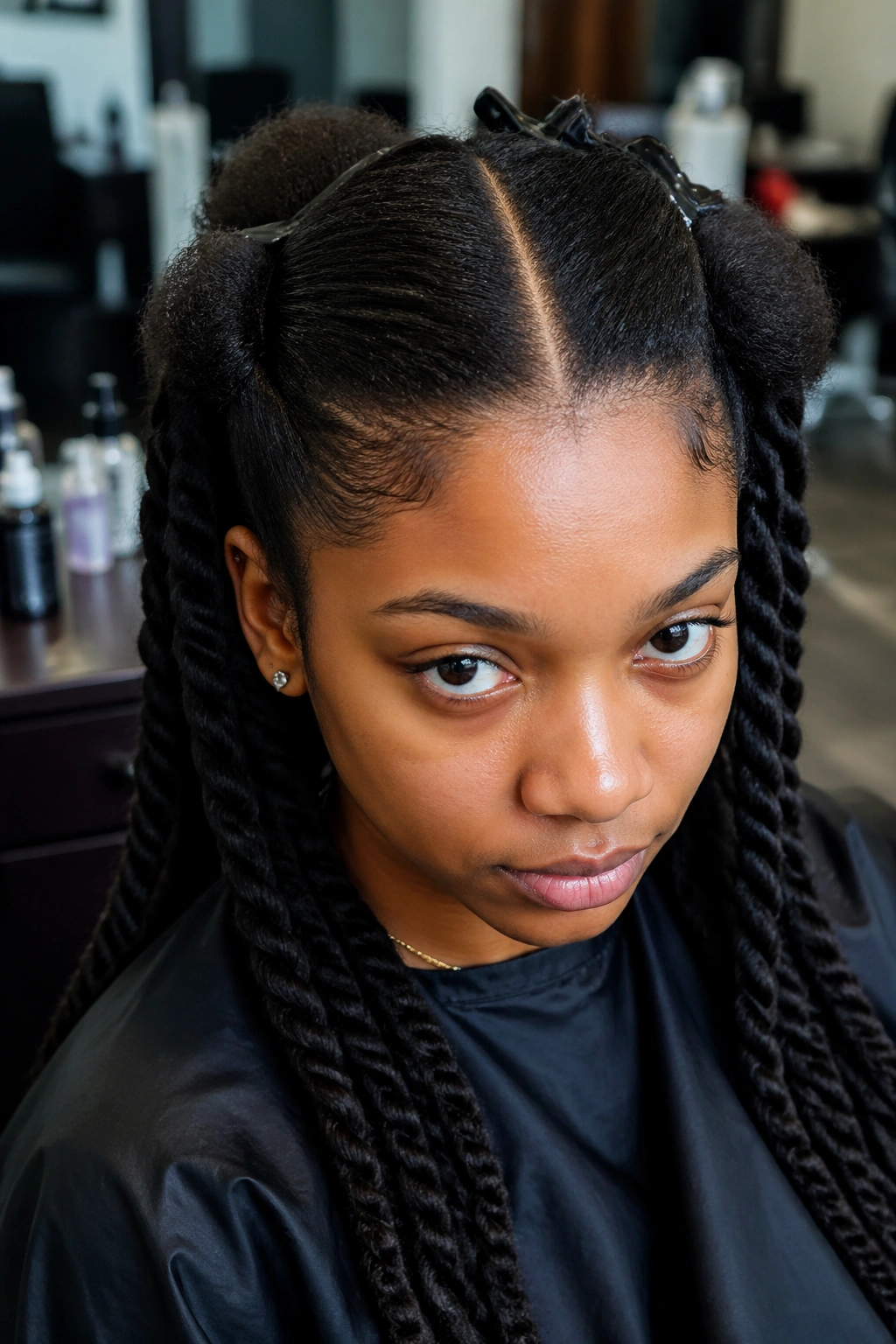
Work from the ends up, not the roots down. Starting at the roots rips tangled hair against the grain and guarantees breakage.
Saturate each section with a detangling conditioner before unraveling. Slip matters. Dry takedown on 4C hair is the fastest way to lose length.
Unwind twists first, cornrows second. The twist portion detangles easily if it was twisted in the correct direction. The cornrow portion releases when you loosen it gently from the end.
Shed hair is normal — sometimes alarmingly so. A full head of braids and twists can release 4-6 weeks of shed hair at once, which looks like a lot. It isn’t loss. It’s accumulation.
Wash in four to six sections after takedown. Never try to shampoo a full head of just-released hair in one go — you’ll tangle it into a matted mess that takes another hour to work through.
Picking the Right Style for Your Hair and Life
Fine hair types should avoid jumbo cornrows and micro twist combos. The weight difference stresses the hairline and leads to breakage.
Thick 4C hair handles almost any combination but particularly favors stitch cornrows with Marley twists — the texture match is seamless.
Shorter natural hair works best with styles that use extensions for the twist portion, like passion twists or Senegalese twists. Full all-natural twist finishes on short hair tend to disappear visually.
Work and lifestyle matter. Jumbo styles wash faster but don’t hold up to gym routines that involve a lot of sweat. Stitch styles photograph beautifully but take twice the install time. Halo and crown styles suit formal settings more than daily wear.
Choose for the month ahead, not the afternoon.
Common Mistakes That Ruin the Look
Parting too small, too fast. Messy parts show on day one and get worse. Slow down.
Over-gelling. Flaky edges by day three. Less gel, better gel, proper application.
Skipping the bonnet. Frizz at the twist ends by day four. Non-negotiable.
Ignoring the transition point. Where cornrow meets twist is the weakest structural point of the style. Braiders who rush that junction leave you with a style that unravels from the middle out.
Leaving too long. Four to six weeks. Not eight. Not ten.
Washing too soon. The first 48 hours are setting time. Respect them.
Cornrows and twists together give you a styling range that flat braids alone can’t match. Tight enough to hold for a month. Soft enough to move with you. Worth the install time every time.
