



There is a particular kind of styling pressure that comes with a special event — the kind that has a date on the calendar, an outfit already chosen, and people who will photograph you. Afro updo styles for special events carry the weight of needing to be both beautiful and durable, which is a harder combination than it sounds. A style can look stunning in the mirror at eight o’clock and look completely undone by ten. The styles on this list have staying power built into their design, not just their appearance.
Natural hair updos get dismissed in some circles as less formal than straight styles or as requiring some kind of straightening first. That’s simply not true. The architecture of afro hair — the volume, the texture, the way coils stack and hold their own weight — actually makes for more interesting updo geometry than straight hair produces. These styles use that architecture intentionally.
What makes an updo special-event appropriate isn’t smoothness or compliance with a Eurocentric definition of formal. It’s execution, precision at the edges and parting lines, and a finished quality that shows the style was intentional.
What Makes an Event Updo Different From an Everyday One
The difference between a Tuesday updo and a wedding-reception updo isn’t the concept — it’s the finishing. The edges are laid more precisely. The sections are cleaner. The securing is more thorough. And the product choices are made with longevity in mind: you want hold that survives four hours of dancing, not gel that starts softening after an hour in a warm room.
Firm-hold edge gel — the kind that doesn’t budge — is the most important product for any event updo. Apply it to the edges last, after everything else is done, and let it set fully before touching the area. A quality gel will form a light cast that holds the edge pattern in place through sweat, warmth, and hours of wear.
Bobby pins matter more than people realize. Event updos use more pins than everyday ones, and the angle of each pin matters. Pins should be crossed — two pins going in opposite directions over the same section — for maximum hold. Single pins slip. Crossed pins stay.
Choosing a Style for Your Hair Length and Density
An updo that works beautifully on two feet of hair will look completely different — and need completely different pinning — on six inches of hair. Before you pick a style, be honest about your working material.
Short to medium natural hair (under eight inches stretched): high puffs, defined afro shapes, bantu knot arrangements, flat-twist designs, and small bun clusters all work well. The key is working with the volume you have rather than trying to engineer length you don’t.
Medium to longer natural hair (eight inches and above): twisted buns, gathered frohawks, braided crowns, sculpted chignons, and large flat-twist updos become possible. More length means more ability to fold, tuck, and construct.
Density matters too. Thin or low-density hair needs more pin work and sometimes small padding — a hair donut or small afro puff hidden inside a bun — to create the volume that makes the style read well from across a room.
How to Prep Hair for a Long-Wear Event Look
The night before matters more than the morning of for event updos. Wash, deep condition, and apply your leave-in and styling products the evening before — this gives the hair time to fully absorb moisture and dry completely. Styling on freshly washed but still-slightly-damp hair means the style sets more firmly and holds longer.
Protein conditioning once or twice before a big event gives the hair shaft more firmness and resistance to humidity. Don’t overdo it — protein every week causes brittle hair — but once in the month before an event is a reasonable strategy if humidity is a concern.
The morning of the event: apply edge gel in sections, work through the whole perimeter, and allow at least ten minutes for it to dry before photographing or entering a humid environment. Edge gel that hasn’t fully dried will smudge, crack, or lose its pattern quickly.
Accessories That Elevate Natural Updo Styles
Hair accessories for natural updos deserve more attention than they usually get. The right piece doesn’t need to compensate for the style — it extends and emphasizes it.
Gold and brass accessories — cuffs, pins, barrettes, decorative pins — complement warm skin tones and the warm texture of natural afro hair in a way that silver accessories rarely do. Pearls read classic and formal with natural updos. Fabric-wrapped accessories — satin bows, printed fabric twists — allow you to bring pattern and color into the style.
Placement changes everything. An accessory at the nape of the neck reads demure. The same piece at the crown reads regal. A cluster of pins along one side reads intentional and contemporary.
1. Twisted High Bun
The twisted high bun is the workhorse of natural hair event styling. You’re gathering the hair at the crown, twisting it — either as a single rope twist or as multiple sections twisted together — and coiling it into a bun shape that’s pinned flat.
The bun reads formal without being stiff. The twist texture is visible in the coil shape, giving the style dimension that a smooth bun on straight hair doesn’t have. The height at the crown suits most formal dress silhouettes.
To hold through an event: start with freshly deep-conditioned hair for the best slip during manipulation. Apply a medium-hold cream before gathering. Once the bun is shaped, push three or four bobby pins through the coil into the gathered mass beneath it. Then add two more crossing pins at the base. A light mist of flexible-hold spray over the whole thing seals it.
2. Flat Twist Updo with Exposed Pattern
This style uses flat twists — lying against the scalp in a designed pattern — as the primary visual element, gathered at the crown or nape into a pinned finish. You’re not wearing a bun or puff on top. The twists themselves are the statement.
Design the pattern first on a piece of paper if you need to. The twists can radiate from a center point at the crown, sweep from a deep side part, or travel from the nape upward. All directions work; all look different.
What Makes It Different
Unlike cornrows, flat twists have a slightly raised, rounder profile against the scalp, which photographs with more dimension. Under event lighting — especially warm or candlelight — the texture of the twists creates striking shadow play that cornrows don’t produce in the same way.
The ends need to be tucked under and pinned carefully at the gathering point so the finish looks clean. No loose ends, no flyaways at the gathered section.
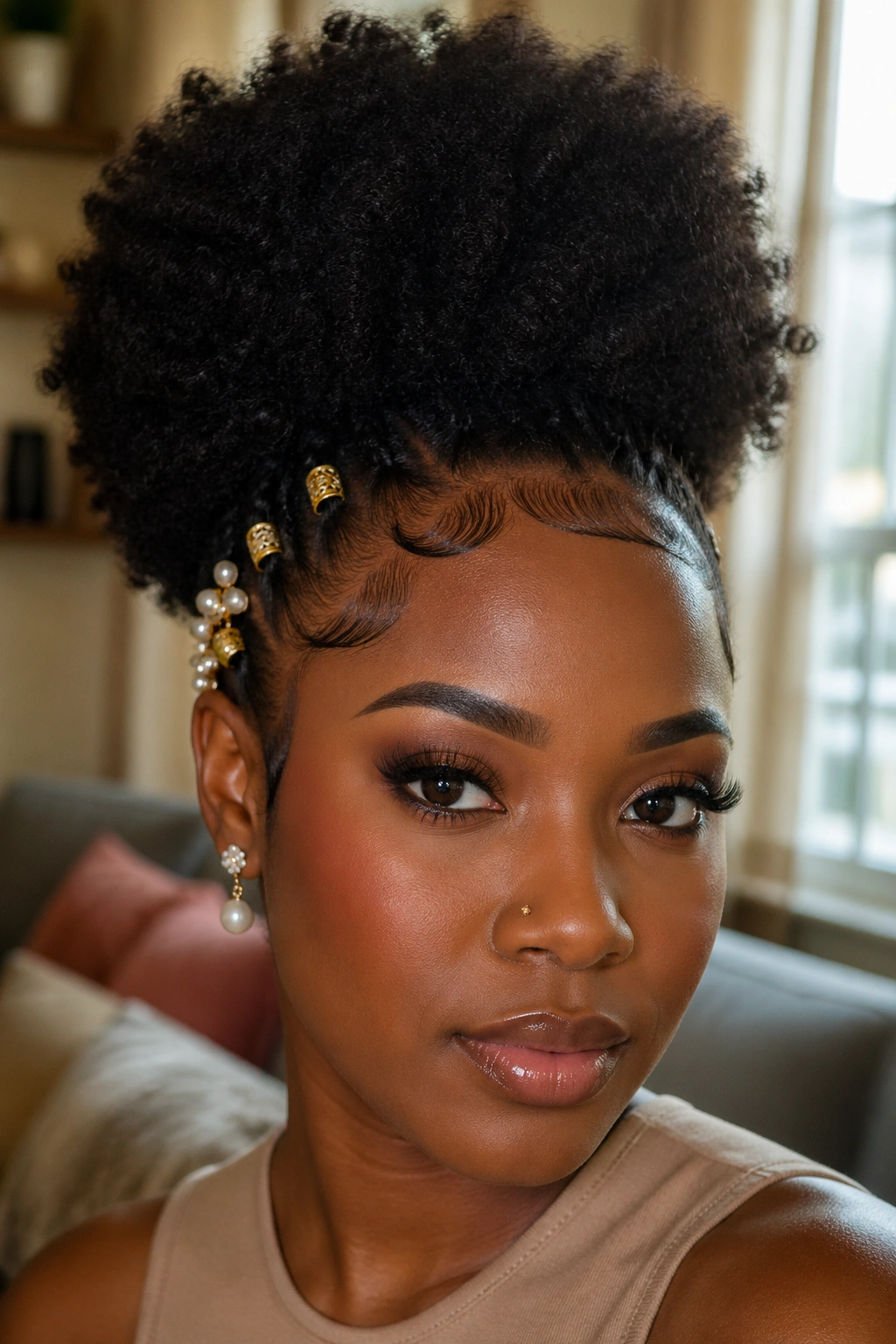
3. Afro Puff with Embellished Edges
A high afro puff becomes event-ready through the quality of its edge work and the accessories added at the perimeter. This style does not require anything dramatic in the puff itself — the puff is the canvas; the edges and accessories are the art.
Lay the edges in an intentional pattern — curved waves, small swirls, or a linear design following the hairline. Allow the gel to fully set. Then add gold or brass hair cuffs, jeweled pins, or pearl clips along the temples or above the ear.
The contrast between the bold, voluminous puff and the delicate accessories at the edges is the style’s main visual tension. It works because natural hair has the structural boldness to hold its own against jewelry-level decoration.
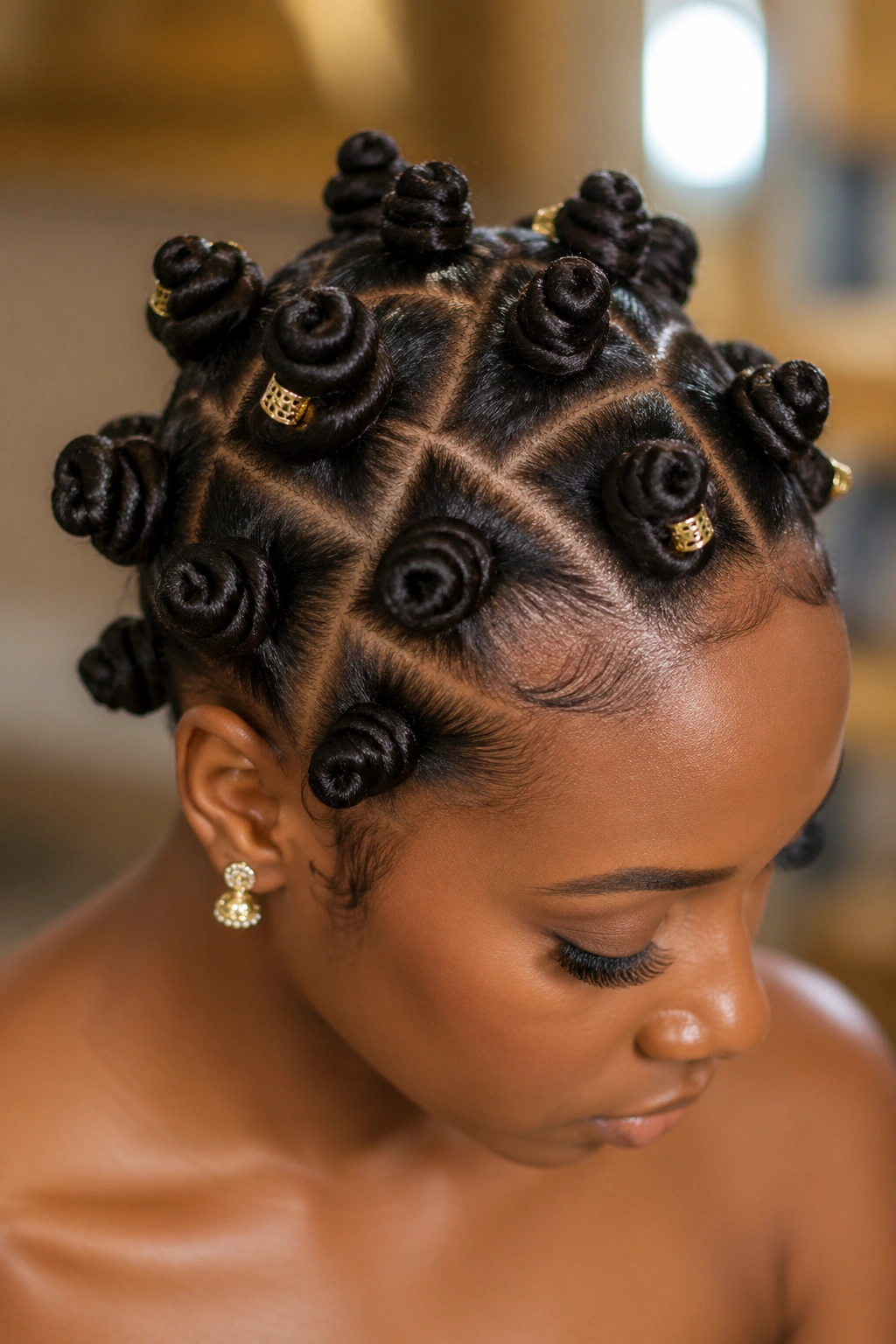
4. Bantu Knot Arrangement as a Full Style
Bantu knots worn as a complete event style — not as a setting technique, but as the finished look — give a sculptural, artistic result that nothing else replicates.
The arrangement of the knots is the design. Uniform rows, a geometric pattern, a cluster at the crown with flat sections at the sides — all completely different silhouettes. For events, plan the pattern deliberately. Parting lines should be clean and even; all knots should be roughly the same size.
Moisturize heavily the day before. Install on slightly damp hair with a firming cream to help the knots hold their coiled shape. Secure each knot carefully under the coil base. Add small accessories — gold pins, pearl clips — at select knots for an elevated finish.
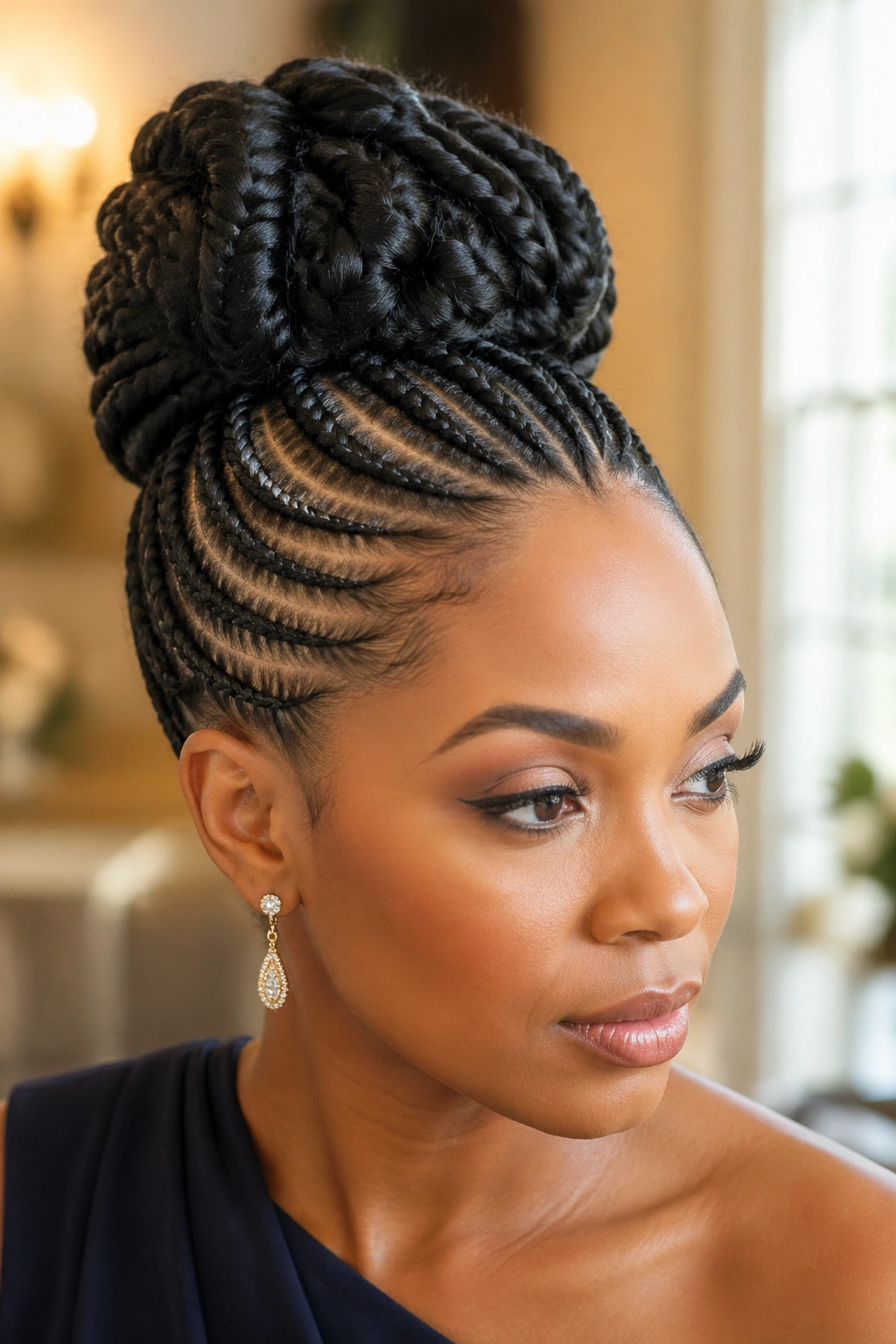
5. Braided Crown Updo
Cornrow braids worked around the perimeter of the head, meeting at the crown, where the ends are gathered and pinned into an updo above the braids. This is one of the most classically elegant natural hair updos available.
Start by braiding around the front from one temple, following the hairline, around to the nape, and then directing the braid pattern upward toward the crown. The back braids begin at the nape and travel upward. All ends converge at the crown, where they’re wrapped and pinned.
The difficulty level: moderate. Getting the back braids to point cleanly upward requires some practice and ideally a second person. The front and side braids are manageable on your own.
This style suits formal events — galas, dinners, ceremonies — more than casual parties. It has the structured elegance of a traditional evening updo with the fullness and texture of natural hair.
6. Gathered Frohawk Updo
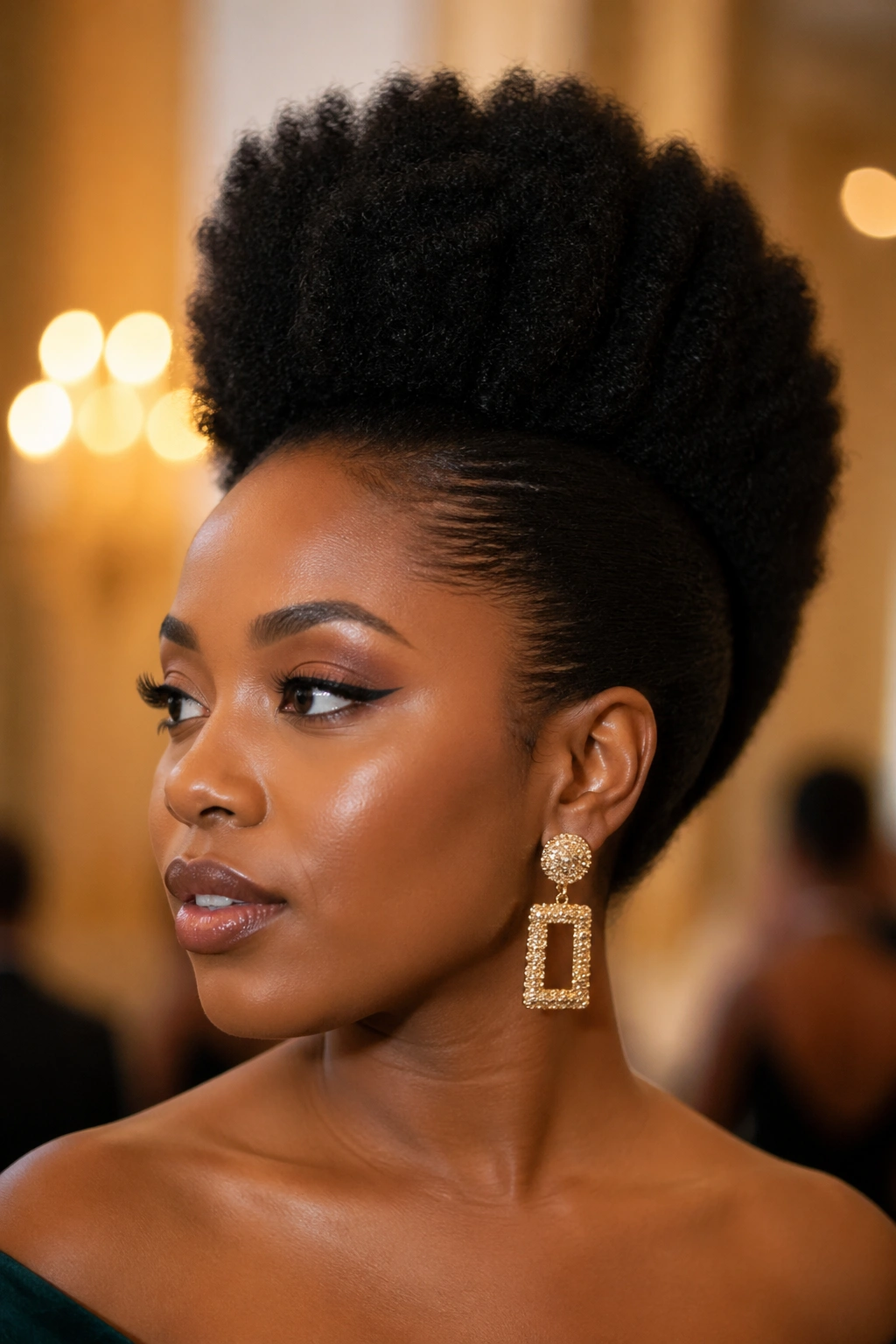
Pin or braid the sides of the hair flat — toward the back of the head. Gather the center section at the crown into a large, elevated puff or fan shape. Pin the sides securely and use edge gel along the gathered perimeter for a clean finish.
The frohawk updo has a more dramatic profile than the flat frohawk style. The gathered center creates height rather than just width, and the combination of flat sides and elevated center creates a silhouette with a striking geometric quality.
For events, the gathered center can be shaped into a fan, a round puff, or a forward-tilting mohawk shape depending on the occasion. A fan shape reads more formal; a rounded puff reads more festive.
7. Low Afro Bun at the Nape
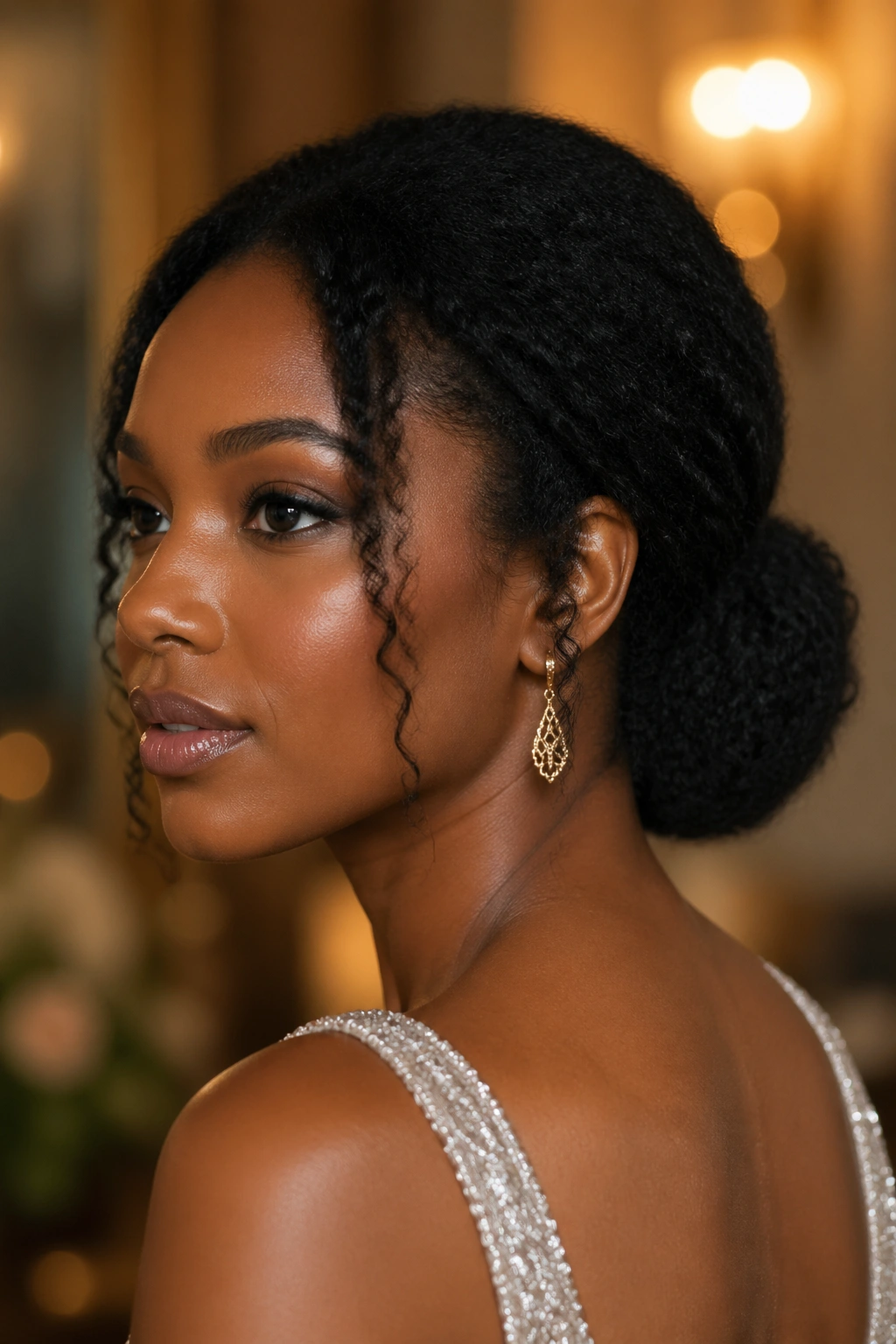
Gathered low at the nape rather than at the crown — this is the natural hair version of a low chignon. The afro texture in the bun means it won’t sit flat against the nape the way a slick chignon would. Instead, it creates a textured, rounded shape just above the neck.
For events, a low bun is often more comfortable than a high one. No neck tension, no headache from a heavy gathered section pulling at the crown. And the nape placement suits backless or low-cut dresses particularly well — the bun draws attention to the neckline rather than competing with the neckline.
Leave small pieces free at the temples. Curled gently around your finger and released, these pieces frame the face and soften the structure of the bun.
8. Twisted Crown with Free Back Section
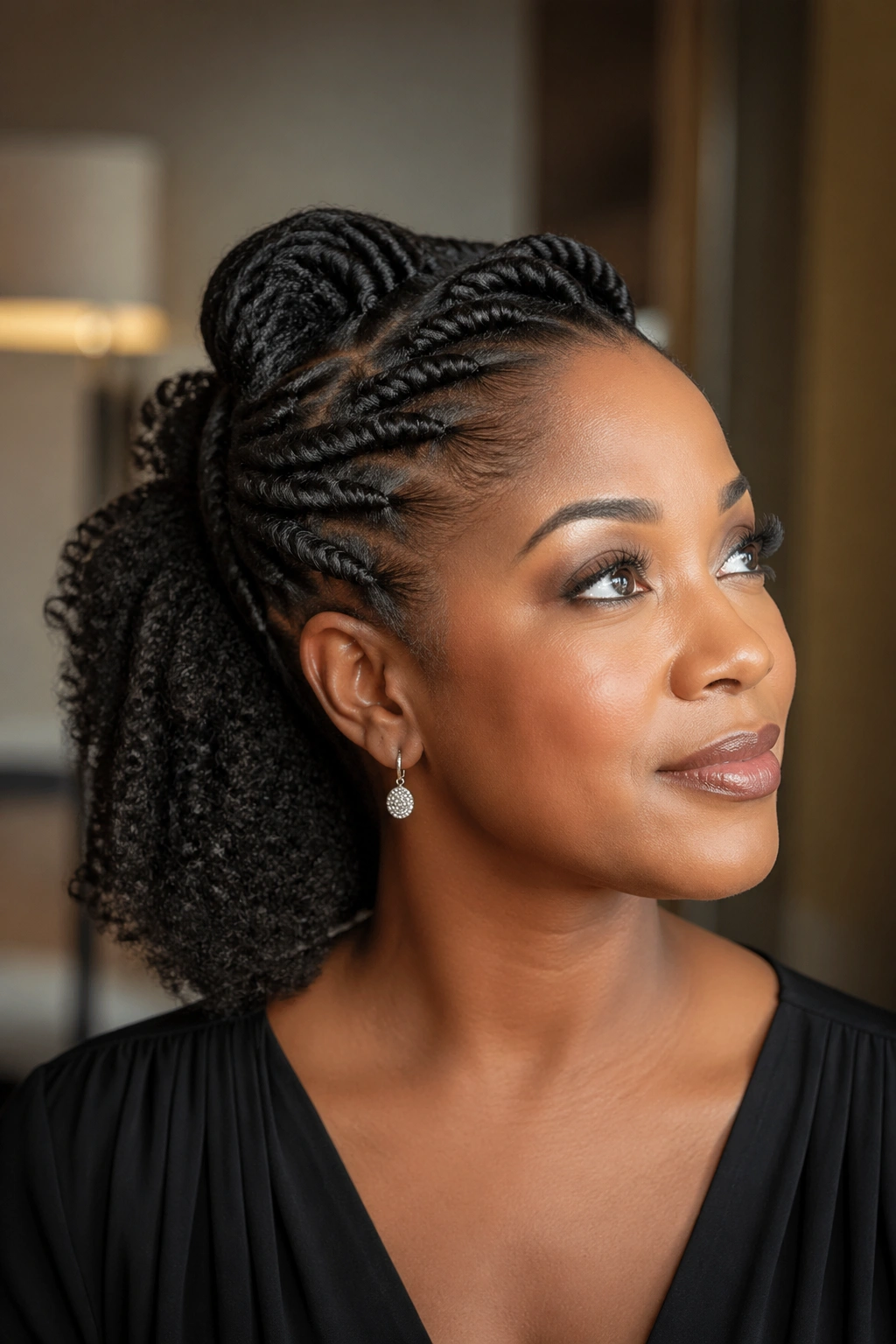
This divides the hair into front-and-sides versus back. Flat twist or two-strand twist all of the front and side sections, directing them toward the back of the crown. Gather and pin them there. Leave the back section completely free — in its natural state, whether that’s a wash-and-go, twist-out remnants, or picked out.
The result is a style that’s half structured, half free — the front reads intentional and elegant; the back reads natural and relaxed. The contrast works particularly well for semi-formal events where you want something interesting but not overly stiff.
The pinned gathering point at the back of the crown is the technical detail that needs the most attention. Crossed bobby pins, hidden under the free section, keep the whole front structure secure throughout the night.
9. Multi-Bun Cluster Style
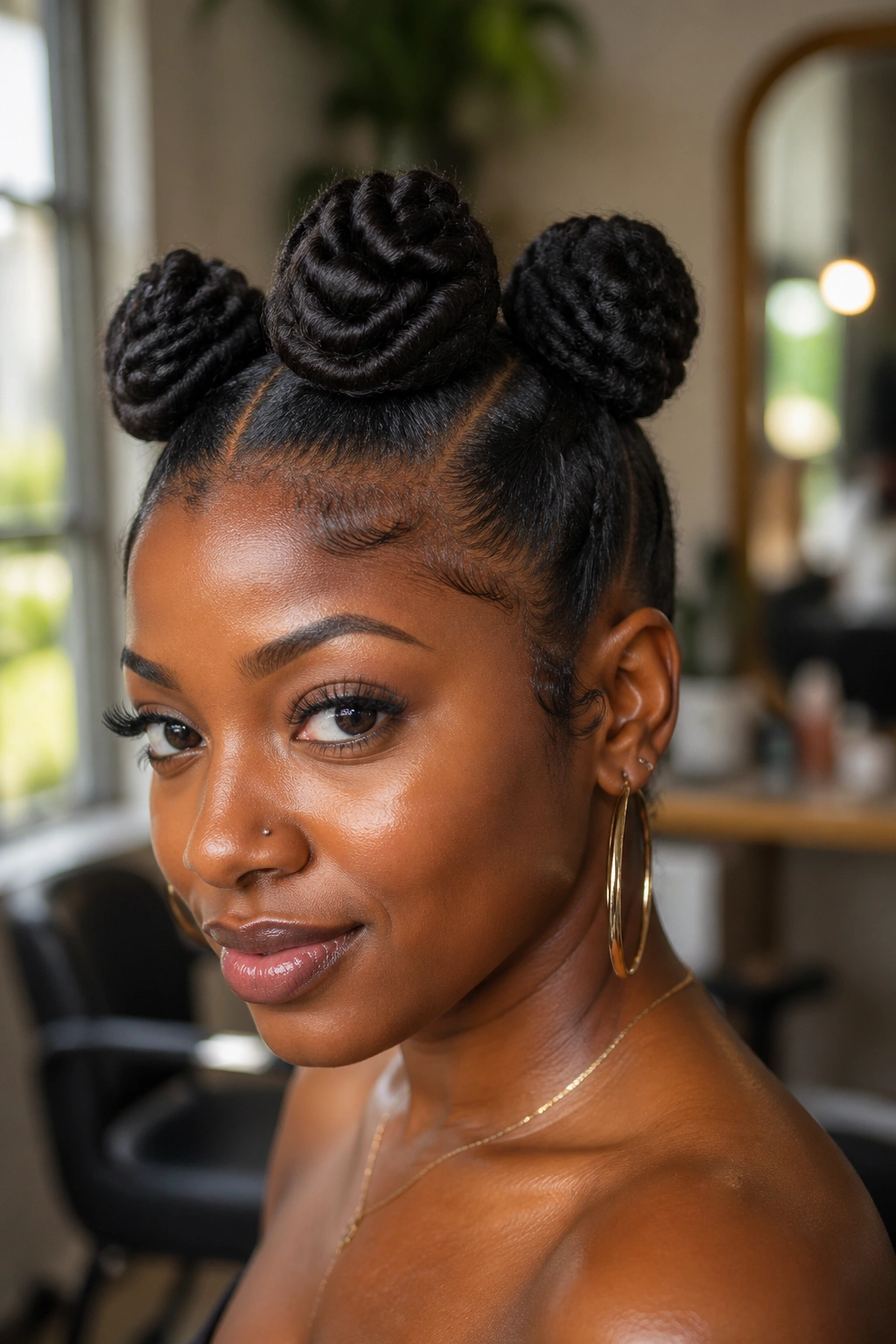
Instead of one large bun, divide the hair into three to five sections and create a small bun from each section. Arrange the cluster of buns together — at the crown, or staggered across the back of the head — and pin each one individually.
Multi-bun styles have a playful quality that single buns don’t, and the collective volume is often more visually interesting. Each small bun shows its own texture and coil pattern. The spaces between the buns add to the dimensional quality of the style.
For events, this works best when the buns are deliberately sized and positioned, not randomly distributed. Plan the cluster before you start pinning — a rough sketch or a mental map saves time and creates a more intentional result.
10. Faux Locs Updo
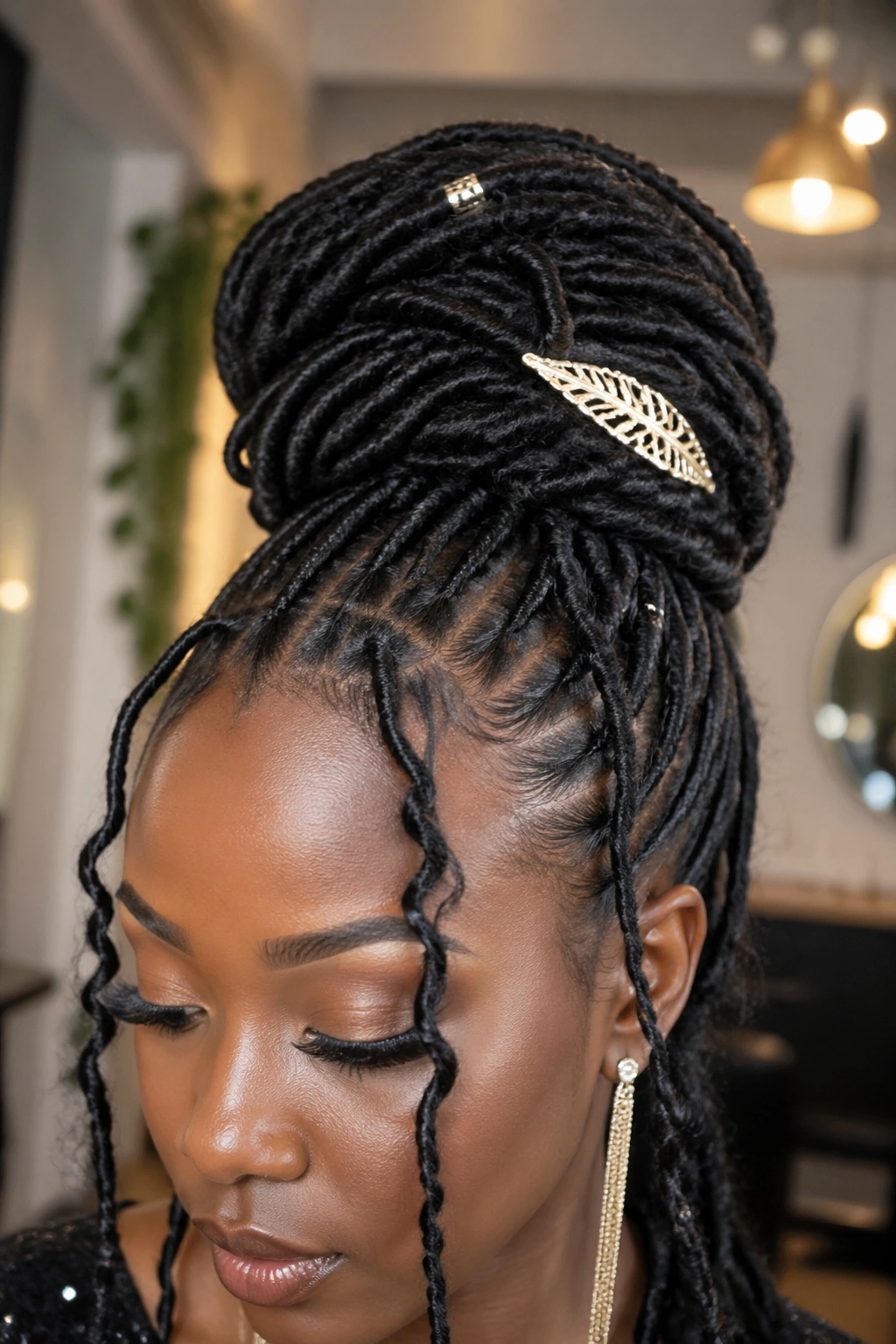
If you’re wearing faux locs — whether extension-based or natural — gathering them into an updo for an event gives the style an entirely different register of elegance. Long faux locs gathered high at the crown, coiled into a pile, and secured with pins and a decorative clip become a dramatic, high-fashion look.
The weight of faux locs means the pinning needs to be substantial. Use long bobby pins — the two-and-a-half-inch variety rather than the standard inch-and-a-half. Use more of them than you think necessary. Add a comb clip or a claw clip as a primary anchor point, then use pins around it.
The visual impact of gathered faux locs at an event is considerable. The texture and length together create a silhouette that reads both sophisticated and distinctively natural.
11. Sculptural Side Puff
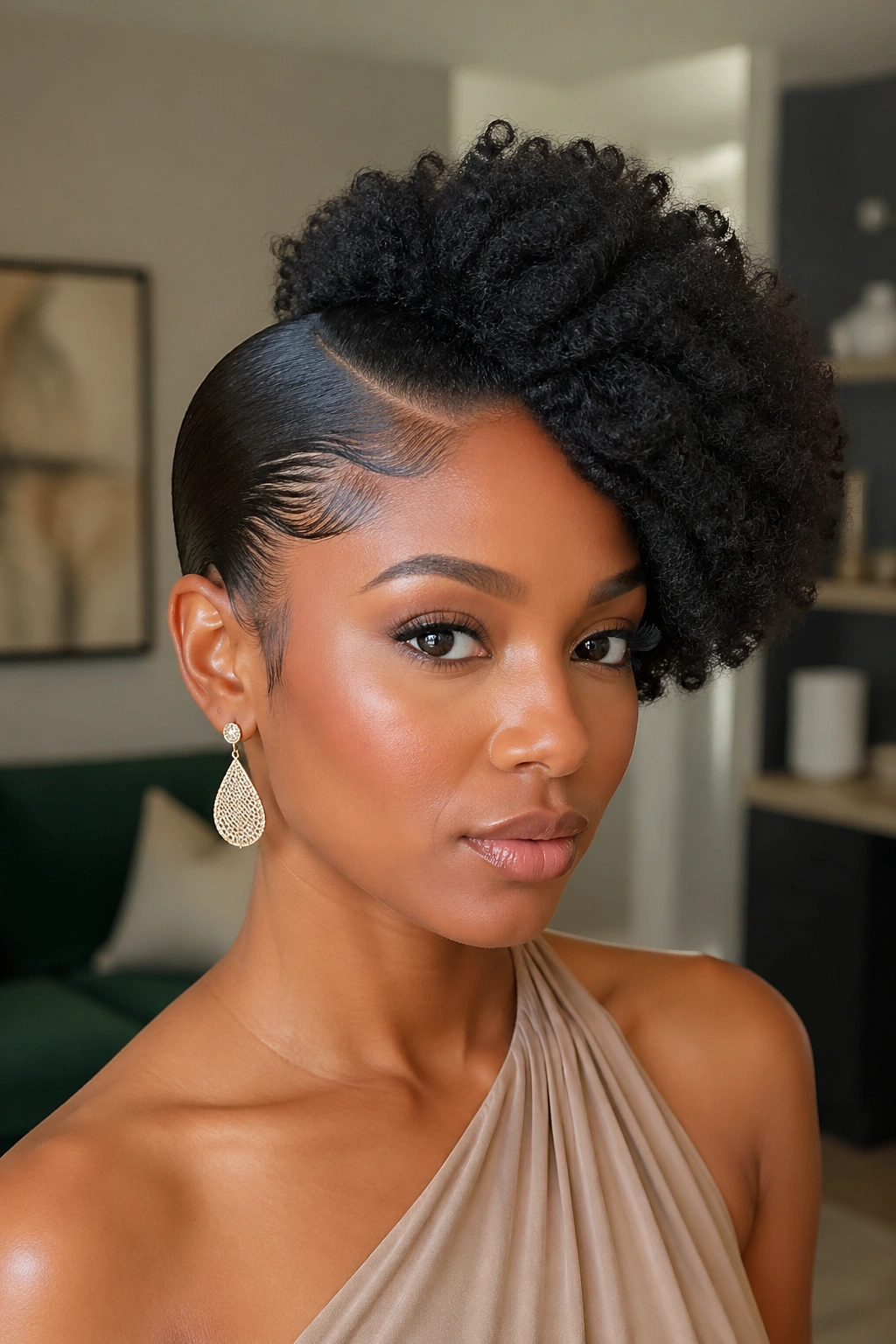
Rather than a centered high puff, gather everything and sweep it to one side — positioned above one ear rather than centered at the crown. The asymmetric placement gives the style an architectural quality that a centered puff doesn’t have.
Secure to one side with a decorative hair clip or covered hair tie. Smooth the opposite side (where the hair sweeps away from) with edge gel — clean and close to the scalp — while the gathered side has full volume.
The visual tension between the smoothed side and the full side is what makes this style interesting. It’s particularly effective at formal events because the asymmetry reads deliberate and fashion-forward rather than accidental.
12. Cornrow Base with Free Natural Puff
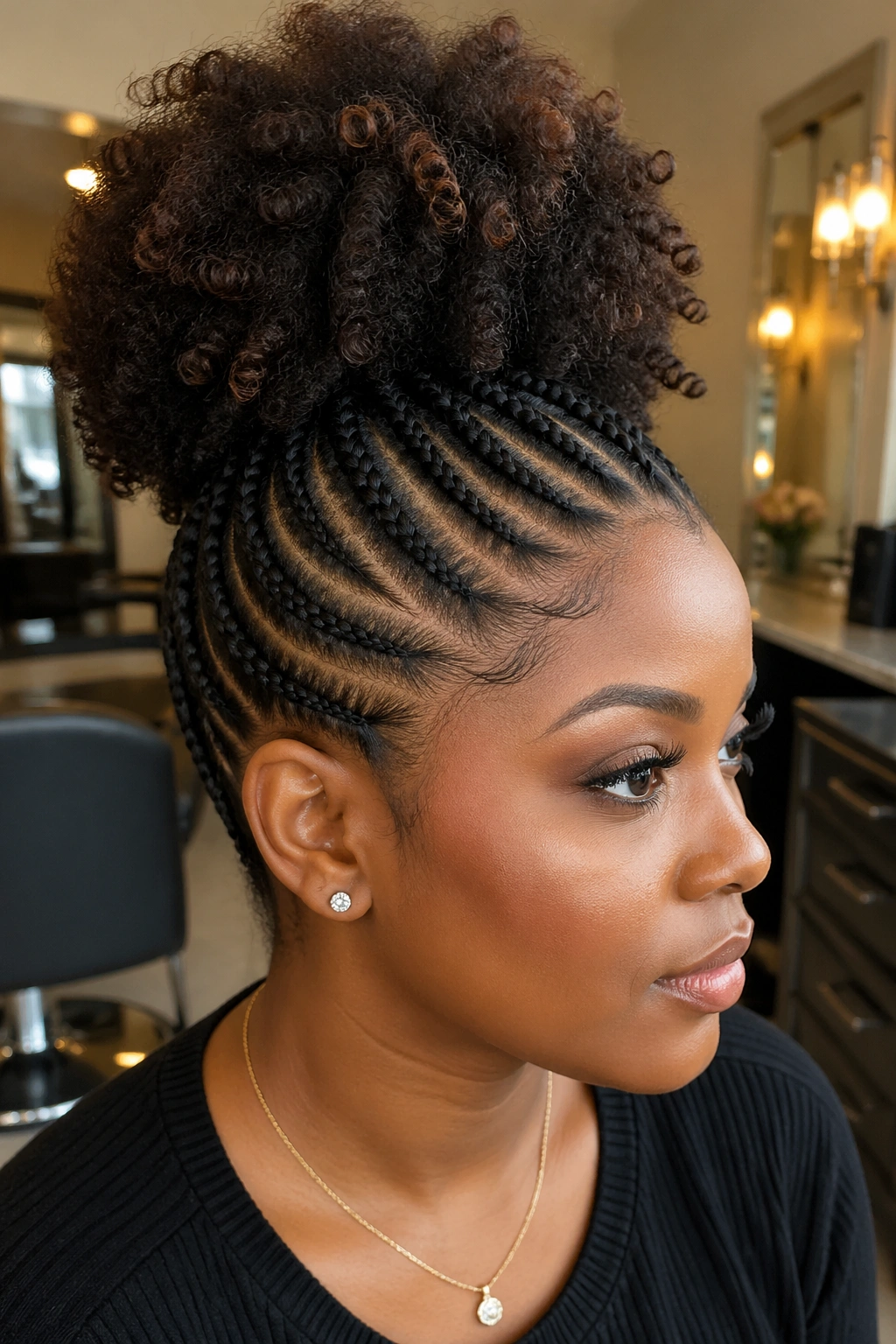
Cornrow the full head except for a section at the crown — leaving a circle of free natural hair about four to five inches across at the very top. The cornrows travel up from all directions and end just around the perimeter of the free section.
The free section, surrounded by the cornrow pattern, creates a halo of natural afro texture at the crown — a textural contrast that looks highly intentional and quite striking from a distance.
For formal events, this works well with a small amount of definition applied to the free section on wash day so the curls or coils are visible rather than just a frizzy cloud.
13. Rolled and Pinned Afro Sections
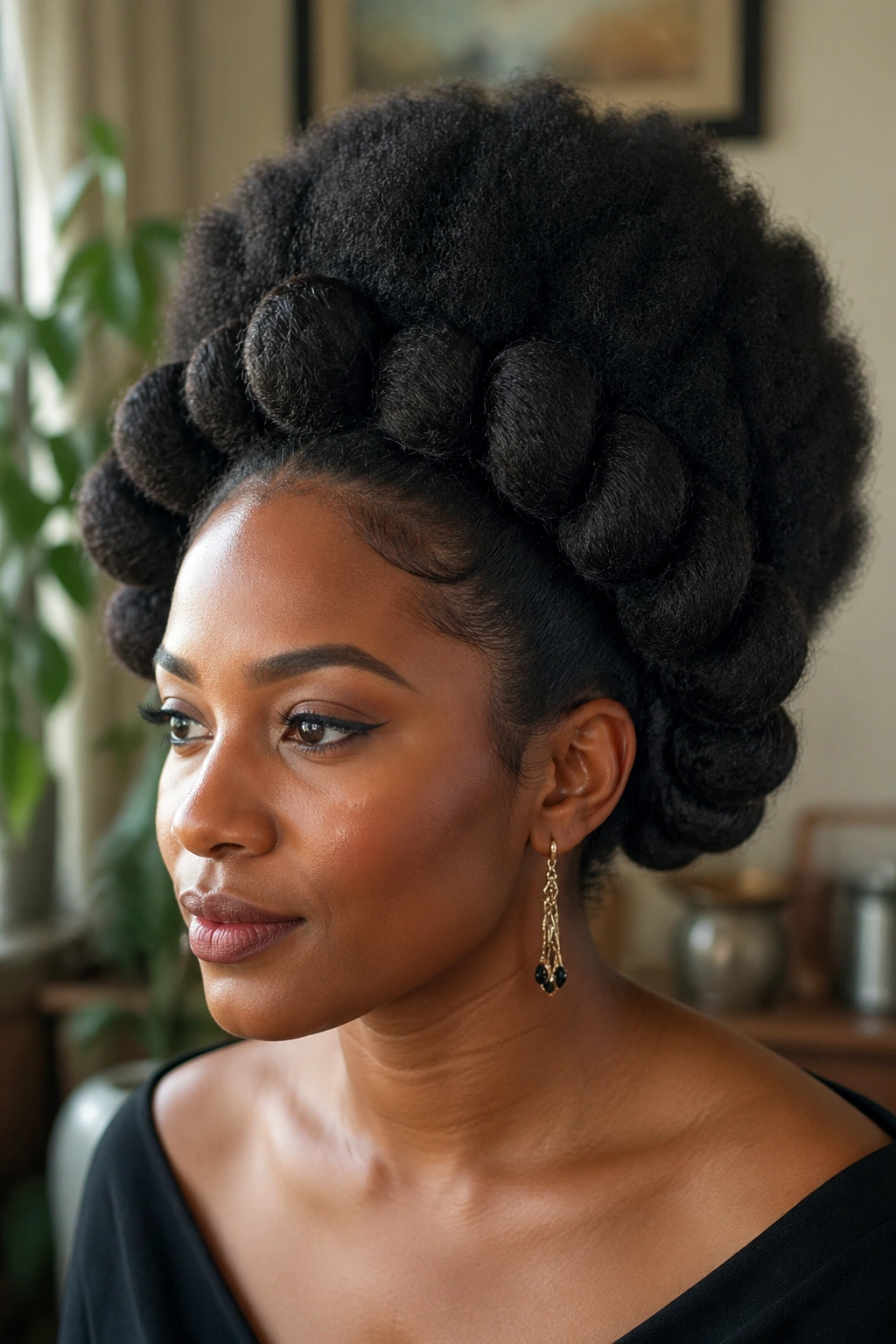
Working section by section around the perimeter of a full afro, roll each outer section of hair inward toward the center and pin it close to the head. The outer sections are all rolled inward; the center sections remain free, creating a dome of natural texture above the rolled perimeter.
This is the natural hair version of a classic “Pompadour roll” concept — applied to afro texture, where each rolled section shows curls or coils rather than smooth hair. The perimeter is controlled and pinned; the center is natural and voluminous.
Event-appropriate because the combination of controlled edges and central volume creates the right balance of structure and natural texture.
14. Knotted Half-Updo
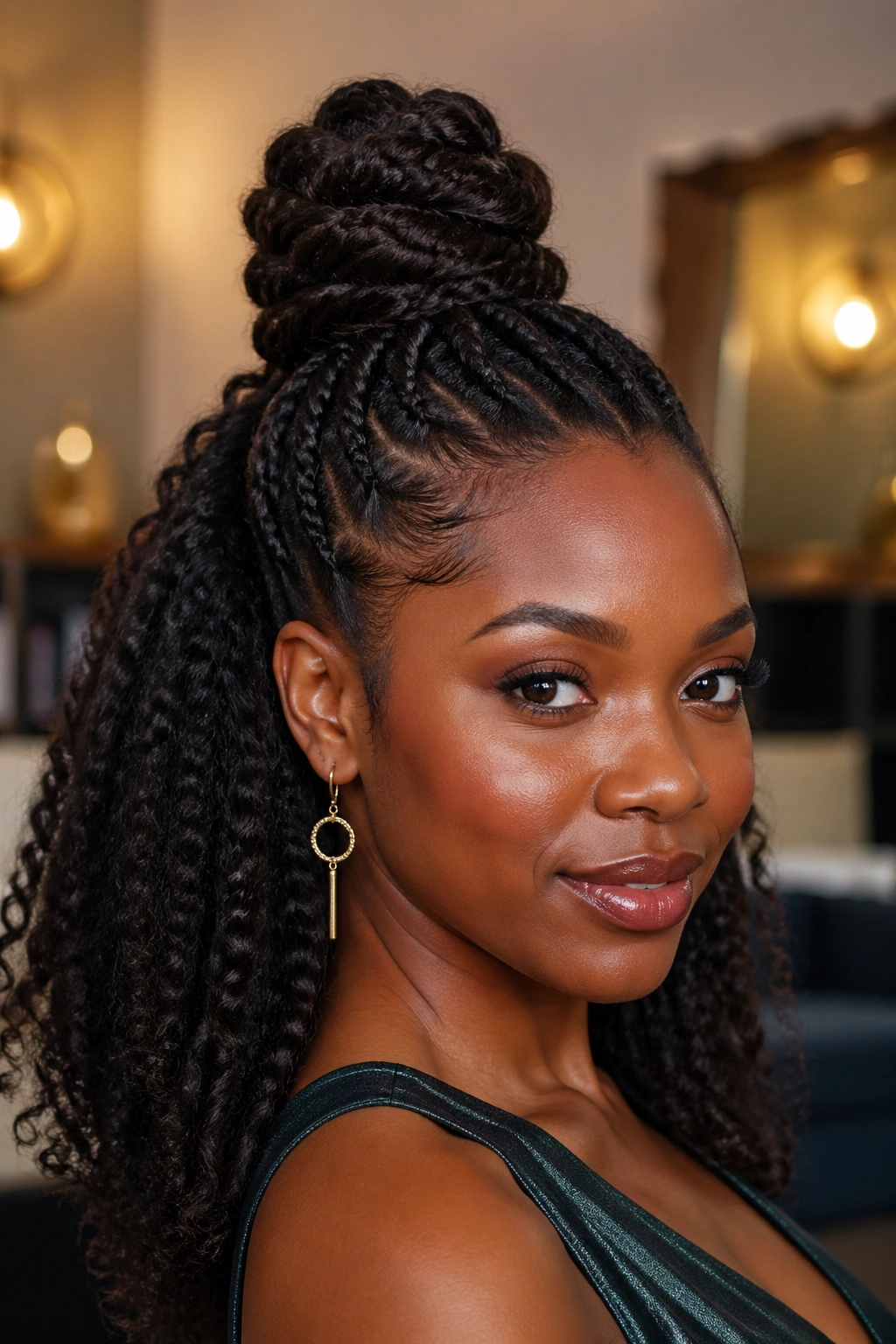
Take the top half of your hair — from the crown to ear level. Gather it, twist it into a loose rope, then tie it in a single large knot (like tying a shoelace, but stopping after the first loop). Tuck the ends under the knot and pin.
The resulting knot at the crown is a textural element all on its own — visible, sculptural, distinct. The lower half of the hair falls free in whatever natural state it’s in.
This style bridges casual and formal more successfully than almost any other natural updo. Worn with a formal dress, the loose lower section and the deliberate knot read artful. Worn casually, the same style reads effortless. It adapts.
15. Braided Chignon
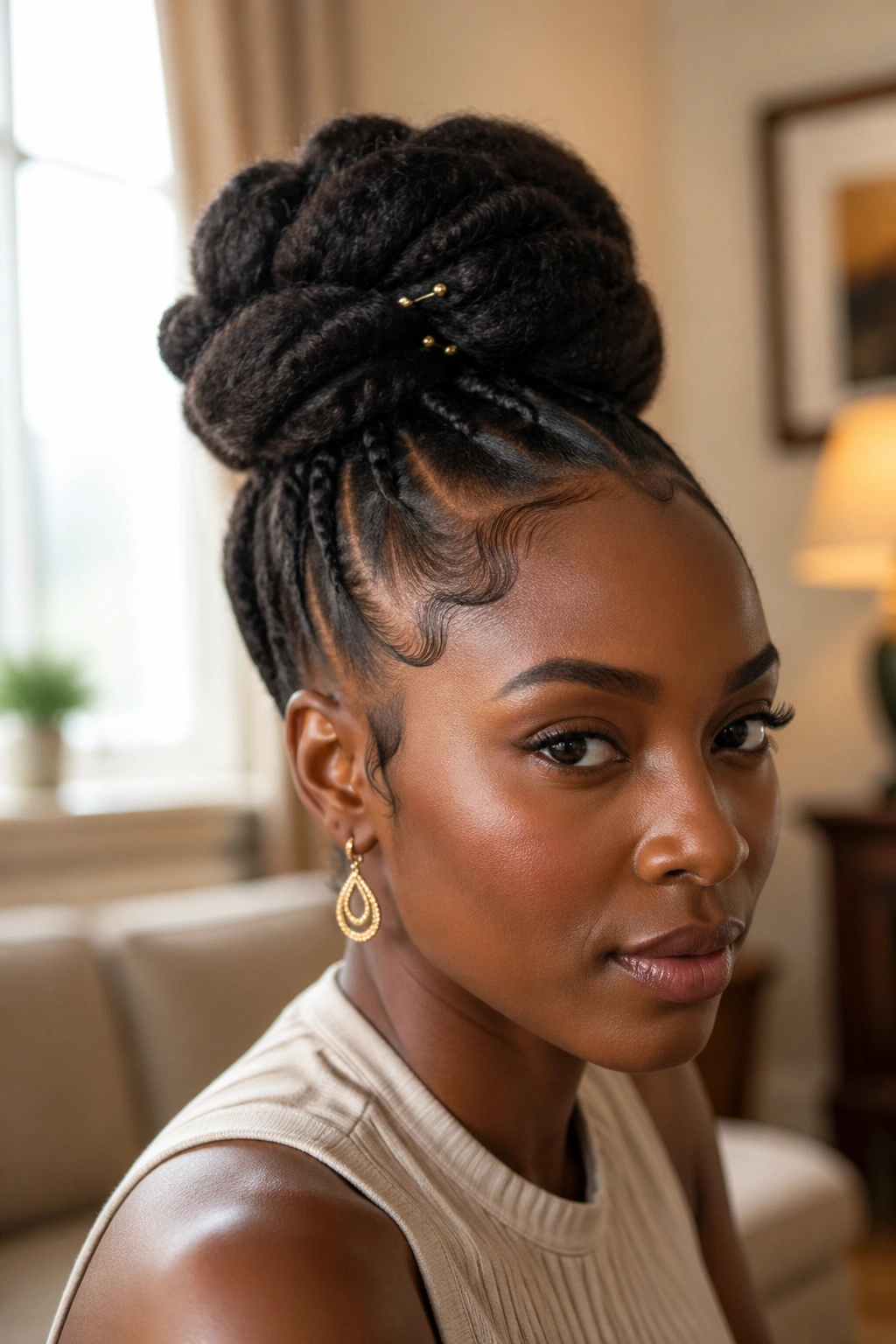
Multiple two-strand twists or three-strand braids gathered at the nape and shaped into a rounded chignon. The chignon is pinned flat — not into a bun that sticks out, but close to the head in a round, flat-ish shape.
Unlike a bun, a chignon lies closer to the neck and has a more refined, less casual quality. On natural afro hair, a braided or twisted chignon has texture that a smooth chignon lacks, which makes it more interesting visually.
For the cleanest finish, the braids or twists should be even in size and tension. Two hours of installation time. An event style worth the effort.
16. High Afro with Defined Edges for Formal Settings
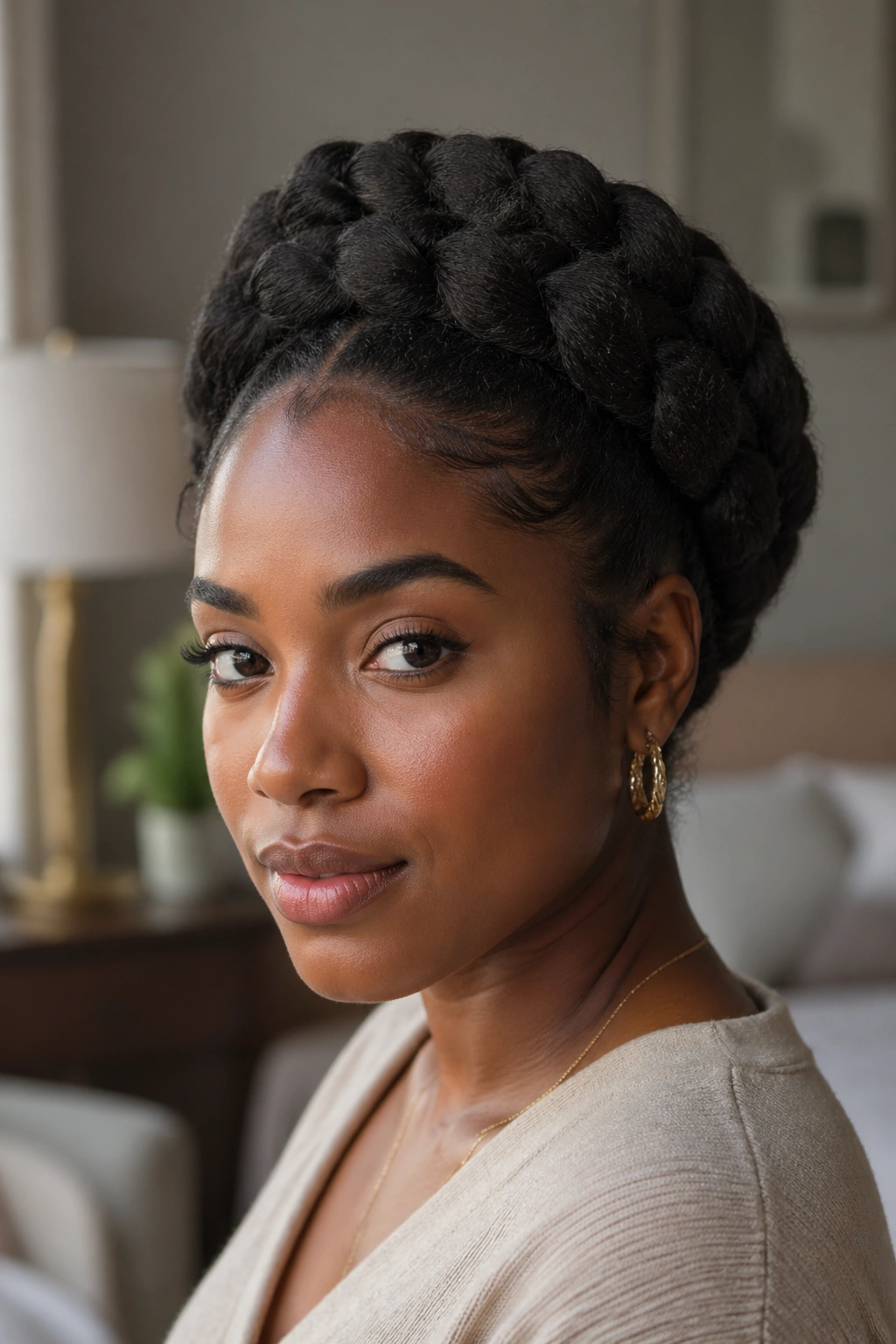
The afro itself, fully shaped and with expertly defined edges, is a formal style. Not every event requires a tucked-and-pinned updo. A picked-out, symmetrically shaped afro with gel-set edge waves or swoops, accessorized with a single piece of jewelry at the ear, is dressed appropriately for most formal events.
The key is precision. Round the silhouette by hand before the edge work. Apply edge gel and lay in a deliberate pattern — symmetrical waves, swoops, or slicked sections. Allow to fully set. Shape the edges on both sides to mirror each other.
An afro that’s round, even, and precisely edged reads formal in a way that an unshaped afro doesn’t. The geometry is the sophistication.
17. Passion Twist Updo
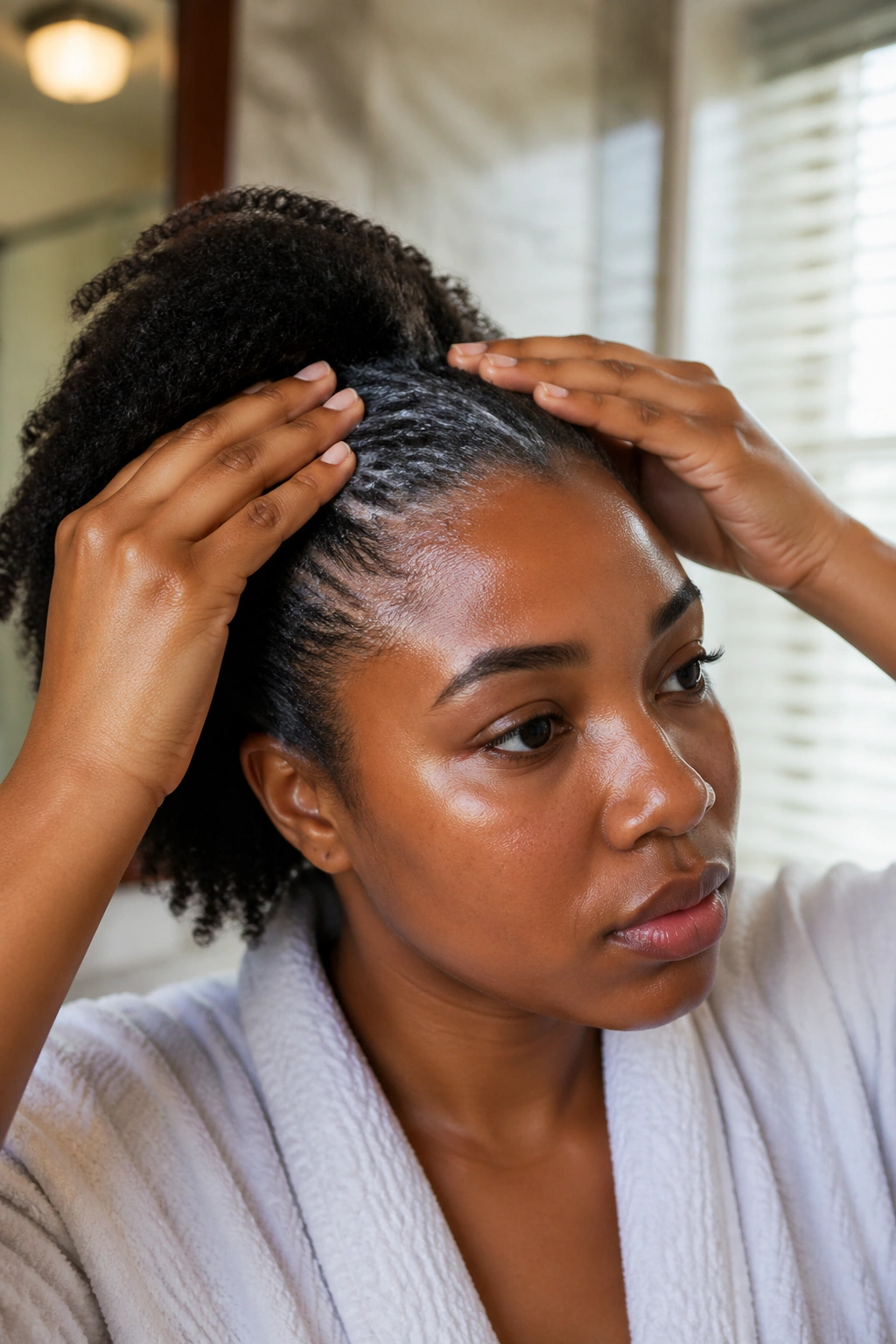
Passion twists — the bohemian faux loc style made with curly or water wave extension hair — carry well into event territory when gathered into an updo. Their textured, slightly lived-in quality suits festival events, outdoor gatherings, outdoor ceremonies, and casual formal occasions.
Gather all of the passion twists into a high gathered puff, a loose bun, or a half-up arrangement. The texture of the individual twists remains visible in the gathered shape — the updo is full and dimensional in a way that straight-hair updos can’t replicate.
Secure with long pins and a firm hair clip or band. Passion twist hair is heavier than natural hair alone, so the pinning needs to be thorough.
18. Afro Hawk for Black Tie Events
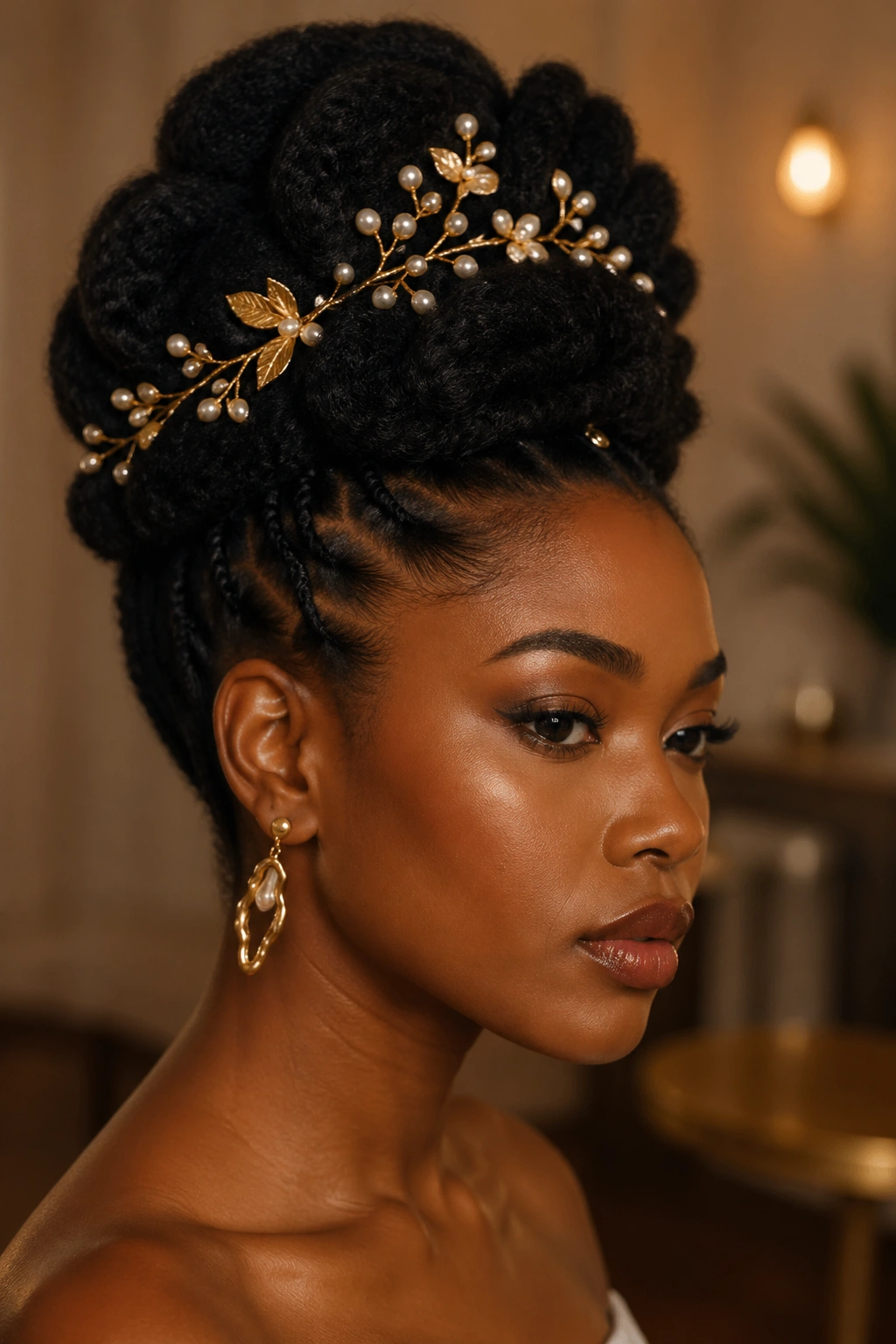
Yes, the frohawk at formal events. The key is the execution level. At a black-tie level, the sides are braided flat rather than just pinned, the center section is picked to an exact round or fan shape, and the edge work along the gathered sides is impeccable.
Satin or velvet ribbon along the braided sides — threaded through the braids or wrapped around them — elevates the aesthetic from street-style cool to genuinely formal. Add a jeweled clip at the center base of the fan for the finishing detail.
It is not a less-formal choice than a bun or a chignon. It is a different formal choice, and in the right room, it is the most remarkable style in it.
19. Twisted Updo with Accessory Headband
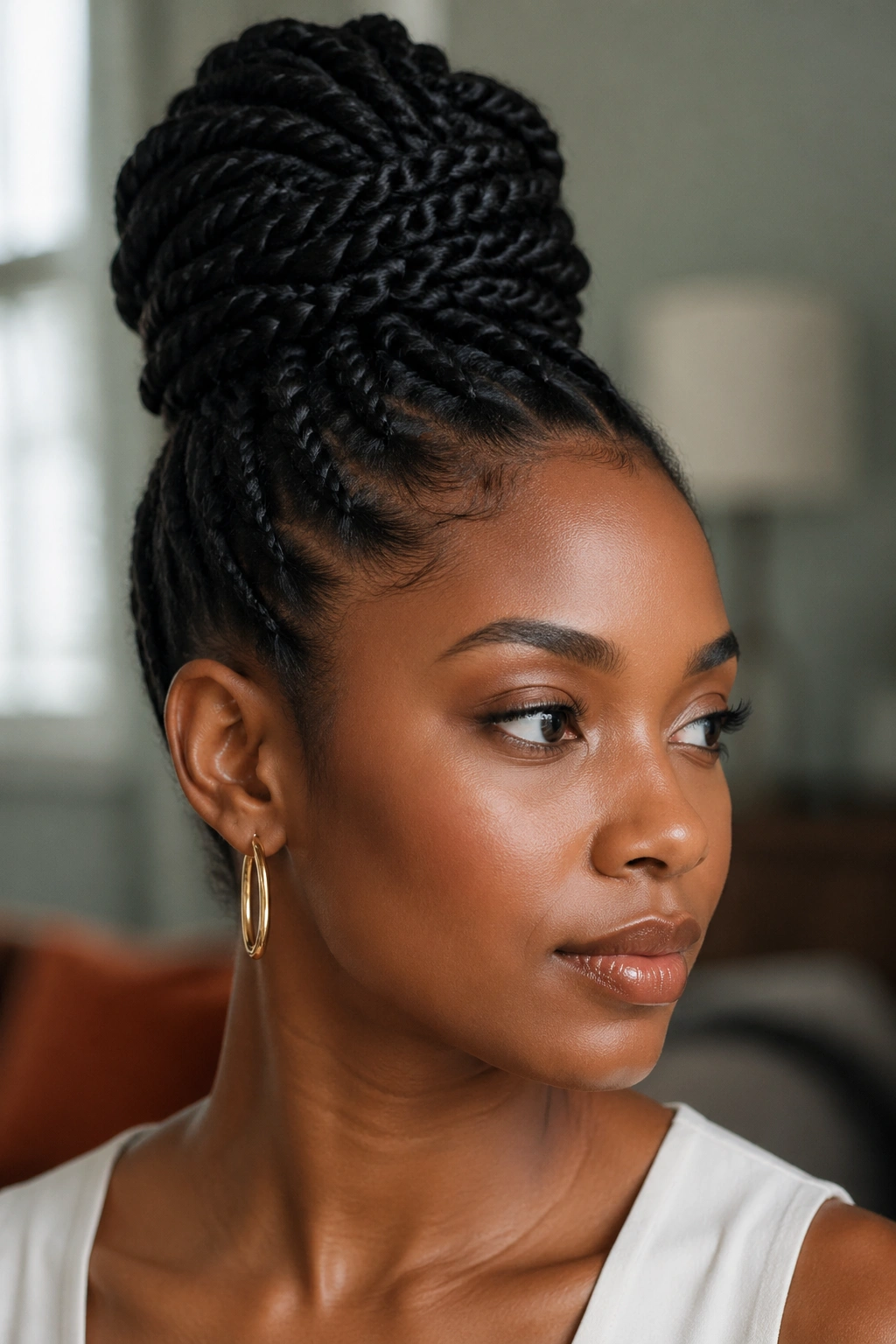
A wide headband — fabric, embellished, or adorned with flowers or embroidery — placed across the front of an updo gives the style a bohemian-formal quality that works particularly well for outdoor events, garden parties, or less traditional ceremonies.
The hair behind the headband can be in any of the updo styles on this list. The headband frames the face, takes the place of elaborate edge work, and adds color or decoration to the total look. A white embroidered headband for a white event. A gold beaded one for a cocktail party. A printed fabric one for a bridal shower.
The headband also provides practical benefit: it keeps the forehead edges smooth throughout the event without requiring the same level of edge gel work that an uncovered hairline needs.
20. Double Twisted Buns
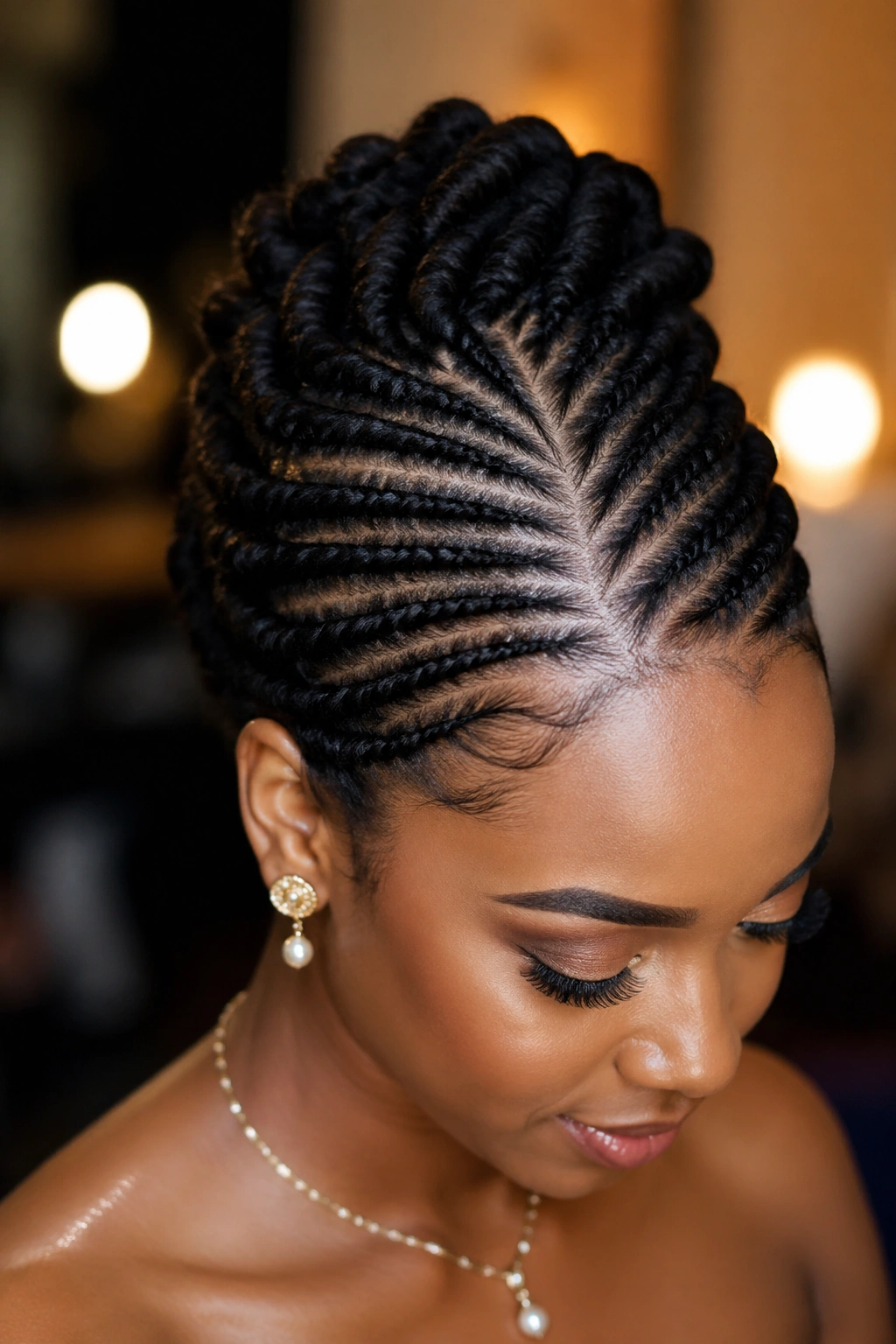
Two buns instead of one. Part the hair horizontally ear-to-ear. Twist the front section into a bun at the top of the crown; twist the back section into a bun just above the nape. Both visible, both pinned, both part of the design.
The double bun arrangement is more playful than a single bun and suited to events with a less strict formality requirement — cocktail parties, birthday dinners, friend celebrations. Each bun shows the twist texture independently.
For very formal events, the double bun can read too casual. Judge by the event. For anything with a dress code above business casual but below black tie, double buns sit exactly right.
21. Afro Updo with Scarf Wrap
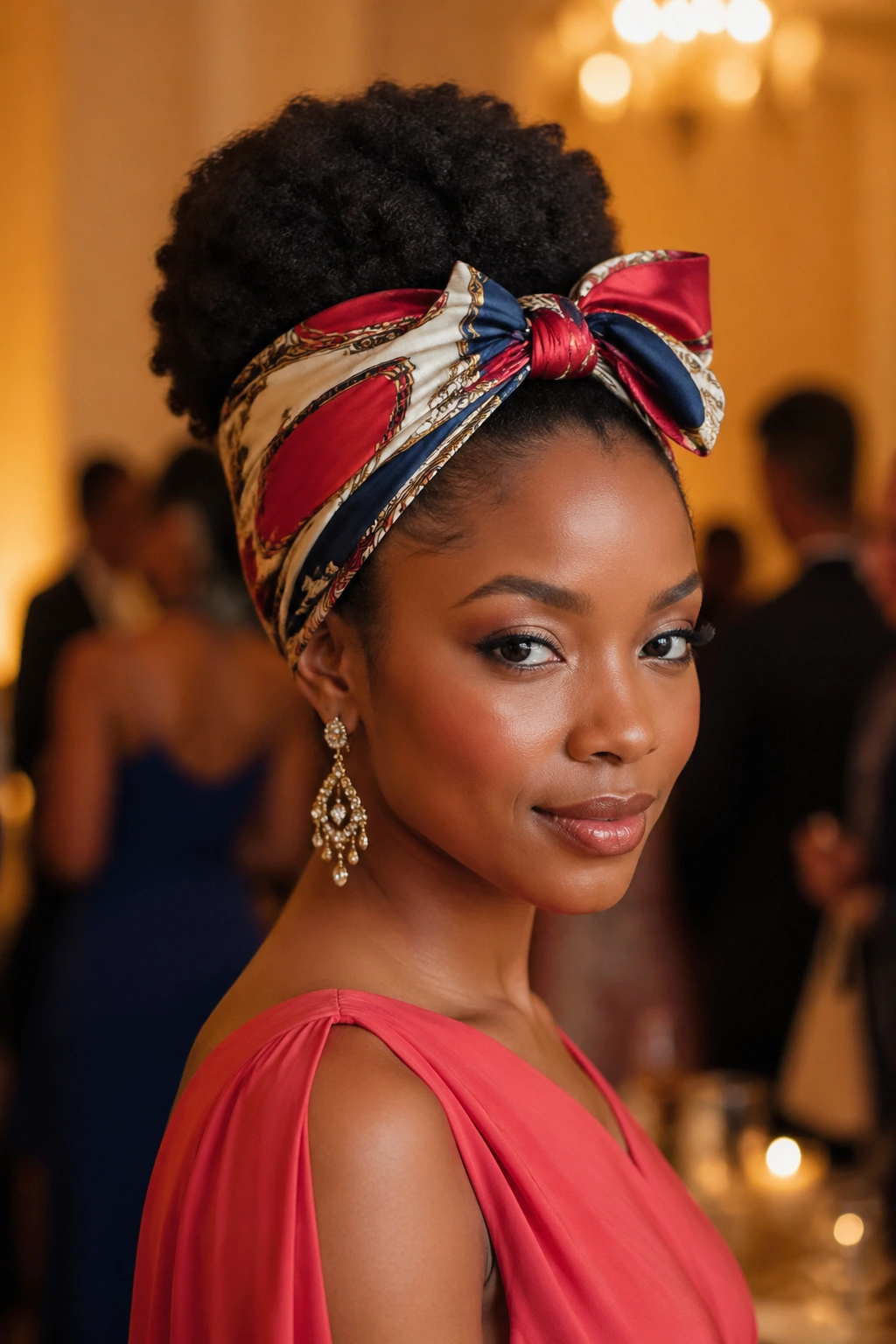
Any afro updo can be transformed by the addition of a scarf wrapped around the base. Gather the hair at the crown, shape it, then wrap a long rectangular scarf around the base of the gathered section — from back to front, tying in a bow or knot above the forehead.
The scarf adds color, pattern, and decoration. It also eliminates the hairline pressure of edge laying, which is a meaningful benefit for events that run long. Satin, silk, or a printed cotton scarf all work; choose the material and print based on your dress.
This style reads particularly well with bold or patterned event outfits, where the scarf can pick up a color from the clothing.
22. Side-Swept Twist-Out Updo
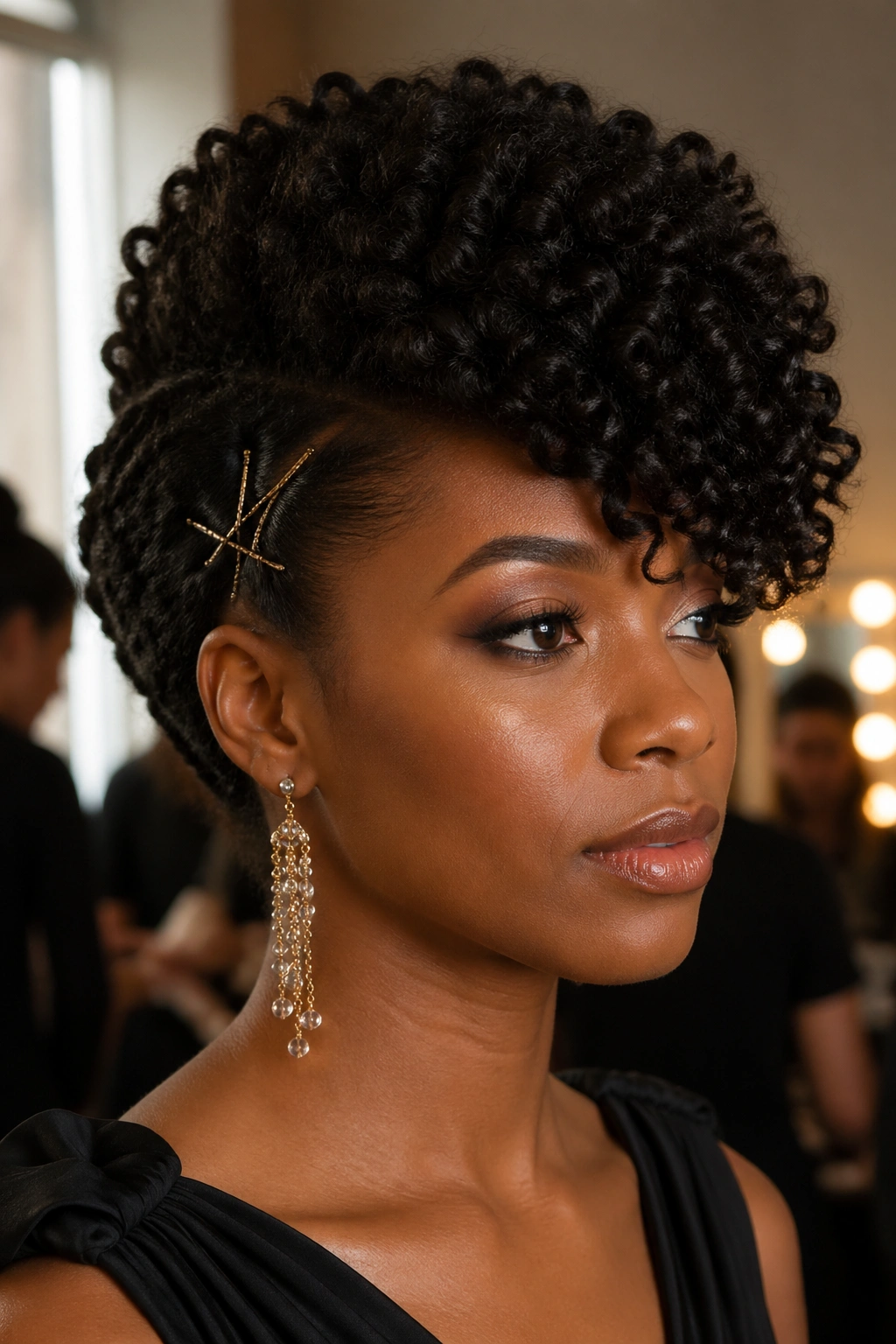
Set a twist-out the night before the event. In the morning, after unraveling, gather all the hair and sweep it dramatically to one side — tucking and pinning on the lower side, creating volume on the upper side.
The twist-out pattern visible in the sweep gives the style texture and dimension. Unlike a smooth side-swept style on straight hair, the coily wave pattern in the sweep creates shadow and light variation that catches beautifully under event lighting.
Secure with crossed pins at the lower temple. Leave the upper side loose and full, shaped into an artful pile rather than a tight gather.
23. Gathered Afro with Decorative Pins Throughout
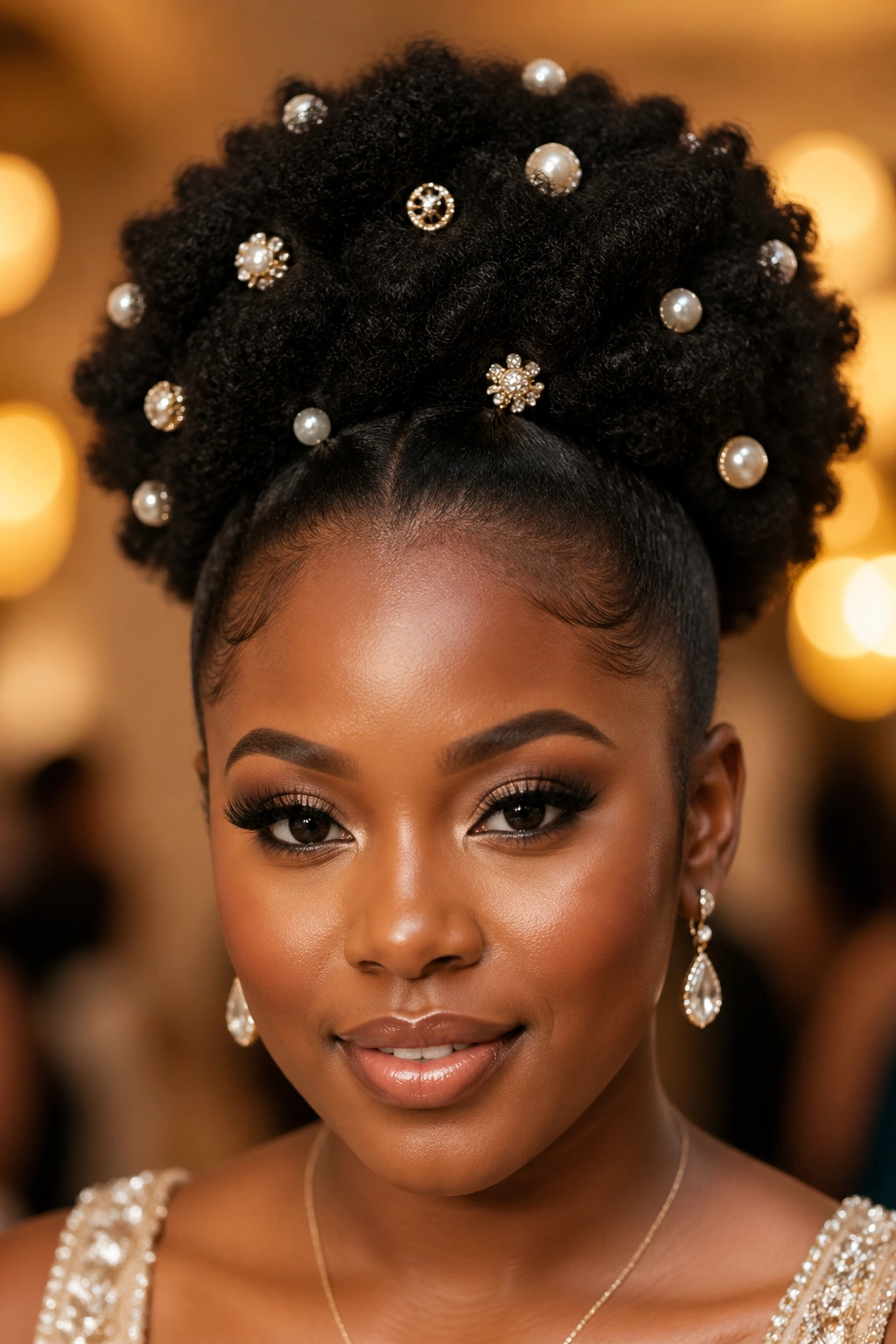
Take a regular puff or gathered afro style and place decorative pins — jeweled pins, gold stick pins, pearl pins — individually throughout the gathered mass of hair. Not clustered in one spot, but scattered intentionally like stars.
This is the most low-technique item on this list. You’re not creating a different structural style — you’re adding decoration to a style you already know. But the result of five or six quality decorative pins placed throughout a natural afro puff is something that reads high-fashion at events.
The pins should be visible — choose ones with decorative heads and insert them so the head is exposed above the hair surface. One at the top, two on the sides, one or two toward the back.
24. Protective Box Braid Updo
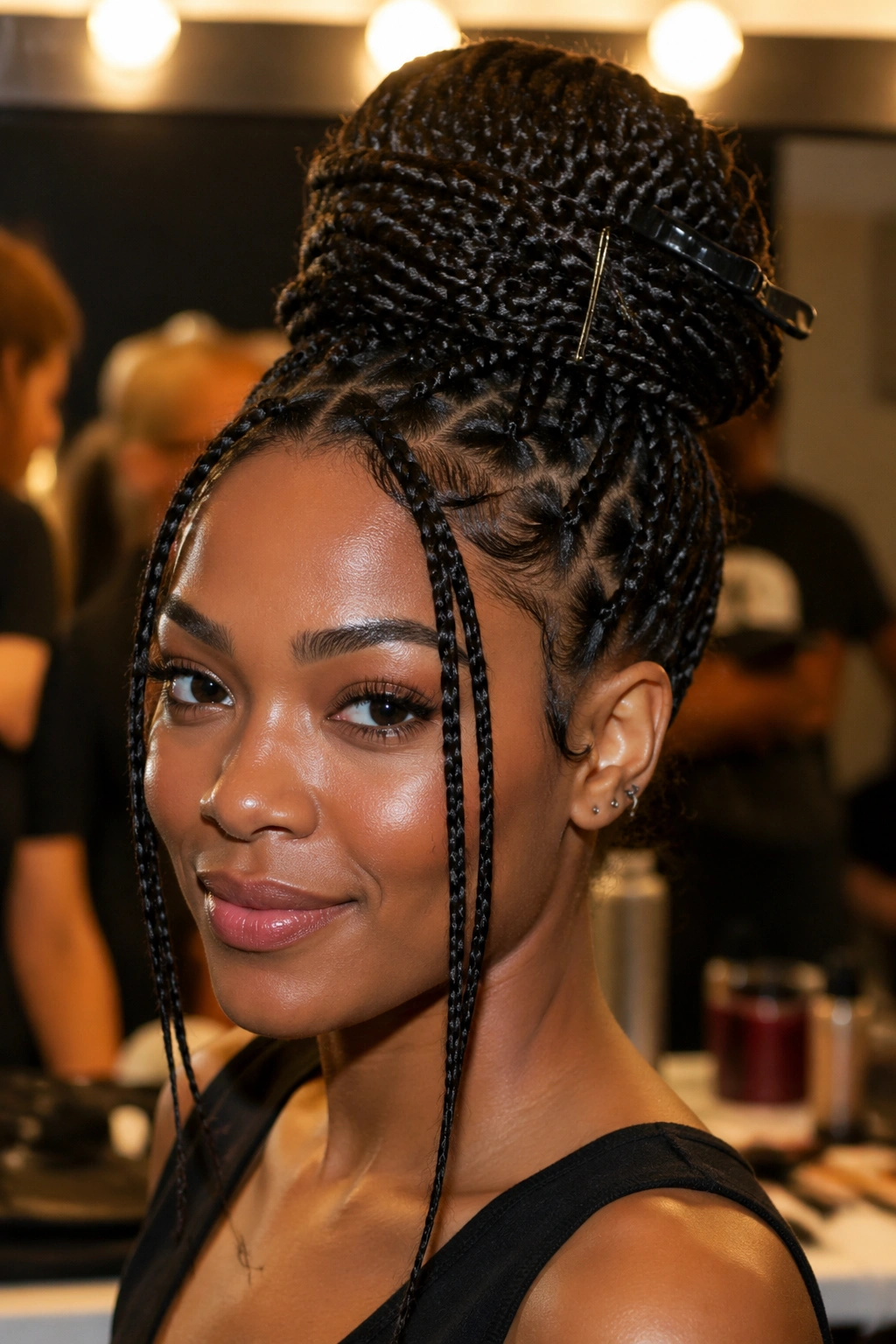
If you’re wearing box braids — with or without extensions — gathering them into an updo for an event is both practical and visually striking. Box braids gathered high at the crown and pinned into a large twisted bun create a massive, voluminous look with impressive structural presence.
The weight of braids means the pin work is critical. Use large pins, many pins, and a claw clip or a heavy covered elastic as the base anchor. Test the style before the event by shaking your head gently — if it shifts, add more pins.
Leave a few individual braids free at the front to frame the face. These loose pieces soften the severity of the full gathered look and give something to tuck behind the ear.
25. Natural Hair Tiara Look
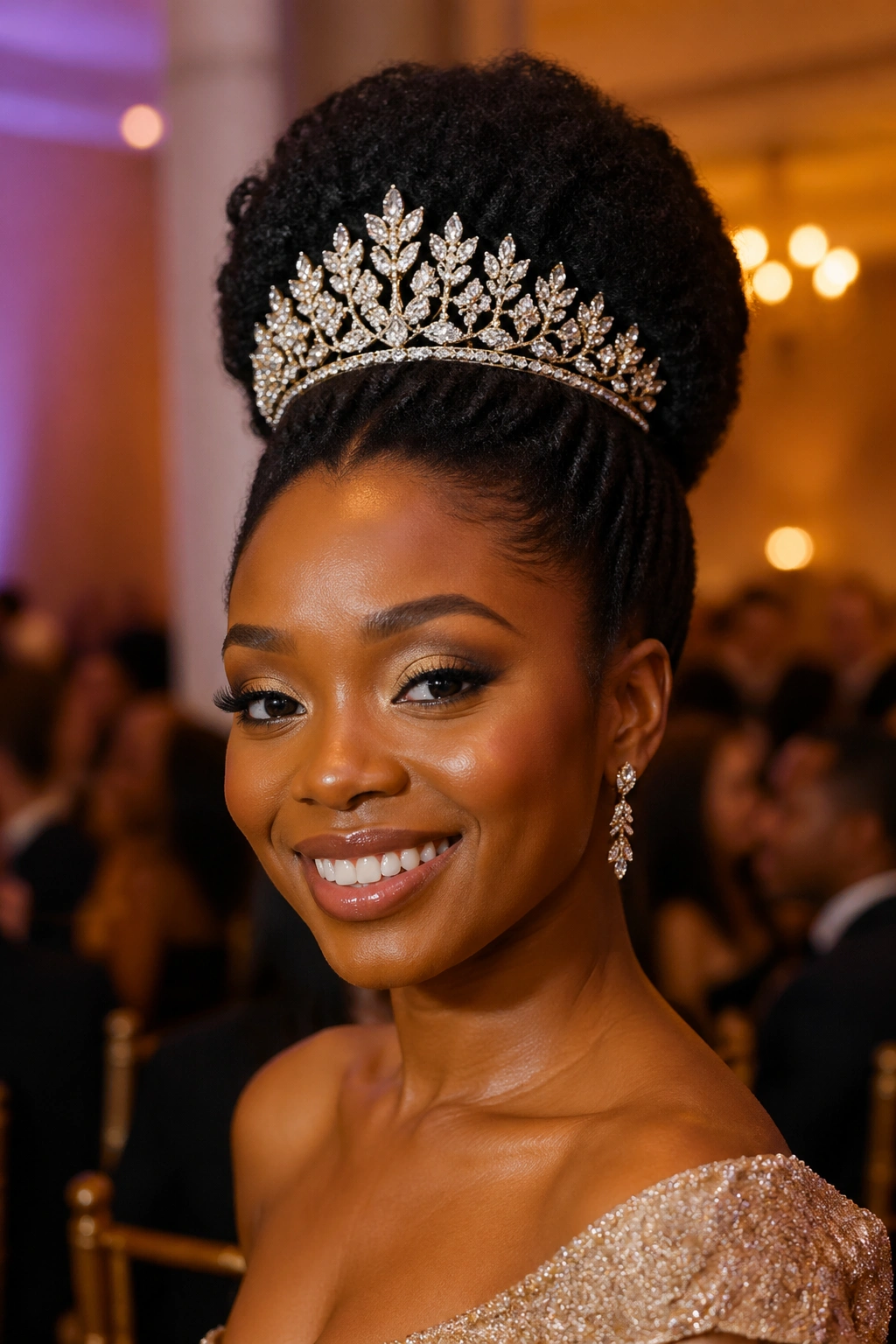
Add a decorative tiara, crown, or embellished headband to a high puff or gathered updo. The tiara-and-natural-hair combination has a regal quality that works for ceremonies, anniversaries, proms, quinceañeras, and any event where the full formal register is appropriate.
The natural afro puff serves as the tiara’s backdrop — the volume and texture of the afro sets the tiara at a visible height and angle, which a flat or straight hairstyle can’t do with the same effect. The tiara literally sits higher and more prominently on natural afro volume.
Choose a tiara size that’s proportional to the puff. A small, delicate tiara on a large voluminous puff reads balanced. A heavy, wide tiara on a small puff overwhelms it.
26. Sculpted Afro Bun with Fabric Wrap
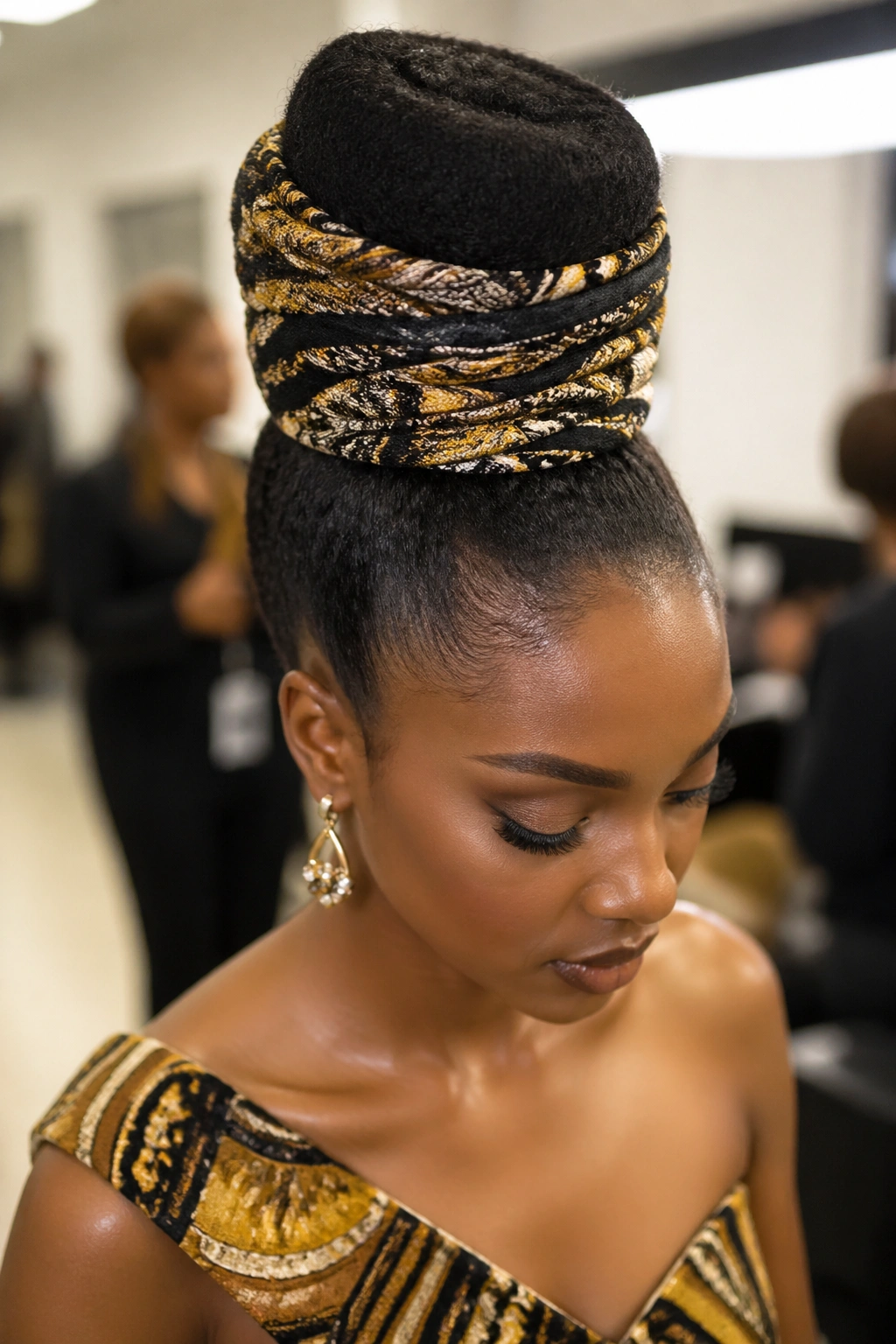
Gather the hair at the crown into a bun shape. Wrap a long rectangular piece of fabric — kente cloth, ankara print, satin, or solid velvet — around the bun in concentric circles, tucking the fabric into itself as you wind. The bun becomes wrapped in fabric, changing its visual texture entirely.
This style bridges hair and fashion in a way most other updos don’t. The fabric wrap becomes part of the look rather than an add-on. And on a natural afro bun where the volume creates the round base, the wrapping sits and holds better than it would on flat-wrapped straight hair.
Match the fabric to your outfit. Or make the fabric the statement and let the outfit support it.
What to Do When the Style Starts Falling at the Event
Even a well-pinned updo can show wear by hour six or seven. Knowing how to recover is as important as knowing how to install.
The most common failure mode: bobby pins start slipping, which causes a section of the style to loosen or sag. The fix is re-pinning — but you need to pin into a stable section of hair, not just re-pin the loose section back on itself. If a section is loose because the hair underneath it is also loose, re-pinning into it won’t hold. Find stable, tightly anchored hair nearby and use that as your base for the new pin placement.
The second most common issue: edge gel breaking down from warmth or sweat. The gel cracks slightly along the laid pattern, and individual baby hairs start lifting. Carry a small amount of gel and a toothbrush or edge brush in your bag. In a bathroom mirror, apply a thin amount of fresh gel over the disturbed edges and lay them back into place. Allow to dry — usually two minutes is enough. Done.
If a section of twist or braid has begun unraveling, the fix depends on severity. A small beginning fray at the ends can be tucked back under the nearest pinned section without anyone noticing. A significant unraveling of a core section means re-twisting or re-braiding that piece, which requires your styling supplies and at least ten minutes. The better preparation is making sure sections are tightly enough set at installation that this doesn’t happen.
Carry three to five extra bobby pins in your bag. Always. They cost nothing, weigh nothing, and have saved more event hairstyles than any product.
Scaling the Style to the Event Type
Not every event calls for the same level of formality in your updo. A corporate gala calls for something different from a birthday dinner, which calls for something different from an outdoor festival. Matching your updo’s register to the event type is a styling skill worth developing.
Black-tie events, galas, award ceremonies: Twisted buns, braided crown updos, flat twist formal styles, and afro styles with jewelry-level accessories. The finishing precision should be your highest — the tightest edges, the most careful pinning, the most deliberate product application.
Cocktail parties, birthday dinners, semi-formal gatherings: Puffs with embellished edges, faux locs updos, side-swept styles, and multi-bun clusters. Some imperfection in the surface texture is charming at this level rather than a problem. A little more relaxed, but still intentional.
Outdoor events — garden parties, outdoor concerts, cultural festivals: Gathered frohawks, pineapple variations, wrapped puffs, and styles with fabric or floral accessories. These need breathability more than rigidity. A style that moves slightly with wind and humidity is appropriate here; a lacquered-stiff updo looks oddly over-done against an outdoor backdrop.
Private family celebrations — anniversaries, milestone dinners, family portraits: Often the most personal and emotionally significant events. Choose the style that makes you feel most like yourself, regardless of its formality level. A high puff you love beats a formal bun that feels foreign.
Making the Style Last Through the Full Event
Longevity comes down to product choices and pin work — as mentioned at the start, but worth returning to at the end.
A final light mist of flexible-hold spray over the entire finished style — from about twelve inches away, not close enough to disturb anything — creates a light film that slows frizz and holds surface texture in place. Don’t spray too close or too heavily. The style should still feel like natural hair, not like lacquered plastic.
Carry a small kit: edge gel, a few bobby pins, a small amount of the cream you styled with, a mini spray bottle of water. Event bathrooms are where styles get saved and salvaged. Ten minutes mid-evening to smooth, re-pin, and refresh is the difference between looking great at the end of the night and looking like the event is already over.
Your natural afro hair, styled with care and precision, belongs at every event you attend. The styles here prove that natural doesn’t mean casual, and afro texture doesn’t mean informal. Bring both the style and the confidence that goes with it.
